Chapter 2: Housing costs and affordability
Updated 9 July 2026
Applies to England

© Crown copyright 2026
This publication is licensed under the terms of the Open Government Licence v3.0 except where otherwise stated. To view this licence, visit nationalarchives.gov.uk/doc/open-government-licence/version/3 or write to the Information Policy Team, The National Archives, Kew, London TW9 4DU, or email: psi@nationalarchives.gov.uk.
Where we have identified any third party copyright information you will need to obtain permission from the copyright holders concerned.
This publication is available at https://www.gov.uk/government/statistics/chapters-for-english-housing-survey-2024-to-2025-headline-findings-on-demographics-and-household-resilience/chapter-2-housing-costs-and-affordability
Introduction
This chapter describes housing costs, including deposits of first time buyers and mean/median weekly rent and mortgage payments. It goes on to discuss affordability as the proportion of weekly household income spent on housing costs, as well as rent arrears, presence/absence of housing support and presence of savings.
In this chapter, recent first time buyers are households who have purchased a property that is their main home for the first time in the last three years and had not previously owned a property. We use a three year threshold to ensure the sample is large enough for analysis, though the number of first time buyers in the EHS is still relatively small and the data are prone to fluctuation.
For an introduction and summary of main findings in this report as a whole, please see the Introduction and key findings.
Housing costs
There are differences in the methodology of the English Housing Survey compared with the Price Index of Private Rents (PIPR). The EHS collects data on both the open-market rental value of a property (market rents) and the below-market value (non-market rents), whereas the Price Index of Private Rents (PIPR) was designed to capture market rents only. Consequently, the interpretation of rent price data is dependent on the data source used.
Finances of recent first time buyers
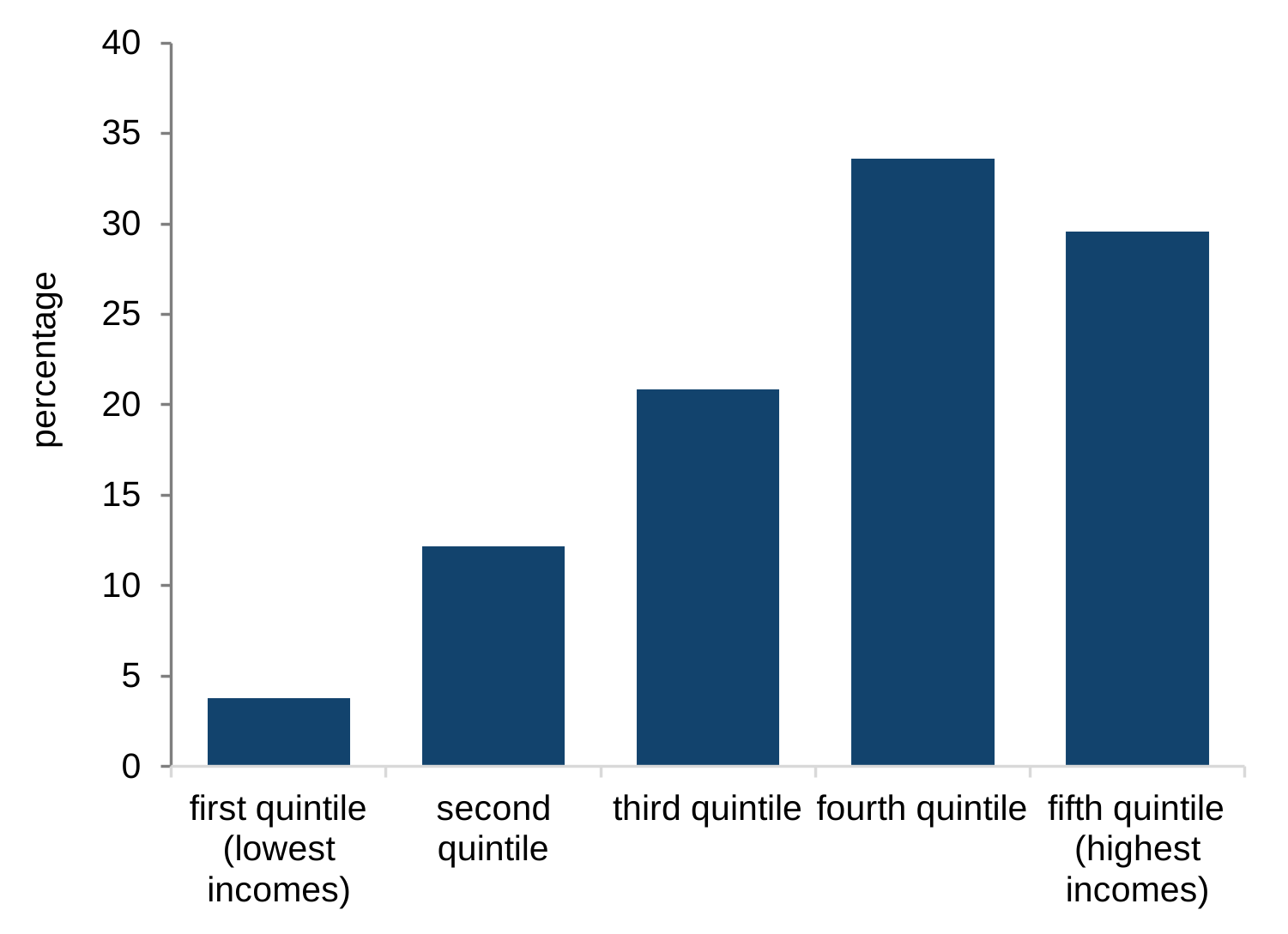
The average (mean) deposit of a first time buyer in 2024-25 was £78,131 (£36,500 median). Given this, it was not surprising that the majority of first time buyers were in the top two income quintiles (34% in quintile 4, 30% in quintile 5), corresponding to the highest incomes (similar to 2023-24), Annex Tables 2.1, 2.2, and Figure 2.1.
Figure 2.1: Weekly gross household income for first time buyers, 2024-25
Base: all recent first time buyers
Notes:
1) underlying data are presented in Annex Table 2.2
2) weekly gross household income. First quintile: below £393, second: £393-£657, third: £657-£984, fourth: £984-£1,513, fifth: £1,513 and over
Source: English Housing Survey, full household sample
Of first time buyers who had a mortgage, nearly all (97%) had a repayment mortgage. Around three in five of first time buyers (62%) with a mortgage had taken a repayment period of 30 years or more. A small proportion (9%) had a 1-19 year mortgage and the remaining first time buyers (29%) had a repayment period of 20-29 years. Compared to five years ago in 2019-20, the proportion of first time buyers with a mortgage of 30 years or more has increased significantly (from 47% in 2019-20 to 62% in 2024-25), Annex Table 2.1.
Around three in five first time buyers (59%) paid a deposit of less than 20% of the purchase price of their property. This includes 16% of first time buyers who paid a deposit between 1% and 9%, and a further 43% who paid a deposit of between 10% and 19% of the purchase price of their property. A small proportion (8%) bought their first home outright.
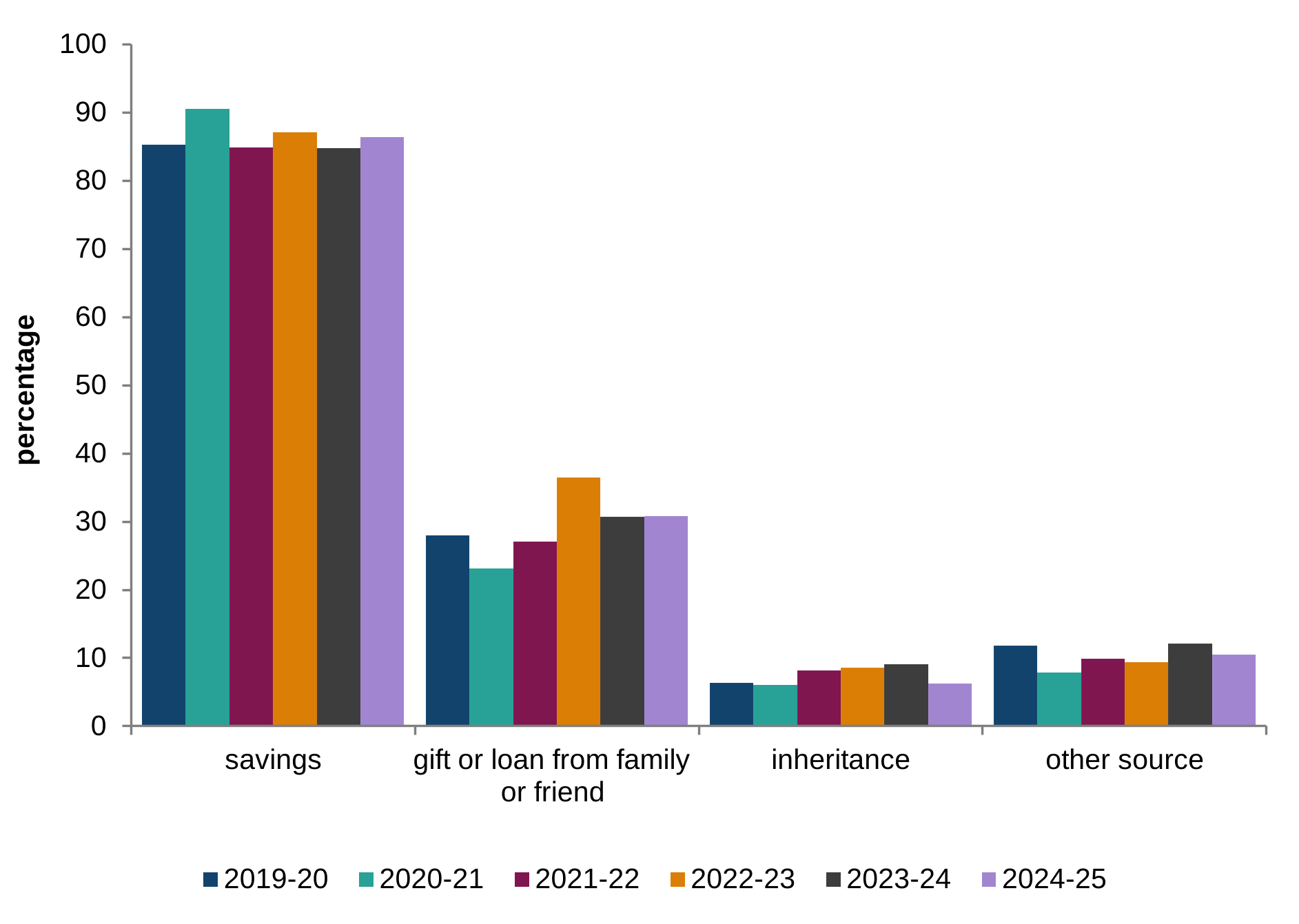
In 2024-25, most first time buyers (86%) funded the purchase of their first home with savings, 31% reported receiving help from family or friends, while 6% used an inheritance as a source of deposit, Annex Table 2.1, Figure 2.2.
Figure 2.2: Source of deposit for recent first time buyers, 2019-20 to 2024-25
Base: all recent first time buyers
Notes:
1) more than one answer could be given
2) underlying data are presented in Annex Table 2.1
Source: English Housing Survey, full household sample</sip>
Mortgage costs
In 2024-25, the average (mean) mortgage payment was £242 per week and the median mortgage payment was £208 per week. The mean mortgage payment represents an increase from both 2023-24 (£222) and 2019-20 (£182), five years ago.
Mean mortgage payments in 2024-25 were higher in London (£375) than in the rest of England (£220). Both areas saw an increase compared to 2023-24 (£317 and £209 respectively). When compared to five years ago (2019-20), the average weekly mortgage payment in London increased by £112 from £263 to £375. Over the same period, the mean weekly mortgage payment in the rest of England increased by £50, from £170 to £220, Annex Table 2.3.
Rents
The average (mean) rent for households in the private rented sector was £250 per week, almost double the price in the social rented sector, £129 (a difference of £121 per week). Within the social sector, housing association tenants paid a higher mean average price per week (£134) than those in local authority accommodation (£120).
Social and private rents were higher in London than in the rest of England. In 2024-25, the average (mean) private rent in London was £393 per week, compared to £207 per week outside of London. The average social rent was £171 per week in London, compared to £119 per week in the rest of England, Annex Table 2.4.
The average (mean) weekly private rent (£250) increased across England, compared to last year (£237) in 2023-24 and from five years ago (£201), in 2019-20.
In the social rented sector, the average (mean) weekly rent also increased significantly to £129 in 2024-25, compared to £118 in 2023-24 and £103 in 2019-20.
Affordability
In this section, affordability is explored. A simple measure of housing affordability was derived by calculating the average proportion of gross income spent on housing. The proportion of income spent on mortgage payments (both the repayment element and the interest element) is compared with the proportion spent on rents in the social and private rented sectors. Housing-related costs, such as water and fuel bills, insurance, maintenance costs and council tax are not included in the calculation. The measure of income we use is the gross weekly income, including and excluding housing support. Outright owners are excluded from this analysis as they have no mortgage costs.
Two different calculations are made: one based on the household income (i.e. the income of all the members of the household), and another based on HRP and partner income only (irrespective of whether there are other adults in the household). For both measures it is not known what members of the household actually contribute to the rent or mortgage. For the household measure, we assume all household members contribute to the rent or mortgage; for the HRP and partner measure, we assume only the HRP and partner contribute.
On average, mortgagors spent 19% of their household income on mortgage payments, whereas rent payments, with housing support included in income, were 28% for social renters and 34% of household income for private renters. If income from housing support was excluded in the calculation, the average proportion of income spent on rent in 2024-25 was 39% for both private and social renters, Annex Table 2.5, Figure 2.3.
Figure 2.3: Mortgage/rent as a proportion of household income (including and excluding housing support), by tenure, 2024-25

Base: all households making mortgage or rent payments
Notes:
1) underlying data are presented in Annex Table 2.5
2) excludes households without a mortgage (i.e. outright owners), those with part-mortgage and part-rent (i.e. shared owners) and zero rent households
3) includes income from all household members irrespective of whether or not they contribute to the rent or mortgage
Source: English Housing Survey, full household sample
Over the last ten years, the proportion of household income (including housing support) that mortgagers spent on their mortgage increased from 17% in 2014-15 to 19% in 2024-25. However, in the social rented sector, this proportion decreased from 29% to 28% and in the private rented sector, this proportion decreased from 36% to 34, Annex Table 2.5.
When using HRP and partner income in the affordability calculation, mortgagors spent an average of 20% of their income on mortgage payments in 2024-25, up from 19% in 2014-15. Rent payments were 31% of income for social renters, similar to 2014-15, and 40% of joint income for private renters (including housing support), down from 46% in 2014-15. Excluding housing support, the average proportion of income spent on rent was 43% for social renters and 46% for private renters, a decrease from 10 years ago (53% for private renters in 2014-15).
Mortgage and rent arrears
In 2024-25, approximately 44,000 (0.6%) mortgagors reported being in mortgage arrears. The proportion of mortgagors who reported being in arrears has remained below 1% since 2015-16, Annex Table 2.6.
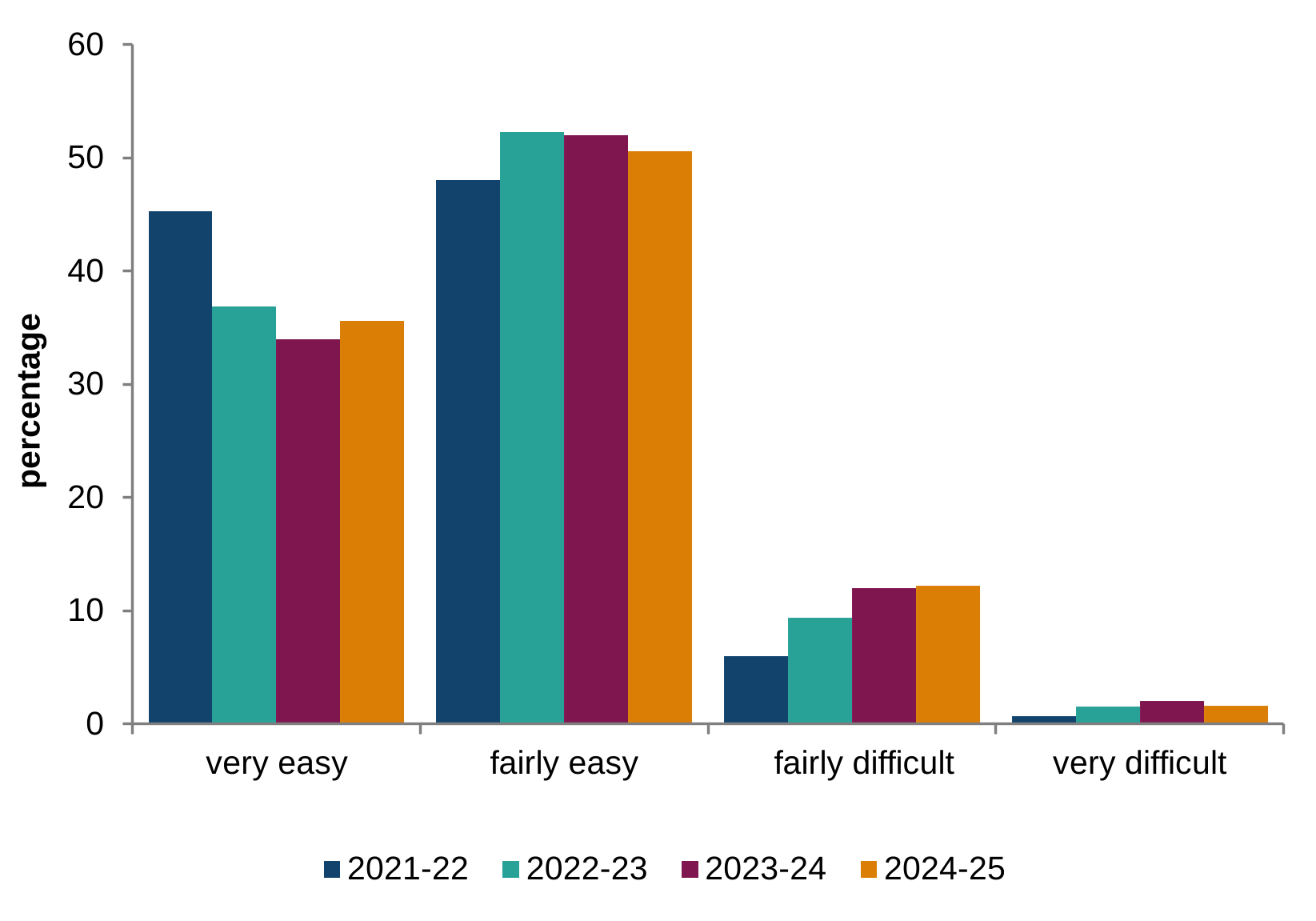
In 2024-25, 14% of mortgagors found it either fairly or very difficult to pay their mortgage, with 12% finding it fairly difficult and 2% very difficult, Annex Table 2.8, Figure 2.4.
Figure 2.4: Ease of affording mortgage, 2021-22 to 2024-25
Base: all mortgagors (including shared owners) who are up to date with mortgage payments
Notes:
1) underlying data are presented in Annex Table 2.8
Source: English Housing Survey, full household sample
In 2024-25, 2% of private renters reported currently being in rent arrears and a further 3% reported they fell behind with rent payments in the 12 months prior (5% of private renters in arrears overall). This was similar to the proportion of private renters in current or previous rental arrears in the last year in 2023-24 (5%), but significantly lower than 5 years ago in 2019-20 (8%), Annex Table 2.7.
Social renters were significantly more likely to report being in rent arrears than private renters: 8% of social renters reported they were currently in arrears, and an additional 6% reported they fell behind with rent payments in the 12 months prior (14% of social renters in arrears overall). Within the social rented sector, those renting from a local authority were more likely to be in arrears (17%) than those renting from a housing association (13%).
Overall in 2024-25, 30% of renters found it either fairly or very difficult to pay their rent, with private renters generally finding it more difficult (32%) than social renters (26%). Of social renters who found it difficult to pay rent, local authority tenants were more likely to find it difficult to pay than housing association tenants (29% compared to 24% respectively).
Since the pre-pandemic period in 2019-20, the proportion of renters overall who reported difficulty in paying rent, increased from 27% to 30% in 2024-25. Specifically, the proportion of private renters reporting finding it difficult to pay rent increased from around a quarter (27%) to just under a third (32%), Annex Table 2.9.
Housing support
Housing support is a means-tested benefit provided by the state to low income households. It includes both legacy Housing Benefit, as well as the housing element of Universal Credit. This section compares receipt of housing support by households in the social and private rented sectors.
Receipt of housing support is reported on a household level, and households are counted as in receipt of support if at least one person in the household receives support for housing costs, though the respondent may not necessarily know about benefit receipt across all household members. More than one person in the household could be in receipt of the benefit. EHS figures may differ from those published by the Department of Work and Pensions, because we define households differently. For more information, please see the glossary.
In 2024-25, 65% of social renters (2.6 million households) and 24% of private renters (1.1 million households) received housing support to help with the payment of their rent.
The proportion of social rented households who received housing support increased (65%) compared to two years ago (59% in 2022-23). However, the proportion of private renters who received housing support remained the same as in 2023-24 and 2022-23 (24% in all years).
Both tenures show an increase in housing support receipt over the last five years, 56% of social renters and 20% of private renters received housing support in 2019-20, Annex Table 2.10, Figure 2.5.
Figure 2.5: Percentage of private and social renters in receipt of housing support, 2011-12 to 2024-25

Base: all renting households
Notes:
1) underlying data are presented in Annex Table 2.10
Source: English Housing Survey, full household sample
The average amount of housing support received was £154 for private renters and £109 for social renters in 2024-25. Both increased since last year (2023-24), when private renters received £145 and social renters received £95. Both tenures also saw an increase in the last five years (£113 and £81 respectively in 2019-20), Annex Table 2.10.
In 2024-25, 72% of renters who were not working received housing support. This was an increase from 67% in 2022-23. The proportion of those working (full or part-time) receiving housing support did not change over this time period (23% in both years).
Social renters were more likely to receive housing support in 2024-25 whether working (41%) or not working (81%) than private renters (15% and 52% respectively), Annex Table 2.11.
Savings
In 2024-25, around two-thirds of households in England (65%), equating to 15.9 million households reported they had savings, Annex Table 2.12.
Across all tenures, the proportion of households with savings remained higher than five years ago. Outright owners were most likely to have savings (83%, up from 75% in 2019-20), followed by those buying with a mortgage (73%, up from 60%), private renters (52%, up from 40%) and social renters (27%, up from 20%), Figure 2.6.
Figure 2.6: Proportion of households with savings, by tenure, 2019-20 to 2024-25

Base: all households
Notes:
1) underlying data are presented in Annex Table 2.12
Source: English Housing Survey, full household sample
Underlying Data
For data underlying this report, see the Annex tables. For the charts in this report, see Figures.
Technical notes and glossary
For technical information, please see the technical notes.
For a detailed glossary of terms please see the glossary.