Commentary - Business Insolvency Demography 2015 to 2025
Published 19 June 2026

© Crown copyright 2026
This publication is licensed under the terms of the Open Government Licence v3.0 except where otherwise stated. To view this licence, visit nationalarchives.gov.uk/doc/open-government-licence/version/3 or write to the Information Policy Team, The National Archives, Kew, London TW9 4DU, or email: psi@nationalarchives.gov.uk.
Where we have identified any third party copyright information you will need to obtain permission from the copyright holders concerned.
This publication is available at https://www.gov.uk/government/statistics/business-insolvency-demography-2015-to-2025/commentary-business-insolvency-demography-2015-to-2025
Released
19 June 2026
Next release
June 2027
Media enquiries
press.office@insolvency.gov.uk
+44 (0)30 3003 1743
Statistical enquiries
Edward Tuersley (author)
David Webster (responsible statistician)
This publication uses company insolvency data from the monthly Company Insolvency Statistics, combined with the Office for National Statistics’ (ONS) Inter-Departmental Business Register (IDBR), which provides demographic information about businesses. Since multiple companies can be related to one business, these statistics are not comparable with the Insolvency Service’s other statistics publications. We have defined a business insolvency as a business for which at least one of its constituent companies has experienced a formal company insolvency procedure after being unable to pay its debts.
This commentary reflects the volumes and rates of business insolvencies for England and Wales from 2015 to 2025. Figures for Scotland and Northern Ireland from 2015 to 2025 can be found in the Tables C1a to D5b of the tables accompanying this release.
1. Main Messages
-
In England and Wales in 2025, there were 22,455 business insolvencies. The business insolvency rate was 116 per 10,000 businesses, similar to in 2024 (117 per 10,000), but higher than the rate in 2019 (88 per 10,000).
-
In 2025, businesses with 10 to 249 employees had higher insolvency rates than micro businesses (businesses with less than 10 employees) or large businesses (250 or more employees). Businesses with £250,000 to £50 million turnover had higher insolvency rates than businesses with less than £250,000 turnover or more than £50 million turnover.
-
The sector with the highest business insolvency rate in 2025 was Accommodation and food service activities, with 268 insolvencies per 10,000 businesses. This sector has had the highest rate each year since the start of the time series in 2015. Out of the top nine industries (by number of businesses), the sector with the lowest rate was Real estate activities, with 60 insolvencies per 10,000 businesses. This sector has had the lowest rate in each year since 2021.
-
In 2025, businesses aged 7 to 10 years had the highest insolvency rate (170 per 10,000). Businesses aged less than 2 years showed the lowest insolvency rate (37 per 10,000).
Trend of business insolvencies over time
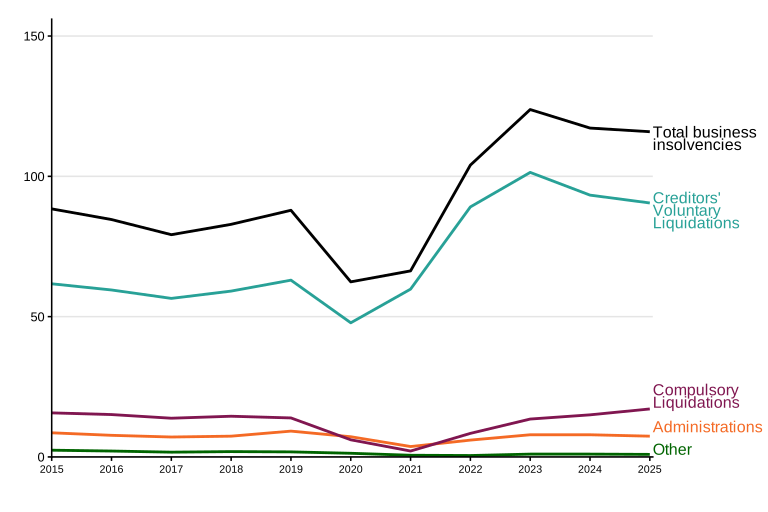
The overall business insolvency rate in England and Wales decreased slightly between 2015 and 2017, before returning to 2015 levels in 2019. The rate then dropped in 2020, when financial support measures were in place during the COVID-19 pandemic and remained historically low in 2021. The rate increased above pre-pandemic levels in 2022 and in 2023 peaked at 124 insolvencies per 10,000 businesses. In 2024 and 2025, the rate decreased slightly, but remained higher than pre-2023 levels.
Figure 1: The business insolvency rate in 2025 was similar to in 2024
Business insolvency rate over time by insolvency type, England and Wales, 2015 to 2025
Source: Companies House (all insolvency data except for compulsory liquidations in England & Wales), Insolvency Service and Office for National Statistics
Monthly company insolvency numbers back to January 2000 can be found in our monthly Company Insolvency Statistics publications.
1.1 Things you need to know about this release
In this publication, we define a business insolvency as a business for which at least one of its constituent companies has experienced a formal company insolvency procedure. This is not directly comparable with the accredited Official Statistics on company insolvencies, which includes counts and rates of insolvencies of registered companies. Businesses can be made up of more than one company, which affects overall counts of business insolvency in these statistics.
In England and Wales in 2025, 23,942 registered companies entered insolvency, while 22,455 businesses experienced a company insolvency. There were 2.1 million active businesses which had a legal status of company (Business population estimates 2025), while there were around 4.9 million registered companies on the effective register (Companies House register activities statistics). This means that the overall business insolvency rate for 2025 in these statistics (116 per 10,000 businesses) was higher than the company insolvency rate in the monthly Company Insolvency Statistics (52.5 per 10,000 registered companies).
This statistics release contains demographic data on business insolvency in the United Kingdom. It presents annual numbers and rates of business insolvencies, from 2015 to 2025. Information on age, sector, employment and turnover are presented separately for England and Wales, Scotland and Northern Ireland. This document covers England and Wales only, but information about Scotland and Northern Ireland can be found in the accompanying data tables.
The company insolvency procedures in this publication are split into administrations, creditors’ voluntary liquidations (CVLs), compulsory liquidations and “other”, which includes company voluntary arrangements (CVAs) and receivership appointments. Moratoriums and restructuring plans are not included in this publication.
Businesses experiencing solvent company closures such as members’ voluntary liquidations and dissolutions are not included in these statistics. Information on business closures in general can be found in the Office for National Statistics (ONS) Business demography publication.
The region of a business has been determined by the business’ registered postcode on the IDBR, which generally refers to the main operating site or the head office of the business. This means the region is not necessarily where staff are employed or where most of the business activity occurs.
The industrial classification of any business on the IDBR is based upon the UK Standard Industrial Classification of Economic Activities 2007 (SIC 2007). This information is sourced from ONS surveys, Value-Added Tax (VAT), Companies House or Pay As You Earn (PAYE).
The age of a business at the time of insolvency is calculated using the birth date of the business on the IDBR and the date the insolvency is registered with Companies House. For businesses with multiple company insolvencies, if the insolvencies are registered within six months of each other, then the registration date for the first insolvency is used. If the insolvencies are more than six months apart, they are counted as separate insolvencies.
On the IDBR, the term ‘turnover’ relates to income received by a business from the ‘sales of goods and/or services charged to third parties’. Annual turnover on the IDBR is generally sourced from the Annual Business Survey (ABS) or VAT information provided by HM Revenue and Customs (HMRC). Turnover data should be treated with caution as they are mainly derived from administrative sources that ONS and The insolvency Service are unable to validate.
An employee is defined as anyone aged 16 or over who is paid directly from the payroll, in return for carrying out a full-time or part-time job or being on a training scheme. The number of employees is the overall headcount of staff, not the Full-Time Equivalent (FTE). Employment data on the IDBR is mainly sourced from the Business Register and Employment Survey (BRES), but other sources include the Short-Term Employment Survey (STES) and PAYE information provided by HMRC.
Businesses have been categorised into micro, small, medium or large based on the number of employees. A micro business is one with less than 10 employees, a small business is one with less than 50 employees, a medium business is one with 50 to 249 employees and a large business is one with 250 employees or more. The micro category is a subset of the small category and the micro, small and medium categories are all subsets of the Small- or Medium-sized Enterprise (SME) category, which is defined as a business with less than 250 employees. The full definition, set out by the Government Commercial Function (Small and Medium-sized Enterprises definition), has not been used here.
This publication is separate from the monthly company insolvency statistics and not directly comparable due to the differences between businesses and companies. Also, due to methodological changes, such as unknowns being excluded from total volumes and rates, figures for 2015 to 2017 differ from the previous publication, with total rates in this publication typically 2-6% lower than in the previous publication (Corporate insolvencies by size, age and location, 2015 to 2017).
1.2 Official statistics in development
These statistics are official statistics in development; they have been produced in line with the standards of trustworthiness, quality and value in the Code of Practice for Statistics. If you have any feedback then please contact the statistics team by email statistics@insolvency.gov.uk. We plan to continue developing the methodology of this statistics publication, with a view to removing the “in development” label for the 2026 publication to be published in June 2027.
2. Size
2.1 Employees
This section splits business insolvencies by the number of employees, where an employee is defined as anyone aged 16 or over who is paid directly from the payroll, in return for carrying out a full-time or part-time job or being on a training scheme.
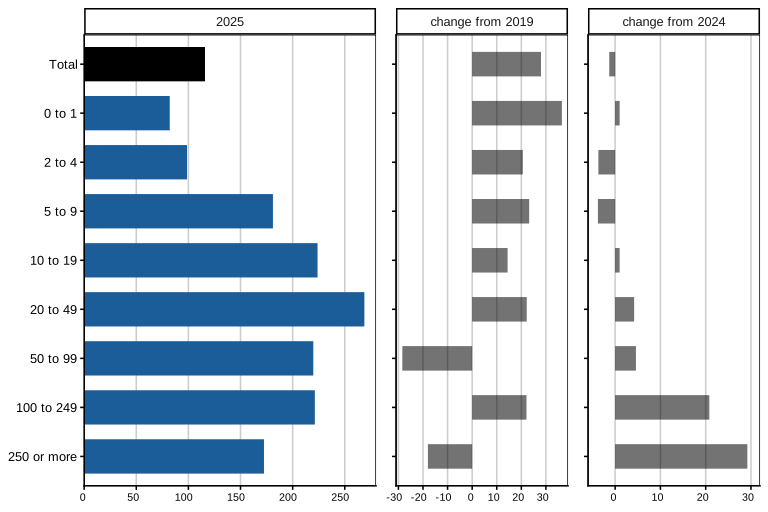
In England and Wales in 2025, 60% of all business insolvencies were for businesses with zero to four employees (13,380 business insolvencies), however businesses of this size make up 78% of all active businesses with legal status company (ONS UK business: activity, size and location). Therefore, the insolvency rate for businesses with less than five employees was lower than average.
In 2025, businesses with 20 to 49 employees had the highest insolvency rate (269 per 10,000). This was slightly higher than the rate in 2024 (265 per 10,000). Businesses with 0 to 1 employees had the lowest insolvency rate (82 per 10,000).
Figure 2: Businesses with 20 to 49 employees had the highest insolvency rate in 2025.
Business insolvency rate per 10,000 businesses by number of employees in 2025, England and Wales, compared with the rate in 2019 and 2024
Source: Companies House (all insolvency data except for compulsory liquidations in England & Wales), Insolvency Service and Office for National Statistics
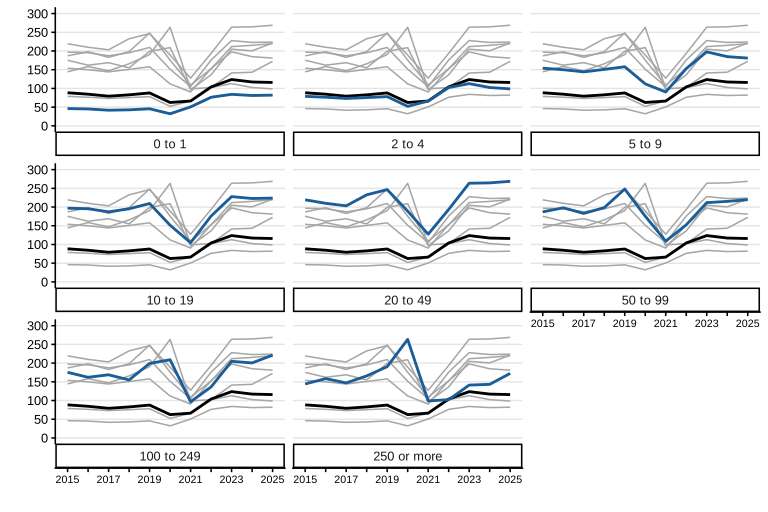
Businesses with 20 to 49 employees have seen the highest insolvency rates in each year from 2015 to 2025, with two exceptions. In 2019, businesses with 50 to 99 employees had the highest insolvency rate, which was slightly higher than that for businesses with 20 to 49 employees. In 2020, businesses with 250 or more employees had the highest insolvency rate.
Between 2015 and 2019, the insolvency rates for businesses with less than 20 employees followed a similar trend to the overall rate, while the rates for businesses with 20 or more employees saw larger increases in 2018 and 2019. Rates for businesses with less than 100 employees then decreased during the COVID-19 pandemic in 2020 and 2021, while the rates for businesses with 100 or more employees increased further in 2020, then saw larger drops in 2021. There were large increases in insolvency rates for all categories in 2022 and 2023, except for businesses with 250 or more employees. In 2024 and 2025, the rate declined slightly for businesses with fewer than 10 employees, but remained at historically high levels. Rates stayed stable for businesses with 10 to 99 employees, but increased for businesses with 100 or more employees.
Figure 3: Businesses with 20 to 49 employees had the highest insolvency rate in each year since 2021.
Business insolvency rate per 10,000 businesses by number of employees, England and Wales, 2015 to 2025
Source: Companies House (all insolvency data except for compulsory liquidations in England & Wales), Insolvency Service and Office for National Statistics
In Figure 3, the black line represents the overall business insolvency rate for England and Wales, while the blue line represents the business insolvency rate for each labelled employee bracket. Employees breakdowns of annual totals and rates of insolvency back to 2015 for England and Wales can be found in Tables B3a and B3b of the tables accompanying this release.
In the United Kingdom in 2025, the estimated total number of employees of businesses experiencing company insolvency was over 400,000. This does not necessarily mean that all these jobs were terminated, particularly where businesses are made up of multiple companies, or where businesses in administration continue as a going concern. For context, in 2025, there were an estimated 23 million employees of businesses registered as companies in the United Kingdom (Business population estimates 2025).
Rates by business size
Businesses have been categorised into micro, small, medium or large based on the number of employees. A micro business is one with less than 10 employees, a small business is one with less than 50 employees, a medium business is one with 50 to 249 employees and a large business is one with 250 employees or more. The group of small-sized businesses includes the micro-sized businesses and the Small- and Medium-sized Enterprises (SMEs) group is the small and medium sized businesses combined.
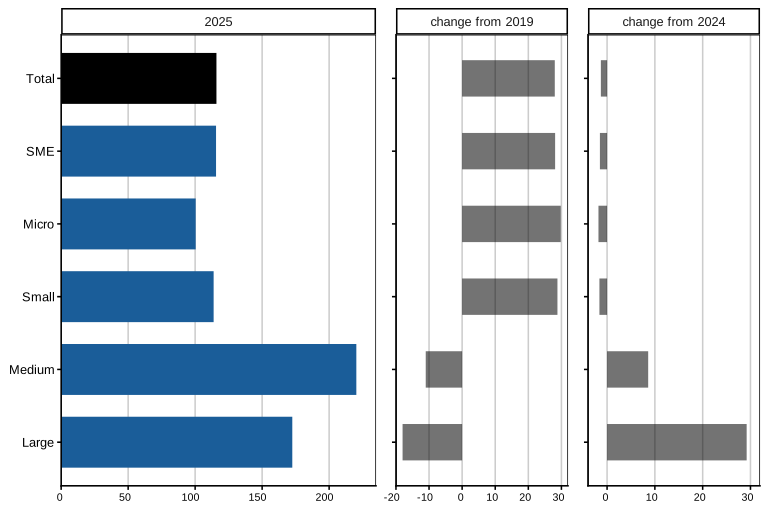
In England and Wales in 2025, there were 21,590 business insolvencies for small businesses, of which 17,205 were micro businesses. Micro businesses had an insolvency rate of 114 per 10,000 business, lower than the rate for all businesses (116 per 10,000).
Medium-sized businesses had the highest insolvency rate in 2025, with 220 insolvencies per 10,000 businesses. Compared to 2019, medium and large sized businesses have seen decreases in rates, while rates increased for micro and small sized businesses.
Figure 4: Medium sized businesses experienced the highest insolvency rate in 2025.
Business insolvency rate per 10,000 businesses by business size in 2025, England and Wales, compared with the rate in 2019 and 2024
Source: Companies House (all insolvency data except for compulsory liquidations in England & Wales), Insolvency Service and Office for National Statistics
Breakdowns of annual totals and rates of insolvency by business size back to 2015 for England and Wales can be found in Tables B5a and B5b of the tables accompanying this release. The same breakdowns for Scotland and Northern Ireland can be found in Tables C5a/b and D5a/b, respectively.
2.2 Turnover
On the IDBR, the term ‘turnover’ relates to annual income received by a business from the ‘sales of goods and or services charged to third parties’.
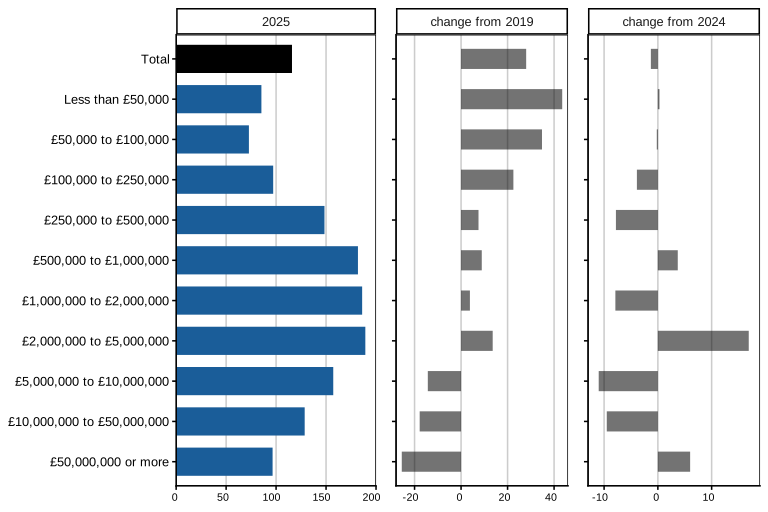
In England and Wales in 2025, there were 10,820 insolvencies for businesses with annual turnover less than £250,000. This was 48% of all business insolvencies, however businesses of this size make up 65% of all active businesses with legal status company in England and Wales. Therefore, the insolvency rate for businesses with annual turnover less than £250,000 was lower than average.
Businesses with an annual turnover of more than £500,000 and less than £5 million experienced the highest insolvency rates in 2025. Businesses with an annual turnover of less than £250,000 or more than £50 million experienced the lowest insolvency rates.
In 2025, £2 million to £5 million was the turnover category with the highest insolvency rate (189 per 10,000). Between 2021 and 2024, businesses with £1 million to £2 million annual turnover had the highest insolvency rate. Businesses with £50,000 to £100,000 annual turnover showed the lowest insolvency rate (73 per 10,000) in 2025.
Figure 5: Businesses with £2 million to £5 million annual turnover had the highest insolvency rate in 2025.
Business insolvency rate per 10,000 businesses by annual turnover in 2025, England and Wales, compared with the rate in 2019 and 2024
Source: Companies House (all insolvency data except for compulsory liquidations in England & Wales), Insolvency Service and Office for National Statistics
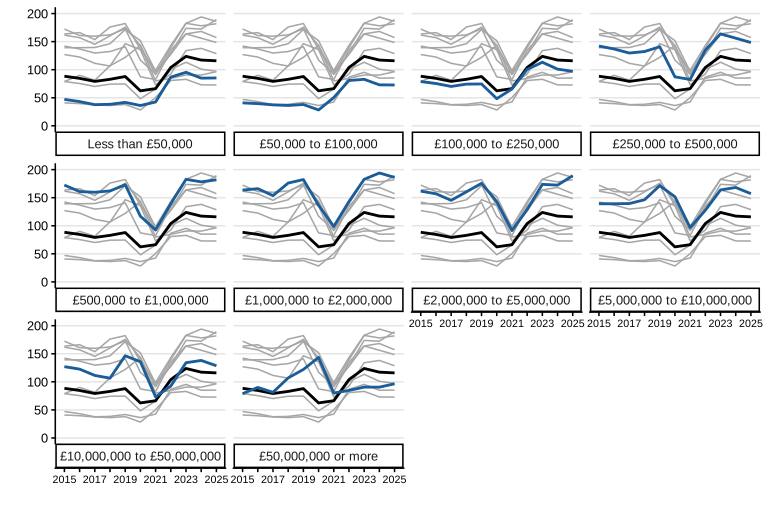
In the lowest turnover bands (less than £250,000), the business insolvency rate was stable between 2015 and 2021, except in 2020, when the business insolvency rate for businesses with £100,000 to £250,000 turnover dropped. These rates then saw large increases in 2022 and peaked in 2023, before they decreased slightly in 2024 and 2025 but remained higher than pre-pandemic levels. Insolvency rates for businesses with £250,000 to £5 million turnover decreased in 2020 and 2021 during the COVID-19 pandemic, but have since increased to levels similar to or higher than the rate in 2019. Insolvency rates for businesses with £5 million to £50 million turnover followed a similar trend; rates between 2023 and 2025 were higher than rates between 2015 and 2018, but remained lower than the peak in 2019. The insolvency rate for businesses with £50 million or more saw increases each year from 2017 before peaking in 2020. The rate then decreased in 2021 to a level similar to in 2017 and has slightly increased each year since, but remained much lower than the 2020 peak.
Figure 6: Businesses with £500,000 to £10 million annual turnover have consistently had higher insolvency rates than businesses with lower turnover in each year since 2015.
Business insolvency rate per 10,000 businesses by annual turnover, England and Wales, 2015 to 2025
Source: Companies House (all insolvency data except for compulsory liquidations in England & Wales), Insolvency Service and Office for National Statistics
In Figure 6, the black line represents the overall business insolvency rate for England and Wales, while the blue line represents the business insolvency rate for each labelled turnover bracket. Turnover breakdowns of annual totals and rates of insolvency back to 2015 for England and Wales can be found in Tables B4a and B4b of the tables accompanying this release.
In the United Kingdom in 2025, the estimated total annual turnover of businesses experiencing company insolvency was over £50 billion. This does not necessarily mean that all this value was lost through insolvency: this is because insolvency may only have affected a small part of a wider corporate group, or that insolvent businesses may have been bought, or otherwise continued as a going concern. For context, in the United Kingdom in 2025, the estimated total annual turnover of businesses registered as companies was over £5 trillion (Business population estimates 2025).
Types of insolvency
In England and Wales in 2025, administration was the most common type of business insolvency for businesses with 100 or more employees, making up 40% of insolvencies for this group, compared with 6% for all business insolvencies. Similarly, administrations made up 52% of insolvencies for businesses with annual turnover of £10 million or more.
Creditors’ voluntary liquidations were the most common type of business insolvency for all other employee and turnover bands. For businesses with two to nine employees, 84% of insolvencies were CVLs, and for businesses with £50,000 to £1 million annual turnover, 83% of insolvencies were CVLs, while CVLs made up 78% of all business insolvencies.
Compulsory liquidations made up 15% of all business insolvencies in 2025. They were more common for the smallest and largest employee and turnover bands (20% for less than two employees, 27% for 250 or more employees, 20% for less than £50,000 turnover, 22% for £50 million or more turnover).
3. Industry Trends
The industrial classification of any business held on the IDBR is based upon the UK Standard Industrial Classification of Economic Activities 2007 (SIC 2007).
In England and Wales in 2025, Wholesale and retail trade had 3,860 insolvencies, the most of any industry. This surpassed the Construction industry, which previously had the highest volume of insolvencies for each year since the time series began in 2015.
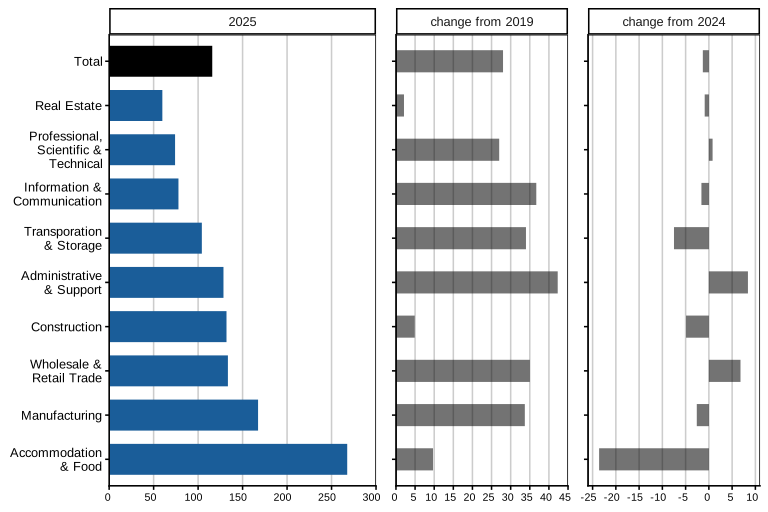
For the largest nine industries (by number of businesses), Accommodation and food service activities had the highest insolvency rate, with 268 insolvencies per 10,000 businesses. Manufacturing showed the second highest rate, with 167 insolvencies per 10,000 businesses. The industry with the lowest insolvency rate (out of the largest nine industries) was Real estate activities, with 60 insolvencies per 10,000 businesses.
Figure 7: Accommodation and food service activities had the highest insolvency rate out of the largest industries in 2025.
Business insolvency rate by the largest nine industries (by number of live businesses) in 2025, England and Wales, compared with the rate in 2019 and 2024
Source: Companies House (all insolvency data except for compulsory liquidations in England & Wales), Insolvency Service and Office for National Statistics
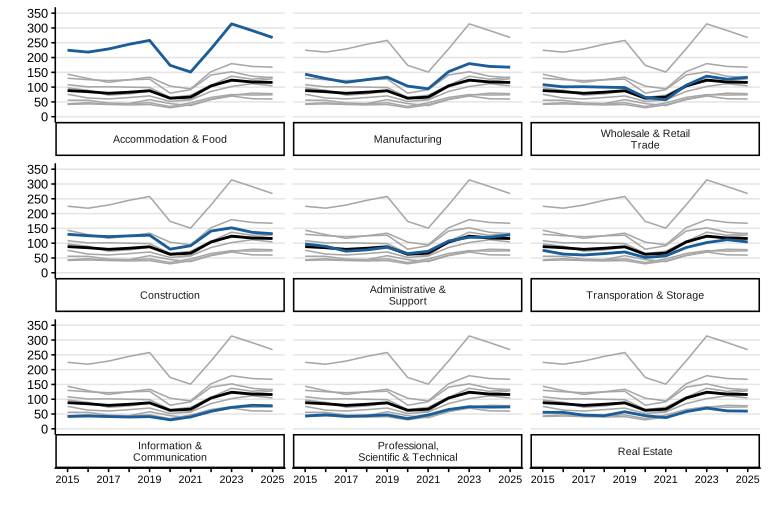
Accommodation and food service activities was the industry with the highest rate each year since the time series began in 2015. The rate peaked in 2023 at 314 insolvencies per 10,000 businesses but declined slightly in 2024 and 2025. Out of the largest nine industries, Real estate had the lowest insolvency rate in each year between 2021 and 2025. Prior to this, each year between 2015 and 2020, Information and communication had the lowest rate. This change was driven by an increase in the number of Real estate businesses, while the number of Information and communication businesses decreased.
Between 2015 and 2019, most large industries had fairly stable insolvency rates, except for Accommodation and food service activities, which saw increases from 2016 to 2019, and Manufacturing, which saw decreases between 2015 and 2017 and then increases between 2017 and 2019.
All industries experienced a drop in insolvency rates in 2020 at the start of the COVID-19 pandemic, and some dropped further in 2021 (Accommodation and food service activities, Manufacturing, Wholesale and retail trade, Real estate). Rates for all nine large industries increased in 2022 and 2023 to levels higher than pre-pandemic. Rates for Accommodation and food service activites and Construction decreased in 2024 and 2025 to similar levels to 2019. However, the overall insolvency rate remained higher than in 2019, driven by larger increases of rates in six out of nine of the largest industries.
Figure 8: Accommodation and food service activities had the highest insolvency rate each year since the time series began in 2015
Business insolvency rate per 10,000 businesses for the largest nine industries, England and Wales, 2015 to 2025
Source: Companies House (all insolvency data except for compulsory liquidations in England & Wales), Insolvency Service and Office for National Statistics
In Figure 8, the black line represents the overall business insolvency rate for England and Wales, while the blue line represents the business insolvency rate for each labelled industry. Industry breakdowns of annual totals and rates of insolvency back to 2015 for England and Wales can be found in Tables B1a and B1b of the tables accompanying this release.
4. Age
The age of a business at the time of insolvency is calculated using the birth date of the business on the IDBR and the date the insolvency is registered with Companies House. For businesses with multiple company insolvencies, if the insolvencies are registered within six months of each other, then the registration date for the first insolvency is used. If the insolvencies are more than six months apart, they are counted as separate insolvencies.
In England and Wales in 2025, there were 4,025 insolvencies for businesses less than four years old, which accounts for 18% of all business insolvencies. At the start of 2025, approximately one-third of all active businesses were less than four years old, so the insolvency rate for businesses of this age was lower than average.
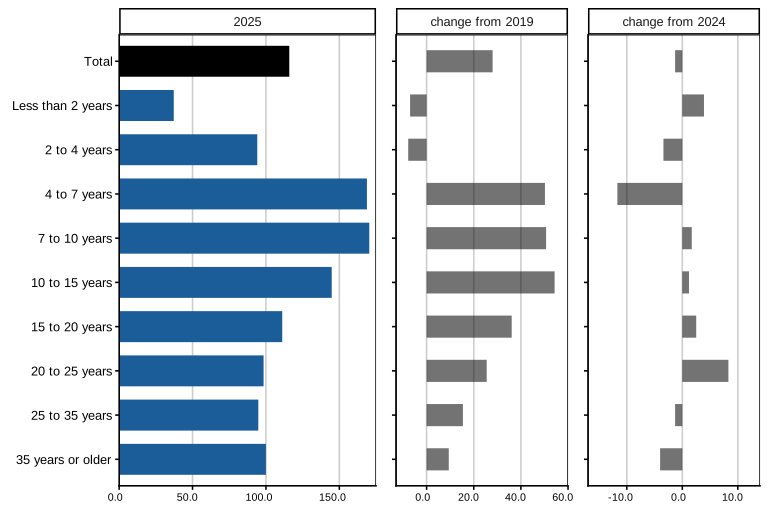
In 2025, businesses aged 7 to 10 years had the highest insolvency rate (170 per 10,000). This was similar to the rate in 2024. Businesses aged less than 2 years showed the lowest insolvency rate (37 per 10,000).
Figure 9: Businesses aged 7 to 10 years had the highest insolvency rate in 2025.
Business insolvency rate per 10,000 businesses by age, England and Wales, 2025, compared with 2019 and 2024
Source: Companies House (all insolvency data except for compulsory liquidations in England & Wales), Insolvency Service and Office for National Statistics
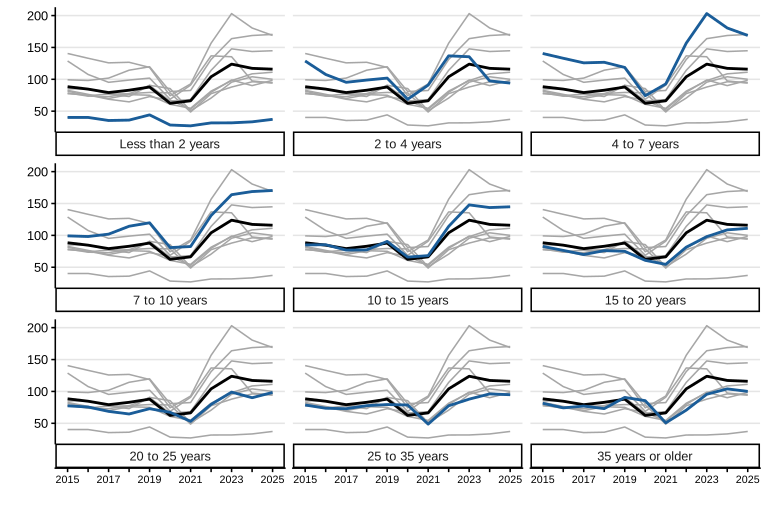
Prior to 2025, businesses aged four to seven years had the highest business insolvency rate each year (2015 to 2024). This peaked in 2023 at 203 insolvencies per 10,000 businesses, but in 2025 decreased to 169 per 10,000. Businesses aged four to seven years old in 2025 were formed between 2018 and 2021, so this may be affected by the COVID-19 pandemic.
The increase in the overall insolvency rate since 2015 was driven by businesses more than four years old. Businesses aged seven to ten years have seen the largest increase in insolvency rate between 2015 and 2025 (88 per 10,000 higher). The largest decrease in insolvency rate between 2015 and 2025 was for businesses aged two to four years (9 per 10,000 lower). The decrease in the overall insolvency rate since 2023 was driven by lower insolvency rates for businesses aged less than 7 years.
Figure 10: The increase in the overall insolvency rate since 2015 was driven by businesses more than four years old.
Business insolvency rate per 10,000 businesses by age, England and Wales, 2015 to 2025
Source: Companies House (all insolvency data except for compulsory liquidations in England & Wales), Insolvency Service and Office for National Statistics
In Figure 10, the black line represents the overall business insolvency rate for England and Wales, while the blue line represents the business insolvency rate for each labelled age bracket. Age breakdowns of annual totals and rates of insolvency back to 2015 for England and Wales can be found in Tables B2a and B2b of the tables accompanying this release.
5. Regional trends
The region of a business has been determined by the business’ registered postcode on the IDBR, which generally refers to the main operating site or the head office of the business. This means the region is not necessarily where staff are employed or where most of the business activity occurs.
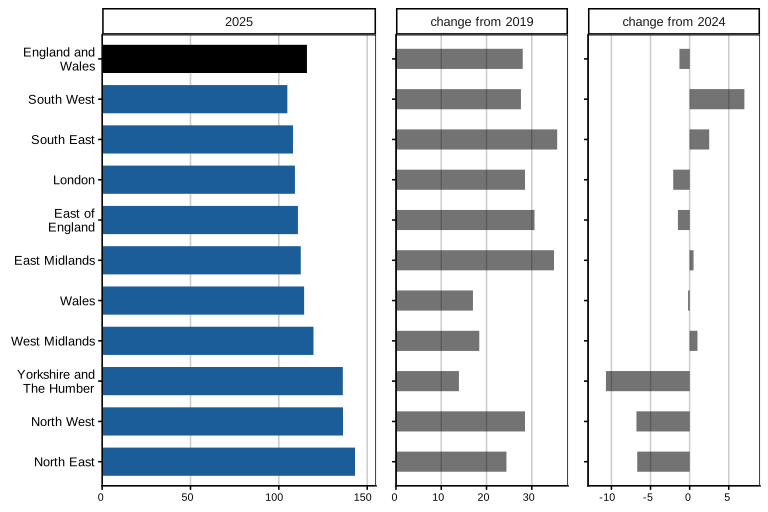
In 2025, the North East had the highest insolvency rate in England and Wales, with 143 insolvencies per 10,000 businesses. It has been the region with the highest rate of insolvency each year since 2021. In 2019 and 2020, Yorkshire and the Humber was the region with the highest insolvency rate.
The South West had the lowest rate of insolvency (105 insolvencies per 10,000) in 2025, and has seen the lowest rate each year since 2021. In 2019 and 2020, the South East was the region with the lowest insolvency rate.
Figure 11: Northern regions of England and Wales had the highest insolvency rates in 2025.
Business insolvency rate per 10,000 businesses by region in 2025, England and Wales, compared with the rate in 2019 and 2024
Source: Companies House (all insolvency data except for compulsory liquidations in England & Wales), Insolvency Service and Office for National Statistics
The distribution of types of insolvency differed by location. The highest CVL rate was in the North East (114); the highest compulsory liquidation rate was in London (22); and the highest administration rate was in the North West (11).
Table 2: The North East had the highest insolvency rate and the South West had the lowest insolvency rate in England and Wales in 2025.
Regions with the highest and lowest insolvency rates per 10,000 businesses in England and Wales in 2025.
| England and Wales rate | Region with highest rate | Region with lowest rate | |
|---|---|---|---|
| Total | 116 | North East (143) | South West (105) |
| Administrations | 7 | North West (11) | Wales (5) |
| Compulsory Liquidations | 17 | London (22) | South West (14) |
| CVLs | 90 | North East (114) | London (79) |
Source: Companies House (all insolvency data except for compulsory liquidations in England & Wales), Insolvency Service and Office for National Statistics
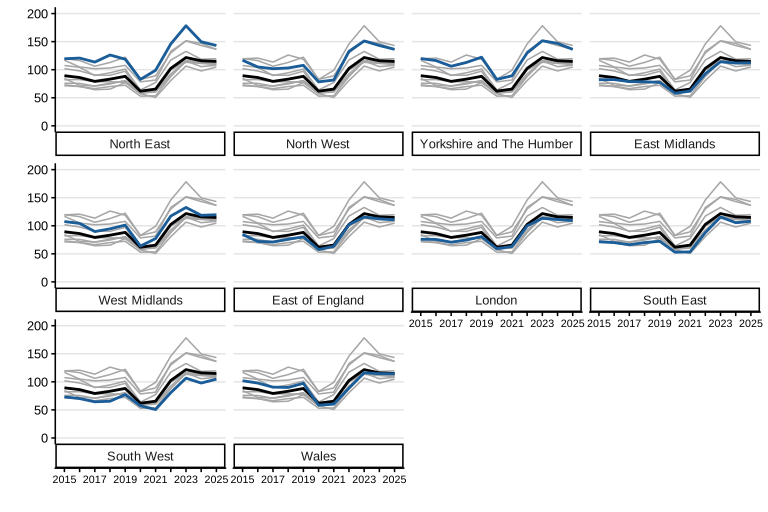
In every year since 2015, northern regions of England and Wales have consistently had the highest rates of insolvency. London, South East and South West have been at or below average every year.
All regions in England and Wales have seen an increase in insolvency rate since 2015, with the South East seeing the largest proportional increase compared to the 2015 level.
Figure 12: Northern regions of England and Wales have had the highest insolvency rates in every year from 2015 to 2025
Business insolvency rate by region, England and Wales, 2015 to 2025
Source: Companies House (all insolvency data except for compulsory liquidations in England & Wales), Insolvency Service and Office for National Statistics
In Figure 12, the black line represents the overall business insolvency rate for England and Wales, while the blue line represents the business insolvency rate for each labelled region. Regional breakdown of years back to 2015 can be found in Tables A1a and A1b of the tables accompanying this release.
6. Data and Methodology
6.1 Methodology and data quality
Detailed methodology and quality information for these statistics, including a breakdown of the accompanying data tables, can be found in the Methodology and Quality document published alongside this commentary.
A business insolvency has been defined as a business for which at least one of its constituent companies has experienced a formal company insolvency procedure after being unable to pay their debts. This is not directly comparable with a company insolvency, since businesses can be made up of more than one company.
Company insolvency data were matched to business demographic data on the IDBR using company reference numbers. Companies that did not match to a business in the IDBR have been counted based on their registered location with Companies House and are included in the “Unknown” row of the accompanying data tables. These companies are excluded from other counts, including totals and breakdowns. This means that volumes and rates are likely to be slightly under-estimated. The matching success rate of insolvent companies to businesses on the IDBR ranged between 90% and 95% in each year.
For rate calculation, the numbers of business insolvencies in each of England and Wales, Scotland and Northern Ireland were divided by the number of active registered businesses with legal status of ‘company’ on the IDBR. This denominator is used as only businesses registered as companies are able to enter a company insolvency. The insolvency rate gives an indication of the probability of a business entering insolvency in each year.
6.2 Data Sources
Company insolvency data used in this publication were sourced from Companies House, except for compulsory liquidation data for England and Wales, which were sourced from the Insolvency Service’s administrative systems. Companies House conducts a series of basic checks on the data, including the removal of duplicate records, prior to supplying the Insolvency Service with monthly snapshots of data to compile company insolvency statistics. Note that Companies House does not verify the accuracy of all information filed, as outlined in their disclaimer published on the Gov.uk website. The company insolvency procedures included in this publication are administrations, creditors’ voluntary liquidations (CVLs), compulsory liquidations and “other”, which includes company voluntary arrangements (CVAs) and receivership appointments. Companies that entered CVL following administration are counted only as administrations and not CVLs, to avoid being counted twice. Moratoriums and restructuring plans are not included within this publication.
Information on a business’s location, industry, age, employment and turnover were sourced from snapshots of the IDBR at the start of each calendar year. More information of the data sources of information on the IDBR can be found in the accompanying Methodology and Quality document.
6.3 Revisions
These statistics are subject to revisions, as set out in the published Revisions Policy. Revisions tend to be made as a result of data being entered onto administrative systems after the cut-off date for data being extracted to produce the statistics. Company insolvency data for the most recent year were extracted in February 2026. Data from the IDBR will not be revised.
This is the first annual publication of these statistics, and therefore there are no revisions. A similar statistical publication was published in 2018 (Corporate insolvencies by size, age and location, 2015 to 2017), but due to differing methodologies, numbers are not directly comparable and therefore revisions have not been marked. Total rates for 2015 to 2017 in this publication were typically 2-6% lower than in the previous publication.
7. Glossary
7.1 Key terms used within this statistical bulletin
| Term | Definition |
|---|---|
| Administration | The objective of administration is to rescue the company as a going concern, or, if this is not possible, to obtain a better outcome for creditors than would be likely if the company were to be wound up. A licensed insolvency practitioner, ‘the administrator’, is appointed to manage a company’s affairs, business and property for the benefit of the creditors. |
| Business insolvency | A business for which at least one of its constituent companies has experienced a formal company insolvency procedure after being unable to pay their debts. This is not directly comparable with a company insolvency, since businesses can be made up of more than one company. |
| Company voluntary arrangement (CVA) | Company voluntary arrangements (CVAs) are another mechanism for business rescue. They are a voluntary means of repaying creditors some or all of what they are owed. Once approved by 75% or more of creditors, the arrangement is binding on all creditors. CVAs are supervised by licensed insolvency practitioners. |
| Compulsory liquidation | A winding-up order obtained from the court by a creditor, shareholder or director. See ‘Liquidation’ for details on the process. |
| Creditors’ voluntary liquidation (CVL) | Shareholders of a company can themselves pass a resolution that the company be wound up voluntarily. See ‘Liquidation’ for details on the process. Administrations which result in a creditors’ voluntary liquidation (CVL) are recorded separately by Companies House and are excluded from CVL figures, as they do not represent a new company entering into an insolvency procedure for the first time. These cases are only ever recorded as administrations. |
| Employee | Anyone aged 16 or over who is paid directly from the payroll, in return for carrying out a full-time or part-time job or being on a training scheme. Employment data on the IDBR is mainly sourced from the Business Register and Employment Survey (BRES), but other sources include the Short Term Employment Survey (STES) and Pay As You Earn (PAYE) information provided by HMRC. |
| Inter-departmental business register (IDBR) | A business register administered by the Office for National Statistics (ONS). It holds records of all businesses registered for Value-Added Tax (VAT) and all businesses operating a Pay As You Earn (PAYE) scheme. Information on a business’s location, industry, age, employment and turnover were sourced from snapshots of the IDBR at the start of the calendar year in which the business entered insolvency. Further information can be found on the ONS IDBR website |
| Liquidation | Liquidation is a legal process in which a liquidator is appointed to ‘wind up’ the affairs of a limited company. The purpose of liquidation is to sell the company’s assets and distribute the proceeds to its creditors. At the end of the process, the company is dissolved – it ceases to exist. Statistics on compulsory liquidations and creditors’ voluntary liquidations are presented in these statistics. A third type of winding up, members’ voluntary liquidation, does not involve insolvency. Therefore, members voluntary liquidations are not included here. |
| Receivership appointments | Administrative receivership occurs when a creditor with a floating charge (often a bank) appoints a licensed insolvency practitioner to recover the money owed to them. Before 2000, receivership appointments could also involve non-insolvency procedures, such as those under the Law of Property Act 1925. The use of this procedure is restricted to certain types of companies, or to floating charges, created before September 2003. |
| Region | For statistical reporting purposes, England is divided into nine regions (formerly Government offices for the regions (GORs)). Each county, unitary authority and London borough is contained entirely within one of these nine regions. |
| Standard Industrial Classification (SIC 2007) | Used in classifying business establishments and other statistical units by the type of economic activity in which they are engaged. Further information can be found on the ONS website. |
| Turnover | The annual income received by a business from the ‘sales of goods and or services charged to third parties’. On the IDBR, this is generally sourced from the Annual Business Survey (ABS) or Value-Added Tax (VAT) information provided by HMRC. |