Bioscience and health technology sector statistics 2024 to 2025: user guide
Published 17 September 2026

© Crown copyright 2026
This publication is licensed under the terms of the Open Government Licence v3.0 except where otherwise stated. To view this licence, visit nationalarchives.gov.uk/doc/open-government-licence/version/3 or write to the Information Policy Team, The National Archives, Kew, London TW9 4DU, or email: psi@nationalarchives.gov.uk.
Where we have identified any third party copyright information you will need to obtain permission from the copyright holders concerned.
This publication is available at https://www.gov.uk/government/statistics/bioscience-and-health-technology-sector-statistics-2024-to-2025/bioscience-and-health-technology-sector-statistics-2024-to-2025-user-guide
1. Introduction
1.1 Background
This user guide accompanies the 2024/25 release of the bioscience and health technology sector statistics (BaHTSS). The BaHTSS publication series presents data and commentary on the UK life sciences sector and its subsectors. The life sciences sector estimates in this publication are based on a dataset of companies in the UK who operate within the biopharmaceutical or medical technology subsectors.
This accompanying user guide provides further details on how these statistics are derived, the underlying quality associated with the data and analysis used in the publication, and changes compared to past releases.
Any feedback or questions are welcome on these statistics, please email analysis@officeforlifesciences.gov.uk
1.2 Changes and additions from previous publications
The 2024/25 report, published on 17 September 2026, is the latest edition in the annual BaHTSS publication series. The 2024/25 release includes new data points for the 2024/25 period, alongside routine revisions to the 2023/24 data points originally published in the 2023/24 release.
Data relating to 2021/22 and before has not been revised due to a notable methodology change that was implemented from the 2023/24 release, and is not directly comparable to subsequent data points.
The following changes and additions have been implemented in the 2024/25 release:
-
A new definition for how Small and Medium Enterprises (SMEs) are defined. Please see section 2.4 for more details.
-
The reintroduction of a timeseries, starting from estimates for 2023/24. The 2024/25 estimates have been compiled using the same methodology as estimates relating to 2023/24, allowing for direct comparisons between the years.
-
Estimates of the number of sites belonging to life sciences companies by region and Local Authority District (LAD). A site is defined as the physical location a company operates out of. For further detail see section 2.1.
1.3 Revisions from past releases
The BaHTSS publication routinely revises previously published estimates in past releases. The 2024/25 release publishes revised estimates for 2023/24 data points. The originally published estimates in the 2023/24 release have been notably revised downwards in the 2024/25 release. This has resulted in a reduction in both national employment and turnover of 13% for 2023/24 compared to the previously published estimates. These revisions have predominantly occurred due to improvements in quality of the company list that underpins the BaHTSS statistics. More details on the impact of this revision can be found in section 3.2 of this report.
1.4 Official Statistics designation
The BaHTSS publication series was previously designated as official statistics. Since the 2023/24 release, the BaHTSS publication has been redesignated as ‘official statistics in development’. More details on the change in badging and an accompanying plan for planned future developments can be found in section 4.
2. Statistical presentation and data collection for 2024/25
2.1 Companies, businesses, and sites in the UK life sciences sector
2.1.1 Definition
The definition of the life sciences sector used in this publication covers businesses operating within the biopharmaceutical or medical technology subsectors in the UK. This definition includes companies involved in the discovery, development and marketing of new pharmaceuticals and medical devices, as well as companies operating in the associated service and supply chains.
Since the 2023/24 release, the BaHTSS publication collates data on:
-
companies: a company is a legal entity which may have a distinct identity from the broader organisation that owns or runs it. A company in the BaHTSS publication is defined as an entity registered with Companies House that has an assigned Company Registration Number (CRN).
-
sites: the physical locations that life sciences companies operate out of. The number of sites belonging to life sciences companies and their locations are collected from the local unit information available in Office for National Statistics’ (ONS) Inter-Departmental Business Register (IDBR). Companies can operate out of any number of sites.
-
businesses: an entity that is the legal owner of one or more companies. Companies are considered part of the same business when they are part of the same enterprise group structure, as defined in IDBR. Some businesses will consist of just one company - in these instances ‘business’ and ‘company’ effectively mean the same thing
For a company to be captured within the scope of the BaHTSS publication, each of the following criteria must be met:
-
it has a legal entity in the UK, not including any Crown Dependencies
-
it is registered with Companies House
-
it is not a university, publicly owned institution, an NHS institution, or a charity
-
it conducts a notable amount of activity that is focused on human health (not including the provision of healthcare, which is out of scope). Veterinary and industrial biotechnology businesses are not in scope
-
it must be registered in ONS’s IDBR. IDBR is a register of all businesses registered for value-added tax (VAT) and/or pay as you earn (PAYE). This means businesses that are not registered for PAYE or VAT, largely sole proprietorships and partnerships, are not included in the publication
-
it must be considered active. Enterprises in IDBR (and the companies that belong to them) are flagged as being ‘active’ if they have activity within the UK and there is no evidence that they have ceased trading.
If a company is considered in-scope of the BaHTSS life sciences sector definition, then its parent business will also be considered in-scope. It is possible for a business within the scope of the publication to comprise of companies both in and out of scope of the BaTHSS life sciences sector definition. Where this is the case, only the in-scope companies within the business are included in the publication data, and the business’ employment and turnover values are scaled down to account for the fact that only some of its companies are in scope (more details in section 2.6.2).
Sites belonging to businesses in the BaHTSS dataset are included when either of the following criteria is met:
-
if all of a business’s activity is considered wholly life sciences (where all companies under the business are in scope of the BaHTSS publication) then all sites associated with that business in the IDBR are considered in scope of the BaHTSS publication.
-
if a business’s activity is considered partially life sciences (where only some companies under the business are in scope of the BaHTSS publication) then sites for inclusion are identified using Standard Industry Classifications (SICs). Sites with the same SIC as the companies in scope are included in the BaHTSS publication, while sites that do not meet this criterion are excluded.
Figure 1 visualises the business structure as defined since the 2023/24 BaHTSS publication for a hypothetical business with 3 companies.
Figure 1: Illustrative example of business structure in the BaHTSS publication
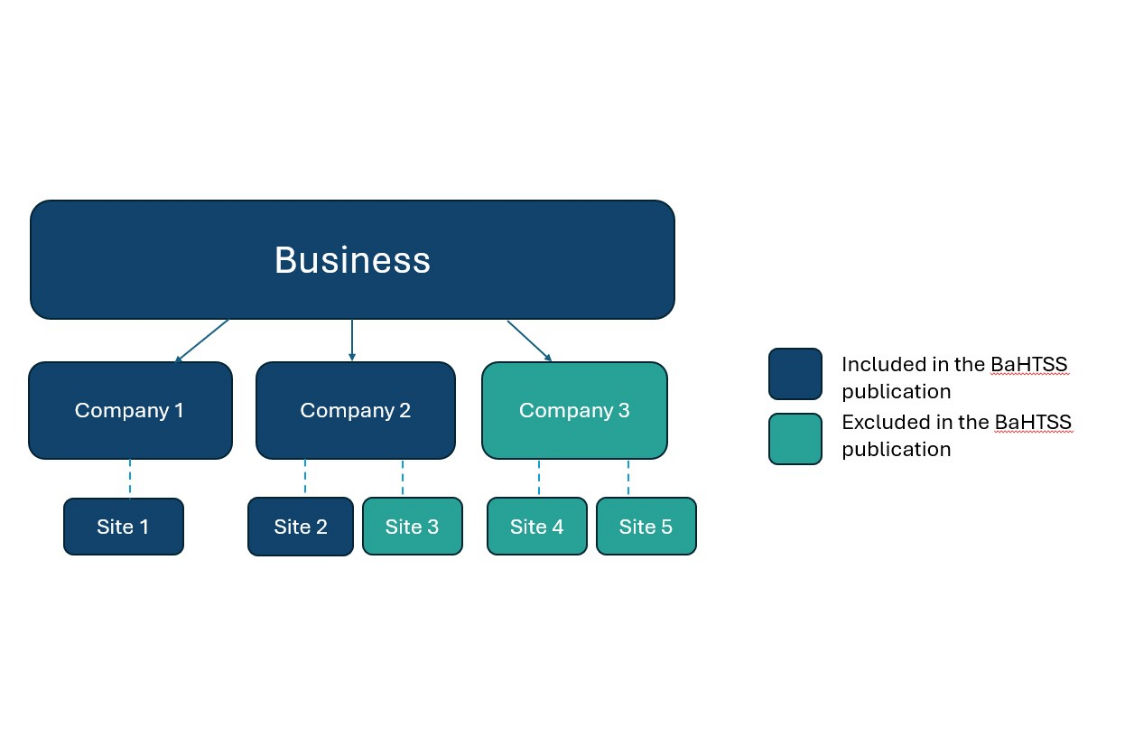
Figure 1: Illustrative example of business structure in the BaHTSS publication
Note: businesses can have ownership over any number of companies. Companies can operate over any number of sites.
2.1.2 Data collection and process
The BaHTSS publication aims to identify life sciences companies which meet the definition set out in section 2.1.1. Since the 2023/24 release, two sources are used to identify companies:
-
an existing dataset of companies used in previous BaHTSS releases relating to 2021/22 and before. This dataset contained a list of identified in-scope companies that were operating as of 2021/22.
-
descriptive text from company websites, which was obtained and analysed through a web-scraping approach and was used to identify additional companies. This process was first introduced from the 2023/24 release.
Existing BaHTSS dataset of companies from 2021/22
The Office for Life Sciences (OLS) holds a dataset of companies operating in the UK life sciences sector as of 2021/22 from previous BaHTSS publications. This dataset of companies was compiled in 2023 through engagement with a cohort of data partners. Data partners are organisations with expertise in the life sciences sector who provide OLS with information on companies they know to be operating in the sector. The full list of data partners can be found in section 8.
This company list is then linked to the ONS IDBR dataset via company registration numbers (CRNs). Companies are then classed as inactive for each financial year if:
-
they weren’t present in the ONS IDBR dataset. Given that several key metrics in this publication are sourced from IDBR data, and given the high coverage of businesses included within IDBR, it has been decided that any companies that are not in IDBR should be excluded from OLS’s company list
-
they were not considered active in IDBR in the reported financial year
-
they were designated as non-profits, government organisations or associated with local authorities in IDBR
Identifying new companies
To identify further companies, a new approach has been used since the 2023/24 BaHTSS release, relying primarily on open web sources. This entailed identifying the textual content on company websites that is descriptive of that company’s activities, and using that to identify a list of companies that may be relevant to the sector. This process was conducted by a consortium of Technopolis and Glass.AI who were contracted by OLS. The process is summarised via the below steps:
-
A series of inputs are used to train multiple models. These inputs include:
-
a subset of Glass.AI’s core dataset of companies. The full core dataset contains data crawled from the websites of companies from all sectors (not just life sciences), but this was filtered down to only include companies where initial evidence suggested there was a degree of textual relevance to the life sciences sector that could be investigated further through machine reading
-
companies included in previous BaHTSS publications and their associated websites
-
online directories of relevant life sciences bodies such as ABPI and their membership lists
-
companies identified through the data partners listed in section 8
-
-
Entity recognition is used to identify websites that belong to companies and businesses and then key details are extracted into a dataset.
-
This data is then fed into a series of models. These models generate a probability score for the likelihood they meet the inclusion criteria for life sciences (as set out in section 2.1.1). These models cover a variety of techniques including LLMs, embedding-based semantic modelling, neural networks, and regression. Some models are trained on company descriptions, whilst others might be trained on snippets of prioritised text from website.
-
An ensemble meta model then produces an overall probability score for each company website decided on a precision-recall curve.
-
A sample of companies is outputted after step 4. These were then reviewed manually for a decision on whether they met the inclusion criteria in section 2.1.1. This manual review was then used as an input for further training of the models (as in step 1) and then steps 3 and 4 were repeated. This manual review process was repeated several times to further refine and train the models.
An initial dataset of companies identified using the above process is sent to OLS for review. The following steps for cleaning the data were applied:
-
the company list is linked to IDBR via Company Registration Numbers (CRNs). The same criteria used to remove companies from the existing BaHTSS dataset of companies
-
any duplicated companies that were already present in the OLS core dataset from past years are removed
-
to mitigate the possibility of the web-scraping process identifying non-life sciences companies, automated data cleansing processes are carried out and a Standard Industry Classification (SIC) based filtering approach was applied. Only companies that met either of the below criteria were retained:
a) All companies with a SIC of 21100, 21200, 26600, 32500, 46460, 72110, 74909 and 72190 are included OR
b) Companies with any SICs are included only if they are linked in IDBR to a business that has at least one company with a ‘core’ SIC of 21100, 21200, 26600, 32500, 46460 or 72110
The definition of the above SIC codes can be found on the ONS UK SIC Hierarchy page. As a result, the final dataset used in the in the 2024/25 release combines the companies remaining after the above criteria are applied with the existing dataset of companies from the previous section.
After these criteria are applied, manual validation of the companies with the highest turnover and employment takes place. Any company found to not meet the definition criteria are removed from the dataset. Further detail can be found in section 3.2 and section 5.
Determining corporate structures and assigning companies to businesses
In the IDBR dataset, the corporate structures of companies and businesses can be determined through the allocation of individual companies to enterprises, and the allocation of enterprises to enterprise groups. An enterprise may consist of one or more companies. All companies in IDBR are considered part of an enterprise, but only some of these enterprises are also part of a wider enterprise group.
The corporate structures from the IDBR dataset are used to determine the link between companies and businesses in the final list of companies produced from the steps above. This is assigned as follows:
-
any companies that are the only company within their business are effectively considered to be both a company and a business
-
any companies that are associated with each other (by being linked under the same business structure) are given the same unique business identifier and are considered a single business. The below criteria are used to define which companies are linked under the same business:
a) if a company is part of a wider enterprise group, all companies within the enterprise group structure are considered part of the same business
b) If a company is not part of a wider enterprise group, all companies within the same enterprise structure are considered part of the same business
Therefore, the term ‘business’ can refer to either an individual company (where that company is not part of a wider corporate structure), an enterprise, or an enterprise group.
2.2 Subsectors
2.2.1 Definition
In this publication, the UK life sciences industry consists of businesses operating in the following 2 subsectors (focusing on human health):
-
biopharmaceuticals: this subsector includes:
-
core companies that develop and/or produce their own pharmaceutical products. This includes companies working on small molecules, vaccines and advanced therapy medicinal products (ATMPs)
-
service and supply companies that offer goods and services to core biopharmaceutical companies including, for example, contract research and manufacturing organisations (CRMOs), and suppliers of consumables and reagents for research and development (R&D) facilities
-
-
medical technology: this subsector includes:
-
core companies that develop and produce medical technology products, ranging from single-use consumables to complex hospital equipment, including digital health products
-
service and supply companies that offer services to core medical technology companies including, for example, CRMOs, and suppliers of consumables and reagents for R&D facilities
-
2.2.2 Data collection and process
Each company included in the dataset is assigned to either the biopharmaceutical or medical technology subsector, based on the following process:
-
Textual information on open web sources (primarily company websites) and existing subsector classifications from past BaHTSS datasets were used as inputs to train a series of models
-
These models used techniques such as embedding-based semantic modelling and neural networks to assign a subsector classification
-
A sample of companies that had been assigned subsector classifications were outputted after step 2. These were then reviewed manually to check the accuracy of the classifications and to provide corrections where appropriate. The results of this manual review were then used to further train the classification models (as in step 1) and then steps 2 and 3 were repeated. This manual review process was repeated several times to further refine and train the models
In some cases, a company may conduct both pharmaceutical and medical technology activities. When this occurs, a subsector is designated by language models and associated scoring, driven by weight of evidence. With this in place, a determination is made, and the company is assigned its primary activity on this basis.
Some companies may also carry out non-life sciences activity in addition to their life sciences activity. In these situations, all employment and turnover for the company has been included in the dataset. Future publications will consider whether life sciences activity can be further disaggregated from non-life sciences activity within companies, more details on this can be found in section 4.
2.3 Manufacturing and research and development (R&D) activity
2.3.1 Definition
Since 2023/24, the BaHTSS publication includes information on companies which have reported either manufacturing or R&D as their primary business activity. In these statistics, manufacturing and R&D companies are identified according to their SIC and are defined as follows:
-
manufacturing companies: any companies with a SIC code within section C of the ONS hierarchy
-
R&D companies: any companies with a SIC code within division 72 (Scientific Research and Development) of the ONS hierarchy
Companies are required to select one primary SIC code that best describes their main activity. Therefore, in this publication, companies which primarily manufacture are mutually exclusive to companies which have R&D as their primary activity. Other companies within the BaHTSS dataset that do not have a primary SIC code within section C or division 72 are not tagged as having manufacturing or R&D activity.
2.3.2 Data collection and process
SIC information is primarily sourced from Moody’s FAME dataset. This collates information on SICs reported by companies to Companies House. This is joined to the BaHTSS dataset via CRN. When company SIC codes are not available in Moody’s FAME dataset, IDBR SICs are used instead. The SIC allocation in IDBR is done at an enterprise level (multiple CRNs can belong to one enterprise) and therefore generalises multiple companies in a single SIC. The IDBR SICs are only used in a small, non-impactful number of cases.
2.4 Small and Medium Enterprises (SMEs)
2.4.1 Definition
A new definition of SMEs has been implemented in the 2024/25 release. SMEs are defined as businesses with an employment value of fewer than 250. This definition has been applied to data points from 2023/24 onwards.
Previous releases defined SMEs according to the European Commission’s definition of small and medium-sized enterprises. The European Commission’s definition classifies a business as an SME when both of the following conditions are met:
-
Employment is fewer than 250
-
Turnover is less than or equal to €50 million or balance sheet total is less than or equal to €43 million
Details on the impact of this change can be found in section 3.1 of this report.
2.4.2 Data collection and process
SME status is based on IDBR employment for businesses, as defined in section 2.1. Any company belonging to a business structure with employment of 250 or less is defined as an SME.
2.5 Company Ownership
2.5.1 Definition
From the 2023/24 release onwards, estimates are published on whether companies are owned by a UK or overseas based business. This is determined using the ‘Global Ultimate Owner’ allocation from Moody’s FAME database. In FAME, the Global Ultimate Owner is identified by searching for the shareholder with the highest direct or total percentage of ownership for each company. If that shareholder is independent, it is defined as the Ultimate Owner for the subject company. If the shareholder is not independent, the process is repeated until an Ultimate Owner is found.
2.5.2 Data collection and process
Company ownership status is sourced from Moody’s FAME dataset and linked to the dataset at a company level through CRNs. For any CRN in the BaHTSS dataset that does not return a match in FAME, the company ownership status is set to ‘unknown’.
2.6 Employment and turnover
2.6.1 Definition
The BaHTSS publication reports on employment and turnover for the life sciences sector at a national level and at further granularities. The source used for employment and turnover since the 2023/24 release is ONS’s IDBR. Employment and turnover are defined as follows:
-
employment: people working for a business, including owners and partners
-
turnover: the income received by a business from the ‘sales of goods and or services charged to third parties’. This excludes value-added tax (VAT)
2.6.2 Data collection and process
The constructed dataset from the previous steps uses employment and turnover information obtained through data matching with IDBR by CRN. IDBR turnover and employment data is available at an ‘enterprise’ level. An enterprise can consist of more than one company. To assign employment and turnover at a company level for each CRN, it is assumed that companies have a uniform share of the enterprise’s employment and turnover, and so the enterprise-level figures are divided equally by the number of companies in the enterprise.
Turnover values collected for past years (2023/24 and earlier) are put in 2024/25 prices, using GDP deflators to account for inflation across the years.
2.7 Time Periods
The 2024/25 release reports on data up to and including 2024/25. Data relating to 2023/24 and onwards is derived from IDBR. This includes information on when businesses ceased operating and employment/turnover information for the relevant financial year.
Company employment and turnover figures within IDBR are mostly updated on an annual basis and are sourced from a range of datasets. Due to the variety of sources used, employment and turnover figures are not updated at a consistent point. The BaHTSS publication uses the snapshot of IDBR data that most closely relates to the reported financial year. Therefore, some company data included in this publication may relate to a different time period, if an update has not been provided.
Some data relating to years between 2008/09 and 2021/22 are published as part of the 2024/25 BaHTSS release, but this is not comparable to estimates from 2023/24 onwards due to the methodology changes that occurred in 2023/24.
2.8 Geographical areas
The BaHTSS publication presents geographical estimates at the following levels:
The postcode for each site within the BaHTSS data is matched to a ITL 1 region and LAD using the ONS’s National Statistics Postcode Lookup (NSPL). This allows consistency throughout all layers of geography used.
The BaHTSS report uses the most appropriate NSPL available from ONS at the time of publication. For the 2024/25, the ONS’s LAD boundaries as of December 2025 were used, which means boundary changes that happened after this date are not reflected in this report.
Since the 2023/24 release, company counts, employment and turnover for geographical units is based on a companies’ registered addresses from Companies House. The 2024/25 release introduces site level counts for geographical units based on the physical location(s) companies operate out of. OLS are conducting further development work to consider if further estimates on employment and turnover by site location can be introduced in future releases. Please see section 4 for more details.
2.9 Rounding and disclosure control
Outputs for the publication are assessed to ensure that employment and turnover values for individual businesses are not disclosed. When a figure is derived from fewer than 5 businesses or companies, these figures are suppressed. All site, company, business counts and employment values are rounded to the nearest 5, and turnover values reported in billions are rounded to 3 decimal places.
For turnover and employment estimates, if any figure in the 2024/25 release is comprised of 1 or 2 businesses that contribute more than 80% of the category total, then these figures are suppressed.
If only one category in a table is suppressed, the lowest remaining value is also suppressed to avoid values being derived from the totals.
The BaHTSS reports apply rounding to quoted numbers to ensure coherence and that the main results of the findings can be interpreted easily.
3. Impact of changes introduced in the 2024/25 release
3.1 Comparability of past BaHTSS releases
The 2024/25 release covers data up to 2024/25. Data relating to 2024/25 and 2023/24 have been compiled using the same methodology and comparisons can be made between the periods. Data relating to periods between 2008/09 and 2021/22 is not directly comparable to estimates for 2023/24 or 2024/25 due to the scale of methodology changes that occurred. Data for 2022/23 is not available due to the time taken to implement the new methodology
Estimates of the sector between 2008/09 and 2021/22 are still referenced in this report where the definition of the metric remains unchanged. This is to allow users to view data on estimates for past years, but it should be noted these figures are not directly comparable and the scale of change in the sector cannot be inferred between 2023/24 onwards and earlier time periods
More details on the methodology changes that occurred in the 2023/24 release and how this impacted the BaHTSS release are available in the accompanying 2023/24 user guide.
The 2024/25 release uses an updated definition for SMEs. This definition has been used for the 2024/25 estimates and backdated for the 2023/24 estimates. This change has resulted in a minor impact on the percentage of companies defined as SMEs. The 2023/24 release reported that 94% of life sciences companies were SMEs using the past definition. The 2024/25 release reports that 89% are SMEs for the 2023/24 period using the new definition.
3.2 Impact of revisions in 2024/25 on past estimates
OLS carry out scheduled revisions in each release for figures reported in past releases. The 2024/25 release revises estimates for 2023/24 that were originally published in the 2023/24 release. More details on how revisions are carried out is available in section 5 of this report. As part of part of the scheduled revision process, OLS conducts a manual validation process on the list of companies included in the underlying dataset. If a company is found to not meet the criteria in section 2.1.1 then the company’s data is removed from the dataset and backdated for estimates relating to 2023/24 onwards.
The manual validation process that was undertaken for the 2024/25 release identified a notable number of companies who did not meet the criteria set out in section 2.1.1. The manual validation process for the 2024/25 release focused on the businesses with the highest values for turnover and employment. In the 2023/24 release manual validation focused on new businesses that were identified through the web scraping process described in section section 2.1.2. The updated manual validation process has resulted in estimates for 2023/24 employment and turnover published in the 2024/25 release being revised substantially downwards.
Both national life sciences employment and turnover for 2023/24 have been revised downward by 13% compared to what was originally published in the 2023/24 release. Further detail on the impact of revisions by subsector and location can be found in the annex of this report.
4. Compliance with the Code of Practice for Statistics
4.1 Designation
The BaHTSS publication series was previously labelled as official statistics. Since 2023/24, the report has been designated as ‘official statistics in development’.
This is defined by the UK Statistics Authority as a ‘subset of official statistics that are undergoing a development; they may be new or existing statistics, and will be tested with users, in line with the standards of trustworthiness, quality, and value in the Code of Practice for Statistics.’
This change is being implemented whilst OLS:
-
carry out further quality improvements to the new methodology
-
consider users’ feedback on the new approach
-
explore ways to reintroduce some breakdowns of the life sciences sector which have been temporarily removed due to the change in methodology
4.2 Quality
This section outlines where the BaHTSS 2024/25 release complies with the quality pillar requirements of the Code of Practice for Statistics and highlights where there are planned future improvements.
4.2.1 Identifying life sciences companies
The estimates in this year’s BaHTSS publication are based on a dataset of life sciences companies identified through the construction process outlined in section 2 of this document. Whilst the dataset holds information on an extensive number of life sciences companies, the dataset does not contain the full population of life sciences companies operating in the UK and therefore any figures in this report should be treated as an estimate. Whilst the BaHTSS series provides the OLS’s best estimate of the size and composition of the sector, limited information is known about its coverage and what the true population of the life sciences sector is in the UK.
Whilst limited information is known about the proportion of the life science sector population that is not included in the BaHTSS dataset, extensive quality assurance is undertaken to ensure records in the dataset meet the inclusion criteria set out in section 2.1. These steps include:
-
removal of non-active companies using IDBR
-
validating records found are legitimate companies with a UK presence using IDBR
-
manual review of the companies with the highest impact on national figures. This review checks whether they meet the BaHTSS definition criteria set out in section 2.1
-
checking for implausible values and missing data
In 2023/24 a web scraping approach was introduced for the first time to identify new companies in the sector, as outlined in section 2.1.2. This approach:
-
identified a wider range of companies compared to past manual approaches
-
associated each company to a website so further research could be conducted on individual companies
-
provides flexibility to refine automated techniques through small-scale sample reviews
For the 2024/25 release, further manual validation checks were carried out on the companies included in the BaHTSS dataset. The manual validation process for the 2024/25 release focused on the businesses with the highest values for turnover and employment. In the 2023/24 release manual validation focused on new businesses that were identified through the web scraping process described in section 2.1.2. These checks identified several companies that do not meet the inclusion criteria set out in section 2.1.1. These companies were removed from the dataset for the 2024/25 release, and they were additionally removed from estimates for the 2023/24 period.
OLS intend to conduct similar manual validation checks introduced in 2024/25 for each release going forward with the aim of reducing the likelihood of large-scale revisions in future releases. OLS will also consider whether other methods of identifying companies and validating the meet the definition criteria for future releases are available.
4.2.2 Employment and turnover estimates
Employment and turnover values have been taken from ONS’s IDBR dataset since the 2023/24 release. IDBR covers all businesses registered for VAT and PAYE.
To be consistent with ONS’s view of the UK business environment and other government analysis that uses IDBR, companies that aren’t included in IDBR also aren’t included in the BaHTSS publication.
Whilst IDBR contains a degree of imputation and estimation for some company’s turnover and employment, the move to using IDBR is an improvement in quality compared to sources used in previous years. The advantages to using IDBR include:
-
a higher quality source for turnover and employment figures. ONS take steps to disaggregate UK activity from international activity based on surveying companies in the register. This previously had to be estimated and manually adjusted from past sources
-
improved methods for linking companies to their overarching business through the use of corporate structures within ONS’s IDBR data. This provides consistency with other statistics produced across government
4.2.3 Subsectors
Companies are assigned either a biopharmaceutical or medical technology subsector classification as outlined in section 2.2. The new methodology using web-scraping (as covered in section 2.1.2) was tested by assessing the share of companies in each subsector compared to data reported on in past publications. Quality assurance was also carried out through manual reviews (the results of which were fed back into the models as training data).
4.2.4 Future developments in quality
Whilst the additional manual validation has introduced higher quality in the underlying BaHTSS dataset, steps will be taken by OLS to further improve the quality of the estimates used in the BaHTSS publication for future releases. OLS will focus on developing the following areas with the aim of further compliance with the Code of Practice and the aim of returning to an official statistics designation:
-
further refinement of the web crawling-based approach and improving the accuracy for identifying life sciences companies. Work was undertaken for the 2024/25 release to remove a notable number of companies in the dataset not meeting the inclusion criteria set out in section 2.1.1. Further work is undertaken by OLS to reduce the likelihood of companies that are not in scope being introduced to the underlying data. This happens through the use of filtering by SIC codes (as outlined in section 2.1.2). Future releases will consider how to mitigate this further via a combination of automated and manual methods.
-
considering whether coverage of life sciences companies in the dataset could be increased by identifying omitted life sciences companies within the same IDBR corporates structures as in-scope companies
Value
This section outlines where the BaHTSS 2024/25 release complies with the Value pillar requirements of the UK Statistics Authority’s (UKSA) Code of Practice for Statistics and highlights where there are planned future improvements.
4.3.1 Value of BaHTSS 2024/25 statistics
These statistics are produced due to the need for a comprehensive view of the life sciences industry in the UK that is not provided by other published data sources. SIC codes are used to classify businesses by industry in other official statistics. This classification system has categories for businesses whose primary activity is the manufacture of pharmaceuticals, manufacture of types of medical equipment, and those whose primary activity is biotechnology R&D.
However, the categories within the SIC system do not align with the full breadth of the life sciences industry, meaning that it is not possible to achieve complete data coverage of the life sciences industry using SIC codes. SIC codes are used in the BaHTSS report to support with the removal of non-life sciences companies identified through web-crawling and to identify companies with primary activities of manufacturing and R&D. Despite this, the BaHTSS publication still reflects a bespoke definition of the sector that is more comprehensive than any definition that could be achieved with SIC codes alone.
The bespoke methods used in this publication to identify and classify UK life sciences businesses therefore mean these statistics fulfil a previously unmet need in providing a more complete view of the life sciences sector.
Site level data was re-introduced in the 2024/25 release and statistics are now available for the number of sites by various geographies for 2023/24 onwards.
4.3.2 Future developments in value
The methodology changes introduced in 2023/24 have resulted in certain breakdowns no longer being available. OLS will focus on developing the following areas with the aim of further compliance with the code and the aim of returning to an official statistics designation:
-
re-introduce more granular level reporting that has not been available since the 2023/24 release. This includes further site level reporting and more granular subsector analysis beyond the biopharmaceutical and medical technology subsectors. OLS will:
-
consider if further statistics using site information for employment and turnover can be introduced
-
explore the use of new data sources that can be used to identify companies’ sub-activities
-
complete further work to introduce more metrics into the BaHTSS series that are known needs of users. OLS will consider what sources are available that could allow reporting on additional variables
-
further work will be done by OLS to consider if other existing sources can be used to bring in more harmonised and consistent subclassifications with other government sources
4.4 Trustworthiness
This section outlines where the BaHTSS 2024/25 complies with the trustworthiness pillar requirements of the Code of Practice for Statistics and confirms there are no required future improvements.
4.4.1 Trustworthiness of BaHTSS 2024/25 statistics
These statistics are produced and published with the aim of ensuring that an accurate and objective view of the life sciences sector in the UK can be conveyed to the public. All material is produced in line with principles in the Code of Practice for Statistics on impartiality.
Decisions on how these statistics are compiled and presented are made by analysts in OLS in line with guidance from the Heads of Profession for Statistics in the Department of Health and Social Care (DHSC) and the Department for Business, Innovation, Science and Trade (BIST).
Access to the BaHTSS publication ahead of release is restricted to those involved in the production of these statistics. The circulation of the statistics 24 hours ahead of their release is restricted to the minimum necessary number of eligible recipients. The job titles of these individuals are outlined in the pre-release access list, which can be found on the accompanying 2024/25 statistics landing page.
The processes and data used to compile the statistics, along with an assessment of the quality and limitations of these processes and data, are outlined in this document.
New companies and their subsector classifications were identified by a contractor on behalf of OLS. All further dataset construction, quality assurance and statistics production was conducted by OLS professional analysts in line with the requirements set out in the Code of Practice for Statistics.
All professionals involved in the creation, publication and storage of this dataset are well-versed in data protection and operate in compliance with data protection legislation. In these published statistics, OLS comply with the strict disclosure control rules required by ONS due to the use of their IDBR dataset.
Future developments in trustworthiness
The 2024/25 BaHTSS statistics comply with all trustworthiness pillars set out in the Code of Practice for Statistics and nothing has changed from past publications.
5. Revision policy
OLS carry out scheduled revisions in each release for figures reported in past releases. The 2024/25 statistics revises estimates for 2023/24 that were originally published in the 2023/24 release. It is not possible to backdate or revise previous estimates of the life sciences sector (relating to 2021/22 and earlier) due to the methodology change that occurred from the 2023/24 release.
Scheduled revisions that occur in the 2024/25 release are due to:
-
identification of new companies: OLS routinely evaluate the list of companies on an annual basis to identify new companies operating and remove companies that have ceased operating. As part of the annual data collection process, companies that have not previously been included in the BaHTSS dataset and began operating in or before past time periods may be identified. When this occurs, these companies are backdated into the relevant years of data.
-
removal of companies not in scope: each year OLS carries out validation exercises on the list of companies used in estimates since 2023/24 and beyond. When a company is determined to not be in scope but was included in past estimates, these companies’ data is removed from the dataset and past estimates are backdated to exclude this data.
-
change in definition for SMEs: the 2023/24 release reported that 94% of life sciences companies were SMEs using the past definition. The 2024/25 release reports that 89% are SMEs for the 2023/24 period using the new definition set out in section 2.4.1.
Due to the process of removing companies not in scope in 2024/25, this resulted in notable revisions for the 2023/24 estimates that were first published in the 2023/24 release. National life sciences employment and turnover for 2023/24 have both been revised downward by 13% compared to what was originally published in the 2023/24 release. Further detail on the impact of revisions by subsector and location can be found in the annex of this report.
Turnover values relating to 2023/24 and earlier have been adjusted into 2024/25 prices using GDP deflators.
Any revisions in future will be in line with BIST’s Revisions and correction policy and highlighted clearly as part of each release. For any future methodology changes, this will be backdated for estimates from 2023/24 onwards, wherever possible.
6. Timeliness and punctuality
This publication is usually released on an annual basis, covering activity relating up to and including the end of the latest available financial year. A publication for data relating to 2022/23 was not produced due to the extensive changes in methodology that have been applied. Data for 2024/25 was published in September 2026. OLS will consider the most appropriate publication schedule going forward to enable the statistics to enter the public domain in a timely manner.
7. Cost and burden
The BaHTSS data collection process for publications relating to 2021/22 and earlier was heavily reliant on manual input, knowledge and processing. The move to the new approaches highlighted in section 2 aims to reduce the need for unnecessary manual steps. This has already achieved a reduction in manual efforts including:
-
the use of SICs to identify manufacturing and R&D activity. This was previously assessed manually on a company-by-company basis (as described in section 2.3)
-
identification of a larger net of companies for inclusion through automated means. This was then filtered down through small sampling reviews and SIC based filtering (as described in section 2.1)
This process will continue to be developed as part of the aim to improve quality and coverage, and OLS will continue to explore ways of making the statistics production process more efficient.
The data partners listed in section 8 continued to provide data on companies entering and leaving the industry for the 2024/25 collection. Data providers keep a record of these changes as part of their usual business cycle and provide a summary as part of the BaHTSS data collection each year. OLS will review annually whether this contribution can be reduced or alleviated through introduction of more automation in the collection processes.
8. Data partner acknowledgement
OLS gratefully acknowledge the contribution of the following regional and national organisations to the BaHTSS publication. These data partners are listed below:
-
Association of British Healthcare Industries (ABHI)
-
Association of the British Pharmaceutical Industry (ABPI)
-
AXREM
-
BioIndustry Association (BIA)
-
BioNow
-
BioPartner UK
-
Biosciences Knowledge Transfer Network (KTN)
-
British Healthcare Trade Association (BHTA)
-
British In Vitro Diagnostics Association (BIVDA)
-
HealthTech and Medicines Knowledge Transfer Network (KTN)
-
Innovate UK
-
Invest Northern Ireland
-
MedCity
-
Medicines Discovery Catapult
-
Medilink East Midlands
-
Medilink North of England
-
Medilink South West
-
Medilink West Midlands
-
MediWales
-
Medicines and Healthcare products Regulatory Agency (MHRA)
-
OBN
-
One Nucleus
-
Scottish Enterprise
-
South East Health Technologies Alliance (SEHTA)
-
TechUK
-
Welsh Government
Annex: Impact of revisions in the 2024/25 release
Table 1a: Change in employment estimates for 2023/24 by subsector
| Subsector | 2023/24 Employment value in the 2024/25 release | 2023/24 Employment value in the 2023/24 release | Percentage change in employment (%) |
|---|---|---|---|
| Biopharmaceuticals | 147,605 | 163,590 | -10 |
| Medical technology | 165,495 | 195,995 | -16 |
| Total | 313,090 | 359,585 | -13 |
Note: employment figures have been rounded to prevent disclosure. Percentage changes are calculated based on unrounded figures so may not match when calculated from the rounded figures in the table
Table 1b: Change in turnover estimates for 2023/24 by subsector
| Subsector | 2023/24 Turnover value (£ billions) in the 2024/25 release | 2023/24 Turnover value (£ billions) in the 2023/24 release | Percentage change in turnover (%) |
|---|---|---|---|
| Biopharmaceuticals | 82.7 | 98.9 | -16 |
| Medical technology | 44.6 | 48 | -7 |
| Total | 127.3 | 146.9 | -13 |
Note: turnover figures have been rounded to prevent disclosure. Percentage changes are calculated based on unrounded figures so may not match when calculated from the rounded figures in the table
Table 2a: Change in employment estimates for 2023/24 by ITL 1 region
| Region | 2023/24 Employment value in the 2024/25 release | 2023/24 Employment value in the 2023/24 release | Percentage change in employment (%) |
|---|---|---|---|
| East Midlands | 16,000 | 22,415 | -29 |
| East of England | 48,150 | 50,845 | -5 |
| London | 44,725 | 56,905 | -21 |
| North East | 7,150 | 8,030 | -11 |
| North West | 25,350 | 32,455 | -22 |
| Northern Ireland | 9,700 | 9,460 | 3 |
| Scotland | 16,170 | 17,125 | -6 |
| South East | 78,560 | 84,795 | -7 |
| South West | 14,750 | 16,005 | -8 |
| Wales | 12,255 | 13,285 | -8 |
| West Midlands | 17,825 | 23,765 | -25 |
| Yorkshire and The Humber | 22,455 | 24,495 | -8 |
| United Kingdom | 313,090 | 359,585 | -13 |
Note: employment figures have been rounded to prevent disclosure. Percentage changes are calculated based on unrounded figures so may not match when calculated from the rounded figures in the table
Table 2b: Change in turnover estimates for 2023/24 by ITL 1 region
| Region | 2023/24 Turnover value (£ billions) in the 2024/25 release | 2023/24 Turnover value (£ billions) in the 2023/24 release | Percentage change in turnover (%) |
|---|---|---|---|
| East Midlands | 3.5 | 5.8 | -40 |
| East of England | 31.8 | 30.3 | 5 |
| London | 22.7 | 33.9 | -33 |
| North East | 1.1 | 1.2 | -7 |
| North West | 7.0 | 8.7 | -19 |
| Northern Ireland | 2.1 | 2.0 | 3 |
| Scotland | 4.3 | 4.4 | -1 |
| South East | 36.6 | 39.4 | -7 |
| South West | 4.5 | 4.5 | 0 |
| Wales | 3.6 | 3.6 | -1 |
| West Midlands | 5.2 | 8.3 | -37 |
| Yorkshire and The Humber | 4.8 | 5.0 | -3 |
| United Kingdom | 127.3 | 146.9 | -13 |
Note: turnover figures have been rounded to prevent disclosure. Percentage changes are calculated based on unrounded figures so may not match when calculated from the rounded figures in the table