
Access arrangements for GCSE, AS and A level: 2024 to 2025 academic year
Published 27 November 2025
Applies to England

© Crown copyright 2025
This publication is licensed under the terms of the Open Government Licence v3.0 except where otherwise stated. To view this licence, visit nationalarchives.gov.uk/doc/open-government-licence/version/3 or write to the Information Policy Team, The National Archives, Kew, London TW9 4DU, or email: psi@nationalarchives.gov.uk.
Where we have identified any third party copyright information you will need to obtain permission from the copyright holders concerned.
This publication is available at https://www.gov.uk/government/statistics/access-arrangements-for-gcse-as-and-a-level-2024-to-2025-academic-year/access-arrangements-for-gcse-as-and-a-level-2024-to-2025-academic-year
This release provides information on the number of access arrangements approved by exam boards and valid for use by students being assessed in their GCSE, AS and A level qualifications each academic year. It also contains statistics on the number of requests fulfilled by exam boards for modified papers for GCSE, AS and A levels in each summer exam series.
Provide your feedback
We welcome your feedback on our publications. If you have any comments on this statistical release, or how to improve it to meet your needs, please complete our short survey or email our statistics team.
How to interpret the figures presented in this release
All figures relate to access arrangements or modified papers for students of all ages, taking their GCSE, AS and A level qualification assessments (including resits) in schools and colleges and other exam centres (referred to as ‘centres’ throughout this release) in England only. This is an improvement to previous releases of these statistics which had also included arrangements that had been approved for use for students who were not being assessed in the given year (see our blog piece on access arrangements data for more information).
Figures include arrangements for assessments in 2020 and 2021 when exams were cancelled due to the COVID-19 pandemic but students were still assessed by their teachers and approvals for access arrangements still took place (further information can be found in the accompanying background notes).
Only access arrangements which were approved by exam boards (detailed in JCQ’s guidelines) and modified papers provided by exam boards to centres are included. Some access arrangements and modified papers do not need to be approved or provided by exam boards and therefore are not included in the figures reported within this release.
Throughout this release, the data does not allow us to comment on the extent to which access arrangements or modified papers were actually used by students during their exams. Instead, figures only relate to the number of arrangements approved and the number of modified papers provided.
Throughout this release, figures on access arrangements are presented as a range rather than as absolute values. The access arrangements data Ofqual receives from exam boards is not linked to exam entries or results. As part of preparing this release, Ofqual linked access arrangements data to our awarding (results) dataset. However, this methodology still has a degree of uncertainty. While in the majority of cases we can be certain which arrangements were for students being assessed during the academic year, for some arrangements we cannot be certain whether or not they were for students being assessed in that academic year. We also cannot always confirm whether multiple access arrangements were requested for the same student, meaning there is additional uncertainty about whether some records are duplicates.
In these ranges, the reported lower bound shows the number of access arrangements (including those presented as a proportion) where we are confident that those students were being assessed in that academic year. This is referred to as the ‘determined proportion’ in the charts. The upper bound also includes arrangements where, due to limitations with the source data, we cannot be confident if there are duplicates or whether they might be for students not being assessed in that year. This is referred to as the ‘known uncertainty’ in the charts.
There is greater uncertainty in the upper bound for the academic year 2024 to 2025. This is because some approved arrangements were requested for students who may be assessed next year. In next year’s release, with an additional year of awarding data for comparison, we expect to be more certain about which exam series these students are being assessed in. As a result, we anticipate a reduction in the uncertainty range for the 2024 to 2025 academic year. To account for this, we have added a dotted line to affected charts, to estimate what this reduction may look like next year. This is referred to as the ‘adjusted known uncertainty’ in figures 1 and 2.
The modified papers section presents figures as absolute values because they come from a different data source and are therefore not subject to the same uncertainty described above.
The accompanying background notes provide full details on data sources and limitations, the methodology we have applied, and an explanation of policy changes over time that may have affected the trends observed.
Status
This statistical release is classed as ‘official statistics in development’.
It adheres to the principles outlined in the Code of Practice for Statistics wherever possible. However, the data source and methodology used in the production of these statistics is likely to develop over subsequent releases. This will be the case as we continue to work with exam boards to improve the data at source and continue to develop our methodology for analysing the data, particularly in how we link access arrangements data with our awarding dataset.
As such, figures reported here may change in subsequent releases as we make improvements to the accuracy of our reporting. Figures reported here are also different to those reported in previous releases (now withdrawn), for the same reason.
For more details on the data and methodology used for this release, and how we plan to develop it, please see the accompanying background information.
We encourage users of this release to give feedback via the survey or email link found in the ‘provide your feedback’ section below. This is, so that we can continue to develop these statistics with user needs in mind. Ofqual will also continue to engage with sector bodies as part of the development of our approach to these statistics and wider policy (see our regulatory report for more information on Ofqual’s wider work in this area).
Key headlines
Note that for access arrangements other than modified papers, we expect the upper values of the ranges for the 2024 to 2025 academic year shown below to decrease when these figures are updated next year, as further data becomes available. This is explained in further detail in the section ‘How to interpret the figures presented in this release’ above.
The main headlines in access arrangements for GCSE, AS and A level for the 2024 to 2025 academic year in England were:
-
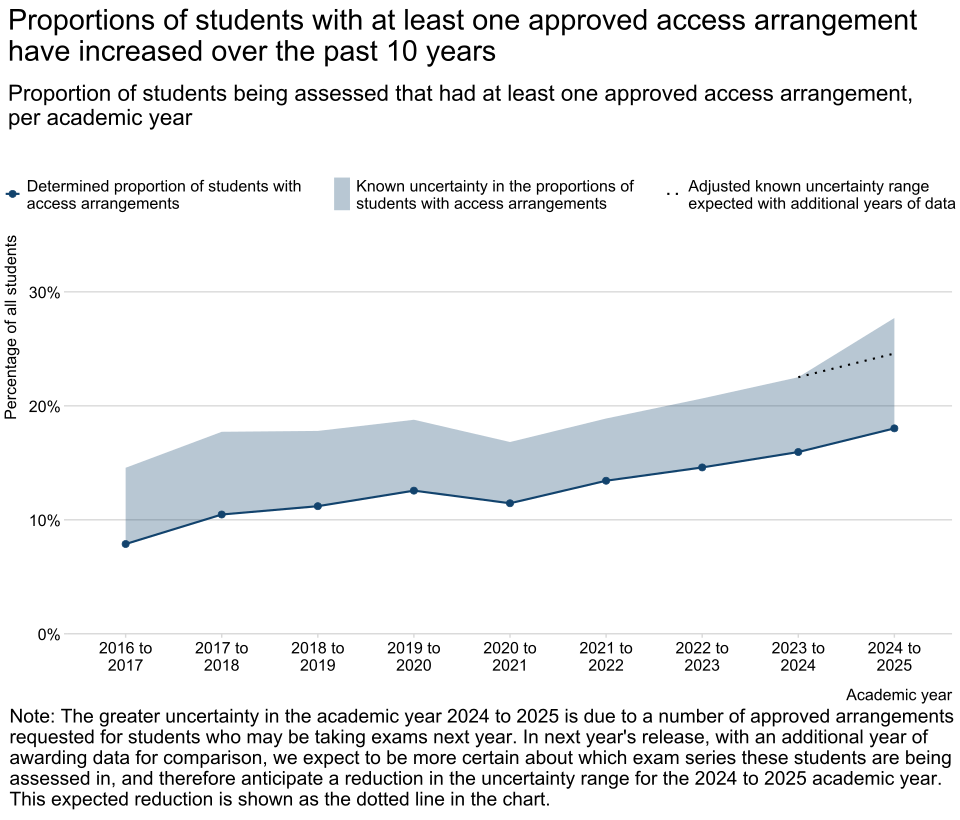
Of all students being assessed in at least one qualification in the 2024 to 2025 academic year, 18.0% to 27.7% of students had at least one access arrangement valid for use in that year.
-
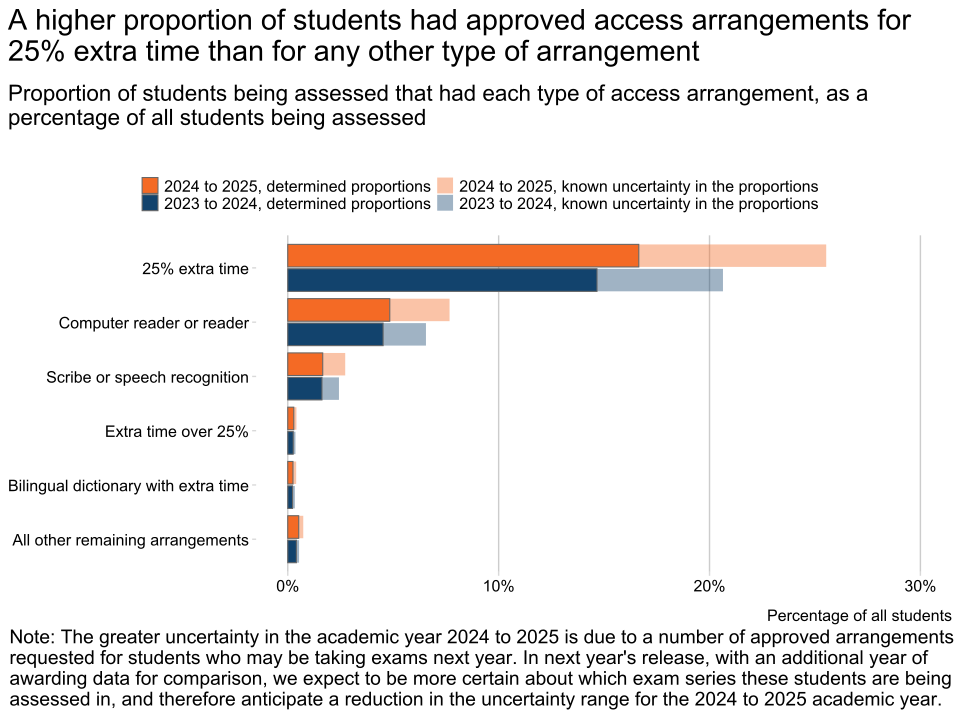
Arrangements for 25% extra time were granted for 16.6% to 25.5% of all students being assessed in 2024 to 2025, compared with 14.7% to 20.6% of students in 2023 to 2024.
-
In independent schools and colleges, 22.4% to 32.1% of students had an arrangement for 25% extra time in the 2024 to 2025 academic year. This compares with 14.6% to 22.0% of students in state-funded secondary schools.
-
In total, 5,567 to 5,769 centres (92.4% to 95.8% of all centres) had at least one student being assessed during the 2024 to 2025 academic year with at least one valid access arrangement, compared with 5,498 to 5,697 centres (92.2% to 95.5% of all centres) in the 2023 to 2024 academic year.
-
There were 65,910 requests for modified papers fulfilled in summer 2025, compared with 69,095 requests fulfilled in 2024 (a decrease of 4.6%). This decrease is largely due to WJEC no longer requiring centres to make a request for non-interactive electronic papers. The most popular type of modified paper in summer 2025 was 18-point bold papers with 25,850 requests fulfilled, 39.2% of all requests fulfilled.
Proportions of students with at least one approved access arrangement
In the 2024 to 2025 academic year, 18.0% to 27.7% (256,790 to 394,785 students) of all students being assessed in at least one qualification had at least one access arrangement valid for use. This compares with 15.9% to 22.5% (222,345 to 313,880 students) of all students being assessed that had access arrangements in the 2023 to 2024 academic year.
The shape of the trends reported over time shows a dip in the academic year 2020 to 2021. The reason for this change could be due to the early cancellation of the summer exams in 2021 due to the COVID-19 pandemic. The decision to cancel the summer exams and to instead award teacher assessed grades was announced before the deadline for submitting applications for access arrangements. Increasing trends resumed from the academic year 2021 to 2022.
Figure 1. Proportion of students with at least one approved arrangement valid for use in each academic year
Note:
For the 2015 to 2016 academic year, we do not hold the data needed to reliably determine the total number of students assessed and are therefore unable to calculate reliable proportions of students with access arrangements for that year. In the chart, we do not show student proportions for 2015 to 2016, and in the table, we use “[x]” to indicate that these proportions are not available. This does not prevent us from calculating the range for the number of students with access arrangements, however, and so these are shown in the table below.
| Academic year | Lower bound of percentage of all students, % | Upper bound of percentage of all students, % | Lower bound of number of students | Upper bound of number of students |
|---|---|---|---|---|
| 2015 to 2016 | [x] | [x] | 99,930 | 204,320 |
| 2016 to 2017 | 7.9 | 14.6 | 110,820 | 204,955 |
| 2017 to 2018 | 10.5 | 17.7 | 136,490 | 231,170 |
| 2018 to 2019 | 11.2 | 17.8 | 147,435 | 234,420 |
| 2019 to 2020 | 12.6 | 18.8 | 162,240 | 242,590 |
| 2020 to 2021 | 11.5 | 16.8 | 147,885 | 217,300 |
| 2021 to 2022 | 13.4 | 18.9 | 171,410 | 241,100 |
| 2022 to 2023 | 14.6 | 20.6 | 192,745 | 272,700 |
| 2023 to 2024 | 15.9 | 22.5 | 222,345 | 313,880 |
| 2024 to 2025 | 18.0 | 27.7 | 256,790 | 394,785 |
Most common types of access arrangements
In this section, we report the top 5 most common types of approved access arrangements valid for use in the 2024 to 2025 academic year which were granted through the Joint Council for Qualifications’ (JCQ’s) Access Arrangements Online system (detailed in JCQ’s guidelines).
Access arrangement types that are not included in the top 5 most common types are aggregated under the category ‘all other remaining arrangements’. Within this category, each student is counted only once, even if they have approvals for multiple access arrangement types included in the group.
Proportions of students with approved arrangements, by arrangement type
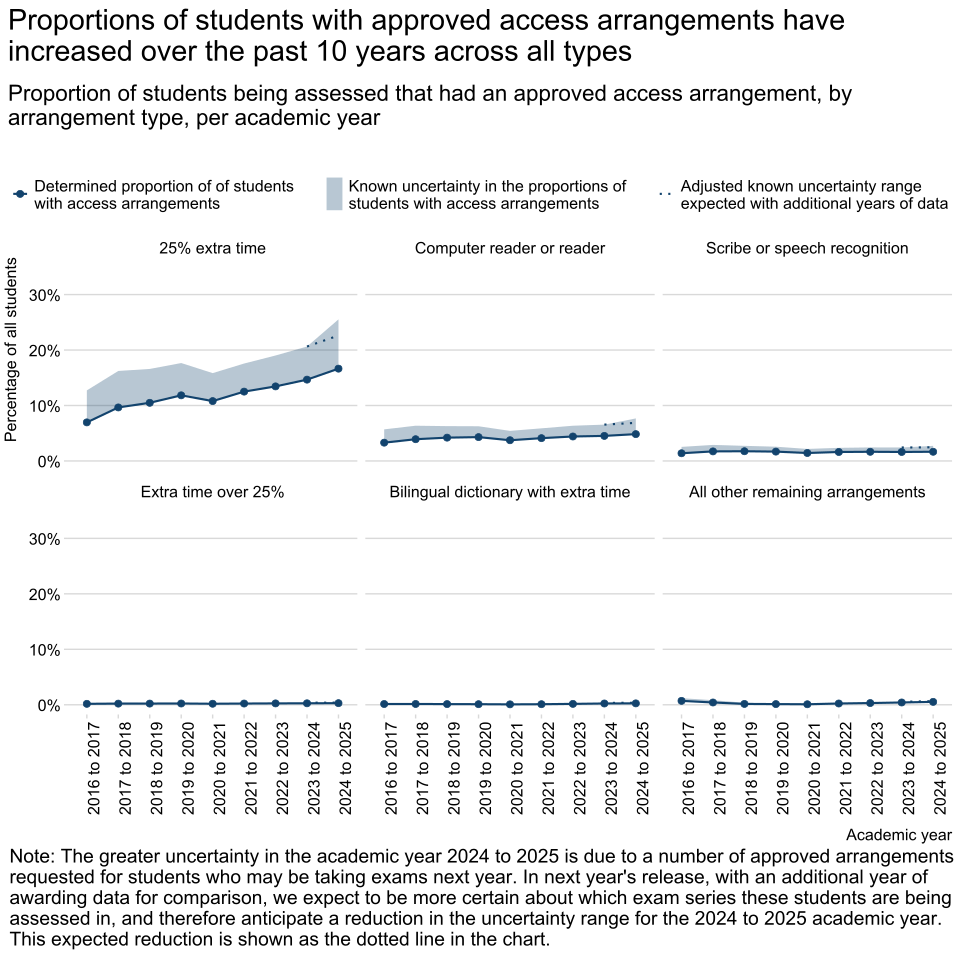
The 5 most common types of access arrangements in the 2024 to 2025 academic year were:
-
25% extra time arrangements approved for 16.6% to 25.5% of all students being assessed (between 237,185 and 363,820 students). This compares with 14.7% to 20.6% (204,480 to 287,760 students) in the 2023 to 2024 academic year.
-
computer reader or reader arrangements approved for 4.8% to 7.7% of all students being assessed (between 68,935 and 109,320 students). This compares with 4.5% to 6.6% (63,030 to 91,375 students) in the 2023 to 2024 academic year.
-
scribe or speech recognition arrangements approved for 1.7% to 2.7% of all students being assessed (between23,625 and 38,815 students). This compares with 1.6% to 2.4% (22,615 to 33,850 students) in the 2023 to 2024 academic year.
-
extra time over 25% arrangements approved for 0.3% to 0.4% of all students being assessed (between 4,070 and 5,860 students). This compares with 0.3% to 0.4% (3,610 to 5,080 students) in the 2023 to 2024 academic year.
-
bilingual dictionary with extra time arrangements approved for 0.2% to 0.4% of all students being assessed (between 3,515 and 5,680 students). This compares with 0.2% to 0.3% (3,150 to 4,665 students) in the 2023 to 2024 academic year.
‘All other remaining arrangements’ were approved for 0.5% to 0.7% of all students being assessed (between 7,400 and 10,475 students), compared with 0.4% to 0.5% (5,700 to 7,460 students) in the 2023 to 2024 academic year.
Further information on all arrangements, including a further breakdown of ‘all other remaining arrangements’, is given in the accompanying data tables.
Please note that more than one type of access arrangement can be granted per student, meaning that an individual student may contribute to the figures for multiple arrangement types.
Figure 2. Proportions of students with approved access arrangements by type over time
Note:
As explained in the note for Figure 1, proportions of students with access arrangements are not available for the 2015 to 2016 academic year. Therefore, we show only the range for the number of students with access arrangements for this academic year in the accompanying data tables
Figure 3 below presents Figure 2 in a different way, to facilitate easier comparisons between arrangement types in the past 2 years.
Figure 3. Proportions of students with approved access arrangements by type, for the 2023 to 2024 and 2024 to 2025 academic years
| Academic year | Access arrangement | Lower bound of percentage of all students, % | Upper bound of percentage of all students, % | Lower bound of number of students | Upper bound of number of students |
|---|---|---|---|---|---|
| 2024 to 2025 | 25% extra time | 16.6 | 25.5 | 237,185 | 363,820 |
| 2023 to 2024 | 25% extra time | 14.7 | 20.6 | 204,480 | 287,760 |
| 2024 to 2025 | Bilingual dictionary with extra time | 0.2 | 0.4 | 3,515 | 5,680 |
| 2023 to 2024 | Bilingual dictionary with extra time | 0.2 | 0.3 | 3,150 | 4,665 |
| 2024 to 2025 | Computer reader or reader | 4.8 | 7.7 | 68,935 | 109,320 |
| 2023 to 2024 | Computer reader or reader | 4.5 | 6.6 | 63,030 | 91,375 |
| 2024 to 2025 | Extra time over 25% | 0.3 | 0.4 | 4,070 | 5,860 |
| 2023 to 2024 | Extra time over 25% | 0.3 | 0.4 | 3,610 | 5,080 |
| 2024 to 2025 | Scribe or speech recognition | 1.7 | 2.7 | 23,625 | 38,815 |
| 2023 to 2024 | Scribe or speech recognition | 1.6 | 2.4 | 22,615 | 33,850 |
| 2024 to 2025 | All other remaining arrangements | 0.5 | 0.7 | 7,400 | 10,475 |
| 2023 to 2024 | All other remaining arrangements | 0.4 | 0.5 | 5,700 | 7,460 |
Proportions of students with approved arrangements, by arrangement type and centre type
Exam boards report where a student had their final qualification assessment with a centre identifier that comes from the National Centre Number (NCN) register. The centre types reported within this release combine categories defined in the NCN register as well as those defined in the Get Information about Schools (GIAS) register..
GIAS centre categories include independent school, independent special school, non-maintained special school, state-funded secondary, state-funded special school establishment and state-funded alternative provision (AP) school. NCN centre categories include further education establishment and ‘other’. There is also an ‘unknown’ category assigned to centres that could not be categorised in any of the types listed above.
Please see the background information notes accompanying this report for more information on centre type categories.
For students being assessed in the 2024 to 2025 academic year:
-
the most common approved access arrangement in all centre types was 25% extra time (ranging from 9.1% to 18.5% of all students being assessed in ‘other’ centres to 74.0% to 100.0% of all students in non-maintained special schools).
-
the second most common access arrangement for all centre types was computer reader or reader (ranging from 1.8% to 3.2% of all students being assessed in ‘other’ centres to 34.1% to 63.7% of all students in non-maintained special schools).
-
scribe or speech recognition was the third most common access arrangement for all centre types (ranging from 0.9% to 1.5% of all students being assessed in ‘other’ centres to 25.7% to 52.6% of all students in non-maintained special schools).
In independent schools and colleges, 22.4% to 32.1% of students had an arrangement for 25% extra time in the 2024 to 2025 academic year. This compares with 14.6% to 22.0% of students in state-funded secondary schools.
Further information on other arrangements by centre type is given in the accompanying data tables.
Figure 4. Proportions of students with approved arrangements valid for use in each academic year, by type of arrangement and centre type

Notes:
Due to uncertainties present within the data as described above, and the methodology used to account for this uncertainty, the upper bounds of proportions for some arrangement and centre type combinations exceeded 100%. These have been capped at 100% for the purposes of reporting.
The ‘other’ centre type includes, but is not exclusive to, pupil referral units (PRUs), prison or hospital schools, language schools, tutorials centres, higher education institutions, distance learning providers providing part-time teaching only and private examination centres accepting private candidates who they have not taught, all non-DfE registered centres.
Number of modified papers provided to centres
Centres request some types of modified question papers in advance of a specific exam series. Exam boards prepare modified papers for students with, for example, visual impairments or significant language comprehension disorders to allow them to demonstrate their skills, knowledge and understanding.
While modified papers can be used for exams in any exam series, Ofqual only reports data on the summer exam series.
Figures reported here only include those modified papers which have been provided by exam boards to centres. Other types of modified papers may be produced by the centres themselves and are therefore not reported here. Note that there has been some variation over time in the exam boards’ requirements for ordering modified papers.
In addition, these figures only relate to the number of modified papers requested, not the number of modified papers that were necessarily used during an exam series. Students may have multiple types of papers available to them and may choose to use one, or multiple types of modified paper, or the standard question paper during their actual assessment.
A request for a modified paper is made for each individual exam paper, whereas for the other types of access arrangements included in this release one request is made for each student for use across all their exams. This means that an individual student can have multiple modified papers made available to them in a single exam series. The figures reported in this section are also only for the summer exam series, whereas the rest of the data reported in this release covers the whole academic year. For these reasons, data for modified papers is presented separately from the other access arrangements in this report.
Due to the cancellation of exams in summer 2020 and 2021, there is no data on modified papers for these series.
Number of modified paper requests fulfilled over time
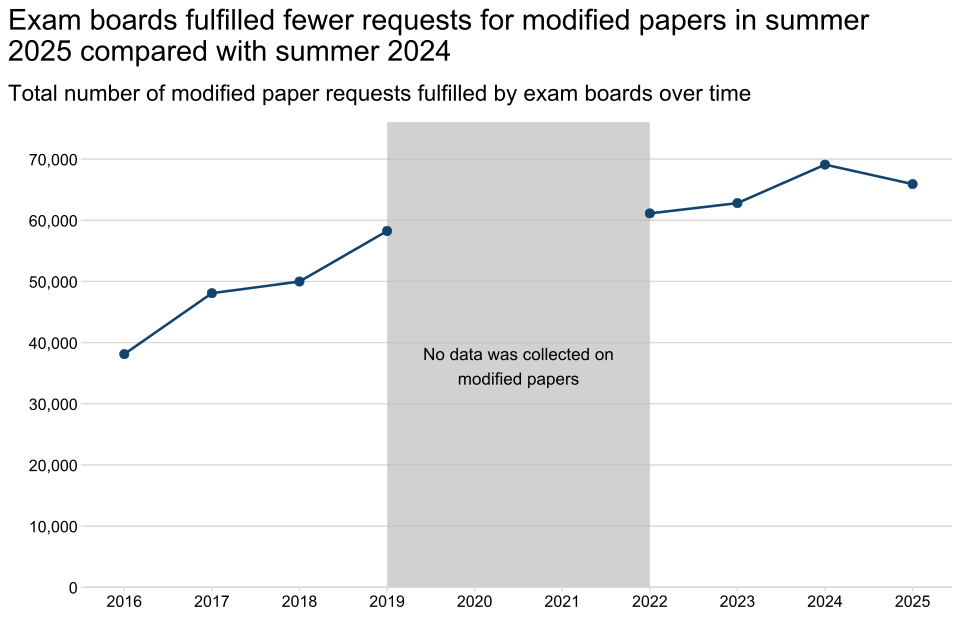
There were 65,910 requests for modified papers fulfilled by exam boards for modified papers in summer 2025, a decrease of 4.6% compared with summer 2024. This decrease is largely due to WJEC no longer requiring centres to make a request for non-interactive electronic papers. The number of unique modified question papers produced by exam boards in summer 2025 was 3,655, compared with 2,555 in summer 2024.
The number of modified question paper requests fulfilled for the summer 2025 exam series (65,910) was small in relation to the 18.2 million standard papers used in the same series. Again however, figures reported here do not include modified papers produced directly by schools and colleges.
Figure 5. Total number of modified paper requests fulfilled by exam boards over time
| Summer exam series | Number of modified paper requests fulfilled |
|---|---|
| 2016 | 38,115 |
| 2017 | 48,080 |
| 2018 | 49,985 |
| 2019 | 58,245 |
| 2022 | 61,125 |
| 2023 | 62,805 |
| 2024 | 69,095 |
| 2025 | 65,910 |
Most common types of modified papers
In summer 2025, ‘18-point bold papers’ was the most common type of modified paper, with 25,850 requests fulfilled by exam boards, 39.2% of all modified paper requests fulfilled in summer 2025. This compares with summer 2024, when 23,340 requests for 18-point bold papers were fulfilled, 33.8% of all modified paper requests fulfilled in summer 2024.
‘Remaining formats’ in the charts below include less frequently used modified papers, such as modified language, transcripts of listening test or video, and other formats. The ‘other’ format includes types of modified papers not included in any of the other types mentioned.
Further information on all modified paper formats, including a further breakdown of ‘remaining formats’, is given in the accompanying data tables.
Figure 6. Modified paper requests fulfilled by exam boards for each summer series, by type of modified paper
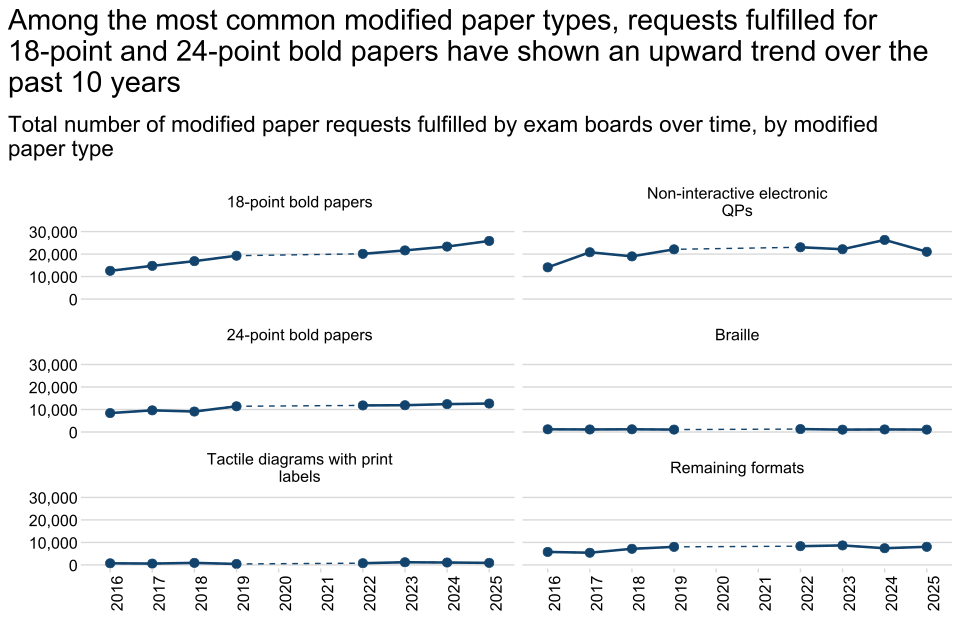
Figure 7. Modified paper requests fulfilled, by type of modified paper, as a percentage of all modified paper requests fulfilled by exam boards
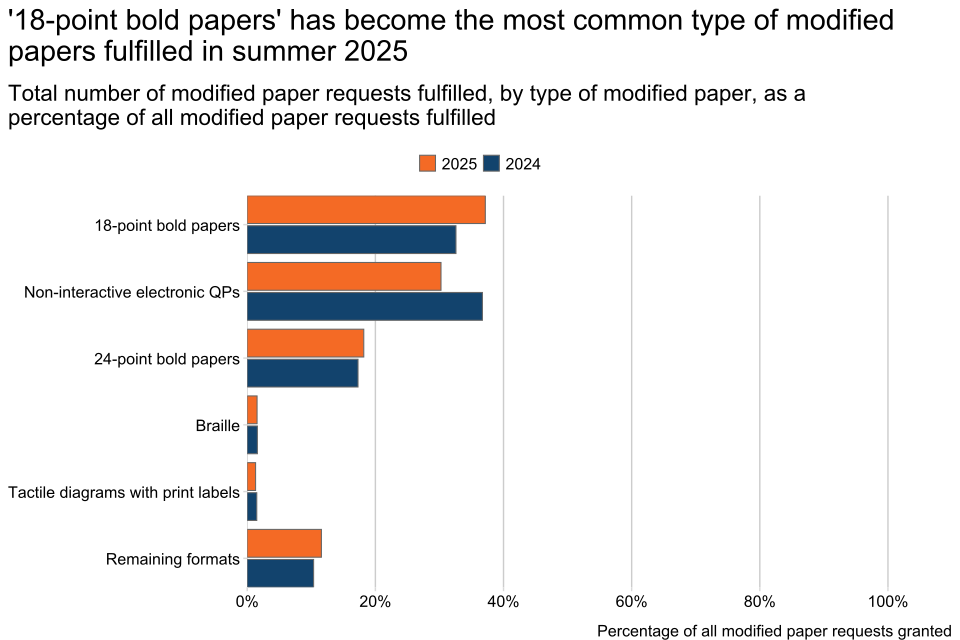
| Summer exam series | Type | Total | Percentage, % |
|---|---|---|---|
| 2024 | 18-point bold papers | 23,340 | 32.6 |
| 2025 | 18-point bold papers | 25,850 | 37.2 |
| 2024 | Non-interactive electronic QPs | 26,300 | 36.7 |
| 2025 | Non-interactive electronic QPs | 21,040 | 30.2 |
| 2024 | 24-point bold papers | 12,385 | 17.3 |
| 2025 | 24-point bold papers | 12,655 | 18.2 |
| 2024 | Braille | 1,135 | 1.6 |
| 2025 | Braille | 1,065 | 1.5 |
| 2024 | Tactile diagrams with print labels | 1,065 | 1.5 |
| 2025 | Tactile diagrams with print labels | 905 | 1.3 |
| 2024 | Remaining formats | 7,420 | 10.4 |
| 2025 | Remaining formats | 8,055 | 11.6 |
Contextual information
In the 2020 to 2021 academic year, the decision to cancel summer exams and instead award teacher assessed grades (TAGs) was announced before the deadline for submitting applications for access arrangements. While centres were still encouraged to apply for access arrangements for their students as normal, the 2020 to 2021 academic year figures would likely have been higher if the summer exams had gone ahead. Also, because no exams took place in summer 2020 and 2021, there are no figures for modified papers for those years.
Access arrangements are the provisions made for students, agreed before they are assessed, to ensure that they can be validly assessed and are not unfairly disadvantaged due to a disability, temporary illness or injury or if their first language is not English. Any student with a disability as defined by the Equality Act 2010 (who has a physical or mental impairment that has a substantial and long-term negative effect on their ability to do normal daily activities) is legally entitled to reasonable adjustments, which are a form of access arrangement.
Access arrangements should not be confused with post-examination adjustments to the marks of students who have not been able to demonstrate their level of attainment in an exam due to exceptional circumstances, such as bereavement or illness at the time of the exam. These post-examination adjustments are covered in a separate report on special consideration.
Any students entered for GCSE, AS or A levels who meet the exam boards’ eligibility criteria can receive an access arrangement. Individual students may require more than one form of access arrangement. According to JCQ guidelines, once granted, an access arrangement for a long-term condition will be valid for up to 26 months, although applications based on temporary conditions will last for one exam series only.
While other types of arrangement can be implemented without needing exam board approval, the data in this release only cover those access arrangements granted by exam boards, and modified papers that have been provided to schools and colleges by exam boards (detailed in JCQ guidelines).
In this release, all figures are rounded to the nearest 5 to ensure confidentiality of the data. Further information on this release is available in the background information as well as the data tables accompanying this report.
Head of profession: Ben Cuff