'What climate security means now' - Foreign Secretary at New York Climate Week
Foreign Secretary address at New York Climate Week's Opening Ceremony, speaking on: 'What climate security means now'
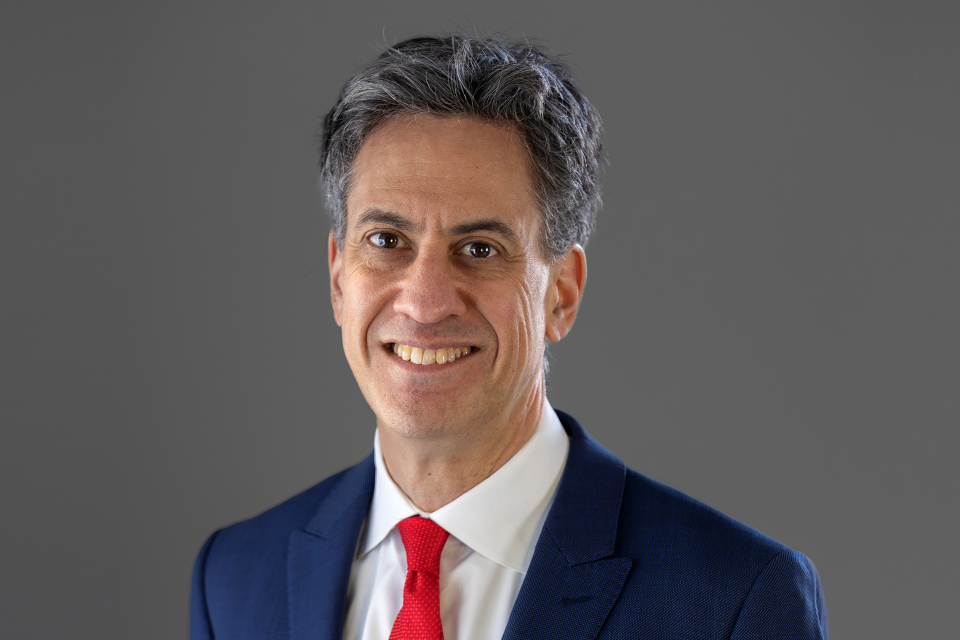
It is really fantastic to be back here at NY Climate Week, I can honestly say to you, this is my second favourite Climate Week in the world, after London of course.
No really, it is fantastic to be here, and look, I think the first thing I want to say is to sound a note of optimism, because despite challenging political times, it is set to be the case that in 2026 we’re going to see $2.2 trillion dollars in clean energy against $1.2 trillion in fossil fuels.
I think that deserves a round of applause, ladies and gentlemen.
I was here last year as the Energy Secretary. I’m now the Foreign Secretary of the United Kingdom, but I come here as passionate about the cause of New York Climate Week, the cause that we are all fighting for.
And I want to make a simple argument to you today, which is that climate and nature loss represents an urgent national security issue and demands action equal to the scale of the challenge, and that it demands a shift in our thinking and a shift in who in government takes an interest and cares about these issues and puts them front and centre.
And I think the history on this is instructive, like many people in this room, I’ve been at this some time for the better part of two decades.
Because for many years when I was the Climate Change Secretary in 2008, climate change and the destruction of nature were treated as peripheral environmental issues. Yes, they were seen as important, but they were separate from the core business of economic growth, or indeed energy security.
And over these last two decades, the penny has dropped about the opportunity that the energy transition offers in terms of the good jobs at good wages that so many people in our different countries want to see.
And Russia’s invasion of Ukraine underlined the dependence that so many countries face on fossil fuel markets, the fossil fuel roller coaster, as we call it in the UK. And the situation with Iran, the Iran war has underlined that again. And I think people now see the energy security imperative, the energy independence imperative of clean energy.
But having understood the jobs opportunity and the energy security imperative, my argument to you today is: we need to take the next step and recognize the national security imperative too.
And I think you all know the picture, and it is gloomy, I warn you, but I’m just going to say some of it to you today because we need to be truth-telling about this.
Over 150 million hectares burned globally in the first four months of 2026 alone.
Record extreme heat causing widespread loss of life.
Nepal’s devastating floods happening due to glacial collapse and the coming El Nino, as Prime Minister Albanese said, is already forecast to be the strongest in living memory.
And the nature loss crisis is just as acute, with ecosystems being degraded in every region of the world.
That is the conclusion of the UK’s recent nature security assessment, which you can all read.
This is why. These facts. What is happening in our world. Is why climate breakdown, in my view, must be an issue for foreign ministers and prime ministers, as well as energy and climate ministers. The security community, not just the activist community, the generals, not just the green campaigners.
And once we accept this, several implications follow.
First, we must change how we assess risk. Climate and nature must be embedded in national security systems, in threat assessments, and contingency planning. Countries need to pool information because a shock beginning in one country can rapidly travel through supply chains, financial markets, and migration patterns to other countries.
Second, we have to become better at managing shocks. These shocks that cross borders, better forecasting and early warning systems, more resilient infrastructure, health and food systems, more effective disaster risk finance and insurance. Acting before the crisis hits, rather than simply picking up the pieces afterwards.
Third, and in some ways this is the most important point of all, we cannot avoid some of these effects which we’re already seeing unfolding in our world. But it is up to us how severe they become.
That’s why we all have a responsibility, if we care about national security, if we care about keeping our populations safe, to act as countries against the threat of the climate crisis.
Since we met last year, the UK has passed world-leading and 1.5 degree-aligned carbon budgets for an 87% reduction in emissions by 2040.
We recently announced our intention to invest £400 million in the Tropical Forest Forever facility to support international action to protect tropical forests.
We are driving forward with our world-leading clean power plan for clean power, clean power system by 2030.
These are just some of the things that we are doing.
For us as a government, clean energy, the clean energy mission, is front and centre to our economic policy, our energy security policy, and indeed our national security policy too.
And my pledge to you is that the UK will pursue this national security imperative, and I see my work as Foreign Secretary as being about using our extensive embassy network, our expertise to work with others, starting here at New York Climate Week and at UNGA, at this autumn’s annual meetings at the World Bank and IMF at COP31, and in our G20 presidency next year.
Let me make three points to end on. First, we can do this, and it’s really, really important to say this. If we don’t say it, nobody else is going to.
When I left the Copenhagen climate summit, which didn’t go so well for those of you from your memories, in in 2009 we were heading for a four degree world.
Now we’re heading for something like a two and a half degree world, that is still fierce, fearsome, and deeply, deeply worrying, but it shows that the world has made progress. So we can do this.
Secondly, we must do this because for our generation we have a unique responsibility, and the unique responsibility is this. Which is we know the scale of the problem, it’s not some theoretical future thing that might happen as it was 20 years ago, we see the climate crisis unfolding, but we have time to do something about it. That is why we must do this. We must act.
And finally, we will do this, in my view, because I believe that actually countries all around the world now recognize this threat, and they recognize that we can only solve it acting together.
Last year, when I was here, I said, “don’t give up on multilateralism”, and I think the countries across the world are not giving up on multilateralism. So many countries, I mean, so many foreign ministers and others, I mean, know that no country can tackle climate change on its own, but we can do it together.
So, friends, this is about what makes our country safe. This is about what makes our economies strong, and this is about what will sustain our planet and our people for future generations to come. Please enjoy New York Climate Week. Thank you so much.