The UK will defend universal rights without fear or favour: UK Statement at the UN Third Committee
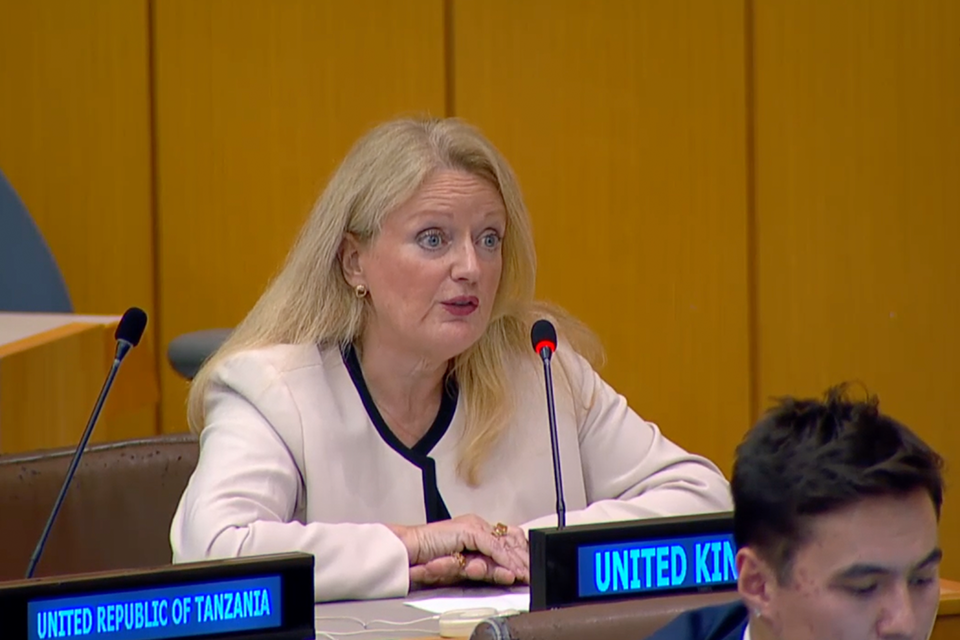
Statement by Ambassador Sarah MacIntosh, UK Permanent Representative to the UN, at the UN Third Committee on Human Rights.
Across the world, people are being denied their human rights through conflict, repression, discrimination, and the misuse of power and technology.
The principles that we defend in this Committee are not abstract.
They protect human dignity, support peaceful and inclusive societies, and help to prevent instability and conflict.
At a time of growing pressure on human rights and on the multilateral system, we must
turn our shared commitments into practical change for people.
Yet the human rights landscape is becoming more dangerous.
Attacks on women, girls and LGBT+ people, and shrinking civic space are compounding the effects of conflict and authoritarian repression.
Our response must put human rights and the rule of law at its heart.
In Gaza, basic humanitarian needs remain unmet.
All parties must uphold international law, protect civilians, and facilitate rapid and unimpeded humanitarian access.
We condemn abuses by Hamas and other non-state actors.
Hamas must decommission its weapons and its terror infrastructure and have no role in Gaza’s future governance.
We support full implementation of the 20-Point Plan.
And we remain committed to a credible political process towards a two-state solution.
In the West Bank, settlement expansion, settler violence, and displacement are
undermining that prospect for a two-state solution.
The UK has taken recent action to address this priority, including restrictions targeting settlement activity and those who support, facilitate, or profit from it.
We call on all parties to uphold international law, protect civilians, and facilitate humanitarian access.
In Ukraine, five years into Russia’s full-scale invasion, the human cost continues to grow.
The United Nations’ independent monitoring and investigative mechanisms are essential.
Russian forces have attacked civilian infrastructure, tortured detainees and prisoners of war, and unlawfully deported and militarised Ukrainian children.
Russia must be held accountable, and Ukraine’s sovereignty, independence, and territorial integrity must be upheld.
In Sudan, civilians face atrocity crimes, conflict-related sexual violence, displacement, and hunger.
The illegal flow of weapons and external support is sustaining that conflict.
All states must stop supporting the warring parties, respect international humanitarian law and use their influence to protect civilians, secure humanitarian access, and end the violence.
The UN Fact-Finding Mission must continue its vital work to preserve evidence and lay the foundations for accountability.
In South Sudan, renewed political tensions, attacks on civilians, forced recruitment, sexual violence, and restrictions on political space threaten stability and risk a return to wider conflict.
Leaders must exercise restraint, pursue genuine, inclusive dialogue, and respect the commitments of the peace agreement.
In Myanmar, we condemn human rights violations and abuses, particularly those committed by the military, including airstrikes on schools, hospitals, and places of worship.
We continue to support efforts to collect and preserve evidence so that perpetrators can be held to account.
In Syria, we welcome the steps taken by the Syrian government to make progress on her
political transition, including convening a new Parliament, and the steps taken
to ensure accountability and transitional justice both for Assad-era crimes and recent incidents of sectarian violence.
We continue to encourage the Syrian Government to ensure an inclusive and representative political settlement that protects the rights of all Syrians, and holds those responsible for human rights abuses and violations to account.
This is essential for the long-term stability and prosperity of the Syrian people.
In Afghanistan, Taliban decrees systematically exclude women and girls from education, work, and public life, restrict access to justice, and entrench discrimination against religious and ethnic minorities.
These policies are indefensible.
And the Taliban must reverse them.
In Iran, thousands of peaceful protesters were killed by security forces in January.
Protesters have since been executed, and many more remain on death row.
Reports of torture and ill-treatment, including of women, ethnic minorities, and religious communities, are deeply concerning.
Iran must end her violent suppression of dissent, establish a moratorium on executions, and cooperate with UN accountability mechanisms.
Beyond conflict, governments are also using technology, law, and state power to silence dissent.
In China, evidence of violations in Xinjiang and Tibet persists.
The Ethnic Unity Law risks entrenching restrictions on the rights and freedoms of ethnic minorities.
China should implement the recommendations of the 2022 assessment, release those arbitrarily detained, address reports of forced labour, and allow meaningful independent access to Tibet.
In Hong Kong, recent convictions underscore how the National Security Law is being used to restrict political expression.
Earlier this year, Jimmy Lai was sentenced to 20 years in prison; we call for his release.
Mr President, in these country contexts and elsewhere, civil society and human rights defenders turn commitments into change.
But they face intimidation, reprisals, and transnational repression, including for cooperating with the United Nations.
The United Kingdom unequivocally condemns such retaliation.
We are proud to support the Lighthouse Fund, providing protection for human rights defenders under threat.
We will also continue to defend the rights of women and girls globally.
This includes tackling all forms of violence against women and girls and promoting comprehensive sexual and reproductive health and rights.
We will champion women’s economic empowerment and their full, equal, and meaningful participation in public life and in decisions on peace and security.
Human rights are universal.
They apply equally to every person, including lesbian, gay, bisexual, transgender, and other LGBT+ people.
No one should face violence, criminalisation, or exclusion because of who they are, or who they love, or how they express themselves.
At a time of pressure on the UN human rights system, the answer is not to lower our ambition.
It is to focus the system where it adds unique value: through independent scrutiny, through credible evidence, through accountability, and through protection for those whose voices are silenced.
The United Kingdom will listen, act, and work with partners from every region.
And we will defend universal rights without fear or favour because defending human dignity is the surest way to build a safer and a fairer world.