Nuclear 2025 conference: Energy Secretary speech
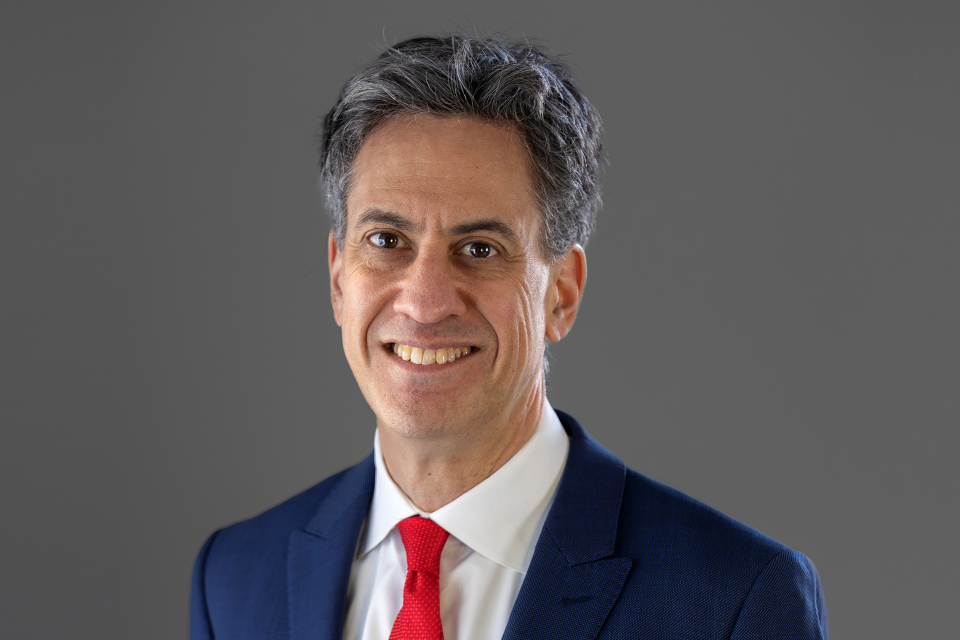
Energy Secretary Ed Miliband spoke at the Nuclear Industry Association's Nuclear 2025 conference.
Thank you, Tom [Greatrex] for that kind introduction.
If you think about where we are now compared to where we were 9 years ago, it’s extraordinary the journey that the industry has been on – and Tom you deserve a huge amount of credit for your advocacy, for your persuasiveness, and your championing of the industry.
I also want to say you are in very safe hands with your new Chair Iain McNicol. [political content removed]
Iain your speech was incredibly moving and evocative and a brilliant testimony to what this industry does. Whether it’s a good thing that the industry made it possible for you to go into student politics I’ll let the audience take a view on. But you spoke really brilliantly about this industry.
I think we should take huge pride from the fact this is the biggest NIA conference ever. That deserves a big round of applause.
That is the sign of the renaissance of this industry.
I want to thank you all because you are brilliant champions of this industry.
Obviously I addressed this conference as Tom said this time last year, less than 6 months into our time in office.
Looking back at where we are now compared to where we were then, we have achieved a huge amount together.
And that’s what I want to talk about today.
About the golden age of nuclear that we are building together.
Why it matters so much to Britain, to our country – and it speaks a lot to what Iain said actually.
And what comes next in this partnership as we seek to maximise the opportunities that nuclear presents.
Let me start by reflecting on the developments of the last 12 months.
At the Spending Review earlier this year the Chancellor committed to and invested in the biggest nuclear building programme our country has seen in half a century—including Sizewell C, SMRs, and fusion.
People have been talking about Sizewell C for decades. And I see Nigel here and Julia is either on her way or here and they are doing an outstanding job.
It was when I was Energy Secretary that I identified Sizewell C as a potential site for new nuclear in the late 2000s.
It has taken 16 years, but I am incredibly proud that thanks to the decision that the Chancellor took in the Spending Review we have been able to invest in the project, and it reached the landmark milestone of financial close.
And now we are getting on and building it.
2,000 workers are already on site each day.
And nearly 100 apprentices have been recruited.
I spoke to one of those apprentices a few months ago.
Honestly it was such an inspiring conversation. He was so excited about what he was doing.
A good job near his hometown.
Doing right by future generations and helping to secure the energy we need.
And what is so inspiring to me about the project is that there will be many, many more like him working on it.
1,500 apprentices and 10,000 jobs at peak construction.
Figures published today show that Sizewell C could cut the local unemployment rate by a third at peak construction.
That is a sign, an indication of what the nuclear industry can do for our country.
It is important we narrate this story – this impact will go far beyond the local area, supporting thousands of companies—from steelmaking in the Rhonda to welding in Hull to enrichment at Urenco in Cheshire.
It has already delivered over £2.8 billion in contracts with UK suppliers.
With billions more to come. That is why I think Sizewell C is such an important project.
Small modular reactors too are part of the incredibly exciting future that we are building.
The next frontier of nuclear power.
Again talked about for many years but not delivered.
In the 12 months since I was last at this conference:
We’ve allocated the investment for our SMR programme, with over £2.5 billion over the Spending Review period.
I’m incredibly proud of the work that Great British Energy-Nuclear is doing.
Obviously in the competition that it had it chose Rolls Royce SMR, a British company, as the preferred bidder—and I want to pay tribute to Simon Bowen the Chair of GBE-N and perhaps you could join me in showing your appreciation of the work they are doing.
And of course, we’ve identified the location for the first project, harnessing the UK’s prime nuclear site at Wylfa.
And next year work will begin on site.
This speaks to what Iain was saying earlier.
This represents the most significant investment in North Wales in a generation, bringing nuclear back to Wylfa a decade since its last plant shut.
And you know I was there with the Prime Minister and the Chancellor a couple of weeks back and it was so obvious what this meant to North Wales from our visit.
There were young people there, like Iain’s story, who said their parents had worked at the plant but didn’t think they would ever get a job in nuclear. And now they saw that it was possible.
For that community this meant so much.
The project again is estimated to create 3,000 jobs in construction and many thousands more in the supply chain.
With the potential for up to 8 SMRs on the site over the longer term.
Alongside the work we are doing to drive forward getting Hinkley Point C built, Sizewell C and our SMR programme will together bring more nuclear capacity onto the grid than in the last half century combined. That is the scale of what we’re doing together.
And we are proud to have taken decisions also to invest in fusion, as we seek to realise the potential it offers for energy security in the future and jobs, growth and innovation today.
We announced another £2.5 billion of public investment for fusion at the Spending Review.
Backing the UK’s expertise at the UK Atomic Energy Authority in Culham.
And delivering the STEP programme—with the first fusion plant of its kind on the site of a former coal fired power station at West Burton in Nottinghamshire.
Again a sign of what the clean energy future can bring.
Creating opportunities for our industrial communities as we lead in the technologies of the future.
This is the first part of my remarks – by any measure, this is a nuclear renaissance for Britain.
The second part of my remarks is about why this nuclear renaissance is so important.
I want to say something broader even than the work of the industry – the number one challenge facing families across this country, I think we know this, is the longstanding affordability crisis.
It is deep rooted and stretches back to the financial crisis.
[political content removed]
Part of the answer to tackling the affordability crisis is things like what the Chancellor did in the budget, the decision to take £150 of costs off energy bills from next April.
Part of it is about making sure that we have the clean homegrown power that we need.
We all know what our exposure to international fossil fuel markets does to our energy insecurity.
That’s why building up our sovereign capability in clean, homegrown power—renewables and nuclear – is so important.
I will say in passing that when we look to electricity in the future it is going to at least double by 2050 as we seize the opportunities of electrification and new industries like AI, as your report said earlier this week, we need to drive forward with all the clean power resources at our disposal.
Going back to my point about my constituency, this is why the nuclear industry is so important.
Because people are saying where are these good jobs and you are answering this question.
[shows map] I absolutely love this jobs map – the staff and everyone at the NIA deserve massive congratulations for having produced it because it shows so clearly what the industry is doing.
98,000 jobs already across the civil nuclear supply chain.
Up by over 10% in the last year alone.
More than four out of five jobs outside London and the South East, as Iain said.
And it is not just about the fact that it is supplying jobs, but the quality of jobs as well.
High skilled, well paid, highly productive.
With decent rights at work, a proper role for trade unions, and a proud record of social partnership.
A model in my view for the rest of the economy.
And I also want to recognise the push for greater diversity in the industry, championed by the brilliant organisation Women in Nuclear which does an amazing job.
It is for all these reasons that the importance of our energy security, the importance of the good jobs we need, the importance of tackling the climate crisis, that nuclear is at the heart of our industrial strategy.
And why it was at the centre of our Spending Review settlement.
And in a sense I think we can learn from what we’re doing in the nuclear industry because what we are doing in Britain is what most other countries have done for a long time.
Which is back the industries where we can lead, with a proper industrial policy supported by public investment to ensure that we reap the benefits.
And that’s what we are doing in nuclear, from driving forward on new nuclear to harnessing our expertise in decommissioning to investing in advanced fuel manufacturing.
And my only ask of you is we squeeze every pound out for communities across the country.
We are not neutral about where things are made and built. We want it built in Britain. It can’t be every pound but I want as many of the pounds that we’re spending as possible to be spent in Britain.
We welcome the ambitious targets for domestic content in major projects like Hinkley and Sizewell—with Hinkley exceeding its original goal.
And whether it’s investing in skills and apprenticeships to support the Nuclear Skills Plan, driving research and innovation, or supporting our brilliant manufacturers, engineers, and supply chain, I believe we can work together to deliver these opportunities for Britain.
So, first I think we’ve done a lot, second this is why it matters.
The third part of my remarks is perhaps the most important - about where we want to take this partnership next.
And my most important message to you is: we are not resting on our laurels.
We have only just begun when it comes to our ambitions for new nuclear in the UK.
When you think about the demands of electricity, there is so much more this industry can do.
And that’s what I want to do in the final part of my remarks.
First, I want to talk about privately led routes to market.
We saw with the agreements between UK and US energy firms earlier this year the huge appetite there is from industry to deploy technologies like advanced modular reactors and SMRs.
At the time of the state visit with President Trump it was incredibly exciting to see these proposals right around the country—from AMRs fuelling industry in Hartlepool, to SMRs powering data centres in Nottinghamshire, to building one of the world’s first micro reactors in Essex.
We are determined to deliver on the promise of these technologies.
And we are soon going to publish – you won’t have to wait too long I hope - publish a framework for privately funded advanced nuclear projects.
As we set out at the Spending Review, GBE-N has been tasked with assessing proposals, working with the National Wealth Fund and helping government break down the barriers.
And the government will use GBE-N’s assessment to give early “in principle” endorsements that can help credible privately led projects mobilise the capital they need.
We are really serious about these privately-led routes to market and that’s what our framework will provide.
But in a way the framework will bless what we are already trying to do with Simon, the National Wealth Fund and others, and my absolute injunction to Simon is: speed really matters, we don’t want to hang around, there is a global race on and we want to win the global race.
Second, on siting and planning.
The nuclear planning framework hasn’t been updated for nearly 15 years.
So we are reforming planning rules as you know to expand the areas where projects can be built beyond the 8 existing sites and include technologies like SMRs and AMRs for the very first time.
The new framework was laid in parliament last month and is due to come into effect later this year.
Taking advantage of this new framework, I have commissioned GBE-N to identify suitable sites across the UK that could potentially host another large-scale nuclear project, including in Scotland.
That will report back by Autumn next year to inform future Spending Reviews.
And this will align with the Strategic Spatial Energy Plan which will also be published next year and will inform our future nuclear building programme into the 2030s and beyond.
Third, on regulation, the Nuclear Regulatory Taskforce report shows how we can build nuclear quickly, affordably and safely.
I want to say to you I am so proud we commissioned this review, and I want to profoundly thank John Fingleton and his team for the work they did.
Our starting point is that you can’t have energy sovereignty and abundance without making it easier to build things in this country.
And as the Prime Minster said on Monday, we are accepting the Fingleton recommendations.
We think the principle of all of them is right and we are determined to make building nuclear power quicker and cheaper.
My department has already begun implementing recommendations in the review, including on risk management and proportionality.
And the government will produce our full implementation plan within three months.
I think there is an important lesson in the Fingleton review for our wider approach to infrastructure.
That if we want prosperity in this country, we have to be prepared to build.
This government is willing to have that discussion with the public. We are willing to have the discussion on renewables and nuclear as well.
If I can put it this way to this audience: the need for homegrown clean energy brings out ones inner YIMBY. I can feel my inner YIMBY coming out.
It doesn’t mean ripping up red tape for the sake of it, or valorising deregulation at all costs.
Appropriate regulation has an important role to play in ensuring safety, environmental protection and accountability.
But let’s be frank about this - we shouldn’t accept the stagnation and delay that is all too often built into our planning system.
Stagnation and delay which does not serve energy security, does not serve jobs and does not serve the British people. And doesn’t serve nature either. Because the biggest threat to biodiversity and nature is not clean energy infrastructure but the climate crisis.
I think this is a really important message.
So on streamlining regulation and more widely, I want you to be clear about our determination to work with you to seize the opportunities of new nuclear for Britain.
We have seen us driving forward over the last 12 months and we want to keep up that pace over the next 12 months and beyond.
The last point I want to make is this:
I hope that over the last 17 months that we have been in office we have demonstrated we are absolutely serious, deadly serious about the role of this industry in our clean energy mission.
And that we are serious about the partnership to make it happen.
The thing that has struck me most in my time doing this job is the incredible ambition of this industry.
I hope you recognise it is an ambition that the government shares.
I said this last year, and I will say it again and it bears repeating:
This is a brilliant industry. Incredibly inspiring.
And I am so excited about everything we have done together, I’m so excited about what we will continue to achieve, and that we will do in the future, as we build a golden age of nuclear for the United Kingdom.
