FOI2026/01029 – Veterinary Safety Communication
Published 12 August 2026

© Crown copyright 2026
This publication is licensed under the terms of the Open Government Licence v3.0 except where otherwise stated. To view this licence, visit nationalarchives.gov.uk/doc/open-government-licence/version/3 or write to the Information Policy Team, The National Archives, Kew, London TW9 4DU, or email: psi@nationalarchives.gov.uk.
Where we have identified any third party copyright information you will need to obtain permission from the copyright holders concerned.
This publication is available at https://www.gov.uk/government/publications/vmd-foieir-requests-may-2026/foi202601029-veterinary-safety-communication
1. Your request
I am writing regarding the recently published peer-reviewed editorial:
von Pfeil DJF et al.
“Emerging Signs of Rapidly Progressive Arthritic Changes in Dogs and Cats Receiving Bedinvetmab and Frunevetmab”
Veterinary and Comparative Orthopaedics and Traumatology (2026)
DOI: 10.1055/a-2846-8347
The publication describes emerging evidence of severe and rapidly progressive arthritic changes associated with anti-NGF monoclonal antibodies, including Librela (bedinvetmab) and Solensia (frunevetmab). Reported findings include severe osteophytosis, periosteal reactions, bone erosion, instability, subluxation, joint collapse, osteolysis, and rapidly progressive destructive arthropathy extending beyond the expected natural progression of osteoarthritis.
The paper additionally documents a feline Solensia case involving severe progressive erosive joint pathology after only two injections, with alternative causes reportedly excluded through diagnostic investigation. Furthermore, the authors reference presentation of 38 canine cases at the Veterinary Orthopedic Society Annual Meeting (March 2026), with reported outcomes including surgical intervention, amputation, euthanasia, and severe deterioration in quality of life.
Given the growing body of peer-reviewed and professional orthopedic discussion regarding these adverse events, the acknowledged similarities to rapidly progressive osteoarthritis concerns previously identified during human anti-NGF monoclonal antibody development, and the reliance on post-marketing pharmacovigilance within veterinary medicine, I respectfully urge the VMD to consider issuing a formal communication or advisory notice to veterinary professionals, similar in principle to the FDA’s ‘Dear Veterinarian’ communication regarding Librela adverse events in the United States. I would also respectfully request consideration of whether the current SPCs/package leaflets for Librela and Solensia remain sufficiently comprehensive and up to date in light of these emerging findings. In particular, additional warnings or precautionary wording regarding rapidly progressive arthropathic changes, severe joint deterioration, instability, erosive changes, osteolysis, and the potential need for prompt reassessment and imaging where unexpected deterioration or “lack of efficacy” occurs may assist both veterinary professionals and pet owners in making fully informed decisions. Moreover, additional awareness may assist clinicians in recognizing potential early signs of rapidly progressive arthropathic changes, understanding the importance of prompt imaging and reassessment where instability or unexpected deterioration occurs, improving adverse event reporting quality and consistency, and ensuring pet owners are appropriately informed of emerging safety concerns and uncertainties surrounding these medications.
Due to the increasing number of reports now being discussed within veterinary orthopedic literature and professional meetings, I would be grateful if the VMD could clarify, whether rapidly progressive osteoarthritic or destructive arthropathic changes associated with anti-NGF monoclonal antibodies are currently being formally monitored as a specific pharmacovigilance signal, and whether the VMD has observed any increase in reports involving severe joint deterioration, instability, osteolysis, erosive changes, or related musculoskeletal adverse events associated with Solensia and/or Librela.
2. Our reply
The VMD constantly reviews adverse event report data to ensure that the overall benefits of each UK licensed veterinary medicine product outweigh the risk posed by their potential adverse events.
While we do not comment on the monitoring of specific pharmacovigilance signals in the manner described, all reported adverse events, including those affecting the musculoskeletal system, are routinely assessed as part of our ongoing pharmacovigilance activities.
2.1 Librela Solution for Injection for Dogs
The published outcome of our assessment of pharmacovigilance data, which was carried out last year for Librela Solution for Injection for Dogs and included assessment of ‘arthritis’ and related terms, can be found at Results of in-depth assessment of selected adverse events for Librela Solution for Injection for Dogs - GOV.UK.
This was shared with veterinary surgeons across the United Kingdom.
As a result of our assessment of the increasing multi-source evidence of a causal association between Librela and these events, an update was made to the product literature for Librela (all strengths) on 20th May 2026 to include the event terms Joint swelling, Joint pain, Bone and joint disorder and Soft tissue ossification. The full SPC can be found at Product Information Database - Home.
On 26th May 2026 we additionally published an urgent/clinically significant safety update; SPC update - Librela Solution for Injection for Dogs - GOV.UK, informing veterinary professionals of the updates made to the SPC.
2.2 Solensia Solution for Injection for Cats
Published information about Solensia pharmacovigilance data can be found at: Solensia 7 mg/ml Solution for Injection for Cats - GOV.UK.
All adverse events submitted to the VMD have their clinical signs coded using the Veterinary Dictionary for Drug Regulatory Activities (VeDDRA). System Organ Class (SOC) is one of the hierarchical levels of VeDDRA. Please be aware that one report may contain more than one animal, and therefore the total number of animals affected may be greater than the total number of reports.
A trend of the number of adverse event reports received since Solensia was authorised, which include events coded to a term within the SOC Musculoskeletal disorders can be seen below:
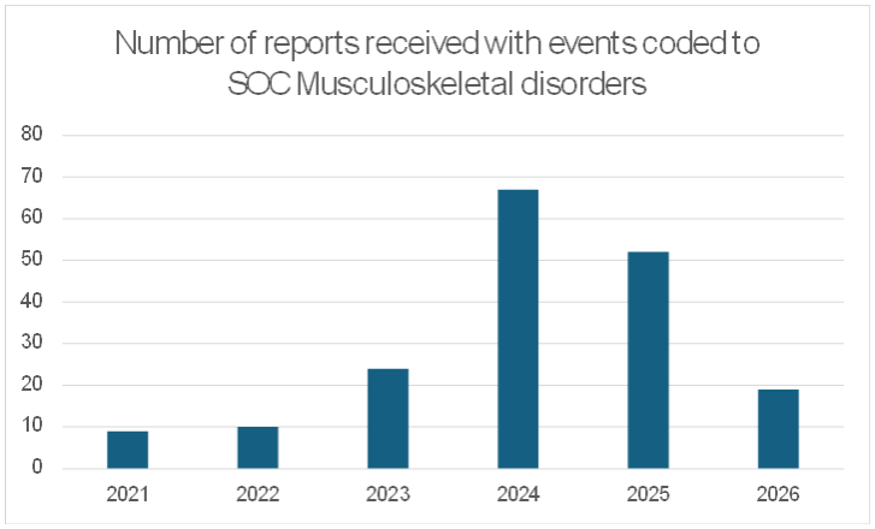
We have included all adverse event reports. This includes reports where more than one product was used, reports when the product was used off-label, that is using a medicine in a way that is not specified on the product’s label, or reports where, on further evaluation, there may have been other reasons for the adverse event occurring.
The number of adverse events alone cannot be used to determine the likelihood of an event occurring. This is because the numbers need to be put into context considering other factors such as differing sales volumes.
Please be aware that the data provided above are not subject to independent verification and the VMD does not guarantee their accuracy.