Value based procurement national standard guidance for medical technology
Published 11 June 2026

© Crown copyright 2026
This publication is licensed under the terms of the Open Government Licence v3.0 except where otherwise stated. To view this licence, visit nationalarchives.gov.uk/doc/open-government-licence/version/3 or write to the Information Policy Team, The National Archives, Kew, London TW9 4DU, or email: psi@nationalarchives.gov.uk.
Where we have identified any third party copyright information you will need to obtain permission from the copyright holders concerned.
This publication is available at https://www.gov.uk/government/publications/value-based-procurement-for-medical-technology/value-based-procurement-national-standard-guidance-for-medical-technology
Summary
Value based procurement (VBP) is an innovative procurement approach that focuses on how a product or solution can:
- best deliver improved outcomes
- reduce total costs of the patient pathway
- provide long-term benefits to all partners in the health system
The Department of Health and Social Care (DHSC) has worked in partnership with NHS England and NHS Supply Chain (NHSSC), to develop national VBP standard guidance. The guidance gives buyers a standard set of questions and scoring criteria to use when buying medical technology (medtech).
The intention is for this approach to be applied to procurement for medical devices, including services that use medical devices, in primary and secondary care. Medical devices include:
- consumables
- implantables
- general medical devices
- medical equipment
- capital equipment
- in vitro diagnostics and point of care testing
- imaging products
- digital products
- artificial intelligence (AI) products
This guidance does not cover the end-to-end procurement process for medical devices. Buyers should use this guidance at the quality assessment stage in the procurement process (that is, in relation to the evaluation of tenders).
Buyers should:
- seek their own legal assurance to ensure that the application of this guidance to their particular procurement process is lawful and fully compliant with the Procurement Act 2023
- consider The Health Care Services (Provider Selection Regime) Regulations 2023 for mixed procurements that include a clinical services element as well as the supply of devices
We have considered the National Procurement Policy Statement when developing this guidance.
How to apply the guidance
This guidance is for NHS buyers:
- when they are developing the specification of requirements when procuring medical devices (including services that use medical devices)
- during the subsequent evaluation of tender submissions for medical devices across both primary and secondary care
Important terms are defined in the glossary in annex A. NHS buyers should include appropriate definitions when using this guidance to produce procurement documents.
There is also a procurement checklist in annex B, which may help when applying this guidance.
Choosing relevant domains and questions to assess value
Value is assessed against up to 5 domains:
- social value
- efficiency
- patient and staff
- supply chain
- purpose
Buyers should choose the domains that are most relevant to the medical device they are buying. Within each of these domains, buyers should choose from the set questions provided. Note that for the ‘social value’ domain only, the questions are known as ‘outcomes’.
Buyers should ensure that their approach to the evaluation of tenders is proportionate to the cost, nature and complexity of the procurement. This includes consideration of the level of effort required from bidders (potential suppliers bidding as part of a tender process) to effectively respond to the evaluation questions.
For example, if available deliverables are supplied by small and medium-sized enterprises (SMEs), it may be proportionate to use only one or a small number of questions and/or social value outcomes (such as those relating to whether the deliverable meets the specification).
Procurement documents and bidder responses
Where a question or social value outcome is chosen, the buyer should include the following in the procurement documents published for bidders:
- question or social value outcome
- relevant additional guidance for suppliers
- associated definitions and scoring methodology
- the recommended word count for responses (between 750 to 1,250 words, depending on the complexity of the question. This can vary if needed)
Buyers should:
- allow sufficient time for bidder responses that is proportionate to the level of information requested
- work with bidders to share the required data, including baseline data where relevant, that will enable all bidders to respond appropriately
Additional considerations
Buyers should:
- consult and involve clinical and finance teams in the evidence validation when using this guidance
- consider contingency planning to ensure business continuity in the event of staff absence, taking into account any additional time needed to carry out procurement using this guidance
For further information about managing the evaluation and moderation process, see the Cabinet Office guidance.
The 5 value domains and whole life cost
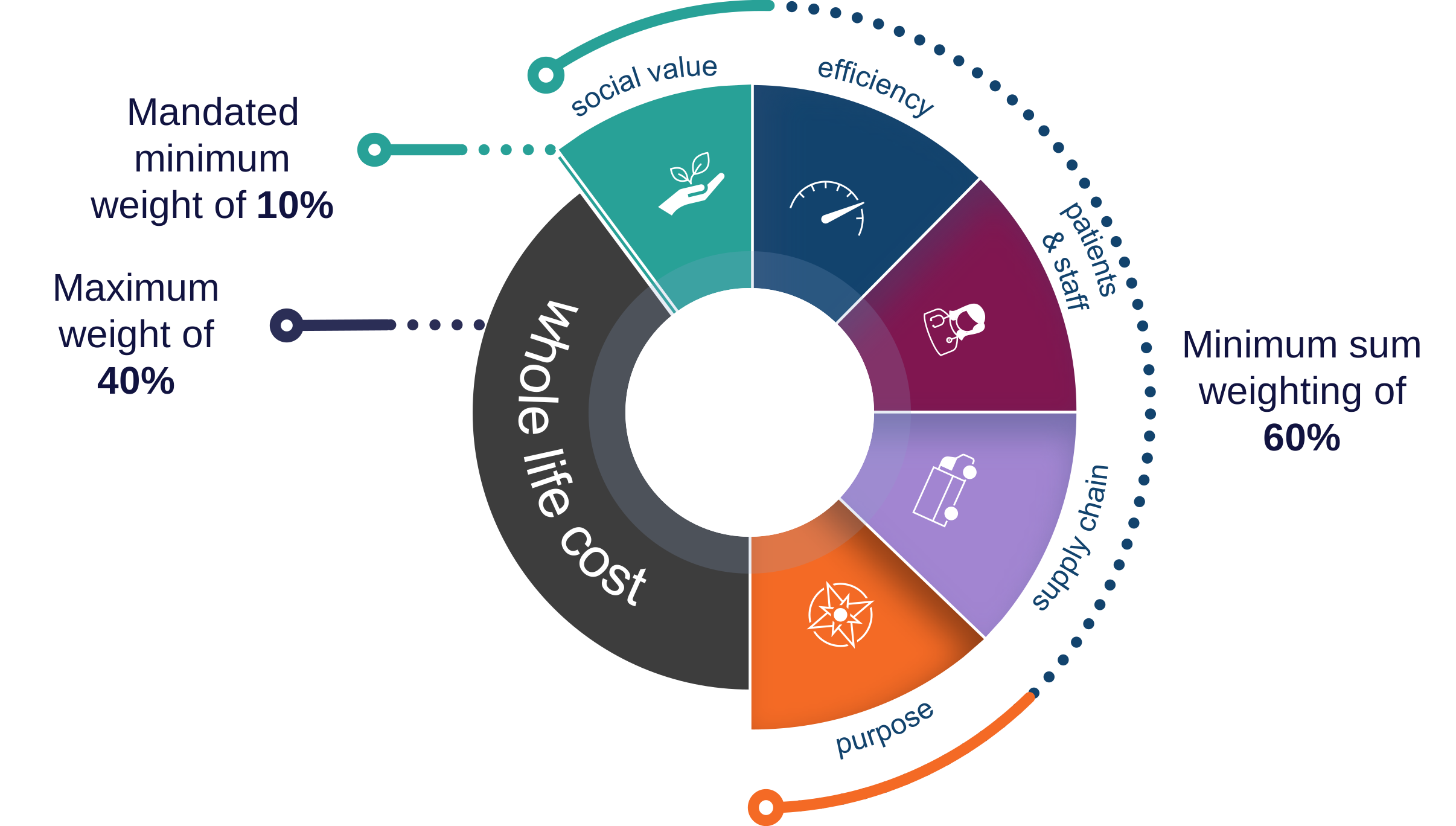
Description of image: illustrates the weighting of the 5 value domains and the whole life cost as follows:
- social value - generates wider social and environmental benefits
- efficiency - improves the patient pathway
- patient and staff - supports patient experience and safety
- supply chain - has a resilient supply chain
- purpose - meets the specification
- whole life cost - includes the purchase cost and the post-warranty support costs where relevant
Combined, the 5 value domains should have a minimum sum weighting of 60%, 10% of which must be allocated to the social value domain. The whole life cost should have a maximum weighting of 40%.
Weighting
Buyers should:
- select the social value domain for all procurements. It must have a minimum weighting of 10% in line with existing mandatory guidance in the NHS Social Value Playbook (July 2025)
- ensure that the sum total of all value domains (social value plus the remaining 4 value domains) is a minimum of 60%. Buyers should distribute this minimum 60% total weighting across the selected domains based on their importance to the buyer
For framework providers only
Note that:
- framework providers can use their discretion to adjust the phrasing of value questions and associated validation criteria for the purpose of making them suitable for framework application. If doing so, they should ensure the substance of the original question remains intact
- framework providers should consider which VBP questions may be more appropriate for framework call offs (subject to what is permissible under relevant framework terms)
- value factors may at times be included under pass and/or fail criteria within framework pre-selection criteria. If this is the case, the corresponding VBP question number should be clearly signposted so that suppliers are aware that the value is being considered
- if framework providers deviate from the recommended weighting of 60% for the chosen value domains and 40% for the whole life cost, they should present their rationale and where possible communicate this to bidders during pre-market engagement
Domain 1: social value
The questions in this domain align with the model questions template in the policy procurement note 002 (PPN) and NHS Social Value Playbook, so the information below varies from the other value domains. For example, in this domain the questions are known as ‘outcomes’.
It is NHS policy that the PPN is applied to procurements on behalf of NHS bodies so it is important that buyers follow the question structure detailed below.
The PPN and relevant NHS policies are as follows:
- PPN 002: taking account of social value in the award of contracts - to be used for procurements under the Procurement Act 2023
- NHS Social Value Playbook - the PPN and Social Value Playbook should be referred to by both buyers and suppliers for further guidance on this domain. The information below describes how to apply the questions to the respective models by reference to the PPN
- Design for Life roadmap
Outcome 1.1: reduction in contract level carbon emissions
In no more than 750 words, set out, in a method statement and project plan, the specific, measurable and time bound commitments your organisation will make to deliver sustainable procurement practices, as defined within the social value model award criteria and sub-criteria outlined below.
Social value model award criteria and sub-criteria
Describe how you will provide additional environmental benefits in the performance of the contract, for example, reducing power requirements in use, reducing need for patient and/or staff travel and use of ‘green’ technologies.
The content of the method statement and project plan should contain the following elements and be relevant to the delivery of the subject matter and contract. Include activities that demonstrate and describe:
- the supplier’s approach to baselining carbon emissions attributed to the deliverable at commencement of the contract
- how carbon emissions will be calculated for the anticipated benefits or outcomes identified because of the deliverable and those benefits demonstrated to the buyer
- how ‘green’ technologies will be used and implemented into business-as-usual activities during the term of the contract
- how reduction in staff and patient journeys will be facilitated during the term of the contract
Guidance for buyers
Edit the specific requirements of this question as it aligns to outcome you are attempting to deliver.
Outcome 1.2: reduction in packaging
In no more than 750 words, set out, in a method statement and project plan, the specific, measurable and time bound commitments your organisation will make to deliver sustainable procurement practices, as defined within the social value model award criteria and sub-criteria below.
Social value model award criteria and sub-criteria
Detail how, through the delivery of the contract, you plan to reduce the amount of packaging provided with the deliverable.
The content of the method statement and project plan should contain the following elements and be relevant to the delivery of the subject matter and contract. Include activities that demonstrate and describe:
- the supplier’s approach to baselining the amount of packaging attributed to the deliverable at the commencement of the contract and through the term
- how the supplier plans to reduce the packaging across the deliverable provided under the contract
- demonstrated understanding of relevant environmental benefits which will be achieved during the term of the contract
- collaborative ways of working with the supply chain to contribute to reduction of packaging and how the supplier will influence manufacturing, logistics, deliveries and packaging processes to support reduction of packaging
- monitoring, review and continuous improvement approaches against regulatory and clinical standards and in response to user feedback
- regulatory or clinical risks, issues or barriers, which should be discussed and addressed where relevant. Patient safety considerations should also be considered within this part of the response
Guidance for buyers
Where the outcome of the procurement is more than a product, change the description within the question to reflect the subject matter of the procurement and resulting contracts.
Outcome 1.3: product usage and disposal guidance
In no more than 750 words, set out, in a method statement and project plan, the specific, measurable and time bound commitments your organisation will make to deliver sustainable procurement practices, as defined within the social value model award criteria and sub-criteria below.
Social value model award criteria and sub-criteria
Detail how, through the delivery of the contract, you plan to create and monitor the use of effective guidance for the proper usage of the deliverable, how to dispose of it correctly and how to extend its useful lifespan, in a digital format.
The content of the method statement and project plan should contain the following elements and be relevant to the delivery of the subject matter and contract. Include activities that demonstrate and describe:
- the supplier’s understanding of digitising product guidance through the life of the contract relevant to the environmental benefits which will be achieved
- collaborative ways of working with the supply chain to contribute to the development of digitised products
- communication and engagement methods as required to implement new guidance, including any relevant training or upskilling of staff
- monitoring, review and continuous improvement approaches where guidance is not being used
- regulatory or clinical risks, issues or barriers, which should be discussed and addressed where relevant. Patient safety considerations should also be considered within this part of the response
Outcome 1.4: modern slavery risk management
In no more than 750 words, set out, in a method statement and project plan, the specific, measurable and time bound commitments your organisation will make to deliver modern slavery risk management, as defined within the social value model award criteria and sub-criteria below.
Social value model award criteria and sub-criteria
Describe how, through the lifetime of the contract, you will identify, mitigate and manage modern slavery risks and improve the impact you are having in the areas identified at risk of modern slavery.
Include activities that demonstrate and describe the supplier’s existing or planned:
- understanding of the modern slavery risks and issues affecting the market, industry, sector or country (of origin or of source) relevant to the contract and the workforce in the supplier’s own organisation and those of its main subcontractors
- measures to identify, mitigate and manage modern slavery risks relating to the contract and how these will be implemented including:
- supply chain mapping
- how the contract workforce is supported
- outline of policies and practices to be applied to or put in place for the contract to mitigate and manage modern slavery risks including:
- pre-employment checks
- recruitment practices
- workplace conditions
- safeguarding plans and processes in place
- regular monitoring with relevant groups considered, which may include sampling
- demonstration of how these activities flow down the supply chain and are monitored including reporting, site visits, audits or other methods
- approach to supporting the contracting authority to ensure business decisions with regards to price and/or cost, short lead times and payment timescales do not create or exacerbate modern slavery risks in the supply chain
- approach for how the supplier will work with non-governmental organisations (NGOs), trade unions or other businesses to address modern slavery risk
- means of influencing staff, suppliers, customers, communities and/or any other appropriate stakeholders with respect to modern slavery risks relating to the contract
Domain 2: efficiency
This domain relates to efficiency and productivity. Efficiency is defined as delivering the same standard of care while reducing the cost of delivering that care. Productivity is defined as achieving greater outputs of care (for example, appointments and operations) from the same inputs (for example, staffing).
Question 2.1: simplify the pathway
Detail how, through the delivery of the contract, you will enable the buyer to safely remove or simplify steps and/or interfaces from the relevant patient pathway.
Validation basis
The supplier should provide evidence of the current delivery of care and clearly identify which steps are being removed or simplified through the introduction of the deliverable.
Additional guidance to share with suppliers where relevant
Consider responses to question 2.2 and 2.3 on hospital and community productivity and 5.2 on ease of use to mitigate duplication.
Recognising that a change in the pathway will require implementation support, suppliers should provide information on the level of change required and evidence how they will support this transition through their response to question 5.2 on ease of use.
Consider working with the buyer to assess a baseline for the relevant pathway and measure improvements post-implementation of the new deliverable.
Suppliers should consider the following prompts in their response:
- which steps in the patient pathway are being removed or simplified
- evidence that simplification and/or removal is safe for patients and healthcare personnel
- how this simplification and/or removal creates more efficient delivery of care
Guidance for buyers
Consider responses for questions 2.2 and 2.3 on improving hospital and community productivity and 5.2 on ease of use to mitigate duplication.
In pre-market engagement with suppliers, ensure there is a collective understanding of baseline practices that consider procedures and follow ups in the relevant pathway.
Consider the appropriateness of safely removing or simplifying steps in the patient pathway.
Consider the impact a change in patient pathway may have on resource, including on other care settings and/or departments, how well this can be absorbed into existing workloads and what would be required of suppliers to ease the burden of implementation.
Refer to the following NHS value and savings methodology categories:
- G - cost avoidance
- I - added value
- O - released capacity
Supporting information
To the extent relevant, responses should:
- assess the current patient pathway to identify and quantify bottlenecks and/or redundant steps. Specify how the deliverable reduces these. Include examples of how the deliverable has done this in similar care settings
- quantify the impact the deliverable will have on resources for the pathway
- include data on the impact of the deliverable on treatment or diagnostic activity. This includes:
- referral speed
- time to treatment
- did not attend rates
- reduced process duplication
- reduced unnecessary appointments
- saved clinician time due to fewer interfaces
- provide evidence of reduced complication events, such as surgical site infections, complications and follow ups
- provide evidence on improved transfer of care times
- provide evidence of clinical safety being maintained for both patients and NHS staff despite pathway changes, by including the number of adverse events and/or patient safety incidents associated with the deliverable
Question 2.2: productivity - hospital
Detail how, through the delivery of the contract, you will enable the buyer to safely improve hospital productivity.
Validation basis
The supplier to provide quantitative evidence of the anticipated impact against a relevant baseline, with qualitative evidence to show that this improvement is feasible in the relevant care settings.
Additional guidance to share with suppliers where relevant
Consider responses to question 2.1 and mitigate duplication.
Suppliers should share details of the tolerance level or risk adjustment for any data provided.
Guidance for buyers
Consider responses to question 2.1 to mitigate duplication.
Buyers should provide figures relating to the current standard delivery of care in the NHS as a baseline for suppliers to compare and demonstrate the effectiveness of their deliverable.
Buyers should ensure that the supplier has independent capability to compliantly examine and transform hospital episode statistics (HES) and/or other clinically coded data for relevant endpoints.
Refer to the following NHS value and savings methodology categories:
- G - cost avoidance
- I - added value
- O - released capacity
Supporting information
To the extent relevant, responses should:
- provide real-world data on the impact of the deliverable on:
- length of stay (pre-procedure non-elective and/or elective bed days)
- procedure time
- readmission rates
- emergency readmissions (30 days)
- hospitalisation rates
- conversion of inpatient to day case
- provide modelling of the metrics above against a baseline provided by the buyer
- provide quantitative or qualitative evidence of workforce optimisation such as:
- savings through remote monitoring capability
- reduced prescribing
- released capacity such as theatre time
- bed days
- consider associated reduction in adjacent service demands, such as improving operational efficiency and reducing programming time
- provide modelling on improved productivity using impact against baseline weighted activity units (WAUs)
- provide projections of increased throughput of patients through completed referral to treatment (RTT) pathways against a baseline provided by the buyer
- provide evidence on the impact on resource against a relevant baseline provided by the buyer
Question 2.3: productivity - community
Detail how, through the delivery of the contract, you will enable the buyer to safely improve community productivity.
Validation basis
The supplier to provide quantitative evidence of the anticipated impact against a relevant baseline, with qualitative evidence to show that this improvement is feasible in the relevant care settings.
Additional guidance to share with suppliers where relevant
Consider responses to question 2.1 and mitigate duplication.
The reduction of follow-up visits should not be due to redirection of care to other procedural settings but be a total reduction in interactions required.
Guidance for buyers
Consider responses to question 2.1 to mitigate duplication.
Buyers should provide figures relating to the current standard delivery of care in the NHS as a baseline for suppliers to compare and demonstrate the effectiveness of their deliverable.
The reduction of follow-up visits should not be due to redirection of care to other procedural settings but be a total reduction in interaction required.
Supporting information
To the extent relevant, responses should provide:
- evidence on the frequency of health appointment follow-ups, home visits and other interactions with the community health team, whether in-person or remote
- evidence of remote monitoring, programming and proctoring opportunities that enhance healthcare delivery in community settings
- evidence on the impact on resource utilisation, against a baseline provided by the buyer in community settings
- data demonstrating the improvement in self-management with the deliverable and the reduction in the requirement for community health team support
Question 2.4: measurement
Detail how you will measure and monitor the delivery of claimed benefits and/or commitments arising through the delivery of the contract.
Validation basis
The supplier to set out measurement methodology including detail of any access to information or data which the buyer will need to provide to the supplier to enable such measurement and monitoring. To support impartiality, this should use existing data repositories where possible including but not limited to:
- national implant registries
- National Institute for Health and Care Excellence (NICE) assessments or recommendations
- health economic platforms such as HES
Additional guidance to share with suppliers where relevant
Suppliers should provide a methodology for buyers which sets out how they should measure the claimed benefits and which data will need to be accessed.
Post implementation, the data should continue to be collected in existing data repositories.
Guidance for buyers
The buyer and supplier should agree to an established baseline for measurement.
Pre-implementation, the buyer and supplier should establish transparent protocols and accountability measures which ensure that data collection and reporting are conducted safely, accurately and efficiently, minimising uncertainty and promoting effective implementation.
Where appropriate, the supplier should have independent capability to compliantly examine and transform HES and/or other clinically coded data to relevant endpoints, including mortality, morbidity, length of stay and RTT.
Post-implementation, the data should continue to be collected in the existing data repositories.
When monitored data does not meet the promised outcomes, clear mechanisms should exist to determine the extent to which the deliverable is accountable. Discrepancies between expected and actual outcomes may be multi-faceted, such as due to patient demographic variations (depending on contract size and location), physician workflows, local patient pathways and so on. These discrepancies should be accounted for to ensure fairness to buyers and suppliers.
Supporting information
Suppliers should provide:
- a list of metrics and data sets that will be used to assess impact
- details on any wraparound support and any data analytics tools they will offer to support measurement
To the extent relevant, responses should:
- detail how the supplier will engage with the buyer to agree a baseline
- detail how the supplier will ensure adherence to any relevant data protection regulations
Domain 3: patient and staff
This domain relates to patient experience and outcomes, patient and staff safety and reducing health inequalities.
Question 3.1: patient experience
Detail how, through the delivery of the contract, you will enable the buyer to improve patient experience and/or quality of life.
Validation basis
Patient experience refers to how the process of care feels for the patient, their carers and family and includes the range of interactions that patients have with the healthcare system.
Performance metrics provided by the supplier showing measurable patient benefits against the current delivery of care.
In some cases, this will require a detailed plan with phases for realising the proposed improvements alongside further evidence to prove the feasibility.
Additional guidance to share with suppliers where relevant
Responses to this question may cover similar qualities to those in domain 2 (efficiency) but should focus on the patient benefit achieved through delivery as opposed to efficiency improvements to the system.
Suppliers should reflect on how the benefits offered by the deliverable improve patient experience.
Where patient experience is improved through a digital solution, suppliers should provide evidence of how they will reduce and/or eliminate digital exclusion.
Suppliers should consider the following prompts in their response:
- how your deliverable works better or improves patient experience compared to alternatives
- an assessment of human factors related to patient experience
- suppliers should outline the feedback process for patient experience and/or acceptance compared to a baseline
Guidance for buyers
Where patient experience is improved through a digital solution, buyers should ensure there is evidence of how the supplier will prevent digital exclusion.
Buyers should ensure clinicians are consulted and involved in the evidence validation throughout use of this guidance, but this is particularly pertinent for this question to ensure that the supplier’s claim of the current patient pathway and evidence of improvements are relevant to the reality at the local level and validated clinically.
Supporting information
To the extent relevant, responses should:
- provide quantitative or qualitative evidence on how the deliverable enhances:
- patient experience
- patient reported experience measures (PREMs)
- satisfaction and associated measurable indicators such as improvements in independence, convenience, social participation and confidence
- demonstrate how the deliverable improves health-related quality of life (QoL) using real-world data
- demonstrate alignment with NICE quality standards for patient experience
- provide evidence on how patients are engaged to ensure their needs are met, leading to better health outcomes
- provide evidence on how the deliverable impacts caregiver capacity and capability including any additional services provided that enhance patient and/or carer QoL
Question 3.2: patient outcomes
Detail how, through the delivery of the contract, you will enable the buyer to improve patient outcomes.
Validation basis
The supplier to provide evidence on how improvement can and will be made against products and/or services that are commonly used. In some cases, this will require detailed technical information based on clinical trials and so on.
Additional guidance to share with suppliers where relevant
Evidence should consider the patient outcomes related to the evidence required in response to question 2.2 and 2.3 on productivity, such as readmission rates and so on, to mitigate duplication.
Suppliers should consider the following prompts in their response:
- what evidence supports the clinical safety and efficacy of your deliverable above and beyond a conformity assessment
- how your deliverable works better or improves patient outcomes compared to alternatives
All answers should include assumptions on activity to deliver an improved patient outcome. For example, a faster diagnosis could improve a patient outcome but only if it the result is acted on.
The model should cater for regular and timely measurements to ensure patient outcomes improve during the entire contract period
Guidance for buyers
Buyers should ensure clinicians are consulted and involved in the evidence validation throughout use of this guidance, but this is particularly pertinent for this question to ensure that the supplier’s claim of the current patient pathway and evidence of improvements are relevant to the reality at the local level and validated clinically.
All answers should include assumptions on activity to deliver an improved patient outcome. For example, a faster diagnosis could improve a patient outcome but only if the result is acted on.
Supporting information
To the extent relevant, responses should:
- describe features and benefits of the deliverable that improve patient outcomes. Include validated metrics specific to the relevant condition and patient reported outcome measures (PROMs)
- provide evidence on additional quality-adjusted life years (QALYs) gained and reduction in disease burden using disability-adjusted life years (DALYs)
- provide evidence of patient-reported data demonstrating health improvements such as EQ-5D scores, pain assessments and patient satisfaction surveys
- provide evidence on reduced complications such as surgical site infections, reoperations and readmissions, leading to improved mortality and/or morbidity rates and psychosocial wellbeing
- provide evidence on non-health related outcomes such as the facilitation of patients’ return to work, improved mobility and resumption of normal daily life after using the deliverable
Question 3.3: reduce risk of harm - patients
Detail how, through the delivery of the contract, you will enable the buyer to safely reduce the risk of harm and complications to patients (including infection)
Validation basis
The supplier to provide evidence on how improvement can and will be made against products and/or services that are commonly used. In some cases, this will require detailed technical information based on clinical trials and so on.
Additional guidance to share with suppliers where relevant
Evidence should consider the reduction in risk to harm and complications compared to the standard delivery of care, balanced with any increased risk that could come from the new deliverable.
Suppliers should consider the following prompts in their response:
- evidence that supports the clinical safety and efficacy of your deliverable above and beyond conformity assessment
- how your deliverable would work better or reduce risk of harm compared to alternatives
- how you will identify and mitigate risks associated with implementing a new deliverable on patient safety
- regulatory compliance with CE accreditation, ISO 13485, Medicines and Healthcare products Regulatory Agency (MHRA) guidelines and post-market surveillance
Guidance for buyers
Consider alongside question 5.3 where it relates to training, education and implementation support.
Buyers should ensure clinicians are consulted and involved in the evidence validation throughout use of the guidance, but this is particularly pertinent for this question to ensure that the supplier’s claim of the current patient pathway and evidence of improvements are relevant to the reality at the local level and validated clinically.
Where applicable, the answer may cater for regular and timely harm reduction measurements through a service level agreement between the buyer and supplier to safely reduce the risk of harm and complication to patients for example, patient education programmes through various media platforms and languages to enhance patient literacy and education, clinical understanding and compliance to the agreed treatment plan.
Where applicable, buyers can ask suppliers to demonstrate partnerships with community organisations to promote patient safety and preventative care in the community.
Refer to the NHS value and savings methodology category J - reduce adverse drug events.
Supporting information
To the extent relevant, responses should:
- provide real-world evidence or clinical trial data demonstrating operational reliability, performance consistency, absence of safety issues and reductions in patient harm
- provide data on deliverable use plotted against the number of adverse events and/or patient safety incidents associated with the deliverable
- quantify the number of adverse events or patient safety incidents potentially avoided
- provide data on any reduced harm risks from accelerating diagnosis and/or improving monitoring
- provide harm grading information detailing severity and classification of any potential risks
- provide data on prevention of unnecessary antibiotic use, reducing resistance risks and compliance with antimicrobial resistance and/or antibiotic stewardship strategies
Question 3.4: reducing the risk of harm - staff
Detail how, through the delivery of the contract, you will enable the buyer to safely reduce the risk of harm to clinicians and/or healthcare personnel.
Validation basis
The supplier to provide evidence of how the delivery of the contract would meet the requirements of the question and improve clinician and/or healthcare personnel safety compared to the current equivalent delivery of care.
Additional guidance to share with suppliers where relevant
Evidence should consider the reduction in risk to harm and complications compared to the standard delivery of care, balanced with any increased risk that could come from the new deliverable.
Suppliers should consider the following prompts in their response:
- evidence that supports the clinical safety and efficacy of your deliverable above and beyond a conformity assessment
- how your deliverable would work better or improve healthcare personnel safety compared to alternatives
- how you will identify and mitigate risks associated with implementing a new deliverable on healthcare personnel safety
- how you will create a feedback process to capture clinical user acceptance
Guidance for buyers
Consider alongside question 5.3 where it relates to training, education and implementation support.
Buyers should ensure clinicians are consulted and involved in the evidence validation throughout use of the methodology, but this is particularly pertinent for this question to ensure that the supplier’s claim of the current patient pathway and evidence of improvements are relevant to the reality at the local level and their experiences of delivering care.
Where applicable, the answer should cater for regular and timely harm reduction measurements through a service level agreement between the buyer and supplier to safely reduce the risk of harm and complication to staff. The agreement can detail and capture the supplier’s requirement and methodology to provide healthcare personnel with easy to access information on deliverables to ensure the effective and safe use of deliverables with supporting data within a shared risk mitigation plan.
Supporting information
To the extent relevant, responses should:
- provide real-world evidence or trial data which shows reductions in risk of harm to staff associated with the deliverable
- demonstrate deliverable reliability with data on operational performance and consistency, harm grading information detailing the severity classification and impact of any potential risks
- provide data on the number of adverse events that impact staff potentially avoided by using the deliverable
- where applicable, provide evidence of exposure control and safety features
- provide details on what data will be collected during the contract to better understand the deliverable’s impact on staff safety, including how clinical staff are engaged to ensure their needs are met
Question 3.5: reducing health inequalities
Detail how through the delivery of the contract you will enable the buyer to reduce inequalities in access, experience or outcomes within the target pathway.
Validation basis
The supplier to provide evidence of how they have given due consideration to deliverable performance across subgroups of the target population.
The supplier to provide evidence of how the deliverable supports equity in access, experience or outcomes across subgroups of the target population.
Additional guidance to share with suppliers where relevant
Suppliers should consider the following prompts in their response:
- how the deliverable is designed to accommodate diverse needs (for example, physical and mental disabilities, learning difficulties and cultural differences)
- how you will support the implementation of the deliverable with patients or healthcare personnel with protected characteristics
- how you will identify and mitigate risks associated with potential health inequalities in the delivery of the contract
Guidance for buyers
Buyers should ensure clinicians are consulted and involved in the evidence validation throughout use of the guidance, but this is particularly pertinent for this question to ensure that the supplier’s claim of the current patient pathway and evidence of improvements are relevant to the reality at the local level and validated clinically.
Supporting information
To the extent relevant, responses should cover:
- access, and should:
- describe how your deliverable improves healthcare access for socioeconomic, ethnic and marginalised populations, addressing geographical disparities
- provide quantitative or qualitative evidence on how the deliverable enhances patient participation and adherence within the care pathway for underserved populations and/or patients
- experience, and should:
- give examples of how your deliverable and related information has been designed for people identified within the Core20PLUS5 (for example, protected characteristics, inclusion health groups) including how the deliverable can improve digital inclusion
- provide data on how your deliverable has reduced disparities in patient experience between different demographics of patients
- describe how the deliverable caters for diverse user needs through materials such as international language instructions or features such as screen readers, voice navigation and large-text options for individuals with disabilities
- outcomes, and should provide data on how the deliverable performs across different patient populations such as ethnicity, age, gender and socioeconomic status
Domain 4: supply chain
This domain relates to the longevity of the deliverable and the resilience with its associated supply chain.
Question 4.1: circular economy
Detail how through the delivery of the contract the deliverable supports a circular economy.
Validation basis
Evidence shown on whether the deliverable is reusable, remanufactured, uses recycled materials or is capable of being remanufactured or recycled through an existing supplier-backed scheme.
Confirmation of how many times the deliverable can be safely used before disposal.
Additional guidance to share with suppliers where relevant
Suppliers should explain how their deliverable supports one of the 3 circular economy pathways:
- reuse: is the deliverable reusable? If so, how many times and what processes (for example, decontamination) are needed to enable reuse? What support will the supplier provide?
- remanufacture: is the deliverable remanufactured (in line with MHRA guidance)? If yes, what are the benefits? If not, can it be remanufactured and how will the supplier support this?
- recycle: what percentage of the deliverable or its components can be recycled through existing systems or take-back schemes? What percentage is made from recycled materials? How will the supplier support future recycling or material recovery?
Guidance for buyers
Consider responses to domain 1 to mitigate duplication.
Buyers should consider:
- which of the 3 circular economy pathways (reuse, remanufacture and recycle) apply to their procurement
- their capability to facilitate the pathway, as well as what support or input they would require from suppliers to make circular options a success. For example, this could include considering what infrastructure is already in place to support reuse (for example, decontamination services) and what capability staff have to implement (for example, trained in handling used devices), so it is clear what input they would need from the supplier to functionally implement the deliverable
Supporting information
In general, the focus should be on the deliverable itself and the primary packaging. To the extent relevant, responses should:
- state whether the deliverable is certified for single-use, single-patient use, or reuse. If reusable, state how many times the deliverable can be safely used before disposal and information or training regarding the decontamination required (for example, steam or manual cleaning)
- provide evidence that the deliverable is remanufactured (as defined by MHRA’s 2016 guidance on remanufacture of medical devices) or capable of being remanufactured through a scheme that you support
- provide evidence on the proportion of the deliverable which is made from recycled materials
- provide evidence of the proportion of the deliverable, or modular components of the deliverable, which can easily be recycled through existing recovery streams
- provide evidence of logistical arrangements for circular pathways, removal or disposal including collaborations with certified third-party recyclers and take-back programs
Question 4.2: obsolescence
Detail how through the delivery of the contract you will reduce the risk of technology obsolescence.
Validation basis
Clear risk management and long-term mitigation plans should be provided to show how technology obsolescence will be prevented for the main technology aspects of the deliverable.
Additional guidance to share with suppliers where relevant
Suppliers should consider evidencing how the deliverable will adapt to future technological advancements in the medtech sector and remain usable and effective at, or above, the minimum performance operating levels relevant at the time of the assessment.
Guidance for buyers
Buyers should consider the future proofing for this deliverable and how it will work with other equipment (including equipment already in place and any plans for purchasing other new equipment).
Supporting information
To the extent relevant, responses should:
- provide risk management and mitigation plans for how technology obsolescence will be prevented for the main technology aspects of the deliverable, including plans for regularly reviewing component availability and technology trends
- provide details on whether the deliverable features a modular or upgradeable design, allowing individual components to be upgraded or replaced as needed to reduce the need for full system replacements, including software upgrades if applicable
- detail the process for upgrades for the deliverable including any specialist equipment or personnel required
Question 4.3: interoperability
Detail how, through the delivery of the contract, the deliverable is interoperable.
Validation basis
Confirmation of whether the deliverable is interoperable with complementary products and/or consumables and/or digital systems.
Additional guidance to share with suppliers where relevant
Suppliers should provide evidence to confirm the extent that the deliverable is interoperable with other products and/or consumables and/or digital systems.
Where the deliverable is interoperable with more than one complementary product, consumable or digital system, suppliers should provide relevant details so that buyers can easily establish which other specific products, consumables and digital systems the deliverable is interoperable with (for example, including details of the other manufacturers’ products that the deliverable is interoperable with).
Suppliers should also provide evidence as to how any interoperability offering can be properly adopted, for example through upskilling staff and/or patients.
Where the deliverable is not interoperable this should be made clear.
Guidance for buyers
Buyers should consider the level of interoperability that will be required between equipment and consumables and how the proposed deliverable will help to evidence and support system wide resilience for equipment across trusts and/or integrated care systems (for example, whether the deliverable will provide enhanced resilience through effective interoperability with multiple other products, consumables and digital systems). This should align with the National Equipment Tracking Inventory System (NETIS).
Buyers should identify the person and/or team responsible for integration of the deliverable.
Supporting information
To the extent relevant, responses should:
- provide real-world evidence that the deliverable is interoperable with complementary products and/or consumables and/or digital systems from third party suppliers
- provide evidence of clinical workflow alignment and how the deliverable will integrate with existing procedures and infrastructure to minimise disruption and ensure smooth implementation without the need for additional original equipment manufacturer (OEM) products
- provide evidence of how the contract will include ongoing support and regular updates to maintain interoperability with new standards and technologies
Question 4.4: risk
Detail how through the delivery of the contract you mitigate and manage supply chain risk.
Validation basis
Risk assessments or business continuity plans detailing contingency measures for supply chain disruptions.
Data on inventory levels, sourcing diversification and supplier reliability, UK-based or alternative manufacturing sites, extended shelf life.
Certifications or audits related to supply chain standards (for example, ISO 22301 for business continuity management).
Additional guidance to share with suppliers where relevant
Suppliers should show how they manage supply chain risks through:
- visibility across supply chain tiers
- stock control and contingency planning
- measures to handle specific disruptions (not all types need evidence, but broader coverage is valued)
Disruption types include:
- manufacturing (for example, shortages, failures, recalls and strikes)
- legal and/or market (for example, demand surges, regulatory issues, legal action and closures)
- logistics (for example, transport issues, IT failures, staff shortages and strikes)
- major events (for example, natural disasters, pandemics, economic shifts and conflict)
Guidance for buyers
Buyers should consider past sourcing experiences, including any supply disruptions and their impact on care delivery. They should assess the robustness of the supply chain and how well the supplier’s measures reduce risks to patient care continuity.
Buyers may request information on specific disruption types, especially those previously encountered. However, credit should be given for all types of disruptions addressed, recognising the unpredictable nature of supply chain shocks.
Resilience strategies should be clearly detailed and demonstrate effective mitigation across important areas, including:
- supply management (for example, multiple manufacturers, stockpiles or alternative sourcing support)
- logistics management (for example, contingency transport routes or air freight options)
- demand management (for example, allocation strategies to prevent overordering and ensure fair distribution)
Supporting information (responses should cover the below to the extent relevant)
To the extent relevant, responses should:
- describe what preparations the supplier has made for supply chain disruptions and demand surges, including risk assessments, business continuity plans and contingency measures
- detail how the supplier will conduct continuous monitoring of supply chains to identify vulnerabilities and implement mitigation strategies before they escalate
- provide ISO 22301 for business continuity management, other relevant certification or independent supply chain audits
- detail how the supplier will work with the buyer to order optimum stock levels
- provide data on inventory levels, including contingency stocks for demand spikes or supply issues, supplier diversity and reliability, UK-based or alternative manufacturing and extended shelf life. Include metrics such as weeks of stock held, UK stock as a percentage of lead time, stock cover relative to shelf life and speed of accessing contingency stock
Domain 5: purpose
This domain relates to the extent to which the deliverable meets the buyer’s requirement and the implementation of the deliverable, including training and after care.
Question 5.1: meeting the specification
Detail how, through the delivery of the contract, you will meet the needs and requirements set out in the buyer’s specification.
Validation basis
Supplier written confirmation against each requirement.
Additional guidance to share with suppliers where relevant
Provide details on how the proposed deliverable will align with the specific requirements of the buyer.
Guidance for buyers
Buyers should set out the requirements within the specification.
Supporting information
To the extent relevant, responses should:
- prior to contract initiation, explain how your organisation will work with the buyer to conduct a thorough needs assessment
- provide detail on how the proposed solution will align with the specific requirements of the buyer
Question 5.2: ease of use
Detail how, through the delivery of the contract, you will support ease of use of the deliverable for the patient and/or their clinical team.
Validation basis
Sample feedback from deliverable users and/or independent assessment of ease of use.
Additional guidance to share with suppliers where relevant
Responses to this question should be focussed on ease of use when the patient or healthcare personnel are interacting with the deliverable as opposed to wider patient pathway implications which are captured in domain 2: efficiency.
Where ease of use is improved through a digital solution, suppliers should provide evidence of how they will reduce and/or eliminate digital exclusion.
Suppliers should consider the following prompts in their response:
- evidence of simplicity and/or ease of use promoting compliance
- how the deliverable’s design supports ease of use for patients or carers
- resources (for example, guides or apps) that are available to help patients use the deliverable
- an assessment of human factors involved and/or required for adoption
Supporting information
To the extent relevant, responses should:
- provide details of how your organisation will support patients and clinical teams to navigate and use the deliverable
- provide evidence of inclusive and equitable design, accommodating a wide range of staff and/or patient needs including those with physical, cognitive or language challenges
- provide evidence of patient education and empowerment including accessible materials, visual guides, translations and digital tools to support understanding, self-management and adherence to care plans
Question 5.3: implementation support
Detail how, through the delivery of the contract, you will support implementation and adoption of the deliverable by the clinical staff of the buyer and any dependencies from the buyer to deliver a seamless implementation.
Validation basis
Implementation plan including resource plan.
Supporting case examples of successful implementations within equivalent healthcare settings.
Additional guidance to share with suppliers where relevant
The response to this question should set out what support will be put in place to monitor how well the deliverable is being adopted and implemented, including checks to ensure it is being implemented in line with supplier guidance.
How suppliers will identify and mitigate risks associated with implementation.
Suppliers should consider the following prompts in their response:
- what training or upskilling support will be provided by the supplier
- what contingency plans will be put in place in instances where adoption is not as successful as intended
- requirements from the buyer and support by the supplier to move away from the current delivery of care during implementation
- an assessment of human factors involved and/or required for adoption
Guidance for buyers
Buyers should consider:
- how they will work with the supplier and what data they may need to make available for the supplier to monitor how effective adoption and implementation of the deliverable is progressing
- the expected impact on resource to support adoption and how well this can be absorbed into their existing workloads. This may include a human factors assessment
- what would be required of suppliers to ease the burden of implementation, for example, whether they would benefit from suppliers providing project management support or support in monitoring the benefits realisation
If the buyer chooses to ask this question, they may want to consider what contract management processes should be put in place, such as contracting for expected benefits.
Supporting information
To the extent relevant, responses should:
- describe any support you would provide to the buyer to implement and adopt the deliverable. This may include additional staff, infrastructure or training
- detail how the deliverable will fit into the buyer’s existing workflows
- provide evidence of comprehensive training and education for staff, including on-site and virtual training sessions, as well as ‘Train-the-trainer’ models. Provide examples of where training programmes for clinical staff have been used and led to increased confidence and competency
- provide plans for roll-out and evaluation including co-designing with staff involved in implementation (for example, consultants, nurses and service leads)
- provide evidence of implementation support for a similar product and/or service in a relevant care setting
Question 5.4: aftercare support
Detail how, through the delivery of the contract, you will safely meet ongoing aftercare support service needs and requirements in relation to the deliverable.
Validation basis
Supplier written confirmation.
Key performance indicator (KPI) data of service performance.
Additional guidance to share with suppliers where relevant
The response to this question should set out what support will be provided by the supplier in relation to aftercare support for the deliverable.
Guidance for buyers
Buyers should consider:
- how they will work with the supplier
- the lifecycle of the deliverable being procured
- the expected resource needed to maintain the deliverable
Supporting information
To the extent relevant, responses should:
- detail the:
- dedicated aftercare support infrastructure including customer support
- access to technical specialists for advice and troubleshooting
- rapid-response mechanisms for issue escalation or critical support needs
- include plans for proactive maintenance and monitoring
- provide evidence of clinical oversight and safety assurance including adverse events reporting, risk assessments and safety reviews and access to updated safety documents and protocols as required
- provide user testimonials of aftercare support received
Whole life cost
Whole life cost (WLC) is the total cost incurred over the lifetime of a deliverable. As WLC is a cost over time, assessments should ensure deliverables are calibrated to the same time period for a valid comparison.
Costs to consider when determining WLC
Purchase cost
Include information on the unit cost.
Implementation and/or operating cost
Include information on the following costs where relevant:
- delivery cost
- installation cost
- user training cost
- energy consumption (kWh)
- estimated decontamination cost
- regular maintenance cost
- major service cost
- if a deliverable requires specific consumables to function, provide relevant information and the estimated cost of these consumables
- any other relevant costs
Post warranty servicing cost
Include information on the annual service cost.
Disposal cost
Include information on the following where relevant:
- residual value
- disposal cost
Deliverable lifetime cost
Include information on the cost in uses and/or years.
Additional guidance to share with suppliers where relevant
To support calculation of whole life costs, suppliers should be prepared to provide information on the lifetime of the deliverable (in uses and/or years as applicable) and the additional costs of implementation, operating and end-of-life for a deliverable.
Guidance for buyers
The total whole life cost should be compared against the expected lifetime of the deliverable (in uses or years) to understand the value of the deliverable. For example, for reusable deliverables, although the whole life cost may be higher, the per-use cost may be lower.
Evaluating the WLC
The WLC should be evaluated using a formula as follows:
L divided by B, then multiplied by W, where:
- L = lowest WLC tendered by any bidder
- B = WLC tendered by bidder being evaluated
- W = percentage weighting to be applied to WLC
Whole life cost should be evaluated after the value scoring has taken place.
Value score system
For each question that uses the scoring method below, the highest relevant score based on the description will be applied.
5 - outstanding
The tenderer has provided an outstanding response.
To the extent that the question sets out buyer requirements, these are all addressed thoroughly and in appropriate detail and the response provides full confidence that the buyer requirements can be met in full.
The response also provides confidence of an outstanding contribution to the support and delivery of the relevant value based theme in the context of the NHS as set out within the question. The response therefore meets all of the following:
- provides excellent proposals and shows competence demonstrated through relevant evidence, taking account of the parameters and information relating to the question
- shows considerable insight into the relevant issues
- addresses the relevant value based domain definition and shows excellent in-depth market experience
4 - good
The tenderer has provided a good response.
To the extent that the question sets out buyer requirements, these are almost all addressed thoroughly and in appropriate detail and the response provides a good level of confidence that the buyer requirements can be met in full. There are a very limited number of minor and/or non-material aspects in which the buyer requirements are not met but these do not give rise to concerns.
The response also provides confidence of a good contribution to the support and delivery of the relevant value based theme in the context of the NHS as set out within the question. There are no significant areas of concern in relation to the value based theme, although there may be very limited minor issues that need further exploration or attention later in the procurement process but which do not give rise to concerns.
The response therefore meets all of the following:
- provides good proposals and shows competence demonstrated through relevant evidence taking account of the parameters and information relating to the question
- shows some insight demonstrated into the relevant issues
- addresses the relevant value based domain definition and shows good market experience
3 - satisfactory
The tenderer has provided a satisfactory response which gives rise to minor concerns.
To the extent that the question sets out buyer requirements, these are mainly addressed in appropriate detail and the response provides a satisfactory level of confidence that the buyer requirements can be met in full. The response contains a limited number of minor and non-material aspects in which the buyer requirements are not met, giving rise to minor concerns.
The response also provides confidence of a satisfactory contribution to the support and delivery of the relevant value based theme in the context of the NHS as set out within the question. There may be minor issues in relation to the value based theme that need further exploration or attention later in the procurement process, giving rise to minor concerns.
The response therefore meets all of the below:
- provides satisfactory proposals and shows competence demonstrated through relevant evidence taking account of the parameters and information relating to the question
- shows some insight demonstrated into the relevant issues
- addresses most of the relevant value based domain definition and shows satisfactory general market experience
2 - poor
The tenderer has provided a poor response which gives rise to major concerns.
To the extent that the question sets out buyer requirements, these are only partially addressed in the response and the response only provides a poor level of confidence that the requirements can be met in full. The response contains material aspects in which the buyer requirements are not met or a significant number of minor aspects in which the buyer requirements are not met, giving rise to major concerns.
The response also evidences a poor contribution to the support and delivery of the relevant value based theme in the context of the NHS as set out within the question. The response gives rise to major concerns in relation to the value based theme because of at least one of the following:
- there is at least one significant issue needing considerable attention
- proposals do not demonstrate competence or understanding
- the response is light on detail and unconvincing
- the response makes no reference to the applicable sector but only shows some general market experience
- the response makes limited reference (naming only) to the relevant value based domain definition
1 - unsatisfactory
The tenderer has provided an unsatisfactory response.
To the extent that the question sets out buyer requirements, the tenderer has provided a minimal response addressing some of the buyer requirements with very little detail.
The response does not provide any confidence that the buyer requirements can be met in full.
The response does not provide any confidence of a satisfactory contribution to the support and delivery of the relevant value based theme in the context of the NHS as set out within the question, taking account of the parameters and information relating to the question.
0 - no response
The tenderer has not provided any meaningful response to the question.
Annex A: glossary
Buyer
The NHS contracting authority that is purchasing the deliverable.
Case
The treatment of a single patient.
Contract
The contract to be awarded under this procurement process.
Deliverable
The product and/or service being procured by the buyer.
Enable
To enable the buyer to achieve. This does not require that the buyer takes up the relevant opportunity.
Health appointment
Includes but is not limited to GP appointments, hospital appointments, visits to A&E and allied health profession appointments.
Human factors
Encompasses the factors that can influence the behaviour and performance of human beings in a system. For further information, see A focus on human factors (East Lancashire Hospitals).
Home visit
A scheduled clinical visit by a member of NHS staff to the home of a patient.
Interface
An interaction with another person or process.
Medical device
As defined in the Medical Devices Regulations 2002 (SI 2002 number 618) as amended or replaced from time to time, medical devices are used in the:
- diagnosis, prevention, monitoring, treatment or alleviation of disease
- diagnosis, monitoring, treatment, alleviation of or compensation for an injury or handicap
- investigation, replacement or modification of the anatomy or of a physiological process
- control of conception
Pathway
The end-to-end treatment route of a patient including both within the buyer and in wider NHS and social care settings.
Patient
The individual patient whose care and/or treatment will be impacted by the deliverable.
Product
The medical device being procured by the buyer.
Productivity
How well the NHS turns a volume of inputs (for example, staff, drugs, medical equipment) into a volume of outputs (for example, surgical procedures, GP consultations, outpatient attendances).
Safely
Without any harm or adverse health impact to the patient or any other individual.
Service
The service being procured by the buyer which is associated with the product (such as installation, support and maintenance services).
Supplier
The supplier of the deliverables.
Annex B: procurement checklist
Use the procurement checklist below to help you as you apply the guidance for VBP. This is an indicative aide rather than an exhaustive list, and you should adapt it to the category, care setting, contract structure and maturity of the market. It will ensure that the use of VBP remains transparent, proportionate and evidence-led.
Preparation and governance
Ensure that you have:
- confirmed that VBP is appropriate for the procurement and that the approach is proportionate to the value, complexity and risk of the requirement
- ensured legal, clinical, commercial, finance and operational stakeholders understand how VBP will be used
- decided which value domains and questions are most relevant to the procurement and why
- identified any mixed procurement issues, including where a clinical services element may require consideration of the provider selection regime
Pre-market engagement
Ensure that you have:
- communicated clearly to the market that this guidance and a VBP approach will be used
- explained the likely value domains, intended outcomes, evidence expectations and how whole-life value will be considered
- carried out engagement in a transparent and fair way that does not distort competition or give any supplier an unfair advantage
- considered publishing or otherwise sharing the same relevant information with all suppliers and allowing adequate time for market feedback
Understanding the supplier base
Ensure that you have:
- assessed the structure and maturity of the supplier market, including whether SMEs, voluntary, community and social enterprise organisations (VCSEs) or specialist innovators are likely to bid
- tested whether the proposed requirements, data asks and response lengths are realistic for the supplier base
- reviewed whether the procurement design could unintentionally exclude capable suppliers or reduce competition
- where relevant, understood supply chain resilience, manufacturing dependencies and market concentration risks
Clinical and patient input
Ensure that you have:
- considered the appropriate involvement of clinicians, patients, carers and service users in shaping requirements and validating value claims
- used clinical input to test whether the proposed pathway, safety, implementation and outcome assumptions are realistic at local level
- used patient and carer input where relevant to inform experience, access, usability, inequalities and adoption considerations
- recorded how stakeholder input has informed the specification, evaluation questions or implementation expectations
Baselines and data
Ensure that you have:
- established the current baseline for cost, activity, outcomes, pathway steps, safety, experience or resource use as relevant
- shared baseline data, assumptions and measurement expectations with bidders where appropriate
- checked that the data requested from suppliers is necessary, relevant and capable of being evidenced
- identified any data access, information governance or analytical support needed to assess and monitor claimed benefits
Drafting the procurement documents
Ensure that you have:
- includes the selected VBP questions, associated definitions, scoring approach and any word-count expectations in the procurement documents
- set out clearly what evidence, assumptions, baselines and implementation information suppliers should provide
- ensured the specification and award criteria are aligned so that bidders understand how value will be assessed
- made clear where bidders should address outcomes for patients, staff, productivity, sustainability, supply chain or purpose
Evaluation readiness
Ensure that you have:
- confirmed that evaluators have the right mix of procurement, finance, clinical, operational and subject matter expertise
- briefed evaluators on the scoring methodology, evidence standards and how to assess claimed value consistently
- planned how evidence will be validated, including where independent data sources or clinical review may be needed
- avoided double counting the same benefit across multiple questions
Award and implementation planning
Ensure that you have:
- considered implementation dependencies, including training, pathway redesign, interoperability, aftercare and change management support
- ensured the promised value can realistically be delivered within the buyer’s operating environment and resource constraints
- where appropriate, built expected benefits, reporting requirements and review points into contract management arrangements
- planned early for adoption support so that value is realised in practice and not only described at tender stage
Post-award measurement and learning
Ensure that you have:
- agreed how outcomes, savings, safety, experience and operational benefits will be measured against the baseline
- monitored delivery regularly and address gaps between promised and realised benefits in a transparent way
- captured learning from the procurement, including what worked well in market engagement, evaluation and implementation
- used that learning to refine future VBP procurements and strengthen local capability over time