The safety of MMRV (measles, mumps, rubella and varicella) vaccine when given in pregnancy
Updated 8 October 2026

© Crown copyright 2026
This publication is licensed under the terms of the Open Government Licence v3.0 except where otherwise stated. To view this licence, visit nationalarchives.gov.uk/doc/open-government-licence/version/3 or write to the Information Policy Team, The National Archives, Kew, London TW9 4DU, or email: psi@nationalarchives.gov.uk.
Where we have identified any third party copyright information you will need to obtain permission from the copyright holders concerned.
This publication is available at https://www.gov.uk/government/publications/vaccine-in-pregnancy-advice-for-pregnant-women/the-safety-of-mmrv-measles-mumps-rubella-and-varicella-vaccine-when-given-in-pregnancy
1. Introduction
Pregnant women who receive measles, mumps, rubella, and varicella (chickenpox) vaccine (MMRV), or vaccines that protect against one or more of these diseases, can be reassured that there is no evidence of specific risks to the baby from receiving these vaccines during pregnancy. This guide explains why the UK Health Security Agency (UKHSA) follows up women who receive MMRV, MMR, or varicella vaccine during pregnancy.
In the UK, MMRV vaccine is given to children as part of the routine childhood vaccine schedule. It may also be given to adults where protection against measles, mumps, rubella, or chickenpox is needed. These diseases are all caused by different viruses.
Infection with natural rubella and chickenpox viruses during pregnancy can lead to congenital conditions (health conditions that a baby is born with). Because the MMRV vaccine contains live, weakened viruses, there is a theoretical risk (risk based on what is known about the natural infection but has not been shown to be true). As a precaution, MMRV vaccine is therefore not recommended for use in pregnancy.
Vaccine in pregnancy (VIP) surveillance was set up to follow up women who received these vaccines whilst pregnant, and their babies when they were born, to help build up more evidence around the safety of these vaccines when they are given in pregnancy. It began in 1981 for rubella vaccines, and in 2007 for varicella vaccines, and is still going today. So far, there is no evidence of specific risks to the baby from receiving these vaccines during pregnancy.
2. MMRV vaccine
The MMRV vaccine protects against 4 diseases: measles, mumps, rubella and varicella (chickenpox). It was introduced in the UK in 2026 to the routine childhood vaccination schedule. It replaced MMR vaccine that has been used in the UK since 1988, so that children could additionally be offered protection against chickenpox. MMRV has been safely used in some other countries for over a decade and is already in routine childhood vaccine schedules in the USA, Canada and Australia, for example.
2.1. Measles
Measles is caused by a virus that spreads very easily. Symptoms include high fever, rash, sore red eyes, cough and runny nose. Four in every 10 people with measles will be admitted to hospital. Problems that can develop include chest infections, fits, encephalitis (swelling of the brain) and brain damage. Measles is more severe in babies under one year old, pregnant women, and people with weakened immune systems. Around 1 in 5,000 people who catch measles may die.
2.2. Mumps
Mumps symptoms include fever, headache and painful, swollen glands in the face, neck and jaw. Complications include hearing loss, meningitis (dangerous swelling of the layers that surround the brain and spinal cord), encephalitis (swelling of the brain), and painful swelling of the testicles and ovaries.
2.3. Rubella
In children rubella is usually mild and can cause a rash, swollen glands and a sore throat. If pregnant women catch rubella however, it can affect their unborn baby who may be born with serious damage to their sight, hearing, heart and brain (see below).
2.4. Chickenpox
Chickenpox is a disease that spreads very easily and is caused by the varicella zoster virus (it is also known as varicella). It is very common in young children and causes a fever and an itchy, spotty rash that blisters and then scabs over. These spots can be painful and appear all over the body. It tends to be more severe in adults, especially pregnant women and people with weakened immune systems. If pregnant women are infected with this virus, it can affect their unborn baby (see below). Later in life, varicella zoster virus can re-activate and cause a painful rash. This is called shingles.
3. Pregnant women who have received MMRV vaccine
Women who have received MMRV vaccine in or shortly before pregnancy can be immediately reassured. The weakened varicella and rubella viruses used in the vaccine have not been linked to specific problems in babies born to women who have received varicella- or rubella-containing vaccines while pregnant. Vaccination in pregnancy would not be a reason to recommend termination of pregnancy (1).
4. The UK Vaccine in Pregnancy Surveillance Programme
All exposures to MMRV vaccine from 30 days before conception to any time in pregnancy should be reported to the UK Vaccine in Pregnancy Surveillance programme. This is run by the Immunisation Department of the UK Health Security Agency. The objectives of the UK Vaccine in Pregnancy Surveillance are to collect additional information on women who are vaccinated with certain vaccines whilst pregnant to monitor the safety of such exposures. These data will be used to better inform pregnant women who have these vaccines, their families, and health professionals who are responsible for their care.
Exposures to other varicella- and rubella-containing vaccines should also be reported. Information for women who have received MMR or single varicella or shingles vaccines is also available.
5. The safety of rubella-containing vaccines in pregnancy
In the USA, UK and Germany, hundreds of women who received rubella-containing vaccine have been followed up since the 1970s. This includes 293 women who were vaccinated with rubella-containing vaccine within 6 weeks of their last menstrual period. None of the babies born to these women had permanent health problems compatible with congenital rubella syndrome (CRS) (2). A small number of babies (16) had blood tests that showed they had been exposed to the weakened vaccine, but there was no sign that the vaccine had affected their development.
Very large measles-rubella (MR) vaccination campaigns, run between 2001 and 2008, targeted women of child-bearing age in South America and Iran (3, 4, 5, 6,7). Over 30,000 women got the MR vaccine either during pregnancy (the majority were less than 12 weeks pregnant) or up to 30 days before they had conceived. Thorough follow-up of pregnant women during these campaigns has provided further strong evidence of the safety of measles- and rubella-containing vaccines in pregnancy.
In the above studies, about 3,000 women were not already immune to rubella, and so at risk of passing the virus to the baby. Extensive follow-up of the outcome of these pregnancies was very reassuring. Whilst a very small number of babies were shown to have been exposed to the weakened vaccine virus in the womb, no babies developed CRS. There was also no increase in the risk of miscarriage or stillbirth in pregnant women who were non-immune when they were vaccinated when compared to those who were already immune (8).
During 2001 to 2002, 56 infants with CRS were reported to the São Paulo State Health Department in Brazil. None of these were born to mothers vaccinated in pregnancy and so it was agreed that all were due to natural infection (8).
These large-scale vaccine programmes were carried out at a time when natural rubella infection was common, and so it was very unlikely that any baby with CRS would be missed (3).
6. The safety of varicella-containing vaccines in pregnancy
A Varicella Zoster Virus-Containing Vaccines Pregnancy Registry was established in the USA in 1995 to monitor the outcomes of pregnant women who were vaccinated with varicella vaccines 3 months before or any time during pregnancy. The registry ran until 2013.
Over this 19-year period, 966 women had a complete follow-up recorded in the registry (9). No conditions consistent with fetal varicella syndrome (see section below) were reported. This included 164 reports of babies born to women who were not immune to chickenpox when vaccinated, with 104 of these babies exposed during the high-risk period for fetal varicella syndrome (first and second trimester of pregnancy). The overall rate of health problems present at birth among infants in the registry was similar to the rate seen in the rest of the population (9,10,11).
7. Natural rubella infection in pregnancy and congenital rubella syndrome
Natural rubella infection in the first 20 weeks of pregnancy if a woman is not immune also puts the baby at risk of serious health problems. Rubella infection in the baby during the first 16 weeks of pregnancy is associated with a high risk of major and varied congenital conditions, commonly known as congenital rubella syndrome (CRS). If rubella infection occurs between 16 and 20 weeks of pregnancy in a woman who is not already immune, the child may be deaf but is unlikely they will have other features of CRS.
In contrast, rubella containing vaccine contains a weakened strain of the rubella virus and there is no known risk associated with giving MMRV (or other rubella-containing vaccines) whilst pregnant or shortly before becoming pregnant. The vaccine will, however, help protect against rubella infection that can cause these problems.
Rubella infection prior to the date of conception, or after 20 weeks of pregnancy, carries no known risk to the baby.
8. Reducing congenital rubella syndrome by immunisation
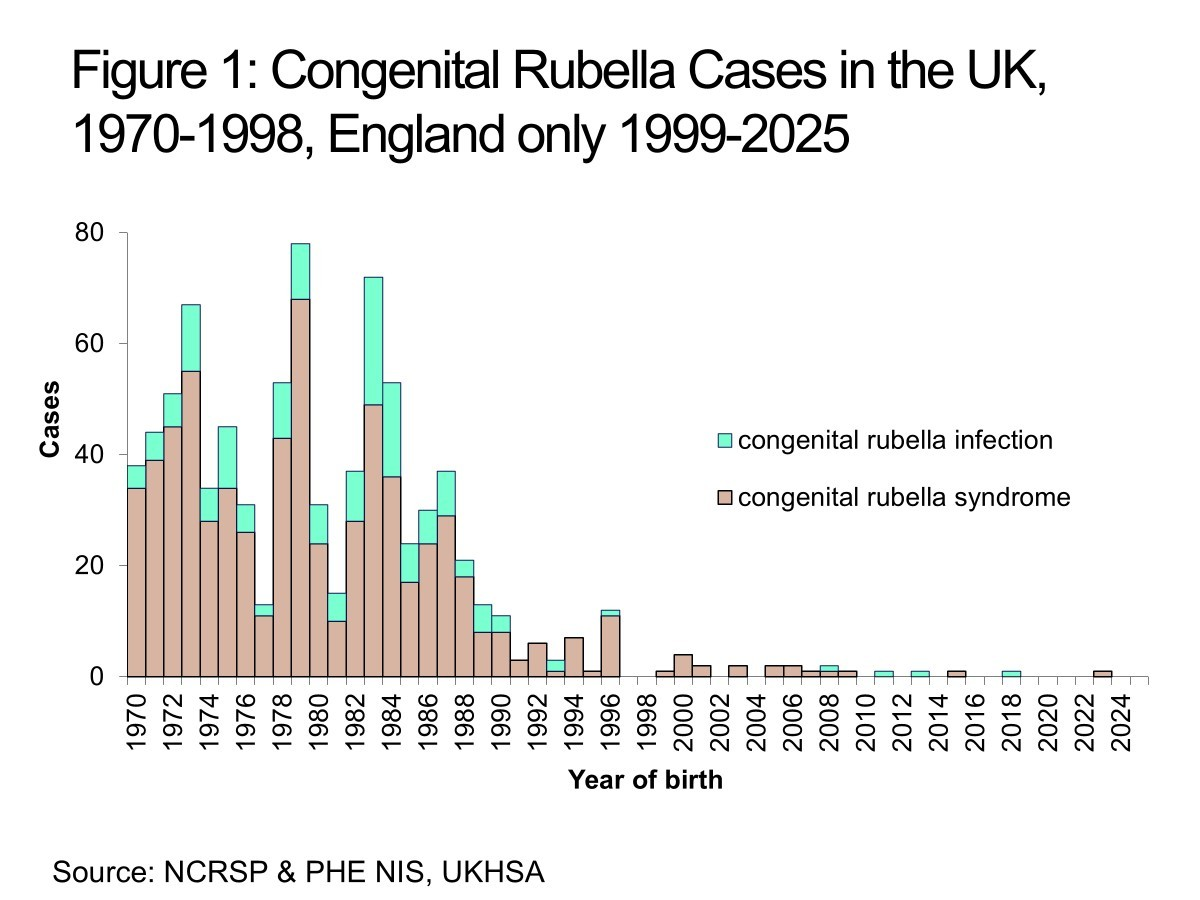
In 1970 a schoolgirl rubella immunisation programme was introduced in the UK. This selective policy was effective in reducing the number of children born with CRS (see graph) but rubella continued to circulate and any remaining non-immune women were often exposed via their own or other young children. Measles, mumps and rubella (MMR) vaccine was introduced in 1988 for all children in the second year of life, with the aim of interrupting circulating rubella.
In 1994, a national measles and rubella vaccine campaign targeted all school aged children (5 to 16 years) in 1994, and the schoolgirl vaccination programme was discontinued. A routine second MMR immunisation at 4 years of age was subsequently introduced in 1996. This was replaced in 2026 so all children will receive 2 doses of measles, mumps, rubella and varicella vaccine (MMRV), usually at 12 and 18 months of age.
Before rubella vaccine became available, an estimated 200 to 300 babies were born each year with CRS in the UK. In the 10 years between 2005 and 2014 there have been 7 cases of CRS born in the UK. The UK achieved rubella elimination in 2016, and since then only one baby with CRS has been reported (Figure 1). This shows that widespread introduction of vaccines that help protect against rubella has led to the near removal of CRS in England.
Figure 1: Congenital Rubella cases in the UK
9. Natural chickenpox or shingles infection in pregnancy and fetal varicella syndrome
When a woman has natural chickenpox infection in pregnancy, both the woman and her baby may be affected.
Chickenpox in pregnancy can be severe, especially in later pregnancy. Complications include pneumonia (infection of the lungs), hepatitis (inflammation of the liver) and encephalitis (swelling of the brain). Treatment with antiviral medicines reduce the risk of severe disease. In a study of almost 1,000 pregnant patients with chickenpox, 2.5% developed pneumonia and none died (12). Newborn babies whose mothers develop chickenpox in the week before and week after birth are at risk of severe disease, and around 20% of these babies die (13).
Infection of the fetus may result in:
- stillbirth
- shingles during infancy or early childhood
- fetal varicella syndrome
Fetal varicella syndrome is a serious condition which can occur in babies whose mothers who had chickenpox up to week 28 of their pregnancy. It is characterised by:
- low birthweight
- scarring of the skin
- problems with limb development
- small head
- cataracts (clouding in the lens of the eye)
In a study conducted in the UK and Germany from 1980 to 1993 involving nearly 1,400 mothers who had varicella infection during pregnancy, the highest risk (2%) for fetal varicella syndrome was seen when the mother’s infection was between weeks 13 and 20 of their pregnancy. Before 13 weeks the risk was estimated to be around 1% (14).
In contrast, the vaccines contain a weakened strain of the varicella zoster virus to protect against this infection, and the vaccine strains have not been found to cause these problems. The vaccine will, however, help protect against the natural infection that can cause these problems.
10. References
- Tookey PA, Jones G, Miller BH, Peckham CS. ‘Rubella vaccination in pregnancy. Communicable Disease Surveillance Centre Review 1991: volume 1, issue 8, pages R86 to R88.
- Best JM, Cooray S, Banatvala JE. Rubella. In: Mahy BMJ and ter Meulen V (editors) Topley and Wilson’s Virology, 10th edition. London (2004): Hodder Arnold.
- Castillo-Solorzano C, Reef SE, Morice A and others. ‘Rubella Vaccination of unknowingly pregnant women during mass campaigns for rubella and congenital rubella syndrome elimination, The Americas 2001 to 2008’ Journal of Infectious Diseases 2011: volume 204, pages S713 to S717.
- Da Silva e Sa GR, Camacho LAB, Stavola MS and others. ‘Pregnancy outcomes following rubella vaccination: a prospective study in the state of Rio de Janeiro, Brazil, 2001 to 2002’ Journal of Infectious Disease 2011: volume 204, pages S722 to S728.
- Soares RC, Siqueria MM, Toscano CM and others. ‘Follow-up study of unknowingly pregnant women vaccinated against rubella in Brazil, 2001 to 2002’ Journal of Infectious Diseases 2011: volume 204, pages S729 to S736.
- Hamkar R, Jalilvand S, Abdolbaghi MH and others. ‘Inadvertent rubella vaccination of pregnant women: evaluation of possible transplacental infection with rubella vaccine’ Vaccine 2006: volume 24, pages 3,558 to 3,563.
- Namaei MH, Ziaee M and Naseh N. ‘Congenital rubella syndrome in infants of women vaccinated during or just before pregnancy with measles-rubella vaccine’ Indian Journal of Medical Research 2008: volume 127, pages 551 to 554.
- Sato HK, Sanajotta AT, Moraes JC and others. ‘Rubella vaccination of unknowingly pregnant women: the Sao Paulo Experience, 2001’ Journal of Infectious Diseases 2011: volume 204, pages S737 to S744.
- Willis ED, Marko AM, Rasmussen SA, McGee M, Broder KR, Marin M. Merck; Centers for Disease Control and Prevention ‘Varicella Vaccine Pregnancy Registry: 19-year summary of data from inception through closure, 1995 to 2013’ Journal of Infectious Disease: 21 October 2022, volume 226, issue supplement 4, pages S441 to S449.
- Wilson E, Goss M, Marin M and others. ‘Varicella vaccine exposure during pregnancy: data from the first 10 years of the pregnancy registry’ Journal of Infectious Disease: March 2008, volume 197, issue supplement 2, pages S178 to S184.
- Marin M, Willis ED, Marko A, Rasmussen SA, Bialek SR, Dana A; Centers for Disease Control and Prevention (CDC). ‘Closure of varicella-zoster virus-containing vaccines pregnancy registry, United States, 2013’ Morbidity and Mortality Weekly Report (MMWR): 22 August 2014, volume 63, issue 33, pages 732 to 733.
- Zhang HJ, Patenaude V, Abenhaim HA. ‘Maternal outcomes in pregnancies affected by varicella zoster infections: population-based study on 7.7 million pregnancy admissions’ Journal of Obstetrics and Gynaecology Research: January 2015, volume 41 issue 1, pages 62 to 68.
- Charlier C, Anselem O, Caseris M, Lachâtre M, Tazi A, Driessen M, and others. (2024). Prevention and management of VZV infection during pregnancy and the perinatal period. Infectious Diseases Now 54(4).
- Enders G, Miller E, Cradock-Watson J, Bolley I, Ridehalgh M. Consequences of varicella and herpes zoster in pregnancy: prospective study of 1739 cases. Lancet. 1994.