UK fusion investment prospectus (HTML)
Published 14 September 2026

© Crown copyright 2026
This publication is licensed under the terms of the Open Government Licence v3.0 except where otherwise stated. To view this licence, visit nationalarchives.gov.uk/doc/open-government-licence/version/3 or write to the Information Policy Team, The National Archives, Kew, London TW9 4DU, or email: psi@nationalarchives.gov.uk.
Where we have identified any third party copyright information you will need to obtain permission from the copyright holders concerned.
This publication is available at https://www.gov.uk/government/publications/uk-fusion-investment-prospectus/uk-fusion-investment-prospectus-html
The UK’s fusion strategy (March 2026) sets out the government’s plans to drive commercialisation of fusion energy technology in the UK, building a thriving fusion industry and supply chain capable supporting national and global opportunities.
This Prospectus provides a practical guide to how you can be part of this transformative emerging industry, benefitting from the UK’s rich ecosystem to invest, partner and grow fusion businesses and the surrounding technology ecosystem.
It brings together information to support companies and investors to understand the market, identify commercial opportunities, and access the networks, programmes and support available across the UK’s fusion ecosystem.
The back section contains a more detailed directory – a practical resource for those wanting further detail on specific opportunities and support.
The UK is the place to grow, invest and transform – join us.
The UK Fusion Advantage: A global investment opportunity
Contents
-
World Leading UK Fusion Ecosystem – The world’s most concentrated cluster of fusion activities. Backed by world-leading facilities and talent.
-
A New Frontier of Investment Opportunities – A sector ripe for global investors and industry. Cutting-edge investment opportunities across fusion and adjacent markets.
-
A De-Risked Route to Market – A sector backed by over £2.5 billion UK government investment. Supported by world-leading fusion policy, political support, and an internationally collaborative environment.
-
STEP Fusion – UK Fusion Energy – Delivering a grid-connected prototype fusion power plant. Anchoring growth across the UK fusion sector. Partnering with industry to accelerate deployment.
-
AI Enabling Fusion – A ground-breaking AI and fusion ecosystem. The Sunrise Supercomputer, dedicated to commercialising fusion.
-
Strategic Support and Incentives - A competitive, pro-innovation environment. Targeted investment and skills programmes.
- The market opportunity for fusion energy is immense, with a global industry estimated at £3-£12 trillion in the future. As a flexible, energy dense, baseload energy generation technology producing no long-lived high-level radioactive waste and without the risk of meltdown, the market for fusion is broader than for existing technologies or those exposed to fluctuating fossil fuel prices.
- Fusion is already moving from scientific ambition to commercial reality and the UK has the world’s most densely clustered fusion ecosystem to deliver this, while offering consistent political backing and support for scaling towards real power plants – all inside a transparent, stable policy ecosystem that investors can navigate with confidence.
- This is an investable market taking shape now, across fusion developers designing and building fusion facilities, the commercial development of fusion’s enabling technologies, and the immediate deployment of these technologies in adjacent markets. All these opportunities are on offer across the UK fusion sector.
Contact the DESNZ Fusion Energy team: Fusion.Prospectus@energysecurity.gov.uk
1. World Leading UK Fusion Ecosystem
The UK hosts one of the highest concentrations of fusion companies globally, spanning multiple technological approaches and key enabling technologies. This density matters.
Clusters accelerate hiring, shorten learning curves and create natural pathways for partnership, acquisition and scale‑up. They also enable capital to compound: talent moves between firms, ideas cross‑pollinate, and infrastructure is reused rather than reinvented.
Fusion Industry Finance – UK Innovation & Science Seed Fund, UK Research and Innovation – Innovate UK, British Business Bank, Invest Northern Ireland, East X Ventures, Barclays, UK Export Finance, National Wealth Fund, Development Bank of Wales, The Scottish National Investment Bank
Fusion Technology Companies – UK Fusion Energy, ILIOS, First Light Fusion, Nuvia, Tokamak Energy, TE Magnetics, Dassault Systems, Stellarex Energy, AECOM, General Fusion, TAE Technologies, Commonwealth Fusion Systems, Proxima Fusion, Pulsar Fusion, Type One Energy, KIER, Eni, Kyoto Fusioneering, Oxford Sigma, Ridgway Machines, Novatron
Supply Chain Organisations – The Fusion Cluster, Fusion Industry Association, UK Inertial Fusion Consortium, Fusion Industry Taskforce, Fusion Energy Insights, Fusion Advisory Services, Superconducting Machines & Systems Catalyst, Sustainable Markets Initiative
Recent Startups, Spinouts, Joint Ventures – UKAEA – Eni H3AT Tritium Loop Facility, RH3OVA, Fusion Energy Partners, MuWave, Scitech Precision, Luffy.ai, Singular Machines, DiPOLE Systems Ltd, digiLab, Standardx, Mach42
National Labs, Programmes – UK Atomic Energy Authority, Sunrise, Manufacturing Technology Centre, UK Programme of Laser Inertial Fusion Technology for Energy (UPLiFT), UK Research and Innovation Science and Technology Facilities Council – Central Laser Facility
Academia – University of Strathclyde Glasgow, University of Edinburgh, University of York, Queen’s University Belfast, Durham University, Lancaster University, University of Manchester, University of Liverpool, University of Sheffield, University of Birmingham, University of Nottingham, Swansea University, University of Warwick, University of Cambridge, University of Bristol, University of Oxford, Imperial College London, University of Bath
For a wider example of companies operating in the UK’s fusion sector, please explore the Fusion Cluster’s growing list of partners at thefusioncluster.com.
Figure 1: UK Fusion Ecosystem – Key Elements
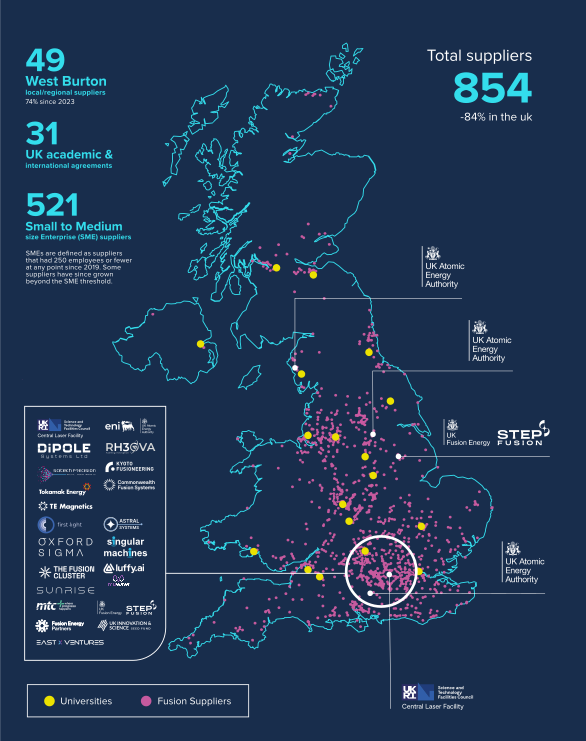
Description of Figure 1: Infographic showing the geographic spread throughout the country of key elements of the UK fusion ecosystem. Universities and Fusion Suppliers are spread throughout the UK; 49 local/regional suppliers in West Burton, 74% since 2023; 31 UK academic & international agreements, ~£3.4m value; 521 small to medium size enterprises (SME) suppliers, SMEs are defined as suppliers that had 250 employees or fewer at any point since 2019; 854 total suppliers, ~84% in the UK; the highest concentration of fusion organisations is indicated as being around the UKAEA’s Culham Campus; the UKAEA Group have facilities throughout the country.
Figure 2: UKAEA Group facilities
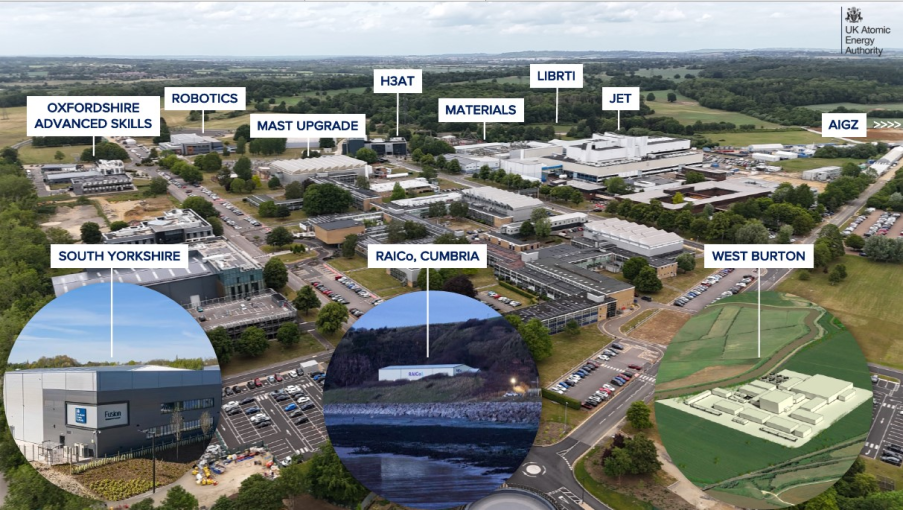
Description of Figure 2: Image showing the research facilities in the UKAEA Group’s Culham Campus, as well as those throughout the country in South Yorkshire, Cumbria, and West Burton. The names of each and their descriptions are below.
UK Atomic Energy Authority
The UKAEA brings together the R&D to solve and commercialise the remaining challenges of fusion. Many of these offer opportunities for partnering and collaboration - with many companies already engaged:
H3AT – Hydrogen-3 Advanced Technology: Building the world’s most advanced tritium fuel-cycle facility to demonstrate how fusion fuel can be processed, stored, recycled and reused at pilot-plant scale, underpinning future fusion power stations
LIBRTI – Lithium Breeding for Tritium Innovation: Developing a world-leading UK testbed for tritium breeding technologies, enabling future fusion power plants to generate their own fuel while de-risking breeder blanket systems for STEP and commercial fusion
MRF - Materials Research Facility: Developing and testing materials capable of withstanding extreme neutron, thermal and mechanical conditions inside fusion power plants
RACE - Remote Applications in Challenging Environments: Creating autonomous robotics technologies for inspection, maintenance and operations in hazardous fusion and nuclear environments
JDR - JET Decommissioning and Repurposing: Safely decommissioning JET while preserving critical knowledge, data and facilities for future fusion programmes
MAST-U: Advancing plasma physics, modelling and experimental research to improve fusion performance and inform future reactor designs.
AI Growth Zone & Sunrise: Applying advanced computing, AI and data science to accelerate fusion research, design optimisation and plant operations.
Culham in Oxfordshire has acted as the nucleus of this ecosystem, while STEP Fusion through West Burton expands its commercial horizon through the design and building of a fusion power plant, all underpinned by a combination of established supply chains, strong industrial collaboration networks, regional ecosystems, and the UK’s world leading academia, offering investors and industry practical pathways to develop, test, scale and commercialise fusion-enabled technologies in the UK.
2. A New Frontier of Investment Opportunities
UK Fusion is accelerating towards commercial deployment, creating new opportunities for investors and industry.
Investors: Backing the companies deploying fusion energy; Capitalising on the growth of fusion supply chains; Taking the lead in new markets for fusion technologies
This is the place for investors: to grab a slice of the prize offered by fusion; capitalise on the growth offered by supply chains as they expand to meet the demands of fusion; and break into innovative new market opportunities as fusion technologies are spun-out and commercialised across the global economy.
Industry: Clustered support for commercialising your fusion technologies
This is the place for industry: providing fusion developers the optimum location to develop and deploy their fusion facilities; for manufacturers to develop, expand, and export their capabilities to meet the rapidly growing demands for fusion sub-systems, components, and technical know-how; and supporting startups, to accelerate the commercialisation of their technology in fusion and adjacent sectors, including AI, power distribution, renewables, transportation, healthcare, space, and defence.
Fusion’s subsystems and technologies, ready for commercialisation into adjacent sectors
Cutting edge fusion technologies are already being commercialised in adjacent sectors, providing near-term returns on investment and helping to scale the manufacturing supply-chains required to deploy fusion energy around the world.
Fusion technologies ready for commercialisation include: High Temperature Superconducting (HTS) Magnets, Gyrotrons, Neutral Beams, Robotics, Advanced Materials, Lasers and Targets, Fusion AI, Cryogenics, Plasma Processing
Adjacent sectors for these technologies include: Advanced Manufacturing, Aerospace, Autonomous Systems, Defence, Digital engineering, Energy Systems, Healthcare, Industrial Processing, Nuclear Fission, Telecoms, Transportation, Quantum Technologies, Renewables, Space
3. A De‑Risked Route to Market
The UK is backing the future of energy.
Over £2.5bn over 5 years.
The UK government is making a record investment in fusion energy of over £2.5bn over 5 years (2025/26 and 2029/30).
-
£1.3 billion for UK Fusion Energy for the next phase of delivering STEP, and progressing the prototype fusion powerplant in partnership with industry
-
£1.2 billion for UKAEA’s cutting-edge R&D infrastructure, facilities, projects and programmes, collaborations, commercialisation, AI, and skills.
A world-leading policy environment for fusion to thrive
DESNZ will continue to provide a forward-leaning policy environment for the fusion sector to thrive:
Innovation – DESNZ will continue to support spin-outs and start-ups to accelerate the commercialisation of fusion technology
Regulatory Certainty - The UK was the first country to confirm its regulatory approach for fusion energy, a proportionate, robust, pro-innovation approach separate to nuclear fission.
National Policy Statement for Fusion (EN-8) - To streamline planning permission for fusion developers and provide certainty for developers.
Regulatory Roadmap - Outlining the early engagement process between developers and regulators ahead of formal regulatory process.
Market Framework for Fusion Deployment - Developing options to oer an energy pricing mechanism for fusion that will enable deployment while protecting billpayers.
Fusion Insurance - Continuing to engage the energy insurance market on fusion risks and encourage fusion to be treated outside of nuclear exclusion clauses.
Grid connections - Launching a new Connections Accelerator Service (CAS) and have committed to using the Planning and Infrastructure Act to improve the connections process
Finance - Continuing to work with the UK’s well established financial systems, including Public Finance support to enable businesses of all types and sizes to raise finance
Skills - Continuing to build the talent pipeline, improving awareness of fusion in compulsory education, working with the Office for Clean Energy Jobs on the expansion of the Energy Skills Passport to fusion, and support via the UK’s strong visa routes.
The UK fusion market is open by design. It welcomes international capital, partners and talent, and is deeply integrated with global supply chains across Europe and North America. UK‑based companies are positioned to scale internationally – and to be natural partners or acquisition targets for global players.
This openness, combined with regulatory clarity and political commitment, makes the UK not just a place to innovate, but a place to invest.
Figure 3: Countries and organisations with which the UK has signed agreements related to fusion
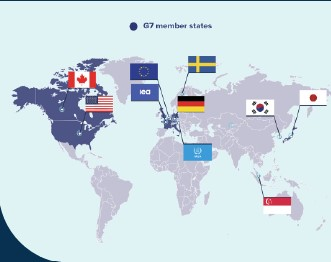
Description of Figure 3: The world map identifies Canada, North America, the EU, Sweden, Germany, the International Energy Agency, the International Atomic Energy Agency, the Republic of Korea, Japan, and Singapore as the countries and organisation with which the UK has signed agreement related to fusion.
4. STEP Fusion – UK Fusion Energy
Through STEP Fusion, the government is backing a grid-connected prototype fusion power plant, supported by a new commercial cluster at West Burton.
STEP is not an experiment – it is a fully integrated fusion plant, and a demand signal. It creates a credible destination for technology, capital and supply chains, and establishes a clear pathway from innovation to electricity generation.
Over its lifetime, STEP will channel £ billions of investment into industry, and stimulate further expansion of the fusion ecosystem – which other companies and investors can come and be part of.
STEP is being delivered by UK Fusion Energy Ltd (UKFE). UKFE is uniquely positioned to be a world leading fusion systems integrator and plant operator, bringing together the full set of capabilities, information, and whole plant understanding needed to reach an integrated fusion power plant design.
This will optimise net power, fuel self-sufficiency and a route to commercial levels of plant availability simultaneously – based on leading R&D and industrial integration, the backing of UKAEA’s scientific expertise and the ability to call upon the coordinating power of government.
As a pioneering, major UK company, UKFE has been set up to partner with private sector construction and engineering companies and be able to raise external investment in future.
UKFE offers industry the opportunity to join the UK through several pathways to deliver the systems and subsystems required to deliver commercial fusion energy. STEP Fusion is already anchoring growth across the UK fusion sector, from Tier 1 developers to SMEs and Startups.
UKFE Partnering Model
UK Fusion Energy is now assembling world-class industrial partners and supply chains to bring together and optimise the full suite of technologies and systems required to deliver whole-plant fusion solutions safely. UKFE are already building a thriving industry which benefits from the global market for these technologies with applications spanning beyond fusion. Industrial partners involved in the development of STEP Fusion will be ideally placed to deliver the future fleet of commercial fusion plants.
Figure 4: UKFE Partnering Model for delivering STEP Fusion
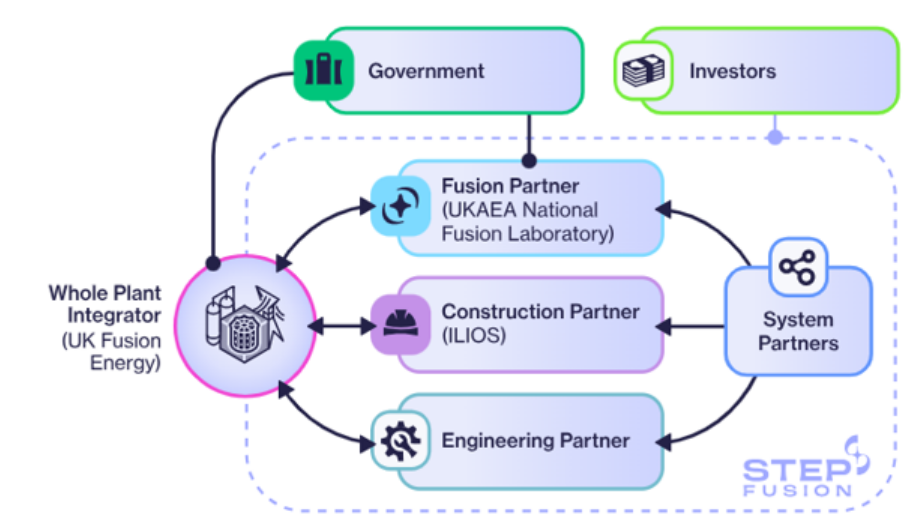
Description of Figure 4: UK Fusion Energy is the STEP Whole Plant Integrator. There are 3 distinct System Partners: UKAEA National Fusion Laboratory is the Fusion Partner, the ILIOS Consortium is the Constriction Partner, and an Engineering Partner has not yet been identified. This model allows government to continuing working with UKAEA National Laboratory, and UKFE, while creating future access to the project for investors.
Fusion Partner: UKAEA, as UKFE’s Fusion Partner, provides unparalleled support through its world-leading fusion expertise and capability. UKAEA will also commercialise some aspects of its fusion expertise through a pipeline of spin outs, IP licenses, and joint ventures with industry partners. The companies created and enhanced in this way will play a key part in the STEP Fusion supply chain.
Construction Partner: UKFE have appointed ILIOS as Construction Partner for STEP Fusion, a Joint Venture between Kier, Nuvia, joined by AECOM, AL_A Architects, and Turner & Townsend as strategic partners.
This collaboration brings strong construction expertise, programme delivery capability and industry leadership into STEP Fusion.
The contract, valued at £200m, is a major milestone in transforming the West Burton site into the UK’s world-leading prototype fusion energy plant
Engineering Partner: UKFE will need world leading capability in major engineering, from concept through to manufactured product and they intend to approach the market with this opportunity. In the near-term, engineering works will be delivered by a range of system partners.
System Partners: UKFE is now identifying key partners at the system level, those companies that specialise in specific critical technologies needed for STEP Fusion and beyond.
In April 2026, Tokamak Energy was confirmed as the Magnet Systems Partner, and were awarded a contract valued at £70m, for work including magnets, tokamak systems, and plasma integration. Delivery will be led through their high temperature superconducting (HTS) technologies division, TE Magnetics.
In April 2026 Dassault Systèmes were awarded a £30m contract to expand delivery and capability within the 3DEXPERIENCE platform, a core part of STEP Fusion’s Plant Information Management System (PIMS)
STEP Fusion is continuing to look for strategic partners to help deliver some of the most important systems in the UK’s prototype fusion power plant, which includes onboarding partners in the following areas:
- Fuel Cycle System Partner
- UKFE Embedded Engineering Resources Framework
- Test Operations Partner
- Breeder Blanket System Partner
- Fusion Plant Controls Partner
- More to be announced
Register for UKFE (STEP Fusion) Procurement Portal.
Sub-System Demand and Manufacturing
STEP Fusion will create demand for the UK supply chain to grow from component level sub-systems to full fusion product delivery, providing opportunities for investment, and for industry to expand or establish production facilities in the UK for these fusion-driven technologies, that are ready for commercialisation, including:
- High Temperature Superconducting (HTS) magnets
- Gyrotrons
- Neutral beam systems
- Remote maintenance and robotics
- Diagnostics and sensors
- Fusion fuel cycle systems
- Fusion hardened components and materials
- Key materials supply
- Lasers and Optics
UKFE itself will develop the capability to bring together fusion systems into an integrated power plant design, a capability that can be commercially exploited by UKFE.
5. AI for Fusion
Fusion energy is one of the five priority areas of the government’s AI for Science Strategy.
Whilst fusion could play a significant role in powering AI in the future, AI will first play a key role in making fusion happen, accelerating progress towards commercialised fusion energy. The government’s AI Opportunities Action Plan announced the UKAEA’s Culham Campus as the UK’s first AI Growth Zone (AIGZ).
Building on this, the UK government has already invested £45 million for a 1.4 MW mission-focused supercomputer named ‘Sunrise’, primed to be the world’s most powerful AI supercomputer dedicated to fusion energy.
Sunrise will tackle key fusion energy challenges in areas such as plasma turbulence, materials development and tritium fuel breeding, while delivering spillover benefits to other clean energy technologies and the UK’s broader net zero ambitions.
Sunrise will simultaneously advance the delivery of fusion energy and grow an AI-native economy.
Further AI resources can be found via the UK’s AI Research Resource (AIRR).
6. Strategic Support and Incentives
The UK provides the practical conditions to build, scale and commercialise fusion businesses. This includes:
- A growing pipeline of highly skilled talent
- Streamlined routes for international expertise
- Generous innovation and venture capital incentives
- Strategic industrial locations
- A coordinated public finance landscape to support business growth.
These reduce barriers to entry and provide a clear pathway from research and innovation through to manufacturing, deployment and commercial scale-up.
Venture Capital Schemes provide tax reliefs to investors backing UK growth, incentivising investment into the SMEs that cornerstone the sector. These include:
- The Seed Enterprise Investment Scheme (SEIS) encourages direct investment in certain early-stage small companies and complements the EIS and VCT scheme (see below).
- The Venture Capital Trust (VCT) encourages indirect investment by individuals, through a VCT investing in, or lending money to, unlisted companies.
- The Enterprise Investment Scheme (EIS) encourages direct investment by individuals
R&D Tax Credits offer cash payments and/or cooperation tax reductions on money spent on the products, processes or services needed for the commercial deployment of fusion technologies. This includes:
- The Merged Scheme R&D Expenditure Credit for companies of all sizes investing in R&D
- The Enhanced R&D Intensive Support for loss-making SME with significant R&D expenditure
- The Patent Box for companies commercialising their IP in the UK
The British Industrial Competitiveness Scheme (BICS) will offer further direct support that could cut your eligible manufacturing energy bill requirements by up to £40 per megawatt hour, protecting your growth against uncertain global energy markets.
The UK is investing in home-grown talent through UKAEA, Academia, and Industry, who are partnering to ensure the UK has the skills needed to meet the demands of the fusion sector.
- The FOSTER Programme, increasing the level and availability of skills from schools through to universities and industry professionals
- The National Fusion Skills Platform, delivering the Fusion Centre for Doctoral Training, Fusion Engineering Doctoral Training Partnership, industrial upskilling and graduate training
- Manufacturing Technology Centre, ensuring the UK has the skills needed for manufacturing, and operation of the Oxford Advances Skills training centre
The UK offers Visa support for attracting globally mobile talent, through a streamlined visa process to meet all talent needs and support business growth. This includes:
- Standard Visitor Visa – To attend meetings and trade fairs, negotiate and sign deals, and carry out site visits and inspections.
- Senior or Specialist Worker Visa – For multinational companies to bring existing employees to the UK.
- Skilled Worker Visa – To recruit skilled workers from overseas
- Innovation Founder Visa – To set-up and run an innovative business in the UK
- UK Expansion Worker Visa – To establish a branch of an overseas business that has not yet started trading in the UK
Industrial Strategy Zones
Offering access to strategic sites and infrastructure via Investment Zones and Freeports.
Industrial Strategy Zones provide investors with ready-made locations for growth, combining development-ready sites, infrastructure and targeted support to accelerate investment decisions.
These zones help businesses establish and expand operations more quickly by bringing forward investible land and facilities, actively supporting inward investment, and fostering strong industrial clusters.
By attracting anchor investments and strengthening local supply chains, Industrial Strategy Zones create dynamic ecosystems where businesses can benefit from collaboration, skilled workforces, and long-term regional economic growth.
The Trent Supercluster, where STEP is located, is the East Midlands Combined County Authority’s (EMCCA) long-term programme to transform three former coal-fired power station sites, West Burton, Cottam and High Marnham, into a nationally significant cluster for clean energy, advanced manufacturing, innovation and economic growth
The Supercluster is backed by Industrial Strategy Zones, including Business Rates Retention Zones, Investment Zones and Freeports benefiting from a range of tax reliefs to attract investment.
DESNZ and the Supercluster are working to leverage STEP Fusion to anchor growth in the region, offering opportunities for inward investment, reindustrialisation, the creation of skilled jobs, building upon the legacy regional power generation legacy of the ‘Megawatt Valley’.
Figure 5: Freeports and Investment Zones map
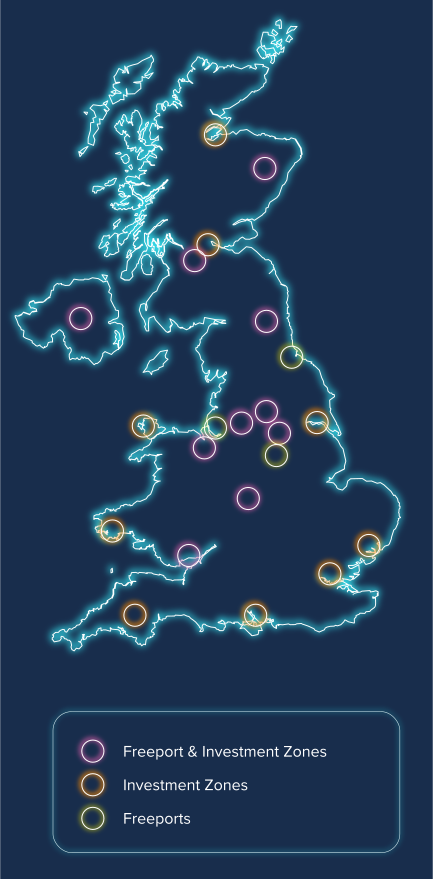
Description of Figure 5: The map shows that Freeports and Investment Zones are spread throughout the UK, with some areas being both an Investment Zone and having a Freeport.
UK Public Finance
The UK has a rich Public Finance landscape providing support to companies at different stages. Whichever one you reach out to, they will make sure you are directed to the right place, and will work together where appropriate to get projects delivered.
Figure 6: UK Public Finance landscape graphic
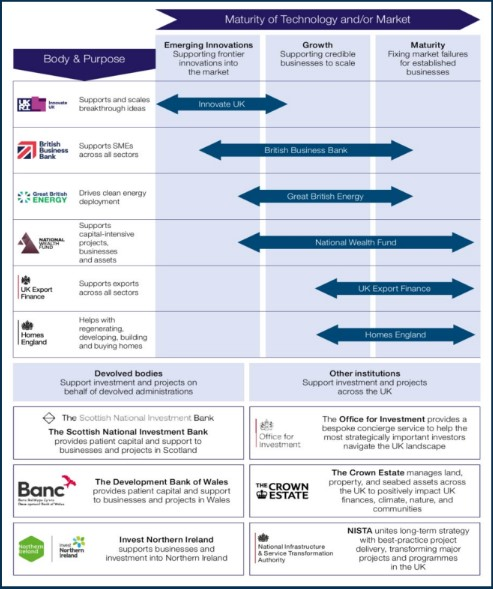
Description of Figure 6: Innovate UK supports and scales breakthrough ideas by providing funding for Emerging Innovations – supporting frontier innovations into the markets, set these for the Growth stage – supporting credible businesses to scale; the British Business Bank supports SMEs across all sectors from Emerging Innovations and Growth stages through to Maturity stage – fixing market failures for established businesses; Great British Energy drives clean energy deployment across all three stages of Emerging Innovations, Growth, and Maturity; National Wealth Fund supports capital-intensive projects, businesses and assets across all three stages of Emerging Innovations, Growth, and Maturity; UK Export Finance supports exports across all sectors across Growth and Maturity stages; Homes England helps with regenerating, developing, building, and buying homes across Growth and Maturity stages. Devolved bodies support investment and projects on behalf of devolved administrations: The Scottish Investment Bank provides patient capital and support to businesses and projects in Scotland; The Development Bank of Wales provides patient capital and support to businesses and projects in Wales; Invest Northern Ireland supports businesses and investment into Northern Ireland. Other institutions support investment and projects across the UK: the Office for Investment provides a bespoke concierge service to help the most strategically important investors navigate the UK landscape; The Crown Estate manages land, property, and seabed assets across the UK to positively impact UK finances, climate, nature, and communities; National Infrastructure & Service Transformation Authority unites long-term strategy with best-practice project delivery, transforming major projects and programmes in the UK.
Other investment funds focusing specifically on the UK fusion ecosystem, include:
- The public funded UK Innovation and Science Seed Fund (UKI2S)
- East X Venture’s Starmaker One fusion fund, a private investment fund backed by a £20m invesment by the UK government
Leading UK financial institutions are also entering the fusion sector. In July 2026, Barclays announced that they are supporting the UK Infinity Consortium’s efforts to advance the development of a commercial fusion power plant project in the UK, bringing its experience in energy, infrastructure, project finance, capital markets, and commercial frameworks.
C.S. Venkatakrishnan, Group Chief Executive at Barclays, said:
Fusion has the potential to become an important part of a secure, resilient and low-carbon energy system. Barclays is pleased to work with fusion related companies and to support the UK Infinity Fusion Consortium as part of our broader engagement with clients and partners working to advance sustainable innovation, including through the Sustainable Markets Initiative.
We look forward to continuing to share our sector perspective and experience with fusion groups in the UK as the consortium helps build momentum behind the UK’s fusion ecosystem and the government’s advanced energy ambitions.
The UK fusion sector benefits from a stable, responsive, and meaningful relationship between government and industry, through structured, ongoing engagement which has built durable trust, backed by the long‑term funding commitments through the Spending Review all signal durable political backing.
Industry are consulted directly on policy design, regulation and public investment priorities, with their efforts recognised through the inclusion of fusion as a clean energy industry of the future in the Industrial Strategy, the Clean Energy Industries: Sector Plan, and throughout the UK’s Fusion Strategy, and are delivery is set out in the UKAEA and UKFE strategies.