Taking part in the UK Emissions Trading Scheme markets
Updated 12 October 2026

© Crown copyright 2026
This publication is licensed under the terms of the Open Government Licence v3.0 except where otherwise stated. To view this licence, visit nationalarchives.gov.uk/doc/open-government-licence/version/3 or write to the Information Policy Team, The National Archives, Kew, London TW9 4DU, or email: psi@nationalarchives.gov.uk.
Where we have identified any third party copyright information you will need to obtain permission from the copyright holders concerned.
This publication is available at https://www.gov.uk/government/publications/taking-part-in-the-uk-emissions-trading-scheme-markets/taking-part-in-the-uk-emissions-trading-scheme-markets
This page provides guidance on operation and participation in the UK Emission Trading Scheme (UK ETS) auctions and the secondary market in UK allowances.
See also:
- participating in the UK ETS for an overview of the scheme and first steps for new participants
- policy aims of the UK ETS for existing policy and next steps for developing the scheme
- technical guidance and other tools for current scheme participants
- UK ETS reports and scheme reviews for scheme or compliance data and other reporting by the Authority
The UK ETS auctions and the secondary market in allowances are regulated by The Greenhouse Gas Emissions Trading Scheme Auctioning Regulations 2021 (the Auctioning Regulations).
UK ETS auctions
Auctioning is the primary means of introducing allowances into the market. Holders of installation operator holding accounts (OHA), aircraft operator holding accounts (AOHA), and trading accounts (that meet the eligibility criteria set out below) within the UK ETS Registry can take part in the auctions of UK allowances (UKAs). Read guidance on how to apply for a UK Registry Account.
ICE Futures Europe currently provide the auction platform and secondary market services under the UK ETS. Market participants need to be registered with ICE Futures Europe to take part in UKA auctions. Market participants who are interested in bidding in UKA auctions should visit ICE Futures Europe’s UK ETS auctions page and contact sales-utilities@ice.com.
The revised 2026 auction calendar was published by ICE on 1 July 2026 to account for the inclusion of maritime emissions. The auction volume has been increased by 983,000 which means just under 53 million allowances will be auctioned across the 25 auctions beginning which began on 14 January 2026. The additional volume will be spread evenly across the remaining 2026 auctions, starting from 12 August 2026. Auctions continue to take place fortnightly.
Participants are also able to trade allowances on the secondary market. For information about the UK ETS Registry and how to open an account if you are a trader, see the relevant guidance in Participating in the UK Emissions Trading Scheme.
Participating in UKA auctions
To be eligible to bid in UKA auctions, entities will need to hold an account in the UK Emissions Trading Registry and be one of the following:
- a UK ETS operator or a UK ETS aircraft operator
- a member of a UK ETS operator or UK ETS aircraft operator’s group (i.e. parent companies, subsidiaries or fellow subsidiaries) which is not required to be located in the UK
- a business grouping of UK ETS operators, UK ETS aircraft operators or their group, which is not required to be located in the UK
- public/state bodies of the UK that control UK ETS operators, UK ETS aircraft operators or members of their group
- a UK investment firm with a Part 4A FSMA permission that would require authorisation under the Markets in Financial Instruments Directive (MiFID)
- a UK credit institution with a Part 4A FSMA permission that would require authorisation under the Capital Requirements Directive (CRD)
- a third country (non-UK) investment firm with a Part 4A FSMA permission that would require authorisation under MiFID
- a third country (non-UK) credit institution with a Part 4A FSMA permission that would require authorisation under CRD
- a person covered by the exemption in paragraph 1(k) of Schedule 3 of the FSMA Regulated Activities Order 2001 (whose investment business is ancillary to their main commodities business, in accordance with regulation 16(2) of the Auctioning Regulations), provided they have a registered office (or head office if no registered office) in the UK.
Determining the Auction Clearing Price
Auction clearing price rules determine the prices paid by participants in UK ETS auctions.
Regulation 7 of the Auctioning Regulations sets out how the auction clearing price is calculated by the auction platform.
a) The auction clearing price is the price of the bid at which the sum of the volumes bid matches or exceeds the volume of allowances auctioned.
b) Where the price calculated through this methodology would be significantly below the price on the secondary market prevailing during and immediately before the bidding window, the auction clearing price becomes the price of the lowest bid that is not significantly below the prevailing secondary market price (this process is illustrated in Figure 1 below).
c) Before the auction starts, the auction platform must:
- decide on the methodology for determining whether the clearing price is significantly below the prevailing secondary market price
- determine what the prevailing price in the secondary market is
- consult the auctioneer (DESNZ) and notify the FCA about this methodology. The methodology used by the auction platform is not public information
d) There is also an auction reserve price. As of 8 April 2026, this is currently set at £28, below which bids will not be accepted.
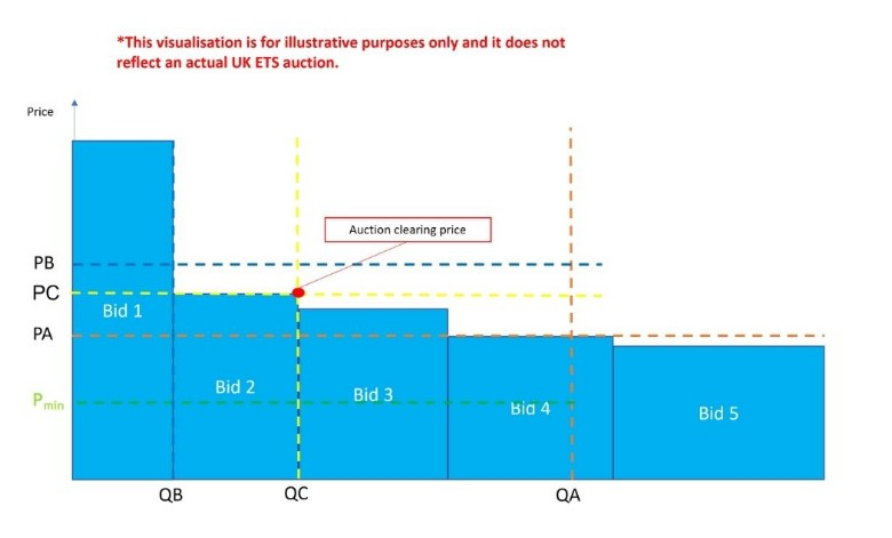
Figure 1: Calculating the auction clearing price when the price at which the sum of volumes bid exceeds the number of allowances auctioned is significantly below the prevailing secondary market price.
Key for Figure 1
PA: Price where the sum of volumes bid exceeded the number of allowances auctioned (would otherwise be auction clearing price).
PB: The prevailing secondary market price.
PC: Auction clearing price because PA is significantly below (determined by ICE) PB
QA: Quantity of allowances available at auction
QB: Quantity of allowances bid at secondary market price
QC: Quantity of allowances sold
Pmin: Auction reserve price
Partially Cleared Auctions
An auction does not fully clear if there are unsold allowances. Any remaining allowances not sold in a UK ETS auction are redistributed across the following four auctions up to 125% of those auctions’ original number of allowances. Above this limit, allowances will transfer into the market stability mechanism account.
Auction Reserve Price
The UK ETS currently has an Auction Reserve Price (ARP) of £28, which establishes a minimum price for which allowances can be sold at auctions. Bids below this price will not be successful at auction.
As set out in the December 2025 Authority Response, the ARP has been adjusted to reflect inflation, from £22 to £28 in 2026. The legislation for this amendment - The Greenhouse Gas Emissions Trading Scheme Auctioning (Amendment) Regulations 2026 - was laid on 5 March 2026, and came into effect on 8 April 2026.
From 1 January 2027 onwards, the ARP value will adjust yearly in line with inflation, according to GDP Deflator data provided by the Office for National Statistics (ONS). There is further information on the inflation-based ARP in the Authority response.
Only one auction of UKAs has ever partially cleared, as described below.
6 October 2021 auction
An auction of 5,187,500 allowances was held by ICE on 6 October 2021. The auction partially cleared, with 4,149,000 allowances being successfully sold at the auction clearing price of £60.00.
Bids that were below £60.00 were determined, according to the methodology employed by ICE, to be significantly below the prevailing secondary market price. £60.00 therefore became the auction clearing price and bids below this level were unsuccessful, resulting in 1,038,500 allowances remaining unsold.
In line with the scheme legislation, these 1,038,500 allowances were allocated across the next four auctions on 20 October, 3 November, 17 November and 1 December.
On 8 October 2021, ICE published an updated auction calendar reflecting the partially cleared auction.
Participating in the UK ETS secondary market
Once allowances have been released through auctions and free allocation, they can be traded on the UK ETS secondary market. The secondary market provides a means for market participants to source allowances outside auctions and free allocation, and it enables participants to plan ahead through hedging future carbon costs.
ICE Futures Europe hosts a secondary market for UKA derivatives. To find out more about how to participate in the secondary market hosted by ICE Futures Europe, email sales-utilities@ice.com.
If you are a UK ETS participant with compliance obligations seeking assistance on participating in the UK ETS secondary market, you may wish to consider researching brokers for UK ETS trading or contacting your commodity trading partner or corporate bank for advice.
Cost Containment Mechanism
The Cost Containment Mechanism (CCM) provides a means for the UK ETS Authority to intervene if prices are elevated for a sustained period.
If the CCM is triggered, the UK ETS Authority will consider whether any intervention is appropriate. In doing so, it may consider whether the sustained price movement reflects underlying market fundamentals. If there is no agreement on what action to take, the final decision will be taken by HM Treasury (HMT). This intervention can include:
- redistributing allowances between the current year’s auctions
- increasing the volume of allowances to be auctioned by:
- bringing forward auctioned allowances from future years
- drawing allowances from the market stability mechanism account
- auctioning up to 25% of the remaining allowances in the New Entrants’ Reserve
- auctioning allowances which form part of the industry cap on free allocation to stationary installations for the current or past scheme years where the amount of free allocation is lower than the industry cap
- bringing allowances into auctions from the flexible share
Furthermore, the decision about what intervention, if any, to make will be clearly communicated to participants in a timely manner.
An explanation of the operation of the CCM is set out in the Explanatory Memorandum to the UK ETS Auctioning Regulations.
In 2023, the UK ETS Authority consulted on options for the future of the CCM and the final decision was published in December 2025.
The CCM Trigger Price
The UK CCM had lower price and time triggers in the first two years of the UK ETS when compared to the equivalent EU ETS mechanism: this was to ensure the intervention could be more agile in early years while the UK ETS matured.
Until January 2022, the CCM was triggered if the average end of day settlement price of a UK allowance (UKA) December futures contract was more than 2 times the average price for the preceding 2-year ‘reference period’, for 3 consecutive months (the ‘monitoring period’).
From February 2022 until January 2023, the CCM would have been triggered if the average end of day settlement price of the relevant UKA December futures contract was more than 2.5 times the average price for the reference period for the duration of the monitoring period (3 consecutive months).
From February 2023 onwards, the CCM is triggered where the monthly average price of the relevant UKA December futures contract exceeds three times the average price during the two-year reference period in each of six consecutive months.
The following diagrams show 2 scenarios where the CCM would and would not be triggered according to CCM rules from February 2023 onwards:
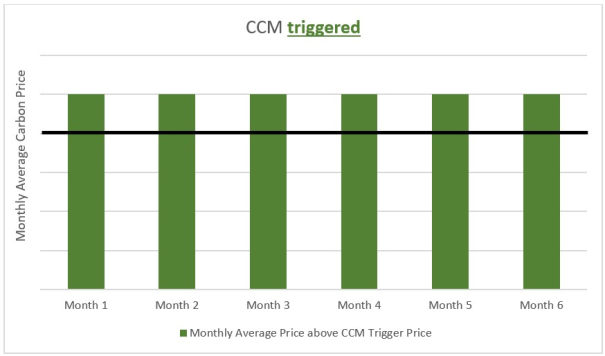
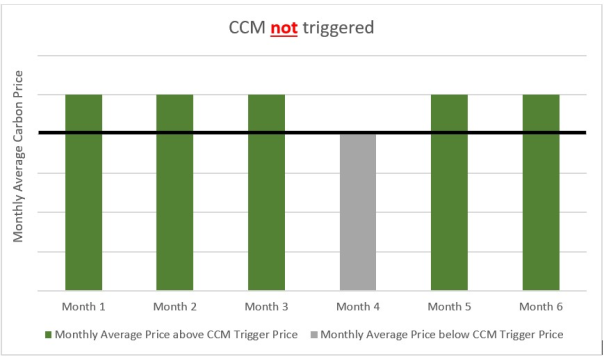
The CCM was triggered in both December 2021 and January 2022. The UK ETS Authority decided not to intervene in the market on both occasions. See the UK ETS Authority Decision Statements for more information.
Reference period
The 2-year reference period ends when the monitoring period starts. Until January 2023, the monitoring period was 3 consecutive months. From February 2023 onwards, the monitoring period is 6 consecutive months.
This means that currently the whole period under consideration is 30 months. This is split into 2 components – the 2-year ‘reference period’ followed by the 6-month ‘monitoring period’.
When the 2-year reference period started in 2019, the carbon price calculation included the end of day settlement prices of the EU allowance (EUA) December futures contracts up until 31 December 2020. EUA prices were used as a reference due to the limited UK ETS market data available since the UK ETS secondary market only started in May 2021. After 31 December 2020 EUA prices were no longer counted. This price was converted from EUR to GBP using the respective historical daily spot exchange rate, provided by the Bank of England.
From 1 January 2021 onwards, the end of day settlement prices of the UKA December futures contracts is counted. However, from 1 January 2021 to 18 May 2021 there were no UKA future contracts. Therefore, these days were treated as non-trading days and did not contribute to the 2-year average.
6-month monitoring period – CCM trigger prices and monthly average prices
The monthly average carbon price is calculated by dividing the sum of the end of day settlement prices for the relevant December futures contract during each month by the number of days in the month for which a price is published.
From 1 December 2025 until 30 November 2026, the 2026 December futures contract is used.
In order for the CCM to be triggered from 2023 onwards, there must be 6 consecutive months where monthly average prices are above the trigger price.
| Month | 2-year reference period | Trigger price | 6-month monitoring period | Month 1 average price | Month 2 average price | Month 3 average price | Month 4 average price | Month 5 average price | Month 6 average price | CCM triggered? Yes or No |
|---|---|---|---|---|---|---|---|---|---|---|
| Oct-26 | 1 April 2024 - 31 March 2026 | £139.82 | Apr, May, Jun, Jul, Aug, Sep | £46.82 | £52.41 | £57.02 | £58.68 | £59.34 | £60.17 | No |
| Nov-26 | 1 May 2024 - 30 April 2026 | £141.21 | May, Jun, Jul, Aug, Sep, Oct | £52.41 | £57.02 | £58.68 | £59.34 | £60.17 | TBD | No* |
| Dec-26 | 1 June 2024 - 31 May 2026 | £142.68 | Jun, Jul, Aug, Sep, Oct, Nov | £57.02 | £58.68 | £59.34 | £60.17 | TBD | TBD | No* |
| Jan-27 | 1 July 2024 - 30 June 2026 | £143.90 | Jul, Aug, Sep, Oct, Nov, Dec | £58.68 | £59.34 | £60.17 | TBD | TBD | TBD | No* |
| Feb-27 | 1 August 2024 - 31 July 2026 | £146.16 | Aug, Sep, Oct, Nov, Dec, Jan | £59.34 | £60.17 | TBD | TBD | TBD | TBD | No* |
| Mar-27 | 1 September 2024 - 31 August 2026 | £148.59 | Sep, Oct, Nov, Dec, Jan, Feb | £60.17 | TBD | TBD | TBD | TBD | TBD | No* |
| Apr-27 | 1 October 2024 - 30 September 2026 | £151.05 | Oct, Nov, Dec, Jan, Feb, Mar | TBD | TBD | TBD | TBD | TBD | TBD | TBD |
*Cannot trigger CCM as at least one monthly average already observed within the relevant monitoring period is below the applicable trigger price
See the full table of CCM trigger prices and monthly average prices since September 2021.
Based on prices observed to date, April 2027 is the earliest month for which triggering has not already been ruled out. This does not indicate that the CCM is expected to trigger in April 2027. To calculate whether the CCM is triggered for April 2027, the relevant reference period is 1 October 2024 to 31 September 2026. The trigger price for April 2027 is £151.05. If the monthly average prices in October, November, December 2026, and January, February and March 2027 are all above £151.05, then the CCM will be triggered for April 2027.
Triggering the CCM in any month runs separately from triggering for previous months and depends on the calculation of future monthly average prices.
The UK ETS Authority will update this page monthly with the latest CCM trigger prices and monthly average carbon prices. The next monthly update will be on 10 November 2026.
Supply of allowances and the Hospital and Small Emitter Reduction Factor (HSERF)
The cap sets the limit on the amount of allowances that can be created each year, as set out in Chapter 2 of the Order. The base cap is set out in Regulation 9(10) of the Auctioning Regulations. The final cap is determined by multiplying the base cap by the HSERF. The final cap figure is then used to calculate the auction volume and industry cap (i.e. the maximum number of allowances that can be freely allocated to stationary installations) for the year.
The HSERF reduces the base cap to account for the fact that installations which opt to apply for HSE status do not take part in the main cap-and-trade elements of the UK ETS and are therefore no longer covered under the cap.
The HSERF for the 2021-2025 trading period is 98.3882344%. This means that the final cap for the first trading period is 622,911,946, compared to a base cap of 633,116,297. This reduction has already been applied to the first trading period and factored into the auction calendars.
The HSERF for the 2026-2030 trading period is 97.9175831%. This means that the final cap for the second trading period is 296,616,764, compared to a base cap of 302,924,924. This reduction has been factored into the 2026 Auction Calendar and will be factored into future auction calendars. However, the final cap figure may change to accommodate future scope expansion of the UK ETS in the second trading period. Any changes to the cap will be communicated far in advance.
Relevant legislation
The Greenhouse Gas Emissions Trading Scheme Auctioning Regulations 2021 govern the auctioning of UK Allowances (UKAs) and the provision of a secondary market. The Auctioning Regulations and Explanatory Memorandum contain additional policy background relating to UK ETS Auctions. DESNZ has been appointed by HMT as UK Auctioneer for these auctions. This role is required by legislation and is responsible for the conduct of the auctions.
The Recognised Auction Platforms (Amendment and Miscellaneous Provisions) Regulations 2021 established a market and auction oversight role for the FCA in the UK ETS and established UK emissions allowances as ‘financial instruments’, ensuring they are subject to the correct regulatory treatment.
These regulations have been amended by the Recognised Auction Platforms and Greenhouse Gas Emissions Trading Scheme Auctioning (Amendment) Regulations 2021. This regulation provides greater clarity on the ARP, the CCM and the eligibility criteria for bidding in UK ETS auctions.