UK cleantech innovation challenges: programme overview (accessible webpage)
Published 15 July 2026

© Crown copyright 2026
This publication is licensed under the terms of the Open Government Licence v3.0 except where otherwise stated. To view this licence, visit nationalarchives.gov.uk/doc/open-government-licence/version/3 or write to the Information Policy Team, The National Archives, Kew, London TW9 4DU, or email: psi@nationalarchives.gov.uk.
Where we have identified any third party copyright information you will need to obtain permission from the copyright holders concerned.
This publication is available at https://www.gov.uk/government/publications/uk-cleantech-innovation-challenges-programme-overview/uk-cleantech-innovation-challenges-programme-overview-accessible-webpage
Foreword
Clean energy is the economic opportunity of the twenty-first century.
We have already secured £100 billion in private investment into the sector in the last two years, and independent analysis from CBI Economics has recently shown that Britain’s green economy now supports more than one million jobs.
This is a thriving and growing sector, rich in innovation. The UK boasts over 5,000 climate tech start-ups and scale-ups, second only to the United States, and our world-class research and development base gives us a strong foundation to strengthen long-term energy security while creating jobs, attracting investment and growing clean energy industries in every part of the country.
But we know there is more to be done. Between now and 2050 we will need new technologies and innovative solutions to reduce greenhouse gas emissions while growing our economy, and government must work with industry to lead the way and remove barriers to progress.
The UK Cleantech Innovation Challenges are designed to help accelerate progress in specific mission-critical areas of innovation. Each challenge will bring together government, innovators, industry and investors behind a clear set of timebound, measurable ambitions, and coordinate action.
They will shape policies to catalyse new markets and help businesses offering new products to connect with the customers, partners and investors they need to scale ideas into commercial reality.
I encourage businesses to get involved and look forward to the insights, partnerships and breakthroughs that the programme will unlock.
By working together, we can maintain the UK’s position at the forefront of clean energy innovation.
Lord Vallance
Minister for Science, Innovation, Research and Nuclear,
Department for Energy Security and Net Zero (DESNZ)
Introduction
Why innovation matters
Innovation is central to delivering the government’s Clean Energy Superpower Mission and driving growth in clean energy industries in line with the Industrial Strategy.
New technologies and solutions are needed to close some of the hardest remaining decarbonisation gaps. Globally, 25% of the emissions reductions needed to reach net zero are expected to depend on technologies that are not yet commercially available.[footnote 1] Innovation is essential to develop, demonstrate and scale new technologies affordably in the UK, helping to deliver net zero by 2050. Analysis suggests that high levels of innovation could deliver cumulative cost savings of £200–350 billion to the energy system between 2025 and 2050, compared with a low-innovation scenario.[footnote 2] Innovation can support jobs, strengthen UK manufacturing and supply chains, create export opportunities and help capture the growth potential identified in the Industrial Strategy’s Clean Energy Industries Sector Plan. In an era of heightened geopolitical risk, it will also help the UK move to a more resilient energy system, boost energy independence, protect billpayers and reduce exposure to global energy supply shocks.
What are the UK Cleantech Innovation Challenges?
The UK Cleantech Innovation Challenges were announced in the Carbon Budget and Growth Delivery Plan in October 2025. The programme will launch a series of innovation challenges, focused on a small number of mission-critical areas of innovation.
Each innovation challenge will publish a challenge statement to set out timebound and measurable ambitions that can be achieved through innovation. Government will engage industry around the challenge statement – via a Challenge Coalition – and facilitate activities to support companies that are developing and commercialising the solutions needed to realise these ambitions. The challenges will also provide a mechanism to improve coordination of innovation activity across the R&D landscape, and act as a tool to focus policy efforts on creating market demand for new technologies and removing barriers to innovation.
The UK Cleantech Innovation Challenges aim to:
- Support UK innovation as a catalyst to grow clean energy industries, especially in areas where the UK has a competitive advantage.
- Address the areas of greatest need for innovation to support current and future carbon budgets.
- Provide support in areas where no similar initiatives or mechanisms already exist.
Stakeholder engagement throughout programme design has helped identify how government can most effectively support innovative solutions through the challenges. This has underlined that the programme should play a valuable role in bringing together industry and government on policy or regulatory matters, facilitating future partnerships, and exploring policy opportunities to help stimulate demand for new solutions.
It is important to note the UK Cleantech Innovation Challenges are not a new R&D funding programme. Instead, the challenges will complement the government’s R&D spend – totalling £86 billion from 2026/27 to 2029/30 – alongside the wider contribution of public finance institutions. The programme seeks to mobilise public finance towards areas of greatest need, as well as focusing on non-financial activities to drive innovation and commercialisation.
Prioritising challenge areas
Challenge areas were prioritised based on four considerations:
- Emissions reduction: prioritising support for the most pressing innovation needs for Carbon Budget 6 and beyond.
- Need for government support: where government action is needed to support that innovation.
- UK economic growth potential: the opportunity associated with the development and accelerated deployment of new technologies, considering where UK businesses have a potential competitive advantage.
- Additionality: the absence of other initiatives designed to support innovation in the area.
Within each challenge area, the focus will be narrowed based on best available evidence – for example through the Energy Innovation Needs Assessment[footnote 3] – and market testing.
The first challenge is on carbon management, with a focus on supporting cost reduction and scale-up of point-source carbon capture technologies, direct air capture and other forms of engineered greenhouse gas removals. It launches alongside this publication in July 2026.
Other innovation challenges are being considered, including long-duration energy storage, hydrogen, AI-driven grid flexibility, clean heat and industrial electrification including future sources of electricity demand. Not all areas currently being considered will result in a challenge being launched. Further areas may be scoped for additional challenges in the future.
Figure 1: In the upper reservoir at RheEnergise’s High-Density Hydro® energy storage facility in Devon, UK, supported by DESNZ funding of more than £9 million through the Longer Duration Energy Storage Stream 2 programme.
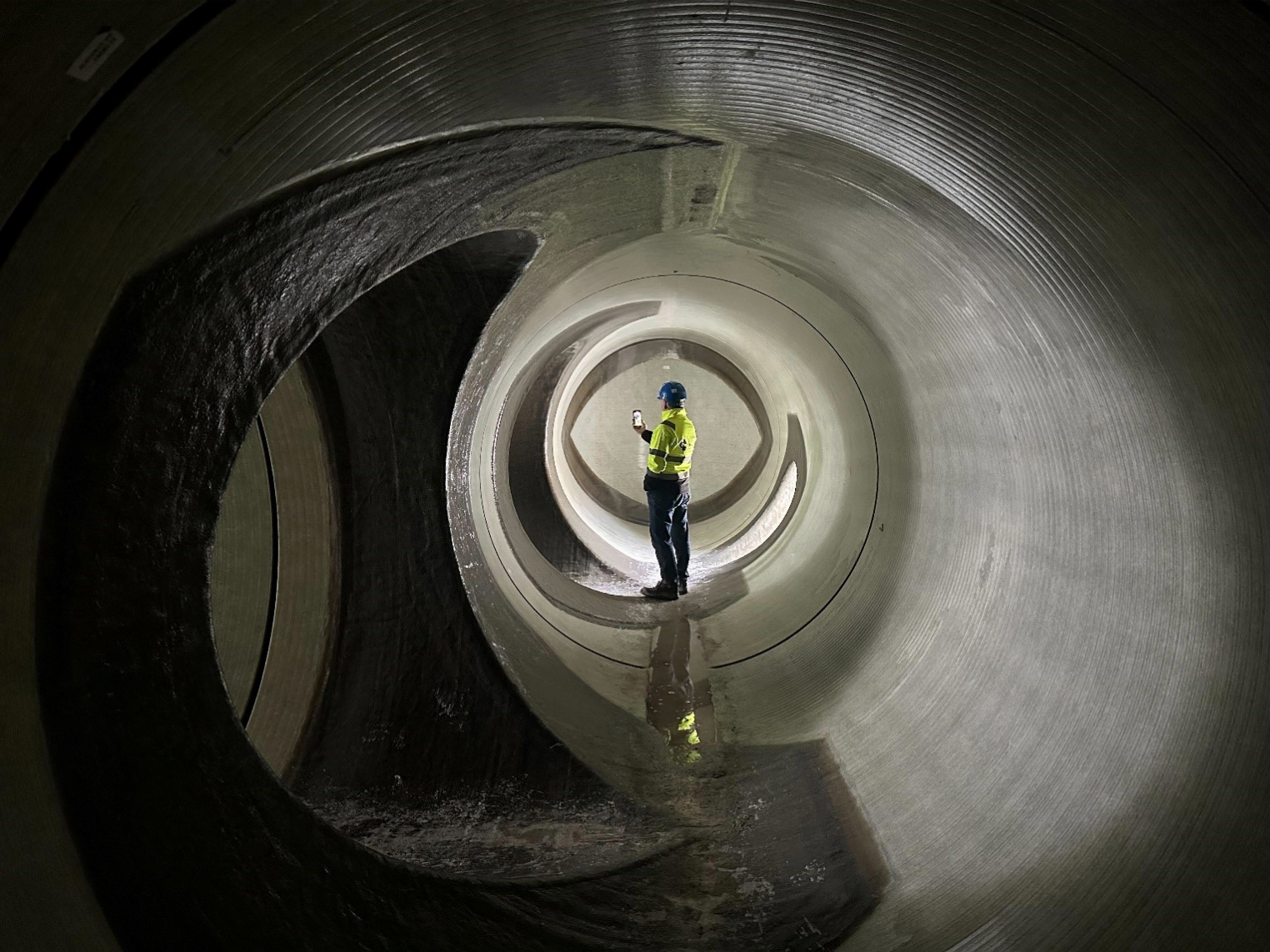
Image credit: RheEnergise
How the challenges will work
Each UK Cleantech Innovation Challenge will be developed and delivered through a common model, adapted to the needs of each challenge area.
Setting ambitions
An inspiring innovation ‘challenge statement’ will be set for each challenge, with stretching, timebound, and measurable ambitions that are focused on areas of innovation critical for delivering the government’s Clean Energy Superpower Mission. The challenge statement will provide government, industry, investors and the research community with a common goal and act as a tool for engagement across the public and private sector.
Guiding principles for the challenges
The challenges will be designed to meet five key principles:
- Ambitious: challenges should be bold, inspiring and achievable with clear timescales for achieving the ambitions and stretching interim milestones beyond current trajectories(i).
- Trailblazing: they should give UK businesses the chance to become world-leading in these technologies, and to capitalise on growth opportunities.
- Technology-focused: challenges should focus on improving the cost and performance of technologies, where possible, leaving scope for a diverse set of possible solutions.
- Targeted: the programme should focus on a small number of high-impact challenges to concentrate effort and resources.
- Co-owned: challenges should be co-developed and co-delivered with industry, with engagement at every stage to shape and implement them.
Monitoring progress
A monitoring framework will help track whether the challenges are making a difference and inform future decisions by government and industry. It will assess progress towards the challenge ambitions, identify where barriers remain, track key developments across industry, and evaluate the effectiveness of activities taken as part of the programme.
Engaging industry through Challenge Coalitions
Industry engagement is central to how the challenges will be developed and delivered. As each challenge is launched, a broad industry-based Challenge Coalition will be established to bring together selected innovators, industry partners, investors, academics, public sector organisations and other stakeholders. The coalitions will own the challenges – shaping the challenges’ activities, driving delivery across industry, building partnerships, sharing knowledge and supporting the tracking of progress against challenge objectives.
Supporting companies with innovative solutions: Innovation Champions
Each challenge will support a cohort of high-potential technology developers, known as Innovation Champions. These companies will be selected through a competitive process and will receive targeted, non-financial support over a period of up to two years. This support will be delivered by DESNZ via a relationship management model, working with partners such as Innovate UK Business Connect.
Support may include:
- Recognition and endorsement, including awarding successful applicants Innovation Champion status, amplifying announcements on key milestones, and recognising their contributions towards the challenge ambitions.
- Policy engagement, including workshops to identify and address barriers to innovation, and to help create market demand for emerging technologies.
- Convening and brokering, acting as a convening platform to facilitate and support engagement between Innovation Champions and key partners, such as investors, customers or collaborators, and showcasing high-potential innovations. This could also include raising awareness of their innovative solutions with public finance institutions and investors, including through pitch days to test their value proposition and build relationships with investors.
- Knowledge sharing and system navigation, including knowledge-sharing events and digital channels to share insights, showcase innovative solutions, build networks, and promote collaboration across the ecosystem; a regular “signposting” newsletter will help Innovation Champions navigate available support, funding opportunities and key developments across the landscape – domestically and internationally.
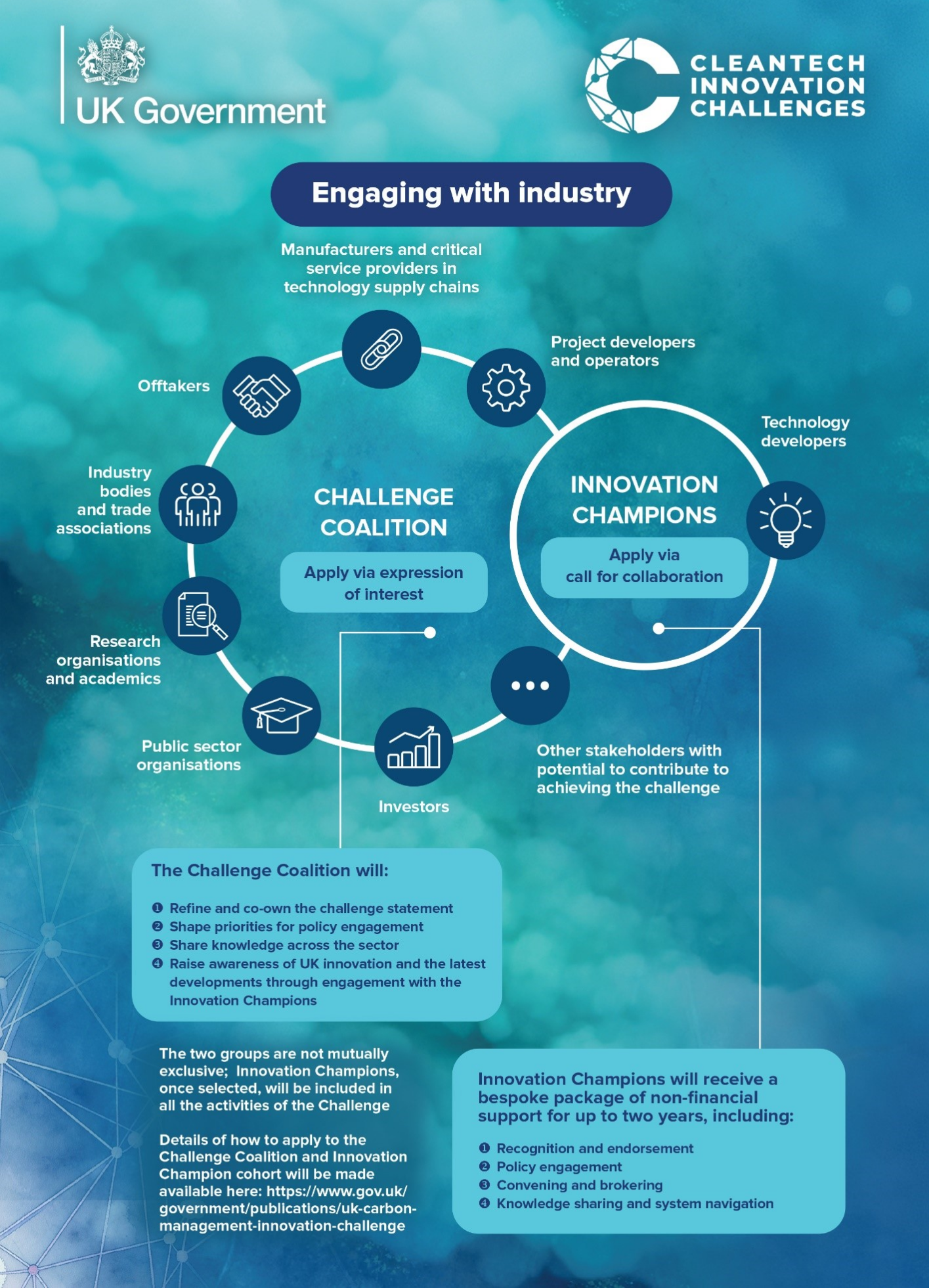
The Innovation Champions will interact with the Challenge Coalitions to build connections and share knowledge, creating a stronger network of support for challenge participants (figure 2). The two groups are not mutually exclusive; Innovation Champions, once selected, will be included in all the activities of the Challenge Coalitions.
Creating an enabling policy environment
For each challenge, government will draw on a suite of policy levers to help minimise barriers to innovation and create market demand. This may include activity to mobilise and align public funding for innovation and scale-up; support policy design that creates market demand; explore opportunities on regulation, permitting and standards relating to new technologies; engage internationally on policy, technical evidence and regulation to support innovation; and share knowledge across industry.
Policy workstreams will be developed with input from industry and tailored to the needs of each challenge. The focus will be on creating the conditions for innovative technologies to commercialise, scale and contribute to the UK’s clean energy transition.
Figure 2. Relationship between the Challenge Coalition and Innovation Champions.
Alignment with other initiatives
The UK Cleantech Innovation Challenges are a platform to bring greater coherence to R&D support across government. DESNZ will work with partners across government to ensure the challenges complement existing activity, support coordinated delivery, and provide organisations with a clear route to access support.
The table below summarises other current key energy innovation initiatives.
| Funding route or initiative | Description |
|---|---|
| UKRI Clean Energy Priority Programme | The programme – £1.2 billion from 2026/27-2029/30 – responds to the Industrial Strategy and delivers on UKRI’s mission to ‘advance knowledge, improve lives and drive growth’. Through the programme UKRI is focusing UKRI’s energy investment, targeting the elements of the Industrial Strategy frontier industries which have the right mix of growth potential, investor confidence, and policy pull through for research and innovation investment to make a tangible difference. Support aligns with priorities in the Industrial Strategy’s Clean Energy Industries Sector Plan. This will be an integrated programme of activity that addresses research, policy, regulatory, industry, and innovation needs and ensures the investment is part of a coherent suite of interventions delivering on government’s ambition. |
| Innovate UK Clean Energy programme (part of the wider UKRI Clean Energy Priority Programme) | The programme seeks to create strong growth pathways for breakthrough UK clean energy solutions to UK and international markets. It will pivot to supporting the highest potential innovators through three areas: - Step-change breakthroughs from deep-tech startups and UK science-base to create the next generation of scalable companies in clean energy. - Working with the best innovators in rapidly scaling clean energy sectors where the UK is world-leading. - Unlocking pathways to later-stage growth and scale-up for clean energy innovators. |
| DSIT Research and Development Missions Accelerator Programme – Clean Energy Superpower Mission[footnote 4] | The UKRI Clean Energy Superpower Mission programme is part of the UKRI R&D Missions Accelerator Programme. This is a flagship new mission-led approach backed by at least £500 million from DSIT to 2030. A Consumer-Led Flexibility challenge[footnote 5], aiming to achieve an additional 2 GW of customer led flexibility on the system by 2030, has been launched as part of the UKRI Clean Energy Superpower Mission, with further challenges to follow. |
| Ofgem Strategic Innovation Fund (SIF)[footnote 6],[footnote 7] | A 10-year, £1 billion programme that enables energy network companies, working with a wide range of external innovators, to deliver ambitious, whole system innovation projects. These projects will accelerate achieving net zero at lowest cost to consumers whilst unlocking economic growth. Now five years into delivery, the fund has launched five new enduring Innovation Challenges[footnote 8], focused on industrial and business connection acceleration, faster build and maintenance, instant-use domestic energy device, eliminating energy outages and decentralised system balancing. |
Next steps
The first wave of challenges is expected to launch over the course of 2026 and 2027, starting with the UK Carbon Management Innovation Challenge in July 2026.
Each challenge will set out how stakeholders can get involved, including through the Challenge Coalition and by applying to become Innovation Champions.
A progress report will be published for each challenge within two years of launch. These reports will summarise activity undertaken, assess progress against the challenge ambitions, recognise the contributions of Innovation Champions, identify remaining barriers and risks, and highlight future actions for government and industry.
Acronyms and abbreviations
- AI – artificial intelligence
- CBI – Confederation of British Industry
- CO₂ – carbon dioxide
- DESNZ – Department for Energy Security and Net Zero
- DSIT – Department for Science, Innovation and Technology
- GW – gigawatt
- Ofgem – Office of Gas and Electricity Markets
- R&D – research and development
- SIF – Strategic Innovation Fund
- UKRI – UK Research and Innovation
(i): The ambitions set out in the innovation challenges are not legally binding and instead act as a tool for engaging industry and the public around ambitious goals.
-
International Energy Agency (2026) The State of Energy Innovation 2026 ↩
-
Department for Energy Security and Net Zero (2025) Energy Innovation Needs Assessments 2025 ↩
-
Department for Energy Security and Net Zero (2025) Energy Innovation Needs Assessments 2025 ↩
-
Consumer Led Flexibility for the Clean Energy Superpower Mission – UKRI ↩
-
Ofgem Strategic Innovation Fund - Innovate UK Business Connect. ↩
-
Ofgem (2026) Networks reimagined: Designed to deliver for customers and growth. ↩