Treasury Approvals Process for projects and programmes
Updated 1 April 2026

© Crown copyright 2026
This publication is licensed under the terms of the Open Government Licence v3.0 except where otherwise stated. To view this licence, visit nationalarchives.gov.uk/doc/open-government-licence/version/3 or write to the Information Policy Team, The National Archives, Kew, London TW9 4DU, or email: psi@nationalarchives.gov.uk.
Where we have identified any third party copyright information you will need to obtain permission from the copyright holders concerned.
This publication is available at https://www.gov.uk/government/publications/treasury-approvals-process-for-programmes-and-projects/treasury-approvals-process-for-projects-and-programmes
Summary of changes
This guidance was last updated in April 2024. The key changes from the 2024 version are summarised below.
| Update | Summary of change |
|---|---|
| Reforms to the public spending control and accountability framework | Codifies specific reforms to the public spending control and accountability framework announced in the Office for Value for Money’s report published at Budget 2025, including: • the integrated approval point in HM Treasury • reforms to the Government Major Projects Portfolio • the role of central functions in supporting projects and programmes • data sharing between projects and programmes and HM Treasury, including NISTA, and the central functions |
| Mega projects scrutiny and approval | Sets out the scrutiny and approvals process for mega projects, as announced in the Office for Value for Money’s report. |
| National Infrastructure and Service Transformation Authority | Updates historic references to ‘IPA’ to ‘NISTA’. Sets out the role of NISTA and its support offer to projects and programmes. |
| Post-approval processes | Sets out clear expectations for transparency and reporting for projects and programmes after approval. |
| Structure and flow | Restructures the guidance to make it clearer and easier to navigate in light of other updates. |
1. Introduction
This guidance on the Treasury Approvals Process (TAP) sets out the arrangements for the HM Treasury scrutiny and approval of qualifying projects and programmes.
The purpose of the Treasury Approvals Process is to ensure that relevant spending proposals reflect the priorities of the government of the day, demonstrate value for money and comply with all relevant standards, guidance and Parliamentary expectations regarding the use of public money.
It is underpinned by 4 key principles. These are:
- Right first time: Projects and programmes are set up for success from the outset. Departments should agree expectations with HM Treasury upfront to save time throughout the approvals process. This does not mean that the government does not revisit initiatives when necessary. This may occur, for example, when proposals fail to deliver their objectives or when there is a significant change in the likelihood of potential success or failure.
- Consistency: The approvals system is predictable and easy to navigate. A clear, consistent approach to the approvals process across all organisations prevents delays and promotes best practice.
- Expertise: Departments should engage the central functions and the National Infrastructure and Service Transformation Authority (NISTA) continuously from the outset of a project or programme. Departments should allow sufficient time to incorporate expert input.
- Value for money: Departments must use the Green Book and supplementary business case guidance to develop and review all spending proposals. They must also follow the Magenta Book guidance on evaluation and ensure compliance with the relevant functional standards.
Scope of this guidance
The Treasury Approvals Process applies to all bodies subject to Managing Public Money. This includes ministerial and non-ministerial departments, agencies and non-departmental public bodies. For expediency, this guidance uses the terms ‘department’ and ‘departments’ to refer collectively to these organisations.
Explicit HM Treasury approval is required if a spending proposal meets any of the characteristics set out in Box 1.A. This guidance covers the Treasury Approvals Process for all projects and programmes that meet any of these conditions, referred to in this guidance as ‘qualifying’ projects and programmes.
HM Treasury is responsible for the final decision on whether a proposal qualifies for the Treasury Approvals Process. Departments should consult their delegation letter if they are uncertain whether a project or programme qualifies. If still uncertain, they should consult their HM Treasury spending team.
Any expenditure that requires HM Treasury approval that is undertaken without that approval is irregular. Detailed guidance on HM Treasury consent and delegated authorities can be found in Annex 2.2 of Managing Public Money.
Box 1.A Characteristics of a proposal subject to the Treasury Approvals Process
- Its whole life costs are above one or more of the relevant department’s Delegated Authority Limits
- It will likely create pressures leading to a breach in agreed budget and Supply Estimate limits
- It will likely involve contractual commitments to significant levels of spending in future years for which budgets have not been set
- It may set a potentially expensive precedent
- It is novel, contentious, or could cause repercussions elsewhere in the public sector
- It requires primary legislation
- It is a statutory requirement to seek HM Treasury consent
Whole life cost and delegated authority limits
Whole life cost typically means the public sector financial cost, shown in nominal, undiscounted terms. It should cover the whole lifetime of the proposal. This extends from project initiation, construction or system development, through to steady-state operation, and then winding-down or decommissioning.
HM Treasury sets Delegated Authority Limits (DALs). Departments usually have separate DALs for different categories of expenditure, such as Capital Delegated Expenditure Limit (CDEL) or Resource Delegated Expenditure Limit (RDEL). Some departments may have agreed a single Total Delegated Expenditure Limit (TDEL) DAL. A project or programme will be subject to HM Treasury approval if its relevant costs meet or exceed any applicable DAL. This will occur, for example, if its whole life CDEL costs exceed the department’s CDEL DAL, or its whole life TDEL costs exceed the department’s TDEL DAL.
The Treasury Approvals Process also applies in cases where a project or programme’s costs are initially below the department’s DAL but then rise above the DAL. Departments should notify their HM Treasury spending team if this is likely to occur.
The GMPP and mega projects
Qualifying projects and programmes may become part of the Government Major Projects Portfolio (GMPP). This covers the government’s largest and most complex projects and programmes with multi-year life spans. HM Treasury, including NISTA, decides whether a project or programme should be included. To be eligible, as well as meeting any of the characteristics set out in Box 1.A, it must meet all of the following criteria:
- it delivers one of the government’s top priorities, as set out in the Plan for Change, or it is a priority growth infrastructure project or programme as determined by HM Treasury, including NISTA, or it is identified as a priority by mission or foundation senior responsible owners (SROs), programme leads, or the Prime Minister
- it has whole life costs exceeding £1 billion
- it is likely to benefit substantially from central intervention, based on an assessment against more detailed criteria by the department and HM Treasury, including NISTA
More detailed criteria could include:
- the maturity of the delivery environment, both departmental and sectoral
- the complexity and nature of the project or programme outcomes. This includes, for example, whether they are ‘first of a kind’, and the scale and range of stakeholders involved
- the complexity of delivery model structures
- the length of the project timescale
In exceptional circumstances, HM Treasury, including NISTA, may add projects or programmes to the GMPP where they are of particular strategic importance and NISTA support is expected to increase the chance of success. This could include proposals that are high risk or underpin critical national infrastructure.
If a project or programme is approved for entry onto the GMPP, it will enter the GMPP quarterly reporting cycle and develop a work programme in line with the type of business case required. The department should continue to manage project or programme risk and undertake appropriate internal assurance and approval activities.
Departments should discuss with HM Treasury, including NISTA, whether a project or programme is appropriate for inclusion on the GMPP at the outset of the Treasury Approvals Process. Departments should develop a feasibility study to inform the decision on whether it should join the GMPP. Departments should refer to chapter 2 for further information on feasibility studies.
Projects and programmes on the GMPP are characterised as either ‘major projects’ or ‘mega projects’. The government has introduced a new mega project classification and announced 5 changes to how it will manage mega projects, as set out in the OVfM mega projects study.
Mega projects are the government’s most significant investments. They are exceptional in cost, risk and complexity, and drive major transformation. A project or programme might be classified as a mega project if it:
- is non-scalable
- has whole life costs exceeding £10 billion
- has delivery timelines longer than 10 years but fewer than 50 years
- is strategically important
- has cross-cutting impacts that span multiple government departments
Overview of the Treasury Approvals Process
Figure 1.A provides an overview of the Treasury Approvals Process, which generally consists of 3 main stages: initiation; scrutiny; and approval.
Figure 1.A Overview of the Treasury Approvals Process
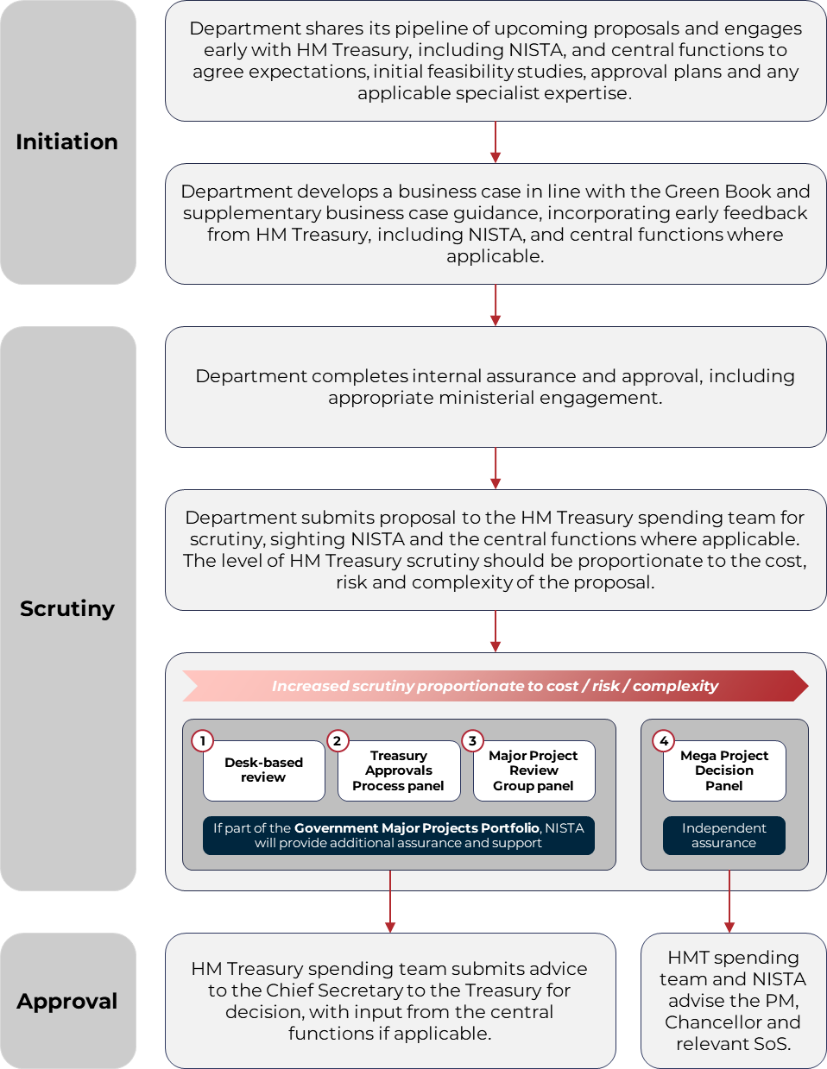
Source: HM Treasury
2. Initiation of spending proposals
This chapter sets out the process for initiating a spending proposal. It covers the main steps including developing business cases, business case pipelines and early engagement with relevant bodies. It also covers evaluation planning and proposals in specific contexts, including cross-government initiatives.
Business cases
Departments must develop spending proposals in the form of business cases, prepared in accordance with central guidance. This includes the Green Book and supplementary business case guidance, the Magenta Book guidance on evaluation and the government’s functional standards.
Business cases enable better spending decisions by supporting the development of robust proposals. The main types of business cases are project business cases and programme business cases, depending on whether the proposal is classified as a project or programme. These are defined in Table 2.A.
The classic model for project development, scrutiny and approval consists of 3 stages, which are:
- Strategic Outline Case (SOC)
- Outline Business Case (OBC)
- Full Business Case (FBC)
The appropriate number of stages for both projects and programmes may vary, depending on the circumstances of the proposal in question. Departments should agree this with HM Treasury, including NISTA. Annex A provides a checklist of key actions departments should undertake prior to submitting a business case.
Table 2.A Types of business case
| Initiative | Business case | Purpose of business case |
|---|---|---|
|
Programme: A unique, temporary, flexible organisation created to co-ordinate, direct and oversee the implementation of a set of projects (or related activities) to deliver outcomes and benefits related to a set of objectives. Programmes can be undertaken in one or more tranches (phases). Example: the TransPennine Route Upgrade |
Programme Business Case (PBC) | Sets out the medium-term objectives for change to be delivered via a collection of projects. This is usually first produced during the initiation phase and is updated regularly thereafter as the programme develops, including for individual programme tranches. |
|
Project: A unique, temporary management environment, undertaken in stages, created for the purpose of delivering one or more business products or outcomes. A project can be standalone within a portfolio or part of a programme. Example: the TransPennine Route Upgrade Project E234; upgrading and electrifying the route from Leeds to Church Fenton |
Strategic Outline Case (SOC) | The first stage in the development of a project business case. It makes the case for change, identifies objectives and sets out an initial longlist and shortlist of options to identify a ‘preferred way forward’. |
| Outline Business Case (OBC) | The second stage in the development of a project business case. It revisits the options in the SOC to identify the ‘preferred option’ following more detailed analysis. It also outlines the commercial, financial and management arrangements for the project. | |
| Full Business Case (FBC) | The third stage in the development of a project business case. It sets out the full details of the commercial, financial and management arrangements required to deliver the project successfully, following the procurement process. |
Source: HM Treasury
Departments should usually obtain HM Treasury approval of a PBC or an SOC before making any public announcements. Where departments have merged the SOC and OBC, they should obtain approval of the merged SOC/OBC. Paragraph 2.23 provides further information on merging SOC and OBC stages. If the preferred option requires legislation, departments must obtain HM Treasury approval of a PBC or an OBC before instructing Parliamentary Counsel.
Early engagement
Departments should notify HM Treasury, including NISTA, and the central functions when a spending proposal is likely to be a qualifying project or programme. Departments should refer to chapter 3 for further information on the role of the central functions.
Early engagement with HM Treasury, including NISTA, and the central functions will ensure that proposals benefit from the relevant expertise early in development. This is particularly important where decisions are complex, require specialist or experienced input, or do not comply with functional standards or strategies.
For projects and programmes on the GMPP, departmental ministers and accounting officers must sign off SOCs, merged SOC/OBCs, and PBCs. Departments should advise their ministers on a project or programme’s interaction with the Treasury Approvals Process as appropriate.
Business case pipelines
As departments develop spending proposals for projects and programmes likely to be subject to HM Treasury approval, they should collate them into a pipeline of upcoming business cases and share this with the relevant HM Treasury spending team and NISTA. They should share the pipeline as regularly as agreed with the spending team. Departments must also share the pipeline with the central functions and highlight any decisions that may require their input.
HM Treasury spending teams and NISTA will advise on the level of HM Treasury scrutiny each proposal is likely to face and whether the proposal may potentially become part of the GMPP. The central functions will indicate where their input is needed. Together, this will help departments develop robust business cases and ensure qualifying projects and programmes are ready for the approvals process, supporting departments to get it right first time.
Integrated assurance and approval
Integrated assurance and approval is the coordination and provision of assurance activities and approval points throughout the project or programme lifecycle. An Integrated Assurance and Approvals Plan (IAAP) sets out how integrated assurance and approvals will be undertaken for the project or programme. It describes the scope, purpose, types and sequencing of assurance and approval activities in support of critical decision and transition points. Departments must develop IAAPs for projects and programmes on the GMPP. They are recommended for all other qualifying projects and programmes.
Developing an IAAP supports timely and efficient approvals and can avoid duplicating activities. They are live documents and departments should update them regularly throughout the life of a project or programme. IAAPs facilitate better decision making by:
- planning all assurance requirements in advance, which means that projects and programmes are subjected to timelier and more coordinated assurance
- integrating and scheduling assurance before approval points, which in turn supports HM Treasury spending team scrutiny
- enabling HM Treasury, including NISTA, and the central functions to better plan resources to meet demand from departments, resulting in timelier approvals
Evaluation planning
All projects and programmes should have evaluation plans in place. Business cases are unlikely to receive approval without a robust and proportionate evaluation plan, properly aligned with the delivery context of the specific project or programme. Departments should refer to the Magenta Book for detailed guidance on evaluation and engage the Evaluation Task Force for further guidance on developing robust evaluation plans.
Cross-government projects
Many of the government’s priorities are delivered through cross-government projects. This includes reducing crime, improving health outcomes, or cross-departmental transformation projects.
For all cross-government projects and programmes, relevant government organisations should work together throughout the development of the business case. They should ensure they are clear on responsibilities between departments and the precise impacts on other organisations. This should be agreed between departments and consistent across all communications to HM Treasury.
The project or programme should have a lead department responsible for ensuring compliance with the Treasury Approvals Process. This includes timely engagement with relevant departments for input into the business case ahead of approval points, as well as representation at review meetings.
Where relevant, the lead department should demonstrate how they will harness opportunities to join up between organisations to improve outcomes. Departments should refer to section 7.6 of Managing Public Money for more detail on models for joint working.
Accelerated projects and programmes
There may be instances where project and programme approvals need to be accelerated to meet an urgent need. This might include, for example, responding to a global pandemic. It is vital that HM Treasury and departments preserve effective scrutiny of proposals in these scenarios.
Departments should develop an IAAP to articulate an accelerated approvals pathway and agree this with HM Treasury, including NISTA. This might involve, for example, running certain steps in parallel rather than in sequence.
At the time of agreeing the IAAP, departments should discuss with their HM Treasury spending team the level of scrutiny they consider suitable and provide the necessary supporting evidence for this in good time. As part of the approvals process, departments will be expected to demonstrate they have conducted appropriate internal assurance in accordance with the agreed IAAP.
Accelerated projects can carry heightened risks, particularly regarding fraud and error. Departments should ensure that decision making in these scenarios benefits from robust internal challenge. They should also include in the business case a provision for potential recovery and enforcement activity (‘clean-up costs’) at the outset. The Government Fraud Risk Assessment Standard can help to provide an initial assessment of how fraud may occur and its potential impacts.
Merging business case stages and delegating approvals
Some simpler projects that are part of an established programme may have a very lean and limited strategic case, which is handed down from the programme. In such instances, it may be efficient and justifiable to merge the project SOC and OBC. This is not appropriate for more significant or standalone projects, where scrutiny at project initiation is essential, and which must have a standalone SOC.
Where projects form part of a programme, HM Treasury may consider delegating approval of some or all of the underlying project business cases to the department. HM Treasury will only consider this for projects:
- that fall within a programme that has already received HM Treasury approval and is not currently rated ‘Red’ by NISTA
- that are not novel, contentious, or repercussive
- where HM Treasury approval to spend is not a statutory requirement
- that are compliant with functional standards and strategies
HM Treasury may also consider delegating approval of specific FBCs to the department. HM Treasury will only consider this for projects:
- that have already received HM Treasury approval at OBC stage and are not currently rated ‘Red’ by NISTA
- that have not experienced any material changes in scope, schedule, costs, or benefits since OBC stage
- that are not novel, contentious, or repercussive
- where HM Treasury approval to spend is not a statutory requirement
- that are compliant with functional standards and strategies
Departments must seek HM Treasury approval for delegation of specified business cases in good time, to allow reasonable consideration before decisions are made. It may be appropriate for departments to discuss the delegation of project approvals when securing HM Treasury approval of the PBC or the delegation of FBC approval when securing HM Treasury approval of the OBC.
HM Treasury spending teams must obtain ministerial approval for any approved delegation requests and must confirm any delegation to the department in writing. The department must not infer such delegation in the absence of a reply. HM Treasury should reflect any changes to delegations in an amended delegation letter.
Departments must still undertake appropriate assurance of all business cases where approval has been delegated by HM Treasury. HM Treasury also reserves the right to withdraw any delegation to a department at any time and require the department to submit a business case to HM Treasury for review and approval.
GMPP feasibility studies
All new projects and programmes expecting to join the GMPP must first conduct an initial feasibility study. The feasibility study should test whether the proposed project or programme is viable before the department begins detailed work on the SOC or PBC. HM Treasury, including NISTA, will review the feasibility study when deciding whether the project or programme should join the GMPP.
The feasibility study should follow a standard structure, tailored to the scale and nature of the work, as advised by NISTA. It should set out the technical approach to delivering the key requirements or outcomes. It should not seek to assess the specific costs, benefits or risks of options, or identify a preferred solution at this stage. Its purpose is to test whether the proposal for change is likely to be achievable and worthwhile in line with the expectations set out in the brief for the work.
Further guidance on what feasibility studies should cover and how departments should conduct and present them is set out in Government Project Delivery Policy Note 02/26 and in supporting guidance on the Government Project Delivery website.
3. Central assurance before approval
This chapter sets out how assurance works within the Treasury Approvals Process. It explains what departments must do before seeking HM Treasury approval, how and when Accounting Officer Assessments (AOAs) are required, and how central functions’ expertise informs approvals. It also describes NISTA’s assurance framework for GMPP initiatives, the main review types and the ‘Response to Red’ process.
Departmental assurance
NISTA assurance reviews of GMPP projects and programmes and scrutiny of a business case by HM Treasury is not a substitute for proper assurance and approval by the relevant department. Departments should generally subject spending proposals to their highest level of internal scrutiny and approval before submitting them to HM Treasury. Departmental assurance provides an internal assessment of the proposal within the context of the department’s own priorities.
Departments should set out their assurance approach for their organisation’s portfolio of major projects in an Integrated Assurance Strategy (IAS). They should also regularly review and consolidate their internal investment approval stages to help improve the quality and speed of decision making within their organisations.
Accounting Officer Assessments
The relevant accounting officer is responsible to Parliament for the value for money of the project or programme. The Treasury Approvals Process does not replace or reduce this personal responsibility.
Departments should ensure that projects and programmes comply with the standards that are expected of all spending, set out in Managing Public Money. This includes compliance with the accounting officer standards of regularity, propriety, value for money and feasibility.
Accounting officers should assure themselves that all projects and programmes put to HM Treasury for approval meet the required accounting officer standards. In most routine cases, this assurance should form part of the department’s standard internal approval processes. Larger or unusual projects and programmes also require explicit accounting officer approval. This would normally take the form of a formal written AOA.
Departments must always produce an AOA for projects or programmes on the GMPP at the following points:
- alongside the request for the accounting officer’s approval of a project’s OBC, at the first approval of a PBC, or at the point the project or programme goes onto the GMPP, if this is later
- at subsequent stages of the project or programme if it departs from the 4 accounting officer standards or the agreed plan – including any contingency – in terms of costs, benefits, timescales, or level of risk, which informed the accounting officer’s previous approval
- if the project or programme SRO decides one is merited at any other stage
Departments should refer to the AOA guidance for further guidance on AOAs. More broadly, the SRO should refer qualifying projects and programmes to accounting officers for approval to proceed at key stages of implementation, where there are significant questions about any of the 4 accounting officer standards that have not been addressed at earlier stages.
Central functions
The government sets functional standards for areas including digital, commercial or property. The ‘central functions’ develop and own these standards as centres of expertise. For qualifying projects and programmes that contain a functional component, departments should consult internal functional expertise and seek early, additional input from the relevant central function, particularly if the proposal is complex.
For example, they should engage the Government Digital Service on digital transformation proposals or the Government Commercial Function on complex procurements. A full list of government functions with links to their relevant central functions can be found on GOV.UK.
It is the department’s responsibility to coordinate input from the central functions for any qualifying project or programme as needed, not HM Treasury’s. Input from the central function informs the integrated approval point in HM Treasury and subsequent advice to HM Treasury ministers. HM Treasury reserves the right to reject a project or programme for approval if it is not satisfied the department has undertaken appropriate engagement with the central functions before seeking HM Treasury approval.
For expenditure that does not require HM Treasury approval, there are no functional spending controls (except for the Advertising, Marketing and Communications control).
Independent assurance reviews of projects and programmes on the GMPP
In addition to departmental assurance, NISTA will arrange and manage independent assurance reviews for projects and programmes on the GMPP. These ‘NISTA reviews’ support the SRO to improve the likelihood of successful delivery and inform HM Treasury scrutiny.
All projects and programmes joining the GMPP must have a Risk Potential Assessment (RPA) and an IAAP that is validated by HM Treasury, including NISTA, and where appropriate, the central functions.
The RPA helps the project or programme, the department and HM Treasury to identify the level and nature of project risk, and therefore the degree of assurance required.
NISTA independent assurance reviews
Projects on the GMPP may be subject to one or more of the following NISTA reviews: - Project Assessment Reviews (PARs) for Major Project Review Group (MPRG) - Stage Gate Assessments (SGAs) - other reviews agreed through the IAAP or with the SRO
NISTA reviews align with the Treasury Approvals Process and advise whether a project or programme is ready to proceed to the next stage. Reviews focus on HM Treasury business case approval points. Later gates and additional reviews are normally reserved for the highest priority projects, as agreed through the IAAP.
NISTA reviews provide a Delivery Confidence Assessment (DCA). A ‘Red’ DCA indicates the project or programme is not ready to proceed. When NISTA gives a project or programme a ‘Red’ rating, this triggers the Response to Red process. Departments should refer to paragraphs 3.23 to 3.25 for more detail on Response to Red.
NISTA tailors reviews to each project and programme by building on departmental assurance, focusing on the main risks and drawing on specialist expertise from the public and private sectors, including NISTA, the central functions, and wider government. To ensure NISTA reviews are appropriately tailored, focused and effective, projects must share with NISTA and the central functions the findings of assurance activities completed before the NISTA review.
Assurance for MPRG and MPDP
Advice to the MPRG must be underpinned by a PAR. The PAR provides a single assurance report, building on existing assurance where appropriate, highlighting the key issues for the panel. Departments and NISTA should agree the timing of PARs through an IAAP, but these should usually take place 6 to 8 weeks before an MPRG.
PARs are normally conducted by independent reviewers and are more bespoke than an SGA. They involve a more senior team and allow more time to analyse and interpret evidence. Departments should expect PARs to take between 5 and 15 days.
Advice to the MPDP must be supported by independent assurance. The SRO and NISTA must agree the terms of this assurance through an IAAP. They should also jointly commission the independent assurance review, which produces a single piece of assurance advice to inform the MPDP.
Response to Red process for GMPP projects
GMPP projects and programmes that receive a ‘Red’ outcome from a NISTA assurance review will enter the Response to Red process. This is a structured process that supports projects and programmes to take clear, purposeful, and collaborative steps to improve deliverability. It includes an Assurance of Action Plan (AAP) review and may involve a Case Conference.
The AAP assesses whether the project or programme is addressing the NISTA assurance review recommendations and whether the project or programme’s action plans are sufficient to resolve issues identified through the review. It also considers whether actions undertaken since the review have sufficiently managed the risk down to an acceptable level, enabling the project or programme to proceed. NISTA will arrange AAPs, working jointly with relevant central functions where beneficial to do so. The AAP results in an updated DCA. A further ‘Red’ DCA triggers a Case Conference.
A Case Conference convenes senior HM Treasury officials, the SRO, the accounting officer and other relevant parties to understand why the project or programme remains ‘Red’ and to agree a recovery action plan. The recovery action plan will be underpinned by a time-bound return to usual HM Treasury approvals and detail interim funding arrangements to support this activity. Departments should refer to the Response to Red guidance on the Government Project Delivery website for further information.
Summary of GMPP assurance tools
Table 3.A summarises the key components of assurance for projects and programmes on the GMPP.
Table 3.A Key components of assurance for projects and programmes on GMPP
| Tool | Description |
|---|---|
| Integrated Assurance Strategy (IAS) | Sets the organisation-wide approach to assurance across a department’s portfolio, so projects are assured to consistent standards. |
| Risk Potential Assessment (RPA) | Assess the strategic risk potential of government projects, programmes and emerging policy that is likely to be delivered through a project or programme. Helps determine the level of assurance and approvals required. |
| Integrated Assurance and Approvals Plan (IAAP) | Sets out the assurance activities and approval points throughout the project or programme life cycle, proportionate to levels of cost and risk. |
| Stage Gate Assessment (SGA) | An independent assurance review providing an assessment of whether the project or programme is ready to proceed to the next stage. |
| Project Assessment Review (PAR) | An independent assurance review focused on the key risk areas to support an MPRG. This can incorporate an SGA. |
| Assurance of Action Plan (AAP) (Response to Red only) | Assesses whether the recommendations identified at the NISTA assurance review are being addressed and whether the actions undertaken have materially reduced risk. |
| Case Conference (Response to Red only) | Explores why the project remains ‘Red’ and agrees a recovery action plan, underpinned by a time-bound return to the usual approval process and interim funding to support this activity. |
Source: NISTA
4. Scrutiny of spending proposals
This chapter sets out the different levels of HM Treasury scrutiny. It also explains the purpose of each level and, where applicable, its governance, membership and attendance.
Scrutiny of business cases
HM Treasury is responsible for the final approval of business cases for qualifying projects and programmes. Departments should submit business cases to HM Treasury only once they have completed their own internal assurance, engaged the relevant central functions, and – for GMPP initiatives – completed the required NISTA assurance.
Departments should submit the business case to their HM Treasury spending team, alongside any supporting documents. Submissions should clearly identify input from relevant departmental functional teams and central functions.
HM Treasury aims to respond within 28 calendar days of formal submission and may respond more quickly for simpler proposals. This is subject to early engagement with the relevant HM Treasury spending team, the central functions, and NISTA where relevant to ensure the business case is of an appropriate standard.
Levels of HM Treasury scrutiny
All qualifying projects and programmes are considered at an integrated approval point, through one of the 4 levels of scrutiny set out in Table 4.A. This scrutiny informs advice to HM Treasury ministers, and other government ministers in the case of MPDP, who decide whether to approve the proposal.
HM Treasury spending teams determine the level of scrutiny to apply. They should do so in line with the IAAP and the evidence provided by the department. The level of scrutiny is typically proportionate to the cost, risk and complexity of the proposal.
A desk-based review should be the default scrutiny level for most qualifying projects and programmes. Treasury Approvals Process panels are typically reserved for projects and programmes that are higher risk, higher cost or more complex. MPRG panels are reserved for the most risky, costly or complex GMPP initiatives. MPDPs are only for mega projects.
Table 4.A Levels of HM Treasury scrutiny
| Type of scrutiny | Scrutiny approach |
|---|---|
| Desk-based review: default level of scrutiny for most projects and programmes, typically not appropriate for anything novel, contentious or repercussive | • desk-based scrutiny undertaken by HM Treasury spending team • input from the central functions, and NISTA where applicable |
| Treasury Approvals Process panel: recommended for projects and programmes that are higher risk, higher cost or more complex, or that are novel, contentious or repercussive | • panel chaired by HM Treasury deputy director or director • panel members from across HM Treasury, including NISTA, and central functions where applicable |
| Major Project Review Group panel (GMPP only): recommended for the most risky, costly or complex GMPP projects and programmes, or those that are highly novel, contentious or repercussive, typically only for projects or programmes with whole life costs of more than £1 billion | • panel chaired by Cabinet Office Permanent Secretary, NISTA CEO, Government Chief Commercial Officer, and relevant HM Treasury director general • panel members include external experts and senior officials from HM Treasury, including NISTA, and central functions |
| Mega Project Decision Panel (GMPP only): reserved for mega projects, the government’s largest and most significant projects with whole life costs of more than £10 billion | • panel chaired by Cabinet Office Permanent Secretary, NISTA CEO, Government Chief Commercial Officer, and relevant HM Treasury director general • panel members include external experts and senior officials from HM Treasury, including NISTA, and central functions |
Source: HM Treasury, including NISTA
Desk-based reviews
Desk-based reviews are assessments undertaken by the relevant HM Treasury spending team of the proposal’s business case and supporting evidence. Spending teams should invite input from relevant teams across HM Treasury, including NISTA, and the central functions where relevant. HM Treasury should then liaise with the department to work through any residual issues ahead of the approval decision.
TAP panels
Treasury Approvals Process (TAP) panels help improve the quality of proposals through constructive and confidential meetings with project leadership teams. Like desk-based reviews, TAP panels provide the necessary scrutiny to inform an approval decision.
TAP panels usually take place to a timeline agreed via an IAAP or at the panel chair’s discretion. They give spending teams and others, including the central functions, a formal opportunity to test key issues and concerns, with agreed lines of enquiry prepared in advance.
TAP panels are usually chaired by the relevant HM Treasury deputy director or director of the lead spending team. The project or programme SRO should attend, with up to 5 other attendees from across the project or programme team and the department, unless HM Treasury agrees otherwise. The TAP panel should also include:
- representatives from the HM Treasury spending team and General Expenditure Policy team
- the relevant NISTA delivery adviser
- representatives from the central functions, where relevant
- a representative from the Evaluation Task Force
MPRG and MPDP
Major Project Review Group (MPRG) panels are used where the scale, risk or complexity of a proposal requires cross-cutting scrutiny and support from senior officials and ministers beyond that provided by a TAP panel. MPRG may also consider departmental portfolios of projects and programmes.
Mega Project Decision Panels (MPDPs) are the most senior forum within the Treasury Approvals Process. They consider the largest, most nationally significant, strategic and complex projects on the GMPP with whole life costs exceeding £10 billion.
MPDPs provide rigorous scrutiny and joint advice to the Prime Minister, Chancellor and relevant Secretary of State on significant mega project decisions. They streamline approvals by superseding other central government panels and oversight bodies.
MPRG and MPDP have 5 co-chairs. These are permanent secretaries and directors general from HM Treasury, including NISTA, and the Cabinet Office:
- Cabinet Office Permanent Secretary
- NISTA Chief Executive Officer
- Government Chief Commercial Officer
- HM Treasury Director General for Public Spending
- HM Treasury Director General for Growth and Productivity
MPRGs are co-chaired by one Cabinet Office and one HM Treasury representative. MPDPs are co-chaired by 3 individuals, including at least one Cabinet Office and one HM Treasury representative. The chairs are supported by senior officials from HM Treasury, including NISTA, and the central functions, and up to 2 independent panel members.
Before scrutiny at an MPRG or MPDP, a project or programme must have:
- approval from its departmental investment committee
- an approved IAAP
- a ‘Green’ or ‘Amber’ PAR or mega project assurance review rating
- Secretary of State endorsement of the business case (MPRG only)
Departments must submit the following at least 3 weeks before the MPRG or MPDP meeting:
- the initial feasibility study (if this is the first panel appearance)
- the business case (including investment committee approval)
- the updated IAAP (3 months prior to MPRG/MPDP)
- the AOA
- the PAR report or mega project assurance review report
- the evaluation plan and benefits realisation plan
- the Initial Fraud Impact Assessment
The MPRG and MPDP secretariat, based in NISTA, oversees and coordinates the process. It works with HM Treasury spending teams, NISTA project delivery and assurance teams and relevant central functions to ensure successful delivery of MPRG and MPDP meetings.
The project or programme SRO and accounting officer must attend MPRG and MPDP meetings. Up to 5 attendees from across the project or programme team and the department may also attend, unless the secretariat agrees otherwise. The secretariat will also invite:
- representatives from the HM Treasury spending team and General Expenditure Policy team
- the relevant NISTA delivery adviser
- representatives from the central functions
- a representative from the Evaluation Task Force
- independent panellists
5. Approval decisions and post-approval processes
This chapter explains how HM Treasury makes and communicates approval decisions. It also sets out post-approval oversight and transparency requirements.
Approval decisions
Desk-based reviews, TAP panels and MPRG panels result in a recommendation to HM Treasury, based on the evidence submitted, to do one of the following:
- approve the project or programme to proceed as proposed
- approve the project or programme to proceed subject to conditions
- reset the project or programme (see paragraphs 5.17 to 5.19)
Where recommendations from the relevant assurance processes are not met, HM Treasury may withhold funding, defer approval, or cancel the project or programme.
In line with Managing Public Money, HM Treasury must give approval in writing, even where it initially gave this orally. Departments cannot infer approval in the absence of a reply and must seek approval in good time to allow reasonable consideration before decisions are required.
Approval decisions are taken by HM Treasury ministers or by officials exercising powers on their behalf. HM Treasury ministers routinely delegate approval of spending decisions to officials.
In the case of MPDP, approval decisions are taken by the Prime Minister, the Chancellor and relevant Secretary of State.
Following ministerial agreement, the relevant chair(s) or the minister should communicate the outcome in writing to the department. In the case of a desk-based review or TAP panel, they should communicate this to the project or programme SRO. In the case of an MPRG or MPDP, they should communicate this to both the department’s accounting officer and the project or programme SRO.
Following the decision, departments should agree a credible plan to address any conditions and engage regularly with HM Treasury, including NISTA, and the central functions on progress. Departments should provide evidence that conditions have been met to the relevant HM Treasury spending team (for desk-based reviews and TAP panels) or to the MPRG and MPDP secretariat (for MPRG panels and MPDPs). They should sight other relevant HM Treasury, including NISTA, and central function teams as appropriate. NISTA tracks and monitors MPRG and MPDP conditions on the Government Reporting Integration Platform (GRIP) to ensure they are completed to standard and within the specified timeframe.
Post-approval processes
Departments must review PBCs at least annually and update them as required. Departments should agree with their HM Treasury spending team how often they will submit the PBC to HM Treasury for scrutiny. HM Treasury should confirm this in writing and, for GMPP programmes, this should be set out in the programme’s IAAP.
Departments should obtain HM Treasury approval of project business cases at each of the 3 key stages set out in paragraph 2.4 (SOC, OBC and FBC). In practice, projects require ongoing monitoring after FBC approval, when they are in delivery. HM Treasury will therefore often agree additional approval milestones beyond FBC stage and reserves the right to add further milestones where necessary.
Transparency and reporting
Transparency supports effective monitoring, the sharing of best practice and the increased accountability of decision makers. It also helps identify cross-cutting issues affecting delivery and supports the development of artificial intelligence and system-learning tools to help projects better anticipate future or systemic blockers.
Departments must share data regularly with HM Treasury, including NISTA, and the central functions, on the progress of qualifying projects and programmes, using GRIP as their main reporting tool. GMPP projects and programmes must report on GRIP using the GMPP reporting template. Other qualifying projects and programmes are also required to report on GRIP using a lighter-touch template. Departments are encouraged to use GRIP to record data for other suitable major projects. Doing so helps HM Treasury identify projects that may require approval at a later stage.
Departments are required to publish business cases for projects and programmes on the GMPP. This may be a Summary Business Case, an FBC or a PBC and must be published within 4 months of the project or programme receiving HM Treasury approval. Further guidance is available on GOV.UK.
Whenever departments produce an AOA for a GMPP project or programme, they must publish a summary of the key points of the assessment on the department’s GOV.UK page. Further guidance is available on GOV.UK.
All qualifying projects and programmes are required to log their evaluation plans and outputs in the Evaluation Task Force’s Evaluation Registry. Further guidance is available on GOV.UK.
Mega project SROs must develop and publish a Strategy and Delivery Plan at the start of the project and at key milestones through development and construction, setting out what the project aims to achieve and how it will do so. The document will be laid in Parliament as a Command Paper.
Project and programme resets
A reset is a substantial change to a project or programme’s stated objectives, approach, outputs, schedule and/or whole life cost. The need for a reset should usually be identified by the accounting officer. HM Treasury, including NISTA, may recommend a reset for a project or programme that has gone through the Response to Red process (see paragraphs 3.23 to 3.25). Further guidance on resetting a project or programme is available on GOV.UK.
At the end of the reset process, the department may need to produce an updated business case for the newly reset project or programme. Unless otherwise agreed with HM Treasury, this normally requires HM Treasury approval if the project or programme either:
- previously required HM Treasury approval
- did not previously require HM Treasury approval but now meets at least one of the characteristics in Box 1.A.
If the project or programme previously required HM Treasury approval, it may also require interim spending approval for the duration of the reset, until it returns for HM Treasury approval.
Interim spending approval
Interim spending approval ensures projects and programmes in the Response to Red process have the funding to complete the steps in the recovery action plan before returning to HM Treasury for approval. It also applies to projects and programmes that are reset and previously required HM Treasury approval.
The interim spending proposal should set out the changes to approach, timelines or milestones that necessitate interim spending approval. It may include costs expected to be incurred between Case Conference, or the decision to reset the project or programme, and the return to HM Treasury for approval. Interim spending approval should be time limited and have a defined expiry date. The proposal should make clear the different costs that need to be met. Where relevant, the proposal may explore options to reprioritise funding across a portfolio.
Interim spending approval should be subject to accounting officer duties and Managing Public Money as per usual but does not require a full AOA. Interim spending approval should not be treated as a substitute to seeking ordinary HM Treasury approval of a business case.
Annex A: Treasury approvals process checklist
This annex provides a checklist of actions to undertake prior to submitting a business case to HM Treasury for approval.
Box A.1 Treasury Approvals Process checklist
At the initiation stage:
- Have you shared a pipeline of upcoming spending proposals with HM Treasury, including NISTA, and the central functions?
- Have you engaged HM Treasury, including NISTA, and central functions in the development of the proposal?
- Is an initial feasibility study required and if so, have you completed one?
- Have you determined the type and level of business case that is required for approval?
- Have you developed the business case according to the Green Book and its supplementary business case guidance? Have you sought relevant functional expertise?
- Have you read through this guidance and determined what level of scrutiny will likely be required?
- Have you consulted your department’s legal team (e.g. on whether public consultation will be required before the business case can be approved)?
- Have you set aside the necessary resources for robust and proportionate evaluation. Have you consulted the Magenta Book and/or evaluation experts on scoping and data requirements?
- Have you drafted an IAAP and, if the project or programme is on the GMPP, have you agreed it with HM Treasury, including NISTA, and the central functions?
- Have you completed an RPA (if joining the GMPP)?
- Have you completed an Initial Fraud Impact Assessment and had it assured by the Public Sector Fraud Authority?
At the scrutiny stage:
- Have you included an evaluation plan in line with the guidance set out in the Magenta Book?
- Have you taken the business case through internal departmental assurance and approval?
- Have you clearly signposted departmental functional input and central function and NISTA input if applicable?
- Have you included the NISTA Gateway Review Rating in the Management Case (if on the GMPP)?
- Where required, have you attached an AOA as an annex?
- If necessary, based on the Initial Fraud Impact Assessment outcome, have you completed a Full Fraud Risk Assessment? Have you considered this within the design of the project?
Annex B: Assurance required at project and programme stages
This annex sets out the typical assurance and approval activities for each stage of a project or programme.
Table B.1 Assurance and approvals – projects
| Project stage | Key preparatory/assurance activities | Approval activities |
|---|---|---|
| 1. Preparatory phase: This stage entails research and development of the initial proposal before formal initiation of the project. An Initial Fraud Impact Assessment should be completed at this stage. | Engagement with central functions: Central functions should be engaged as early as possible, ideally as the spending proposal is first developed. For GMPP: Early-stage workshops are held to align key stakeholders in the research and preparation phase. These are commissioned by the SRO or NISTA and enable the development of several key documents that will be required for project initiation and the business case, including the IAAP. The department should also complete an initial feasibility study. | The project team should engage their HM Treasury spending team, NISTA and the central functions on the details of their proposal. |
| 2. Strategic Outline Case (SOC): The first stage in the development of a project business case. It makes the case for change, identifies objectives and sets out an initial longlist and shortlist of options to identify a ‘preferred way forward’ | Engagement with central functions: Central functions should feed in relevant expertise as applicable to inform the SOC. For GMPP: NISTA Gate 1 Review – Business Justification. This is commissioned by the SRO or NISTA and must happen before the formal submission of the SOC to HM Treasury. The project will be reviewed against the Gate 1 (Business Justification) requirements as appropriate. | Formal submission of the SOC to the relevant spending team, sighting relevant central functions and NISTA if applicable. |
| 3. Outline Business Case (OBC): The second stage in the development of a project business case. It revisits the options in the SOC to identify the ‘preferred option’ following more detailed analysis. It also outlines the commercial, financial and management arrangements for the project. | Engagement with central functions: Central functions should feed in relevant expertise as applicable to inform the OBC. For GMPP: NISTA Gate 2 Review – Delivery Strategy. This is commissioned by the SRO or NISTA and must happen before the formal submission of the OBC to HM Treasury. The project will be reviewed against the Gate 2 (Delivery Strategy) requirements as appropriate. | Formal submission of the OBC to the relevant spending team, sighting relevant central functions and NISTA if applicable. |
| 4. Full Business Case (FBC): The third stage in the development of a project business case. It sets out the full details of the commercial, financial and management arrangements required to deliver the project successfully, following the procurement process. | Engagement with central functions: Central functions should feed in relevant expertise as applicable to inform the FBC. For GMPP: NISTA Gate 3 Review – Investment Decision. This is commissioned by the SRO or NISTA and must happen before formal submission of the FBC to HM Treasury. The project will be reviewed against the Gate 3 (Investment Decision) requirements as appropriate. | Formal submission of the FBC to the relevant spending team, sighting relevant central functions and NISTA if applicable. |
Source: HM Treasury, including NISTA
Table B.2 Assurance and approvals – programmes
| Programme stage | Key preparatory/assurance activities | Approval activities |
|---|---|---|
| 1. Preparatory phase This stage entails research and development of the proposal before formal initiation of the programme. An Initial Fraud Impact Assessment should be completed at this stage. | Engagement with central functions: Central functions should be engaged as early as possible, ideally as the spending proposal is first developed. For GMPP: Early-stage workshops are held to align key stakeholders in the research and preparation phase. These are commissioned by the SRO or NISTA and enable the development of several key documents that will be required for programme initiation and the business case, including the IAAP. The department should also complete an initial feasibility study. | The programme team should engage their HM Treasury spending team, NISTA and the central functions on the details of their proposal. |
| 2. Strategic assessment: This stage sets out the strategic context of the proposal and makes the case for change. It should confirm how the programme: supports national, regional, local, or organisational policies, initiatives and targets, fits within the organisation’s business strategy and set out plans for achieving those goals, aligns with the other projects and programmes within the organisation’s portfolio | Engagement with central functions: Central functions should feed in relevant expertise as applicable to inform the strategic assessment. For GMPP: NISTA Gate 0 Review – Strategic Assessment. This programme-level review is commissioned by the SRO or NISTA and must happen before the formal submission of a programme’s initial strategic level business case to HM Treasury. The programme will be reviewed against the Gate 0 (Strategic Assessment) requirements as appropriate. | Formal submission of the PBC to the relevant spending team. The PBC may require one or two approval points to agree an optimum programme design. |
| 3. Subsequent tranches: The longevity and complexity of programmes means that approval of timing and spending takes place in tranches, as agreed by the reviewing authority at the strategic assessment stage. PBCs should be produced or updated for each tranche. | Engagement with central functions: Central functions should be consulted throughout this process. For GMPP: NISTA Gate 0 Review – Strategic Assessment. This programme-level review is commissioned by the SRO or NISTA and is repeated at approval points of the PBC. The requirements of the Gate 0 Reviews will be tailored to the stage of the programme as appropriate. | Approval is required for each tranche. Modification of the programme should take place alongside annual departmental-level reviews. This is repeated until the programme is complete. Individual components of a programme are still subject to the normal project approvals process. |
Source: HM Treasury, including NISTA
Annex C: Glossary
This annex sets out a list of the commonly used acronyms in this guidance.
- AAP – Assurance of Action Plan
- AOA – Accounting Officer Assessment
- CDEL – Capital Departmental Expenditure Limit
- DAL – Delegated Authority Limit
- DCA – Delivery Confidence Assessment
- DEL – Departmental Expenditure Limit
- FBC – Full Business Case
- GMPP – Government Major Projects Portfolio
- GRIP – Government Reporting Integration Platform
- IAAP – Integrated Assurance and Approval Plan
- MPRG – Major Project Review Group
- MPDP – Mega Project Decision Panel
- NISTA – National Infrastructure and Service Transformation Authority
- OBC – Outline Business Case
- PAR – Project Assessment Review
- PBC – Programme Business Case
- RDEL – Resource Departmental Expenditure Limit
- RPA – Risk Potential Assessment
- SDP – Strategy and Delivery Plan
- SGA – Stage Gate Assessment
- SOC – Strategic Outline Case
- SRO – Senior Responsible Owner
- TAP – Treasury Approvals Process
- TDEL – Total Departmental Expenditure Limit