Phase 1 report: volume 1 (accessible)
Updated 15 May 2026

© Crown copyright 2026
This publication is licensed under the terms of the Open Government Licence v3.0 except where otherwise stated. To view this licence, visit nationalarchives.gov.uk/doc/open-government-licence/version/3 or write to the Information Policy Team, The National Archives, Kew, London TW9 4DU, or email: psi@nationalarchives.gov.uk.
Where we have identified any third party copyright information you will need to obtain permission from the copyright holders concerned.
This publication is available at https://www.gov.uk/government/publications/the-southport-inquiry-phase-1-report/phase-1-report-volume-1-accessible
The Southport Inquiry Report
Volume 1
13 April 2026
HC 1768-I
Presented to Parliament pursuant to section 26 of the Inquiries Act 2005
Ordered by the House of Commons to be printed on 13 April 2026
This publication is licensed under the terms of the Open Government Licence v3.0 except where otherwise stated. To view this licence, visit nationalarchives.gov.uk/doc/open-government-licence/version/3
Where we have identified any third party copyright information you will need to obtain permission from the copyright holders concerned.
This publication is available at www.gov.uk/official-documents
Any enquiries regarding this publication should be sent to us at info@southport.public-inquiry.uk
ISBN 978-1-5286-6243-7 E03549332 04/2026
Printed on paper containing 40% recycled fibre content minimum.
Printed in the UK by HH Associates Ltd on behalf of the Controller of His Majesty’s Stationery Office.
Foreword
1. The events of 29 July 2024 mark one of the darkest moments in recent national memory. Three young girls – Alice, Bebe and Elsie – were murdered in an act of chilling brutality. Many other children and adults suffered grave physical and/or psychological harm, including Child C1, Child C2, Child C3, Child C4, Child C5, Child C6, Child C7, Child C8, Child J, Child K, Child L, Child M, Child N, Child O, Child P, Child Q, Child R, Child S, Child T, Child U, Child V, Child W and Child X, together with Ms Leanne Lucas, Mr Jonathan Hayes and Mrs Heidi Liddle. I recognise not only the depth of their suffering but the strength, dignity and resilience they have shown, and I pay tribute also to the families, professionals and members of the community whose lives were forever marked by this tragedy.
2. From the outset of this Inquiry, I have acknowledged that ordinary language simply fails to capture the enormity of what occurred. No words can adequately reflect the suffering endured, nor the courage shown by those directly affected. It is in honour of them, and in pursuit of meaningful change, that this Inquiry has carried out its work.
3. In establishing this statutory Inquiry, the government made clear that society must not allow such an appalling event to pass without answers. While the perpetrator’s responsibility is absolute, the public, and above all the families and survivors, are unquestionably entitled to understand how a young person with a known history of deeply troubling behaviour, repeated contact with a number of agencies and organisations, and for whom there were clear indicators of serious risk was able to inflict such devastation. That central question has shaped every phase of our examination.
4. Phase 1 of the Inquiry has involved a rigorous and fair scrutiny of the years, months and days leading up to the attack. We have looked closely at the decisions made by a range of agencies – across education, health, social care, policing, youth justice and more – examining how information was shared, interpreted and acted upon. Our hearings heard profoundly moving impact statements and commemorative portraits from the bereaved families and survivors, followed by extensive witness evidence. I am deeply grateful for the candour, courage and dignity with which so many participated. Their accounts have greatly assisted this Inquiry and the urgency of its task.
5. Throughout this process, we have remained acutely aware of the risk of retraumatisation, particularly for the young child survivors. Our procedures have therefore been shaped by the need to protect them – including anonymity measures, careful handling of sensitive material, and restrictions on the public display of distressing evidence. For the same reasons, the name of the perpetrator was not used during the Inquiry and is not used in my report. He is simply to be referred to as ‘the perpetrator’ or AR. The work of this Inquiry has been significantly enhanced by the professionalism, co-operation and dedication of the Core Participants, their legal teams, and the many organisations that responded promptly to extensive disclosure and witness statement requests.
6. Following the establishment of the Inquiry, I was fortunate to be able to secure the assistance of four very experienced members of the Bar to act as Counsel to the Inquiry, a very experienced Solicitor and an equally experienced Secretary. They were Nicholas Moss KC, Leading Counsel to the Inquiry, Richard Boyle, First Junior Counsel to the Inquiry, and John Goss and Harriet Wakeman, Second Junior Counsel to the Inquiry; Caroline Featherstone, Solicitor to the Inquiry; and Kate Anderson, Secretary to the Inquiry. To each of them and their staff I am greatly indebted for the skill, industry, unfailing courtesy and positivity they displayed throughout what has been an exceptionally challenging undertaking, given, most particularly, the timeframe within which the Home Secretary asked me to provide this report. It was undoubtedly in the public interest and that of the victims and their families for this Inquiry to be conducted at speed, but the resultant pressures have been considerable.
7. In a similar vein, I express my gratitude to the legal representatives and advisers of the Core Participants for their spirit of co-operation throughout the Inquiry. Their preparedness to accept the collegial approach sought by me through the Inquiry Legal Team has been key to ensuring the smooth running of the proceedings. It enabled us to find sensible resolutions to seemingly intractable problems in the leadup to and during the course of the hearings.
8. I am profoundly grateful to the Lord Mayor of Liverpool, Councillor Barbara Murray, and the City of Liverpool for the generous manner in which the Inquiry has been hosted in Liverpool Town Hall. The Inquiry has inevitably caused a significant degree of disruption for the council but the assistance we have received has been unstinting.
9. The Inquiry has been provided with outstanding technical support (the audio-visual, broadcasting and transcription arrangements have been exemplary), and similarly the security, witness support and in-court assistance has been excellent. All of these arrangements were critical to the success of the hearings and the preparation of this report.
10. This report represents the culmination of many months of analysis. It aims to provide the fullest possible explanation of what occurred, to identify each missed opportunity and systemic failing, and to make practical, sensible and achievable recommendations. Some of these recommendations are urgent; others will require longer-term structural reform. But all share a single purpose: to reduce the risk of another young person following a similar path to catastrophic violence.
11. It is my sincere hope that this Inquiry will stand as a turning point. The Prime Minister described Southport as a “line in the sand”; the Home Secretary emphasised the need for answers unburdened by cultural or institutional sensitivities. Those expectations have guided this work. They must now guide its implementation.
12. Above all, I recognise that no process, however thorough, can repair the loss suffered by the families whose daughters did not return home that day. Nothing can undo the trauma endured by the survivors. But I hope that this report provides clarity, accountability, and the foundations for meaningful change. It is a privilege to present it with profound respect for all those affected by this tragedy.
Sir Adrian Fulford
Chair, Southport Public Inquiry
Chapter 1
Fundamental problems
Introduction
1. As part of its investigation into how the attack on 29 July 2024 was able to happen, the Inquiry heard evidence from a range of local and national agencies which had prior contact with its perpetrator, AR. The later chapters of this report identify a number of opportunities to manage the risk that AR posed to the public which were either not recognised or not taken by individual agencies.
2. However, a proper understanding of how this attack was able to happen cannot be reached by simply looking at the involvement of the individual agencies, including the failures of those agencies.
3. This chapter addresses the five fundamental problems in how AR’s risk was understood and managed. These five problems were overlapping: each of them reinforced and exacerbated the others.
4. Everything that follows in this report should be read with these five fundamental and overlapping problems in mind. They affected and indeed infected all dealings with AR and the individual agencies. The examples cited in this chapter are more fully explained in Chapter 2: Chronology and in the chapters dealing with the relevant individual agencies.
A failure of any organisation or multi-agency arrangement to take ownership of the risk that AR posed
5. There was a fundamental failure by any organisation, or multi-agency arrangement, to take ownership of the risk that AR posed.
6. This manifested in a number of ways, including a disturbing lack of clarity as to who, if anyone, was the lead agency, which persisted through the Inquiry’s hearings. Witnesses in appropriate positions were asked who was responsible for AR’s risk. There was no consistent response. No agency was prepared to accept that it had the lead role in managing the risk that AR posed to others, with the sole and partial exception of the Child and Youth Justice Service (CYJS) which acknowledged it was responsible for assessing the risk posed by AR during the life of his referral order between February 2020 and January 2021.[footnote 1]
7. Examples of this included:
a. Lancashire Constabulary’s Community Safety team took the view in December 2019 that as soon as a referral had been made to Prevent, it was Prevent which was to be the lead agency;[footnote 2]
b. Prevent declined to refer AR’s case to a Channel panel on three occasions when, based on the information that should have been known to Counter Terrorism Policing North West (CTPNW), referrals ought to have been made;[footnote 3]
c. Forensic Child and Adolescent Mental Health Services (FCAMHS) closed AR’s case in March 2020 despite having carried out no structured assessment of the risks posed by AR to others;[footnote 4]
d. Lancashire Constabulary repeatedly took the view that its role was complete so long as a referral had been made to the Multi Agency Safeguarding Hub (MASH), even when officers repeatedly attended at the same address; this was compounded by the fact that the Constabulary did not routinely receive any feedback from the MASH or other agencies as to what action was being taken;[footnote 5]
e. Lancashire County Council’s (LCC) Children’s Social Care (CSC) repeatedly ‘stepped down’ AR’s case to LCC’s non-statutory Early Help service (also known as the Child and Family Wellbeing Service (CFWS));[footnote 6]
f. CFWS repeatedly closed AR’s case despite interventions having had no or no meaningful impact;[footnote 7]
g. The lack of response to The Acorns School’s request for a multi-agency assessment of AR’s risk following the hockey stick attack at Range High School.[footnote 8]
8. The inability of any agency to identify clearly who held the lead responsibility, and the consequent regular shifting of AR’s case to others, reflects the structures that were in place at the time. A central theme of this Phase 1 report is, therefore, that throughout the relevant period leading up to 29 July 2024, no institution or agency took the overall responsibility for assessing and thereafter addressing the clear high degree of risk of violent harm to others that AR had demonstrated from early October 2019.
9. Whenever concerns were raised about risk of harm to others, they lacked an appropriate ‘destination’: put simply, there was no designated individual or agency with clear responsibility for ensuring that the risk to the public was assessed at speed and – to the extent possible – neutralised.
10. Conversely, there was an enduring focus on the part of many who were involved with AR, throughout the entire period leading up to 29 July 2024, on the potential risk of harm to AR as opposed to the risks that he posed to others. In very many cases involving children, it is clearly crucial and appropriate that the authorities should focus on the risk of harm to the young person in question. Frequently, the risk to the child themselves will be the central - if not the only - real safeguarding issue. However, in a case such as AR’s, when the available information demonstrates that a young person poses a significant threat to others, this should be treated with at least equal seriousness. The pervasive failure to act on AR’s dangerousness (with some notable exceptions) was a fundamental failure in this case.
11. For those convicted of serious criminal offences, the Multi Agency Public Protection Arrangements (MAPPA) are the means by which the dangerousness of the offender will be monitored upon release in the community. MAPPA is a statutory set of arrangements which provides a common framework for the identification, assessment and management of certain offenders in the community. There are four categories of MAPPA offenders: category 1 covers convicted sexual offenders who are subject to notification requirements; category 2 covers convicted violent offenders who have been sentenced to 12 months or more in custody; category 3 covers dangerous offenders who have been cautioned for or convicted of an offence which indicates that he or she is capable of causing serious harm and which requires multi-agency management; and category 4 covers terrorist or terrorist risk offenders.
AR self-evidently did not come within any of categories 1, 2 or 4. He could in theory have been considered for discretionary inclusion within category 3 following his convictions in February 2020, but the reality is that, as a child, he was never likely to have been referred to MAPPA absent an exceptionally robust identification of the risk he posed.[footnote 9]
12. My attention was also drawn to Multi-Agency Safeguarding Partnerships (MASPs), a non-statutory arrangement implemented in Lancashire in 2022 as part of its work under the Serious Violence Duty under the Police, Crime, Sentencing and Courts Act 2022. MASPs provide early intervention and support for children and young people (up to 18 years old) who are at risk of exploitation. Their introduction reflects an increased focus on ‘contextual safeguarding’ and the harm that can be caused to children by risks outside the home such as criminal exploitation. While those risks to the child may in some cases be found alongside an increased risk of harm to others from the child (for example, where involvement in criminal gangs means that the child is more likely to carry weapons), this is not part of the focus of the MASP.
Accordingly, although this provides a potential model that is worth further exploration, the MASP structure does not adequately address the risks that a child or young person may pose to others.
13. Accordingly, both MAPPA and MASP, as they currently operate, fail to provide appropriate and comprehensive protection for the public in these circumstances.
14. Instead, at a multi-agency level, the three possible frameworks in place at the time for handling AR’s dangerousness were:
a. Prevent, which could bring multiple agencies together at Channel panel meetings aimed at reducing the risk of being drawn into terrorism;
b. Child Protection multi-agency working under Working Together to Safeguard Children, which was led by LCC Children’s Social Care and aimed at protecting children from harm as defined in the Children Act 1989; and
c. The multi-agency Early Help processes known as the Team Around the Family (TAF) led by LCC’s CFWS, which were focused on stopping cases escalating to Child Protection, often by a focus on improving parenting and family relationships.
15. While Prevent, by the nature of the cases which it routinely deals with, would have been the most likely framework to be able to address AR’s risk, none of these three frameworks was by any means a perfect fit. The risk of harm posed by AR fell between their respective remits.
16. At times, Prevent and Children’s Social Care (CSC) recognised the risk that AR posed to others, but were unwilling or unable (within their systems or policies) to flex to deal with it themselves. Examples of this include:
a. The First Referral to Prevent;[footnote 10]
b. The 2019 to 2020 multi-agency strategy meetings under Working Together to Safeguard Children.[footnote 11]
17. At other times, all three multi-agency fora failed to recognise that such a risk existed:
a. The Second and Third Referrals to Prevent;[footnote 12]
b. CSC’s response to the incident where AR carried a knife on a bus on 17 March 2022;[footnote 13]
c. CFWS’s response to AR’s violent behaviour at home in January and November 2021.[footnote 14]
18. In my assessment, the individual workers and managers within the agencies that dealt with AR displayed the variety of competencies, abilities and shortcomings that would likely be found in any detailed investigation of public sector multi-agency work. Some I found unimpressive. A few were clearly outstandingly good. Most fell in between with an inevitable mixture of strengths as well as weaknesses. I readily accept that all acted in good faith and with good intentions. However, the frankly depressing – and therefore urgent – matter requiring government attention is this failure – at an organisational and individual level – to stand up and accept responsibility for managing the risk that AR posed. Far too often, AR’s “case” was passed from one public sector agency to another in an inappropriate merry-go-round of referrals, assessments, case-closures and “hand-offs”.
19. Agencies repeatedly passing the risk to others and closing/downgrading their own involvement is not effective – or responsible – risk management. If, as a society, we are to avoid repetition of what happened in AR’s case, this culture has to end. This is the single most important conclusion of Phase 1 of this report. This failure lies at the heart of why AR was able to mount the attack, despite so many warning signs of his capacity for fatal violence.
Poor information management and sharing
20. Information management and information sharing between and within agencies was often poor. Risk information was not adequately shared between agencies and was lost or diluted over time even within agencies. As a consequence, the significance of subsequent events was seriously underestimated and opportunities to intervene were lost. This was a critical factor in AR’s risk never being properly appreciated. Even as AR’s risk to others was increasing from (at least) late 2021 onwards, the early risk indicators that had been present in late 2019 were not sufficiently understood. As AR increasingly disengaged from any support, he was thereby enabled effectively to conceal his increasing risk from external agencies.
21. There are many examples of this process occurring from the very earliest stages of the agencies dealing with AR. Non-exhaustively:
a. Information available in October 2019 about AR’s intention to use the knife he had been taking to Range High School was not effectively shared with LCC until after AR had carried out an attack at that school on 11 December 2019;[footnote 15],[footnote 16]
b. Information about AR having referred to the Manchester Arena bombing as having been a “good battle” at Range High School in June 2019 was not passed to other agencies until December 2019 and was not then properly recorded or passed on;[footnote 17],[footnote 18],[footnote 19]
c. Information about AR’s browsing history at The Acorns School was not shared with Prevent for the purposes of the First Referral to Prevent, or with Merseyside Police for the purposes of their criminal investigation after the 11 December 2019 attack;[footnote 20]
d. Information that AR had seriously assaulted his father, who then retaliated by striking him, in the context of a domestic argument in January 2021 was recorded by LCC (both CYJS and CFWS) but not shared with other agencies.[footnote 21] As early as August 2021, the fact that this had occurred had been lost from view even in the context of Children’s Social Care exploring AR’s allegations of violence by his father;[footnote 22],[footnote 23]
e. Information about the status of AR’s Prevent referrals was not effectively sought or shared with CFWS in October 2021; conversely, CFWS did not share the information of concern it gained about AR’s political views or online activity with any external agency;[footnote 24],[footnote 25]
f. The Acorns School did not share information with Prevent in relation to AR’s comments in January 2022;[footnote 26],[footnote 27]
g. On AR’s transfer to Presfield High School in March 2022, information about AR was not effectively shared between the schools: it was sent by The Acorns School but not accessed by Presfield High School until after 29 July 2024;[footnote 28],[footnote 29]
h. In March 2022, following the bus incident (see below for further detail), The Acorns School requested information from Child and Adolescent Mental Health Services (CAMHS) “so we can update our safeguarding and risk assessments”.[footnote 30] However, the response from CAMHS did not set out details of the bus incident, the knife possession, any precipitating issues, or provide any information that might have assisted in risk assessment.[footnote 31]
22. The most marked example of the consequences of poor information management and sharing came on 17 March 2022 when AR went missing from home, was found with a knife on a bus, said to police that he had wanted to stab someone and admitted to (at least) earlier thoughts about using poison. Had the agencies involved in this episode had a remotely adequate understanding of AR’s risk history, AR would have been arrested on this occasion and (in all probability) his home would have been searched leading to police and other agencies gaining critical information about the ricin seeds he had bought, and the terrorist material he had downloaded on his computer.
Excusing AR’s behaviour on the basis of his perceived or diagnosed autism spectrum disorder
23. There was a repeated tendency on the part of multiple agencies to excuse AR’s behaviour (including his violence) on the basis of his perceived or, later, confirmed autism spectrum disorder (ASD). Throughout this report I refer to ASD unless quoting text that refers to autism spectrum condition (ASC). Both terms are widely used and describe the broad continuum of autism. In adopting ASD for the purposes of this report, I have noted the position of NHS England that it is the official way of describing autism. The use of “disorder” in accordance with the clinical diagnostic term should not be taken to reflect adversely on the autistic community.
24. I make clear from the outset that it would be entirely wrong to make a general association between autism and an increased risk of violent harm to others.
25. AR, however, manifestly fell into the cohort of those with ASD whose individual characteristics mean that their autism does carry an increased risk of harm to others.
26. Far from recognising that AR was responsible for his own actions, and that his ASD meant (in his individual case) that he posed an increased risk of harm to others, agencies regularly used his autism as an explanation or even excuse for his conduct, including his violence. This was both unacceptable and superficial.
27. Linked to this, the presence of AR’s ASD – even prior to the formal diagnosis – became a way for agencies such as the police, Prevent and social services to view any difficult behaviour by AR as a “mental health” problem. This reflected a poor understanding of both ASD itself and a misunderstanding of the ability of mental health services to ‘treat’ or address it.
28. Examples of agencies inappropriately ascribing/excusing AR’s behaviour as being merely due to his ASD include:
a. The insipid response of CYJS to AR’s refusal to cooperate with appointments mandated under his referral order;[footnote 32],[footnote 33]
b. The excusal of AR’s concerning comments and behaviour in the context of the First and Third Prevent Referrals;[footnote 34],[footnote 35]
c. The collectively inadequate response to AR’s various incidents of violence in the home address in November 2021;[footnote 36],[footnote 37]
d. The inadequate response by police and social services to the bus incident on 17 March 2022 which police put down to AR having a “bad mh [mental health] episode” as regards “multiple mental health issues”.[footnote 38],[footnote 39]
29. Even when ASD was a factor in why AR was behaving in a certain way, it was never properly recognised that, in his particular case, this was a factor which significantly increased the risk that he posed. It meant that his long-standing and already disturbing interests in violence, weapons, and atrocities escalated to far beyond anything that could be regarded as normal or reasonable. It also contributed to AR’s tendency to perceive even the smallest of matters as a grave injustice towards him, his inability to let such situations go or to perceive two sides to a situation, and his willingness to escalate confrontations save when the very clearest and most firmly applied boundaries were set. All of those matters should have been indicators that AR’s ASD – given his particular characteristics and in his individual case – was a factor that significantly increased the risk he posed to others.
30. Strategies and interventions were therefore needed to address that risk. Instead, all too often the presence of ASD was treated as an excuse and the underlying risk left unmanaged.
Failure to oversee and intervene in AR’s online behaviour
31. Following the attack, Merseyside Police’s criminal investigation gained considerable (though far from complete) insight into AR’s online behaviour.[footnote 40] As well as having twice downloaded an academic article that contained the text of an Al-Qaeda training manual, AR had downloaded a wide range of vile and disturbing imagery, as well as articles and papers relating to a variety of conflicts and atrocities, both contemporary and historical.
32. Although there is no evidence that this level of acutely inappropriate
(and, on occasion, unlawful) online activity by AR was known to any agency prior to the attack, there is a direct line back from it to reports of AR’s online behaviour between 2019 and 2021. At these earlier stages, AR was known to have searched his school computer for school shootings, he had asked about access to pictures of weapons or severed heads, and he had searched for information about terrorist attacks and global conflicts. Save for The Acorns School, this concerning aspect of his behaviour was never properly appreciated by any agency or by AR’s parents. Although it formed the basis of the three Prevent referrals made by The Acorns School, CTPNW did not deem AR vulnerable to being drawn into terrorism and all the referrals were closed (a topic which is addressed more generally below).
33. There had been an earlier investigation of AR’s electronic devices following his arrest in December 2019. However, it was inconclusive. As a result of ineffective liaison between Merseyside Police and CTPNW, only very limited search terms were used on AR’s devices. While it cannot now be determined whether other searches might have revealed material of concern, AR’s known online activity makes that a serious possibility. This failure illustrates the cumulatively scant regard that was paid to the risks arising from AR’s online behaviour.
34. Consistent with this, the record of searches by AR on The Acorns School’s own computers, which was held by The Acorns School for 15 November 2019 only, was never provided to any police force until after the attack. Nor was it adequately chased by CTPNW in the course of the First (or either subsequent) Referral to Prevent. The detailed circumstances of that are set out in Chapter 8: Prevent and Counter Terrorism Policing, and Chapter 11: Education, but proper analysis of that material would have revealed not only that AR accessed a news article about a school shooting, but also his preoccupation with graphic ‘degloving’ injuries. It would also have revealed that AR had been lying when he had made the self-serving assertions that he only accessed the same material as other students, or that he simply followed links sent to him by other students.
35. The Acorns School’s concerns about AR’s online behaviour were known to LCC, but any exploration of AR’s online behaviour by LCC was highly limited and ineffectual, amounting to little more than asking AR whether he was aware of the need to remain safe on the internet. Over time, the earlier concerns about AR’s online behaviour receded when all of those dealing with him should have remained vigilant and concerned. Matters that, when taken together with those earlier concerns, would have constituted obvious red flags were treated as isolated incidents which did not in and of themselves indicate any risk.
36. Although there are difficulties over the statutory powers available to agencies to oversee and monitor online behaviour by children, there would have been options and interventions available. One obvious opportunity was as part of AR’s referral order, but others would have included when AR told LCC family support workers in October 2021 that he was earning money online but refused to tell them how and, in the same meeting, set out a range of concerning political views; similarly, following the bus incident on 17 March 2022 (when AR threatened to cause serious harm as a result of his own social media usage).[footnote 41] Generally, there was a lack of curiosity as to how AR was spending his time, in circumstances when it was well-known that he was attending education at best fitfully and at worst not at all, had no constructive employment, and was not leaving the home address. Remarkably, for the entirety of the period 2019 to 2024, when AR was aged 13 to 17, AR’s parents did not even have the precaution of online parental controls set at the home address.
More remarkably still, this seems to have gone unnoticed (and certainly unchallenged) by all the agencies dealing with AR.
37. I have no hesitation in concluding that the degrading, violent and misogynistic material which AR was viewing online contributed to – and ‘fed’ – his already unhealthy fascination with violence. It also led him to build an arsenal of weapons, and to prepare a chemical and biological weapon in ricin, through online purchases.
38. The lack of exploration of, or engagement with, AR’s online life was a significant failing that hampered agencies from identifying and addressing the risk AR posed to others. In the digital online age, it should be self-evident that how someone is behaving online, and what they are seeking out or exposed to, can be both a powerful influence and an effective predictor for how they are likely to behave offline. The opportunity that this poses to gain greater understanding of risk should therefore be plain. Equally self-evident is the proposition that simple self-reporting may not amount to adequate exploration of that opportunity.
39. The failure, by multiple agencies, to appreciate these obvious matters meant that a crucial perspective on AR’s thinking was never properly explored despite opportunities for that to occur.
The role of AR’s parents
40. The role of AR’s parents is complex, and I address it in Chapter 12: AR’s family. However, seen in the round, AR’s parents (and particularly Alphonse R, AR’s father) created significant obstructions to constructive engagement with AR by the various agencies that were involved. AR’s parents faced significant challenges, but they were too ready to excuse and defend AR’s actions; they failed to stand up to his behaviour and set boundaries (difficult though this was given his sometimes violent response); and they ultimately failed to report the clear escalation in risk in the period 22 to 29 July 2024.
41. Inevitably, however, the relevant agencies must be prepared to deal with parents who – through a mixture of inability, difficulty and unwillingness – are ill-equipped to address the risks of violent children. The relevant agencies’ work in respect of AR should have taken more fully into account the fact that the level of co-operation and support from his parents was at best inconsistent and at times clearly both manipulative and harmful.
42. AR’s father, in particular, had fixed ideas as to what decisions ought to be taken about AR. He was in equal measure obsessive and misguided in pursuing them. Where agencies would not fall in line with those ideas, he made himself exceptionally difficult, to the point of active and outright hostility and even aggression. This was evident in, for example, his hostility to The Acorns School, and his aggression which led to the withdrawal of Dr Ramasubramanian as treating Consultant Psychiatrist.
43. No one should doubt how challenging such behaviour was for the agencies dealing with AR and his parents. At the same time, however, those challenges were a warning sign in and of themselves. They should have made it obvious that AR was not being effectively parented and that a child who needed firm boundaries to be set was instead being allowed to exert control over his own parents. This pattern was apparent from the earliest stages: as early as 16 December 2019, when AR was only 13 years old, he was observed by a social worker to be “quite a force in the household, appearing to dominate discussion”.[footnote 42] Yet the significance of this was never fully appreciated by those who were in a position to act. The views of agencies which did raise concerns about it – notably The Acorns School – were not given sufficient regard or weight.
44. The overall effect was that a yet further significant risk factor in respect of AR (that his parents were not able or willing to challenge his conduct, impose adequate boundaries, or model appropriate behaviour) was never properly taken into account and AR’s parents were allowed on occasions to obstruct efforts to address concerns about AR.
45. AR’s parents’ obstructive approach (again most notable in Alphonse R as AR’s father) involved an outright refusal to take legitimate professional concerns seriously or to accept that AR’s conduct was seriously unacceptable. That included seeking to justify AR carrying a knife in October and December 2019 and even seeking to blame AR’s commission of the hockey stick attack at Range High School in December 2019 on the schooling he was receiving. Regrettably, this element of parental self-deception continued even into the parents’ oral evidence to the Inquiry.
46. In other cases, AR’s parents’ actions meant that relevant information was concealed from professionals, hindering their ability to make fully informed assessments. This was typically because it served the outcome that AR’s parents wanted to achieve, such as ensuring that AR was not removed from their family or was more likely to be able to take part in mainstream education. Alphonse R did not report to the agencies those weapons which he knew AR had ordered online. Alphonse R’s WhatsApp messages to Ms Andrea Fontaine of CFWS on 2 November 2020 made clear that he did not consent to CFWS sharing information with the Child and Youth Justice Service, as their role was to “punish” AR. As Ms Katherine Ashworth, Head of the Children and Family Wellbeing Service, acknowledged, “There is a propensity for this man to want to try to control the narrative”.[footnote 43]
47. At other times, the lack of co-operation from AR’s parents was due to a dangerously short-term desire to prevent AR from having a violent outburst, which would often be directed at AR’s father. On one level this desire on the part of AR’s parents was understandable. However, when this meant indulging AR in not attending appointments with CYJS or refusing to allow professionals even to confirm that AR was safe after he had not attended school for almost a year, it should have been clear to AR’s parents that this had become harmful and counterproductive. Ultimately, the parents’ desire to minimise the number and frequency of AR’s outbursts became a factor contributing to a far worse outcome. To the extent that the agencies (particularly LCC and CAMHS) identified that AR’s parents were unable or unwilling (or both) to set boundaries and to enforce expectations on AR’s behaviour, this did not translate to an appreciation of the consequential increase in risk to others.
48. AR’s parents’ irresponsible and harmful attitude to sharing information and to managing the risk posed by AR to others culminated in the week prior to the attack. In that period, AR’s parents, for the reasons that are set out in detail in Chapter 12: AR’s family, bear significant responsibility for failing to alert any appropriate agency whatsoever to the full extent of the risk of a serious or fatal attack by their son. Over the period leading to 29 July 2024, they came into possession of crucial information which revealed that their son was covertly accumulating a number of deadly weapons and that he remained intent on carrying out some form of attack outside the home address. What can only be described as their misguided and irresponsible motivation for not sharing this information was to avoid AR being taken into care or custody. I have explained the basis for this conclusion and the evidence on which it is based in Chapter 12: AR’s family. If the parents had reported their true level of knowledge to the authorities prior to the 29 July 2024, AR would undoubtedly have been arrested and he would either have been taken into care or held in custody.
That position would have been likely to have remained the case both during and following the inevitable criminal proceedings in which he would have faced serious charges, particularly over the production of ricin and the electronic possession of an Al-Qaeda manual (although I accept that his parents did not understand the significance of the former, and were ignorant of the latter).
49. I conclude that:
a. Relevant agencies did not sufficiently (or in some cases at all) make allowance for AR’s parents’ behaviours in their assessment of the risk that AR posed to others;
b. If AR’s parents had done what they morally ought to have done,
AR would not have been at liberty to conduct the attack and it would not therefore have occurred.
Consequences
50. Drawing these issues together, AR had clearly revealed the extreme danger that he presented to others by as early as 11 December 2019. On that day, he took weapons to his former school, with the pre-meditated intention of killing an identified pupil whom he perceived had previously bullied him. On it becoming apparent he would not be able to attack his intended victim, AR instead assaulted another pupil at random. This followed AR having earlier repeatedly carried a knife to the same school in October 2019, again with the intention of using it to kill or do really serious harm in response to AR’s perception that he had been slighted or bullied. It also followed the identification by The Acorns School that AR was searching for concerning content on the internet and expressing disturbing interests in violence and in atrocities.
51. The incident on 11 December 2019 was, in my view, a watershed event: it put beyond doubt that AR was motivated by an enduring desire to inflict severe harm on and possibly kill another pupil, on a pretext of perceived bullying, for which there was either no objective basis at all, or which was at best grossly disproportionate to any difficulty he had experienced with other pupils. Taken with the other information available at the time, this should have led all agencies involved to a conclusion that AR posed a high risk of harm to others. As the subsequent narrative will reveal, nothing occurred during the next five years to indicate that this level of danger had diminished. To the contrary, as time passed the authorities, with certain minor exceptions, had an ever-reducing understanding of AR’s preoccupations and intentions. Interaction between AR and the relevant organisations became, at best, something of a token. They were unaware of his continuing chilling internet preoccupations and his accumulation of lethal weapons, as well as the ingredients for a lethal poison.
52. It is significantly troubling that no agency within our public services had the responsibility to monitor, investigate and take steps to neutralise a risk of this order of magnitude. This was a risk that had been clearly established between October and December 2019. The most acute example of this is that had AR’s further carrying of a knife (with self-confessed intent) on 17 March 2022 been judged and responded to by the relevant agencies with a proper appreciation of his past risk, AR would have been arrested. Thereafter his serious further criminality (possession of ricin seeds with chemical equipment, possession of the Al-Qaeda manual) would have come to light. Instead, two probationary police constables were essentially left to deal with this incident on the ground, in circumstances where poor systemic information management meant that they had very little understanding of AR’s past behaviours and risk.
53. Wholly separately, therefore, from my view that the attack would not have occurred had AR’s parents reported what they knew in late July 2024, if appropriate arrangements and reasonable resources had been in place to address the risk that AR posed to others from December 2019 onwards, it is highly likely that the tragedy of 29 July 2024 would not have occurred.
Recommendations
54. Many of the issues identified above are the subject of recommendations later in this report in respect of individual agencies or sectors. But by their very nature, fundamental problems about the relationship between different agencies cannot be resolved by action from those agencies alone. The ‘multi-agency’ approach in AR’s case completely failed to assess and react to the evident high level of danger that he posed. That failure means that detailed consideration should be given to restructuring fundamentally the way that our society handles those who pose a real risk of killing or causing serious harm to others (including ‘violence fixated’ individuals).
55. I therefore make the following three related recommendations.
56. First, I consider that there should be a single, dedicated agency or structure with responsibility for monitoring and co-ordinating any necessary information sharing or gathering and any intervention, providing direction, and holding the relevant agencies to account. The form will be a matter for consideration, but it could be through a mechanism for the appointment of a pre-existing agency as the ‘lead agency’; the expansion or creation of a dedicated multi-agency structure (for example MAPPA or akin to MAPPA); or the creation of a new agency. As I return to in Chapter 8: Prevent and Counter Terrorism Policing, it is right to note that, on any view, Prevent’s current statutory remit does not extend to all forms of risk of harm to others. A question that will need to be considered is whether this new mechanism, structure or agency would be separate from, or incorporated into, Prevent.
57. Among others, Ms Louise Anderson, Director of Children’s Social Care for LCC, gave considered and helpful evidence about the various multi-agency frameworks that exist, as well as on where responsibility for identifying and assessing risk lies.[footnote 44] In her view, FCAMHS was the principal agency with the training to be able to assess whether a child is a risk to another person. I have addressed FCAMHS in Chapter 10: AR’s healthcare, but I am sure that FCAMHS cannot be the entirety of the answer as to how to identify and address risk to others, nor are they in any way currently resourced or commissioned to do this. Ms Anderson’s evidence served to emphasise the significant flaws in the present system.
58. Further, as Ms Anderson explained and as I address in detail in Chapter 9: Social care, the multi-agency arrangements for child protection under Working Together to Safeguard Children, and the Early Help provision offered by LCC’s Child and Family Wellbeing Service, are heavily focused on preventing and removing risks to a child, rather than addressing risks from the child to others.[footnote 45] Although Children’s Social Care ought to be involved in managing those latter risks, I do not consider that the Working Together to Safeguard Children framework has sufficient flexibility to be the primary means of addressing risks to others.
59. The other frameworks to which Ms Anderson drew my attention were MAPPA and MASP. But as set out above, I do not consider that these were appropriate frameworks for identifying or managing the risk posed by AR.
60. Ultimately, the evidence I heard amply demonstrated the pressing need for identification of a single agency or structure, and most likely an identified individual within that agency or structure, with responsibility for ensuring proper coordination between other involved agencies. This should include responsibility for the implementation of any plan to address the risks posed by individuals such as AR.
Recommendation 1: Phase 2 should consider what single agency or structure should be appointed or established to record, monitor and co-ordinate interventions for children and young people who present a high risk of serious harm. This must be matched with cultural change so that agencies are prepared to own and manage risk appropriately not just refer it on to others.
61. Second, and relatedly, this case has demonstrated the urgent need for a method of assessing risk which ‘talks’ across social care, mental health, education, policing and the criminal justice system. At present there is a lack of even a shared risk form, in which, amongst other things, the basic history is set out accurately, clearly and concisely. There was a wide range of exercises purporting to be risk assessments carried out, by different individuals at different stages, applying different frameworks and with varying degrees of rigour. Dr Tina Irani, the expert forensic child psychiatrist instructed by the Inquiry, made clear that what is required is a structured risk assessment tool to help with thinking about risk over time: neither purely actuarial nor ‘gut feeling’ risk assessments are adequate in this context.[footnote 46] Ms Stephanie Roberts-Bibby, of the Youth Justice Board, was clear that the existing structured risk assessment tool for youth offending was both difficult to work with and in need of updating, with the development of a new tool needing collaborative work across a range of agencies:[footnote 47] I agree, but such a tool needs to be used not only for those children or young people who are in contact with the youth justice system, but any child or young person who poses a serious risk of harm to others.
62. Ultimately, there needs to be a clear mechanism established, potentially with a grounding in statute, to identify and assess whether a young person poses a risk of causing serious harm to the public. This assessment should be the result of multi-agency involvement. The agency responsible for this work needs to be identified, and the level and detail of the assessment agreed.
That agency should undertake or co-ordinate this work and ensure that it is completed. Furthermore, the responsible agency should ensure the appropriate sharing of information, to address the persistent issues over information sharing. Dr Anthony Molyneux of Alder Hey CAMHS advocated a “unified system” which would enable public sector agencies to access each other’s information.[footnote 48] That is likely to be unachievable for a variety of principled and practical reasons, but a single risk assessment tool, under the co-ordination of a single responsible agency, would be a proportionate way of reaching the same position. Once a risk has been appropriately identified and assessed, where necessary there should be interventions in place to address it.
63. The absence of a common risk assessment mechanism means that there is a significant gap in the ability of the public services to provide protection for the public from those who pose a real threat of serious harm.
Recommendation 2: Phase 2 should consider the development of a shared multi-agency risk-assessment tool that is clear, accessible and suitable for use across public sector services.
64. Third, as I have already indicated, Merseyside Police’s post-attack investigation and this Inquiry have revealed the degrading, violent and misogynistic material that AR was accessing from home. He was able to access that material and use his home internet to purchase an arsenal of weapons notwithstanding the concerns strongly raised by The Acorns School as early as November 2019 about AR’s internet use.
65. Important steps have been taken in the United Kingdom via the Online Safety Act 2023 and strengthened age verification measures around online knife purchase. Other countries have taken, or are actively considering taking, a variety of other measures regarding children’s safety online and related mental health concerns. The agencies involved with AR – and his parents – could and should have done more within their existing powers to influence and supervise his online behaviour. However, I consider that there is a pressing question about whether further statutory powers to monitor or restrict internet use are required. Any such powers should in my view be tightly focussed on children/young people who have already been responsible for significant violence and show signs of a fascination with violence being fostered online.
66. I am, of course, alive to the issues of liberty and freedom of expression that characterised the careful balance that had to be struck in the Online Safety Act. However, echoing remarks made by ACC Winstanley at the end of his evidence, currently children, “at the click of a button […] can see the most horrific and horrendous incidents and they can go online and purchase things which […] I can see no legitimate purpose for, in crossbows, in machetes”. In 2019, AR had armed himself with knives on a significant number of occasions, and carried out a premeditated serious assault, confessing to an intention to use the knife on his intended target if the hockey stick did not inflict the damage he wanted. When AR’s parents were unable or unwilling to set boundaries at home, many observers would think it inexplicable that agencies were not empowered in such a case to enforce an appropriate level of control or supervision of his online behaviour in the years that followed, while AR was instead able to view graphically violent material and buy weapons online. Insight into what AR was doing online would have revealed the true level of his dangerousness.
67. Both the implications of such further powers (even if the threshold for their use is a high one) and an appropriate mechanism to deliver them were far beyond the scope of what could be considered in Phase 1 of this Inquiry. They require further and wider consideration in Phase 2 of this Inquiry.
Recommendation 3: Phase 2 should consider whether there should be a further ability to restrict or monitor access to the internet on the part of children and young people, if a significant threshold is passed concerning the risk they pose to others.
68. I will wish to examine how such an ability might, where necessary, be supported by a court-imposed order, including how any such order could relate to individuals within the Prevent programme.
Chapter 2
Overview chronology
1. Chapters 5 to 11 of this report each comprise a detailed assessment of particular themes (weapons and poisons, online harms) or agencies (policing, Prevent and Counter Terrorism Policing, social care, healthcare, education) followed by Chapter 12 which considers AR’s family. I have adopted this structure to facilitate close scrutiny of each agency or topic. I recognise the risk, however, that the chronological assessment of individual themes or agencies in this way may lose track of the overall picture or the sense of what was happening in parallel to the actions of one single agency.
2. Therefore, this chapter provides an overview chronology. It is not intended to be comprehensive but is designed to provide a sufficient introduction to the overall flow of events. While I have included some limited commentary on key events, my detailed findings including any criticisms or praise for the actions of those involved, should be taken from the relevant chapters.
| Date/period | Detailed event summary | Inquiry reference |
|---|---|---|
| 2002 and 2003 | AR’s parents (Alphonse R and Laetitia M) are granted asylum. | IWS000058/§7 |
| 2004 | Dion R (AR’s older brother) born in Cardiff. | IWS000056/§8 |
| 7 August 2006 | AR born in Cardiff. | IWS000056/§8 |
| December 2012 | AR’s family moves to Southport; in 2017, they relocate to 10 Old School Close, Banks, Lancashire. | IWS000058/§§10-12 |
| 4 September 2017 | AR starts at Range High School; initially quiet, no concerns. | RAN000036/§15 |
| 11 April 2019 | AR’s GP makes first referral to mental health services, reporting that AR was suffering from nervousness at school and around crowds. Referral was rejected by Alder Hey Child and Adolescent Mental Health Services (CAMHS) the next day. Family signposted to Parenting 2000 for counselling sessions. | AHCH000297 AHCH000162/1 AHCH000095/1 |
| 30 May 2019 | AR has the first of seven privately funded counselling sessions with Parenting 2000 in relation to symptoms of anxiety. | PAR2000018/§11 PAR2000005 |
| Late year 8 (June to July 2019) | AR’s behaviour starts to deteriorate, with regular detentions, however nothing of major concern. | RAN000036/§18 |
| 18 June 2019 | AR makes a concerning comment during discussions in a religious education lesson about jihad. He states that the Manchester Arena attack “was a good battle”, but when asked says he was saying this from the viewpoint of the attacker, not his own. The teacher’s concerns are passed to the designated safeguarding lead. | RAN000039/§§17-20 LCC001402 |
| July 2019 | Range High School assess AR for attention deficit hyperactivity disorder (ADHD). Survey results show poor behaviour traits rather than ADHD. Alphonse R disagrees with the result. | RAN000023, row 7 |
| 14 August 2019 | AR’s GP refers him to Alder Hey’s Community Paediatric Service for autism spectrum disorder (ASD)/ADHD assessment. The first appointment is not until 2 July 2020 (46 weeks) and the assessment and diagnosis process not completed until 3 February 2021 (77 weeks). | AHCH000091 AHCH000339 |
| Start of year 9 (September 2019) | AR’s behaviour markedly deteriorates, including fighting, and commenting – when given a detention – “That’s why teachers get murdered”. | RAN000036/§§30-32 RAN000006/2 |
| 5 to 8 October 2019 | From 5 October, AR contacts Childline on a number of occasions stating he wants to kill another pupil whom he perceived as having bullied him. On 7 October, he refers to taking a knife to school for that purpose. Childline refer this to the National Crime Agency the same day, who inform Lancashire Constabulary. Police Constables Alex Wood and Alexander McNamee visit the family home that night. AR admits to carrying a knife to school around 10 times and said that he would have used it to kill “if things got to a certain point with the bully”. Police inform Range High School who search AR the next morning. They do not find a knife, but AR admits to carrying a knife previously, and says he would have used it. Police open a vulnerable child investigation and also make a high-risk safeguarding referral to Lancashire County Council’s (LCC) Multi-Agency Safeguarding Hub (MASH), who decide that AR’s case can be managed by LCC’s Child and Family Wellbeing Service (CFWS). | MERP000176 RAN000036/§37 LANC000065 LANC000144 LANC000041 LANC000018 LANC000066 LANC000067 |
| 9 October 2019 | Range High School permanently exclude AR for carrying a knife to school. | MERP001170/1 |
| 10 October 2019 | Range High School refer AR to CAMHS following AR’s disclosures to Childline of carrying a knife to school. | LCC000377 |
| 12 October 2019 | CAMHS close the referral from Range High School after two days, stating AR was at risk of crime, but that no mental health issues were indicated in the referral. CAMHS suggest that a referral to Sefton Council’s Targeted Youth Prevention team would be suitable. | AHCH000162/2 LCC001390 |
| 17 October 2019 | AR’s Parenting 2000 counsellor refers him to the CAMHS Crisis Care Team expressing concern that AR appeared very angry after being excluded by Range High School for taking a knife into school with the intention of using it. CAMHS maintained that a referral to the Targeted Youth Support team was appropriate. Parenting 2000 transfer AR’s counselling sessions to be funded under a Sefton Council project called Sunshine and Showers. This funds an additional 14 sessions of counselling with Parenting 2000. | AHCH000162/3 PAR2000005 PAR2000018/§§11-14; §§22-24 |
| 17 October 2019 | AR starts at The Acorns School Pupil Referral Unit (PRU). On AR’s first day, during an admissions meeting with AR and his parents, deputy headteacher Mrs Joanne Hodson asks AR why he took a knife into his former school, Range High School. AR replies, “to use it”, showing no remorse or emotion. | LCC001773/§10, §13 |
| 28 October 2019 | Alphonse R emails PC McNamee requesting his assistance at an appeal meeting to seek to reverse AR’s exclusion from Range High School. Police Constable (PC) McNamee declines to assist. | LANC000069 |
| 5 November 2019 | Range High School’s governing board upholds AR’s exclusion. | RAN000039/§34 |
| 6 November 2019 | Ms Lucy Parkinson (a family support worker in CFWS) conducts a home visit but is unable to see AR. Further attempts at contacting the family prove unsuccessful. | LCC002311/3-5 |
| 15 November 2019 | AR researches US school shootings during an IT lesson and is told to stop by the teacher. The internet browser history for this day revealed, when later analysed by this Inquiry, that AR had also repeatedly searched for gory images of degloving injuries. | LANC000059/3 LCC001401 |
| 20 to 22 November 2019 | The Acorns School escalates concerns to Lancashire CAMHS but they decline the referral due to AR’s GP being in Sefton; The Acorns School ask Alder Hey Community Paediatrics to place AR on the ASD pathway (for which he was already awaiting his first appointment after the GP referral in August 2019) due to their significant risk concerns. | LCC000775/3 LCC001421/3 LCC001773/§30 |
| 24 November 2019 | PC McNamee requests the closure of the vulnerable child investigation but is told to ensure that Merseyside Police are aware that AR has taken a knife to school so that they can record a crime. PC McNamee asks Merseyside Police if Range High School has made a report to them and is told it has not. | LANC000269/§29 LANC000066 LANC000070 |
| 29 November 2019 | AR punches a ceiling laminate very hard during a lesson at The Acorns School. In discussions about how to promote a local business, AR says “people don’t trust others they don’t know in case they get murdered”. | LANC000059/3-4 |
| 3 December 2019 | During an art lesson AR asks why he is allowed to draw guns but not to view them on the internet and asks to have a picture of a severed head instead. The Acorns School send further information regarding AR’s behaviour and internet searching to Alder Hey to be added to the ASD referral. The Acorns School also contact PC McNamee at Lancashire Constabulary setting out their concerns. PC McNamee advises the school to call 999 if they feel unsafe. | LCC001417/2-3 LANC000059/3-4 LCC001773/§192 |
| 4 December 2019 | The Acorns School email PC McNamee, worried that with a Lancashire address and a Sefton GP, AR would “fall through the cracks” and that “there is potential for a serious incident if we can’t access the right support”. Additionally, the Lancashire Constabulary Community Safety team become aware, from CFWS, of The Acorns School’s concerns. PC Paul Harrison contacts The Acorns School and seeks to facilitate a referral being made to the MASH. | LANC000059/2 LANC000060 LANC000097 LANC000099 |
| 5 December 2019 First Referral to Prevent | Emergency multi-agency agency review meeting between LCC’s CFWS, The Acorns School and Alphonse R, with AR present for part of the meeting. At the meeting, Alphonse R and AR dispute the concerns raised by The Acorns School and CFWS. The Acorns School make the First Referral to Prevent. This highlighted the knife carrying with intent to stab, the violent online searches and escalating behavioural issues. | LCC001346/67 LCC002311/6-7 CTPNW000154 |
| 9 to 10 December 2019 | On the 9 December, the Lancashire Constabulary vulnerable child log is closed without any Merseyside Police crime reference numbers having been added. On the 9 and 10 December, AR attempts to override school IT restrictions to view restricted content. | LANC000066 LCC001346/67 |
| 11 December 2019 | AR returns to his old school (Range High School) having booked a taxi the previous day. He is armed with a hockey stick that he has modified for use as a weapon, and carries a kitchen knife in his backpack, intending to attack the boy he perceived as having bullied him. When chased by school staff, he instead attacks a random pupil with the hockey stick. He is arrested by Merseyside Police and taken into custody. AR is assessed by Ms Stephanie Hallaron of Mersey Care Criminal Justice Liaison and Diversion Team (CJLDT) and states “I did want to kill him but I don’t think I would. Ideally, I wish I did it”. Following referrals to the MASH, LCC step AR’s case up from CFWS to Children’s Social Care (CSC) for assessment. The Acorns School make PC Harrison aware of what has occurred; he liaises between Prevent, Merseyside Police and CSC. As a result, a Merseyside Police search of AR’s home address recovers a number of electronic devices which are submitted for examination. In March 2020, it is reported that nothing significant has been found. AR is released on bail overnight. | MERC000026/4/§1 GMMH000004 AHCH000121/3 MERP002881 LANC000239 LANC000100 LANC000104 MERP002919/10 |
| 12 December 2019 | AR is interviewed under caution by Merseyside Police following the attack. His mother is present as appropriate adult. He provides a misleading written statement denying intent to use the knife, and when interviewed denies searching online for inappropriate content, but otherwise refuses to answer questions. After the interview, he is released on bail conditions which, among other things, prevent him attending The Acorns School until social services or the appropriate authority clear his return. As a result, in conjunction with the first COVID-19 lockdown and The Acorns School’s concerns about the risk AR poses, he does not return to any face-to-face education until 6 July 2020. | MERP002919/3 MERP002927 MERP007527/§21 MERP000186/17 MERP002882/8 LCC001773/§113, §198 |
| 13 December 2019 | PC Harrison visits 10 Old School Close to discuss supervision of AR with his parents and forms the view that AR’s parents are playing down the situation. He shares his observations with CSC. Ms Hallaron refers AR to Forensic CAMHS (FCAMHS) and CAMHS. FCAMHS accept the referral the same day, and CAMHS accept it on 16 December. | LANC000149 AHCH000121 MERC000010 AHCH000162/5 |
| 16 December 2019 | Having gone through preliminary deconfliction checks, the First Referral to Prevent is passed to PS Carmen Thompson. Her rank at the time was police constable and she was a Prevent Counter Terrorism Case Officer (CTCO) within Counter Terrorism Policing North West (CTPNW). CSC visit AR at home. They observe AR to be a force in the household, and that his parents are struggling with boundaries, but find no concerns of neglect. | CTPNW000122 LCC000019/3 |
| 17 December 2019 | LCC’s CSC hold a strategy meeting. CAMHS, CJLDT, Prevent, Lancashire Constabulary Community Safety team, Merseyside Police, Range High School and The Acorns School all attend. FCAMHS do not attend. The meeting concludes that there is a need for multi-agency support to the family, but that there is no evidence that either AR or his brother is at risk of significant harm. A follow-up meeting is planned, although Lancashire Constabulary Community Safety team are not invited as there are no open actions for them. | LANC000054 LCC000234 LCC000019 LCC001346/63 LANC000135 CTPNW000132 |
| 20 December 2019 | AR has a face-to-face CAMHS assessment by case manager Mr Skott Morgan. He finds no indications of a serious mental health condition. In considering possible autism, he notes AR has atypical behaviours with a lack of empathy and rigid thinking. | AHCH000162/12 |
| 3 January 2020 | PS Carmen Thompson and another Prevent officer visit AR at home. AR states his behaviour and online searching has been taken out of context by The Acorns School. | CTPNW000135 |
| 6 January 2020 | CSC chair another multi-agency strategy meeting. LCC’s alternative provision of education team, CJLDT, Prevent, CAMHS, Merseyside Police, Range High School and The Acorns School all attend. FCAMHS do not attend. Prevent update that they have no concerns about radicalisation or of AR being led into criminality. The meeting agrees that neither AR nor Dion R were at risk of serious harm, but there was a risk to AR of further criminality and of his needs in respect of education and health not being met. CSC is to complete its Child and Family Assessment, running alongside the Merseyside Police criminal investigation, but otherwise the case is to be closed. | LCC000023/2 LCC001346/60-61 CTPNW000009 LCC000235 MERC000002/50 AHCH000162/13-14 |
| 8 January 2020 | Mr Morgan completes a CAMHS risk assessment, although detail is lacking in the assessment. | AHCH000162/14 |
| 21 January 2020 | FCAMHS host a case assessment meeting. CAMHS do not attend but The Acorns School, CJLDT and CSC attend. Discussion focuses on: balancing the need to get AR back into education against the risk to staff and pupils; AR’s wider care; the delay to the ASD diagnosis; and who was to conduct a risk assessment. It is suggested that unfortunately, The Acorns School had been left “holding the baby!”. No formal lead agency for supporting AR is identified. | LCC000020 LCC001346/61-62 GMMH000005/1-5 MERC000002/49 |
| 31 January 2020 | The First Referral to Prevent is formally closed. PS Thompson had concluded that there were no Counter Terrorism/ domestic extremism concerns at this stage but AR was extremely vulnerable and needed support from other agencies that were in place and who had been advised to re-refer AR if appropriate. The closure is approved by her supervisor DS James Neale. | CTPNW000122/31 |
| 4 February 2020 | As a result of the Merseyside Police investigation into the hockey stick attack at Range High School, AR is charged with assault occasioning actual bodily harm, possession of an offensive weapon in a public place, and possession of a bladed article on school premises. | MERP002914 |
| 11 February 2020 | Mr John Hicklin of FCAMHS writes to Ms Hallaron further to the 21 January meeting, having now spoken to CAMHS. He notes the long waiting times for autism assessment and suggests a diagnosis will be fundamental in categorising AR’s high-risk behaviour. CAMHS were to discuss how escalation of concerns could be raised with the paediatric team. He advises that AR would benefit from psychologically informed interventions to address his high-risk behaviour, taking into account his likely diagnosis of ASD. The exact nature of those interventions was to be determined by CAMHS. | GMMH000006 |
| 14 February 2020 | Mr Morgan of CAMHS writes to Ms Anna Jameson of LCC, highlighting AR’s likely ASD traits and how they related to his offending behaviour, but stressing that AR had not presented with any mental health concerns. No actions identified for further support for AR from CAMHS. | LCC000029/1 |
| 19 February 2020 | AR pleads guilty in the Youth Court and receives a 10-month referral order, for which AR will be open to LCC’s Child and Youth Justice Service (CYJS) (sometimes known as the Youth Offending Team (YOT)). CSC complete the Child and Family Assessment. This focuses on the risks to, rather than from, AR. It concludes that AR should be treated as a ‘child in need’ (this was level 3 on the Continuum of Need as it applied at the time). A further meeting is planned for 4 March 2020 to “consider the future risk and further plan the assessment”. | LCC000027 |
| 2 March 2020 | Alphonse R and Laetitia M write to Ms Jameson of CSC (the email being sent from Alphonse R’s email account, but signed by both parents). They express significant concerns over AR’s education at The Acorns School. They criticise the school’s focus on behaviour. They suggest that the school has an aggressive environment, going so far as to suggest that this contributed to AR’s return to Range High School to attack a pupil. They downplay AR’s actions, describing him as a good boy, and not a threat to himself or others. | LCC000482 LCC002310/21 |
| 4 March 2020 | A child in need meeting is chaired by Ms Jameson of CSC, with FCAMHS, LCC alternative provision of education, CYJS, CJLDT, CFWS, Range High School and The Acorns School attending. CAMHS do not attend following Mr Morgan’s recent departure from that service. AR’s parents’ email is discussed. The Acorns School reject its characterisation of their provision for AR. Most of the focus is on risk assessments but no consideration is given to using a structured clinical risk assessment such as the Structured Assessment of Violence Risk in Youth (SAVRY). AR’s case is stepped down from child in need to Early Help from CFWS. | LCC001346/58 GMMH000007 LCC002310/22 |
| 8 March 2020 | AR is closed to the CJLDT. | MERC000026/4/§1 |
| 9 March 2020 | Mr Hicklin of FCAMHS writes again to Ms Hallaron of CJLDT with a summary to be shared with other agencies. Mr Hicklin notes that AR was now closed to CAMHS but he had hoped that CAMHS would advise on local service provision and support escalation of the autism assessment. He states the risk assessment will be complicated by AR’s likely diagnosis of autism and provides factors to take into account. He indicates that assessment by FCAMHS is not indicated as until the diagnosis was complete, they would not be able to contribute further to the understanding of risk. He notes that any professional can contact FCAMHS for clarification or if review is indicated because of a significant change in risk behaviour. AR is then closed to FCAMHS. | GMMH000007 |
| 24 March 2020 | Ms Anna Croll of CYJS carries out an AssetPlus assessment of AR. It concludes AR’s risk of serious harm is ‘medium’. This is heavily based on the absence of opportunity or imminence. AR’s statements, in both October and December 2019, that he had intended to use the knives he had been carrying on each occasion do not appear to be known to CYJS. | LCC000447 |
| 9 April 2020 | Ms Andrea Fontaine, AR’s new CFWS caseworker completes a Common Assessment Framework (CAF) form, although as there is already a Child and Family Assessment in place, this was limited to ensuring they were capturing the latest “voice of the family”. | LCC000283 |
| April to May 2020 | Ms Fontaine makes a number of attempts to contact the family but these go mostly unanswered. The Acorns School and CYJS express similar frustrations with contacting the family. | LCC002311/16-19 LCC001712/§81 |
| 1 May 2020 | Dr Vicky Killen of Alder Hey writes to FCAMHS, LCC and CYJS confirming a new CAMHS case manager for AR, Mr Samuel Coppard. She provides healthcare input to AR’s education, health and care plan (EHCP) application (completing the forms on 14 May), and requests information on any other concerns. Dr Killen also requests sight of the FCAMHS assessments, which had not been shared with CAMHS. These are sent to Alder Hey and shared with Dr Killen and Mr Coppard. However, in error, they are not scanned onto the Alder Hey system or included in AR’s electronic patient record. | AHCH000234 AHCH000324/1 AHCH000003/2-3 |
| 19 May 2020 | A Team Around the Family (TAF) meeting takes place, led by Ms Fontaine from CFWS. Ms Croll, Mrs Hodson and Alphonse R all attend. It is agreed that further work on the family’s social isolation would need to wait until COVID-19 restrictions are lifted. | LCC000061 |
| 20 May 2020 | Mrs Hodson emails Ms Fontaine and Ms Croll stating that she needs to share her concerns following the TAF meeting. She stresses that Alphonse R still seems to perceive AR as the victim rather than the perpetrator of the hockey stick attack at Range High School, and that he was justified in carrying a knife because he was “frightened”. She feels the risk AR poses to The Acorns School has increased and stresses the duty she owes to both staff and pupils. Ms Fontaine responded to Mrs Hodson on 21 May stating that Alphonse R’s view of his son’s temperament and behaviour did not influence the risk level posed by AR and suggesting that no new or additional information had been provided that would suggest an increased risk. On 22 May, Ms Croll replied similarly, noting that she assessed AR as medium risk of serious harm. She provides an extract from the AssetPlus assessment but the full version is not shared. | LCC000998 |
| May and June 2020 | AR’s new CAMHS case manager, Mr Coppard, makes repeated attempts to engage AR, but AR largely fails to engage. | AHCH000289/§§36-54 |
| 9 June 2020 | With Alphonse R’s consent, Ms Fontaine closes AR’s CFWS case given the challenges of the COVID-19 restrictions and his non-attendance at school: the plan is to re-open the case in September 2020 when it is anticipated AR will return to school. This decision is made notwithstanding detailed input from The Acorns School explaining why it would be beneficial for AR to remain open to CFWS over the summer. | LCC000284/1 LCC000998/2-3 |
| June to September 2020 | Mr John Fitzpatrick takes over the management of AR’s referral order from Ms Croll in the CYJS. He conducts three 30-minute in-person sessions with AR on: ‘No Knives Better Lives’, victim awareness and impact, and anger management. AR refuses a number of other regular contact sessions. Despite this, the frequency of CYJS contact is reduced in September 2020. | LCC000488/7-10 LCC001712/§128 |
| 2 July 2020 | Face-to-face appointment between Mr Coppard, AR and Alphonse R. Alphonse R seeks medication for AR to help with his anxiety, but Mr Coppard advises him that Talking Therapy is indicated, emphasising the need for motivation in tackling anxiety through such therapy and behavioural work. A follow-up session is arranged for a week later. | AHCH000289/§§64-69 |
| 6 July 2020 | Further (single agency) risk assessment of AR undertaken by The Acorns School, which allows him to return to face-to-face schooling, initially on a one-to-one basis. | LCC000707 |
| 9 to 23 July 2020 | AR had inconsistent healthcare attendance, failing to attend several follow-up appointments with Mr Coppard, although he does attend on 16 July 2020. Alphonse R states that AR finds the appointments stressful. Discharge from CAMHS agreed shortly after this due to lack of engagement. | AHCH000289/§§72-76 |
| 4 August 2020 | AR’s initial EHCP is finalised. This identifies requirements in understanding emotions, developing social skills, making positive choices and avoiding situations of risk to self/others. | LCC000073 |
| 11 August 2020 | AR fails to attend a final CAMHS appointment. AR is not formally closed on the system, but there is no further engagement until February 2021. | AHCH000289/§78 |
| 28 August 2020 | AR assessed by speech and language therapist from Alder Hey Community Paediatrics as part of an autism assessment. | AHCH000096/4-5 |
| 14 September 2020 | Ms Fontaine of CFWS reopens their involvement with AR following the start of the autumn term. She starts another CAF assessment. | LCC001707/§49 |
| 27 October 2020 | Community Paediatrics ASD Pathway report is completed and sent to AR’s parents. Report to be discussed at a multi-agency meeting. | AHCH000096/4-5 |
| 28 October 2020 | Ms Fontaine completes the CAF form, with a focus on supporting AR with his return to school and social interactions. She assesses AR as being at level 2 on the Continuum of Need, having some unmet needs and being low risk. | LCC001707/§§53-57 and §60 LCC000306 |
| 2 November 2020 | Alphonse R messages Ms Fontaine and stresses that he does not consent to any sharing of the CAF report with The Acorns School (save as necessary for AR’s education), CYJS or CSC. He describes the CYJS as being “in charge of punishing” AR. Ms Fontaine confirms that CFWS’ work is based on consent and she would not be sharing anything without consent. | LCC002311/32 |
| 4 November 2020 | Ms Fontaine chairs a TAF meeting with The Acorns School and Alphonse R. It is agreed she will undertake sessions with AR to help with his anxiety, and with AR and Alphonse R on their communication with each other. | LCC000308 |
| 15 December 2020 | Mr Fitzpatrick of CYJS updates the AssetPlus assessment of AR, whose risk of serious harm is now assessed as ‘low’. | LCC000449 |
| 30 December 2020 | Community Paediatrics ASD multidisciplinary team meeting held. AR formally diagnosed by the panel with ASD. | AHCH000096/11 |
| 14 January 2021 | Alphonse R contacts Ms Fontaine reporting that AR has assaulted him in the course of a domestic argument. Ms Fontaine gives Alphonse R advice about de-escalation. | LCC002311/36 |
| 19 January 2021 | Mr Fitzpatrick of CYJS conducts final visit to AR under the referral order. At this meeting, AR states that Alphonse R had recently assaulted him. Alphonse R’s account is that AR threatened to break his laptop and had then kicked him, and Alphonse R had slapped AR in the face in response. AR had no visible injuries. Mr Fitzpatrick informs CFWS and The Acorns School. Ms Fontaine confirms that Alphonse R had texted her about the altercation earlier in the week. LCC teams decide that no referral to CSC was necessary in terms of any risk to AR arising from Alphonse R’s physical retaliation. No specific action is taken regarding AR’s own violence towards his father. | LCC000488/2-3 |
| 19 January 2021 | Ms Fontaine chairs a TAF meeting with Alphonse R and The Acorns School. CFWS agrees to close the case and consider another referral to CAMHS. | LCC000310 |
| 21 January 2021 | AR comes to the end of his referral order and CYJS close his case. | LCC000449 LCC001510 |
| 25 January 2021 | Ms Fontaine conducts a home visit to see AR. Alphonse R confirms that AR kicked him in the earlier incident reported to Mr Fitzpatrick and that he hit AR back. AR does not show remorse and says he was not sorry. | LCC002311/37 |
| 1 February 2021 Second Referral to Prevent | The Acorns School make the Second Referral to Prevent following receipt from Range High School of Instagram posts made by AR praising Colonel Gaddafi’s Libyan regime. The Second Referral to Prevent is shared with CYJS and CFWS; neither take any action in response. | CTPNW000126 LCC001510/1 |
| 3 February 2021 | CAMHS shares ASD diagnosis with AR. Alphonse R requests a re-referral to CAMHS and questions the status of the ADHD referral. | AHCH000100/40 AHCH000163/2 |
| 9 February 2021 | Ms Lynsey Boggan (Interim Clinical Lead of Alder Hey’s ASD Pathway) responds to Alphonse R, explaining that for an ADHD referral to be progressed, The Acorns School would need to provide a referral as potential ADHD symptoms needed to be observed in two settings (e.g. school and home). Due to an administrative failure, the school are not informed of this. CAMHS are contacted to arrange a new appointment. | AHCH000163/1 |
| 15 February 2021 | PS Thompson of Prevent carries out a Police Gateway Assessment (PGA) and closes the Second Referral to Prevent, concluding that AR was not the author of the posts. She concludes that the posts did not suggest that he holds any extremist ideology but rather an opposing opinion on Gaddafi’s regime, questioning the Western motivation for removing him. Her supervisor DS Treharne agrees with this assessment. | CTPNW000124/18 |
| 1 April 2021 | Ms Samantha Steed takes over as AR’s new CAMHS case manager. She holds a video call with Alphonse R. AR is initially asleep and then refuses to join when awake. Five sessions are held with AR over the next six weeks. | AHCH000163/4-27 |
| 22 April 2021 Third Referral to Prevent | The Acorns School make the Third Referral to Prevent after AR was observed accessing material thought to relate to a London Bridge bombing and AR was involved in discussions around the IRA, MI5 and Israel/Palestine. This is again subject to a Prevent Gateway Assessment by PS Thompson (finalised 7 May 2021), which concludes that there are no Counter Terrorism/domestic extremism concerns at this stage, also noting that AR is awaiting an EHCP and a specialist educational placement which will help support him through his ongoing education. | CTPNW000137 CTPNW000143/3 |
| 7 May 2021 | DS Rachael Treharne of Prevent reviews and approves the closure of the Third Referral to Prevent. She concludes AR is not at risk of radicalisation currently on the information provided, pointing to a lack of extreme views, the context of the comments having been the discussion of current affairs. | CTPNW000125/18-19 |
| May 2021 | There is a series of exchanges over revising the wording in AR’s EHCP between Alphonse R, The Acorns School, and CAMHS, which leads to marked redrafting in respect of a number of significant issues, including the risk AR poses to others. | LCC001773/§§107-109 LCC001346/29 |
| May to June 2021 | Ms Steed holds five meetings regarding AR, two with him, one with his parents and two with Sefton CAMHS multidisciplinary team. AR continues to struggle with anxiety around leaving the house and tension around support from his father. A routine referral to a psychiatrist was made to consider medication options. When AR’s presenting anxiety worsened, this was escalated to the urgent waiting list. | AHCH000163/29-41 |
| 24 June 2021 | Alphonse R requests an assessment by CSC in respect of both AR’s and Dion R’s disability needs. CSC conduct multiple interviews over the next two months, including with Ms Steed and The Acorns School (who consider approximately 12 months’ consistent support is required for AR to be ready to access social activities), as well as the whole family. In August, CSC are informed by CAMHS that AR is alleging that Alphonse R has domestically (physically) abused him and his brother; AR repeats this allegation to CSC when asked about it. When not backed up by the family, AR states everyone is lying and pours milk over his parents’ bed. AR’s allegations are investigated as part of the assessment and found to be unsubstantiated. AR refuses to partake in a substantive meeting. | LCC000247 LCC002310/27 |
| 1 July 2021 | AR has his first telephone consultation with Dr Lakshmi Ramasubramanian (CAMHS consultant child psychiatrist) to consider his chronic anxiety. She did not have the complete picture of AR’s history regarding risk to others. She deems him not to have a serious mental disorder, but prescribes him propranolol, a beta-blocker for his anxiety. | AHCH000163/42 |
| 2 July 2021 | Ms Steed holds a video appointment with AR, who engages well, and Laetitia M. Ms Steed emphasises that behavioural activation work should accompany the new medication. Over the following days, Alphonse R contacts Ms Steed on several occasions setting out AR’s desire for different medication following online research he had conducted. Following Ms Steed consulting with Dr Ramasubramanian, the advice remains that AR should try propranolol for a period. | AHCH000163/49-51 |
| August 2021 | Further meetings are held by Ms Steed with wider CAMHS professionals, AR and Alphonse R. Alphonse R requests a new case manager. (It is in one of these meetings on 17 August that AR makes the allegations of domestic abuse against Alphonse R referred to above, which were found to be unsubstantiated.) | AHCH000163/59-94 |
| 30 August 2021 | AR downloads a document containing an Al-Qaeda training manual. He downloads the same document a second time on 4 September 2021. | MERP000323/12 |
| September 2021 | AR refuses to attend The Acorns School in September, only returning intermittently from November. | LCC001773/§115 |
| 7 September 2021 | CSC’s disability needs assessment is completed. It recommends considering funding a carer to support AR to attend social activities. This is not supported by a manager, who considers that AR’s needs would be better met by increased school participation. The case is stepped back down to CFWS and a new case worker, Ms Louise Lewis, is assigned. | LCC000247 LCC000115 |
| 10 September 2021 | Ms Steed meets with Alphonse R who again requests a new case manager. He is conflicted, wanting Ms Steed involved but does not like the way she works in that she listens to AR too much and takes AR’s side. Alphonse R declines family therapy and does not want to consider parent support groups, but says he would accept a key worker. | AHCH000163/92 |
| 15 September 2021 | AR and Laetitia M have a consultant psychiatric review. Dr Aesha Aseri (standing-in for Dr Ramasubramanian who is off work with COVID-19) prescribes sertraline, an anti-depressant. She agrees a follow up in four weeks. | AHCH000163/96-98 |
| 4 October 2021 | Home visit by Ms L Lewis and Ms Sharon Barrett of CFWS. AR refuses to let his parents speak and mentions he makes money on the internet but refuses to expand on how (although it is now known he ran an online genealogical research business). AR is vocal on politics, including in relation to the Taliban, and the perceived powers of the intelligence services to access his data. | LCC002311/42 LCC000321 |
| 12 to 14 October 2021 | Following the 4 October meeting, Ms Barrett emails Ms L Lewis flagging information about proscribed groups that should be discussed with AR’s parents. Ms Barrett also initiates a referral to the Targeted Youth Support team within CFWS, which includes mention of concerns about AR having extreme views and the risks that these could pose, which may need to be reported to Prevent. However, CFWS do not make a Prevent referral. | LCC000977 |
| 13 October 2021 | Follow up psychiatric appointment. Dr Ramasubramanian notes no improvement, with AR still not leaving the house or attending school. She increases the dose of sertraline. | AHCH000163/107-109 |
| 15 October 2021 | Multi agency meeting organised by The Acorns School to discuss AR’s lack of attendance. Alphonse R attends. CAMHS review AR’s medication and referrals made to youth support and transition teams. | LCC002311/42-43 |
| 27 October 2021 | Another home visit by LCC. AR refuses to leave his room but speaks with Ms Barrett. A further visit scheduled for the week after. | LCC002311/45 |
| 1 November 2021 | Ms L Lewis completes a CFWS Early Help assessment which notes concerns in relation to AR’s extreme thoughts and his vulnerability to being involved in “left wing extremists behaviours and his thoughts being said in the wrong environment may make him vulnerable”. It identifies other needs including online social media safety, relationship breakdown within family and AR’s poor school attendance. | LCC000321 |
| 3 November 2021 | A further CFWS home visit takes place to introduce AR to his new targeted youth support worker, Mr Carl Coughlan. AR agrees to meet Mr Coughlan at a youth centre the next week. After Mr Coughlan leaves, AR’s behaviour escalates following Laetitia M’s request to speak to Ms Barrett in private and he has an argument with his father. | LCC002311/46 |
| November 2021 | AR reaches the top of the waiting list for a CAMHS key worker and is assigned Ms Michelle Warner. She has seven sessions with AR over the next four months. | AHCH000261/§13 |
| 5 November 2021 | Laetitia M calls 999 regarding AR ‘trashing’ the house. Lancashire Constabulary do not attend following further call with Laetitia M where she states that AR has calmed down, but they make a safeguarding referral to the MASH. | LANC000024 LANC000076 |
| 8 November 2021 | AR attends The Acorns School for the first time this term and meets Mr Coughlan at the Youth Zone for his first session. They discuss AR taking knives to school and his interests and look to find activities he would be interested in to help him develop social skills. A further meeting takes place on 18 November and AR fails to attend one on 2 December. | LCC002311/48-49 LCC001708/§§40-54 |
| 15 November 2021 | AR meets with Dr Ramasubramanian, who notes some improvements (AR is attending school and anxiety has improved). Neither AR nor his parents mention the incident on 5 November. | AHCH000163/113-115 |
| 21 November 2021 | Alphonse R contacts CAMHS regarding two further incidents over the preceding weekend. AR had made verbal threats to Alphonse R and poured milk over him. CAMHS alert CFWS. | LCC000975 |
| 30 November 2021 | There is another 999 call by AR’s parents, regarding a further incident with AR, who got angry during dinner and threw a plate at a rental car, damaging the windscreen. Lancashire Constabulary officers attend late in the evening. Alphonse R confirms that AR kicked him. AR is not arrested and Alphonse R did not support a criminal investigation. A further safeguarding referral is sent to the MASH. | LANC000079 LANC000025 LANC000080 |
| 7 December 2021 | Agreement reached between AR’s parents and LCC for AR to attend a specialist school. EHCP amended accordingly. TAF meeting chaired by Ms L Lewis (CFWS). Alphonse R and AR both attend. Meeting is deemed positive, including complementary education options, and the meetings with Mr Coughlan are moved to the afternoons to encourage AR’s attendance. | LCC001524 LCC000130 |
| 10 January 2022 | Sessions restart between AR and Mr Coughlan. Six are planned but AR refuses to attend one. Mr Coughlan reports general progress. AR is more used to leaving the house and is positive about continuing to make progress. | LCC001708/§66-102 |
| 11 January 2022 | LCC contacts Presfield High School to consider a place for AR in September 2022. TAF meeting; family therapy is recommended, for which the family are already on the waiting list. The meeting notes record that CFWS support will close once the sessions with Mr Coughlan finish. | PRE001809/§9 AHCH000164/5-6 LCC000137 |
| 18 to 25 January 2022 | AR orders castor beans (the precursor to ricin), chemicals and chemistry equipment from Amazon suitable for crude ricin production. He specifies the next-door neighbour as the delivery address for some of the orders. Some of the items, none of which require age verification, are therefore delivered to a neighbour, including the castor beans. The neighbour is in contact with Alphonse R by WhatsApp asking him to sort out AR getting packages delivered to the wrong address. | AMA000096, rows 26, 33, 34, 39-46 MERP001255 MERP000164 |
| 20 January 2022 | Presfield High School Head of Sixth Form, Mrs Hayley Dawson visits The Acorns School to discuss AR’s transfer. Mrs Dawson recalls no concerns were raised by The Acorns School at this particular meeting, and Presfield High School offer AR a place the next day. | PRE001809/§§12-13 PRE0001807/§§5-7 |
| 21, 25 and 26 January 2022 | AR makes references in lessons to the Holocaust, the death of Princess Diana, and the London Bridge attacks, while stating that violence is sometimes necessary. The Acorns School challenge these comments and record them but following a discussion do not pass the comments onto Prevent. | LCC001346/12 LCC001773/§171 |
| 24 January 2022 | Dr Ramasubramanian conducts telephone review with AR and Alphonse R. AR is positive, stating his anxiety settles down once he manages to get outside, and he is working well with Ms Warner, enjoying going to a local shop with her. | AHCH000164/22-24 |
| 8 February 2022 | Ms L Lewis refers AR to the LCC Adult Social Care Transitions team, which works with young people who are approaching their 18th birthdays to ensure a smooth transition from child to adult services. However, the Transitions team assessment visit does not occur until 9 November 2023. | LCC001810 LCC000438/3-6 |
| 10 February 2022 | Ms L Lewis chairs a further TAF meeting. AR attends and is quiet. AR’s parents report he is starting to show an interest in community-based activities and is looking forward to joining Presfield High School. Case still heading towards closure to CFWS. | LCC000144 |
| 21 February 2022 | Mr Coughlan completes the final (eighth) direct youth work session with AR. | LCC002311/80 |
| 24 February 2022 | Presfield High School agree to take AR before September 2022, following his further drop in attendance at The Acorns School and an understanding AR wants to start at Presfield High School. Sefton agree funding for a start date of 19 April 2022. Presfield High School put a transition plan in place to assist AR with school visits in March. | LCC001346/8-9 |
| 28 February 2022 | AR attends The Acorns School for the last time. | LCC001773/§115 |
| 4 March 2022 | AR orders conventional archery equipment from Amazon, which he later cancels. | AMA000096, rows 49-51 |
| 14 March 2022 | At a further TAF meeting, CFWS close AR’s case as had been foreshadowed in previous TAF meetings in January and February 2022. Ms L Lewis cites the end of the sessions with Mr Coughlan, and that AR is calmer. The case is closed notwithstanding that AR is about to change schools. | LCC000155 |
| 15 March 2022 | AR has his final (of seven) session with CAMHS Keyworker Ms Warner. | AHCH000261/§13 |
| 17 March 2022 | AR is due to visit Presfield High School for an orientation session. Instead, he goes missing with a kitchen knife. Alphonse R reports AR missing to Lancashire Constabulary, who initiate a missing person investigation. AR is later found on a bus with the knife by Lancashire Constabulary officers. He informs police while being returned home that he intended to stab someone so his social media profiles would be deleted. AR mentions making poison to police. The police discuss matters with Laetitia M and Alphonse R once AR is returned home. As AR has returned home, a missing child referral is generated to LCC’s Missing from Home team. A criminal investigation into the offensive weapons offence is begun but rapidly closed on the basis that AR’s conduct was explained by his mental health. AR is neither arrested nor charged. | LANC000045 LANC000082 |
| 18 March 2022 | Ms Steed meets with AR and Laetitia M. They discuss his reasons for going missing the previous day. He reiterates the desire to get arrested to have his social media accounts deleted, but does not mention taking a knife. CAMHS do not follow this up, and Ms Steed ends the assessment by recording no change to risk status and no current risk identified. PC Eve Rhodes of Lancashire Constabulary (one of the attending officers for the 17 March incident) makes a high-risk safeguarding referral to the LCC MASH. | AHCH000164/43-44 LCC000157 |
| 21 and 22 March 2022 | The Acorns School share significant information with Presfield High School regarding AR. This includes information about the recent knife incident and a full Child Protection Online Management System (CPOMS) report. Presfield High School do not open the CPOMS report until after the attack on 29 July 2024. The LCC MASH try to contact Laetitia M but with no response. They close the case with no identified supporting needs that would require CSC or CFWS intervention. Ms Amanda Chapman of the Missing from Home team visits AR at home on 22 March to conduct a Return Home Interview. She has little information about the incident. AR gives a confused account, and lies by suggesting that he did not have a weapon on him. | LCC001346/4 PRE001806/§8 LCC000157/6 LCC000159 |
| 28 March 2022 | AR enrols at Presfield High School. He barely attends. AR orders a bow, arrows, and a duffel bag from a number of sellers via Amazon. After the attack, these are found under his bed. | PRE001809/§§14-18 AMA000096, rows 58-59 |
| 7 April 2022 | Dr Ramasubramanian conducts a review with AR. She is aware of the bus incident and AR carrying a knife but does not ask questions about it; CAMHS is not told that AR spoke of wanting to stab someone or that he mentioned poison. There is no re-referral to FCAMHS or re-assessment of AR’s risk by CAMHS. AR is keen to try new medication but this is not agreed to. Instead, Dr Ramasubramanian prescribes a slightly higher dose of sertraline for two months. | AHCH000164/50-52 |
| 26 April 2022 | Following AR stopping taking medication and complaining of heartburn (which is not a common side effect of sertraline), Dr Ramasubramanian shares her concerns with Alphonse R that AR manages his own medication and is seeking reasons to change to a new medication. She remains firmly opposed to new medication, and says AR should not restart sertraline. | AHCH000164/58 |
| 30 April 2022 | AR orders 12 glass swing top bottles and a 5L jerry can from Amazon. | AMA000096, rows 63-64 |
| 3 to 5 May 2022 | AR contacts two archery retailers enquiring about discreet packaging and age verification for orders of crossbows. AR does not place an order. It is unlawful to sell a crossbow to someone aged under 18. | TAC000003 MERA000002 |
| 4 May 2022 | Presfield High School teacher Mr James Berry undertakes a home visit to AR to encourage attendance. Alphonse R will not let him in due to the concerns that AR might get angry and attack him. | PRE001805/§§16-17 |
| 13 May 2022 | A planned session with Ms Steed does not go ahead. Alphonse R mentions to her that AR had started retaking sertraline but had stopped again. Ms Steed clarifies that AR should not be in possession of his own medication but Alphonse R’s response is that AR would not harm himself with his medication. Alphonse R requests an urgent meeting with Dr Ramasubramanian. She calls him and offers an in-person meeting. | AHCH000164/62-65 |
| 14 May 2022 | AR’s family call 999 again following a violent episode at night where AR attempts to flood the house and throws food after being denied access to a computer in the middle of the night. Lancashire Constabulary attend and make a high-risk safeguarding referral to the LCC MASH reporting that AR’s parents “are struggling to cope with him. They are going to contact CAMHS and his GP. Any help would greatly assist the family”. AR’s parents do not contact CAMHS or their GP, despite telling the attending police officers that they would do so. | LCC000170 LANC000093 LANC000094 LANC000167 |
| 16 May 2022 | Presfield High School contact LCC MASH requesting details of AR’s previous contact with social services. LCC responds stating the history cannot be provided unless consent is obtained from a parent, or there is an immediate safeguarding risk. Appropriate attempts by Presfield High School to follow these referrals up with LCC did not lead to any change of position and AR remained closed to all forms of social care services. | LCC000165/4 LCC000168 LCC000170 |
| 23 May 2022 | Following the request on 13 May 2022, Dr Ramasubramanian holds an in person review with AR, Alphonse R and Ms Steed. AR is gaunt and thin. Agreement that AR will restart sertraline. Dr Ramasubramanian is concerned about lack of parental supervision of AR’s medication. Dr Ramasubramanian suggests Alphonse R should give him one strip of tablets at a time. A follow up clinic letter on 25 May 2022 sets out AR’s poor eating and sleep habits and the concerns over medication monitoring. | AHCH000164/69-70 AHCH000095/24-26 |
| 26 May 2022 | Alphonse R calls CAMHS to complain about Ms Steed and requests a new case manager. Ms Steed agrees that the situation is untenable and that she does not feel comfortable continuing. | AHCH000164/73, 77 |
| 31 May 2022 | Alphonse R contacts Ms Steed to complain about the contents of the 25 May clinic letter and setting out a number of “corrections”. He demands an amended letter be sent. Dr Ramasubramanian refuses to amend the letter in the absence of evidence that its content was incorrect and maintains the concerns about medication monitoring which are long-standing. | AHCHC000164/83-86 |
| 1 June 2022 | CAMHS Multi-Disciplinary Team (MDT) meeting where Ms Steed states both she and Dr Ramasubramanian find Alphonse R to be aggressive and rude, and Ms Steed queries if any case manager will be able to work with Alphonse R in the present situation. | AHCH000164/88-90 |
| 14 June 2022 | Dr Ramasubramanian and Ms Steed attend a meeting with Presfield High School to provide the latest information on AR to help facilitate attendance at the school. For the only time in her career, Dr Ramasubramanian requests to be removed from a case, on account of Alphonse R’s behaviour. | AHCH000239/§66 AHCH000169 |
| 23 June 2022 | Dr Ramasubramanian and Dr Killen attend a meeting with AR’s parents. They remind the parents of appropriate behaviours and discuss that the letter of 25 May 2022 will not be changed. AR’s adherence to a regular sertraline regime was also requested. | AHCH000164/104-110 |
| 28 June 2022 | Mr Coppard begins a course of family therapy with a video appointment. Alphonse R states that AR does not wish to participate. Family therapy sessions continue until 23 April 2024, none of which AR attends. | AHCH000289/ §§124-125; 185 |
| 14 July 2022 | Mrs Dawson of Presfield High School writes to Iain Calderbank, Senior Special Educational Needs Officer at LCC, stating that the school is withdrawing AR’s place for September due to his “devastatingly low” attendance. She notes LCC failed to attend AR’s annual review meeting on 7 July. | LCC000178/19-20 |
| 28 July 2022 | Dr Anthony Molyneux, consultant child psychiatrist at Alder Hey, who has taken over from Dr Ramasubramanian, conducts a home visit. AR remains upstairs but he spends time with AR’s parents. Dr Molyneux prescribes AR a low one-off dose of diazepam, to act as a mild sedative to help AR attend the appointment planned for 1 August 2022. | AHCH000253/§§11-12 |
| 1 August 2022 | Dr Molyneux sees AR and Alphonse R, observes AR is very slim but not unwell, and presents as “stable in terms of his mental health”. He notes “no evidence of any thoughts of harm to self or others”. He prescribes a low dose of fluoxetine for AR’s anxiety. Dr Molyneux is not aware of most of the past relevant history of AR’s risks and violence to others. | AHCH000253/§§19-20 |
| 5 September 2022 | Alphonse R writes to Presfield High School requesting they keep AR on their student roll despite the significant non-attendance. The school reply confirming that they cannot meet AR’s needs, and the placement has been withdrawn. However, subsequently LCC refuses Presfield High School’s request to remove AR from the roll. Ms Kathryn Morris becomes AR’s CAMHS case manager and stays in that role until AR is discharged from CAMHS on 23 July 2024. | PRE000117 PRE001809/§21 AHCH000278/§1, §§224-229 |
| 20 October 2022 | Ms Morris has a video appointment with Alphonse R and AR. AR will not appear on camera and is not interested in the discussion. Alphonse R indicates AR is eating and seems happier but is still struggling to leave the house. | AHCH000164/124 |
| 7 November 2022 | Ms Morris has a face-to-face appointment with AR. They discuss his knife carrying to Range High School, but further discussions of police incidents are abruptly shut down. AR does not attend the next session scheduled for 28 November. | AHCH000278/§§33-36 |
| 1 December 2022 | Dr Molyneux conducts a telephone review with Alphonse R and AR. AR has stopped taking fluoxetine some weeks previously. Dr Molyneux asks if AR has tried sertraline before. AR lies and says no, and sertraline is prescribed. Two weeks later, Dr Molyneux recognises that AR has been previously prescribed sertraline having re-reviewed the notes. | AHCH000164/130 |
| 29 December 2022 | Dr Molyneux sees AR alone at the clinic and observes he is healthier and mentally stable. His impression is AR does not want to attend but is doing so “on a transactional basis” as he hopes that Dr Molyneux will provide “pharmacological intervention” for anxiety symptoms. | AHCH000253/§32 |
| 8 January 2023 | AR orders a pack of four orange smoke “grenades” from Inevitable UK, a company selling them on Amazon. Such items are not for military/police purposes but do qualify as fireworks that should not be sold to anyone under 18. Although there is a legal disclaimer stating that the product is not for sale to people under the age of 18, neither Inevitable UK nor Amazon have any kind of age verification checks for the order of these items. | AMA000096, row 76 |
| 16 January 2023 | Ms Morris has a face-to-face session with AR. His sole interest is to stay open to CAMHS to get medication. This is the last appointment with a CAMHS nurse case manager which AR attends. | AHCH000278/ §§53-58, §§63-64 |
| 31 January 2023 | Alphonse R raises the issue of ADHD with a general paediatrician who is seeing AR about his nutrition. She requests that either AR’s GP or CAMHS progress a referral for ADHD assessment, but the request is not actioned. | AHCH000096/27 |
| 3 to 10 February 2023 | Presfield High School email LCC regarding AR’s place at the school. LCC respond on 6 February stating that AR is on Presfield High School’s roll and named on AR’s EHCP, and the school must prove it cannot meet his needs. The school reply confirming LCC failed to attend the annual review and have not responded to the school’s letters and calls. Concern raised that LCC are a barrier and that the school is not able to meet AR’s needs. | PRE000152 |
| 6 February 2023 | AR refuses to attend Dr Molyneux’s clinic. Alphonse R states he has lost weight and is experiencing adverse side effects from the sertraline. Dr Molyneux is concerned that AR is self-administering the medication without parental oversight. | AHCH000253/§§35-38 |
| 27 February 2023 | AR attends Dr Molyneux’s clinic with Alphonse R. He appears well and stable but there seem to be tensions with Alphonse R and AR. AR adamant that he wants to go back on sertraline, and Dr Molyneux agrees to re-titrate it. This is the last time AR sees Dr Molyneux in person. | AHCH000253/§§39-40 |
| 2 March 2023 | Ms Morris attends a professional review with AR’s parents, LCC and Presfield High School. Ms Morris states that AR has told her that he does not want to go to school. Laetitia M disagrees with this view, and does not want it shared with the school, in case they use it to remove AR’s place. | AHCH000164/141-142 |
| 20 March 2023 | Presfield High School asks Sefton Council to conduct a visit to AR’s house after he fails to turn up to school. Ms Angela Maguire visits to see AR and is refused entry by Laetitia M. Sefton recommend Presfield High School contact Lancashire Constabulary. | LCC000186 PRE000210 PRE000216 |
| 21 March 2023 | Presfield High School requests a welfare check from Lancashire Constabulary. This is declined under the Right Care, Right Person (RCRP) policy. Presfield High School seek assistance from Merseyside Police instead. | PRE000223 |
| 22 March 2023 | Presfield High School seek assistance from the LCC MASH because they have not seen AR in 10 months and Ms Maguire’s attempted visit of 20 March had failed. LCC MASH respond stating the matter will stay closed as the case does not meet the threshold for section 47 intervention (significant harm), parents are not responding despite “numerous attempts” and no parental consent has been obtained. They do however write to AR’s parents. | LCC000186/5 |
| 4 April 2023 | Alphonse R seeks support from the LCC MASH and AR reopens to CFWS with new lead family support worker Ms Ashleigh Williams. | LCC000187 |
| 11 April 2023 | Ms Williams and Ms Barrett visit AR at home. He is calm but does not make eye contact. They see evidence of violence with a hole in the wall but are assured by Alphonse R that this is no longer happening. | LCC002311/103-104 |
| 14 April 2023 | Ms Williams visits AR again at home. She focuses on AR’s online activity, which he claims is limited to YouTube and states that he is safe online. | LCC002311/104-105 |
| 2 May 2023 | Ms Williams accompanies AR on a short walk. He was uncomfortable being outside but had made efforts to re-attend school. Ms Williams felt there was some progress. AR refuses to engage on two further attempted visits by Ms Williams on 9 and 18 May 2023. | LCC002311/105-106 |
| 15 May 2023 | Review due to take place with Dr Molyneux. Email previous day from Alphonse R saying AR would only attend school if allocated a less boring teacher. Dr Molyneux and Ms Morris describe the case as a combination of overaccommodation, gaslighting and safeguarding. Meeting cancelled in any event due to AR staying up all night and being asleep. Dr Molyneux prescribes melatonin. | AHCH000185 AHCH000253/§49 |
| 25 May 2023 | TAF meeting takes place chaired by Ms Williams to discuss AR’s progress. AR did not attend. Dr Molyneux, Ms Morris, Presfield High School and AR’s parents present. Dr Molyneux interprets Presfield High School’s observations about AR’s mental health as positive. Dr Molyneux states that as AR’s weight loss issues have resolved, he no longer met the criteria for mental disorder and was only being kept open by Alder Hey as a gesture of “goodwill”. It is agreed Mr Coughlan will try and re-engage AR as he requested anxiety support. It is noted that AR’s parents were unable to enforce even basic steps like getting AR to take his medication at the appropriate time. | LCC000359 AHCH000253/§58 |
| June and July 2023 | On five occasions Ms Williams and/ or Mr Coughlan visit the family home to meet AR, but he refuses to engage each time. A joint visit with Ms Barrett, requested by Alphonse R, is unable to take place due to sickness. | LCC002311/113-118 |
| 5 June 2023 | Ms Morris writes a care plan for AR, noting he had been referred to CAMHS for “low mood, radicalisation, bringing knife to school and attacking peers, police involvement”. Mentions that AR does not want a case manager but wants to remain open to psychiatry. | AHCH000164/155-156 |
| 10 June 2023 | AR orders a Bushcraft Survival Machete and sharpening stone from Springfields of Burton Ltd using a driver’s licence belonging to a woman called Alice (born 1991). The items are delivered by an age verified delivery through DPD and subsequently hidden by Alphonse R on top of the parents’ bedroom wardrobe. AR also orders a 2.7 kg sledgehammer from a company via Amazon (which is not subject to any age restriction), and a pack of fire lighters, duct tape, and hurricane matches. The latter are found taped to swing top bottles in the living room of 10 Old School Close following the attack. | SPRB000002 DPD000010 AMA000096, rows 85-88 |
| 20 June 2023 | Presfield High School make a referral to Community Paediatrics for AR to be assessed for ADHD. This was rejected in February 2024 as the referral did not contain sufficient evidence of ADHD (although Presfield High School had been unable to complete several sections of the form because of AR’s minimal school attendance). | IWS000055 AHCH000250 |
| 3 July 2023 | Very shortly before the scheduled time, AR refuses to attend another appointment with Dr Molyneux. One final prescription of sertraline is prescribed. | AHCH000253/§61 |
| 17 July 2023 | Another TAF meeting takes place chaired by Ms Williams. CAMHS not in attendance. AR’s parents report AR has not been taking his medication for some time. Presfield High School reported on AR’s very poor attendance and said that they could not offer any more therapeutic support than was already being provided. | LCC000363 |
| 18 July 2023 | PC Stephen Baker of Merseyside Police visits the family home with a member of the Presfield High School safeguarding team to encourage AR to attend school. Engagement is limited, and further visits in September, November and December prove unsuccessful. | MERP008318/§§29-39 |
| 6 September 2023 | Ms Barrett and Ms Williams carry out a joint home visit. AR refuses to engage, but they meet with Alphonse R. | LCC002311/120 |
| 13 September 2023 | TAF meeting held, chaired by Ms Barrett. AR’s parents, Mrs Dawson and Ms Morris attend. CAMHS and CFWS report no engagement, and Presfield High School confirmed that if his attendance continues to be so poor they will seek advice about offering his place to another student. Parents remain keen for AR to attend school and receive support. Presfield High School agree to continue to try to encourage attendance but cannot mandate this given AR is above compulsory school age. CFWS indicate their intention to close the case as AR is indicating that he is not consenting to any support, parents have declined parenting support and there are no safeguarding concerns. | LCC000365 |
| 25 September 2023 | Following another cancelled meeting, Dr Molyneux attends the family home. AR is in his bedroom and refuses to meet with him. Alphonse R informs Dr Molyneux that AR has not taken sertraline for two months. He considered that the sertraline prescription should cease. Following this, Dr Molyneux recommends discharging AR from CAMHS. The outcome of subsequent discussions within CAMHS is that AR would remain nominally open to CAMHS psychiatry. | AHCH000253/§63 |
| 29 September 2023 | AR’s CFWS case formally closes. The main reason given is AR’s refusal to engage and his parents not wanting additional parenting support. | LCC000355 |
| 3 October 2023 | AR orders a Black Panther Machete from Knife Warehouse using a driver’s licence belonging to a man called Samuel (born 1961). Delivered by Royal Mail through an age verified delivery. Alphonse R takes delivery of this order. | KWAW000009 RMG000002 |
| 14 October 2023 | AR orders a black coloured Kukri Machete Congo from Huntingandknives. co.uk using the driving licence details for ‘Samuel’. Hunting and Knives is a trading name of Ageo Wholesale UK Ltd. The delivery, which is not age verified, is contracted by Ageo Wholesale UK Ltd through a supply chain involving SJ Henderson Fulfilment/Ruach Music, Whistl and Evri. It is ultimately delivered by Evri on 26 October 2023. As Ageo Wholesale do not require any age verification measures, this parcel is delivered to AR (who is underage) and after the attack, this machete is found under his bed. [The Inquiry has discovered that over 2,800 other packages (the overwhelming majority of which were knives/bladed items) were sold by Ageo Wholesale to different customers and delivered through SJ Henderson Fulfilment/Ruach Music without any age verification protections.] | HKAW000032/§11 |
| 9 November 2023 | Ms Suzanne Walmsley, a social worker within LCC Adult Social Care Transitions team, visits the home address following the referral from CFWS in February 2022. AR declines to engage, but Ms Walmsley speaks with AR’s parents. The notes of the visit are not written up until after the 29 July 2024 attack, and there is no plan for AR’s transition to adult services in place. This is the last contact from any form of social care/CFWS services with AR prior to the attack. | LCC000438 |
| 11 December 2023 | Alphonse R emails Dr Molyneux saying AR is struggling to sleep, but otherwise well. Dr Molyneux again offers a prescription for melatonin. | AHCH000253/§93 |
| 22 February 2024 | Ms Morris reviews the Risk Assessment and Management Tool and Child and Young Person Current View documents. She answers the question, ‘Poses risks to others’ with the entry ‘none’. | AHCH000155 AHCH000154 |
| 20 March 2024 | AR’s EHCP is rescinded (on the grounds that he had not been in education for two years) and funding formally withdrawn for his place at Presfield High School. Alphonse R appeals, asking that AR remain on the Presfield High School roll and that his EHCP remain in place to his 19th birthday. | PRE001298 |
| 16 April 2024 | Dr Molyneux formally discharges AR from CAMHS psychiatric team. AR remains open to CAMHS support due to ongoing family therapy. | AHCH000253/ §§101-105 |
| 23 April 2024 | Final family therapy session takes place with Mr Coppard. Alphonse R notes that he has found them useful, whereas Laetitia M has developed a mistrust of CAMHS. | AHCH000289/§181, §§185-189 |
| 21 June 2024 | AR places an order for a 20cm kitchen knife from Huntingandknives.co.uk, from whom he had successfully purchased the third machete. He chases the order on 11 July asking why it has not been delivered. Hunting and Knives respond stating the order is pending as he has not paid. The knife is never delivered. | HKAW000032/§§16-17 HKAW000009 HKAW000012 |
| 27 June 2024 | AR is formally removed from Presfield High School’s roll after 0.7% attendance over two years. | PRE001808/§37, §52 |
| 13 July 2024 | AR orders an Apollo chef knife from Amazon. He then cancels the order, and re-orders two of the same knives from Amazon, this time using a Virtual Private Network. He uses Alphonse R’s details for the online age verification. The package containing the knives is delivered on 15 July by Mr Hamza Ali, a contracted delivery driver for Condor Carriers, with age verified delivery. The year of birth of the person taking delivery was recorded as 1978 and the name was recorded as ‘Ax’ (the same name used for the delivery). This Inquiry finds that it was Alphonse R who took the delivery, and that Alphonse R then failed to prevent AR from taking custody of the two knives. AR goes on to use one of these knives in the attack on 29 July 2024. | AMA000096, row 98 HMA000002 COND000033 |
| 22 July 2024 | Alphonse R intercepts AR preventing him from travelling to Range High School to carry out some kind of attack on the last day of their summer term. AR asks Alphonse R when Range High School has their morning break. Alphonse R tells him that it is the last day of their term. Alphonse R notices AR appears restless and in some kind of crisis. He sees a large bottle of fluid in AR’s room which AR says is alcohol. Alphonse R also sees a bow and arrows, as well as a Tupperware container with a liquid in it and a residue that looked like blue ink. AR allowed Alphonse R to pour the contents down the lavatory. AR asks Alphonse R to buy him petrol. He also produces a knife which was identified by Alphonse R after the attack as one of the newly delivered kitchen knives from Amazon. | |
| 22 July 2024 (continued) | AR demands from Alphonse R the knife/ machete that Alphonse R had hidden following the delivery on 14 June 2023. AR starts to lightly stab the bed near Alphonse R. Alphonse R deceives AR into leaving the bedroom first suggesting that the knife (machete) was downstairs. Alphonse R then shuts AR out of the bedroom. Alphonse R hears AR make a telephone call. AR makes a taxi booking to Range High School using the false name, ‘Simon’. Alphonse R attempts (unsuccessfully) to find out from a local taxi company where AR has booked to travel to. Alphonse R hears the front door close and, running outside, he spots AR entering a taxi with a rucksack. Alphonse R believes that the rucksack contained the knife that AR had used to threaten him. Alphonse R begs the driver not to take AR to Range High School which the driver states was the destination booked. AR comes back inside the home. Alphonse R calls Laetitia M to come home from work early. They wait outside the front door for over an hour. Once AR’s parents are inside the house, the Inquiry finds that they clean AR’s room with AR’s permission and see a number of the concerning items which AR had purchased. They are shocked by what they see and Alphonse R’s impression was that his wife, Laetitia M, was “petrified”. | |
| 22 July 2024 (continued) | AR threatens Alphonse R by saying “[n]ext time, next time if you stop me there will be consequences”. That night, Alphonse R texts Laetitia M saying “Our child needs to be protected. Imagine how those things [meaning AR’s behaviour] have faded away and he could have been killed of imprisoned for good/for life”. | |
| 23 July 2024 | CAMHS case formally closed by Ms Morris as AR has been discharged by CAMHS psychiatry and family therapy has concluded. There was a final risk assessment. | AHCH000160 |
| 26 July 2024 | Dion R returns home from university. Alphonse R tells Dion R that AR had done something bad recently. Dion R sent a message to a friend the next day indicating that his father had said “your brother is dangerous, he can kill you”. | IWS000060/§108, §§111-112 IWS000057/3 MERP001217/4 |
| 29 July 2024 | AR commits the attack 09:51 – Timestamp on five files on AR’s tablet suggest he viewed material at home during the morning relating to violence and conflict, including excerpts from Kamikaze Death Poetry. 10:00 – The dance class starts at the Hart Space, 34A Hart Street in Southport. 10:50 – AR uses the chrome browser on his tablet to search for a podcast about Bishop Mar Mari Emmanuel who was stabbed in Sydney in April 2024. 10:55 – AR deletes his browser history on his laptop. 11:04 – AR searches for the “[M]ar [M] ari stabbing” this time on Twitter/X. The Inquiry finds that AR probably then viewed the actual footage of the stabbing which was posted on X. |
IWS000058/§§227-250 MERP000216/1 IWS000056/§§235-241 |
| 29 July 2024 (continued) | 11:10 – AR leaves the house on foot and walks round the corner. Alphonse R hears AR leave the house and shouts to Laetitia M who sees AR leaving their road on foot. Alphonse R asks Laetitia M if AR was carrying anything and she replies that he did not have a bag with him. The Inquiry concludes that Laetitia M had found the empty packaging for a knife and Alphonse R and Dion R are aware of this. AR’s parents do not call the police. 11:13 – From Hoole Lane, AR makes an aborted taxi booking attempt then one minute later successfully orders a taxi to 34A Hart Street (with One Call Taxis). 11:17 – AR returns to Old School Close and remains near the house. 11:31 – The taxi arrives and AR enters the taxi, which is driven by Gary Poland. There is no conversation between them during the journey. 11:44 – The taxi arrives in the vicinity of 34 Hart Street. AR asks if this is 34A. He exits and heads towards Masters Auto Repairs without paying. Mr Poland follows him in his taxi, asking him to pay the fare. AR refuses to pay and heads back to Hart Street, still on foot, then turns left into the Norwood Business Centre Car Park and walks towards the Hart Space. Mr Poland follows him in his taxi continuing to demand payment. Mr Poland parks outside the building. 11:45.30 – AR tries to enter the downstairs studio which is locked. 11:46:06 – Sounds of screams are heard on Mr Poland’s dashcam. 11:46:15 – The first child exits as Mr Poland starts to drive away believing (erroneously) that shots had been fired. Other children fleeing are visible to Mr Poland as he drives away. |
|
| 29 July 2024 (continued) | 11:46:28 – Alice da Silva Aguiar leaves the building. She is the 19th child to exit the building. She subsequently collapses, resuscitation is attempted and she is transferred to hospital. 11:46:31/33 – The first 999 call is made by Leanne Lucas. Her call connects as she is running across the car park having herself been seriously injured in the attack. 11:47:08 – Ms Lucas’ 999 call is connected through to Merseyside Police Force Control Room. 11:51 – The Merseyside Police Force Incident Manager directs that firearms officers were to make their way to the scene but that unarmed patrols should approach with caution, assess the situation and deal with it if safe to do so. 11:56:53 – The first police officer (Police Sergeant Gillespie) arrives on scene. 11:57:25 – The first paramedic, Senior Paramedic Team Leader Paul Smith, arrives at the scene. 11:57:50 – PS Gillespie has been joined by Acting Police Sergeant (A/PS) Holden and Police Community Support Officer (PCSO) Parry. 11:57:56 – PS Gillespie (armed with a baton) and A/PS Holden (armed with Taser) enter the Hart Space and confront AR on the upstairs landing. AR drops the knife and is physically restrained. PCSO Parry enters the building to assist on hearing that a knife is involved. 11:58:39 – AR is arrested. |
|
| 29 July 2024 (continued) | 12:04 – Elsie Dot Stancombe is formally declared life extinct at the scene. 12:36 – Mr Poland calls 999 approximately 50 minutes after the attack. 13:03 – Bebe King is formally declared life extinct at the scene. |
|
| 30 July 2024 | 01:20 – Alice da Silva Aguiar is formally declared life extinct at Alder Hey hospital. AR is interviewed by police for the first time. He remains silent. | MERP007551/§42, §97 |
| 31 July 2024 | AR is charged with three offences of murder, ten offences of attempted murder, and one offence of possession of a bladed article. | |
| 31 October 2024 | AR is further charged with production of a biological toxin (the ricin found under his bed), and possessing a PDF document likely to be useful to a person committing or preparing an act of terrorism (the article containing the Al-Qaeda training manual). | |
| 20 January 2025 | AR pleads guilty to all charges on the first day of his trial at the Crown Court at Liverpool. | |
| 23 January 2025 | Mr Justice Goose sentences AR to detention at His Majesty’s pleasure for each count of murder, to life imprisonment for each count of attempted murder, and imposes additional sentences for the other counts. The minimum term is set at 52 years. |
Chapter 3
The victims and the impact of the attack
Introduction
1. This chapter of the report is dedicated to the voices of those most profoundly affected by the events of 29 July 2024. It contains a summary of the commemorative and impact evidence provided by the victims and their families. These statements were testimonies to courage, resilience, and the enduring consequences of a day that irrevocably changed lives. I stress at the outset, however, that no written summary can adequately convey how moving it was to hear the first-hand accounts from the victims and their families at the start of the Inquiry’s evidence.
2. The Inquiry wishes to acknowledge the immeasurable impact on the bereaved families – the parents of Elsie, Alice and Bebe – whose loss cannot be captured in words. Their grief and strength have been central to this Inquiry, and their statements remind us of the human cost of systemic failings.
3. The purpose of including a summary of this evidence is twofold. First, it ensures that the human dimension of this tragedy is fully recognised in the Inquiry’s work. Behind every fact and finding lies a child, a family and a community whose lives have been devastated and disrupted in ways that should not be forgotten. Second, it serves as a call for accountability and change. Many of those who delivered their evidence expressed the hope that their experiences will lead to meaningful reforms, so that no child or family ever faces similar horrors again.
4. The statements reflect a range of experiences: from the devastating grief of those who were bereaved, the children and adults who sustained catastrophic injuries and underwent life-saving surgery, to those who escaped physical harm but live with deep psychological trauma. They also convey the impact on parents, siblings, and extended families, whose lives have been marked by grief, anxiety, and a loss of trust in systems intended to protect them. Despite these challenges, themes of bravery, compassion and solidarity recur throughout these accounts.
5. The Inquiry acknowledges the courage it took for each individual to share their story. These statements are central to understanding the impact of what occurred on 29 July 2024 and why change is imperative. A Restriction Order remains in place prohibiting the identification of the child victims and survivors of the attack.[footnote 49] Nothing in this report should be read as permitting any publication or disclosure that could lead, directly or indirectly, to their identification.
Elsie Dot Stancombe[footnote 50]
6. Elsie was a dreamer, full of big ideas and with a beautiful imagination. She was joyful, affectionate and with her own sense of style, making creations from fabrics and things she found around the house. Jennifer and David, her parents, described that they considered their life before 29 July 2024 to be perfect, filled with warmth, love, and security. They were “blessed” by two daughters, and their eldest, Elsie, was central to the family’s happiness. She was a source of endless laughter and positivity at home. She had formed a very close and protective bond with her younger sister, acting as her role model, confidante and playmate. With her infectious laugh, Elsie brought energy and love everywhere she went.
7. On the morning of 29 July 2024, Elsie was excited at the prospect of the event at the Hart Space. She was eager to show off her new ear piercings and to enjoy the planned crafts and dancing. Her parents accompanied her to the venue and watched her run to join her friends, leaving her at what they believed to be a safe place. Later, when they received the terrible news that Elsie had been stabbed, they rushed to the scene only to witness the chaos and devastation. They hoped desperately that Elsie had been taken to hospital, having failed to find her among the injured children, but were then told that, tragically, she had not survived. Their lives were instantly and irreversibly changed: their perfect family was shattered forever.
8. Elsie’s parents described the profound impact on the family of Elsie’s death. Their youngest child suffers from separation anxiety, she fears leaving her parents’ sight and she struggles to understand her sister’s absence. David and Jennifer experience daily grief; they suffer from anxiety and flashbacks, and the memories of the day of the attack, along with their daughter’s death, continually intrude. Ordinary tasks, such as cooking, watching television and leaving the house are now accompanied by an intense sense of fear and anxiety. Both parents are overwhelmed by guilt and a sense of helplessness at having not been able to protect Elsie, and they described how they struggle with the knowledge that she was alone during the attack.
9. They were distressed and angered by the public disclosure of the details of Elsie’s injuries and circumstances of the attack, which violated her dignity and privacy. These revelations have been traumatising. They are deeply frustrated that this information was released notwithstanding their pleas that her anonymity should be protected. They stress that the incident should not be viewed merely as an example of ‘knife crime’ but rather a failure by the authorities to prevent an individual who was intent on harming children from committing these crimes.
10. Despite their immense sense of loss, Elsie’s parents are committed to preserving her memory, supporting their surviving daughter and advocating for justice and systemic changes in order to prevent similar tragedies.
They pressed upon the Inquiry the need for accountability, societal reform and improved protections for children. They want Elsie’s death to serve as a “line in the sand”, to ensure that no other family experiences what they have endured. They described powerfully their profound grief following what had occurred, the enduring trauma inflicted on the lives of their family, and their determination to fight for their daughter’s legacy, along with the safety of other children.
Alice da Silva Aguiar[footnote 51]
11. Alice was a much wanted and deeply loved child who was born after fertility treatment. From birth she was cherished. She was a beautiful baby with jet-black hair and large brown eyes, known for her happiness, warmth and contentment. She grew into a bright, caring and outgoing girl who loved people, music, dancing and going to school. Of these, dance was her greatest passion, expressed through ballet as a toddler, street dancing and cheerleading.
She was lively, sociable, and conscientious, rarely missing school and thriving in her friendships. She was playful, affectionate and mischievous, sharing a close bond with her parents and her pet cat, Niko.
12. On 29 July 2024, the lives of Alexandra and Sergio da Silva Aguiar were shattered when their only child was fatally attacked. They described this date as the day their “perfect, happy, loving, safe family unit” was forever destroyed.
13. Their family life was centred around Alice. She adored holidays in Madeira with her grandparents, she greatly enjoyed her skincare and make-up routines, and she played pranks on her father. She dreamed of becoming a dance teacher and a vet, as well as travelling the world. Her parents had promised to give her the childhood they themselves never had, and they described her as their “world” and the heart of their family.
14. On the morning of the attack, Alice was excited to be spending a few days packed with dancing, a birthday party and a trip to Gulliver’s World. Her mother, Alexandra, dropped her off at the Hart Space, never imagining the horror that would follow. On returning to collect Alice, she was confronted with chaos, the injured children, blood on the walls and cries of terror. She frantically searched for Alice until she finally found her, gravely injured. Alice was treated by the emergency services and taken to Southport Hospital, and then to Alder Hey, where her parents endured the agony of 13 hours waiting before she tragically died.
15. Alice’s parents described how their lives are now haunted by the traumatic consequences of what occurred and their feelings of guilt and devastation. They constantly replay the events, and they are tormented by their decision to leave Alice at the class and the horror of the scene they witnessed. Their lives are filled with grief. Even simple routines feel unbearable. They grieve not only the child they lost but also the future of which she was robbed, including the milestones of her time at school, concerts, friendships and her later adult life.
16. The impact of what occurred is all pervasive and permanent. Their only child, for whom they built their lives in the United Kingdom, was violently taken, leaving them broken and traumatised. They asked that Alice – “the most loveable, caring, beautiful, funny little girl” – be remembered throughout the Inquiry proceedings.
Bebe King[footnote 52]
17. Bebe King was killed when she was six years old. She was described by Lauren and Ben King, her parents, as “joyful, hilarious and magical”. She had a unique spark that made her stand out – people were drawn to her kindness, humour, and confidence. She was caring and sensitive, yet sassy and spirited, unafraid to stand up to anything she thought unfair. She was cheeky and funny beyond her years, filling their home with laughter and warmth.
18. Bebe loved stories, singing, dancing, and performing – especially the musicals Wicked, Hamilton and The Wizard of Oz. She made others feel special without trying, encouraging nervous children at school and dance class, helping them settle and feel confident. She had a natural talent for music, acting and creativity, and had recently developed a love for Taylor Swift which was bringing her even closer to her mother through their car singalongs.
19. Bebe had a deep, almost spiritual bond with her mother that had existed from birth. They shared inside jokes, a secret language and a sense of silliness. Her hugs felt to her mother “like home”. She had a playful and loving relationship with her father. They shared bedtime games, built dens and enjoyed simply being together. He adored her and she made “being a dad” feel easy. Losing her has left him broken and adrift.
20. Bebe shared music, play and deep trust with her older sister. Indeed, Bebe was her sister’s anchor, especially as the latter struggled with anxiety. They chose to share a room so they would feel close. Bebe had a way of making her sister feel “safe and confident” and loved unconditionally.
21. Bebe attended what should have been a safe, joyful Taylor Swift-themed dance and yoga class. Instead, it became the scene of a brutal attack. Her parents endured agonising hours not knowing if Bebe was alive, before being told in public that she had been murdered.
22. Her mother, Lauren, described how she has been broken by grief. She suffers from post-traumatic stress disorder (PTSD), physical pain and a complete loss of the ability to function in daily life. She cannot cook, struggles to complete simple tasks, and lives with constant flashbacks and anxiety. She describes herself as a shell of the person she once was. Her father, Ben, feels that a part of him has gone forever. He struggles with despair and has lost interest in life, often wishing he could be with Bebe again. He is tortured by thoughts which, as he observes, no parent should bear. Bebe’s sister has suffered extreme anxiety because of what occurred, and her ability to be independent has regressed. She now requires daily care and support.
23. Bebe’s grandparents, aunts, uncles, and cousins have been deeply traumatised. Her grandparents had to say goodbye to their six-year-old granddaughter at her funeral. Bebe’s cousin, her best friend, struggles to understand why she will never return. The whole family lives with the weight of the trauma, grief and horror. The attack has devastated not only Bebe’s family but also her school, dance community and their neighbourhood. Hundreds of people have been left traumatised, and the ripple effect has spread far beyond one family.
24. Lauren and Ben emphasised that Bebe’s death was preventable. They asked that the Inquiry establishes the truth as to what occurred, identifies accountability and is an instrument for real change: we should avoid what they described as a box-ticking exercise. Although no apology or report can bring Bebe back, changes must be made so that no other child or family in the future endures what they have suffered.
25. Bebe was not just a victim – she was a daughter, sister, granddaughter, cousin and friend, loved beyond measure. Her family live by the phrase “Be More Bebe”, meaning to be brave and kind, and describing someone who brings light into the world.
Child C1[footnote 53]
26. Child C1 was described as having once been a carefree, creative and adventurous child, known by her parents as “our little hippie”. She was full of confidence and joy. Before the attack she lived without fear, but that innocence and sense of safety were taken from her by AR. She suffered catastrophic injuries as a result of 33 stab wounds, which required multiple lifesaving surgeries. She lost her entire blood volume, endured extensive physical trauma and had to relearn how to walk, move and use her hands. Despite her injuries, she showed extraordinary bravery, helping other children during the chaos, shielding them and guiding them to safety, even while gravely wounded.
Her recovery has been long and continues daily. She still suffers flashbacks, panic attacks and separation anxiety, and she continues to struggle with her memories. Everyday life – school, dancing, watching films – requires significant support and protection due to the risk of her being reminded of what occurred. Her scars are a painful representation of what has been taken from her.
27. Child C1’s parents spoke vividly of their hope that their daughter’s courage will be fully recognised, that she saved herself and others. They highlighted the painful fact that in Child C1’s moment of greatest danger, no adults were there to protect her; instead, there were only children, who supported each other. They expressed their gratitude for the actions of the teachers, who did what they could to save lives. They stressed that the Inquiry must ensure that meaningful change occurs, that there is accountability for what happened, and there is an apology from those responsible for all the relevant failings, to ensure that no child in the future endures similar horrors.
28. Despite everything, they are proud of Child C1’s extraordinary strength and continue to support her in rebuilding her life, although all of their lives will never be the same. They ended their statement with a heartfelt tribute to Child C1’s courage and resilience, and a message of solidarity to all the children who were affected: “We will draw stars around your scars”.
Child C2 and Child C7[footnote 54]
29. Sisters Child C2 and Child C7 were both stabbed during the attack. Child C2 was gravely injured while protecting and saving the life of her younger sister, before Child C7 was guided from the building by another child. They demonstrated extraordinary courage, of a kind that should not be expected of any child. Both underwent surgery in hospital. Their parents described the horror of searching for them, finding them injured and their overwhelming consequential sense of powerlessness.
30. Child C2 and Child C7 both endure nightmares, flashbacks, panic attacks and a fear of noises. They are hypervigilant and unable to sleep alone. Child C2’s scars are visible, and she has severe panic attacks. Child C7 freezes when startled and frequently relives the attack in her dreams. Both struggle with trusting others and they live in constant fear. Nonetheless, despite the trauma they endured, both girls excel at school. Child C2 has channelled her pain into charity work, and she is determined to help others. Their parents are immensely proud of them and have vowed to support them so as to prevent the attack from defining their lives.
31. Their parents are continually alert. They are haunted by the memory of what happened, and they take medication to alleviate their enduring sense of anxiety and to assist with sleep. Members of their extended family have also been adversely affected, including their grandfather who witnessed the aftermath of the attack and their brother who struggles to understand how this could have happened.
32. The parents are concerned as to how their daughters will cope when they eventually learn more details of what occurred and the ways in which the attack should have been prevented. They stressed the importance of the opportunity for the Inquiry to bring about change.
Child C3[footnote 55]
33. Child C3 was stabbed three times in the back by AR. Despite being critically injured, she showed remarkable courage, escaping the building and finding safety before receiving life-saving emergency surgery. Her recovery has been slow and difficult. She bears both physical and emotional scars and continues to struggle with flashbacks, sleep difficulties, anxiety, hypervigilance and a fear of loud noises. Her everyday life still requires constant care and adjustment.
34. On the day of the attack, her parents spent six hours waiting to learn if the emergency surgery their daughter had to undergo had been successful. They paid tribute to the staff at Alder Hey Hospital and the skill of the paramedics, surgeons and medical staff that saved their daughter’s life.
35. The impact on the family has been profound, and Child C3’s parents described how their own lives have been intricately linked to her ongoing recovery.
While they remain a strong family unit, the trauma has been challenging for each of them. Despite this, Child C3 continues to show bravery, positivity and determination. She faces her scars with dignity and refuses to be defined by what happened to her. Her parents described her as a caring, funny, courageous and resilient child, and they are immensely proud of her strength. Surrounded by love and support, they believe she will continue to thrive. To her parents, she is their hero.
Child C4[footnote 56]
36. Child C4’s mother recounted the deep and lasting effect of the attack on 29 July 2024 on her daughter, herself and their family. Child C4, affectionately known as their “sunshine”, was a bright, vivacious and carefree child before the attack, full of energy, confidence and joy. As a consequence of what happened, her innocence and security have been significantly stripped away, leaving her with hypervigilance and anxiety that impacts every aspect of her life. She struggles to find her enthusiasm for the activities she once loved, experiences wild mood swings, bouts of tears and feelings of intense worry, which her mother describes as “storm clouds” over her formerly sunny disposition.
37. Child C4 displayed extraordinary courage and compassion during the attack. She was one of the last girls to escape, with no adults able to assist her.
Despite the attack and the wounds inflicted on her, she made the safety of other children the priority, encouraging them to leave first and helping them escape. Even after reaching safety, bleeding from five stab wounds, she continued to check on and comfort others. Her parents have emphasised her remarkable kindness and bravery, emphasising that her heroism should be remembered along with the horrors of that day.
38. Child C4’s injuries have left visible physical scars which are a daily reminder of the attack. She experiences pain, itching and embarrassment; she frequently covers the sites of the injuries with baggy clothes, which raises concerns for her future teenage years. The trauma has extended to the wider family. Child C4’s father and brother were abroad at the time of the attack, and they have vivid flashbacks of the moment when they received the frantic telephone calls informing them of Child C4’s injuries. They had to endure a strong sense of helplessness and fear while they returned home.
39. Notwithstanding these significant challenges, Child C4 has shown remarkable resilience. She is gradually rebuilding her confidence and is returning to former activities, channelling her experiences into helping others. Her family expressed immense gratitude for the support they have variously received from the emergency services, the hospital medical staff who cared for Child C4, the therapists with whom they have worked, Child C4’s teachers, the members of their extended family and the wider Southport community who have all helped Child C4 survive physically and emotionally. Child C4’s parents stressed that while the attack has had a devastating impact, they are determined their daughter will not be defined by this trauma. Her bravery, resilience, and compassion shine through, and the family remain committed to supporting her recovery, nurturing her potential and helping her reclaim the joy and innocence that was taken from her.
Child C5[footnote 57]
40. Child C5’s parents described the devastating and lasting impact of the attack on their eldest daughter (Child C5), their youngest child and themselves.
Child C5 was stabbed twice while trying to flee. Despite catastrophic injuries and believing she would die, she nonetheless managed to escape. She lost her entire blood volume and underwent life-saving surgery, coming within minutes of death. Child C5 sustained severe internal injuries. Her spleen was removed with the consequence that she now faces lifelong health vulnerabilities. She has extensive scarring, requires a variety of ongoing treatments and experiences chronic pain and limitations. She continues to experience severe trauma, which is manifested in panic attacks, fear of being touched, insomnia, hypervigilance and mistrust of adults. She struggles with ‘survivor’s guilt’, blaming herself for having not saved the three young girls who were killed. Everyday situations – such as traffic lights, people in hoods or noises at night –trigger a sense of fear and anxiety.
41. For their part, Child C5’s parents suffer ongoing trauma, stress and fear.
Child C5’s mother endures nightmares and panic attacks, and she has intrusive visions of the attacker. Child C5’s father feels constantly on edge and struggles between wanting to protect his daughters and allowing them normal independence. Child C5’s younger sister, having witnessed the aftermath of the attack when her sister was bleeding, remains traumatised. She cannot sleep alone, expresses fears of “monsters”, and needs professional support. As a result, their family life is dominated by hypervigilance, fear and grief. The attack has left permanent cracks in their lives.
42. Child C5, through her parents, told the Inquiry that she wants change to occur so that no other child experiences what she went through: “Children should be protected. Things must change.”
Child C6[footnote 58]
43. Child C6 was the youngest of those who gave evidence to the Inquiry. She spoke courageously about the enduring impact the attack has had on her life. Together with her sister, Child T, she attended the workshop on 29 July 2024 and what had been intended as a joyful event became a “living nightmare”. She was older than the other girls and attended as a helper. She was stabbed in one of her arms and her back, resulting in a collapsed lung and two broken bones in her spine, and she underwent emergency surgery. The trauma has had lasting physical effects: she has reduced stamina and has lost flexibility and core strength. She requires ongoing physiotherapy.
44. As a consequence of what occurred, Child C6 lives with recurring nightmares, flashbacks and panic attacks. Memories of AR intrude into her thoughts. She is highly anxious in crowded or unpredictable situations. Attending school can be extremely difficult, and on occasion she needs to leave lessons early; she avoids subjects that risk her recalling the events of 29 July 2024; and she receives individual support to help her catch up academically. She feels socially and emotionally isolated from her peers.
She finds it difficult to relate to others, including the survivors of the attack because she was the eldest of the children but much younger than the adult victims, which makes her recovery feel lonely; and she experiences anger and frustration.
45. Child C6’s love of dancing, once central to her identity, has been severely disrupted. She was unable to attend lessons or to perform independently for months following the attack. Safety measures are now necessary, for instance doors need to be locked and her parents need to be present, in order for her to be able to participate.
46. Child C6 feels caught between childhood and adulthood. She fears the trauma resulting from what occurred will never fully disappear, albeit she is determined to regain her independence and to continue dancing. She asked the Inquiry to explain why the attacker was not stopped and why the relevant agencies failed to communicate with each other. The Inquiry must identify how similar incidents can be prevented, and she emphasised that nothing like this event should ever happen again.
47. I have addressed the impact evidence of Child C6’s parents in paragraphs 87 to 91, below.
Child C8[footnote 59]
48. Child C8, before the attack, was full of energy and joy. She was a kind, creative, and independent child who loved singing, dancing, art and sports. She was caring and sensitive to others. She enjoyed school and spending time with her family and friends. This incident has changed everything. She sustained serious injuries and although she remembers the attack vividly, she struggles to believe it was real. Since then, she has become fearful and hypervigilant, unable to be left alone and constantly scanning for danger. She is particularly sensitive to anything that reminds her of the attacker, any relevant images in the media, groups of schoolchildren and travelling on public transport. Sleep remains a major challenge, with consequential late nights, nightmares and distress. Medical visits are traumatic due to her fear of any sharp implement.
Despite support and adjustments, trauma continues to interfere with her education and confidence.
49. Her mother described, therefore, how their lives changed overnight. Child C8, from being an independent child, now requires constant reassurance and protection. The consequent toll on her mother has been immense, leading to PTSD, flashbacks, insomnia and emotional exhaustion. Attempts to shield Child C8 from the significant media coverage have not been entirely successful, leading to unexpected reminders of the event which often trigger distress.
50. The attack has had a devastating impact not only on Child C8 but on her whole family. Along with her mother’s gratitude that she survived, there is an enduring painful awareness of how deeply Child C8 has been changed, and how she is burdened by what she experienced and witnessed.
Leanne Lucas[footnote 60]
51. Leanne Lucas described the profound impact the attack has had on her life, her work and her family. At the outset, she acknowledged the unimaginable trauma experienced by the families of the children, emphasising that it was not her intention to compare suffering but instead to recount her personal experience.
52. Before the attack, as a primary school teacher and children’s yoga instructor she had found joy, purpose and fulfilment in nurturing and inspiring children. The attack abruptly ended her professional life; she has not returned to teaching or yoga, leading to a profound loss of identity and confidence.
The hours leading up to the attack had been joyful and full of energy, making the sudden violence especially devastating. She was stabbed multiple times, suffering injuries to her chest, back, head, arm and shoulder; her spine was damaged. She tried to protect and evacuate the children while calling emergency services and despite fearing for her own life. She recalls the chaos, her fear for the children’s safety and her sense of uncertainty as to her own survival.
53. Ms Lucas has recovered physically, while psychologically she lives with severe trauma. This is manifested by hypervigilance, anxiety in public spaces and a sense of fear even in situations once associated with peace, such as yoga. She has faced relentless online abuse and public scrutiny, which has increased her distress and sense of isolation. The attack has deeply affected her family. Her parents became her full-time carers and advocates, and they have, as a consequence, experienced vicarious trauma, PTSD and anxiety, along with disruption to their lives.
54. Ms Lucas described her life as being divided between “before” and “after” the attack. She has lost her independence, she has felt ostracised within her own community, and she continues to face daily reminders of the trauma. Nonetheless, she has managed to complete a diploma in therapeutic counselling and is now a qualified counsellor. She launched a campaign, ‘Let’s Be Blunt’, with the aim of channelling her pain into action and raising awareness of what occurred in order to prevent similar violence. She hopes the Inquiry will address the enduring consequences of what occurred and help ensure no one else has to endure such lasting trauma.
Jonathan Hayes[footnote 61]
55. Jonathan Hayes expressed his acute consciousness of the trauma suffered by the children and their families. He went to investigate what was happening when he was confronted by AR who stabbed and severely wounded Mr Hayes in one of his legs. He saw some of the critically injured children. He feared he might die from severe blood loss, but a colleague applied a tourniquet and called for assistance. He underwent surgery at Aintree Hospital for deep tissue and nerve damage to his leg. His recovery has been long and painful, leading initially to a loss of mobility which rendered him reliant on his wife for care.
It was two to three months before he could walk up stairs. He has a permanent scar and continues to experience daily reminders of the attack.
56. Psychologically, Mr Hayes has been deeply affected. He experiences flashbacks, nightmares and anxiety. He has developed avoidance behaviours, most particularly as regards to being in confined spaces, knives and individuals wearing hoodies. His life at work and at home has been altered. He was fearful of returning to his office and he has changed the way he behaves in public.
His sleep has been significantly disrupted, and he suffers from ongoing trauma.
57. The attack has undermined his outlook on life: he is more cautious, reflective and subdued than before 29 July 2024; his priorities have changed, and his confidence has diminished. His sense of gratitude for the help he received, and his survival is tempered by awareness that the attack and its consequences have fundamentally changed him, as demonstrated by his heightened feelings of vulnerability and the caution he now exercises in his daily life.
Heidi Liddle[footnote 62]
58. Heidi Liddle described the severe consequences of the attack. Before 29 July 2024 she had led a fulfilling life as a dance teacher, teaching assistant and mother. She enjoyed her work with children and was in the process of reconnecting with friends and family, following the birth of her daughter and maternity leave. What had been a “room filled with joy and happiness” was shattered by violence. She witnessed Leanne Lucas being brutally attacked and immediately focused on protecting the children. Amidst the intense chaos and fear all around her, she hid with a young girl, Child X, in a locked lavatory. Although she escaped without physical injuries, the psychological trauma has profoundly affected her life. She experiences daily flashbacks, she has become hypervigilant, and she has a permanent sense of guilt over the girls who died and those who were physically and psychologically harmed, notwithstanding reassurances that she is not to blame.
59. She considers that the attack has “changed my whole life” and she feels disconnected from the person she was prior to the attack. She has cut herself off from friends and family so as to hide her pain. She no longer enjoys the activities she once loved, especially dance. Everyday tasks and routines, including those at home, can trigger fear and anxiety. The trauma has adversely affected her parenting, and she fears that her children have not had the mother they deserve. Significant events, such as birthdays, tend to act as a reminder of what occurred. Mrs Liddle grieves for the children who died and the survivors, along with their families, and she is acutely conscious of the wider impact of the attack. She resists reaching out to offer support, fearing she will cause further distress.
60. She now lives with a constant sense of fear and despair. She struggles to imagine her future, feeling trapped in the present and continually reliving the circumstances of the attack. Despite this, she is striving, albeit gradually, to rebuild and find a way of enjoying her life, and to regain a sense of safety. Mrs Liddle said that she hoped that the Inquiry will play a part in ensuring that this traumatic event is never repeated.
Child J Child S
61. Child J and Child S (who are not from the same family) both suffered psychological harm as a result of the attack. Because of, variously, parental preference for privacy and the terms of the anonymity orders that have been made, it is not appropriate for this report to provide further detail of the impact of the attack on them, but it is important that this report acknowledges them as victims.
Child K[footnote 63]
62. The father of Child K described how the traumatic attack of 29 July 2024 has permanently changed the lives of his family. Their daughter left home in the morning full of excitement, but hours later her mother and father were confronted with the terror of the attack’s immediate aftermath. His partner called him in panic, fearing their daughter might have been killed. This left him feeling powerless and terrified during the drive home. His relief on hearing their daughter was physically unharmed was accompanied by a sense of being heartbroken that she had experienced an intense fear no child should know.
63. Since that day, the family has been profoundly adversely affected. Child K struggles with fear, she is unable to sleep alone, and she has been unable to return to the activities she previously loved. Both parents have an overwhelming sense of guilt: her father for being elsewhere and her mother because, although one of those first at the scene, she was unable to prevent the attack. These feelings of guilt are compounded by the continual psychological triggers of daily life, which include the sound of the sirens from emergency vehicles, raised voices and driving, all of which re-open the emotional wounds inflicted on 29 July 2024.
64. The members of the family are being provided with continuing counselling and medication to cope with their trauma. Outwardly, their daughter may appear to have returned to “normal”, but internally the scars remain. While the family is surviving, they continually relive the events of 29 July 2024, along with the realisation of how close they came to losing Child K.
Child L[footnote 64]
65. Child L witnessed the terrifying events of 29 July 2024 and now lives with deep emotional trauma. She no longer feels safe at school, when out of doors or even at home. She suffers from insomnia; she has a permanent fear of intruders; and she has developed obsessive behaviours. She is hypervigilant: she checks exits and ensures doors are locked, and she positions herself near escape routes when in class.
66. She experiences flashbacks. She has to cope with ‘survivor’s guilt’ about her escape when others died, and she is concerned she did not protect one of her friends. She avoids normal childhood activities such as holiday clubs and birthday parties. School holidays are anticipated with a sense of dread.
67. Her parents carry a sense of guilt for having not protected their daughter and for what they described as the delay in collecting her after the attack. Although her mother and father are receiving mental health support, they continue to live with anxiety and fear. They have considered leaving the country. They are concerned about Child L’s future, and particularly her ability to trust others, to form relationships and to live independently. Their son has also been affected, having witnessed the impact the attack has had on his parents and their family life. Child L’s parents highlight how their sense of safety and, particularly, their belief in their ability to shield their children from harm has been shattered. They are proud of their daughter’s courage but grieve the loss of the carefree life she should have experienced.
68. Child L’s parents hope for relevant failures to be exposed; consequences to be acknowledged; and meaningful change to occur, thereby ensuring that children are better protected in the future. They asked the Inquiry to consider what occurred from a human as well as a legal perspective, so that their daughter’s pain “will count for something”.
Child M[footnote 65]
69. The mother of Child M explained the lasting impact of the attack on 29 July 2024. She daily regrets her decision to hang out the washing instead of going straight to collect her daughter and a friend from the Hart Space. When she arrived she was confronted with a scene of chaos, blood and injured children. There was a period during which she feared her daughter had been killed before she eventually found her physically unharmed. These events have caused profound emotional and psychological trauma.
70. Child M has been left struggling with an intense sense of fear. She is extremely sensitive to noise and to using stairs; she finds it difficult to sleep alone; and she is reliant on being with her mother in order to feel safe. She requires ongoing counselling and only recently began to speak about what happened. Her mother emphasised Child M’s bravery, noting that she not only protected herself but helped other children to escape during the attack. The wider family has been deeply affected. They moved out of Southport to avoid being close to the scene of the attack, as its proximity had a traumatising effect. For Child M’s mother, along with harbouring a sense of guilt at having delayed travelling to the Hart Space, she is daily haunted in nightmares and flashbacks by vivid images of the scene of the attack. Her husband similarly demonstrates the lasting psychological impact this event has had on the entire family. Items such as the trainers their daughter was wearing during the attack have become symbols of survival and courage.
71. Child M’s mother spoke of the bravery of all the surviving children, and in paying tribute to Elsie, Bebe, and Alice, she highlighted the lasting positive impact they have had. She urged the Inquiry to deliver justice, to provide answers and to ensure that real change prevents similar future tragedies.
Child N[footnote 66]
72. The attack on 29 July 2024 had a profound impact on Child N and her family. She had been excited at the prospect of spending a joyful day with her best friend, which was to have been filled with dancing, singing, and friendship. Instead, it turned into a traumatic ordeal. When her parents arrived at the scene, they witnessed the shock and panic of the immediate aftermath of the attack. They were initially unable to find their daughter. When they later viewed the CCTV footage, they were able to appreciate the remarkable courage Child N displayed when escaping. Although physically unharmed, she has been profoundly affected by what she saw and experienced.
73. Child N has subsequently struggled, in public and at home, with severe anxiety and fear. She is unable to spend time alone, she avoids her bedroom, and she suffers from nightmares. The daily life of the family is dominated by a sense of hypervigilance and fear, and Child N is carefully monitored to ensure her safety. Notwithstanding the trauma, she has shown remarkable strength, courage and resilience, and has retained her kind and joyful nature.
74. Child N’s parents emphasised the fundamental change occasioned by the attack, which has left the members of the family with a pervasive sense of fear and uncertainty. They highlighted the need for accountability and systemic change, so as to prevent a recurrence of similar events in the future.
Child O[footnote 67]
75. The parents of Child O described the grave impact of the attack on their daughter and family. As a bright, confident and carefree child, Child O had been excited that she was to attend the Taylor Swift workshop, which was to be followed by a nail appointment with her sister. What should have been an ordinary, joyful day turned into a traumatic event which ended her childhood sense of safety and her innocence.
76. Immediately following the attack, Child O could not be left alone and was overwhelmed by fear. Sounds and noises startled her. As a coping mechanism, she has continually crafted bracelets, thereby keeping intrusive thoughts at bay. School became a challenge; she suffered from panic attacks, anxiety, and difficulties in concentrating; she has avoided playgrounds and extracurricular activities. Home has been the safest environment. Despite these challenges, including her sense of fear and the psychological scars, she has shown remarkable bravery and resilience, gradually recapturing glimpses of her former self.
77. Child O’s sister and parents have been traumatised by what occurred.
Her sister, who arrived to collect Child O, saw the chaos and the injuries to some of the victims. Their father described what he witnessed as a scene of horror, and he receives counselling for consequential PTSD. The family emphasised that along with their sense of gratitude that Child O survived, her innocence has been stolen and her life changed forever. They are committed to helping her rebuild a joyful and loving life, albeit there will be a lasting adverse psychological impact.
Child P[footnote 68]
78. Child P saw AR enter the upstairs studio and she witnessed other children being harmed. She fell in the stairwell while fleeing in terror but got to her feet and helped a younger girl to safety. Thereafter, she escaped to a nearby house. Although not physically injured, she was covered in blood and was in a state of shock, repeating the words “It has to be fake”. That night she clung to her mother, terrified the attacker would come for her; indeed, she has not slept alone since.
79. Child P continues to suffer severe anxiety and is continually fearful.
She struggles to manage her emotions, which are overwhelming. She is afraid of the dark, sirens, strangers and anything linked to violence. She avoids normal childhood activities, such as school trips, public transport, sleepovers and holidays, and her parents try to avoid anything which will prompt memories of what occurred. Her mother and father have been traumatised and are in therapy. They experience flashbacks and they are burdened with a sense of guilt for what occurred. They described how AR stole their daughter’s innocence and that for her the normal joys of childhood have been replaced with fear.
80. They seek answers from the Inquiry, in order to facilitate healing and the necessary changes which will ensure that children are able to feel safe again. As her parents observed: “Every child deserves to feel safe. We must make sure this never happens again.”
Child Q[footnote 69]
81. Child Q has always been an anxious child, particularly in unfamiliar social settings, and attending the event on the day of the attack constituted a significant step. She went to the Hart Space feeling proud and happy. The trauma that unfolded has had a profound effect. Although physically unharmed, Child Q has struggled greatly with the psychological impact of what occurred. She became withdrawn, emotional and had “so many worries”, as revealed by her questioning, “how will I ever be normal again?” She remains anxious about being apart from her parents, fears sirens and emergency vehicles, and cannot sleep alone. She needs doors closed to feel safe and is hyper-aware of her surroundings at school, often sitting where she can see the door. At times, her anxiety has prevented her from attending school.
82. Therapy through Victim Support has been helpful, allowing Child Q to build trust and speak about her fears, and she now has access to school-based emotional support whenever needed. While progress has been made, she continues to need reassurance and careful support to rebuild her confidence. The impact of this attack has extended to the whole family. Child Q’s mother has required therapy; she changed her job to one that would allow her to be more available; and she continues to struggle with understanding this terrible event. Child Q’s father and brother have also been deeply affected by witnessing the toll on both Child Q and her mother.
83. Despite these challenges, Child Q’s parents described her as strong, brave, and beautiful. She is surrounded by love and support, and her family remain determined to protect her childhood, help her feel safe, and ensure the trauma does not define or control her life.
Child R[footnote 70]
84. For Child R, prior to 29 July 2024 the two most important things in her life were dancing and having fun with her friends. As she watched the attack unfold, she initially mistook what was happening as part of the event until she realised a girl was bleeding. Although she was not physically injured, she has suffered profound psychological trauma. She continues to suffer nightmares and panic attacks, and she is constantly anxious. She needs the reassurance of her father sleeping in her room. She no longer believes that her greatest love – dance – is safe, and she will only participate under strict conditions: the doors must be locked and her parents in attendance. Activities now require extensive preparation, given the levels of reassurance that are necessary, including the presence of her mother and father. Child R appears outwardly sociable, but this disguises the significant emotional support she needs at home.
85. Child R’s parents described how they live with a sense of ongoing fear and the need to shield Child R at every turn. They are caught between wanting to encourage her independence and their strong awareness of the potential risks. Her father has been deeply traumatised, to the extent that he is unable to talk about what occurred. The family feels their world has changed irreversibly.
Child R’s innocence has been stolen.
86. Child R’s parents stressed that children should never experience such fear or trauma or be failed in the way that occurred on 29 July 2024. They urged the Inquiry not just to ask questions but to provide answers and to secure meaningful change.
Child C6 and Child T[footnote 71]
87. The parents of Child C6 and Child T described the devastating and long-lasting impact of the 29 July attack on their entire family. It was a day intended to be the start of a carefree summer holiday, which turned into a scene of unimaginable violence, leaving both girls deeply traumatised. Child C6 was attending in order to help the organiser, while Child T was excited to spend time with her sister and her best friend.
88. Their parents had to deal with the immediate horror of the severe injuries inflicted on Child C6, their eldest daughter, who required emergency treatment including blood transfusions and a chest drain. Child T, their youngest daughter, witnessed the attack but was initially unaware of the extent of danger.
Their mother described arriving at the scene of the injured children who the emergency services were working tirelessly to treat, while she grappled with the need to help not only her daughters but also others who had been affected.
89. The family expressed their profound grief over the death of Alice, their youngest daughter’s best friend. Child T has struggled with the impact of this loss.
90. The two girls have been gravely affected. Child C6 suffers from PTSD; she has become hypervigilant and has developed a heightened sense of anxiety; and she finds it difficult to engage fully at school, with certain lessons causing distress. Her friendships have suffered, she struggles with anger and generally finds it difficult to regulate her emotions. These difficulties have been aggravated by what she perceives as the intrusion into her life by the media and on social media. Child T struggles with her feelings of grief and anxiety, displaying trauma-related behaviours which include masking her emotions up to the point at which she is overwhelmed. She has faced bullying at school, prompting a move to a new school, and she continues to try to resolve and make sense of the attack and the loss of her friend.
91. Their parents continue to address the consequential strain on themselves and their family. Their businesses have suffered and they face increased financial pressures. They both wrestle with a sense of guilt about what occurred, along with the challenges posed by their children’s recovery. Despite these hardships, they emphasise the resilience and bravery of their daughters, who have channelled their experiences into positive action. The girls have launched a clothing brand, ‘Go Anywhere Be Anything’, to fund charity work focused on first aid, knife crime awareness and mental health. They have volunteered at Alder Hey Hospital, in order to spread a sense of joy and to offer support to others. Despite the trauma, the family is committed to ensuring their daughters’ future is defined by resilience, hope, and positive action rather than by the events of 29 July 2024.
Child U[footnote 72]
92. Child U survived the attack but is profoundly changed: she is traumatised and grieves the loss of her best friend. She is unable to talk about the majority of what occurred. In contrast with her previous life, she now avoids play and noisy spaces; she sits with a teacher during lunch; she has abandoned previously loved activities such as dancing and parties; and she cannot be left alone (her mother needs to be with her).
93. She experiences nightmares; she is hypervigilant; she has an intense fear of knives and the sight of blood; and she experiences a sense of panic when in crowds and whenever she hears sirens or there is sudden noise. Child U has experienced a deep sense of grief and guilt, and she lost the innocence of childhood. Her mother is particularly concerned that her daughter’s distress appears to be internalised, as demonstrated by her silence.
94. Child U’s mother has also been traumatised. She is haunted by the memory of what occurred; her sleep has been adversely affected and she cries at night; she lives with a constant sense of anxiety and hypervigilance; and both mother and daughter feel isolated and exhausted.
95. Child U’s mother fears her daughter has been permanently changed by the attack and that she may carry the consequences of 29 July 2024 with her into adolescence and adulthood. They fear they face a life-long burden, as opposed to being able to recover the lives they have lost.
Child V and Child W[footnote 73]
96. Sisters Child V and Child W escaped the attack but were separated in the chaos. Their parents later witnessed their bravery as captured on the CCTV footage. They are deeply grateful to those who ensured their safety.
97. After the event, Child V and Child W struggled to understand what had happened, and they initially described to their parents that someone had come into the class with a “fake knife and fake blood”. However, thereafter they became fearful, anxious and tearful. Exits to rooms now need to be identified and they fear a return by the attacker. Child V has developed a nervous verbal and physical tic, and Child W created a “Worry World” in therapy. Both remain cautious. They are fearful of sirens; they are unwilling to go to unfamiliar places; and a year after the attack they still cling closely to each other if they have not been together during the day. They are not the same children and their “spark” and former carefree joy have faded.
98. Both parents have been diagnosed with PTSD/complex post-trauma stress disorder (CPTSD), experience flashbacks, and there have been lasting changes in their daily lives. They expressed their gratitude for the continuing help they receive from their family, friends, Victim Support, Alder Hey Hospital and their children’s school. They observe “It has taken a village”. They refuse to let fear define their daughters’ futures. They remain committed to helping them live with love, joy and hope, and they are inspired by their resilience. They paid tribute to the other families, especially those who lost children, and stressed the importance of the Inquiry as a means of securing change and accountability.
Child X[footnote 74]
99. Child X survived by hiding in the upstairs lavatory cubicle while Mrs Liddle shielded the door. Although physically unharmed, she was terrified and has since lived with daily trauma. She experiences significant anxiety and is permanently fearful. She struggles with flashbacks and nightmares, and she has become fixated on what occurred. She has a sense of guilt that she survived while others died. She has lost her ability to be independent, constantly needing reassurance, and she is unable to leave her mother. This has resulted in a severe restriction in the activities she used to enjoy.
100. Following the attack, her mother now suffers from PTSD, including intrusive flashbacks. The trauma she has experienced, along with the need to support her daughter, have caused her to resign from her demanding job. She also now lives in a constant state of hypervigilance, and she is fearful whenever her daughter is out of sight. The wider family have been deeply affected by what occurred. Alongside their relief that Child X survived, they are haunted by the realisation of what could have happened. They are conscious of her invisible but lifelong wounds.
101. Child X’s mother, as with other parents, urged the Inquiry to provide answers and to be an instrument in ensuring that systemic change results in safeguards which prevent a recurrence of this kind of event.
Other psychological victims
102. Before leaving the impact and commemorative evidence, it is right to emphasise additionally that those who attended the scene in the immediate aftermath of the attack, providing first aid and diverse other forms of assistance, deserve separate mention. Lives were saved and desperately needed help was provided in circumstances which have had a profound impact on all those who helped the young victims, Ms Lucas, Mrs Liddle and Mr Hayes. Their contribution, together with the impact this event had on them, should not be forgotten, and I address this further in the following chapter dealing with the attack.
Chapter 4
The attack
Introduction
1. The Terms of Reference require the Inquiry to:
“Establish a definitive account of the events leading up to the Southport attack and the attack itself, … The account of the attack will include the facts and circumstances of each individual death to reflect the purposes of section 5(1) of the Coroners and Justice Act 2009.”
This chapter deals with the day of the attack itself, the dance and yoga event which AR targeted, and the immediate response of the emergency services.
2. Merseyside Police conducted an extremely thorough investigation following AR’s attack. Thirty-seven officers assisted in supporting the victims and their families, a task in which they were assisted by their neighbouring forces.
They spoke to 547 witnesses and took 405 statements, 17 of which were by way of Achieving Best Evidence videos. They made 78 safeguarding referrals. They reviewed extensive CCTV material and sifted through some 159,000 electronic messages, the majority of which were in Kinyarwandan. They reviewed 164,000 documents and 1,244 exhibits.[footnote 75] This was an exceptionally thorough piece of police work, for which Detective Chief Inspector (DCI) Pye, as the Senior Investigating Officer, and his team deserve considerable praise.
3. The investigating officers disclosed to the Inquiry 48 statements from members of the public, 40 statements from 32 paramedics and hospital clinicians, the statements of 58 police officers and 12 statements from seven expert witnesses.
4. To add to that significant body of evidence, the Inquiry has obtained a further 32 statements relevant to the attack and its immediate aftermath. We have investigated in detail the response by the emergency services and the relevant arrangements at the Hart Space.
5. Given the painstaking way in which this material has been collected and analysed, the precise history of this rapidly unfolding event, together with its immediate aftermath, is very largely undisputed. Accordingly, there has been no need for the Inquiry to spend time considering every detail of AR’s attack in the Hart Space. Indeed, it would have been inappropriate to do so. That would have involved hearing voluminous evidence that would have been highly likely to re-traumatise the victims, their families and a considerable number of others affected by this terrible event, including the members of the public who intervened to assist and the first responders from the emergency services.
6. Instead, the Inquiry sought to address the evidence of the attack itself in a trauma-informed way. I called Detective Chief Inspector Pye to give evidence and draw out in public as much information about the attack as the public interest required, while avoiding – so far as practicable – the fine detail and imagery of the day which would have been most distressing to the victims.
7. This chapter adopts a similar approach. It contains the information I consider necessary to fulfil the requirement for a definitive account of the attack itself, but I avoid unnecessary detail of the most immediate events of the stabbings themselves, which would serve no useful purpose.
AR’s knowledge of the dance and yoga class
8. Ms Leanne Lucas, a primary school and yoga teacher, and Mrs Heidi Liddle, a dance teacher and teaching assistant, had arranged a Taylor Swift themed dance and yoga workshop for children, to take place between 10:00 and 12:00 on 29 July 2024.[footnote 76],[footnote 77]
9. Ms Lucas ran Enlighten Kids Yoga in Southport, which provided children and family yoga classes, with the aim of delivering yoga, mindfulness and wellbeing. She ran weekly yoga classes and the Hart Space was one of a number of venues she used.
10. Although they had not run precisely this kind of class together before, Ms Lucas knew Mrs Liddle well. They originally met as staff members at Churchtown Primary School where Mrs Liddle acted as Ms Lucas’s classroom teaching assistant for three years. They met in advance of 29 July 2024 and discussed the running of the event and the arrangements. It was hoped to make this a special event by introducing the dance element (to be led by Mrs Liddle) in addition to the yoga element which Ms Lucas was used to leading in the classes she ran.
11. On 7 July 2024, Ms Lucas advertised the event on her Enlighten Kids Yoga account on Instagram, indicating that it was to be held at the Hart Space, behind 34 Hart Street (in Southport) and giving the postcode.[footnote 78] Mrs Liddle also posted about the event on Instagram. The advertisement made clear that the class was for children in academic years 2 to 6, that is to say children aged 6 to 11. It would have been obvious that the organisers were women because the advertisement read: “Yoga and dance workshop with Leanne and Heidi”. Given that it was a Taylor Swift themed dance and yoga event for children, it would also have been apparent that young girls would be the most likely to attend. A later post on 18 July 2024, again giving the age of the intended attendees along with the address (including the postcode), indicated that the event was sold out.[footnote 79] The bookings which Ms Lucas took for the event were for 26 girls, most aged between 6 and 10, with one 13-year-old assistant or helper (Child C6).
12. Meta are the owners of Instagram.[footnote 80] They complied with the Inquiry’s request for disclosure. However, neither the disclosed Instagram data (which does not reveal pages which AR merely viewed) nor the retrievable data from AR’s devices, established definitively that AR saw one of these Instagram posts.
I am, however, in no doubt that AR did see one or more of these posts and that he had researched the venue. Notably, the Merseyside Police investigation established that AR had saved the precise postcode for the Hart Space as a contact on his Nokia mobile telephone.[footnote 81] Additionally, AR was very precise in the address when he later arranged the taxi that took him to the Hart Space to carry out the attack (see paragraph 36 below).
13. Consistent with the sentencing remarks of Mr Justice Goose, I conclude that AR had deliberately targeted the children who were to become his victims. AR knew that they would be very young. He knew they would be mainly girls. He knew the organisers were two women. I am therefore in no doubt that, in a most cowardly way, he deliberately chose young girls to be the victims of his abhorrent violence.
29 July 2024: the events before the attack started
The Hart Space and the arrival for the dance and yoga class
14. The Hart Space was part of the Norwood Business Centre on Hart Street, Southport.
15. I return later in this chapter to consider the security and other arrangements at the Hart Space. For present purposes, it suffices to give a brief introduction. Ms Lucas described the Hart Space, in terms that have not been contradicted, as follows:
“The Hart Space was a well-loved, well used, and well-established venue. It was known as a community and family venue, holding multiple workshops including baby yoga, antenatal classes, music and dance workshops, baby book club, Rhyme Time classes, Relax Kids yoga club, meditation classes, and holiday clubs.”[footnote 82]
16. The Hart Space was conceived and run by Mrs Jennifer Scholes.[footnote 83] Under the trading name ‘Empowered Bumps’, Mrs Scholes ran her own classes for expectant mothers and mothers and babies, having trained in hypnobirthing, baby massage, baby yoga and as a birth doula. Through ‘The Hart Space Limited’, Mrs Scholes leased the studios that made up the Hart Space as a main venue for these classes. But she also sub-let the Hart Space for hire by the hour to other class facilitators. She did so on a selective basis, only offering the space to classes or activities of a broadly similar ethos.
17. Ms Lucas’s ‘Enlighten Kids Yoga’ classes shared the same ethos, and Ms Lucas was one of the class facilitators who regularly hired the Hart Space.
18. The landlord of the Norwood Business Centre was JGH Developments Ltd. While the Director of JGH Developments was Mrs Helen Hayes, in reality this was part of the group of businesses run by her husband Mr Jonathan Hayes, himself a victim of the attack.[footnote 84] Mr Hayes was a costs lawyer who owned Calculus Legal Costings Limited, which was run out of the neighbouring large unit in the upstairs of the Norwood Business Centre.
19. The Hart Space comprised a downstairs studio (reached by its own access door from the communal car park), and an upstairs studio which was reached by an entrance and staircase shared by Calculus Legal Costs Holdings.
The layout is depicted in Figures 1 to 3, below.
Figure 1: The Hart Space seen from outside[footnote 85]
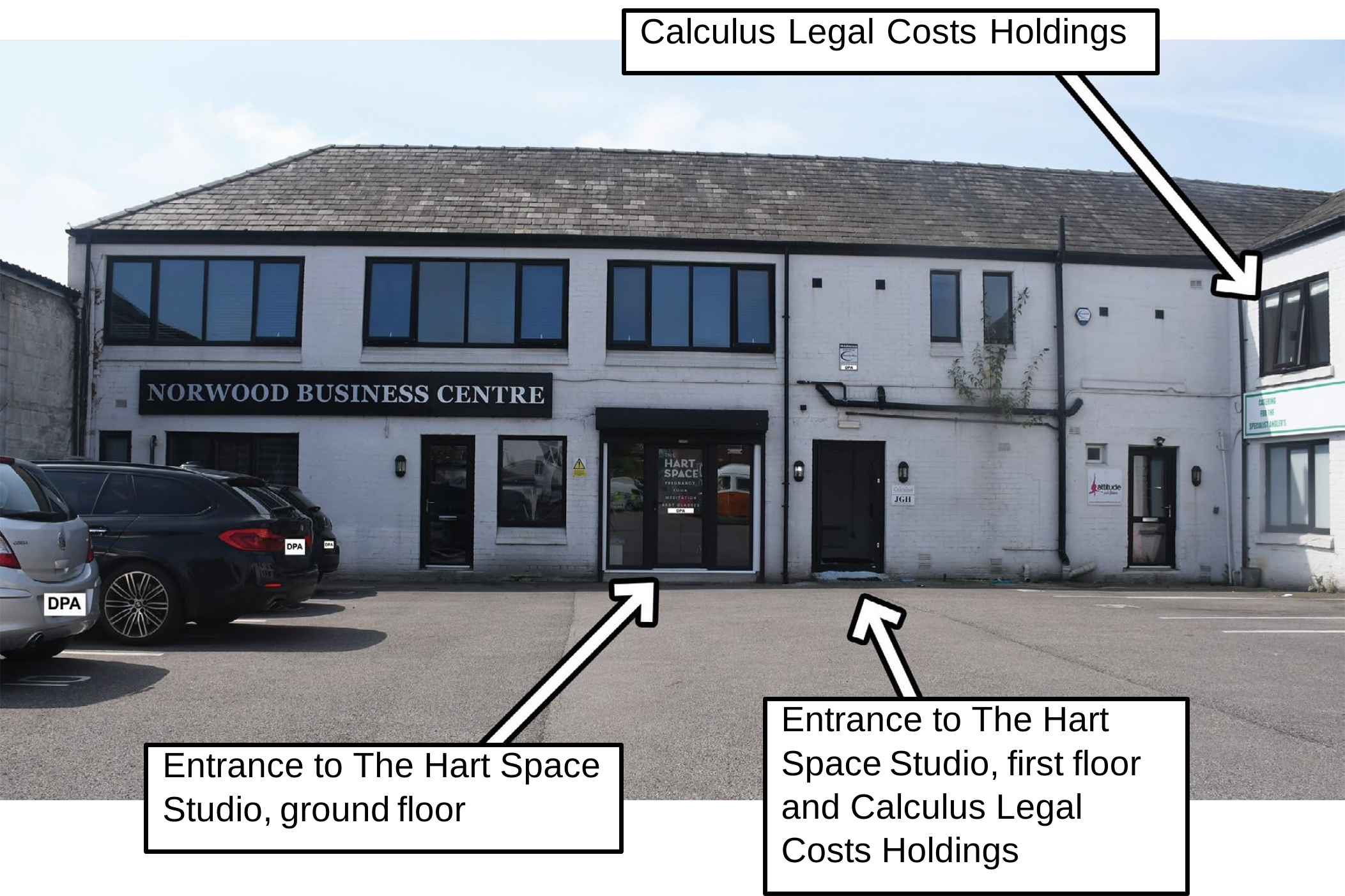
Figure 2: Internal plan – Hart Space downstairs and communal staircase[footnote 86]
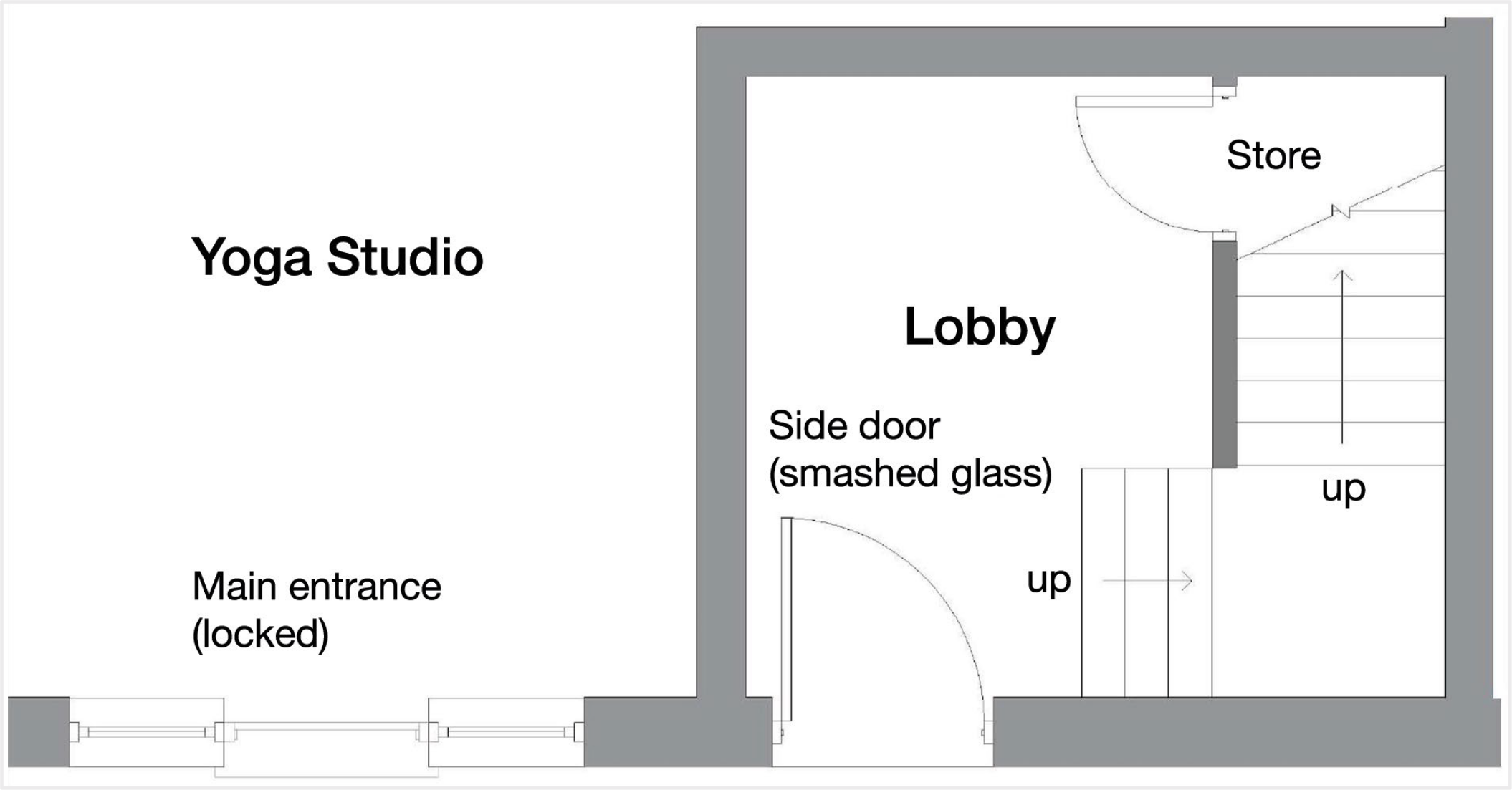
Figure 3: Internal plan – Hart Space upstairs, communal landing and Calculus office[footnote 87]
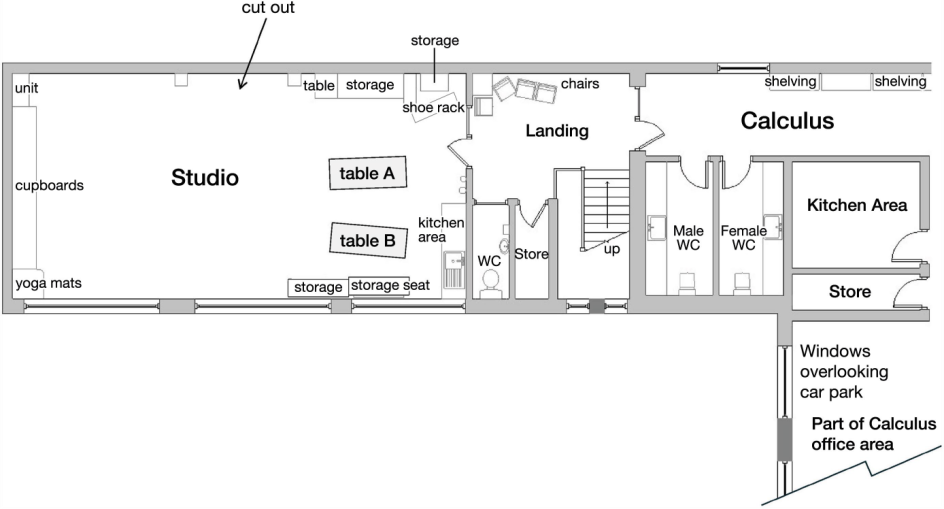
20. The Calculus office extended along the upstairs of the Norwood Business Centre. The Calculus office windows gave a view over both the car park and the communal entrance. CCTV cameras also covered both of these areas: see Figure 4, below. It is neither necessary nor appropriate for this report to replicate imagery from the CCTV cameras, but they enabled Merseyside Police to compile a careful chronology of the movements in and out of the Hart Space, by AR and of his victims.
Figure 4: Outside view of Calculus office and CCTV locations[footnote 88]
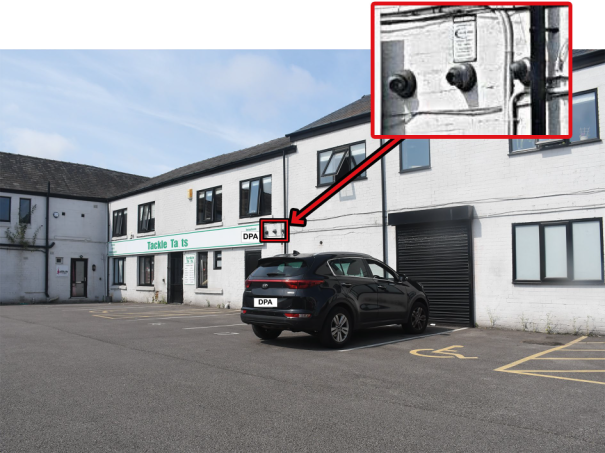
CSI image showing CCTV cameras overlooking the access and egress to The Hart Space Studio and Calculus Legal Costs Holdings.
21. On 29 July 2024, the day of the attack, Ms Lucas arrived at the Hart Space shortly before 09:29. Mrs Liddle arrived a minute later.[footnote 89] The 25 young girls who had booked to attend the event, along with Child C6 as the 13-year-old helper, all arrived between 09:50 and 10:06. Initially, the event was split into two groups with Ms Lucas taking the yoga element downstairs and Mrs Liddle the dance element upstairs. However, at 11:16 the two groups combined in the upstairs space for making bracelets using beads and the conclusion of the class.
AR’s computer use on the morning of 29 July 2024
22. AR lived at 10 Old School Close, Banks, Lancashire PR9 8SB. It should be noted that AR’s family no longer live at this address. This location, relative to the scene of the attack is shown in Figure 5, below.
Figure 5: Key locations[footnote 90]
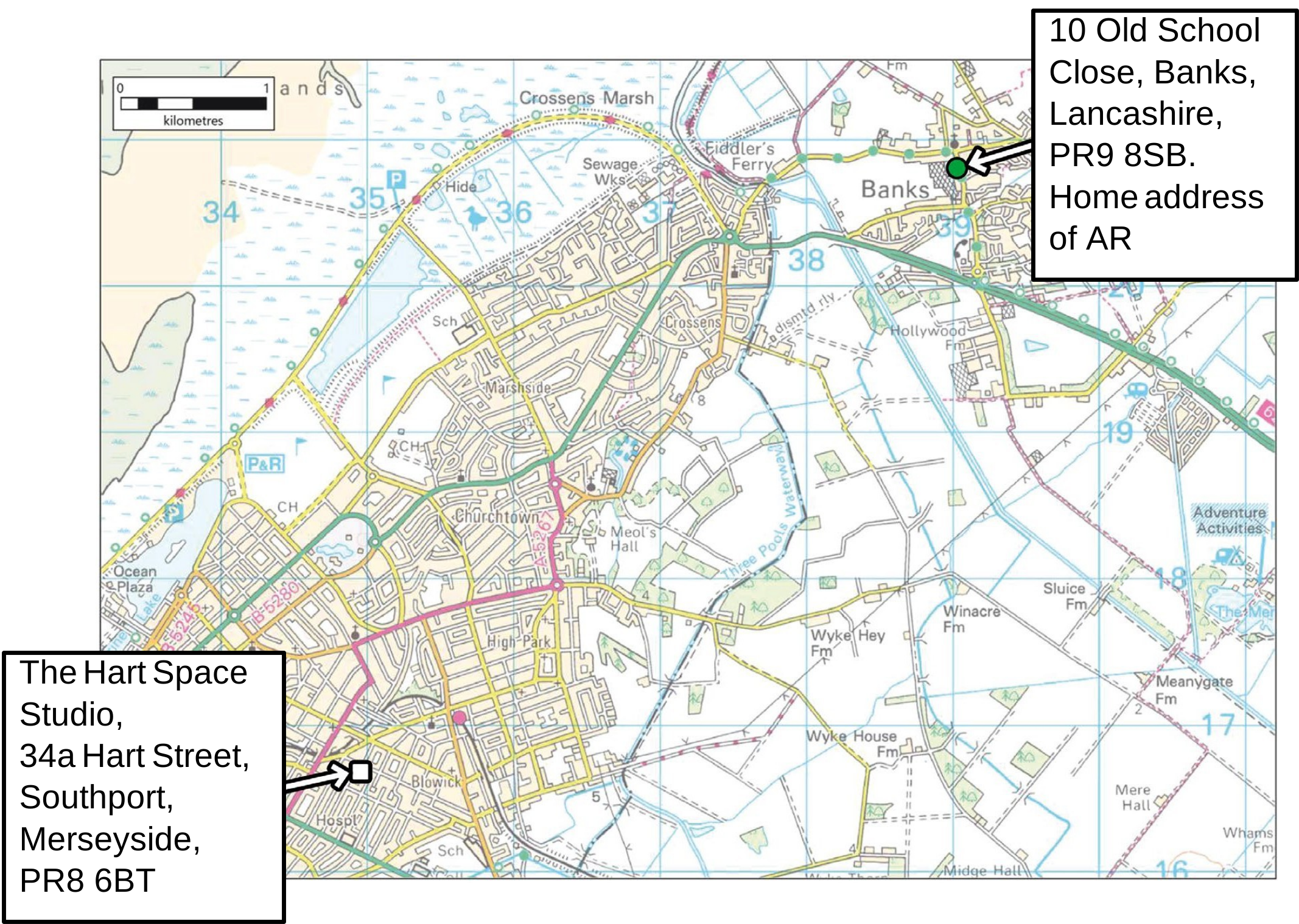
Map showing 10 Old School Close and The Hart Space Studio.
23. AR was at home overnight on the night of 28/29 July 2024. Both his parents were also at home as was his brother Dion R, who had recently returned home from university. I focus here on the actions of AR on 29 July. I will return in Chapter 12: AR’s family to the actions of AR’s family that morning.
24. By July 2024, AR had the use of three main electronic devices:
-
An HP laptop;
-
An older Lenovo Tablet (designated exhibit SMG/3 in the police investigation);
-
A new Lenovo Tablet, purchased on 9 October 2023 (designated SMG/2).
25. At 10:06 on 29 July 2024, on the Lenovo Tablet SMG/2, AR took a screenshot of recently accessed files showing five PDF files.[footnote 91] The time stamp for these files was 09:51, with no date. When PDFs had been accessed weeks or months earlier, a date appeared as well as the time. Merseyside Police assessed that this shows that AR accessed these particular files very recently and I accept this; he likely viewed these files that same morning, 29 July 2024. The five files were consistent with other evidence of AR’s fascination with violence and conflict. They were:
a. Divinity and Experience — The Religion of the Dinka;
b. Excerpt from Kamikaze Death Poetry;
c. Understanding Contemporary Ethiopia;
d. The Ethiopian Revolution — War in the Horn of Africa;
e. Rebellion in Iraq 869-883 CE Race, Rebellion.[footnote 92]
The document on Kamikaze Death Poetry is perhaps particularly significant since it documented poems arising out of “a tradition held by World War II Japanese Kamikaze pilots to place pen to paper one last time”.[footnote 93]
26. At 10:50 on 29 July 2024, AR used the Chrome browser on his Lenovo Tablet SMG/2 to search for “around 1:22:30 mar mari podcast”.[footnote 94]
27. At 10:55, AR then deleted the internet browser history on his HP Laptop, both on Microsoft Edge and Google Chrome. This prevented later searches on the device revealing what AR had been viewing on this laptop, save that it revealed that there were images of knives and hammers dating from around October 2020.[footnote 95]
28. At 11:04, approximately six minutes before he left the address, AR then again used the newer of his Lenovo Tablets (SMG/2) to carry out a search on Twitter/X for “mar mari Emmanuel stabbing”. The limitations of the retrieved data meant that it could not be definitively established one way or the other whether AR followed the search links to view the footage.
But when the same search was later created by the investigating officers, it led to posts containing the full video footage of Bishop Mar Mari Emmanuel being stabbed while live streaming a sermon in a church in Sydney, Australia.[footnote 96]
29. The video was flagged by X as sensitive at this time and would, therefore,
not have been visible to users who had provided a date of birth which rendered them under 18.[footnote 97] However, X’s age verification process at that time simply asked a user to enter a date of birth and did not involve any further age verification such as checks on the email address provided, the provision of a live selfie (for the purposes of estimating age) or the provision of a government identity document.[footnote 98] Those are all measures that X has put in place for UK users as a result of the Online Safety Act 2023, which was not in force at the relevant time.[footnote 99]
30. Despite the wide terms of the Inquiry’s original Section 21 notice to X, it was only on the evening of 3 November 2025, just before Ms Deanna Khananisho was due to give evidence as the corporate witness on behalf of X, that its legal representative belatedly wrote to the Inquiry confirming that the date of birth was held for one of AR’s multiple accounts (‘the extant account’).[footnote 100],[footnote 101] Even then, X required a further Section 21 notice to be served for the Inquiry to obtain this information, despite the fact that the information would have been covered by the Inquiry’s original Section 21 notice.[footnote 102] The Inquiry did then serve a Section 21 notice the following morning, 4 November 2025, before Ms Khananisho gave evidence.[footnote 103] During her oral evidence later that day, Ms Khananisho stated she was not able to provide the date of birth.[footnote 104] She denied that it would be a matter of embarrassment to X for it to be publicly clear that AR entered a false date of birth, and since that was the only requirement, that AR was able to access sensitive material on X.[footnote 105] The Inquiry finally received the information on 14 November 2025, only a few hours before the further Section 21 deadline was due to expire. Perhaps unsurprisingly against this procedural history, X revealed in answer to the second Section 21 notice that the date of birth for AR’s extant account was 1 January 1990. This date of birth suggested that AR was 34 years of age, not 17, at the time of searching for the video of Bishop Emmanuel being stabbed.[footnote 106]
31. The data disclosed by X shows that AR began a user session on X at 10:29 on 29 July 2024 using an account (‘the de-activated account’).[footnote 107],[footnote 108] The data disclosed for the extant account, for which X has provided a date of birth, does not show any user sessions on 29 July 2024. It therefore appears that AR was using the de-activated account when he carried out the searches for the stabbing. X stated that it did not hold a date of birth for the de-activated account.[footnote 109] Nevertheless, I find that AR did use a false date of birth for this account, given that he had done the same for the extant X account and his Instagram accounts.[footnote 110] As a result, I conclude that because of X’s weak age verification processes at that time, AR was able to use an adult account on X to search for the video of the stabbing. I further conclude that it is probable that AR did view the actual footage of the stabbing before carrying out the attack.
32. I note that X has shown no signs of any self-critical reflection for the fact that AR was so easily able to bypass its (at the time) weak age verification process and thereby obtain search results for violent content. It is also regrettable that X’s approach to disclosure meant that there was such a protracted process before X provided the admission that AR provided a false date of birth.
In addition to the late disclosure of the given age for the most relevant of AR’s X accounts, I note X would only accept service of hard copy Section 21 notices at its offices in Dublin, rather than in electronic copy on its recognised legal representatives. In addition, X refused – on the legal grounds that it considered it was prohibited by US laws – to supply any ‘content data’, such as posts, likes or messages, associated with AR’s accounts.[footnote 111] While X maintain that such disclosure would be in breach of US law (an issue which it is neither necessary nor appropriate for me to resolve), I simply observe that, in contrast, Meta did provide content data for AR’s Instagram accounts.
33. Looking at matters in the round, I observe that, regrettably, X did not show the same ready willingness to co-operate with the Inquiry as almost all other organisations and Core Participants.
34. Returning to the narrative of the events of the attack, as leading Counsel to the Inquiry observed in his opening statement, it is both sobering and concerning that almost the last thing that AR did before committing these dreadful crimes was to search for and probably view material on X in relation to a stabbing carried out by another boy aged under 18.[footnote 112] I have viewed the full footage of the Bishop Emmanuel stabbing. The footage is graphic and horrific. While taken from medium distance, it shows the assailant making a repeated stabbing action with his arm as he attacked Bishop Emmanuel. I return to this in Chapter 6: Online harms.
AR leaving his house and the taxi journey to the Hart Space
35. AR then left 10 Old School Close at 11:10 and walked in the direction of Hoole Lane.[footnote 113] Notwithstanding the warm weather, AR was dressed in a green hooded sweatshirt with the hood pulled over his head and his face was covered with a surgical mask. He had with him one of the two Cerbera kitchen knives with a 20 cm blade, manufactured by Apollo, which he had bought from Amazon on 13 July 2024.[footnote 114]
36. Once outside his home and out of sight of his parents, AR first made an aborted call to one taxi company. AR then made an unsuccessful booking attempt with the automated system for One Call Taxis (timed at 11:13). He then made a second successful call to One Call Taxis (timed at 11:14) to take him to 34A Hart Street.[footnote 115] The significance of the timing of the call is that it meant that AR would arrive at 34A Hart Street towards the end of the advertised dance and yoga class. Since AR had provided a false name (Simon) to One Call Taxis on his earlier booking on 22 July 2024, that was the name under which this automated booking was recorded. AR then went back to Old School Close and remained in the vicinity of his home at number 10, until he was collected at 11:31 by Mr Gary Poland, one of the drivers for One Call Taxis.[footnote 116]
37. The timings for these events were established by the Merseyside Police investigation from a combination of examination of AR’s mobile telephone, street CCTV, and Ring doorbell footage.
38. Mr Poland’s taxi was fitted with front and rear facing dashcams. The relevant footage – both visual and audio – was recovered by Merseyside Police.
The Inquiry produced a full transcript of the audio from the dashcam recording.[footnote 117] This shows that there was essentially no conversation between AR and Mr Poland during the 14-minute trip. The taxi arrived in the vicinity of 34 Hart Street at 11:44. Consistent with his intent to attack the dance and yoga class, AR was specific in asking Mr Poland, “Is this 34A Hart Street”.
At this stage, Mr Poland wrongly pointed towards Masters Vehicle Repairs Ltd (‘Masters Garage’), the next-door premises. AR expressed surprise at being directed to a spray shop. AR did not react when asked whether he was paying by “cash or card” and instead alighted from the taxi and, following Mr Poland’s mistaken direction, walked towards Masters Garage. The latter premises is at the end of a driveway and is separated from the Norwood Business Centre by a brick wall shown in Figure 6 below.[footnote 118]
39. As Mr Poland recalled in his statement given to the police, AR appeared to be holding one of his arms tightly, which was not swinging.[footnote 119] Mr Poland followed AR in his vehicle, persistently requesting payment. These events were witnessed by Mr Colin Parry, the owner of Masters Garage, Mr James Dixon, an employee, and Mr John Philips, a customer. When Mr Philips and Mr Parry shouted at AR to pay the driver, he responded with words to the effect of “what are you going to do about it?”[footnote 120]
40. The dashcam footage shows that AR then retraced his steps, walking back to Hart Street. He then turned left and immediately left again, in the direction of the Hart Space. He crossed the car park in order to reach the entrance to 34A Hart Street. Mr Poland, still at the wheel of his taxi, followed AR across the car park and pulled up outside 34A Hart Street. Mr Poland had been repeatedly asking whether AR was paying by cash or card, and he threatened to call the police. AR seemingly did not react.
41. At 11:45:30 AR attempted to enter the Hart Space via the ground floor door to the downstairs studio. This door had been locked when Ms Lucas took the second yoga group upstairs for the bracelet making and end of the class. Having been unable to gain entry that way, immediately afterwards (at 11:45:37) AR used a door to the right to the communal stairway which was unlocked. Shortly afterwards he was caught on the taxi’s dashcam on the first-floor landing.
42. AR then entered the upstairs studio and launched his attack.
Figure 6: Aerial image showing taxi drop-off and Masters Garage[footnote 121]
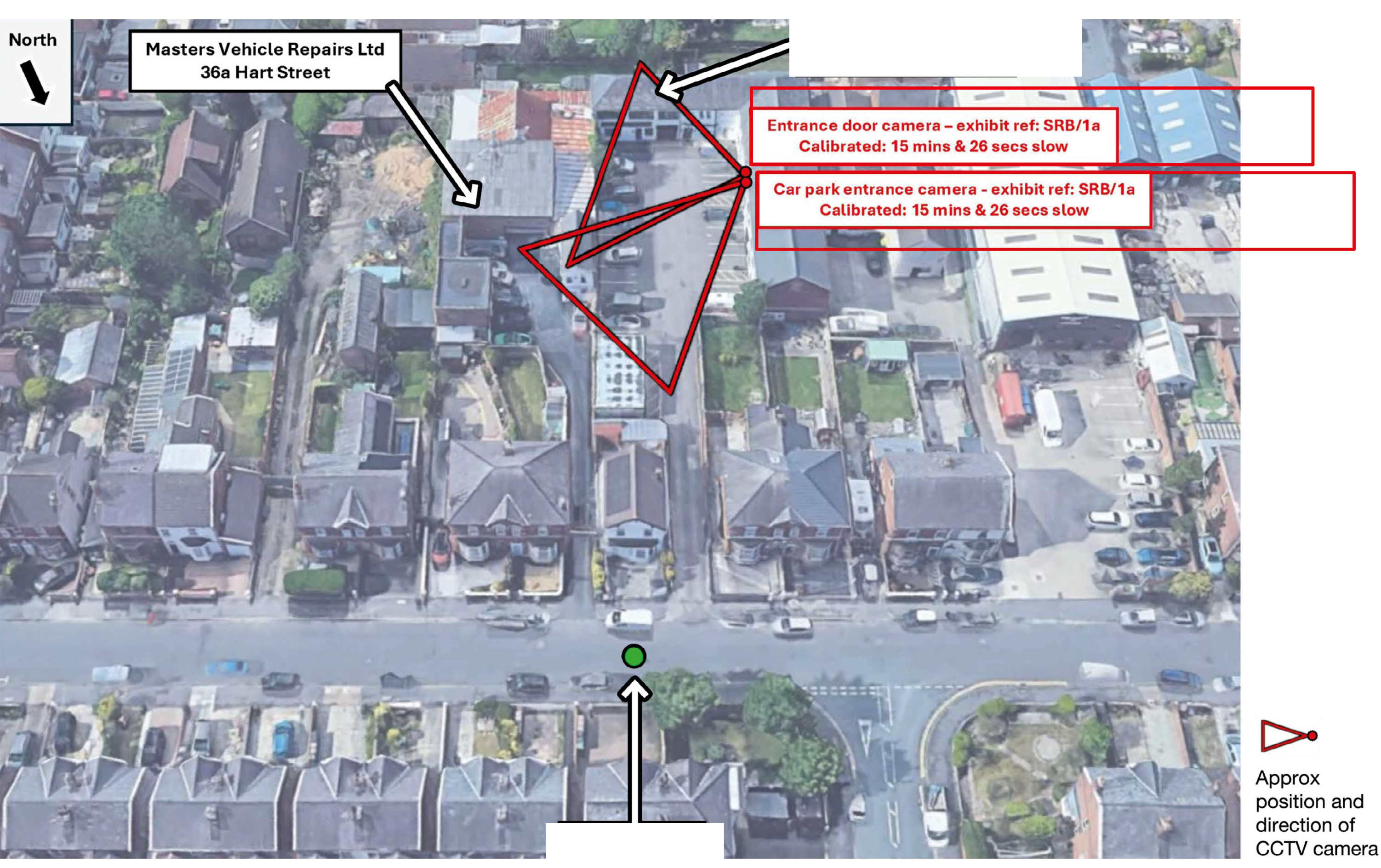
The attack within the upstairs studio and communal staircase
43. It is neither necessary nor appropriate for me to seek to detail the horrendous events within the upstairs studio, or on the staircase, as those victims who could attempted to flee. AR has been convicted, on his late guilty plea of the murder of Alice, Bebe and Elsie, and the attempted murder of Child C1, Child C2, Child C3, Child C4, Child C5, Child C6, Child C7, Child C8, Ms Lucas and Mr Hayes. Importantly, Mr Justice Goose was also sure that had AR been able to “… he would have killed each and every child, all 26 of them, as well as any adults who got in his way”.[footnote 122] I agree. The evidence heard by this Inquiry strongly supports Mr Justice Goose’s assessment that AR would have killed all the children in the studio had he been able to do so, including those girls who in the end escaped physical injury, but were of course all deeply psychologically injured.
44. I was made aware that, as between some of the survivors, there may be differing recollections as to the precise sequence of events within the upstairs studio, including as to which child was attacked first. I do not need to resolve that issue. I deliberately did not seek to call evidence to address it, as this would have served only to traumatise the victims further. For understandable reasons, Merseyside Police decided that it was not necessary to take evidential accounts from the young child survivors in the way that was done for the adult victims who were inside the upstairs studio, Ms Lucas and Mrs Liddle. As DCI Pye recognised in his evidence to the Inquiry, with such a traumatic event the genuine recollections of those present might not fully align as to the precise sequence in which things happened.[footnote 123]
The immediate aftermath: the victims who had been in the Hart Space
45. Having seen AR enter the Hart Space, Mr Poland slightly reversed his taxi (“half of a three-point turn”), in order to be in a more convenient position to drive away. His hope was that AR had gone into the building to collect the money to pay the fare.[footnote 124] Distressingly, the screams during the attack were recorded on the audio of the dashcam in Mr Poland’s taxi, and could be heard at 11:46:06, 29 seconds after AR first entered the building.[footnote 125]
46. The first child to exit was Child C3, who ran from the building via the open ground floor door at 11:46:15, some 38 seconds after AR had entered the building. The front-facing dashcam captured the image of two more children leaving the building at 11:46:18 prior to the taxi being driven back to Hart Street, thereafter departing the scene. Mr Poland, in driving away, caused Child C3 to change direction (she had to run round Mr Poland’s car). Mr Poland exited the scene at this stage, with more of the escaping girls visible in his rear-view mirror. Mr Poland did not call the police at this stage or immediately afterwards. I return to Mr Poland’s conduct at paragraph 92, below.
47. The chronology of those escaping was as follows:[footnote 126]
a. Child C3, as above, was the first to get out and exited at 11:46:15;
b. Within three seconds, by 11:46:18, two more children followed Child C3 out;
c. Between 11:46:19 and 11:46:24, a period of five seconds, six more children exited. Thus, nine girls had escaped by this stage;
d. They were followed by Ms Lucas (who of course by this time had been seriously injured with a number of stab wounds);
e. Ms Lucas stopped at the door to usher three more children (who would initially have been behind her) out of the building. Thus, 12 girls had escaped by this stage;
f. Ms Lucas had her mobile telephone in her hand at the doorway;
g. As the third girl ushered out by Ms Lucas started to move across the car park, Ms Lucas herself started to move away from the door running across the car park at 11:46:27. As she ran across the car park Ms Lucas had her hands on her telephone;
h. Immediately behind Ms Lucas a further 10 girls came out, in quite quick succession, but with a bit of a gap between the last two of this group who were Child C5 and Child C7. Alice was the seventh girl within this group and the 19th in sequence to leave (as I shall detail below, Alice collapsed by a BMW car parked in the car park). This group all left the doorway within about five seconds of Ms Lucas having left, that is to say by 11:46:32. By this stage, 22 girls had escaped;
i. As she ran across the car park, Ms Lucas was connected in the 999 call she was making. There was a slight difference in the timing as recorded on the device (11:46:31) and from the network provider (11:46:33).[footnote 127] While I am satisfied that Ms Lucas was only connected on her 999 call once out in the car park, she may have started to try to dial earlier attempting to get through to the emergency services;
j. Child C1 attempted to leave the building at 11:46:46 but was pulled back inside by AR. She managed finally to escape some 13 seconds later at 11:46:59, only to collapse in the car park to one side of the open door at 11:47:12. She was the 23rd girl to get out.
48. The three children left inside were Bebe, Elsie and Child X.
49. Tragically, Bebe’s and Elsie’s injuries were unsurvivable, and they both died in the upstairs of the building.
50. Child X – who had special educational needs – was shielded bravely in the upstairs lavatory cubicle by Mrs Liddle; they were escorted out once AR had been arrested. It is appropriate to repeat here the impact evidence of Child X’s mother who said that “Heidi had saved my daughter’s life” and
“I owe everything to Heidi for having the foresight to protect my daughter”.[footnote 128]
51. I have addressed the timing of the 999 call which was connected as Ms Lucas ran across the car park. Ms Lucas was the first person to call 999 in response to the attack. Despite her injuries she told the operator that there had been multiple stabbings and injuries at Hart Street by a single “boy”. She also managed to flag down Mr Joel Verite and Mr Marcin Tyjon who were driving down Hart Street. This was significant because, as I shall summarise below, both Mr Verite and Mr Tyjon were able to intervene to assist as best they could. Given her very significant injuries, Ms Lucas did extremely well to convey this information to the police and flag down Mr Verite and Mr Tyjon.
52. I wish to stress, consistent with the observations of Mr Justice Goose, that in my view Ms Lucas was concerned to try to save as many children as she was able, having herself been attacked by AR at an early stage. As the judge observed, AR stabbed Ms Lucas five times to her head, back, shoulder blade and arm. She required a blood transfusion. Her spinal vertebrae, a rib and a shoulder blade were each fractured by the knife blows inflicted by AR, all of which injuries were the result of blows of severe force. Internally, Ms Lucas suffered a bilateral haemopneumothorax; when the area between the lung and chest wall contains both air and blood.
53. For some of the parents of the victims, it is a circumstance of acute sadness and other understandably strong emotions that their daughters ended up left alone with the murderous perpetrator, AR.
54. I therefore want fully to acknowledge the bravery of those girls who courageously helped each other and battled to get out, some of them being (by the latter stages) without an adult alongside them as they did so. Theirs was a terrifying ordeal. I hope that through the family impact evidence, the voice of these girls has been heard.
55. At the same time, given this was an exceptionally violent, unheralded and fast-moving event, it would in my view be misconceived for commentators on social media (or otherwise) to seek to blame Ms Lucas for not remaining inside the Hart Space for longer than she did, not least given the grave injuries Ms Lucas had herself sustained.
56. It is, I hope, possible to acknowledge the awfulness of the situation which the girls faced, some of them eventually alone as they tried to escape, without translating this into some kind of blame on the part of Ms Lucas.
57. In my assessment, I repeat that Ms Lucas did all she reasonably could.
The immediate aftermath: the staff in the Calculus Office and the injury inflicted to Mr Hayes as he sought to assist
58. As I have set out above, Mr Jonathan Hayes was the head of Calculus Legal Costs Holdings. He was at work on the morning of the attack together with several other members of his costs team. As shown in Figures 3 and 4, above, the office was in the upstairs of the Norwood Business Centre, and the main entrance was to the right of the landing at the top of the communal stairs.
59. The other members of the Calculus staff present that morning were
Mr Jonathan Cape,[footnote 129] Mr Joseph (Joe) Manning,[footnote 130] Mr Adam Martindale,[footnote 131] Mr Josh Davies[footnote 132] and Mr Robby Feeney.[footnote 133] From their office, Mr Manning heard screaming but believed it was children playing in the car park.
He was used to children screaming and playing related to classes in the Hart Space, and while this was louder than normal, it did not immediately arouse his suspicion. Mr Manning said that very shortly after this screaming noise had stopped, he had rolled a cigarette and was intending to go for a smoke downstairs in the car park. However, on stepping outside the Calculus offices he saw blood in the stairwell, and immediately retraced his steps, realising something was wrong. Mr Manning told his colleagues back inside the office what he had seen. He described how he and others in the office then looked out of the window and saw a girl lying on the ground. The girl on the ground can only have been Child C1. Mr Manning states that his colleague Mr Cape then called for an ambulance “straightaway”.
60. This account entirely tallies with the 999 call which Mr Cape made at 11:47:56, and which was transcribed as part of the police investigation.[footnote 134] Since it is evident from the CCTV footage that Child C1 collapsed outside at 11:47:12, the maximum time that elapsed between Mr Manning and Mr Cape seeing Child C1 prone on the floor and the 999 call was 44 seconds. It is understandable in the circumstances that Calculus staff mistook the screaming of girls in panic on the morning of the attack for the more usual type of screaming and playing emanating from the Hart Space. Moreover, Mr Cape’s 999 call appears to have been made promptly upon he and Mr Manning realising that something was seriously wrong. Objectively speaking (and without criticism of any of the Calculus staff), by the time the staff in the Calculus office did realise that something was seriously wrong, Alice, Bebe and Elsie had all already been fatally attacked, and the injuries to all of the child survivors as well as Ms Lucas had already been inflicted.
61. This account of Mr Manning and Mr Cape’s actions, and the timing of the 999 call, helps to put in sequence Mr Hayes’s own involvement and the timing of AR’s attack on Mr Hayes. For it was after Mr Cape had been connected on his 999 call, that Mr Manning then went to the far side of the office to inform Mr Hayes that something “really bad is happening outside” and that a girl (in fact Child C1) was “bleeding out”.[footnote 135]
62. It was at this point that Mr Hayes, without delay, went to leave the Calculus office, running the length of the office to the exit, intending to go downstairs in order to assist.[footnote 136] However, as he reached the door, Mr Hayes saw a young girl – most likely Bebe – lying on the ground on the landing. AR walked towards Mr Hayes and entered the Calculus office. He was holding a knife which Mr Hayes courageously attempted to grab. AR wounded him severely in the leg. Mr Hayes shouted out “Get him out” and fell to the floor. As Mr Martindale, one of Mr Hayes’s colleagues, came to assist, AR sprinted from the offices but then turned to face Mr Martindale. The latter ran to the office door which he was able to close, leaving AR on the landing.[footnote 137] Another employee at Calculus, Mr Davies, applied a tourniquet to Mr Hayes’ leg.[footnote 138] Consistent with all of the above, the disturbance in the aftermath of Mr Hayes being stabbed is audible in the background in the audio recording of Mr Cape’s 999 call.
63. It follows from the above that Mr Hayes was the last of the survivors to be stabbed by AR. While by this stage, all of the injuries to the child survivors had already been inflicted, that does not diminish the appropriateness and courage of Mr Hayes’ actions. Moreover, it should also be recalled that Child X and Mrs Liddle were sheltering in the upstairs lavatory cubicle at this stage, still vulnerable to being attacked by AR.
Members of the public respond: an example of bad meeting good
64. In this section of the report, I wish to acknowledge and record the actions of members of the public who responded in an admirable way to the unfolding events.
65. First, it is important to recognise that many of the parents and other relatives of the girls attending the class had started to arrive. Without singling any of them out, I should start by acknowledging the mutual support they tried to give each other in the desperately confusing and awful situation they faced. Some of this is caught on the emergency responders’ body worn footage which is too distressing to have made public in the hearings. It was vividly described in the Inquiry’s impact evidence.
66. The girls and Ms Lucas who had escaped out of the Hart Space headed towards the rear (Hart Street end) of the car park. Some of the girls got into the white BMW owned by Q-M, the mother of Child Q.[footnote 139] Alice was able to reach this same car but collapsed on the ground on the far (Hart Street) side of it.
Q-M, with other family members, was seated in the vehicle. As well as Child Q getting into her mother’s car, a number of other girls were able to take shelter in the car too, including Child C3 and Child C6. Q-M was able to drive out of the car park and into Hart Street, where she parked so that first aid could be given to the injured children.
67. I have described Child C1 collapsing by the door to the Hart Space, having been pulled back in and further attacked by AR. Mr James Dixon, who was working in Masters Garage, had heard screams and went towards the Hart Space.[footnote 140] As he was walking towards Hart Space, he saw Child C1 and went to pick her up, despite the potential risks to himself. He can be seen on the CCTV picking up Child C1 at 11:49:29. He carried her to Hart Street and placed her on the floor to the left of the car park entrance and applied pressure to her wounds. In my view he is to be congratulated on the prompt and effective assistance he provided. Child C1’s parents described him as “a wonderful man who took her to safety”.[footnote 141]
68. I have mentioned that Mr Verite and Mr Tyjon were flagged down on Hart Street by Leanne Lucas.[footnote 142],[footnote 143] They were work colleagues in their work vehicle.
They stopped to help and ran towards the Hart Space. At 11:50, Mr Verite picked up Alice and carried her to the ground in the driveway of 34 Hart Street, close to where Child C1 had been carried by Mr Dixon.
69. The movement of Q-M’s BMW and the location to which Child C1 and Alice were carried by Mr Dixon and Mr Verite is shown in Figure 7 below.
Figure 7: Treatment locations[footnote 144]
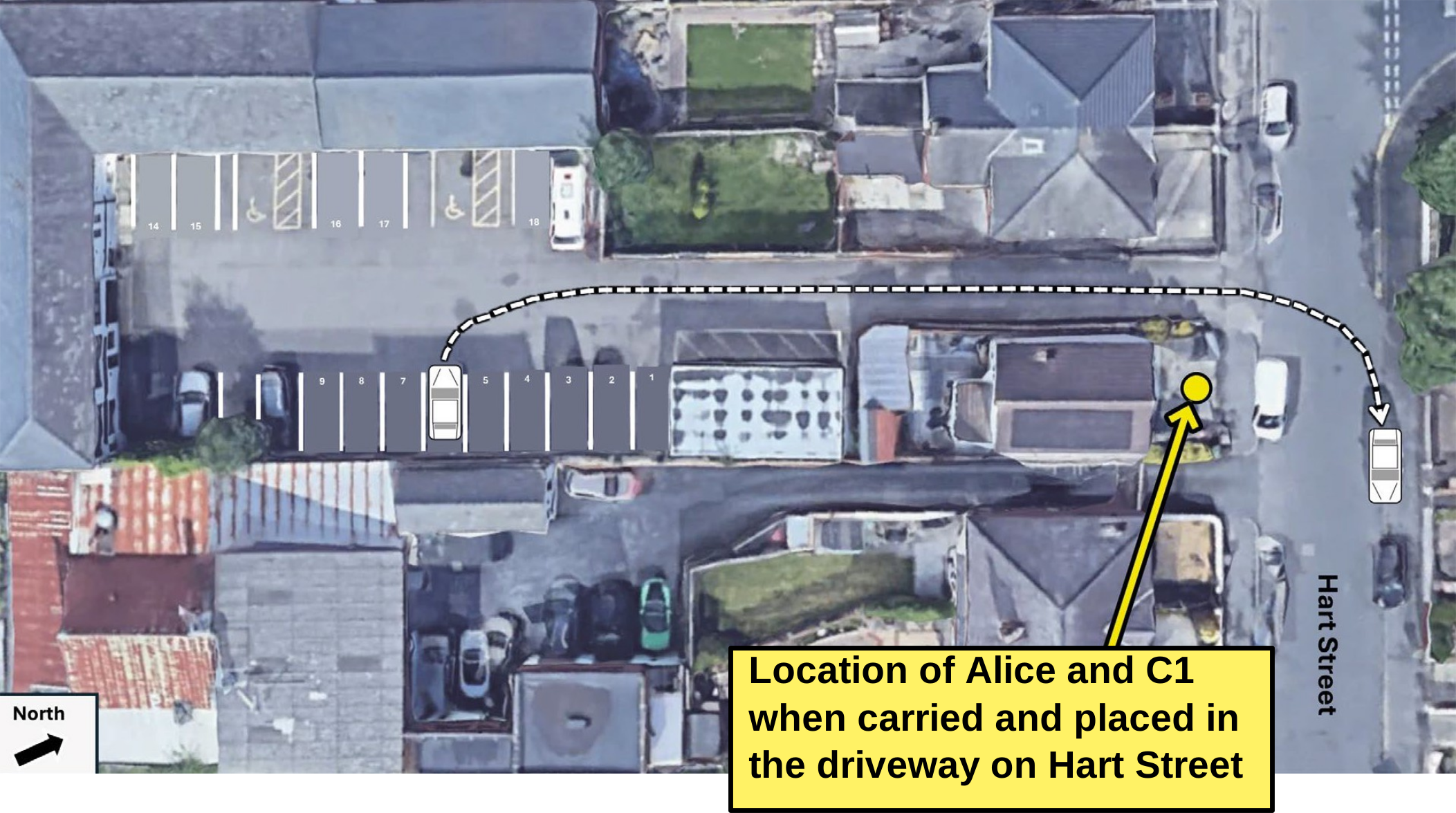
Aerial image showing the route of the white BMW.
70. Mr Tyjon remained with Alice and provided such care as he was able, including administering first aid, until the paramedics arrived.
71. Mr Verite, having left his T-shirt as a makeshift bandage with Mr Tyjon to help treat Alice, went back into the car park and then entered the Hart Space.
At 11:52 he started climbing the stairs. However, he saw AR pacing on the landing at the top of the stairs and carrying a large knife. Mr Verite went back downstairs and left the building several seconds after he had entered it, at 11:53. He smashed the glass pane to the door, to stop AR from locking himself in.
72. When the police arrived (as I shall detail further below), Mr Verite supplied Police Sergeant (PS) Gregory Gillespie with information as to what he would face inside. When the police went inside to detain AR, Mr Verite followed them in, having armed himself with a hammer. He was asked by the police to carry Bebe out of the building in order to see if any help could be provided to her. He carried Bebe to Hart Street where she was placed in an ambulance and later moved to a guarded cordon.
73. Mr Stephen Mitton, who lived on Hart Street, saw some of the girls running away.[footnote 145] He intervened and ushered them inside his house where they were cared for by his wife, Mrs Pamela Mitton.[footnote 146] Mr Mitton also assisted at the scene. An ambulance was called. Mr and Mrs Mitton behaved in a praiseworthy public-spirited fashion, acknowledged by the parents of the girls who were able to shelter in their home. Mr Manju John, an off-duty nurse, who lived on Hart Street, went to the home of the Mittons and was able to provide first aid and other assistance.[footnote 147]
74. Mr Andrew Batchelor was another resident on Hart Street.[footnote 148] He telephoned the police at 11:49. He provided towels to those caring for the injured, assisted in the care of Alice, he liaised with the emergency services, and he helped manage the traffic, an important form of assistance given the need to try to keep Hart Street accessible to the emergency services.
75. Ms Julie Woof was driving past 34 Hart Street with her two children when she saw a child lying on the pavement, Child C2, who was being cared for by Mr Martin Fessey.[footnote 149],[footnote 150] She helped compress Child C2’s injuries until relieved by Police Community Support Officer (PCSO) Barry Calder and paramedics. Mr Fessey nonetheless remained and provided additional assistance.
76. PCSO Calder (a retired police medic) triaged some of the children, ensured they were receiving first aid and recorded the details of key witnesses.[footnote 151]
77. Ms Joanne Martlew was driving home with her family.[footnote 152] She had worked with the Coast Guard and Fire Service and had associated medical skills.
She assisted by assessing some of the injuries, providing first aid, and in co-ordinating the medical response. She also assisted the police in collecting clothing in evidence bags. She remained at the scene until all the children were en route to hospital.
78. Ms Abigail Butler, an off-duty nurse, was called to the scene by her sister Mrs Jennifer Scholes (who leased the Hart Space).[footnote 153] Ms Butler assisted one of the injured children and then, using an ambulance kit, provided care for Mr Hayes inside the Calculus office until the North West Fire Service carried him from the Calculus office to the triage area on Hart Street, where she administered oxygen and pain relief until his transfer to hospital. She then offered support to other attending emergency staff.
79. Mr Mikhail Lawler, a senior charge nurse at Southport and Formby General Hospital, was driving in the area while off duty and went to assist once he saw the emergency vehicles.[footnote 154] He provided first aid, critical medical care and general support to a number of the casualties, including in particular to Alice.
80. Even senior and experienced members of the emergency services who attended described the dreadful and distressing nature of the scene, with multiple gravely injured children, parents in a state of shock and deep distress, and the realisation that there had been child fatalities.
81. In the face of such a scene, DCI Pye aptly described the actions of those I have summarised in this section:
“I think this was definitely an example of bad meeting good and there were lots of members of the public, some professionals, some not, who had no duty of care but actually stopped to assist. People may have seen on television how chaotic the scene was outside but there were lots of good people and it is only right that we recognise the work that those people did.”[footnote 155]
82. All of those referred to in this section, together with others – families, relatives and other members of the public who did what they could at the scene – are, in my view, to be commended for their actions.
AR’s arrest
83. I address the wider Merseyside Police response to the attack at paragraphs 118 to 139, below. This section addresses the immediate circumstances of AR’s arrest.
84. AR was arrested at the scene.[footnote 156] At 11:56:53 Police Sergeant Gillespie was the first police officer to arrive, parking on Hart Street at the exit to the car park.[footnote 157] His body worn video camera was activated as he made his way to the scene and remained on. When PS Gillespie arrived, he noticed a child on the pavement who appeared not to be breathing. He told members of the public to flag down a paramedic vehicle which he had seen behind him. He ran to the Hart Space with Mr Verite. He arrived at the door at 11:57:04 (11 minutes 27 seconds after AR entered the building and around 10 minutes 30 seconds after Ms Lucas first called 999). The true time is 10 minutes 33 seconds or 10 minutes 31 seconds depending on whether you take the time recorded on the device or from the network provider. He provided an update via his radio that he was going to detain the perpetrator and started to take out his baton when Mr Verite told him that the attacker had a knife. Mr Verite said in forceful terms that the police would need a firearm in order to enter the premises. Mr Mitton and another member of the public, Mr Alan Crowley, joined them at the entrance. Acting Police Sergeant (A/PS) Luke Holden, who was taser trained and taser equipped, along with PCSO Timothy Parry arrived at 11:57:50.[footnote 158],[footnote 159] This was 46 seconds after PS Gillespie’s arrival at the Hart Space entrance.
85. PS Gillespie told Mr Verite and PCSO Parry to wait at the door while he and A/PS Holden entered the building, having decided not to wait for firearms officers. PS Gillespie entered at 11:57:56 with A/PS Holden initially immediately behind. PS Gillespie had been at the door for only 52 seconds. PS Gillespie and A/PS Holden were respectively holding a baton and a Taser. A/PS Holden then took over the front position.
86. When halfway up the stairs, both officers saw AR and shouted at him to drop the knife he was holding. AR complied. PS Gillespie ran at AR and – in order to detain him – kneed him in the stomach and struck him twice to his back with the baton. AR was forced to the floor, and the officers took hold of his wrists to handcuff him. PCSO Parry also entered the building and secured AR’s legs. AR was arrested by PS Gillespie initially for attempted murder and placed in handcuffs by A/PS Holden.[footnote 160] Other officers then started to arrive, including PCs Simeon Shakespeare and Alan Carr who assisted with the restraint of AR.
87. The reason that PCSO Parry left the door was that he heard the shout from his colleagues concerning the knife. PCSO Parry acted bravely and appropriately in doing this, given as a PCSO he did not carry the same level of equipment as a warranted police officer. He acted in the preservation of life. However, with only three officers initially at the scene, all of them were now involved in trying to detain AR. This meant that some of the parents of the victims and others at the scene were initially able to enter the Hart Space. Since the scene was distressing, one issue that was touched on in the Phase 1 hearings was whether an earlier cordon should have been established to prevent access.
In my view, it would be entirely wrong to blame the police officers for having not established a cordon at the ground floor door in the initial stages. They were in the middle of restraining an armed murderer very shortly after a violent attack.
At an early stage the officers started asking those who had entered to leave. There was no failure in this regard by Merseyside Police. The preservation of life and detention of the offender rightly took priority.
88. All three officers deserve significant recognition for their bravery and the speed of their action, which was commendable. They went in despite Mr Verite warning them they needed to have a firearm. PS Gillespie paused briefly at the doorway where he used his radio to obtain and give necessary updates, and he then very rapidly deployed once A/PS Holden had arrived. As with the actions of Mr Hayes, it should be recalled that Mrs Liddle and Child X were still sheltering in the lavatory cubicle and could still have been killed by AR.
89. At the police station, AR was assessed by psychiatrists who found no evidence to warrant any orders under the Mental Health Act. They found him fit to be detained and interviewed. He declined to answer any questions put to him.
90. However, while in custody AR made various unsolicited comments which were either recorded on CCTV or noted down at the time.[footnote 161] Among other things, AR said:
“I’m so glad those kids are dead. It makes me happy. I don’t care. I’m feeling neutral. It’s a good thing those children are dead.
Literally such a good thing those kids are dead, six years old. I’m so glad the children are dead. So glad. Yeah I’m so happy. Six years old. It’s a good thing they are dead, yeah.”
In sentencing AR, Mr Justice Goose relied upon these remarks in concluding that AR could not claim to have shown any remorse, and that his unsolicited comments in the police station made clear his feelings. I entirely agree with those findings.
91. In terms of the procedural position in this Inquiry, AR was put on notice that sensitive personal data such as his medical records would be disclosed, but he neither sought, nor was invited or permitted, to play any part in the process.
The taxi driver’s conduct in failing to call the police
92. I return to consider the conduct of Mr Poland, who – as I have already summarised – had left the scene without calling the police.
93. I address first, briefly, Mr Poland’s training.
94. Mr Poland has been a taxi driver for over 25 years. He could not recall whether ‘safeguarding’ formed a part of his training to become a taxi driver, although he thought it would have done so. He said he knew that if a child showed signs of mistreatment he should report it to social services and that if it was a question of more immediate harm, he should call 999.[footnote 162] He held a taxi licence issued by Sefton Metropolitan Borough Council, and he was bound by their terms and conditions. He confirmed that he had received and read the updated local authority’s handbook for taxi drivers in June 2024, when his taxi licence was renewed for the year. He explained that drivers are provided with the current version of the handbook each time they ‘plate’ their vehicle.[footnote 163] He was aware of the section entitled ‘Safeguarding children and young people and sexual exploitation’. He understood that as a taxi driver he was “well placed to see signs of children and young people being exploited or abused” and that “information [he had] heard or seen could be vital to keeping the child or young person safe”.[footnote 164] He was aware that he was expected to have read the section on ‘safeguarding’ which additionally contained the following:[footnote 165]
“As members of the general community, drivers of hackney carriages and private hire cars are in a good position to help to keep children and young people safe. Drivers work with all sorts of members of the public and will often see things that seem strange or troubling, but they do not necessarily know what to do about it. The following advice is given in order to help licensed drivers to help us protect the children and young people in our area.”
And:
“If, of course, you feel a child or young person is in serious danger of immediate harm, you should call the emergency police telephone number, 999.” (emphasis in the original)
95. Mr Poland accepted that these requirements coincided with common sense, and that he was expected to follow them.[footnote 166] He was obliged, therefore, to inform the police if something such as the attack at Hart Space occurred, particularly given he had delivered the perpetrator at the scene of the incident.
96. I find that there is no proper basis to criticise Mr Poland up to the stage where he immediately left the car park of the Norwood Business Centre on the day of the attack. I reach that conclusion for the following reasons:
a. First, when Mr Poland collected AR on 29 July 2024, he knew nothing of the previous incident on 22 July 2024 when AR had used the same taxi firm to book his aborted attack on Range High School. The earlier incident had not caused AR’s address to be blocked on the taxi firm’s booking system;
b. Second, Mr Poland collected AR at 11:31:03. The fare was £9.70.
He assumed that AR was collecting a car from Masters Garage and/ or was a care worker.[footnote 167] Although the combination of someone on a warm day in late July wearing a ‘hoodie’ which conceals their head, along with a facemask covering their face, can seem threatening and suspicious, it is a style of dress that is sufficiently commonplace to mean that Mr Poland is not to be criticised for being unperturbed by AR’s appearance. Similarly, the essentially silent journey and AR’s refusal to pay the fare were unexceptional events. I accept, therefore, Mr Poland’s evidence that he was not suspicious of his passenger;
c. Third, even when AR went into the Hart Space building, Mr Poland did not have grounds to think that he was involved in anything other than fare evasion. As I have indicated, Mr Poland thought that AR may be going inside to get money for the fare.[footnote 168]
97. I have referred already to the distressing fact that the sounds of screams were captured on Mr Poland’s dashcam. Mr Poland’s evidence (supported by the first telephone call that he made after the event) was that he heard a loud noise which he took to be gunshots. His account is that he thought he heard four or five loud bangs which he believed were gunshots.
98. Mr Poland acknowledged in his evidence (as is evident from both the dashcam and CCTV footage) that he saw some of the girls fleeing screaming in panic.
I have already referred to the fact that the first girls who left were clearly visible to Mr Poland. Moreover, as Mr Poland drove away, more children were running out of the building. They were clearly visible in Mr Poland’s rear dashcam.
Some of them ran alongside his car and their screams would have been clearly audible to Mr Poland, who was looking in his rearview mirror as he drove out of the car park.[footnote 169] Mr Poland accepts that he saw “a massed huddle of children, aged approximately six or seven years old, stumble and run in a panicked hurry out of 34A Hart Street. They were screaming”.[footnote 170]
99. Mr Poland maintains he was terrified and shocked, and that he was driving away from what he believed was a shooting. He realised this was a very serious incident, in which he believed a gun had been used. He maintained he feared for his life because he had shouted at AR asking him to pay the fare.[footnote 171]
100. I pause to record that, having believed that he had heard gunshots, Mr Poland cannot fairly be criticised for getting himself and the car out of immediate danger for example by getting just around the corner on Hart Street before calling the emergency services.
101. However, that is not what Mr Poland did.
102. Instead, having got to the end of the Norwood Business Centre drive, Mr Poland continued driving and, within a minute of having turned onto Hart Street, he telephoned his “best mate”, Mr Julian Medlock, who worked in Masters Garage. Mr Poland’s evidence was: “He is my best mate of […] 40-odd years and I just thought of him straightaway because we’d been up that drive to begin with and I just thought, if someone’s got a gun, he’s going to have to be careful”.[footnote 172] On this call, Mr Poland observed that he was lucky not to have been shot. While Mr Poland told the police that he had cautioned Mr Medlock to stay indoors, there is no indication on the dashcam transcript that he said this, and I do not accept that Mr Poland made this call out of a desire to warn Mr Medlock about his safety.[footnote 173],[footnote 174] During this call, Mr Poland made no mention of the young girls running from the building or of any concern for their welfare. There was no mention of calling the emergency services and Mr Poland took no steps to ascertain if they were already on their way.[footnote 175]
103. At 11:49:16, Mr Poland then stopped on Brompton Road, a few streets away. There, on his evidence, Mr Poland accepted another fare by mistake, having accidentally pressed the ‘accept’ rather than the ‘reject’ button.[footnote 176]
He collected and delivered this passenger to her destination, having stopped at a shop en route. He was engaged with this customer for about 15 minutes. The dashcam footage and transcript shows that there was very mundane chatter between them during the journey.[footnote 177] When Mr Poland passed a police car driving in the opposite direction with its emergency lights and siren activated, he simply answered his passenger’s question “I wonder what that was” with the observation “In a rush, ain’t he”.
104. A second telephone call was then made between Mr Poland and Mr Medlock. Mr Poland asked him whether he was in “one piece”. Mr Medlock told Mr Poland that the assailant had “stabbed about 15 kids, one’s dead”. Mr Medlock told Mr Poland that the police would want to speak with him.
When Mr Medlock told him that people had been stabbed and some had died, Mr Poland observed that he was “lucky”, given he had shouted at AR.[footnote 178]
105. Mr Poland then made a telephone call to the control room at One Call Taxis during which he asked for confirmation of the collection address for AR.[footnote 179] He drove to his home, discussed what had occurred with his wife and finally rang 999 at 12:36, some 50 minutes after the first cries of distress could be heard from the first floor of the Hart Space.[footnote 180]
106. Mr Poland said in evidence that he could not understand why he had delayed for so long, save that he was in shock. He accepted that it had been his moral duty to have called 999 earlier.[footnote 181] It was acknowledged by Mr Poland that he should have contacted the police earlier and he should have checked on the welfare of the children. He agreed that he had heard their screams which he described as “harrowing”. He expressed his regret at “not doing more”.[footnote 182]
107. Nonetheless, Mr Poland expressed his belief that his “actions as a taxi driver were fit and proper” and that he had reacted out of fear, shock and panic (“mortal terror”).[footnote 183],[footnote 184]
108. I regret that I am, in the main, unable to accept this contention.
109. I acknowledge this would have been a deeply disturbing event for anyone who was present – either at the time of the attack or during the immediate aftermath – yet many others, despite their sense of horror, reacted in a selfless, courageous and public-spirited manner. I have watched the dashcam recording of Mr Poland as he drove away from the Hart Space. I make all proper allowance for how different people can react differently to stressful events.
However, Mr Poland appears composed, calm and entirely in control of his actions in this footage. The contents of the various telephone calls which he made over the next hour, along with his behaviour during the journey with the customer he accepted shortly afterwards contain no hint of a man in turmoil or in mortal terror (save for the eventual 999 call when he suggested he was shaken up and his heart was racing).
110. Mr Poland’s main reaction appears to have been relief that neither he nor Mr Medlock had been harmed. I have borne in mind that appearances can be deceptive, but I nonetheless consider it to be telling evidence that he only rang 999 after he had been told that the police would inevitably want to speak with him and after he had returned home and discussed matters with his wife. Mr Poland had seen the terrified children fleeing from what he believed was a shooting and he knew the likely home address of the perpetrator. Nonetheless, it took Mr Poland nearly an hour to ring the emergency services.
111. In a subsequent statement to the police, Mr Medlock stated that Mr Poland had said (apparently by reference to the first telephone call) Mr Poland “…wouldn’t phone the police for a tenner”.[footnote 185] No such comment is caught on the dashcam recording of either telephone call between Mr Poland and Mr Medlock.
Mr Poland thought that he may well have shared this comment with Mr Medlock at some later time in another context. The comment itself is ambiguous. It could be taken to mean that Mr Poland was not the sort of person to call the police even if someone paid him. Another explanation is that Mr Poland meant that he would not call for police over an unpaid £10 fare. Because the fare was £9.70, on this occasion I am prepared to accept Mr Poland’s account that he meant the comment in the latter sense. This does not, however, explain Mr Poland’s failure to call the police promptly once he believed that shots had been fired, and he had seen the girls fleeing the Hart Space.
112. Two clear factual conclusions can be drawn in relation to Mr Poland’s conduct:
a. First, I find that the principal reason why Mr Poland did not call 999 sooner was not that he was in shock, rather it was because he was more preoccupied with himself, his own role in the events, and his ‘lucky escape’ than in the fate of the girls he had seen fleeing in panic;
b. Second, in failing to call 999 until much later, Mr Poland also breached the terms of the taxi driver’s handbook issued by Sefton Council, the relevant taxi licensing authority.
113. I stress, however, that in the event, Mr Poland’s delay made no difference to the outcome or to the survivability, severity of injury or recovery of any of the victims. Ms Lucas made the first 999 call just 25-27 seconds after the first opportunity that Mr Poland had to ring the emergency services. As Ms Lucas was able to communicate the central information in that call so quickly after Mr Poland might himself have first called the emergency services, I am satisfied that there was no actual detriment caused by Mr Poland’s delay. That said, it is a matter of concern that Mr Poland could not have known at the time that someone else had called 999, nor did he trouble to ask about this when he first called Mr Medlock.
114. The Inquiry heard evidence from Mr Liam Rice, the General Manager of One Call Taxis Ltd, the taxi company for whom Mr Poland worked on a self-employed basis.[footnote 186] Mr Rice was not aware, prior to the work of the Inquiry, of the duration of the delay before Mr Poland called 999.[footnote 187] Mr Rice disputed Mr Poland’s suggestion that One Call Taxis had no terms and conditions separate from the licensing conditions. Mr Rice later provided the terms and conditions that were in place, which reflected the safeguarding guidance in the Sefton Council handbook.[footnote 188] He accepted that there was a case for tightening the wording of this to make even clearer the expectation on drivers to report criminality they witness while on licensed driving duty.
115. The Inquiry also heard evidence from Mr Mark Toohey, who is responsible for the taxi licensing arrangements of Sefton Metropolitan Borough Council.[footnote 189] He confirmed that One Call Taxis had been licensed by Sefton since 5 December 2019 and Mr Poland had been a licensed driver with Sefton Council since February 2012.[footnote 190] As would be expected, there were appropriate arrangements in place to check the suitability of drivers under the Disclosure and Barring Service (DBS) arrangements (this was not an issue in Mr Poland’s case). Mr Toohey explained that the handbook was and is the main document which summarises the relevant standards and policies which have been adopted by the Council in relation to taxi drivers.[footnote 191] It is intended as an all-encompassing document that brings together legislation and policy. Mr Toohey accepted that failure to follow the guidance in the handbook calls into question whether a person is fit and proper to hold a taxi licence.[footnote 192]
The guidance makes it clear the need to call 999 in such circumstances.
Mr Toohey said that Sefton Council would consider making the guidance clearer about a duty to report criminality more generally and making it clear that a failure to report criminality could result in an investigation and penalties.[footnote 193] Sefton Council has since informed the Inquiry that relevant changes to the taxi licensing conditions are to be included in a consultation exercise in early 2026.[footnote 194]
116. During the course of the evidence in this area, various options were explored including whether it should be mandatory for taxi bookings to be made with a pre-requirement for identification, an account and age verification (although this would have to allow for teenagers of a certain age to make bookings). Such was the awful nature of the Southport attack, that it is right to cast the net of potential measures widely. Ultimately, however, I am not persuaded that this would be a proportionate step, nor one that would effectively reduce the risks of a further attack of this kind.
117. However, I make two recommendations in relation to taxi licensing and control, set out in my conclusions and recommendations at the end of this chapter.
The Merseyside Police response
118. The first 999 call to Merseyside Police was the call by Ms Lucas. Allowing for the time it took to be routed to Merseyside Police Force Control Room, it was received at 11:47:08.[footnote 195] The report was that there was a boy who had stabbed “loads of kids” and that there were numerous casualties. It was graded as an emergency call and transferred to a supervisor in the Force Control Room. The Force Control Room supervisor determined that Southport Police Station, around five minutes from the scene, should be set as a Rendezvous Point (RVP) given the report of bladed weapons. The log was referred promptly to Chief Inspector Andrew Hughes who was one of the two on-duty Force Incident Managers. In the meantime, multiple police resources began to be deployed to the incident, initially to the RVP, including the officers whose actions I have set out above.[footnote 196]
119. Once he had received the log at 11:49, CI Hughes directed at 11:51 that armed officers were to make their way to the scene, but that given the immediate duty to protect life while armed officers were en route, unarmed patrols were to be deployed “to approach with caution”. They were directed to “assess the situation……if safe deal……………………………….. if officers believe that they cannot safely deal with this incident then they should take appropriate action to minimise the risk to the public and maximise their own safety”.[footnote 197]
120. Merseyside Police’s Call Handling Policy states that emergency calls should be attended within 10 minutes.[footnote 198] CI Hughes clarified that this meant 10 minutes from the call being received by the Force Control Room.[footnote 199] However, calls involving firearms or a bladed weapon should be referred to a Force Incident Manager “for consideration regarding the nature of a police response”. That may mean that the 10-minute attendance time cannot be met, because it may take longer for suitably armed or equipped officers to attend: “[w]hilst such incidents require an emergency response, it may not be possible to achieve an emergency response time”.
121. CI Hughes’ decision that unarmed officers were to approach with caution, reflected learning from the Manchester Arena Inquiry which had been briefed extensively to Force Incident Managers. However, CI Hughes was unsure whether it was recorded in Merseyside Police training and stated that it was not part of the call room response policy.[footnote 200] As CI Hughes understood it, the learning involved taking on a calculated degree of risk in recognition of the immediate need to protect the public from an obvious risk to life. This included the fact that, in some situations, it may be appropriate, even when there is, for example, a bladed weapon threat, to deploy unarmed officers forward with caution.[footnote 201] As set out below, that decision meant that AR was confronted and arrested significantly sooner than he would have been if the direction had been to wait for armed officers, in circumstances where Mrs Liddle, Child X, and the staff of Calculus Legal Costs remained alive and inside the Hart Space building, and AR could therefore have caused yet further harm.
122. Less significantly, but still importantly, CI Hughes’ decision meant that the first police officers arrived on scene slightly inside the 10-minute response time based on when Ms Lucas’ 999 call was received by the Force Control Room, even though this was a bladed article call that had to be referred to the Force Incident Manager. The call was received at 11:47:08, and PS Gillespie arrived on scene at 11:56:53.
123. CI Hughes’ decision was undoubtedly the right one. It was fortunate that CI Hughes had received the briefing and recalled and applied it. CI Hughes suggested that the matters included in the Manchester Arena Inquiry learning and briefing were not reflected in formal policy or guidance. I return to this in the recommendations at the end of this chapter.
124. CI Hughes’ direction overrode the initial instruction to unarmed officers to attend the RVP set as Southport Police Station: unarmed officers were now directed to attend the scene directly (while exercising caution). The designation of an RVP was, though, conveyed to North West Ambulance Service at 11:55, in a call that a police call handler made to a North West Ambulance Service call handler.[footnote 202] The call transcript suggests a level of confusion with the police call handler saying “we’re at scene now at the RVP point I think its showing us on scene” and the ambulance call handler later saying “I’ve put the note on for the RVP … we should be there any moment”. The discussion led to a marker for the RVP being placed on a North West Ambulance Service log. The marker remained in place until 12:03, although North West Ambulance Service dispatchers did not act upon the marker by dispatching resources to the RVP during this period. By the time the marker was noted by the dispatcher, North West Ambulance Service resources were already at the scene.[footnote 203] Separately, North West Ambulance Service had given an instruction to “stand off” to two crews which I address further below. The North West Ambulance Service concept of standing off required its resources to deploy to the scene but stop a safe distance from the final destination in the interests of safety.
125. I conclude that the passage of information from the police to North West Ambulance Service about the RVP therefore made no meaningful difference. However, it is a matter of concern that the understanding and language used by two emergency services is so open to confusion. The concept of an RVP under the Joint Emergency Service Interoperability Principles is a carefully selected and managed location to control access to a scene.[footnote 204] This is different to the sometimes-necessary early identification of a site while a scene is secured. CI Hughes also used the term RVP for the latter: a location in an initial phase of a response which is used to keep unarmed staff away from a location that might not be safe for them to attend.[footnote 205] CI Hughes acknowledged that Merseyside Police “don’t use the term ‘standing off’, we only use the term ‘RVP’”, and that he – an experienced Force Incident Manager – was not familiar with the distinction North West Ambulance Service draws between the two.[footnote 206] He also accepted that the different meanings ascribed to RVP by Merseyside Police could mean there was potential for miscommunication.[footnote 207] For example, if North West Ambulance Service dispatchers had acted upon the marker and deployed resources to the RVP, instead of standing off, then they would have diverted resources away from the scene and instead to Southport Police Station: about five minutes drive from Hart Street.[footnote 208]
126. In this case, the earliest point where information was passed by police to North West Ambulance Service that the scene was safe to attend was at 12:06, via the Emergency Services Interoperability Control Channel (known as ESICTRL), when an ETHANE message was passed in an attempt to conform to Joint Emergency Service Interoperability Principles.[footnote 209] That included information that police and ambulance had already moved forwards from the RVP (still set as Southport Police Station) and concluded, “All agencies please go”. As CI Hughes accepted, this did not amount to a clear statement that the attacker had been detained or that the scene was now safe to approach, but given both agencies already had resources at the scene, I accept that this was what was intended and would have been understood as such.[footnote 210]
127. I have set out above the actions of the first police responders on scene.
It was 11:59 when the fact that a male was detained in possession of a knife was recorded on the police log. By that point, ambulance resources were already arriving outside the Hart Space. Any delay in conveying information to North West Ambulance Service did not therefore make any difference to how quickly treatment could be delivered.
128. I make all allowances for the confusion and speed of the early stages of a complex no-notice major incident such as this, with information coming in extraordinarily rapidly and from a range of sources. I also recognise that it is not the role of the police, responding to such an incident, to take operational decisions for other emergency services such as whether or not to ‘stand off’ from an incident. I do, however, find it surprising that the Force Control Room did not appear to regard one of its crucial tasks in this situation as being to ensure that the ambulance service knew whether it was safe for them to deploy all resources to the scene or at least that the ambulance service had all available information to make such an assessment. Information about whether it is safe for other emergency services to attend the incident should be passed at the very earliest opportunity, including, at the very least, any known information which allows other emergency services to assess the safety of forward deployment. This is ‘safety/time critical’ information which the ESICTRL Standard Operating Procedure recognises should be passed ‘without delay’.[footnote 211] CI Hughes agreed that this would be beneficial, and that clearer or more standardised communication between emergency services would be advantageous.[footnote 212] The message that unarmed officers were present and had detained a suspect, which indicated a relatively low degree of risk to other emergency services attenders, could in this case have been passed sooner (though only by a very small number of minutes) and more clearly, even before a M/ETHANE message could be relayed. In other cases, that could make a material difference. I set out my recommendations in this regard at the end of this chapter.
129. CI Hughes also had to consider whether or not to declare Operation Plato, the response to a marauding terrorist attack. He chose not to do so, on the basis that the information available to him appeared to him to suggest a level of risk that could be managed by Merseyside Police’s own resources, in particular its armed officers. That cannot have been an easy decision to make, on imperfect information and under extreme pressure of time. Nonetheless, CI Hughes made the correct decision. Initiating Operation Plato would have had the effect of reducing the level of threat that emergency responders were exposed to, but also of delaying treatment and resources going to the scene as specialist resources were stood up to attend.[footnote 213]
130. At 12:09, Inspector Philip Cowin arrived on the scene.[footnote 214] He was the area response inspector. He had made his way from around 14 miles away, self-deploying at 11:52. En route, he had declared a ‘critical incident’ at 12:05, a decision which cues certain resources and protocols within Merseyside Police, but which is distinct from a major incident declaration. On arrival, he took on the role of Bronze Commander. This was approximately four minutes after the first responders had extracted Mrs Liddle, Child X and Mr Hayes from the Hart Space. The time it took Merseyside Police to establish an appropriate command structure on the ground was in my view entirely reasonable.[footnote 215]
131. At 12:14, CI Hughes declared a major incident for Merseyside Police.
He accepted that this could have been declared sooner: his attention had been drawn away from the log and the general radio channel in order to brief the armed officers.[footnote 216] Insp Cowin, on the basis of information he received over the radio, had felt able to declare a critical incident at 12:05, and I consider that a major incident could have been declared at this point in time. That would have enabled the initial ETHANE message which began to be sent at 12:06 to be sent as a M/ETHANE message (the ‘M’ indicates whether a major incident has been declared or not). CI Hughes was clear that the level of police resources deployed to the scene from the outset was consistent with a major incident in any event. He considered that earlier declaration by the police of a major incident would not have made a difference in terms of speed of deployment.[footnote 217] I accept that evidence. Given that the delay was no more than nine minutes, I also do not consider that this made any difference as regards the standing up of Merseyside’s Silver Control Room, which takes over management of major incidents from the Force Incident Manager. Although I do not consider that this is a matter which merits a formal recommendation I make the following observation.
Observation A: It should be incumbent on all Force Incident Managers to consider whether the criteria for a major incident are met and to declare one at the earliest opportunity.
132. The first armed response vehicles arrived at 34 Hart Street at or shortly before 12:15. With the perpetrator in custody by this point, CI Hughes directed that their initial role was to clear the Hart Space to ensure there were no further offenders. I would add that this would also ensure that there were no further unidentified casualties inside.[footnote 218] As such, this was an entirely appropriate order to give, and two of the armed officers carried it out promptly. Other armed officers, who are trained to a higher level of first aid than unarmed police officers, began to assist in first aid. I do not consider that there was any meaningful delay in armed officers beginning to assist paramedics with first aid.
133. At 12:25, the first Joint Emergency Service Interoperability Principles meeting took place at the scene, bringing together the lead officers from the various emergency services in attendance. One feature of this meeting was that all agencies agreed that there were now sufficient first responders in place.[footnote 219] That is important as when HM Coast Guard offered the Merseyside Police Force Control Room 10 to 15 first aiders to attend scene within 15 minutes at 12:41, that request was declined. In the circumstances, that was an appropriate decision to make. Too many people at a scene can be a challenge as well as having too few, and there is nothing to indicate that by this point there was any shortage of suitably trained and equipped first responders to provide care to the injured.[footnote 220]
134. Beyond this, the police response continued to evolve. A more suitable RVP was selected, and a designated Bronze Commander was beginning to take over at the scene from Insp Cowin, while a designated Silver Commander was preparing to take over from CI Hughes. At 12:54, an entry was made on the log recording details of the telephone call from Mr Poland, described above. For the first time, this provided some biographical detail about the arrested suspect including a potential address of 10 Old School Close, as that was where Mr Poland had picked up AR. That led to the identification of previous intelligence held by Merseyside Police about AR, including a history from 2019 of him logging onto school websites involving school mass shootings and talking about guns and beheadings. CI Hughes deployed armed officers to the address. The need to deploy armed officers was because it was unclear whether there were further offenders present, or whether there were further victims at the address, or whether attending at the address would be dangerous for officers in some way. Although 10 Old School Close was in Lancashire rather than Merseyside, there were well-established principles for cross-border deployment of armed officers, and the address was secured by 13:28 with AR’s family being found unharmed.[footnote 221]
135. By this point, the initial incident response was starting to conclude, and the investigation process was being stood up. CI Hughes handed over the incident to the designated Silver Commander at 13:34 and revoked the firearms authority at 13:44. By this point, there was a clear command structure for both the investigation and for incident response. Detectives were at the scene which had been secured and cordoned, AR was in custody and had been taken to a custody suite, a forensic strategy was being developed, there was ongoing work managing the members of the public, including family members, in Hart Street and at hospitals. The scene at 10 Old School Close was secured, family liaison officers were being deployed, and media and communications staff were working to inform the public about what had occurred.[footnote 222]
136. CI Hughes said that this incident – in which his involvement lasted a little under two hours – was unlike anything he had had to deal with before as a Force Incident Manager.[footnote 223] Nevertheless, he considered that his training and experience equipped him well to deal with it, and although “it was a very chaotic, horrific incident which gets landed on you with no warning whatsoever” he did not at any stage feel overwhelmed or struggle to carry out his duties, and he had sufficient resources available at all times.[footnote 224]
His view was that the support of the second Force Incident Manager on duty, CI Neal Arrowsmith, was “absolutely essential”.[footnote 225] The practice of having two Force Incident Managers on duty at all times was adopted by Merseyside Police following the Kerslake Report into the Manchester Arena Bombing, which came ahead of the public inquiry into the same event chaired by Sir John Saunders. Accordingly, I have made a recommendation at the end of this chapter in relation to support for Force Incident Managers across all police forces.
137. Overall, I agree with CI Hughes’ view that Joint Emergency Service Interoperability Principles operated effectively in this case.[footnote 226] Although there was some initial and short-lived confusion, in particular over RVPs and deployment to the scene, this did not ultimately make any material difference to events on the ground.
138. The response as a whole was well-managed and displayed effective inter-agency liaison and communication.
139. It would be wrong to conclude this section of this report dealing with the initial police response without again highlighting the bravery of the unarmed officers, PS Gillespie and A/PS Holden, who attended along with PCSO Parry to detain AR. They did not know that he would surrender when challenged; they did not even know that he was alone. Their courage in entering a stairwell, against the advice of those who had seen how AR was armed and how he was behaving, is worthy of the highest praise.
The North West Ambulance Service response
140. The first 999 call to the North West Ambulance Service (NWAS) was the call made by Mr Jonathan Cape which was received by the NWAS Emergency Operations Centre at 11:47:56. This was two minutes and 19 seconds after AR had entered the ground floor entrance to the Hart Space at 11:45:37. During the call, a disturbance can be heard in the background (as I have addressed above, this was Mr Hayes having been stabbed by AR) and the call then cuts out.
The call was initially deemed to be a Category 2 – emergency call. The second call was received by NWAS at 11:48:34 and is now known to have been made by the mother of Child C5 (C5-M). C5-M reported stabbing and the call was classified as a Category 1 – life threatening call.[footnote 227]
141. The first NWAS crew that was allocated was Senior Paramedic Team Leader Mr Paul Smith. He was dispatched to the scene at 11:50:09. This was in response to the Category 2 call of Mr Cape, which was to be responded to using blue lights and sirens. He was advised that the incident was for a young person who had been stabbed in the back.
142. At 11:50:47, Paramedic Ms Gemma March-Jackson and Emergency Medical Technician (EMT) Ms Katie Johnson were allocated to the attack. At 11:51 Ms March-Jackson’s ambulance contacted the dispatcher via the radio to ask if it was safe to attend the scene. Ms March-Jackson would have been provided information about stabbing or knives on the ambulance’s mobile data terminal. The dispatcher advised that the police were aware of the incident and in attendance, but they should stand off until further information was provided.
143. Having been advised to stand off, the expectation was that their ambulance would proceed towards the scene using blue lights and sirens but stop a safe distance from the attack due to the risk presented at the scene. However, it is apparent from the ambulance’s dashcam footage that the ambulance was instead driven toward Hart Street without blue lights and sirens.[footnote 228] NWAS’s investigation into why this occurred is continuing. The Inquiry understands, however, that the explanation given for the lack of blue lights and sirens was effectively an oversight while focusing on the immediate response tasks in hand.[footnote 229] Given that responses of this nature are time critical, I would have made a recommendation to address the risk of this re-occurring. However, NWAS have recognised that there is an opportunity to state more clearly the standard and expectations in relation to the use of blue lights and sirens. As a result, NWAS is to refresh and reissue operational instructions to staff which clearly require the use of blue lights and sirens, as well as updating the driver training course content.[footnote 230] I am satisfied that this addresses the issue and therefore do not make any further recommendations. While it is a matter of concern, this did not in fact have a material impact on the NWAS response because, firstly, the short distances in question meant that the use of blue lights and sirens would not have significantly shortened their travel time and, secondly, this ambulance followed Mr Smith’s vehicle straight to the scene rather than standing off.
144. At 11:52, Mr Smith was contacted by the dispatcher and told that the attacker could still be on scene and to stand off. At 11:53, Mr Smith was advised that police were in attendance. This was not actually the case: PS Gillespie was the first Merseyside Police officer to arrive on scene at 11:56. It was not necessary for the Inquiry to determine the exact cause of this miscommunication. However, given the matters set out above, including the confusion between police and ambulance call handlers, it is possible that this is a further demonstration of confusion between NWAS and Merseyside Police in relation to the different terminology used for RVPs, being ‘at scene’ and ‘standing off’.[footnote 231] From NWAS’s perspective, their witness, Mr Daniel Ainsworth (Director of Operations), was not aware of the differences in terminology used by Merseyside Police for the RVP and agreed that NWAS and Merseyside Police should have a common understanding in this respect.[footnote 232]
145. As Mr Smith was at the junction of St Luke’s Road and Hart Street, he saw a police vehicle behind him. This was the vehicle of PS Gillespie. He pulled over and spoke to PS Gillespie about directions to Hart Street and then decided to follow PS Gillespie to the scene, despite the instruction to stand off. At around the same time, at 11:56, the dispatcher passed further information to Mr Smith stating that there were reports of armed men in the Norwood Business Centre and to stand off. Mr Smith replied confirming that he was already on the scene. He parked his vehicle at the scene at 11:57:25.
146. The relevant NWAS policy gave responders a discretion as to whether to move forward to the scene following a stand off instruction. Given the information provided to him, Mr Smith made a brave and commendable decision to go forward to the scene.[footnote 233] As I have referred to above, Ms March-Jackson’s ambulance crew showed similar courage to go straight to the scene, and they arrived shortly after Mr Smith at 11:58:00.
147. Mr Smith arrived at the scene around nine and a half minutes after the first 999 call was received by NWAS. For a Category 1 call, this was within the 15-minute target time for 90% of calls. It was slower than the target average time of seven minutes. However, the first call was correctly classified as a Category 2 call, which has slower response targets. Mr Smith went straight to the scene from the moment of dispatch, save for some short time when he appropriately discussed his attendance with PS Gillespie.
148. I am therefore entirely satisfied that the NWAS response time was appropriate.
149. In total, NWAS deployed 37 resources to the scene. Apart from the two resources referred to above, and a few justified exceptions, none was given an instruction to stand off or to attend a RVP. All of those resources mobilised directly to the scene using blue lights and sirens.
150. Mr Ainsworth, NWAS Director of Operations, stated that it was difficult to ascertain when a Major Incident on Standby and a Major Incident had been declared, but concluded that a Major Incident had been declared by Gary Fitzpatrick, Advanced Paramedic, at 12:25.[footnote 234] He accepted that:
a. There was a level of confusion about whether a Major Incident had been declared in the documentation;
b. While Paul Smith had intended to relay a Major Incident at 12:05, it was not clear that he had done so and no declaration was recorded or taken forward;
c. A clear M/ETHANE message was not relayed from the scene during the early stages (The ‘M’ in the M/ETHANE mnemonic stands for ‘Major Incident’. Following this structured approach is intended to focus attention, under the letter ‘M’, on whether a Major Incident should be, or has already been, declared);
d. Those at the Emergency Operations Centre could have contacted those at the scene to seek clarity on whether a Major Incident had been declared;
e. In any event, there was sufficient information available to the Emergency Operations Centre to declare a Major Incident at an earlier stage;[footnote 235]
f. Once a Major Incident had been declared within NWAS, it was not shared with Merseyside Police by the Emergency Operations Centre (although it was discussed at scene) and nor was a M/ETHANE message sent.[footnote 236]
151. Significantly, the declaration of a Major Incident on Standby and a Major Incident trigger a pre-determined attendance of various NWAS resources.
Mr Ainsworth’s evidence, which I accept, was that the resources appropriate for a Major Incident on Standby had been deployed within the first 15 minutes of the first NWAS 999 call and the resources for a Major Incident were deployed within 28 minutes of the first call.[footnote 237] As a result, the dispatchers did deploy appropriate resources to the scene, even in the absence of clear declarations and the NWAS response was not affected by this confusion.
152. Nevertheless, the oversight or confusion about whether a declaration has been made could have had a serious impact on an ambulance service response by delaying the pre-determined response. Mr Ainsworth’s explanation for the failure to make a declaration was the infrequency with which paramedics are faced with such a scene. He also noted that the dispatch leadership team felt overwhelmed in the early stages of the response.[footnote 238]
153. NWAS has introduced duty officers to assist with these issues. It has also revised its incident response plan to reduce the demands on the Emergency Operations Centre duty manager. However, Mr Ainsworth identified exercises as a tool to address these issues.[footnote 239] Those in a command role undergo training twice yearly and are required to take part in exercises but NWAS does not have the capacity or the funding to allow all levels of staff to participate in exercises.
This is despite the fact that such exercising was a recommendation of the Manchester Arena Inquiry. NWAS had received increased resources since that Inquiry, but Mr Ainsworth stated these those increased resources were to increase the number of ambulances available and NWAS remain in discussions with NHS England in this regard.[footnote 240] I recognise that work is ongoing in this area (albeit some time has now passed since the Manchester Arena Inquiry concluded) but I return to this issue in my recommendations at the end of this chapter.[footnote 241]
154. Another issue that arose during the NWAS response was the provision of paediatric analgesia. Mr Ainsworth accepted that, in a number of cases after the attack, there was an opportunity to administer stronger pain relief than the oral paracetamol that was given to the child victims, for example orodispersible morphine.[footnote 242] He noted that NWAS was working to counteract any hesitancy to provide strong pain relief to young children by improving their briefings and guidance.[footnote 243] As a result of this indication, I do not consider it necessary to issue a recommendation.
The arrangements including security at the Hart Space
155. One of the issues explored during the Inquiry’s Phase 1 hearings was the security and other arrangements at the Hart Space. Some of the parents of the victims of the attack were concerned that their children should have been provided with a greater degree of protection. The background to this was that the outside door to the communal staircase through which AR entered was unlocked, as were the wooden doors on the upstairs landing that were the entrance to the upstairs studio. A further issue considered was the ratio of adults to children for the event.
156. These are sensitive issues. Ms Lucas who was in reality the main organiser of the class was of course a victim of the attack having been – like many of the children – brutally stabbed. Mrs Scholes came to the scene in the aftermath of the attack. She has been badly affected by the events and had to shut down her classes at the Hart Space and completely relocate. Mr Hayes, who on a day-to-day basis had operational control of the Business Centre freehold, was also stabbed. Accordingly, while I have naturally reviewed these issues dispassionately and objectively, it was necessary to traverse the issues with care in the Inquiry’s oral evidence because of the trauma suffered by all of those involved. Indeed, in the event Ms Lucas was not fit enough to give further evidence on these issues, although she was later able to provide a supplementary witness statement.[footnote 244]
157. Seen in isolation through the lens of hindsight (knowing that the attack occurred), it may be tempting to consider that there ought to have been a locked door between AR and the children. However, in order to consider this issue fairly it is important to consider the leasing arrangements in more detail, the duties that were owed in terms of fire exits, and the guidance that was in place for those running activities for ‘out-of-school settings’.
The detailed leasing arrangements
158. As I have indicated, Mrs Scholes leased the Hart Space. She originally leased the upstairs studio, named Unit H in the lease. Later she also took on the downstairs studio, named in the lease as Units A and B. The original lease, covering the upstairs studio, was entered into between JGH Developments Ltd and Mrs Scholes (1 September 2019 to 31 August 2022). It included at clause 4.2 that the tenant should “not […] obstruct any part of the Building used for access to the property or to any other part of the Building”.[footnote 245]
This covered the communal areas, including the staircase jointly used with Calculus. There was no requirement in the lease that the tenant should lock the communal door or the door to the studio upstairs. While Mr Hayes, made it clear in contemporaneous correspondence that Mrs Scholes should ensure that the building was “kept secure” at all times, I understood this to mean that the building should not be left unlocked when it was unoccupied, for instance at night.[footnote 246] The maintenance of the communal areas (which would have included the main entrance door to the communal area) was the responsibility of the landlord, and the costs of cleaning constituted an element of the service charge.
159. Mrs Scholes informed the landlord that it was intended to use the premises for teaching baby yoga or classes of a similar nature. She was clear from a very early stage that she intended to sub-let the space for classes with a “similar ethos” and the landlord was aware of this.[footnote 247]
160. In turn, the organisers of events who leased the Hart Space by the hour from Mrs Scholes were responsible for the events they were facilitating, although they were able to advertise via the Hart Space social media channels.
161. Mrs Scholes entered into an agreement with Ms Lucas, on her standard agreement terms. Although the original could not be found, there is no reason to doubt that Mrs Scholes’ standard terms applied. This included the stipulation that the person hiring the premises “is […] solely responsible to ensure that all of the premises and other facilities and access to and exit from them are safe, suitable and adequate for the purpose of hire […]”. In other words, the event organiser (here Ms Lucas) needed to ensure that the venue was safe, suitable and adequate for the type of class or event that they were running. They needed additionally to ensure that there was appropriate access to and exit from the premises for the event and that they did not cause or allow any obstruction to any access into or exit from the premises. This would have included not obstructing or preventing access to and from the Calculus offices.
162. Additionally, the hirer was obliged to “ensure that a competent responsible person authorised by the hirer to act on its behalf is present at the premises throughout each session and provides overall supervision of each session” and to “provide sufficient staff or others for the running, stewarding, overall supervision and any necessary further supervision of each session […] [and] be responsible for the care and safeguarding of any children or vulnerable adults attending for or in connection with a session […] [and] ensure that the premises are safe for the purpose of hire”. I consider that the presence of Ms Lucas and Mrs Liddle satisfied these requirements, given their experience and training.
163. The primary fire exit from the upstairs studio was through the wooden doors out of the studio onto the upstairs landing, down the communal stairs and out through the communal door into the car park. There was a secondary fire exit via the Calculus offices, the door to which unlocks if the fire alarm is activated.
164. Against that background, it is necessary to consider the relevant mandatory and advisory obligations governing the Hart Space when used for events of the kind presently under consideration.
The fire safety requirements
165. The fire safety requirements are important because leaseholders and hirers of a venue cannot be expected to lock doors if to do so is in breach of their legal duties in terms of fire safety requirements.
166. The primary legislative provision governing fire safety in England and Wales is the Regulatory Reform (Fire Safety) Order 2005 (‘the 2005 Order’) which imposes certain legal duties on a ‘responsible person’ (RP). Those coming within the definition of an RP include those who have “control of the premises (as occupier or otherwise) in connection with the carrying on by him of a trade, business or other undertaking (for profit or not)” (Article 3 (b) 1). This is a sufficiently broad provision to encompass both a leaseholder such as Mrs Scholes who was renting out a dance/yoga space, along with the organiser or organisers of a children’s themed dance event hiring the venue by the hour.
167. An RP owes Fire Safety duties under Articles 8 to 22B of the 2005 Order “…so far as the requirements relate to matters within [their] control” (Article 5(2).) These duties are owed to ‘relevant persons’ (put generally, anyone who is or may be legally on or near the premises (Article 2)).
The RP’s duties include ensuring that:
a. Emergency routes and exits lead as directly as possible to a place of safety (Article 14(2)(a));
b. It is possible for individuals to evacuate the premises as quickly and as safely as possible (Article 14(2)(b));
c. The number, distribution and dimensions of emergency routes and exits are adequate having regard to the use, equipment and dimensions of the premises and the maximum number of persons present (Article 14(2)(c)); and
d. The emergency doors can be easily and immediately opened by anyone needing to use them in an emergency (Article 14(2)(f)).
168. The RP must conduct a “suitable and sufficient” risk assessment to identify the precautions required to comply with the requirements and prohibitions imposed by the 2005 Order (Article 9(1)), with a record being made of the assessment as soon as practicable.
169. The Home Office non-statutory guidance ‘Fire safety risk assessment: small and medium places of assembly’ updated 28 August 2024 adds nothing of substance in the present context, save that by section 4 escape routes are to be suitable, and easily, safely and immediately usable at all times.
170. The Building Regulations 2010, in addressing fire safety, do not materially expand on the responsibilities and guidance set out above. However, it is reinforced in Schedule 1, Part B that there shall be “appropriate means of escape in case of fire from the building capable of being safely and effectively used at all material times”.
171. These, in my view, are the critical provisions. AR was able to walk up the stairs unimpeded and into the dance yoga class, via unlocked doors on the ground and first floors. The key question is whether they, or either of them, should have been locked or otherwise secured.
172. The main door giving access between the car park and the communal stairway had a conventional mortice type lock. Similarly, the wooden doors into the upstairs studio could be locked with a key. But for the leaseholder or event organiser to have locked these doors in this way would have been wholly inappropriate while the building was occupied, bearing in mind the requirement that the escape route needed to be “easily, safely and immediately usable at all times”. Put shortly, they would have been locking doors that formed the fire exit; this would have been unlawful.
173. In these circumstances, the critical question is not whether the doors should have been locked but whether an alternative, ‘specialist’ fire door should have been fitted in place of the communal ground floor door between the car park and the stairway, and/or in place of the wooden doors to the upstairs studio. The two designs of such fire doors commonly in use are those with a physical push bar allowing easy exit, and doors with a magnetic lock which can be released typically via a green button but unlock in the event of the fire alarm sounding.
174. It is fair to note immediately that:
a. A magnetic lock specialist fire door for the upstairs studio doors may have posed obvious practical problems given that it was required as access for children and class participants to access the lavatories on the landing;
b. In the case of Mrs Scholes and Ms Lucas, the question is not whether they should have fitted such doors, because they did not own the property. Rather the question is whether they should have requested the landlord to fit them. In the case of the landlord (strictly speaking JGH Developments Ltd, but on a day-to-day operational level, Mr Hayes), the question is whether they were in breach of any duty or guidance in not having fitted such doors.
Guidance for out-of-school settings
175. The relevant fire legislation and guidance is aimed at ensuring safe exit in the event of fire. Understandably, it does not address security considerations such as whether an event should have a magnetic locking fire door as opposed to an unlocked door as an exit while the building is occupied.
176. In terms of wider and less specific legal duties:
a. Both Mrs Scholes (as the leaseholder) and Ms Lucas as the hirer of the venue, are likely to be treated as ‘occupiers’ for the purposes of the Occupiers’ Liability Act 1957, with their respective duties dependent on the extent of their control over any relevant matters.
The duty imposed on them under the 1957 Act is the ‘common duty of care’, namely “to take such care as in all the circumstances of the case is reasonable to see that the visitor will be reasonably safe in using the premises for the purposes for which he is invited or permitted by the occupier to be there” (section 2(2) of the 1957 Act);
b. The Health and Safety at Work etc. Act 1974 (HWSA), in my view, would not have applied to Ms Lucas as the main organiser of the yoga dance class. Section 4 of the HWSA imposes an obligation on ‘persons concerned with premises’ regarding individuals who are not their employees if non-domestic premises are “made available to them as a place of work or as a place where they may use plant or substances provided for their use there”. The young girls were not using the premises as a place of work and I consider it unrealistic to suggest that they were using plant or substances provided for their use. The leaseholder (Mrs Scholes) may well have been covered by this legislation as regards the dance class organisers who use the premises as a place of work. In any event, however, the obligation was a general one to ensure, among other things, that the premises and means of access are safe.
177. In light of the absence of any specific legal duty as to the standard of security of entrances for such community events, it is important, to look at the guidance that was available and which could have been expected to inform community organisers of the nature of the standards that they should follow.
178. For a community event for children such as that being run by Ms Lucas, the only guidance in place at the time was the Department for Education’s September 2023 non-statutory guidance titled ‘After-school clubs, community activities, and tuition Safeguarding guidance for providers’ (the Out-of-School Settings, or ‘OOSS’ guidance).[footnote 248] In the current context, the most relevant section of this guidance was section 3. The advice given to providers in that section included:
a. That they “… have a duty to take reasonable steps to ensure that people will be safe using the venue for the purposes for which they attend”;
b. That they should as a minimum annually review and update their risk assessments;
c. That they should have an emergency plan in place to help them and any staff respond effectively to an emergency;
d. That they should have a fire safety and evacuation plan;
e. That they should have a register of children attending;
f. That they should have at least one person who has first aid training;
g. That they should take reasonable steps to reduce health and safety risks through a health and safety policy although if they have fewer than five employees or volunteers (as was the case for Ms Lucas), it was not necessary to write down the health and safety policy;
h. That they have a fire safety management policy and evacuation plan forming part of the health and safety policy.
179. However, and importantly, the OOSS guidance made no provision (and indeed was completely silent) about whether providers should ensure that entrance doors to venues were lockable specialist fire doors or be covered by video entry or similar.
180. Ms Kate Dixon, Director of Strategy and Safer Streets at the Department for Education assisted the Inquiry on this aspect.
181. Significantly, it was apparent from Ms Dixon’s evidence that the absence of any guidance on specialist fire doors and entry security standards in the OOSS guidance was deliberate. She emphasised that while schools have detailed guidance about school security and premises security, the out-of-school sector is made up over very small providers through to very big providers.
As Ms Dixon explained, the Department for Education considers that they need to adopt a proportionate approach that ensures that the department does not stifle the out-of-school sector, but encourages providers to think about, among many other things, the safety of the setting and the personnel that are involved.[footnote 249]
182. It follows that, at the material time Mrs Scholes was hiring out the Hart Space, and Ms Lucas was planning the Taylor Swift themed class, there was simply no legally binding, or even advisory, guidance to the effect that such small events should only be held if there is at least one door that was locked. Nor was there any guidance or expectation for CCTV, video or telephone entry, or similar.
183. In the absence of any such legal requirement or even guidance, I consider it is unrealistic to expect:
a. JGH Developments Ltd / Mrs Hayes / Mr Hayes to have fitted specialist fire doors to make the entrance more secure; or
b. Mrs Scholes or Ms Lucas to have requested the landlords to fit such doors as a security precaution.
184. In the course of the evidence, the Inquiry explored whether there had been issues or incidents that may have changed this position. I find that there were not. Mrs Scholes had experienced someone using the Hart Space lavatories on the upstairs landing, and this had led to lavatory barrel locks being fitted. However, this was not a case of an intruder or stranger getting into the Hart Space, but instead simply somebody else in the Norwood Business Centre premises using the Hart Space’s dedicated lavatory. There had also been a concern about a ‘creepy man’ who was known to send inappropriate messages to hypnobirthing classes. This had become the subject of discussion on Mrs Scholes’ WhatsApp group for class facilitators, and Mrs Scholes arranged for some self-defence classes as a positive and confidence boosting measure for the class facilitators. However, this man had not attempted to get access to the Hart Space, and I do not consider that this very different theoretical risk should have led to the security of the entrance door arrangements being reviewed.
185. Finally, in this context, it is relevant to record four further matters which reinforce the conclusions I have set out above.
186. The first is that the evidence demonstrated that for relatively small community providers, both Mrs Scholes and Ms Lucas took health and safety matters seriously. For her part, Mrs Scholes:
a. Had a written hire agreement in place for all those hiring the Hart Space (this was, I find, good practice, and by no means something that would always be expected of those hiring venues by the hour);[footnote 250]
b. Had a written generic risk assessment in place. I note that this did consider ‘acts of violence’ but in this context, not unreasonably, Mrs Scholes was thinking about the risk of class facilitators being in the Hart Space out of hours and therefore lone working. She did not contemplate the type of random mass knife attack targeting young children perpetrated by AR;[footnote 251]
c. Had a written class specific risk assessment in place for her own classes;[footnote 252]
d. Had taken into account toddlers and children when the interior or the Hart Space was kitted out, (for example, cabinets were secured against falls, there was no high-level storage, to avoid items falling and hurting children, there were child lock cabinets including for cleaning equipment);[footnote 253]
e. Had a separate check list of questions/information;[footnote 254]
f. Had a written health and safety policy;[footnote 255]
g. Had a written fire evacuation procedure;[footnote 256]
h. Required hirers to provide a copy of their insurance details and were asked to have their own class specific risk assessments;[footnote 257]
i. Was selective in those to whom she hired the Hart Space and ran through the relevant assessments and policies with anyone who was hiring the venue for the first time;[footnote 258]
j. Was cognisant of the fact that it was the landlord who managed the building fire assessments, alarms, smoke detectors and emergency lighting, but she was aware of the emergency lighting and signage that was fitted.[footnote 259]
187. Mrs Scholes gave oral evidence. While understandably visibly distressed, I have no doubt from her evidence that (consistent with the approach evidenced above), she was careful and thoughtful about her duties in hiring out the Hart Space, displaying a level of professionalism that I am sure would be above average for such a small community venue.
188. As to Ms Lucas, she:
a. Had appropriate qualifications in yoga for the class she was going to teach;[footnote 260]
b. Had enhanced Disclosure and Barring Service (DBS) clearance;[footnote 261]
c. Had safeguarding training and an Advanced Safeguarding, Child Protection and Prevent certificate;[footnote 262]
d. Held insurance;[footnote 263]
e. Had a class specific written risk assessment;[footnote 264]
f. Had a safeguarding policy;[footnote 265]
g. Was first aid qualified (as was Mrs Liddle);[footnote 266]
h. Had a register for the event, and an online booking form with terms and conditions and consent form;[footnote 267]
i. Relied (as it seems to me not unreasonably) on the venue fire safety and evacuation plan.[footnote 268]
As with Mrs Scholes, I was satisfied that Ms Lucas was someone who took health and safety responsibilities seriously and approached the organisation of her yoga classes with professionalism. I have noted that in her supplementary statement Ms Lucas has clarified that she was not aware of the emergency exit route through the Calculus office.[footnote 269] While it is fair to observe that Ms Lucas should have been aware of this alternative exit route (because it was in the Fire Evacuation Procedure), I am satisfied that this was irrelevant to the events as they in fact unfolded.[footnote 270] The Calculus door would only have been unlocked upon the fire alarm being activated (through being depressed or smoke/fire being detected) and that route would in any event have been a longer route to the outside. In the circumstances, it is – I find – entirely understandable that the shorter direct route to escape was used. I find it improbable that Ms Lucas would have acted differently (in the fast moving and traumatic situation she faced including the injuries viciously inflicted on her) even if she had known of the second exit route.
189. The second matter is that, in my judgement, neither Mrs Scholes nor Ms Lucas can be faulted for not having foreseen (or specifically planned for) an attack of the kind carried out by AR. While it is fair to say that this risk was not part of the risk assessments carried out by either Mrs Scholes or Ms Lucas, I do not consider that a reasonably conscientious organiser of a relatively small community event for young children aged 6 to 10 would have readily foreseen a mass casualty knife attack by a complete stranger deliberately targeting young children.
190. The third matter is that, as regards the security arrangements that were in place, the class that was attacked at the Hart Space was by no means out of step with standards for such classes or events elsewhere in the community, I take into account that Mrs Scholes was neither ‘an expert’ nor wholly independent (in the sense that she had a direct involvement in these events). Nevertheless, both as a class facilitator and in her paid employment as a Health and Inequalities Community Engagement Lead, Mrs Scholes has significant experience of visiting a wide variety of community venues for classes for expectant mothers and young children. I accept as fair and accurate, the summary in her written statement which explained that:
100. In my NHS job and as a mother, I attend venues which host after school and holiday clubs. Some have a small gate system, similar to what you would find in a gym to prevent small children from running out, some have magnetic locks, some have nothing. Many places I visit are multipurpose venues, hosting different things at the same time, using the entrance as a communal area for all spaces within the venue. It would not be unusual to have a children’s club running at the same time as other events / classes / services in many venues which have a communal entrance.
104. As part of my NHS employment, I have attended small classes with children and babies around the area and across Cheshire and Merseyside and access to these locations are very rarely locked and many don’t have the provision to do so. Some have gates to keep children inside, but these wouldn’t stop a determined intruder.
105. I can think of many other examples such as roller rinks, holiday clubs and more which are located in multi-use buildings, sometimes open to the general public for other facilities such as gyms. All these places have a much larger public footfall than Norwood Business Centre did. Children’s classes and activities also take place on open public fields. The above statements about other venues are not a criticism of them, it is simply to highlight that The Hart Space ran no differently to other places.”[footnote 271]
191. The fourth matter is that it – put at its lowest – I cannot be confident that a locked specialist fire door (either the outside door or in place of the wooden doors to the upstairs studio) would necessarily have reduced the risk or the injuries in the face of the devastating attack carried out by AR.
Both Mrs Scholes and Ms Lucas have emphasised their view that it may have made matters worse. Ms Lucas considers that had a door to AR been locked, she would likely have opened it, assuming it was a parent or other family member arriving to collect a child (Ms Lucas’s initial reaction when she very first saw AR was that his presence was not unusual – there were other premises in the business centre and parents might come into the Hart Space at pick up time).[footnote 272] Mrs Scholes points to the risk that if the outside door had a magnetic lock releasable by a green button, more children could have been even more seriously wounded or killed because, in the panic, they may not have remembered or been able to reach the green button, or the door could have ended up relocked.[footnote 273] It seems to me both difficult and unnecessary to seek to resolve this ‘what if’ counterfactual: it is in truth hard to predict what, if any, difference a magnetic lock fire door may have made. I do, however, note that it is by no means certain that such a specialist fire door with magnetic locks would have led to a better outcome on the dreadful facts of AR’s particular attack.
Ratios of adults to children
192. Some concern was also raised about the adult:child ratio for the class.
193. This arose in part because there is (non-binding) guidance from the NSPCC.[footnote 274] This guidance makes clear that: “There is no specific guidance about supervision ratios for organisations that are not in the education or early years sectors”. But it goes on to make a recommendation based on “… some best practice guidance to help other organisations work out how many adults are needed to supervise children safely”. On this approach, the National Society for the Prevention of Cruelty to Children (NSPCC) recommendation was for:
“…at least two adults present when working with or supervising children and young people. We recommend the following adult to child ratios as the minimum numbers to help keep children safe:
- 0 - 2 years – one adult to three children
- 2 - 3 years – one adult to four children
- 4 - 8 years – one adult to six children
- 9 - 12 years – one adult to eight children
- 13 - 18 years – one adult to ten children”
194. The class on the day of the attack comprised 25 girls aged 6 to 10, with one (Child C6) aged 13 acting as an informal ‘helper’, who would not count towards supervisory ratios. There were two adult supervisors, Ms Lucas and Mrs Liddle.
So, the overall ratio was 1:13, which would not be in accordance with the (non-binding) NSPCC recommendations.
195. I do not however consider that there was any material failure here by Ms Lucas. I reach that conclusion for the following reasons.
a. The NSPCC recommendations only provide organisational guidance, they are not binding;
b. The national guidance, the OOSS guidance, does not mandate any ratio. Again, Ms Dixon’s evidence was that this was deliberate because of the need for proportionality in the context of a wide variety of types of event;[footnote 275]
c. One relevant factor in considering appropriate adult:child ratios would be the experience and qualifications of the supervisors. Here both supervisors were qualified and highly experienced teaching professionals used to dealing with children of this age, not (for example) inexperienced adult volunteers;
d. A further relevant factor would be the nature and location of the activities. This was an indoor event. The activities themselves (children’s yoga and dance in indoor studio spaces) might be thought to be relatively low risk when taught by qualified staff (contrast for example outdoor adventure pursuits, or sports with significant contact or impact);
e. For classes of this kind, Ms Lucas normally followed a ratio of 1:15, but she stated that she capped attendance at this event at 26, rather than 30, children to the two adults.[footnote 276]
Conclusions and recommendations concerning the immediate circumstances of the attack
Responsibility
196. The responsibility for the dreadful attack was established by the criminal process.
197. On 20 January 2025, on the first day of his Crown Court trial, AR entered guilty pleas to three counts of murder, 10 counts of attempted murder, offences of having a bladed article, production of a biological toxin, and possession of a document likely to be useful to a person preparing an act of terrorism. He was sentenced by Mr Justice Goose on 23 January 2025 to detention at His Majesty’s pleasure for each count of murder, and to custody for life for the counts of attempted murder. The minimum term was 52 years. If it had not been for his age, he would have received a whole life term. The judge set out when passing sentence:
“I am sure that [AR] had a settled and determined intention to carry out these offences, and that had he been able to, he would have killed each and every child, all 26 of them, as well as any adults who got in his way. It was only because some managed to escape that prevented many more from being murdered.”
The deceased: Alice, Bebe and Elsie
198. Given the role of this Inquiry regarding the matters that are conventionally addressed at the conclusion of a Coronial Inquest, the Terms of Reference require me to include within the account of the attack the facts and circumstances of each individual death to reflect the purposes of section 5(1) of the Coroners and Justice Act 2009.
199. Sections 5(1) and (2) of the CJA 2009 provide as follows:
“5(1) The purpose of an investigation under this Part into a person’s death is to ascertain—
a. who the deceased was;
b. how, when and where the deceased came by his or her death;
c. the particulars (if any) required by the 1953 Act to be registered concerning the death.
(2) Where necessary in order to avoid a breach of any Convention rights (within the meaning of the Human Rights Act 1998 (c. 42)), the purpose mentioned in subsection (1)(b) is to be read as including the purpose of ascertaining in what circumstances the deceased came by his or her death.”
200. It is neither necessary nor appropriate for this report to go into unwarranted detail as to the injuries sustained by the three murdered girls. The following findings are sufficient.
201. Elsie Dot Stancombe remained where she had been found in the Hart Space dance studio. She was formally declared life extinct at 12:04 by Senior Paramedic Team Leader Paul Smith. This was confirmed at 13:53 by Dr Eimhear Quinn.
202. Bebe King was taken out from the Hart Space by Mr Verite as I have already described. She was formally declared life extinct at 13:03 by Advanced Paramedic Gary Fitzpatrick. She was moved from the back of an ambulance to a guarded cordon.
203. Dr Cieka concluded in two full post-mortem reports dated 19 September 2024 that the deaths of Bebe and Elsie had been caused by “Multiple Stab Wounds” and that their injuries “would not have been amenable to emergency medical treatment however rapidly this intervention occurred”. This conclusion has not been questioned.[footnote 277]
204. Alice da Silva Aguiar managed to run out of the Hart Space as I have already described. She collapsed by the white BMW in the car park and was carried by Mr Verite to outside 34 Hart Street. There she was treated initially by Mr Tyjon and Mr Batchelor, and then by the attending paramedics aided by police officers and the off-duty Mr Lawler. Alice was transferred by road ambulance initially to Southport and Formby District General Hospital, and later on 29 July 2024 to Alder Hey Hospital. After all treatment options had been attempted, Alice died at Alder Hey Hospital and was declared life extinct by Dr Jessica Green at 01:20 on 30 July 2024. Forensic pathology evidence was provided by Dr Jonathan Medcalf, first in an interim post-mortem report dated 1 August 2024 and thereafter in a full report dated 6 November 2024.
Dr Medcalf concluded that the cause of Alice’s death was “Multiple Stab Wounds”. Dr Medcalf indicated that “With regards to the potential ‘survivability’ of the injuries, this probably would be best addressed by a suitable qualified clinician”.
205. Alice’s family, entirely understandably, wanted to understand whether her injuries might have been survivable and whether all appropriate interventions were taken to try to save her. The Inquiry therefore arranged for the entirety of the relevant medical records to be considered by one of the leading experts in this area, Professor Richard Lyon MBE, who is a Consultant in Emergency Medicine and Pre-Hospital Care.
206. Professor Lyon provided a full expert report which was provided to Alice’s family and to the Core Participants who were entitled to see it. The legal representatives for Alice’s family did not seek to challenge Professor Lyon’s conclusions. Since the full detail of the expert report inevitably contains detail that is deeply distressing, Counsel to the Inquiry produced a summary of that report which was agreed by Professor Lyon and the legal representatives of both Alice’s family and the organisations involved in her treatment.
This summary was presented to the Inquiry on day 11, 23 September 2024.[footnote 278]
207. Professor Lyon notes that Alice sustained critical internal injuries as a result of being stabbed. Alice was bleeding internally into her chest from several different sites. The type of bleeding this caused was slower than arterial bleeding which is why – for a short period of time – Alice was able to run from the scene, before collapsing from critical blood loss. Alice, following her collapse and loss of consciousness, would then have gone into cardiac arrest. The cardiac arrest most likely occurred when Alice was still at the BMW. Professor Lyon concluded that it would not have been possible to have prevented this from happening at the scene.
208. Once this had occurred, the probability of meaningful survival for Alice would have been <2%. She would have suffered irreversible brain injury from lack of oxygen to the brain due to the period during which she was in cardiac arrest. The lack of heart movement on the ultrasound scan taken at Southport Hospital in Professor Lyon’s view indicated a virtually zero chance of survival.
209. Therefore, given the context of this incident, the timing and location of Alice’s cardiac arrest and the available emergency medical resources, it would not have been possible for Alice to have survived her injuries. Professor Lyon was clear that the immediate response by the lay bystanders was commendable but there was nothing more that they could have done. Alice received rapid care, with both Merseyside Police and NWAS being on scene within a small number of minutes. Professor Lyon commends the NWAS paramedics for providing rapid medical care following their dynamic risk assessment.
210. Professor Lyon paid tribute to the efforts made by bystanders, the NWAS crews and the Southport and Alder Hey Hospital teams in what he describes as their outstanding response to this terrible incident and for the commendable attempt to give Alice the best possible chance of survival, despite her catastrophic injuries.
211. In summary, Alice’s heart had stopped beating and she was in cardiac arrest at the scene, resulting in brain damage. Although the doctors when she was at hospital were able to establish a pulse and they carried out emergency surgery, her bleeding remained uncontrollable. In essence her wounds were simply too grave for her to have been able to survive. Neither a pre-hospital resuscitative thoracotomy nor being provided with blood/blood products by the first Helicopter Emergency Medical Service (HEMS) resources on the scene, would have changed the tragic outcome for Alice.
Conclusion on the section 5(1) facts and circumstances
212. I find the following facts and circumstances in relation to the three deceased. The reasons for my wider narrative conclusions are apparent from the later chapters of this report.
Alice
Name of the deceased: Alice da Silva Aguiar.
Medical cause of death: Multiple Stab Wounds.
How, when, and where, and for investigations where section 5(2) of the Coroners and Justice Act 2009 applies, in what circumstances the deceased came by her death: On 29 July 2024, shortly after 11:45 am, Alice was the victim of a deliberate mass knife attack carried out by a 17 year old violence-fixated male on a group of innocent girls attending a dance and yoga event at the Hart Space, 34A Hart Street, Southport. Alice was able to flee the studio where the event was held but collapsed outside and went into cardiac arrest. Despite extensive and appropriate medical treatment by bystanders and then emergency responders at the scene and later in hospitals, Alice died at Alder Hey Children’s Hospital, Eaton Road, Liverpool at 01:20 on 30 July 2024.
Conclusion as to the death: Alice was unlawfully killed.
While the sole immediate cause of Alice’s death was her unlawful killing by the perpetrator, the attack that led to her death was preventable. There was a serious failure by a number of relevant agencies over the preceding years to share risk information about the perpetrator, assess the risk he posed, and act on that information in an effective multi-agency way so as to mitigate the risk. More effective earlier intervention would probably have led to the perpetrator’s fascination with violence being recognised earlier and more clearly. This in turn would have revealed earlier criminal acts committed or in preparation by the perpetrator leading to significant criminal justice and counter-terrorism interventions. The perpetrator’s violent behaviour was difficult for his parents to manage in the family home.
However they had knowledge that he had purchased some weapons, and they knew he had tried to leave the house to carry out some form of attack at his old school just one week prior to the fatal attack, when there was a real risk that he was armed with a weapon. They also knew of empty knife packaging once the perpetrator left the family home on the day of the fatal attack. They failed to report this to the police or any other agency.
Bebe
Name of the deceased: Bebe King.
Medical cause of death: Multiple Stab Wounds.
How, when, and where, and for investigations where section 5(2) of the Coroners and Justice Act 2009 applies, in what circumstances the deceased came by her death: On 29 July 2024, shortly after 11:45 am, Bebe was the victim of a deliberate mass knife attack carried out by a 17 year old violence-fixated male on a group of innocent girls attending a dance and yoga event at the Hart Space, 34A Hart Street, Southport. Bebe suffered extensive and unsurvivable injuries which would have caused rapid death within the upstairs of the Hart Space. She was later formally declared life extinct at 13:03 on 29 July 2024.
Conclusion as to the death: Bebe was unlawfully killed.
While the sole immediate cause of Bebe’s death was her unlawful killing by the perpetrator, the attack that led to her death was preventable. There was a serious failure by a number of relevant agencies over the preceding years to share risk information about the perpetrator, assess the risk he posed, and act on that information in an effective multi-agency way so as to mitigate the risk. More effective earlier intervention would probably have led to the perpetrator’s fascination with violence being recognised earlier and more clearly. This in turn would have revealed earlier criminal acts committed or in preparation by the perpetrator leading to significant criminal justice and counter-terrorism interventions. The perpetrator’s violent behaviour was difficult for his parents to manage in the family home.
However they had knowledge that he had purchased some weapons, and they knew he had tried to leave the house to carry out some form of attack at his old school just one week prior to the fatal attack, when there was a real risk that he was armed with a weapon. They also knew of empty knife packaging once the perpetrator left the family home on the day of the fatal attack. They failed to report this to the police or any other agency.
Elsie
Name of the deceased: Elsie Dot Stancombe.
Medical cause of death: Multiple Stab Wounds.
How, when, and where, and for investigations where section 5(2) of the Coroners and Justice Act 2009 applies, in what circumstances the deceased came by her death: On 29 July 2024, shortly after 11:45 am, Elsie was the victim of a deliberate mass knife attack carried out by a 17 year old violence-fixated male on a group of innocent girls attending a dance and yoga event at the Hart Space, 34A Hart Street, Southport. Elsie suffered extensive and unsurvivable injuries which would have caused rapid death within the upstairs of the Hart Space. She was later formally declared life extinct at 12:04 on 29 July 2024.
Conclusion as to the death: Elsie was unlawfully killed.
While the sole immediate cause of Elsie’s death was her unlawful killing by the perpetrator, the attack that led to her death was preventable. There was a serious failure by a number of relevant agencies over the preceding years to share risk information about the perpetrator, assess the risk he posed, and act on that information in an effective multi-agency way so as to mitigate the risk. More effective earlier intervention would probably have led to the perpetrator’s fascination with violence being recognised earlier and more clearly. This in turn would have revealed earlier criminal acts committed or in preparation by the perpetrator leading to significant criminal justice and counter-terrorism interventions. The perpetrator’s violent behaviour was difficult for his parents to manage in the family home.
However they had knowledge that he had purchased some weapons, and they knew he had tried to leave the house to carry out some form of attack at his old school just one week prior to the fatal attack, when there was a real risk that he was armed with a weapon. They also knew of empty knife packaging once the perpetrator left the family home on the day of the fatal attack. They failed to report this to the police or any other agency.
Safeguards regarding taxis: duty to impart information and report crime
213. The evidence heard by the Inquiry revealed that taxi drivers may at times be the first or only members of the public to witness indications of serious criminal activity. Their actions in such moments can materially influence the speed and effectiveness of an emergency response. The events of 29 July 2024 have highlighted the importance of ensuring that all licensed taxi drivers clearly understand their safeguarding obligations and the expectation that they report serious criminal behaviour immediately. The following recommendation seeks to strengthen this understanding across the sector.
Recommendation 4: The Department for Transport should require local authorities to ensure that all licensed taxi drivers have a clear duty promptly to report any significant criminal activity they witness while working. This duty should form part of mandatory training, and a failure to report such activity, subject to individual circumstances, should place the driver’s licence at risk. Local authorities should implement practical measures to ensure that drivers have read, understood and acknowledged this requirement.
214. I am concerned that on the day of AR’s earlier attack on Range High School in December 2019, The Acorns School called the taxi company that usually brought AR to school but that firm refused to give out any information about where AR was going to in the alternative taxi that he had booked, when he should have been in the school taxi (see Chapter 11: Education).[footnote 279]
Recommendation 5: The Department for Transport should ensure that local authorities establish effective arrangements between licensed taxi companies and schools. These should enable school safeguarding teams to access taxi booking information where relevant to a legitimate safeguarding or risk concern relating to a child who should be at school.
In this context, I note that Alphonse R experienced similar difficulties on 22 July 2024 (and to some extent on 11 December 2019) when trying to get information from taxi firms about where AR was heading. There may be safeguarding concerns around whether parents should similarly be able to access such information from taxi firms: parents who are a risk to their own children might use this information for malign purposes and it may prevent children at risk accessing places of safety. Therefore, my formal recommendation above is limited to school safeguarding teams, but I make the following observation.
Observation B: The balance of risks around parents being able to access information concerning the destination of taxis booked directly by their children might also warrant consideration.
Lessons from the emergency response
215. Before setting out my recommendations in relation to the police and paramedics, it is important to note the situation faced by the emergency services on 29 July 2024. The events unfolded at speed and were complex. First responders made decisions under extreme pressure and in the face of significant uncertainty. The recommendations below are made recognising both the commendable bravery and professionalism shown by the responders, but also the importance of strengthening emergency service responses in future no-notice, life-threatening incidents. They are intended to support clearer decision-making, enhance resilience, and ensure that emergency services personnel have the training, structures and resources needed to respond as effectively and safely as possible.
216. The evidence heard by the Inquiry demonstrated that rapid and informed decision-making by Force Incident Managers is critical in responding to attacks where a threat to life is ongoing. In this case, the decisions taken by Merseyside Police — particularly CI Hughes’ willingness to take a measured degree of calculated risk in deploying unarmed officers — were decisive in preventing further loss of life. However, CI Hughes suggested that the matters included in the Manchester Arena Inquiry learning and briefing were not reflected in formal policy or guidance. I recognise that the police use overarching principles of decision making which address the question of calculated risk in threat to life situations, in particular the National Decision Making Model, and that these themes are addressed in many elements of police training, including the Force Incident Manager course and via Stay Safe training. Nevertheless, in my view it is important that these specific issues, which arose in the Manchester Arena Inquiry and this attack, are appropriately embedded. The following recommendation is therefore intended to ensure that all police forces adopt clear, structured guidance on how calculated operational risk should be assessed and managed in such circumstances.
Recommendation 6: All police forces should ensure that their policies, guidance and training address taking on a calculated degree of risk in recognition of the immediate need to protect the public from an obvious risk to life. This may involve the decision to deploy unarmed officers with caution.
217. The Inquiry also heard compelling evidence of the pressure placed on a single Force Incident Manager during the early stages of a rapidly developing major incident. In Merseyside Police, the availability of a second Force Incident Manager provided essential support and contributed to effective command decision-making. As this practice is not yet universal across forces, I make the following recommendation to promote consistent resilience in incident command capacity nationwide.
Recommendation 7: All police forces that have not implemented a model providing immediate and direct support to Force Incident Managers, ideally through a second Force Incident Manager, should consider adopting such arrangements to strengthen decision-making during critical incidents.
218. The Inquiry examined in detail the ambulance service response to the attack. Notwithstanding the evident professionalism and courage of the individual clinicians who deployed, certain structural issues had the potential to impede clarity and the speed of response during the early stages of the incident.
In particular, the absence of clear, consistently understood procedures for declaring a Major Incident or Major Incident Standby created avoidable uncertainty. I stress again, however, that in this attack, this had no impact on the survivability of the injuries that were suffered by the victims. Additionally, the Inquiry heard that NWAS, in common with other ambulance services, does not currently have the funding capacity to allow all frontline staff to participate in regular major incident exercises, despite the clear value of such training and ongoing work in this area. The following recommendations seek to address these issues so that ambulance services are better supported, better prepared and better able to co-ordinate effectively with partner emergency responders.
Recommendation 8: NHS England should review funding, and consider providing additional resources, to enable all emergency response ambulance staff to participate in appropriate training exercises.
Recommendation 9: North West Ambulance Service should review its procedures for declaring a Major Incident or Major Incident (Standby) to ensure clarity in how declarations are made and how they are communicated internally and to other emergency services.
Wider lessons regarding the medical response
219. Professor Lyon was asked to comment on whether there are lessons to be learnt for the benefit of the future from what occurred on 29 July 2024. While Professor Lyon has not identified any failings in the response to this incident by the first-responders or the medical services, nonetheless his detailed consideration of the treatment of Alice has led him to highlight a few general areas that he suggests should form part of any consideration of how the number of fatalities might be reduced should similar incidents occur.
220. First, Professor Lyon suggests that there may be a need to secure a greater degree of “situational awareness” of a complex scene when multiple 999 calls are received from the public. This is an important observation by Professor Lyon, but the difficulty for the Inquiry is that no practical steps have been identified which would have improved what was a highly successful reaction by the emergency services to this incident.
Observation C: The relevant bodies and agencies (North West Ambulance Service, Merseyside Police, the College of Policing and the National Ambulance Resilience Unit [NARU]) may wish to consider this observation by Professor Lyon when considering any improvements to the ways in which major tragedies of this kind are handled and in their training exercises.
221. Second, it is self-evidently right for Professor Lyon to observe that it would be helpful if chest seals and bleed control kits, usable by those who are not medically qualified, are more readily available. However, as Professor Lyon pointed out, there will always be a challenge as to the location of these kits and ensuring that sufficient kits are immediately accessible. Mr Daniel Ainsworth’s evidence was that both of these are useful tools for clinicians but that there needs to be considerations around the practicalities of how they would be used – by comparison, there is a network of defibrillators which are registered, at locations and with codes visible to 999 call handlers.
Observation D: The efforts which I am told are presently underway to place such kits in high-risk locations for penetrating trauma (e.g. pubs and night clubs) are important and should be prioritised. But it would be unrealistic to suggest that such a kit should be located in a building such as the Hart Space. I suggest this would be a disproportionate expectation, given the low likelihood of an event of this kind occurring.
222. Third, Professor Lyon has suggested that there was an apparent delay in declaring a major incident in the present case, potentially because of a lack of urgency or a sense of reluctance to take this step. I have addressed the issue above.
223. Fourth, Professor Lyon suggests that there could be an earlier deployment of HEMS and Consultant-level Pre-Hospital Emergency Medicine responders to the scene of an incident such as the present, to aid in clinical decision making and to provide more immediate enhanced care, including critical interventions such as a thoracotomy. Mr Ainsworth provided a detailed explanation of the arrival time of the HEMS resources in response to the attack.[footnote 280] In short, at the time of the incident, many of the HEMS resources were deployed on other incidents. North West Air Ambulance resource H08, crewed by a double critical care paramedic, arrived at the scene at 12:23. Due to the allocation of other resources to other incidents, the Complex Incident Hub contacted the Great North Air Ambulance Service and resource H58, crewed by a doctor and a critical care paramedic, flew from the Penrith area and were transported from the landing site to the scene.
They are timed as being with a patient at 12:40. A BASICS doctor was allocated to the event at 12:01 but required to travel from Manchester. I am satisfied from Mr Ainsworth’s evidence that these resources were appropriately managed.
224. Fifth, Professor Lyon suggests that improvements could be made as regards the interoperability of the police and the ambulance services, including the ways in which they communicate and in M/ETHANE reporting. I agree with this observation and have set out the confusion that appears to have arisen through the different terminology used by Merseyside Police and North West Ambulance Service above. This was also a feature of the Forbury Gardens Inquests for which I was Judge Coroner.
Recommendation 10: Merseyside Police and North West Ambulance Service should review the terminology used in their systems and procedures to ensure shared understanding and interoperability. The College of Policing and the National Ambulance Resilience Unit should undertake a national review to ensure that police and ambulance services across the country operate with consistent terminology and mutual understanding.
225. Sixth, Professor Lyon proposes that more potentially needs to be done to ensure rapid and effective role allocation at the scene. As to this proposal, Mr Ainsworth noted that this would have assisted, for example by the allocation of an equipment officer. However, he noted that the allocation of such roles would have taken clinicians away from initiating care and treatment. He stated that there is a balance between allocating roles and providing treatment which would depend on the incident. He stated that allocating all roles would, in this case, have been the wrong decision given the condition of the patients and he thought that the right balance was taken.[footnote 281] While there was some evidence that there were issues with equipment, these were not fundamental issues and did not have any causative impact, and I therefore do not consider that I need to make a recommendation in this respect.
226. Finally, the possibility is raised by Professor Lyon of making blood products available earlier following an incident of this kind. This would be especially important when they occur in remote or rural areas, with lengthy journeys for the injured to hospital. Mr Ainsworth stated that, since the attack, North West Air Ambulance Critical Care Paramedics now have the ability to provide pre-hospital blood transfusions. As a result, there are now four HEMS resources that can administer blood products, rather than one.[footnote 282] If in place at the time of the attack, it would have meant that blood products could have been administered by the crew of H08 which was on scene at 12:23, rather than waiting for the arrival of a doctor on H58 at 12:40. Mr Ainsworth was also asked about whether NWAS Advanced Paramedics should be able to administer blood products. He explained that blood products are incredibly beneficial but only to a very specific presentation of clinical need and NWAS did not believe that it is appropriate to widen the provision of blood products. Noting the improvements already made at the local level, I was satisfied by his explanation, and I do not consider this warrants a formal recommendation, but I make the following observation:
Observation E: The capacity for getting blood products to the scene in response to major and critical incidents is worthy of ongoing consideration by ambulance trusts and helicopter emergency medical services nationwide.
Venue security
227. I readily understand why it is felt that the children present on 29 July 2024 should have been provided with a greater degree of protection. It would be wrong to criticise the parents who sought to have these issues scrutinised in this Inquiry’s Phase 1 hearings. Painful though I know it has been – particularly for Ms Lucas and Mrs Scholes – these were necessary questions.
228. Having considered the matter with care, for the reasons I have set out above, I find that in terms of the organisation of the class and the security of the venue there were no shortcomings or failures on the part of:
a. Ms Lucas as the main class organiser (and this also extends to Mrs Liddle);
b. Mrs Scholes as the leaseholder;
c. JGH Developments Ltd as the landlord (this also extends to Mrs Hayes as director, and Mr Hayes who had day-to-day operational control).
229. The level of risk and the protections that need to be in place for a community event or class will need to be assessed on an event-by-event basis.
The present attack was wholly unpredictable and there were no grounds for suspecting that the children at this dance class were at risk of violence, particularly of this extreme kind. I do not consider that those listed above can be faulted for not anticipating this kind of eventuality.
230. I have considered whether I should recommend change to the OOSS guidance so as to mandate greater security of access points for community venues.
In considering this issue, I take account of the strength of feeling among some of the victim families that there should be change in this area. I am keenly aware, given the appalling actions of AR, of the strong temptation to suggest this protective step.
231. However, after careful deliberation I have concluded it would be disproportionate and potentially counter-productive for me to recommend that all community events of this kind must take place behind a securely locked door.
232. In reaching this conclusion, I have had regard to essentially the same issues highlighted by Ms Dixon. Imposing particular physical security arrangements on the huge range of community providers risks (through both cost and practicality) deterring small-scale community events from being organised. Such events are a major benefit and contribution to communities. I have also taken into account that, under the Terrorism (Protection of Premises) Act 2025 (‘Martyn’s Law’), certain premises and events are required to ensure that steps have been taken to prepare for potential terrorist attacks and get ready to help keep people safe in the event of an attack. Notably, under that Act, in order to be a qualifying premises, 200 or more individuals (including staff) must, at least occasionally, be reasonably expected to be present at the same time in connection with one or more uses specified in that Act.
I consider this reflects the importance of not imposing disproportionate burdens on small premises and providers. I also take account of the fact that, as considered below, this was an essentially unprecedented event in the history of the United Kingdom. An occurrence of such rarity should not, in my view, lead to a profound change in the way that valuable classes of this kind are organised. The wholly exceptional nature of the present violence tends, therefore, to indicate that requiring ad hoc children’s gatherings such as the present to be held behind securely locked doors which cannot be opened from the outside by unauthorised individuals would be an unjustified step.
233. I found it informative that Mrs Scholes, having since moved to new premises, has refused an offer from Sefton Council to install a quick release door because she fears that should there be a fire it may not be safely navigated by small/ young children attempting to flee the building.
234. I wish to stress, therefore, that the security measures needed, for instance, at school premises (as to which there is more demanding guidance in place) are unlikely to be applicable – at least as an appropriate mandatory measure – for informal and occasional classes such as the one on 29 July 2024.
I recognise, however, that circumstances which are dissimilar to the present may call for a more cautious approach, if a notable level of risk is apparent.
235. There is, however, no recorded history of attacks, still less serious attacks, in the United Kingdom on small and informal gatherings of young children outside of a school setting. The closest events in gravity to the Southport attack are in truth attacks on schools with firearms. Those have been historically mercifully rare in the UK. Nothing similar has occurred for nearly 30 years, since the devastating Dunblane attack in March 1996 which led to The Firearms (Amendment) (No. 2) Act 1997 banning .22 calibre handguns.
236. For reasons that I understand, Mrs Scholes and Ms Lucas have suggested that organisers of events such as the present should be warned if a dangerous individual poses a risk. This would include maintaining a central register and the police being in a position to warn all those responsible for holding events such as this dance class. Even with recent technological advances, this would be an expensive and labour-intensive undertaking and organisers of informal events of this kind would need to be aware of this responsibility. Moreover, although there were strong reasons to suspect that AR harboured a violent grievance directed at Range High School, there was no basis for appreciating that a Taylor Swift themed dance and yoga class for young girls might instead become the focus of his attention. I consider it unlikely, therefore, that a register of the kind suggested would have afforded protection to the victims in this case.
237. In all the circumstances, I make a more limited recommendation in this area.
Recommendation 11: The Department for Education should update the out-of-school settings guidance by reviewing the health and safety section to ensure terminology is clear and consistent, particularly regarding emergency plans and fire/evacuation plans for smaller providers. The guidance should also be updated to include a non-binding cross-reference to school entrance security guidance, emphasising that while out-of-school settings may differ from schools in terms of what is necessary, appropriate or proportionate, providers should still consider appropriate entrance and exit security measures.
Chapter 5
Weapons and poisons
Introduction
1. This chapter addresses the weapons and poisons AR accumulated by the time he launched his attack on 29 July 2024. The weapon AR used in the attack was a 20 cm Apollo Chef Knife purchased from Amazon on 13 July 2024. However, it is no exaggeration that AR had by this time accumulated a small arsenal of weapons. I have introduced the broad timeline of these purchases in Chapter 2: Chronology. The timing of these purchases and their location is relevant to the evidence of AR’s family which I address in Chapter 12 and to the individual agencies which I address in Chapters 7 to 11. My main focus in this chapter is to consider:
a. The legal restrictions on the sale of the items in question both at the time, and currently;
b. The enforcement of those restrictions;
c. Whether the relevant vendors complied with the legal restrictions and met good practice;
d. Recommendations for the future.
2. I received valuable evidence on the wider context of youth offending involving weapons, particularly knives, from Mr Nick Hunt, the Head of the Firearms and Weapons Policy Unit in the Home Office,[footnote 283] and from Ms Stephanie Roberts-Bibby, Chief Executive of the Youth Justice Board.[footnote 284] Ms Roberts-Bibby said, rightly, that this is a ‘complex and complicated’ problem that cannot simply be legislated away, and she provided valuable insight and proposals for systemic change.[footnote 285] Mr Hunt set out the existing legislative framework around both the possession and sale of weapons.
He also explained the measures within the Crime and Policing Bill which are intended to address vulnerabilities in the current regime for purchase and sale of knives, especially in respect of age verification and remote sales. His evidence additionally covered the Home Office’s response to the Clayman Review into knife sales.[footnote 286],[footnote 287] This broader context was invaluable in assessing the evidence about AR’s purchases and attempted purchases of weapons, as well as in formulating the recommendations which appear at the end of this chapter.
AR’s Amazon usage
3. AR made enquiries with, and purchases from, a range of online retailers. However, a number of the purchases of concern were made on Amazon. As a result, it is convenient to address AR’s Amazon account first in this chapter. Thereafter, I address individually AR’s key purchases of concern (made through Amazon and other retailers): castor beans and equipment used to make ricin; archery equipment (conventional bows and crossbows); and knives and machetes.
AR’s Amazon account
4. AR opened an Amazon account on 25 April 2019 using his email address: a.megalania7@yahoo.com.[footnote 288] The customer name for this account was originally a pseudonym (Daniel Rysen), then simply “A” and then “A R”. Initially, he made purchases using a combination of his parents’ bank cards and his own, but he used his own card only from 27 October 2021. I address the various shipping names and billing names used for different orders below.[footnote 289]
5. Amazon’s Conditions of Use and Sale include a term that: “[w]e do not sell products for purchase by children. We sell children’s products for purchase by adults. If you are under 18 you may use the Amazon Services only with the involvement of a parent or guardian”.[footnote 290] However, there was and is no age verification process when opening an Amazon account, for example no requirement to provide an ID or even provide a date of birth. The term in question is only visible to those customers who click onto the terms and conditions and read them. Mr John Boumphrey, the Vice President and Country Manager for Amazon UK and Ireland, accepted that not many customers would do this.[footnote 291] He drew an analogy to physical shops, which would not prevent children from accessing their stores. However, he accepted the position may be different for Amazon given the range of products on sale and accepted that there are no means of checking how many children are main account holders of Amazon accounts, thereby being able to use those accounts without the supervision of a parent or guardian.
6. Searches of the older of AR’s two tablets (SMG/3), carried out after the attack, revealed cached images of the items AR had been browsing on Amazon.[footnote 292] The images show a variety of items including axes, knives, arrows, a sledgehammer (see below), a bill hook, secateurs and pruning saws.
These items were all legal to sell, although some required age verification (e.g. axes), and a number are in common household use. Nevertheless, all of those items could be used as weapons in the wrong hands. When viewed together, it was a concerning collection and Mr Boumphrey accepted that it was “very difficult to look at that list”.[footnote 293]
7. AR’s browsing on Amazon reveals a violence fixated mindset. It is concerning that someone with that mindset was able to browse such dangerous items and that AR was then able to purchase items that could be used as weapons without any age restriction.
Jerry can, bottles and matches
8. On 30 April 2022, AR purchased a ‘5L Plastic Jerry Can with Spout’ and 12 ‘Glass Beer Swing Stopper Bottles… (500ml)’.[footnote 294] On 10 June 2023, AR purchased: a ‘Pack of 5… Flame Lighters’, ‘Duck Tape’ and ‘Hurricane Survival Matches’.[footnote 295] These were all delivered to 10 Old School Close with a shipping and billing name of “Ax Rud”, save for the jerry can and bottles for which the shipping and billing name was “Al Rud”.
9. Alphonse R stated that, on the morning of 22 July 2024, before AR had attempted to take the taxi to Range High School, AR had asked him to buy petrol. AR did not have a driving licence. Alphonse R had noticed the jerry can in the living room a couple of days earlier.[footnote 296] Alphonse R thought that AR wanted to use the petrol to start a fire at Range High School, however, he did not ask AR anything about this.[footnote 297]
10. After the attack, the jerry can and a number of bottles with matches taped to them were found in the living room. Detective Chief Inspector Jason Pye surmised that AR could have started to make petrol bombs or Molotov cocktails.[footnote 298] None of these items were illegal to purchase, although if petrol and a wick had been present, then it could have amounted to a criminal offence to have these items in a home under the Explosive Substances Act 1883.
‘Smoke grenades’
11. On 8 January 2023, AR made an online order for an ‘Inevitable Party Pack of 4 Ring Pull Smoke Grenade Effects for Paintball, Weddings, Photoshoots & Special Effects (Orange)’ from a company called Inevitable UK, via Amazon.
He used his payment card (bearing his full name), and the shipping address was 10 Old School Close. The shipping and billing name was the slightly abbreviated version of AR’s name (“Ax Rud”).[footnote 299]
12. These smoke grenades were not the sort that might be used by the military or in policing.[footnote 300] Nevertheless, they fell within the definition of an F2 firework and therefore should not have been sold to an under-18-year-old.[footnote 301] The online sale of F2 fireworks was not, however, subject to any specific requirements, such as the requirement for a warning label on knife delivery packaging.[footnote 302]
13. Although Amazon does not store or handle smoke grenades, it does allow their sale by retailers via Amazon who use their own delivery arrangements.[footnote 303] Ms Michelle O’Brien, the sole trader behind Inevitable UK, stated that the listing of the smoke grenades on Amazon had always included a ‘legal disclaimer’ that “This product is not for sale to people under the age of 18”.[footnote 304] However, there was no online age verification or age verified delivery in place. Ms O’Brien provided the following explanation:
“In January 2023 we assumed that the buyer was over 18 due to having been able to use an account on Amazon.co.uk. You have to be 18 years or older to open an Amazon account. Parents can set up child accounts, which are added to their own account however they then bear responsibility for the account. This should cover protections before an order could be placed, and protections when the item is delivered.”[footnote 305]
14. In fact, as set out above, Amazon does not carry out any age verification checks when an account is opened and the requirement for a purchaser to be over the age of 18 is only visible to those who click through and read Amazon’s terms and conditions.
15. The absence of any checks meant that AR was able to purchase the smoke grenades while under 18, without any form of online age verification. The parcel was delivered by Evri, which (as I have set out in detail below) does not undertake age verified deliveries.[footnote 306]
16. The fact that the smoke grenades should have been subject to age restriction was not recognised by Amazon’s internal review dated 7 February 2025.[footnote 307] Once the issue was appreciated, Amazon wrote to the sellers of these smoke grenades reminding them of the age restriction associated with these products and their legal duties. Additionally, there is now a uniform age restriction warning on every listing of smoke grenades in the same position on the product detail page.[footnote 308]
17. In conclusion, I am concerned that these smoke grenades were inappropriately sold and delivered to AR and, moreover, that Amazon only appreciated at a late stage that the smoke grenades should have been subject to age restriction. Since they did not form any part of the attack and there is no evidence as to their likely or possible lethal effect, I have not included the arrangements for the sale of smoke grenades in my recommendations. However, it is clearly essential that the age restriction requirements are followed. Moreover, the fact that:
a. Amazon failed to identify the lack of age restriction for some time; and
b. The retailer is relying on account holders being 18 or over,
provides support for the case for requiring age verification on opening an Amazon account and for having systems in place to monitor concerning patterns of purchases. I consider this further below.
Sledgehammer
18. On 10 June 2023, AR purchased an industrial strength ‘Amtech… 2.7kg… Sledge Hammer’ from a company called Jimbobs Ltd, via Amazon.[footnote 309]
The shipping and billing name was “Ax Rud”. There was, and is, no legal age requirement for the purchase of a sledgehammer.
19. Alphonse R saw the sledgehammer when he was tidying the living room on 22 July 2024, after AR had attempted to take the taxi to Range High School. He moved it to the airing cupboard “so that it was out of the way”.[footnote 310] When the police searched the house after the attack, the sledgehammer was found in sealed packaging in AR’s bedroom, which contained an airing cupboard.[footnote 311]
20. Since the attack, Jimbobs Ltd now require age verification from a buyer when purchasing a tool on eBay. Mr Robert Shaw, the Director of Jimbobs Ltd, considers that age verification is an important step when someone is purchasing an item online that could be considered to be a weapon and that Amazon needs to do more in this regard.[footnote 312]
Analysis
21. The issues above support the case for online monitoring and restrictions of persons who have been identified as being violence fixated or those at risk of violence fixation. The cached images on AR’s old tablet would have been revealing if they had been appreciated at an earlier stage. Moreover, restrictions on AR’s online access would have hindered his ability to amass his collection of weapons.
22. Amazon takes no active steps to enforce the condition that children can use Amazon Services only with the involvement of a parent or guardian. Given it has such a policy, combined with the concerns raised by this case, Amazon should take steps to ensure that the policy is enforced, and I return to this in the recommendations at the end of this chapter.
23. More generally, the facts provide some support for a recommendation that online retailers introduce age verification for legal but dangerous items, such as sledgehammers. I do however recognise the challenges in this respect, given that:
a. Some of these items could be purchased by those under 18 for legitimate reasons; and
b. The challenges of setting the scope of such restrictions, for example, would it apply to a baseball bat or a rounders bat?
24. As a result, there may instead be a case for more focused systems which recognise, prevent and report dangerous patterns of browsing and purchase. Mr Boumphrey accepted that it would be appropriate for Amazon to liaise with the Home Office and law enforcement bodies over framing guidance as to when retailers should alert the authorities.[footnote 313] This could include if particular items, which could be used offensively, are bought in conjunction from the same retailer (with or without other concerns, such as a pattern of cancelled orders). I appreciate that such systems are likely to be complex. I note the suggestion in the closing statement on behalf of the Secretary of State for the Home Department that measures in relation to this issue could form part of a licensing regime for those who sell knives.[footnote 314] However, I also note some of the practical challenges in relation to a wider system set out in the second statement of Mr Nick Hunt.[footnote 315] As a result, I wish to explore this further in Phase 2 of the Inquiry.
AR’s purchase of castor beans, associated chemical equipment and production of a crude preparation of ricin
Legislation
25. It is an offence to manufacture or retain ricin under both section 1 of the Biological Weapons Act 1974 and section 2 of the Chemical Weapons Act 1996. Therefore, extracting ricin from castor beans is a criminal offence.
26. It is not an offence to purchase or possess castor beans, which are lawfully available from conventional commercial outlets such as nurseries. Castor plants are fairly widely used for ornamental purposes and, therefore, have a benign everyday gardening use. The purchase of castor beans is therefore not in any way regulated.
27. Retailers, such as Amazon, are under a duty to report suspicious transactions of regulated or reportable substances covered by the Poisons Act 1972 (including any transaction that seems unusual).[footnote 316] Regulated substances require a licence for purchase. Reportable substances do not require a licence but must be monitored for suspicious activity. The Home Office issues guidance to retailers to assist with identifying a suspicious transaction. This legislation does not cover ricin, and there was no duty, therefore, on retailers to report suspicious transactions relating to the sale of the ingredients used in the production of ricin.
The purchase and delivery of castor beans and laboratory equipment
28. On 18 January 2022, via Amazon, AR ordered a ‘Salter… Arc Kitchen Scale’. The payment card was in AR’s own full name with the billing address of 10 Old School Close, Banks, although the billing name given was “Al Rud”. The shipping address was Amazon Hub Counter, Co-op Banks, 42 Church Road, Banks.[footnote 317]
29. On 19 January 2022, AR purchased castor beans from Premier Seeds Direct Ltd, via Amazon. He also ordered other associated chemicals from other retailers, via Amazon, including isopropyl alcohol. The payment card for these transactions was in AR’s own name with the billing name “Al Rud” and billing address 10 Old School Close, Banks. The shipping address for this order was Alphonse R’s full name, 8 Old School Close, Banks (the address of the next-door neighbour).[footnote 318]
30. The items were duly delivered to the next-door neighbour who contacted Alphonse R via WhatsApp on 25 January 2022, stating that he had received two more parcels from Amazon and asking Alphonse R to “get this sorted please”.[footnote 319] Alphonse R learned that the orders had been made by AR because he replied stating it is “sorted now. These were the last orders, I am told. He will use our address next time”.
31. Alphonse R stated in evidence that he thought at the time that AR had made an honest mistake and it was not until after the attack that he appreciated that AR had deliberately used the 8 Old School Close address.[footnote 320] Alphonse R thought that one of the packages contained seeds. He had not seen AR do any gardening, but AR had expressed what I consider to be an improbable interest in gardening to his mother.[footnote 321] Alphonse R would have liked to ask AR what the packages were for but said that any questions would be met with a
violent outburst. The WhatsApp messages do show, however, that Alphonse R had discussed these orders with AR. He was asked by Counsel to the Inquiry whether this was one of the occasions where he should at least have tried to enquire further, to which Alphonse R said that it was difficult at home.[footnote 322]
32. On 25 January 2022, via Amazon, AR ordered further equipment, including laboratory equipment, that could have been used to manufacture ricin.
He also ordered ‘Food Storage Containers’. Again, the payment card for these transactions was in the AR’s own full name with the billing name “Al Rud” and billing address 10 Old School Close, Banks. The shipping address is recorded as Amazon Hub Counter - Co-op Banks, 42 Church Road, Banks.[footnote 323]
33. On 1 February 2022, via Amazon, AR ordered additional laboratory equipment that could have been used for the manufacture of ricin, using the same details and shipping method as the order on 25 January 2022.[footnote 324]
34. On 30 April 2022, via Amazon, AR ordered further equipment that could have been used for the manufacture of ricin. The shipping name was “Al Rud” and the address was 10 Old School Close, Banks. The same payment and billing details were used as for these previous orders.[footnote 325]
AR’s possible research in relation to ricin
35. After the attack, the police examined AR’s devices. On one of the Lenovo tablets used by AR in the weeks leading up to the killings, the police found a document containing terrorist material that had been downloaded by AR twice in 2021.[footnote 326] This included advice on assassinations using poison, and a description was provided of the production of ricin from castor beans (one of the most potent poisons). It provided a description of the resulting symptoms. Mr Justice Goose stated, in his sentencing remarks, that he was sure that AR had followed these instructions.[footnote 327]
The unwitting discovery of ricin preparation by Alphonse R
36. On the morning of 22 July 2024, Alphonse R saw a number of items in AR’s room and the landing before AR attempted to take a taxi to Range High School. These included a bottle of fluid. Alphonse R asked AR what the bottle contained and AR said that it contained alcohol. Given that AR was very agitated at this stage, Alphonse R did not ask him anything further, even though he felt uneasy and it was “frightening to see things that were there”.[footnote 328] Alphonse R stated that there was also an open small Tupperware box containing fluid. Alphonse R asked AR whether he could dispose of it, to which AR agreed, and Alphonse R poured it down the toilet. He described the fluid as a blue dye colour with a residue on the top.[footnote 329]
37. Alphonse R stated that he had not appreciated that AR had ricin until it was discovered after the attack. Of course, if Alphonse R had known then he would not have picked the box up with his bare hands. Alphonse R accepted, in this context, that he knew things were wrong, that the things he was seeing “were not right” and were not “normal things” but said that he was scared. However, he failed to ask any appropriate follow-up questions about these items whether on 22 July 2024, or in the days that followed.[footnote 330]
38. Later on 22 July 2024, after AR had been stopped from taking the taxi to Range High School, AR allowed Alphonse R and Laetitia M to clean his room. Alphonse R stated that: “I moved the items that I now know were being used to try to create ricin.” This included some Tupperware and a bottle of alcohol. Alphonse R said that “[t]he contents of the Tupperware box looked disgusting but I had no idea that it contained poison”.[footnote 331],[footnote 332]
The police investigation and prosecution
39. 10 Old School Close was searched after the attack. During the search, a Tupperware box was found under AR’s bed containing a pulp-like substance. As a result, the search was suspended, specially trained officers were used to complete the search and the Defence, Science and Technology Laboratory was involved. By AR’s bed were items believed to have been used in the production of ricin, including a Tupperware box. In addition, police found the plastic bag in which the seeds were sent. Those all correlated to the Amazon purchases referred to above.[footnote 333]
40. Images of these items found are below:[footnote 334]
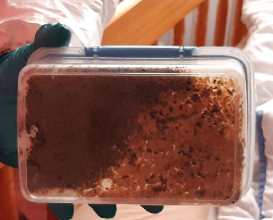
41. The items found in AR’s bedroom demonstrated that that a crude preparation of toxic ricin had been produced, using the equipment that AR had bought online.
42. As Dr Martin Pearce, an expert from the Defence Science and Technology Laboratory instructed in the prosecution of AR, in due course concluded the purchased castor beans could have produced significant quantities of ricin that, in certain circumstances, could have killed many. Dr Pearce provided detailed toxicity assessments noting that ricin is a potent toxin.[footnote 335]
43. AR pleaded guilty to the production of a biological toxin, namely a quantity of ricin, an offence for which he received a 12-year sentence of imprisonment.[footnote 336]
Analysis
44. I consider the inaction of AR’s parents in this respect further in Chapter 12: AR’s family.
45. In relation to the sale of the castor beans, there was no legislation prohibiting their sale nor requiring age verification. Mr Boumphrey indicated that his company are not experts as regards the quantities in which particular products should be sold and they rely on guidance from governments and law enforcement agencies.[footnote 337]
46. The Home Office is in the early stages of considering the feasibility, along with the potential impact and proportionality, of regulation of the sale of castor beans.[footnote 338] This includes engaging with a wide range of trade organisations, including online retailers, mapping the supply chain of castor beans, looking at packaging, the size of packaging and the awareness of risk. The review was expected to conclude within a few months when Ms Ellsmore gave evidence on 13 October 2025. In this context it is relevant to note that Mr Philip Redman, the Managing Director of Premier Seeds Direct, has decided that his company will reduce its packet size in order to try to help mitigate the risk that castor beans are misused.[footnote 339]
47. As a result, at the time, there was no requirement or expectation that the purchase of castor beans would lead to further action by Amazon.
However, AR’s Amazon order history showed not just the purchase of castor beans but also the purchase of alcohol and laboratory equipment. Amazon has the technical ability to analyse the combinations of purchases in contexts such as this, but they consider that they need guidance from the Home Office as to which combinations would potentially be of interest.[footnote 340] Again, as described above, I consider that there is a case for the introduction of systems that can detect suspicious patterns of purchases: the “detection algorithm” referred to in the closing statement on behalf of the Secretary of State for the Home Department.[footnote 341]
Archery equipment (conventional bows and crossbows)
Legislation
48. In considering the applicable legislation for archery equipment, the logical starting point is the criminal offence under section 1 of the Prevention of Crime Act 1953, of having an offensive weapon in a public place without lawful authority or reasonable excuse. This is a broadly drawn offence which applies to any kind of offensive weapon, being defined by section 1(4) as “any article made or adapted for use for causing injury to the person, or intended by the person having it with him for such use by him or by some other person”. The possession in public of weapons that are not subject to more particular control, may be caught by this provision, dependent upon whether there is a lawful authority or reasonable excuse for carrying it. Possession in public of items such as a bow and arrow could therefore be caught by this provision depending on the individual circumstances.[footnote 342]
49. The Crossbows Act 1987 applies to crossbows with a draw weight of
1.4 kilograms or more.[footnote 343] By section 1, it is an offence to sell or let for hire such a crossbow to anyone under 18 years of age unless the seller believed the purchaser to be 18 years of age or older and has reasonable ground for that belief. There is a defence under section 1A if the seller believed the purchaser to be 18 years of age or older, and either had taken reasonable steps to establish the purchaser’s age or no reasonable person could have suspected from the purchaser’s appearance that they were under the age of 18. The seller is only to be treated as having taken reasonable steps to establish the hirer’s age if they have been shown a passport or a UK/European Union driving licence (there are specific provisions for Scotland). By section 2, it is an offence for someone under the age of 18 to buy or hire a crossbow. By section 3, it is an offence for a person under the age of 18 to have with him a crossbow which is capable of discharging a missile (or parts of a crossbow that could be assembled to discharge a missile) unless he is under the supervision of a person who is 21 years of age or older. By section 4, the police may search individuals they have reason to believe are in unlawful possession of a crossbow.
50. There was at the time, and still is, no legal requirement for an age verification procedure for the delivery of crossbows and the packaging does not have to reveal the contents or that it is meant for someone over the age of 18. The government intends to introduce stronger controls for online crossbow sales via the Crime and Policing Bill, which I address further at paragraph 90, below.[footnote 344]
51. There are no corresponding legislative restrictions relating to conventional archery bows and arrows.
AR’s history of purchasing and attempting to purchase archery equipment
AR’s refunded attempted purchase of an archery bow and arrows on 4 March 2022
52. On 4 March 2022 AR made an online Amazon order comprising: [footnote 345]
a. From Amazon seller Top Archery, a ‘Toparchery Archery 53’’ Traditional Recurve Bow’ being a ‘Handmade Mongolian Horsebow Hunting Bow… for Adult Hunting Practice’.[footnote 346] An example of a traditional recurve bow shown below:[footnote 347]
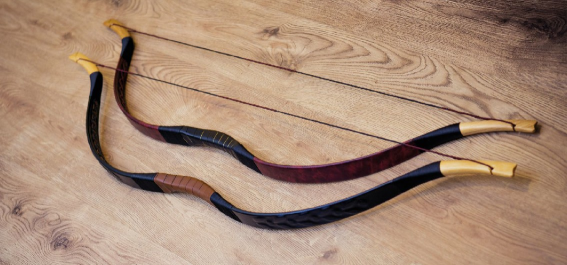
b. From Amazon seller Chuhuikang, two sets of ‘DZGN Archery Carbon Arrows Spine 500 Hunting Arrows’;
c. From Amazon seller G4Free-Direct, a ‘G4Free Archery Deluxe Canvas Back Arrow Quiver’;
d. From Amazon seller Fodlon, an ‘Extra Large Drawstring Bag’.
To make this order, AR used the email address a.megalania7@yahoo.com The payment card for this transaction was AR’s full name with billing address 10 Old School Close, Banks and the name on the shipping address as “Al Rud”. The Amazon records indicate that this order was cancelled because refunds were made for these purchases. Accordingly, there was no completed delivery for these items.
53. Neither the archery bow nor the arrows in this (refunded) order were age restricted items under UK law. The Inquiry nevertheless contacted Top Archery and Chuhuikang about these orders with a number of questions, including what legitimate purpose a child would have for this type of archery equipment.
Both companies appear to be based in China. They have not replied to the Inquiry’s requests for information and being outside of the jurisdiction, the Inquiry does not have any powers of compulsion in relation to them.
Observation F:
1. Given the gravity of the matters being investigated, it is unfortunate that Top Archery and Chuhuikang appear to have decided to ignore the Inquiry’s requests for information on a voluntary basis. These companies have acted poorly by failing to respond to the Inquiry’s requests for assistance;
2. Amazon may wish to take note of their sellers’ apparent lack of co-operation in this Inquiry’s investigation.
AR’s successful purchase of archery equipment on 28 March 2022
54. On 28 March 2022, AR made a further online Amazon order which partially replicated the sort of order he had made but had refunded on 4 March 2022.
The 28 March order comprised: [footnote 348]
a. From Amazon seller Jiankangyi, the same kind of ‘Toparchery Archery 53’’ Traditional Recurve Bow’ being a ‘Handmade Mongolian Horsebow Hunting Bow… for Adult Hunting Practice’: see paragraph 52, above for an image of this kind of archery bow;
b. From Amazon seller Ping Jianqiang, a set of ‘Huntingdoor 12Pcs 30 inch Archery Carbon Arrows Spine 550 Hunting Targeting Arrows’, which were as below:[footnote 349]
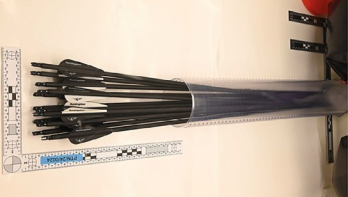
c. From Amazon seller Recomoney EU, a ‘Duffel Bag’.[footnote 350]
The payment card for this transaction was in AR’s own full name with billing address 10 Old School Close, Banks. The shipping name and address was given as “Al Rud, 10 Old School Close, Banks”.
55. As with the refunded purchase attempted earlier in March 2022, I note neither the archery bow sold by Jiankangyi, nor the arrows sold by Ping Jianqiang were age restricted items under UK law. Again, the Inquiry nevertheless contacted these sellers with a number of questions. They again appear to be China-based and have not replied to the Inquiry’s requests for information. Being outside of the jurisdiction, the Inquiry does not have any powers of compulsion in relation to them.
Observation G:
1. Given the gravity of the matters being investigated, it is unfortunate that Jiankangyi and Ping Jianqiang appear to have decided to ignore the Inquiry’s requests for information on a voluntary basis. These companies have acted poorly by failing to respond to the Inquiry’s requests for assistance;
2. Amazon may wish to take note of their sellers’ apparent lack of co-operation in this Inquiry’s investigation.
56. Unlike the earlier March 2022 order, these items were delivered, and they were found in a black holdall under the bunk beds in AR’s room.
57. It is inconceivable that AR bought this archery bow and hunting arrows for legitimate sporting activity; instead, they were early purchases in what was to become his significant collection of weapons. Although possibly more cumbersome than a crossbow, an archery bow still has a lethal potential.
In the wrong hands, it is an extremely dangerous weapon. It is perhaps of some significance that AR started by purchasing conventional archery equipment (that was not age restricted), then gravitated towards an interest in crossbows, and then machetes (see further below).
AR testing out purchasing of a crossbow: contact with Tactical Archery and Merlin Archery in May 2022
Tactical Archery
58. On the morning of 3 May 2022, AR used the email address a.megalania7@yahoo.com to send an email to the UK seller Tactical Archery (a trading name of MB Outdoors Limited) in the following terms:
“Hi, I would like to purchase from Tactical Archery but I would prefer discrete packaging which doesn’t provide any information on what is inside the box. Could I see a photo of what the external packaging of your products look like? Thanks in advance. A.”[footnote 351]
59. The same day, a representative from the company replied as follows:
“Thanks for getting in touch. We use grey packaging bags when sending out crossbow. This is so that no one is able to see what is inside.”[footnote 352]
60. An exchange then followed with AR asking the company if the packaging carried any branding, such as “Tactical Archery”, to which the reply indicated that plain grey bags or black wrapping were used.’[footnote 353] with ‘An exchange then followed with AR sending two identical emails asking the company if the packaging carried any branding, such as “Tactical Archery”, to which the replies indicated that plain grey bags or black wrapping were used.[footnote 354]
61. Mr Sutherland said that at the time the company did not treat these exchanges as being suspicious. He said that, on occasion, they received enquiries from individuals who intended to give an item as a gift and who for that, or indeed, other reasons, did not want the recipient to be alerted to the identity of the item.[footnote 355] However, he accepted that with the benefit of hindsight the fact that AR enquired about packaging three times was “a bit suspicious”.[footnote 356]
62. Their approach has now changed, and the company now treats repeated questions about the packaging with suspicion.[footnote 357]
63. At the time, in May 2022, the company used government-approved age verification software (‘AgeChecked’) for the purchase of crossbows. Their requirement at the time was for purchasers to be aged 21 of over.
They have since lowered the age at which this applies from 21 to 18, and this was said to be on the basis of their greater confidence in their improved age verification checks. At the time, they did not ask for additional identification if the AgeChecked process was passed. If the AgeChecked process was failed, they would ask for photo ID, a passport or identification with a Proof of Age Standards Scheme (PASS) logo on it, and the identification would be manually checked. They would rely on their own experience in looking out for fake identifications. Having regard to the wording of the Crossbows Act 1987, Mr Sutherland accepted that it would have been sensible to ask for a passport or driving licence for everyone, so as to bring themselves in line with the specific statutory defence.[footnote 358]
64. Commencing in 2025, Tactical Archery voluntarily utilises the procedures for crossbows, as set out above, to the sale of archery bows. A form of photographic identification is now always requested (e.g. a passport or driving licence, or a suitable document bearing the PASS logo) as part of a mandatory process for establishing a customer account. If the name on the identification does not match that of the purchaser, the latter will be asked to provide photographic identification as well. If these steps are successfully completed, the company then applies fraud software to the details which have been provided. These steps are followed by internal checks for previous purchases, or attempted purchases, of concern. The company then uses couriers who provide an age verification service, to ensure that all crossbows and archery bows are delivered to someone who is 18 or over. At present, the delivery is age verified but does not require it to be the purchaser who takes delivery.[footnote 359]
65. The company’s packaging has changed. Since the events of 29 July 2024, a shipping label is stuck to the outer packaging informing the delivery driver of the need to check the identification of the recipient. There is a separate large label which carries the warning: “MUST ONLY BE DELIVERED TO AN ADULT”.[footnote 360]
66. Mr Sutherland accepted that the ‘Tactical’ in the trading name Tactical Archery could be viewed as bearing an undesirable military connotation and as a consequence they are considering adopting a new name.[footnote 361] The company is also intending to introduce additional safety measures to identify potentially dangerous customers, particularly by requesting additional background details as part of the ordering process.[footnote 362] With a view to the anticipated changes in the Crime and Policing Bill, Mr Sutherland was open to introducing the stipulation that the parcel will only be handed to the person who purchased the crossbow or archery bow. Mr Sutherland expressed the view that requesting a ‘selfie’ video – as opposed to a still picture – along with the other formal identification requirements would provide additional protection.[footnote 363] Mr Sutherland’s own view was that protections were required for bows as well as crossbows because they could be just as powerful, and he thought this should be looked at.[footnote 364] As a general proposition, he raised the suggestion that a database of customers’ information could be established, containing information such as the age, address and criminal convictions of those purchasing crossbows and archery bows in England and Wales.[footnote 365]
67. Of particular note, Mr Sutherland indicated that the extensive enhanced protections which have been instituted by his company have not had an adverse effect on their profitability (“no, not really”). Indeed, some of their clients have expressed their approval of these changes and the company is in any event keen to ensure that they do not sell these potentially dangerous items to those who are under 18.[footnote 366]
68. In the event, despite the exchange of emails, AR did not proceed to attempt to order a crossbow from Tactical Archery.
69. I consider that Tactical Archery ought ideally to have been more suspicious at the time about the repeat enquiries AR was making about packaging.
AR asked for information three times, signing himself off without using a full name, from an email that bore no relation to his name. However, I accept that it was not a clear and obvious case of a minor seeking to purchase a crossbow, and I accept that Tactical Archery had age identification measures in place at the time. That stage was not reached because AR did not proceed to attempt to order. On balance therefore, I am not critical of Tactical Archery. I note in addition that as well as the protections that they did have in place at the time, Tactical Archery appear to have taken a responsible approach to developing strengthened procedures which age restrict the sale not just of crossbows but also (on their own voluntary basis) of traditional archery bows. Reflecting his firm’s approach, Mr Sutherland was an open and straightforward witness.
70. I shall address below my recommendations in terms of further action that I consider is necessary in respect of crossbows and archery bows.
Merlin Archery
71. Later the same morning that AR had first contacted Tactical Archery (3 May 2022), AR also made contact with another UK archery company, Merlin Archery Limited, probably also with a view to purchasing a crossbow. He emailed them asking as follows:
“Hi, If I bought an 18+ product how would you verify my age, do you verify ID online or does the delivery person check my ID at my door? Also, do I have to be 18 to receive the product when it is at my door? Thanks in advance. A”[footnote 367]
72. On 3 May 2022 Merlin Archery’s customer service manager, Mr Oliver Clayton-Smith, replied as follows:
“Thank you for your email.
If purchasing an age restricted product such as a Crossbow or Blade article for example, we would need to verify your age before we can dispatch an item. The first thing that we check is the Electoral Register as a lot of people are present on here, if so that is all we need an [sic] your account will be approved and the order processed. If you are not on the electoral register for any reason we would contact you to verify your age by an alternate method, this would normally be through a photo of a passport or driving license [sic].
Once your account has been verified once it would not need to be again, so if you were to then order another age restricted product in the future you would need to verify your age again as long as it is on the same account.”[footnote 368]
73. On 5 May 2022 AR sent a further email:
“Hi, I would like to purchase from Tactical Archery [sic] but I would prefer discrete packaging which doesn’t provide any information on what is inside the box. Could I see a photo of what the external packaging of your products look like? Thanks in advance. A” [footnote 369],[footnote 370]
74. On 5 May 2022, Mr Clayton-Smith, replied:
“Our parcels are all sent in plain brown paper so are as discreet as they can be, I do not have any photos to hand but I am sure you can picture what I mean.”[footnote 371]
75. On 5 May 2022, AR sent a further email from a.megalania7@yahoo.com with the subject “Product Packaging”:
“Hi,
I would like to purchase from Merlin Archery but I would prefer discrete packaging which doesn’t provide any information on what is inside the box. Does the exterior packaging give any indication of what is inside the box? Thanks in advance. A”[footnote 372]
76. Merlin Archery did not reply because the information had already been provided. There were no further exchanges, no order was placed, and accordingly no items were delivered.
77. Mr Benjamin Jones a Director of Merlin Archery gave evidence in relation to these exchanges and his company’s approach.[footnote 373] In his witness statement, Mr Jones had sought to suggest that while the exchange could have been the cause for “some low level suspicion”, they were not sufficient for them to call the police.[footnote 374] In his oral evidence, Mr Jones went somewhat further and accepted that the exchanges should have been considered as suspicious.[footnote 375] Mr Jones thought that the suspicious nature of the queries had not been picked up because they were not as clear cut as some other queries, but he has since implemented an improved system for managing suspicious emails.[footnote 376] Concerningly, in terms of reporting suspicions to the police, Mr Jones’ perception was that the police would not take action. This was based on unsatisfactory experiences he had faced in the past.[footnote 377]
78. One point of difference between the evidence of Mr Jones and Mr Sutherland was that Mr Jones, speaking on behalf of Merlin Archery, was less accepting of a need for tighter regulation of conventional archery bows (as opposed to crossbows). He said that conventional archery bows were most definitely used for sporting activity (taught in schools, scout groups and the like), and he was not aware of their use in crime. He suggested that all the inappropriate/ concerning enquiries they received (which they are prepared to report to the police) were in respect of crossbows, not conventional archery bows.[footnote 378] He supplemented his oral evidence with later extended written reasons.[footnote 379]
79. As to age verification checks conducted by Merlin Archery at the time, as reflected in the email exchange with AR, they would not carry out age verification checks if the purchaser was on the electoral role. He appeared to accept that it would been sensible to have carried out checks on all customers’ identification documents to bring the company within the section 1A defence.[footnote 380] Of some concern, I note that their in-store checks on crossbow purchasers were actually stronger than those online as in the former case, all customer identifications were checked.[footnote 381] They were not, at the time, marking packages for crossbow deliveries or requiring age checked deliveries, although neither of these were legal requirements. They did, however, have a log of refusals if prospective customers made inappropriate queries, to avoid selling to them in the future.[footnote 382] They had also always had their own crossbows sales register.[footnote 383] They have since introduced: age verified deliveries, identification document checks for all crossbow purchases (no longer relying on the electoral roll), and age labelling on the packaging. Mr Jones was also supportive of the further changes suggested in the Crime and Policing Bill, although he had only just become aware of these proposed changes.[footnote 384]
80. In a follow up document after his oral evidence, Mr Jones suggested that there should be controls to ensure that businesses selling crossbows were legitimate (he would not oppose licensing or registration of retailers).[footnote 385]
He raised the possibility of a government-run portal for retailers who sell age restricted products giving legal updates, a government-provided age verification check service to avoid fraudulent identification documents and guidance on the correct and proper method for age verification. He suggests that such a system could also flag if there was a difficulty with selling by reasons of a level of government ‘background check’. Mr Jones flags the need to have clear guidance on the threshold for reporting suspicious activity to the police. Mr Jones also raises whether there could be an industry “pub watch” type scheme to warn retailers of suspicious customers, but he notes that this could be open to abuse with competitors flagging genuine customers. He is in favour of a crossbow register for in-store sales, incorporating also the details of online crossbow sales.
81. As with Mr Sutherland of Tactical Archery, I found Mr Jones of Merlin Archery to be a straightforward witness, doing his best to assist the Inquiry. Merlin Archery have clearly further tightened their age verification processes since the attack.
I accept they are generally seeking to take a responsible approach to their marketing of archery equipment. In the case of Merlin Archery, AR’s initial query, “If I bought an 18+ product how would you verify my age, do you verify ID online or does the delivery person check my ID at my door? Also, do I have to be 18 to receive the product when it is at my door?”, clearly should have raised suspicions (as Mr Jones ultimately accepted). It is hard to see why anyone over the age of 18 would have raised these questions in this way.
Merlin Archery were therefore, to some degree, at fault for not treating this as a suspicious enquiry, and ideally, they should have passed this on to the police.
I note, however, both the lack of guidance provided to archery retailers in this respect, and Mr Jones’ perception of a lack of police interest when an earlier matter was reported.
Purchase of further archery kit (unidentified) from Hattila in June 2023
82. On 12 June 2023, AR paid £22.98 for an undisclosed item which was purchased from Hattila, an archery and crossbow supplier.[footnote 386] The company is based in France. The Inquiry has sought to contact this company with a number of questions including what item AR purchased. There has been no reply to the Inquiry’s request or follow-up enquiries.
Observation H: Given the gravity of the matters being investigated, it is unfortunate that Hattila appears to have decided to ignore the Inquiry’s requests for information on a voluntary basis. Hattila appears to be a mainstream French retailer selling directly online to the UK market; it has acted poorly by failing to respond to the Inquiry’s requests for assistance.
83. I have addressed relevant recommendations at the end of this chapter.
Knives and machetes
Legislation relating to the sale of bladed items including knives
84. Section 141A of the Criminal Justice Act 1988 (CJA) prohibits the sale or hire to a person under the age of 18 of:
a. A knife, a knife blade or razor blade;
b. An axe; or
c. Any other bladed or pointed article which is made or adapted for use for causing injury to the person.
For a person charged with an offence under this section, there is a defence of proving that he or she took all reasonable precautions and exercised all due diligence to avoid committing this offence.
85. The offence under section 141A of the CJA 1988 applies to all sales of bladed or pointed articles to those under 18. However, from 6 April 2022, part 3 of the Offensive Weapons Act 2019 (OWA 2019) amended the CJA 1988. Since then, there have been minimum steps that a seller is obliged to take when a knife is sold remotely (where the seller is not physically present with the buyer). By section 141B of the CJA 1988, a remote seller is not to be regarded as having established the “all reasonable precautions” defence unless, at a minimum, they can prove that:
a. They operated a system for checking that the person who bought the article was not under 18;
b. The system was likely to prevent a person under the age of 18 from buying the article;
c. The packaging clearly indicated that it contained an article with a blade or which was sharply pointed and that when delivered it should only be handed to a person aged 18 or over;
d. The seller took all reasonable precautions and exercised due diligence to ensure that the package was delivered into the hands of a person aged 18 or over; and
e. The seller did not deliver the item to a locker.
86. As well as tightening the “all reasonable precautions” defence for remote bladed articles sales, Part 3 of the OWA 2019 introduced specific measures for knife offences. In particular strengthening age verification requirements and stopping certain knives (“bladed products”) being delivered to residential addresses after they are bought online, unless the seller has arrangements in place with the delivery company to ensure that the product would not be delivered into the hands of a person under 18.[footnote 387] Under these provisions:
1. Section 38(2) makes it an offence for a seller to make a remote sale of a bladed product which the seller either delivers or arranges to be delivered to residential premises;
2. Section 39 makes it an offence for a delivery company to deliver a bladed product that had been sold remotely to residential premises if they do not deliver it into the hands of a person aged 18 or over;
3. Section 40 provides defences to these two offences. The most relevant are these:
a. For a seller who delivers the bladed product themselves to the residential premises, under section 40(2) it is a defence to prove that:
i. At the time the offence is alleged to have been committed, the seller had procedures in place which were likely to ensure that any bladed product delivered by the seller to residential premises would be delivered into the hands of a person aged 18 or over; and
ii. The seller took all reasonable precautions and exercised all due diligence to ensure that the product to which the charge relates would be delivered into the hands of a person aged 18 or over;
b. For a seller who arranges the delivery of the bladed through a third party to residential premises, under section 40(3), it is a defence to prove that:
i. The arrangement required the person with whom it was made to have procedures in place which were likely to ensure that any bladed products delivered to residential premises pursuant to the arrangement would be delivered into the hands of a person aged 18 or over; and
ii. The seller took all reasonable precautions and exercised all due diligence to ensure that the product to which the charge relates would be delivered into the hands of a person aged 18 or over;
c. For a delivery company who has entered into an arrangement to deliver the bladed product to residential premises, under section 40(7) it is a defence in England, Wales and Northern Ireland for the company to prove that they took all reasonable precautions and exercised all due diligence to avoid the commission of the offence;[footnote 388]
d. There is an additional provision in section 42 of the OWA 2019 providing a defence for delivery companies when the seller is outside the United Kingdom, of having taken all reasonable precautions and having exercised all due diligence.
87. Under section 1 of the Knives Act 1997, it is an offence to market a knife in a way which indicates or suggests that it is suitable for combat or is otherwise likely to stimulate or encourage violent behaviour involving the use of the knife as a weapon. Under section 2 of the Act, it is also an offence to publish “any written, pictorial or other material in connection with the marketing of any knife” which has the same effect. Section 10 of the 1997 Act defines “suitable for combat” as meaning “suitable for use as a weapon for inflicting injury on a person or causing a person to fear injury”. There are statutory defences to this offence, including that it was reasonable for the knife to be marketed in that way.
88. I note that in R v STC Limited and others [2021] EWCA Crim 1237, Lord Justice Edis observed that, following the receipt of Royal Assent in 1997, the Act has “…lain largely unnoticed since. No member of this court has had any professional dealings with it until today, either as advocate or judge, in the 24 years since it came into force in September 1997. We have not found any decision of this court dealing with it” (judgment, paragraph 10).[footnote 389] In that case, the Court of Appeal dismissed the appeal by the defendant knife vendors which had challenged the decision of the judge following a preparatory hearing. The judge had rejected the defendants’ contention that the 1997 Act was not engaged by the advertising for an ‘Expendables Double Shadow Style Knife’,
a ‘Anglo Arms Kukri machete’ and a ‘Rambo 3 replica knife’.
89. In the same case, Lord Justice Edis made clear the potentially wide ambit of the 1997 Act offences:
“23. The 1997 Act prohibits marketing (s.1) or publishing material connected with marketing (s.2) which indicates or suggests that the knife is suitable for combat or is otherwise likely to stimulate or encourage violent behaviour involving the use of the knife as a weapon. In this case it is enough for the prosecution to show that the marketing suggested that the knife was “suitable for combat”, which merely means “suitable for use as a weapon for inflicting injury on a person or causing a person to fear injury.” That wide definition means that a great many knives satisfy it. These offences, however, are not principally about the nature or purpose of the knife, but about the way in which it is marketed. The marketing must not contain any “suggestion” that the knife is “suitable” for hurting someone to any extent. These are low thresholds, as Mr. Heller on behalf of Lambeth submits. The knife does not have to be “made or adapted for use in causing injury to any person” (to cite the wording of the Prevention of Crime Act 1953). If it is, however, and the way that it is marketed suggests that this is so, then the offence is committed. It may be very difficult to market some types of knife at all without making this suggestion. This does not mean that such marketing ceases to be criminal. It would be a rational aim of an Act of Parliament to restrict substantially the ability of sellers to market weapons of the kind with which this case is concerned and the choice of wide words and low thresholds appears to be intended to do just that.”
90. All of the provisions set out above were in force at all material times in relation to the knives and machetes which AR purchased.
91. The government intends to introduce further restrictions on the online sale of knives and crossbows through the Crime and Policing Bill. The age verification aspects of the intended changes are explained in the government’s factsheet as follows:
“Strengthened age verification for knives and crossbows
-
At the point of purchase, online sellers of knives and crossbows will be required to check a photographic identity document, either a passport or a UK driving licence, and a current photograph of the buyer used to demonstrate that they are the holder of the photographic identity document.
-
At the point of delivery, the courier must check the photographic identification document provided by the person receiving the package to demonstrate that they are aged 18 or over and that they are the buyer.
-
The Bill also introduces a two-step age and identity verification measure for the online purchase, letting (hire) and delivery of a crossbow or part of a crossbow.
-
Operators of collection points will also be required to carry out the same enhanced age verification checks before handing over knives to the buyer, or in the case of crossbows or crossbow parts, to the buyer or hirer of the item.
-
These additional steps will also bring crossbow deliveries in line with deliveries of knives, by preventing a crossbow, or part of a crossbow from being delivered to a locker, left on a doorstep or delivered to a neighbour or another person in the household.”[footnote 390]
Legislation relating to the possession of bladed items including knives
92. It is an offence under section 139 of the CJA 1988 to have a bladed or sharply pointed article in a public place without good reason or lawful authority, and there is a further offence for possession of such an item on educational premises (section 139A). It is also an offence to threaten someone in a public place or on school premises with a bladed or pointed article (section 139AA). These provisions were in force throughout the relevant period of AR’s conduct.
93. Under section 141 of the CJA 1988, as amended, and under the Criminal Justice Act 1988 (Offensive Weapons) Order 1988, it is an offence to possess in private a curved sword or a zombie knife.[footnote 391] This includes a sword with a curved blade of 50 centimetres or over in length.
The legislation as a whole
94. At this stage, I reflect on the legislation set out above and note that there is a patchwork quilt of provisions across various different statutes and orders. This is exaggerated further when considering the provisions in relation to the sale of crossbows (see above). The evidence showed that not all retailers had the necessary understanding of the legislation and, to an extent, that is understandable.
Observation I:
1. There is a need for better clarity and accessibility regarding what the law requires in the sphere of controls on bladed items. I wish to consider as part of Phase 2, the best way to achieve this, and options may include consolidated guidance and consolidating legislation.
2. In the meantime, it is important that the Home Office and police forces maximise the visibility of existing guidance and that retailers and delivery companies familiarise themselves with it. Available guidance includes the following:
a. The Home Office’s Statutory Guidance: Offensive Weapons Act 2019;[footnote 392]
b. The Business Companion Guide: ‘Knives, other bladed items and corrosive substances’;[footnote 393]
c. The National Business Crime Centre (NBCC) knife guidance[footnote 394] which includes:
i. NBCC Knife Sellers Toolkit;[footnote 395]
ii. NBCC guidance on the Offensive Weapons Act;[footnote 396]
iii. NBCC guidance: Offensive Weapons Act – Retailer Checks;[footnote 397] and
iv. NBCC online training for storage, display, sale and delivery of knives.[footnote 398]
AR’s purchase of three machetes
95. AR succeeded in having three machetes delivered to 10 Old School Close.
The first machete (Springfields of Burton Ltd)
96. On 10 June 2023 at 23:34, AR made an order online for a ‘22-inch Bushcraft Survival Machete’ from Springfields.co.uk (Springfields of Burton Ltd, a third-generation family business catering largely to scout groups, activity centres and the bushcraft market), along with an ‘8 inch extra-large sharpening stone’. AR gave his details as “Alice […]”.[footnote 399] The machete cost just £9.49. AR paid via PayPal using the email address a.megalania7@yahoo.com An automatic order confirmation was sent.[footnote 400]
97. On the morning of 12 June 2023, AR emailed the company asking, “Do I need to show ID?”[footnote 401] The company’s initial age verification via the electoral roll failed. This would have been because, naturally, no one called Alice […] was registered on the electoral roll at AR’s family home. Springfields sent a text message and email requesting photo identification. On 12 June, Springfields also sent an email to “Alice” in response to AR’s email earlier that day. The material part read:
“Hello Alice, As you have ordered an age-restricted item we have to by law confirm that the person receiving this order is over 18, we do this via either the electoral roll or via some form of I.D. Would you be able to email us a photo or scan of either your driver’s license, passport, or birth certificate showing your full name and date of birth?”[footnote 402]
98. The next day, 13 June 2023 AR provided a copy of a genuine driving licence in the name Alice (with a year of birth of 1991) with an address in Sunderland. That address obviously differed markedly from the delivery address of 10 Old School Close, Banks PR9 8SB. Later that day, Springfields replied to “Alice”, stating “Thank you for confirming your age, your order will be dispatched without delay. If you order again you will not be checked a second time”.[footnote 403] The transaction, therefore, was completed.
99. Springfields used DPD or Royal Mail’s age verified delivery services for delivering bladed weapons. This particular order was delivered by DPD. Springfields had an arrangement with DPD that specifically acknowledged that bladed items, as defined in the OWA 2019, would be delivered and that they would be packaged and clearly labelled as containing a bladed product. DPD warranted that the delivery would be age verified and Springfields agreed that there would be age verification on purchase.[footnote 404]
100. The Inquiry obtained evidence from DPD about this order from Mr Glyn Johnson, their head of security.[footnote 405] DPD records confirm that the machete was delivered to AR’s home address at 12:18 on 14 June 2023. DPD’s proof of age process required the driver to verify that the recipient was over the age of 18 either visually or by checking their identification, but they did not need to be the recipient named on the order.[footnote 406] DPD had been able to trace the driver with the details provided by the Inquiry. The driver was interviewed by DPD and the driver recalled that the recipient for this order was a black adult male who he thought was older than his own age (46) and whom he described as having a “terrible attitude”.[footnote 407] As someone who was obviously, visually, over the age of 18, no documentary identification would have been required under DPD’s procedures. The recipient was recorded as “RUDAKUBN” and not Alice.[footnote 408]
101. As I shall address in Chapter 12 dealing with AR’s family, AR’s father accepts that he took delivery of this parcel. He put the parcel on top of the wardrobe in his own bedroom. It was found there when the family home was searched after the attack. Springfields supplied the following image of the nature of the machete sold:[footnote 409]
102. This is consistent with the machete and sharpening stone as recovered by Merseyside Police from the top of AR’s parents’ wardrobe:[footnote 410]
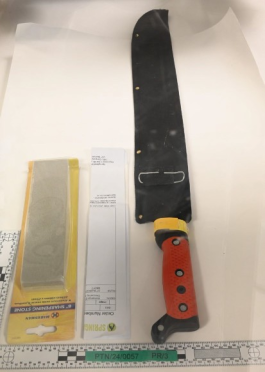
103. When found on the police search the machete was still in its Springfields packaging as depicted in the police exhibit image below.[footnote 411] It is of note that the parcel had a label in a prominent red colour on the outside which read “Bladed items delivery to 18+ only”.
104. Mr Luke Bullock, the Company Director of Springfields of Burton Ltd, gave evidence as to the company’s approach to age verification and online sales of knives and machetes.
105. I have significant concerns about the relative ease with which AR was able to order machetes, and more generally about the potential for harm of machetes as against their (as it seems to me currently) relatively limited legitimate use.
I should, however, record that from consideration of Mr Bullock’s evidence, Springfields of Burton Ltd appear to be at what might be thought the ‘respectable end’ of the spectrum of online retailers of knives and machetes. I draw that conclusion because:
a. Springfields had an age verification process in place at the point of purchase and age verified delivery that appear to have met the legal requirements;
b. Their marketing of knives and machetes tends to avoid associations with the military and combat, and related imagery, and generally (although not without exception) avoided language around being ‘tactical’ in the products and descriptions of items on sale.[footnote 412] This is in contrast to the retailers Knife Warehouse and Hunting and Knives, sellers of the second and third machetes to whom I shall return.
Mr Bullock explained that the company took account of College of Policing studies in deciding what knives to sell, such that if a knife might be “attractive” it was not cheap, and they refused to stock knives if they looked “threatening”;[footnote 413]
c. It is apparent that the company has in the past made reports to the police of suspicious enquiries and orders, and Mr Bullock has been active in liaison with the police over the approach to online knife sales. Mr Bullock explained that, on occasion, an item would not be shipped to the customer if on an internal check it appeared that the individual was, for instance, placing repeat orders for knives. The company is alert, therefore, to suspicious transactions. This may result in the delivery address being designated a ‘banned postcode’;[footnote 414]
d. As further detailed below, Springfields has further enhanced its procedures since the Southport attack, including a voluntary more precautionary approach on the sale of machetes.
106. Mr Bullock was candid in his acceptance that AR’s ability to purchase a machete using the identification of a woman called Alice living in a completely different part of the country revealed a vulnerability in Springfields’ systems at the time of this purchase. Mr Bullock also accepted that with what he knew now about the features of the order (the address being so different from the identification address, the request about whether he needed to show ID, and the time of day of the order) it ought to have raised suspicion.[footnote 415] However, Mr Bullock said that it was not unusual for people to move and for their driving licence address (for example) to no longer match the shipping address, or for people to have things delivered to a work address.[footnote 416] At the time there was no legal requirement to ensure that the identification provided (in this case a valid driving licence) matched the delivery address, nor to obtain a live image of the purchaser to ensure that it matched the form of identification provided.
107. In response to the suggestion that there are very limited legitimate uses for machetes in the UK, Mr Bullock maintained that there was a legitimate demand: they had sold machetes to a broccoli farm, a thatched roofing company, a vineyard and a ducal estate, and otherwise to those who wanted to clear ground.[footnote 417] He highlighted that in 2023 the Home Office, following a consultation process, had decided against banning the sale of machetes in the United Kingdom because they have legitimate uses.[footnote 418] Further information on this consultation and its result was provided in the follow up statement from Mr Hunt on behalf of the Home Office.[footnote 419]
108. Springfields have introduced a number of significant changes since the Southport attack:
a. They now require photographic identification and also seek a live selfie that matches the identification.[footnote 420] These are elements of the proposed requirements of the Crime and Policing Bill which Springfields have adopted early.[footnote 421] There is no requirement that the address on the photo ID and the delivery address match because they still feel the need to be able to deliver to workplaces. Instead, Mr Bullock considers it better to ensure (as per the new intended requirements of the Crime and Policing Bill) that the person to whom the item is delivered is the purchaser;
b. Since these events, to buy a machete from Springfields, the order has to be placed with the accounts department (it cannot be purchased on the company’s website), and they only sell machetes to businesses not private individuals, and with the photographic identification and selfie requirement, as above, for the person buying for the business.[footnote 422]
The second machete (Knife Warehouse)
109. On 3 October 2023, AR purchased a second machete from the Knife Warehouse, a trading name of Artemis Web Limited. This was a ‘Black Panther Kukri’ machete, with a 16.5 inch blade, entirely black in colour with a curved blade. It cost only £24.95. The image below shows the machete recovered from the family home:[footnote 423]
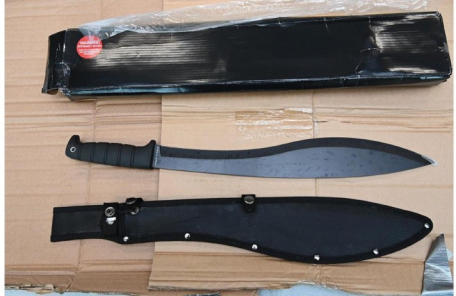
110. AR used the email a.megalania7@yahoo.com to place the order. He purchased this second machete using a different false identity “Olakunle Samuel […]”. As with the purchase in the name of Alice […], AR used a genuine driving licence but this time it was a licence in the name of a man called “Olakunle Samuel […]”, born in 1961 (therefore he would have been aged about 62), who lived in Uxbridge when complying with the company’s age verification process.[footnote 424],[footnote 425]
111. The only correspondence that the Knife Warehouse had with AR was in the form of automated emails generated from the order.[footnote 426]
112. Mr Joseph Wheeler, the Managing Director of Artemis Web Ltd who runs the day-to-day activities of the company, gave evidence to the Inquiry.
The company did have an age verification policy in place at the time, which included the requirement, marked clearly, that purchasers had to be over 18, and also that purchasers could not use someone else’s identification.[footnote 427] Once a customer went through with the purchase of an age verified item, they were required to upload proof of identity if this was their first purchase, and the purchasing email would be blocked if they failed to provide identification.[footnote 428] In terms of checks that were done, the company ensured the identification looked genuine (Mr Wheeler had experience of checking specimen identifications online to help identify fakes) and that it matched the delivery name of the person making the order (which in this case it did). The machete was only shipped after the proof of age stage had been completed.[footnote 429]
113. Mr Wheeler accepted (with the benefit of hindsight) that their system was still open to abuse because someone could use and upload someone else’s identification, and put that as the delivery name, and that was sufficient to permit an order to be made. However, he understood the process at the time to be compliant with the law as it then stood.[footnote 430]
114. Turning to the packaging for this machete, when recovered by the police from the family home, this machete was still in its grey packaging with the original delivery label. I observe that the age verification labelling from Knife Warehouse was present but far less prominent than the labelling from Springfields. The age verification label was not prominently coloured and did not specifically refer to the item containing a bladed product, although the return address was Knife Warehouse.[footnote 431]
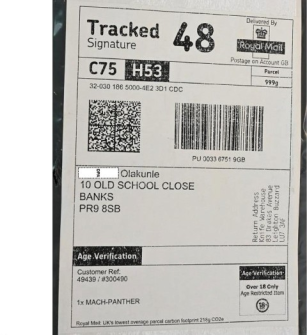
Given the provisions of the CJA 1988 as amended (see paragraph 85, above), while the contents were described as “1 x Mach-Panther”, I note that Knife Warehouse failed to ensure that the packaging clearly indicated that it contained an article with a blade or which was sharply pointed.[footnote 432] Mr Wheeler said that he was aware of the legal obligation to have labelling showing that the item was a bladed article and that ‘DYMO’ labels were usually used, but when challenged by Counsel to the Inquiry he accepted that no label appeared to be present for this parcel:
“Q. You did not meet your legal duty in that respect, in terms of this delivery; would you agree?
“A. Well, this is the first time I’ve seen this parcel but it appears not to be on there, yes.”[footnote 433]
I cannot entirely rule out the possibility that an appropriate label was affixed at the time of the delivery but came off at some stage when the parcel was kept in the house or cleared by the police. But given that the parcel and packaging appear otherwise intact with the delivery label in place, I find it more likely that no label stating it was a bladed article was ever attached.
As such, it was very poor practice of Knife Warehouse not to ensure that there was a clear bladed article warning on this package. As I address below, the package was received by AR’s father Alphonse R. Had Alphonse R paid proper attention to the package, he would have been put on notice that it was likely to be an inappropriate item for AR to possess. But a clear warning that the parcel contained a bladed item such as that used by Springfields would have made this immediately obvious. As a result, Alphonse R intercepted (and hid) the first machete but did not intercept the second machete. This was principally the fault of Alphonse R but Knife Warehouse contributed to it by inadequate labelling.
115. Knife Warehouse used an age verified delivery service from Royal Mail. The machete was delivered on 6 October 2023 at 15:12 in the afternoon.[footnote 434] Royal Mail provided evidence from Mr Ricky McAulay, their UK Operations Director.[footnote 435] The delivery driver was mandated to request identification if the parcel was to be handed to someone who appeared to be under the age of 25.[footnote 436] On the evidence provided to the Inquiry, it is overwhelmingly likely that this parcel was handed to AR’s father. The recipient’s year of birth was entered as 1975 which is Alphonse R’s year of birth. It is exceptionally unlikely that the delivery driver would have accepted a year of birth of 1975 (that is someone aged in their late 40s) if AR, then aged 16, had answered the door. Moreover, the delivery driver states that the door to 10 Old School Close was answered by a black, middle-aged man, of slight build with short, cropped hair.[footnote 437] While not exactly matching Alphonse R, that is broadly consistent with it having been Alphonse R who took delivery. It is also totally inconsistent with it being any of the other occupants of the house, whether AR himself who was 16, Dion R who was a wheelchair user and only a few years older, or AR’s mother.
Alphonse R accepted that it is more likely that it was he who took the delivery, although he suggested he could not completely rule out that it was AR.
116. I have no hesitation in finding that Alphonse R accepted this parcel.
This particular weapon was not specifically noted by Merseyside Police during the initial search of the house. It was identified after AR’s prosecution among the contents of the house that had been cleared.[footnote 438] The police were therefore unable to be specific about where in the house it was found. It is unlikely to have been in AR’s bedroom which was the subject of meticulous searching. On his own evidence, Alphonse R only intercepted and hid one machete (the Springfields machete, as addressed above). As I have indicated, this was still in its original packaging. I find that Alphonse R took delivery of this parcel at the door and then probably left it lying somewhere in the house among other delivery parcels. One of the images taken by Merseyside Police during the house search shows a parcel, which is entirely consistent with the Knife Warehouse parcel, lying among other post and parcels.[footnote 439] AR could therefore easily have accessed this machete had he wanted to. I return to Alphonse R’s responsibility for this in Chapter 12: AR’s family.
117. Returning to Knife Warehouse as a retailer and its approach to online knife sales, AR was able to order this machete because the law at the time did not require any check to be done to ensure that the purchaser matched the person whose identification document was provided. Mr Wheeler conceded that with hindsight, he should have given further consideration to why a gentleman in his 60s in Uxbridge was ordering a machete and wanting it shipped to Banks in Lancashire.[footnote 440] As I have already indicated Knife Warehouse was also at fault for not marking this item as being a bladed item.
118. However, I am also significantly concerned by the lack of responsibility shown by Knife Warehouse more generally. I reach that conclusion for three reasons.
119. First, there is the appearance and marketing of this particular machete. As I have indicated, this machete was advertised as a ‘Black Panther [Kukri] machete’ from Anglo Arms and as depicted in paragraph 109, above it was entirely black.[footnote 441] Several aspects of this are concerning. If the machete was aimed at legitimate agricultural use, it seems hard to justify the all-black appearance. Challenged by Counsel to the Inquiry, Mr Wheeler had to accept that the appearance of the machete was redundant and that it looked “sinister”:
“Q. If a machete was being used for agricultural purposes, it wouldn’t matter what colour it was, would it?
A. No.
Q. In the real world, a black machete, a machete with an entirely black silhouette, looks more sinister.
A. I suppose so, yes.
Q. There’s no “suppose so” about it. It makes it look more like a sinister weapon; would you agree?
A. Yes.”[footnote 442]
Mr Wheeler claimed not to know that Kukri machetes were associated with the Gurkhas.
“Q. […]you didn’t realise that it might have a connotation with military use by a regiment best known for their bravery and fierceness?
A. No, I thought it was just the shape of the machete, or the blade, rather.”[footnote 443]
Mr Wheeler said that to him ‘Black Panther’ was just a brand name. Pressed by Counsel to the Inquiry he said he had “never thought about it at the time”:
“Q. Well, it may be the brand name but what does it suggest to you in the real world?
A. I don’t know, it’s just an animal.
Q. A friendly animal?
A. No, no.
Q. Black Panther kukri machete, with a completely black silhouette, it might be thought, is named and branded in a way to make it look as ferocious as a weapon as possible; is that fair?
A. Maybe so. I never thought about that at the time, or I didn’t think of it in that way.”[footnote 444]
120. Mr Wheeler had been a specialist in this trade since 2010. I found this evidence hard to believe. Mr Wheeler was either profoundly naïve and unthinking about the descriptions of items he was selling, or he knew full well that some of his merchandise was branded and sold in a way that had connotations with their use as weapons. I regret that I find the latter is by far the more likely. While I accept that Knife Warehouse are not responsible for the brand names (here ‘Black Panther Kukri machete’), they did as a company choose to stock items with such names. Mr Wheeler has sought to maintain that the blade is black as it is anodized to prevent rusting. While he maintains that it is just a colour, I cannot accept that he was unaware that the combination of the machete’s name, its colour and its design, made it more attractive as a weapon. It is not a complete answer to these criticisms, that the importation of the machetes of this kind had not been prohibited by law. A responsible retailer would have paid regard to the name, design and description of the item, in deciding whether to stock it at all and if so how to market it.
121. It is to some limited extent a credit to Knife Warehouse that they had taken some steps to start to mitigate their website’s inappropriate content. They no longer stock this item, they have reduced the size of the knives they sell, and Mr Wheeler thought that they no longer sold machetes at all, although in this respect he was mistaken.
122. Second, however, Mr Wheeler’s claim to have stopped marketing machetes was inaccurate and even at the date of his giving evidence, it still contained inappropriate marketing content. I formed the clear impression that Mr Wheeler appeared not to be on top of his own website content. Whereas he claimed to no longer sell machetes, on the morning he gave evidence, the company website still advertised, albeit it out of stock, a ‘Buckland kukri field knife machete’, which was described as a “deeply curved kukri machete from Buckland […] with a phenomenal curve angle that puts the full weight of the knife behind each cut”. This was another black-coloured machete advertised on his website with the claim that “it is non-reflective so won’t scare the fish away if you’re out on the lake!”. Asked if “the reasonable outside observer might think that it’s pretty offensive to pretend that the reason for the machete being all black is so that, if you are fishing with a black machete, you’re not going to scare the fish?”, Mr Wheeler could only say, “I don’t know to be honest”.[footnote 445] Mr Wheeler claimed that although it was on the website, it was not for sale. I was troubled by these answers and doubted whether they reflected a genuine change of heart on the part of Knife Warehouse to cease selling clearly dangerous weapons, particularly when advertised in a way that tended to indicate their offensive use. While Mr Wheeler seeks to maintain that these items were lawful under UK law, this overlooks his company’s responsibility for how the items were marketed on the Knife Warehouse website. In the case of the Buckland machete, the marketing included the disingenuous line that the non-reflective black colour of the machete helped avoid scaring fish away if using it while fishing on a lake.
123. Third, the concerning content of the Knife Warehouse website was not limited to machetes. At the time the Inquiry contacted Knife Warehouse requesting a statement, it was still selling ‘Rambo’ knives, with names such as ‘Predator’, ‘Cold Steel’, and ‘Walking Dead’. Mr Wheeler justified these on the basis of films/other media after which they were named, and that there were popular “collectables”.[footnote 446] Mr Wheeler claimed to be unaware of the connotations of “cold steel”:
“Q. But what does ‘Cold Steel’ imply when it is a knife, Mr Wheeler?
A. It’s just a brand from America.
Q. It may be a brand name but, again, to the outside observer, Cold Steel is a phrase used about things like bayonets and stabbing people, isn’t it?
A. I was not aware of that, no.
Q. Really?
A. Really, yes. Cold Steel?”[footnote 447]
I was unimpressed by Mr Wheeler’s evidence in this regard. Mr Wheeler relies on the fact that ‘Cold Steel’ is a major and established brand sold by many knife retailers and has continued to maintain that he was genuinely not aware of the military and weaponry connotation of the phrase ‘cold steel’.
If true, again I find this both surprising and naïve for someone who has been a specialist in this trade since 2010. While Knife Warehouse did not create or choose the brand names for such items, it should have given far more consideration to whether it was appropriate to stock, and if so how to market, items whose brand names might be associated with knives and machetes being used offensively as weapons.
124. It is appropriate to recall that it is a criminal offence under the Knives Act 1997, to market a knife in a way which indicates or suggests that it is suitable for combat or is otherwise likely to stimulate or encourage violent behaviour involving the use of the knife as a weapon.
125. The content of both the Knife Warehouse website and the Hunting and Knives website (which I address in the context of the third machete, below) is very troubling. It causes me to conclude that far too little attention has been paid by the authorities to the content of online knife and machete marketing descriptions. I am very concerned that enforcement of the existing law in this area has been inadequate.
126. The closing statement on behalf of the Secretary of State for the Home Department “…acknowledges the very significant concerns that arise from the evidence the Inquiry has obtained regarding the online retail, packaging and delivery of knives and the effectiveness of the systems in place” including those designed to prevent “knife sellers from marketing knives online in a way that glamourises violence”.[footnote 448] Mr Hunt who gave evidence on behalf of the Home Office in respect of knife policy accepted that the evidence which the Inquiry had heard was “very concerning”.[footnote 449] He has pointed to the fact that tackling such breaches will fall within the work of the new police team established in response to the Clayman review of the online sale of knives.[footnote 450],[footnote 451] The closing statement on behalf of the Secretary of State for the Home Department also rightly anticipates that I will have recommendations around the enforcement of sections 1 and 2 of the Knives Act 1997.[footnote 452] I turn to those recommendations at the end of this chapter.
The third machete (Hunting and Knives)
127. On 14 October 2023, AR purchased a third machete from the online retailer Hunting and Knives (a trading name of Ageo Wholesale UK Ltd, a company with a registered address in London). The circumstances in which AR came to purchase and have delivered this third machete are the most concerning of all. It is no coincidence that this purchase – in which the processes were weakest – meant that the machete got into AR’s hands; it was found after the attack under AR’s bed.[footnote 453] It is also, I find, no coincidence that having established that Hunting and Knives’ processes were so weak in terms of age verification for machetes, that AR’s first effort to buy a knife was from the same company.
128. The police investigation established that this machete was purchased from Hunting and Knives having obtained relevant partial emails from AR’s Lenovo tablet SMG/2. The Inquiry has been able to establish a fuller picture of the supply chain involved in the delivery of this machete. In overview:
a. Ageo Wholesale UK Ltd under their trading name Hunting and Knives sold the machete online;
b. Ageo Wholesale UK Ltd had contracted a Northern Ireland based company SJ Henderson Fulfilment Ltd, to deliver its products in the UK;
c. Mr Stephen Henderson of SJ Henderson Fulfilment Ltd also ran Ruach Music Ltd, (selling musical instruments and accessories). The delivery fulfilment business grew out of Mr Henderson’s music business for which he already had to receive and deliver online orders. Mr Henderson put the Ageo Wholesale UK Ltd delivery work through the contract that Ruach Music Ltd had with Whistl;
d. Whistl did not perform deliveries themselves, they were essentially an intermediary, offering a range of delivery suppliers, which included Evri;
e. The machete was ultimately delivered by Evri. Evri do not offer age verified delivery services.
It is of very significant concern that, in the event, the delivery of this machete had no age verification process at all, and the machete was not appropriately labelled with a warning that it was a bladed article that should be delivered to over-18-year-olds only. Within the slightly complicated supply chain set out above, the need for this to be an age verified delivery got lost. For the reasons set out below, this was principally the fault of Hunting and Knives (Ageo Wholesale UK Ltd), to which a degree of failure by Mr Henderson of SJ Henderson Fulfilment Ltd / Ruach Music Ltd also contributed. I find that neither Whistl nor Evri would have appreciated that the item being sent was a machete requiring age verification.
129. After the attack, Merseyside Police were able to make a partial recovery of the emails which passed between AR and sales@huntingandknives.co.uk (Hunting and Knives / Ageo Wholesale UK Ltd). These were exchanged in the period 28 September 2023 to 3 October 2023. Hunting and Knives have provided fuller copies of the relevant emails.[footnote 454]
130. On 28 September 2023, AR asked “In order to verify my age for age restricted items, do you ask for ID online or does the courier ask for it in person?”[footnote 455]
131. The reply on the same day was as follows:
“Hello, we always request online verification unless it can be verified by the electoral roll and the address matches. Although sometimes delivery verification is also requested.
It is also possible to verify your identity if you send us a proof to this email. In the case of online verification, it is only necessary to do it once and your account will be verified.
Despite the exceptions contemplated by law, we always establish the minimum purchase period at 18 years or over [sic]. We hope to have helped you with your query, we remain at your disposal for any other question.”[footnote 456]
132. On 1 October 2023, AR asked “Does the person who receives the delivery have to be the same person on the ID or not?”[footnote 457] The answer from the company the following day, 2 October 2023 set out the following details:
“Hello,
Yes, the package is marked with the name of the person who must receive the package and in this type of shipments it is specified that the named person must be the one who receives the merchandise. Otherwise, the delivery person would not be doing the job well, since this aspect is what was agreed upon with the transport company.
It would be possible to schedule a delivery at a collection point if you are not going to be at home; This could be done once the tracking number is received from the transport company’s website.”[footnote 458]
There are two points of note concerning this reply both of which show the poor standards and knowledge of Hunting and Knives. First, the assertion that the person who receives the delivery has to be the person who made the order was nothing like the actual delivery arrangements effected by the company. Secondly, the email offered delivery to a collection point. If this was a locker-type arrangement, it would have been illegal.
133. On 3 October 2023, AR then asked, “What types of collection points are available?”[footnote 459] This query was not answered by Hunting and Knives, but it shows that AR was looking for weaknesses in the delivery options that would minimise the chances of his parents intercepting the delivery of the machete.
134. Less than 2 weeks later, on 14 October 2023 AR then proceeded to order a ‘Kukri Machete Congo 488 JKR’. An image of the machete as recovered from AR’s bedroom is below:[footnote 460]
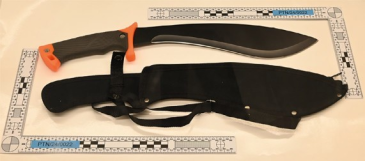
It is of note that, like the machete sold by Knife Warehouse, this was another machete with an all-black blade and a predominantly black handle. Moreover, this machete was marketed by Hunting and Knives in a wholly inappropriate way. Their website described this machete in the following terms, “Like any good kukri machete, the Congo Kukri have 3 parts to their blade, a pointed tip for stabbing, a wide midsection for chopping, and a narrow area near the handle for whittling and carving[…]”.[footnote 461] Mr Juan Martinez, the Director of Ageo Wholesale UK Ltd, wholly unconvincingly attempted to suggest that “stabbing” meant “to pinch”, as in to “pinch a fruit” and that kukris were bought for “survival” and as a tool for work in the countryside and for working with vegetation.[footnote 462] The limited legitimate uses for a machete in the UK would be for agricultural/gardening clearing and similar outdoor tasks, and perhaps survival skills. As such, any responsible vendor concerned not to offend the provisions of the Knives Act 1997, ought to avoid sales descriptions of machetes associated with stabbing. I find that Mr Martinez and Hunting and Knives took no such care in the marketing language associated with this machete.
135. This was not a one off. When the Inquiry issued its Rule 9 witness statement request to Hunting and Knives, it had a link to a blog on machetes where the blog included the statement, “A machete is a cutting tool, also used as a weapon somewhat shorter than a sword”. Upon this being pointed out in the Inquiry’s statement request, it seems that the link to this blog was deactivated by Hunting and Knives.[footnote 463] Even by the time that Mr Martinez gave his oral evidence to the Inquiry, the Hunting and Knives website was advertising a ‘Muela Magnum-26 Bowie deer stag knife’, described as “useful as a stabbing weapon, as well as a cutting tool”.[footnote 464] Again, it is important to recall the offence under section 1 of the Knives Act 1997, which makes it an offence to market a knife in a way which indicates or suggests that it is suitable for combat or is otherwise likely to stimulate or encourage violent behaviour involving the use of the knife as a weapon. Mr Martinez accepted this description was grossly inappropriate.[footnote 465] He suggested that it could be used for hunting deer or other animals, notwithstanding the fact that it is unlawful in the United Kingdom to hunt deer with knives. I note that even at the time of my drafting of this report and having made concessions at the hearings that the website content was inappropriate, Hunting and Knives have not reviewed their website to remove inappropriate marketing. They had for sale a ‘ka-bar bk9 Bowie’ knife for sale described as “combat-ready”.[footnote 466] I am also concerned at Hunting and Knives’ extensive practice of marketing knives as “tactical” given the association with military use and therefore combat.[footnote 467]
136. I have set out the terms of the Knives Act 1997. By virtue of section 2(1) of the Inquiries Act 2005, it is not for me to rule on or determine any question of criminal liability. However, by virtue of section 2(2) of the Act, I am not to be inhibited in the discharge of my functions by any likelihood of liability being inferred from facts that are determined or recommendations that are made.
I find as a fact that Hunting and Knives was routinely marketing (and to some extent continues to market) knives online in a way which is inappropriate and irresponsible, with references to knives/machetes as weapons, their utility for stabbing, and with reference to combat. This same finding leads to the very significant concern about the poor enforcement of the provisions of the Knives Act 1997 as regards online retailers, including Hunting and Knives.
137. Returning to the order which AR placed for this third machete, AR was able to make this order because he once again used the driving licence of the 62-year-old “Olakunle Samuel […]”, living in Uxbridge. I am more critical of Hunting and Knives for accepting this order than for the orders placed with Springfields and Knife Warehouse. That is because the range of emails sent to Hunting and Knives was more extensive (as set out above). This should have alerted Hunting and Knives to the strong possibility that this was a minor seeking to place an order. When the order was then made with an ID for a 62-year-old man in Uxbridge but a delivery address in Lancashire, Hunting and Knives should have viewed this as extremely suspicious, given the circumstances of a 62-year-old having enquired about age verification requirements with such persistence. However, Hunting and Knives failed to spot this and instead proceeded to allow the order to be made.
138. The machete was then delivered to 10 Old School Close on 26 October 2023 by the delivery company Evri, who do not undertake age verified deliveries. No age verification was required on delivery.
139. The Inquiry obtained witness statements and called oral evidence from an appropriately senior member of each element of the supply chain for the delivery of this machete in order to investigate how it could be that such a dangerous bladed item ended up being delivered without the age verified delivery. Those witnesses were as follows:
a. Hunting and Knives / Ageo Wholesale UK Ltd: their Director, Mr Martinez;[footnote 468]
b. SJ Henderson Fulfilment Ltd and Ruach Music Ltd: the Director and CEO, Mr Henderson;[footnote 469]
c. Whistl Group: their Chief Operating Officer Mr Nigel Polglass;[footnote 470]
d. Evri Limited: their Chief Customer Officer Mr Christopher Ashworth.[footnote 471]
140. I find the following factual matters established in terms of the relevant supply chain for Hunting and Knives orders in the relevant period.
141. On 21 February 2022, Ageo Wholesale UK Ltd entered into a contract with SJ Henderson Fulfilment Ltd for distribution of its orders.[footnote 472] This followed a short period of pre-contractual exchanges earlier that month. This contract was effectively for what is termed “dropship” products, which is to say that SJ Henderson Fulfilment Ltd were to forward the goods on to the end customer rather than store them for later dispatch.[footnote 473] The contractual terms included that SJ Henderson Fulfilment Ltd would not accept:
“2.12.1 goods which are, or may become, dangerous, hazardous, noxious, explosive, radioactive or damaging to itself or other property;
2.12.2 firearms, living organisms, cash, frozen or perishable food;
2.12.3 goods prohibited by law or regulation of any government or public authority of any jurisdiction where the goods are carried;
12.12.4 goods which SJ Henderson deems unsafe or not in a suitable condition for storage or packing or otherwise unsuitable for the Services offered by SJ Henderson;
2.12.5 goods tendered by Client which do not conform to the description or specification as provided in an Order or otherwise agreed by SJ Henderson;
2.12.6 goods on which Client has not paid all applicable duties, levies, taxes or other similar governmental or statutory requirement in connection with the import, export and/or delivery of such goods.”[footnote 474]
142. The obligations on Ageo Wholesale UK Ltd included that it warranted and agreed that:
“3.1.2. all goods are appropriately marked and packed for storage and handling by SJ Henderson.”
And that Ageo Wholesale UK Ltd as the client would:
“3.1.6 comply will [sic] all laws and regulations affecting manufacture, sale, packaging and labelling of its goods.”[footnote 475]
143. Under this contract, Ageo Wholesale UK Ltd pre-packed their items for distribution by SJ Henderson Fulfilment Ltd. It would appear that Hunting and Knives bought large quantities of knives and other items from Grupo Marpasi S.L. in Spain which were sent directly to SJ Henderson Fulfilment Ltd, packaged and labelled for delivery to the customer (including the name, address, postcode and country). SJ Henderson Fulfilment Ltd would then add an additional shipping label. Ageo Wholesale UK Ltd would choose, from a range of providers, which courier service they would wish to be used when submitting an order with SJ Henderson Fulfilment Ltd, but it was Mr Henderson (in fact through Ruach Music) who contracted with the onward courier companies.[footnote 476]
144. In making this arrangement with SJ Henderson Fulfilment Ltd, I find that Ageo Wholesale UK Ltd (and Mr Martinez personally) were responsible for a wholesale failure to have proper regard for their duties not to sell prohibited items to those under 18 and to ensure that bladed items were packaged in accordance with the UK legislation. This was most pronounced in two fundamental respects in that they did not:
a. Require SJ Henderson Fulfilment Ltd to ensure that the items were sent by age verified delivery;
b. Package and label the items clearly indicating that it contained an article with a blade, or an item which was sharply pointed, and that when delivered it should only be handed to a person aged 18 or over.
145. These were the direct obligations on Ageo Wholesale UK Ltd (Hunting and Knives). If they chose (as they did) to deliver machetes and knives through a third party, it was their obligation to ensure that the arrangement they made with that third party required these steps to be taken. They did not do so. They acted entirely irresponsibly and in breach of their obligations.
My conclusions in this regard are re-enforced by the fact that Ageo Wholesale UK Ltd made a positive requirement that the deliveries were tracking enabled (thus they specified aspects of the delivery type) but made no mention of any age verification requirements. Ageo Wholesale UK Ltd went so far as to tell Mr Henderson, “These packages could be sent already packed and labelled so that you only have to include the label of the transport agency) and from your warehouse they would be sent to the final clients”.[footnote 477]
146. Mr Martinez accepted that he had not mentioned the involvement of SJ Henderson Fulfilment Ltd in his original witness statement; he claimed this was because he just responded to questions directly asked by the Inquiry.[footnote 478] Mr Martinez claimed that he had had a video call with SJ Henderson Fulfilment Ltd during which he had indicated that a label needed to be added, as appropriate, with the ‘18+’ delivery warning.[footnote 479] He claimed he gave this as a clear instruction. There is no record of this alleged meeting, and I did not accept this evidence from Mr Martinez as truthful. Mr Henderson denied that any such instruction was given during a video call. I accept Mr Henderson’s evidence on this point. While I am critical of some aspects of Mr Henderson’s conduct under this contract, he was doing his best to give honest and accurate evidence to the Inquiry in a co-operative way. I find it impossible to accept that he would have ignored a clear indication that the packages were knives, needed age verified delivery and 18+ bladed items labelling.[footnote 480] I conclude that the factual position is that Mr Martinez took no steps to ensure compliance with the United Kingdom legislation as regards the supply of knives to those under 18.
147. This serious failure is aggravated by the scale of the breach. Hunting and Knives on its own evidence has shipped 2,811 packages to the United Kingdom via SJ Henderson Fulfilment Ltd, “99.9%” of which were knives or machetes.[footnote 481] It is overwhelmingly likely that none of them have been subject to delivery utilising age verification. This is self-evidently deeply troubling. Mr Martinez in his written statement to the Inquiry maintained that he could not have carried out his role more efficiently.[footnote 482] In his oral evidence to the Inquiry, he was belatedly forced to accept, more realistically, he had fallen “woefully short” of his duties.[footnote 483]
148. I deal with my recommendations in this area at the conclusion of this chapter. I note here, however, that my findings of fact as to the nature and extent of the failures of Hunting and Knives / Ageo Wholesale UK Ltd and Mr Martinez are such that my recommendations include that there should be a police-led investigation as to whether they have committed one or more criminal offences, with appropriate input from the Crown Prosecution Service. Since Ageo Wholesale UK Ltd is registered in London, the Commissioner of Police of the Metropolis would appear to be the relevant chief officer of police.
149. Consistent with the concerningly lax approach taken by Ageo Wholesale UK Ltd / Hunting and Knives to their labelling of imported articles, I note that SJ Henderson Fulfilment Ltd ended their shipping arrangements with Hunting and Knives when the Irish Customs intercepted a quantity of knives and a pepper-box revolver (a historical firearms replica) in a consignment labelled “cutlery items”.[footnote 484] I found Mr Martinez’s attempts to explain this as unconvincing as many other aspects of his evidence.[footnote 485]
150. I turn to consider the position of Mr Henderson and his two companies SJ Henderson Fulfilment Ltd and Ruach Music Ltd. For the reasons I have detailed above, I have no doubt that the principal failures for the breach of age verification and labelling requirements were those of Ageo Wholesale UK Ltd / Hunting and Knives. Mr Henderson was notified of the Inquiry’s interest very late in the day because his involvement had not hitherto been apparent. Within a matter of a week or so, he had produced a detailed statement, relevant disclosure and flown from Northern Ireland to give evidence. His co-operation was therefore impressive, and I accept he gave evidence honestly. However, Mr Henderson through his companies ought to have acted with more care and circumspection. I reach that conclusion for three reasons.
151. First, as a preliminary matter, the contractual terms I have outlined above, at paragraph 141, excluded dangerous goods or goods prohibited by law in any jurisdiction where the goods are carried, but they did not explicitly exclude knives and machetes. Mr Henderson agreed that the terms of the agreement were ambiguous so far as knives were concerned.[footnote 486]
152. Second, Mr Henderson had not informed himself about the UK legal requirements so far as the sale and delivery of knives was concerned.
He thought that his company did not “perform” the sale of knives and they relied on their clients to apply appropriate labelling. But the fact remains that Mr Henderson was simply unaware of the labelling requirements or age verification delivery requirements for bladed items.[footnote 487] That may have been acceptable if SJ Henderson’s contractual terms expressly and clearly prohibited the delivery of knives, but the terms were not so expressly clear.
153. Third, Mr Henderson asserted that it was not until 2025 with the Irish customs find that he realised that Ageo Wholesale UK Ltd had been sending knives and machetes through his company.[footnote 488] I can and do accept the honesty of this answer. However, had he been acting more diligently and carefully, Mr Henderson would have realised this in the pre-contractual and early contractual period of his dealings with Ageo Wholesale UK Ltd. That is so because:
a. In a pre-contractual questionnaire, in answer to a question about “What are the commodities / products”, Ageo Wholesale UK Ltd answered, “Outdoor suplies [sic], we are specialized in knives”. And in answer to a question about their e-commerce platforms, Ageo Wholesale UK Ltd gave their e-commerce platform address as huntingandknives.co.uk.[footnote 489] Mr Henderson said that the significance of this was not acknowledged at the time and he was shocked to read that email in the investigation he had conducted into what had happened. He accepted that this was a very clear missed opportunity to understand that Ageo Wholesale UK Ltd were a knife seller and that in hindsight he should have asked more questions;[footnote 490]
b. In March 2022, an early consignment from Ageo Wholesale UK Ltd (though this was not the case for all the later consignments) did have content descriptions and all bar one of the items was a bladed article.[footnote 491] I accept Mr Henderson’s evidence that this was data on the system that, because of the dropship nature of the process, did not have to be interrogated or reviewed. If the questionnaire had been properly considered, however, this early consignment description could have been used to check what Ageo Wholesale UK Ltd were in fact shipping.[footnote 492] Although they would have been one set of data among thousands of orders, the associated images on the SJ Henderson Fulfilment Ltd portal for these items showed that they were knives;[footnote 493]
c. In terms of labels, while Ageo Wholesale UK Ltd failed to attach labels marking the parcels as containing bladed articles that were for 18+ delivery only, Ageo did send the parcels (at the very least for the first assignment) with delivery information labels applied that had a reasonably prominent ‘HK’ logo on them with the words “Hunting & Knives” clearly visible underneath.[footnote 494] Although Mr Henderson is right to note that the contractual dealings were through Ageo Wholesale UK Ltd, and he suggests that the label image came to him in an email where the wording on the labels would not have been very prominent, this was another missed opportunity for Mr Henderson and those handling the parcels to spot the likelihood that they contained knives.
154. Realistically, and consistent with the above, Mr Henderson regretted not doing more, being more curious and asking more questions.[footnote 495] He accepted, also, that it was a very serious matter that over 2,500 packages had been sent by Ageo Wholesale UK Ltd through his firm, all of which should have been age verified and had warning labelling.[footnote 496]
155. I should record that Mr Henderson, at short notice, had determined in the week before he gave evidence that the dropship arrangement was a vulnerability in his systems and he had already emailed his customers to require in future that all orders, including those sent through the dropship rather than warehousing option, required product details to be provided.[footnote 497] This was reflective of a pro-active approach by a company that was taking the issues raised in the Inquiry seriously. However, my conclusion remains that Mr Henderson ought to have acted with more care and circumspection in his dealings with Ageo Wholesale UK Ltd. Had he done so, he would have realised they were dealing in knives and machetes and either terminated the relationship or informed himself about the requirements for delivery of bladed articles. That may well have prevented this particular machete from being delivered to AR.
156. I can deal with the position of Whistl and Evri more briefly. As regards Whistl, they are a parcel management company who act effectively as a very large-scale intermediary for businesses in the parcel logistics trade. They link parcel senders (such as online retailers and other fulfilment companies) with companies (like Evri) who effect the actual delivery.[footnote 498] The large number of parcels with which they deal means that they can obtain cheaper prices from the delivery companies than the sellers/senders could negotiate separately. Their services also include software that effectively acts as a bridge between the seller’s order management system and the carrier’s management systems so that the parcels can be labelled, sent and tracked efficiently, in a highly automated way.[footnote 499]
157. There is a minor technical dispute (which it is not necessary for me to resolve) about the contractual terms between Whistl and Evri. Whatever the position as regards the relevant version of that contract, Mr Polglass of Whistl accepted that Whistl had long been aware that Evri did not accept age restricted items,[footnote 500] and it was Mr Polglass’s evidence that this information was made known to Whistl’s customers, although he thought this could be further improved with more frequent reminders.[footnote 501] Evri had made clear to Whistl that it did not wish to engage in the delivery of age verified articles covered by the Offensive Weapons Act 2019.[footnote 502] From Whistl’s point of view, it was its customer’s obligation to choose the appropriate delivery option for the type of parcel being sent. As such, an online seller of knives ought to choose an age verified delivery option and ensure its products were appropriately packaged.[footnote 503]
158. Whistl’s relevant contract was with Ruach Music Ltd and was signed in January 2021.[footnote 504] Whistl’s account was that they only learnt in the context of this Inquiry that Ruach Music Ltd shared premises with SJ Henderson Fulfilment Ltd.[footnote 505] Mr Henderson did not agree with this and pointed to the fact that a proposal from Whistl was sent to the SJ Henderson Fulfilment Ltd email and he considers it was apparent that SJ Henderson Fulfilment Ltd’s orders would be put through the Ruach Music Ltd account.[footnote 506] Subsequent disclosure from Mr Henderson tends to confirm his account in this regard, although this difference between Whistl and Mr Henderson is of only marginal relevance.[footnote 507] The contract gave Ruach Music Ltd options to send parcels with Evri (then called Hermes), Royal Mail or Yodel.[footnote 508] There was a customer guidance and carrier guide with sections on prohibited items, dangerous goods and restricted items.[footnote 509] The effect was to make the customer (here Ruach Music Ltd) responsible for ensuring that it follows any requirements relating to these types of goods. There was a link to Evri’s website in which it was made clear that Evri did not carry knives. For the Ageo Wholesale UK Ltd orders, Evri was chosen as the carrier for delivery for nearly all of the over 2,500 orders, with one shipment being sent through Yodel.[footnote 510]
159. Mr Polglass said that Whistl do accept shipments of kitchen knives, but not of weapons. He accepted that there was a degree of judgement in this, but he said that Whistl would never have accepted a contract that involved the shipment of machetes.[footnote 511]
160. Mr Polglass also accepted that the content information for the early shipment from Ageo Wholesale UK Ltd (showing that nearly all the items were knives) would “Quite probably” have come to Whistl. However, he explained – and I accept – that for Whistl this would have simply been data on their internal systems which did not need to be interrogated and there would have been no need for this to be scrutinised in the ordinary course of business. In this sense, the data was in their hands but there was no reason for it to be reviewed.[footnote 512]
161. As regards Evri, they are a large-scale UK parcel logistics and “final mile” delivery service company. Mr Ashworth explained (and I accept) that Evri had no knowledge or means of knowing that the parcel containing the third machete contained a bladed item, nor that it came from “Hunting and Knives”. Their information provided by Whistl did not include specific parcel contents.[footnote 513] As noted above, before the Offensive Weapons Act 2019 came into force, Evri made clear to Whistl that it had not developed a delivery product for age verified items under the Act.[footnote 514] Mr Ashworth explained that it was well known in the industry of online retailers that Evri does not serve the bladed articles
/ OWA 2019 market.[footnote 515] In his oral evidence, Mr Ashworth explained that this was for two reasons. First, because morally, such items did not sit comfortably with the Evri board. Second, the Evri delivery model emphasises speed and Mr Ashworth said they could not be confident that couriers would not rely on a customer agreement about safe places for delivery or similar and end up, as I understood his evidence, delivering a bladed item where it could be picked up by someone who was not the intended recipient including someone underage. Mr Ashworth explained succinctly, “I didn’t want any blades in our network”; and their refusal to take bladed items was very widely publicised and in their standard terms.[footnote 516] Mr Ashworth explained that the delivery method chosen for the Ageo Wholesale UK Ltd parcel was one of their cheapest delivery options; a loosely wrapped item that is possible to be delivered through the letterbox or left with a customer if it did not fit through the letter box; with proof of delivery in the form of a photograph.[footnote 517] As I understand it, this machete could, therefore, have been left on the doorstep/porch etc. with a photograph taken as proof of delivery.
162. Evri had no relationship with Ruach Music Ltd and would not have known who the ultimate seller had been; the content information in the first assignment (available to SJ Henderson Fulfilment Ltd and Whistl) did not get sent on to Evri.[footnote 518] Mr Ashworth accepted that the machete parcel was in fact delivered by Evri, as established by the data retained by Whistl showing delivery at 09:51 on 26 October 2023, but Evri’s data retention period of 13 months meant they no longer themselves retained information on the delivery.[footnote 519]
163. In the circumstances set out above, I find that neither Whistl nor Evri were at fault in the delivery of the third machete. I am, however, concerned at the potential for confusion when multiple companies are involved in the supply and delivery process, as in this instance: Grupo Marpasi S.L, Hunting and Knives, SJ Henderson Fulfilment Ltd / Ruach Music Ltd, Whistl and Evri.
164. In this regard, one aspect that arose from the evidence of both Mr Ashworth and Mr Polglass was the potential for the use of technology to provide further assurance regarding parcel content. There were two aspects to this:
a. There is potential for AI to be used to scan the (very large scale) parcel content information passing through large scale parcel logistics firms and for this to be used to check if items described as knives (or similar) are matched to age verified deliveries;[footnote 520]
b. While it would involve a more substantial change, if domestic parcel contents had to be given the same product harmonisation codes that are used for international parcel deliveries, that information could be used to check that the parcel delivery method was appropriate (in particular whether it should be age verified). While a final mile service like Evri could easily use such information, the changes for the supply chain higher up would be much more substantial and such a system would have a significant lead-in time.[footnote 521]
I return to this in my recommendations at the end of this chapter.
Knives
Attempted purchase from Hunting and Knives
165. As addressed in the previous section, in October 2023 AR had obtained a machete with no age verified delivery from Hunting and Knives.
166. When in the summer of 2024 AR wanted to buy a chef’s knife as an offensive weapon, it was (perhaps unsurprisingly given their lax standards) to Hunting and Knives that he first turned.
167. As such, on 21 June 2024 AR made an online order from Hunting and Knives for an ‘Arcos Niza Series 200mm (c.8 inch) chef’s knife’.[footnote 522] He gave the same details of Olakunle / Samuel as the purchaser, the email address a.megalania7@yahoo.com and the billing and shipping address of 10 Old School Close, Banks PR9 8SB.
168. For reasons that remain unclear, AR did not complete the payment page for this purchase. As such, the age verification stage was not reached, and this knife was never in fact dispatched to him.
169. On 11 July 2024, in the apparent belief that the purchase had gone through AR emailed Hunting and Knives, from his a.megalania7@yahoo.com address, in the following terms: “It has been 20 days since I ordered a product from HK and I still haven’t received it even though the confirmation email said it would take 20 business days. When will my order be delivered?”[footnote 523]
170. On 12 July 2024, Hunting and Knives sent an email reply to AR at as follows “can you please tell me your order number?”[footnote 524] To which AR replied “#100005276”.[footnote 525]
171. On 15 July 2024 Hunting and Knives then emailed AR in reply stating, “I am sorry to tell you that your order is pending because you haven’t paid yet… Sorry. Have a good day”.[footnote 526] AR does not appear to have replied to this, which may have been because, as below, on 13 July 2024, he had turned to Amazon instead to source knives.
Purchase of the knives used in the attack: online order
172. On 13 July 2024 at 20:16, AR placed an online order for an ‘Apollo Chef Knife 20cm Cerbera’ from Amazon (order number 205-1823547-6705969) with his Amazon account.[footnote 527]
173. The product page for this knife, and for bladed articles on Amazon in general, included the following warning:
“Age Verification Required: This product is not for sale to people under the age of 18 and will require an online age verification check. To confirm the recipient is over 18, valid photographic ID with a date of birth may also be required upon delivery. The driver will input your year of birth into their device and may then require an ID check to complete the age verification process. The driver will not be able to access your information once the delivery is complete. See Details”.[footnote 528]
174. The IP address used for this purchase was 2.98.141.79 which was associated with 10 Old School Close.[footnote 529] Shortly after the purchase was made, Amazon <(order-update@amazon.co.uk> sent an email to AR stating “We’re writing to let you know that your order has been successfully cancelled…. Customer Cancelled APOLLO Chef Knife 20cm CERBERA Qty: 1”.[footnote 530]
175. Less than a minute later, AR placed an online order for two ‘Apollo Chef Knife 20cm Cerbera’ from Amazon (order number 205-7351162-4218749). He used the same account but the IP address was 104.243.213.232, which was associated with a Virtual Private Network (VPN).[footnote 531] AR, therefore, had cancelled his first order for the Apollo knife and shortly thereafter placed a new order for two of the same Apollo knives using a VPN. Presumably, AR felt that the use of a VPN would avoid scrutiny.
176. Once a customer clicks ‘proceed to checkout’ on Amazon, they are taken through a process of age verification. The purchaser provides their date of birth, their ‘legal’ name and their place of residence. These details are sent by Amazon to Experian, an age verification provider, and checked against various databases including government, voter and credit records. If this process verifies that the individual is 18 or over, the customer proceeds to the checkout. Otherwise, the purchase is not completed.
177. At the age verification stage, AR provided his father’s details (namely, Alphonse R’s name, address and date of birth) for the first of these two orders, which were accepted. He was not required to repeat this process for the second order, using the VPN, because in July 2024 the online age verification check was only required to be undertaken once for an account.
178. Alphonse R’s details were accepted, notwithstanding they did not match the information provided as regards the purchaser. There was no requirement for the online age verification details to match the details of the order: Alphonse R’s details were accepted even though the shipping and billing name given was “Ax Rud” and the credit card name was AR’s full name. Mr Boumphrey agreed that any child would have been able to circumvent the age verification requirements by providing the name and date of birth of an adult with whom he or she lived. He accepted that the lack of a link between the online age verification and the purchaser or the recipient on delivery was a fundamental flaw in Amazon’s systems, as in force in July 2024. He conceded that, in relation to online age verification, the company had “got the balance wrong” between the practicalities of buying articles online as set against the need to ensure there were effective controls to prevent the supply of prohibited items to those under 18. He did not contest the suggestion that what occurred to circumvent the age verification was “child’s play”.[footnote 532]
179. By way of an additional weakness at the relevant time, if a customer was unsuccessful in using the age verification process and sought assistance, Amazon’s internal guidance suggested that the customer was advised to “try and submit the details of someone else in their household”.[footnote 533]
Mr Boumphrey agreed that this was not an acceptable direction to give to a minor because they were potentially being directed to a way of avoiding the age verification measures.[footnote 534]
180. Although, as set out below, these processes have now been changed and improved, I nonetheless express my profound concern that it took an incident of this magnitude to prompt Amazon into instituting new processes which have rendered it less easy for lethal weapons to be delivered to those under 18. For a major e-commerce platform which buys and sells a vast range of products online, these deficiencies should have been appreciated and rectified long before the tragic events at the Hart Space on 29 July 2024. Amazon was founded on 5 July 1994, it was launched on 16 July 1995 and it rapidly expanded over the succeeding 10 years. It is a highly experienced retailer. Since 16 April 2022 there have been minimum steps a seller is obliged to take when a knife is sold to someone under 18 through a remote sale (where the seller is not physically present with the buyer), including an effective age verification system. The consequences of these lax and inadequate safeguards contributed significantly to the profound and tragic consequences in this case: one of these knives was used by AR when he carried out his attack, during which he killed three young girls and inflicted serious wounds and profound trauma on many others. The other knife was found wrapped in a duvet on a sofa in the living room where AR had been sleeping.
Purchase of the knives used in the attack: delivery
181. Given knives were an age verified purchase, a label was automatically applied to the packaging. The shipping label indicated “18+” in the top right-hand corner and the lower part of the label stated “Bladed Article”.[footnote 535]
182. The delivery was made by Condor Carriers, a Delivery Service Partner (DSP) of Amazon. DSPs are independent third-party delivery companies who contract self-employed drivers to make deliveries using Amazon branded vans.
183. The delivery driver for Condor Carriers was Mr Hamza Ali. Mr Ali had initially worked for Amazon as a self-employed independent contractor (a programme known as Amazon Flex) for around a year and a half. He then started work with Condor Carriers from April 2024. He estimated that, throughout this period, he would be making a couple of age verified deliveries a day.[footnote 536]
184. In terms of training, Mr Ali had been required to view a series of videos to deliver for Amazon Flex, one of which related to age verified deliveries. Mr Ali did not feel that this was sufficient training and he had been informally trained by a relative, but this was not organised by Amazon.[footnote 537] When Mr Ali joined Condor Carriers, he received two days of classroom training, which included training on age verified deliveries, and spent two days riding along with another delivery driver.[footnote 538] He felt that he had received appropriate training to carry out age verified delivery, was able to speak to colleagues and was constantly given reminders about the importance of age verified deliveries.[footnote 539]
185. When delivering for Amazon, Mr Ali used an app which asked a series of questions in order to complete the delivery. For age verified deliveries, drivers were required to ask the recipient for their year of birth and enter it into the app. If the year of birth rendered the person over 25 years old, then the app asked whether the recipient appeared over the age of 25. If the recipient gave a year of birth that rendered them over 25 and they also looked over the age of 25 then the item could be delivered. If the recipient gave a year of birth that rendered them under 25, or if they appeared to be under 25, then the driver was required to check the recipient’s ID to confirm that they were 18 or older. The recipient’s name was recorded on the app. Consistent with the legal requirements, only the recipient had to be over 18 to accept the parcel and no checks were required at the point of delivery of the person who made the order or the person named on the parcel.[footnote 540]
186. On 15 July 2024 at 12:06, Amazon <(shipment-tracking@amazon.co.uk> emailed AR <(a.megalania7@yahoo.com> as follows: “Your package with 2 APOLLO Chef Knife 20cm… will be delivered today. Order # 205-7351162-4218749 Track your package APOLLO Chef Knife 20cm CERBERA, Mult… Qty: 2. As your delivery includes an age-restricted item, someone over the age of 18 with a valid ID must be present to receive this package”.[footnote 541]
187. The two Cerebra knives were delivered by Mr Ali to 10 Old School Close on 15 July 2024 at 17:40. A message of confirmation of delivery was sent to AR at 17:41. Mr Ali is recorded before and after the delivery by the doorbell camera of AR’s neighbour. However, the delivery itself is not captured on video and forensic enhancement of the audio did not assist in identifying who received the delivery.[footnote 542]
188. Mr Ali recorded on the app that the recipient’s year of birth was 1978 and the recipient appeared to be over 25. As a result, the recipient was not required to provide identification. Mr Ali testified that his personal practice was always to ask for proof of age with age verified deliveries unless
“they’ve got white hair and they obviously look very old”.[footnote 543] Mr Ali stated that there was no way that he could have seen AR, who was 17 at the time, and yet entered a date of birth of 1978 into the app and delivered the parcel.
189. In his witness statement, Alphonse R accepted that only he and AR were home at the time of the delivery. However, he doubted whether he had received the delivery because the date of birth was wrong: his year of birth is 1975. He also stated that he would have intercepted and diverted a parcel if he had seen the warnings on the Amazon label. He noted that the delivery took place quickly.[footnote 544]
190. However, in his oral evidence, Alphonse R accepted that it was highly likely that he had taken delivery of this parcel.[footnote 545] Indeed, there is no other credible possibility given the evidence of Mr Ali and the appearance of AR, who did not remotely look as though he had been born in 1978. Moreover, Alphonse R accepted that he might have deliberately given a year of birth that was close to his own, but did not match, either by mistake or because the question seemed intrusive.[footnote 546]
191. After the Inquiry heard evidence from Mr Ali, it emerged that the name entered on the app when the delivery was made was “Ax”. This detail was disclosed through a further statement from Mr Boumphrey.[footnote 547] Mr Ali gave a further statement in which he stated that he always asked the name of the recipient but noted that it was possible that there was a typing error, the name was given very quickly or that he misheard the name.[footnote 548] “Ax” was the name displayed on the app and also on the parcel itself. I note the addendum to the fourth statement of Mr Boumphrey which states that Mr Ali entered a name into the app which was either an exact or close match to the name on the parcel on many but not all occasions.[footnote 549] In my opinion, none of this evidence undermines the fundamental point that the date of birth entered was very close to that of Alphonse R and could not credibly have been given by AR. It is far more likely that Mr Ali, who I found to be a frank witness, misheard the name given by Alphonse R and entered the name associated with the delivery and the parcel label. I find, as a fact, that Alphonse R did accept the delivery.
In fact, this occurred on a number of occasions. Furthermore, Mr Boumphrey accepted that when Amazon was approached by Merseyside Police in relation to the attack on 29 July 2024, the company should have provided more complete information, going beyond the delivery details, and that it ought to have supplied the relevant online age verification information and the name of the delivery driver. While these issues did not engender confidence in Amazon’s systems, the errors were explained and promptly corrected so I do not doubt Amazon’s good intent or co-operation with the Inquiry.
Purchase of the knives used in the attack: analysis
192. The tragedy in this case, for which Alphonse R bears incalculable responsibility, is that he then left the parcel “behind the (front) door” without troubling, on his account, to read the label which stated 18+ and bladed article, or to demonstrate any curiosity as to what it contained.[footnote 550] This is despite the fact that he was asked for his year of birth at the point of delivery, demonstrating that the parcel required age verification. I have addressed this failing, which Alphonse R accepted was “terrible”, in Chapter 12: AR’s family.
193. Although the 18+ and bladed article warnings were clearly visible on the outside label, Mr Boumphrey agreed that some other retailers used more “noticeable” and prominent warnings on their labels. He indicated that there is internal consideration taking place as to the labelling used by Amazon. I note that Mr Ali suggested that he was unaware of the bladed article warning on Amazon packaging, although he was aware of the 18+ labelling.[footnote 551] Mr Boumphrey also considered that the suggestion advanced by Counsel to the Inquiry that delivery drivers could be instructed to tell the recipient that they were receiving a bladed item was an interesting proposal which he intended to raise internally. While Alphonse R had more than sufficient information to cause him to check the parcel, these measures would have further reinforced the contents of the parcel.
194. During the COVID-19 pandemic, Amazon stopped requiring a signature from the recipient. At present Amazon is not considering reinstituting the requirement for a signature for items which are subject to age verification. Although it does not cause me to doubt that Alphonse R received the parcel, I am troubled that the date of birth and name associated with the delivery do not match and that these issues could hamper other investigations wishing to establish who received a knife later used for a crime. I appreciate that there are downsides to signatures, which may be illegible, and photographs, which may raise data protection issues, but I consider that further work could be done on this issue.
195. Given the evidence of Mr Ali, in relation to the training he received for Amazon Flex and his understanding of the labelling, I have concerns about the training delivered to Amazon Flex drivers. The company has harmonised the penalties which are imposed on drivers working for Amazon Flex and drivers from DSPs when they fail to carry out appropriate age verification checks. The penalties were previously more lenient on Flex drivers, partially due to the less rigorous training that delivered to Amazon Flex drivers. Mr Boumphrey accepted that the appropriate solution was instead to improve the training delivered to Amazon Flex drivers. He stated that training for Amazon Flex drivers has been enhanced and updated.[footnote 552]
196. Amazon undertakes audits of age verified deliveries. In 2023 there was full compliance with the required procedures in 81% of cases, and 83% in 2024. The short-term goal is to reach 90%, rising to 100% in due course. In the future, drivers who do not achieve full compliance will no longer be used by Amazon.
Of particular concern in this context, as agreed by Mr Boumphrey, is that in 2024 six of Amazon’s competitors had pass, or compliance, rates of only around 50%. This undoubtedly raises fundamental questions about the utility of age verified delivery systems, and whether they have sufficiently improved.
197. In relation to changes made to online age verification, in September 2025, Amazon instituted a system by which the cardholder must complete an online verification procedure for each age verified purchase. Once the cardholder is verified, the bank provides a passcode to a mobile device to ensure they are the individual making the purchase. If this improved process had been in place in 2024, it would have prevented AR from purchasing the murder weapon.
The justification for having not implemented this procedure until recently was unconvincing, namely that AR was the first person whose activities alerted the company to this risk. This is unpersuasive for two reasons: first, the covert nature of such avoidance would by its very nature not come to the attention of the company and, second, the company should have been considering proactively whether their systems were fallible.
The location of certain suspect items
198. An important consideration is the location within the family home of the potentially lethal items bought by AR. This is relevant, not least, to the knowledge on the part of AR’s parents and brother as to the risk that he posed. While I have endeavoured to set out above where each purchase was found in the house, I summarise the findings here.
199. The following were either under or by the bed in AR’s bedroom: the bow and arrows and the machete (inside a black holdall); laboratory equipment used in the production of ricin (inside a box); the bottle of Isopropyol Alcohol (in a cardboard box); and other equipment used in the production of ricin, including the Tupperware box, and the bag of seeds. The industrial strength sledgehammer was in a box behind the door in his bedroom.[footnote 553]
200. In other parts of the house, one set of Cerbera knife packaging was found in a carrier bag on the first floor landing.[footnote 554] Another set of Cerbera knife packaging was found in a bin in the garden.[footnote 555] The second Cerbera knife, matching the knife used in the attack, was found wrapped in a duvet on the sofa in the living room (where AR had been sleeping).[footnote 556] A 14cm kitchen knife was discovered in the bathroom.[footnote 557]
201. Items that could have been used to make a petrol bomb or Molotov cocktails were found in the lounge (namely, bottles, matches, duct tape).
202. A further machete and a sharpening stone were on top of the wardrobe in AR’s parents’ bedroom (in sealed packaging with a delivery label which read “Alice H […] 10 Old School Close, Banks”). I have addressed the possible location of the third machete above, but its location was not identified by the police investigation.
Recommendations
203. The Inquiry’s Phase 1 hearings have been a deliberately focused and rapid examination of the circumstances of the attack itself, and the relevant agencies dealings with AR. While I have heard evidence in Phase 1 from online retailers, including in relation to knives/machetes and archery equipment/crossbows, I have not at this stage been able to consider wider arguments from interested groups including (for example) archery enthusiasts, or those for whom, for various reasons, online retail may be very important because of difficulties in accessing traditional physical retailers.
204. Accordingly, it is appropriate for me to draw a distinction between recommendations which I am confident in making now in Phase 1 and matters which I would wish to consider further as part of Phase 2.
Patterns of suspicious online purchases: recommendations
205. I will wish to consider wider evidence regarding the ability to spot suspicious patterns of online purchases.
Recommendation 12: Phase 2 should consider systems to detect and report concerning online behaviour and suspicious combinations of purchases. This should include consideration of:
1. Concerning patterns of online browsing and purchasing (e.g. change of names and addresses, use of Virtual Private Networks).
2. Concerning purchases of dangerous but legal items (e.g. sledgehammers, bow and arrows and smoke grenades).
3. Concerning combinations of purchases (e.g. castor beans, alcohol and laboratory equipment).
Ricin: recommendations
206. Ricin is highly dangerous. If AR had decided to commit multiple murders using ricin rather than a knife, the death toll – depending on the method of distribution – could well have been even more extensive than the dreadful attack carried out on 29 July 2024. In my view, the Home Office is right to be carrying out a review of the sale of castor beans. Although there is an entirely valid horticultural use for castor beans, I consider that there is a case for tighter controls on their sale.
Recommendation 13: The Home Office’s ongoing review of the sale of castor beans should consider regulation of the number of castor beans that can be sold in a single transaction.
I wish to be kept apprised of the review and of the actions taken as a result of the review.
Archery equipment (conventional archery bows and crossbows): recommendations
Conventional archery bows
207. The evidence I have heard in relation to conventional archery bows has varied. This was exemplified in the difference of approach between Tactical Archery (who voluntarily age check conventional archery bow purchases, despite the lack of legal requirement) and Merlin Archery who do not see conventional bows as a particular risk.
208. I recognise that there are material differences between conventional archery bows and crossbows. The sporting (target) use of conventional archery bows is far more recognised and accepted. I note Mr Jones’ evidence as to the widespread youth interest in sporting archery, and the legitimate need for children to own/possess their own equipment. Ms Ellsmore of the Home Office explained in her statement that conventional bows are considered to be less attractive for potential misuse than crossbows, as they require a much greater degree of skill to use, are more cumbersome to carry, very difficult to conceal from sight, and are unlikely to have the same ability to fire as rapidly as crossbows. She has stated that this is reflected in the “very few (if any) offences that are committed by bows that are not crossbows”.[footnote 558] Mr Hunt of the Home Office expanded on this in his oral evidence noting that bows and arrows (compared to crossbows) had very rarely been used in crime, being relatively cumbersome and requiring a high degree of skill to use.[footnote 559]
209. Nevertheless, based on the Phase 1 evidence. I do have concerns about the almost complete lack of control over the sale of traditional archery bows:
a. AR’s own purchase of an archery bow and arrows, which he doubtless purchased as a weapon, shows their attractiveness as a weapon to violence fixated individuals. It is of note that AR bought a bow and arrows (which did not have age control) before moving on to seeking out the potential to buy, underage, a crossbow;
b. There is no doubt about the serious harm that could be inflicted by the kind of bow and arrows widely available online;
c. Some of the imagery and language around even conventional archery bows is, in my view, questionable. I have already touched on the very name of Tactical Archery (while recognising that MB Outdoors Limited are considering changing this trading name). I have no doubt that Merlin Archery Limited are at the more responsible end of the retailers in this area. But even they chose to use marketing imagery of someone in military-style camouflage kit holding an archery bow.[footnote 560]

Given that it is illegal to use any bow or crossbow for the purposes of hunting any wild bird or wild animal, it is hard to see why camouflage gear is being used to market archery equipment.[footnote 561]
Similarly, the online retailer PreppersShop.co.uk chooses to use a image for the page of its conventional archery sales.[footnote 562] A sample image of how the crossbows are marketed with camouflage gear is shown below.[footnote 563]
210. I will wish to consider wider evidence on this issue.
Recommendation 14: Phase 2 should consider whether conventional archery bows should be subject to age-verification prior to sale, delivery restrictions including ID checks, mandatory labelling for deliveries, and industry or trading standards to prevent the use of military-style imagery in marketing.
Crossbows
211. While I take into account that AR does not appear to have succeeded in buying a crossbow, I am confident that he was emailing both Tactical Archery and Merlin Archery to ‘test the waters’ on how strict the age verification was, and on what the packaging would be so he could try to evade his parents knowing if he bought one. While he did not place an order, AR’s well-evidenced interest in crossbows shows their attractiveness to violence fixated individuals.
212. As reflected in the current legislative distinction between conventional archery bows and crossbows, crossbows carry obvious risks that are much higher than conventional archery bows. As explained by Mr Jones, crossbows:[footnote 564]
a. Are easy to become proficient with, requiring minimal instruction;
b. Can be cocked aimed and shot with relative ease and accuracy;
c. Can be fired one handed;
d. Are easier to conceal;
e. Can be held for long periods in the ready to fire position;
f. Are on average more powerful than conventional archery bows and cocking aids mean the crossbow can be used regardless of the user’s physical strength.
213. I welcome the government’s recently published response of 19 March 2026 to the crossbow call for evidence, which confirmed the intention to introduce significant new controls, including a licensing scheme for existing owners and a prohibition on the sale of crossbows, with further consultation planned on the detailed design of these measures. I am conscious that I have not heard detailed evidence of the extent of the legitimate use of crossbows and that this should be further explored in parallel with the government consultation before I make final recommendations in Phase 2.
214. I should record however my particular concern about the attractiveness of crossbows as a weapon, their design (which in the case of pistol crossbows, in particular, appears to gravitate towards making crossbows look like conventional firearms), and the imagery that is associated with their current marketing. Samples of readily accessible images from retailers advertising for UK crossbow online sales include online retailers PreppersShop.co.uk,[footnote 565],[footnote 566] Tacticalarchery.co.uk,[footnote 567],[footnote 568],[footnote 569] Merlinarchery.co.uk,[footnote 570] Hattila.com.[footnote 571]
Similar examples of images are shown below.[footnote 572],[footnote 573]
215. I will wish to consider wider evidence on the issue of crossbows. However, I make the following recommendation mindful of their lethal potential, their attractiveness as weapons to violence fixated individuals, their greater risks over conventional archery bows, and their more limited legitimate use.
Recommendation 15: Phase 2 should consider, in parallel with the government’s consultation where possible, a prohibition on the sale of crossbows, a licensing scheme similar to firearms, tighter controls on purchasing such as restricting sales to age-verified in-store transactions, and Trading Standards measures to prevent military-style marketing.
All archery bow retailers (conventional and crossbows)
Recommendation 16: The Home Office should provide clear guidance to all UK retailers of archery bows and crossbows on identifying and reporting suspicious behaviour, including underage purchasers or those who appear to be interested in criminal use of the equipment, and should consider placing retailers under defined obligations to report material suspicions.
Knives and machetes: recommendations
Recommendations for immediate action
Recommendation 17: The Commissioner of Police of the Metropolis should consider an investigation, with input from the Crown Prosecution Service if appropriate, as to whether Ageo Wholesale UK Ltd committed criminal offences in relation to how it marketed knives/machetes or sold them without required age verification or labelling.
Recommendation 18: The Home Office should take immediate action to ensure that online knife retailers are complying with the Knives Act 1997, particularly regarding the marketing of knives, machetes, swords and similar bladed articles.
I am aware that following the Inquiry’s Phase 1 evidence, the Home Office has already raised this with the National Police Chiefs’ Council.
Recommendation 19: Amazon should:
1. Improve its measures to prevent children from making purchases, including making the conditions of use and sale more prominent.
2. Improve the labelling on packaging of bladed articles so that the warning is more prominent.
3. Ensure drivers inform recipients whenever deliveries contain a bladed article (I recognise the closing statement on behalf of Amazon that this is in train).
4. Review its systems for recording details of the recipient to ensure that an accurate record of the recipient is obtained.
5. Audit its training of age verified deliveries for drivers, in particular for Amazon Flex drivers. This should include training on the labelling of packaging so that, where appropriate, delivery drivers know what they are delivering.
Recommendations for more detailed consideration in Phase 2 of this Inquiry
216. As a result of the evidence that I heard during the Inquiry regarding the online sale of knives and machetes, I wish to extend this further in Phase 2.
Recommendation 20: Phase 2 should consider further measures relating to knives/bladed items sales, including:
1. Restrictions on sharp-tipped knives.
2. Prohibiting some online sales (such as machetes).
3. Strengthening online age-verification and age verified delivery standards.
4. Mandatory reporting and information-sharing about suspicious behaviour.
5. The risks surrounding importation of bladed items.
6. The risks surrounding multiple sub-contractors in a supply chain delivering bladed articles.
The Inquiry notes that the Home Office has launched a public consultation, opened on 16 December 2025, on proposals to introduce a licensing system for the sale and importation of knives and bladed articles. The Inquiry welcomes this development and requests that it be kept updated on the progress and outcomes of this consultation, including any emerging proposals or legislative intentions arising from it.
Chapter 6
Online harms
Introduction
1. I have described in Chapter 8: Prevent and Counter Terrorism Policing and Chapter 11: Education, AR’s online activity at school. In short, on 15 November 2019, AR was reported by The Acorns School to have researched school shootings. This was referred to Prevent, along with other issues. However, the Prevent referral was closed. The concerns of The Acorns School in late 2019 about AR’s internet use were also known to Lancashire County Council (LCC), both prior to and, in more detail after, AR’s offending on 11 December 2019.
2. The Acorns School obtained AR’s online browsing history for 15 November 2019. Analysis of the browser history shows that AR had searched for ‘degloving injuries’ and had sought to view at least one image of a school shooting and of an injured animal.[footnote 574] This illustrates AR’s interest in violence and gory injuries even at this early stage in the chronology. It also raises the question of what AR was viewing at home, given that this is the sort of material that he was prepared to search for at school during lessons with a level of teacher supervision.
3. For reasons I have addressed in Chapters 8 and 11, the detail in the online browsing history was not appreciated at the relevant time. If it had been recognised, then Police Sergeant (PS) Carmen Thompson (Counter Terrorism Case Officer for Prevent) stated that she would have accepted the referral and referred AR to the Channel panel.[footnote 575] This is one example of the difference that a full understanding of AR’s online activity would have made throughout the period before the attack.
4. There were other concerns about AR’s online activity that arose before AR carried out the attack on 29 July 2024:
a. In addition to the reference to school shootings, on 3 December 2019, AR had been overheard in a class talking to another pupil about videos of people hurting themselves on YouTube.[footnote 576] This detail was included in the First Prevent Referral;
b. On 22 November 2019, AR was seen to be looking at nunchucks (a martial arts weapon) during an IT lesson. Mrs Janet Lewis, designated safeguarding lead (DSL) at The Acorns School, accepted that this ought to have been passed onto Prevent but it was not, although AR did refer to this incident when he met with PS Thompson on 3 January 2020;[footnote 577]
c. The Acorns School subsequently blocked AR’s access to the internet. When he realised that he had been blocked, AR made attempts to override the security settings to allow internet access on 9 and 10 December 2019. Mrs J Lewis accepted that these actions should also have been passed onto Prevent;[footnote 578]
d. AR posted on Instagram about Libyan dictator Colonel Gaddafi.
A pupil from Range High School who followed AR on Instagram informed Mr David Cregeen (DSL), of this post who, in turn, passed it on to The Acorns School.[footnote 579] On 1 February 2021, The Acorns School made a Second Prevent Referral which, for the reasons addressed in Chapter 8: Prevent and Counter Terrorism Policing, was closed by PS Thompson;[footnote 580]
e. On 21 April 2021, The Acorns School allowed AR access to the internet again for the first time since December 2019. On that first day, AR was seen to have two webpages open with the words “London Bridge”.[footnote 581] It was recorded that AR had been reading the news about a recent bomb that had been planted on London Bridge, although AR later stated that it did not relate to a bomb and the inquests in relation to the terrorist attack at Fishmongers’ Hall were ongoing at this time.[footnote 582] On 22 April 2021, The Acorns School made a Third Prevent Referral in relation to this internet use and AR’s comments at the time.[footnote 583] Again, as addressed in Chapter 8: Prevent and Counter Terrorism Policing, this referral was closed by PS Thompson;
f. On 4 October 2021, AR’s behaviour at a meeting with Ms Louise Lewis and Ms Sharon Barrett from LCC’s Child and Family Wellbeing Service (CFWS) raised concerns over AR’s online use. He said that he was making his own money via the internet but refused to say how.[footnote 584] He expressed views on political issues that led Ms L Lewis to conclude that there were unaddressed needs for AR in relation to ‘Online Social Media Safety’.[footnote 585] Ms Katherine Ashworth, as the corporate witness for LCC in relation to the CFWS, accepted that there was no response to this need in the plan for AR, and that there was “little curiosity around how he was spending his time”;[footnote 586]
g. On 17 March 2022, AR told police officers from Lancashire Constabulary that the reason he had a knife on a bus was that he had intended to stab someone in order that his social media accounts could be accessed and deleted. This was passed to the LCC Multi-Agency Safeguarding Hub but, other than the officers passing this information to AR’s parents, no other action was taken in response to this, although it should have led to consideration of AR’s online activity.[footnote 587]
5. Another aspect of AR’s online activity was his online purchases. I have addressed these in Chapter 5: Weapons and poisons. By the time of AR’s online purchases of concern (the first being the ricin seeds purchased on 19 January 2022) AR was rarely leaving the house on his own, if at all.
It was, therefore, his uncontrolled online access that allowed him to build an arsenal of weapons.
6. After the attack on 29 July 2024, the police seized an HP laptop, two Lenovo tablets and a hard drive all of which were seemingly exclusively used by AR. They contained numerous images and articles relating to wars and international conflicts, including in Gaza, Ukraine, Sudan, Korea, Iraq and the Balkans.
He had researched material on dynamite and detonators; indeed, three Word documents which he had generated in around June 2021 were on the subject of explosives. The violent content on these devices was extremely varied, among which were pictures of dead bodies, the Twin Towers in New York, the victims of torture and beheadings. Other subjects focused on the enslavement of women, torture, death, weapons and genocide (e.g. clan cleansing in Somalia and the genocide in Rwanda). AR had researched the practice known as Amerindian torture. He had sought material on “operational deaths”, including by the armed forces of the UK (e.g. during the Zulu War and the Mau Mau uprising), under Nazi Germany (mass graves with naked bodies), in Chechnya, and as part of the fight against ISIS in Mosul. He had considered the punishments administered to slave rebels in eighteenth century British plantation societies.[footnote 588]
7. There were cartoons of killings, violence and rape. There were others which insulted or mocked different religions, notably Islam, Judaism and Christianity (of particular note, there was a significant quantity of anti-Islamic material which included grossly offensive and graphic cartoons). There were materials that were seriously and offensively demeaning to women and girls.
8. It is to be stressed that the police searched for and were unable to find any evidence of AR having pursued an ideological cause, whether political, religious or racial. Although he had downloaded an image of the Twin Towers and an academic paper containing the Al-Qaeda training manual, these two items were patently insufficient to support a suggestion that he was motivated by Islamic fundamentalism when balanced against the remainder of the material in his possession.
9. In my view it is clear from AR’s online activities that he had a deep and enduring preoccupation with extreme violence and the brutal deaths of others. He took steps to erase his browsing history shortly before the attack, as well as de-activating one of his X accounts on the same day, and consequently we have only a partial view. Nevertheless, the information we have is revealing.
10. This preoccupation with extreme violence went beyond mere internet research. It is relevant that he had accessed PDFs entitled ‘Military Studies in the Jihad Against the Tyrants: The Al-Qaeda Training Manual’ (downloaded on 30 August and 4 September 2021, in which the entirety of the manual is set out, including guidance on the use of poisons, knives and stabbings), ‘Adolescents’ Peer Friendship and Anxiety and Depression among First Generation BAME Families in the UK’, ‘A Qualitative Study Exploring Adolescents’ Experiences of Peer Relationships in an inpatient CAMHS Setting’ and ‘Manslaughter by Reason of Diminished Responsibility’ (accessed on 17 July 2023 and subsequently deleted). Although the evidence is not necessarily conclusive, there are strong indications that AR had been researching material on the best means of attacking others, as well as the mental health explanations and defences that might be available to him following a criminal prosecution.
11. Although there was no digital history revealing a focus on killing and maiming young girls, AR’s longstanding preoccupation with attacking a pupil at his former school, together with his repeated statements that he intended to use a knife to attack others, strongly tends to demonstrate that inflicting extreme violence of this kind was an entrenched fixation. Combined with this online activity, I have described in detail elsewhere the evidence relating to his purchase of weapons, his preparedness to carry weapons, the attack carried out by him on a random former fellow pupil, and his stated desire to attack and kill others.
12. In Chapter 4: The attack, I described AR’s computer/tablet use on the morning of 29 July 2024. It is likely that AR viewed a number of files on the morning of the attack, including an excerpt from Kamikaze Death Poetry. In addition, he carried out searches for the “mar mari Emmanuel stabbing” on X.
I concluded that, because of X’s weak age verification processes, AR was able to use an adult account on X to search for the video of the stabbing of Bishop Mar Mari Emmanuel. I further concluded that it is probable that AR did view the actual footage of the stabbing before carrying out the attack.
13. I note that AR also provided a false date of birth for his Instagram accounts and was thereby also able easily to open an adult account on that platform.[footnote 589] However, there is no evidence that this enabled him to view content such as the Bishop Emmanuel stabbing on that platform. Indeed, the content of AR’s Instagram accounts showed that AR primarily followed young female influencers.[footnote 590]
14. Finally, the Inquiry has gained some further insight into AR’s use of X because X disclosed the accounts followed by AR and following AR for his extant account. This shows that AR followed a range of accounts: some posting material concerning African politics, history, including colonialism, and conflict; accounts using racialised language; and accounts relating to the Israel/ Palestine conflict.[footnote 591]
The absence of parental control
15. The response of AR’s parents to AR’s online activity is addressed in full in Chapter 12: AR’s family. For the purposes of this chapter, I note that, through the Prevent Referrals, and their awareness that AR had purchased weapons online, AR’s parents were aware of concerns about AR’s online activity. Moreover, they knew that AR was spending substantial amounts of time online, particularly as he became more isolated and barely attended school from September 2021 onwards. Nevertheless, they failed to place any sort of parameters on AR’s online activity whether through monitoring his use by asking what he was accessing, seeking to view his browsing history or using monitoring software, controlling his use through the use of a firewall or parental controls, or preventing his use by restricting his access to his tablets and laptop. In addition, when they became concerned about AR’s online purchases, it was open to AR’s parents to report this to Amazon, who would have closed AR’s Amazon account on the basis that he was underage.[footnote 592] Alphonse R stated that he did not put in place any basic measures because he would not have been able to manage AR’s destructive behaviour in response. While I recognise the evidence about AR’s violent outbursts in the home, Alphonse R did not even attempt such measures. In my view, this was a failure to put in place appropriate boundaries on AR and a failure of parental control.[footnote 593]
16. In addition, for reasons set out in Chapter 8: Prevent and Counter Terrorism Policing, and Chapter 11: Education, AR’s parents failed to support AR’s schools and Prevent when concerns were raised. For example, in relation to the First Prevent Referral and the suggestion that AR had researched school shootings, The Acorns School asked Alphonse R to reinforce to AR that this was not appropriate use of the internet at school. Alphonse R returned the call and put forward AR’s version of events.[footnote 594] Alphonse R does not appear to have contradicted or questioned the same account when it was given by AR to Prevent.[footnote 595] In addition, Ms Barrett, senior support worker for LCC, stated that she was told by AR’s parents that they supervised AR’s online use.[footnote 596] If AR’s parents believed that they were unable to implement measures at home for fear of AR’s violence, they ought to have supported the authorities when they questioned AR’s online activity, rather than simply advancing AR’s own excuse or wrongly suggesting that he was supervised. In addition, they could have taken active steps to obtain support in relation to AR’s online activity from those authorities.
17. I have no doubt that the parental failure to establish any parameters, and the failure to support others when they were seeking to investigate AR’s online activity, meant that AR was able to pursue his ongoing obsession with violence, and that this obsession was a substantial contributor to AR carrying out the attack.
AR’s online activity at school
18. AR’s online activity at The Acorns School was concerning. It appears that the content he accessed about school shootings, and the London Bridge terror attack were news articles. One can understand that press reporting may not readily trigger a firewall and, in addition, this usage was identified and addressed by those supervising AR. However, AR’s internet browsing history suggests that he was able to view images of degloving injuries, despite the school having a firewall in place.[footnote 597] Those searches were not identified by the teaching staff at the time. This illustrates that supervision of online usage alone is unlikely to be a complete answer where a student is determined to view concerning material. Mrs Joanne Hodson, now headteacher of The Acorns School, stated that the school was relying on what they viewed to be a reputable firewall system which, in her experience was effective, although the school now uses a strengthened system.[footnote 598]
19. Ms Kate Dixon, of the Department for Education (DfE), stated that DfE issues guidance, including Keeping Children Safe in Education, which requires schools to have appropriate filtering and monitoring systems in place. These systems are to be regularly reviewed to limit exposure to harmful content. Ms Dixon noted that the filtering will never be perfect and that it is necessary to both monitor and filter.[footnote 599] Further detail on the standards required is set out in DfE’s Filtering and Monitoring Standards for Schools and Colleges and via self-assessments (plan technology for your school).[footnote 600],[footnote 601]
20. Ms Dixon stated that the DfE “quite purposefully” does not quality assure filtering systems and instead sets out what is to be expected, rather than exactly how to deliver it.[footnote 602] She explained that DfE’s system is to give autonomy to individual schools. However, I note that her statement says that it is “an ongoing and active priority to increase software compliance with the filtering and monitoring standards, and to make it easier for schools to identify suitable systems”.[footnote 603]
21. I remain concerned that individual schools may lack the technical knowledge to assess whether they have appropriate filtering systems in place. This was demonstrated by the fact that The Acorns School believed that they had an effective filtering system, but it appears that AR was nevertheless able to access violent content and by the fact that The Acorns School have since moved to a strengthened system. I return to this issue in the recommendations at the end of this chapter.
AR’s online activity: involvement of the police, Prevent and The Acorns School
22. In Chapter 7: Policing, I have addressed failures by the police to take forward sufficient searching of AR’s devices following AR’s attack at Range High School, and the fact that there would have been grounds to search his home and his devices following AR being found with a knife and mentioning poisoning in March 2022.
23. In Chapter 8: Prevent and Counter Terrorism Policing and Chapter 11: Education, I have addressed failures by Prevent to ensure that there was adequate scrutiny of AR’s school internet history, and The Acorns School for not ensuring that the school internet history was provided to Prevent as they had intended it would be.
24. I reference these features now because it should not be thought that Lancashire County Council, addressed below, was the only agency who should have taken more action in relation to AR’s online activity.
Oversight of AR’s online activity by Lancashire County Council
25. As set out above, there were also concerns raised with LCC at various stages about AR’s online activity, in particular in December 2019, October 2021 and March 2022. AR’s online safety was explored by LCC on a number of subsequent occasions.
26. In December 2019, the multi-agency strategy process identified serious concerns about AR’s online behaviour based on the information from The Acorns School described above. However, once the Prevent Referral was closed, this was not carried forward into any form of work with AR by Children’s Social Care, the Child and Youth Justice Services (while AR was on the referral order) or CFWS. As an example, the child in need plan developed on 20 February 2020, following a detailed Child and Family Assessment by Ms Anna Jameson, a social worker, that recorded a precis of the information from The Acorns School, did not identify any issues, concerns or needs relating to AR’s online behaviour.[footnote 604],[footnote 605] Nor did Child and Youth Justice Services conduct any work with AR in relation to online behaviour or safety. This was an example of inadequate exploration or response even when significant concerns about online harms have been identified. While it is right that online activity was not relevant to the charges which gave rise to the referral order and Prevent did not put AR’s case forward for consideration for adoption by Channel, the fact that AR’s internet use was concerning was known to LCC from the early concerns raised by The Acorns School.
27. In October 2021, ‘Online Social Media Safety’ was assessed to be a need for AR, following the receipt by CFWS of information both about how AR was making money and about the political views he was expressing.
No specific action was put in place to address that in LCC’s plan, but it ought to have been.[footnote 606]
28. Ms Barrett’s evidence was that she became aware that AR was making money “doing something with family trees or something like that”, which is consistent with evidence from AR’s family that he made some money from online genealogical research.[footnote 607] Ms Barrett was adamant that she had learned this prior to the attack, but there were no contemporaneous reports to that effect. The other steps she described to investigate AR’s online activity were to speak with him and his parents about whether his access to devices was supervised – they told her it was – and, on one occasion, Ms Barrett looked at something on AR’s tablet while he was using it. These kinds of steps might perhaps be just adequate or sufficient where no particular concern has been raised, but in the context of real issues about online behaviour having been raised both recently and historically, they were naïve and insufficient. That was particularly so given the history of both AR and his parents being less than candid with professionals, which Ms Barrett and Ms L Lewis ought to have been aware of from the records. This is another example of inadequate exploration or response even when significant concerns about online harms had been identified.
29. In February 2022, Mr Carl Coughlan of the Targeted Youth Support team within LCC conducted a ‘radar’ assessment with AR that, among other matters, considered his online safety.[footnote 608] AR said that he “rarely use[s] Instagram, to look at people I know Stories. Don’t speak to people at all online, just watch YouTube, would know what to do if something went wrong”. Mr Coughlan accepted that AR was deceiving him. He had not made himself aware of AR’s history of concerning online behaviour. Had he done so, he might have pushed back on this assessment.[footnote 609] Given that in March 2022 AR was making very different disclosures about his social media use to the police, it is possible that this would have revealed more information. Again, this approach was naïve. It is an example of inadequate exploration of the issue of online safety and harm.
30. A third instance was when Ms Ashleigh Williams, a family support worker within CFWS, worked with AR from April to September 2023. Again, she explored ‘My Online World’ as part of a radar assessment with AR on one of the few occasions that he was prepared to engage with her, identifying no concerns. Again, AR stated that “he is safe online and he only uses YouTube”.[footnote 610]
Her evidence, which I accept, is that she “would have had a full conversation” about AR’s online activity, and that this would have been informed by her general knowledge of previous concerns around AR’s extreme thoughts or views, although she was not aware of the detail of AR’s previous online behaviour.[footnote 611] Given the very limited engagement between AR and Ms Williams, I do not think that she could realistically have done more than she did, but it was striking that by this point, there was very little institutional knowledge of the very serious concerns that had previously been apparent.
31. Overall, LCC’s approach to AR’s online activity appears to have been relatively cursory. Even when concerns were identified over AR’s behaviour online, these were not effectively followed up. On other occasions, the dilution or loss of important earlier information meant that there was not sufficient understanding or rigour in pressing AR as to his online activity, which might have led to further concerns being raised. There was also, from at least 2021 onwards, a marked lack of professional curiosity as to how AR was spending his time, in circumstances where he was neither in education, nor had any other form of constructive activity, and was barely leaving the house. LCC does not have any statutory powers that would have enabled them to investigate AR’s online behaviour. However, it would have been possible for them to discuss it with AR’s parents and make appropriate suggestions and recommendations – such as ensuring that parental controls were applied (although I accept that it is questionable whether AR’s parents would have adopted any such suggestions). Given how far short LCC fell in this area, across a number of teams and a significant period of time, I have made a recommendation that they review the approach to be taken in the future in my recommendations below.
Checks on social media use for children
32. It is not possible to identify the source of all the material that was found on AR’s laptop and tablets. However, it is clear that AR was able to use social media to seek graphic and violent content, at the very least in so far as he searched for the Bishop Mar Mari Emmanuel stabbing in the minutes before he left the house to carry out the attack.
33. At the time of those searches, on 29 July 2024, platforms were required to act quickly to remove any illegal content that they hosted, if they were notified that such content was on their site.[footnote 612] However, platforms were not under any obligation actively to identify illegal content and there was no regulation to protect children from accessing legal but harmful content online in the UK. The Inquiry heard from Ms Sarah Connolly of the Department for Science, Innovation and Technology (DSIT), who accepted that the regulation in place in 2024 was “fragmented”.[footnote 613] Among the regulations in place was regulation of video service platforms by the Office of Communications (Ofcom).[footnote 614]
The regime required video service providers to protect users of all ages from relevant harmful material and required further protections for under-18s.[footnote 615] However, the regulation did not apply to some of the biggest and most well-known services which were not within the UK’s jurisdiction for the purposes of these regulations, including X and Meta.
34. This has since changed through the Online Safety Act 2023 (OSA). The OSA received Royal Assent on 26 October 2023. However, it was not enforceable against regulated platforms until Ofcom had published Codes of Practice and those codes were not published until 2025. As a result of the OSA and Ofcom’s Code of Practice, regulated platforms, including social media platforms, are required to assess whether children are likely to access the service and, if likely to be accessed by children, then to assess the risk of children encountering harmful content. Social media platforms likely to be accessed by children are under a duty to:
a. Put in place proportionate systems and processes designed to prevent children of any age from encountering certain types of content, for example content relating to suicide and self-harm or material relating to eating disorders;
b. Put in place proportionate systems and processes to protect children from other types of content that is harmful to children. This includes content which encourages, promotes or provides instructions for acts of serious violence and/or content which depicts real or realistic serious violence or injury against a person in graphic detail; and[footnote 616]
c. Platforms that host the above content are required to have in place highly effective age assurance. Ofcom has set out detailed guidance on what this requires but it could include the use of credit card data, driving licences or age estimation based on facial recognition software.[footnote 617]
35. Ms Deanna Romina Khananisho, X’s Head of Global Government Affairs, described X’s age verification requirements. Users of X must be over 13 years old. Prior to the OSA, users were required to enter their date of birth. If the date of birth rendered them over the age of 13 but under 18 then they were precluded from viewing content that X deemed sensitive.[footnote 618] At that time, there were no checks carried out on the date of birth provided or further requirements such as the provision of a government ID. As a result, Ms Khananisho accepted that a 13-year-old could simply enter a false date of birth and therefore gain access to sensitive material.[footnote 619]
36. X has introduced further age verification measures in 2025 to comply with the duties set out in the OSA. X now assesses a user’s age using a number of measures including: if a user has previously declared that they are under 18, if a user has a blue badge (which would have required them to prove that they were an adult), if the account was created in 2012 or earlier, if the account was from a government or verified organisation, estimations based on email addresses or social connections, and, in the UK, facial age estimation based on a live ‘selfie’ or government-issued ID.[footnote 620] Ms Khananisho did not deny that X could have put these measures in place prior to the OSA coming into force.[footnote 621]
37. The time that the OSA took to come into force was explored in evidence with Ms Connolly. It took four years from the Online Safety White Paper, dated April 2019, until the OSA received Royal Assent. Ms Connolly frankly accepted that the passage of the Bill was long and slightly fraught because of the deeply contentious balance between online protections and freedom of expression.
In addition, there was the impact of political churn, with seven Secretaries of State between 2016 and 2023. I have no reason to doubt Ms Connolly’s evidence that there was nothing that could have been done from the perspective of officials at DSIT to speed up the passage of the Bill. In addition, there was further time taken for Ofcom to publish its Codes of Practice after the Act received Royal Assent. This took almost a year and a half for the first Code. Nevertheless, the OSA required Ofcom to go through a series of steps to publish the Codes of Practice, including laying them before Parliament.
The end result is that it was around six years from the White Paper to the Codes of Practice being enforced.
38. Those time periods are unfortunate because if the OSA had been in force almost exactly a year earlier, it might have impacted on AR’s searches on X for the Bishop Emmanuel video.[footnote 622] However, I can put this no higher than ‘might’ because AR was a prolific user of Virtual Private Networks (VPN) and it would have been possible to use a VPN to bypass any UK specific age verification checks on X (see recommendations in relation to this below).[footnote 623]
X’s approach to the video of the Bishop Mar Mari Emmanuel stabbing
39. Bishop Mar Mari Emmanuel is an Australian cleric who live streams his services on YouTube. On 15 April 2024, Bishop Emmanuel was delivering a sermon when he was stabbed on multiple occasions and seriously injured by an assailant who, at the relevant time, was a teenager. After the attack, screams can be heard from the congregation who ran towards the attacker and Bishop Emmanuel. The attack was captured by the live footage. Ms Khananisho accepted, and I agree, that the footage is horrific and very violent.[footnote 624],[footnote 625]
It is manifestly unsuitable for viewing by children.
40. The criminal trial of the assailant has not yet begun but he faces charges of committing a terrorist act. Fresh charges were laid in September 2025 alleging that the assailant accessed and shared violent extremist material.
It is entirely plausible that the assailant carried out the attack in the knowledge that it would be live streamed, that the footage of the attack would be shared online and that the assailant wished for that to occur in order to advance his extremist cause.
41. Initially, the footage was shared across many websites worldwide including YouTube, Facebook, Instagram, TikTok, Reddit and X. X has continued to host the video, albeit it is deemed sensitive content and therefore would not have been available to children in 2024, provided they had honestly self-declared their real age. X deemed the footage to comply with the various relevant policies it had in place, for example its Violent Content Policy.[footnote 626] Ms Khananisho stated that she was not at X at the time and could not comment on whether X found this a difficult decision to make but she did at least accept that the footage could be seen as very close to the thresholds set out in X’s policies.[footnote 627] The video is no longer available on YouTube, although that appears to be because the poster removed it, rather than because it was removed by YouTube for breaching its Policies. The video was also subject to age restriction on YouTube (see further below).
42. On 16 April 2024, the Australian e-Safety Commissioner issued a takedown notice to X to remove the video content depicting the attack. In response, X promptly made posts inaccessible to users in Australia but stated that it intended to file a legal challenge. The commissioner then applied to the Federal Court of Australia seeking the permanent removal and/or restriction of the content for all users of X globally. The commissioner obtained an interim injunction. However, on 13 May 2024, the Federal Court dissolved the injunction, noting that: it could not determine the position for global users, the footage could be viewed on other platforms online and Bishop Emmanuel was not himself opposed to the footage remaining on social media. The court did also acknowledge that removing the posts from the platform altogether would be a reasonable step for X to take, in the sense that a decision to take that step could readily be justified. Nevertheless, X decided to continue hosting the footage, the commissioner discontinued the litigation and also agreed to set aside the removal notice. This occurred around a month and a half before the attack by AR.
43. I have set out X’s age verification measures in 2024 above. Ms Khananisho stated that they were satisfactory at the time and noted that X is not targeted at children and has less than 1% user base under the age of 18 (the latter statistic presumably relies on X’s user age data being accurate). In that context, X did not consider it proportionate to put in place further checks, noting the privacy concerns that could arise when requiring identification. It is of note that AR was also able to give a false date of birth for his Instagram accounts.
44. Nevertheless, I am conscious of the context. X had fought litigation in order to continue hosting the footage of the Bishop Emmanuel stabbing.
Ms Khananisho agreed that X had, over recent years, erred on the side of freedom of speech and the sharing of more material.[footnote 628] She also commented that removing the footage “under the guise of safety, that isn’t justice; that is tyrannical overreach”.[footnote 629]
45. Ms Khananisho stated that “X is committed to ensuring that its young users are protected from age inappropriate and sensitive content online and that violent and terrorist content is removed or otherwise treated appropriately”.[footnote 630] If that was the case, then, given the context, it was incumbent on X to ensure that it protected children from violent content with appropriate age verification. In my view, the age verification measures that X had in place in 2024, which were simply a requirement for the user to state their age, were inadequate and failed to meet X’s purported commitment to young users.
46. On 24 January 2025, the day after AR’s conviction and shortly after the announcement of this Inquiry, the Home Secretary and the Secretary of State for DSIT wrote a joint letter (‘the joint letter’) asking platforms to remove the Al-Qaeda Training Manual and the Bishop Emmanuel stabbing footage.[footnote 631] The joint letter noted, in relation to the Bishop Emmanuel stabbing footage:
“it is still available to view in the UK. We are therefore urgently asking you to ensure this is removed from your platforms to ensure that it is not used to inspire other attacks. This trial has laid bare the potential consequences of failing to act on such content. We would now urge you to urgently review again the specific content accessed by [AR] and, the options available to you to remove all instances of this specific material, found to be materially relevant to this tragic case, present on your services.”
47. It is clear from the joint letter that the Bishop Emmanuel stabbing footage was not deemed to be illegal and footage depicting a crime is not, in and of itself, illegal. Nevertheless, it is clear that the footage was deemed legal but harmful and I agree with that assessment.
48. TikTok and Meta replied to the joint letter expressing their condolences and stating that the video had been removed from their services.[footnote 632] X responded to state that it is “committed to being fair, informative, responsive, and accountable ensuring that our measures are targeted and proportionate” and that X takes its “responsibility to combat terrorism and violent extremism very seriously”. However, the letter stated that the:
“content reported has not been found to be in violation of the X Terms of Service. The media has however been marked with a sensitive content warning in response to UK law enforcement requests …
X has clear policies … We also recognise that sometimes it may be in the public interest to allow people to view posts where this directly contributes to understanding or discussion of a matter of public concern. We uphold it is in the public’s interest to view this footage should they wish to do so. Additionally, the Bishop himself has expressed that the public should be allowed to see the footage.”[footnote 633]
49. Ms Khananisho mounted a strong defence for the continued hosting of the footage, noting that she is a devout parishioner of the church of Bishop Emmanuel and stating that she viewed that footage as showing a miracle.[footnote 634] This view, and the range of approaches to the balance between free speech and online protections, might be understood before the attack took place (if appropriate age verification measures had been in place). However, I note that X failed to address the fact of the attack in any way in its response to the joint letter and failed to express any condolences to the victims. Ms Khananisho was not part of X’s decision making after receiving the joint letter and was unable to comment on it.[footnote 635] In my view, it is deeply regrettable that X has continued to host the full video, despite the evidence that it was searched for, and probably viewed, by AR before he went on to carry out such a heinous attack. Moreover, I do not consider that Ms Khananisho gave a satisfactory response, by quoting Benjamin Franklin, to the question of whether X could have continued to allow footage of the lead up and aftermath of the attack but without permitting the graphic imagery of the terrorist stabbing itself.[footnote 636],[footnote 637] In my view, that step was, at the very least, an appropriate response to the attack.
50. X’s response, throughout, has remained that its action was lawful, in line with the principles of freedom of expression and that the attack on the Bishop was a newsworthy event. X goes so far as to argue that suggesting that a platform should remove such a video after a request from government would be a dangerous, unworkable precedent that conflicts with the OSA and even with Article 10 of the European Convention on Human Rights: freedom of expression. I make clear that I do not suggest that X has acted unlawfully in this regard. UK law currently permits it to act in this way. The criticism is that it is deeply regrettable that they have refused outright to exercise their discretion to prohibit posts which include the most graphic part of the material, namely the immediate act of the stabbing of the Bishop. X maintained this position once they knew that the material had been searched for by AR minutes before he left to murder Elsie, Alice and Bebe. For most people, this would have caused – at the very least – a significant concern that the footage may have fortified AR’s motivation to go ahead and carry out his murderous attack. In light of that concern, a prohibition of posts of the most graphic part of the video would have been consistent with X’s statement that it takes its “responsibility to combat terrorism and violent extremism very seriously”, notwithstanding the importance of freedom of expression.[footnote 638]
51. Ms Connolly agreed that X’s response was disappointing from DSIT’s perspective and that, given the regulation in place at the time, DSIT could not do anything further to have the video removed.[footnote 639] Ms Ellsmore of the Home Office stated that the outcome was not a satisfactory state of affairs.[footnote 640] However, the OSA does not give Ofcom the power to require legal but harmful content to be removed from platforms nor to adjudicate on complaints in relation to particular pieces of footage. Instead, Ofcom assesses whether the platform has taken the correct approach and has appropriate systems in place, in line with the Codes of Practice.
X’s co-operation with the Inquiry
52. In Chapter 4: The attack, I observed that, regrettably, X did not show the same ready willingness to co-operate with the Inquiry as almost all other organisations and Core Participants. X took an inappropriately narrow view of the Inquiry’s first Section 21 notice and did not disclose any content data (e.g. posts, likes etc.) in contrast to the approach taken by Meta.
53. While there was a level of co-operation with the Section 21 notices by X, and considerably more co-operation from Meta on behalf of Instagram, it is crucial that inquiries are able to access information about the social media use of perpetrators. This case demonstrates that information about online activity can be revealing.
54. There is a power for Senior Coroners to notify Ofcom in order to obtain information about social media use (section 101 of the Online Safety Act 2023), but this only applies to the child whose death is being investigated.
It does not apply where the inquest is investigating the death of a victim and wishes to obtain information about the social media use of the perpetrator. Moreover, the power applies to coroners only, not to public inquiries investigating a death.
Recommendations
Immediate action
Effective internet filtering in schools
55. At paragraphs 18 to 21, above, I have set out my concerns that at The Acorns School, AR was able to search for and view graphic imagery of degloving injuries, despite the school believing it had an effective filtering system using reputable software.
Recommendation 21: The Department for Education should review and strengthen its guidance to schools on monitoring and filtering systems, including ensuring that the systems used are appropriate and adequate from a technical perspective. The department should ensure schools understand these requirements and consider whether inspections by Ofsted should play a greater role in monitoring compliance.
Local action by Lancashire County Council
Recommendation 22: Lancashire County Council should undertake a comprehensive review of how its children’s services and Early Help teams (i.e. Children and Family Wellbeing Service) assess and manage risk and online harms to children. This review should ensure that all frontline staff have a consistent and up-to-date understanding of online risks, and that they have access to effective tools and guidance to identify and respond to these risks. It should specifically include consideration of the risks associated with the use of Virtual Private Networks, which can enable children to bypass the safeguards established under the Online Safety Act 2023. The Department of Health and Social Care should consider whether reforms to national guidance, policy or training are required.
Limits on the powers of coroners and statutory inquiries
56. At paragraph 54 above, I have drawn attention to the anomaly that the power under section 101 of the OSA 2023 applies only to coroners (and not to the chair of a statutory inquiry) and applies only to the online accounts of a child who has died, not to a perpetrator who may have viewed violent material.
Recommendation 23: The Department for Science, Innovation and Technology should consider extending the powers under the Online Safety Act 2023 to enable Senior Coroners to make a notification to Ofcom to obtain access to social media accounts of perpetrators (not just of a child who has died), and for statutory Inquiries to be able to make a notification to Ofcom to obtain access to the social media accounts of both a child who has died and also a perpetrator.
Recommendations for matters to be further considered in Phase 2 of this inquiry
Powers under the Online Safety Act 2023
57. I have considered whether I ought to make recommendations for DSIT to consider legislating, for example by amendment to the OSA, so that there is a power to require content such as the Bishop Emmanuel stabbing to be removed from platforms. This would prevent such content being visible to adults and also reduce the risk that it can be viewed by children (for example, if the content has not been recognised as sensitive or the child is able to bypass age verification checks). I have decided that this would not be appropriate. Ms Connolly described the political debates that took place during the passage of the OSA, including consideration of the balance to be struck between free speech and online protections. It was clear that the issue of whether legal but harmful content should be available to adults was investigated by Parliament, such a measure having previously been in place for video service platforms. However, Parliament considered that it should not take steps to preclude adults from viewing legal but harmful content. I do not consider, in these particular circumstances, that these are issues into which I should trespass. Moreover, I recognise that the OSA has only recently come into effect, and I acknowledge the evidence of Dr Lappin of Meta, that policymakers should give the OSA time to take effect before considering the introduction of new or amended legislative requirements.[footnote 641]
58. I do however have a specific concern that young people may use VPNs to bypass the age verification checks imposed by the OSA. I recognise that there are some legitimate benefits in using VPNs and the balance to be struck therefore justifies further scrutiny.
Recommendation 24: Phase 2 should consider age verification for the use of Virtual Private Network (VPN) software and other options to avoid VPNs being used to circumvent the age-related protections in the Online Safety Act 2023.
59. I have already recommended in Chapter 1: Fundamental problems, that Phase 2 should consider whether there should be a further ability to restrict or monitor access to the internet on the part of children and young people, if a significant threshold is passed concerning the risk they pose to others.
E03549332 04/2026 ISBN 978-1-5286-6243-7
-
T/S: 28/166/10-18, T/S: 28/218/7-219/14. ↩
-
Chapter 7: Policing. ↩
-
Chapter 8: Prevent and Counter Terrorism Policing. ↩
-
Chapter 10: AR’s healthcare. ↩
-
Chapter 7: Policing. ↩
-
Chapter 9: Social care. ↩
-
Chapter 9: Social care. ↩
-
Chapter 11: Education. ↩
-
T/S: 31/117/1-6, T/S: 32/22/2-7. ↩
-
Chapter 8: Prevent and Counter Terrorism Policing. ↩
-
Chapter 9: Social care and Chapter 10: AR’s healthcare. ↩
-
Chapter 8: Prevent and Counter Terrorism Policing. ↩
-
Chapter 9: Social care. ↩
-
Chapter 9: Social care. ↩
-
LANC000018; LANC000248; T/S: 17/141/14-142/19, T/S: 17/146/13-147/6. ↩
-
Chapter 7: Policing. ↩
-
Chapter 11: Education. ↩
-
T/S: 29/75/14-76/10, T/S: 29/78/1-3. ↩
-
Chapter 9: Social care. ↩
-
Chapter 8: Prevent and Counter Terrorism Policing. ↩
-
LCC002311/37 (the Transcript refers to LCC002302 but LCC002311 is a better version of the same document); LCC000488/1, 3; T/S: 29/37/16-39/17, T/S: 30/71/15-77/23, T/S: 30/205/10-210/12. ↩
-
LCC000247; Witness Statement of Ms Haydock LCC001772/§§43-45. ↩
-
Chapter 9: Social care. ↩
-
T/S: 29/156/19-167/17, T/S: 30/106/7-108/23. ↩
-
Chapter 9: Social care. ↩
-
T/S: 27/193/4-196/9. ↩
-
Chapter 8: Prevent and Counter Terrorism Policing and Chapter 11: Education. ↩
-
T/S: 27/222/23-225/17. ↩
-
Chapter 11: Education. ↩
-
PRE000357/2; Second Witness Statement of Ms Steed AHCH000326/§§31-36. ↩
-
Chapter 9: Social care and Chapter 11: Education. ↩
-
T/S: 29/14/2-9, T/S: 29/19/1-25/14. ↩
-
Chapter 9: Social care. ↩
-
T/S: 21/70/4-73/8, T/S: 21/90/14-19, T/S: 21/100/2-24, T/S: 22/145/6-146/8; Witness Statement of DC Aspinall CTPNW000173/§§37-42. ↩
-
Chapter 8: Prevent and Counter Terrorism Policing. ↩
-
T/S: 29/176/19-177/25, T/S: 30/110/17-111/8. ↩
-
Chapter 9: Social care. ↩
-
LANC000046/3-4; LANC000088; T/S: 19/48/13-49/13, T/S: 19/95/12-96/21, T/S: 19/97/20-98/2. ↩
-
Chapter 7: Policing and Chapter 9: Social care. ↩
-
T/S: 10/107/17-134/13, T/S: 11/1/5-25/21. ↩
-
LCC002311/42 (the Transcript refers to LCC002302 but LCC002311 is a better version of the same document); LANC000082. ↩
-
LCC000234/3. ↩
-
T/S: 31/73/15-19. ↩
-
T/S: 31/114/13-118/4, T/S: 31/119/20-122/12. ↩
-
T/S: 31/77/6-16. ↩
-
T/S: 26/17/22-21/19. ↩
-
T/S: 32/32/15-35/16. ↩
-
T/S: 24/88/2-89/18. ↩
-
Restriction Order, ‘Anonymity and related protections for victims of the Southport attack pursuant to Section 19 of the Inquiries Act 2005’, available at: https://southport-prod. s3.eu-west-2.amazonaws.com/2025/07/2025.07.06-Restriction-Order-Anonymity-Related-Protections.pdf ↩
-
T/S: 7/3/1-20/22. ↩
-
T/S: 7/21/15-33/14. ↩
-
T/S: 7/34/4-46/8. ↩
-
T/S: 2/20/22-34/14. ↩
-
T/S: 4/8/21-17/15. ↩
-
T/S: 2/6/20-10/17. ↩
-
T/S: 4/18/6-25/11. ↩
-
T/S: 6/25/5-35/23. ↩
-
T/S: 6/8/16-15/9. ↩
-
T/S: 2/15/22-20/7. ↩
-
T/S: 5/30/11-38/13. ↩
-
T/S: 3/14/21-26/18. ↩
-
T/S: 5/18/21-30/1. ↩
-
T/S: 5/10/4-13/16. ↩
-
T/S: 4/3/6-8/10. ↩
-
T/S: 3/27/2-31/21. ↩
-
T/S: 4/34/8-37/8. ↩
-
T/S: 5/13/25-18/5. ↩
-
T/S: 5/3/19-9/7. ↩
-
T/S: 2/11/20-15/13. ↩
-
T/S: 4/26/3-34/1. ↩
-
T/S: 3/5/19-14/11. ↩
-
T/S: 3/32/11-40/18. ↩
-
T/S: 6/2/11-8/5. ↩
-
T/S: 6/15/23-24/17. ↩
-
T/S: 11/39/15-40/19. ↩
-
First Witness Statement of Ms Lucas IWS000003/§1. ↩
-
Witness Statement of Mrs Liddle IWS000002/§1. ↩
-
MERP000983. ↩
-
MERP008146. ↩
-
See generally Witness Statement of Mr Lappin META000016. ↩
-
MERP001363/7. ↩
-
First Witness Statement of Ms Lucas IWS000003/§27. ↩
-
First Witness Statement of Mrs Scholes JSC000003/§§7-11, §29, §§35-38. ↩
-
Witness Statement of Mrs Hayes IWS000001/§1, §3. ↩
-
MERP007543. ↩
-
MERP007546. ↩
-
MERP007544. ↩
-
MERP007543. ↩
-
For an overview of the attack chronology see further the First Witness Statement of DCI Pye MERP007551/§§7-44. ↩
-
MERP007539. ↩
-
First Witness Statement of DCI Pye MERP007551/§86 (later corrected to refer to SMG/2: Second Witness Statement of DCI Pye MERP008308/§8). ↩
-
MERP000926/5-6. ↩
-
MERP007520. ↩
-
First Witness Statement of DCI Pye MERP007551/§86 (later corrected to refer to SMG/2: Second Witness Statement of DCI Pye MERP008308/§8). ↩
-
T/S: 11/22/16-23/4. ↩
-
First Witness Statement of DCI Pye MERP007551/§86 (later corrected to refer to SMG/2: Second Witness Statement of DCI Pye MERP008308/§8). ↩
-
T/S: 32/82/6-15. ↩
-
T/S: 32/83/19-84/9. ↩
-
T/S: 32/94/2-98/8. ↩
-
Pursuant to a Section 21 notice dated 18 September 2025, X had been required to disclose “any information (including user account details, username, any linked identifiers, communications and records of activity available to X in relation…” to AR’s email addresses, telephone number and X handle: XIUC000128. ↩
-
Further letter from the Inquiry dated 28 October 2025 (XIUX000132), and response of 3 November 2025 (XIUC000134). Account number ending -5419. ↩
-
It stated that the data had been preserved “pending service of a valid Section 21 notice”. (XIUC000134) and sought to suggest (despite the wide terms of the original Section 21 notice) that “The year of birth was not originally requested by the Inquiry in their Section 21 notice dated 18 September 2025, and therefore was not produced”. ↩
-
XIUC000136, XIUC000137. ↩
-
There was this exchange between Mr Moss KC as Counsel to the Inquiry and Ms Khananisho: “Q. I’m only going to ask this one further question, why is it, having received a Section 21 notice signed by the Chairman this morning, that you are not in a position to give that information now? A. I can’t – I don’t even know what time it was received by whom and how long that assessment takes, so I can’t speak to the length by which that response is going to be. It could be that it just wasn’t received by somebody before we started this Inquiry. I have no idea.” (T/S: 32/130/9-18). ↩
-
T/S: 32/130/24-131/7. ↩
-
XIUC000138. ↩
-
Account number ending -1584: XIUC000040. ↩
-
XIUC000038. ↩
-
XIUC000134. ↩
-
META000003/3; META000008/3. ↩
-
XIUC000130. ↩
-
T/S: 8/53/1-54/5. ↩
-
First Witness Statement of DCI Pye MERP007551/§11. ↩
-
AMA000095, row 98. ↩
-
MERP001175/3; MERP000518; First Witness Statement of DCI Pye MERP007551/§11. ↩
-
First Witness Statement of DCI Pye MERP007551/§12. ↩
-
ILT000017. ↩
-
This image has a privacy amendment to the image superimposed by the Inquiry for privacy reasons. ↩
-
MERP000266/3. ↩
-
First Witness Statement of DCI Pye MERP007551/§13. ↩
-
MERP007541 (redaction applied). ↩
-
Sentencing Council (2025), ‘Sentencing note 23 January 2025’, §4. Available at: www.judiciary.uk/wp-content/uploads/2025/01/R-v-Rudabukana.pdf ↩
-
T/S: 10/43/5-10. ↩
-
T/S: 13/6/14-23. ↩
-
ILT000017. ↩
-
T/S: 10/46/6-56/6 (evidence of DCI Pye, relying upon the CCTV footage). All these timings are corrected for the error in the CCTV timings, the CCTV being 15 minutes and 26 seconds slow. ↩
-
MERP001610/3; MERP000585; MERP001385 – Disclosed but not published due to sensitive content. ↩
-
T/S: 6/18/7-13. ↩
-
MERP000068; MERP001429 – Disclosed but not published due to sensitive content. ↩
-
MERP001230 – Disclosed but not published due to sensitive content. ↩
-
MERP000845 – Disclosed but not published due to sensitive content. ↩
-
MERP002292 – Disclosed but not published due to sensitive content. ↩
-
Initial account of Mr Feeney MERP001877 – Disclosed but not published due to sensitive content. ↩
-
MERP001371. ↩
-
T/S: 10/63/25-65/22. ↩
-
T/S: 10/66/18-68/7. ↩
-
MERP000845/4 – Disclosed but not published due to sensitive content. ↩
-
T/S: 10/69/17-20. ↩
-
MERP001140 – Disclosed but not published due to sensitive content. ↩
-
MERP000686 – Disclosed but not published due to sensitive content. ↩
-
T/S: 2/24/23. ↩
-
MERP001434 – Disclosed but not published due to sensitive content. ↩
-
MERP001442 – Disclosed but not published due to sensitive content. ↩
-
MERP007547. ↩
-
MERP001041 – Disclosed but not published due to sensitive content. ↩
-
MERP000792 – Disclosed but not published due to sensitive content. ↩
-
MERP001033 – Disclosed but not published due to sensitive content. ↩
-
MERP001424 – Disclosed but not published due to sensitive content. ↩
-
MERP000386 – Disclosed but not published due to sensitive content. ↩
-
MERP000678 – Disclosed but not published due to sensitive content. ↩
-
MERP001072 – Disclosed but not published due to sensitive content. ↩
-
MERP000848 – Disclosed but not published due to sensitive content. ↩
-
MERP001347 – Disclosed but not published due to sensitive content. ↩
-
MERP000065 – Disclosed but not published due to sensitive content. ↩
-
T/S: 10/100/13-19. ↩
-
The arrest evidence was summarised in the First Witness Statement of DCI Pye MERP007551/§§30-34 and T/S: 10/81/21-91/20. The events here summarised have been independently verified by the Inquiry from the body worn video footage. That footage has not been released by the Inquiry due to its distressing content. ↩
-
MERP001335 – Disclosed but not published due to sensitive content. ↩
-
MERP000180 – Disclosed but not published due to sensitive content. ↩
-
MERP000053 – Disclosed but not published due to sensitive content. ↩
-
Shortly later he was further arrested for murder once it was appreciated that Elsie was deceased. T/S: 10/91/17-92/17. ↩
-
First Witness Statement of DCI Pye MERP007551/§§93-99. ↩
-
T/S: 13/18/16-20/2. ↩
-
T/S: 13/13/22-14/19. ↩
-
SEF000169/3. ↩
-
SEF000169/8. ↩
-
T/S: 13/13/15-21. ↩
-
T/S: 13/5/10-15. ↩
-
T/S: 13/6/20-23. ↩
-
T/S: 13/34/8-24. ↩
-
T/S: 13/33/25-34/3; MERP000266/3. ↩
-
T/S: 13/34/8-15. ↩
-
T/S: 13/7/17-25. ↩
-
MERP000266/4. ↩
-
ILT000017/2-3. ↩
-
ILT000017/2-4; MERP000266/4. ↩
-
T/S: 13/47/5-20. ↩
-
ILT000017/3-4. ↩
-
ILT000017/5-6. ↩
-
ILT000017/7-8. ↩
-
MERP000647. ↩
-
T/S: 13/63/15-65/11. ↩
-
Witness Statement of Mr Poland IWS000038/§27. ↩
-
Witness Statement of Mr Poland IWS000038/§27.4. ↩
-
MERP000266/3. ↩
-
MERP000248/1. ↩
-
Witness Statement of Mr Rice OCT000001; T/S: 13/68/7-100/3. ↩
-
T/S: 13/92/2-10. ↩
-
OCT000004. ↩
-
Witness Statement of Mr Toohey SEF000170; T/S: 13/100/14-121/17. ↩
-
T/S: 13/104/4-9. ↩
-
T/S: 13/108/1-6. ↩
-
T/S: 13/112/21-23. ↩
-
T/S: 13/113/9-114/1. ↩
-
Letter to the Inquiry from Sefton Council dated 20 November 2025, SEF000194. ↩
-
MERP001610/3; MERP000481 – Disclosed but not published due to sensitive content. ↩
-
MERP000469/2. ↩
-
MERP000469/3-4. ↩
-
MERP007530/11. ↩
-
T/S: 12/13/14-23. ↩
-
T/S: 12/15/10-16/1. ↩
-
T/S: 12/15/4-9. ↩
-
MERP001395 – Disclosed but not published due to sensitive content. ↩
-
MERP000738/17-19; Witness Statement of Mr Ainsworth NWAS001083/§36.6. ↩
-
The College of Policing Authorised Professional Practice on Civil Contingencies defines an RVP as a location to which all police and emergency service personnel attending an incident should be directed to ensure that the scene does not become inundated with resources and so that personnel can be deployed to the scene in an orderly fashion: Witness Statement of Mr Hughes MERP007548/§23. The Joint Emergency Service Interoperability Principles defines an RVP as a “point to which all resources arriving at the outer cordon are directed for logging, briefing, equipment issue and deployment”: Closing Statement on behalf of Merseyside Police MERP008361/13/§40. ↩
-
T/S: 12/19/1-3. ↩
-
T/S: 12/19/13-20/13. ↩
-
T/S: 12/36/10-37/19. ↩
-
I accept that the dispatchers were unlikely to do so in these circumstances because, firstly, it appears that the North West Ambulance Service were under a misconception that the police were already on scene by 11:53 and, secondly, North West Ambulance Service resources were themselves on scene by 11:57 (see below). However, it may have been these fortuitous timings alone that meant that the marker was not acted upon. ↩
-
ETHANE is a mnemonic which stands for Exact Location, Type of incident, Hazards, Access, Number of casualties, Emergency Services. Major incident is added at the start (hence M/ETHANE) where appropriate. The M/ETHANE model is an established reporting framework which provides a common structure for responders and their control rooms to share incident information. ↩
-
T/S: 12/40/5-41/1. ↩
-
NWAS000016/11. ↩
-
T/S: 12/41/15-42/6. ↩
-
T/S: 12/31/13-35/1. ↩
-
MERP000268. ↩
-
T/S: 12/51/19-52/3. ↩
-
T/S: 12/56/2-18. ↩
-
T/S: 12/57/11-58/16. ↩
-
T/S: 12/60/13-61/23. ↩
-
MERP000268; T/S: 12/63/7-65/10. ↩
-
T/S: 12/64/22-65/17. ↩
-
T/S: 12/66/13-70/14. ↩
-
T/S: 12/70/22-74/3. ↩
-
T/S: 12/74/11-16. ↩
-
T/S: 12/74/17-75/12. ↩
-
T/S: 12/75/8-12. ↩
-
T/S: 12/76/17-77/12. ↩
-
NWAS received a further eight calls. The later NWAS audit referred to in the Witness Statement of Mr Ainsworth: NWAS001083/§§35-37, found that five of the calls did not achieve a safe standard, in a number of cases because there were missed opportunities for the call handler to gather further information from the caller. However, this did not impact the overall response because resources were allocated to the call made by C5-M which was classed as a Category 1 call. ↩
-
T/S: 12/123/8-18. ↩
-
NWAS001340. ↩
-
NWAS001339. ↩
-
T/S: 12/123/1-7. ↩
-
T/S: 12/104/3-105/15. ↩
-
Adopting the words used by Mr Ainsworth: T/S: 12/128/9-12. ↩
-
T/S: 12/142/10-14. ↩
-
T/S: 12/142/22-148/15. ↩
-
T/S: 12/142/22-143/16. ↩
-
T/S: 12/146/10-21, T/S: 12/147/14-18. ↩
-
T/S: 12/144/2-21, T/S: 12/148/16-149/11. ↩
-
T/S: 12/146/2-9. ↩
-
T/S: 12/156/6-158/24. ↩
-
Closing Statement on behalf of NHS England NHS000574/6-8/§23-29. ↩
-
T/S: 12/162/2-21. ↩
-
T/S: 12/163/19-165/9. ↩
-
Second Witness Statement of Ms Lucas IWS000061. ↩
-
JSC000005/3. ↩
-
JSC000002/1. ↩
-
T/S: 14/16/2-4. ↩
-
DFE000018/34 – Department for Education (2025), ‘After-school clubs, community activities and tuition: safeguarding guidance for providers’, GOV.UK. Available at: www.gov.uk/government/ publications/keeping-children-safe-in-out-of-school-settings-code-of-practice ↩
-
T/S: 28/128/20-130/6. ↩
-
First Witness Statement of Mrs Scholes JSC000003/§43. ↩
-
JSC000010; First Witness Statement of Mrs Scholes JSC000003/§43; T/S: 14/49/20-50/23. ↩
-
JSC000011. ↩
-
First Witness Statement of Mrs Scholes JSC000003/§§74-75. ↩
-
JSC000012. ↩
-
JSC000013. ↩
-
JSC000014. ↩
-
First Witness Statement of Mrs Scholes JSC000003/§85. ↩
-
First Witness Statement of Mrs Scholes JSC000003/§84. ↩
-
First Witness Statement of Mrs Scholes JSC000003/§90. ↩
-
First Witness Statement of Ms Lucas IWS000003/§5. ↩
-
First Witness Statement of Ms Lucas IWS000003/§6. ↩
-
IWS000011. ↩
-
IWS000024. ↩
-
IWS000027. ↩
-
IWS000025. ↩
-
First Witness Statement of Ms Lucas IWS000003/§18. ↩
-
IWS000028; IWS000029; IWS000030; IWS000031; MERP000928. ↩
-
First Witness Statement of Ms Lucas IWS000003/§38. ↩
-
Second Witness Statement of Ms Lucas IWS000061/§§21-22. ↩
-
JSC000014. ↩
-
First Witness Statement of Mrs Scholes JSC000003/§100, §§104-105. ↩
-
First Witness Statement of Ms Lucas IWS000003/§53, §§55-56. ↩
-
First Witness Statement of Mrs Scholes JSC000003/§116. ↩
-
NSPCC000001. ↩
-
T/S: 28/130/7-21. ↩
-
First Witness Statement of Ms Lucas IWS000003/§58. ↩
-
First Witness Statement of DCI Pye MERP007551/§§40-41. ↩
-
T/S: 11/42/9-54/5. ↩
-
This was not One Call Taxis. ↩
-
Witness Statement of Mr Ainsworth NWAS001083/§§126-134. ↩
-
T/S: 12/160/14-162/1. ↩
-
T/S: 12/166/1-17. ↩
-
First Witness Statement of Mr Hunt HOM000202/§2, adopting §§192-293 and Annex B of the First Witness Statement of Ms Ellsmore, HOM000078; Second Witness Statement of Mr Hunt HOM000221; T/S 23/115/18-182/10. ↩
-
Witness Statement of Ms Roberts-Bibby YJB000076; Addendum to the Witness Statement of Ms Roberts-Bibby YJB000129; T/S: 32/1/1-63/6. ↩
-
T/S: 32/40/6-10. ↩
-
HOM000160, available at: www.gov.uk/government/publications/independent-end-to-end-review-of-online-knife-sales ↩
-
T/S: 23/142/1-10, T/S: 23/145/10-155/25, T/S: 23/179/14-181/23. ↩
-
T/S: 17/51/12-52/12. ↩
-
AMA000096. ↩
-
AMA000040/§17. ↩
-
T/S: 17/49/16-51/11. ↩
-
MERP001464; T/S: 17/52/13-58/10. ↩
-
T/S: 17/54/8-17. ↩
-
AMA000096, rows 63-64. ↩
-
AMA000096, rows 84-87. ↩
-
T/S: 34/57/13-23. ↩
-
T/S: 34/58/14-59/3. ↩
-
First Witness Statement of DCI Pye MERP007551/§76(i). ↩
-
AMA000096, row 76. ↩
-
T/S: 17/73/2-6. ↩
-
Under section 31 of the Pyrotechnic Articles (Safety) Regulations 2015. UK Parliament (2015), ‘Pyrotechnic Articles (Safety) Regulations 2015’, section 31. Available at: www.legislation.gov.uk/uksi/2015/1553/regulation/31 ↩
-
T/S: 17/74/19-75/14. ↩
-
T/S: 17/73/16-74/18. ↩
-
Witness Statement of Ms O’Brien INEV000001/§10. ↩
-
Witness Statement of Ms O’Brien INEV000001/§11. ↩
-
MERP007641/8. ↩
-
AMA000084. ↩
-
T/S: 17/76/14-21; Second Witness Statement of Mr Boumphrey AMA000083/§5.5. ↩
-
AMA000096, row 88. ↩
-
Witness Statement of Alphonse R IWS000058/§250. ↩
-
First Witness Statement of DCI Pye MERP007551/§76(e); MERP000767/6. ↩
-
Witness Statement of Mr Shaw JIMB000002/§8. ↩
-
T/S: 17/72/11-16. ↩
-
Closing Statement on behalf of the Secretary of State for the Home Department HOM000212/21/§59. ↩
-
Second Witness Statement of Mr Hunt HOM000221/§§4-11. ↩
-
First Witness Statement of Ms Ellsmore HOM000078/§298. ↩
-
AMA000096, row 26. ↩
-
AMA000096, rows 33-34, 37-38. ↩
-
MERP000164. ↩
-
T/S: 34/23/15-24/7. ↩
-
T/S: 34/25/22-26/12. ↩
-
T/S: 34/24/20-25/21. ↩
-
AMA000096, rows 39-47. ↩
-
AMA000096, row 48. ↩
-
AMA000096, row 65. ↩
-
MERP001466/1. ↩
-
MERP002476/5/§24, Sentencing note (2025), ‘R -v- AR’. Available at www.judiciary.uk/wp-content/uploads/2025/01/R-v-Axel-Rudakubana.pdf ↩
-
T/S: 34/52/17-53/5. ↩
-
T/S: 34/55/2-22. ↩
-
T/S: 34/56/8-57/12. ↩
-
T/S: 34/66/4-20. ↩
-
Witness Statement of Alphonse R IWS000058/§247. ↩
-
T/S: 10/110/7-111/18. ↩
-
MERP007641/10, 31. ↩
-
MERP000550/26. ↩
-
T/S: 10/113/2-5. ↩
-
T/S: 17/69/4-9. ↩
-
T/S: 22/92/22-93/17. ↩
-
T/S: 17/68/20-69/3. ↩
-
T/S: 17/70/2-72/16. ↩
-
Closing Statement on behalf of the Secretary of State for the Home Department HOM000212/23/§65. ↩
-
First Witness Statement of Ms Ellsmore HOM000078/§§209-211. ↩
-
See further the First Witness Statement of Ms Ellsmore HOM000078/§§229-231. ↩
-
First Witness Statement of Ms Ellsmore HOM000078/§224, §§268-269 and factsheet HOM000123, Home Office (2025), ‘Crime and Policing Bill: knife crime and crossbows factsheet’. Available at: www.gov.uk/government/publications/crime-and-policing-bill-2025-factsheets/crime-and-policing-bill-knife-crime-factsheet#:~:text=The%20Bill%20introduces%20 ↩
-
AMA000096, row 49-52. ↩
-
TOPARCHERY Traditional Recurve Bow 53’’ Archery Hunting Handmade Horse bow Longbow 30-50 lbs, found at: www.amazon.co.uk/Toparchery-Traditional-Recurve-Archery-Handmade/ dp/B0718YN372?th=1 ↩
-
AMA000096, rows 58-59. ↩
-
MERP002936/2. ↩
-
Due to a referencing error by Amazon, the Inquiry was initially led to believe Recomoney EU had sold actual archery equipment. As such the Inquiry made a statement request to Recomoney EU to which no response has been provided. Since then, however, with a corrected information from Amazon (Third Witness Statement of Mr Boumphrey AMA000110), it is apparent that they only sold AR a bag and the lack of reply from Recomoney, while regrettable, is of no material significance to the Inquiry’s investigation. ↩
-
TAC000003. ↩
-
TAC000004. ↩
-
TAC000005; TAC000007; TAC000008; TAC000006. ↩
-
T/S: 16/10/17-11/3. ↩
-
T/S: 16/12/1-11. ↩
-
T/S: 16/12/12-19. ↩
-
T/S: 16/14/9-11. ↩
-
T/S: 16/14/16-20/5. ↩
-
T/S: 16/20/14-25/11. ↩
-
T/S: 16/25/12-26/16; TACA000009. ↩
-
T/S: 16/26/21-27/22. ↩
-
T/S: 16/27/23-28/24. ↩
-
T/S: 16/29/4-31/2. ↩
-
T/S: 16/31/3-11. ↩
-
T/S: 16/31/12-23. ↩
-
T/S: 16/32/9-33/11. ↩
-
MERA000002/1. ↩
-
MERA000002/1. ↩
-
I note that AR appears to have become confused here as to which archery company he was corresponding with as this was a duplicate of his first email to the other company Tactical Archery. ↩
-
MERA000002/2. ↩
-
MERA000002/2. ↩
-
MERA000003/1. ↩
-
T/S: 16/33/25-70/17; Witness Statement of Mr Jones MERA000006. ↩
-
Witness Statement of Mr Jones MERA000006/§18. ↩
-
T/S: 16/47/13-53/25. ↩
-
T/S: 16/55/14-56/24. ↩
-
T/S: 16/56/25-60/25. ↩
-
T/S: 16/37/3-39/20. ↩
-
MERA000007/2-4. ↩
-
T/S: 16/41/22-43/11. ↩
-
T/S: 16/43/12-44/23. ↩
-
T/S: 16/46/9-47/12. ↩
-
T/S: 16/61/15-20. ↩
-
T/S: 16/61/9-62/17. ↩
-
MERA000007/1. ↩
-
MERP000534/7. ↩
-
Defined in section 41(1) as an article which – (a)is or has a blade, and (b) is capable of causing a serious injury to a person which involves cutting that person’s skin. UK Parliament (2019), ‘Offensive Weapons Act 2019’. Available at: www.legislation.gov.uk/ukpga/2019/17/contents ↩
-
Slightly different provisions apply for Scotland: section 40(8) Offensive Weapons Act 2019. Available at: www.legislation.gov.uk/ukpga/2019/17/section/40 ↩
-
R v STC Ltd and others judgment. Available at: www.judiciary.uk/wp-content/uploads/2022/07/ R-v-STC-Ltd-and-Ors-2021-EWCA-Crim-1237.pdf ↩
-
HOM000123, Home Office (2025), ‘Crime and Policing Bill: knife crime and crossbows factsheet’. Available at: www.gov.uk/government/publications/crime-and-policing-bill-2025-factsheets/crime-and-policing-bill-knife-crime-factsheet ↩
-
Amendments to the Criminal Justice Act 1988 (Offensive Weapons) Order 1988 were made in relation to curved swords in 2008 and zombie knives in 2021. Legislation.gov.uk (1988), ‘The Criminal Justice Act 1988 (Offensive Weapons) Order 1988’. Available at: www.legislation.gov.uk/uksi/1988/2019 ↩
-
HOM000143; Statutory guidance: Offensive Weapons Act 2019 (2022), ‘Statutory guidance: Offensive Weapons Act 2019’. Available at: www.gov.uk/government/publications/the-offensive-weapons-act-2019 ↩
-
Business Companion (2026), ‘Knives, other bladed items and corrosive substances’. Available at: www.businesscompanion.info/en/quick-guides/underage-sales/knives-other-bladed-items-and-corrosive-substances ↩
-
National Business Crime Centre (2025), ‘Knife guidance’. Available at: http//:nbcc.police.uk/business-support/knife-guidance ↩
-
National Business Crime Centre (2025), ‘Knife sellers toolkit’. Available at: https://nbcc.police.uk/business-support/knife-guidance/knife-retailers-toolkit ↩
-
National Business Crime Centre (2025), ‘Offensive Weapons Act guidance’. Available at: https://nbcc.police.uk/business-support/knife-guidance/offensive-weapons-act ↩
-
National Business Crime Centre (2025), ‘Offensive Weapons Act 2019: Retailers’. Available at: https://nbcc.police.uk/business-support/knife-guidance/offensive-weapons-act-2019-retailers ↩
-
National Business Crime Centre (2025), ‘Training for storage, display, sale and delivery of knives’. Available at: https://nbcc.police.uk/knifeguidance ↩
-
Consistent with the approach taken in the inquiry’s disclosure, I have not used Alice’s surname in this report as it is assessed likely that Alice […] is a real individual in relation to whom AR illicitly obtained a copy of her (genuine) driving licence. There is no suggestion that she was involved in any wrongdoing, and her surname is redacted to protect her identity. ↩
-
SPRB000002. ↩
-
Witness Statement of Mr Bullock SPRB000014/§12. ↩
-
Witness Statement of Mr Bullock SPRB000014/§16. ↩
-
Witness Statement of Luke Bullock SPRB000014/§18. ↩
-
SPRB000012. ↩
-
Witness Statement of Mr Johnson DPD000010. ↩
-
DPD000009. ↩
-
DPD000003/3-5. ↩
-
Witness Statement of Mr Johnson DPD000010/§7. ↩
-
SPRB000004. ↩
-
MERP002936/23 – Disclosed but not published due to sensitive content. ↩
-
MERP008267. ↩
-
His company sell a knife called a ‘Mora Bushcraft Black Tactical’, although Mr Bullock explained this was the manufacturer’s name; along with a ‘Strong Arm Fine Edge Gerber Knife’ which is described as a “fixed blade tactical knife”. Mr Bullock noted that in addition to these being manufacturers’ descriptions, the items were relatively expensive, and would – he thought – be unattractive to those buying knives to use for violence; T/S: 15/133/10-135/4. ↩
-
T/S: 15/106/20-107/10. ↩
-
T/S: 15/113/23-116/3. ↩
-
T/S: 15/129/8-17. ↩
-
T/S: 15/128/11-21. ↩
-
T/S: 15/132/1-133/4. ↩
-
T/S: 15/133/5-9. ↩
-
HOM000207; HM Government (2023), ‘Government response to consultation and summary of public responses’. Available at: www.gov.uk/government/consultations/machetes-and-other-bladed-articles-proposed-legislation and Second Witness Statement of Mr Hunt HOM000221/§§17-28. ↩
-
T/S: 15/117/12-25. ↩
-
T/S: 15/136/18-137/21. ↩
-
T/S: 15/135/17-136/13. ↩
-
MERP008292/9 – Disclosed but not published due to sensitive content. ↩
-
The full name has again been withheld from disclosure by the Inquiry. ↩
-
KWAW000009; MERP000392. ↩
-
KWAW000007; KWAW000009; KWAW000008. ↩
-
KWAW000002; see also their legal information notice at KWAW000005. ↩
-
T/S: 15/5/11-7/15. ↩
-
T/S: 15/11/14-12/19. ↩
-
T/S: 15/13/8-14/7. ↩
-
MERP008292/19 – Disclosed but not published due to sensitive content. ↩
-
I do not overlook the fact that the manufactures black box inside the grey packaging bore a caution on the outside, “Warning, extremely sharp” (MERP008292/4 – Disclosed but not published due to sensitive content). However, this is beside the point. To be effective, the bladed article warning needs to be on the outside delivery packaging. ↩
-
T/S: 15/26/15-18. ↩
-
RMG000002. ↩
-
Witness Statement of Mr McAulay RMG000016. ↩
-
RMG000010/4-6. ↩
-
Witness Statement of Mr McAulay RMG000016/§11(e). ↩
-
Second Witness Statement of DCI Pye MERP008308/§§4-5. ↩
-
MERP007784/15. ↩
-
T/S: 15/23/1-12. ↩
-
MERP000486, although there was a typographical error in the webpage (‘Kurki’) – Disclosed but not published due to sensitive content. ↩
-
T/S: 15/18/17-25. ↩
-
T/S: 15/19/15-19. ↩
-
T/S: 15/19/20-20/8. ↩
-
T/S: 15/32/13-35/15. ↩
-
Witness Statement of Mr Wheeler KWAW000006/§52. ↩
-
T/S: 15/36/5-13. ↩
-
Closing Statement on behalf of the Secretary of State for the Home Department HOM000212/17/§47. ↩
-
T/S: 23/149/3-21. ↩
-
HOM000160; Home Office (2025), ‘Independent end-to-end review of online knife sales’. Available at: www.gov.uk/government/publications/independent-end-to-end-review-of-online-knife-sales ↩
-
T/S: 23/149/17-150/25. ↩
-
Closing Statement on behalf of the Secretary of State for the Home Department HOM000212/20/§55. ↩
-
First Witness Statement of DCI Pye MERP007551/§76a. It was found in the search of AR’s home in a black holdall under the bunkbeds in AR’s bedroom with the bow and arrows. ↩
-
MERP000980/8; HKAW000002; HKAW000004; HKAW000005; HKAW000006. ↩
-
HKAW000002. ↩
-
HKAW000003. ↩
-
HKAW000004. ↩
-
HKAW000005. ↩
-
HKAW000006. ↩
-
MERP002936/1 – Disclosed but not published due to sensitive content. ↩
-
First Witness Statement of Mr Martinez HKAW000032/§12. ↩
-
T/S: 15/85/3-88/23. ↩
-
First Witness Statement of Mr Martinez HKAW000032/§67. ↩
-
ILT000049. ↩
-
T/S: 15/100/5-102/12. ↩
-
Hunting and Knives (2025), ‘KA-BAR Becker BK9 Combat Bowie’. Available at: www.huntingandknives.co.uk/ka-bar-becker-bk9-bowie.html (last accessed 30 November 2025). ↩
-
T/S: 15/51/23-53/13. ↩
-
First Witness Statement of Mr Martinez HKAW000032; Second Witness Statement of Mr Martinez HKAW000033; T/S: 15/39/2-103/10. ↩
-
Witness Statement of Mr Henderson RUAM000003; T/S: 16/152/16-202/6. ↩
-
First Witness Statement of Mr Polglass WHI000009; T/S: 16/109/7-152/8. ↩
-
Witness Statement of Mr Ashworth EVRI000002; T/S: 16/70/25-109/2. ↩
-
HKAW000034. ↩
-
Witness Statement of Mr Henderson RUAM000003/§9. ↩
-
HKAW000034/3/§2.12. ↩
-
HKAW000034/3/§3.1.2, 4/§3.1.6. ↩
-
Witness Statement of Mr Henderson RUAM000003/§38(iii) and (viii). ↩
-
RUAM000005/1, 3 (emails of 8 February 2022 and 17 February 2022). ↩
-
T/S: 15/63/11-25. ↩
-
T/S: 15/50/14-51/22, T/S: 15/64/10-69/15. ↩
-
T/S: 16/167/21-168/12. ↩
-
T/S: 15/74/17-75/25. ↩
-
First Witness Statement of Mr Martinez HKAW000032/§43. ↩
-
T/S: 15/77/3-78/3. ↩
-
Witness Statement of Mr Henderson RUAM000003/§§24-25; RUAM000010; RUAM000011; RUAM000012. ↩
-
T/S: 15/96/7-98/1. ↩
-
T/S: 16/164/14-167/16. ↩
-
T/S: 16/156/3-160/13. ↩
-
T/S: 16/169/11-24. ↩
-
HKAW000035. ↩
-
T/S: 16/169/25-174/12. ↩
-
RUAM000006. ↩
-
T/S: 16/174/13-177/5. ↩
-
HKAW000038; T/S: 16/177/6-179/8. ↩
-
RUAM000008. ↩
-
T/S: 16/181/20-22. ↩
-
T/S: 16/182/10-15. ↩
-
T/S: 16/164/1-9; RUAM000017. ↩
-
First Witness Statement of Mr Polglass WHI000009/§§5-6. ↩
-
First Witness Statement of Mr Polglass WHI000009/§34a; T/S: 16/114/12-116/12. ↩
-
T/S: 16/132/18-133/12. ↩
-
T/S: 16/135/10-137/3; First Witness Statement of Mr Polglass WHI000009/§12. In a follow up statement Mr Polglass has informed the Inquiry that communications have gone out to all Whistl customers reminding them of their obligations relating to dangerous, prohibited and restricted items; the presentation of associated information is being reviewed and reminders will now be sent out every 6 months: Second Witness Statement of Mr Polglass WHI000019/§§2-5. ↩
-
First Witness Statement of Mr Polglass WHI000009/§15. ↩
-
First Witness Statement of Mr Polglass WHI000009/§14. ↩
-
WHI000004. ↩
-
First Witness Statement of Mr Polglass WHI000009/§19. ↩
-
Witness Statement of Mr Henderson RUAM000003/§31. ↩
-
RUAM000019. ↩
-
First Witness Statement of Mr Polglass WHI000009/§22. ↩
-
WHI000005; WHI000006. ↩
-
First Witness Statement of Mr Polglass WHI000009/§31. ↩
-
T/S: 16/121/8-122/17. ↩
-
T/S: 16/125/13-128/18. ↩
-
Witness Statement of Mr Ashworth EVRI000002/§§8-9. ↩
-
Witness Statement of Mr Ashworth EVRI000002/§10. ↩
-
Witness Statement of Mr Ashworth EVRI000002/§7. ↩
-
T/S: 16/74/9-76/5; Witness Statement of Mr Ashworth EVRI000002/§12. ↩
-
T/S: 16/78/1-6. ↩
-
T/S: 16/79/23-83/22. ↩
-
T/S: 16/88/3-89/9; Witness Statement of Mr Ashworth EVRI000002/§16. ↩
-
T/S: 16/85/11-87/20, T/S: 16/99/19-101/17, T/S: 16/128/24-129/10; see further the Second Witness Statement of Mr Polglass WHI000019/§§15-17. ↩
-
T/S: 16/103/18-108/15. ↩
-
First Witness Statement of Mr Martinez HKAW000032/§§16-17, §37. ↩
-
HKAW000009. ↩
-
HKAW000010. ↩
-
HKAW000011. ↩
-
HKAW000012. ↩
-
AMA000056, row 97. ↩
-
First Witness Statement of Mr Boumphrey AMA000081/§16.3 ↩
-
MERP000323/14. ↩
-
AMA000096, row 98; First Witness Statement of DCI Pye MERP007551/§63. ↩
-
MERP000323/15. ↩
-
T/S: 17/83/5-10. ↩
-
AMA000008/4. ↩
-
T/S: 17/87/1-88/18. ↩
-
AMA000059. ↩
-
T/S: 17/3/4-6/24. ↩
-
T/S: 17/7/5-8/21. ↩
-
T/S: 17/9/3-17. ↩
-
T/S: 17/9/18-10/9. ↩
-
AMA000065. ↩
-
MERP000980/2; Witness Statement of DCI Pye MERP007551/§67. ↩
-
MERP008150; T/S: 17/27/1-15. ↩
-
T/S: 17/16/13-17/5. ↩
-
Witness Statement of Alphonse R IWS000058/§224. ↩
-
T/S: 34/44/25-45/3. ↩
-
T/S: 34/44/7-24. ↩
-
Fourth Witness Statement of Mr Boumphrey AMA000113/§4. This was not the only occasion on which Amazon was required to make further disclosure or correct previous evidence. ↩
-
HMA000004. ↩
-
81%. See further the Addendum to Fourth Witness Statement of Mr Boumphrey AMA000117/§2. ↩
-
T/S: 34/45/4-49/1. ↩
-
T/S: 17/20/4-22/12. ↩
-
T/S: 17/99/25-100/11. ↩
-
First Witness Statement of DCI Pye MERP007551/§76e. ↩
-
First Witness Statement of DCI Pye MERP007551/§76f. ↩
-
MERP000049. ↩
-
First Witness Statement of DCI Pye MERP007551/§76g. ↩
-
First Witness Statement of DCI Pye MERP007551/§76h. ↩
-
First Witness Statement of Ms Ellsmore HOM000078/§214. ↩
-
T/S: 23/127/10-128/10. ↩
-
Merlin Archery website, (2025). Available at: www.merlinarchery.co.uk (last accessed 25 November 2025). ↩
-
Sections 5 and 11 Wildlife and Countryside Act 1981, available at www.legislation.gov.uk/ ukpga/1981/69/section/5; www.legislation.gov.uk/ukpga/1981/69/section/11 ↩
-
Preppers shop website, (2025). Available at: Preppersshop.co.uk/collections/archery (last accessed 25 November 2025). ↩
-
www.istockphoto.com/photo/bowman-with-bow-and-arrow-gm508650851-46094770 ↩
-
MERA000007/3-4. ↩
-
’CROSSBOWS’ section picture at www.preppersshop.co.uk ↩
-
Picture 6 at www.preppersshop.co.uk/products/tenpoint-turbox-acuslide-compound-crossbow-rangefinder-package-in-vektra-camo ↩
-
See shop by brand on the opening page at https://tacticalarchery.co.uk ↩
-
EK Archery Revo 7 Self-Repeating Crossbow 90lbs at https://tacticalarchery.co.uk/products/ ek-archery-revo-7-self-repeating-crossbow-90lbs ↩
-
EK Archery - Vlad Pistol Crossbow With 8-Bolt Magazine at https://tacticalarchery.co.uk/ products/ek-archery-vlad-pistol-crossbow-60lbs-90lbs ↩
-
Steambow AR-Series M10 Tactical Crossbow at www.merlinarchery.co.uk/steambow-ar-series-m10-tactical-crossbows.html ↩
-
6 carbon hunting bolts for 50 and 80 pound mini crossbows at www.hattila.com/en/50-80-lb-shafts/2556-6-carbon-hunting-arrows-for-crossbows-80-lbs.html ↩
-
www.istockphoto.com/photo/tactical-jungle-military-hunter-camouflaged-gm1197769293-342082043 ↩
-
www.istockphoto.com/photo/modern-crossbow-isolate-on-a-white-background-quiet-weapon-for-hunting-and-sports-gm1396754868-451404862 ↩
-
LCC001401; ILT000022 – Both disclosed but not published due to sensitive content. ↩
-
T/S: 21/76/25-78/6. ↩
-
CTPNW000154/4. ↩
-
CTPNW000135; T/S: 27/61/11-62/18. ↩
-
LCC001346/66-67; T/S: 27/62/19-63/9. ↩
-
T/S: 26/207/3-13, T/S: 27/29/3-30/15. ↩
-
LCC000455. ↩
-
LCC001346/41; T/S: 27/189/3-9. ↩
-
LCC001346/41-42. ↩
-
LCC001399. ↩
-
LCC002311/42 (the Transcript refers to LCC002302 but LCC002311 is a better version of the same document). ↩
-
LCC000321/2. ↩
-
First Witness Statement of Ms Ashworth LCC001998/§85. ↩
-
LCC000157. ↩
-
First Witness Statement of DCI Pye MERP007551/§§70-72; T/S: 11/14/3-15/5. ↩
-
META000003; META000008. ↩
-
ILT000054 – Disclosed but not published due to sensitive content. ↩
-
ILT000083; ILT000084 – Both disclosed but not published due to sensitive content. ↩
-
T/S: 17/58/11-59/2. ↩
-
T/S: 33/117/6-121/14. ↩
-
T/S: 27/43/13-44/4. ↩
-
CTPNW000135. ↩
-
T/S: 30/97/11-100/7. ↩
-
T/S: 27/172/1-174/22. ↩
-
T/S: 27/183/9-184/1. ↩
-
T/S: 28/91/6-20. ↩
-
Department for Education (2025), ‘Meeting digital and technology standards in schools and colleges’, GOV.UK. Available at: www.gov.uk/guidance/meeting-digital-and-technology-standards-in-schools-and-colleges ↩
-
Department for Education (2024), ‘Plan technology for your school’, GOV.UK. Available at: www.gov.uk/guidance/plan-technology-for-your-school ↩
-
T/S: 28/92/2-94/12. ↩
-
Witness Statement of Ms Dixon DFE000256/§339. ↩
-
LCC000032. ↩
-
LCC000027. ↩
-
LCC000321/2. ↩
-
T/S: 30/97/11-20. ↩
-
LCC000151. ↩
-
T/S: 29/223/22-225/8. ↩
-
LCC000357. ↩
-
T/S: 30/129/8-10, T/S: 30/138/9-139/15. ↩
-
T/S: 31/197/2-18. ↩
-
Witness Statement of Ms Connolly DSIT000004/§12; T/S: 31/196/21-24. ↩
-
Pursuant to the EU’s Audio-Visual Media Services Directive, available at: www.legislation. gov.uk/uksi/2020/1062 and Part 4B of the Communications Act 2003, as amended on 1 November 2020, available at: www.legislation.gov.uk/ukpga/2003/21/part/4B/2024-01-10 ↩
-
Witness Statement of Mr Higham OFC000002/§25. ↩
-
T/S: 31/218/15-221/3. ↩
-
T/S: 31/224/6-225/3. ↩
-
T/S: 32/81/19-82/15. ↩
-
T/S: 32/83/19-84/9. ↩
-
Witness Statement of Ms Khananisho XIUC000030/§14. ↩
-
T/S: 32/87/20-89/13. ↩
-
T/S: 31/215/3-218/9. ↩
-
T/S: 11/21/25-22/3. ↩
-
T/S: 32/104/9-24. ↩
-
T/S: 32/107/13-15. ↩
-
XIUC000013. ↩
-
T/S: 32/111/1-112/5. ↩
-
T/S: 32/84/24-85/4. ↩
-
T/S: 32/118/25-119/2. ↩
-
Witness Statement of Ms Khananisho XIUC000030/§41. ↩
-
HOM000092/2. ↩
-
HOM000194; HOM000193 respectively. The Home Office also wrote to Google: HOM000195. While one of the subsidiary companies associated with Google is the provider of the YouTube service in the UK (Google LLC), the response set out the approach of the Google search engine to the issues raised, rather than the approach of YouTube. It therefore appears that the joint letter was addressed to Google rather than to YouTube. In any event, it does not appear that YouTube took a conscious decision to continue to host the video of the attack having been put on notice that it was viewed by AR minutes before he carried out the attack. The statement of Alexander Rawle of Google LLC noted that the video was no longer available by the time he drafted his statement and he had not viewed it before it was deleted. Moreover, YouTube introduced automated systems to assess user’s ages (in addition to asking users to input their date of birth) in 2020. ↩
-
HOM000196/3. ↩
-
T/S: 32/117/5-118/24. ↩
-
T/S: 32/141/10-21. ↩
-
“Those that give up essential liberty, to purchase a little temporary safety, deserve neither liberty nor safety”. ↩
-
T/S: 32/119/3-19. For the avoidance of doubt, this is not a suggestion that X could edit posts which include the full video but, instead, that it could prohibit such posts, while permitting posts of the footage showing the lead up and aftermath of the attack, for example in news reports of the attack. ↩
-
HOM000196. ↩
-
T/S: 31/212/19-213/2. ↩
-
T/S: 22/91/14-92/6. ↩
-
Witness Statement of Mr Lappin META000016/§48. ↩