Office for Value for Money: The OVfM report
Published 26 November 2025

© Crown copyright 2025
This publication is licensed under the terms of the Open Government Licence v3.0 except where otherwise stated. To view this licence, visit nationalarchives.gov.uk/doc/open-government-licence/version/3 or write to the Information Policy Team, The National Archives, Kew, London TW9 4DU, or email: psi@nationalarchives.gov.uk.
Where we have identified any third party copyright information you will need to obtain permission from the copyright holders concerned.
This publication is available at https://www.gov.uk/government/publications/the-office-for-value-for-money-report/office-for-value-for-money-the-ovfm-report
Joint foreword
Ensuring we get the most value for every pound of taxpayers’ money is an essential duty of government. This is not just about saving money: focusing on value for money allows us to deliver more effective and responsive public services for the British public. Every pound the government is able to save through efficiency can be redirected to deliver better hospitals, schools and other public services. That is why, at Autumn Budget 2024, I created the Office for Value for Money (OVfM) and gave it a clear remit: improving the value for money of public spending through targeted interventions at Spending Review 2025 and developing reforms to the spending framework. I am pleased the OVfM has fully delivered on this remit. It worked with departments to identify credible plans to deliver almost £14 billion of efficiencies per year by 2028-29 and developed a series of reforms to the public spending framework which the government is now committed to implementing. It has successfully challenged the status quo and its reforms will help embed a culture of efficiency across government.
The OVfM was set up as a small, time-limited organisation, with a clear remit that allowed it to target longstanding value for money issues in public spending. It was not intended to be a permanent addition to, or to duplicate the work of, the existing structures and frameworks across government that are designed to deliver value for money. As the OVfM’s work comes to a close, its reforms will become part of HM Treasury’s and the rest of government’s business as usual. The government will build on this foundation – driving continuous improvement, sustaining a ruthless focus on efficiency, and upholding our commitment to value for money in every decision government makes.
The Rt Hon Rachel Reeves MP
Chancellor of the Exchequer
When I was appointed as independent Chair of the OVfM, the Chancellor set out a clear and ambitious remit for improving value for money in public spending. From the outset, the OVfM’s focus has been on practical and lasting change, delivered in collaboration with HM Treasury, departments, and external partners. We have sought to address systemic value for money issues not by setting unevidenced targets, but by working in partnership with others to address root causes rather than symptoms, sharpening accountability, supporting credible long-term planning, and tackling the persistent barriers to effective coordination across government.
The results are significant, and I am immensely proud of what the OVfM has achieved. At the Spending Review we agreed with departments bespoke efficiency targets and plans. We have worked in partnership with colleagues across government to inform future delivery of two high-risk areas of public spending. And, crucially, we have delivered change. The OVfM leaves the spending framework better than we found it 13 months ago, and on a clear path towards further, sustained improvement after the OVfM is gone.
As the OVfM closes, I am genuinely delighted we have fulfilled the remit set by the Chancellor. None of this would have been possible without the expertise of ministers and officials in HM Treasury and across government, nor the constructive challenge and support of our external partners. My thanks go to all those who have contributed to the OVfM’s work.
David Goldstone CBE
Independent Chair of the Office for Value for Money
1. Introduction
The Office for Value for Money (OVfM) was formally launched at Autumn Budget 2024 with the appointment of David Goldstone CBE as independent chair. The OVfM was set up as a time-limited HM Treasury unit and was not intended to be a permanent addition to the existing structures and frameworks that aim to deliver value for money (VfM) across the public sector. Alongside the Chair, the OVfM comprised a multi-disciplinary team of c.15 officials based in HM Treasury, including secondees from the National Audit Office (NAO), the Government Commercial Function, and the Evaluation Task Force.
The OVfM was given a clear remit by the Chancellor of the Exchequer: to make targeted interventions at Spending Review 2025 (SR25) and to develop recommendations for reform to improve government efficiency and the VfM of public spending. The OVfM has fully delivered on this ambitious remit.
As a first step, the OVfM was tasked with advising the Chancellor and the Chief Secretary to the Treasury on decisions for SR25, including through:
- conducting an assessment of where and how to root out inefficiency;
- undertaking a small number of VfM studies in specific high-risk areas of cross-cutting departmental spending; and
- scrutinising investment proposals to ensure they offer VfM.
At SR25 and through the UK Infrastructure: A 10 Year Strategy, the OVfM:
- worked with departments to identify and publish credible plans to deliver almost £14bn of technical efficiencies per year by 2028-29;
- set out a new, bespoke approach to the governance and budgeting arrangements for mega projects; and
- published principles the government will use in future to improve the procurement of short-term residential accommodation.
These specific interventions informed the OVfM’s recommendations for broader reform of the spending framework. The OVfM determined the best way for the centre of government to improve VfM and instil a stronger culture of efficiency was not by applying resources to individual areas of public service delivery but by improving the rules, frameworks and incentives within which the rest of the public sector operates. This reflects the complexity and challenges of delivering in the public sector – given its size, breadth and political and public profile – which means it is not possible or optimal for the centre of government to oversee and intervene on all individual transactions.
The OVfM targeted reforms to the spending framework in three areas to improve efficiency and VfM: sharpening accountability, including by resetting the relationships between the centre of government and departments; requiring departments to put in place credible, longer-term plans to improve the efficiency of their services and reduce costs; and tackling inefficient coordination across government, particularly where that results in high and growing costs and poor outcomes.
The reforms the OVfM has recommended and which the government has accepted, in addition to the targeted interventions at SR25, are:
- improvements to the public spending controls and accountability framework that will see the business of government become more efficient by removing unnecessary processes that add limited value, which will reduce the cost of activities and increase capacity and speed of delivery;
- requiring all departments to deliver at least 1% technical efficiencies a year, supported by the biennial publication of credible plans to do so – replicating the success of the OVfM’s efficiencies exercise at SR25 in the future;
- ensuring thematic VfM reviews take place in the years between spending reviews. These will build on the VfM studies conducted by the OVfM in partnership with departments and wider stakeholders, and provide government with a tool to tackle complex, cross-cutting VfM challenges outside the heat of the spending review process; and
- a new and bespoke approach to governance and budgeting arrangements for mega projects, working closely with those leading delivery of the projects.
This report is structured to reflect the three themes that have been core to the changes introduced by the OVfM:
- sharpening accountability;
- credible longer-term planning; and
- tackling inefficient coordination.
2. Sharpening accountability
An essential part of good management in the public sector is ensuring that accountability for public services and spending decisions is clear and sits at the most appropriate level. When accountability is blurred, and responsibility is diluted, the system is weakened, which can result in delays, causing higher costs and poorer outcomes.
This chapter covers two ways the Office for Value for Money (OVfM) has sharpened accountability. This has involved resetting the relationship between the centre of government - defined as the core institutions and functions at the heart of the executive, such as the Prime Minister’s Office, Cabinet Office, and HM Treasury - and departments so the centre engages more strategically and enables and incentivises departments to make the best use of their limited resources to efficiently deliver outcomes for citizens. This means removing processes that add cost and time without adding value; being absolutely clear about who will be held responsible for delivery of government commitments; and having a ruthless focus in the centre of government on the biggest, most complex issues.
VfM study on the governance and budgeting arrangements for mega projects
In the lead up to Spending Review 2025 (SR25), the OVfM sought to reset the relationship between the centre of government and those responsible for delivering the very biggest and most complex projects the government undertakes: mega projects.
Mega projects are critical to delivering the government’s biggest priorities, with transformational benefits for the economy, public services or national security. In 2024-25, the budgets of three mega projects (High Speed 2 (HS2), Sizewell C and Dreadnought) made up more than 10% of the government’s total capital budget. When mega projects go wrong, as they often have both in the UK and internationally, this has a large negative impact on public finances and delays the transformational benefits these projects are intended to deliver.
Given the complexity, size and strategic significance of mega projects, the OVfM saw a case for undertaking a value for money (VfM) study aimed at improving their governance and budgeting arrangements and removing some of the obstacles that get in the way of their efficient delivery.
As a result, UK Infrastructure: A 10 Year Strategy announced five changes the government would make to how it manages mega projects, with the detail published in the OVfM’s study:
- a Strategy and Delivery Plan will be published and laid as a Command Paper in Parliament at key stages of development and construction, including any material changes to scope or objectives;
- bespoke, streamlined decision-making processes and integrated assurance plans will be established to reflect the unique nature of each mega project;
- projects in development will be given staged, incremental funding as the design is developed, and uncertainty and risk is reduced;
- mega projects that move into construction will be given a fixed capital envelope for the entirety of the project, including flexibility to move money forward and back to deliver more efficiently, up to an amount approved by HM Treasury, as long as they are not undertaking a fundamental reset; and
- delivery bodies will be granted automatic freedoms to determine pay for specialist roles that require skills not typically held by civil servants.
These changes mark a clear departure from how these projects have been managed in the past. They grant project leaders greater flexibility in return for more robust governance and strengthened accountability and transparency to Parliament. Collectively, the changes will support the primary objective of delivering the intended benefits of these projects as quickly and efficiently as possible, maximising their benefits for taxpayers.
The OVfM has ensured the new bespoke approach for the governance and budgeting arrangements of mega projects are implemented by those leading their delivery. They will be supported by the National Infrastructure and Service Transformation Authority (NISTA), who are also implementing the new central government decision-making structures that will allow for streamlined and effective approvals.
Since the changes were announced in June, the newly created Mega Projects Decision Panel has agreed detailed ways of working, including how NISTA will work with mega project delivery teams to support assurance and the publication of Strategy and Delivery Plans. Sizewell C will be the first of these, setting out the bespoke governance and assurance arrangements that reflect and underpin Sizewell C’s unique operating model. Budget 2025 has also announced that Sizewell C funding will be classified as Mega Projects Capital Annually Managed Expenditure (MPCAME), reflecting the unique operating model under which the project has autonomy to flex its budget to ensure effective delivery.
Dreadnought is benefiting from bespoke governance arrangements that will result in much less time spent in sequential approval points, and will be publishing a Strategy and Delivery plan in due course, as will HS2 after its reset.
Reforms to the controls and accountability framework
The government will put in place reforms to the public spending control and accountability framework, developed by the OVfM working in partnership with others in HM Treasury, including NISTA, and across government.
The fundamental objective of reforming the current system is to create a framework that achieves better outcomes for better value – driving value for money and enabling the public sector to deliver the government’s priorities efficiently.
The current system of spending control and accountability is guided by a complex set of rules and behaviours. This reflects both major reforms and incremental changes that have been made by successive governments over recent years, to address ministerial priorities or risks of the day. No system as complex as this one can remain fit for purpose forever, and periodic reviews are necessary to ensure the whole system is as efficient as possible.
The OVfM’s review revealed significant scope to remove duplication of controls and strengthen accountability, to deliver more effective and efficient spending control, while freeing up capacity to focus on delivery of citizens’ priorities.
The overlapping nature of the control frameworks exercised by the centre of government and departments has diluted accountability, weakening Parliament’s ability to hold departmental Secretaries of State and Accounting Officers (AOs) responsible for the value for money of day-to-day decision-making. It also limits the centre of government’s ability to ruthlessly focus on the biggest strategic and cross-cutting priorities of the day.
A reformed system will see the business of government become more efficient and effective by reducing the time and therefore cost of activities and increasing the speed of delivery. This ultimately means better and faster outcomes for citizens. The new approach will be underpinned by five principles:
- decisions should be delegated to those closest to delivery, at the lowest appropriate level, with ultimate accountability to Parliament remaining with Secretaries of State and AOs;
- the centre of government should be responsible for oversight of the biggest strategic risks and cross-cutting priorities;
- functional expertise should be embedded in departments and their Arm’s Length Bodies (ALBs) as required, with central functions focused on setting common standards and frameworks; supporting capability; dealing with issues that are best done once on behalf of the whole of government; and providing specialist support up front;
- approval of decisions should typically be done once and done well, by those accountable for those decisions; and
- trust, openness and collaboration should be the foundation of cross-government relationships.
In undertaking this review, the OVfM has been guided by the principle that value for money is driven by the centre of government putting the right frameworks and processes in place, not by micro-managing the decisions and responsibilities of those closest to delivery. Informed by advice from the OVfM, the government will introduce reforms to address three key areas.
First, the reforms will reinforce accountability by making the rules and frameworks more streamlined and effective. This includes resetting controls and approval limits set by the centre of government, so that departments are held responsible for day-to-day decision-making and can therefore be held accountable for those decisions. In parallel, departments will need to streamline their own internal approval processes to speed up delivery. The reforms will require predictable transparency from departments to Parliament, to support better scrutiny of value for money and efficiency. The centre of government will be freed up to focus on oversight of the biggest risks and priorities, ensuring a stronger central grip on the government’s overall strategy.
Second, the reforms will enable the central functions to focus more of their efforts on building capability across government. They will set consistent standards and provide support on the biggest and most complex issues - including the setting of functional strategies, providing guidance to inform departmental decision-making and dealing with issues that are best done once on behalf of the whole of government, rather than approving individual transactions. The size of the Government Major Projects Portfolio will be reduced, so central expertise is focused on the most strategically important programmes and portfolios.
Third, the reforms will need to be supported by open and collaborative ways of working across government, which are underpinned by high levels of transparency and trust. This means departments engaging openly and early with the centre of government on emerging risks to priorities, and the centre of government responding through timely, constructive, and strategic interventions rather than micro-management. Where there are challenges, there will be a clear and predictable escalation mechanism, ensuring issues are addressed quickly and in a constructive way.
These reforms will be implemented in a phased way, with an expectation that the rules and guidance will be updated at the start of the 2026-27 financial year. Building capability and improving ways of working will take time to bed in, and will therefore be a key focus for the whole of government over the Spending Review period.
3. Credible, longer-term planning
Delivering public services efficiently means more than just announcing high-level ambitions. Ensuring the government can maximise the outcomes it achieves through spending taxpayers’ money requires developing detailed, deliverable plans to underpin specific targets and outcomes. Without this, government cannot track success or failure, which risks wasting scarce resources or not delivering the best possible outcomes for citizens.
This chapter covers three ways in which the Office for Value for Money (OVfM) sought to deliver more credible, longer-term planning: putting better structures in place at Spending Review 2025 (SR25); ensuring those structures will be embedded into future spending reviews; and ensuring greater transparency on the government’s long-term investments.
Bespoke efficiency targets and credible delivery plans
As part of the OVfM’s role making targeted interventions at SR25, we conducted an assessment of where and how to root out inefficiency. This exercise was not about cuts, but about getting more value out of every pound spent, protecting and, in many cases, enhancing public service outcomes. It built on and learned the lessons from previous efficiencies exercises across government.
At SR25, the OVfM developed a new approach to driving efficiency across government. This approach was guided by three principles, which together helped deliver a sustainable outcome:
- first, it placed greater focus on improving outcomes not just reducing costs;
- second, it aimed to increase confidence in the deliverability of efficiencies, by working with departments to develop bespoke targets underpinned by credible plans; and
- third, it supported greater transparency by publishing departments’ targets and plans, allowing external scrutiny and public accountability.
The OVfM worked closely with all departments to agree bespoke efficiency targets and credible delivery plans. The exercise harnessed cross-government expertise, including from the Government Commercial Function, the Office of Government Property, the Government Grants Management Function and the Department for Science, Innovation and Technology as the digital centre of government.
The departmental efficiency delivery plans published alongside SR25 identified total annual technical efficiency gains of £13.8 billion by 2028-29, the final year of the SR period, through a combination of improved outcomes and reduced cost. Most departments developed efficiency plans to deliver at least 3% annual efficiency gains by 2028-29, with some delivering over 8% (Figure 1). Those departments that did not develop plans to deliver 3% efficiencies by 2028-29 committed to continue to identify opportunities over the coming period.
Figure 1: Department net technical efficiencies target as % of RDEL budgets by 2028-29
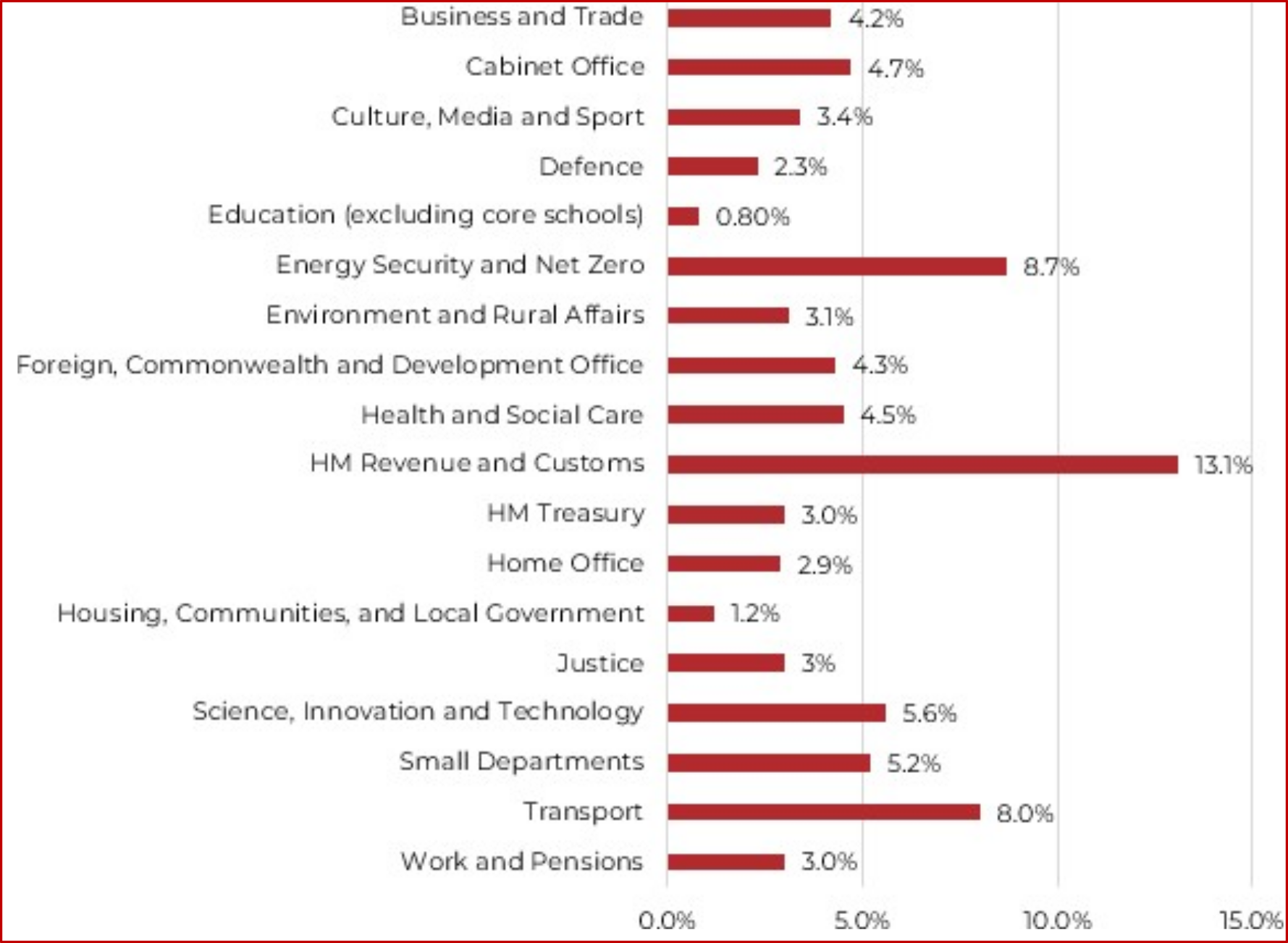
*DfE plans to spend £7.8 billion RDEL on non-frontline services in 2025-26. Total efficiencies net of investment excluding frontline services is 3.2% in 2028-29.
**Taking into account the impact of MHCLG projects and programmes on local government, there will also be efficiency gains for local government who will then be able to recycle these gains into frontline services.
Efficiencies were in most cases driven by a small number of common areas of opportunity (see Figure 2). The largest gains came from digital, data and AI, with automation and online services making up a third of the total. Policy and structural reforms also played a major role, accounting for a similar share.
Figure 2: 2028-29 efficiencies by theme
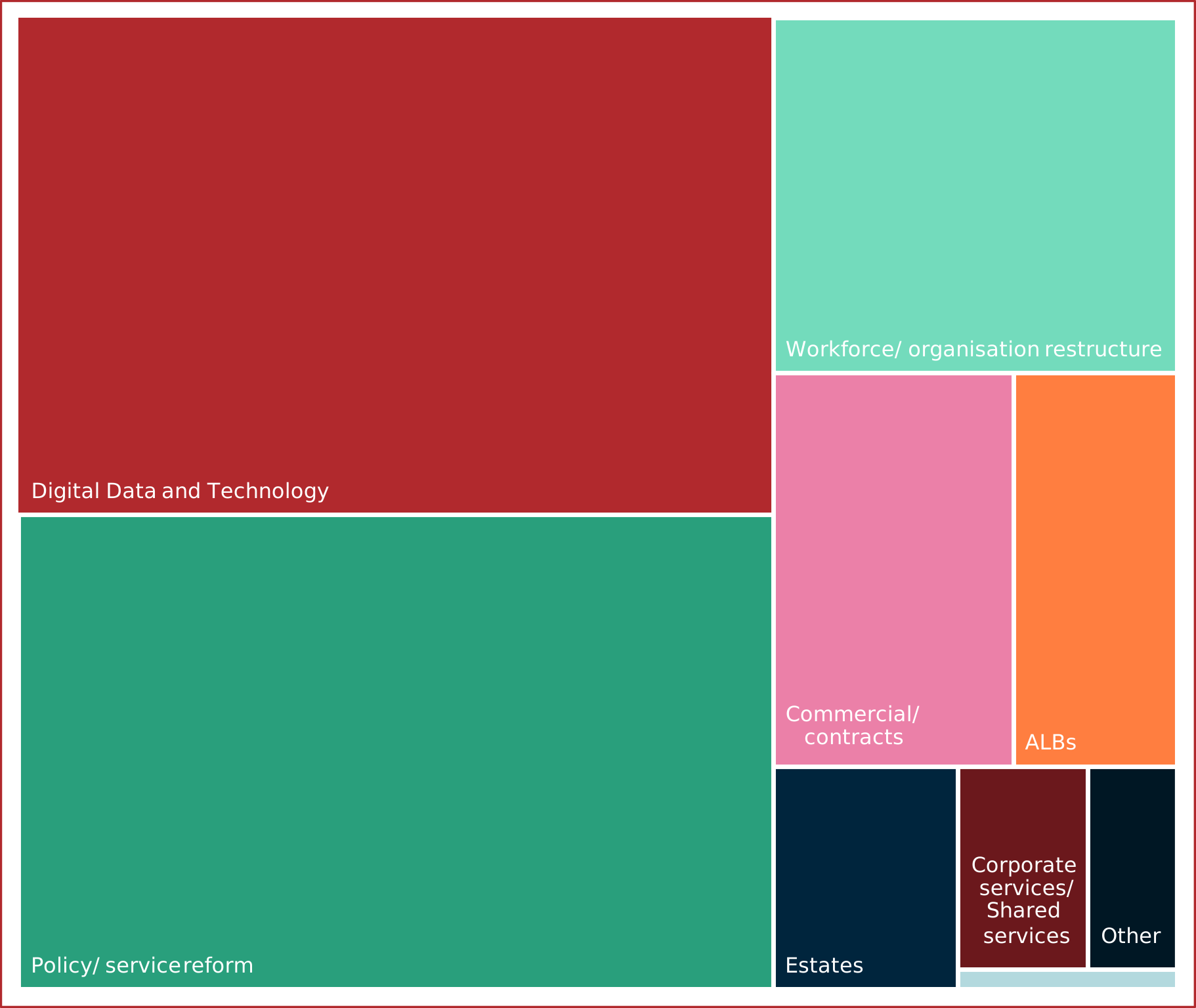
- Small blue section in the bottom right represents grants and funding simplification
Box 1: Efficiency Delivery Plans
Efficiencies set out by departments in their delivery plans included:
- The Ministry of Defence delivering £315 million of efficiency gains per year by 2028-29 by streamlining its acquisition process to reduce duplication and bureaucracy.
- The Ministry of Housing, Communities and Local Government radically simplifying funding for local government, thereby providing councils with more flexibility and certainty over a greater portion of their income, and cutting wasteful bureaucracy.
- The Department for Culture, Media and Sport reducing its estate footprint across a number of its public bodies and the core department by combining back-office sites, reducing office space no longer needed, and leasing out spare museum storage space.
The publication of delivery plans will enable greater external scrutiny, public accountability and sharing of best practice. Departments will report on progress against these targets through their Annual Report and Accounts, in line with the definitions and requirements set out in the updated Government Efficiency Framework. HM Treasury will be responsible for monitoring the performance of departments against their bespoke targets and for convening departments to allow for the sharing of best practice.
The National Audit Office (NAO) commented positively on the changes introduced by the OVfM: “ensuring that efficiencies represent genuine improvements as opposed to spending cuts, developing clear plans to support targets, and ensuring rigorous follow-up of progress, are all important principles for achieving sustainable efficiencies.”
Bespoke efficiency targets and plans in future
In line with a recommendation from the OVfM, the government has committed to an expectation of at least 1% efficiencies for all departments in future years, backed by plans for how they will be delivered. To support this commitment, the government will publish bespoke departmental efficiency targets and plans biennially, embedding a culture of continuous improvement backed up by greater confidence in delivery. This process will be led in future years by HM Treasury, who will also monitor performance against agreed targets.
10 Year Efficiency Projections
External commentators, such as the NAO[footnote 1] and Institute for Government[footnote 2] have argued that successive governments and HM Treasury are too focused on short-term affordability and fiscal targets when making spending decisions, to the detriment of programmes where benefits are delivered over the medium or long-term.
To start to address this longstanding criticism, the OVfM has published a supplementary report setting out the investments and expected long-term efficiency gains for a selection of programmes funded at SR25. This document builds on and complements the efficiencies exercise conducted at SR25, by setting out the efficiency projections for up to 10 years. The document covers a range of investments announced at SR25, including an example of moving from treatment to preventative spend:
- children’s social care – including funding to roll-out the Families First Partnership, a new system of help and protection designed to prevent need from escalating and help children stay with their families where possible;
- NHS technology transformation – including funding for the Future Workforce Solution, which will replace the existing Electronic Staff Record system with a new, scalable, user-centric, and data-driven system;
- shared services clusters – which will improve and expand shared services by replacing legacy IT systems and consolidating back office functions, creating economies of scale and reducing costs that arise from maintaining separate functions within individual departments rather than operating a single shared service across several; and
- HMRC digital services – including funding to improve the experience of users of government digital services.
Increased transparency will ensure departments have greater accountability for delivering efficiencies over the longer-term, providing HM Treasury with greater confidence that these investments will be value for money and a stronger incentive to fund them. This, in turn, should provide departments with greater incentive to develop robust efficiency proposals to tackle long-term issues for future spending reviews, even where the efficiency gains in the spending review period do not exceed the investment.
This document is intended to act as a prototype to support departments to develop their modelling capability to enable a greater focus on long-term VfM and could allow HM Treasury to conduct a similar exercise in future.
4. Tackling inefficient coordination
Many of the government’s key policy priorities require coordination and collaboration across departmental boundaries and this is only becoming more necessary as the government focusses on outcomes. A failure to efficiently coordinate can lead to siloed services, and competition between different parts of the public sector which can drive up costs, and lead to resources being wasted.
That is why the Office for Value for Money (OVfM) has sought to tackle inefficient coordination across government, particularly where that results in escalating costs and poor outcomes. This means developing a more systematic approach to collaborating across government and tackling barriers to cross-departmental working in a pragmatic way.
This chapter covers two ways the OVfM has addressed inefficient coordination. Ahead of Spending Review 2025 (SR25), the OVfM completed a value for money (VfM) study on short-term residential accommodation – an example of a major spending issue where existing arrangements are increasingly undermined by poor coordination between departments and local authorities.
Informed by this study, the OVfM subsequently recommended, and ministers agreed, a reform to the spending framework which ensures future spending reviews are better set up to resolve particularly complex and cross-cutting spending issues.
Planning and procurement of short-term residential accommodation
The OVfM conducted a study into the planning and procurement of short-term residential accommodation by the public sector given the high risk to VfM in this area. There is a high risk to VfM because of a lack of coordination and planning in procurement of short-term residential accommodation, a steep rise in costs, and likely ongoing reliance on it in the short-term.
To improve VfM, the OVfM worked with others in government to develop principles for a future approach to procuring short-term residential accommodation. These principles are: moving towards greater local delivery to support integration and outcomes, with national planning and coordination to support a longer-term approach, underpinned by new procurement models and measures to support required capacity.
Moving to this future approach would be complex and take time, but the steps the government has taken are already showing benefits. The Ministry for Housing, Communities and Local Government and the Home Office are working with local government to test new locally-led models and these will inform future decisions on the implementation of the principles for the future approach.
Thematic VfM reviews
Resolving particularly complex and cross-cutting spending issues, like short-term residential accommodation, takes time and the sustained involvement of a range of interested parties. Therefore, drawing on the approach taken to VfM studies at SR25, the OVfM secured the government’s commitment to a reform of the public spending framework which involves undertaking a programme of rolling thematic VfM reviews in the years between spending reviews.
These thematic VfM reviews will ensure the government is tackling key challenges in cross-cutting and high-risk areas of public spending as effectively as possible. They will ensure spending reviews are better set up to coordinate spending on related activities and initiatives, improving overall VfM and addressing gaps in delivery and risk management. They will do this by identifying options for reform in areas with increasing costs or poor VfM, to inform decisions in the spending review that takes place in the subsequent year.
The approach to thematic reviews will build on international good practice and lessons learned from the OVfM’s targeted VfM studies carried out at SR25. This approach will involve officials from different departments working together in the years between spending reviews on analysis and policy options for significant public service reform. The reviews will be coordinated jointly by HM Treasury and relevant departments, ensuring they are implemented with a focus on realising benefits from every pound of public spending.
As announced at Budget 2025, the Chief Secretary to the Treasury will lead a process, with Secretaries of State, to review value for money across government spending ahead of the next spending review. This will include reviewing:
- new models of care within the NHS and communities, as part of implementing the 10 Year Health Plan, to help shape a system that delivers earlier intervention and preventative care where possible;
- youth provision, to better align with the ambitions of the National Youth Strategy and maximise the value and impact of out-of-classroom support for young people;
- homelessness services, to assess funding and delivery models, including ways to improve the supply of good value for money and good quality temporary accommodation and supported housing, such as greater coordination and planning in procurement between different parts of the state; and
- maintenance of public assets, to protect the value and function of the infrastructure, buildings and equipment that deliver public services.
These reviews will build evidence and potential solutions ahead of the next spending review, so that government support delivers better outcomes and better value for money.
Overall, the OVfM expects this reform to ensure continuous improvement to public services, as it institutionalises a mechanism for assessing systemic problems between spending reviews and collaboratively developing solutions across departments.
5. Next Steps
The Office for Value for Money (OVfM) was intended to be a time-limited intervention to improve the focus on VfM, rather than a permanent addition to the existing structures in government. This means the OVfM has targeted areas where it could have most impact. As a result, the OVfM has successfully delivered on its remit, including identifying almost £14 billion per year of efficiencies by 2028-29, four reforms to the spending framework which aim to leave a legacy of concrete improvements to value for money (VfM), and identifying improvements to two high-risk areas of public spending.
Having delivered on its remit as set by the Chancellor of the Exchequer (included as Annex A), the OVfM has now closed. The Chair would like to thank all departments, ministers and officials across HM Treasury, and external organisations for their contributions to the OVfM’s work. Their expertise, collaboration, and commitment have been instrumental in delivering the OVfM’s objectives and supporting HM Treasury’s wider mission of ensuring VfM in every pound of public money spent.
The OVfM has provided a solid foundation for continuous improvement in VfM in public spending both at SR25 and in the run up to SR27 and beyond. This will require sustained focus, so the OVfM has ensured there are clear and agreed implementation plans to ensure the reforms have a sustained impact.
HM Treasury, including the National Infrastructure and Service Transformation Authority (NISTA), is mainstreaming the OVfM’s core functions and is focused on implementing the following reforms:
- improving the controls and accountability framework that will see the business of government become more efficient by reducing the cost of activities and increasing capacity and speed of delivery;
- requiring all departments to deliver at least 1% technical efficiencies a year, underpinned by credible plans, repeating the OVfM’s successful efficiencies exercise at every future SR;
- undertaking biennial thematic VfM reviews, informed by the lessons learned from the OVfM’s VfM studies; and
- the bespoke approach to governance and budgeting arrangements for mega projects, working closely with those leading delivery of the projects.
HM Treasury has published an evaluation of the OVfM alongside this report.
Annex A: The OVfM’s remit
| Commitment | Action | Output |
|---|---|---|
| Conducting an assessment of where and how to improve efficiency | SR25 bespoke efficiency targets and credible delivery plans | Published at SR25 |
| 10 Year Efficiency Projections | Published at Budget 2025 | |
| Undertaking a small number of VfM studies in specific high-risk areas of cross-departmental spending | VfM study on the governance and budgeting arrangements for mega projects | Outcomes published in UK Infrastructure: A 10 Year Strategy |
| VfM study on short-term residential accommodation | Outcomes published in UK Infrastructure: A 10 Year Strategy | |
| Scrutinising investment proposals | OVfM appraisal criteria | Published on gov.uk |
| Scrutiny of SR25 investment proposals against appraisal criteria | Private advice to Ministers | |
| Reforms to the framework for public spending | Requiring all departments to deliver at least 1% efficiencies a year, repeating the OVfM’s successful efficiencies exercise at every future SR. | Published at SR25 with implementation plans set out in final report |
| Undertaking biennial thematic VfM review, informed by the lessons learned from OVfM’s VfM studies. | Set out in final report | |
| Implementing changes to how the government manages mega projects. | Set out in final report | |
| Implementing reforms to improve the controls and accountability framework | Set out in final report | |
| Evaluation | Evaluation following published evaluation plan | Published at Budget 25 |
-
A planning and spending framework that enables long-term value for money, National Audit Office, 27 October 2024 https://www.nao.org.uk/wp-content/uploads/2024/10/lessons-learned-a-planning-and-spending-framework.pdf ↩
-
A dominant Treasury is causing problems for government, Institute for Government, 17 Jan 2024 https://www.instituteforgovernment.org.uk/press-release/treasury-orthodoxy-problems-for-government#:~:text=The%20Treasury%20is%20also%20too,the%20quality%20of%20spending%20decisions ↩