MHCLG appraisal guide: technical annex
Updated 18 February 2026
Applies to England

© Crown copyright 2026
This publication is licensed under the terms of the Open Government Licence v3.0 except where otherwise stated. To view this licence, visit nationalarchives.gov.uk/doc/open-government-licence/version/3 or write to the Information Policy Team, The National Archives, Kew, London TW9 4DU, or email: psi@nationalarchives.gov.uk.
Where we have identified any third party copyright information you will need to obtain permission from the copyright holders concerned.
This publication is available at https://www.gov.uk/government/publications/the-mhclg-appraisal-guide/mhclg-appraisal-guide-technical-annex
Introduction
This Technical Guide provides further detail on some of the key appraisal methods outlined in the fourth edition of the MHCLG’s Appraisal Guide. The aim of this guidance is to ensure that Ministers and other decision makers have robust evidence on value for money when making policy and investment decisions.
This document is being published alongside:
- MHCLG’s main Appraisal Guide which provides an introduction to how MHCLG and partner interventions should be appraised;
- The HAUS economic model and user guide for assessing the health impacts of urban design interventions; and
- Two case studies showing how the HAUS model has been used to model the health impacts of urban interventions.
I am very pleased to recommend the use of this Technical Guide and related documents as a means of helping to deliver better evidence-based policy making. This is a living document and I look forward to future improvements that should make it even more helpful.
Stephen Aldridge,
Director for Analysis and Data
Ministry of Housing, Communities and Local Government
List of abbreviations
AH Affordable Housing
AONB Area of Outstanding Natural Beauty
AST Appraisal Summary Table
BAU Business as Usual
BCR Benefit Cost Ratio
BRE Building Research Establishment
CORE Continuous Recording of Lettings and Sales in England (MHCLG survey)
GMCA Greater Manchester Combined Authority
GHG Greenhouse Gas
GVA Gross Value Added
HE Homes England
LVU Land Value Uplift
MV Market value
NAO National Audit Office
NPSV Net present social value
OB Optimism bias
PDL Previously Developed Land
PRP Private Registered Providers
PRS Private Rented Sector
PVB Present Value of Benefits
PVC Present Value of Costs
PWF Preferred Way Forward
RCF Reference Class Forecasting
SR Spending Review
SRS Social Rented Sector
TA Temporary Accommodation
VfM Value for Money
VOA Valuation Office Agency
MHCLG Appraisal Group
The MHCLG Appraisal Group is responsible for overseeing the development of appraisal guidance in MHCLG and ensuring it is communicated and applied effectively within MHCLG and across partner organisations. The group covers all areas of appraisal relevant to MHCLG and Homes England.
- Stephen Aldridge, Chief Analyst at MHCLG
- Prajesh Bij, Deputy Director, Central Analysis, Data Exploration & Support & Co-Chair of the Appraisal Group
- Shayan Moftizadeh, Deputy Director, Central Analysis, Data Exploration & Support & Co-Chair of the Appraisal Group
- Andrew Charlesworth-May, Lead Co-ordinator & Analyst for Appraisal Guide
- Stephen Meredith, Deputy Director, Housing Investment, Supply & Planning Analysis
- Scott Dennison, Deputy Director, Housing Analysis for Homelessness, Resettlement, Tenure & Social Housing
- Andrew Wallis, Chief Economist, Homes England
- Ben Toogood, Deputy Director, Local Government Finance Analysis
- Catherine Barham, Deputy Director, Evaluation and Research
- Fay Graves, Deputy Director, Communities, Devolution & Growth Analysis
- Paul Vickers, Deputy Director, Buildings Resilience & Fire Analysis
- Amy Sippitt, Head of Elections Research & Analysis
- Jo Brotherhood, Head of Economics, Homes England
- Chris Holton, Senior Economist, Housing Analysis for Homelessness, Resettlement, Tenure & Social Housing
- Gemma Weston, Senior Economist, Housing Analysis for Homelessness, Resettlement, Tenure & Social Housing
- Jen Fleming, Senior Economist, Housing Analysis for Homelessness, Resettlement, Tenure & Social Housing
- Amy Lee, Senior Economist, Buildings Resilience & Fire Analysis
- David Craine, Senior Economist, Buildings Resilience & Fire Analysis
- Thomas Annable, Senior Economist, Buildings Resilience & Fire Analysis
- Daniel Kirby, Senior Economist, Communities, Devolution & Growth Analysis
- Chloe Mitchell, Senior Economist, Communities, Devolution & Growth Analysis
- James Caddick, Senior Economist, Local Government Finance Analysis
- Stephen Smith, Senior Economist, Local Government Finance Analysis
- Danny Fellowes, Senior Economist, Housing Investment, Supply & Planning Analysis
- Ollie Popescu, Senior Economist, Housing Investment, Supply & Planning Analysis
- Robert Mills, Senior Economist, Housing Investment, Supply & Planning Analysis
- Lesley Smith, Head of Evaluation, MHCLG
Technical annexes
Annex A: Assumptions List
A1 This annex sets out recommended assumptions to use in a MHCLG appraisal. Separate annexes are supplied for some assumptions which require more detailed discussion. In some instances – such as with additionality and optimism bias – the relevant assumptions should be formed on a case-by-case basis, taking into account the guidance provided.
Appraisal period
A2 This should be at the discretion of the user, with a key objective being to strike the right balance between capturing all material impacts in the cost-benefit analysis and maintaining a reasonable level of confidence in the results (given the exponential rise in uncertainty with respect to time). However, costs and benefits should normally be extended to cover the period of the useful lifetime of the assets under consideration. Recommended defaults should be 10, 30 or 60 years, depending on the intervention being considered and - if there is an asset - its expected lifetime.
A3 It is important when deciding the dates over which the appraisal is conducted to allow for the delivery trajectory. For example, if an asset with an expected lifetime of 30 years was to be completed 5 years after the current period t, then the impacts would be measured up to year t+35. If the asset took 4 years to build then these costs would be appraised from t to t+4.
A4 Longer appraisal periods are likely to be required for residential and non-residential development and environmental interventions, while shorter appraisal periods may be appropriate for policy and regulatory changes (a ten-year period can be considered the default). It may be appropriate to include an allowance for the ongoing value of an asset where the appraisal period is truncated.
Distributional weights
A5 The Green Book provides guidance on the use of distributional weights in cost benefit analysis. The use of distributional weights will be most relevant to policies that have a significant progressive element to them (that is policies that benefit low income individuals relatively more than high income individuals). If so, then distributional weights can be used in the calculation of the BCR but the judgement made on the size of any distributional weights should be made clear for decision makers. Any distributional weighting of impacts should be presented alongside unweighted impacts. See Annex H for an example of how distributional weights have been applied in housing.
Existing economic use value
A6 Land value uplift is the difference between the economic value of land in its new use and that in its existing use (see the main Guide chapter 4). To estimate the land value uplift that would be caused by an intervention, it is necessary to estimate the existing economic use value of the land. Where local land value data is not available VOA estimates can be used.
A7 In cases where there is no active economic use of the site and there will not be for the foreseeable future without public sector intervention, it may be appropriate to apply an existing use value of zero.
External impacts of development
A8 Land value uplift aims to capture the net private benefit associated with a development. However, there are external impacts not accounted for in the land value uplift which should be considered in an appraisal. Some external impacts have well established methodologies - for example, valuing carbon emissions - but others, particularly those specific to development, require further work so they can be operationalised into an economic appraisal. A selection of these external impacts is given in the main Guide chapter 5. However, all external impacts should be considered in an appraisal and form part of the value for money assessment.
Gross Domestic Product (GDP)
A9 If the appraisal involves using future GDP levels or requires the uprating of a variable in line with GDP, the default data to use should be the Office for Budget Responsibility’s (OBR) latest GDP forecast. This can be found on the OBR’s website.
Holding costs
A10 If land is owned by the public sector then the public sector will incur holding costs. These include for example maintenance of land and buildings on the site, maintaining its security and environmental standards. In the absence of site specific evidence then industry standards indicate these can be assumed to be 2% of the existing value of the land per year. Should the land be developed then these holding costs will be avoided.
House prices
A11 The OBR produces a forecast of the mix-adjusted house price index (based on the existing Office for National Statistics indices) at a national level. These are published as part of OBR’s Economic and Fiscal Outlook and can be found in their supplementary economy tables. If necessary, future nominal prices beyond the forecast period should be assumed to be in line with long term nominal per capita income growth, consistent with OBR’s forecasting methodology. These can be converted into real values using the GDP deflator (see inflation section below). House price assumptions need to be internally consistent with assumptions made on house building rates. In some instances, it may be appropriate to deviate and co-vary both sets of assumptions in sensitivity analysis.
A12 Depending on the spatial distribution of the policy, it may not be appropriate to use national assumptions for house prices. Users may wish to consider housing cycles at a sub-national level to convey divergences in house price growth at different spatial scales, within the bounds of the national forecast. However, price growth should be assumed to converge towards the long-term growth rate of income, as before.
Inflation
A13 The following should be used to adjust prices from nominal to real terms:
- for short time horizons, whole economy inflation (the “GDP deflator”) from the most recent forecasts by the OBR
- for long time horizons, forecasts of the GDP deflator published in the OBR Fiscal Sustainability Report (FSR)
- for longer time horizons, beyond the end of the OBR’s FSR, the GDP deflator should be extrapolated using the growth rate in the final year of the OBR’s projection
A14 Where particular goods or services play an important role in an appraisal, e.g. if building materials or particular types of labour make up a large element of costs, then bespoke inflation assumptions could be used. However these need to be developed in a rigorous way with input from experienced analysts. For business cases which go to MHCLG and HMT, assumptions will need to be agreed with the Department’s Appraisal Group and by HMT spending teams. ONS also publish industry level deflators.
Land value growth
A15 Land represents a factor of production. Its real value increases over time according to increases in its productivity. Unless there is more specific evidence to the contrary, it should be assumed for appraisal purposes that the future value of land increases in line with real GDP per capita growth rates (see GDP section).
Learning rates
A16 Where particular prices are expected to increase at significantly higher or lower rates than general inflation, the relative price change should be calculated and factored into the economic appraisals.
A17 Cost and performance of different technologies can change over time as manufacturers and installers develop processes and technologies that improve performance and reduce costs through experience. For instance, if the size of the market for a particular good or service increases, then there is a greater potential for economies of scale, and relative prices may then also be expected to reduce.
A18 An evidenced estimate for appropriate learning rates for such technologies should be applied. An example of where learning rates have been applied is in new energy technologies including solar and wind power. For business cases which go to MHCLG and HMT, assumptions will need to be agreed with the Department’s Appraisal Group and by HMT Green Book team.
Opportunity cost of public sector assets
A19 Where the public sector owns an asset (e.g. land) in an intervention option, the market value of that asset (or opportunity cost of that asset) should be accounted as a cost in Year 1 of the appraisal, for all options.
A20 Under an option where the public sector holds the asset until the end of the appraisal period, its market value in the final year of the appraisal should be entered as a receipt.
A21 Any income streams or costs to the public sector as a result of holding the asset should also be quantified and included in the appraisal. Here, the receipt from disposal should be accounted for in the denominator of the BCR by netting off public sector costs.
Optimism bias
A22 Optimism bias (OB) is the systematic tendency for forecasts to underestimate costs and overestimate benefits. Costs and benefits need to be adjusted for OB to gauge the robustness of the value for money of a project.
A23 OB should be used to inform decision makers about the risks of costs being higher and benefits being lower than forecast. It is therefore a useful concept in assessing the robustness of a project’s overall value for money. All value for money metrics should be calculated with OB included.[footnote 1]
A24 In the absence of more specific information, the level of OB to apply to costs should be based on the Green Book supplementary guidance on OB. However, where there is more recent and local evidence on the appropriate OB to apply than the supplementary guidance this should be used.
A25 Homes England provides additional advice to the Green Book on how optimism bias might be applied to residential projects. This is set out in Annex F.
A26 There are a number of difficulties with applying OB to estimated benefits - users are free to decide the most appropriate way of accounting for the risk that the estimated benefits will not materialise. In the context of land value uplift, this includes recognising that some of the land value may not be realised due to atypical costs and inefficient firms. However, it should be recognised that when local land value data is used, these risks may, to a large extent, already be accounted for in the private valuation of the land.
Present value year
A27 All future impacts should be discounted back to a common year to calculate their present value. The discount rate should be Green Book consistent. The recommended default should be to discount impacts back to the earliest of the following: the year in which the first public investment is made, the year in which the project opens or the year in which the policy takes effect.
Sunk costs
A28 Sunk costs refer to expenditure or payments already incurred and should be excluded from the appraisal of social value. What matters are costs and benefits affected by decisions still to be made and this should form the central case.
Unit of account
A29 As per Green Book guidance, costs and benefits should normally be presented in market prices rather than in factor prices. This ensures that all goods and services are compared on the basis of a common measure.
A30 Factor costs for businesses and government, which do not pay VAT, must be converted into market prices using the indirect taxation correction factor. The latest estimate is published in the TAG Data Book by DfT.
Annex B: Appraisal summary table example
B1 A leading aerospace manufacturer is considering investing in a regeneration area but requires a government loan to address a market failure in the lending market. The development is on brownfield land and involves significant ‘clean-up’ costs. The manufacturer claims that without this government support they will invest abroad. This example considers only two spending options (in practice a wider range of options would be considered). As this Annex is about how to complete an AST, a number of simplifying assumptions are made. In particular that there is 100% additionality, so no displacement of economic activity occurs elsewhere in the UK. (This is very unlikely in practice.)
Option 1 (preferred option)
B2 The preferred option is a large capital investment from the manufacturer which is forecast to create 1,000 high skilled jobs, it is assumed that these jobs go to local residents and are better paid than existing jobs. The benefits have not been quantified and monetised as the project is at an early stage but are expected to be large.
B3 The investment will also improve the amenity value of the brownfield land in the surrounding area. This amenity value is estimated to be around £10 million over 30 years. The clean-up costs allowing for optimism bias are estimated to be £30 million.
B4 Illustrative Valuation Office Agency (VOA) data on land value uplift suggests such a development would result in a land value uplift of around £30 million.[footnote 2] The manufacturer requires MHCLG to fund the full £30 million clean-up cost in 2025 but is willing to repay £20 million of this over 30 years.
B5 There will be some impact on traffic flows from changes in work trips but the impact on congestion is expected to be a relatively small adverse effect as there is spare road capacity on local roads.
Option 2
B6 An alternative option is a smaller capital investment from the firm in a nearby area. There would be 500 high skilled jobs which again for simplicity are assumed to go to local workers and increase their wages. However the level of wage benefits is smaller than under Option 1.
B7 The amenity value of the brownfield land would improve by £5 million over 30 years. The clean-up costs are estimated to be £15 million.
B8 Illustrative VOA data on land value uplift suggests such a development would result in a land value uplift of around £15 million. For this option, the manufacturer requires MHCLG to fund the full £15 million clean-up cost in 2022 but is willing to repay £5 million of this over 30 years.
B9 There are unlikely to be traffic disbenefits given existing spare road capacity in the area.
B10 The AST table 1 below illustrates how the central VfM category is decided. (Information on VfM categories and switching values is set out in the main Guide.)
| Option 1 | Option 2 | ||
|---|---|---|---|
| A | Present Value of Monetised Benefits (£m) | 20 | 15 |
| B | Present Value Public Sector Costs (£m) | 10 | 10 |
| C | Net present social value (£m) [A-B] | 10 | 5 |
| D | Benefit-Cost Ratio [A /B] | 2 | 1.5 |
| E | Non-monetised impacts | ||
| Employment Impacts | Very large beneficial | Medium Beneficial | |
| Traffic Impacts | Small adverse | Neutral | |
| Costs (after OB allowed for) | Neutral | Neutral | |
| F | Change in benefits and costs required to switch VfM category | ||
| Benefits | £20m increase (Very High) £5m fall (Medium) |
£5m increase (High) £5m fall (Acceptable) |
|
| Costs | £5m fall (Very High) £3.4m increase (Medium) |
£2.5m fall (High) £0.1m increase (Acceptable) |
|
| G | Most likely VfM Category | High | Medium |
| H | Key Assumptions and uncertainties that might affect VfM | 1. Level of local employment and wage uplift generated by location of high tech factory. 2. Level of congestion caused by extra jobs |
1. Level of local employment and wage uplift generated by location of high tech factory. 2. Level of congestion caused by extra jobs |
| I | MHCLG Financial Cost, £m | £30m in 2025/26 | £15m in 2025/26 |
| J | Residual risk & optimism bias allowances | 20% of costs | 20% of costs |
| K | Life span of project | 30 years | 30 years |
VfM Discussion
- Table 1 shows that Option 1 has a higher Benefit Cost ratio than Option 2 (2 compared to 1.5).
- Both Option 1 and 2 are likely to have positive non-monetised impacts with wage uplift impacts outweighing congestion impacts.
- However Option 1 is likely to have the largest non-monetised impacts because it will affect more workers.
- As both the Benefit Cost ratio and non-monetised impacts are greater for Option 1 than 2 and Option 1 more effectively meets key local objectives around better jobs it is assessed as being the preferred option.
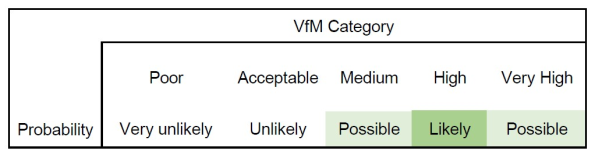
- Overall Option 1 is assessed as being High VfM. For it to be Very High VfM non-monetised benefits would have to be greater than £20m.[footnote 3] This is possible but not as likely as High VfM. Costs are unlikely to rise as optimism bias has been included so it is unlikely the VfM of Option 1 will slip to Medium.
- The distribution of possible VfM categories for Option 1 is shown below.
Detailed Calculations
B11 The detailed calculations underlying the Benefit Cost Ratio and NPSV calculations are shown below.
Table 2: Calculations underlying AST
| Option 1 relative to counterfactual (preferred option) | Option 2 relative to counterfactual (low cost option) | |
|---|---|---|
| Land value uplift (a) | 30 | 15 |
| Clean-up cost initially funded by MHCLG (b) | 30 | 15 |
| Manufacturer payment to MHCLG (c) | 20 | 5 |
| Initial MHCLG financial cost (d) | 30 | 15 |
| Improved Amentity Value (e) | 10 | 5 |
| Present Value Monetised Benefits (f) = (a) + (e) – (c) |
20 | 15 |
| Present Value Costs (g) = (b) – (c) |
10 | 10 |
| Net present social value = (f) - (g) | 10 | 5 |
| Benefit Cost Ratio = (f) / (g) | 2 | 1.5 |
Annex C: Land value uplift for residential development
C1 The methodology for appraising development is explained in the main Guide chapter 4. This annex provides further detail on how the methodology can be applied to the appraisal of residential development. This methodology is also set out in TAG.
C2 Where local land value data is available, this should be used in the first instance. This could be informed by a site-specific development appraisal. This would provide evidence on the GDV likely to be realised from that specific site, as well as the build costs and fees a developer would incur, which would be needed in addition to the land’s current use value.
C3 Where local land value data is not available, Valuation Office Agency (VOA) estimates can be used.
C4 The value to society of a decision to grant permission for residential development may be separated into:
- the private benefit associated with the change in land use, as represented by the change in value arising from the land moving from its current use to a more productive use. This change is defined as the value of the land in its new use (in this case residential) minus the value of the land in its existing use (e.g. agriculture)
- the net external impact of the resulting development (see the main Guide chapter 5 for a full list of external impacts to be considered)
C5 The equation becomes:
Net private value of housing =
New use of land value [1] - Existing land use value [2]
Net social value of housing
= Net private value of housing
+ Net external impact of housing developments [3]
C6 A range of infrastructure is required to facilitate new development, including water, sewerage and electricity connections. The impacts of granting planning permission may be attributed jointly to the land use development and any accompanying infrastructure improvements, including those relating to transport. It would not be appropriate to ascribe the impacts to the development in isolation.
C7 Note that costs of infrastructure, whether borne by developers or by the exchequer, do not affect the overall valuation of the change in land use outlined above. However, the incidence of infrastructure costs does have distributional effects – to the extent that developers contribute towards these costs, we would expect the costs to be ‘passed back’ to landowners in the negotiated price of undeveloped land, so reducing the surplus that otherwise accrues to landowners on the grant of permission.
Residential land value [1]
C8 The residual method of land valuation gives the maximum price a firm is willing to pay for land for development. As noted in the main Guide chapter 4, the developer will also incur costs and would expect a minimum level of profit from developing a site. In a competitive market, the firm will pay a price that gives a normal level of profit.
Residential land value (or price of developed land)
= hectarage of housing x residential land value per hectare
C9 Users must firstly calculate the hectarage of housing. The total value of the land in planned residential use is then estimated by multiplying that hectarage by a per hectare residential land value. Alternatively, the residential land value may be estimated by other means, for example:
Residential land value
= GDV - build costs - externals - professional fees - sales costs
- finance costs - contingencies - normal level of developer profit
C10 Any abnormal costs not covered in the above values should then be netted off as a disbenefit to the private sector.
C11 For appraisal, the Green Book advises that transfers of resources between people (e.g. gifts, taxes, grants, subsidies or social security payments) should be excluded from the overall estimate of Net Present Social Value (NPSV). Market land values are reduced by affordable housing requirements, which allocates a proportion of the total value to society of new housing towards building additional affordable housing.
C12 The values published in MHCLG ‘Land value estimates for policy appraisal’ are already adjusted in this way, so as to provide values for appraisal which reflect the full value to society of new housing. Where local land value estimates are used these should also be prepared so as to exclude, for example, the impact of affordable housing requirements on prices.
Existing land use value [2]
Existing land use value
= {hectarage of dependent housing on PDL
x per hectare value of land in industrial use}
+ {hectarage of dependent housing on non
- PDL x (per hectare) value of land in agricultural use}
Note: PDL = previously developed land
C13 Users must then calculate the hectarage split between previously developed land (PDL, also known as ‘brownfield’) and undeveloped land (non-PDL, also known as ‘greenfield’), of the land for residential development. The overall value of the land in existing use is then estimated by multiplying the PDL and non-PDL hectarages by corresponding per hectare values.
C14 For PDL, a regional-level per hectare value for industrial and warehouse land can be used; for non-PDL, a regional-level per hectare value for agricultural land in mixed use can be used. The MHCLG ‘Land value estimates for policy appraisal’ publication’ contains average value estimates for industrial and agricultural land in England, though users may draw upon alternative sources of evidence to inform estimation of land values in areas of dependent development.
Net external impact of housing development [3]
Net external impact of housing development
= {hectarage of dependent housing on non
- PDL x per hectare external impact of development on non
- PDL} + transport related external impact of development
C15 The existing hectarage split between PDL and non-PDL for development is also used to estimate the overall value of the external impact of the development. For non-PDL, estimates of the external benefits of undeveloped land are set out in the main Guide chapter 5. The mean average of the reported estimates of external benefits of 4 types of land: urban fringe (forested land), urban fringe (greenbelt), intensive agricultural land and extensive agricultural land can be used.
C16 For PDL, the external impact of development has not been monetised, though in certain circumstances redevelopment might bring external benefits through, for example, improving the aesthetic value of the area surrounding the development (see the Main Guide Chapter 5).
C17 Users may draw upon alternative sources of evidence to inform estimation of the external impacts of development.
C18 As noted earlier, there is a further external impact of development to be considered in the overall valuation - the transport costs imposed on existing users of the network by residents of the new development. These transport-related external impacts of development should be added to the non-transport-related external impacts discussed above (see the main Guide chapter 5 for further details).
Qualification to [3] when applying the wider area impacts approach
C19 In regeneration areas, to avoid double counting, the wider area impacts approach set out in the main Guide chapter 5 should be used rather than the external impacts identified in equation [3]. The main Guide chapter 5 provides a calculator to assess impacts in regeneration areas.
Development in future years
C20 For any additional housing that is expected to be delivered in future years, land value uplift should be uprated in line with real per capita GDP growth each year. This assumption is in line with the discussion set out in the house price and land value growth sections. To simplify and in the absence of further data, we assume that this applies to all elements of net social land value uplift including agricultural land values, industrial land values, and externality values.
C21 Given the uncertainty surrounding future house prices it is recommended that sensitivity analysis is carried out to test the robustness of the results. The sensitivities to be applied will depend on forecast GDP per capita growth, but a reasonable range would be:
- a low sensitivity given by nominal growth in line with price inflation (that is a 0% real increase in house prices and LVU per annum)
- a high sensitivity of a 5% increase in house prices and land value uplift above inflation, which is consistent with previous appraisal guidance assumptions
Annex D: Land value uplift for non-residential development
D1 This Annex describes MHCLG’s approach to valuing the impacts of non-residential development.
- The preferred approach involves the use of local land value data to assess the private costs and benefits of a policy.
- In the absence of reliable local land value data, an approach using illustrative VOA land value data is outlined.
D2 Even where local data is available it may be useful to cross-check estimates using VOA data. Large discrepancies should be investigated further to find out what is driving them.
The approach
D3 The value to society of a planning decision to grant permission for new non-residential development may be separated into:
- the private benefit associated with the change in land use, as represented by the uplift in value arising from the land moving from its current use to a more productive use. This uplift is defined as the value of the land in its new use (in this case commercial) minus the value of the land in its existing use (e.g. agriculture)
- the net external impact of the resulting development, including any loss or gain in amenity
D4 The equation below summarises this:
Net private value of non - residential development
= Non - residential land value [1] - Existing land use value [2]
Net social value of non - residential development
= Net private value of non - residential development
+ Net external impact of non - residential development [3]
The calculation
D5 Below is a discussion of the key elements of the appraisal, including the data inputs and underlying assumptions. Note that a number of data inputs must be specified by the user on a case-by-case basis as they relate to the nature of the development in question.
Non-residential land value [1]
D6 The total value of the land in planned non-residential use is estimated by multiplying the hectarage of land by a per hectare non-residential land value.
Non - residential land value = Hectarage x Land value per hectare
a) Locally available land value data is available
D7 Where possible locally derived land value data should be used to estimate the land value post-development. It should be noted that in practice land values vary substantially on a site-by-site basis, given differences in, for example, proximity to amenities or density of development. As land value estimates are one component of subjective residual valuations made by developers, it is important that an explanation for how these estimates are derived is clearly set out in the economic dimension of a business case:
- the valuation of a site should be based on the most valuable possible use, rather than the highest value that could be obtained for its current use
- an assessment of the value of a site in the most valuable alternative use should be based on the advice of a suitably qualified and experienced valuation surveyor. Either in-house valuers or external experts can be commissioned to carry out the valuation
- valuations should be based on the definitions of ‘market value’ (MV) used in the ‘RICS Valuation of Professional Standards’ (the Red Book). Valuations should take into consideration the prospects for development and the presence of any purchaser with a special interest, insofar as the market would do so
- site values used should follow the Green Book guidance on prices where market prices may need to be adjusted to show the full value to society.
D8 Users are encouraged to draw upon alternative sources of evidence to inform estimation of land values in areas of dependent development. Any site values based on recent sales should be consistent with the intended development on:
- business use of site: for example commercial property can be used as an industrial plant, a logistics warehouse, a hi-tech lab or as office space and the value generated by each of these developments is very different
- state of development of site: represent typical levels of value for sites that are ripe for development, in that they have the following conditions:
- no abnormal site constraints
- a planning permission of a type generally found in the area
- services to the edge of the site
- measurements: the size of the site should be consistent
- locally available land value data is not available
D9 The preference is to use locally derived land value data to estimate both the existing land value and future non-residential land value. Where these are not available, typical values estimated by the VOA can be used.
D10 The VOA provides non-residential land value estimates at Local Enterprise Partnership (LEP) area level. Values are available for agricultural use, industrial use and commercial use. For industrial and commercial values, estimates for multiple areas within LEP area are available and users should use their judgement as to which is most appropriate for the area they are appraising. For commercial values, values are available for both city centre and out of town offices (or for London, inner or outer London) and again users should use their judgement as to which is appropriate. VOA’s non-residential land values should be regarded as illustrative and represent typical levels of value for sites for development. They should be regarded as being at market prices (that is gross of indirect tax).
D11 As noted above land values vary substantially on a site-by-site basis, given differences in, for example, proximity to amenities or density of development. Users are therefore encouraged to draw upon alternative sources of evidence to inform estimates of land values.
D12 The economic dimension of the business case should clearly set out the justification for choices made in use of land value data.
Existing land use value [2]
Existing land use value = Hectarage x Land value per hectare
D13 Where locally available data is available users may draw upon those sources of evidence to inform estimation of land values.
D14 Where locally available data is not available then typical values estimated by the VOA can be used.
Net external impact of housing development [3]
Net external impact of non - residential development
= [Hectarage x per hectare external impact of a development]
+ Transport related external impact of a development
D15 Users may draw upon alternative sources of evidence to inform estimation of external impacts of development. A conservative assumption may be to assume that the net external impact of non-residential development is zero even though redevelopment may bring external benefits through, for example, improved aesthetic value of the area surrounding the development.
D16 The overall benefits related to the development are therefore:
The net social value of the development is
= Net private value of non - residential development [1] - [2]
+ Net external impact of non - residential development [3]
In which the land value uplift estimate captures the net private benefits and the net external impact captures externalities such as changes in amenity.
Costs
D17 All public sector costs should be included. If the land is owned by the public sector then it will be incurring holding costs. These costs include, for example, maintenance of land and buildings on the site, maintaining its security and environmental standards. In the absence of site specific evidence these can be assumed to be 2% of the existing value of the land per year (see holding costs). Should the land be developed then these holding costs will be avoided. This needs to be reflected in the appraisal as a negative cost. Any private costs associated with the development should be included in the appraisal as a disbenefit and therefore feature in the numerator of the BCR calculation.
Appraisal period
D18 Expected to be 10, 30 or 60 years, depending on the intervention being appraised.
Timing
D19 The land value uplift is assumed to happen at the same time as a change in land use. There is no assumption that benefits are built slowly over a specified time period. All other costs and benefits will need to be discounted at 3.5 per cent per annum in line with the HMT Green Book.
Multiple sites
D20 Where there are multiple sites an overall BCR may be calculated provided there is a positive uplift on all sites.
Additionality
D21 Not all economic activity associated with the land value uplift of an intervention will be additional – some will be displaced from other locations and some might have occurred in the absence of the intervention (deadweight). As a result, in an economic appraisal the land value uplift associated with an intervention should be adjusted for additionality.
D22 For example, it would be expected that the additionality of the land value created would be relatively high for an intervention where there is strong market failure (e.g. access to finance), a strong strategic rationale (e.g. clustering of similar industries meaning investment in an alternative location is unlikely), where the development is in a low displacement sector and where there is limited alternative uses for the land. Where these considerations do not hold additionality is likely to be significantly lower. Annex E provides some illustrative values to use when assessing additionality.
A worked example
D23 Assume a policy option being appraised is a grant of £3.7 million for the second phase of works at a 39 acre site owned by the public sector. The land is highly contaminated and the grant is to be used to remediate the land. The remediation of the land would enable businesses to move to an area where there is an existing cluster of businesses in a highly productive sector. Also assume that an additional £4.2 million of infrastructure works including road and electricity works simultaneously goes ahead to increase the site’s commercial viability. These costs were incurred by the public sector. The land is publicly owned with holding costs of approximately £65,000 per year.
D24 There is data available on the current value of the land and the value of the land post remediation. The future land value estimate is based on the sale of a piece of land in a similar state of development and to be used for the same business use.
Table 3: Worked example for non-residential development
| Factor | Detail |
|---|---|
| Site area | 39 acre (≈ 15 hectares) |
| Primary cost | £3.7m grant for remediation |
| Other costs | £4.2m infrastructure works in the first year. A negative holding cost to the public sector without intervention (assumed £65k per year) |
| Existing use land value estimate | £30,659 per acre |
| Future use land value estimate | £200,000 per acre |
D25 Costs: the costs are valued as the net present value costs to the public sector. The costs include the £4.2 million infrastructure works and the £3.7 million grant less the negative (avoided) annual public holding cost of £65,000. Using the 3.5% discount rate this gives a net present public sector cost of £7.1 million (appraised over 10 years for simplicity).
D26 Net private value: the net private value is calculated using the land value estimates set out above. The new use land value of £200,000 per acre gives a total value of £7.8 million over 39 acres.[footnote 4] Subtracting the £1.2 million[footnote 5] existing land value (before remediation) gives a net present private value of £6.4 million rounded to the nearest hundred thousand and after discounting by 3.5% to reflect the fact it takes a year to remediate the land.[footnote 6]
D27 Net external impact: the net external impact is estimated to be zero. This is a conservative estimate since there may be an amenity value from the redevelopment. Therefore, the present value benefit of the development is £6.4 million.
D28 BCR: the BCR before an additionality factor is applied is:

D29 Additionality: the above calculation assumes 100% additionality, that is that the firm which ‘takes over’ the site only does so as a result of the intervention and there is no displacement of economic activity elsewhere. However, although it is reasonable to argue that there would be no deadweight (given the BCR is less than one indicating such an investment by the private sector would not happen as it would not be commercially viable), there may still be some displacement of economic activity from elsewhere.
D30 Sensitivity analysis: sensitivity analysis can be used to see how the BCR might change if assumptions were altered with respect to additionality. Sensitivity analysis should look at both costs and benefits. For example:
a. Benefits – it might be that the land price after intervention is overly optimistic or only a proportion of the site is wanted by firms so that benefits are lower. If this occurred and benefits were reduced by for example 10%, the BCR would fall to £5.8m/£7.1m = 0.8.
b. Costs – Alternatively the costs of remediation or of additional public sector infrastructure might be different from central estimates. Three illustrative examples are shown in the table of a 40%, 100% and 150% increase in total costs (initial land value, remediation + other infrastructure-less holding costs).
D31 For example, a 100% increase in costs leads to BCR=£6.4m/£14.2m = 0.45. The BCRs for the other two cost increases are shown in the table below.
Table 4: BCRs with varying levels of optimism bias
| 10% lower benefits | 40% higher costs | 100% higher costs | 150% higher costs | |
|---|---|---|---|---|
| BCR | 0.80 | 0.65 | 0.45 | 0.35 |
D32 Switching values: sensitivity analysis can also be used to identify a ‘switching value’ where the VfM moves to a different band. This can be used to examine non-monetised impacts as well as uncertainty in monetised impacts. In the example the potential for amenity benefit from the development is examined. The question is, “How big does this amenity benefit need to be for the BCR to be 1, 1.5 or 2, for example?”
Table 5: Increase in land values required from external amenity impact to shift to new BCR
| BCR = 1 | BCR = 1.5 | BCR = 2 | |
|---|---|---|---|
| Required additional benefits for given present value costs of £7.1m | £700,000 | £4,250,000 | £7,800,000 |
| Additional amenity value required per acre (to nearest £1,000) | £18,000 | £109,000 | £200,000 |
D33 As the sensitivity analysis shows, the BCR of the development could fall to as low as 0.65 if Optimism Bias of 40% was applied to the costs of the remediation. The BCR could be 1 if the post-remediation value of the land was approximately £18,000 per acre higher than the £200,000 it has been estimated at, or if the value of the net external impact of development was valued positively at 11% of the value of the private benefit instead of being valued at zero. With no other impacts to consider - and given that the size of the amenity benefits needs to be relatively large even if 100% additionality is assumed - then this policy option could be considered Poor value for money.
Annex E: Estimating additionality
E1 This chapter provides guidance on quantifying the size of the additionality for residential and non-residential developments.
E2 Additionality is the real increase in social value that would not have occurred in the absence of the intervention being appraised. For developments the key factors involved in assessing additionality are:
a) Deadweight – defined as the level of target outputs/outcomes that would have been produced if the intervention did not go ahead. This involves estimation of what scale and type of development, if any, would have taken place on the site in the absence of intervention, and over what time frame.
b) Displacement – defined as the level of outputs/outcomes (occurring under the counterfactual and the intervention options) accounted for by reduced outputs/outcomes elsewhere in the target area.[footnote 7]
E3 Where interventions are targeted on particular areas or target groups (e.g. low income groups or particular industries/commercial groups) then leakage also becomes relevant. This represents the proportion of outputs that do not go to the target group/area. High rates of leakage indicate that that the intervention is failing to achieve its key objectives. Analysis of leakage is a key part of distributional analysis.[footnote 8]
E4 To estimate the correct level of additionality it is essential to properly determine the counterfactual and work through the logic model of the intervention. This involves clarifying the chain of causation through which inputs translate into outputs and outcomes, both desirable and otherwise.
E5 The approaches to measuring additionality in residential and non-residential developments are set out below.
Box 1: The link between additionality and VfM
There is a direct link between the size of the additionality associated with a policy option and the estimated VfM. This is particularly important to note when private benefits represent a significant proportion of overall benefits. When this is the case, in the absence of a sound rationale for intervention such as a market failure, it would be reasonable to assume that in the absence of government intervention these private benefits would materialise anyway. This would suggest such a policy option would have significant deadweight and minimal additionality, and therefore be poor VfM. However, where there is evidence of a market failure preventing a development from taking place in the absence of government intervention, it would be reasonable to assume there is less risk of deadweight and greater levels of additionality associated with the policy (meaning higher VfM).
Additionality for residential developments
E6 Three key factors determine the extent of additionality:
- the degree to which there is a clear market failure which means that market outcomes are suboptimal (e.g. development is too low because of failure to take account of positive externalities, or there are credit constraints on small builders due to asymmetric information)
- whether the focus of the intervention is on the demand or supply side of the residential market. Demand side policies tend to have higher elements of displacement than supply side policies as they do not initially increase the volume of housing stock (that occurs in response to subsequent price increases)[footnote 9]
- the point in the housing cycle. In economic upswings housing interventions are likely to be in greater competition for resources with existing planned activity, leading to greater displacement
E7 Ex-ante assessment of additionality is often extremely difficult to quantify, and therefore any figures used should be subject to rigorous sensitivity analysis as part of the appraisal. Users may wish to calculate a switching value of additionality that gives an overall BCR of 1 (or NPSV of zero) for the policy, that is, what number or percentage of dwellings would need to be genuinely additional in order for benefits to exactly equal costs.
E8 The following bullets set out potential additionality assumptions that could be used in the absence of alternative evidence to help inform the value for money of a housing intervention:
-
0-25% additionality: policies which fall into this category will be demand focussed. The market failure underpinning the intervention may also be less prevalent than in the past (such as access to finance, though we may still expect this to be significant for Small and Medium Enterprises). These policies are therefore likely to have a very large amount of deadweight and displacement associated with them.
-
25-50% additionality: policies which fall into this category may be demand or supply focussed but the level of additionality is higher because of the point in the housing cycle when the intervention takes places, and / or because the market failure (ideally supported by local evaluation evidence) is stronger. For example, the policy may be targeted at a particular group like Small and Medium Enterprises (SMEs) or first time buyers. Deadweight or displacement is likely to be large.
-
50-75% additionality: policies which fall into this category will usually be supply focussed with good supporting evidence justifying the additionality assumption. Deadweight and displacement are likely to be relatively small. An example would be Affordable Housing where there is strong evidence to suggest housing of this type is unlikely to be built by private developers in the absence of policy and very little crowding out of private development occurs in practice.
-
75%+ additionality: policies which fall into this category will usually have a strong supply focus with good supporting evidence. Deadweight and displacement are likely to be small. For example, it could cover a situation where there are relatively high ‘clean-up’ costs which mean the site is unviable (and so would not go ahead in the counterfactual) and there are no other sites available in the local area. There could also be a condition of funding that housing would need to be delivered on top of local plans. The site may also be located in an area of high housing need. General economic conditions might also be relatively muted, maximising any additional impacts on the demand side (if applicable).
Specific evidence for supply side housing interventions
E9 Specific evidence on the additionality of supply side housing interventions has been developed by AMION. AMION has calculated deadweight and displacement ready reckoners to provide approximate estimates of each impact. Figures 1a and 1b below show the ready reckoner flowchart for both deadweight and displacement. These should be followed to calculate deadweight and displacement for supply side housing interventions.
Deadweight ready reckoner
E10 In most cases the preferred approach to assessing deadweight is to construct a bespoke counterfactual built on evidence-based judgments. However as a general guide to analysts, a deadweight ready reckoner is provided to indicate how the deadweight associated with supply-side housing projects could be assessed.[footnote 10] It provides a plausible range of deadweight values associated with different types of project. The degree of deadweight that should be applied will vary according to judgement of the significance of individual factors and the strength of the evidence.
Displacement ready reckoner
E11 The displacement ready reckoner is based on regression analysis carried out by AMION to estimate displacement associated with government supported projects. It is designed to be used to support the estimate of displacement for supply-side housing projects. Key factors affecting displacement have been identified as local housing market affordability; development activity in the local area; the scale of the development; and the proportion of homes that are non-market homes.
E12 To estimate total additionality the following formula should then be used once the deadweight and displacement calculations have been made:
Additionality = (1 - deadweight) * (1 - displacement).
E13 There are 2 important caveats to these ready reckoners:
- they should only be applied to supply side housing interventions
- they do not assess leakage, place based or distributional impacts. Where these are judged to be important by the user, further analysis would need to be done to understand their impacts in line with the Green Book
Figure 1a: Flowchart for calculating deadweight
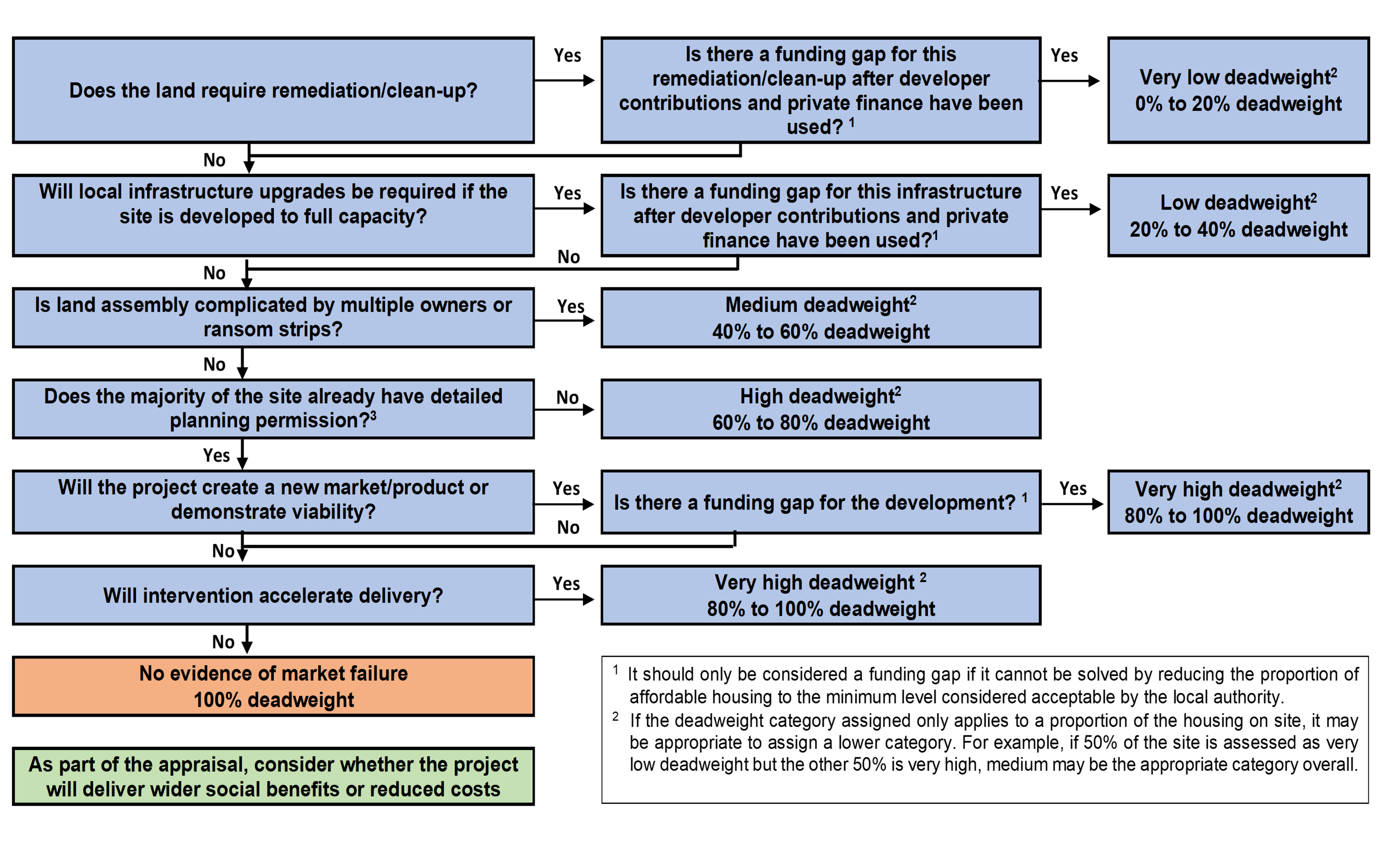
Does the land require remediation/clean-up?
Yes > Is there a funding gap for this remediation/clean-up after developer contributions and private finance have been used?1 > Yes > Very low deadweight2 0% to 20% deadweight
No > Will local infrastructure upgrades be required if the site is developed to full capacity? > Yes > Is there a funding gap for this infrastructure after developer contributions and private finance have been used?1 > Yes > Low deadweight2 20% to 40% deadweight
No > Is land assembly complicated by multiple owners or ransom strips? > Yes > Medium deadweight2 40% to 60% deadweight
No > Does the majority of the site already have detailed planning permission? > No > High deadweight2 60% to 80% deadweight
Yes > Will the project create a new market/product or demonstrate viability? > Yes > Is there a funding gap for the development?1 > Yes > Very high deadweight2 80% to 100% deadweight
No > Will intervention accelerate delivery? > Yes > Very high deadweight2 80% to 100% deadweight
No > No evidence of market failure 100% deadweight
As part of the appraisal, consider whether the project will deliver wider social benefits or reduced costs
1It should only be considered a funding gap if it cannot be solved by reducing the proportion of affordable housing to the minimum level considered acceptable by the local authority. 2If the deadweight category assigned only applies to a proportion of the housing on site, it may be appropriate to assign a lower category. For example, if 50% of the site is assessed as very low deadweight but the other 50% is very high, medium may be the appropriate category overall.
Figure 1b: Flowchart for calculating displacement
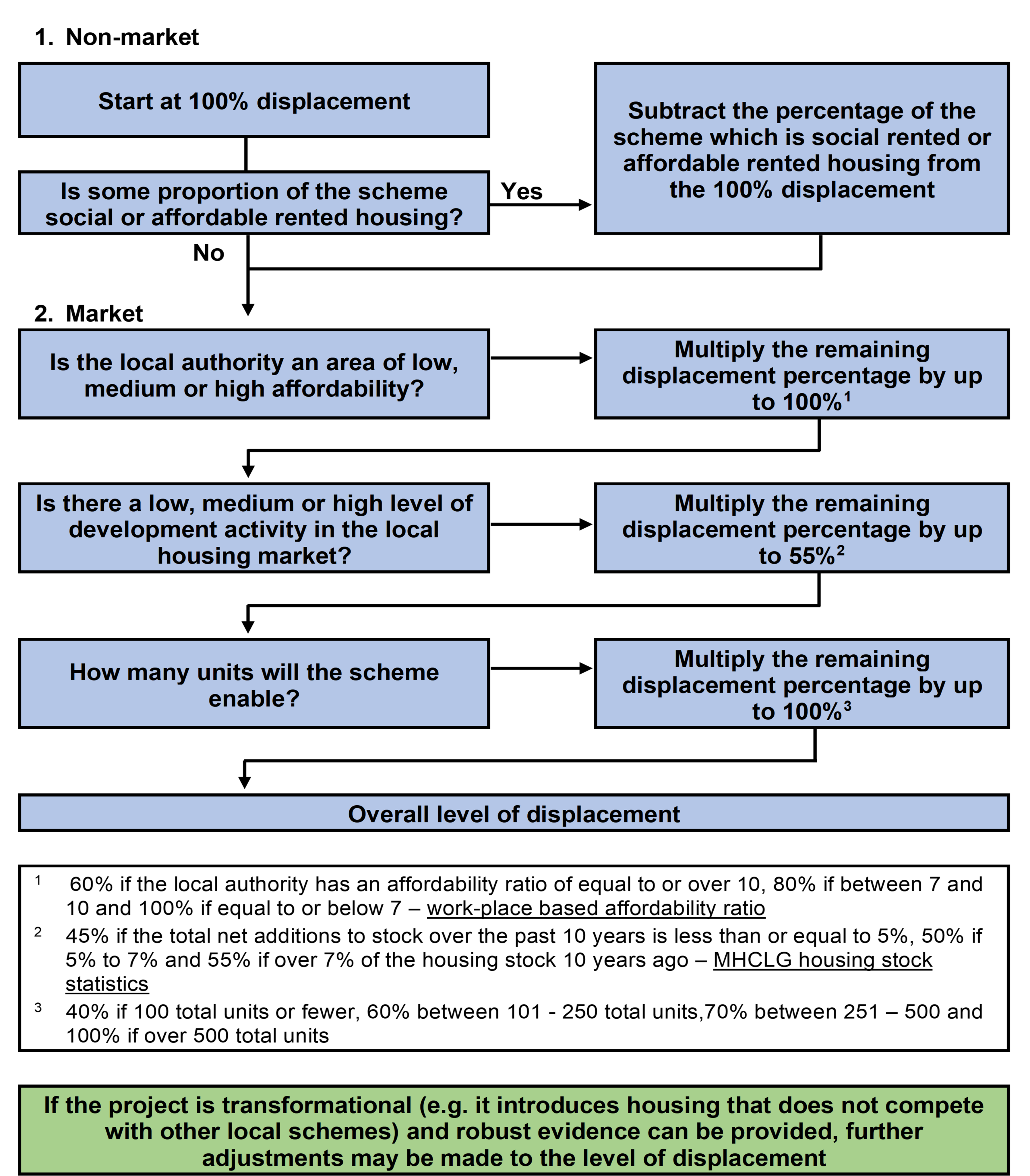
1. Non-market
Start at 100% displacement > Is some proportion of the scheme social or affordable rented housing?
Yes > Subtract the percentage of the scheme which is social rented or affordable rented housing from the 100% displacement
No > Go to 2. Market
2. Market
Is the local authority an area of low, medium or high affordability? > Multiply the remaining displacement percentage by up to 100%1
Is there a low, medium or high level of development activity in the local housing market? > Multiply the remaining displacement percentage by up to 55%2
How many units will the scheme enable? > Multiply the remaining displacement percentage by up to 100%3
Overall level of displacement
160% if the local authority has an affordability ratio of equal to or over 10, 80% if between 7 and 10 and 100% if equal to or below 7 – work-place based affordability ratio 245% if the total net additions to stock over the past 10 years is less than or equal to 5%, 50% if 5% to 7% and 55% if over 7% of the housing stock 10 years ago – MHCLG housing stock statistics 340% if 100 total units or fewer, 60% between 101 - 250 total units,70% between 251 – 500 and 100% if over 500 total units
If the project is transformational (e.g. it introduces housing that does not compete with other local schemes) and robust evidence can be provided, further adjustments may be made to the level of displacement.
Box 2: Example of the application of deadweight and displacement calculators
A local authority is bidding for £1 million to unlock a site which will release 1.5 ha of brownfield land for the residential development. The final site will have 60 units, of which 20 units will be affordable or social rent. It is currently a riverside industrial site with significant decontamination costs, demolition, and flood defence requirements, for which the local authority is seeking a grant to part meet costs. The bid includes an industry standard valuation of the site and an estimate of the cost of works based on similar schemes. The affordability ratio in the local authority is 8.5, and the total net additions to stock over the past 10 years is 6.5%.
Deadweight - The deadweight of the scheme is assessed as between 0% and 20%, with a central estimate of 20% to reflect that a proportion of the site is likely to be developed in the future without addressing the abnormal costs in the remainder of the site. Most of the land within the site requires significant remediation and clean up before it can be used for development. There is clear evidence from the site-specific valuation that it is the additional costs related to this that creates a funding gap / viability issue which will prevent most of the site being developed. There are no reasonable changes to the scheme, such as reducing the proportion of affordable housing, that would be acceptable within local planning guidelines.
Displacement - the level of displacement depends on the proportion of social/affordable rented housing, the level of affordability, the level of development and the number of units built. Based on the example:
Displacement = (100% – % of social/affordable rent) x medium affordability (80%) x medium development activity (50%) x number of units (40%)
= (1 - 0.33) x 0.8 x 0.5 x 0.4 = 11%.
The final additionality of the scheme is (1 – deadweight) x (1 – displacement)
= (1 – 0.2) x (1 – 0.11) = 71%.
Additionality for non-residential developments
E14 As the main Guide chapter 4 explains, one way of accounting for potential displacement and deadweight is to adjust the gross land value uplift estimates of an intervention. To guide users on how this adjustment could be done, the framework set out in Figure 2 could be used in conjunction with sensitivity analysis in a non-residential appraisal. Please note, the sizes of the adjustment factors are purely a guide. If there is evidence on the appropriate size of these adjustment factors then this should be used in the first instance. In the absence of this information, the illustrative figures can be used.
E15 The framework in Figure 2 sets out various criteria that would need to apply for there to be minimal displacement and deadweight from a particular intervention. For example, the existence of a market failure and strong strategic rationale for a development coupled with the industry under consideration being in a relatively low displacement sector would lead to high additionality being assumed. This might be a firm wishing to expand in a geographic area where there is a clustering of industry it would benefit from being near to but being unable to do so because of a failure in the lending market. In this case a relatively small downward adjustment would be made to the gross land value, for example 75% of the gross land value might be used in the appraisal.
E16 On the other extreme, where there is a weak market failure and strategic rationale for intervening, and where the industry under consideration suffers from significant displacement (such as retail), the gross land value would be significantly adjusted downwards, with the net impact being 25% or less of the gross land value created.
E17 The levels of existing vacancy rates in the non-residential sector will also be important. Where vacancy rates are high for the relevant sector then levels of additionality are likely to be low and additionality assumptions should be adjusted to reflect this.
E18 Analysts will need to exercise judgement on the appropriate size of the adjustment to use taking into account the criteria below. As part of any sensitivity analysis, it may be useful to calculate a ‘switching value’ that is the size of the additionality factor required to make the development NPSV positive.
E19 The sensitivity analysis on the land value estimate, as well as the potential for non-monetised impacts and the externalities in Chapter 5 of the main Guide should inform value for money category and BCR. In particular, this sensitivity analysis will be useful in arriving at an overall judgement on the value for money category and the range it takes.
Figure 2: Additionality framework for non-residential development
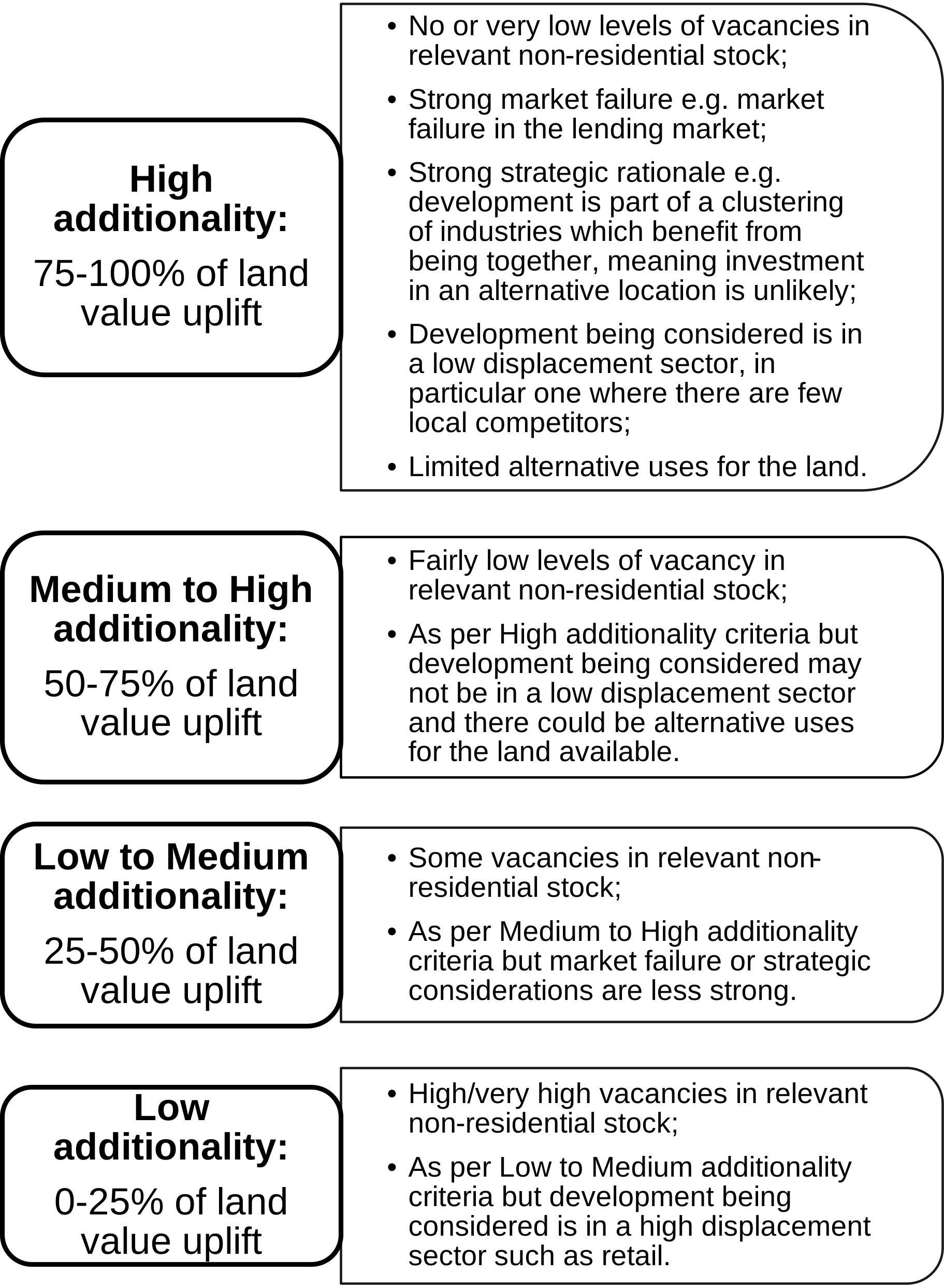
High additionality: 75-100% of land value uplift
- no or very low levels of vacancies in relevant non-residential stock
- strong market failure e.g. market failure in the lending market
- strong strategic rationale e.g. development is part of a clustering of industries which benefit from being together, meaning investment in an alternative location is unlikely
- development being considered is in a low displacement sector, in particular one where there are few local competitors
- limited alternative uses for the land
Medium to High additionality: 50-75% of land value uplift
- fairly low levels of vacancy in relevant non-residential stock
- as per High additionality criteria but development being considered may not be in a low displacement sector and there could be alternative uses for the land available
Low to Medium additionality: 25-50% of land value uplift
- some vacancies in relevant non- residential stock
- as per Medium to High additionality criteria but market failure or strategic considerations are less strong
Low additionality: 0-25% of land value uplift
- high/very high vacancies in relevant non-residential stock
- as per Low to Medium additionality criteria but development being considered is in a high displacement sector such as retail
Annex F: Homes England Optimism Bias guidance
Optimism bias on capital costs
F1 This annex provides advice to support analysts in determining the appropriate level of optimism bias (OB) to apply to costs in the appraisal of Homes England’s interventions.
F2 There are 2 parts to this annex:
- The first summarises new research that sets out a Reference Class Forecasting (RCF) approach for projects and programmes supported by Homes England to better inform judgements by building on HMT’s optimism bias supplementary guidance. This should be used as the core approach to estimating OB.
- The second provides guidance on the practical application of the HMT OB supplementary guidance in the context of residential development projects. This should be used as a sensitivity test for the RCF approach.
Part 1: Optimism Bias and Contingency at Homes England
F3 Homes England has published new research[footnote 11] that sets out a RCF approach for Homes England’s interventions. The RCF approach uses evidence on the performance of a broad pool of past projects to inform an assessment of the risk of cost overruns of individual components of project spend of new projects at different points in the project lifecycle. This research can be used to construct project specific estimates for OB based on the pool of past projects and to inform the assessment of contingency requirements in the financial case. Section 5 of the Homes England guidance provides further detail on how RCF can be used, alongside other methods such as Quantitative Risk Assessment and expert judgement, to determine contingency requirements in the financial case.
F4 Importantly the RCF approach recognises the need to consider a range of outcomes that may be expected, rather than focusing on a single point estimate. From the perspective of OB this allows for the range of uncertainty to be considered and interpreted by analysts when drawing conclusions on VfM.
F5 Section 5 of the Homes England guidance provides detail on how to apply the research in the context of economic appraisal. The guidance highlights that the following scenarios should be considered when forming a judgement on a central OB estimate and conducting appropriate sensitivity tests.
- Central estimate – The P-mean RCF should be used.[footnote 12] This is a trimmed mean based on the P5 to P95 values and so excludes the impact of any outliers in the dataset.
- Standard sensitivities – The P50 and P80 estimates should be presented as standard sensitivity tests unless alternatives are more appropriate. Where alternatives are used, the rationale for these should be explained within the business case document.
- Contingency level – Where the proposed level of contingency in the financial case falls outside the range of the standard sensitivities, the economic case should be tested at the proposed contingency level so that the value for money implications of that level of cost can be interpreted.
- Optimism Bias – A sensitivity test should be included in the economic appraisal at the level suggested by the standard Green Book adjustments (see Part 2 below).
- Further sensitivity testing – Where proportionate, further sensitivity testing may be undertaken to, for example, test the switching value for the value for money category. This may be most relevant where the value for money category changes across the P50-P80 range and further understanding of the risk to value for money is required to inform the analysis.
Part 2: Application of HMT OB supplementary guidance in the context of residential development projects
Spend categories
F6 The HM Treasury supplementary guidance on OB should also be used when considering OB within economic appraisal. Where RCF is being used, as per Part 1 above, the section below can be used to inform the suggested sensitivity test at the level suggested by the standard Green book adjustment (the fourth bullet from the list in Part 1).
F7 The table below provides the upper and lower bounds presented in the Green Book supplementary guidance on OB. The upper bound reflects the average OB found for traditionally procured projects pre-procurement and the lower bound reflects the level of OB to be applied at the point of contract award for projects with effective risk management. The starting point for projects will be the upper bound.
F8 For larger projects it may be necessary to undertake an assessment of OB separately for each phase in recognition of the different stage of development of those phases. For example, if there was an early phase that was already contractually committed the lower bound OB may be appropriate, whereas for a future phase yet to be developed the upper bound might be applied.
| Capital Expenditure Optimism Bias % | ||
|---|---|---|
| Upper | Lower | |
| Standard Buildings | 24 | 2 |
| Non-Standard Buildings | 51 | 4 |
| Standard Civil Engineering | 44 | 3 |
| Non-Standard Civil Engineering | 66 | 6 |
| Equipment/Development | 200 | 10 |
| Outsourcing | 41 | 0 |
F9 Within the Green Book supplementary guidance and other associated documents, several definitions are provided to help to explain the categories of spend included in the table above. The table on the following page aligns these categories with definitions applicable to residential and commercial development projects.
F10 When considering these definitions, it may be necessary to divide a project into several component parts so that the relevant level of OB can be applied to each component. For example, where a project involves constructing a new school building and a new road there may be elements of buildings and elements of civil engineering.
F11 The breakdown by these components can then be used to generate a blended OB rate that can be used as an input to the appraisal model.
| Category | Definition |
|---|---|
| Standard Buildings | The construction of buildings where a standard approach to design can be used. For example, where there is a greenfield site with few constraints impacting on design. Buildings could include the construction of offices, living accommodation or schools. |
| Non-Standard Buildings | The construction of buildings where a non-standard approach to design is required. Characteristics of a site where a non-standard approach is required may include: - Space constraints - Brownfield sites - Refurbishment projects - Innovative buildings - Other complicated site characteristics Buildings could include the construction of offices, living accommodation or schools. |
| Standard Civil Engineering | Those facilities, in addition to buildings, where no special design considerations are required. For example, where there is a greenfield site with few constraints impacting on the design. Facilities could include the construction of roads and utilities. |
| Non-Standard Civil Engineering | Characteristics of a site where a non-standard approach is required may include: - Space constraints - Brownfield sites - Other complicated site characteristics - Unusual output specifications - Innovative transport infrastructure or upgrade/extension projects - Innovative utility projects Facilities could include the construction of roads and utilities. |
| Equipment/Development | The provision of equipment and/or the development of software and systems. |
| Outsourcing | The provision of hard and soft facilities management services. |
Contributory factors and mitigations
F12 Within the Green Book supplementary guidance percentage contributions to the upper bound rates are given for a series of contributory factors, allowing for the upper bound OB rate to be reduced based on an assessment of the extent to which each has been mitigated within the scheme.
F13 To standardise the process for the assessment of development schemes, we pose a series of questions linked to these contributory factors. The responses to these questions will then be used to apply a standardised set of mitigation factors to the upper bound OB rate.
F14 Consideration should be given to whether the responses to the questions would be the same for all options under consideration or whether the responses and so level of OB may need to vary by option.
F15 The table below lists these questions, the responses and proposed level of mitigation of the associated contributory factor by response. These are based on the detail within the appendix to the Green Book supplementary guidance and Appendix E from the 2002 Mott MacDonald study.
F16 Those listed as N/A relate to categories not linked to capital cost mitigations for buildings or civils within the Greenbook supplementary guidance. We also assume no mitigation against the ‘other’ categories listed.
| Procurement | ||||
|---|---|---|---|---|
| Questions | Response 1 | Response 2 | Response 3 | |
| Complexity of contract structure | Is a standardised contract structure being used? | Yes (100% mitigated) | No (0% mitigated) | |
| Late contractor involvement in design | Was the contractor involved in the scheme design? | Contractor fully responsible for design (100% mitigated) | Contractor consulted on design (50% mitigated) | No or contractor not yet appointed (0% mitigated) |
| Poor contractor capabilities | Has the contractor successfully completed projects of a similar scale and nature previously? | Yes and with Homes England (100% mitigated) | Yes but not with Homes England (50% mitigated) | No or contractor not yet appointed (0% mitigated) |
| Government guidelines | N/A | |||
| Dispute and claims occurred | Has a disputes resolution and claims process been agreed with the contractor? | Yes, a standardised process is being used that has been tested with this contractor previously (100% mitigated) | Yes, a process has been agreed but not yet tested (50% mitigated) | No or contractor not yet appointed (0% mitigated) |
| Information management | N/A | |||
| Other | No mitigation assumed |
| Project specific | ||||
|---|---|---|---|---|
| Questions | Response 1 | Response 2 | Response 3 | |
| Design Complexity | Are there any design complexities? E.g. resulting from site conditions or interaction with other infrastructure. | No, work is taking place on greenfield site with no interaction with other infrastructure (100% mitigated) | Yes (0% mitigated) | |
| Degree of Innovation | Are innovative methods being used? | Yes (0% mitigated) | No, all methods are tried and tested (100% mitigated) | |
| Environmental Impact | Is there the potential for a planning objection to the scheme based on environmental impacts (e.g. wildlife, biodiversity, noise, pollution, or contamination)? | Yes, highly likely (0% mitigated) | Yes, but unlikely (50% mitigated) | No, there is no environmental impact or all planning permissions in place (100% mitigated) |
| Other | No mitigation assumed |
| Client specific | ||||
|---|---|---|---|---|
| Questions | Response 1 | Response 2 | Response 3 | |
| Inadequacy of the business case | Has a business case been prepared that; - establishes clear project objectives; - defines requirements; - fixes project scope; and - has been agreed with all stakeholders. |
A business case has been prepared, agreed with all stakeholders and all necessary approvals have been granted (66% mitigated) | A business case has been prepared and agreed with some stakeholders (33% mitigated) | The business case is still being developed (0% mitigated) |
| Large number of stakeholders | N/A | |||
| Funding availability | Has sufficient funding been committed to cover the full cost of the project? | Yes, funding sources identified and approvals sought but may be subject to future business planning and/or spending reviews (66% mitigated) | No (0% mitigated) | |
| Project Management team | Has project management team successfully delivered projects of a similar scale and nature previously? | Yes (100% mitigated) | No (0% mitigated) | |
| Poor project intelligence | Have detailed ground investigations and/or surveys have been completed? | Yes and no risks have been identified (100% mitigated) | Yes and some risks have been identified (25% mitigated) | No, further investigations/surveys are planned (0% mitigated) |
| Other | No mitigation assumed |
| Environment | ||||
|---|---|---|---|---|
| Questions | Response 1 | Response 2 | Response 3 | |
| Public relations | Is there expected to be any opposition to the project? E.g. due to environmental impacts, noise, traffic. | Yes, highly likely (0% mitigated) | Yes, but unlikely (50% mitigated) | No, there are no external impacts (100% mitigated) |
| Site characteristics | Does the site have any sensitive environmental characteristics? E.g. protected species, archaeology or contamination. | Yes (0% mitigated) | None have been identified to date, but further investigation/surveys required (0% mitigated) | No, detailed investigations/surveys have confirmed there are no sensitive site characteristics (100% mitigated) |
| Permits/ Consents / Approvals | N/A | |||
| Other | No mitigation assumed |
| External influences | ||||
|---|---|---|---|---|
| Questions | Response 1 | Response 2 | Response 3 | |
| Political | N/A | |||
| Economic | Is the delivery of project outcomes linked to the economic climate? | Yes (0% mitigated) | No (100% mitigated) | |
| Legislation/Regulations | Is the delivery of project outcomes linked to required changes to legislation and/or regulations? | Yes (0% mitigated) | No (100% mitigated) | |
| Technology | Is the delivery of project outcomes linked to required changes to technological advancement? | Yes (0% mitigated) | No (100% mitigated) | |
| Other | No mitigation assumed |
Annex G:Market failures
G1 Public sector intervention can be based on strategic objectives, improvements to existing policy, market failure or distributional objectives that the government wishes to meet. Market failure is one rationale for intervention and exists when the market mechanism alone cannot achieve economic efficiency in the allocation of a good or service.
G2 In welfare economics, an inefficient outcome means social welfare can be increased without making other parties worse off – that is, by correcting market failure, social value will increase. This definition does not mean that it is appropriate for the public sector to deliver whatever the market will not. There needs to be sufficient social value in doing so and not unduly displacing market activity.
G3 The table below outlines instances of market failure which are particularly relevant in a MHCLG context but is not exhaustive.
Table 6: Sources of market failure
| Type of Failure | Definition |
|---|---|
| Public good | A public good can be defined by two characteristics: firstly, it is difficult to exclude anyone from enjoying it (non-excludable in supply); and secondly, once provided, a person’s consumption of the good does not stop anyone else from consuming it (non-rival in demand). A public good will be both non-rival and non-excludable. |
| Externalities | Externalities arise when an activity results in benefits or costs to people other than those directly producing or consuming the good. A failure to properly consider these external impacts will result in socially sub-optimal outcomes. A common example of a negative externality is pollution, where those causing the pollution do not bear the full costs. In contrast, an intervention to redevelop a derelict site to provide new housing is an example of a positive externality through the impact it can have on improving the amenity of the surrounding area. |
| Coordination failure | Coordination failure refers to when a socially desirable activity does not take place due to a failure to coordinate effectively between the different parties involved. For example, a development scheme may require agreement between multiple land owners but this is not possible in the absence of public sector intervention due to competing or incompatible objectives. |
| Market power | Market power results from insufficient competition to ensure a market operates efficiently. Sectors such as housebuilding have high barriers to entry and existing businesses may act strategically, through predatory pricing, taking options on land or land banking, to deter competition. |
| Imperfect information | Imperfect information happens when buyers and sellers do not have all the information they need to make a fully informed decision. Buyers need to know the quality of a good or service to judge the value it can provide. Sellers, lenders and investors need to know the reliability of a buyer, borrower or investor. If information is asymmetrical, this can lead to adverse selection and the market may not operate efficiently. |
Approach to assessing market failure
G4 When building a case for market failure it is helpful to consider the following points:
- proportionality should always underpin market failure assessment. Large, novel or contentious projects will inevitably require more detailed work
- when considering market failure arguments and reviewing evidence, thought should be given to how potential causes of market failure may evolve over time
- it is important to understand all the reasons the market alone will not deliver efficient outcomes for society (for example, there might be more than one factor which needs to be addressed through public sector intervention). Taking this holistic view will be crucial in helping decide if and how a scheme should come forward using public sector intervention
Annex H: Distributional impacts
H1 The HMT Green Book makes clear that where a policy affects separate income groups differently distributional weights can be applied to provide a refined estimate of the policy’s impact on social welfare. (This analysis should be done in addition to unweighted appraisal of costs and benefits which is the minimum requirement of Social CBA).
H2 The basis for distributional weights is the economic principle of the diminishing marginal utility of income. It states that the value of an additional pound of income is higher for a low income recipient than for a high-income recipient. A review of international evidence provides an estimate of the marginal utility of income at 1.3.[footnote 13]
H3 The remainder of this annex:
- shows how distributional weights are derived from a utility function
- provides a practical application of weights to a social housing tenure problem
- provides a practical application of weights to a local government funding problem
H4 Further background on distributional weights is provided in the Green Book. This annex sets out an example on how distributional weights have been used in MHCLG appraisals and how the results of such analysis should be presented in an appraisal.
Theoretical derivation
H5 To calculate the distributional impact of a policy we first need to calculate the weights for individual income deciles. As noted above, the rationale for welfare weighting is based on the difference in marginal utility of consumption. The classic utility function is the logarithm function:

H6 In marginal terms:

H7 The marginal utility can be derived by dividing 1 by income, I, (which we use interchangeably with consumption) for each of the deciles:

H8 Distributional weights, (WW), can then be derived using the marginal utility of each decile (1/Id) as a percentage of average marginal utility (1/M):
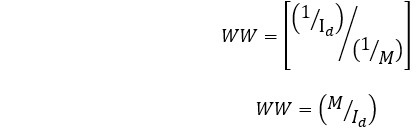
H9 However, the form of the utility function outlined above assumes the elasticity of marginal utility of consumption is equal to 1. More recent studies have shown different estimates of elasticity of marginal utility. The Green Book cites a review of international evidence which concludes that a reasonable elasticity value η is 1.3. This changes the form of the utility function (where U(C) = log(C) due to an assumption of η = 1) to:

H10 The marginal utility is therefore:

H11 This gives the following formula to calculate gross weights by income decile:

H12 This is the function adopted for the analysis of the social housing tenure problem below and the one that should be adopted more generally for distributional analysis of MHCLG interventions.
Practical applications to social housing tenure
H13 The following calculation of distributional weights is illustrative. The use and calculation of distributional weightings should be viewed in the context of the rationale for the policy proposals being considered and whether they are suitable or not in that light. The HMT Green Book provides further guidance on this.
H14 Consider an intervention that benefits residents in the social housing tenure group. Using DWP data on median household income before housing costs, per decile, for all households[footnote 14] in the UK gives the following gross weights per decile:
Table 7: Gross welfare weights by income decile (equivalised, disposable, before housing cost income)
| Deciles | 1 | 2 | 3 | 4 | 5 | 6 | 7 | 8 | 9 | 10 | Median (M) |
|---|---|---|---|---|---|---|---|---|---|---|---|
| Income per week (Id) | 204 | 307 | 376 | 444 | 512 | 582 | 665 | 771 | 928 | 1,363 | 547 |
| Weight (M/Id)1.3 | 3.60 | 2.12 | 1.63 | 1.31 | 1.09 | 0.92 | 0.78 | 0.64 | 0.50 | 0.31 | 1 |
H15 The gross weights vary from 3.6 to 0.31.[footnote 15] For a person in the lowest income decile, a £1 benefit increases utility by 3.6 relative to the average marginal utility for all households, whereas for the highest decile, there is a marginal increase in utility of 0.31 relative to the average marginal utility for all households.
H16 The next step is to calculate an average weight for the policy based on the gross weights above. In this example, the intervention benefits residents in the social housing tenure group in England. To calculate the average welfare weight for tenants in the social housing tenure, the gross weights by decile are multiplied by the percentage of social tenants that are in that income decile.
H17 The distribution of social tenants (before housing costs) between income deciles of all households is as follows:[footnote 16]
Table 8: Distribution of social tenants in England across UK income deciles
| Income Decile | 1 | 2 | 3 | 4 | 5 | 6 | 7 | 8 | 9 | 10 | Total |
|---|---|---|---|---|---|---|---|---|---|---|---|
| % of social tenants | 16% | 19% | 18% | 14% | 12% | 9% | 6% | 4% | 2% | 1% | 100% |
H17 This shows, for example, 16% of social tenants are in the bottom income decile for all households.
H18 Multiplying the gross welfare weights for each income decile in Table 7 by the percentage of social tenants in that income decile from Table 8 gives the following weights:
Table 9: Gross welfare weight adjusted for housing costs
| Deciles | 1 | 2 | 3 | 4 | 5 | 6 | 7 | 8 | 9 | 10 | Sum |
|---|---|---|---|---|---|---|---|---|---|---|---|
| Weight | 0.58 | 0.40 | 0.28 | 0.19 | 0.13 | 0.08 | 0.04 | 0.03 | 0.01 | 0.00 | 1.75 |
H19 Summing across the income deciles in Table 9 gives an average weight for all social tenure households of 1.75.
H20 We then calculate welfare weights net of the cost to taxpayers (to reflect the negative marginal utility for households arising from paying taxes and other revenue raising activities). Thus, we subtract the £1 of transfer from the £1.75 benefit, leaving only £0.75 of pure welfare gain. In other words, spending £1 on a social housing tenant has an additional welfare equity effect of 75 pence on top of the direct £1 benefit which they receive from the spending.
H21 The Green Book recommends multiplying benefits by a welfare weight where appropriate, presenting the results alongside the unweighted benefits to demonstrate the impact of the weighting process. For business cases relating to affordable housing (and thus, social tenants), the rent subsidy that tenants would receive has been calculated as the difference between the affordable rent post-intervention and the market rent that would otherwise be charged on the home. In effect, this calculates the amount of additional money these tenants would have in their pocket compared to if they had to pay a market rent.
H22 In 2020/21, the average affordable rent on first-time let, general needs lettings was £142 per week.[footnote 17] Given affordable rents are set at up to 80% of market rent for the home, we can infer the average market rent on affordable rent lettings to have been around £177, the difference therefore being £35 per week. The difference is funded by direct government subsidy.
H23 Assuming that the subsidy is distributed in accordance with the existing distribution of income of social tenants, welfare weights could be used to calculate the distributional benefit of the changes. This means multiplying £35 by 0.75, which gives a £26.25 benefit per week per tenant. If some of the rental subsidy resulted in lower housing benefit (and Universal Credit) expenditure as opposed to lower rents for tenants, further adjustments would be required to account for this.
Annex I: VfM categories for initiatives which save money
I1 Some interventions result in financial savings to the public sector rather than increased spending. Examples include:
- invest to save spending, for example, on maintenance which reduces higher spend later on
- reduction in service provision, for example, cutting back the coverage of a service or from reducing funding per person
- interventions which result in significant earned income from provision of services or involve the sale of assets
I2 In such situations the present value of costs of the activity is negative. BCRs can no longer be used as summary measures of performance from monetised impacts as its size is no longer related to economic performance. In this case alternative measures for assessing VfM are needed.
I3 The general approach for initiatives which save public sector money is to use the Net Present Social Value, with a positive NPSV representing good VfM. Two positive NPSV scenarios are highlighted in rows 1 and 2 in Table 10.
I4 Where the NPSV <0, that is, the reduction in benefits are greater than the reduction in spend, the investment is likely to be poor VfM.
I5 Adjustments for non-monetised impacts - it should be noted that PVB and PVC represent only monetised impacts. Any non-monetised impacts should also be accounted for. If on balance non-monetised impacts are large in one direction it is possible that they will shift the NPSV from positive to negative or vice versa. If the shift is from negative to positive this implies that the intervention is VfM. Conversely if the NPSV shifts from positive to negative it implies the intervention is not VfM.
I6 Sensitivity testing – as before where there are uncertainties in the analysis and these are likely to be significant these should be tested.
Table 10: Value for money categories for money saving initiatives
| Examples | Impacts | Comments | |
|---|---|---|---|
| 1. Very High and Financially Positive VfM | NPSV >0. | PVB >0 | Maintenance is often quoted as an example. Results in longer term savings and improved quality of service. |
| 2. Economically Efficient Cost Savings | NPSV>0 | PVB<0 but PVC fall faster than benefits | Decommissioning of a loss-making operation. |
| 3. Poor but financially positive VfM | NPSV<0 | PVB is more negative than PVC | Project fails to be VfM. |
Footnotes
-
In the Financial Case of a spending proposal, the OB adjustment should be excluded and instead a reasonable level of contingency should be made. This should be based on an assessment by the project team of risks allowing for identified activities to avoid occurrence and mitigate impact. When assessing risks, attempts should be made quantify the impact and probability of its occurrence. Techniques such as quantitative risk assessment could be used to assess contingency needed. For novel projects expert opinion may need to be brought in to support identification and measurement of risks. ↩
-
VOA data provides illustrative land value uplift estimates based on typical development costs. In this example, the estimated ‘clean up’ costs are considered atypical and so should be accounted for separately. ↩
-
A Very High VfM category must have a BCR greater than or equal to 4. The PVC are £10m, so PVB would have to be £40m. The monetised PVB = £20m so non-monetised benefits would have to be equal to £20m for a BCR = 4. ↩
-
39 x £200,000 = £7.8m ↩
-
39 x £30,659 = £1.2m ↩
-
£7.8m - £1.2m = £6.6m = £6.4m discounted at 3.5% as recommended by the Green Book. ↩
-
Substitution – which is the replacement of one type of input by another type in response to an intervention is unlikely to be relevant for residential and non-residential interventions so is not discussed further. ↩
-
At the local level there are also likely be multiplier impacts relating to increased economic activity – these are covered in the Place Based Analysis Chapter of the Main Guide. ↩
-
There are important distributional impacts from demand side interventions which need to be taken into account. For example, interventions might be targeted on extending home ownership to first time buyers or for less affluent families. ↩
-
Note that the ready reckoner does not apply to schemes which involve the provision of developer finance. ↩
-
https://assets.publishing.service.gov.uk/media/65b93630ee7d49000d9849f7/Optimism_Bias_and_Contingency_at_Homes_England.pdf ↩
-
The P-level refers to the percentile values taken from a distribution. For instance, the P50 refers to the median and the P80 is the 80th percentile. In the case of cost and the use of RCF, the P80 value therefore refers to the value where 80% of projects in the reference class had a cost overrun of less than this value. ↩
-
Layard et al. (2008) “The marginal utility of income” Journal of Public Economics, Vol. 92, pp. 1846-1857. ↩
-
DWP publish the data as part of the Household below average income series. The data is taken from HBAI 2019/20. ↩
-
For example, for a household in the lowest decile weekly income = £204. Therefore the weight = (547/204)1.3 = 3.6. For the top decile weekly income = £1,363. Therefore the weight = (514/1363)1.3 = 0.31. ↩
-
Based on DWP’s Households Below Average Income data, 2017/18 – 2019/20. ↩
-
Based on MHCLG’s ‘Social housing lettings in England, April 2018 to March 2019’. ↩