Disruptions and arrests for organised immigration crime activity, between January 2023 and March 2026
Published 16 July 2026

© Crown copyright 2026
This publication is licensed under the terms of the Open Government Licence v3.0 except where otherwise stated. To view this licence, visit nationalarchives.gov.uk/doc/open-government-licence/version/3 or write to the Information Policy Team, The National Archives, Kew, London TW9 4DU, or email: psi@nationalarchives.gov.uk.
Where we have identified any third party copyright information you will need to obtain permission from the copyright holders concerned.
This publication is available at https://www.gov.uk/government/publications/the-border-security-commanders-annual-report-data/disruptions-and-arrests-for-organised-immigration-crime-activity-between-january-2023-and-march-2026
This ad hoc statistical release sets out the latest available operational management information on Organised Immigration Crime (OIC) enforcement activity. This release provides additional detail on OIC enforcement activity and revises data published in the previous ‘Immigration system statistics’ publication. OIC includes, but is not limited to, offences which have the effect of exploiting vulnerable migrants by smuggling them across borders for profit, including offences committed by organised criminal groups (OCGs).
The publication of this information supplements the Border Security Commander’s Annual Report, which was published on 16 July 2026, and is intended to provide the public with clear and timely statistics in an area of high public interest. The Border Security Command uses enforcement data provided by the National Crime Agency (NCA) and Home Office to assess its performance and impact against OIC.
The data summarised in this note is provisional, taken from live operational systems and subject to change. The next immigration system statistics quarterly release will adopt the methodology applied to this release and be published as ‘Statistics in Development’ on 27 August 2026, providing updated data on the number of OIC disruptions. Additional information on these statistics is provided in the user guide.
1. Organised Immigration Crime disruptions
The underlying data collection and methodology for these statistics are currently being refined to improve accuracy and consistency. As part of this process, figures have been revised from those previously published in the Immigration system statistics release. The Home Office is working with law enforcement agencies to continuously improve data quality. While stable trends can be observed, absolute volumes are lower than previous releases as these improvements are embedded.
A disruption is when an agency takes proactive or reactive action in response to a threat, where it can evidence an impact upon an OCG or individual involved in serious organised crime (SOC), intended to prevent them being able to operate at their previous level of criminality. Disruptions may include various forms of law enforcement action such as asset seizures, equipment seizures, revocation of licenses, arrests, convictions or sentences.
The data covers activity from across the NCA, Home Office, National Police Chiefs’ Council (NPCC) police forces, Police Service of Scotland and Police Service of Northern Ireland.
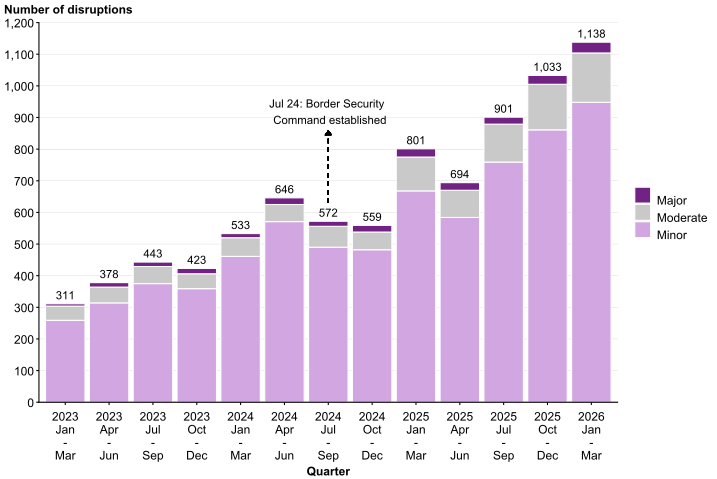
Between 1 April 2025 and 31 March 2026, there were 3,766 OIC disruptions recorded, 46% more than in the previous year (2,578).
OIC disruptions are categorised by operational agencies in 3 groups reflecting the level of impact achieved. These are defined as major, moderate and minor as follows:
- major disruptions include activity with a significant and/or long-term impact in the context of the threat; for example, prison sentence(s) given to key member(s) of the OCG, dismantling the group long term
- moderate disruptions include activity with a notable and/or medium-term impact in the context of the threat; for example, arrest of OCG members and seizure of significant amounts of cash disrupting criminality temporarily as the OCG cannot purchase more commodity
- minor disruptions include activity with a minimal and/or short-term impact in the context of the threat; for example, arrest of lower-level members of the OCG whilst transporting criminal commodity reducing the volume and frequency of the OCGs criminality
There were 108 major OIC disruptions recorded between 1 April 2025 and 31 March 2026, 29% more than the number of major disruptions in the previous year. In the same period, moderate and minor disruptions increased by 79% and 43% respectively.
Table 1: The number of disruptions of Organised Immigration Crime conducted by public agencies, by impact level of disruption, from January 2023 to March 2026 1,2
| Year | Quarter | Major | Moderate | Minor | Total |
|---|---|---|---|---|---|
| 2023 | January to March | 7 | 45 | 259 | 311 |
| 2023 | April to June | 14 | 50 | 314 | 378 |
| 2023 | July to September | 14 | 54 | 375 | 443 |
| 2023 | October to December | 17 | 47 | 359 | 423 |
| 2024 | January to March | 13 | 59 | 461 | 533 |
| 2024 | April to June | 21 | 54 | 571 | 646 |
| 2024 | July to September | 16 | 66 | 490 | 572 |
| 2024 | October to December | 21 | 56 | 482 | 559 |
| 2025 | January to March | 26 | 107 | 668 | 801 |
| 2025 | April to June | 24 | 86 | 584 | 694 |
| 2025 | July to September | 22 | 120 | 759 | 901 |
| 2025 | October to December | 28 | 144 | 861 | 1,033 |
| 2026 | January to March | 34 | 156 | 948 | 1,138 |
Notes:
- Data provided is a count of ‘lead disruptions’, excluding ‘support disruptions’ to avoid double counting.
- This data represents UK-led disruptions only and does not include where UK Law Enforcement has supported international upstream disruptions.
Figure 1: Disruptions of OIC, by impact level, January 2023 to March 2026
2. Organised Immigration Crime arrests
Arrests are conducted by suitably trained officers using powers as set out in the Police and Criminal Evidence Act 1984, the Police and Criminal Evidence (Northern Ireland) Order 1989, and the Criminal Justice (Scotland) Act 2016, resulting in deprivation of liberty through custody. Arrests refer to all arrests made under an OIC investigation and are not necessarily for OIC offences; for example, arrests for money laundering offences involving profits from organised immigration criminality.
Arrests do not represent total enforcement activity and should not be considered a subset of disruptions. Disruptions and arrests are distinct measures and do not have a one-to-one correspondence; a single disruption may be the result of multiple, one, or no arrests.
The data reflects the number of arrests rather than the total number of offences committed.
The offence associated with an arrest may have occurred in a different reporting period to the arrest itself.
Arrests may not lead to further action for a range of legitimate reasons. As such, data here does not reflect the number of charges or convictions and should be interpreted as a measure of activity rather than outcomes.
In some operations, one agency may instruct a partner organisation to carry out an arrest, while retaining operational responsibility for the case. In such circumstances, both agencies may record involvement in the arrest, thus creating the potential for duplicate records on the same arrest.
To minimise the potential for duplicate recordings, the published data on total number of arrests only includes arrests where the arresting agency is also the agency responsible for the operation, or where the arresting agency is an overseas partner.
The Home Office estimates that there have been at least 1,900 arrests relating to OIC between 1 April 2025 and 31 March 2026. This is up 74% compared to at least 1,100 between 1 April 2024 and 31 March 2025.
Of the estimated number of arrests in the latest financial year, at least 1,700 were made by UK law enforcement and 200 by overseas partners. This is up 77% and 50% respectively from the previous financial year.
2.1 Agency involvement in Organised Immigration Crime arrests
These figures represent agency involvement in arrests. Where multiple agencies are involved in a single arrest, the arrest may be included for each agency involved and may therefore be counted more than once.
Table 2: Involvement in arrests for Organised Immigration Crime by public agencies, from April 2024 to March 2026
| Law Enforcement Agency | April 2024 to March 2025 | April 2025 to March 2026 |
|---|---|---|
| National Crime Agency | 194 | 305 |
| Police Forces | 382 | 1,173 |
| Home Office | 817 | 902 |
Notes:
- These figures include the total number of arrests in which each agency were involved. Where multiple agencies are involved in a single arrest, the arrest may be included for each. Therefore, caution on duplicate recording should be considered when interpreting data and the breakdowns here should not be summed to produce a total count of arrests.
- Data recording practices may vary between law enforcement agencies; in particular, the categorisations and recording methodologies applied to OIC offences and arrests.
- This data represents both UK arrests and those where UK Law Enforcement has supported international partners overseas.
3. Notes
The OIC disruption statistics are labelled as “official statistics in development”. They are based on information provided to the Home Office by the NCA and gathered from the Immigration Enforcement Criminal and Financial Investigations (CFI) team and Home Office Intelligence. We are developing how we collect the data and produce the statistics to improve their quality.
Once we have completed the developments, we will review the statistics with the Statistics Head of Profession. If the statistics meet trustworthiness, quality and value standards based on user feedback, we will remove the “official statistics in development” label to publish under the “official statistics” label. If they do not meet trustworthiness, quality and value standards, we will further develop them and may stop producing them.
We will inform users of the outcome of our, and any OSR, review and any changes.
As part of the ongoing development of these statistics, we welcome feedback from users on the content, methodology and presentation of the figures. Please send comments to MigrationStatsEnquiries@homeoffice.gov.uk. Please include the words ‘PUBLICATION FEEDBACK’ in the subject of your email.
OIC arrest statistics are not classified as official statistics. They are published to provide timely information and may be subject to future revision.
The statistics in this release refer to the number of OIC disruptions delivered, as well as the number of arrests related to an OIC investigation across different government and law enforcement agencies (LEAs). However, data from agencies not currently captured in our reporting is not included. The data covers activity from across the NCA, Home Office, NPCC police forces, Police Service of Scotland and Police Service of Northern Ireland.
Data reported by individual LEAs may differ from this release dependent on the time of publication and data definitions used.
Due to fewer mandatory reporting requirements across different LEAs, in particular the NPCC police forces, data prior to 2023 will not be directly comparable to future years and therefore has been excluded from this release.
Quality of the data is dependent on the recording and quality assurance by the respective agencies.
Trends in OIC enforcement activity may reflect both underlying offending levels and operational factors, including enforcement approaches and resource levels.
The Home Office are working with LEAs to improve the quality of these statistics.