Supporting employers to recruit disabled people and people with health conditions: Technical Report
Updated 17 September 2026

© Crown copyright 2026
This publication is licensed under the terms of the Open Government Licence v3.0 except where otherwise stated. To view this licence, visit nationalarchives.gov.uk/doc/open-government-licence/version/3 or write to the Information Policy Team, The National Archives, Kew, London TW9 4DU, or email: psi@nationalarchives.gov.uk.
Where we have identified any third party copyright information you will need to obtain permission from the copyright holders concerned.
This publication is available at https://www.gov.uk/government/publications/supporting-employers-to-recruit-disabled-people-and-people-with-health-conditions/supporting-employers-to-recruit-disabled-people-and-people-with-health-conditions-technical-report
Technical report
This technical report sets out in detail the methodology for the rapid evidence assessment on ‘how to support employers to recruit disabled people and people with health conditions’. It includes the inclusion and exclusion criteria, scope, search, sifting and review process.
Criteria for inclusion and exclusion
The parameters for the evidence review were specified in a PICOS (Population, Intervention, Comparison, Outcome, Study Design) framework as set out below.
Table 1: Inclusion and exclusion criteria
Population
Employers in England, Scotland, Wales, Northern Ireland or other high-income OECD countries.
| Criteria | Basis for inclusion | Basis for exclusion |
|---|---|---|
| Country | England, Scotland, Wales, Northern Ireland or other high-income OECD countries. (This includes USA, countries in Europe, Australia, Japan, Korea, New Zealand.) | Employers in medium or low-income OECD countries. |
Programme or intervention
Employer practices that support the recruitment of disabled people and people with health conditions.
| Criteria | Basis for inclusion | Basis for exclusion |
|---|---|---|
| Inclusive recruitment practices | Inclusive recruitment practices, such as flexible working, job design/carving, additional support, possibly via Access to Work or employee assistance programmes, at the point of job entry. | 1) Programme or intervention has a work and skills-only focus e.g. interventions and outcomes are exclusively work or skills-focused or are related to work and other non-health areas of support. 2) Programme or intervention has no specific targets for supporting disabled people or those with health-related barriers to work. 3) Supported employment. 4) Self-employment. 5) Practices or programmes exclusively focused on retention or return to work of existing employees. |
Study Design
The study includes evaluations and research from 1997 onwards.
| Criteria | Basis for inclusion | Basis for exclusion |
|---|---|---|
| Type of study to include | 1) Process evaluations. 2) Impact evaluations. 3) Studies highlighting specific ‘what works’ elements from a programme or intervention. | Research deemed low or very low on YEF-EQA scale. |
| Comparator group | Studies will be included even if a relevant comparator is not available. | N/A |
| Date of delivery | 1997 onwards to ensure all relevant programmes delivered as part of the New Deal are captured. | Programmes and interventions delivered before 1997 or where no process, interim, or final evaluation is available by June 2026. |
Outcomes
The evaluation explores individual and employer outcomes.
| Criteria | Basis for inclusion | Basis for exclusion |
|---|---|---|
| Individual outcomes | Study explores individual outcomes, such as employment outcomes (such as job entry and retention), reduced benefit dependency, health and wellbeing outcomes. | Studies that do not explore one or more of these types of outcomes resulting from the programme or intervention under consideration. |
| Employer outcomes | Study considers employer outcomes, such as increase in employee diversity, increase in numbers of disabled employees and employees with health conditions, implementation or introduction of inclusive recruitment practices, economic benefits and financial return e.g. increased productivity or turnover. | Studies that do not explore one or more of these types of outcomes resulting from the programme or intervention under consideration. |
| Effective practice | Study highlights recommendations and considerations for future employment practices. | Studies that do not explore one or more of these types of outcomes resulting from the programme or intervention under consideration. |
Scope
The review covered evaluations of employer recruitment practices and ALMP interventions in England, Scotland, Wales, Northern Ireland or other high-income OECD countries. The studies were evaluating:
-
inclusive recruitment practices, such as flexible working, job design/carving, additional support, possibly via Access to Work or employee assistance programmes, at the point of job entry
-
enablers of inclusive recruitment practice, such as training, knowledge (capability) and external support
-
ways to support employers to adopt inclusive recruitment practices
The studies were:
-
1997 onwards
-
impact studies, process studies and studies highlighting ‘what works’ elements of a programme or intervention
-
assessing the attainment of individual outcomes, employer outcomes and effective practice
Evidence standards
The intention of this rapid evidence assessment (REA) was to synthesise and disseminate the best quality and most relevant evidence to meet stakeholder needs, within the programme resources, and to provide an indication of the strength of each element of the evidence for readers. There was a trade-off between being able to apply high to moderate standards in rating the strength of evidence, and ability to answer research questions. A pragmatic approach was taken to the application of evidence standards.
Assessing primary research
The Youth Endowment Fund Evidence Quality Assessment (YEF-EQA) tool was used to assess primary research. This tool enables the inclusion of qualitative and mixed methods evaluations, that other quality assessment tools do not, and it is used by other what works centres such as the Youth Futures Foundation allowing for consistent assessment. The overall quality of evidence was assessed, resulting in a high, moderate, low, or very low score.
The evidence assessment process used the following standards to assess each study against the following criteria (where applicable to study types):
-
quality of individual studies (including design; clarity of evaluation questions; clarity of methodology; assessment of potential bias; and effective use of administrative data)
-
quality of recruitment and sampling (including clear sampling and recruitment strategy; and appropriateness of strategy to evaluation questions)
-
positionality, assumptions and biases (including whether the researcher’s own position, assumptions and possible biases are outlined)
-
clarity of outcomes (whether the outcomes are clearly defined; whether outcomes have been measured, where appropriate, using an existing, validated measurement tool; whether confounding has been adequately controlled; whether outcomes are reported with equal emphasis; whether the study considers extenuating factors e.g. trial was stopped early)
-
robustness of the data analysis process (including whether the data analysis approach is adequately described and sufficiently rigorous)
-
validity of implications and recommendations (whether the implications or recommendations are clearly based in the evidence from the study)
-
consideration of treatment and comparison groups (including whether assignment to treatment and comparison groups is done at the appropriate level e.g. individual, community; and whether the methods used to assign participants to treatment and comparison groups are sufficiently rigorous)
Each item was rated as high (3 points), moderate (2 points) or low quality (1 point). The final score was then calculated as a percentage of the applicable maximum points. This percentage score was then used to determine the overall quality of the study as high (90% to 100%), moderate (70% to 89%), low (50% to 69%), or very low (below 50%). The studies selected for inclusion were scored independently by two researchers. Quality of evidence ratings for included studies are in Appendix Two.
Assessing evidence reviews
The Critical Appraisal Skills Programme (CASP) systematic review checklist was used to assess the quality of systematic reviews and REAs. This checklist was chosen for its applicability to reviews that may contain both qualitative and quantitative studies and the range of elements it includes. The CASP systematic review checklist appraises reviews on 10 elements:
Section A: Are the results of the review valid?
-
Did the review address a clearly focused question?
-
Did the authors look for the right type of papers? For example, to address the review question with an appropriate study design
-
Do you think all the important, relevant studies were included?
-
Did the review’s authors do enough to assess quality of the included studies?
-
If the results of the review have been combined, was it reasonable to do so? For example, were the results of included studies clearly displayed if combined, were variations discussed
Section B: What are the results?
-
What are the overall results of the review?
-
How precise are the results?
Section C: Will the results help locally?
-
Can the results be applied to the local population?
-
Were all important outcomes considered?
-
Are the benefits worth the harms and costs?
As the CASP checklist does not provide a strict categorisation framework, researchers developed a qualitative rating approach to determine the overall quality of the study as high, moderate, low or very low. These categories were used in order to be consistent with the YEF-EQA framework used for primary research:
-
a high quality rating was given when Q1-4 were all answered “yes”
-
a moderate quality rating required “yes” responses to the two screening questions (Q1 and Q2), but allowed a “no” or “can’t tell” response to Q3 or Q4
-
a low quality rating was given if Q1 or Q2 was answered “no” or “can’t tell”, or if there were three to five “no” or “can’t tell” responses across the checklist
-
a very low quality rating was given where there were more than five “no” or “can’t tell” responses overall
Strength of evidence assessment
In addition to an assessment of the quality of the individual studies, the review includes an assessment of the type and strength of evidence for key findings. The standard seeks to represent the realities of the diverse evidence base, making clear the evidence type and methods used. It combines the Maryland Scientific Methods Scale (SMS), YEF-EQA standards and CASP systematic review checklist.
Table 2: Evidence type and strength
| Evidence type | Strength of evidence |
|---|---|
| Causation - this type of evidence demonstrates that the activity directly produced the outcome (e.g. X directly causes Y). Causation can only be stated if strong causal research methods were used in evaluations, such as Randomised Controlled Trials, or Quasi-Experimental Designs. | High (SMS Level 5-3). |
| Influence on outcome - evidence that shows the intervention helped to achieve the outcome, alongside other factors, and explains how, why and for whom. Influence on an outcome can only be stated if the evidence used quantitative methods, qualitative methods, and/or mixed methods, and the evaluation/evidence set out a clear programme logic and/or Theory of Change. | High (Quantitative designs will be SMS Level 1-2 with YEF-EQA rating of high, or a CASP systematic review rating of high). Moderate (Quantitative designs will be SMS Level 1-2 with YEF-EQA rating of moderate, or a CASP systematic review rating of moderate). Low (YEF-EQA or CASP systematic review rating low). |
| Indicative/promising - evidence that suggests or signals potential to influence an outcome. This type of evidence will be less developed, for example in a test and learn phase, or developing hypothesis. It might have used methods such as descriptive analysis and case-studies. | YEF-EQA or CASP systematic review ratings high, moderate, low. |
Source: IES and L&W, 2026
Evidence sources
The evidence review was conducted in May and June 2026.
Searches were conducted across a range of sources, including sources of ‘grey literature’ (e.g. websites of research organisations and charities) and academic databases. These were:
- What Works Centres: Youth Endowment Fund; What Works Centre for Local Economic Growth, Youth Futures Foundation
- CIPD
- PubMed
- GOV.UK Evaluation Registry
- International Labour Organisation
- Publications Office of the EU
- Business Disability Forum
- Joseph Rowntree Foundation
- SAGE
- Journal of Social Policy
- NIHR
- SSRN
- ProQuest
- Clearinghouse for Labour Evaluation and Research
- Youth Employment UK
- OECD
- The Kings Fund
- Local Government Association
- Acas
- Nuffield Foundation
- Social Policy and Society
- Cochrane Library
- Psycinfo
- Google Scholar
- CoPilot
In addition to these searches a Call for Evidence was implemented. This asked for submissions of published and unpublished evaluations of employer practices that support the recruitment of disabled people and people with health conditions. The call for evidence was open for from 28 April to 22 May 2026 and publicised by the LMEP website, LinkedIn social media posts, and IES and L&W mailing lists. This generated eight studies. Recommendations of papers were also obtained from expert advisers from IES and partner organisations.
Search terms
The search strategy for this review involved creating a broad search string to search these databases that was adapted to meet the requirements of different search engines.
Search terms were developed to answer the research questions and used to form search strings. A broad search string was developed, which was then adapted to meet the requirements of different search engines. For example, due to Google Scholar’s 256-character limit, a shorter search string was developed. A keyword search string was also developed and used to fit the search engines of grey databases, many of which did not respond to long search strings with Boolean operators and brackets.
Broad search string
(recruit OR hiring OR hire OR “selection process” OR “job interview” OR assessment OR application) AND (disab* OR “health condition” OR “chronic illness” OR neurodivergen* OR autism OR ADHD OR ill-health OR “psychological condition”) AND (workplace OR employer OR organisation OR organization OR SME OR HR) AND (inclus* OR fair* OR accessib* OR accommodation* OR adjustment* OR “reasonable adjustment” OR “inclusive practice” OR intervention* OR program* OR policy OR initiative* OR “bias reduction” OR “structured interview” OR “alternative assessment” OR “job carving” OR encourage) AND (impact OR evaluation OR effective OR benefit OR review OR economic)
Google scholar search string
(recruit OR hiring OR “job interview” OR “application process”)
(disability OR “health condition” OR illness OR autism)
(employer OR organisation OR organization OR SME OR HR)
(accessible OR adjustment OR practice OR policy OR program OR intervention)
Keyword search string
recruit/hiring/interview/assessment
employer
disability
health
policy
Sifting process
The sifting process involved using the inclusion and exclusion criteria outlined above. Sifting was done using Covidence, and this process is outlined in the PRISMA flow diagram in Figure 1.
Figure 1 PRISMA flow diagram
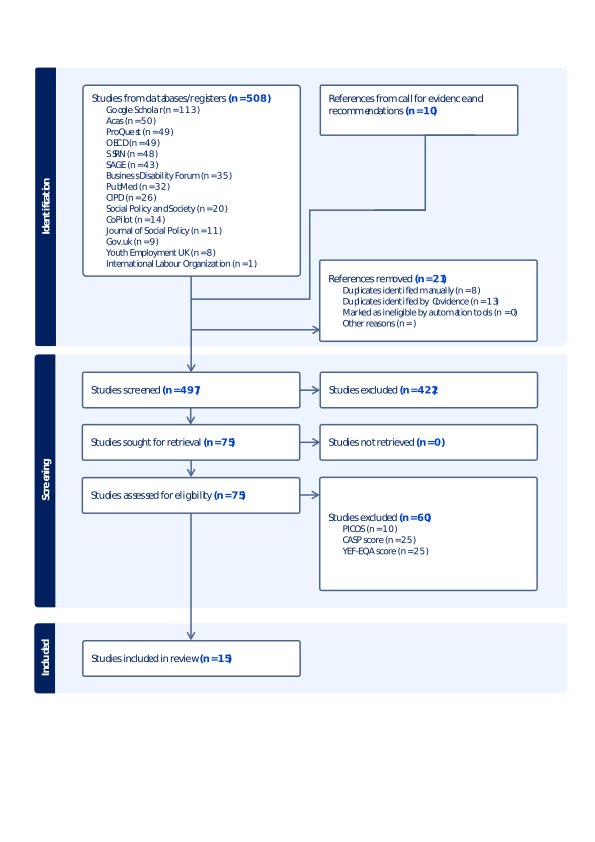
The figure shows the PRISMA: Preferred Reporting Items for Systematic Reviews and Meta-Analyses
Identification:
Studies from databases/registers (n=508)
Google Scholar (n=113)
Acas (n=50)
ProQuest (n=49)
OECD (n=49)
SSRN (n=48)
SAGE (n=43)
Business Disability Forum (n=35)
PubMed (n=32)
CIPD (n=26)
Social Policy and Society (n=20)
CoPilot (n=14)
Journal of Social Policy (n=11)
Gov.uk (n=9)
Youth Employment UK (n=8)
International Labour Organisation (n=1)
References from call for evidence and recommendations (n=10)
References removed (n=21)
Duplicates identified manually (n=8)
Duplicates identified by Covidence (n=13)
Marked as ineligible by automation tools (n=0)
Other reasons (n=0)
Screening:
Studies screened (n=497)
Studies excluded (n=422)
Studies sought for retrieval (n=75)
Studies not retrieved (n=0)
Studies assessed for eligibility (n=75)
Studies excluded (n=60)
PICOS (n=10)
CASP score (n=25)
YEF-EQA score (n=25)
Included:
Studies included in review (n=15)
Source: IES created using Covidence, 2026.
A 4-stage sifting process using the inclusion and exclusion criteria outlined above was then applied:
-
first sift – title and abstract/summary
-
second sift – full paper/report: the methodology considered in more detail. At this stage, the evidence standards were applied
-
third sift – full paper/report: against inclusion / exclusion criteria
-
review stage
Following the sifting process 15 studies were identified for full review and extraction. The main reason for the low number of papers is that although most papers were marked as moderate or high, fewer of these papers met the PICOS criteria – for example, this review found very few evaluations of employer hiring practices. One study was removed after the extraction process, with 15 studies included in the final report.
Use of AI tools
Search strings were initially created by researchers, building on search strings used when scoping papers for this review. Search strings were then inputted into CoPilot to test their suitability for different database search engines and then adapted accordingly.
After searching all databases stated above, CoPilot was used with the prompt “I am doing an evidence review on supporting employers to recruit people with health conditions and disabled people, what are the key papers for this review?”. This returned a ‘minimum core reading list’ of 10 papers that were then uploaded to Covidence for sifting.
Extraction of evidence
Fifteen studies were identified for inclusion and were extracted using a grid framework outlining how each study relates to the PICOS information, and how they address the research questions.
The relevant columns for each research question were:
Enablers of inclusive recruitment
- enablers for employers
- barriers for employers
- differences by organisational characteristics
Effective inclusive recruitment strategies
- most effective ways for employers to recruit disabled people and people with health conditions
- differences by organisational characteristics
The role of the ALMP practitioner
- what information can be provided to employers to support recruitment
- applicability to carers and people with fluctuating availability to work
- any evidence of other support for employers
It was originally intended that extraction would follow the Updated Consolidated Framework for Implementation Research (CFIR), however at the start of the extraction process the framework was deemed to be too detailed for the purpose of this review, and so was not used.
Details of included studies
| Title | Funder | Details of programme/ intervention | Evidence type | Evidence standard rating |
|---|---|---|---|---|
| Mitigating Disability Bias in Hiring: The Role of Inclusion-Focused Generative AI in Complex HR Decisions | Macquarie University, Australia | Inclusion-focused generative AI to assess job applications | Causal | High |
| Perceptions and Bias of Small Business Leaders in Employing People with Different Types of Disabilities | National Institute on Disability, Independent Living, and Rehabilitation Research | This study explores the motivations and challenges small employers face when hiring people with disabilities and how their attitudes and willingness to hire vary based on disability type | Influence | High |
| Survey of Employer Policies on the Employment of People with Disabilities: Final Report | U.S. Department of Labor, Chief Evaluation Office and Office of Disability Employment Policy | U.S. employer policies and practices related to the recruitment, hiring, retention and advancement of people with disabilities | Influence | High |
| A systematic meta-review of organizational diversity and inclusion interventions and their associated outcomes | Inclusive Australia | Employer diversity and inclusion interventions | Influence | High |
| Effectiveness of return-to-work interventions for disabled people: a systematic review of government initiatives focused on changing the behaviour of employers | English Department of Health Policy Research Programme through the UK Public Health Research Consortium (PHRC). | Government interventions to influence employers’ employment practices concerning disabled and chronically ill individuals in five OECD countries | Indicative | High |
| International comparisons of disability benefits and disability employment | Department for Work and Pensions | Disability benefits and disability employment support across selected OECD countries | Indicative | High |
| Improving knowledge and attitudes via an Interactive Video: A Randomized Controlled Trial | U.S. Department of Health and Human Services | An interactive training video intended to improve knowledge, attitudes, and intent to hire people who are blind or have low vision | Causal | Moderate |
| Demand-Side Factors Related to Employment of People with Disabilities: A Survey of Employers in the Midwest Region of the United States | SPR, Inc. | Employer factors (characteristics and behaviours) that may influence hiring and retaining disabled people | Influence | Moderate |
| The Employment Environment: Employer Perspectives, Policies, and Practices Regarding the Employment of Persons with Disabilities | U.S. Department of Education National Institute on Disability and Rehabilitation Research | Employer policies and practices related to the employment of disabled people | Influence | Moderate |
| Breaking down barriers: How remote and hybrid work can support disabled workers | Nuffield Foundation | Remote and hybrid working arrangements | Influence | Moderate |
| Employers’ recruitment of disadvantaged groups: exploring the effect of active labour market programme agencies as labour market intermediaries | Economic and Social Research Council | The role of ALMP programmes in employers’ recruitment of disadvantaged groups | Influence | Moderate |
| The Demand-Side of Active Labour Market Policies: A Regional Study of Employer Engagement in the Work Programme | Leeds Business School | The role of employers in ALMPs programmes | Influence | Moderate |
| Enabling (dis) ability at work: Employer engagement in hiring and retaining workers with disabilities, including its contributions to employability | Not applicable | Employer practice | Indicative | Moderate |
| Employer Engagement in Active Labour Market Programmes in the UK and Denmark: Final Report | Centre for Employment Relations, Innovation and Change | Employer engagement in ALMP programmes in the UK and Denmark | Indicative | Moderate |
| Employer Practices in Improving Employment Outcomes for People with Disabilities: A Transdisciplinary and Employer-Inclusive Research Approach | U.S. Department of Education National Institute on Disability and Rehabilitation Research | Workplace practices related to hiring, retaining, and promoting people with disabilities | Indicative | Moderate |