Studland Bay Marine Conservation Zone: anchoring and other activities
Guidance for people using Studland Bay Marine Conservation Zone for activities including anchoring, boating, paddling, diving, snorkelling and wildlife watching. Find out how to use the voluntary no anchor zone safely and protect seagrass and other features.
Documents
Details
Using Studland Bay Marine Conservation Zone (MCZ)
People use Studland Bay for a range of activities. MMO manages anchoring to reduce damage to seagrass while allowing people to continue to use enjoy the bay safely.
The voluntary no anchor zone
MMO introduced the voluntary no anchor zone (VNAZ) in 2021 to reduce anchoring damage to the main seagrass bed in Studland Bay MCZ. The current zone covers the main seagrass area off South Beach and Middle beach. Use the current boundary information when planning to anchor.
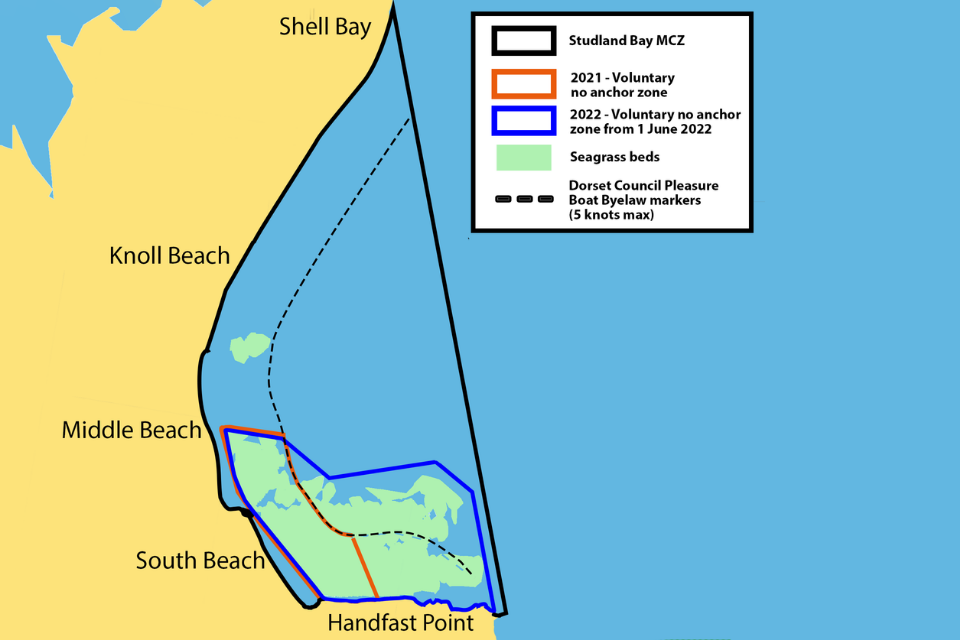
Studland Bay map showing the marine conservation zone, the voluntary no anchor zone, seagrass beds and pleasure boat byelaw markers
The no anchor zone in the Studland Bay MCZ is enclosed by a series of geodesic lines connecting nine specific points.
- Point 1: 50°38.9814’N 01°57.0306’W
- Point 2: 50°38.9814’N 01°56.7072’W
- Point 3: 50°38.8752’N 01°56.4324’W
- Point 4: 50°38.9868’N 01°55.8966’W
- Point 5: 50°38.9094’N 01°55.6782’W
- Point 6: 50°38.5188’N 01°55.4568’W (boundary of the MCZ)
- Point 7: 50°38.4690’N 01°56.3676’W
- Point 8: 50°38.7504’N 01°56.8620’W
- Point 9: 50°38.8146’N 01°56.9256’W (returning to Point 1)
- Download the voluntary no anchor zone coordinates
Download the shapefiles for the zones:
When you anchor
-
Avoid anchoring inside the voluntary no-anchor zone where it is safe to do so
-
Avoid anchoring on seagrass, including seagrass outside the voluntary no anchor zone
-
Use an environmentally sensitive mooring or eco mooring where one is available and suitable for your vessel
-
Follow normal navigation and safety requirements – safety of life at sea comes first
Safety at sea
Studland Bay can provide important refuge for vessels. Safety of life at sea comes first. The voluntary no anchor approach does not prevent anchoring in an emergency or where anchoring is necessary to avoid a genuine emergency.
Why anchoring is managed
Studland Bay Marine Conservation Zone was designated in 2019. Its protected features are seagrass beds, intertidal coarse sediment, long snouted seahorse and subtidal sand.
Anchors can damage and uproot seagrass, fragment the habitat and leave scars in the seabed. MMO’s assessment concluded that anchoring needed to be managed to support the recovery of the seagrass beds and other protected features.
More information about Studland Bay Marine Conservation Zone: assessments, decisions and monitoring
Environmentally sensitive moorings/ecomoorings
Environmentally sensitive moorings, also known as advance mooring systems or eco moorings, are designed to reduce damage to the seabed compared with traditional moorings or repeated anchoring.
Use current local information to check which moorings are available, fees and seasonal arrangements.
More information about moorings: environmental impacts, consent and marine licensing
Protected wildlife and habitats
The seagrass beds support marine wildlife, including long-snouted seahorses. Take care around sensitive habitats and wildlife and follow any current site guidance.
Other marine activities
MMO has also assessed other marine non licensable activities at Studland Bay. A monitoring and control plan has been put in place. No further management is currently being introduced.
Assessment, decisions and monitoring
MMO assessed marine non licensable activities at Studland Bay and gathered evidence and views from people and organisations with knowledge of the site.