Statutory security of supply report: 2025
Published 17 December 2025

© Crown copyright 2025
This publication is licensed under the terms of the Open Government Licence v3.0 except where otherwise stated. To view this licence, visit nationalarchives.gov.uk/doc/open-government-licence/version/3 or write to the Information Policy Team, The National Archives, Kew, London TW9 4DU, or email: psi@nationalarchives.gov.uk.
Where we have identified any third party copyright information you will need to obtain permission from the copyright holders concerned.
This publication is available at https://www.gov.uk/government/publications/statutory-security-of-supply-report-2025/statutory-security-of-supply-report-2025
Presented to Parliament pursuant to Section 172 of the Energy Act 2004 (as amended by Section 80 of the Energy Act 2011)
Ordered by the House of Commons to be printed on 17 December 2025
HC 1464
Introduction
This report is prepared jointly by the Secretary of State for Energy Security and Net Zero and the Gas and Electricity Markets Authority (GEMA) as required by section 172 of the Energy Act 2004 (as amended by section 80 of the Energy Act 2011). It assesses the availability of electricity and gas to meet the reasonable demands of consumers in Great Britain (GB) considering the short and long-term (this assessment covers the next four calendar years, as required by legislation).
Although security of oil supply is not included as part of the statutory requirement, this report includes a section produced by the Department for Energy Security and Net Zero (DESNZ) on oil security of supply for general information.
The technical data presented here has been produced from analysis conducted by DESNZ, the Office of Gas and Electricity Markets (Ofgem), National Gas acting in its capacity as the gas system operator, and the National Energy System Operator (NESO).
The statistics underpinning this document are for GB only where possible. However, in some cases where it is not possible to separate the GB data from the United Kingdom (UK) data, UK statistics have been used. Where this is the case, they have been referred to as UK in the accompanying text. Some figures have been rounded, meaning some totals may not correspond with the sum of the separate figures.
Executive summary
The Statutory Security of Supply Report 2025 concludes that GB is expected to have the ability to access and secure sufficient supplies of electricity and gas to meet consumers’ demands over the short and long-term (this assessment covers the next four calendar years, as required by legislation). GB has also continued to maintain good access to oil supplies. Government will continue to closely monitor security of supply.
Electricity security of supply
GB has demonstrated consistent success in ensuring secure electricity supplies and is expected to continue this trend in the future. NESO forecasts sufficient electricity capacity to meet this winter’s demand, with a derated margin of 6.1GW (10.0%) of the Average Cold Spell (ACS) peak demand for this winter. This is an increase from 5.2GW (8.8% of peak demand) last winter and is the highest predicted margin since 2019.
The UK benefits from a diverse electricity mix including gas generation, renewables, nuclear and interconnector imports. This reduces our dependence on one generation source and helps ensure security of supply in a range of conditions. The Capacity Market (CM) is GB’s key mechanism for ensuring there continues to be sufficient electricity capacity margin to meet peak demand. The required electricity capacity needed to ensure security of supply over the medium term has mostly been procured via four-year ahead auctions, with the most recent auction in 2025 having been for the T-4 delivery year of 2028/29, while any remainder is procured through future ‘top up’ auctions held in the year before delivery. While most of this capacity comes from existing units, new build projects which can enter multi-year CM agreements have also been successful. This includes a pipeline of electricity storage and interconnector projects.
Gas security of supply
Natural gas (‘gas’) remains a vital component of Great Britain’s energy mix, continuing to play a key role in heating, industry, and power generation. GB has access to a diverse range of gas supply sources, with domestic gas from the UK Continental Shelf, imported gas via the Norwegian Continental Shelf, the interconnectors, and LNG from various global supply routes.
Although gas reserves from the UK Continental Shelf are continuing to naturally deplete for geological reasons, government is accelerating the decarbonisation transition which will reduce our exposure to fossil fuels. Over the next four years specifically, we expect this changing supply mix to coincide with a robust, oversupplied global LNG market, as detailed in this report.
The role of gas is expected to continue to evolve in the longer-term from providing base load supply to playing a key part in ensuring system flexibility. As such, we are committed to protecting gas security of supply as long as it is required, with a clear plan:
First, government will accelerate efforts to decarbonise and electrify the economy, which will over time reduce our gas demand and therefore our exposure to fossil fuels.
Second, we will continue to work with the gas industry and market to maintain security of supply as supply and demand patterns change. DESNZ is addressing this through the Gas System in Transition: Security of Supply consultation published in November, the aim of which is to ensure sufficient and resilient gas infrastructure and to understand how we can best provide insurance for low-probability, high-stress scenarios. It is the first step in government’s programme of work to manage the challenges facing the gas sector and ensure security of supply in the long term.
Third, DESNZ and Ofgem will continue to work with the gas system operator, National Gas, who manage the system with a variety of balancing tools on a day-to-day basis, and with NESO, who will continue to provide advice through its annual gas security of supply assessments. Assessments from National Gas and NESO have informed this report.
Oil security of supply
In 2024, UK demand for oil products continued to recover following the lifting of COVID-19 travel restrictions. Total product demand increased by 2.0% compared to 2023, with jet fuel experiencing the most significant growth, rising by 7.9% as international air travel approached pre-pandemic levels.
Domestic supply in the UK’s production of crude oil and natural gas liquids fell to 30.4 million tonnes, aligning with the long-term natural decline of the mature North Sea basin. Refinery output also remained subdued, with total production of oil products at 50.8 million tonnes.
To meet rising demand and compensate for declining domestic production, the UK’s net primary oil imports increased by 11.7% in 2024. Following the implementation of sanctions on Russian oil imports in response to the 2022 invasion of Ukraine, the UK expanded its network of trading partners. The UK continued this in 2024, diversifying supply to further enhance energy security.[footnote 1]
Despite the transition of the Grangemouth refinery to an import terminal and the cessation of refining operations at Prax Lindsey Oil Refinery, the UK remains relatively well-positioned in terms of oil supply security, maintaining strong self-sufficiency in petrol and meeting demand for other oils through trade with both established and new trading partners.
Electricity
Introduction
GB’s electricity system continues to deliver secure electricity supply, benefitting from a diverse electricity generation and infeed mix – including gas, renewables, nuclear and interconnector imports - which ensures that businesses, industry, and households can be confident they can get the electricity they need. Most of the required electricity capacity to ensure security of supply for the next four years has already been procured via the Capacity Market (CM) four year ahead auctions, with the remainder to be procured through future ‘top up’ auctions held in the year before delivery.
NESO is the independent public body responsible for strategically planning Great Britain’s electricity and gas networks and operating the electricity system to meet growing future energy needs. Central to NESO’s role is a whole system approach to ensure the delivery of a secure energy system, drive consumer value and pave the way towards a sustainable energy future. NESO is responsible for operating a safe, reliable and efficient network. NESO is required to plan, develop and operate the National Electricity Transmission System (NETS) in accordance with the Security and Quality of Supply Standard (SQSS) which details the criteria and methodologies for planning and operation of the system.
For this winter, 2025/26, NESO has determined that we have sufficient available capacity to meet electricity demand with an increased margin compared to last year. Their projections and analysis are set out in their annual Winter Outlook.[footnote 2] In the information below, we provide more detail on supply, demand and the available operational tools that allow NESO to safely manage the electricity system. The government continues to work closely with NESO, Ofgem and all relevant stakeholders to monitor the electricity supply horizon, and to ensure the system operator has the right tools so the market can respond to fluctuations in supply and demand.
Government is committed to ensuring the electricity system delivers for businesses and consumers. As part of this, in July 2025 we announced the outcome of the Review of Electricity Market Arrangements (REMA) Programme, which focused on ensuring that our electricity market arrangements were fit for the long-term as our power system continues to evolve.
One of the key decisions was whether to retain the current national system in which all areas in Britain pay the same wholesale price for energy - or undertake an overhaul to split the country into different pricing zones depending on the relative balance of supply and demand within that zone.
As announced in the July 2025 REMA update, government weighed the options carefully, and decided to retain a single national, GB-wide, wholesale market pricing regime.[footnote 3] The new programme is called Reformed National Pricing (RNP). RNP will ensure that careful planning and price signals work together to make sure new energy sources are built in the best places, and that the power grid grows in a way that keeps up with the energy we’ll need and where it needs to go.
At the core of the reforms is the Strategic Spatial Energy Plan (SSEP) and its delivery levers. The SSEP is being developed by NESO following a commission from DESNZ in October 2024. The SSEP will help to better align electricity supply to electricity demand, setting out on a zonal basis, future required generation and storage for both electricity and hydrogen. This will also be used to inform wider strategic energy planning for networks and grid connections. In addition to the SSEP, the government will work with Ofgem to drive forward a review of transmission and connection charges to provide stronger incentives for investors to build generation where it is needed, supporting a cheaper system for all. This will give market participants and investors clarity on our approach.
Bolstering confidence in security of supply during the transition to clean power by 2030 is the Clean Power 2030 Action Plan which sets out the actions underway to achieve this mission.[footnote 4] The following information details where these actions will have direct impact over the next four years.
Demand
NESO produce electricity demand projections which provide data to be utilised for network planning processes, including its Future Energy Scenarios (FES) publications. The Ten-Year Forecast is a data set that complements the FES and is designed for use in security of supply planning and CM auctions, along with NESO’s annual production of its Electricity Capacity Report (ECR).
-
The Future Energy Scenarios (FES): In 2024, the NESO framework shifted from scenarios to pathways.[footnote 5] For 2025, the NESO framework has retained the four pathways from 2024 (see below), renaming the “Counterfactual” pathway to “Falling Behind”, which does not meet the 2050 Net Zero target.
-
The Ten-Year Forecast is a data set retained and included in the FES data workbook and provides the best estimate for security of supply purposes of annual and peak demand to 2035, as opposed to the strategic view taken by the net zero pathways.[footnote 6]
NESO FES Explained
This year’s FES provides pathways that consider the different ways GB will progress towards a net zero energy system.
Net Zero Pathways:
-
Holistic Transition - net zero met through a mix of electrification and hydrogen, with hydrogen mainly around industrial clusters. Consumer engagement in the transition is very strong through the adoption of energy efficiency improvements and demand shifting with smart homes and electric vehicles providing flexibility.
-
Electric Engagement - net zero met through mainly electrified demand. Consumers are highly engaged in the energy transition through smart technologies that reduce energy demand, using technologies such as electric heat pumps and electric vehicles.
-
Hydrogen Evolution - net zero met through fast progress for hydrogen in industry and heat. Some consumers will have hydrogen boilers, although most heat is electrified. There are low levels of consumer engagement within this pathway. Hydrogen is used for some heavy goods vehicles, but electric vehicle uptake is strong.
-
Falling Behind - considers a world where some decarbonisation progress is made against today, but at a pace not sufficient to meet net zero. The Falling Behind pathway is used alongside the net zero pathways to consider the full range of potential demand levels along with any possible remaining reliance on unabated fossil fuel usages.
Demand projections allow government, NESO and other key stakeholders to plan for future changes in demand, helping to ensure security of supply over a longer time period.
Supply
Ensuring electricity security of supply means meeting the government’s reliability standard which is expressed as a Loss of Load Expectation (LOLE) of three hours per year. LOLE is a statistical measure based on an assessed range of scenarios and weather conditions. LOLE represents the number of hours per year in which supply is expected on average to be lower than demand under normal operation of the system. The LOLE metric is not a measure of the expected number of hours in which customers may be disconnected but represents periods in which normal system infeed would not meet predicted overall demand, and the system operator would need to take additional actions to mitigate risk.
Electricity security of supply is also measured by de-rated capacity margins. This measures the amount of excess supply above forecast Average Cold Spell (ACS) peak demand. De-rating means the capacity is adjusted to reflect the expected availability by fuel type or technology of system infeeds. It reflects the proportion of an electricity source which is likely to be technically available to generate at times of system stress based on its previous performance and reliability.
2025-26 Winter Ahead Assessment
Each year NESO publishes a Winter Outlook Report which presents their view of the security of supply for the electricity systems for the winter ahead and how they expect to manage supply and demand.
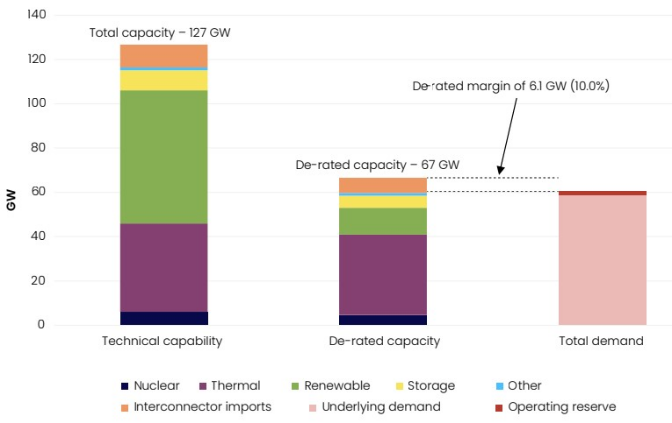
As shown in Figure 1, the 2025/26 Winter Outlook Report shows sufficient available capacity to meet electricity demand this winter with a derated margin of 6.1GW (10.0%) against the predicted ACS peak demand for this winter and a LOLE of below 0.1 hours/year. This is an increase from 5.2GW (8.8% of ACS peak demand) last winter.[footnote 7] NESO has the tools it needs to operate the electricity system reliably and can call on a range of technologies to balance electricity supply and demand, including gas-fired generation and flexible technologies such as batteries and consumer-led flexibility.[footnote 8]
NESO analysis shows that demand can be met under all their credible range scenarios, though there may be times when they need to use their standard operational tools such as system notices or operational actions. System notices are a routine way to communicate lower margin periods to the market. They do not indicate that electricity supply is at risk, or that an emergency situation will follow, but simply tell the market what is required in response to which participants will seek to make further capacity available.
Figure 1. De-rated margin in relation to generation capacity and demand
Source: NESO (2025) Winter Outlook 2025/2026
Four Year Ahead Assessment
Most of the required capacity of dispatchable generation and other infeeds to ensure that GB electricity margins remain within the reliability standard through to the 2028/29 delivery year has already been procured via the CM. The remainder will be procured through future ‘top up’ auctions, meaning we can be confident of electricity security of supply over the next four years.
While most of this capacity comes from existing units, the CM auctions also procure new build units and secure refurbishing units through multi-year agreements. In the 2022 T-4 auction, 2.6GW of derated capacity of new build generating units and 1.0GW of new build interconnector capacity was secured for delivery in the 2026/27 delivery year. In the 2023 T-4 auction, 1.5GW of new build generation capacity and 1.0GW of new build interconnector capacity was procured for delivery in the 2027/28 delivery year. In the 2024 T-4 auction, 2.1GW of new build generation capacity and 0.3GW of new build interconnector capacity was procured for the 2028/29 delivery year.[footnote 9]
Capacity Market
Capacity Market Explained
The purpose of the CM is to ensure security of GB’s electricity supply at least cost to consumers, by providing all forms of capacity with the right incentives to be on the system and to provide capacity which can be used to secure supply when needed. The CM ensures there is sufficient reliable capacity available during periods of electricity system stress, for example during cold, still periods with high demand and low wind generation.
The CM works by allowing eligible capacity providers to bid into a competitive auction to provide capacity. Successful capacity providers receive payments to be available to provide their capacity at times of system stress, such that the GB system operates within the Reliability Standard of 3 hours LOLE. These capacity payments incentivise the necessary investment to maintain and refurbish existing capacity, and to finance new capacity where necessary. Capacity providers face penalties if they fail to deliver against their capacity obligation – to provide electricity, or reduce demand, when required during a System Stress Event.[footnote 10]
The CM is technology neutral and does not seek to procure allocated volumes of capacity from specific types of technology. All types of technology can participate except for capacity providers in receipt of support from other specific policy measures, provided they can demonstrate sufficient technical performance to contribute to security of electricity supply, and provided they comply with the CM’s emissions limits.
The Electricity Settlements Company’s (ESC) records show that £1.25 billion was paid out to CM agreement holders for the 2024/25 Delivery Year.[footnote 11]
Capacity auctions
There are two capacity auctions: the T-4 auction which secures capacity for the delivery year four years ahead, and the T-1 auction which secures capacity for the delivery year one year ahead.
T-1 Auction results for the delivery year 2025/2026
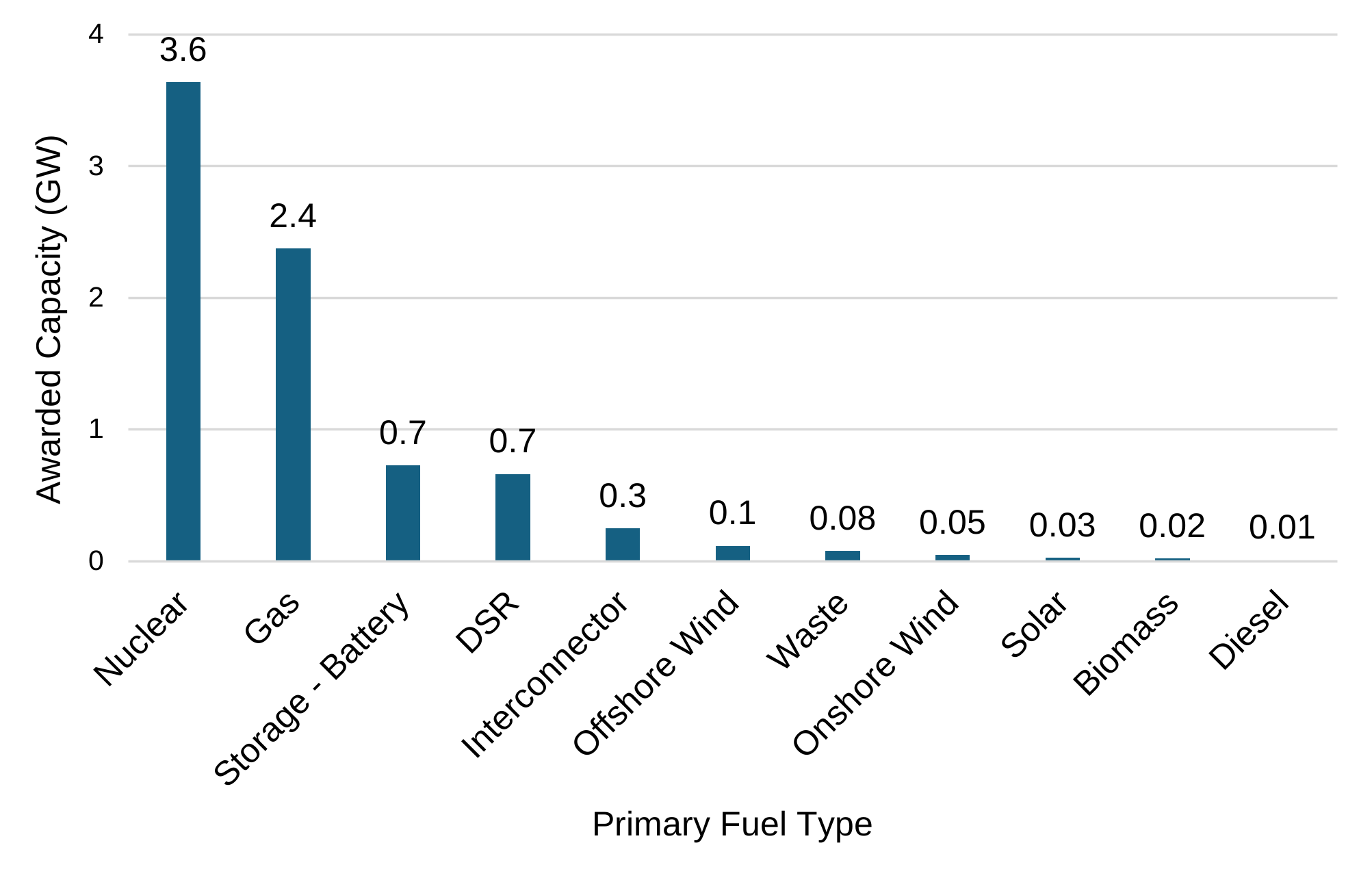
The T-1 auction for the Delivery Year 2025/2026 concluded on 5 March 2025 and secured 7.9GW of de-rated capacity at a clearing price of £20/kW per year.[footnote 12] A total of 9.1GW of de-rated capacity entered the auction, of which 87.0% received CM agreements. 6.3GW of awarded capacity is from existing generation capacity; 0.7GW is from new build generation capacity and 0.2GW from new build interconnectors. The remaining capacity was awarded to consumer-led flexibility (0.7GW). Figure 2 shows the breakdown of capacity agreements by fuel type.
Consumer-led flexibility (CLF, covered in more detail below) refers to action taken by consumers to reduce or increase the amount of electricity they take off the grid at a particular time responding to operational requirements. In the CM Rules, CLF is defined as Proven Demand Side Response (DSR) and Unproven DSR.[footnote 13] The DSR category is determined by whether a DSR Test is completed ahead of the auction prequalification period (Proven DSR) or following the auction prequalification period but ahead of the relevant CM delivery year (Unproven DSR).
Under CM Rules, Unproven DSR is required to submit a business plan as part of its application which details how it will acquire its submitted capacity offer. Proven DSR secured 0.2GW of awarded agreements and Unproven DSR 0.5GW agreements for the 2025/26 T-1 auctions.
Figure 2. T-1 Auction results breakdown by Capacity Agreements awarded by fuel type (de-rated capacity)
Source: NESO (2025) Final Auction Results Report
T-4 Auction results for the delivery year 2028/2029
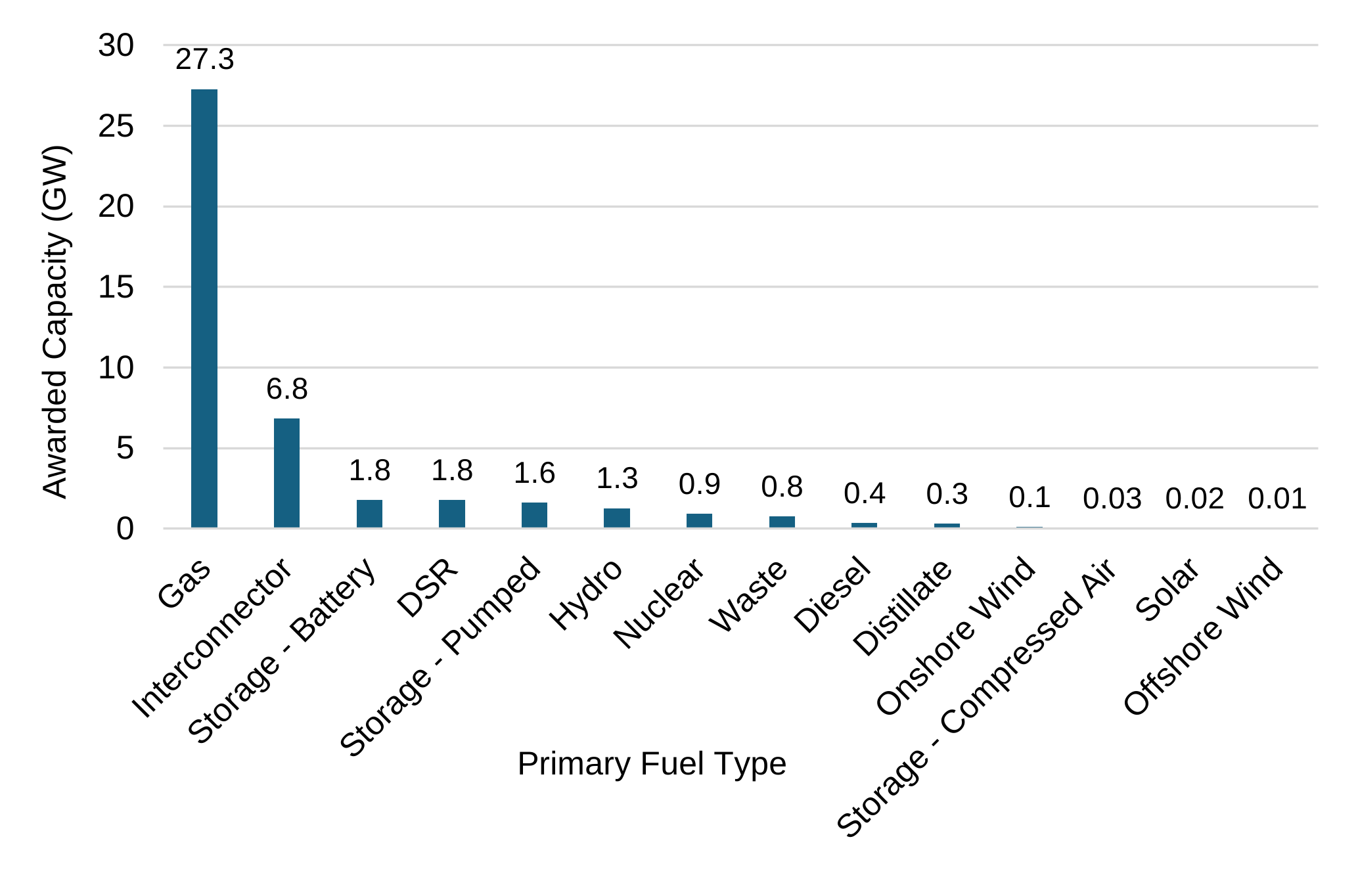
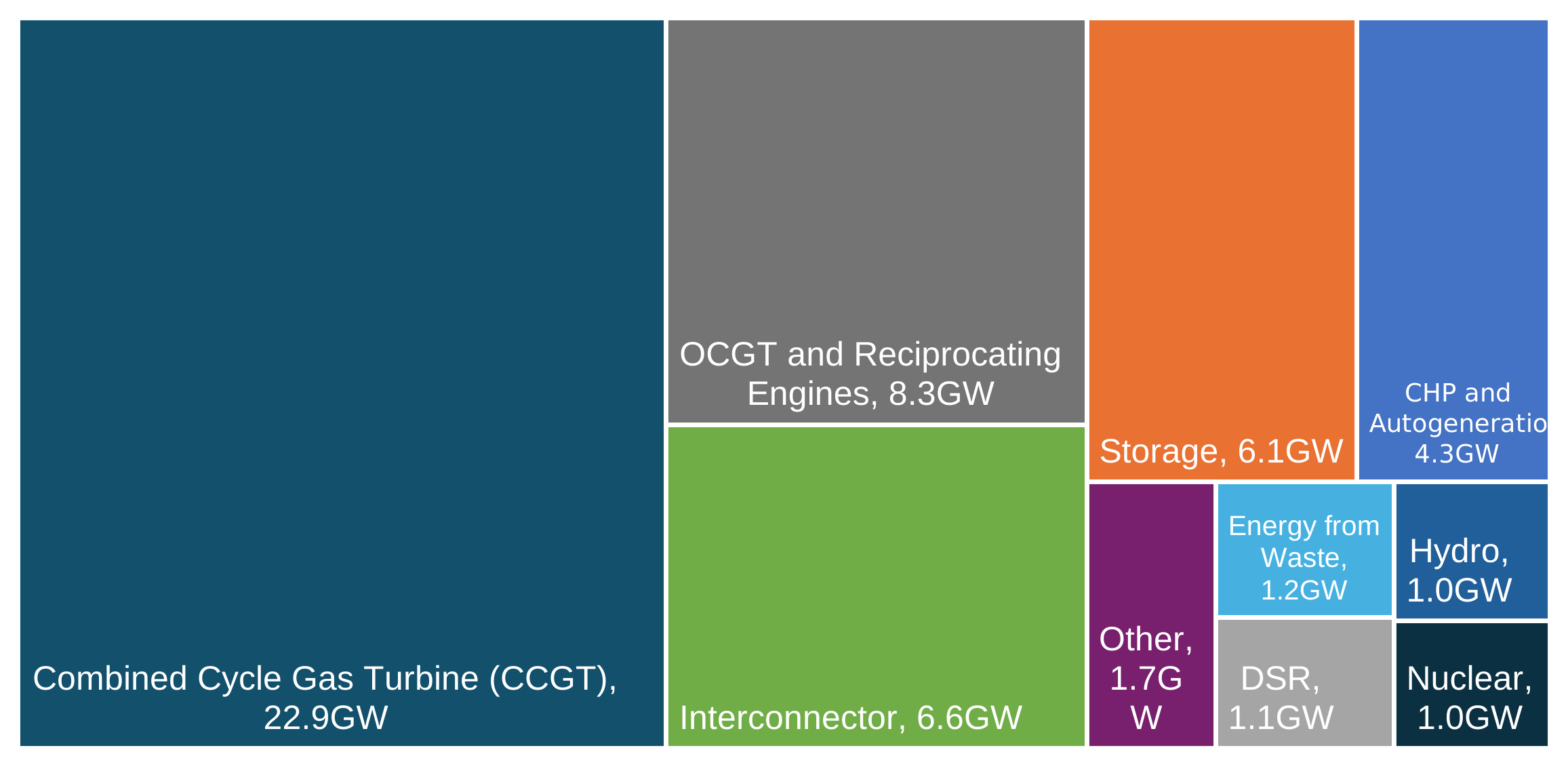
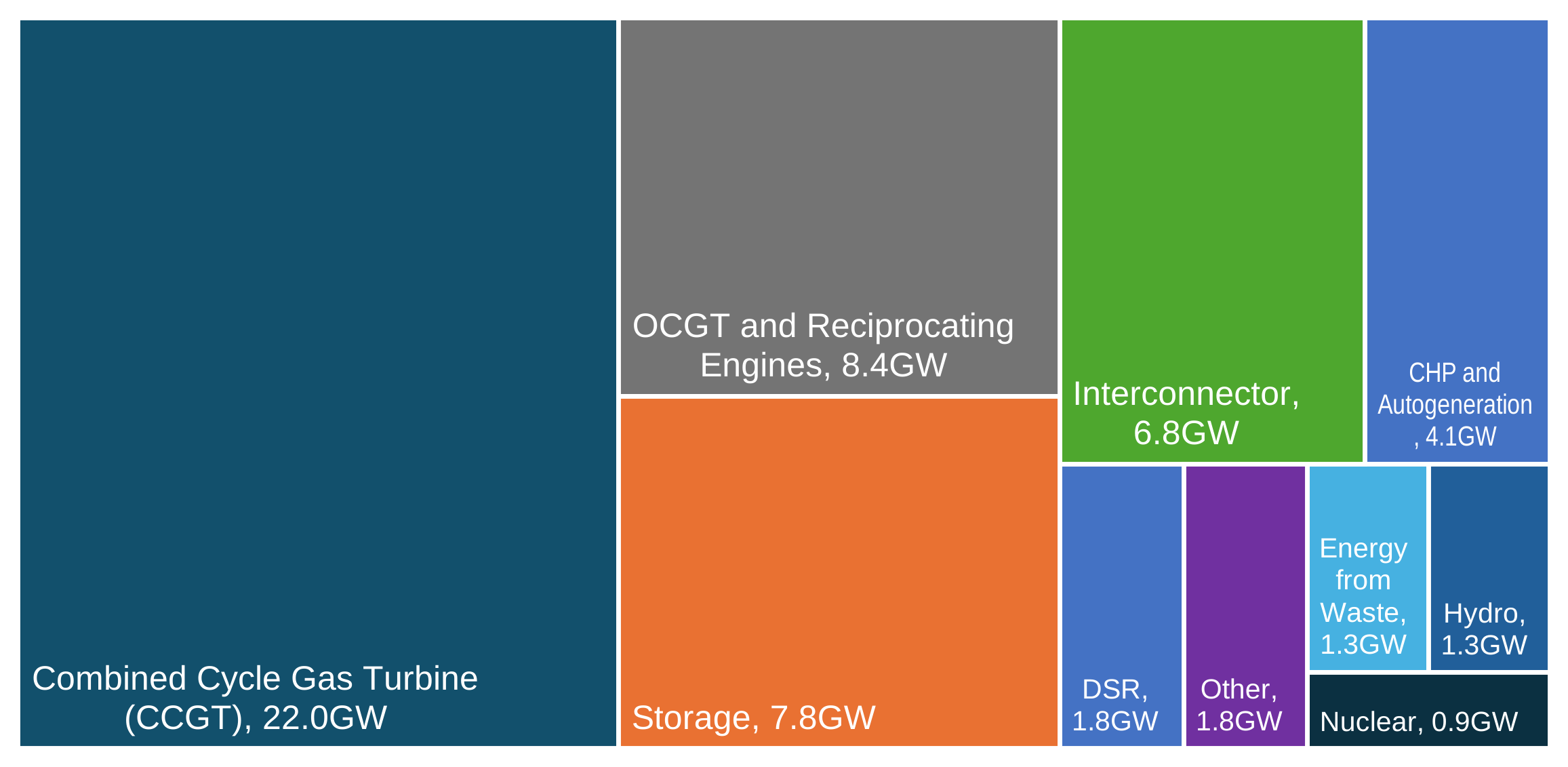
The T-4 auction for the delivery year 2028/2029 concluded on 11 March 2025 and secured 43.1GW of de-rated capacity at a clearing price of £60/kW per year.[footnote 14] A total of 44.7GW of de-rated capacity entered the auction, of which 96.4% received CM agreements. 29.4GW of awarded capacity is from existing generation capacity; 6.6GW from existing interconnectors; 2.1GW from new build generation capacity; and 0.3GW from new build interconnectors. The remaining capacity was awarded to Unproven DSR (1.5GW), Proven DSR (0.3GW) and refurbishing generating capacity (2.9GW). Figure 3 shows the breakdown of capacity agreements by fuel type.
Figure 3. T-4 Auction results breakdown by Capacity Agreements awarded by fuel type (de-rated capacity)
Source: NESO (2025) Final Auction Results Report
Capacity procured in historical auctions for future delivery years
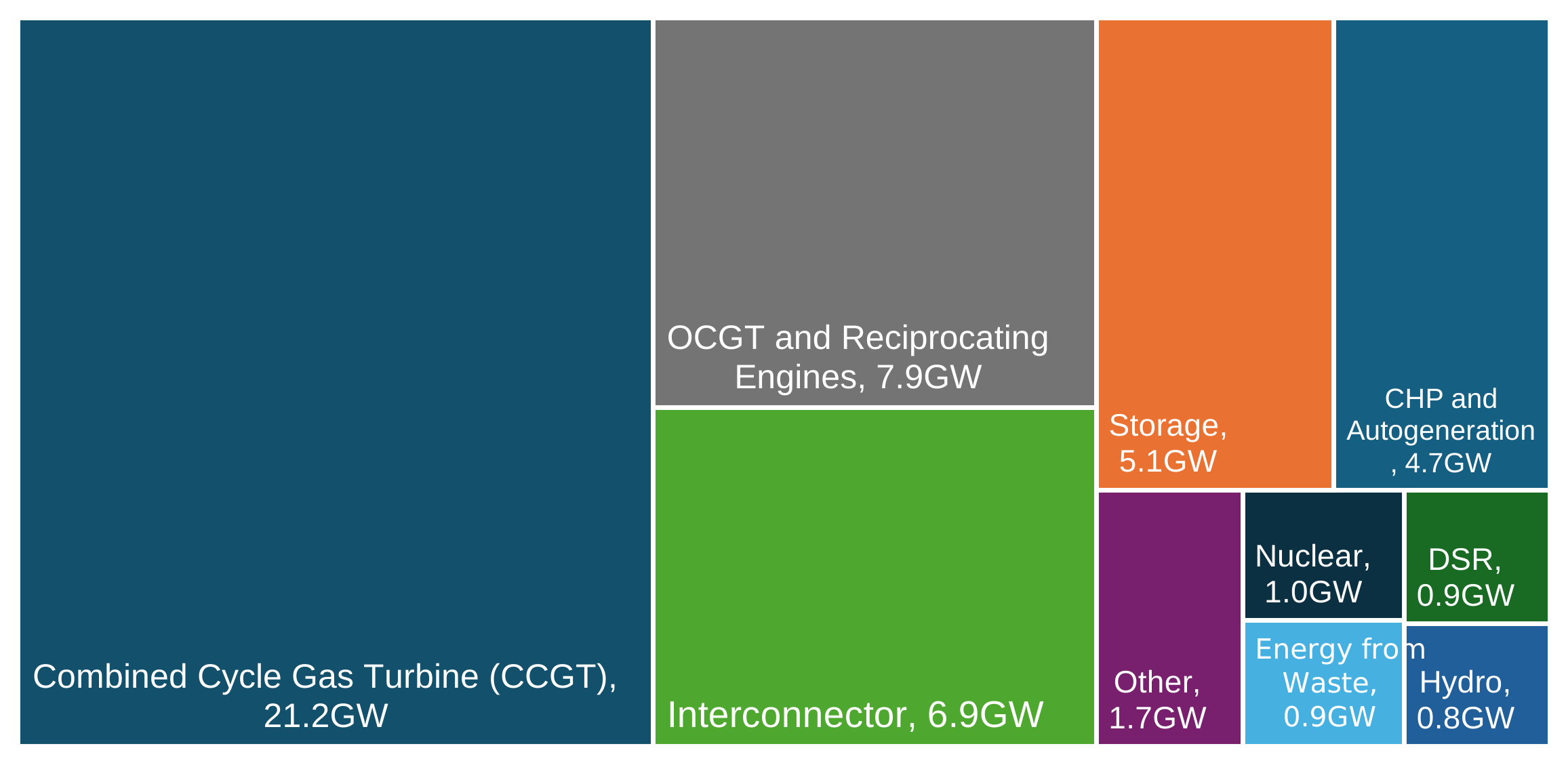
The majority of the capacity required to meet forecasted peak demand for the 2026/27 (58.9GW), 2027/28 (59.4GW) and 2028/29 (60.2GW) Delivery Years has already been procured in historical T-4 CM auctions.[footnote 15] Total derated capacity procured each year currently stands at, 50.1GW for 2026/27 (Figure 4), 54.1GW for 2027/28 (Figure 5) and 56.1GW for 2028/29 (Figure 6).[footnote 16] In 2026/27, 3.4GW of procured capacity is new build generating capacity and 1.0GW is new build interconnector capacity.[footnote 17]
The CM has a robust set of Rules and Regulations that incentivise new build units to deliver their contracted capacity on time.[footnote 18] Capacity Market Units (CMUs) must meet several milestones prior to receiving their first Capacity Payment. These milestones are evidenced through reports from Independent Technical Experts and include meeting the Financial Commitment Milestone of taking a Final Investment Decision and spending 10% of Capital Expenditure, as well as reaching the Substantial Completion Milestone by showing a CMU can deliver 90% of its obligated capacity.
The capacity for each future Delivery Year will be topped up in the corresponding T-1 auctions, which will include adjustments for any non-delivery.
Figure 4. Derated Capacity secured for 2026/27 delivery year by technology, in GW[footnote 19]
Source: NESO (2025) Capacity Market Register
Figure 5. Derated Capacity secured for 2027/28 delivery year by technology, in GW
Source: NESO (2025) Capacity Market Register
Figure 6. Derated Capacity secured for 2028/29 delivery year by technology, in GW
Source: NESO (2025) Capacity Market Register
The next Capacity Market auctions
The next CM auctions will be held in March 2026. These will include a T-1 auction to top-up capacity for the 2026/27 Delivery Year and a T-4 auction to secure the bulk of the capacity for the 2029/30 Delivery Year.
NESO published the target capacity recommendations for the March 2026 CM auctions in its 2025 Electricity Capacity Report (ECR).[footnote 20] For the T-1 Auction for the 2026/27 Delivery Year this was 5.8GW, to top up the 43.0GW already procured in the earlier T-4 auction for the 2026/27 Delivery Year. For the 2029/30 Delivery Year, NESO recommended a total target of 40.1GW.
The Secretary of State wrote to NESO on 8 July 2025 to set the CM auction targets.[footnote 21] The Secretary of State set this target in agreement with NESO’s recommendation and with consideration of the views of the DESNZ-appointed independent Panel of Technical Experts (PTE). The PTE’s views are detailed in their annual report on the ECR.[footnote 22] For the T-1 Auction, the target was set as 5.8GW. For the T-4 auction, the target was set as 39.1GW, with 1.0GW set aside for the future corresponding T-1 auction.
The Secretary of State may adjust the auction targets ahead of the auctions in March 2026, taking into account any updated advice from NESO. Final targets will be confirmed before the auctions are scheduled to be held.
Improvements to the Capacity Market
Changes made over the last year in the CM Rules have been intended to improve security of supply and align with the government’s clean power and net zero goals. The scheme improvements made this last year are set out below.
Capacity Market changes ahead of Prequalification 2025 for the 2026 CM auctions
Government has routinely made changes to the CM to improve its functioning and ensure it remains fit for purpose in the changing energy policy and technology context. Ahead of scheme prequalification in 2025, government introduced changes as outlined in responses to consultations published in October 2023,[footnote 23] October 2024,[footnote 24] and December 2024.[footnote 25]
The changes introduced included:
- Amending timelines for post-stress event activities to improve administrative arrangements.
- Amending rules on what can be captured as part of refurbishment programmes.
- Defining a low carbon definition to support low carbon technologies with lower capital expenditure requirements to access longer term agreements. This included agreements of up to 3-years for zero CAPEX, low carbon capacity and agreements of up to 9-years for low carbon capacity whose CAPEX would not meet the existing threshold for agreements of up to 15-years.
- Supporting low carbon projects with longer build times to access support from the CM through the introduction of an Extended Long Stop Date. This is intended to provide revenue certainties in order to support investment decisions for low carbon projects.
- Publishing emissions data on a publicly available register.
- Making it easier for plants to access three-year ‘refurbishing’ CM agreements, by reducing the capital expenditure threshold. This should provide greater revenue certainty to plants that need to undertake refurbishment, encouraging the type of investment ageing plants need to extend the operating life of the plant. This is important to mitigate short-term risks to electricity security.
- Providing assurance that all substantially refurbishing or new combustion power plants participating in the next CM auction commit to having a credible plan to decarbonise, either through converting to hydrogen firing or carbon capture. The decarbonisation plan must be in place before they become operational.
- Introducing an exit pathway to enable gas plants to leave multi-year CM agreements without penalty and transfer to a Dispatchable Power Agreement (DPA), enabling conversion to low carbon. This pathway is subject to the Capacity Provider becoming party to a DPA, which is subject to Transport and Storage capacity, value for money and affordability.
- Updating the CM Rules to improve accessibility, provide policy intent clarifications and remove redundant sections and references.
- Streamlining administrative processes for consumer-led flexibility providers and CM delivery partners to improve deliverability.
- Introducing a termination fee for non-delivery of previously unproven consumer-led flexibility CMUs to mitigate against possible lost capacity and subsequent shortfalls.
- Updating the CM low carbon policy consulted on under the ‘Phase 2’ changes in 2023, to allow capacity providers to submit a Low Carbon Declaration after being awarded an agreement, aligning the change to the original policy intent.
Capacity Market: Changes ahead of Prequalification 2026 for the 2027 CM auctions
On 02 October 2025, the government published a consultation[footnote 26] and call for evidence[footnote 27] seeking views on a series of changes to the CM. These aim to enable bringing forward enough dispatchable enduring capacity capable of generating power over prolonged periods of tight supply without relying on stored energy, to ensure security of electricity supply is maintained. This is accompanied by proposed changes looking to protect consumers’ interests by encouraging competition in the CM. Further proposals look to make sure the CM Rules are accessible and clear, boosting investor confidence and ensuring delivery from CMUs. The consultation and call for evidence closed for responses on 27 November 2025, and a government response will be published in Spring 2026.
The consultation seeks views on the following areas:
- Multiple price Capacity Market – Implementing targeted price-related reforms to ensure security of supply is cost-effectively maintained. This will be achieved by introducing a second, higher, price cap into the auction for specific designated categories of project that could, if needed, secure new build dispatchable enduring capacity that can generate power over prolonged periods of tight supply.
- Ensuring efficient bidding in Capacity Market auctions – A package of interventions to reduce information provided to participants before and during auctions that will increase uncertainty relating to the expected gains and losses from bidding strategically and thereby ensure efficient bidding that maximises value for money.
- Consumer-led flexibility - Implementing additional delivery assurance processes in relation to Demand Side Response components entering the CM, both from an operations perspective and the CM value attributed to diverse Demand Side Response technologies in providing system response.
- Self-nomination of connection capacity for battery storage technologies – Allowing battery CMUs to self-nominate their connection capacity below their full network connection capacity to mitigate the risk of failing extended performance testing due to degradation.
- Determining appropriate means for non-fossil fuel generation to access low carbon Capacity Market mechanisms - Introducing appropriate sustainability criteria for biogenic sources to evidence against, which could enable them to access low carbon benefits in the CM.
- Further improvements to Capacity Market administration and delivery assurance - Ensuring clarity of the Rules by proposing policy clarifications, amendments and revocations, as well as introducing a Termination Fee for Termination Events that currently have no fee associated. These proposals also seek to improve value for money by suspending payments for CMUs that are subject to an Insolvency Termination Event.
The call for evidence, published alongside the consultation, is seeking views on enabling Hydrogen to Power (H2P) to participate in the CM, and on implementing a new methodology for the technical adjustment element of the process by which interconnector de-rating factors are set.
In addition, in winter 2025, the government published two further consultations on the CM to address emerging issues which required changes to the CM Rules and Regulations. The DESNZ Consultation on Proposal Regarding Locational Changes of Capacity Market Units and Consultation on Proposals to Integrate Low Carbon Technologies and Enhance Delivery Assurance Ahead of Prequalification 2026 seek to maintain electricity security, keep the CM’s impact on bills as low as possible for consumers, strengthen delivery assurance of low carbon technologies, and improve the overall functioning of the scheme.[footnote 28]
Taken together, these proposals will continue to ensure our future electricity security at least cost to consumers.
The government aims to publish responses to the consultation on the proposal regarding location changes of CMUs in winter 2026 and the responses to the other consultations in spring 2026. Changes will be introduced ahead of Prequalification 2026 prior to the auctions in 2027, subject to parliamentary time.
Electricity storage
Storage harnesses the power of clean energy when it is in abundant supply and releases it during times when supply is low. This is critical to supporting electricity security of supply over the next four years, as well as being vital for achieving clean power by 2030 and net zero by 2050. Storage also reduces the need for costly new infrastructure to meet peak demand. Using clean energy flexibly not only helps shift demand or supply of electricity, it also cuts emissions, helping tackle climate change.
This is all the more important because as we electrify transport, heating and industry to decarbonise the economy, our electricity needs will rise sharply. To make this future system work we need a variety of storage technologies that complement each other. At one end of the spectrum we have shorter term storage – such as batteries, both domestic and grid-scale, which store electricity for up to eight hours – in which durations the market is at present dominated by lithium-ion technology; at the other end we have long duration electricity storage (LDES), which includes a range of technologies such as pumped storage hydro (PSH) which can provide power for eight hours or more. The government has outlined its plans for the deployment of electricity storage in the Clean Power 2030 Action Plan and the Clean Flexibility Roadmap.[footnote 29] In the Clean Power 2030 Action Plan, the government outlined an ambition for 23GW to 27GW of grid-scale batteries in 2030,[footnote 30] increasing from just over 6GW that is currently on the grid,[footnote 31] and deploying 4-6GW of LDES, up from the existing 2.8GW of LDES capacity.[footnote 32]
In terms of the battery pipeline, there are 17GW of projects with CM agreements due to be operational by 2029,[footnote 33] and a further ~35GW with planning permission.[footnote 34] The 23-27GW ambition is deliverable: adding all projects with CM agreements to the existing capacity would take us to around 21-23GW by 2029, with two auctions to spare.
Earlier this year, Ofgem launched the LDES Cap and Floor scheme to support investment in these projects. Ofgem recently announced that 77 projects passed the initial eligibility assessment stage and will now progress to more detailed assessment, with final decisions to be made by summer 2026 for delivery by either 2030 or 2033, according to the project’s bid.[footnote 35]
The progress made on delivering battery storage and LDES adds to our confidence in GB’s ability to deliver secure electricity supply over the next four years.
Interconnection
Electricity interconnectors are electricity cables which transport electricity between countries. Interconnectors enable us to import and export electricity depending on price signals from the connected markets, transporting electricity from the lower-priced market to the higher-priced market. Electricity interconnectors provide us with access to a more diverse pool of generation, for example nuclear energy in France and hydropower in Norway, complementing our domestic energy mix and enhancing our security of supply.
Point-to-point interconnectors transport electricity directly between the connected countries. Offshore Hybrid Assets (OHAs) are a novel type of electricity asset, which would combine interconnectors with offshore wind farms and are a potential future development.
NESO’s FES 2025 show that GB is expected to become a net exporter of electricity post 2030 and retain that position until 2050 under the Holistic Transition and Electric Engagement Pathways.[footnote 36] However, we expect to continue to rely on imports to provide flexibility during tight margin periods and potential stress events.
The Clean Power 2030 Action Plan highlights a need for between 12-14GW of interconnector capacity by 2030 to provide short-duration flexibility and to balance periods of higher or lower generation.[footnote 37]
GB currently has 10.3GW of operational electricity interconnector capacity across ten interconnectors:[footnote 38]
- 4.0GW to France: IFA 2.0GW, IFA2 1.0GW, and ElecLink 1.0GW, operational since 1986, 2021 and 2022 respectively
- 0.5GW to Northern Ireland: Moyle, operational since 2001
- 1.0GW to Ireland: East-West and Greenlink, operational since 2012 and 2025 respectively
- 1.0GW to Netherlands: BritNed, operational since 2011
- 1.0GW to Belgium: Nemo Link, operational since 2019
- 1.4GW to Norway: North Sea Link, operational since 2021
- 1.4GW to Denmark: Viking Link, operational since 2023
There is currently one project under construction, which will add a further 1.4GW of capacity to GB, bringing the total to 11.7GW:[footnote 39]
- 1.4GW to Germany: NeuConnect, scheduled for completion in 2028
Ofgem regulate electricity interconnectors and typically provide agreements through their cap and floor regime, which was launched in 2014. The regime is a market-based approach that aims to incentivise developers to deliver interconnection capacity by limiting their exposure to electricity market price risk. There have been three application windows for new project proposals since the launch of the regime, with the first two windows approving all projects. The net total quantifiable benefit to GB consumer welfare of Window 1 and Window 2 projects has been assessed as £13.6 billion and £8.9 billion, respectively.[footnote 40]
Ofgem published their final decisions for Window 3 and the OHA pilot scheme in November 2024. Three point-to-point interconnectors were granted a cap and floor regime in principle – MaresConnect (0.75GW to Republic of Ireland), LirlC (0.7GW to Northern Ireland) and Tarchon (1.4GW to Germany).[footnote 41] Two OHA projects were granted a Pilot OHA regulatory regime in principle – LionLink (1.8GW to Netherlands) and Nautilus (1.4GW to Belgium).[footnote 42]
The UK has historically been a net importer of electricity, with the exception of 2022. In 2022, the UK was a net exporter for the first time in more than 40 years, with net exports totalling 5.3TWh. This was due to the widespread outages in the French nuclear fleet, increasing the demand for exported electricity to France and market price differentials.
In 2024, net imports increased by 40% from 2023 to reach 33.4TWh. Total annual imports rose by 31% to 43.7TWh, a new record high. Total exports increased by 9% from 2023 to reach 10.3TWh, the second highest annual figure. Interconnectors to France accounted for 19.5 TWh of net imports, followed by Norway with net imports of 9.6TWh, Belgium with net imports of 4.2TWh, Denmark with net imports of 3.7TWh. More electricity was exported to Ireland than was imported, with net exports of 5.2TWh.[footnote 43]
In Q2 2025, net electricity imports fell by 20% to 7.4TWh compared to Q2 2024. This was equivalent to 10% of UK electricity demand for Q2 2025. The reduced imports were due to less favourable price differentials for imports compared to the same period in 2024.[footnote 44]
This Winter, NESO expects GB margins to be adequate and within the Reliability Standard. The current Base Case de-rated margin for interconnection has increased from Winter 24/25 from 5.2GW to 6.1GW, partly due to the commissioning of the Greenlink interconnector with Ireland.[footnote 45] NESO analysis suggests that imports will be available from Europe when needed, diversifying our generation mix and supporting our security of supply. In addition, NESO’s analysis expects that there will be a significant number of days when GB could support exports to neighbouring markets, if required, supporting European-wide decarbonisation.[footnote 46]
Looking to the future, we are moving towards aligning future interconnection with strategic planning. We are working with NESO to explore the optimal role of future interconnection in GB’s future system through to 2050. Ofgem and DESNZ will develop a future delivery approach for strategically aligned projects, providing clarity to industry via clear and consistent timelines and processes.[footnote 47]
Consumer-led flexibility
As set out in the Clean Flexibility Roadmap, flexibility is the cornerstone of the government’s plan to reach clean power by 2030 and net zero by 2050 and will support our electricity security.[footnote 48] The country needs a more flexible electricity system to meet the needs of homes and businesses as we harness renewable energy and electrify energy demand sectors. Consumer-led flexibility (CLF) involves incentivising consumers of all sizes to voluntarily shift electricity use away from peak periods of demand to when supply may be more abundant, cheaper and cleaner.
CLF can help consumers save money and improve system efficiency by using electricity at times that are beneficial to the system and being rewarded for doing so. It supports the integration of renewables and helps defer or avoid the need for costly network upgrades and new generation capacity.
Flexibility from technologies such as CLF, alongside energy storage, and interconnection, could save up to £10 billion (2012 prices) per year by 2050 by reducing the amount of generation and network build needed to decarbonise.[footnote 49]
In 2024, CLF from electric heating provided 7.1GW of flexibility (including 6.9GW from storage heaters) and industrial and commercial consumers are providing around 0.8GW of CLF to the system.[footnote 50] Participation from domestic consumers, smaller non-domestic consumers and electric vehicle charging, remains at an early stage but these collectively contribute 0.6GW.[footnote 51] We expect these to provide a significant source of flexibility over the next decade and beyond, when combined with tariffs that reward flexible electricity use.
The CM represents one revenue stream for CLF. Table 1 shows the amount of CLF winning capacity agreements in CM auctions for T-4 (held four years ahead of delivery year) and Table 2 shows the amount of CLF winning capacity agreements, in CM auctions for T-1 (held one year ahead of delivery year). This is awarded capacity, which has been de-rated in line with the CM’s de-rating factor for CLF.
Table 1. Capacity Agreements awarded to CLF in recent CM T-4 auctions
| Auction Delivery Year | 2024-25 | 2025-26 | 2026-27 | 2027-28 | 2028-29 |
|---|---|---|---|---|---|
| Awarded Capacity (MW) | 1,066 | 1,004 | 925 | 1,130 | 1,768 |
Table 2. Capacity Agreements awarded to CLF in recent CM T-1 auctions
| Auction Delivery Year | 2021-22 | 2022-23 | 2023-24 | 2024-25 | 2025-26 |
|---|---|---|---|---|---|
| Awarded Capacity (MW) | 239 | 528 | 405 | 745 | 662 |
Source: NESO (2025) ‘Capacity Market Auction Results’
Demand Flexibility Service
Another significant CLF enabler has been the Demand Flexibility Service (DFS), introduced by the Energy System Operator (ESO, which transitioned to NESO in 2024) in Autumn 2022 in response to increased volatility and uncertainty in energy markets following Russia’s illegal invasion of Ukraine.
It gave ESO the option to pay consumers – via their energy supplier or an approved third-party intermediary – to turn down their demand in time periods where there might be a shortage of electricity. Over winter 2022/23, DFS incentivised 1.6 million households and businesses to lower their electricity demand when required, saving over 3.3GWh of electricity.[footnote 52] During winter 2023/24, there was an over 50% increase in the number of participants in the service, with around 2.5 million participants and over 3.6GWh delivered.[footnote 53]
In November 2024, DFS changed from a winter-only enhanced action to an enduring year-round, in-merit margin tool. From December 2024 to March 2025, DFS delivered 3.9GWh of flexibility, across 44 events.[footnote 54]
Liquidity in the GB wholesale power market
Energy market firms buy and sell their electricity in the wholesale market. The wholesale market allows participants to trade a range of products that enable them to meet their obligation to supply energy whilst also enabling them to mitigate risk. The degree of access to these products relates to the liquidity of the market and low levels of market liquidity can be indicative of an uncompetitive market.
Poor liquidity in the wholesale market can prevent consumers from fully realising the benefits that competition can deliver in terms of downward pressure on bills, better service and greater choice. It can also obscure or weaken price signals, inhibiting long term investment decisions in new generating plants with negative consequences for security of electricity supply.
In December 2023, Ofgem published a Call for Input on GB Power Market Liquidity.[footnote 55] This was to explore current market power liquidity trends, issues and concerns following the suspension of the Market Making Obligation (MMO) in 2019.[footnote 56] In August 2024, Ofgem published the Summary of Responses to the Power Market Liquidity Call for Input.[footnote 57] Ofgem did not consider that there was a clear and strong case to proceed with market intervention (e.g. a market maker) at the time. Ofgem committed to discuss potential policy levers to improve liquidity with the relevant teams at both Ofgem and DESNZ and continue to monitor liquidity trends going forward.
Ofgem’s most recent monitoring shows:
- Traded volumes have shown strong recovery since the trough seen at the end of 2022, peaking in early 2025 and remaining considerably above 2024 levels. Total traded volumes (exchange and over-the-counter) reached nearly 250TWh in January to March 2025, the highest since 2020.[footnote 58] This is a significant rebound from the trough in October to December 2022 (140TWh). Although volumes declined in April to June 2025, they remained more than 25% higher than the equivalent 2024 period, rising from 176TWh to 226TWh.
- Churn (the number of times a forward product is traded before delivery) has been increasing steadily since the end of 2022, when forward contracts were traded twice on average before delivery. In the April to June 2025 period, forward contracts were traded three times on average before delivery. This figure is generally accepted as the threshold for a liquid market.[footnote 59]
- Bid-offer spreads (the difference between the highest bid to buy and the lowest offer to sell) are another measure of market liquidity, with low spreads indicating higher liquidity. Across front month, front quarter and front season contracts, bid-offer spreads continue to decrease from their 2022 peak (the annual average for front quarter contracts was £0.9/MWh). Across 2025, weekly average bid-offer spreads for front quarter contracts have remained below the level for the equivalent week in 2022, and annual averages are broadly consistent with levels seen in 2024 (around £0.4/MWh for front quarter contracts).
Ofgem will continue to monitor liquidity. If liquidity shows signs of deteriorating, Ofgem may review this and reconsider the introduction of a market maker if market conditions show there may be clear benefits to introducing this.
Network reliability
Current network reliability
The historic overall reliability for the electricity networks (both transmission and distribution) in terms of supplied demand has been high – over 99.9% in each year from 2021 to 2024-25 – and we are confident that will continue.[footnote 60]The UK has a highly resilient electricity network, and industry works to continuously minimise the risk of unplanned outages while taking the risk of such outages into account in forward planning.
As part of the price control process, Ofgem sets targets and incentive rates for the number of customer interruptions and customer minutes lost for each Distribution Network Operator (DNO). The Interruptions Incentive Scheme incentivises DNOs to invest in and operate their networks to manage and reduce the frequency and duration of power cuts experienced by their customers, whilst maintaining focus on minimising network costs and securing optimal value for consumers. The standards encourage DNOs to meet certain expected levels of service and to provide payments to end customers in the event of individual standards not being met. The standards cover a range of activities, including restoring supply during an unplanned interruption and providing notice periods for planned interruptions. DNOs did not perform well against the Interruptions Incentive Scheme (IIS) in 2023-24, incurring a total penalty of £29.7 million. This contrasts with the last published annual report in 2021-22, when they exceeded Customer Interruptions and Customer Minutes Lost targets and received a combined reward of £174 million.[footnote 61] Improvements are anticipated as DNOs continue investing in network resilience and performance enhancements.
Offshore Transmission Systems connect offshore generation (such as wind) to the wider National Electricity Transmission System, and do not have a direct role in supplying demand. The regulatory system for Offshore Transmission Owners is therefore distinct from that of Onshore Transmission Owners because regulatory performance incentives are based on system availability, rather than loss of supply. This ensures offshore generators are able to export energy with minimal disruption. The Annual System Availability of Offshore Networks for 2024-25 was 98.2%.[footnote 62]
Future development of networks
Accelerating the delivery of electricity network infrastructure and reforming the process for connecting new projects to the network are not only vital for ensuring short and long-term security of supply, but are also crucial enablers for the government’s Clean Energy Superpower and Growth missions.
Since autumn 2024, the connections reform programme has moved from planning to implementation, with NESO and the network companies introducing measures to prioritise viable, strategically aligned projects and deprioritise stalled or speculative ones from the connections queue. These reforms, supported by government and Ofgem, are designed to accelerate connections for clean energy generation and demand-side projects, unlocking billions in investment and ensuring the grid evolves in line with national energy strategy.
The Planning and Infrastructure Bill, introduced in March 2025, provides new powers for the Secretary of State and Ofgem to modify industry codes and licenses and designate strategic plans - such as the Clean Power 2030 Action Plan - for use in prioritising grid connections.[footnote 63] Ofgem’s formal approval of NESO’s reform proposals in April 2025 marked a pivotal moment, enabling the reordering of the queue based on readiness and strategic alignment.[footnote 64]
The implementation plan is now underway, with a one-time evidence submission window completed and new connection offers expected to be issued from autumn 2025.
Overall, the reforms are expected to help facilitate £40 billion a year of mainly private investment in homegrown clean power projects and infrastructure across the country, reduce unnecessary network costs, and provide developers with the certainty needed to proceed. By aligning grid access with Clean Power 2030, we are delivering a more efficient, transparent, and strategically driven connections process which supports clean power delivery, economic growth, and investor confidence.
To achieve network requirements for Clean Power 2030, we will need to deliver four times as much new transmission network by 2030 as has been built in the last decade. NESO’s Clean Power 2030 advice confirms that all 80 transmission projects identified as required to achieve clean power by 2030, including both upgrades to existing infrastructure and new transmission lines, are already in existing strategic network plans.
Through the strategic network planning process, NESO takes a holistic view in determining recommendations for new transmission network. In 2022, ESO published the Holistic Network Design which made recommendations for network build due to be delivered by or shortly after 2030. As documented in the methodology one of the key design criteria assessed in determining the design was deliverability and operability, which looks to ensure that the resulting system is safe and reliable.
To accelerate delivery of networks infrastructure, we are reforming the planning and consenting process, reducing community impacts through the strategic approach to network design, ensuring that communities benefit from hosting infrastructure, supporting the supply chain, securing workforce, reforming system access and expediting Ofgem’s regulatory approval process.
Networks require ongoing and increasing investment to maintain a reliable electricity system and to provide the necessary acceleration to achieve clean power by 2030. Ofgem’s RIIO (Revenue = Incentives + Innovation + Outputs) price control models are ensuring this takes place, while driving further efficiency savings, incentivising outperformance, maintaining affordability, and encouraging innovation. Incentives, such as the Output Delivery Incentive (ODI) reward network operators for delivering outputs that enhance efficiency and reliability. The Network Asset Risk Metric (NARM) incentivise network operators to ensure efficient management of asset risk.
Ofgem has advanced its regulatory approach through the development of the RIIO ET3 price control for electricity transmission networks, which will apply from 2026 to 2031. Ofgem will introduce new mechanisms to accelerate strategic investment, like Centralised Strategic Network Plan – Funding (CSNP-F) and the Advanced Procurement Mechanism, while maintaining strong efficiency incentives and performance-based regulation. These changes are designed to enable timely delivery of critical infrastructure to meet growing electricity demand and support the transition to net zero.
Under the current RIIO-2 framework, Ofgem has continued to utilise re-opener mechanisms to allow for mid-period adjustments in response to emerging system needs. In 2024, electricity transmission and distribution network operators received additional allowances to address new investment requirements, reinforcing the flexibility of the regulatory model. This approach ensures that networks can adapt to evolving challenges while maintaining value for consumers and delivering the infrastructure necessary for a decarbonised electricity system.
Looking ahead, Ofgem has begun shaping the ED3 framework for electricity distribution networks, which will run from 2028 to 2033. The new framework will be underpinned by Regional Energy Strategic Plans, to support smarter, more resilient local networks and enable faster, more efficient connections for low-carbon technologies. These developments are designed to ensure that the regulatory regime remains fit for purpose as the electricity system becomes more decentralised, digitalised, and demand-led and will be coordinated by NESO, also needing to align with the SSEP.
Gas
Introduction
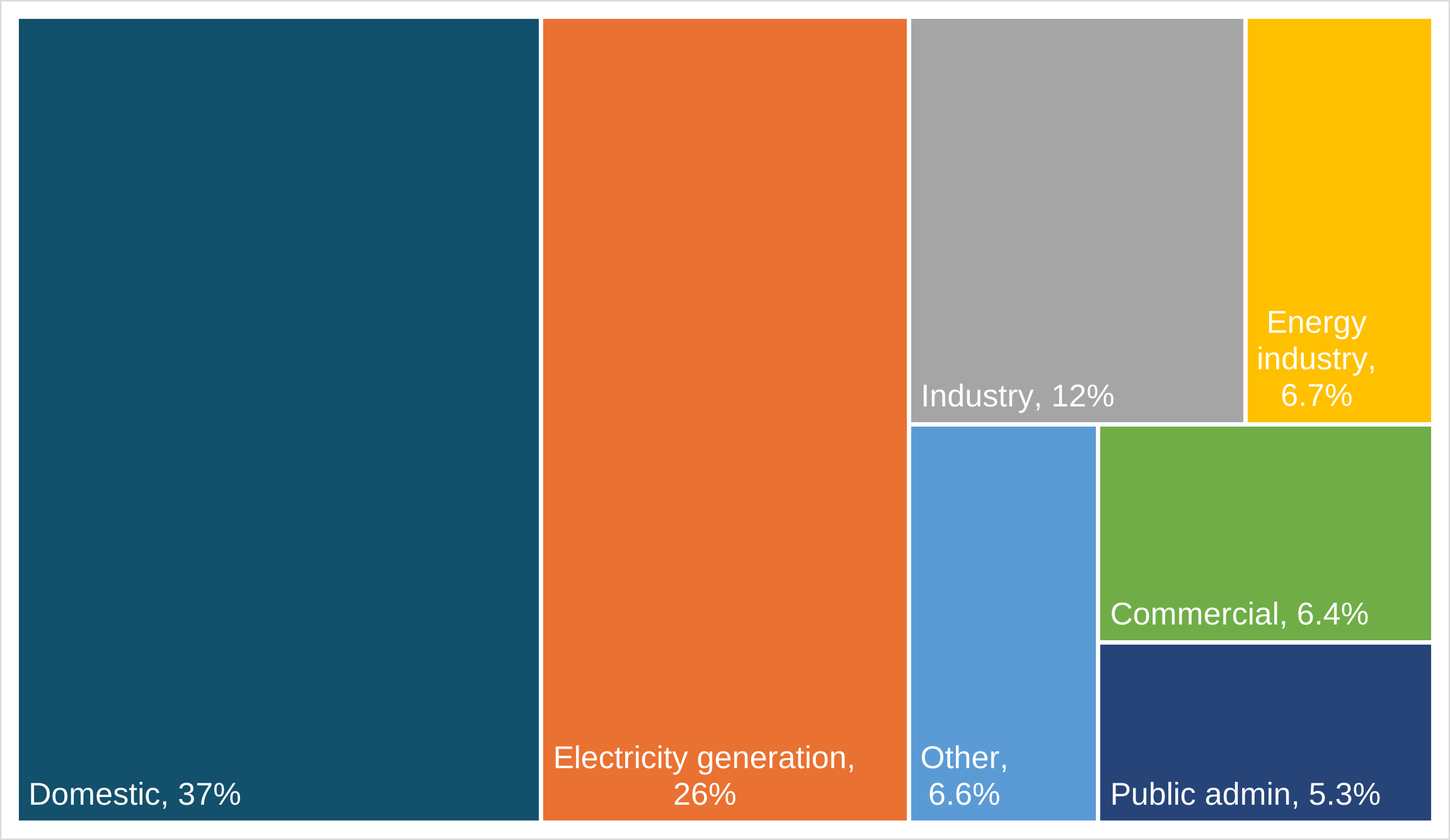
Gas continues to be critical for its usage in heating, industry, and power generation in GB. In 2024, it made up 35% of total UK energy demand.[footnote 65] Sectoral consumption of natural gas in 2024 is illustrated in Figure 7 below, and this year’s winter assessment by the gas system operator, National Gas, forecasts sufficient supply capacity to meet demand this winter (2025/26).[footnote 66]
Over the next four years, the UK is expected to continue to benefit from a secure and diverse gas system – including through access to our own North Sea gas reserves, the second largest Liquefied Natural Gas (LNG) port infrastructure in Europe, and steady pipeline gas imports from reliable partners like Norway.
The role of gas is set to change in the long term as the UK Continental Shelf (UKCS) continues to naturally deplete, from providing base load supply to being important for system flexibility. As such, government is working to ensure the gas system adjusts in turn to these changing requirements.
A key part of this plan is for government to continue to work with the gas industry and market as gas supply and demand patterns change, through a series of upcoming publications, as set out in the June 2025 update to market.[footnote 67] The first of these is the Gas System in Transition: Security of Supply Consultation which aims to ensure sufficient and resilient gas infrastructure and to understand how we can best provide insurance for low-probability, high-stress scenarios.[footnote 68] This consultation is open until 18 February 2026 and we welcome responses from all market participants and interested parties.
Figure 7. Sectoral consumption of natural gas in 2024[footnote 69]
Source: DUKES (2025) ‘Chapter 4: UK gas’
Demand
GB’s annual gas demand is expected to gradually decline over the next few years, driven by decarbonisation and the shift to clean power by 2030. However short-term peaks in demand may still occur due to unpredictable factors like weather. We are assured that National Gas has the necessary physical, commercial, and market-based tools in place to manage supply and demand imbalances effectively, in the unlikely event they are necessary.[footnote 70]
In their 2025/26 winter outlook, National Gas estimate overall GB gas demand (including exports to continental Europe and Ireland) will be slightly lower (4%) than last winter. This reduction is mostly driven by a continued decrease in gas demand for domestic power generation and reduced exports to continental Europe, which have been stabilising.[footnote 71]
Within GB’s overall demand, forecast demand for domestic, commercial and smaller industrial (non-daily metered (NDM)) remains similar to the actual demand for winter 2024/25 (27.2bcm forecast for winter 2025/26, compared to 26.9bcm demand for last winter).[footnote 72]
Daily metered (DM) and industrial demand is historically consistent and forecast to be comparable to previous winters (4.1bcm actual demand for winter 2024/25, compared to 4.3bcm forecast demand for this coming winter).[footnote 73]
Future total gas demand is broadly expected to decline as the UK continues to decarbonise to meet Clean Power 2030 and net zero 2050 ambitions. NESO’s FES net zero compliant pathways estimate a 5-11% decline in annual gas demand between 2025 and 2030, depending on the decarbonisation pathway. The Clean Power Action Plan sets out our aim for unabated gas to provide less than 5% of GB’s electricity generation by 2030 which will contribute to declining gas demand alongside the electrification of heat, industry and transport.[footnote 74]
Supply
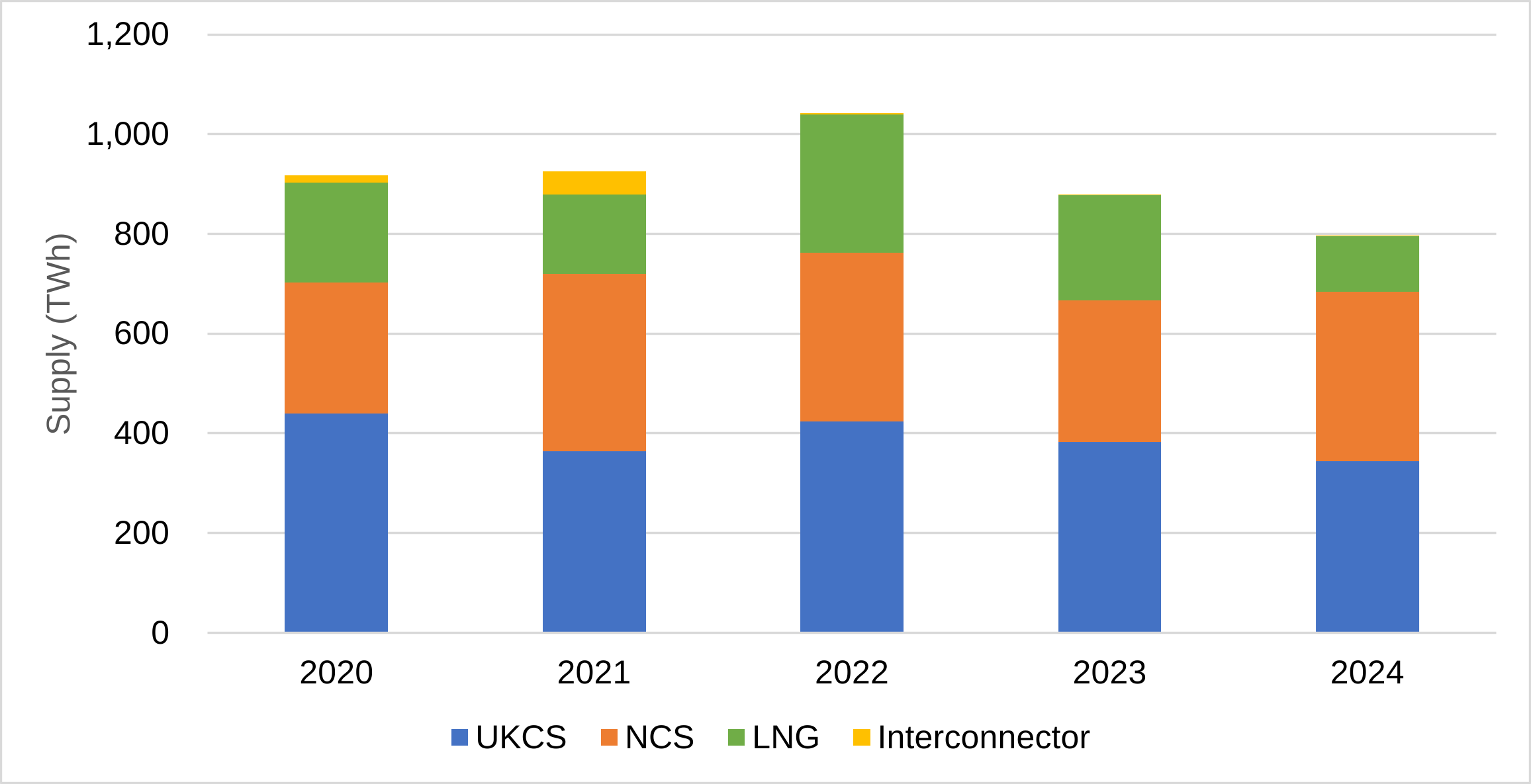
Over the next four years, GB’s supply mix will be characterised by declining indigenous production on the UKCS (as a result of natural geological decline) and increased focus on GB’s other sources of supply: Norwegian gas, LNG and interconnector imports from continental Europe.
GB benefits from a variety of gas supply sources. The majority of our gas supply historically comes from gas transported via pipelines from the UKCS and the Norwegian Continental Shelf (NCS) in the North Sea (comprising 43% and 35% of the UK’s gross annual gas supply, respectively, based on a five-year average). The remainder of our gas supply is primarily made up of Liquefied Natural Gas (LNG) shipments (21%) and interconnector pipeline imports, which play a key role in balancing supply and demand on cold winter days, from Belgium and the Netherlands (1%).[footnote 75] GB also has eight gas storage facilities, which act as a source of system flexibility when responding to short-term changes in supply and demand. These sites provided the equivalent of 8% of 2024/25 total winter gas demand and rely on being filled by the above sources of supply.[footnote 76]
Figure 8. UK Gross Gas Supply Mix (TWh)
Source: DUKES (2025) ‘Chapter 4: UK Gas’
Over the next four years, our supply mix will change. As the UKCS continues to naturally deplete each year, multiple sources of supply – Norwegian gas, LNG and interconnector pipeline imports from continental Europe – will play increasingly important roles in meeting national gas demand.[footnote 77] As noted in the ‘Import Capacity’ section below, this changing supply mix is likely to coincide with an oversupplied global LNG market, reinforcing our confidence in the reliability of the market to deliver supply.[footnote 78]
Additionally, as our supply mix changes, the gas system will need to adapt to ensure the UK continues to benefit from sufficient, resilient and commercially viable supply capacity to meet a broad range of demand. This is discussed further in both the DESNZ consultation, Gas System in Transition: Security of Supply (where we invite industry views on both the challenges themselves and, if deemed necessary, mitigating actions that could be taken), and NESO’s medium-term Gas Supply Security Assessment.[footnote 79]
Domestic production
The UKCS is considered a super-mature basin. This means the most accessible oil and gas in the basin has already been extracted, following sixty years of production. UKCS production is naturally declining on an annual basis and has been doing so over the last twenty-five years.
The North Sea Transition Authority (NSTA) currently projects an annual decline of domestic offshore gas production to continue at a rate of 12% per year.[footnote 80] We have factored in a declining UKCS gas basin into our modelling and are confident it will continue to play an important, although declining, role in our gas supply mix in the next four years.
As most gas fields on the super-mature basin have already been explored given its long production history, government’s commitment not to issue new exploration license in the UKCS will have a marginal impact on future production levels and will not make a material difference to security of supply.[footnote 81] However, government’s plan to issue Transitional Energy Certificates will support overall security of supply by managing existing fields for the entirety of their lifespan.[footnote 82]
Government also recently published a response to the Building the North Sea’s Energy Future, which set out a framework for the future of energy in the North Sea and invited industry views.[footnote 83]
Import capacity
GB is well connected to global gas markets and supply sources. This includes direct connection to the Norwegian Continental Shelf via several pipelines, predominantly the Langeled pipeline, as well as the Vesterled, Tampen Link, FUKA, SAGE and Gjoa pipelines. GB is also connected to international markets via two interconnectors to mainland Europe and three LNG import facilities. Interconnector Ltd (INT) links the National Balancing Point (NBP, GB’s gas trading hub) to the Belgian Zeebrugge gas trading hub. The Balgzand-Bacton Line (BBL) links to the Dutch Title Transfer Facility (TTF). GB has the second largest LNG import infrastructure capacity in Europe, with facilities in Isle of Grain, Kent, and two in Milford Haven, Southwest Wales (Dragon and South Hook).
Currently, GB has a total import capacity of around 368 million cubic metres per day (mcm/d) or 134 billion cubic metres per year (bcm/y), made up of ~135mcm/d from Norway, 83mcm/d from Belgium and the Netherlands, and 150mcm/d from LNG.[footnote 84] Imports provide GB with a flexible source of gas, increasing when demand in GB is high, and decreasing when demand falls. We are confident GB will continue to be able to attract gas imports under normal conditions when we need them. While infrastructure capacity does not guarantee utilisation and imports are market price sensitive, our current infrastructure has always facilitated the delivery of the gas required.
In considering the above supply capacities, we have considered developments in the market that are likely to affect the next few years and beyond:
- First, our LNG terminals, the operators of the Grain and South Hook terminals have invested in capacity expansion, with both projects expected to be completed this year. For South Hook this will increase their technical capacity by 15mcm/d, and at Grain by around 10mcm/d.[footnote 85] However technical limitations on the maximum capacity of the National Transmission System means that these additional flows can only be accepted under certain network conditions, so they have not been included in our supply calculations or figures quoted above.
- Second our interconnectors with Europe play an important role in meeting GB’s gas demand on cold winter days, bringing gas from Belgium and the Netherlands when price signals indicate highest demand. Although interconnector imports only made up an average of 1% of gross supply between 2020 and 2024, their value lies in their ability to meet 17% of demand this winter (falling to 12% from winter 2026/27). Both BBL and INT have undertaken reviews of their GB import capacity in order to reduce costs against a fixed operating cost base due to low GB import capacity sales: in December 2024 BBL announced a reduction in capacity from 40mcm/d to 22mcm/d, and INT has held an open season on capacity sales and reduced capacity from 73mcm/d to 61mcm/d from 04 November 2025, and announced plans to reduce import capacity to 36mcm/d from 01 October 2026. These figures have been used in this report to ensure it is based on the most up to date information. The government, together with other agencies, will continue engaging with BBL and INT on this issue.
However, GB has always been able to source the gas required on international markets, and we are confident that gas will continue to be available to import under normal conditions when we need it. Looking ahead, imported gas is likely to make up a greater share of our supply mix due to the natural geological decline of the UKCS (as explained above under ‘Domestic Production’). According to the IEA’s 2025 Q3 Gas Market report, while Global LNG markets remain tight in 2025, the global supply of LNG is growing as supply increased by 4% (or 12bcm) in the first half of 2025.[footnote 86] Indeed around 300bcm of new LNG export capacity is expected to begin production by 2030, a 55% increase on current levels.[footnote 87] Long-term external outlooks for global gas supply vary between different market intelligence providers, traders and NGOs, but most analysts expect the global LNG market to be relatively oversupplied by around 2027-28.[footnote 88]
In addition, the government will work with the gas industry to ensure the gas system can adapt to changing patterns of supply and demand. The DESNZ consultation, Gas System in Transition: Security of Supply, will help inform whether further policy is needed to support the functioning of the imports market and gas import infrastructure; such as ensuring interconnector import capacity, exploring options for a floating storage and regassification unit (FSRU) and whether amendments to increase the upper limit of the Wobbe Number may bolster our ability to import gas, particularly from Norway and Europe.[footnote 89]
Gas storage
Gas storage will continue to play an important role, helping meet peak demand, especially during periods of cold weather and when renewable generation is lower.
Our varied sources of gas supply means that the UK is less reliant on gas storage than some European countries, who have larger storage capacities to mitigate their lack of diverse supply, and who in some cases operate a ‘strategic reserve’ model. Instead, GB’s gas storage plays an important role in providing system flexibility in responding to short-run changes in supply and demand (i.e. helping top-up supply to meet peak demand on any given day).
GB currently has eight gas storage facilities, with a maximum storage capacity of 3.2bcm, and a maximum deliverability of 117mcm/day (though daily deliverability declines as stocks deplete due to reduced pressure).[footnote 90] Seven of these are medium-range storage which means they can cycle gas regularly – some sites can empty and refill within days, others within weeks (this is dependent on pressure and the age of the facilities). The eighth facility is a long-range storage site meaning it cycles on a seasonal basis. Long-range sites tend to have higher capacity but lower deliverability rates and are therefore less able to respond to within day demand peaks.
In winter 2024/25, gas storage provided 8% of total NTS gas demand.[footnote 91] Gas storage has provided a similar proportion of total gas demand each winter for the last few years (ranging from 4-7%);[footnote 92] and we expect gas storage to contribute at a comparable level over the next four years. The government will continue to monitor GB’s storage capabilities as the dynamics of the gas market continue to evolve. We expect storage to continue to play an important flexibility role in ensuring a resilient gas system, alongside existing import capacity. The consultation, Gas System in Transition: Security of Supply, will help inform whether further policy is needed to support the functioning of the gas storage system.
Demand Side Response (DSR)
National Gas offers a Demand Side Response (DSR) scheme as one of its tools to help balance supply and demand. DSR allows daily metered (DM) consumers (i.e. large industrial customers) to voluntarily reduce their demand in exchange for a payment at times when expected available supplies are forecast to be insufficient to meet demand by the end of a gas day.[footnote 93]
National Gas run a tender process every summer during which potential consumers and shippers can offer DSR quantities. Since 2022, they have made changes to DM DSR to stimulate the nascent market, whilst simultaneously fulfilling their obligation to procure gas balancing services economically and efficiently. As such, National Gas decided in June 2025 that significant volume growth from last year’s tender would be required for them to accept any offers for winter 2025/26 (an aggregate option quantity of 2.3mcm/day, or ~25,000,000 kWh).
The aggregate quantity offered as a result of the 2025 tender process was 1.3mcm/day.[footnote 94] Although this was an increase in total volume offered from last year’s tender, National Gas did not accept any offers for this coming winter as the minimum threshold to provide an operational benefit if called upon was not met therefore pre-contracted DM DSR options will not be available to National Gas for winter 2025/26,
However, if necessary, National Gas can send out a gas balancing notification (GBN) or margins notice in specific circumstances, inviting shippers to submit DSR offers on the On-the-day Commodity Market (OCM), in which case they would not be required to contract with National Gas in advance. GBNs are rarely issued, and only where National Gas identifies a material risk to the physical end-of-day balance between supply and demand. Margins notices can be issued as a precautionary measure when forecast demand exceeds supply for the following day even by a small margin.
DESNZ and Ofgem are continuing to work with National Gas and industry to further develop DM DSR and improve its usefulness as a potential method of balancing supply and demand. Interested parties are encouraged to respond to the DESNZ Gas System in Transition: Security of Supply consultation, which closes on 18 February 2026, with their views on the scheme.
Peak supply and demand capability
As part of this assessment of the GB gas system’s infrastructure capacity, we assess whether there is sufficient capacity to accommodate peak gas demand under various low probability ‘stress’ conditions, including 1-in-20-year peak daily demand and a 1-in-50-severe winter.[footnote 95] For the coming winter, National Gas have confirmed that GB has sufficient infrastructure capacity to accommodate peak demand under the conditions mentioned above, with 1-in-20-year peak daily demand in particular assessed in NG’s recent 2025/26 Winter Outlook.[footnote 96] In the 2025/26 Outlook, the supply margin for a 1-in-20-year peak day is 83mcm, which is lower than last year’s Winter Outlook peak day supply margin (127mcm) but broadly similar to the 2019/20 and 2020/21 Winter Outlooks.[footnote 97]
National Gas, as the Gas System Operator and residual balancer of the network, is able to balance the GB gas system by utilising the range of tools available to them as required. These include commercial tools to maximise supply and reduce demand.[footnote 98]
As noted above, we anticipate UKCS supply to continue to naturally decline over the next four years, reflecting the mature status of the basin. On an average winter’s day, we expect that we will continue to be able to supply sufficient gas for all our needs, in a wide range of decarbonisation scenarios. Our analysis indicates there is sufficient global gas supply for the UK, but also that we will need to ensure we have the right infrastructure capacity in place in the early 2030s to continue to freely access that available global supply. We also need to ensure that this infrastructure provides insurance against low probability but high-impact scenarios – for example, a 1-in-20-year peak day, or unprecedented infrastructure failure. The key factor will be the pace of the transition to net zero (i.e. progress made in power, heat and industrial decarbonisation), which will affect the level of 1-in-20-year peak demand on any given day in future.
This trend was recently noted in NESO’s Gas Security of Supply Assessment[footnote 99] and in the DESNZ Gas System in Transition: Security of Supply consultation, in which DESNZ set out how government will ensure continued energy security during the transition with a clear plan:
- First, the overall priority must be that we will decarbonise and electrify our economy. This will reduce demand for gas and our exposure to fossil fuels, and it will cement our security of supply for the long-term.
- Secondly, we will take the steps necessary to ensure we have the right levels of gas supply and infrastructure in place to meet demand, whenever it is needed – even in the low probability, ‘stress’ scenarios. This will ensure the gas system and market adapt in the right way to a changing role for gas in the wider energy system. Policy options could include ongoing support for key infrastructure operators, regulatory changes and the procurement of additional and temporary supply capacity.[footnote 100] Several options could be implemented over a relatively short time period, if considered sufficient value for money.
- Thirdly, we will continue to work with the Gas System Operator, National Gas, and NESO, to monitor and maintain gas security of supply using the existing suite of tools available. These will ensure the system continues to match supply with demand and is balanced on a daily basis now and for years to come.
The DESNZ consultation closes on 18 February 2026 and we invite industry views on both the long-term trends we have identified for the gas system as well as the range of potential policy options outlined. We will also continue to liaise with National Gas, Ofgem and NESO to identify and agree any additional measures to ensure we meet all legal standards, such as ‘N-1’ out to 2030 and beyond, in a way that offers the best value for consumers and ensures high resilience standards.[footnote 101]
Market functioning
The underlying market arrangements in GB are established on the basis that the market will provide the gas, and the market will balance supply and demand. Should the market not balance supply and demand, the gas system operator, NG, will step in as the residual balancer, effectively entering the market and undertaking trading activity to seek to resolve any imbalance on the system. Access to international markets allows GB to meet annual gas demand by supplementing indigenous production from the UKCS, which bolsters security of supply by reducing reliance on any one source. The GB gas market has delivered effectively to date, and we expect that delivery to continue.
Churn is effectively the number of times a unit of electricity or gas is traded before delivery to the end-consumer (ratio of traded volume to end demand) and can tell us how liquid a market is. As NG will look to the market to remedy tight margins in the first instance (e.g., through a Margins Notice), the ability to trade efficiently is important to security of supply. The higher the churn, the more traders are likely to participate in the market and therefore alleviate potential security concerns. A churn ratio of three or more is considered to be the threshold for a liquid market[footnote 102] and the GB gas market remains relatively liquid with a significant number of participants. The gas wholesale market’s churn ratio in the Apr-Jun 2025 period averaged 13.4 (the average unit of gas was traded more than thirteen times before delivery to the end-consumer), an increase of 0.8 from the previous quarter (12.6) and up 2.9 from the equivalent period in 2024 (10.5).[footnote 103]
Figure 9. GB wholesale gas prices, January 2024 to August 2025, p/therm (GBp)
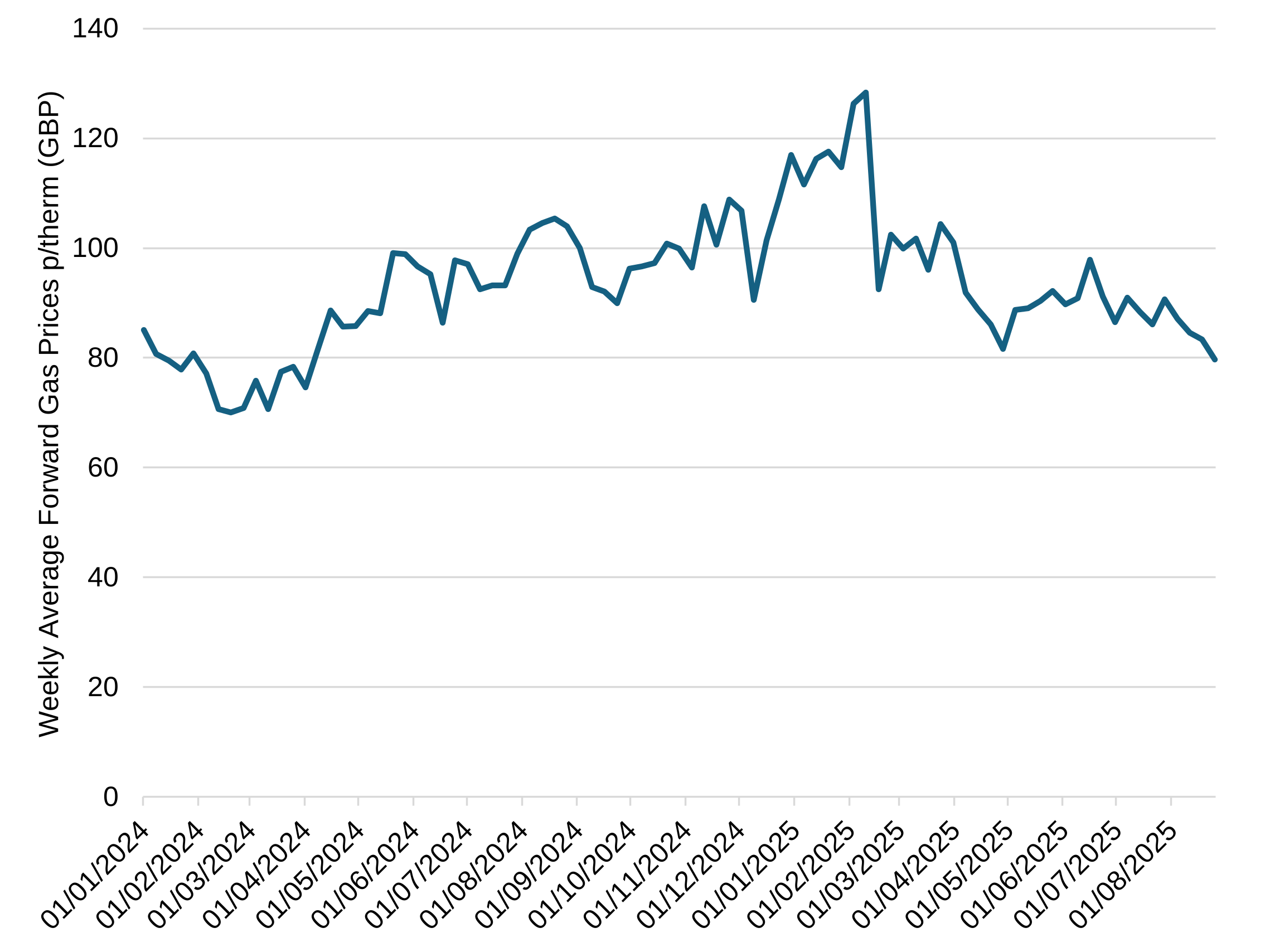
Source: Ofgem Wholesale Market Indicators. Forward prices refer to prices for front-quarter contracts.
Wholesale gas prices were at a 21-month high at the start of this calendar year, with forward prices for gas being above 110p/th in January 2025 and peaking in February 2025 at close to 130p/th. Since then, however, they have decreased and averaged around 84p/th in August 2025.[footnote 104] High prices were driven by European gas storage concerns, as gas winter 2024/25 finished with EU storage levels at around 34% fullness, significantly below the previous two years although in line with pre-crisis seasonal averages.[footnote 105] Low temperatures, levels of renewable generation and a lack of Russian pipeline gas contributed to low storage levels at the end of last winter. Geopolitical events continued over the summer months in 2025, notably the Iran-Israel conflict, increasing price volatility. However, prices fell back as the 12-day conflict ended and remained subdued as the Israel-Hamas ceasefire came into effect. Whilst general geopolitical uncertainty remains, National Gas’s Winter Outlook forecasts slightly lower overall gas demand and sufficient security of supply for GB.
GB has an established reputation in promoting transparent market-based approaches and fully supports the liquid, transparent and flexible global gas market. Market flexibility is essential to promoting global security of supply, ensuring that gas is delivered where it is most needed. The existing market mechanisms in the UK continue to balance supply with demand.
Oil
Introduction
Security of oil supply is not part of the statutory requirement but is included here for general information.
Key factors that have affected patterns of oil supply and demand in 2024 and the first two quarters of 2025 have been the continuing recovery in aviation fuel demand since the COVID-19 pandemic,[footnote 106] price fluctuations (notably affecting domestic demand),[footnote 107] and low crude oil production meaning that in 2024 net imports of oil products reached 13.0 million tonnes.[footnote 108] Oil demand is projected to fall by around 1.5% in 2026, and around 9% in 2029 compared to 2025, mainly as renewable fuels displace traditional fossil fuels for transport.[footnote 109]
Oil accounted for 40% of overall energy consumption in 2024 with transport fuels comprising approximately three-quarters of oil product demand.[footnote 110] Hydrocarbon jet fuel demand increased by 7.9% in 2024 compared to 2023, recovering to within 1% of pre-pandemic levels following low air traffic because of COVID-19 travel restrictions.[footnote 111]
Domestic demand for heating oil has recently tracked price changes more than temperature shifts.[footnote 112] Low prices in 2020 increased bulk purchases, while higher prices in 2022 following Russia’s invasion of Ukraine reduced demand. Despite warm weather, price drops in 2023 and 2024 led to demand increases of 8.4% and 13.0% as customers re-filled storage tanks.[footnote 113]
Crude oil and natural gas liquid production were 30.4 million tonnes in 2024, down by 8.9% on 2023 with a 11.7% increase in primary oil net imports that reached 19.7 million tonnes and were at the highest since 2014.[footnote 114] Despite this the UK remains well-positioned to meet demand for crude oil, with stable imports from trading partners such as the US and Norway.[footnote 115]
In 2024 the UK did not import any oil from Russia for the second year in a row; the government implemented a statutory ban in December 2022 with the last cargoes of primary oils and oil products from Russia arriving in October and November 2022, respectively.[footnote 116] More recent data on oil imports to the UK are published in Energy Trends Table 3.14.[footnote 117]
Primary oil supply and demand
Domestic production of crude oil and natural gas liquids peaked in 1999 and had declined to 30.4 million tonnes in 2024, down by 8.9% on 2023 in line with declining output from the mature North Sea basin.[footnote 118] Projections suggest that compared to 2024, crude oil production will have fallen by around a third in 2030 and by 85% in 2050.[footnote 119]
Nearly 90% of crude oil production is exported, mainly to the Netherlands.[footnote 120] Historically, UK refineries took receipt of more domestic crude as a share of total supply, but refinery economics mean crude of a different chemical composition, namely more light, sweet crude, has been imported more - mainly from the US and Norway.[footnote 121] These are commercial decisions by refinery operators, but we understand they are driven by factors such as market prices, the increasing sulphur content of domestic crudes and changes in maritime shipping fuel rules since 2020 putting downwards pressure on sulphur content of fuels.
Refineries took receipt of 4.0 million tonnes of crude produced from the UK Continental Shelf (UKCS) in 2024, down by 40.7% compared to 2023 and meeting 7.7% of refinery demand compared to 13.0% in 2023.[footnote 122] This meant that primary oil net imports increased by 11.7% to 19.7 million tonnes - the highest since 2014.[footnote 123]
Figure 10. UK supply and demand for primary oils, 1998-2024
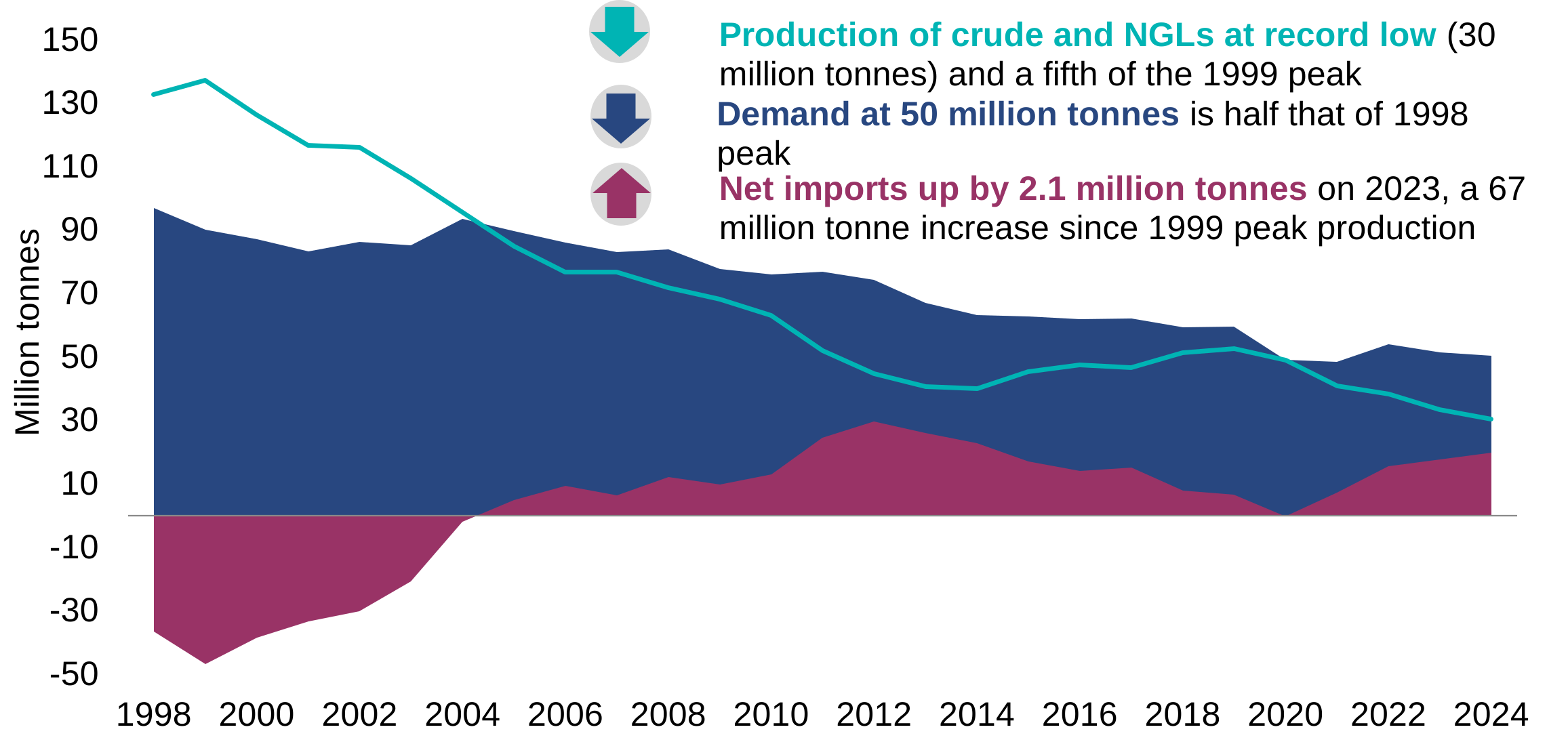
Source: DESNZ (2025) DUKES Table 3.1
In 2024 the United States took back its position from Norway as the number one exporter of crude oil to the UK by almost three million tonnes.[footnote 124] Imports from the US accounted for over a third of total crude imports and were up by 23.4% compared to 2023. At 16.2 million tonnes, 2024 was a record year for UK crude imports from the US. Norway was the second largest source of crude imports at 13.5 million tonnes, accounting for 31.1% of the UK’s imported crude.
Figure 11. UK sources of crude oil imports 2024 (thousand tonnes)
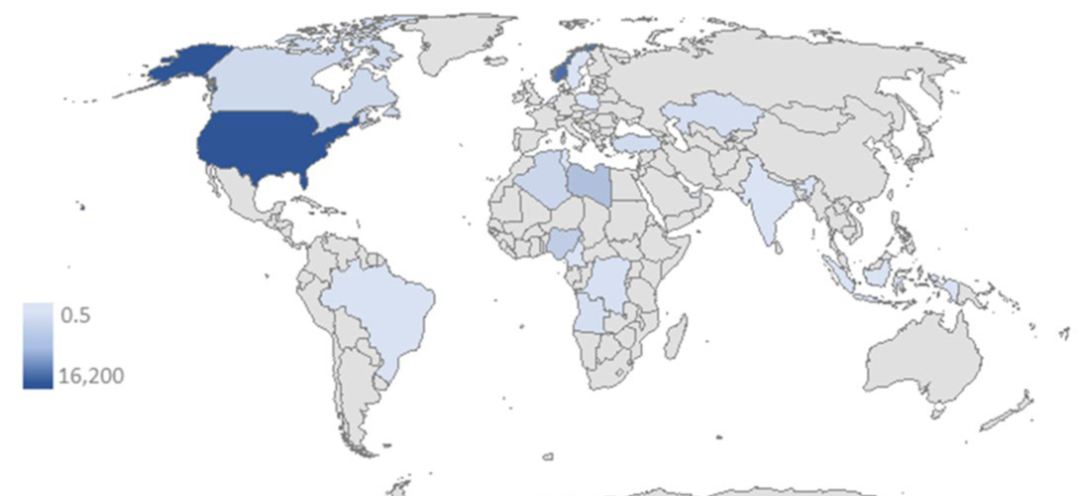
Source: DESNZ (2025) DUKES Table 3.7
Refined product supply and demand
Total demand for petroleum products increased by 2.0% in 2024 compared to 2023, reaching 60.6 million tonnes and the highest annual demand since the onset of the COVID-19 pandemic.[footnote 125] However, demand remains a tenth lower than in 2019 and a fifth lower than in 2000.
Refinery production was 50.8 million tonnes, around 60% of that seen 25 years ago in 2000.[footnote 126] Compared to 2019, production in 2024 was down by 13.6%, with a 16.7% increase in net product imports.
Figure 12. UK supply and demand for petroleum products, 1998-2024
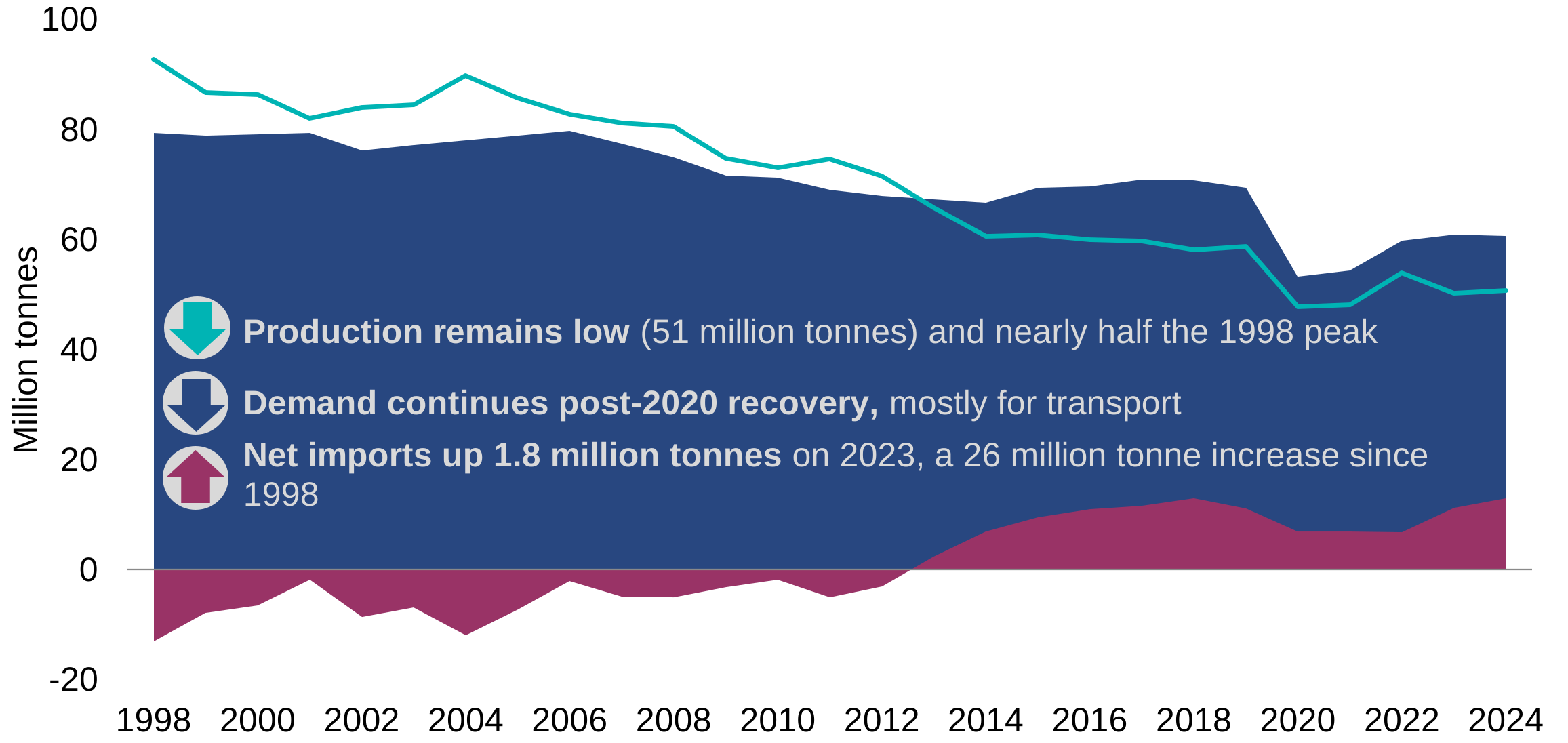
Source: DESNZ (2025) DUKES Table 3.2
The UK was a net importer of products in 2024 by 13.0 million tonnes, an increase of 16.7% on the previous year.[footnote 127] Product exports remained stable in 2024, but imports rose by 5.9% because the increase in refinery production did not keep pace with the 2.0% increase in demand.[footnote 128] The UK benefits from ready access to international maritime trade in oil products, including the Antwerp, Rotterdam, Amsterdam trading hub, with the Netherlands and Belgium combining to provide most of the UK’s oil product imports.[footnote 129]
The UK remains favourably positioned to obtain diesel and jet fuel from a diverse range of sources. Just under 40% of product imports were diesel, with more than two-thirds from the United States, the Netherlands, and Belgium, reflecting a change since the 2022 ban on the import of Russian oils (which remains in place), given that Russia used to be an important source of diesel for the UK.[footnote 130] In 2024 the UK imported diesel from 28 trading partners, with 35.5% from the US alone and a further 37.0% from the Netherlands and Belgium combined.[footnote 131]
There is strong jet fuel demand in the UK because Heathrow is one of the busiest airports in the world and the UK imported from 23 countries in 2024.[footnote 132] In recent years, Kuwait has become the primary source of imported jet fuel for the UK, accounting for 38% of the total at 4.1 million tonnes. India, the UAE, and Saudi Arabia also each supplied more than one million tonnes.[footnote 133]
Figure 13. UK sources of oil product imports 2024 (thousand tonnes)
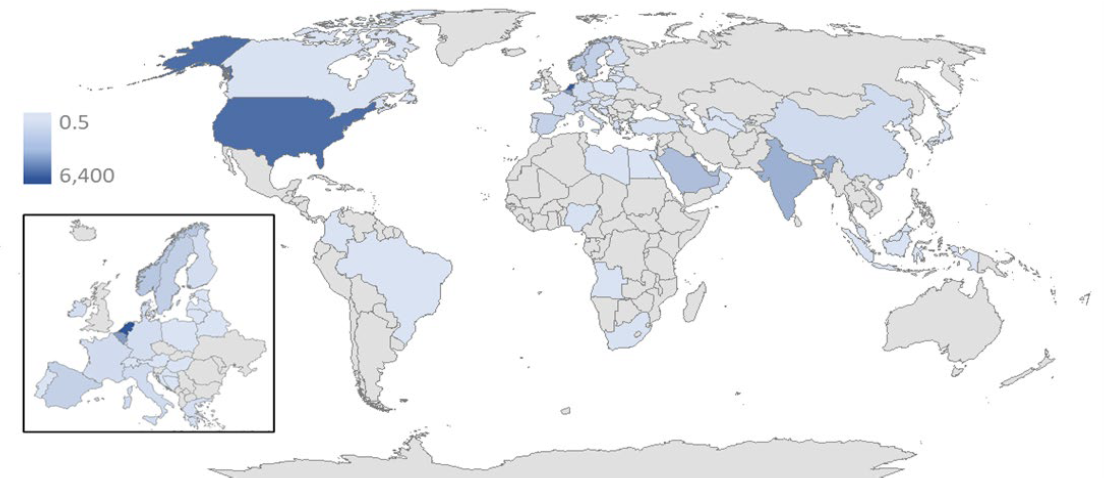
Source: DESNZ (2025) DUKES Table 3.7
The Netherlands is the UK’s closest major oil refining and trading hub, so accounts for most oil trade with the UK. Dutch product imports represented a fifth of the total at 6.4 million tonnes, with the next highest source being the United States at 5.3 million tonnes.[footnote 134]
Production of key petroleum products
Oil must be refined into oil products before it can be used for all forms of transport, manufacturing, roads, medicines, textiles, etc. Refinery production was up by 1.1% compared to 2023 but remains 13.6% lower than in 2019 before travel restrictions curbed demand for (and therefore production of) transport fuels.[footnote 135] Travel accounts for three quarters of oil product demand.[footnote 136] In 2024 UK refiners produced a quarter more petrol than was needed and met 54.9% and 28.8% of road diesel and jet fuel demand, respectively.[footnote 137] Excess petrol was exported, mainly to the US, with imports helping meet demand for diesel and jet fuel.[footnote 138]
Most oil that the UK exported went to EU partners in 2024, including mainly primary oils to the Netherlands and Germany, mainly petrol to Belgium, and 96.9% of UK jet fuel exports were to Ireland. Nearly a quarter of petrol exports were to the US.[footnote 139]
Consumption of key petroleum products
Final consumption of oil was up by 2.9% in 2024 compared to 2023, mainly driven by a 2.4% increase in demand for transport fuels as road and air travel continued to bounce back after the lifting of restrictions to curb the spread of Covid-19.[footnote 140]
Figure 14. UK demand for petroleum products (arrows show change in 2024 compared to 2023)
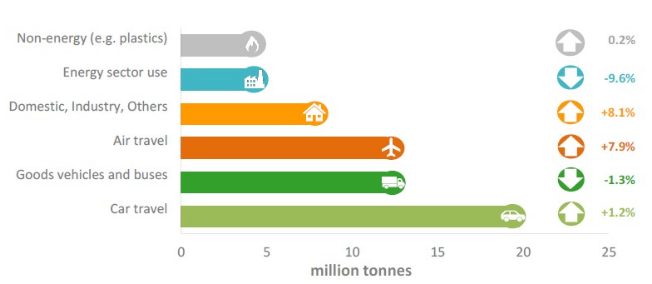
Source: DESNZ (2024) DUKES Table 3.2
Petrol demand in 2024 exceeded demand in 2019 (up by 0.5%), and jet fuel demand had recovered to within 1% (although had exceeded 2019 demand when sustainable fuel is included).[footnote 141] Over 40% of transport fuel demand was accounted for by diesel vehicles – cars, goods vehicles and buses.[footnote 142] Nonetheless, diesel demand has not shown the post-pandemic recovery that petrol and jet fuel have but rather has continued decreasing steadily since a peak of 25.0 million tonnes in 2017.[footnote 143]
From 2000 to 2017, demand from diesel vehicles increased by 60%. From 2017 to 2024, demand fell by one fifth.[footnote 144] This is partly due to an increase in biodiesel,[footnote 145] but also the increasing popularity of electric vehicles, and motorists switching away from diesel due to environmental concerns since the emissions scandal around 2017 to 2018.[footnote 146]
Table 3. UK demand for oil products 2024
| Petroleum Product | Quantity (million tonnes) |
|---|---|
| Petrol | 11.8 |
| White Diesel | 22.7 (of which 20.0 for road use) |
| Jet Fuel | 12.0 |
| Burning Oil | 3.1 |
| Gas Oil | 2.2 |
| Fuel Oil | 0.4 |
| Other | 8.4 |
Source: DESNZ (2025) DUKES Table 3.2
Technology changes, including adoption of electric vehicles, increased use of sustainable transport fuels, and renewables for heat generation, will ultimately reduce future demand for oil. Under current policies, estimates indicate a reduction in final demand for oil of roughly 46% (42% including international aviation) in 2050 compared to 2024.[footnote 147] While air transport is expected to make nearly 30% of oil demand, road transport demand remains persistent at more than 40% of estimated demand when current policies have been taken into account.
Resilience
The UK remains well supplied with a diverse and resilient fuel supply from domestic refining and imported fuels. The government works closely with the fuel sector to ensure that fuel supplies for the UK are maintained. In January 2024, the Energy Act 2023 came into force including a requirement on significant core fuel sector operators to report any incident which affects the person’s relevant activities or assets in such a way as to create a significant risk of, or cause a disruption to, or a failure of, the continuity of supply of core fuels.
The Department also continues to monitor a sample of forecourt stock levels as an indicator of domestic road transport fuel supply.[footnote 148] There were no significant disruptions to the national supply of these fuels in the UK in 2024.
The Petroineos Grangemouth refinery was converted into an import terminal in spring 2025, ensuring Scotland’s fuel needs are met through imported supplies while preserving flexibility and resilience in the energy system. We have assessed Petroineos’ import terminal model to ensure it will provide energy security and resilience for Scotland – and we will continue monitoring to ensure long term confidence for Scottish consumers and businesses. We are confident there is no risk to the UK’s fuel supply following the insolvency of Prax Lindsey oil refinery. It was the smallest refinery in the UK and is next to the Phillips 66 Humber refinery, one of the biggest refineries in the UK, which continues to operate profitably and supplies the region.
Emergency oil stocks
As a condition of membership of the International Energy Agency (IEA), the UK is required to hold stocks of oil equivalent to at least 90 days of net imports that could be released in the event of severe disruption to global supply. The government meets this obligation by directing industry to hold minimum levels of stocks. Companies may choose to hold stocks within the UK or abroad via legal agreements with other countries. In July 2025 the net total of tickets held here for other countries or held abroad on behalf of the UK was around 15% of total stocks.[footnote 149] In the same month total stocks were equivalent to around 120 days of net imports.
Following the illegal invasion of Ukraine by Russia, the UK participated in an IEA-led co-ordinated release of oil stocks to help protect global oil market prices. The UK released 2.2 million barrels in March 2022 and 4.4 million barrels in April 2022.[footnote 150] The IEA announced the end of the release in June 2023, and the UK completed re-building stocks in April 2024.
-
DESNZ (2025), ‘Diversity of supply for oil and oil products in OECD countries in 2024’ (viewed 02 October 2025) ↩
-
NESO (2025), ‘Winter Outlook Report 2025/26’ (viewed 09 October 2025) ↩
-
DESNZ (2025), ‘REMA Summer Update’ (viewed 22 October 2025) ↩
-
DESNZ (2024), ‘Clean Power 2030 Action Plan: A new era of clean electricity’ (viewed 09 October 2025) ↩
-
NESO (2025), ‘Future Energy Scenarios: Pathways to Net Zero’ (viewed 07 October 2025) ↩
-
NESO (2025), ‘FES Data Workbook’ (viewed 07 October 2025) ↩
-
NESO (2025), ‘Winter Outlook Report 2025/26’ (viewed 09 October 2025) ↩
-
NESO (2025), ‘Winter Outlook Report 2025/26’ (viewed 09 October 2025) ↩
-
NESO (2025), ‘Capacity Market Register’ (viewed 09 October 2025) ↩
-
NESO (2025), ‘During a System Stress Event’ (viewed 10 November 2025) ↩
-
Low Carbon Contracts Company (2025), ‘Electricity Settlements Company Annual Report’ (viewed 07 October 2025) ↩
-
NESO (2025), ‘T-1 (DY 2025/26) Final Auction Results Report’ (viewed 09 October 2025) ↩
-
DESNZ (2025), ‘Capacity Market Rules’ (viewed 09 October 2025) ↩
-
NESO (2025), ‘T-4 (DY 2028/29) Final Auction Results Report’ (viewed 09 October 2025) ↩
-
NESO (2025), ‘Electricity Capacity Report 2025 Data Workbook’ (viewed 09 October 2025) ↩
-
NESO (2025), ‘Capacity Market Register’ (viewed 09 October 2025) ↩
-
NESO (2023), ‘T-4 (DY 26-27) Final Auction Results Report’ (viewed 09 October 2025) ↩
-
DESNZ (2025), ‘Capacity Market Rules; The Electricity Capacity Regulations 2014’ (viewed 09 October 2025) ↩
-
Delivery year capacity accounts for multi-year agreements and confirmed terminations that have occurred since the capacity agreement was awarded. The Other category includes technologies such as Wind, Solar, Biomass and Mixed-use generators. ↩
-
NESO (2025), ‘Electricity Capacity Report 2025’ (viewed 09 October 2025) ↩
-
DESNZ (2025), ‘Capacity Market auction parameters: letter from DESNZ to NESO’ (viewed 09 October 2025) ↩
-
DESNZ (2025), ‘NESO Electricity Capacity Report 2025: findings of the Panel of Technical Experts’ (viewed 09 October 2025) ↩
-
DESNZ (2023), ‘Capacity Market 2023: Phase 2 proposals and 10 year review’ (viewed 09 October 2025) ↩
-
DESNZ (2024), ‘Capacity Market: proposals to maintain security of supply and enable flexible capacity to decarbonise’ (viewed 09 October 2025) ↩
-
DESNZ (2024), ‘Capacity Market: proposals to modernise Rules and improve participation and delivery assurance of consumer-led flexibility’ (viewed 09 October 2025) ↩
-
DESNZ (2025), ‘Capacity Market: proposed changes for Prequalification 2026’ (viewed 08 October 2025) ↩
-
DESNZ (2025), ‘Capacity Market: Hydrogen to Power and interconnectors’ (viewed 08 October 2025) ↩
-
DESNZ (2025), ‘Capacity Market: proposal regarding locational changes of Capacity Market Units’ (viewed 19 November 2025); DESNZ (2025), ‘Capacity Market: proposals to integrate low carbon technologies and enhance delivery assurance ahead of Prequalification 2026’ (viewed 08 December 2025) ↩
-
DESNZ (2025), ‘Clean Flexibility Roadmap’ (viewed 09 October 2025) ↩
-
DESNZ (2024), ‘Clean Power 2030 Action Plan: A new era of clean electricity’ (viewed 09 October 2025) ↩
-
MODO Energy (2025), ‘The Battery Buildout Report GB: Capacity Hits 5.6 GW in Q2 2025’ (viewed 06 October 2025) ↩
-
British Hydro Association (2025), ‘Pumped Storage Hydropower’ (viewed 09 October 2025) ↩
-
NESO (2025), ‘Capacity Market Register’ (viewed 09 October 2025) ↩
-
DESNZ (2025), ‘Renewable Energy Planning Database: quarterly extract’ (viewed 09 October 2025) ↩
-
Ofgem (2025), ‘Long Duration Electricity Storage (LDES) window 1 eligibility assessment outcome’ (viewed 24 September 2025) ↩
-
NESO (2025), ‘Future Energy Scenarios: Pathways to Net Zero’ (viewed 24 September 2025) ↩
-
DESNZ (2024), ‘Clean Power 2030 Action Plan: A new era of clean electricity’ (viewed 24 September 2025) ↩
-
DESNZ (2025), ‘DUKES 5.13A’ (viewed on 24 September 2025) ↩
-
Ofgem (2025), ‘Interconnector Webpage’ (viewed 24 September 2025) ↩
-
Ofgem (2021), ‘Interconnector Policy Review’ (viewed 24 September 2025) ↩
-
Ofgem (2024), ‘Window 3 Results: Interconnectors: Initial Project Assessment of the Window 3 Interconnectors – decision’ (viewed 24 September 2025) ↩
-
Ofgem (2024), ‘Window 3 Results: OHA Pilot Projects: Initial Project Assessment for the Offshore Hybrid Asset Pilot Projects’ (viewed on 24 September 2025) ↩
-
DESNZ (2025), ‘DUKES 2025 Chapter 5: Electricity’ (viewed 24 September 2025) ↩
-
DESNZ (2025), ’Energy Trends: September 2025’ (viewed 06 October 2025) ↩
-
NESO (2025), ‘Winter Outlook 2025-26’ (viewed 17 October 2025) ↩
-
NESO (2025),’Winter Outlook Early View 2025’ (viewed 24 September 2025) ↩
-
DESNZ (2025), ‘Clean Flexibility Roadmap’ (viewed 24 September 2025) ↩
-
DESNZ (2025), ‘Clean Flexibility Roadmap’ (viewed 24 September 2025) ↩
-
DESNZ (2021), ‘Appendix I: Electricity system flexibility modelling’ (viewed 07 October 2025) ↩
-
NESO (2025), ‘Future Energy Scenarios: Pathways to Net Zero’ (viewed 07 October 2025) ↩
-
NESO (2025), ‘Future Energy Scenarios: Pathways to Net Zero’ (viewed 07 October 2025) ↩
-
NESO (2023), ‘DFS Winter Review 22/23’ (viewed 08 October 2025) ↩
-
NESO (2024), ‘Winter 23/24 - End of Year Report’ (viewed 08 October 2025) ↩
-
NESO (2025), ‘Demand Flexibility Service Winter 24/25 Review’ (viewed 08 October 2025) ↩
-
Ofgem (2023), ‘Call for input: power market liquidity’ (viewed 12 September 2025) ↩
-
Ofgem (2019), ‘Decision to suspend the Secure and Promote Market Making Obligation with effect on 18 November 2019’ (viewed 12 September 2025) ↩
-
Ofgem (2024), ‘Summary of responses following liquidity call for input’ (viewed 12 September 2025) ↩
-
Over the Counter trading takes place directly between counterparties, in contrast to exchange-based trading where the exchange acts as a counterparty to all trades. ↩
-
ACER/CEER (2015), ‘Annual Report on the Results of Monitoring the Internal Electricity Markets in 2015’ (viewed 12 September 2025) ↩
-
NESO (2025), ‘National Electricity Transmission System Performance Report 2024-2025’ (viewed 22 October 2025) ↩
-
Ofgem (2025), ‘RIIO-2 Electricity Distribution: Annual Report 2023 to 2024’ (viewed 30 October 2025) ↩
-
NESO (2025), ‘National Electricity Transmission System Performance Report’ (viewed 07 October 2025) ↩
-
House of Commons (2025), ‘Planning and Infrastructure Bill’ (viewed 07 October 2025) ↩
-
Ofgem (2025), ‘Decision on Connections Reform Package (TM04+)’ (viewed 30 October 2025) ↩
-
DESNZ (2025), ‘Digest of UK Energy Statistics 2025 Chapter 4: natural gas’ (viewed 02 October 2025) ↩
-
National Gas (2025), ‘Winter Outlook’ (viewed 20 October 2025) ↩
-
DESNZ (2025), ‘Midstream gas system: update to market’ (viewed 18 November 2025) ↩
-
DESNZ (2025), ‘Gas System in Transition: Security of Supply’ (viewed 26 November 2025) ↩
-
Definitions of each demand category can be found at DESNZ (2025), ‘Natural gas statistics: data sources and methodologies’ (viewed 20 October 2025) ↩
-
National Gas (2025), ‘Winter Outlook’ (viewed 20 October 2025) ↩
-
National Gas (2025), ‘Winter Outlook’ (viewed 20 October 2025) ↩
-
National Gas (2025), ‘Winter Outlook’ (viewed 20 October 2025) ↩
-
National Gas (2025), ‘Winter Outlook’ (viewed 20 October 2025) ↩
-
DESNZ (2024), ‘Clean Power Action Plan’ (viewed 19 November 2025) ↩
-
DESNZ (2025), ‘Energy Trends: UK gas’ (viewed 20 October 2025) ↩
-
DESNZ analysis using storage site data from National Gas (2024), ‘Gas Ten Year Statement’ (viewed 20 October 2025) and winter gas demand data from National Gas (2025), ‘Gas Winter Review 2024/25’ (viewed 20 October 2025) ↩
-
Unlike the super-mature UK Continental Shelf, which is already declining at a rate of 12% per year, the comparatively less mature Norwegian Continental Shelf is expected to only start declining in the late 2020s. Whilst the Norwegian Offshore Directorate expect production on the NCS to decline in all scenarios, the NCS could still be a significant source of supply for continental Europe and the UK, depending on future discovery of exploitable reserves. Norwegian Offshore Directorate (2025), ‘Oil and Gas on the Shelf Moving Forward’ (viewed 23 October 2025) ↩
-
IEA (2024), ‘LNG capacity and trade, 2015-2035’ (viewed 23 October 2025) ↩
-
DESNZ (2025), ‘Gas System in Transition: Security of Supply’ (viewed 26 November 2025); NESO (2025), ‘Gas Supply Security Assessment’ (viewed 27 November 2025) ↩
-
North Sea Transition Authority (2025), ‘Data and insights - Production and expenditure projections’ (viewed 20 October 2025) ↩
-
NESO (2025), ‘Gas Supply Security Assessment’ (viewed 27 November 2025) ↩
-
DESNZ (2025), ‘North Sea Future Plan for fair, managed and prosperous transition’ (viewed 26 November 2025) ↩
-
DESNZ (2025), ‘North Sea Future Plan for fair, managed and prosperous transition’ (viewed 26 November 2025) ↩
-
National Gas (2025), ‘Winter Outlook’ (viewed 20 October 2025) ↩
-
National Gas (2025), ‘Winter Outlook’ (viewed 20 October 2025) ↩
-
IEA (2025), ‘Gas Market Report, Q3 2025’ (viewed 21 October 2025) ↩
-
IEA (2025), ‘Global LNG Capacity Tracker’ (viewed 21 October 2025) ↩
-
Oxford Institute for Energy Studies (2023), ‘A New Global Gas Order? (Part 1): The Outlook to 2030 after the Energy Crisis’ (viewed 20 October 2025); IEEFA (2024), ‘Global LNG Outlook 2024-2028’ (viewed 20 October 2025). ↩
-
The Wobbe Number is a measure of a gas’s energy content and how it burns. GB sets allowable limits for safety and appliance compatibility. Increasing the upper limit could allow a wider range of imported gas to enter the system without additional processing. ↩
-
National Gas (2024), ‘Gas Ten Year Statement’ (viewed 20 October 2025) ↩
-
National Gas (2025), ‘Gas Winter Review 2024/25’ (viewed 15 October 2025) ↩
-
National Gas (2024), ‘Winter Review and Consultation 2024’ (viewed 24 October 2025) ↩
-
National Gas (2025), ‘Demand Side Response’ (viewed 20 October 2025) ↩
-
National Gas (2025), ‘DSR Tender Outcome Report 2025’ (viewed 20 October 2025) ↩
-
NG is licenced to plan the gas transmission system to meet 1-in-20 peak aggregate daily demand, as well as a 1-in-50 severe winter. ↩
-
National Gas (2025), ‘Winter Outlook’ (viewed 20 October 2025) ↩
-
A daily supply margin equates to excess, unnecessary supply on a certain day if all supply flowed at operational maximum, thus constituting GB’s ‘buffer’ to absorb supply losses or demand increase; Peak 1-in-20-day supply margins include 79mcm (2020/21 Winter Outlook) and 89mcm (2019/20 Winter Outlook). ↩
-
DESNZ (2023), ‘National Emergency Plan for Downstream Gas and Electricity’ (viewed 26 November 2025) ↩
-
NESO (2025), ‘Gas Supply Security Assessment’ (viewed 27 November 2025) ↩
-
DESNZ (2025), ‘Gas System in Transition: Security of Supply’ (viewed 26 November 2025) ↩
-
‘N-1’ is a standard set out in legislation that requires the National Transmission System (‘N’) to be able to accommodate peak 1-in-20-year daily demand without the single largest piece of infrastructure on the system (‘-1’). As the standard is based on an unlikely case of major infrastructure failure, which coincides with a 1-in-20-year peak demand day, it is considered to reflect an extremely unlikely scenario. ↩
-
ACER/CEER (2015), ‘Annual Report on the Results of Monitoring the Internal Electricity Markets in 2015’ (viewed 16 October 2025) ↩
-
Ofgem (2025), ‘Gas trading volumes and monthly churn ratio by platform (GB)’ (viewed 24 October 2025) ↩
-
Ofgem (2025), ‘Gas prices: Forward Delivery Contracts - Weekly Average (GB)’ (viewed 24 October 2025) ↩
-
Aggregated Gas Storage Inventory (2025), ‘Gas Infrastructure Europe’ (viewed 16 October 2025) ↩
-
DESNZ (2025), ‘Energy Trends, Section 3’ (viewed 02 October 2025) ↩
-
DESNZ (2025), ‘Digest of UK Energy Statistics’ Section 3 Table 3.2 (viewed 02 October 2025) ↩
-
DESNZ (2025), ‘Digest of UK Energy Statistics’ Section 3 Table 3.1 (viewed 02 October 2025) ↩
-
DESNZ (2024), ‘Energy and emission projections Annex F’ (viewed 02 October 2025) ↩
-
DESNZ (2025), ‘Digest of UK Energy Statistics (DUKES), Section 1’, Table 1.1 (viewed 02 October 2025); DESNZ (2025), ‘Digest of UK Energy Statistics’ Section 3 Table 3.2 (viewed 02 October 2025) ↩
-
Note that once the increased use of sustainable aviation fuel (SAF) in the sector is accounted for, aviation demand is 1.3% up on 2019. DESNZ (2025), ‘DUKES Table 1.1’ (viewed 02 October 2025) ↩
-
DESNZ (2025), ‘Digest of UK Energy Statistics’ Section 3 (viewed 02 October 2025) ↩
-
DESNZ (2025), ‘Digest of UK Energy Statistics’ Section 3 Table 3.2 (viewed 02 October 2025) ↩
-
DESNZ (2025), ‘Digest of UK Energy Statistics’ Section 3 Table 3.1 (viewed 02 October 2025) ↩
-
DESNZ (2025), ‘Digest of UK Energy Statistics’ Section 3 Table 3.1 (viewed 02 October 2025); DESNZ (2025), ‘Digest of UK Energy Statistics’ Section 3 Table 3.7 (viewed 02 October 2025) ↩
-
DESNZ (2023), ‘Guidance: UK ban on Russian oil and oil products’ (viewed 02 October 2025); DESNZ (2025), ‘Energy Trends, Section 3’ Table 3.14 (viewed 02 October 2025) ↩
-
DESNZ (2025), ‘Energy Trends, Section 3’ (viewed 02 October 2025) ↩
-
DESNZ (2025), ‘Digest of UK Energy Statistics’ Section 3 Table 3.1 (viewed 02 October 2025) ↩
-
North Sea Transition Authority (2025), ‘Production and expenditure projections’ (viewed 02 October 2025) ↩
-
DESNZ (2025), ‘Digest of UK Energy Statistics’ Section 3 Table 3.1 (viewed 02 October 2025); DESNZ (2025), ‘Digest of UK Energy Statistics’ Section 3 Table 3.8 (viewed 02 October 2025) ↩
-
DESNZ (2025), ‘Energy Trends, Section 3’ Table 3.10 (viewed 02 October 2025); International Maritime Organization (2020), ‘Cutting sulphur oxide emissions’ (viewed 29 September 2025); DESNZ (2025), ‘Digest of UK Energy Statistics’ Section 3 Table 3.1 (viewed 02 October 2025); DESNZ (2025), ‘Digest of UK Energy Statistics’ Section 3 Table 3.7 (viewed 02 October 2025) ↩
-
DESNZ (2025), ‘Energy Trends, Section 3’ Table 3.10 (viewed 02 October 2025) ↩
-
DESNZ (2025), ‘Digest of UK Energy Statistics’ Section 3 Table 3.1 (viewed 02 October 2025) ↩
-
DESNZ (2025), ‘Digest of UK Energy Statistics’ Section 3 Table 3.7 (viewed 02 October 2025) ↩
-
DESNZ (2025), ‘Digest of UK Energy Statistics’ Section 3 Table 3.2 (viewed 02 October 2025) ↩
-
DESNZ (2025), ‘Digest of UK Energy Statistics’ Section 3 Table 3.2 (viewed 02 October 2025) ↩
-
DESNZ (2025), ‘Digest of UK Energy Statistics’ Section 3 Table 3.2 (viewed 02 October 2025) ↩
-
DESNZ (2025), ‘Digest of UK Energy Statistics’ Section 3 Table 3.2 (viewed 02 October 2025) ↩
-
DESNZ (2025), ‘Digest of UK Energy Statistics’ Section 3 Table 3.7 (viewed 02 October 2025) ↩
-
DESNZ (2025), ‘Digest of UK Energy Statistics’ Section 3 Table 3.2 (viewed 02 October 2025); DESNZ (2025), ‘Digest of UK Energy Statistics’ Section 3 Table 3.7 (viewed 02 October 2025) ↩
-
DESNZ (2025), ‘Digest of UK Energy Statistics’ Section 3 Table 3.7 (viewed 02 October 2025) ↩
-
DESNZ (2025), ‘Digest of UK Energy Statistics’ Section 3 Table 3.7 (viewed 02 October 2025) ↩
-
DESNZ (2025), ‘Digest of UK Energy Statistics’ Section 3 Table 3.7 (viewed 02 October 2025) ↩
-
DESNZ (2025), ‘Digest of UK Energy Statistics’ Section 3 Table 3.7 (viewed 02 October 2025) ↩
-
DESNZ (2025), ‘Digest of UK Energy Statistics’ Section 3 Table 3.2 (viewed 02 October 2025) ↩
-
DESNZ (2025), ‘Digest of UK Energy Statistics’ Section 3 Table 3.2 (viewed 02 October 2025) ↩
-
DESNZ (2025), ‘Digest of UK Energy Statistics’ Section 3 Table 3.2 (viewed 02 October 2025) ↩
-
DESNZ (2025), ‘Digest of UK Energy Statistics’ Section 3 Table 3.8 (viewed 02 October 2025); DESNZ (2025), ‘Digest of UK Energy Statistics’ Section 3 Table 3.2 (viewed 02 October 2025) ↩
-
DESNZ (2025), ‘Digest of UK Energy Statistics’ Section 3 Table 3.8 (viewed 02 October 2025) ↩
-
DESNZ (2025), ‘Digest of UK Energy Statistics’ Section 3 Table 3.2 (viewed 02 October 2025) ↩
-
DESNZ (2025), ‘Digest of UK Energy Statistics’ Section 3 Table 3.2 (viewed 02 October 2025); Note that once the increased use of sustainable aviation fuel (SAF) in the sector is accounted for, aviation demand is 1.3% up on 2019. DESNZ (2025), ‘DUKES Table 1.1’ (viewed 02 October 2025) ↩
-
DESNZ (2025), ‘Digest of UK Energy Statistics’ Section 3 (viewed 02 October 2025) ↩
-
DESNZ (2025), ‘Digest of UK Energy Statistics’ Section 3 Table 3.2 (viewed 02 October 2025) ↩
-
DESNZ (2025), ‘Digest of UK Energy Statistics’ Section 3 Table 3.2 (viewed 02 October 2025) ↩
-
DESNZ (2025), ‘Energy Trends, Section 3’ Table 3.5 (viewed 02 October 2025) ↩
-
DESNZ (2025), ‘Road Diesel Demand Drivers’ (viewed 02 October 2025) ↩
-
DESNZ (2024), ‘Energy and emission projections Annex F’ (viewed 02 October 2025) ↩
-
DESNZ (2025), ‘Average road fuel sales, deliveries and stock levels’ (viewed 02 October 2025) ↩
-
DESNZ (2025), ‘Energy Trends Table 3.11’ (viewed 02 October 2025) ↩
-
DESNZ (2023), ‘Digest of UK Energy Statistics (DUKES) Section 3’ (viewed 09 October 2025) ↩