
Small mammal, beaver and domestic grazing species damage to trees
Published 4 September 2026
Applies to England

© Crown copyright 2026
This publication is licensed under the terms of the Open Government Licence v3.0 except where otherwise stated. To view this licence, visit nationalarchives.gov.uk/doc/open-government-licence/version/3 or write to the Information Policy Team, The National Archives, Kew, London TW9 4DU, or email: psi@nationalarchives.gov.uk.
Where we have identified any third party copyright information you will need to obtain permission from the copyright holders concerned.
This publication is available at https://www.gov.uk/government/publications/small-mammals-beavers-and-domestic-grazing-species-damage-to-trees-a-visual-guide/small-mammals-beavers-and-domestic-grazing-species-damage-to-trees
How to spot tree damage
Trees can be damaged by mammals in several ways:
- gnawing or stripping bark
- browsing shoots
- damaging roots
- digging up seeds or seedlings
This visual guide helps you identify damage caused by small rodents, rabbits and hares, beavers and domestic grazing species.
Early identification of mammal damage is crucial. By recognising the signs and understanding which species are involved, you can put effective management in place before significant damage occurs.
Read our guidance on spotting damage from deer and squirrels.
Five questions to help identify the cause of tree damage
- What type of damage is it – browsing, gnawing, rubbing or other?
- What is the height of the damage?
- What time of year has the damage occurred?
- Are there teeth marks present – if so, what size are they and in what orientation?
- Are there other signs of mammal activity in the form of footprints, hair/wool or droppings?
Rabbit and hare damage – what to look out for
Three species can be found in England, but only one, the mountain hare, is native. European rabbits and brown hares have a widespread distribution across low ground, whereas in England, mountain hares are only found in the Peak District.
Rabbits usually strip bark from beech and ash, and prefer to browse on seedlings and young trees of birch. Such damage can limit regeneration or stunt growth. Both rabbits and brown hares have been observed to impede the regrowth of hazel in coppices.
-
Rabbits and hares leave clean diagonal cuts on browsed stems while deer and sheep leave ragged ends. The shoot is often left lying rather than consumed.
-
Browsing will typically occur to a height of 50 centimetres or so for rabbit damage and 70cm for hare.
-
Bark stripping will also be low down. Incisor marks are 3 to 4 millimetres wide, in pairs, usually running diagonally across the stem.
-
Rabbits and hares tend to browse or bark strip progressively along a row of trees.
Small rodent damage – what to look out for
Field and bank voles primarily damage trees through bark stripping and gnawing, but they may also browse buds and stems. Bark stripping by voles is most severe in winter, showing distinct population cycles with peaks and troughs. Field voles are typically found in open habitats and young woodlands, making them more likely to damage newly planted trees. In contrast, bank voles prefer woodlands with dense understorey cover, and their impact is more likely to be on natural regeneration.
Wood mice feed on tree seeds which might impact direct seeding. Edible dormice are a non-native species and in 2025 are found in the Chiltern Hills area. They primarily strip bark in early summer, with damage most commonly occurring in the crowns of trees above about 1 to 3 metres tall.
-
Vole bark damage 20cm or more from the ground is generally bank voles. While damage below 20cm is usually caused by field voles which rarely climb. Often the bark is stripped all the way around the stem (known as ring-barked or girdled).
-
Voles may nest within tree tubes and in some case gnaw the bottom to allow access, which may then make young trees vulnerable to damage from voles or other herbivorous species.
-
Where wood mice dig up direct-sown seeds, they can leave empty shells with characteristic precise holes.
-
Edible dormouse bark damage most commonly occurs in the crowns of pole-stage or mature trees and is identifiable by the characteristic rectangular shape of the stripped patches.
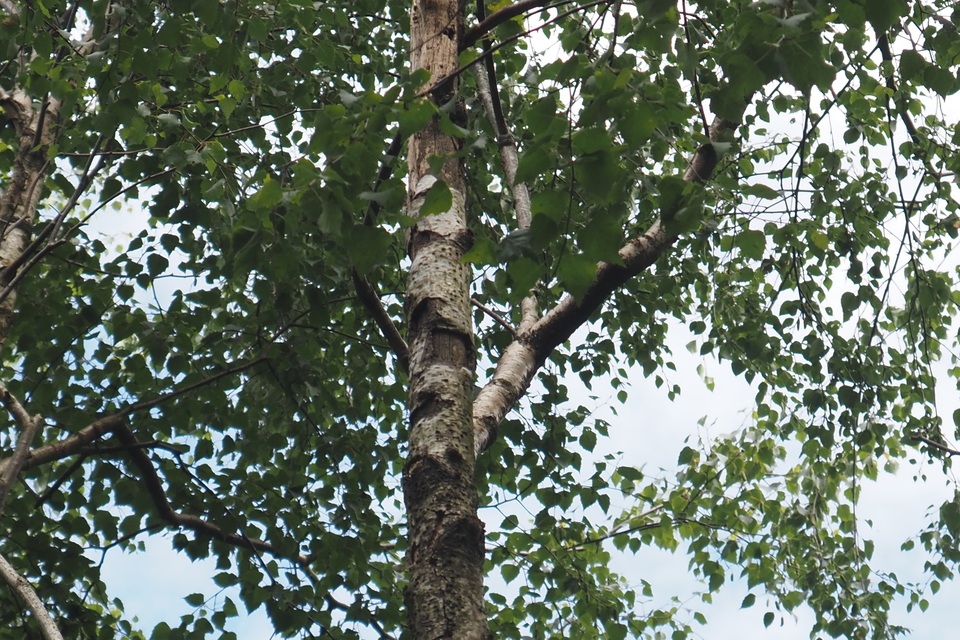
Rectangular shaped stripped patches on bark caused by edible dormouse.
Domestic grazing species damage – what to look out for
Domestic grazing species can cause significant damage to trees, and it’s important to be able to distinguish their damage from that of wild herbivores. Sheep damage can often be mistaken for deer damage.
Horses, ponies, sheep, goats, pigs and boar may be present as either domestic livestock or feral populations, while cattle and European bison may be used for woodland grazing. As this is a diverse group, their damage can also be varied, but there are a few key clues to look out for.
-
Sheep and goat browsing can be challenging to distinguish from deer, but sheep are likely to leave traces of wool behind.
-
Both horses and sheep leave diagonal teeth marks when they strip bark, which may help to distinguish damage by these species from the vertical marks often left by the lower incisors of deer.
-
Cattle and European bison strip bark of trees, and cattle can also cause damage by rubbing against bark. While this damage can be hard to distinguish from other species, it can reach up to 2m on the trunk, higher than most deer or sheep damage.
-
In high densities, livestock can cause significant soil compaction through poaching which can damage the roots of trees.
-
Pigs or boar can damage or kill tree seedlings or roots through their habit of turning over soil with their snouts for feeding (called ‘rooting’). This soil disturbance is likely to be more extensive and deeper than that caused by badger foraging and ‘snuffle holes’.
-
Some of these species can cause indirect damage to trees through damage to a tree protective measure itself. For example, ponies and cattle can break tree guards (particularly if the stake is too low), while wild boar can dig under fencing, allowing other herbivore access.
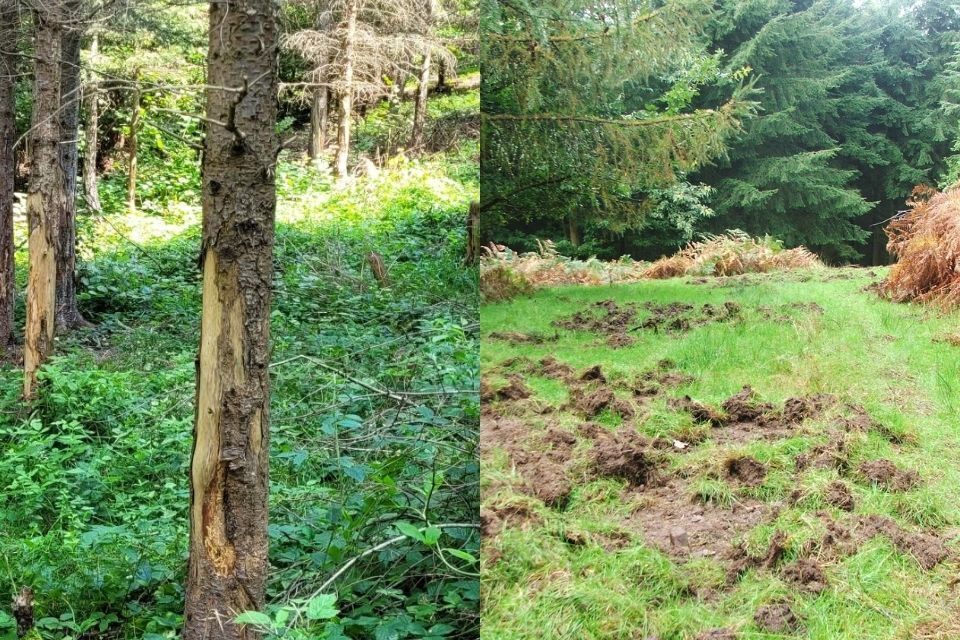
Bark damage caused by bison rubbing against tree (left) and soil disturbance caused by boar rooting. Credit: Andrej Gubka (left)
Beaver damage – what to look out for
Eurasian beavers primarily damage trees through browsing or felling when gathering materials to build their dams. With their large incisor marks, beaver damage is almost unmistakable. Felled trees may resemble a ‘pencil end’ if gnawed from all sides, or a ‘whistle end’ if gnawed mainly from one side, which is more common in smaller stems. Frequently, chippings are left around the gnawed stem.
In most cases, damage is limited to trees with a diameter of less than 10cm and located within 10m of the water’s edge. Eurasian beavers generally avoid conifer species, but in areas with few broadleaved trees, they may browse conifer saplings during late winter or early spring, which can cause ring-barking.
-
Prior to tree felling, an hour-glass shape will indicate beaver damage, and their distinct large teeth marks and wood chips at the base of the tree are other clues.
-
Where felling has recently occurred, you may see the stump and adjacent felled tree before it is removed to a food cache or dam/lodge.
-
Cut stumps have a characteristic ‘pencil’ end, or an asymmetrical ‘whistle’ end for stems cut from one side only. For some tree species such as willow and hazel regrowth of shoots from the stump may create a ‘beaver coppice’ which may disguise the cut end.
-
Beavers may also ring-bark trees to consume the bark, which looks different from felling as the central wood of the trunk (the ‘heartwood’) is not chipped away.
Mammal damage identifier
Bark damage (stripping, rubbing, fraying):
| Mammal | Tree size | Time of year | Description of damage |
|---|---|---|---|
| Field voles | Young trees to 5cm in diameter | All year but greatest risk in winter | Bark is stripped on roots or lower stem up to the height of surrounding vegetation. Very small trees can be felled and girdled – when a piece of bark is removed around the entire trunk of a tree. Bark removed in short, irregular strips 5 to 10mm wide, with incisor marks 1mm wide in pairs in the bark around the edge of the wound. |
| Bank voles | To early pole stage | Winter and spring | Bark removed in short, irregular strips 5 to 10mm wide, with incisor marks 1mm wide in pairs. Bank voles climb, so damage can occur up to 4m. Less common than damage by field voles. |
| Edible dormice | Pole or mature stage | Early summer | Bark typically removed from the main stem in the crown of a pole or mature stage tree, and the damaged patches can have a characteristic rectangular shape. Larch, Scots pine, Norway spruce, beech and birch most at risk. Very localised to Chiltern Hills area. |
| Beavers | All | All year | When felling trees, they leave distinctive chippings of bark and heartwood, and the action creates an hour-glass shape before the tree falls. Ring-barking occurs by thin strips being removed vertically which may leave a ragged upper edge. |
| Rabbits | All | Winter and spring | Bark stripping can occur to a height of 54cm (higher in snow). Incisor marks are 3 to 4mm wide, in pairs, usually running diagonally across the stem. Beech is particularly vulnerable. |
| Hares | All | Winter and spring | Very similar to rabbits but can reach up to 70cm (higher in snow). |
| Grey squirrels | Highest risk to trees aged 10 to 40 years | April-July | Incisor marks 1.5mm wide in pairs, usually running parallel with stem or branch. Sycamore, beech, oak and pine most at risk. |
| Deer | Pole stage | All year with potential for fraying between March-May | Red, sika and fallow deer strip bark leaving vertical incisor marks. Male deer damage the bark by rubbing their antlers, which is known as fraying. |
| Sheep and goats | All | All year | Severe stripping of bark to 1.5m, often leading to tree death. Incisor marks diagonal. |