Service Modernisation Customer Experience Survey: Wave 1 and Wave 2
Updated 9 April 2026
Applies to England, Scotland and Wales

© Crown copyright 2026
This publication is licensed under the terms of the Open Government Licence v3.0 except where otherwise stated. To view this licence, visit nationalarchives.gov.uk/doc/open-government-licence/version/3 or write to the Information Policy Team, The National Archives, Kew, London TW9 4DU, or email: psi@nationalarchives.gov.uk.
Where we have identified any third party copyright information you will need to obtain permission from the copyright holders concerned.
This publication is available at https://www.gov.uk/government/publications/service-modernisation-customer-experience-survey/service-modernisation-customer-experience-survey-wave-1-and-wave-2
DWP research report no. 1120
A report of research carried out by IFF Research on behalf of the Department for Work and Pensions. We would like to thank Lucy Groves and Kristina Freeman who have provided the key point of contact and support for this work.
Our thanks go to all those who gave up their time to take part in this study.
Crown copyright 2026.
You may re-use this information (not including logos) free of charge in any format or medium, under the terms of the Open Government Licence. View this licence or write to:
Information Policy Team
The National Archives
Kew
London
TW9 4DU
or email psi@nationalarchives.gov.uk.
This document/publication is also available on the GOV.UK website
If you would like to know more about DWP research email socialresearch@dwp.gov.uk.
First published January 2026.
ISBN 978-1-78659-933-9
Views expressed in this report are not necessarily those of the Department for Work and Pensions or any other government department.
Glossary
The glossary below defines the key terms used throughout this report. The definitions ensure consistent use of terminology across all sections and are aligned with DWP’s standard language and reporting conventions.
| Term | Explanation |
|---|---|
| Appointee | A person formally authorised to act on behalf of a customer in dealings with DWP, often used when the customer is unable to manage their own affairs due to age, disability, or health condition. |
| Benefits | Financial support or allowances provided by DWP to eligible individuals, such as State Pension. Lowercase ’benefits’ is sometimes used generically and interchangeably with service line or claim; capitalised Benefit is reserved for official scheme names. |
| Chatbot | An automated online messaging service that would use Artificial Intelligence (AI) to provide answers to customer queries and guide them through processes without direct human involvement. Distinct from webchat, which would involve a live DWP staff member. |
| Claim | A formal request made by a customer to receive a specific benefit. Claims usually require eligibility checks, documentation, and verification. Claim is sometimes used interchangeably with the terms ‘benefit’ and ‘service lines’. |
| Customer | An individual who interacts with DWP to access benefits or services. |
| Joined up and automated services | A coordinated approach to DWP services that ensures customers receive clear, consistent, and consolidated information across channels, which may be supported by automation. |
| Mode of contact | The channel through which a customer interacts with DWP, such as post, telephone, email, or online portal. |
| Modernisation | The process of making DWP services more accessible and responsive to customer’s needs, with higher quality, joined up and more efficient service delivery. This includes an increase in self-service and online channels alongside improving the person to person offer to those that need to engage with DWP directly. This also involves removing reliance on outdated processes and IT and building in greater flexibility and ability to meet changes in demand. |
| Modernised Communications Only | An analysis category of customers who reported having contact with DWP via video call, email, and webchat, or choosing the way they dealt with DWP to suit their preferences. To be allocated to this group, customers must not have experienced any other forms of modernisation. The term ‘modernised communications’ may also refer to a set of modernisation ideas. |
| Online Services | An analysis category of customers who reported experiencing an interaction via online services, such as contact via an online portal or chatbot, managing or making changes to a claim or dispute online, or receiving updates about a claim or dispute without having to speak to someone at DWP. This group may also have experienced the statements which make up Modernised Communications Only. The term ‘online services’ may also refer to a set of ideas that signal a transition to online channels. |
| ‘New’ claims or customers | ‘New’ claims were defined as claims newer than 12 weeks based on administrative data, for example at Wave 2 these were typically defined by having been made in the period October to December 2024. Exact dates for each service line are provided in the technical report which is included as an annex to this report. |
| No Modernisation | An analysis category of customers who did not report using any of the services included in the Online Services or Modernised Communications Only categories. |
| Respondent | A customer who has taken part in a survey or research activity. Not all customers are respondents, but respondents are drawn from the customer population and as such are often referred to as customers throughout. |
| Service lines | The distinct areas of DWP operations that deliver specific benefits or services such as Attendance Allowance, Maternity Allowance, State Pension, or Pension Credit. Nine of these were selected for this survey. Service line is sometimes used interchangeably with the terms ‘benefit’ and ‘claim’. |
| Services | The full range of assistance, benefits, and support provided by DWP to meet the needs of customers. |
| ‘Stock’ claims or customers | ‘Stock’ claims refer to claims older than 12 weeks at time of sampling based on administrative data, for example at Wave 2 this was typically before October 2024. Exact dates for each service line are provided in the technical report which is included as an annex to this report. |
| Touchpoint | A specific stage or interaction in the customer journey, such as seeking information, applying, submitting evidence, or receiving payment. |
| Wave | The research draws on two large-scale customer surveys conducted in spring 2024 (referred to as Wave 1) and spring 2025 (referred to as Wave 2). |
| Webchat | A real-time online messaging service between customers and DWP staff via DWP website. Distinct from a chatbot, which would be automated using AI. |
Executive Summary
This report explores customer experiences of services provided by the Department for Work and Pensions (DWP) as part of the Service Modernisation Programme. It draws on two large-scale surveys conducted in spring 2024 (Wave 1) and spring 2025 (Wave 2). These surveys examine how experiences are evolving as services are modernised, and customers’ perceptions and experiences of modernisation.
This report presents findings on overall customer experience and DWP Customer Experience Drivers. These provide standards against which customer service delivery can be measured. Please note, findings presented in this report are independent and different to those of the Customer Experience Survey which provide the department’s key measure of customer satisfaction. Further information can be found on DWP Customer Experience Survey: Benefit customers 2024 to 2025.
Customers were surveyed from the following service lines that were originally targeted for modernisation: Attendance Allowance (AA), Carer’s Allowance (CA), State Pension (SP), Pension Credit (PC), Access to Work (AtW), Disability Living Allowance for children (DLAc), Maternity Allowance (MA), Disputes Resolution Service (DRS) and the Child Maintenance Service (CMS). Transformation activity on AtW was paused prior to Wave 2, but customers were still included to track their views and experiences. DWP will keep transformation of AtW under review as future funding and prioritisation decisions are made. Since the survey, transformation of DRS moved out of the scope of the programme and into other areas of delivery.
Customers were sampled based on one service line and asked to think about that service when answering questions, however they may have had claims across multiple service lines. A separate survey was conducted to explore experiences managing multiple claims, findings from which are provided as an annex to this report.
Customer experiences
At both waves, 70% of customers were satisfied with their overall customer experience. Overall customer experience varied greatly between service lines, ranging from 29% for DRS customers to 89% for AA customers at Wave 2. Across waves, AtW customers saw a decline in overall customer experience (68% at Wave 1 vs 58% at Wave 2), while other service lines remained stable. Customer Experience Drivers were broadly stable across waves for the overall population.
Perceptions and experiences of modernisation
Some customers were receptive to modernisation ideas at both waves and being able to choose the way they had contact with DWP was the most popular idea (80% at both waves). At Wave 2, 42% of customers experienced at least one form of online services, and 45% of customers had no concerns about using online services (increase from 39% at Wave 1).
Customers who reported experiencing online services were more positive across a range of customer experience measures, compared to those who reported experiencing no modernisation. Across nearly all service lines, customers were more likely to agree that services were easy to use, and that DWP clearly explained the reasons for their decisions.
Regression analysis conducted at Wave 2 also showed that reporting positive experiences of modernised services was influential in driving overall customer experience. The most consistent factor driving positive scores across service lines was customers having positive experiences of choosing the way they dealt with DWP to suit their preferences.
1. Introduction
Background
The Service Modernisation Programme (SMP) is a large-scale programme seeking to modernise the way the Department for Work and Pensions (DWP) delivers its services to customers. It is one of the largest change programmes across Government, and aligns with DWP’s priority outcome to deliver a reliable, quality welfare and pensions system which customers have confidence in.
Modernisation does not mean any one specific initiative or shift within DWP services, such as the digitisation of benefits processes, or changing underlying entitlement conditions. By modernisation, the programme is referring to making DWP services more accessible for those who rely on them, including an increase in self-service and online channels at the same time as improving the person to person offer to those that need to engage DWP directly. It also means making services more efficient to run, reducing the cost to serve through removing the reliance on outdated processes and IT, and building in greater flexibility and ability to meet changes in demand. Customer experience is fundamental to all of the activity undertaken by the programme, and the introduction of modernisation aims to enhance this across all services within its scope.
Building on customer experience being one of the key objectives of SMP, the early roll out of the programme has been underpinned by a large-scale two-wave customer experience survey. The findings of this survey, reported here, help build the evidence base around customers’ experiences and expectations of modernised services. This research addresses gaps in current evidence sources, specifically exploring customers’ current experiences and future expectations of how modernised services are delivered. Customers’ future expectations are explored with a particular focus on the automation and digitalisation of services they access.
This report presents findings on overall customer experience and DWP Customer Experience Drivers. These provide standards against which customer service delivery can be measured. Please note, findings presented in this report are independent and different to those of the Customer Experience Survey which provide the department’s key measure of customer satisfaction. Further information can be found on the DWP Customer Experience Survey: Benefit customers 2024 to 2025.
This report focuses on two core surveys, conducted approximately 12 months apart, in spring 2024 and spring 2025 (Wave 1 and Wave 2). These surveys explore changes over time in customers’ overall experiences, their perceptions of modernised services, and their experiences of modernisation. Different samples of customers were taken at each wave to ensure a useable base size across customer journey touchpoints. Using the same sample would have meant fewer customers had recent experience of touchpoints such as applying for a service line. At the time the Wave 1 survey was launched, some customers might have already experienced some forms of modernised services. As such, these surveys provide ‘snapshots’ of customer experience at different stages of Service Modernisation Programme delivery, rather than representing customer experiences before and after modernisation has taken place.
The surveys focus on customers from the nine key service lines earmarked for Service Modernisation at the time the research was conducted. These were: Attendance Allowance (AA), Carer’s Allowance (CA), State Pension (SP), Pension Credit (PC), Access to Work (AtW), Disability Living Allowance for children (DLAc), Maternity Allowance (MA), Disputes Resolution Service (DRS) and the Child Maintenance Service (CMS). At the time of publishing, it is important to note that transformation activity on AtW was paused prior to Wave 2, but customers were still included in the survey to track their views and experiences. DWP will keep transformation of this service under review as future funding and prioritisation decisions are made. In addition, since the survey, transformation of DRS has moved out of the scope of the programme and into other areas of delivery.
An additional third survey was conducted in spring 2025 to examine the experiences of customers who access multiple service lines. The purpose of this survey was to gain insight into the experience and expectations of how services could be improved for customers claiming multiple services. It mirrors the core Wave 1 and Wave 2 surveys but focuses specifically on experiences of managing more than one claim with DWP. The findings of this survey are published as an annex to this report.
Methodology
Development
The core survey for each wave was designed in close collaboration with DWP, including via a series of online workshops with representatives from the relevant directorates and service lines, to understand the customer journeys within each service line. The questionnaire was then cognitively tested and piloted at both waves amongst samples of relevant DWP customers, with refinements made at each stage.
At both waves, there were differences in the question set in particular for Dispute Resolution Service and Child Maintenance Service. This is due to substantial differences in the customer journey for these service lines. Some surveys were conducted with appointees, who manage contact with DWP on behalf of the customer. Due to the age of the DLAc ‘customers’ in this research (all 0 to 15), all surveys for this service line were conducted with appointees.
Sampling and fieldwork
At each wave, the survey drew a sample of customers from each of the nine service lines. The research was targeted at customers who had contact with DWP in the 12 months prior to sampling, and therefore new claims were oversampled compared to the population. New samples were drawn at each wave; therefore, the surveys are cross-sectional and represent ‘snapshots’ of customer experiences at two points in time, approximately one year apart.
Fieldwork took place between 5 March and 6 May 2024 for Wave 1 and between 13 February and 14 April 2025 for Wave 2.
In Wave 1, 10,172 customers took part, with between 1,125 and 1,140 responses per service line. The survey was mixed mode, with 3,235 responses complete online through a web-based survey and 6,937 responses complete through Computer Assisted Telephone Interviews (CATI) where a professional interviewer collects responses by asking questions over the phone.
At Wave 2, 10,178 respondents took part with between 1,111 and 1,200 responses per service line. This survey had 3,270 online completes and 6,908 CATI completes.
The sample from both waves was weighted to be representative of customers with an email address vs those without, and ‘new’ claims vs ‘stock’. ‘New’ claims were defined as claims newer than 12 weeks based on administrative data, for example at Wave 2 these were typically defined by having been made in the period October to December 2024. ‘Stock’ claims refer to claims made before this 12 week period, for example at Wave 2 this was typically before October 2024. DRS customers were weighted to ‘open’ claims vs ‘closed’ claims, rather than ‘new’ vs ‘stock’. AtW was not split by length of claim due to the nature of this service line.
The sample was then weighted to the population distribution for age, gender and region for DWP customers in England and Wales. At each wave, weighting was applied against each service line population individually.
The sample of CMS customers was a mixture of paying parents and receiving parents. Paying parents pay Child Maintenance payments either directly or through CMS to the receiving parents to cover a child or children’s living costs.
The sample of DRS customers was drawn from those who either requested a mandatory consideration of a Personal Independence Payment (PIP) or Universal Credit (UC) claim, or appealed the decision of a mandatory reconsideration for these services. Mandatory reconsideration is a process that allows individuals to challenge a decision made by DWP regarding their benefits.
The full technical and methodological details for all surveys are provided in the technical report which is included as an annex to this report.
About this report
This report covers findings from both Wave 1 and Wave 2 of the survey. A key aim was to track any changes in customer experience between waves, within the context of ongoing modernisation. Charts showing percentage findings from the two waves of the survey are included throughout. Where charts compare findings between Wave 1 and Wave 2, ‘+’ and ‘–’ symbols are used to show statistically significant changes between waves. The ‘+’ symbols signify a statistically significant increase in Wave 2 compared to Wave 1. The ‘–’ symbols signify a statistically significant decrease in Wave 2 compared to Wave 1.
However, where tables are included, only Wave 2 data is reported for readability and accessibility reasons. Wave 1 data is included in the text where there were statistically significant changes at Wave 2.
Where this report comments on differences between waves or subgroups (for example, customers in this service line were more or less likely than customers in another service line to say X) the differences are statistically significant at a 95% confidence level. This means that you would only expect to see the result by chance 1 in 20 times if there were no true difference in the population. Where a figure is not reported with a direct comparison (for example, this group of customers were more likely to say X) the finding is that this group is more likely than the average of other subgroups to say X, not including the group in question.
Additionally, charts comparing responses between service lines include a result which reports the total figure excluding Disputes Resolution Service and Child Maintenance Service (labelled ‘Total (excluding CMS/DRS)’). This is due to DRS and CMS having substantially different customer journeys compared to the rest of the service lines, as the purpose of these service lines are not to facilitate making a claim. Those using DRS are disputing a decision on their claim, while CMS facilitates the payments of financial support for a child between two parents. Moreover, those using CMS utilise a different portal and touchpoints to other service lines. Throughout the survey, statements were rephrased to ensure that they were applicable to DRS and CMS service lines.
Unweighted base sizes are reported throughout. Differences between subgroups with an unweighted base size of less than 50 are not reported, or are reported as indicative, and flagged as such. Base sizes between 50 and 100 are reported but should be treated with caution. Responses for subgroups with larger base sizes will be more robust and have a lower margin of error than subgroups with smaller base sizes. Responses that are under 1% are not included and are only displayed as ‘<1%’.
Service lines are abbreviated throughout this report for brevity, including in charts, tables and base descriptions. The initials are detailed in Table 1 below.
Table 1: Table of abbreviations
| Abbreviation | Definition |
|---|---|
| AA | Attendance Allowance |
| AtW | Access to Work |
| CA | Carer’s Allowance |
| CMS | Child Maintenance Service |
| DLAc | Disability Living Allowance (DLA) for children |
| DRS | Disputes Resolution Service |
| MA | Maternity Allowance |
| PC | Pension Credit |
| SP | State Pension |
2. Customer profiles and contact with DWP
Customer profiles
Each service line has a distinct customer profile and journey. The four tables below present the demographic profile of service line users surveyed in Wave 2, including age group, gender, ethnicity and whether the respondents reported a long-term physical or mental health condition. As mentioned in the ‘about this report’ section above, only Wave 2 data has been included in the tables below for readability, but any significant differences to Wave 1 are mentioned in text. It is important to note that, overall, the demographics of customers remained similar between Wave 1 and Wave 2. Throughout these tables, “Don’t know”, “Prefer not to say”, and “Not applicable” responses are not included and therefore percentages in the tables may not add up to 100%.
Age
Table 2 - Age group of respondents by service line at Wave 2:
| Age Group | All | SP | PC | AA | CA | AtW | MA | DLAc | CMS | DRS |
|---|---|---|---|---|---|---|---|---|---|---|
| 16-24 | 4% | 0% | 0% | 0% | 6% | 9% | 12% | 1% | 2% | 12% |
| 25-34 | 19% | 0% | 0% | 0% | 16% | 23% | 59% | 28% | 24% | 22% |
| 35-44 | 22% | 0% | 0% | 0% | 26% | 25% | 28% | 47% | 43% | 24% |
| 45-54 | 13% | 0% | 0% | 0% | 22% | 23% | 1% | 18% | 24% | 20% |
| 55-64 | 10% | 0% | 0% | 0% | 27% | 17% | 0% | 4% | 6% | 19% |
| 65-74 | 14% | 52% | 43% | 16% | 3% | 3% | 0% | 0% | <1% | 3% |
| 75-84 | 13% | 40% | 39% | 43% | 0% | 0% | 0% | 0% | 0% | 0% |
| over 85 | 5% | 9% | 19% | 41% | 0% | 0% | 0% | 0% | 0% | 0% |
Base: All customers (Wave 2: 10,178). The DLAc figures refer to the age of the appointees rather than the customers, as all DLAc customers are aged 0 to 15.
As seen in Table 2, the age group of respondents tends to follow the nature and purpose of the service line, so the customer age profile reported on here is to be expected. For example, SP, PC and AA customers are all over the age of 65 because eligibility for these service lines includes being of State Pension age.
Over half (52%) of SP customers were aged between 65 and 74. Due to random sampling, in Wave 2, SP customers were relatively older than those surveyed in Wave 1 (52% were age 65 to 74 in Wave 2, compared to 63% in Wave 1, and 40% were age 75 to 84 in Wave 2, compared to 30% in Wave 1).
Of the PC customers surveyed, just over two-fifths (43%) were between 65 to 74 years of age. PC customers surveyed at Wave 2 were slightly older, a fifth (19%) were aged over 85 in Wave 2, compared to only 11% in Wave 1.
As mentioned, as with SP and PC, all AA customers were aged 65 or over, with nearly equal proportions in the 75 to 84 (43%) and over 85 (41%) age band. Between Wave 1 and Wave 2, the age profile of AA customers shifted slightly older, with a smaller proportion of customers being between 65 to 74 in Wave 2 (16%) than Wave 1 (19%).
Customers using the AtW service line fall into a range of age groups, with roughly equal proportion being aged 25 to 34 (23%), 35 to 44 (25%) and 45 to 54 (23%). In Wave 2, female AtW customers shifted towards middle age, for example, 45 to 54 (25%) and 55 to 64 (17%), and away from younger age groups.
The most common age bracket for MA is 25 to 34 (59%). A smaller proportion of those claiming MA fell into the 16 to 24 category in Wave 2 than in Wave 1.
The most common age bracket for CMS customers was 35 to 44 (43%). The age profile of customers using CMS changed slightly between Wave 1 and Wave 2, with those surveyed in Wave 2 being relatively younger (for example, 24% were aged 25 to 34, compared to 22% in Wave 1).
For DRS customers, the most common age group was 35 to 44 (24%), followed by 25 to 34 (22%). Between Wave 1 and Wave 2, the profile of these customers shifted slightly older.
All DLAc claimants are aged 0 to 15. However, the DLAc ‘customers’ in this research are their appointees, around half (47%) of whom were between the ages of 35 and 44. For CA, around a quarter of customers were aged 55 to 64 (27%). For customers of these service lines, the changes in age profile between waves were negligible.
Gender
Table 3 - Gender of respondents by service line at Wave 2:
| Gender | All | SP | PC | AA | CA | AtW | MA | DLAc | CMS | DRS |
|---|---|---|---|---|---|---|---|---|---|---|
| Male | 31% | 49% | 27% | 39% | 28% | 36% | 0% | 8% | 51% | 46% |
| Female | 69% | 51% | 73% | 61% | 72% | 64% | 100% | 91% | 49% | 54% |
Base: All customers (Wave 2: 10,178). The DLAc figures refer to the gender of the appointees rather than the customers.
As seen in Table 3, for PC, AA, CA, AtW, DLAc and MA service lines, a greater proportion of customers were women than men. Apart from MA, where, as expected, the customer profile is entirely women, DLAc appointee respondents had the highest proportion of women (91%) to men (8%) of all service lines. The rest of the service lines, including SP, CMS and DRS, had a roughly even gender split.
For all service lines, the ratio of male to female customers remained relatively consistent between Wave 1 and Wave 2.
Ethnicity
Table 4 - Ethnicity of respondents by service line at Wave 2:
| Ethnicity | All | SP | PC | AA | CA | AtW | MA | DLAc | CMS | DRS |
|---|---|---|---|---|---|---|---|---|---|---|
| White | 81% | 96% | 88% | 94% | 81% | 81% | 55% | 81% | 83% | 73% |
| Mixed / multiple ethnicity | 3% | <1% | 1% | 1% | 3% | 4% | 3% | 4% | 3% | 6% |
| Asian / Asian British | 6% | 1% | 5% | 3% | 8% | 6% | 15% | 6% | 4% | 8% |
| Black / African / Caribbean / Black British | 6% | 1% | 3% | 1% | 3% | 5% | 22% | 6% | 6% | 7% |
| Other | 1% | <1% | 1% | <1% | 2% | 1% | 2% | 2% | 1% | 1% |
Base: All customers (Wave 2: 10,178). The DLAc figures refer to the ethnicity of the appointees rather than the customers.
Note: ‘Don’t Know’ and ‘Prefer not to say’ proportions are not shown here.
Table 4 shows that, for all service lines, the most common ethnicity was White. SP has the highest proportion of White customers (96%), while MA has the lowest (55%). MA has the highest proportion of ethnic minority customers (42%), followed by DRS (22%).
Between Wave 1 and Wave 2, there was a shift in the ethnicity of MA and DRS customers. For both service lines, the proportion of White customers decreased from Wave 1 to Wave 2, with MA (72% in Wave 1 vs 55% in Wave 2) experiencing a greater shift than DRS (80% in Wave 1 vs 73% in Wave 2). In Wave 2, a higher proportion of MA customers surveyed were Asian or Asian British (10% in Wave 1 vs 15% in Wave 2) and Black, African, Caribbean, or Black British (12% in Wave 1 vs 22% in Wave 2).
For the rest of the service lines, the ethnicity of customers surveyed remained consistent between waves.
Health condition
Table 5 - The percentage of those who reported a long-term physical or mental health condition by service line at Wave 2:
| Health Condition | All | SP | PC | AA | CA | AtW | MA | DLAc | CMS | DRS |
|---|---|---|---|---|---|---|---|---|---|---|
| Yes | 51% | 40% | 67% | 69% | 41% | 84% | 12% | 40% | 34% | 75% |
| No | 45% | 59% | 31% | 28% | 51% | 12% | 84% | 58% | 59% | 21% |
Base: All customers (Wave 2: 10,178). DLAc figures refer to the health condition of the appointees rather than the customers.
Due to the nature of the service lines experiencing modernisation, it is to be expected that there is a high proportion of customers who have a long-term physical or mental health conditions. AtW and AA service lines are specifically aimed at individuals with long-term health conditions, those using DRS services might be disputing their PIP claim and older populations, including SP and PC customers, are more likely to suffer from long-term health conditions.
As seen in Table 5, customers of the PC, AA, AtW and DRS service lines had a higher proportion of people reporting that they had a long-term physical or mental health condition than did not. Over four-fifths (84%) of AtW service line users reported that this was the case, which is the highest proportion of all service lines.
Those who use CA, MA, DLAc and CMS were less likely to have a long-term physical or mental health condition. MA service line users had the lowest proportion of customers with a long-term health condition, with just over one in ten (12%).
Of the SP customers surveyed, in Wave 1 just over a third (34%) said that they had a disability or long-term health condition, with this increasing to two-fifths (40%) in Wave 2.
For all other service line users, the proportion of those reporting a long-term physical or mental health condition remained similar between Wave 1 and Wave 2.
Digital access and competency
Customers were asked whether they had access to the internet at home and whether they could use online government services without help.
As seen in Figure 1, at an overall level in Wave 2, home internet access was high (89% overall, and 90% or over for the majority of individual service lines). However, it is important to note that this decreased marginally since Wave 1, where 91% of respondents had access to the internet. CMS (97% at Wave 1 vs 94% at Wave 2), DLAc (98% at Wave 1 vs 97% at Wave 2) and MA (98% at Wave 1 vs 95% at Wave 2) customers all reported lower levels of internet access at Wave 2. In Wave 2, access was also low for PC (71%), AA (78%) and SP customers (88%), however home internet access was low for these service lines in Wave 1 too.
Customers’ ability to use government services online without help was more variable (also shown in Figure 1). At Wave 2, MA had the highest proportion of customers who could use services online without help (79%). CMS (76%), DLAc (75%), and CA (66%) customers were also more likely than the average of other service lines to be able to do this. The majority of AtW (62%) and SP customers (58%) could also do this. The proportions capable of using government services online without help were lower than average for DRS (50%), AA (35%) and PC (28%).
Overall, customers’ ability to use government services online without help did not significantly vary between waves. On a service line level, this decreased between waves for MA customers, with 5% fewer users being able to use government online services without help (84% in Wave 1 and 79% in Wave 2). Whereas for DRS this increased from 43% at Wave 1 to 50% at Wave 2.
Figure 1 - Access and ease of use of online services
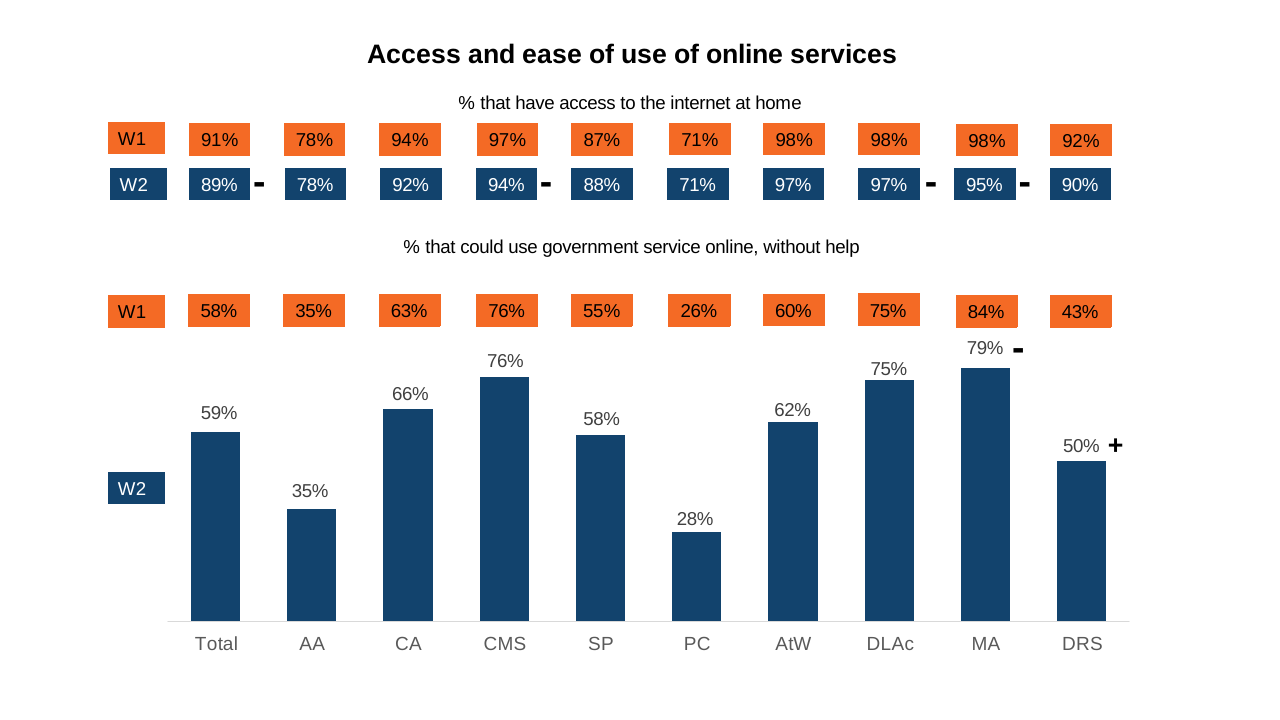
Base: All customers (Wave 1: 10,172, Wave 2: 10,178. + and – are used to show significant difference at Wave 2 compared to Wave 1.
Customers who could access government services online with help were asked at both waves what specific types of support would be most useful to them if DWP were to move services online, findings from this are detailed in Chapter 5.
Furthermore, customers were also asked whether dealing with DWP via email, text message, video call, chatbot, or a webchat service would be manageable for them. This question was added at Wave 2, so there is no comparison with Wave 1 figures.
Figure 2 - Whether dealing with DWP via different modes of contact would be manageable:
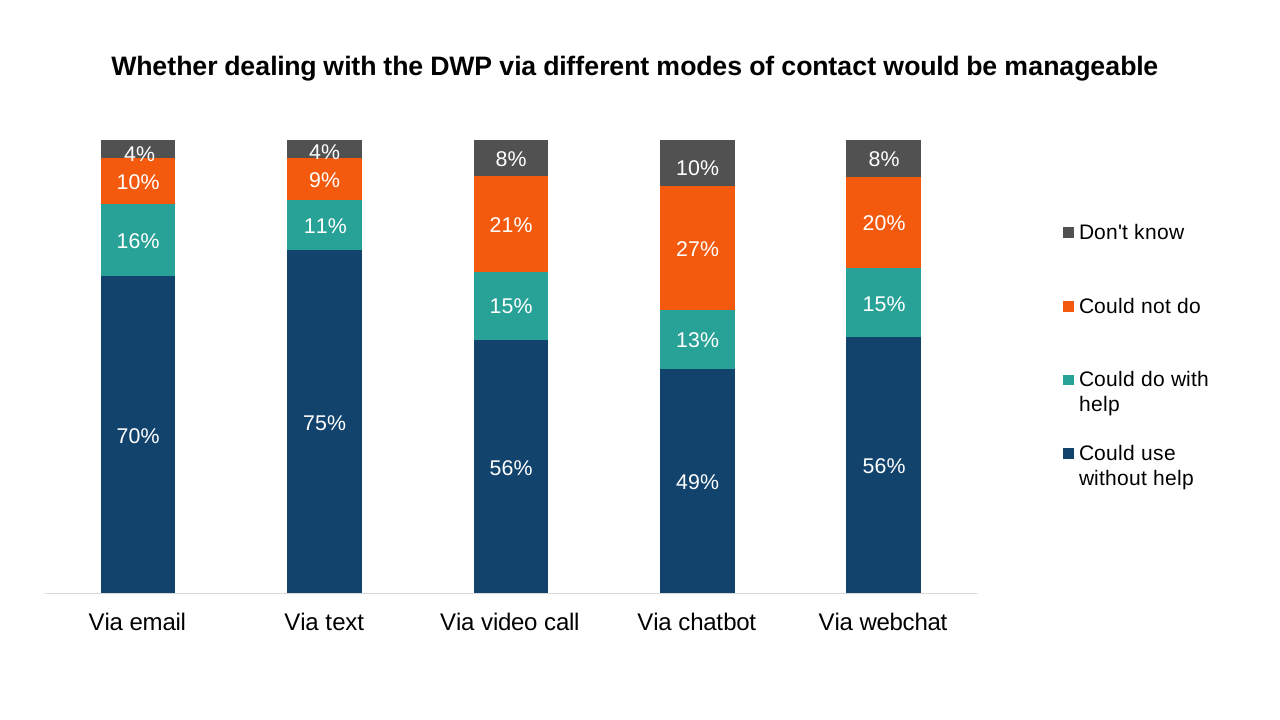
Base: All customers (Wave 2: 10,178).
As seen in Figure 2, the mode of contact that customers felt was the most manageable was via text, with three-quarters (75%) saying this was manageable. This was followed by just seven in ten (70%) saying contact via email would be manageable, and just over half (56%) saying contact via video call or webchat would be manageable. The mode of contact mode that customers were least likely to say was manageable was contact via a chatbot (49%). Certain service lines were more likely to say that they could not use a particular mode of contact, including: PC (for text: 23%, email: 30%, webchat: 54%, video call: 51%, chatbot: 60%), AA (for text: 23%, email: 24%, webchat: 46%, chatbot: 54%) and SP (for text: 16%, email: 16%, webchat: 32%, video call: 37%, chatbot: 42%).
Customer contact with DWP in the last 12 months
This section gives an overview of the main types and modes of contact that customers had with DWP in the 12 months prior to survey, to reflect and inform changes in these service lines. Type of contact refers to the touchpoints throughout the customer journey, such as applying or receiving notifications, whereas mode refers to the channel through which a customer interacts with DWP, such as post or online portal. Type and mode of contact differs between service lines due to their nature and purpose.
Types of contact in the last 12 months
Customers were asked what types of contact they had with DWP in the past 12 months prior to survey. Responses were prompted by a list of potential ‘touchpoints’ and can be seen in Figure 3 below.
DRS had some different touchpoints that are unique to this service, in which customer contact is about a dispute for a claim, rather than making or managing the claim itself. For this reason, data for DRS customers is presented separately from other service lines and can be seen in Figure 4. In Chapter 3 on ‘Customer journey experiences’, DRS are included in the total where possible, so totals may differ from those in Figure 3.
Figure 3 - Types of contact with DWP in the last 12 months:
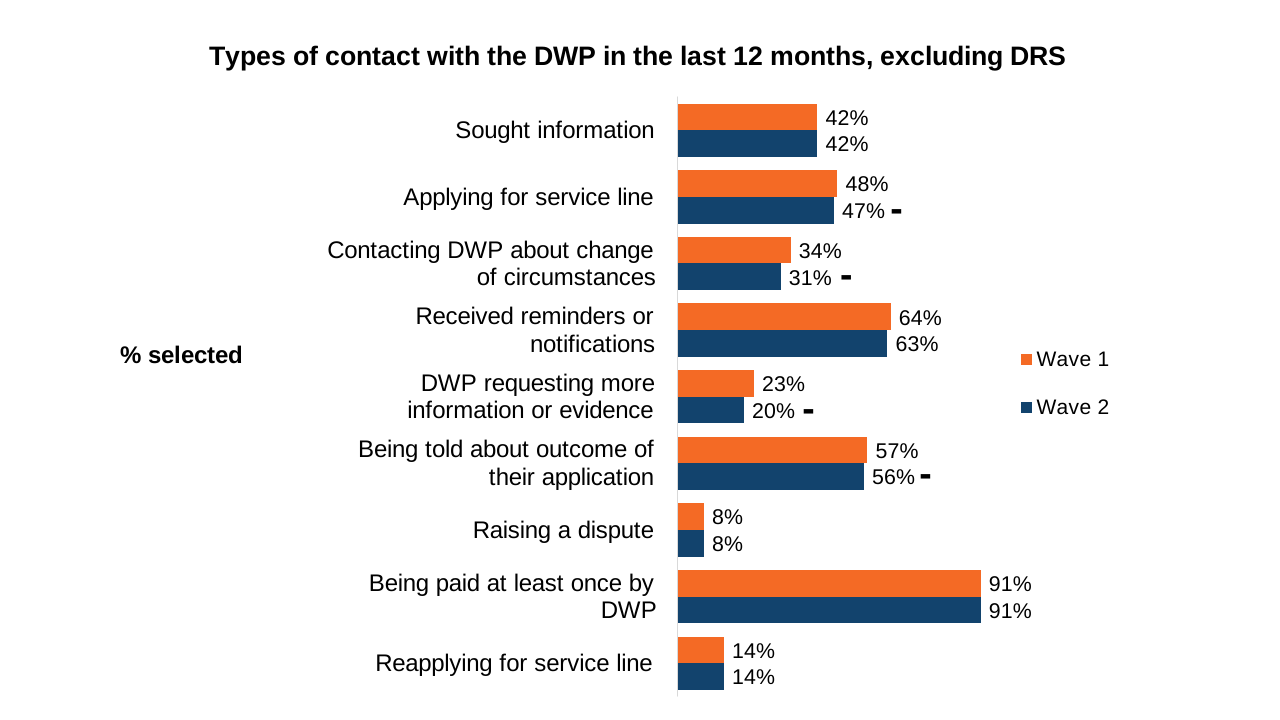
Base: All excluding DRS customers (Wave 1: 9,043, Wave 2: 9,038). + and – are used to show significant difference at Wave 2 compared to Wave 1.
As Figure 3 illustrates, the incidence of various touchpoints remained largely consistent between Wave 1 and Wave 2. The most common type of contact at both Wave 1 and Wave 2 for non-DRS customers was being paid by DWP (91% at both waves), followed by being sent reminders or notifications by DWP about their service line (64% at Wave 1 vs 63% at Wave 2). Raising a dispute (8%) was the least common form of contact, followed by reapplying (14%). This was the same for both Wave 1 and Wave 2.
Between Wave 1 and Wave 2, non-DRS customers were slightly less likely to apply for a service line (48% at Wave 1 vs 47% at Wave 2), contact DWP about a change of circumstance (34% at Wave 1 vs 31% at Wave 2), receive a request from DWP for additional information or evidence (23% at Wave 1 vs 20% at Wave 2), and be told about the outcome of their application (57% at Wave 1 vs 56% at Wave 2).
DRS types of contact in the last 12 months
DRS customers often have a substantially different customer journey than other service lines, as these customers are challenging a benefit decision, rather than making a claim. This meant that statements within the survey were rephrased so that they were applicable to this service line. DRS customers were sampled from two key groups: those who had requested a mandatory reconsideration of their claim in the past 12 months, and those who had appealed the outcome of their mandatory reconsideration in the past 12 months.
As seen in Figure 4, in Wave 2, over four-fifths of DRS customers (85%) raised a dispute or started the process of raising a dispute in the last 12 months, other disputes would have been raised more than 12 months prior to the survey. Two-thirds (64%) of customers had sought information about this process. Among DRS customers who were sampled as having requested a mandatory reconsideration, three-quarters (75%) said they were told the outcome of this within the last 12 months. Among DRS customers who were sampled as having appealed their mandatory reconsideration, nearly nine in ten (89%) reported that they had done this in the last 12 months.
Figure 4 - Types of contact with DWP in the last 12 months, DRS only:
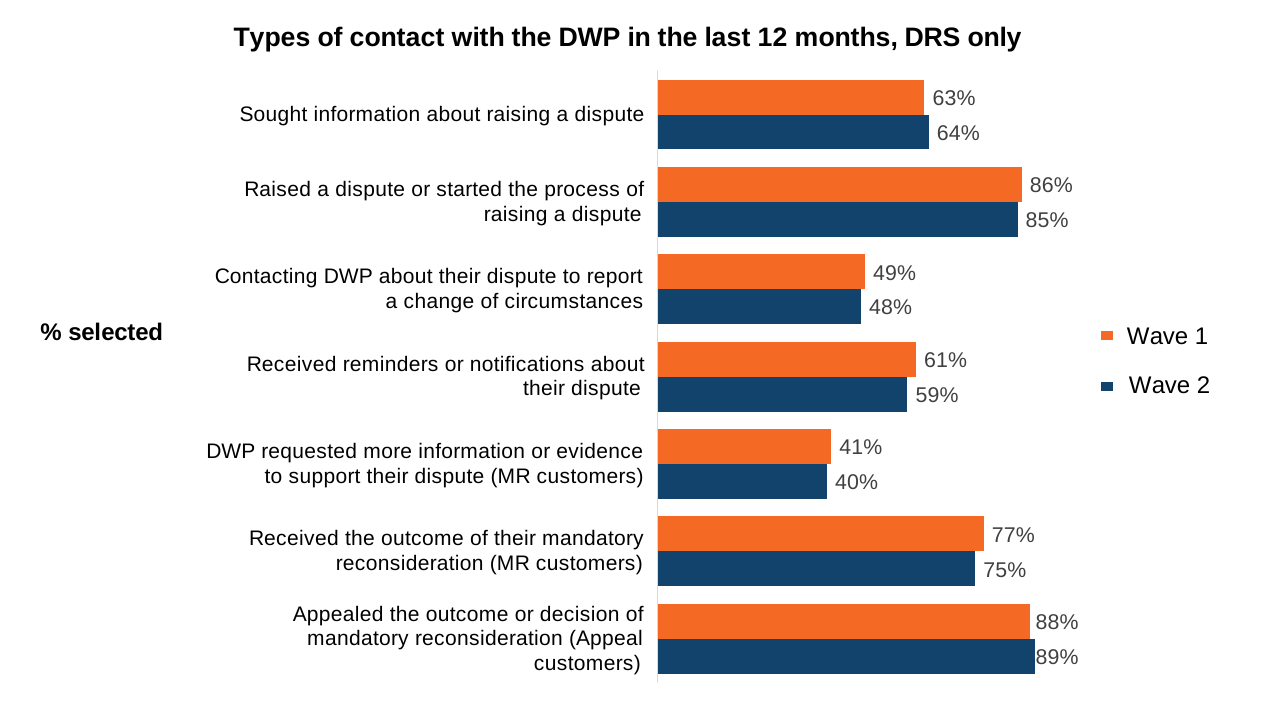
Base: DRS customers (Wave 1: 1,129, Wave 2: 1,140).
Frequency of contact
Looking at frequency of contact, most customers had experienced at least four different touchpoints in the 12 months prior to the survey at Wave 2 (51%). This varied considerably by service line, which is to be expected given the nature of the different service lines, where some have more touchpoints due to differences in the customer journey. Table 6 below breaks down the number of different touchpoints experienced by customers, by service line, for Wave 2.
Table 6 - Number of touchpoints selected by each service line at Wave 2:
| Number of touchpoints | All | SP | PC | AA | CA | AtW | MA | DLAc | CMS | DRS |
|---|---|---|---|---|---|---|---|---|---|---|
| 1 | 11% | 18% | 14% | 13% | 15% | 13% | <1% | 6% | 14% | 6% |
| 2 | 19% | 48% | 27% | 16% | 24% | 15% | 2% | 15% | 18% | 12% |
| 3 | 17% | 19% | 15% | 18% | 16% | 16% | 11% | 14% | 17% | 25% |
| 4 or more | 51% | 13% | 43% | 51% | 45% | 55% | 86% | 65% | 46% | 55% |
Base: All customers (Wave 2: 10,178).
At Wave 2, customers, on average, experienced a similar number of touchpoints with DWP as they did in Wave 1. Over half (51%) of Wave 2 customers interacted with DWP across at least four different touchpoints, which was consistent with Wave 1 (54%). At a service line level, the picture at Wave 2 also remained the same as Wave 1. MA, DLAc, AtW and DRS customers had more types of contact than average, with State Pension customers having the least, which is expected due to the nature of the service lines.
Modes of contact with DWP in the last 12 months
Customers were asked about the modes of contact that they used to contact DWP in the past 12 months, with responses prompted by a list. Customers could select as many options as were applicable. As this was self-reported, this may not accurately represent actual contact customers had with DWP or reflect channels that are available for different service lines. In particular, it should be noted that DLAc and MA services do not have an online contact option currently, though MA customers can fill out forms online to print, which may be perceived as online contact.
Figure 5 below shows the modes of contact service line customers have used in the last 12 months, comparing Wave 1 and Wave 2 responses.
Figure 5 - Chart showing how customers had contact with DWP over the last 12 months:

Base: All customers (Wave 1: 10,172, Wave 2: 10,178). + and – are used to show significant difference at Wave 2 compared to Wave 1.
At Wave 2, post was by far the most common mode of contact overall (68%). This was followed by telephone (36%), email (24%) and through online portal (22%). Overall, use of post (70% at Wave 1 vs 68% at Wave 2), and telephone (39% at Wave 1 vs 36% at Wave 2) decreased between Wave 1 and Wave 2, while use of email increased slightly (21% at Wave 1 vs 24% at Wave 2). This indicates a positive shift in channels for Service Modernisation. However, there was also a slight increase in customers reporting in person contact (2% at Wave 1 vs 3% at Wave 2). Webchat was also introduced as an option in the survey at Wave 2. Webchat is a functionality that would allow service line users to have live conversations with DWP staff to answer questions and queries. This is different to a chatbot, which would be automated. Around a tenth (9%) of customers reported using webchat as a mode of contact at Wave 2.
The use of different modes of contact varied by service line at Wave 2. This can be partly explained by the extent of modernisation experienced by each service line. The most common mode of contact with DWP was by post for all service lines except AtW and CMS customers.
AtW customers had more contact via email (73%), telephone (64%) and through their online portal (42%), than by post (39%). Use of an online portal was higher for CMS customers than other service lines, so levels of contact via an online portal (61%) and via post (54%) were similar for CMS customers, unlike, most service lines. This is to be expected given the My Child Maintenance Case portal available for CMS customers.
Extent of modernisation experienced
In Wave 2 analysis, reported modes of customer contact (described above) and additional modernisation questions (as seen in Chapter 6 on ‘Experiences of modernisation’), were used to categorise customers into three modernisation groups. These are used throughout the report for subgroup analysis. This was based on customers self-reporting and may not accurately represent channels available across service lines. The modernisation groups were designed as follows:
-
Modernised Communications Only: customers who reported experience of modernised forms of communication with DWP staff including via video call, email, and webchat, or those who chose the way they dealt with DWP to suit their preferences. To be allocated to this group, customers must not have experienced any of the forms of modernisation in the Online Services category.
-
Online Services: customers who reported they have experienced an interaction via online services, such as contact via an online portal, contact via a chatbot, managing and making changes to a claim or dispute online, or receiving updates about a claim or dispute without having to speak to someone at DWP. This group may also have experienced the statements which make up Modernised Communications Only. As previously mentioned, MA and DLAc customers do not currently have an online contact option, but if they reported that they had experienced online contact, they were placed into this category.
-
No Modernisation: customers who reported they had experienced no forms of modernisation.
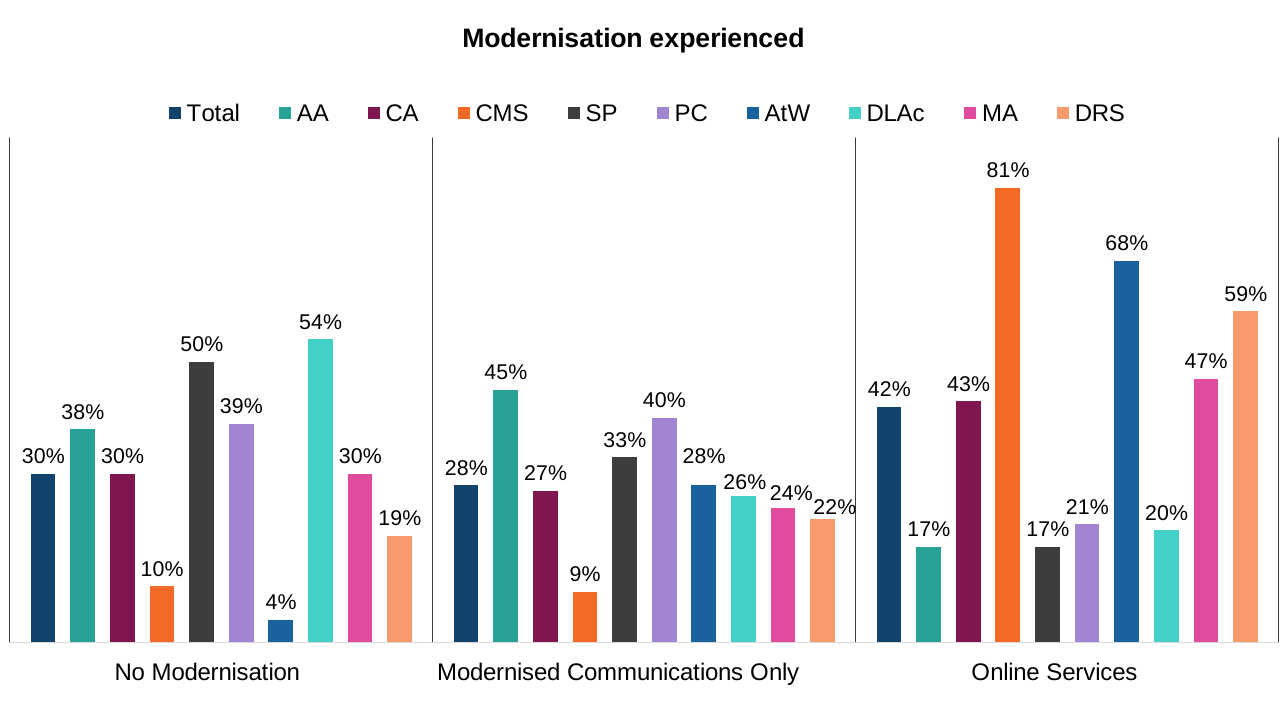
Figure 6 below shows the percentage of customers that were categorised in these groups. Overall, 28% of customers were categorised as Modernised Communications Only. Service lines that were more likely to have reported experiencing Modernised Communications Only were AA (45%), PC (40%), and SP (33%). Service lines that were less likely to fall into this group included MA (24%), DRS (22%), and CMS (9%).
In total, 42% of customers were in the Online Services group. Service lines that were more likely to have reported experiencing Online Services were CMS (81%), AtW (68%), DRS (59%) and MA (47%).
Based on responses, 30% of customers were placed in the No Modernisation category.
Figure 6 - Chart showing the proportion of customers in each modernisation group at Wave 2 by service line:
Base: All customers (Wave 2: 10,178).
3. Customer journey experiences
This section gives an overview of customer contact and experience, within the context of modernisation, at ten different touchpoints in the customer journey across service lines, as described in Chapter 2. For each touchpoint, the report provides findings for:
-
proportion of customers who interacted with DWP at the touchpoint, across service lines
-
mode of contact for the touchpoint, where relevant
-
customers’ experience of the touchpoint measured by agreement with a series of statements asked in the survey, including subgroup analysis
For modes of contact at each touchpoint, only Wave 2 data is included in the tables in this chapter for readability. Wave 1 data is included in the text where there are statistically significant changes at Wave 2.
Seeking information
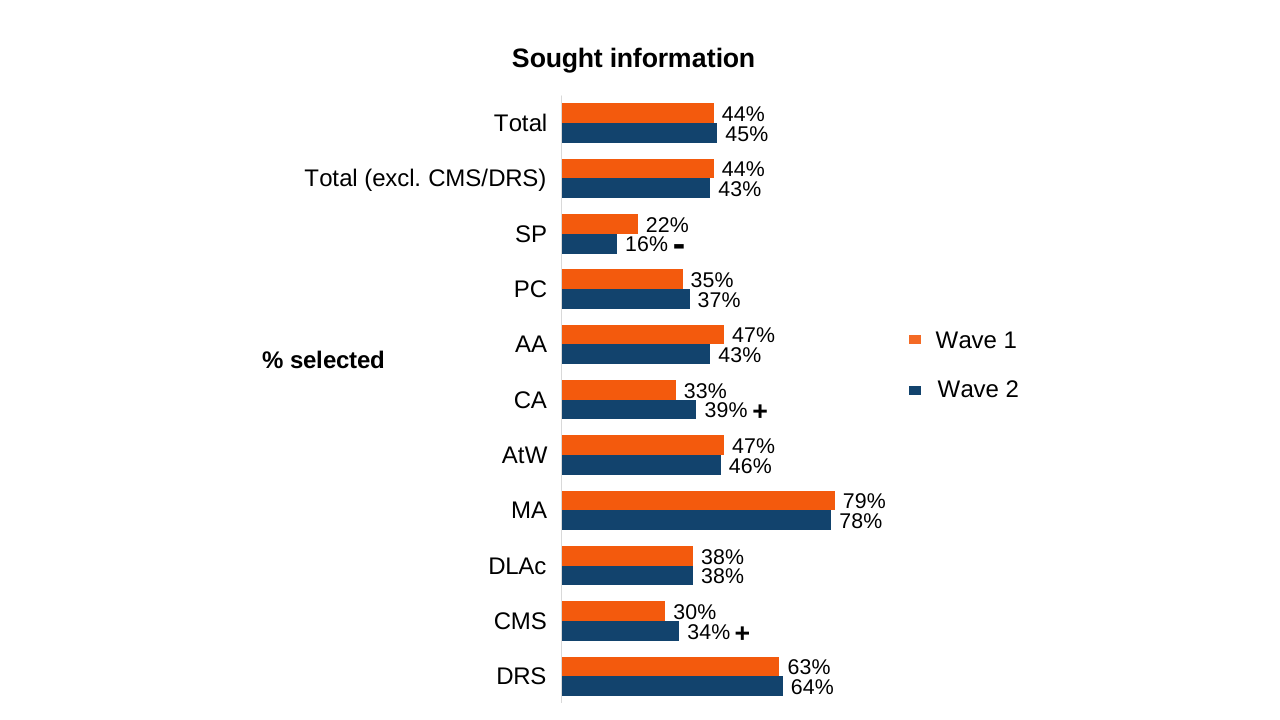
Customers were asked whether they sought information about their service line, for example to check their eligibility to make a claim. As shown in Figure 7, under half (45%) of all customers at Wave 2 sought information, similar to Wave 1 (44%).
Figure 7 - Customers who sought information in the last 12 months:
Base: All customers (Wave 1: 10,172, Wave 2: 10,178). + and – are used to show significant difference at Wave 2 compared to Wave 1.
Across both waves, MA (79% at Wave 1 and 78% at Wave 2) were the most likely to seek information. SP customers were less likely to do so than all other service lines and this also decreased between waves (22% at Wave 1 vs 16% at Wave 2). This is likely due to the nature of claiming State Pension in comparison to other service lines.
Looking at differences between waves, CA customers sought information more at Wave 2 (33% at Wave 1 vs 39% at Wave 2), as did CMS customers (30% at Wave 1 vs 34% at Wave 2).
Mode of seeking information
Customers who sought information about their service line were asked where they looked for this information. As shown in Table 7, at Wave 2, the most common mode was via the UK government website, GOV.UK (68%), in line with Wave 1 (69%). The next most common source of information was calling DWP (25%), followed by other websites of charities (14%) and family and friends (13%), again similar to Wave 1 (25%, 19% and 14%, respectively).
Table 7 - Mode of seeking information at Wave 2, by service line:
| Information source | Total | AA | CA | CMS | SP | PC | AtW | DLAc | MA | DRS |
|---|---|---|---|---|---|---|---|---|---|---|
| The UK government website, GOV.UK (includes DWP and Jobcentre Plus websites) or the Child Maintenance website | 68% | 50% | 80% | 79% | 54% | 39% | 74% | 64% | 87% | 62% |
| By calling DWP or Child Maintenance Service | 25% | 15% | 16% | 39% | 29% | 29% | 29% | 24% | 16% | 37% |
| Other websites of charities (for example, Citizens Advice) | 14% | 14% | 8% | 9% | 4% | 10% | 16% | 13% | 7% | 30% |
| From family or friends | 13% | 20% | 11% | 11% | 4% | 12% | 11% | 11% | 12% | 14% |
| Other non-charity websites | 5% | 4% | 4% | 6% | 2% | 4% | 6% | 9% | 5% | 5% |
| By post | 3% | 3% | <1% | 2% | 12% | 6% | <1% | 7% | 1% | 4% |
| Health professional or service | 3% | 10% | 1% | <1% | 0% | 1% | 4% | 7% | 1% | 2% |
Base: Customers who sought information in the last 12 months (Wave 2: 4,294). The option ‘Other non-charity websites’ was only provided at Wave 2.
Use of GOV.UK was most common among MA customers (87%), with CA (80%) and CMS (79%) customers also relatively more likely to use this source. CMS customers (39%) and DRS customers (37%) were relatively more likely to seek information by calling DWP. DRS customers were also relatively more likely to use other websites of charities (30%). Finally, AA customers (20%) were relatively more likely to ask family and friends.
Looking at differences across waves, SP customer use of GOV.UK was much lower at Wave 2 (70% at Wave 1 vs 54% at Wave 2). At an overall level, a smaller proportion of customers used other websites of charities to get information at Wave 2 (19% at Wave 1 vs 14% at Wave 2), and this also fell significantly across some individual service lines, including AA, CA, CMS, DLAc and MA.
Customer experience of seeking information
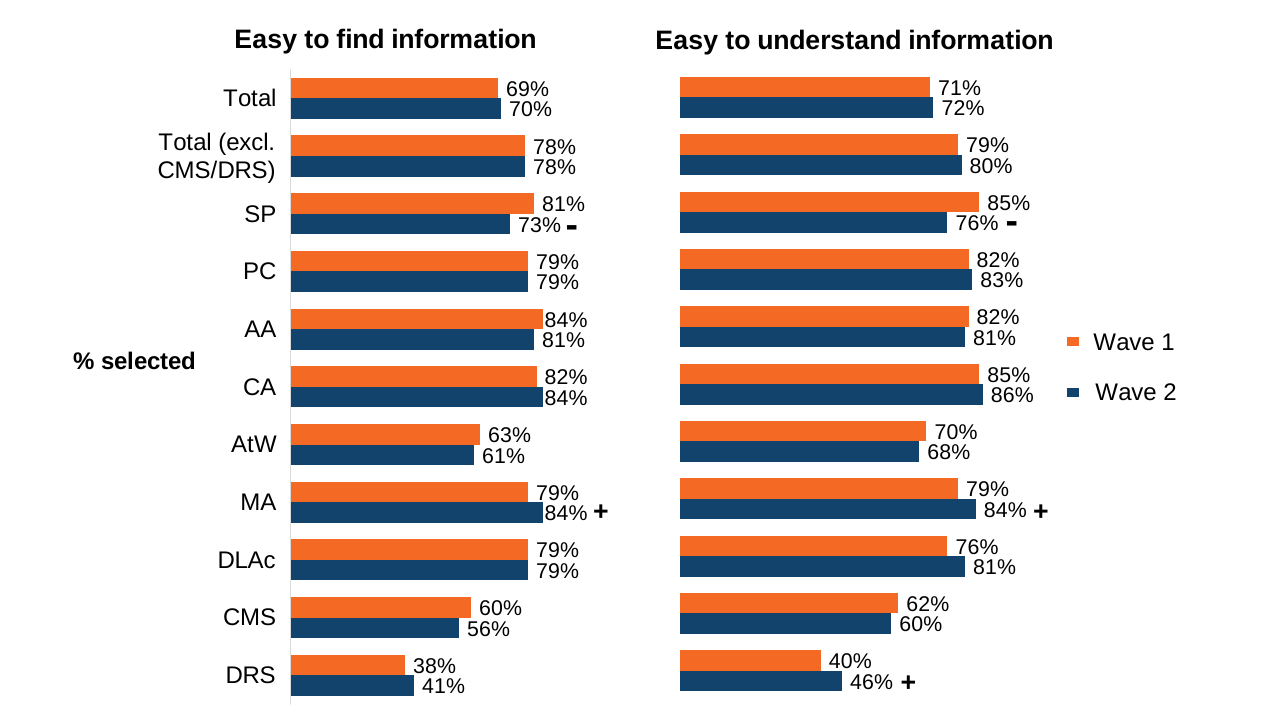
Customers who sought information were asked whether it was easy to find and easy to understand. As seen in Figure 8, across these two statements, overall, there were no significant changes between Wave 1 and Wave 2. Most customers, around seven in ten, continued to agree it was easy to find information (69% at Wave 1 vs 70% at Wave 2) and that it was easy to understand information (71% at Wave 1 vs 72% at Wave 2).
Figure 8 - Customer agreement that they could find all the information needed easily, and that the information was easy to understand:
Base: Customers who sought information in the last 12 months (Wave 1: 4,130, Wave 2: 4,294). + and – are used to show significant difference at Wave 2 compared to Wave 1.
Looking at individual service lines, MA customers showed an increase in agreement that it was easy to find information at Wave 2 (79% at Wave 1 vs 84% at Wave 2) and that it was easy to understand information (79% at Wave 1 vs 84% at Wave 2). Agreement for DRS customers also increased at Wave 2 for ease of understanding information (40% at Wave 1 vs 46% at Wave 2).
There were some reductions in agreement between waves for these two statements for SP customers, though agreement remained relatively high. Ease of finding information went down by eight percentage points at Wave 2 for SP (81% at Wave 1 vs 73% at Wave 2) and ease of understanding information by nine percentage points (85% at Wave 1 vs 76% at Wave 2).
At Wave 2, customers who reported experiencing Online Services were more likely to agree it was easy to find information than those who experienced No Modernisation for MA (89% vs 78%), AA (87% vs 71%), PC (87% vs 69%), CA (85% vs 73%) and DRS (47% vs 25%).
AA (85% vs 71%), CA (91% vs 73%) and PC (82% vs 69%) and DRS (37% vs 25%) customers who experienced Modernised Communications Only were also more likely to agree it was easy to find information compared to those who experienced No Modernisation.
Some customers in the Online Services group were also more likely to agree it was easy to understand information compared to those who experienced No Modernisation. This was seen for PC (90% vs 77%), MA (89% vs 82%), AA (85% vs 75%), and DRS (51% vs 32%). Additionally, SP customers (84% vs 68%) who experienced Modernised Communications Only were also more likely to agree it was easy to understand information compared to No Modernisation.
Digital confidence also had an impact on agreement at Wave 2 across DRS, CA and PC customers specifically. Those who were more digitally confident within these service lines were more likely to agree with the above statements around ease and understanding of seeking information.
Making an application or raising a dispute
Customers were asked whether they made an application for their service line in the last 12 months. DRS customers were asked whether they had raised a dispute in the last 12 months. As shown in Figure 9, just over half of all customers at Wave 2 applied for their service line or started a dispute (52%), which remained in line with Wave 1 results (53%).
Figure 9 - Customers who applied for service line or started a dispute, in the last 12 months:

Base: All customers (Wave 1: 10,172, Wave 2: 10,178). + and – are used to show significant difference at Wave 2 compared to Wave 1.
Looking at individual services lines, MA customers (92% at Wave 1 and 93% at Wave 2) were the most likely to have made an application in the last 12 months. This aligns with the fact that MA customers are only part of the service line for 39 weeks. SP customers were the least likely of all service lines to have applied for their service line in the last 12 months (19% at Wave 1 and 10% at Wave 2). This could be explained by the makeup of SP respondents who are almost all ‘stock’ customers at both waves. This reflects the makeup of the wider population as State Pension being a long-term benefit designed to support through all of retirement. AtW customers were less likely to have applied at Wave 2 than Wave 1 (56% at Wave 1 vs 52% at Wave 2).
Mode of making an application or starting a dispute
Customers were asked what mode of contact they used to apply, or raise a dispute for DRS customers. The mode customers used to make their application remained consistent between Wave 1 and Wave 2. In line with overall contact (Chapter 2), respondents were prompted by a list. As this was self-reported this may not accurately represent the actual mode customers used to apply, nor reflect modes that are available in each service line.
As seen in Table 8, at Wave 2 the most reported mode of making an application was via an online portal or by post (both 37%).
Table 8 - Mode of making an application or starting a dispute in Wave 2, by service line:
| Total | AA | CA | CMS | SP | PC | AtW | DLAc | MA | DRS | |
|---|---|---|---|---|---|---|---|---|---|---|
| Via post | 37% | 49% | 17% | 2% | 19% | 18% | 4% | 84% | 73% | 15% |
| Via online portal or My Child Maintenance Case | 37% | 25% | 66% | 75% | 57% | 29% | 69% | 6% | 21% | 36% |
| Via telephone | 14% | 5% | 6% | 13% | 16% | 32% | 12% | 5% | 2% | 35% |
| Via email | 3% | 2% | 2% | 0% | 2% | 4% | 8% | 1% | 1% | 5% |
| In person | 3% | 8% | 3% | 0% | 4% | 4% | 1% | 2% | <1% | 4% |
Base: Customers who made an application or raised dispute in the last 12 months (Wave 2: 5,150).
Comparing across service lines, DLAc customers were more likely to apply by post than any other service line (84%), which can be explained by DLAc having no online application option. CMS (75%), as expected, were more likely than other service lines to apply via an online portal as this reflects the default method of completing an application for this service line. PC was the only service line where telephone was the most common way of applying (32%), though DRS also had a substantial proportion applying by telephone (35%).
Comparing between waves, AA customers were more likely to use an online portal at Wave 2 (20% at Wave 1 vs 25% at Wave 2), along with AtW customers (61% at Wave 1 vs 69% at Wave 2). For MA, although customers do not have an online portal, they were less likely to say they used an online portal at Wave 2 to make an application (30% at Wave 1 vs 21% at Wave 2). This may be explained by responses being self-selected, and MA customers having the option to fill out applications online but print and post to submit them.
Customer experience of making an application or raising a dispute
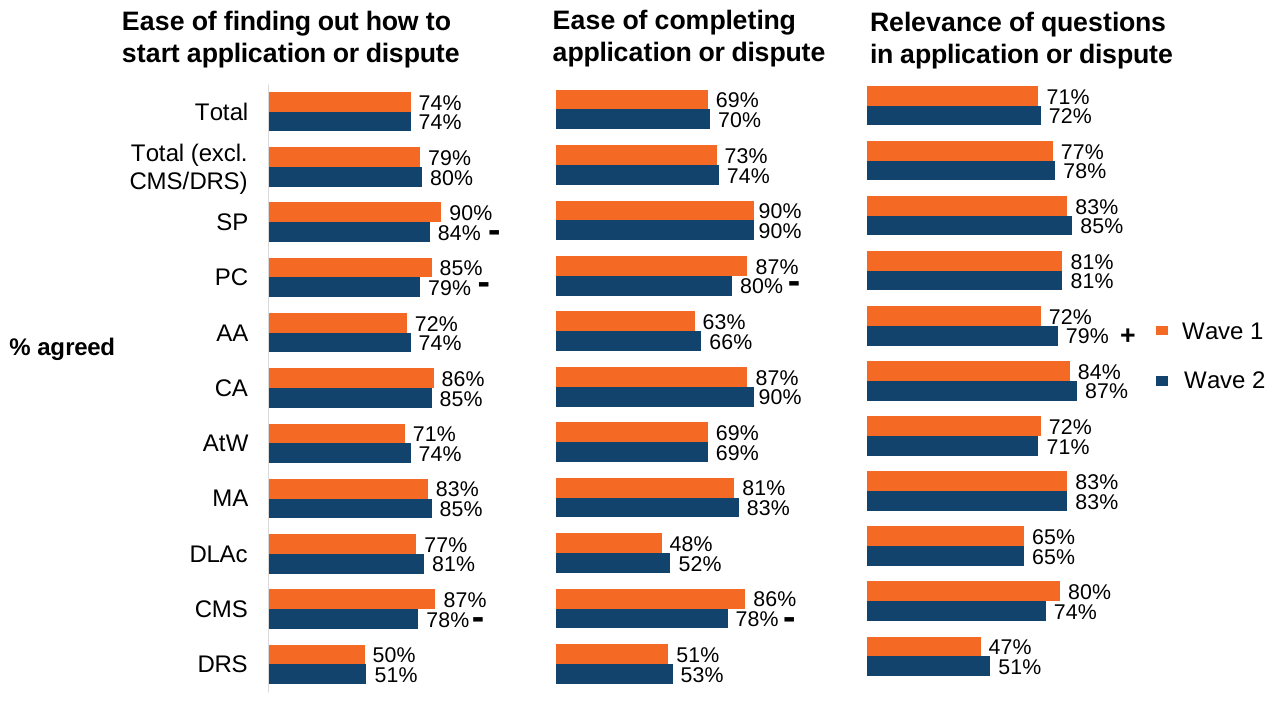
Customers were asked whether they agreed it was easy to find out how to start an application for their service or benefit, how easy it was to complete an application, and how relevant the questions were in the application (Figure 10).
Agreement across these statements was consistent between Wave 1 and Wave 2. At Wave 2, 74% agreed it was easy to find out how to start, 70% agreed it was easy to complete, and 72% agreed the questions were relevant, similar percentages to Wave 1.
Figure 10 - Customer agreement that it was easy to find out how to start an application, it was easy to complete an application and that the questions in the application felt relevant:
Base: Customers who applied or raised a dispute (for DRS) in the last 12 months (Wave 1: 5,093, Wave 2: 5,150). + and – are used to show significant difference at Wave 2 compared to Wave 1.
However, there were some changes between waves for individual service lines. CMS customers’ agreement that it was easy to find out how to start an application fell (87% at Wave 1 vs 78% at Wave 2), as did their agreement that it was easy to complete an application (86% at Wave 1 to 78% at Wave 2). PC also declined between waves for ease of finding out how to start an application (85% at Wave 1 vs 79% at Wave 2), and for ease of completing an application (87% at Wave 1 vs 80% at Wave 2). Additionally, for ease of finding out how to start the application, SP dropped from 90% at Wave 1 to 84% at Wave 2; whereas AA customers were more likely to agree the questions in the application were relevant at Wave 2 (72% at Wave 1 vs 79% at Wave 2).
There were some notable differences in the customer experience among those customers who had reported experience of some forms of modernisation at Wave 2. Online Services customers were more likely to agree it was easy to find out how to start an application compared to those who experienced No Modernisation for AA (87% vs 62%), MA (87% vs 80%), AtW (77% vs 55%) and DRS (56% vs 34%). For those in the Modernised Communications Only group, MA (88% vs 80%), AA (77% vs 62%) and DRS (51% vs 34%) were more likely to agree it was easy to find out how to start an application than those who experienced No Modernisation.
Some customers in the Online Services group were also more likely to find it easy to complete the application compared to those who experienced No Modernisation. These included CA (91% vs 81%), MA (87% vs 78%) PC (84% vs 71%), and DRS (59% vs 40%) customers. Among Modernised Communications Only customers, CA (91% vs 81%) were more likely to agree that it was easy to complete an application. AA (82% vs 72%), DLAc (71% vs 61%) and DRS (55% vs 30%) customers in the Modernised Communications Only group were more likely to agree that questions were relevant compared those who experienced No Modernisation. As mentioned, these categories are based on self-reporting and may not reflect available channels.
As with several other touchpoints, digital confidence had some impact for making an application or raising a dispute. At Wave 2, for DRS, CA, SP and AtW there were higher levels of customer agreement across all three statements for those who were digitally confident.
Submitting evidence
Customers were asked about their experiences of submitting evidence to DWP. For DRS this was asked to mandatory reconsideration customers only. Overall, 21% said DWP contacted them to request more evidence to support their claim at Wave 2, which was a slight decrease compared to Wave 1 (24%), as shown in Figure 11.
Figure 11 - Customer who submitted evidence in the last 12 months:
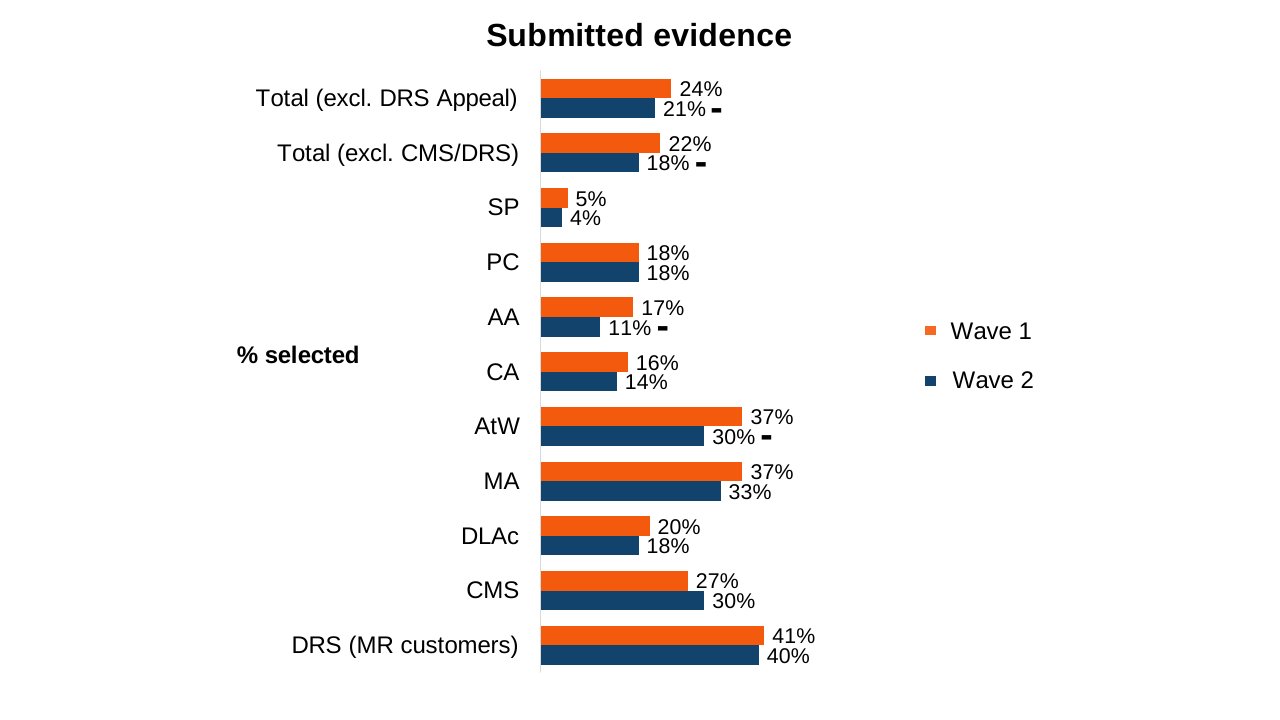
Base: All customers excluding DRS Appeal (Wave 1: 9,635, Wave 2: 9,589). + and – are used to show significant difference at Wave 2 compared to Wave 1.
AtW, MA, CMS and DRS customers were more likely to have been contacted for more information or evidence to support their claim, SP customers were less likely. There were decreases for specific service lines between waves. AA customers were less likely at Wave 2 (11%) to have contact about submitting evidence compared to Wave 1 (17%). This was the same for AtW customers at Wave 2 (37% at Wave 1 vs 30% at Wave 2).
Mode of submitting evidence
Customers were asked what mode they used to submit evidence. In line with overall contact (Chapter 2), respondents were prompted by a list. As this was self-reported this may not accurately represent the actual mode customers used to submit evidence or reflect modes that are available in each service line.
The most common mode for submission of evidence overall was via post, though use of post fell between Wave 1 and Wave 2 (55% Wave 1 vs 48% Wave 2). This indicates a positive shift in channels for Service Modernisation and moving away from paper, print and post.
This was followed by online portal (40%), telephone (23%), and email (20%), as shown in Table 9. One in twenty (5%) respondents selected that they submitted evidence in person, with other modes mentioned by 1% or lower (including webchat, chatbot and video call).
Table 9 - Mode of submitting evidence in Wave 2, by service line:
| Total | AA | CA | CMS | SP | PC | AtW | DLAc | MA | DRS | |
|---|---|---|---|---|---|---|---|---|---|---|
| Via post | 48% | 67% | 45% | 17% | 46% | 52% | 18% | 95% | 83% | 40% |
| Via online portal or My Child Maintenance Case | 40% | 27% | 48% | 83% | 26% | 16% | 48% | 7% | 14% | 48% |
| Via telephone | 23% | 13% | 23% | 28% | 30% | 43% | 28% | 12% | 11% | 20% |
| Via email | 20% | 6% | 18% | 17% | 27% | 10% | 56% | 11% | 9% | 14% |
| In person | 5% | 6% | 4% | 1% | 8% | 8% | 2% | 3% | 2% | 15% |
Submission online was the most common mode for CMS (83%), CA (48%) and DRS customers (48%), reflecting the modernised channels introduced for CMS and some DRS customers. AtW customers most commonly reported submitting evidence via email (56%).
Customer experience of submitting evidence
Customers were asked whether they agreed if DWP made it clear what information or evidence was needed to support their claim or dispute and if the process of submitting evidence was easy (Figure 12). They were also asked if they could do this via their preferred mode of contact and if it was clear how DWP used this information (Figure 13). Again, for DRS, these questions were asked to mandatory reconsideration customers only.
At Wave 2, most customers agreed it was clear what evidence was needed (73%), and it was easy to submit evidence (71%). These headline figures were in line with results at Wave 1.
Figure 12 - Customer agreement that it was clear what evidence or information was needed and that it was easy to submit evidence or information to support their claim or dispute:
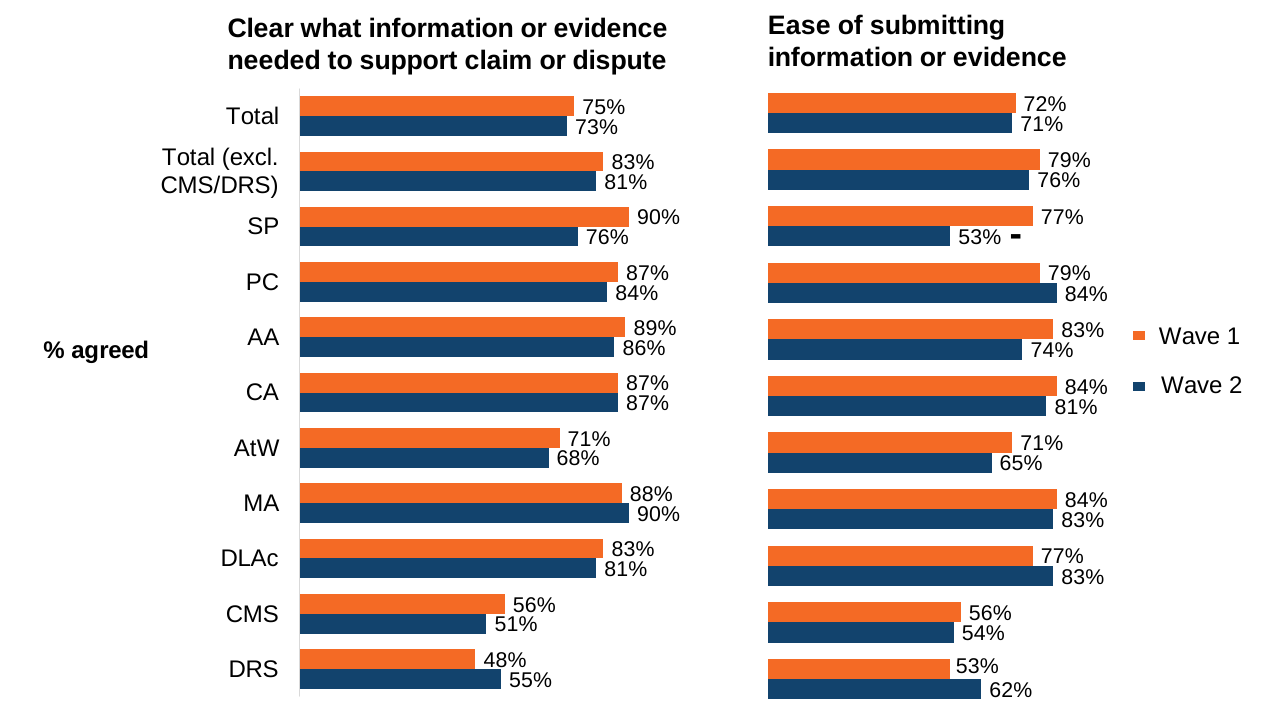
Base: Customers where DWP asked for more evidence in the last 12 months (Wave 1: 1,739, Wave 2: 1,608). + and – are used to show significant difference at Wave 2 compared to Wave 1.
As seen in Figure 12, SP customers experienced a decline in perceived ease of submission (77% at Wave 1 vs 53% at Wave 2). However, it is worth noting that base sizes here were low as 54 respondents in Wave 1 and 63 respondents in Wave 2 reported needing to submit further evidence. This means that the percentages are less likely to be representative.
There were some notable differences in the customer experience among customers who were categorised as having encountered modernisation. Customers who reported experiencing Online Services were more likely to agree it was clear what information or evidence was needed compared to those in the same service lines who experienced No Modernisation for PC (97% vs 75%), MA (96% vs 85%), DLAc (90% vs 71%) and DRS customers (62% vs 24%). DRS customers who experienced Modernised Communications Only were also more likely to agree with this statement than those who experienced No Modernisation (64% vs 24%).
PC customers who reported experience of Online Services were more likely to agree it was easy to submit evidence compared to those who experienced No Modernisation (93% vs 76%), as were MA (90% vs 71%) and DRS (66% vs 38%). Again, DRS customers who experienced Modernised Communications Only were also more likely to agree than those who experienced No Modernisation (68% vs 38%). As mentioned, these categories are based on self-reporting and may not reflect available channels.
Customers were also asked if they could submit evidence via their preferred mode of contact and if it was clear how DWP used this information (Figure 13). Three-quarters of customers agreed they could submit evidence through their preferred mode (74%), while two-thirds of customers also agreed it was clear how DWP used evidence (64%). These figures also remained in line with Wave 1.
Figure 13 - Customer agreement that they were able to submit evidence by their preferred mode of contact and that it was clear how DWP used evidence or information:

Base: Customers where DWP asked for more evidence in the last 12 months (Wave 1: 1,739, Wave 2: 1,608). + and – are used to show significant difference at Wave 2 compared to Wave 1.
AtW customers (70% at Wave 1 vs 79% at Wave 2) and DLAc (74% at Wave 1 vs 86% at Wave 2) both saw an increase at Wave 2 for agreement that they could submit evidence by their preferred mode.
At Wave 2, customers who reported experience of Online Services were more likely to agree they could submit evidence by their preferred mode compared to those who experienced No Modernisation for PC (100% vs 73%), MA (86% vs 56%) and DRS (68% vs 46%). MA customers who experienced Modernised Communications Only were more likely to agree for this statement compared to those in the No Modernisation group (79% vs 56%).
Customers in the Online Services category for PC (92% vs 75%) and MA (88% vs 68%) were more likely to agree it was clear how information was used compared to those who experienced No Modernisation. As mentioned, these categories are based on self-reporting and may not reflect available channels.
At Wave 2, digital confidence influenced agreement for some statements related to submitting evidence, particularly for DRS customers. DRS customers who were digitally confident were more likely to agree that the process of submitting evidence was easy (66% vs 37%), that they were able to submit evidence through their preferred mode (67% vs 37%) and that it was clear how DWP used the evidence (44% vs 20%) compared to those who were not digitally confident.
Receiving the outcome of a claim or dispute
Customers were asked about receiving a decision or outcome of their application for a service line. For DRS customers this would mean receiving a decision on their mandatory reconsideration, as a percentage of mandatory reconsideration customers, and for all other customers this would be receiving a benefit decision. As seen in Figure 14, 57% of customers, excluding DRS Appeal customers, had been told the outcome of their claim or dispute in the last 12 months at Wave 2, similar to Wave 1 (58%).
Figure 14 - Customers who received outcomes on their claim or dispute in the last 12 months:
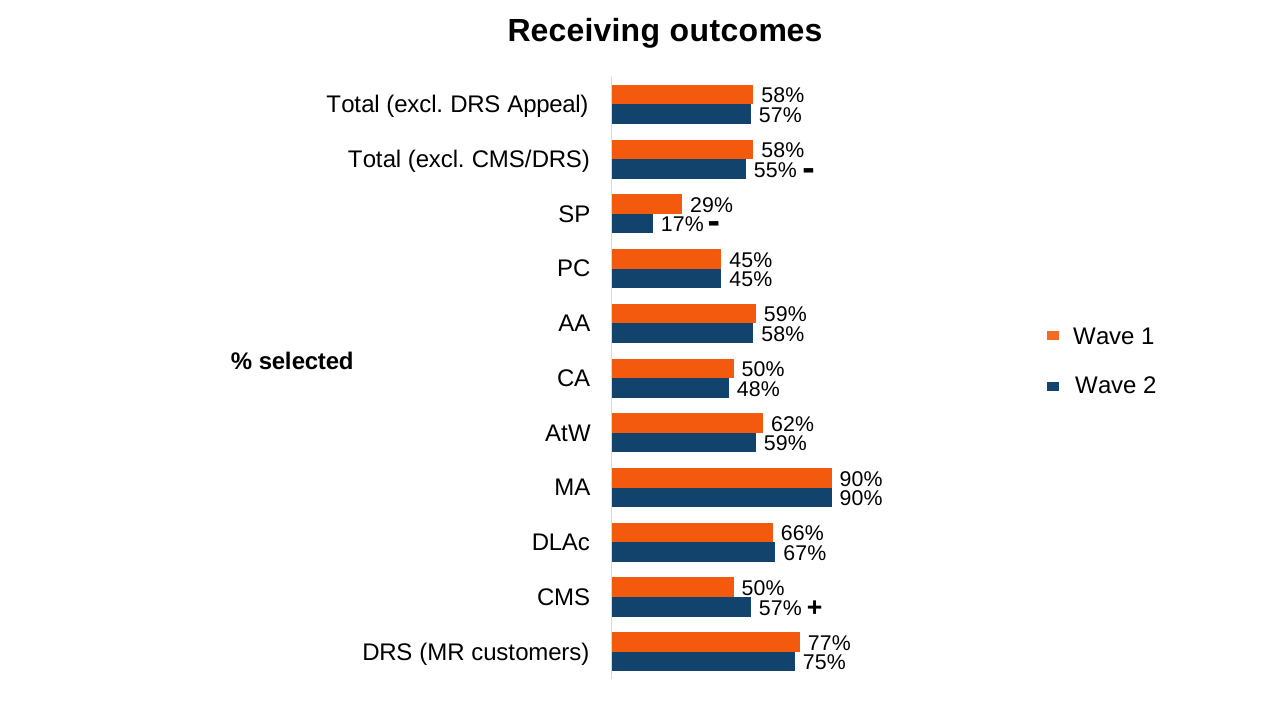
Base: All customers excluding DRS Appeal (Wave 1: 9,635, Wave 2: 9,589). + and – are used to show significant difference at Wave 2 compared to Wave 1.
Three-quarters of DRS MR customers had been told the outcome of their mandatory reconsideration in the past 12 months at Wave 2 (77% at Wave 1 vs 75% in Wave 2). CMS customers were more likely to have received the outcome on their claim at Wave 2 (57%) compared to Wave 1 (50%), while SP customers were less likely to have done so at Wave 2 (29% at Wave 1 vs 17% at Wave 2).
Mode of receiving outcome
Customers were asked what mode they received an outcome about their claim or dispute through. In line with overall contact (Chapter 2), respondents were prompted by a list. As this was self-reported this may not accurately represent the actual mode customers received their outcome through or reflect modes that are used by each service line.
As seen in Table 10, the most common mode selected for how customers were informed about the outcome of their application or dispute was by post (74%), which was lower than at Wave 1 (78%). This again indicates a shift from paper, print and post. This was followed by email (19%), the use of which had increased since Wave 1 (15%). Use of text message (11% vs 15%) and online portal (9% vs 11%) had also increased since Wave 1 (11% and 9%, respectively). This may suggest a positive trend of customers moving towards more digital services. Receiving an outcome via telephone remained stable between waves (12% Wave 1 vs 11% at Wave 2).
Table 10 - Mode of receiving outcome at Wave 2, by service line:
| Total | AA | CA | CMS | SP | PC | AtW | DLAc | MA | DRS | |
|---|---|---|---|---|---|---|---|---|---|---|
| Via post | 74% | 89% | 84% | 54% | 80% | 89% | 48% | 94% | 72% | 62% |
| Via email | 19% | 6% | 13% | 41% | 9% | 6% | 65% | 4% | 12% | 9% |
| Via text message | 15% | 2% | 7% | 24% | 1% | 3% | 5% | 13% | 39% | 9% |
| Via telephone | 11% | 6% | 8% | 8% | 11% | 12% | 28% | 8% | 9% | 14% |
| Via online portal or My Child Maintenance Case | 11% | 1% | 5% | 56% | 5% | 1% | 5% | 1% | 2% | 31% |
Base: Customers who were informed of the outcome of their application or dispute (for DRS) in last 12 months (Wave 2: 5243).
Customer experience of receiving an outcome of a claim or dispute
Customers were asked whether they were satisfied with the time it took DWP to inform them of the outcome and whether they felt DWP clearly explained the reason for their decision. As mentioned, for DRS this would be mandatory consideration customers only, and for all other service lines this was only asked to those who said they received their claim or dispute outcome in the 12 months prior to the survey. Overall, as seen in Figure 15, most customers were satisfied with the time it took DWP to inform them of the outcome of their claim or dispute (68%, consistent across Wave 1 and Wave 2) and most customers also agreed DWP clearly explained their decisions (73%, consistent across Wave 1 and Wave 2).
Figure 15 - Customer agreement that they were satisfied with the time taken to communicate their outcome and that DWP clearly explained the reasons for their outcome decision:
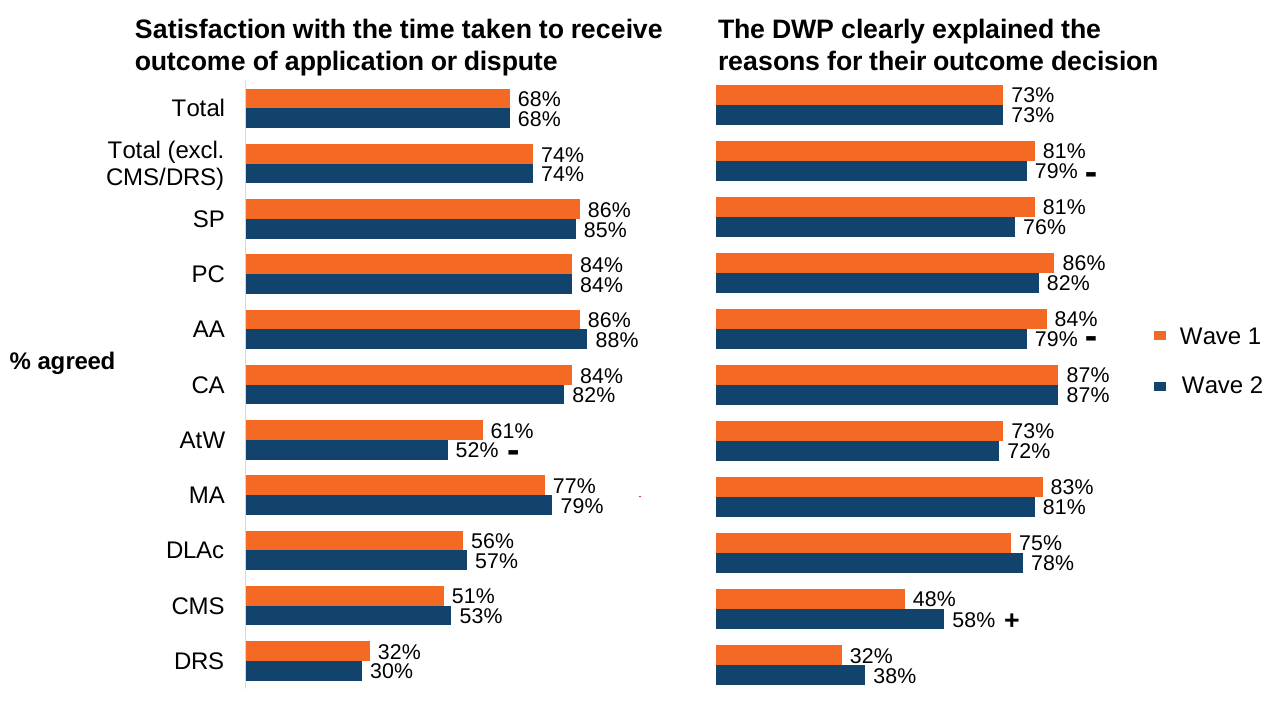
Base: Customers who were informed of the outcome of their application or dispute (for DRS) in last 12 months (Wave 1: 5,283, Wave 2: 5,243). + and – are used to show significant difference at Wave 2 compared to Wave 1.
AtW customers saw a decrease in satisfaction with time taken to inform them of their outcome at Wave 2 (61% Wave 1 vs 52% in Wave 2), this was expected due to an ongoing backlog in the AtW service line which may have meant slower processing of claims.
There were some notable differences in the customer experience among those customers who had encountered modernisation at Wave 2. Customers who reported using Online Services were more likely to be satisfied with the time taken for DWP to inform them about their outcome compared to those who experienced No Modernisation for PC (92% vs 80%), CA (85% vs 73%), MA (85% vs 71%), DLAc (68%) and CMS (56%).
CMS customers were more likely to agree that DWP explained their decision clearly at Wave 2 (48% at Wave 1 vs 58% at Wave 2), which coincided with them being more commonly informed of their outcome via online portal at Wave 2 (43% at Wave 1 vs 56% at Wave 2). AA customers were less likely to agree that DWP explained their decision clearly at Wave 2 (84% at Wave 1 vs 79% in Wave 2).
CA (90% vs 84%), DLAc (89% vs 73%), MA (86% vs 73%), AA (83% vs 74%) and DRS customers (45% vs 23%) who reported experience with Online Services were also more likely to agree that DWP clearly explained the reason for their decision, compared to those who experienced No Modernisation. As mentioned, these categories are based on self-reporting and may not reflect available channels.
Digital confidence had some influence on statements related to receiving outcomes at Wave 2. DRS customers (39%) and CA Customers (89%) who were digitally confident were more likely to agree that DWP clearly explained their decision compared to those not digitally confident (27% and 69% respectively). CMS customers who were digitally confident were more likely to be satisfied with the time taken (55%) or agree that DWP clearly explained their decision (59%) than those who were not digitally confident (30% and 39% respectively). Conversely, AtW customers who were not digitally confident (68%) were more likely to be satisfied with the time taken than those who were confident (51%).
Receiving payments
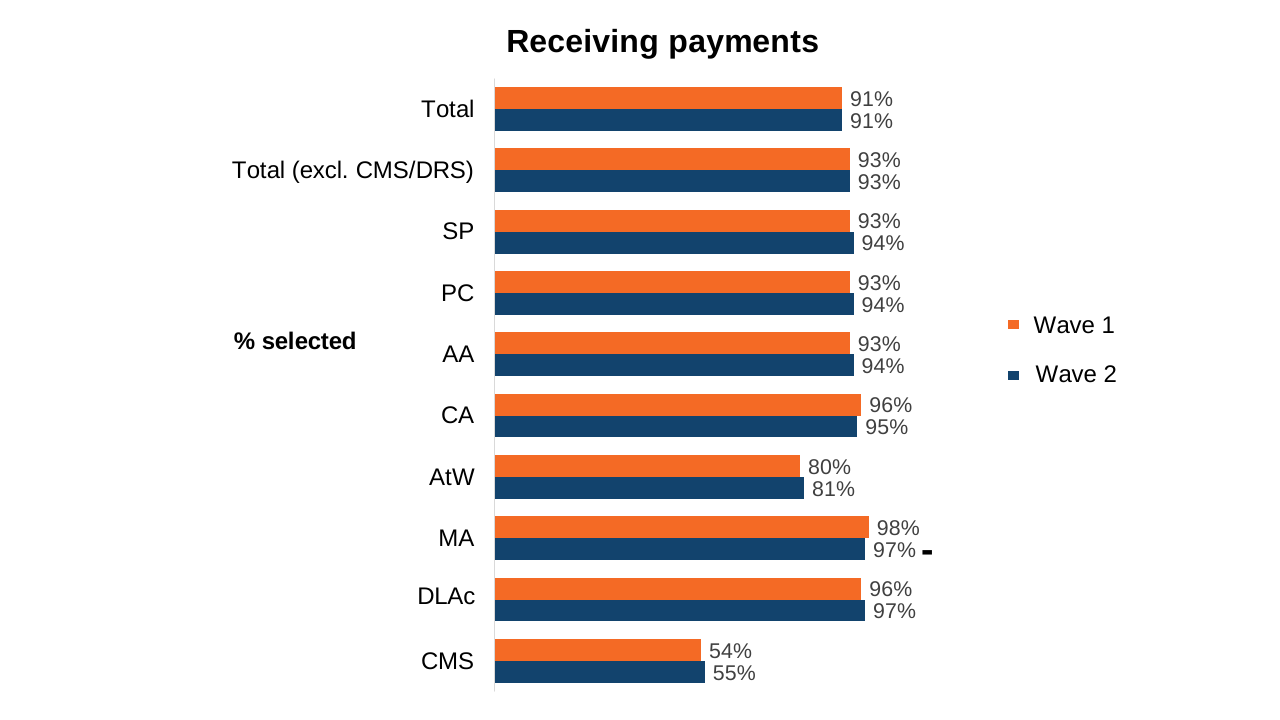
Customers were asked about their experiences of being paid by DWP in the 12 months prior to the survey. DRS and CMS paying parent customers were not asked these questions as they were not applicable for the service they experienced. Mode of receiving payment was not asked as it is also not applicable. As seen in Figure 16, overall, at Wave 2 91% of customers, excluding CMS paying parents and DRS, had been paid by DWP in the last 12 months, as with Wave 1.
Figure 16 - Customers who received at least one payment in the last 12 months:
Base: All except DRS and CMS paying parents (Wave 1: 8,302, Wave 2: 8,326). + and – are used to show significant difference at Wave 2 compared to Wave 1.
Over 90% of customers experienced this touchpoint for most service lines at both waves, with the exceptions of AtW (80% at Wave 1 and 81% at Wave 2), and CMS receiving parents (54% at Wave 1 and 55% at Wave 2). There was only one statistically significant difference between waves; MA customers were slightly less likely to receive payments at Wave 2 (98% at Wave 1 vs 97% at Wave 2).
Customer experience of receiving payments
Customers who received payments in the 12 months prior to the survey were asked if they thought DWP made payments when they said they would and paid them the amount that they said they would. Customers were also asked if they were satisfied with the time it took DWP to make the payment following a decision on their claim. AtW customers were not asked about satisfaction with the time taken to receive payments due to the nature of how payments are made within this service.
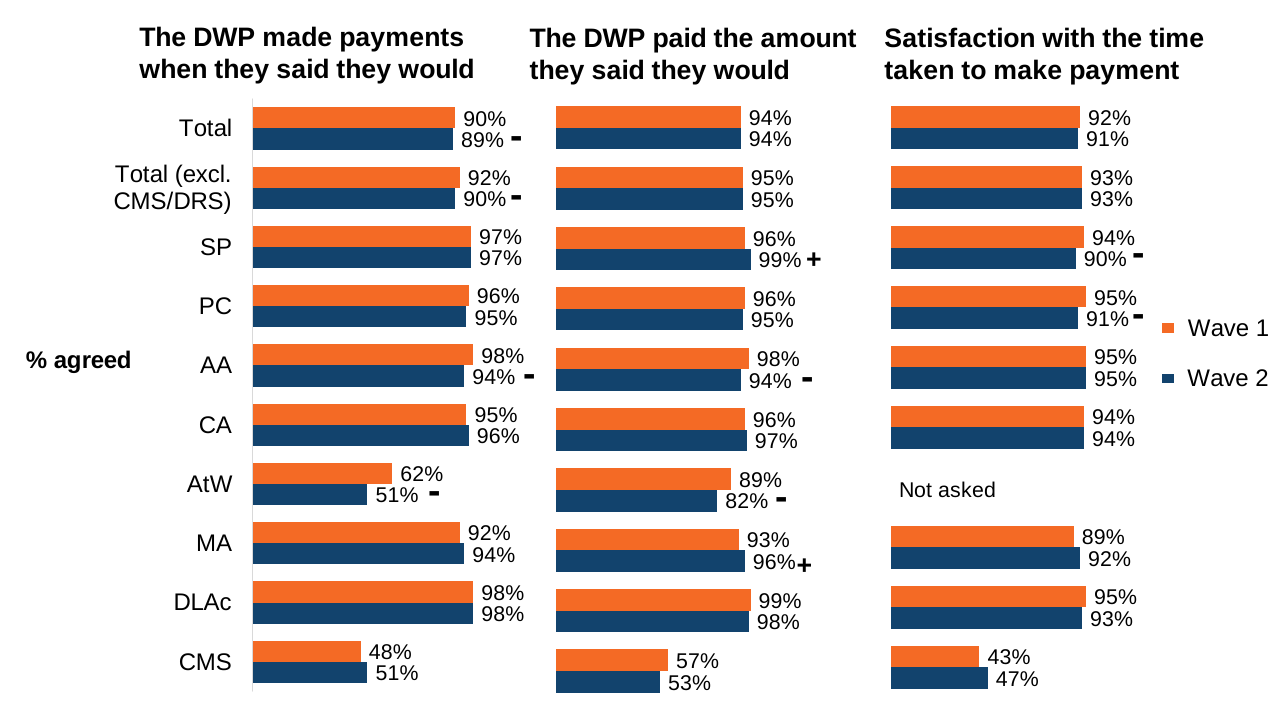
This remained a high-performing area for most services at Wave 2. As seen in Figure 17, agreement that DWP paid customers the amount that they said they would remained in line with Wave 1 (94% at Wave 1 and Wave 2), whereas agreement that DWP made payments when they said they would fell slightly (90% at Wave 1 vs 89% at Wave 2). Satisfaction with the time taken for DWP to make payment remained high at both waves (92% at Wave 1 vs 91% at Wave 2).
Figure 17 - Customer agreement that DWP made payments when they said they would, that DWP paid the amount they said they would, and that they were satisfied with the time taken for DWP to make payments:
Base: Customers who were paid at least once in the last 12 months (Wave 1: 6,526, Wave 2: 6,615). + and – are used to show significant difference at Wave 2 compared to Wave 1.
Within specific service lines, there were some declines in satisfaction and agreement. At both waves, AtW customers were relatively less likely than other service lines to agree that DWP paid me the amount they said they would (89% at Wave 1 vs 82% at Wave 2) and DWP made payments when they said they would (62% at Wave 1 vs 51% at Wave 2). Agreement with these statements also decreased among AA customers (98% at Wave 1 vs 94% at Wave 2 for both statements). SP (94% in Wave 1 vs 90% in Wave 2) and PC (95% in Wave 1 vs 91% in Wave 2) customers also experienced slight drops in satisfaction with the time taken to make payment. SP and MA customers saw an increase at Wave 2 for DWP paid me the amount they said they would (96% at Wave 1 vs 99% at Wave 2 for SP, 93% at Wave 1 vs 96% at Wave 2 for MA).
At Wave 2, some groups of customers were more likely to agree with these statements if they had experienced modernisation. Online Services PC and AA customers were more likely to agree that DWP paid them the amount they said they would compared to those experienced No Modernisation (99% vs 91%, and 98% vs 93%, respectively). PC customers who reported experiencing Online Services or Modernised Communications Only were also more likely to agree that DWP made payments when they said they would compared to those who experienced No Modernisation (100% and 95% vs 91%).
AA (98% vs 92%), MA (95% vs 89%), PC (98% vs 85%), and SP customers (92% vs 85%) who reported using Online Services were more likely to be satisfied with the time it took DWP to make payment compared to those in the same service line who experienced No Modernisation. SP customers who experienced Modernised Communications Only (95% vs 85%) were also more likely to be satisfied with the time taken than those who experienced No Modernisation.
Receiving notifications and reminders
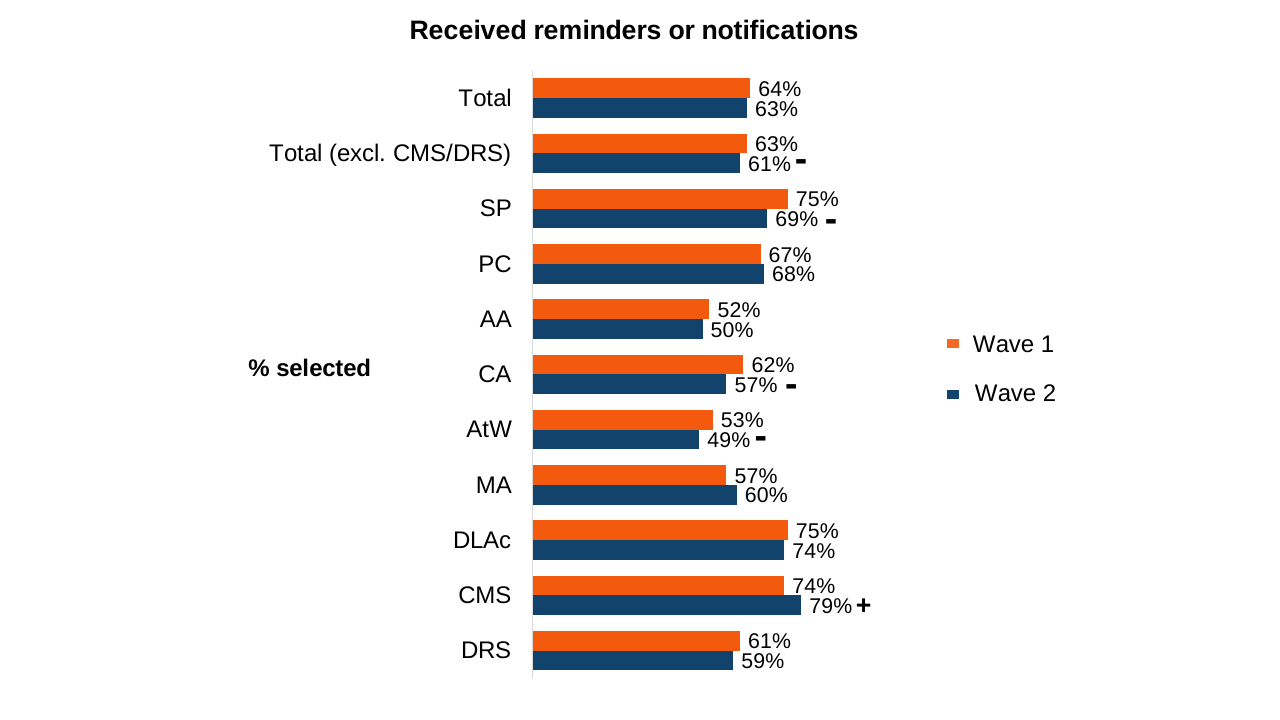
All customers were asked whether they had received reminders or notifications from their service line about their claim in the 12 months prior to the survey. As seen in Figure 18, at Wave 2, over half (63%) received reminders or notifications about their service line in the last 12 months, which was in line with Wave 1 (64%).
Figure 18 - Customers who received notifications or reminders from DWP in the last 12 months:
Base: All customers (Wave 1: 10,172, Wave 2: 10,178). + and – are used to show significant difference at Wave 2 compared to Wave 1.
At Wave 2, CMS customers were more likely than any other service line to receive notifications or reminders, and this increased between waves (74% at Wave 1 vs 79% at Wave 2). Conversely, CA (62% at Wave 1 vs 57% at Wave 2), SP (75% at Wave 1 vs 69% at Wave 2) and AtW (53% at Wave 1 vs 49% at Wave 2) customers all saw decreases in receiving notifications.
As shown in Figure 19, customers were asked about the type of information covered by these notifications and reminders, this remained similar to Wave 1. The most common type of information conveyed was confirmation of the payment amount (71%, consistent between Wave 1 and Wave 2). However, confirmation that an application or dispute had been received was slightly more common at Wave 2 (47% at Wave 1 vs 49% at Wave 2), as was notification of the decision on their claim (44% at Wave 1 vs 47% at Wave 2).
Figure 19 - Different types of information that notifications or reminders covered:

Base: Customers who received notifications or reminders from DWP in the last 12 months (Wave 1: 5,468, Wave 2: 5,450). + and – are used to show significant difference at Wave 2 compared to Wave 1.
Mode of receiving notifications and reminders
At Wave 2, customers who received notifications and reminders were asked about the modes of contact used for these. This question was not asked at Wave 1. In line with overall contact (Chapter 2), respondents were prompted by a list. As this was self-reported this may not accurately represent the actual mode customers received notifications or reminders through or reflect modes that are available for each service line. As seen in Table 11, the most common mode used for notifications and reminders was via post (76%).
Table 11 - Mode of contact through which notifications and reminders were communicated in Wave 2, by service line:
| Total | AA | CA | CMS | SP | PC | AtW | DLAc | MA | DRS | |
|---|---|---|---|---|---|---|---|---|---|---|
| Via post | 76% | 95% | 89% | 49% | 94% | 95% | 31% | 96% | 66% | 59% |
| Via text message | 23% | 2% | 10% | 45% | 1% | 3% | 25% | 19% | 59% | 44% |
| Via email | 21% | 5% | 14% | 47% | 7% | 5% | 79% | 3% | 15% | 30% |
| Via online portal or via My Child Maintenance Case | 12% | 2% | 6% | 51% | 1% | 1% | 11% | 1% | 2% | 24% |
| In person | 1% | 2% | <1% | 0% | <1% | <1% | 1% | <1% | <1% | 3% |
Base: Customers who received notifications or reminders from DWP in the last 12 months (Wave 2: 5,450).
AtW (31%) and CMS (49%) customers were less likely than those in other service lines to receive notifications and reminders via post. CMS had a wide spread of common modes used for notifications and reminders. CMS customers were more likely than other service lines to receive notifications and reminders through an online portal (51%), reflecting its use as the primary contact method for this service. AtW customers were the most likely to receive notifications and reminders via email (79%).
Customer experience of receiving notifications and reminders
Customers who received reminders or notifications were asked at both waves whether the content was useful, and at Wave 2 whether reminders arrived at a time that was useful. The responses to these questions are shown in Figure 20. Overall, agreement that reminders contained information that was useful was higher at Wave 2 (77% at Wave 1 vs 79% at Wave 2). Overall, three-quarters (75%) agreed that reminders arrived at a time that was useful.
Figure 20 - Customer agreement that reminders contained information that was useful and arrived at a time that was useful:
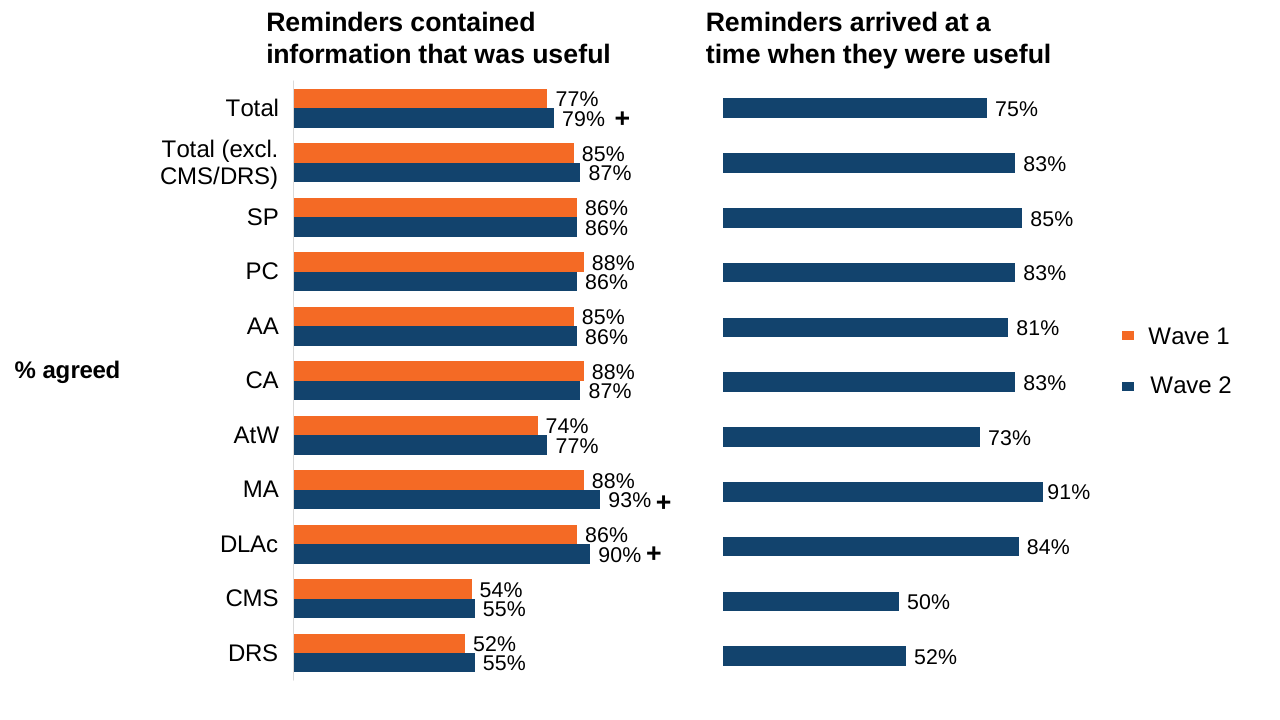
Base: Customers who received notifications or reminders from DWP in the last 12 months (Wave 1: 5,468, Wave 2: 5,450). + and – are used to show significant difference at Wave 2 compared to Wave 1.
At Wave 2, there were increases in agreement that the reminders contained information that was useful for MA customers (88% at Wave 1 vs 93% at Wave 2) and DLAc customers (86% at Wave 1 vs 90% at Wave 2). In terms of reminders arriving at a time that was useful, MA (91%) customers were also more likely than those in the other service lines to agree.
There were some notable differences in the customer experience among customers who reported they had encountered modernisation at Wave 2. PC (97% vs 85%), MA (95% vs 88%) and DRS customers (61% vs 45%) in the Online Services group were more likely to agree that reminders contained useful information than those who experienced No Modernisation. There was also higher agreement among MA customers who had experienced Modernised Communications Only compared to No Modernisation (95% vs 88%).
For whether reminders arrived at a time that was useful, PC (92% vs 80%), MA (96% vs 83%), DLAc (90% vs 80%), DRS (58% vs 41%), and CMS (54% vs 37%) customers who reported use of Online Services were more likely to agree than those who experienced No Modernisation. For customers who experienced Modernised Communications Only compared to No Modernisation, there was also higher agreement that reminders arrived at a time that was useful for AA (85% vs 76%), and DLAc (88% vs 80%).
Digital confidence affected DRS customers’ experiences at Wave 2. No other service lines showed significant differences by digital confidence. DRS customers that were digitally confident were more likely to agree that reminders contained useful information (58%) and came at a useful time (56%) compared to those who were not digitally confident (44% and 39% respectively).
Change of circumstances
All customers were asked whether they had reported a change of circumstances to DWP in the last 12 months. As shown in Figure 21, at Wave 2, a third of customers (33%) had reported a change of circumstance to DWP, which was lower than at Wave 1 (36%).
Figure 21 - Customers who contacted DWP to tell them about a change in their circumstances:
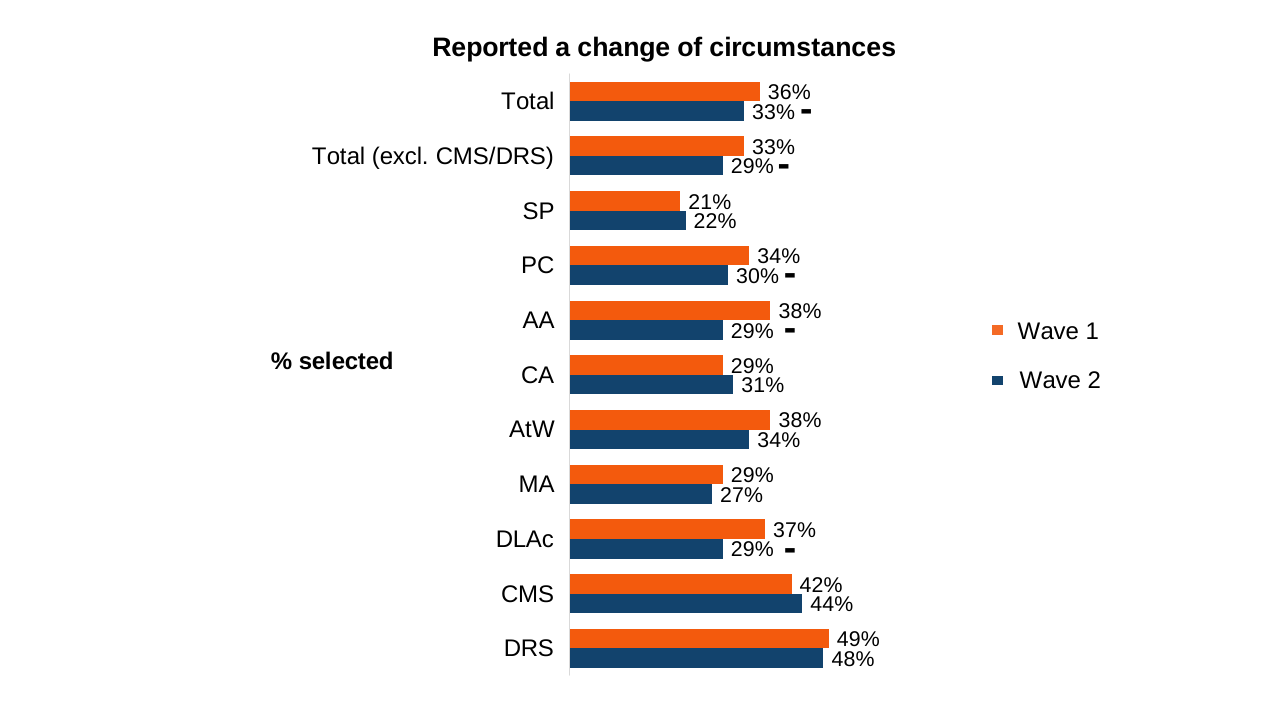
Base: All customers (Wave 1: 10,172, Wave 2: 10,178). + and – are used to show significant difference at Wave 2 compared to Wave 1.
Comparing between service lines, DRS customers were the most likely to have updated DWP about a change of circumstances at both waves (49% at Wave 1 and 48% at Wave 2). Comparing between waves, there was a decrease in reporting a change of circumstances between Wave 1 and Wave 2 for AA customers (38% at Wave 1 vs 29% at Wave 2), PC customers (34% at Wave 1 vs 30% at Wave 2), and DLAc customers (37% at Wave 1 vs 29% at Wave 2).
Mode of reporting a change of circumstances
Customers who reported a change in their circumstances were asked which contact mode they used to do this. This question was not asked at Wave 1. In line with overall contact (Chapter 2), respondents were prompted by a list. As this was self-reported this may not accurately represent the actual mode customers used to report a change of circumstances or reflect modes that are available in each service line. Overall, at Wave 2, customers most commonly updated DWP by telephone (60%) or via online portal (29%), as seen in Table 12.
Table 12 - Modes of contact to report change in circumstances in Wave 2, by service line:
| Total | AA | CA | CMS | SP | PC | AtW | DLAc | MA | DRS | |
|---|---|---|---|---|---|---|---|---|---|---|
| Via telephone | 60% | 62% | 60% | 51% | 57% | 78% | 62% | 78% | 63% | 46% |
| Via an online portal or via My Child Maintenance Case | 29% | 9% | 33% | 70% | 18% | 6% | 21% | 6% | 10% | 47% |
| Via post | 17% | 27% | 11% | 8% | 24% | 12% | 4% | 38% | 23% | 19% |
| Via email | 12% | 5% | 8% | 11% | 11% | 4% | 36% | 5% | 9% | 10% |
| In person | 2% | 3% | 2% | <1% | 3% | 2% | 1% | 1% | 2% | 5% |
Base: Customers who told DWP about a change of circumstances in the last 12 months (Wave 2: 2,565).
Use of online portal for informing DWP of changes of circumstances was highest among Child Maintenance Service (70%) and DRS (47%), aligning with increased use of digital channels in these service lines. It was lowest among AA (9%), DLAc (6%), and PC (6%) customers. Informing DWP of a change of circumstances by telephone was more common for PC (78%) and DLAc (78%) customers. This is due to the availability of channels for reporting a change of circumstances within these service lines. Use of email was relatively higher for AtW customers (36%).
Customer experience of reporting a change of circumstances
Customers who reported updating DWP about a change in circumstances were asked how easy it was to understand what to update DWP about, and how easy it was to report a change of circumstances. As seen in Figure 22, at Wave 2, just over three-quarters (77%) agreed it was easy to understand what changes to update DWP about, while agreement that it was easy to update DWP was lower (66%). Both ratings were consistent with Wave 1 findings (77% and 65%, respectively).
Figure 22 - Customer agreement that they understood what changes of circumstance to update DWP about and that it was easy to update DWP about a change of circumstances:
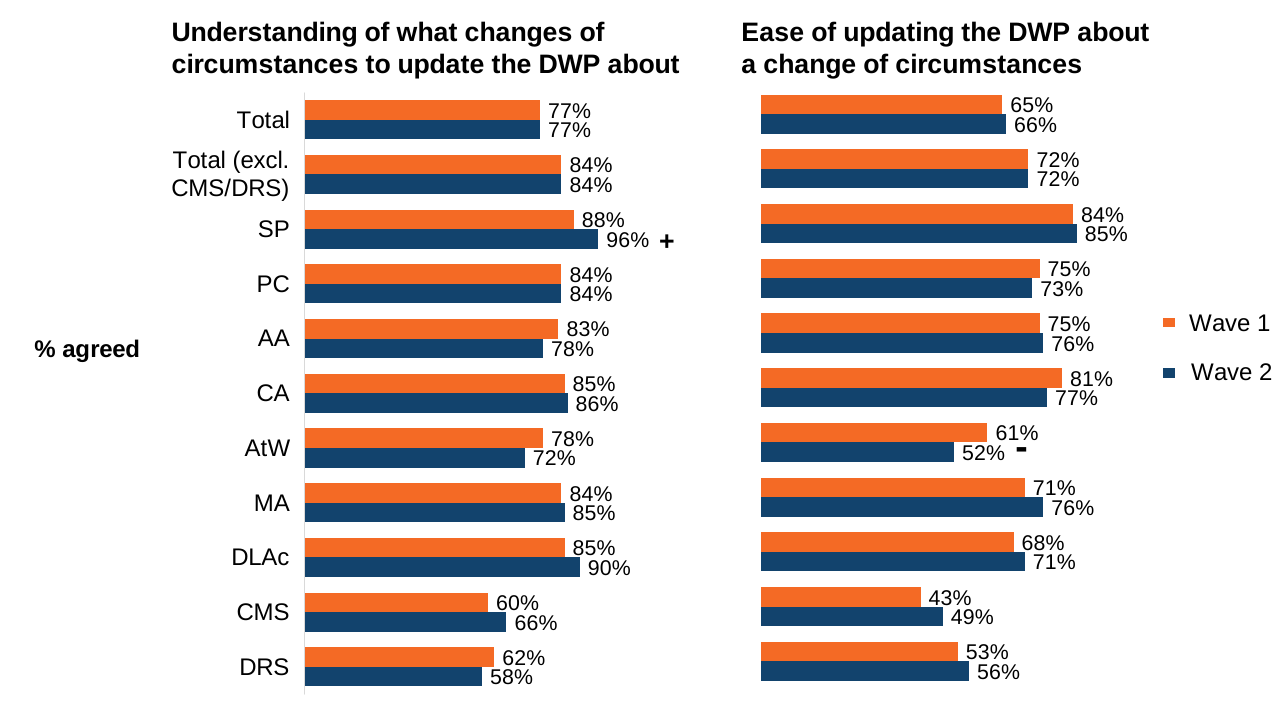
Base: Customers who told DWP about a change of circumstances in the last 12 months (Wave 1: 2,790, Wave 2: 2,565). + and – are used to show significant difference at Wave 2 compared to Wave 1.
In terms of changes from Wave 1, SP saw a significant increase in agreement that customers understood what changes of circumstances to update DWP about at Wave 2 (96%) compared to Wave 1 (88%). For agreement that it was easy to update DWP about a change in circumstances, AtW customers saw lower levels of agreement in Wave 2 (61% at Wave 1 vs 52% in Wave 2).
There were some notable differences in the customer experience among those customers who had encountered modernisation. For some service lines, customers in the Online Services category showed higher agreement that it was easy to update DWP about a change in circumstances than those who experienced No Modernisation. AA (89% vs 73%), MA (88% vs 61%), DLAc (83% vs 60%), PC (78% vs 63%), and DRS (62% vs 48%) customers were more likely to agree compared to those who experienced No Modernisation.
This also applied to some customers who had received Modernised Communications Only. SP (98% vs 85%) and DLAc (80% vs 60%) customers who had received Modernised Communications Only were more likely to agree it was easy to update DWP about a change of circumstances compared to those who experienced No Modernisation.
There were variations in ratings within some service lines by digital confidence. Digitally confident DRS customers again were more likely to agree to both statements as were digitally confident CA customers. Going against the grain of the other findings, AtW customers who were not digitally confident were more likely to agree they understood what to update DWP about (89%) than those who were digitally confident (71%).
Disputes
Non-DRS customers were asked whether they had raised a formal dispute with their service line in the past 12 months, while DRS customers who had appealed their mandatory reconsideration (MR) were asked if they had done so in the 12 months prior to the survey. As shown in Figure 23, 13% of the total of these groups of customers had done so, in line with Wave 1.
Figure 23 - Customers who raised a formal dispute or DRS customers who appealed the outcome of their mandatory reconsideration in the last 12 months:

Base: All customers excluding DRS MR (Wave 1: 9,580, Wave 2: 9,627). + and – are used to show significant difference at Wave 2 compared to Wave 1.
As expected, DRS Appeal customers were the most likely to have done so in the 12 months before the survey (89%), again consistent with Wave 1. For the majority of service lines less than 10% of customers had raised a dispute, with exceptions of CMS (26% at Wave 1 and 28% at Wave 2) and DLAc (11% at both waves). The only significant change observed between waves was that the proportion of AtW customers raising a dispute increased at Wave 2 (8%) compared to Wave 1 (5%).
Customer experience of raising a dispute or appealing an outcome
Non-DRS customers who had raised a formal dispute and DRS Appeal customers who appealed their mandatory reconsideration in the 12 months prior to the survey, were asked about their understanding of the process, and whether it was easy to dispute or appeal. As seen in Figure 24, findings were in line with Wave 1. At Wave 2, just under half (47%) agreed about understanding the process, and just over a third agreed it was easy to dispute or appeal (35%).
Figure 24 - Customer agreement that they understood the steps needed to raise a dispute and that it was easy to dispute DWP’s decision:

Base: All customers who raised a dispute or appealed a mandatory consideration decision (Wave 1: 944, Wave 2: 1,016). + and – are used to show significant difference at Wave 2 compared to Wave 1.
Due to the low incidence of non-DRS customers raising a formal dispute, there were few statistically significant differences, and many service lines do not have findings to report here due to low base sizes, based on the number of customers who raised disputes. At Wave 2, MA (87%) and DLAc (70%) customers were more likely to agree it was easy to understand the steps compared to DRS (47%) and CMS (31%) customers, based on statistical significance.
Experiences of modernisation made a difference for DRS Appeal customers. Those who reported using Online Services were more likely to understand the steps needed to appeal an MR (53%) compared to those with No Modernisation experience (35%). They were also more likely to find the process easy (45%) compared to those with No Modernisation experience (27%).
DRS Appeal customers who were more digitally confident were also more likely to have understood the steps needed to appeal (52%) and to have found it easy (41%) compared to those not digitally confident (35% and 24% respectively).
Reapplying or being reassessed
Customers were asked whether they had reapplied for their service line, or applied to be reassessed for AtW, in the 12 months prior to the survey. These questions were not asked to DRS customers as this touchpoint is not applicable for this service line. As seen in Figure 25, the proportion of customers reapplying at Wave 2 was consistent with Wave 1 (14% at both waves).
Figure 25 - Customers who reapplied for their service line or were reassessed for Access to Work in the last 12 months:
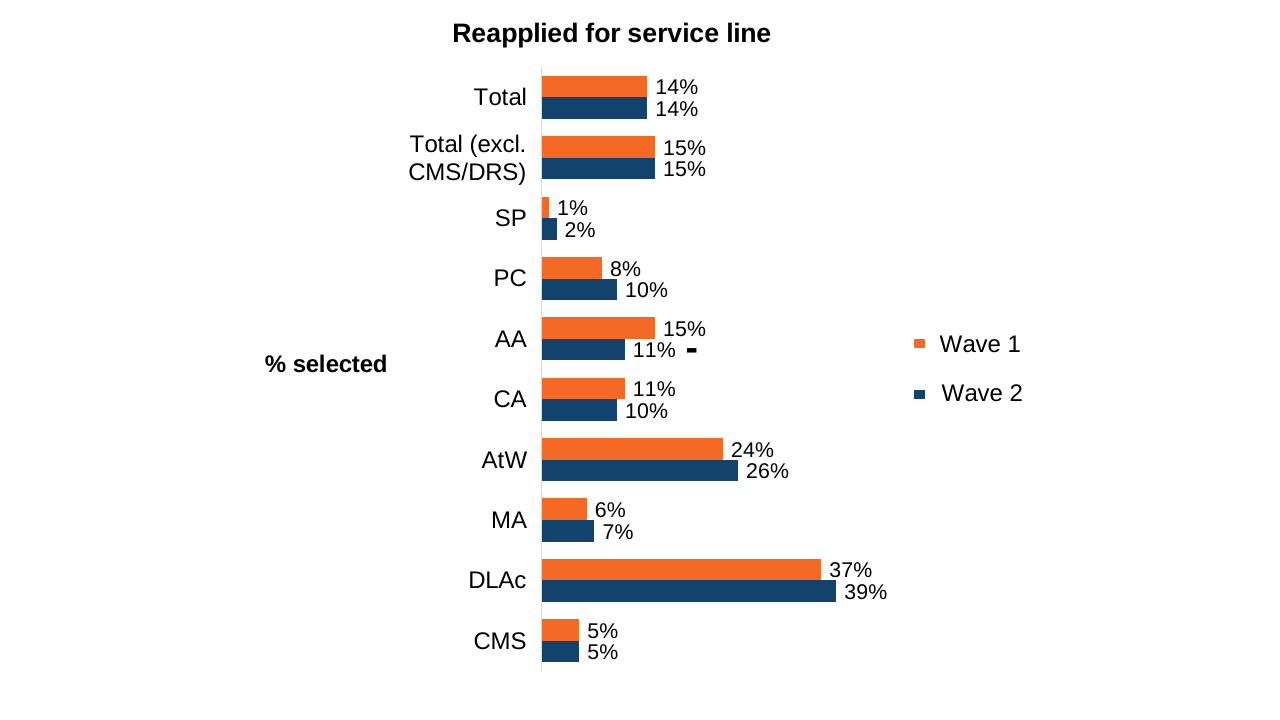
Base: All non-DRS customers (Wave 1: 9,043, Wave 2: 9,038). + and – are used to show significant difference at Wave 2 compared to Wave 1.
DLAc (39%) and AtW (26%) customers were more likely to reapply compared to other service lines. Comparing findings between waves, AA respondents in Wave 2 were less likely to say they reapplied compared to respondents at Wave 1 (15% at Wave 1 vs 11% at Wave 2), though this could be attributed to different sample between waves rather than changes in customer experience.
Customer experience of reapplying or being reassessed
Customers who reapplied for a service line or were reassessed for AtW were asked whether the process was clearly explained by DWP and whether it was easy to reapply. As seen in Figure 26, the proportion of customers who agreed that DWP clearly explained the reapplication process decreased at Wave 2 (76% at Wave 1 vs 72% at Wave 2). Agreement that the process was easy remained at a similar level between waves (65% at Wave 1 vs 67% at Wave 2).
Figure 26 - Customer agreement that DWP clearly explained the process to reapply or be reassessed and that it was easy to reapply or to be reassessed:
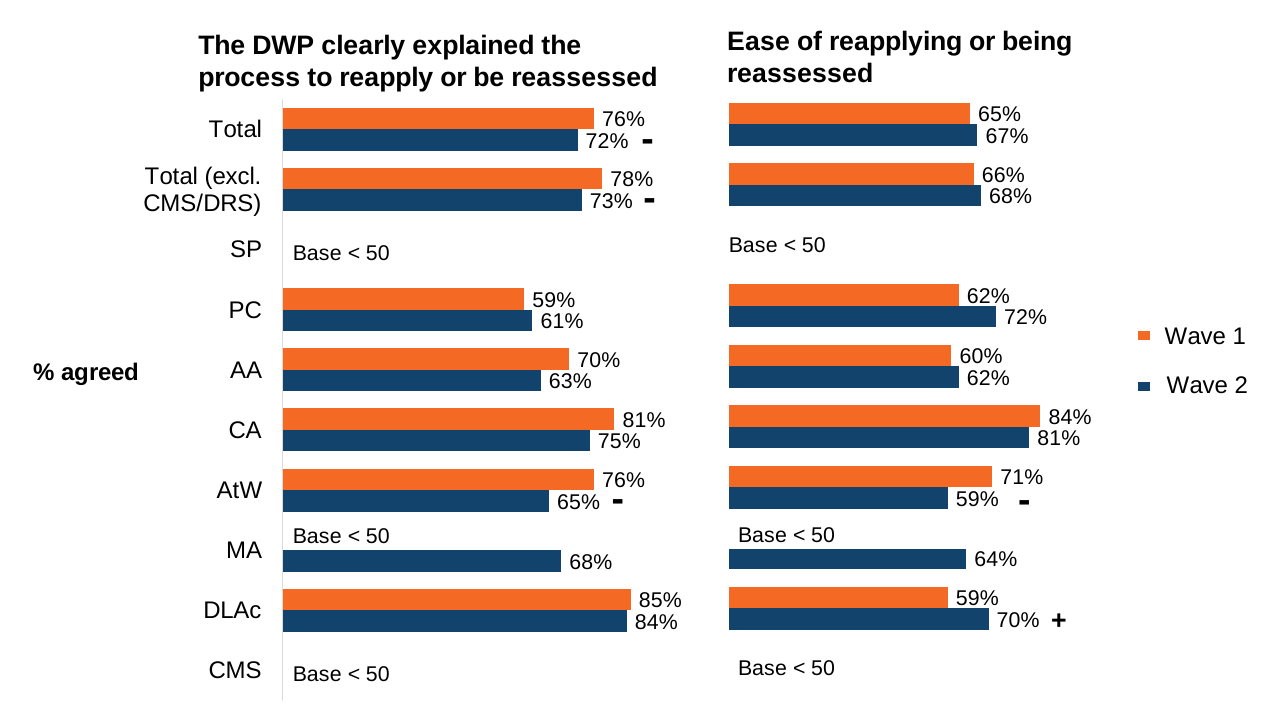
Base: Customers who reapplied or were reassessed in the last 12 months (Wave 1: 891, Wave 2: 938). + and – are used to show significant difference at Wave 2 compared to Wave 1.
Within most service lines, agreement that DWP explained the process clearly remained consistent between Wave 1 and Wave 2. The drop in overall agreement can be primarily attributed to the decrease among AtW customers. Agreement that DWP clearly explained the process among AtW customers dropped by 11 percentage points at Wave 2 (76% at Wave 1 vs 65% at Wave 2). There was a similar drop for AtW customers for agreement that it was easy to reapply (71% at Wave 1 vs 59% at Wave 2). Overall satisfaction likely remained unchanged due to an increase in agreement for DLAc customers (59% at Wave 1 vs 70% at Wave 2).
Modernisation had an impact only for the DLAc service line. DLAc customers who experienced Modernised Communications Only were more likely to agree the process of reapplying was explained clearly by DWP (91%) and was easy (79%) compared to those who experienced No Modernisation (81% and 66% respectively).
4. Overall customer experience measures
This chapter presents findings on overall customer experience and DWP Customer Experience Drivers. These provide standards against which customer service delivery can be measured. Please note, findings presented in this report are independent and different to those of the Customer Experience Survey which provide the department’s key measure of customer satisfaction, whereas this report is looking to understand how experiences of specific services are evolving with modernisation. Further information can be found on DWP Customer Experience Survey: Benefit customers 2024 to 2025. This chapter includes findings relating to the following five Drivers:
- Make it Easy
- Get it Right
- Trusted
- Communicate Clearly
- Professional and Supportive
The theme of ‘timeliness’ is also covered in this chapter despite not being one of the five Drivers, as it is a key element of the customer experience.
For conciseness and readability, only the key statements for each Driver are reported here. The statements selected were the most relevant to the specific Drivers and asked to the broadest base of customers. Additional questions that were asked in the survey, but are not analysed in this section, can be found in the annex of additional findings included in this report.
For each Driver, key statements are presented at an overall level, then compared across different service lines. This chapter also explores how agreement with these statements has changed since Wave 1. The analysis then explores how customer experiences vary depending on the degree of modernisation that customers reported that they had experienced, and the modes of contact they reported they had with DWP.
Overall customer experience
Thinking about the 12 months prior to the survey, customers were asked to rate their overall customer experience with their service line on a scale of 1 to 10, with 1 meaning extremely dissatisfied and 10 meaning extremely satisfied. Customers who were considered to be ‘satisfied’ with or ‘positive’ about their overall customer experience were those who gave a score between 7 and 10.
As shown in Figure 27, most customers (70%) were positive about their overall customer experience of their respective service lines in both Wave 1 and 2. Overall customer experience scores were lower among CMS and DRS customers, who tend to be more negative than other customers due to the nature of these service lines, with DRS being focused on disputes to a claim and CMS on collecting and receiving payment for a child. When excluding CMS and DRS customers, the overall customer experience figures are higher (80% in Wave 2 and 81% in Wave 1). However, considerable variation between service lines persisted.
Figure 27 - Overall customer experience with the service provided:
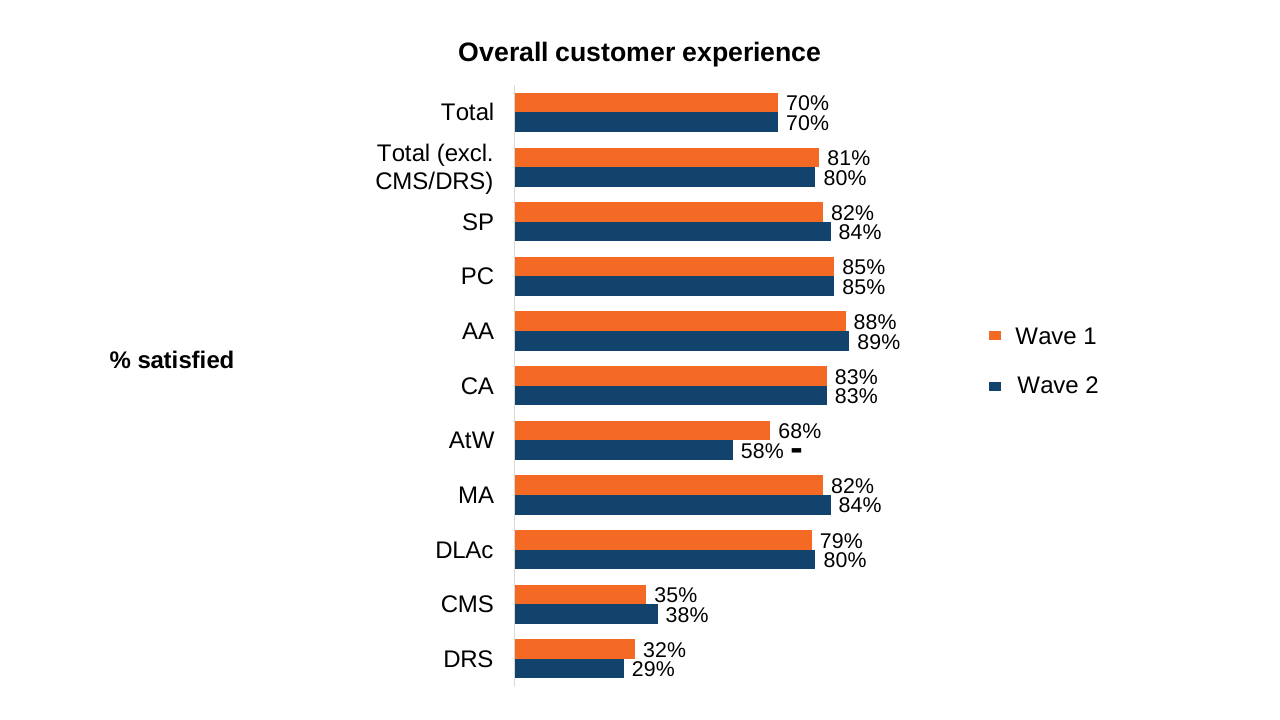
Base: All customers (Wave 1: 10,172, Wave 2: 10,178). + and – are used to show significant difference at Wave 2 compared to Wave 1.
AA customers were the most likely to be positive about their overall customer experience in both Wave 1 (88%) and Wave 2 (89%) followed by PC customers (85% in both waves). There were lower overall customer experience scores among CMS and DRS customers (38% and 29% respectively in Wave 2) which was consistent with findings at Wave 1 (35% and 32% respectively). Among CMS customers, scores varied, with receiving parents reporting higher overall customer experience than paying parents (49% vs 27%), which is to be expected due to the nature of their interaction with CMS. AtW was the only service line that saw a reduction between waves in their overall customer experience, (68% at Wave 1 vs 58% at Wave 2) while other service lines remained consistent with Wave 1.
Customers’ overall customer experience varied depending on the degree of modernisation they experienced at Wave 2, when analysing by service line. Generally, customers who reported use of Online Services were the most positive. The greatest differences were seen among CMS customers (Online Services 41% vs No Modernisation 23%) and MA customers (Online Services 92% vs No Modernisation 75%). For DLAc customers, overall customer experience scores were higher among those who experienced Modernised Communications Only compared with those who experienced No Modernisation (85% vs 79%).
Overall customer experience also varied with the contact mode that the customer reported they had with DWP. As previously highlighted, this contact was self-reported so it may not represent the actual contact customers had with DWP. DRS, CMS and CA customers who had contact via email were more likely to be positive about their overall customer experience (DRS 38%, CMS 45%, CA 91%). Among MA customers, those who said they had contact via an online portal (91%) or text message (88%) were more likely to give higher customer experience scores. PC and AA customers who had contact via post were more likely to be satisfied with their overall customer experience (PC 87%, AA 90%).
Reasons for positive customer experience ratings
Customers who gave an overall customer experience rating of between 7 and 10 were asked why they had scored the service highly. The most common reason given was a general satisfaction with how the service operated (31%), which was an increase from Wave 1 (27%). Customers who cited a general satisfaction tended to do so because the service met their expectations, and they encountered no issues.
An MA customer said:
My experience with DWP has been great. I have not had any reasons to file a complaint, and the biweekly maternity payment has been prompt.
Customers also commonly said that they viewed the process as smooth and easy (21%). Customers who cited this reason for rating the service highly tended to mention that the application process was straightforward, and they received a response from DWP promptly.
An MA customer said:
It was an easy, clear and simple process, DWP were quick in requesting additional information and approving my application. They also promptly texted me to inform me when my money would be paid.
Mirroring the high scores on specific statements related to staff, many customers also attributed their positive overall customer experience to staff being helpful and knowledgeable (20%). However, this was a decrease from Wave 1 (23%).
A CA customer said:
Every time I have spoken to the Carer’s Allowance team, they have been very helpful and polite and gave me the answers I needed.
Similar to Wave 1, good communication from the service (13% in both waves) and an efficient process (12% at Wave 1 and 11% at Wave 2) were also common reasons for an overall positive customer experience.
Reasons for negative customer experience ratings
Among customers who scored low on overall customer experience (giving a rating of between 1 and 4), around a third said that the service was generally unhelpful (34% at Wave 1 and 33% at Wave 2). More specifically, many customers gave low overall customer experience scores because of poor communication (28% at both waves).
A DLAc customer said:
I had to keep chasing up the decision. Every time I called, I was told I had to wait more and wasn’t kept in the loop.
Another reason given was that the evidence provided by the customer had not been taken into account (26%). This was a reduction from Wave 1, where 32% of dissatisfied customers gave this reason.
Customers also mentioned being generally unhappy with the service (26%), finding the process inefficient (26%) and receiving incorrect or delayed payments (22%). These final two reasons were less commonly cited in Wave 1, by 22% and 17% of customers respectively.
A CA customer said:
They cancelled my Carer’s Allowance because DWP were behind with my DLA claim. I ended up having to reapply because they don’t communicate between the systems of DLA and Carers.
Make it Easy
Customers were asked about their level of agreement with four key statements related to the Make it Easy Driver:
- it is easy to use DWP services
- I could contact DWP at a time that suited me
- it was easy to get an update on the progress of my claim or dispute
- I didn’t have to contact different people or teams within DWP for the same issue
It is easy to use DWP services
As shown in Figure 28, nearly two-thirds of customers (65%) agreed that it was easy to use their service line, similar to Wave 1 (64%).
Figure 28 - Customer agreement that it is easy to use DWP services:
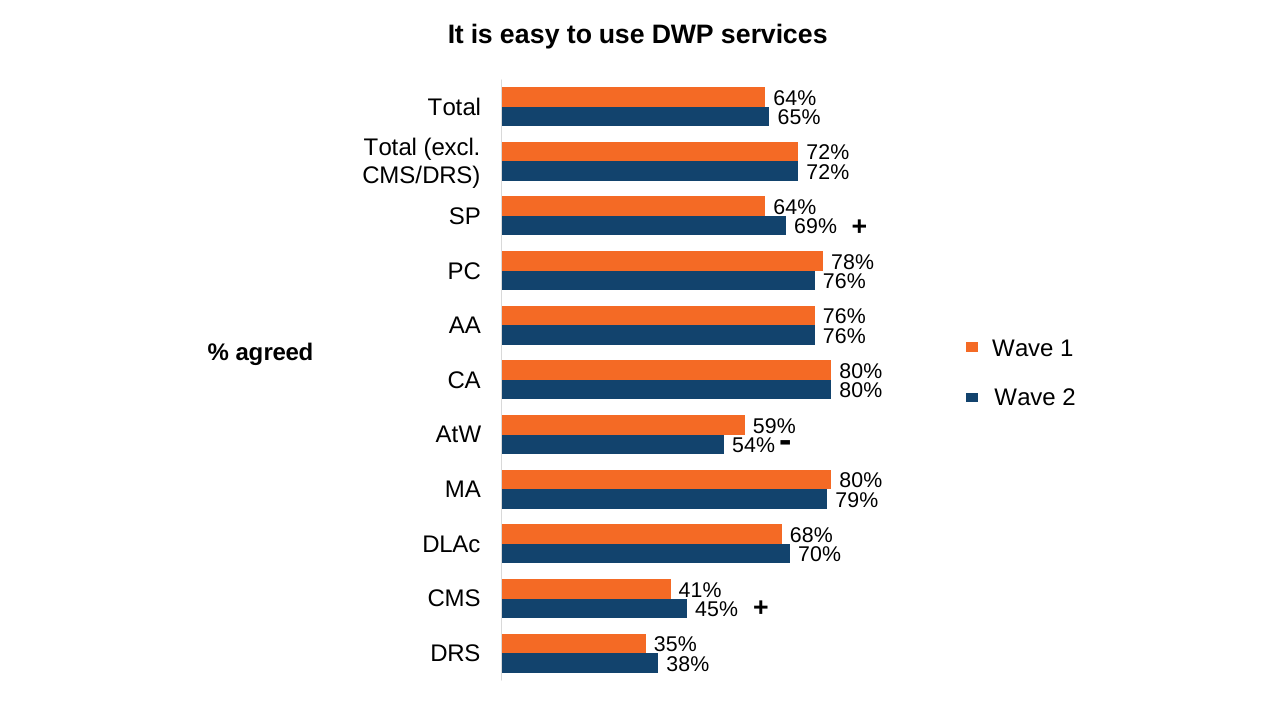
Base: All customers (Wave 1: 10,172, Wave 2: 10,178). + and – are used to show significant difference at Wave 2 compared to Wave 1.
Across service lines, CA and MA customers were the most likely to agree that the service was easy to use (80% and 79% respectively). Agreement among CMS customers had risen from Wave 1 (41% at Wave 1 vs 45% at Wave 2) and the same was the case for SP customers (64% at Wave 1 vs 69% at Wave 2). Conversely, agreement fell for AtW customers (59% at Wave 1 vs 54% at Wave 2). Agreement with this statement remained consistent between waves across other service lines.
Across almost all service lines, customers who reported experiencing Online Services were more likely to agree that DWP’s services were easy to use, compared to those who reported No Modernisation. CMS customers saw the largest difference in agreement between the two groups, with 23% agreement among those who reported experiencing No Modernisation compared with 50% agreement among those who reported using Online Services.
Across all service lines except CMS and AtW, users who reported experiencing Modernised Communications Only also reported a higher level of agreement with this statement in comparison to those who experienced No Modernisation. However, this contrast in agreement was generally smaller than for the Online Services group. For example, 79% of PC customers who reported experiencing Modernised Communications Only agreed with this statement, compared to 87% among those who reported using Online Services, and compared to 68% of those in the No Modernisation group.
Customer agreement on ease of using DWP’s services also varied by the mode of contact respondents reported they had with DWP. SP, AA, CA and CMS customers who had contact with DWP via email had higher levels of agreement that DWP services were easy to use (SP 79%, AA 86%, CA 87%, CMS 52%). AtW and PC customers who had contact with DWP via text message (AtW 63%, PC 88%), and MA customers who had contact with DWP via an online portal (90%) also had higher levels of agreement. Conversely, AtW, CMS and MA customers who had contact with DWP via telephone had lower levels of agreement that DWP services were easy to use (AtW 51%, CMS 36%, MA 76%).
I could contact DWP at a time that suited me
As shown in Figure 29, over half of customers overall at Wave 2 (54%) said that they could contact DWP at a time that suited them either all or most of the time, which was in line with Wave 1 (53%).
Figure 29 - Customers who said they could contact DWP at a time that suited them either all or most of the time:

Base: All customers (Wave 1: 10,172, Wave 2: 10,178). + and – are used to show significant difference at Wave 2 compared to Wave 1.
DLAc customers were more likely to say they could contact DWP at a time that suited them all or most of the time at Wave 2 compared to Wave 1 (53% at Wave 1 vs 62% at Wave 2). Other service lines remained in line with findings at Wave 1.
There were also differences in this statement by reported modernisation experience. Across all service lines, Online Services customers were more likely to say they could contact DWP at a time that suited them all or most of the time than those who reported experiencing No Modernisation.
Furthermore CA, CMS, DRS, SP and AA customers who reported having contact via email were more likely to say they could contact DWP at a time that suited them all or most of the time.
It was easy to get an update on the progress of my claim or dispute
Overall, close to half (48%) of customers at Wave 2 agreed it was easy to get an update on the progress of their claim or dispute, as seen in Figure 30. This was an increase compared to Wave 1 (46% Wave 1 vs 48% Wave 2).
Figure 30 - Customer agreement that it was easy to get an update on the progress of their claim or dispute:

Base: All customers (Wave 1: 10,172, Wave 2: 10,178). + and – are used to show significant difference at Wave 2 compared to Wave 1.
MA customers (61% Wave 1 vs 66% Wave 2) and CMS customers (32% Wave 1 vs 39% Wave 2) were more likely to agree it was easy to get an update at Wave 2 than Wave 1.
The extent of modernisation experience reported was also associated with agreement with this statement. Across all service lines, customers who reported experiencing Online Services were more likely to agree that it was easy to get an update on progress than those in the No Modernisation group. Customers in several service lines were also more likely to agree with this if they reported having contact via email, including CA, DRS, CMS and SP customers. This was also true of those who reported contact with DWP via text across CA, AA, PC, MA and AtW customers.
I didn’t have to contact different people or teams within DWP for the same issue
Overall, as seen in Figure 31, over six in ten customers agreed they didn’t have to contact different people within DWP for the same issue, in line with Wave 1 (62% at both waves).
Figure 31 - Customer agreement that they didn’t have to contact different people or teams within DWP for the same issue:

Base: All customers (Wave 1: 10,172, Wave 2: 10,178). + and – are used to show significant difference at Wave 2 compared to Wave 1.
AA customers (75% Wave 1 vs 81% Wave 2) and MA customers (73% Wave 1 vs 77% Wave 2) were more likely to agree they didn’t have to contact different people for the same issue at Wave 2 than Wave 1. Conversely, AtW customers were less positive about this statement at Wave 2 (58% agreed at Wave 1 vs 53% at Wave 2).
Online Services customers were more likely to agree that they didn’t have to contact different people in DWP for the same issue than those who reported No Modernisation experience across all service lines. Customers across several service lines were more likely to agree with this if they reported having contact via email, including DRS, CMS, SP, PC and MA customers.
Get it Right
In relation to the Get it Right Driver, customers were asked about their agreement with the statement: DWP took the right action about my case, first time. Customers were also asked:
- whether they raised any problems or issues with DWP
- how often they had to give the same information to DWP more than once
DWP took the right action about my case, first time
Overall, two-thirds (66%) of customers in Wave 2 agreed that DWP took the right action about their case, first time, which was consistent with Wave 1. These findings are shown in Figure 32.
Figure 32 - Customer agreement that DWP took the right action about their case, first time:

Base: All customers (Wave 1: 10,172, Wave 2: 10,178). + and – are used to show significant difference at Wave 2 compared to Wave 11.
AA and MA customers had the highest levels of satisfaction for this statement (88% and 85% agreed, respectively). DRS customers were particularly negative with regard to this statement: only 18% agreed that DWP had got it right first time at Wave 2, similar to Wave 1 (17%). This is likely due to the nature of the service, being intended to support customers who are unhappy with the original decision provided on their claim. CMS customers were also relatively negative, with only 39% agreeing that DWP had got it right first time, although agreement increased slightly for this group at Wave 2 (35% Wave 1 vs 39% Wave 2). Among CMS customers, receiving parents were more likely to agree with this statement than paying parents (50% vs 29% at Wave 2), which is likely to be related to their lower levels of satisfaction.
There were some differences in agreement by whether customers reported that they had experienced different forms of modernisation. Across all service lines except DLAc, AA and AtW, customers who reported using Online Services were more likely to agree that DWP took the right action about their case first time, compared to those who reported experiencing No Modernisation. For example, 73% of SP customers in the Online Services group agreed with the statement, compared to 47% of SP in the No Modernisation group. Other notable differences were seen among MA (Online Services 91% vs No Modernisation 76%) and PC customers (Online Services 87% vs No Modernisation 74%).
Raised problems or issues with DWP
As shown in Figure 33, only one in ten customers (10%) in both waves raised a problem or issue with DWP about their service line experience in the last 12 months.
Figure 33 - Customers who raised problems or issues with DWP in the last 12 months:
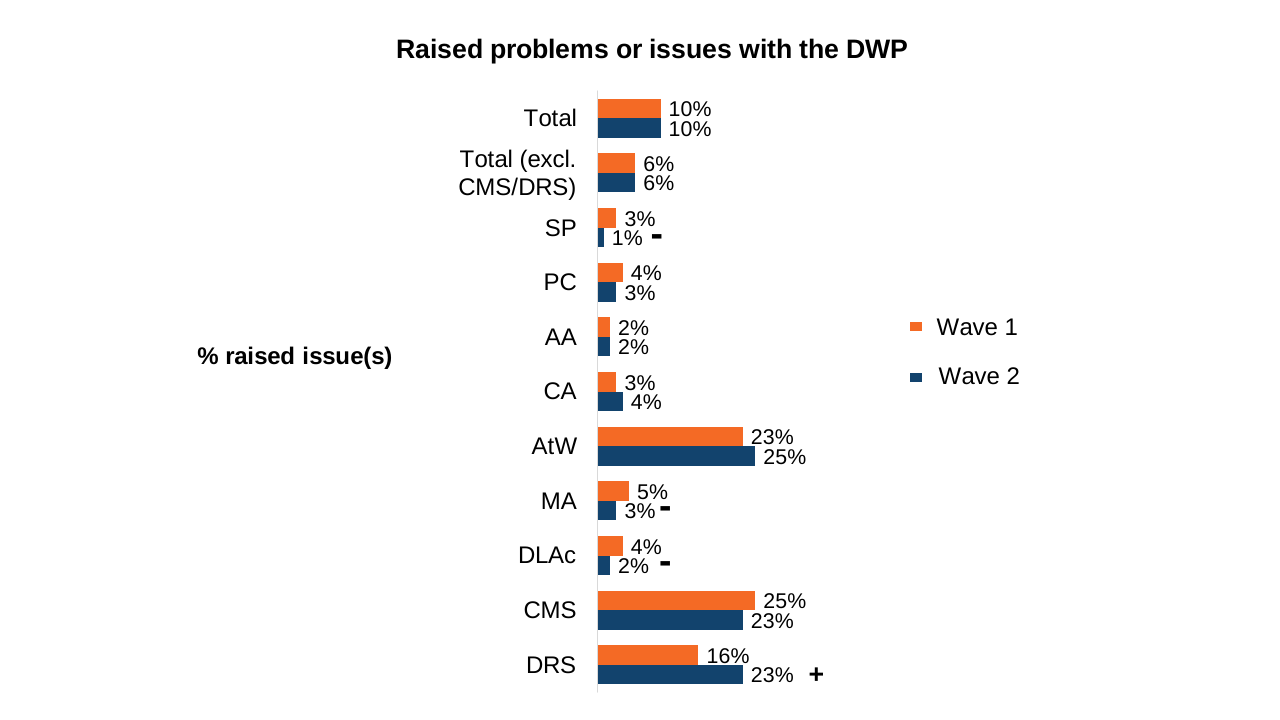
Base: All customers (Wave 1: 10,172, Wave 2: 10,178). + and – are used to show significant difference at Wave 2 compared to Wave 1.
Similar to Wave 1, this proportion was greater for CMS (23%) and AtW customers (25%) at Wave 2. Among CMS customers, paying parents were more likely to have raised a problem than receiving parents (28% vs 17% at Wave 2), which is to be expected given their satisfaction levels. The proportion of DRS customers who raised a problem or issue rose from 16% in Wave 1 to 23% in Wave 2. A higher percentage who raised issues is expected for DRS customers due to the nature of the service line being based on disputes. Subgroup analysis was not included for this question due to low base sizes across most service lines.
At Wave 2 specifically, customers who raised issues were asked the reasons for their problem or issue. The top three reasons, all scoring 62%, were: DWP made mistakes (for example, wrong or delayed payments), it took too long to get a response or decision, and I had to give DWP the same information more than once.
I had to give the same information to DWP more than once
Overall, at Wave 2, just under one in four customers (24%) said they had to give the same information to DWP more than once, all or most of the time. This was a lower proportion than at Wave 1 (26%). This is shown in Figure 34.
Figure 34 - Customers who said they had to give the same information to DWP more than once, either all or most of the time:

Base: All customers (Wave 1: 10,172, Wave 2: 10,178). + and – are used to show significant difference at Wave 2 compared to Wave 1.
SP customers were less likely to say they had to give the same information to DWP more than once, all or most of the time, at Wave 2 (11% at Wave 1 vs 8% at Wave 2). Having to provide information more than once varied considerably by service line. Customers in DRS, CMS, AtW and DLAc were more likely to say this, while those in SP, AA, MA, PC or CA were less likely to say this.
The impact of modernisation and different modes of contact was mixed here with no clear trends overall that indicated strong differences for a type of contact or modernisation.
Trusted
Customers were asked about their level of agreement with two key statements related to the Trusted Driver:
- DWP staff did what they said they would
- DWP took responsibility when issues arose
DWP staff did what they said they would
Across Wave 1 and 2, the majority of customers agreed that DWP staff did what they said they would. Overall, at Wave 2, around seven in ten (69%) customers agreed that this was the case, in line with Wave 1 (71%). There was a slight decrease for the total excluding CMS and DRS (83% at Wave 1 vs 80% at Wave 2). This question was only asked to customers who had some form of contact via phone, video call, or in person, as it is based on assessing trust with DWP staff. These findings are shown in Figure 35 below.
Figure 35 - Customer agreement that DWP staff did what they said they would:
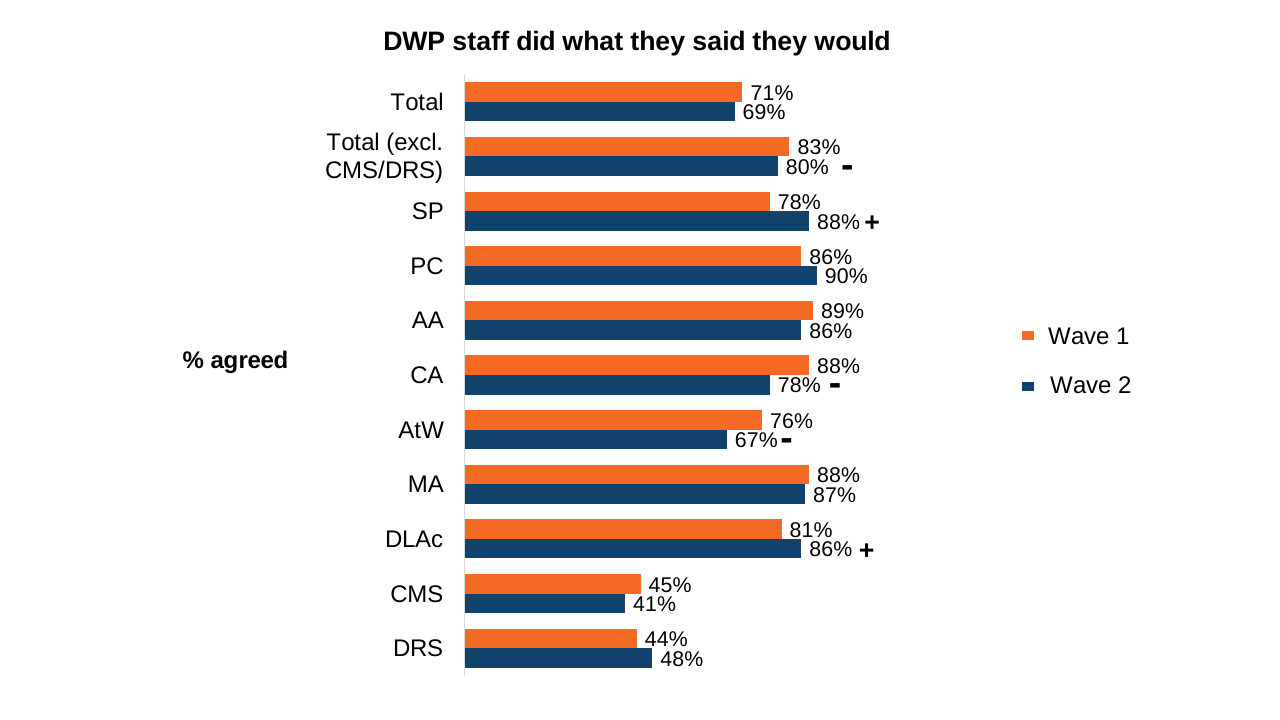
Base: Customers who had contact with DWP via phone, video call or in person in the last 12 months (Wave 1: 4,241, Wave 2: 4,005). + and – are used to show significant difference at Wave 2 compared to Wave 1.
Agreement was highest among PC customers at Wave 2 (90%, 86% at Wave 1). This was followed by SP customers (88%) with an increase in agreement among this group compared with Wave 1 (78%). Similarly, DLAc customers were also more likely to agree at Wave 2 (86% compared with 81% at Wave 1). Conversely there was a decrease for CA and AtW customers (88% at Wave 1 vs 78% at Wave 2, and 76% at Wave 1 vs 67% at Wave 2, respectively). CMS and DRS customers were far less positive than those from other service lines. Less than half of each group (41% and 48%, respectively) agreed that DWP staff did what they said they would. These customers gave similarly low responses in Wave 1 (45% and 44% respectively). Again, lower satisfaction is expected of DRS customers due to the nature of the service, as it supports customers who challenging a benefit decision. Among CMS customers agreement varied, with receiving parents reporting higher levels of agreement with this statement than paying parents (50% vs 32% at Wave 2), in line with higher levels of satisfaction amongst receiving parents.
There was some variation in agreement by level of modernisation experienced. Within all service lines except DLAc, CA and AtW, customers who reported using Online Services were more likely to agree that DWP staff did what they said they would, compared to those who experienced No Modernisation. For example, agreement was 78% among AA customers who experienced No Modernisation, compared to 100% among AA customers who had reported using Online Services.
DWP took responsibility for solving problems or issues
Amongst customers who had raised a problem or issue with DWP (10% of customers), there were relatively low levels of agreement that DWP had taken responsibility for solving these issues (Figure 36). Within this group, overall, only two in ten (21%) agreed that DWP had taken responsibility for solving these problems or issues (consistent with Wave 1, when it was 25%).
Figure 36 - Customer agreement that DWP took responsibility for solving problems or issues:
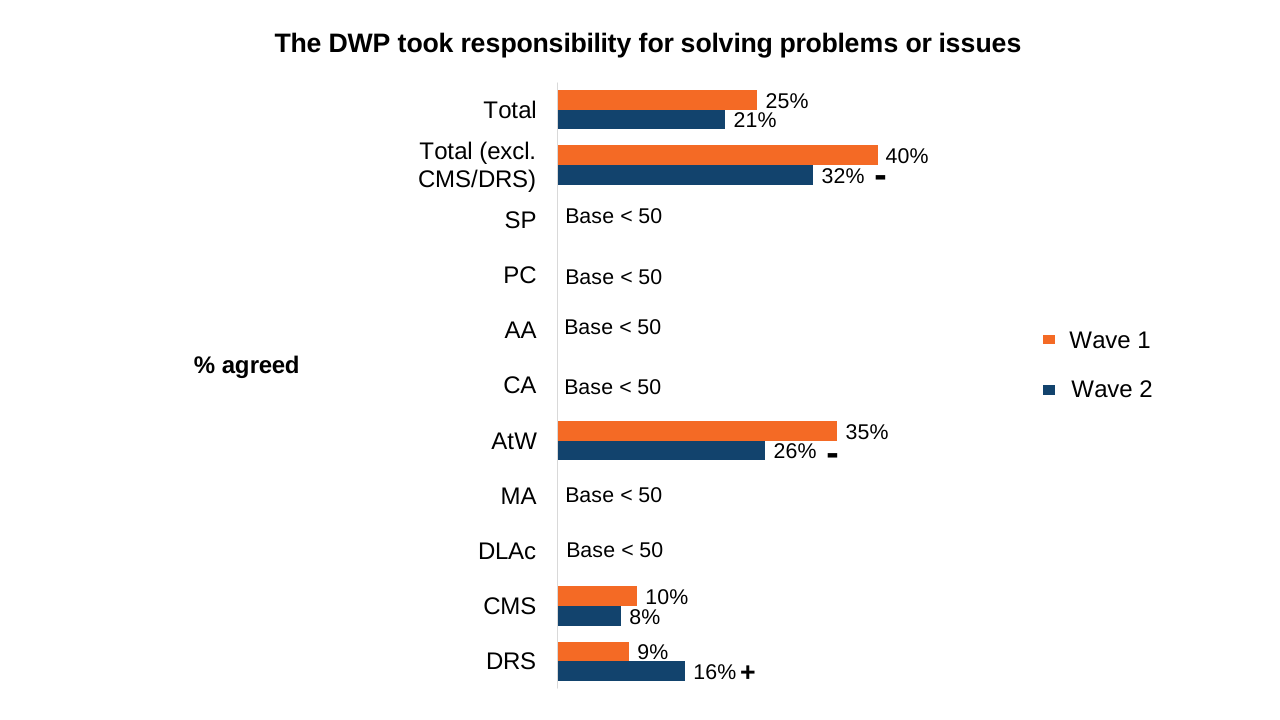
Base: Customers who experienced issues in the last 12 months (Wave 1: 981, Wave 2: 983). + and – are used to show significant difference at Wave 2 compared to Wave 1.
Reflecting the general trend, agreement was lowest among CMS and DRS customers (8% and 16%, respectively at Wave 2). However, agreement for this statement among DRS customers was higher at Wave 2 than at Wave 1 (9% at Wave 1 vs 16% at Wave 2). On the other hand, there was a decrease in agreement among AtW customers who had issues, with agreement in this group falling from 35% in Wave 1 to 26% in Wave 2. Many service lines do not have findings to report here due to low base sizes based on the number of customers who reported issues.
Communicate Clearly
Customers were asked about their level of agreement with two key statements related to the Communicate Clearly Driver:
- DWP clearly explained the reasons for their decisions
- DWP remembered my needs and preferences when communicating with me
DWP clearly explained the reasons for their decisions
Overall, at Wave 2 around two-thirds (65%) of customers agreed that DWP clearly explained the reasons for their decisions. This was consistent with Wave 1, as seen in Figure 37.
Figure 37 - Customer agreement that DWP clearly explained the reasons for their decisions:

Base: All customers (Wave 1: 10,172, Wave 2: 10,178). + and – are used to show significant difference at Wave 2 compared to Wave 1.
Findings by service line were generally consistent with Wave 1, with CA, MA, and PC customers being the most likely to agree with the statement (80%, 79% and 79%, respectively at Wave 2). DRS and CMS customers were again the least positive (30% and 46% respectively). However, CMS customers saw an increase in agreement from Wave 1 (where it was 42%). Conversely, agreement fell for AtW (68% at Wave 1 vs 64% at Wave 2). Less than half (48%) of SP customers agreed with this statement, which was similar to Wave 1 (49%). However, this was due to a higher proportion reporting that the statement did not apply to their situation (42%), as opposed to higher levels of disagreement (only 4% of SP customers disagreed).
There were some notable differences in the customer experience among customers who had reported encountering modernisation at Wave 2. Across all service lines, customers in the Online Services group had higher levels of agreement that DWP explained their reasons clearly than those in the No Modernisation group. The greatest differences were seen among CMS customers (Online Services 49% vs No Modernisation 31%) and MA customers (Online Services 86% vs No Modernisation 70%). SP customers who reported experiencing Modernised Communications Only also saw higher levels of agreement (54%) than SP customers who reported No Modernisation (39%).
There were also some variations in agreement by reported modes of contact with DWP. SP, CMS, DRS and MA customers who reported contact via email were more likely to agree that DWP clearly communicated the reasons for their decisions (SP 73%, CMS 51%, DRS 38% and MA 84%). AtW and PC customers were more likely to agree that DWP clearly communicated the reasons for their decisions if they reported contact with DWP via text (AtW 72%, PC 89%). Conversely, AtW, CA and CMS customers were less likely to agree on this statement if they reported contact with DWP via telephone (AtW 62%, CA 75%, CMS 36%).
DWP remembered my needs and preferences when communicating with me
Overall, under half of customers at Wave 2 (45%) said that DWP remembered their needs and preferences when communicating with them either all or most of the time. This was in line with customers at Wave 1 (44%) as seen in Figure 38.
Figure 38 - Customers who said that DWP remembered their needs and preferences when communicating with them, all or most of the time:
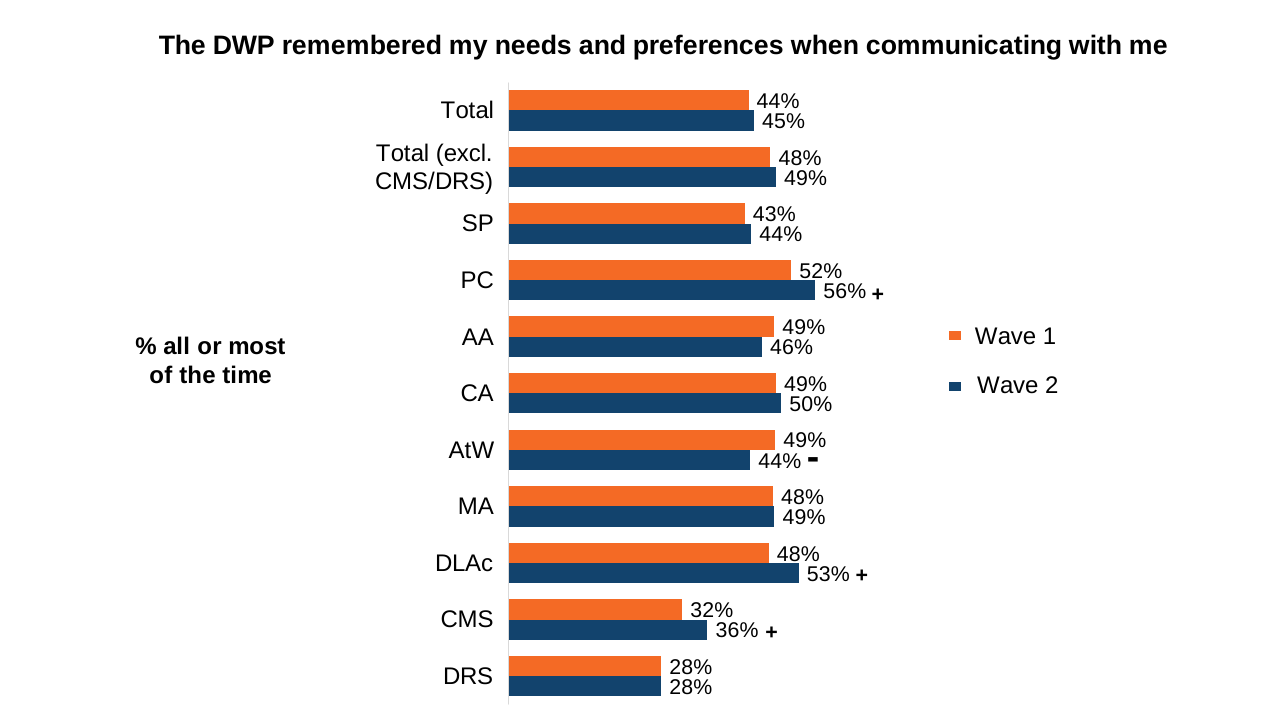
Base: All customers (Wave 1: 10,172, Wave 2: 10,178). + and – are used to show significant difference at Wave 2 compared to Wave 1.
Positivity towards this statement improved across several service lines at Wave 2. PC customers (52% at Wave 1 vs 56% at Wave 2), DLAc customers (48% at Wave 1 vs 53% at Wave 2), and CMS customers (32% at Wave 1 vs 36% at Wave 2) were all more likely to agree that DWP remembered their needs and preferences when communicating with them at Wave 2 compared to Wave 1. On the other hand, AtW were less likely to agree with this statement at Wave 2 (49% at Wave 1 vs 44% at Wave 2).
Customers who reported experiencing Online Services were more likely to agree that DWP remembered their needs compared to those who reported No Modernisation experience, across all service lines except for DLAc and AtW, where this difference was not significant. Customers who reported contact with DWP via text were also more likely to say this across all service lines except for SP.
Professional and Supportive
Customers who had contact with DWP via phone, video or in person, were asked about their level of agreement with two key statements related to the Professional and Supportive Driver:
- staff handled my case professionally and treated me with respect
- I felt DWP listened to me and treated me as an individual
Staff handled my case professionally and treated me with respect
Among the most positive of the customer experience statements in both waves was the extent to which DWP staff were perceived as professional and supportive. As seen in Figure 39, overall, three-quarters (74%) of customers in Wave 2 agreed that DWP staff they dealt with handled their case professionally and treated them with respect (consistent with Wave 1, when this was 76%). This question was only asked to customers who had some form of contact via phone, video call, or in person, as it is based on assessing experiences with DWP staff.
Figure 39 - Customer agreement that DWP staff handled their case professionally and treated them with respect:
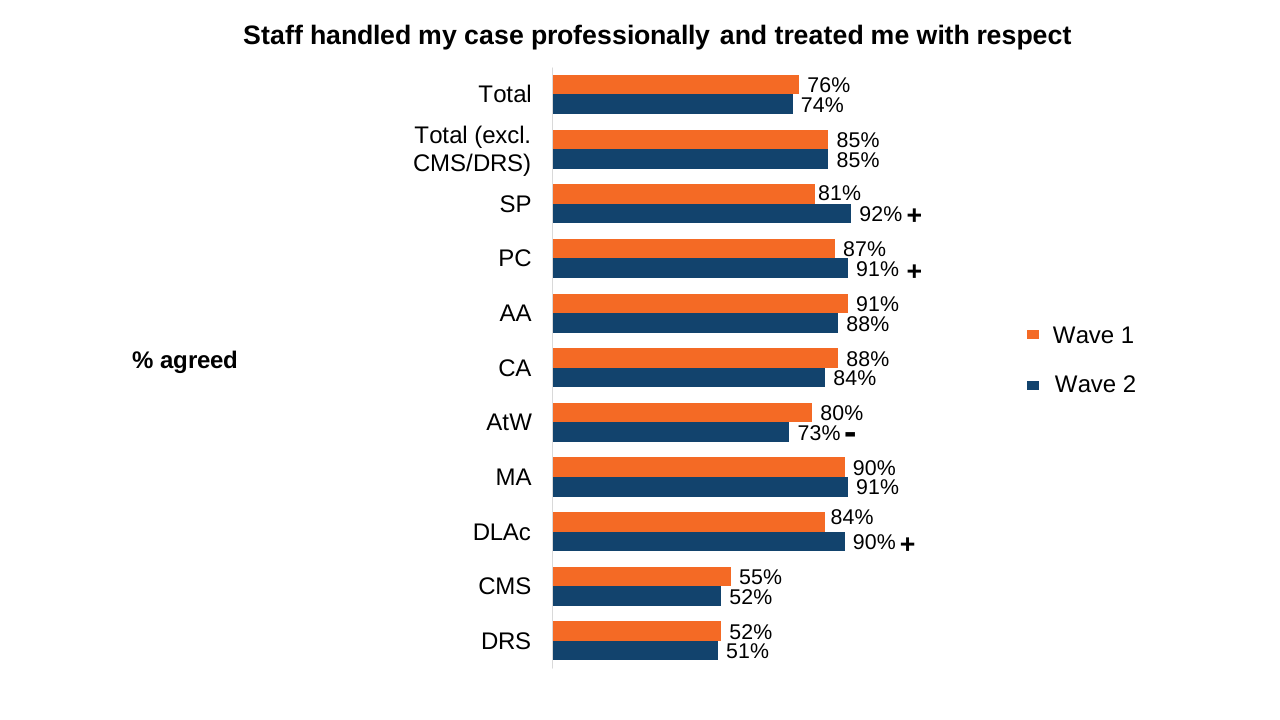
Base: Customers who had contact with DWP via phone, video call or in person in the last 12 months (Wave 1: 4,241, Wave 2: 4,005). + and – are used to show significant difference at Wave 2 compared to Wave 1.
Across all service lines, the majority of customers agreed with this statement. There was an increase in agreement among SP customers from 81% at Wave 1 to 92% at Wave 2, as well as PC customers (87% at Wave 1 vs 91% at Wave 2) and DLAc customers (84% at Wave 1 vs 90% at Wave 2). While agreement was relatively lower among DRS and CMS customers, over half of each group agreed with this statement (51% and 52% respectively at Wave 2).
For this statement, there was less variation in levels of agreement by whether or not the customer reported modernisation experience. The only differences were among AA (Online Services 100% vs No Modernisation 84%), MA (Online Services 98% vs No Modernisation 89%), DRS (Online Services 56% vs No Modernisation 40%) and PC customers (Online Services 95% vs No Modernisation 87%). Among SP customers, those who reported experiencing Modernised Communications Only were also more likely to agree with this statement (97%) than those who reported No Modernisation (84%).
I felt DWP listened to me and treated me as an individual
Overall, around two-thirds of customers (65%) agreed that DWP listened to them and treated them as an individual at Wave 2, in line with Wave 1 (65%), as seen in Figure 40.
Figure 40 - Customer agreement that they felt listened to by DWP and treated as an individual:

Base: All customers (Wave 1: 10,172, Wave 2: 10,178). + and – are used to show significant difference at Wave 2 compared to Wave 1.
DLAc customers were more likely to agree that DWP listened to them and treated them as an individual at Wave 2 (74% at Wave 1 vs 79% at Wave 2). On the other hand, AtW customers were less likely to agree with this at Wave 2 (70% at Wave 1 vs 65% at Wave 2).
Across all service lines except for DLAc and AtW, DWP customers who reported using Online Services were more likely than those who reported No Modernisation to agree that DWP listened to them and treated them as an individual. Customers who reported having contact via email were also more likely to agree with this statement across several service lines including CA, DRS, AA, CMS and SP.
Timeliness
Customers were asked about their level of agreement with two key statements related to timeliness:
- I was satisfied with the time DWP took to progress my case
- I was satisfied with the time DWP took to resolve my problems or issues
I was satisfied with the time DWP took to progress my case
As seen in Figure 41, in both waves around three in five customers (62%) were satisfied with the time it took for DWP to progress their case.
Figure 41 - Customer agreement that they were satisfied with the time DWP took to progress their case:

Base: All customers (Wave 1: 10,172, Wave 2: 10,178). + and – are used to show significant difference at Wave 2 compared to Wave 1.
Agreement with this statement was highest for AA (82% at Wave 1 and 85% at Wave 2), MA (82% at Wave 1 and 84% at Wave 2), PC (79% at both waves), and CA (80% at Wave 1 and 77% at Wave 2) customers. It was lowest for DRS (25% at Wave 1 and 24% at Wave 2) and CMS (36% at Wave 1 and 40% Wave 2) customers. The only significant difference for service lines between waves was a decrease in satisfaction among AtW customers between Wave 1 (55%) and Wave 2 (46%). This was expected due to an ongoing backlog in the AtW service line which may have meant slower processing of claims.
There were some differences in satisfaction by whether customers reported experiencing modernisation. Customers from all service lines except AtW, DLAc and DRS were more likely to be satisfied on this statement if they reported experiencing Online Services. CMS customers saw the greatest difference between those who reported using Online Services (44%) and those who reported No Modernisation (21%), followed by SP customers (Online Services 73% vs No Modernisation 50%). SP and AA customers who reported experiencing Modernised Communications Only were also more likely to be satisfied on this statement than those who reported No Modernisation. Conversely, AtW customers who reported experiencing No Modernisation were more likely to be satisfied on this statement (63%) than those who reported using Online Services (48%).
I was satisfied with the time DWP took to resolve my problems or issues
Those who raised an issue or problem with DWP (10% of customers at both waves) were asked whether they were satisfied with how long it took DWP to resolve their problems or issues. Overall, at Wave 2, 17% agreed that they were satisfied with the time that DWP took to resolve their issue, as shown in Figure 42. This was a decrease from Wave 1, when 21% agreed they were satisfied.
Figure 42 - Customer agreement that they were satisfied with the time DWP took to resolve problems or issues:

Base: Customers who experienced issues in the last 12 months (Wave 1: 981, Wave 2: 983). + and – are used to show significant difference at Wave 2 compared to Wave 1.
Many service lines do not have findings to report here due to the low numbers of customers reporting issues generating small base sizes. At Wave 2, there was a decrease in satisfaction with the time that DWP took to resolve problems or issues for AtW customers (31% at Wave 1 vs 18% at Wave 2).
5. Perceptions of modernisation
This chapter covers customers’ responses to the idea of certain modernised DWP services. The different elements of modernised services are split into different groups: modernised communications, online services, and joined up and automated services. These differ slightly from the modernisation groups detailed in the ‘Extent of modernisation experienced’ section in Chapter 2, as there were fewer experience questions available to develop a joined up and automated services group (see Chapter 6). Finally, this chapter also looks at customer views and concerns about using modernised DWP services.
Perceptions of modernised communications
Customers were asked how they would feel about the idea of DWP offering certain modernised communications (Figure 43).
In both waves, customers felt most positive about the idea of being able to choose the way that they deal with DWP to suit their preferences (80% in Wave 1 and 2), being able to receive updates via email (69% at Wave 1 and 68% at Wave 2) and communicating via text (64% in both waves).
Figure 43 - Customer perceptions of modernised communications:
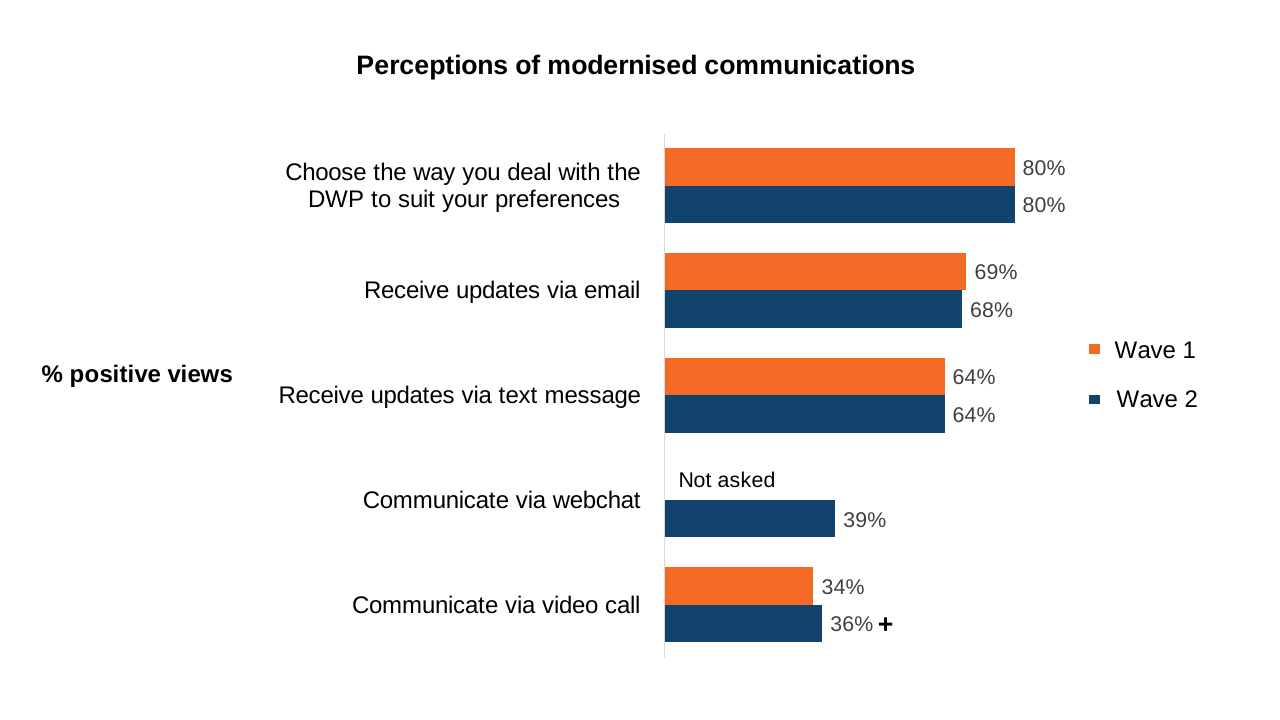
Base: All customers (Wave 1: 10,172, Wave 2: 10,178). + and – are used to show significant difference at Wave 2 compared to Wave 1.
Customers within some service lines were more likely to have positive perceptions of being able to choose the way they deal with DWP (DLAc 92%, MA 86%, CA 88%). These service lines had similarly positive views for DWP offering updates via email (DLAc 86%, MA 84%, and CA 78%); and via text (DLAc 86%, MA 85% and CA 75%). Those who were more digitally confident also had more positive perceptions of being able to choose the way they dealt with DWP (82%), and DWP offering updates via email (77%).
After receiving updates via email and text, the next most positively perceived forms of modernised communications were communicating via webchat (39%) and video call (36%). Compared to Wave 1, communicating via video call saw a two percentage point rise. Customers within some service lines were more likely to have positive perceptions of the idea of communicating via webchat (DLAc 63%, MA 58% and CA 48%), and video call (DLAc 56%, MA 43% and CA 42%). In contrast, AtW customers were more likely to be positive about the idea of video call only (43%). No comparisons are available for webchat as this was introduced at Wave 2 to distinguish this from chatbot.
Perceptions of online services
Customers were asked how they would feel about the idea of DWP enabling them to interact with DWP services online in various ways (Figure 44). The form of online interaction with DWP services that customers felt the most positive about DWP offering was making a claim or starting the process of raising a dispute online.
Nearly seven in ten customers (68%) were positive about the idea of making a claim or, for DRS customers, starting the process of raising a dispute online, closely followed by around two-thirds (64%) who were positive about the idea of managing or making changes to a claim online and six in ten (61%) who were positive about the idea of receiving updates online. These findings remained in line with Wave 1.
Figure 44 - Customer perceptions of online services:
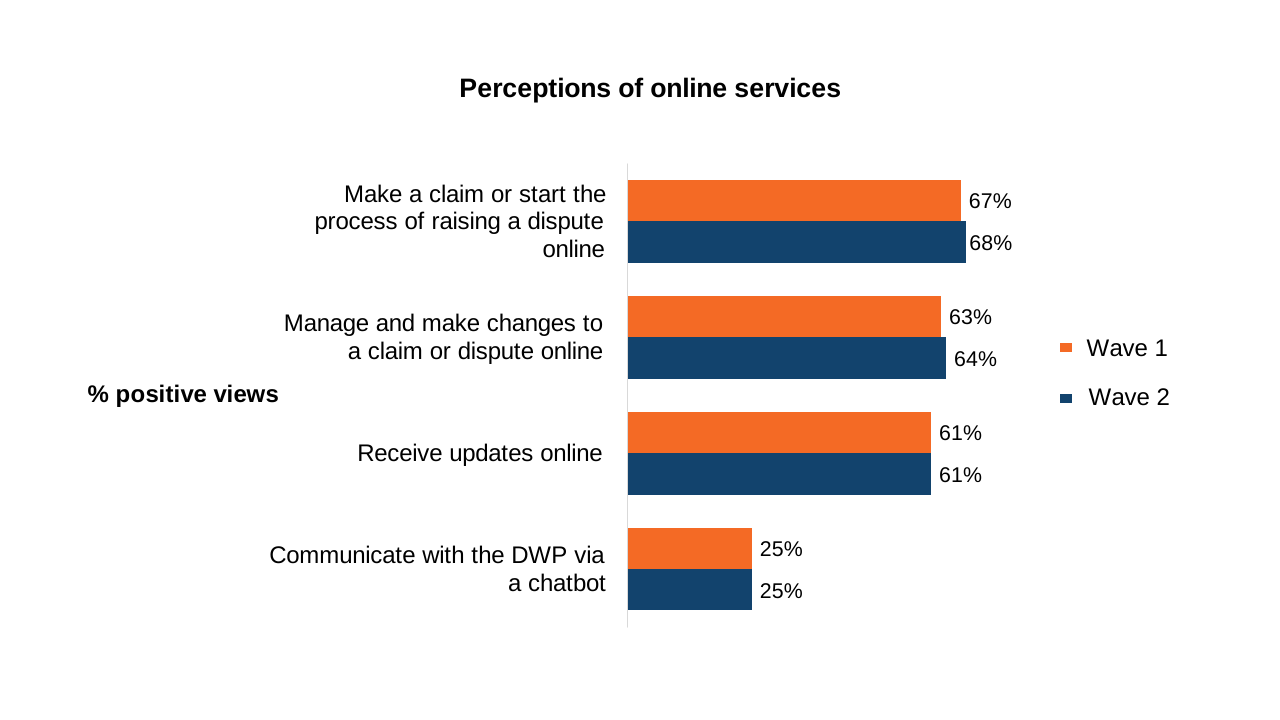
Base: All customers (Wave 1: 10,172, Wave 2: 10,178). + and – are used to show significant difference at Wave 2 compared to Wave 1.
Customers within some service lines were more likely to have positive perceptions of these ideas. Regarding being able to make a claim online, MA (88%), DLAc (83%), CA (82%), and AtW (79%) customers were more likely to be positive about the idea of this. Regarding managing and making changes to a claim online, DLAc (83%), MA (82%), CA (78%) and AtW (71%) customers were more positive about the idea of this.
Regarding receiving updates online, DLAc (81%), MA (79%), CA (73%), and AtW (68%) customers were more likely to be positive about the idea of this. Finally, only 25% of customers were positive about the idea of communicating with DWP via a chatbot. Customers that were more positive about the idea of communicating with DWP via chatbot included MA (44%), DLAc (42%) and CA (33%).
Perceptions of joined up and automated services
Customers were asked about how they would feel about the idea of DWP offering more joined up and automated services, as seen in Figure 45.
Figure 45 - Customer perceptions of joined up and automated services:
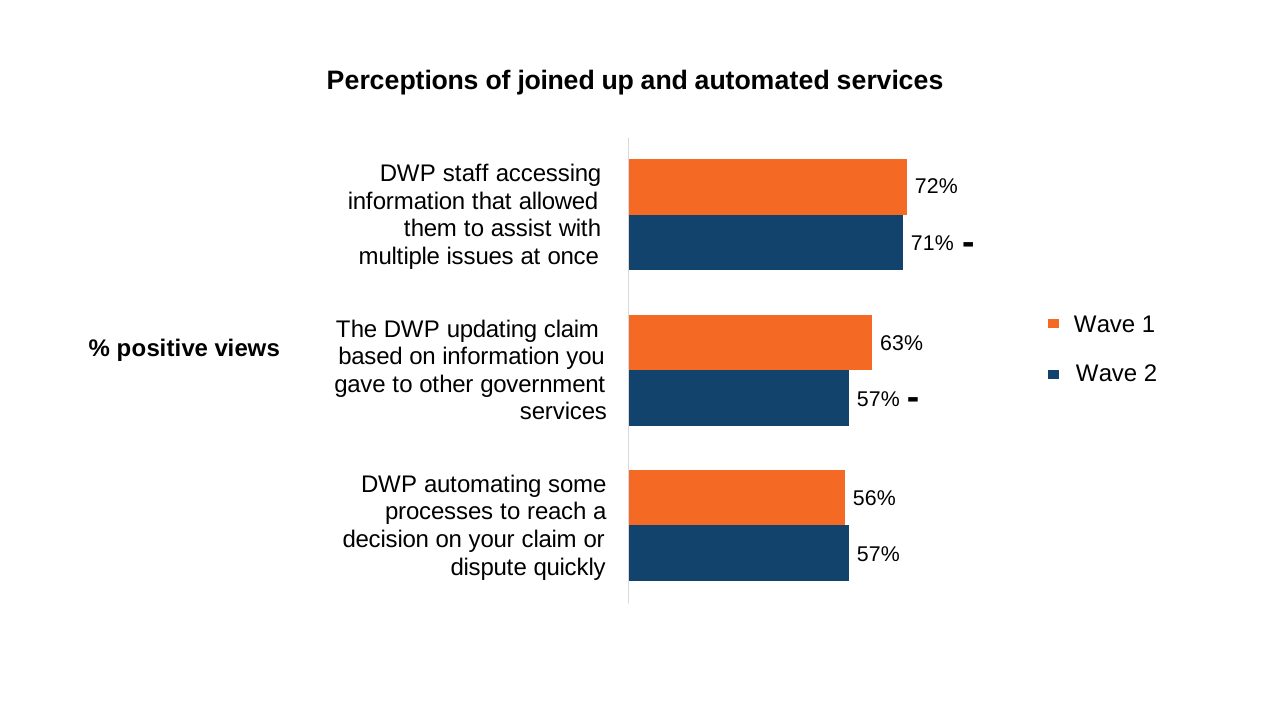
Base: All customers (Wave 1: 10,172, Wave 2: 10,178). + and – are used to show significant difference at Wave 2 compared to Wave 1.
Most customers were positive about the idea of DWP staff accessing information that allowed them to assist with multiple issues at once (71%), although this did see a slight decrease compared to Wave 1 (72%). DLAc (87%), MA (81%) and CA (80%) customers were more positive about the idea of DWP staff accessing information that allowed them to assist with multiple issues at once at Wave 2.
Customers were relatively less positive about the idea of DWP updating their claim based on information they have given to other government services, with over half being positive about the idea of this. This had declined somewhat from Wave 1 (63% at Wave 1 vs 57% at Wave 2). Service lines more likely to express positive opinions on this idea included MA (78%), DLAc (70%), and CA (68%).
Some customers had positive views towards DWP automating some processes to reach a decision on their claim or dispute quickly (57%). This was a similar proportion to Wave 1 (56%). MA customers were more positive about DWP automating some processes (78%), as were DLAc customers (70%) and CA customers (68%) at Wave 2.
Reasons for positive and negative views of modernisation
Customers were asked to give the reasons for their perceptions of the different modernisation ideas given above, the most common of which are reported below. Overall, customers who had positive views cited a variety of reasons:
-
modernisation would make accessing the service, support, and information around the service easier
-
modernised forms of communication would allow for convenience and flexibility
-
modernised forms of communication were seen as more efficient
-
certain forms of communication such as video calls would allow for more personable forms of contact without having to physically be present
On the other hand, reasons for negative views included:
-
those with a lack of digital competency would struggle to access the service
-
concerns that modernisation would not reduce wait times
-
concerns about confidentiality
-
concerns that a human touch is needed for complex cases
-
concerns about accuracy and whether automated systems are advanced enough
Customers were also asked whether they would have any concerns about using online services (Figure 46), with just under half (45%) saying they would have no concerns, a six percentage point increase from Wave 1. Customers who were more likely to have no concerns included MA (56%) and DLAc (55%), and customers less likely to be without concerns included CMS (42%), AtW (38%), and DRS (34%) at Wave 2.
Figure 46 - Customer concerns about using online services:
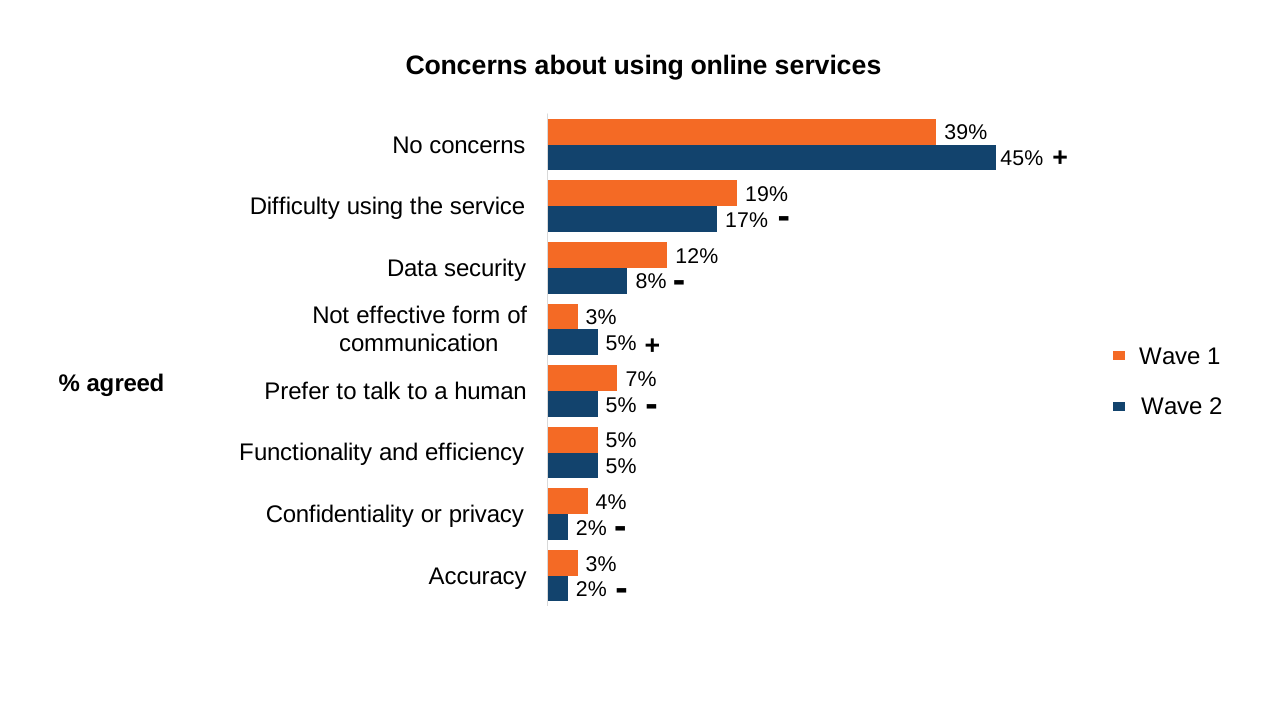
Base: All customers (Wave 1: 10,172, Wave 2: 10,178). + and – are used to show significant difference at Wave 2 compared to Wave 1.
The most common concern cited by customers was that there would be general difficulties using an online service, but this decreased by two percentage points from Wave 1 (19% at Wave 1 vs 17% at Wave 2). Several other concerns saw declines compared to Wave 1; data security (12% at Wave 1 vs 8% at Wave 2), preference to talk to a human (7% at Wave 1 vs 5% at Wave 2), concerns over confidentiality and privacy (4% at Wave 1 vs 2% at Wave 2), and concerns over accuracy (3% at Wave 1 vs 2% at Wave 2). Concerns that online services were not an effective form of communication increased (3% at Wave 1 vs 5% at Wave 2).
Support using online services
As seen in Chapter 2, over eight in ten (84%) customers said they could access government services, with or without help. Those who said they could access government services with support were asked what support they would find most useful, with the three most common forms being telephone help (78%), online help for example, webchat (43%), and online help pages (37%), as shown in Figure 47.
Figure 47 - Types of support customers would find helpful to access online services:
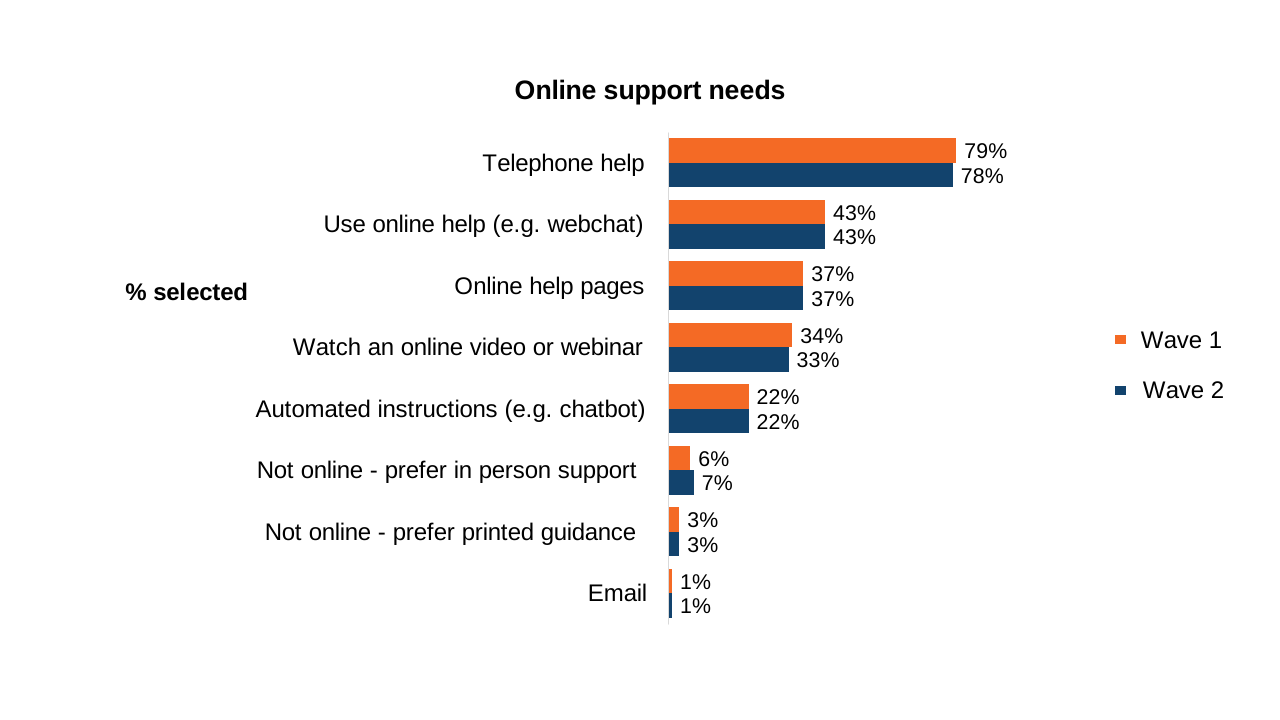
Base: All customers who could access online government services with support (Wave 1: 2,742, Wave 2: 2,582).
6. Experiences of modernisation
This chapter covers customers’ experiences of using modernised DWP services. The different elements of modernised services are split into different groups; modernised communications, online services, and joined up and automated services, as seen in Chapter 5. Alongside general modes of contact with DWP, responses in this chapter were used to develop subgroups for analysis throughout the report (see the ‘Extent of modernisation experienced’ subsection in Chapter 2). As there was only one statement related to joined up services that customers could report they had experienced, this was not aggregated into a modernisation proxy variable like the other categories. Responses to the modernisation questions below were self-reported and may not reflect channels or services available across service lines. Customers were only asked about their experiences of modernised services at Wave 2, so there are no comparisons with Wave 1 available for figures in this section.
Experiences of modernised communications
Customers were asked whether they had experienced various forms of modernised communications and, if so, whether they had positive or negative experiences of them (Figure 48).
Figure 48 - Experiences of modernised communications:
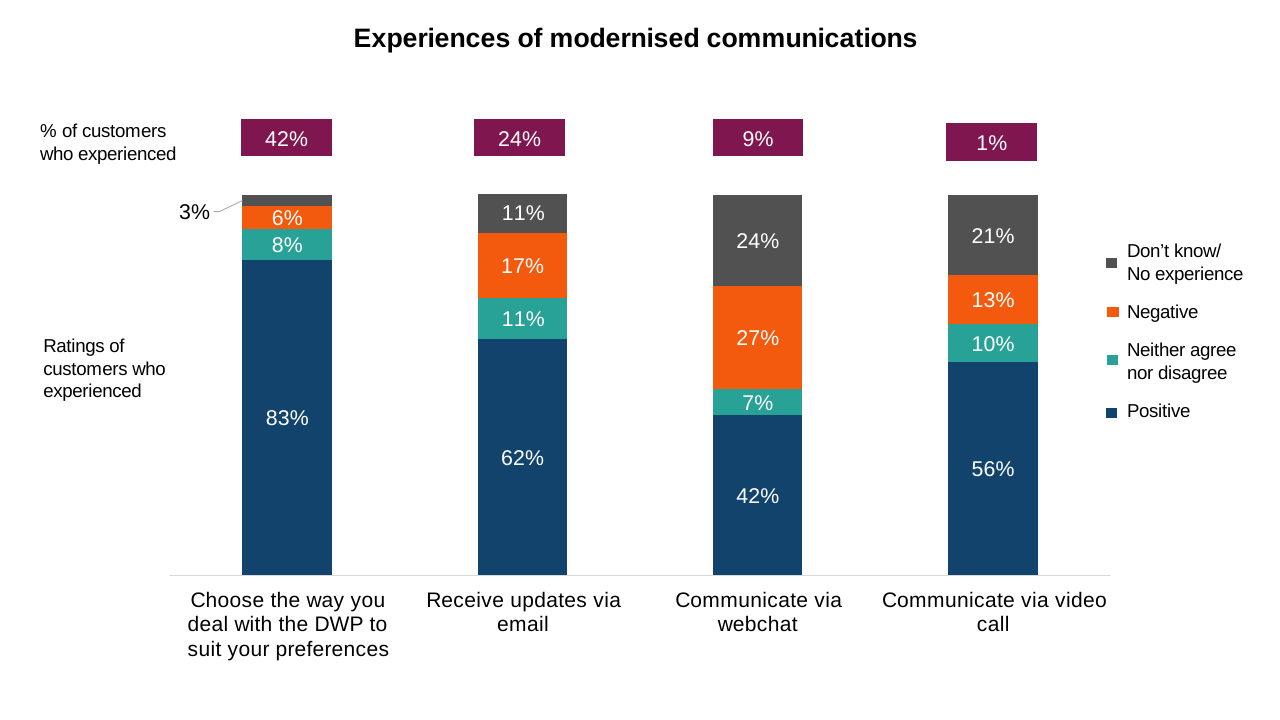
Base: All customers (Wave 2: 10,178).
As mentioned in the previous chapter, customers felt most positive about the idea of being able to choose the way that they deal with DWP to suit their preferences and being able to receive updates via email. These were also the elements of modernised communications that customers were most likely to report having experienced (42% being able to choose the way they deal with DWP; 24% receiving updates by email) and to report having had positive experiences of (83% of those who experienced being able to choose the way they deal with DWP; 62% of those who experienced receiving updates by email).
AtW (49%), CMS (48%), MA (48%), and CA (45%) customers were more likely to report that they experienced choosing the way they dealt with DWP to suit their preferences. Among those who reported choosing the way they dealt with DWP to suit their preferences, PC (92%), AA (91%), SP (90%), MA (90%), CA (87%), and DLAc (87%) customers were more likely to report positive experiences. The most common reason given for having had a positive experience with choosing the way that they dealt with DWP was that accessing support and contacting the service was easy (42%), and the most cited reason for having had a negative experience was difficulties contacting DWP or having to wait a long time to get through (28%).
Customers that were more likely to report that they received updates via email included AtW (73%), CMS (44%), and DRS (31%) customers. Of those who reported receiving updates via email, MA (76%) and CA (75%) customers were more likely to have had positive experiences. Again, the most common reason given for having had a positive experience was that accessing support and contacting the service was easy (37%), while the most cited reason for a negative experience was email being seen as an unreliable form of communication (38%).
Finally, a small proportion of respondents reported experiencing webchat and video call contact at Wave 2 (9% and 1% respectively), to note this is self-reported and may not be accurate. Due to the low base size, further analysis on experience is not included here.
Experiences of online services
Customers were asked whether they had experienced various forms of online services and, if so, whether they had positive or negative experiences of them (Figure 49).
Figure 49 - Customer experiences of online services:
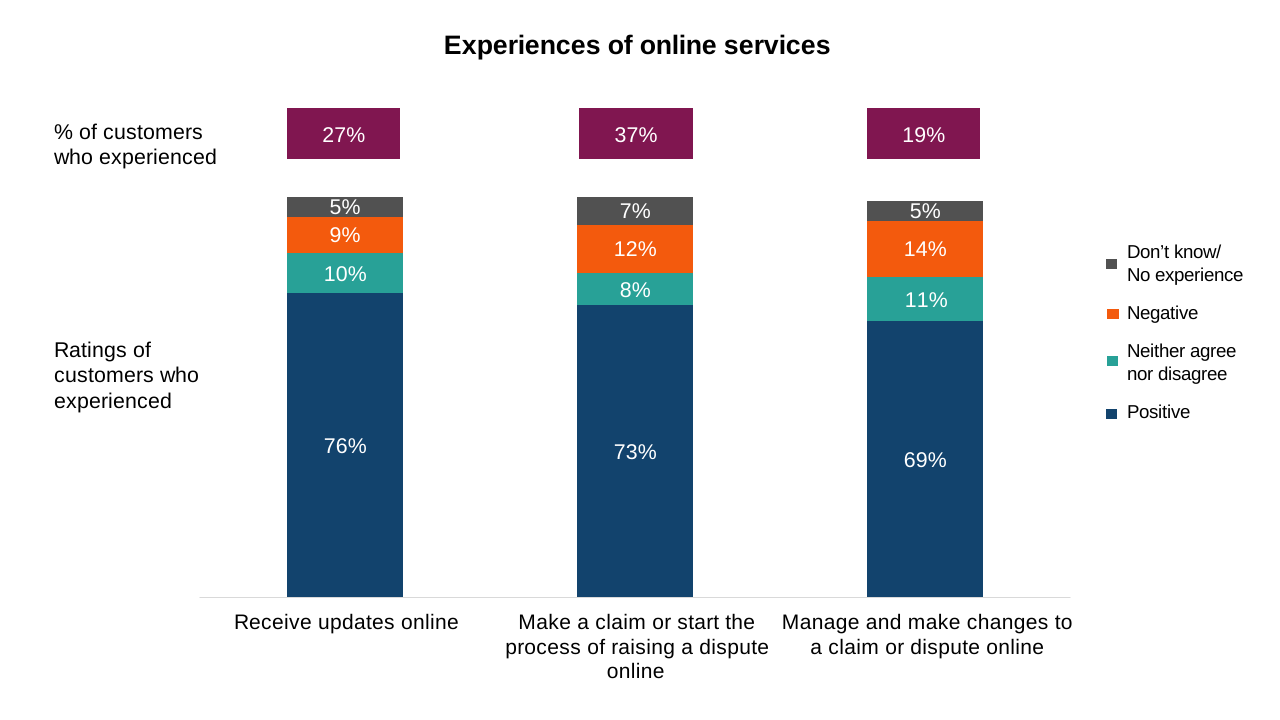
Base: All customers (Wave 2: 10,178).
Making a claim online, or starting the process of raising a dispute online for DRS customers, was the most reported form of online services experience (37%), followed by receiving updates online (27%), then managing or making changes to a claim or dispute online (19%). Among those who experienced these, customers were most likely to have had a positive experience of receiving updates online (76%), followed by making a claim or starting the process of raising a dispute online (73%), then managing or making changes to a claim or dispute online (69%).
Groups more likely to report having received updates online included CMS (59%), AtW (40%), MA (37%) and DRS (32%). AA (90%), MA (90%), CA (87%) and PC (83%) customers were more likely to report positive experiences of receiving updates online. The most common reason given for positive experiences of receiving updates online was that accessing support and making contact with the service was easy (32%), while the most common reason for a negative experience was poor communication (39%).
Customers within some service lines were more likely to report making a claim online; CMS (75%), AtW (69%), CA (66%) and SP (57%). Of customers who reported making a claim online, DLAc (100%), CA (91%), MA (87%), PC (83%), and CMS (78%) customers were more likely to have had a positive experience. The most common reason for having a positive experience of making a claim or starting the process of raising a dispute online was being able to access all of the information needed (46%), and the most common reason for a negative experience was a lack of support (36%).
Groups more likely to report having managed and made changes to a claim or dispute online included CMS (45%), AtW (33%), DRS (27%) and CA (22%). Service lines that were more likely to have had a positive experience of managing or making changes to a claim online included SP (90%), PC (87%), AA (85%), MA (85%), DLAc (82%), and CA (78%). The most common reason for a positive experience of managing and making changes to a claim or dispute online was that it makes access and contact with the service easy (37%) and the most common reason for a negative experience was the online system not being user friendly (27%).
Finally, only one percent of respondents reported communicating with DWP via a chatbot (59 respondents), to note this is self-reported and may not be accurate. Due to the low base size, further analysis on experience is not included here.
Experiences of joined up and automated services
Customers were also asked about whether they had experienced DWP staff accessing information that allowed them to assist with multiple issues at once. Those who had were asked whether they had positive or negative experiences of this (Figure 50).
Figure 50 - Experiences of joined up and automated services:
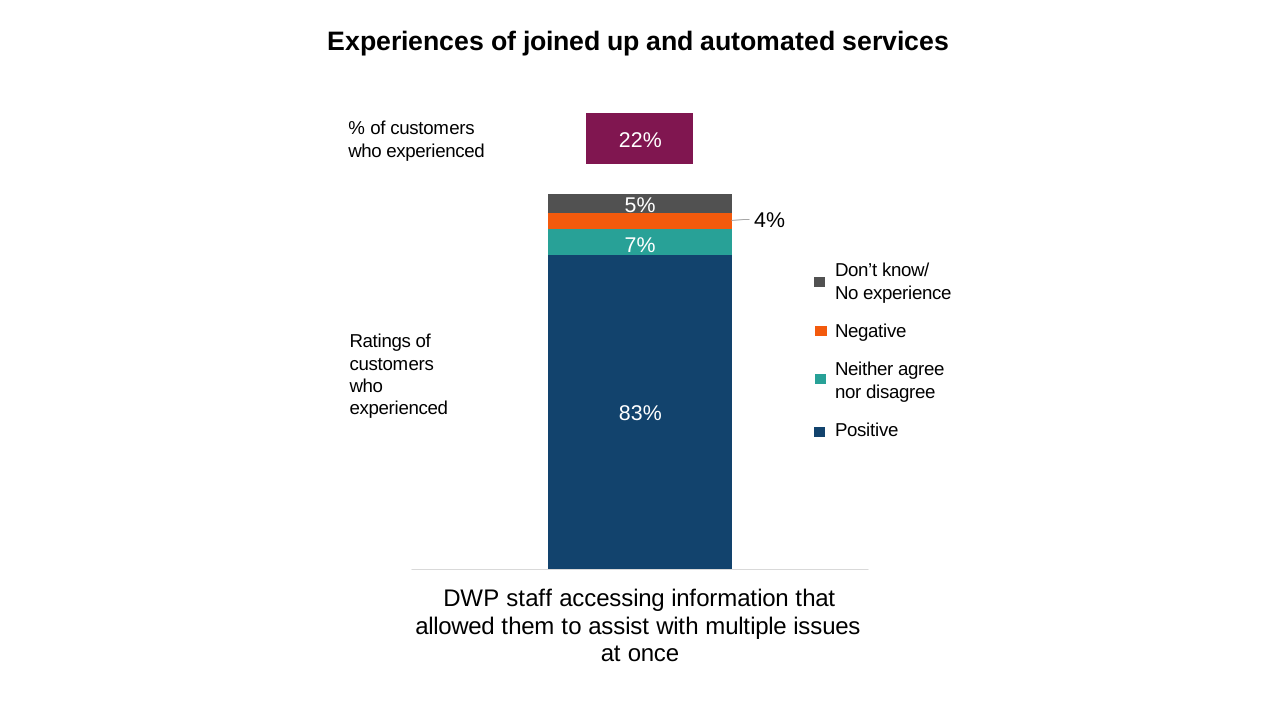
Base: All customers (Wave 2: 10,178).
Around one in five (22%) customers reported that DWP staff accessed information that allowed them to assist with multiple issues at once, with MA (32%), CA (25%) and CMS customers (25%) being more likely to have done so. Most (83%) customers who experienced this rated it positively. Customers more likely to have had a positive experience include DLAc (91%), MA (91%), and PC (89%). The most common reason given for a positive experience was that it made the process easier and more streamlined (31%). The most common reason for a negative experience was that staff were unhelpful (30%). This was the only question asked as part of this section as for the other statements (DWP updating your claim based on information you have given to other government services, and DWP automating some processes to reach a decision on your claim or dispute quickly), customers were less likely to know whether they had experienced this or not.
7. Influence of modernisation on overall customer experience
At Wave 2 of the survey, a key aim was to examine the relationship between overall customer experience and experience of modernised services. As previously mentioned, this is based on customers’ self-reporting of what contact modes and modernised services they had experienced and may not accurately reflect channels available across service lines.
Throughout the report, subgroup analysis is included to show where modernisation experiences are associated with more positive views on customer experience. To further build on this, a series of multiple regression analyses were conducted for each of the nine service lines on Wave 2 survey data only. This models the extent to which different forms of modernisation experienced by customers predict a customer’s overall customer experience score (as reported in Chapter 4), while controlling for factors like the type of interaction with DWP (for example, raising a dispute, receiving a payment), and customer demographics (for example, gender, health, employment status). By controlling for these factors, there is a higher level of confidence that the effects represent the true impact of modernisation experiences on overall customer experience. Detailed results of the analysis can be found in the annex of additional findings included in this report.
The key outputs from the regression models that are discussed in this chapter are as follows:
-
Adjusted R-squared (R2): The R2 value states how much of the variation in the overall customer experience scores can be explained by all the factors included in each model. A higher percentage means the model is a better fit for the data and explains more of the variation in overall customer experience.
-
Relative Importance: The relative importance shows how much each factor contributes to the model’s overall explanatory power, with factors adjusted to sum to 100%. It shows which drivers have the most influence on overall customer experience, both positive and negative. Only factors that were found to be statistically significant at the 95% level are reported. To note: the terms drivers and factors are used interchangeably throughout this section, and they are separate from the Customer Experience Drivers reported in Chapter 4 of the report.
The models were run separately for each service line, given their substantial differences in demographic characteristics. Where a driver is referred to as “positive experiences of” for a particular type of modernisation, this indicates that the variable driving experiences was the positive rating (between 7 and 10 on a 1 to 10 rating scale) of that modernisation, rather than just experiencing it overall.
Summary of the most important factors associated with overall customer experience
Table 13 below shows the top 1 to 4 most important factors driving overall customer experience for each service line. Only independent variables are shown in this table (not control variables), with an importance score above 10%, except for DRS where the highest importance of any factor was 7%.
The most consistent factor driving higher overall customer experience scores across service lines at Wave 2 was customers having positive experiences of choosing the way they dealt with DWP to suit their preferences. This was a key factor for customers in AA, CMS, SP, PC, AtW, MA and DLAc.
Positive experiences of using online services was also a common theme driving higher overall customer experience across service lines. Positive ratings of different elements of interacting with DWP online were a positive driver of experience for customers in CA, CMS, SP, and MA.
Positive experiences of interacting with DWP via email was a positive driver of overall customer experience for CMS and AtW customers, while the positive experiences of text interactions was a driver of experience across DLAc and MA.
Finally, DWP staff accessing information that allowed them to assist customers with multiple issues was an important factor across several service lines. Positive experiences of this were a driver of overall customer experience for AA, SP and DLAc. For PC and DRS, just experiencing this was a positive driver, regardless of their rating of it.
Table 13 - Most important factors driving overall customer experience at Wave 2, by service line:
| Service line | Most important factors associated with overall customer experience | Model R2 | Importance score | Positive or Negative |
|---|---|---|---|---|
| AA | Positive experience of choosing the way that you dealt with DWP, to suit your preferences (for example, online, by telephone, by video call) | 10% | 23% | Positive |
| AA | Positive experience of DWP staff accessing information that allowed them to assist you with multiple issues at once | 10% | 15% | Positive |
| CA | Positive experience of making a claim online | 20% | 29% | Positive |
| CA | Positive experience of managing and making changes to a claim online | 20% | 21% | Positive |
| CMS | Positive experience of receiving updates about your claim, online, without having to speak to someone at DWP | 48% | 14% | Positive |
| CMS | Positive experience of choosing the way that you dealt with DWP, to suit your preferences (for example, online, by telephone, by video call) | 48% | 14% | Positive |
| CMS | Positive experience of receiving updates via email | 48% | 13% | Positive |
| CMS | Positive experience of managing and making changes to a claim online | 48% | 12% | Positive |
| SP | Positive experience of choosing the way that you dealt with DWP, to suit your preferences (for example, online, by telephone, by video call) | 11% | 18% | Positive |
| SP | Positive experience of making a claim online | 11% | 15% | Positive |
| SP | Positive experience of DWP staff accessing information that allowed them to assist you with multiple issues at once | 11% | 14% | Positive |
| PC | Positive experience of choosing the way that you dealt with DWP, to suit your preferences (for example, online, by telephone, by video call) | 16% | 22% | Positive |
| PC | Reported experiencing DWP staff accessing information that allowed them to assist with multiple issues at once | 16% | 14% | Positive |
| AtW | Positive experience of receiving updates via email | 38% | 46% | Positive |
| AtW | Positive experience of choosing the way that you dealt with DWP, to suit your preferences (for example, online, by telephone, by video call) | 38% | 18% | Positive |
| DLAc | Positive experience of choosing the way that you dealt with DWP, to suit your preferences (for example, online, by telephone, by video call) | 14% | 26% | Positive |
| DLAc | Positive experience of receiving updates via text message | 14% | 18% | Positive |
| DLAc | Positive experience of DWP staff accessing information that allowed them to assist you with multiple issues at once | 14% | 11% | Positive |
| MA | Positive experience of receiving updates via text message | 21% | 20% | Positive |
| MA | Being part of the Online Services category | 21% | 20% | Positive |
| MA | Positive experience of choosing the way that you dealt with DWP, to suit your preferences (for example, online, by telephone, by video call) | 21% | 12% | Positive |
| DRS | Reported experiencing DWP staff accessing information that allowed them to assist with multiple issues at once | 30% | 7% | Positive |
8. Conclusions
Changes in customer experience over time
The differences in customer experience overall between Wave 1 and Wave 2 were minimal, providing reassurance that modernisation is not negatively impacting overall customer experience. This report presents findings on overall customer experience and DWP Customer Experience Drivers. These provide standards against which customer service delivery can be measured. Please note, findings presented in this report are independent and different to those of the Customer Experience Survey which provide the department’s key measure of customer satisfaction. Further information can be found on DWP Customer Experience Survey: Benefit customers 2024 to 2025. Overall customer experience with DWP services was high (70% at Wave 1 and 2). However, when examining individual service lines, some show more noticeable changes, both positive and negative.
DRS (32% at Wave 1 and 29% at Wave 2), CMS (35% at Wave 1 and 38% at Wave 2), and AtW customers were less likely to be positive about their overall customer experience than other service lines across both waves, with AtW seeing a significant decrease in overall customer experience between waves (68% at Wave 1 vs 58% at Wave 2). Variation between service lines followed a similar pattern to overall customer experience across most Customer Experience Drivers, with DRS, CMS, and AtW often scoring lowest. As mentioned, that transformation activity on AtW was paused prior to Wave 2 and transformation will be kept under review as future funding and prioritisation decisions are made. It is also worth noting that, since the survey, transformation of DRS has moved out of the scope of the programme and into other areas of delivery.
The highest scoring Customer Experience Driver across both waves was Professional and Supportive. Agreement that DWP staff handled customers’ cases professionally and treated them with respect was 76% at Wave 1 and 74% at Wave 2, and this also increased across some service lines at Wave 2 including SP (81% at Wave 1 vs 92% at Wave 2), PC (87% at Wave 1 vs 91% at Wave 2) and DLAc (84% at Wave 1 vs 90% at Wave 2). This indicates the importance of DWP staff in delivering high quality modernised services. The majority of customers also agreed that DWP staff did what they said they would (71% at Wave 1 and 69% at Wave 2), DWP took the right action first time (66% at both waves), and that it was easy to use DWP services (64% at Wave 1 and 65% at Wave 2).
However, DWP’s handling of issues consistently scored comparatively poorly, specifically, DWP taking responsibility for issues (25% at Wave 1 and 21% at Wave 2) and the time taken to resolve these issues (21% at Wave 1 and 17% at Wave 2).
Across the different customer touchpoint statements, payments scored highest while raising a dispute had the lowest scores. Similar to overall customer experience, AtW also saw decreases across several customer journey touchpoints. For example, AtW customers were relatively less likely to agree that DWP made payments when they said they would, compared to other service lines, and there was a sharp decline in this at Wave 2 (62% at Wave 1 vs 51% at Wave 2). Agreement that DWP paid the amount they said they would also decreased for AtW customers (89% at Wave 1 vs 82% at Wave 2). SP and PC customers also experienced some declines in customer journey experiences, particularly around payments and applying, though this only tended to be small or marginal declines.
Some service lines saw improvement between waves in both customer journey experiences and Customer Experience Drivers. DLAc customers reported improvements in interactions with staff, with agreement that DWP staff did what they said they would increasing at Wave 2 (81% at Wave 1 vs 86% at Wave 2). Agreement that the process of reapplying was easy also increased considerably (59% at Wave 1 vs 70% at Wave 2), as did agreement that they were able to submit evidence in the way they preferred (74% at Wave 1 vs 86% at Wave 2).
CMS customers also saw improvements in some areas at Wave 2. In terms of clarity of communication, agreement that DWP clearly explained reasons for their decisions increased at Wave 2 (42% at Wave 1 vs 46% at Wave 2) as did agreement that it is easy to use DWP services (41% at Wave 1 vs 45% at Wave 2). Despite this, there was a clear drop in agreement that it was easy to make an application (86% at Wave 1 vs 78% at Wave 2) and that it was easy to find out how to do this (87% at Wave 1 vs 78% at Wave 2).
DRS customers showed small improvements, for example, they were more likely at Wave 2 to agree that DWP took ownership of handling problems (9% at Wave 1 vs 16% at Wave 2). Despite this, overall customer experience with DRS remained very low (29%) and DRS customers saying they raised issues with DWP increased (16% at Wave 1 vs 23% at Wave 2). This is to be expected for this customer group.
Modernisation insights
At an overall level and across multiple touchpoints, the channels that customers are engaging with are shifting. The use of post and telephony saw a decrease at Wave 2 (70% at Wave 1 vs 68% at Wave 2, and 39% at Wave 1 vs 36% at Wave 2, respectively), while use of email increased slightly (21% at Wave 1 vs 24% at Wave 2). This was also evident across several touchpoints where the use of paper, print and post decreased and more modernised communication channels increased (for example, online and email).
In terms of using online government services, over eight in ten (84%) customers said they could access government services, with or without help. At Wave 2, 45% of customers reported that they had no concerns about using online services, which increased from Wave 1 (39%), and concerns such as difficulty using the service and data security saw decreases (19% at Wave 1 vs 17% at Wave 2, and 12% at Wave 1 vs 8% at Wave 2, respectively).
Overall, customer perceptions around modernised services were positive. The idea that customers were most positive about was choosing the way they dealt with DWP to suit their preferences (80% at both waves). The form of online interaction that customers felt the most positive about DWP offering was making a claim or starting the process of raising a dispute online (67% at Wave 1 and 68% at Wave 2). Although still high, views around joined up and automated services saw decreases at Wave 2 for: DWP staff accessing information to deal with multiple issues at once (72% at Wave 1 vs 71% at Wave 2), and DWP updating claims based on information given to other government services (63% at Wave 1 vs 57% at Wave 2).
There is sometimes a disconnect between the extent to which customers positively view the idea of specific modernisation elements, and the extent to which they experience these as positive in practice. For instance, email updates were more commonly positively received as an idea than they were positively experienced in practice. Conversely, receiving updates online and DWP staff accessing information to assist the customer across multiple issues at once were more commonly experienced as positive in practice – amongst those who experienced them – than they were viewed as positive in concept.
The findings show a clear link between customer experience and the use of modernised services. Customers who reported experiencing Online Services often rated their experience more highly, across multiple touchpoints and Drivers. Customers who experienced Modernised Communications Only also often gave more positive ratings than those who had experienced No Modernisation at all. However, the improvements were less consistent across different service lines.
Regression analysis showed that positive experiences of various elements of modernised services were highly influential in driving the overall customer experience score. A consistent positive driver of overall customer experience was customers reporting a positive experience of choosing with the way they dealt with DWP (particularly important for AA, AtW, CMS, DLAc, MA, PC, and SP). A positive experience of DWP staff being able to access information to help with multiple issues at once was also important for many (most important for AA, DLAc, and SP), as was a positive experience of making a claim online (most important for CA and SP). Positive reported experiences of receiving updates were also influential across a range of modernised channels: text updates were important for DLAc and MA, email updates for AtW and CMS, and managing and making changes to a claim online for CMS and CA.
Looking across customer experience and modernisation, there is clear evidence about the potential for transformation to improve service delivery leading to a better experience for DWP customers. However, it is important to consider how this will impact those with lower digital competency and confidence managing more modernised forms of communication. This is particularly important for AA and PC customers where internet access and confidence using online government services is low.
9. Annex of additional findings
Detailed results of regression analysis for overall customer experience
The following provides detailed findings by service line for the regression analysis described in Chapter 7. The main report only provides results for independent variables with an importance score of higher than 10%, apart from DRS where the highest importance of any factor was 7%. The below includes these findings with the addition of factors that are below this threshold. Methodological detail on how the regression analysis was conducted can be seen in the Technical Report which is provided as a separate annex to this report.
Attendance Allowance
The model for Attendance Allowance (AA) explains 10% of the variance in overall customer experience scores.
The two most important positive drivers of overall customer experience for AA customers were positive experiences of different types of modernisation. Positive experiences of choosing the way to deal with DWP to suit preferences was the most important factor (relative importance of 23%). Positive experiences of DWP staff accessing information to assist with multiple issues at once also drove higher overall customer experience scores (15%).
Carer’s Allowance
The model for Carer’s Allowance (CA) explained 20% of the variation in overall customer experience.
Experiences of using DWP services online were the most important drivers of overall customer experience for CA customers. The most important factor driving positive overall customer experience was reporting positive experiences of making a claim online, which had a relative importance of 29%. Reporting positive experiences of managing and making changes to a claim online was the second most important driver of higher overall customer experience (21%). Reporting positive experiences of receiving updates via email also drove better customer experience (9%). Reporting experiencing staff being able to assist with multiple issues at once was also an important positive factor (8%), as well as having a positive experience of this (7%).
Child Maintenance Service
The model for Child Maintenance Service (CMS) explained 48% of the variation in overall customer experience.
Customer experience of CMS was strongly influenced by modernisation. Reporting positive experiences of receiving online updates about a claim (14%), choosing the way to deal with DWP (14%), receiving updates via email (13%), managing and making changes to a claim online (12%) and making a claim online (5%) were all drivers of higher overall customer experience scores.
Being in the Online Services or Modernised Communications Only groups (7%) and reporting experiencing DWP staff accessing information that allowed them to help with multiple issues at once (5%) were also drivers of higher overall customer experience for CMS customers. Having contact with DWP via post was also important, albeit a smaller factor (1%).
State Pension
The model for State Pension (SP) customers explained 11% of the variation in overall customer experience.
For SP customers, reporting positive experiences of customers choosing the way they dealt with DWP (18%), making a claim online (15%), and staff being able to assist with multiple issues at once (14%) all drove higher overall customer experience.
Pension Credit
The model for Pension Credit (PC) explained 16% of the variation in overall customer experience.
Reporting a positive experience of choosing the way of dealing with DWP was the most important positive driver of overall customer experience for PC customers, with a relative importance of 22%.
Reporting experiencing staff accessing information to assist with multiple issues was also an important factor (14%), as well as reporting a positive experience of this (8%).
Positive reported experiences of making a claim online was also an important factor driving higher overall customer experience scores (4%).
Disability Living Allowance for children
The regression model for Disability Allowance for children (DLAc) appointees explained 14% of the variation in overall customer experience scores.
Modernisation experiences were important positive drivers of overall customer experience. The most important driver was reporting a positive experience of being able to choose the way to deal with DWP, which had a relative importance of 26%. A positive reported experience of receiving updates via text message (18%), and staff being able to assist with multiple issues at once (11%) were also associated with higher overall customer experience scores.
Belonging to the Modernised Communications Only group of customers also had a positive impact on overall customer experience (10%), independent of positive sentiment about their modernised experiences.
Maternity Allowance
The model for Maternity Allowance (MA) explained 21% of the variation in overall customer experience.
The most important factors driving higher overall customer experience was reporting a positive experience of receiving updates via text message (20%). A positive reported experience of choosing the way to deal with DWP to suit your preferences was also an important positive driver (12%), followed by a reported positive experience of receiving email updates (9%) and making a claim online (6%).
Simply being part of the Online Services modernisation group (20%) was also an important driver of higher overall customer experience scores.
Access to Work
The model for Access to Work (AtW) explained 38% of the variation in overall customer experience.
Modernisation experiences were important for this group. The most important driver of overall customer experience was a positive reported experience of receiving updates via email, which had a relative importance of 46%. Reporting a positive experience of being able to choose a preferred contact mode was also a strong positive driver (18%), followed by reporting positive experiences of making a claim online (7%), and reporting a positive experience of DWP staff accessing information that allowed them to deal with multiple issues at once (6%).
It is important to note that transformation activity on AtW was paused prior to Wave 2, but customers were still included in the survey to track their views and experiences. DWP will keep transformation of this service under review as future funding and prioritisation decisions are made.
Disputes Resolution Service
The model for Disputes Resolution Service (DRS) explained 30% of the variation in overall customer experience.
For DRS customers, reporting experiences of modernisation drove higher overall customer experience scores. The most important factor was reporting that DWP staff accessed information that allowed them to assist with multiple issues at once; experiencing this was associated with higher overall customer experience, independent of the rating of their experience (relative importance of 7%). Other drivers included having a positive experience of being able to choose a preferred contact mode (4%), positive experiences of receiving updates about a claim online (3%), via email (3%) text message (3%), and making a claim online (2%)
Simply being part of the Modernised Communications Only group (2%) was also a driver of higher overall customer experience scores, as well as having contact with DWP via telephone (1%).
Since the survey, transformation of DRS has moved out of the scope of the programme and into other areas of delivery.
Data tables for questions not covered in the main report
As referenced in Chapter 4, these are additional questions from the overall customer experience measures section of the report that were not included for readability and conciseness.
Throughout these tables, “Don’t know”, “Prefer not to say”, and “Not applicable” responses are not included and therefore percentages in the tables may not add up to 100%.
I could contact DWP in the way I wanted (Wave 1)
Table 1 - The frequency with which customers felt able to contact the in their preferred way - Wave 1:
| Total | Total (excl. CMS/DRS) | AA | CA | CMS | SP | PC | AtW | DLAc | MA | DRS | |
|---|---|---|---|---|---|---|---|---|---|---|---|
| None/Some of the time | 28% | 23% | 14% | 15% | 47% | 14% | 20% | 34% | 33% | 27% | 44% |
| All/Most of the time | 56% | 59% | 60% | 65% | 45% | 53% | 62% | 59% | 57% | 57% | 49% |
| At all | 74% | 74% | 67% | 77% | 74% | 60% | 73% | 85% | 78% | 75% | 75% |
Base: All customers (Wave 1: 10,178).
I could contact DWP in the way I wanted (Wave 2)
Table 2 - The frequency with which customers felt able to contact DWP in their preferred way – Wave 2:
| Total | Total (excl. CMS/DRS) | AA | CA | CMS | SP | PC | AtW | DLAc | MA | DRS | |
|---|---|---|---|---|---|---|---|---|---|---|---|
| None/Some of the time | 28% | 23% | 16% | 15% | 47% | 15% | 18% | 37% | 26% | 29% | 46% |
| All/Most of the time | 56% | 58% | 57% | 67% | 46% | 51% | 61% | 56% | 63% | 55% | 47% |
| At all | 73% | 72% | 66% | 76% | 73% | 57% | 72% | 82% | 81% | 72% | 76% |
Base: All customers (Wave 2: 10,172).
I could receive information from DWP in the way I wanted (Wave 1)
Table 3 - The frequency with which customers could receive information from DWP in the way they wanted - Wave 1:
| Total | Total (excl. CMS/DRS) | AA | CA | CMS | SP | PC | AtW | DLAc | MA | DRS | |
|---|---|---|---|---|---|---|---|---|---|---|---|
| None/Some of the time | 25% | 19% | 12% | 13% | 42% | 12% | 17% | 29% | 28% | 22% | 45% |
| All/Most of the time | 65% | 69% | 73% | 73% | 52% | 69% | 73% | 65% | 65% | 65% | 48% |
| At all | 81% | 82% | 80% | 82% | 78% | 75% | 84% | 87% | 85% | 82% | 75% |
Base: All customers (Wave 1: 10,172).
I could receive information from DWP in the way I wanted (Wave 2)
Table 4 - The frequency with which customers could receive information from DWP in the way they wanted - Wave 2:
| Total | Total (excl. CMS/DRS) | AA | CA | CMS | SP | PC | AtW | DLAc | MA | DRS | |
|---|---|---|---|---|---|---|---|---|---|---|---|
| None/Some of the time | 25% | 20% | 13% | 17% | 42% | 13% | 15% | 34% | 25% | 24% | 46% |
| All/Most of the time | 63% | 67% | 69% | 71% | 52% | 70% | 72% | 59% | 68% | 63% | 46% |
| At all | 80% | 81% | 77% | 83% | 78% | 78% | 81% | 82% | 87% | 79% | 75% |
Base: All customers (Wave 2: 10,178).
DWP provided a consistently good service (Wave 1)
Table 5 - Customer agreement that DWP provided a consistently good service - Wave 1:
| Total | Total (excl. CMS/DRS) | AA | CA | CMS | SP | PC | AtW | DLAc | MA | DRS | |
|---|---|---|---|---|---|---|---|---|---|---|---|
| Agree | 70% | 80% | 88% | 85% | 38% | 80% | 86% | 63% | 77% | 82% | 32% |
| Neither agree nor disagree | 10% | 9% | 5% | 7% | 14% | 7% | 7% | 15% | 14% | 9% | 15% |
| Disagree | 17% | 8% | 4% | 4% | 46% | 6% | 5% | 20% | 8% | 7% | 51% |
Base: All customers (Wave 1: 10,172).
DWP provided a consistently good service (Wave 2)
Table 6 - Customer agreement that DWP provided a consistently good service - Wave 2:
| Total | Total (excl. CMS/DRS) | AA | CA | CMS | SP | PC | AtW | DLAc | MA | DRS | |
|---|---|---|---|---|---|---|---|---|---|---|---|
| Agree | 71% | 81% | 88% | 82% | 42% | 85% | 88% | 56% | 82% | 83% | 30% |
| Neither agree nor disagree | 10% | 9% | 6% | 10% | 11% | 5% | 5% | 17% | 11% | 8% | 16% |
| Disagree | 17% | 8% | 3% | 5% | 45% | 3% | 5% | 26% | 6% | 7% | 51% |
Base: All customers (Wave 2: 10,178).
DWP made it clear what the next steps would be (Wave 1)
Table 7 - Customer agreement that DWP made it clear what the next steps would be - Wave 1:
| Total | Total (excl. CMS/DRS) | AA | CA | CMS | SP | PC | AtW | DLAc | MA | DRS | |
|---|---|---|---|---|---|---|---|---|---|---|---|
| Agree | 67% | 73% | 70% | 80% | 45% | 52% | 74% | 68% | 82% | 82% | 42% |
| Neither agree nor disagree | 7% | 5% | 5% | 4% | 13% | 3% | 4% | 9% | 7% | 7% | 14% |
| Disagree | 14% | 7% | 5% | 3% | 37% | 6% | 6% | 15% | 7% | 7% | 40% |
Base: All customers (Wave 1: 10,172).
DWP made it clear what the next steps would be (Wave 2)
Table 8 - Customer agreement that DWP made it clear what the next steps would be - Wave 2:
| Total | Total (excl. CMS/DRS) | AA | CA | CMS | SP | PC | AtW | DLAc | MA | DRS | |
|---|---|---|---|---|---|---|---|---|---|---|---|
| Agree | 67% | 73% | 71% | 80% | 50% | 50% | 74% | 64% | 85% | 83% | 41% |
| Neither agree nor disagree | 7% | 5% | 5% | 4% | 10% | 3% | 4% | 11% | 6% | 5% | 15% |
| Disagree | 14% | 7% | 4% | 5% | 35% | 3% | 6% | 20% | 5% | 7% | 40% |
Base: All customers (Wave 2: 10,178).
DWP made progress with my case without me needing to chase them (Wave 1)
Table 9 - Customer agreement that DWP made progress with their case without them needing to chase them - Wave 1:
| Total | Total (excl. CMS/DRS) | AA | CA | CMS | SP | PC | AtW | DLAc | MA | DRS | |
|---|---|---|---|---|---|---|---|---|---|---|---|
| Agree | 61% | 69% | 80% | 78% | 35% | 48% | 78% | 54% | 67% | 78% | 31% |
| Neither agree nor disagree | 8% | 6% | 3% | 6% | 11% | 3% | 4% | 10% | 9% | 7% | 15% |
| Disagree | 20% | 12% | 5% | 5% | 48% | 6% | 7% | 26% | 19% | 12% | 48% |
Base: All customers (Wave 1: 10,172).
DWP made progress with my case without me needing to chase them (Wave 2)
Table 10 - Customer agreement that DWP made progress with their case without them needing to chase them - Wave 2:
| Total | Total (excl. CMS/DRS) | AA | CA | CMS | SP | PC | AtW | DLAc | MA | DRS | |
|---|---|---|---|---|---|---|---|---|---|---|---|
| Agree | 62% | 69% | 84% | 74% | 42% | 47% | 78% | 50% | 67% | 80% | 30% |
| Neither agree nor disagree | 7% | 6% | 2% | 5% | 9% | 2% | 3% | 9% | 11% | 6% | 13% |
| Disagree | 19% | 11% | 4% | 8% | 41% | 3% | 6% | 32% | 17% | 9% | 50% |
Base: All customers (Wave 2: 10,178).
DWP staff were knowledgeable about my service line (Wave 1)
Table 11 - Customer agreement that DWP staff were knowledgeable about the service line or disputes - Wave 1:
| Total | Total (excl. CMS/DRS) | AA | CA | CMS | SP | PC | AtW | DLAc | MA | DRS | |
|---|---|---|---|---|---|---|---|---|---|---|---|
| Agree | 71% | 81% | 87% | 81% | 51% | 78% | 83% | 75% | 79% | 88% | 44% |
| Neither agree nor disagree | 9% | 7% | 4% | 5% | 14% | 6% | 4% | 11% | 10% | 4% | 14% |
| Disagree | 16% | 8% | 3% | 6% | 33% | 9% | 7% | 13% | 8% | 6% | 35% |
Base: Customers who had contact with DWP via phone, video call or in person in the last 12 months (Wave 1: 4,086).
DWP staff were knowledgeable about my service line (Wave 2)
Table 12 - Customer agreement that DWP staff were knowledgeable about the service line or disputes - Wave 2:
| Total | Total (excl. CMS/DRS) | AA | CA | CMS | SP | PC | AtW | DLAc | MA | DRS | |
|---|---|---|---|---|---|---|---|---|---|---|---|
| Agree | 69% | 80% | 87% | 81% | 46% | 78% | 89% | 69% | 86% | 86% | 46% |
| Neither agree nor disagree | 10% | 7% | 4% | 9% | 15% | 4% | 4% | 12% | 6% | 6% | 15% |
| Disagree | 17% | 9% | 5% | 7% | 36% | 2% | 4% | 17% | 5% | 6% | 33% |
Base: Customers who had contact with DWP via phone, video call or in person in the last 12 months (Wave 2: 4,005).
How easy or difficult it was to get through to someone who could help with my issue (Wave 1)
Table 13 - The ease with which customers found getting through to someone who could help with their issue - Wave 1:
| Total | Total (excl. CMS/DRS) | AA | CA | CMS | SP | PC | AtW | DLAc | MA | DRS | |
|---|---|---|---|---|---|---|---|---|---|---|---|
| Easy | 49% | 55% | 74% | 66% | 31% | 53% | 64% | 49% | 39% | 59% | 40% |
| Difficult | 46% | 40% | 16% | 29% | 67% | 44% | 32% | 46% | 59% | 36% | 57% |
Base: Customers who had telephone contact with DWP in the last 12 months (Wave 1: 3,965).
How easy or difficult it was to get through to someone who could help with my issue (Wave 2)
Table 14 - The ease with which customers found getting through to someone who could help with their issue - Wave 2:
| Total | Total (excl. CMS/DRS) | AA | CA | CMS | SP | PC | AtW | DLAc | MA | DRS | |
|---|---|---|---|---|---|---|---|---|---|---|---|
| Easy | 49% | 56% | 71% | 67% | 32% | 61% | 60% | 38% | 60% | 63% | 40% |
| Difficult | 47% | 41% | 21% | 30% | 65% | 35% | 37% | 58% | 38% | 36% | 57% |
Base: Customers who had telephone contact with DWP in the last 12 months (Wave 2: 3,875).