
Round 1-3 funded projects
Updated 25 February 2026
Applies to England

© Crown copyright 2026
This publication is licensed under the terms of the Open Government Licence v3.0 except where otherwise stated. To view this licence, visit nationalarchives.gov.uk/doc/open-government-licence/version/3 or write to the Information Policy Team, The National Archives, Kew, London TW9 4DU, or email: psi@nationalarchives.gov.uk.
Where we have identified any third party copyright information you will need to obtain permission from the copyright holders concerned.
This publication is available at https://www.gov.uk/government/publications/seed-sourcing-grant-funded-projects/round-1-3-funded-projects
The Seed Sourcing Grant (SSG) supports projects that create, identify and enhance seed stands and orchards to ensure the availability of diverse, high-quality tree planting stock to meet government tree planting targets. This funding helps increase the quality, quantity and diversity of seed stands and seed orchards on the Register of UK Basic Material.
Summary of rounds 1-3 funding
- total funding allocated: over £850,000
- number of projects funded: 15 projects across 13 organisations
- geographic spread: projects were located across England
- project duration: projects ran from 2023 to 2025
Funded projects
Creating a source-identified seed stand and enhancing grafting knowledge for beech, hornbeam and field maple
- organisation: Future Trees Trust
- organisation type: tree breeding charity
- location: across southern England
This project aims to create a source-identified seed stand for blackthorn (Prunus spinosa) using seed from the Millennium Seed Bank. The Trust will carry out a grafting pilot on beech (Fagus sylvatica), hornbeam (Carpinus betulus) and field maple (Acer campestre) to address lack of grafting knowledge for these species.
They will identify beech and hornbeam plus trees across southern Britain (regions of provenance 30 and 40), and graft beech plus trees for a qualified clonal seed orchard to be planted after the funded project ends.
Establishing silver birch and Scots pine tested seed orchards
- organisation: Trees Please Ltd
- organisation type: tree nursery
- location: Northumberland
This project aims to establish a qualified silver birch (Betula pendula) seed orchard, using breeding populations from the north of England and south of Scotland. This will be converted into a tested seed orchard in the future following progeny trials by the Future Trees Trust.
They will also create a tested Scots pine (Pinus sylvestris) seed orchard using grafts of scions from Forest Research. Deer and rabbit fencing will be installed to prevent damage to the orchards.
Thinning a small-leaved lime seed stand to increase seed production
- organisation: Clive Ellis
- organisation type: woodland manager
- location: Essex
This project aims to register compartments of an ancient semi-natural woodland as a small-leaved lime (Tilia cordata) seed stand on the Register of UK Basic Materials. Clive will increase the quantity and quality of viable seed available for collection in the stand through thinning.

Collecting dry seed in thinned small-leaved lime stand. Credit: Clive Ellis
Creating a wych elm seed orchard with enhanced resistance to Dutch elm disease
- organisation: John Innes Centre
- organisation type: plant science research centre
- location: Norfolk
This project aims to plan a genetically diverse qualified wych elm (Ulmus glabra) seed orchard by locating wych elm trees throughout England that appear to have resistance to Dutch elm disease (DED) and producing saplings from cuttings and seeds. Methods will be developed to test the saplings for tolerance to DED. After the period of the grant, these materials will be planted in what will become a qualified seed orchard, which will be registered on the Register of UK Basic Materials.
Registering new seed stands across Woodland Trust woodlands
- organisation: The Woodland Trust
- organisation type: woodland conservation charity
- location: across England
This project aims to identify, ground truth and register new seed stands across the Woodland Trust England estate. The Trust are focusing on desk and field studies to identify stands of:
- guelder rose (Viburnum opulus)
- hazel (Corylus avellana) (specifically non-405)
- holly (Ilex aquifolium)
- hornbeam (Carpinus betulus)
- small-leaved lime (Tilia cordata)
- whitebeam (Sorbus aria)
- service tree (Sorbus torminalis)
- yew (Taxus baccata)
Expanding and managing a hawthorn seed stand and establishing a new hazel seed stand
- organisation: Aveland Trees Ltd
- organisation type: tree nursery
- location: Lincolnshire
This project aims to expand, manage and register an autochthonous source-identified UK 402 hawthorn (Crataegus monogyna) seed stand. Pruning and aftercare will ensure successful establishment of trees and enable efficient mechanical harvesting of berries from mature bushes. Aveland Trees will also collect hazel (Corylus avellana) nuts from ancient semi-natural woodlands to establish a source-identified UK 402 hazel seed stand.
Identifying and registering seed stands across National Trust woodlands
- organisation: The National Trust
- organisation type: conservation charity
- location: across England
This project aims to use desk and field studies to identify and register seed stands on the 33,200 hectares of woodland owned by the National Trust. The project will focus on:
- aspen (Populus tremula)
- blackthorn (Prunus spinosa)
- elder (Sambucus nigra)
- guelder rose (Viburnum opulus)
- holly (Ilex aquifolium)
- hornbeam (Carpinus betulus)
- juniper (Juniperus communis)
- spindle (Euonymus europaeus)
- whitebeam (Sorbus aria)
- wild apple (Malus sylvestris)
- wild privet (Ligustrum vulgare)
- wych elm (Ulmus glabra)
Creating 29 seed stands and orchards
- organisation: Forestart
- organisation type: tree seed supplier
- location: Shropshire
This project aims to create 29 seed stands and orchards covering 19 species. The source-identified seed stands will be planted using material from autochthonous populations in England as indicated. The qualified Douglas fir (Pseudotsuga menziesii) orchard will also act as clone archive for the Conifer Breeding Coop.
Source-identified seed stands:
- bird cherry (Prunus padus) – regions 30 and 40
- hazel (Corylus avellana) – regions 30 and 40
- wild privet (Ligustrum vulgare) – region 40
- spindle (Euonymus europaeus) – regions 30 and 40
- black poplar (Populus nigra) – English provenance
- wayfaring tree (Viburnum lantana) – regions 30 and 40
- crack willow (Salix fragilis) – English provenance
- blackthorn (Prunus spinosa) – regions 30 and 40
- dog rose (Rosa canina) – region 30 and 40
- dogwood (Cornus sanguinea) – regions 30 and 40
- field rose (Rosa arvensis) – region 30 and 40
- field maple (Acer campestre) – regions 30 and 40
- grey alder (Alnus incana) – region 40
- guelder rose (Viburnum opulus) – regions 30 and 40
Qualified orchards:
- service tree (Sorbus torminalis) – selections for timber quality
- Norway spruce (Picea abies) – production selections
- wild cherry (Prunus avium) – regions 30 and 40
- Douglas fir (Pseudotsuga menziesii)
Tested orchard:
- sitka spruce (Picea sitchensis) – production selections
Managing a selected sessile oak seed stand
- organisation: Duchy of Cornwall
- organisation type: estate
- location: Herefordshire
This project aims to bring an existing selected sessile oak (Quercus petraea) seed stand (region of provenance 40) into management, through thinning, mulching and installing deer fencing.
Converting progeny trials into tested oak seed orchards
- organisation: Earth Trust / Sotterley Estate / Future Trees Trust
- organisation type: multiple
- location: Oxfordshire and Suffolk
This project aims to convert a progeny trial at Earth Trust into a tested pedunculate oak (Quercus robur) seed orchard and a progeny trial at Sotterley Estate into a tested sessile oak (Q. petraea) seed orchard through selective thinning. The trials were originally established in 2003 and growth and form data collected over 18 years, which will be used to design the rogueing strategies.
Improving a source-identified sweet chestnut seed stand
- organisation: Woodley Gate Account
- organisation type: project
- location: east England
This project aims to extend and improve an existing source-identified sweet chestnut (Castanea sativa) seed stand (region of provenance 40), through selective thinning, singling of coppice and removal of undergrowth. The resulting stand will be registered on the Register of UK Basic Materials as a selected seed stand, subject to forest reproductive material inspection.
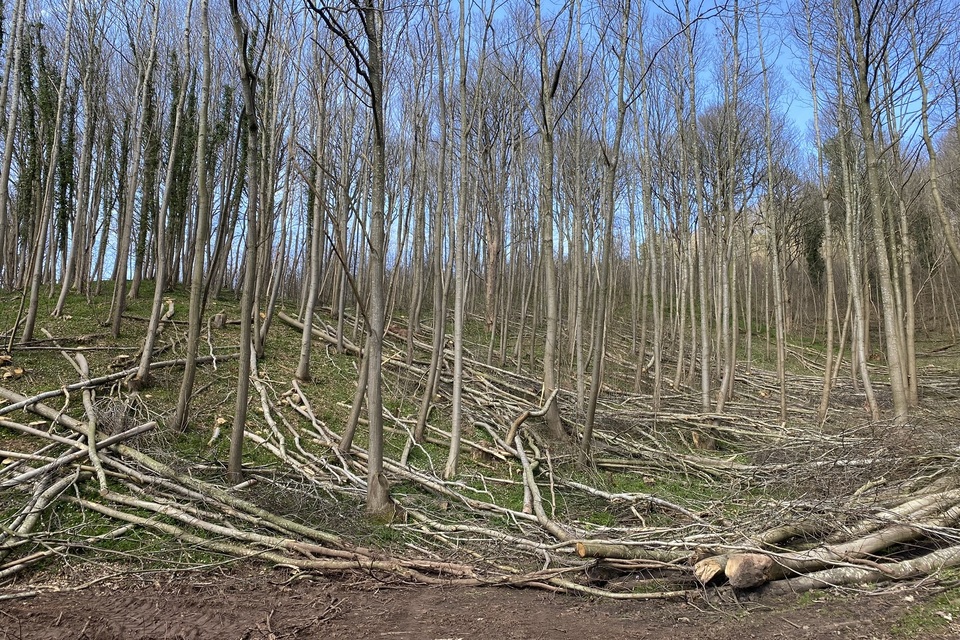
Selective thinning to improve a sweet chestnut Seed stand in Herefordshire. Credit: Andrew Pickup
Identifying and registering seed stands across Derbyshire
- organisation: Derbyshire Wildlife Trust
- organisation type: wildlife conservation charity
- location: Derbyshire
This project aims to conduct desk and field-based studies to identify and register seed stands across Derbyshire Wildlife Trust’s owned and managed estates. The project will focus on:
- bird cherry (Prunus padus)
- hazel (Corylus avellana)
- black poplar (Populus nigra)
- blackthorn (Prunus spinosa)
- elder (Sambucus nigra)
- holly (Ilex aquifolium)
- field maple (Acer campestre)
- wild apple (Malus sylvestris)
- small-leaved lime (Tilia cordata)
A report will be produced at the end of the project including recommended actions to develop seed sources in Derbyshire for the species studied.
Expanding a cherry breeding programme
- organisation: Future Trees Trust
- organisation type: tree breeding charity
- location: Oxfordshire and Herefordshire
This project aims to bring existing underutilised wild cherry (Prunus avium) resources back into the Future Trees Trust cherry breeding programme. The Trust will add to existing qualified seed orchards and establish a new qualified seed orchard. This will include locating additional plus trees and repropagating existing unused resources (including French material for climate change adaptation and selections for resistance to bacterial canker).
This will also include carrying out genetic studies to inform on overall genetic diversity of the cherry breeding population and to ascertain the S allele (self-incompatibility status) of all plus trees.
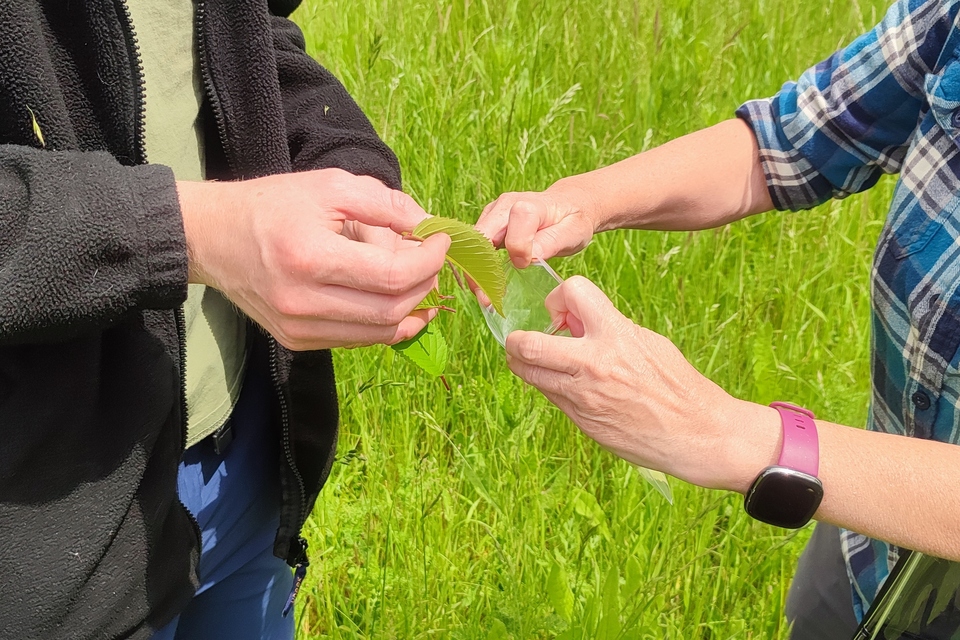
Future Trees Trust staff collecting leaf samples from wild cherry seed orchard for DNA analysis.
Identifying viable sources of wild apple seed
- organisation: Woodland Trust
- organisation type: woodland conservation charity
- location: across England
This project aims to identify and genotype potential sources of true-to-type wild apple (Malus sylvestris) seed. They will summarise findings, produce recommendations and register any suitable sites as seed stands. Then, they will deliver training to Woodland Trust and other charity and environmental NGO staff on identifying viable sources of seed to build expertise and capacity in the sector.
Registering 3 source-identified seed stands
- organisation: Surrey County Council
- organisation type: local council
- location: Surrey
This project aims to carry out desktop and field studies to identify and register 3 new source-identified seed stands across Surrey County Council’s land portfolio. This includes 1 stand each for juniper (Juniperus communis), yew (Taxus baccata) and service tree (Sorbus domestica).
Find out about more SSG funded projects.