The ‘achievement’ grade, attainment data and schools in challenging circumstances
Published 20 May 2026
Applies to England

© Crown copyright 2026
This publication is licensed under the terms of the Open Government Licence v3.0 except where otherwise stated. To view this licence, visit nationalarchives.gov.uk/doc/open-government-licence/version/3 or write to the Information Policy Team, The National Archives, Kew, London TW9 4DU, or email: psi@nationalarchives.gov.uk.
Where we have identified any third party copyright information you will need to obtain permission from the copyright holders concerned.
This publication is available at https://www.gov.uk/government/publications/school-inspections-statistical-commentaries-2025-to-2026/the-achievement-grade-attainment-data-and-schools-in-challenging-circumstances
Introduction
The renewed education inspection framework came into use in November 2025. Since then, we have inspected and published report cards for 921 schools.[footnote 1] These 921 schools represent only 4% of all state-funded schools, so the grade profile is not representative of all schools. In fact, as we inspect lower-performing schools more often than high-performing schools, the mix of schools inspected in any single year is not typically representative.[footnote 2] The following analysis is based on inspections carried out between 10 November 2025 and 30 April 2026, where the report card was published by 30 April.
While these early inspections cannot inform firm conclusions about the sector as a whole – and may change as time goes on – we can start to look at the relationships between different aspects. For instance, we can start to see the relationship between the ‘achievement’ evaluation area and the performance data for schools, and how grades differ by the characteristics of the schools, such as the level of disadvantage.
Figure 1: State-funded school grades by evaluation area, 2025/26 to date
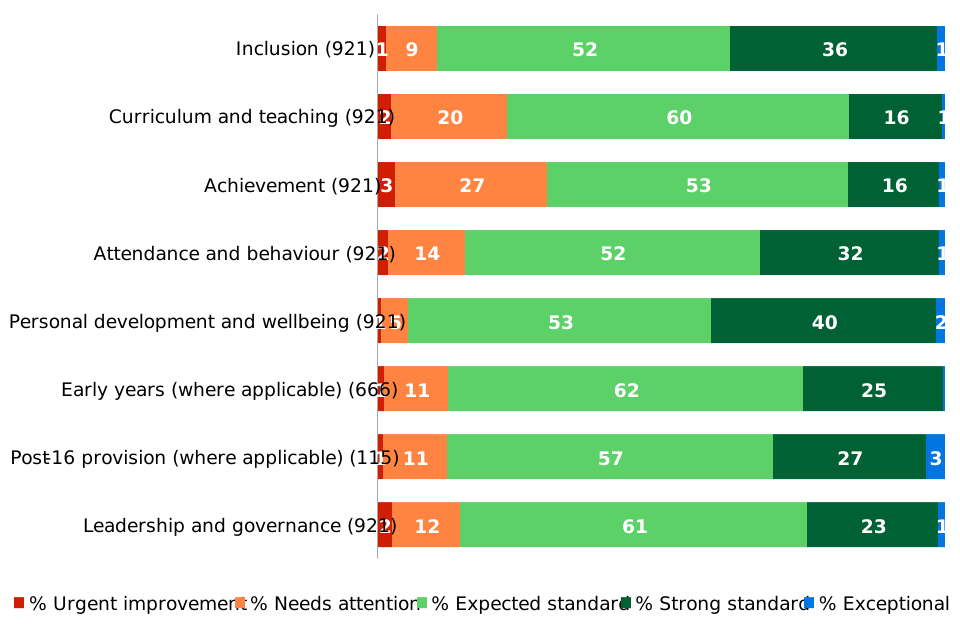
Notes: The evaluation areas for early years and post-16 provision are only graded in schools with this provision, so the numbers of schools inspected above are lower for these areas.
View data in an accessible table format.
The evaluation area with the highest proportion of schools graded expected standard or better so far is ‘personal development and wellbeing’ (95%), while the lowest is ‘achievement’ (70%). Seventy-three per cent of schools received a mix of different grades across the 6 core evaluation areas.[footnote 3] Of the 27% of inspections where the grades match, the most common scenario is all 6 evaluation areas were graded expected standard (accounting for 16% of all inspections). Safeguarding standards were met in 99% of inspections.
Where schools are on a journey of improvement, ‘achievement’ will often reach the ‘expected standard’ later than other evaluation areas. The actions of leaders commonly have a quicker impact on pupils’ personal development and wellbeing, their behaviour and their attendance. Leaders’ work to improve curriculum and teaching tends to take a little longer, and for this to have impact on achievement takes longer still.
Schools in challenging circumstances
Schools serving disadvantaged communities face a range of challenges, which can act as barriers to their pupils reaching high levels of achievement.
Our expectations for pupils’ achievement, regardless of their backgrounds, are rightly high. However, we take the context of a school into account – including by recognising the hard work of leaders and staff in schools that are making a real difference despite the challenges they face.
The role of the school’s performance data in evaluating achievement
When we talk about achievement, we are referring to attainment and progress – but we never rely on test and exam results alone to reach grading decisions. Achievement is measured in more than statutory outcomes and qualifications. It’s about realising potential and helping pupils to thrive.
We define achievement broadly, considering pupils’ knowledge and skills, and their readiness for their next steps, as well as their results in national tests and examinations.
Most importantly, inspectors strike a balance between the information provided by published data and the evidence they gather on site.
As part of their inspection preparation, inspectors use the Inspection Data Summary Report (IDSR) to understand the performance of the school and its context. The IDSR:
- shows whether the school’s performance on a particular measure is above average, close to average, or below average
- provides data over time, for all pupils, and for disadvantaged pupils
- gives additional context on the pupils in the school, such as the proportion of pupils with special educational needs and/or disabilities (SEND), pupils eligible for free school meals (FSM), and children in need [footnote 4]
- looks at the stability, and the deprivation level in the local area [footnote 5]
See our blog on the role of data on school and further education inspections and sample IDSRs for more detail.
National benchmarks
In some schools, a significant number of pupils face or have faced significant barriers to learning. Our toolkit standards are carefully worded to reflect this complexity.[footnote 6]
For the ‘expected standard’, inspectors evaluate whether ‘On the whole, pupils achieve well. Typically, this will be reflected in their attainment and progress in national tests and examinations.’ The word ‘typically’ here is crucial. It emphasises that national test results may not reflect how well some pupils are doing. Inspectors will always take each school’s context into account. They will use their professional judgement to decide whether the quality of pupils’ learning that they’ve seen across the school is reflected in their results at the end of Years 6, 11 or 13. Inspection report cards will also always tell this nuanced story.
Inspectors’ use of national averages is just one part of the picture of achievement in any school. Their use of this data is highly contextualised. By definition, national averages help to provide a useful benchmark for achievement in most schools. However, they never give the full picture.
Inspectors use national averages cautiously (especially where cohorts are small) to understand different aspects of a school’s performance. In schools with average proportions of disadvantaged pupils, this is more straightforward, as it is likely that the school’s performance compared to national averages gives a reasonably accurate picture. But we know that disadvantaged pupils do not attain as well as all pupils nationally. That is why inspectors’ first consideration when starting to build a picture of the attainment of disadvantaged pupils in a school will always be how this compares to national averages for all disadvantaged pupils. A context-driven comparison is therefore baked into the inspection process. This has been a core part of training for inspectors under the renewed framework.
Rightly, neither school leaders nor Ofsted would ever be comfortable with capping our expectations for disadvantaged pupils. That is why, particularly when considering the ‘strong standard’ for achievement, inspectors will also consider whether gaps between the attainment of the school’s disadvantaged pupils and non-disadvantaged pupils nationally are closing. In this way we ensure that we consider achievement in schools fairly, including for those that serve a large proportion of disadvantaged pupils, while upholding the right ambitions for these pupils over time.
Comparing school-level data on disadvantaged pupils with national data for disadvantaged pupils
As the following 2 charts show:
- schools in which disadvantaged pupils are performing broadly in line with the national average for all disadvantaged pupils tend to be graded ‘expected standard’
- schools in which disadvantaged pupils are performing below the national average for all disadvantaged pupils are more likely to be graded ‘needs attention’ or ‘urgent improvement’
- schools that are closing the gap for their disadvantaged pupils are likely to be recognised for doing so and graded ‘strong standard’ or ‘exceptional’
Figure 2: Average Attainment 8 scores for disadvantaged pupils, compared with the national average for disadvantaged pupils, in secondary schools split by achievement grade, 2025/26 to date
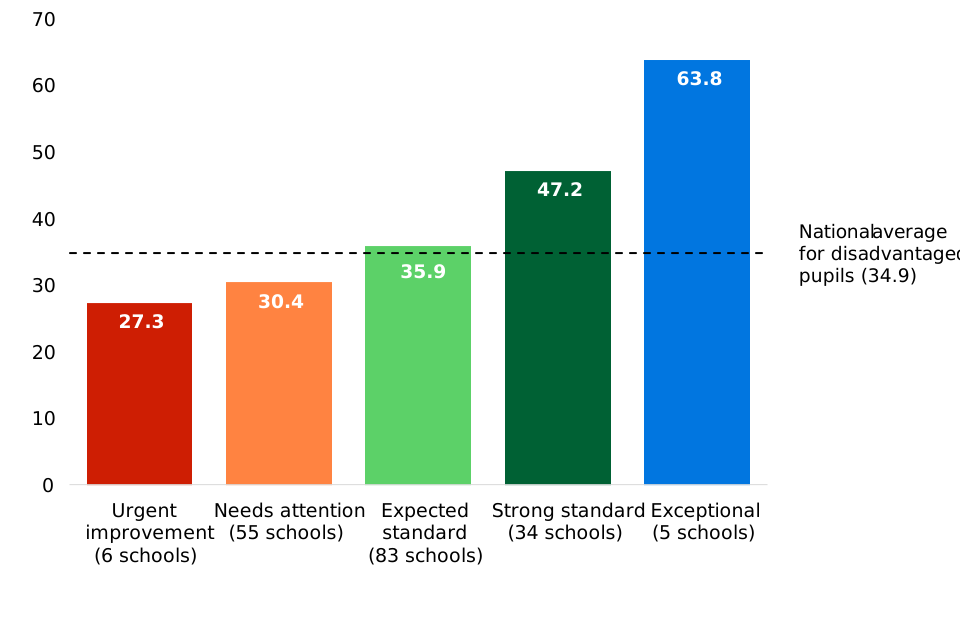
Notes: The key stage 4 data is final data for 2024/25. This is the latest data for each school and may not reflect the data in the IDSR at the time of the inspection. The data shown for each group is an average of the Attainment 8 scores of disadvantaged pupils for each of the schools inspected.
View data in an accessible table format.
Figure 3: Average percentage of disadvantaged pupils reaching the expected standard in reading, writing and maths compared with the national average for disadvantaged pupils, for primary schools, split by achievement grade, 2025/26 to date
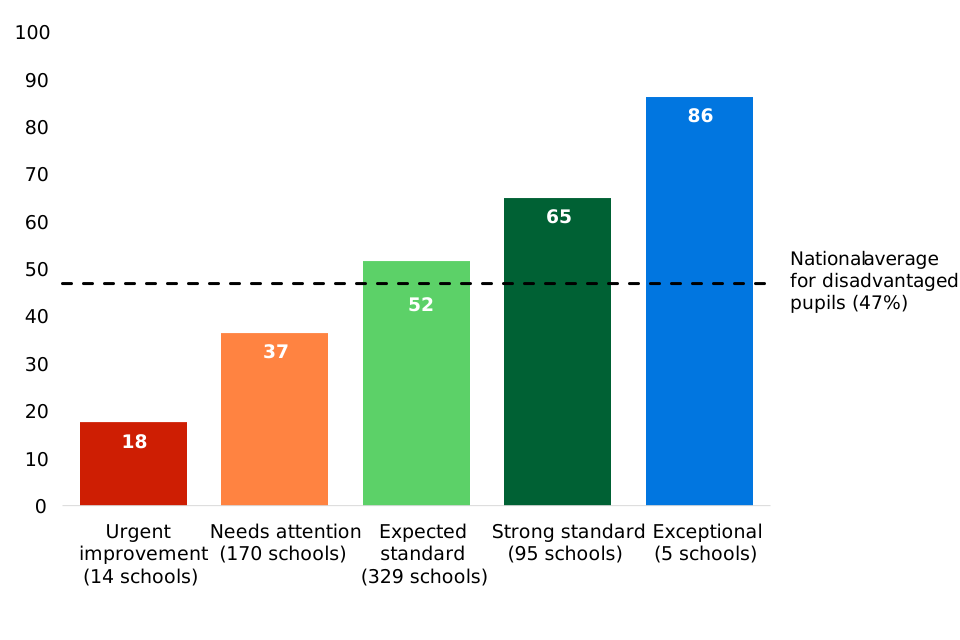
Notes: The key stage 2 data is final data for 2024/25. This is the latest data for each school and may not reflect the data in the IDSR at the time of the inspection. The data shown for each group is an average of the percentage of disadvantaged pupils reaching the expected standard for each of the schools inspected.
View data in an accessible table format.
Figure 2 and Figure 3 show the correlation between evaluation grades awarded and how the attainment of a school’s disadvantaged pupils compare with the national average for disadvantaged pupils.
The following chart (Figure 4) shows that schools serving a range of backgrounds are being graded ‘expected standard’ or better for ‘achievement’, and that inspectors are considering more than data alone when making these evaluations.
In the IDSR, the school’s percentage of pupils eligible for FSM is allocated to one of 5 bands.[footnote 7] In Figure 4 and Figure 5, we have summarised these as 3 bands: above national average, close to national average and below national average.
Figure 4 shows the Attainment 8 data for pupils in the 122 secondary schools (each shown as a dot) graded ‘expected standard’ or higher for ‘achievement’ so far.[footnote 8] The grey vertical and horizontal lines show how their data compares with the national averages for all pupils and for disadvantaged pupils. The schools with the highest percentage of pupils eligible for FSM (blue dotted line) tend to have lower performance data for pupils than the schools with the lowest FSM (pink dotted line), but there are lots of schools in challenging circumstances that are helping their pupils to achieve well. In each case, inspectors found that ‘achievement’ at the school met at least the ‘expected standard’.
Figure 4: Attainment 8 scores, by level of disadvantage, in all secondary schools graded ‘expected standard’ or higher for ‘achievement’ in 2025/26 to date
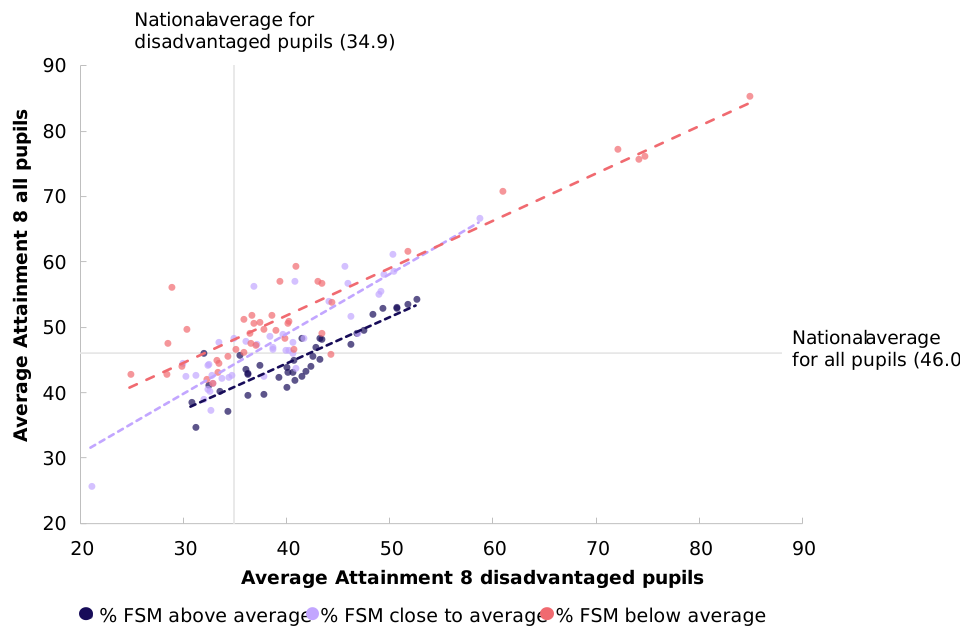
Notes: The Attainment 8 data is final data for 2024/25. This is the latest data for each school and may not reflect the data in the IDSR at the time of the inspection. The diagonal dotted lines show the best fit lines for the groups of schools with % FSM above/close to average/below average. The FSM measure includes pupils eligible for FSM in the last 6 years.
View data in an accessible table format.
Recognising the ‘building blocks’ of achievement
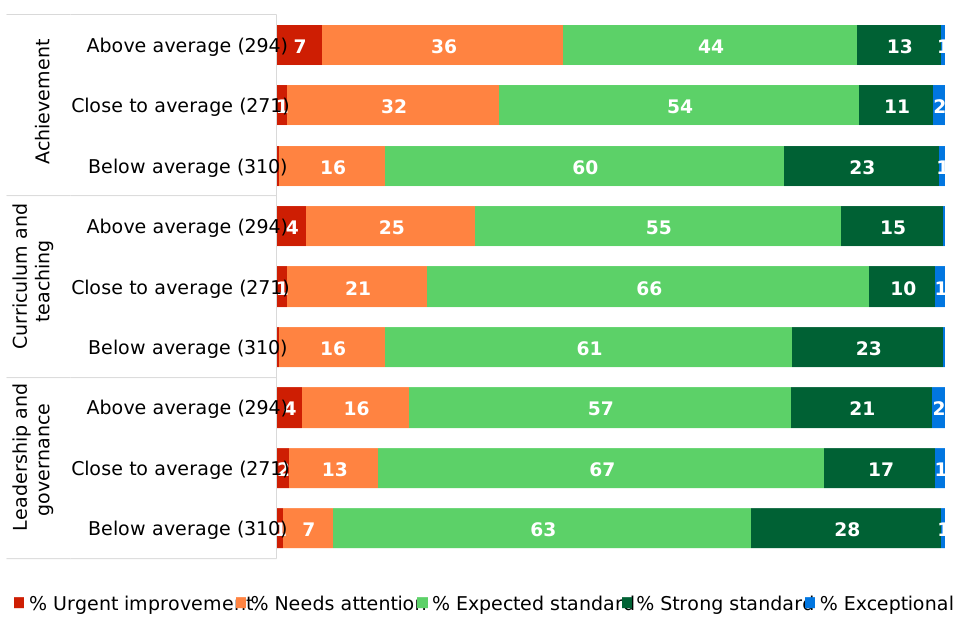
To date, the ‘achievement’ grades have been lower for the schools in the above average band compared to those schools in the below average band. Despite this, nearly three fifths of the schools with above average FSM were graded ‘expected standard’ or better.[footnote 9]
The grades for ‘curriculum and teaching’ by FSM band follow a similar pattern, which is logical. If the quality of curriculum and teaching is lower, this typically affects how well pupils achieve. It may take time for improvements made to the curriculum and teaching to feed through into pupils’ achievement.
The differences by FSM are less pronounced for ‘leadership and governance’. Schools in the above average FSM band are more likely to receive a ‘leadership and governance’ grade that exceeds their ‘achievement’ grade.[footnote 10]
Figure 5: Grades for selected evaluation areas for primary and secondary schools by % of pupils eligible for FSM, 2025/26 to date
View data in an accessible table format.
Of the 126 schools in the above average FSM band that were graded ‘urgent improvement’ or ‘needs attention’ for ‘achievement’, 54% were graded ‘expected standard’ or better for ‘leadership and governance’. Where this is the case, it reflects inspectors’ recognition of the significant challenges that these schools face and the hard work of leaders and staff to overcome these challenges in working towards the best possible outcomes for all pupils. Sixty-seven per cent of these 126 schools were also graded ‘expected standard’ or better for ‘inclusion’.
Conclusion
While there is a relationship between the level of disadvantage in a school and the school’s grade for the ‘achievement’ evaluation area, 57% of schools with above average FSM have been graded ‘expected standard’ or better so far. Schools with strong outcomes for disadvantaged pupils are more likely to be graded ‘strong standard’ or ‘exceptional’, especially where they are performing above the national average for disadvantaged pupils (see Figure 2 and Figure 3). Inspectors are allowing for context, without normalising lower levels of achievement for children from more disadvantaged backgrounds.
Last year, we announced that we would develop an additional measure to strengthen how we take account of a school’s context: by comparing its performance to other schools in a similar context. We have been working with the Department for Education (DfE) to develop this ‘similar schools’ model. This allows us to look at how a school is performing both compared to national benchmarks and to other schools in similar contexts. We will introduce this comparison into the IDSR in the new academic year and further detail will also be shown in the DfE’s new digital service which will enable schools to benchmark their performance and connect with similar schools.
It is unusual for a school to serve a wholly disadvantaged or wholly non-disadvantaged community. In reality, a school is likely to cater for a spectrum of needs and barriers to learning. That is why inspection can never rely on data alone, but on the human activity of visiting a school, talking to its leaders, pupils, staff and parents and seeing it in action.
The new report cards display grades for multiple evaluation areas, allowing inspectors to better reflect the balance of strengths and areas for improvement that exists in every school.
Data tables for figures
Data for Figure 1: State-funded school grades by evaluation area, 2025/26 to date
| Evaluation area | Number of inspections | % Urgent improvement | % Needs attention | % Expected standard | % Strong standard | % Exceptional |
|---|---|---|---|---|---|---|
| Inclusion | 921 | 1 | 9 | 52 | 36 | 1 |
| Curriculum and teaching | 921 | 2 | 20 | 60 | 16 | 1 |
| Achievement | 921 | 3 | 27 | 53 | 16 | 1 |
| Attendance and behaviour | 921 | 2 | 14 | 52 | 32 | 1 |
| Personal development and wellbeing | 921 | 1 | 5 | 53 | 40 | 2 |
| Early years (where applicable) | 666 | 1 | 11 | 62 | 25 | 0 |
| Post-16 provision (where applicable) | 115 | 1 | 11 | 57 | 27 | 3 |
| Leadership and governance | 921 | 2 | 12 | 61 | 23 | 1 |
See Figure 1.
Data for Figure 2: Average Attainment 8 scores for disadvantaged pupils, compared with the national average for disadvantaged pupils, in secondary schools split by achievement grade, 2025/26 to date
| Achievement grade | Number of schools | Average Attainment 8 score for disadvantaged pupils |
|---|---|---|
| Urgent improvement | 6 | 27.3 |
| Needs attention | 55 | 30.4 |
| Expected standard | 83 | 35.9 |
| Strong standard | 34 | 47.2 |
| Exceptional | 5 | 63.8 |
| National | 34.9 |
See Figure 2.
Data for Figure 3: Average percentage of disadvantaged pupils reaching the expected standard in reading, writing and maths compared with the national average for disadvantaged pupils, for primary schools, split by achievement grade, 2025/26 to date
| Achievement grade | Number of schools | Average percentage of disadvantaged pupils reaching the expected standard in reading, writing and maths |
|---|---|---|
| Urgent improvement | 14 | 18 |
| Needs attention | 170 | 37 |
| Expected standard | 329 | 52 |
| Strong standard | 95 | 65 |
| Exceptional | 5 | 86 |
| National | 47 |
See Figure 3.
Data for Figure 4: Attainment 8 scores, by level of disadvantage, in all secondary schools graded ‘expected standard’ or higher for ‘achievement’ in 2025/26 to date
| National average for all pupils | National average for disadvantaged pupils |
|---|---|
| 46.0 | 34.9 |
See Figure 4.
Data for Figure 5: Grades for selected evaluation areas for primary and secondary schools by % of pupils eligible for FSM, 2025/26 to date
| Evaluation area | FSM band | Number of inspections | % Urgent improvement | % Needs attention | % Expected standard | % Strong standard | % Exceptional |
|---|---|---|---|---|---|---|---|
| Achievement | Above average | 294 | 7 | 36 | 44 | 13 | 1 |
| Achievement | Close to average | 271 | 1 | 32 | 54 | 11 | 2 |
| Achievement | Below average | 310 | 0 | 16 | 60 | 23 | 1 |
| Curriculum and teaching | Above average | 294 | 4 | 25 | 55 | 15 | 0 |
| Curriculum and teaching | Close to average | 271 | 1 | 21 | 66 | 10 | 1 |
| Curriculum and teaching | Below average | 310 | 0 | 16 | 61 | 23 | 0 |
| Leadership and governance | Above average | 294 | 4 | 16 | 57 | 21 | 2 |
| Leadership and governance | Close to average | 271 | 2 | 13 | 67 | 17 | 1 |
| Leadership and governance | Below average | 310 | 1 | 7 | 63 | 28 | 1 |
See Figure 5.
-
All analysis is based on inspections in the 2025/26 academic year to date under the renewed framework, and covers full inspections between 10 November 2025 and 30 April 2026, where the report card was published by 30 April 2026. See sheet D1 of the ‘Management information - state-funded schools - as at 30 April 2026’ ODS file for the list of schools and their outcomes: State-funded school inspections and outcomes: management information. 1,803 full inspections were carried out by 30 April, of which 921 have published report cards so appear in this list. ↩
-
Of the 921 schools inspected this year, 18% were graded ‘requires improvement’ or ‘inadequate’ at their last full inspection. This is based on overall effectiveness for all schools, apart from 5 schools that were inspected in 2024/25 and so did not have an overall effectiveness grade – for these, we have used the quality of education grade instead. This 18% compares to 10% of all 22,000 schools that were graded ‘requires improvement’ or ‘inadequate’ at their most recent inspection in August 2024, and an estimate of 8% in August 2025.
All of the 125 schools inspected from 10 to 30 November 2025 were volunteers. ↩
-
The 6 core evaluation areas exclude early years and sixth-form provision, which are only graded in schools with the relevant age group. See tables 8a and 8b of the ODS file ‘Management information - state-funded schools - as at 30 April 2026’ for more detail; State-funded school inspections and outcomes: management information. ↩
-
The FSM data used in the IDSR and in this analysis refers to pupils who are eligible for FSM or have been eligible at any point in the last 6 years. This is also known as ‘Ever 6 FSM’. ↩
-
Stability is a measure of the percentage of pupils who were admitted to the school at the standard time of admission. ↩
-
State-funded schools inspection toolkit, September 2025 (updated November 2025). ↩
-
Based on the Department for Education’s FSM 6 measure, which looks at pupils eligible for FSM at any time in the last 6 years. The 5 FSM bands are calculated by Ofsted and are based on the difference between the school’s percentage and the national average for that phase. The 5 bands are not evenly sized (the close to average band is bigger), but are a similar size when summarised as 3 bands in this analysis. ↩
-
Excludes schools graded expected standard or higher that did not have the relevant performance data. ↩
-
Data in this section covers primary and secondary schools only. The number of schools included is slightly lower than in Figure 1, which covers all phases. ↩
-
Thirty-eight per cent of schools with above average FSM had a ‘leadership and governance’ grade that was higher than their ‘achievement’ grade. This compares to 26% for schools with close to average FSM and 17% of those with below average FSM. ↩