Collision between a passenger train and rail handling trolleys at Queens Park, 9 May 2026
Published 3 September 2026

© Crown copyright 2026
This publication is licensed under the terms of the Open Government Licence v3.0 except where otherwise stated. To view this licence, visit nationalarchives.gov.uk/doc/open-government-licence/version/3 or write to the Information Policy Team, The National Archives, Kew, London TW9 4DU, or email: psi@nationalarchives.gov.uk.
Where we have identified any third party copyright information you will need to obtain permission from the copyright holders concerned.
This publication is available at https://www.gov.uk/government/publications/safety-digest-062026-queens-park/collision-between-a-passenger-train-and-rail-handling-trolleys-at-queens-park-9-may-2026
1. Important safety messages
This accident demonstrates the importance of:
- controllers of site safety ensuring that changes in the location of on-track equipment such as trolleys are clearly communicated and recorded
- controllers of site safety checking that all equipment has been removed from the track before handing the railway back for the operation of trains, particularly when there has been a transfer of responsibility
- Network Rail staff and contractors working in axle counter areas using vehicle management forms as part of the line clear verification process
- safe work packs including copies of all the relevant forms that will be needed by controllers of site safety to implement the planned safe system of work
- Network Rail staff and contractors responsible for trolleys being used on track ensuring that they are fitted with operational lighting to improve their conspicuity during darkness.
2. Summary of the accident
At around 05:35 on 9 May 2026, a passenger train, travelling at 77 mph (123 km/h), struck two rail handling trolleys near to Queens Park station, London. The trolleys were manually propelled rail handlers (MPRHs), colloquially known as ‘ironmen’, and had been used to transport sections of rail during overnight engineering works and had been unintentionally left on the track after the work was completed.
No injuries were caused to anyone in the collision. The MPRHs involved were damaged beyond economic repair. The train did not derail but sustained minor damage to the coupler and underside and was unable to continue in service.
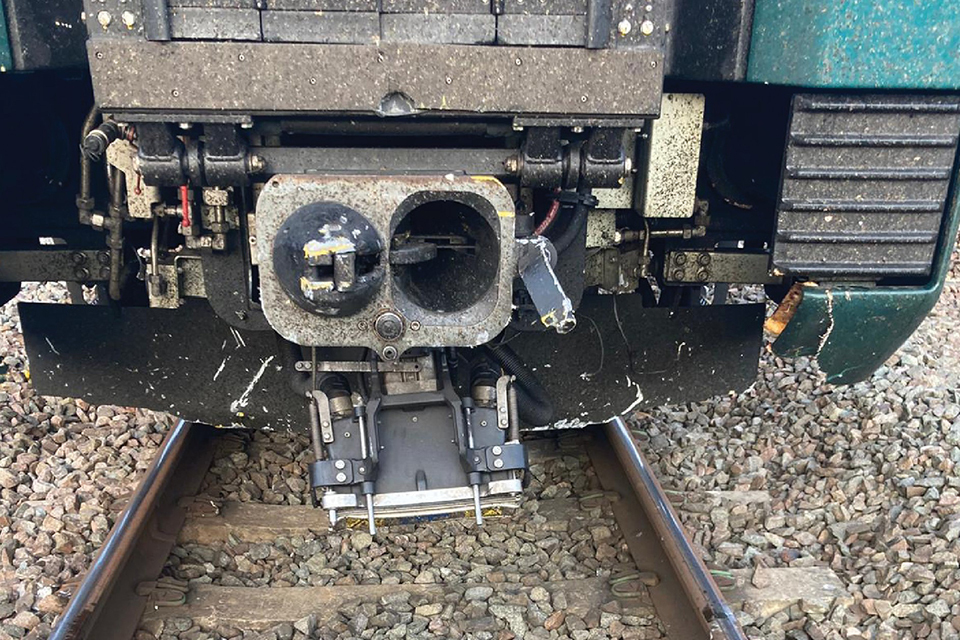
The damage to the front of the train (courtesy of Network Rail).
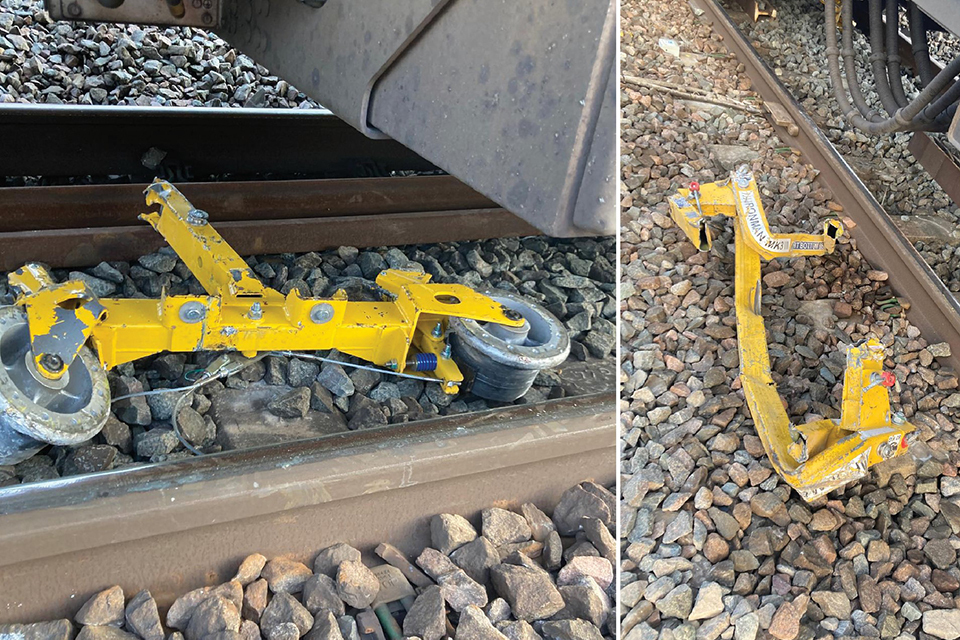
The remains of one of the MPRHs after the collision (courtesy of Network Rail).
3. Cause of the accident
The collision occurred because the MPRHs were left on the Up Fast line (which carries trains travelling towards London) after overnight engineering work had been completed. The staff who had been using the MPRHs did not recognise that the trolleys had been left on the track before the line was reopened to trains in the morning. The train that struck the MPRHs, just after passing Queens Park station, was the first to use the Up Fast line after it had been reopened.
The collision occurred at a road-rail access point (RRAP1) situated beside Canterbury Terrace, where staff can gain access to the railway to place equipment, including trolleys, on the track during maintenance work. There is a second RRAP about 110 metres closer to the southern terminus of the line at Euston station (RRAP2), which can also be accessed from Canterbury Terrace.
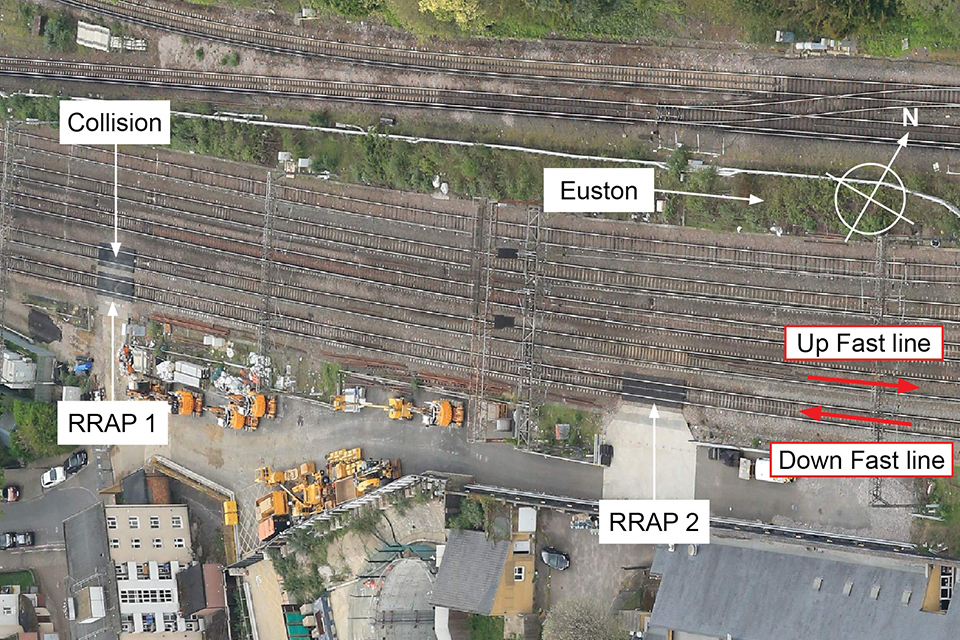
Location of the two RRAPs (courtesy of Network Rail).
During the night of 8 to 9 May, Network Rail was undertaking inspection and repair work to the track at multiple locations between RRAP2 and Euston station. Two maintenance teams were involved in the work. Team 1 was replacing short sections of rail at two locations on the Down Fast line, which were about 570 metres and 970 metres from RRAP2 in the direction of Euston station. Team 2 was undertaking a rail defect repair on the Up Fast line, about 230 metres from RRAP2 in the direction of Euston station. Each team had a controller of site safety (COSS) responsible for establishing and briefing a safe system of work for their team. Both the Up Fast and Down Fast lines were blocked under a possession.
At the start of the shift, at about 00:30 on 9 May, team 1 accessed the track at RRAP2. They placed two MPRHs onto the Up Fast line, which they loaded with a length of replacement rail. They also placed two flat trolleys on the Up Fast line, which they loaded with welding and rail stressing equipment. They then pushed the MPRHs and flat trolleys to the furthest of the two defect locations on the Down Fast line and started work.
Around the same time, team 2 accessed the track at RRAP1 where the replacement rail they needed was stored. They placed two MPRHs onto the Up Fast line and loaded them with the replacement rail. They also placed a flat trolley onto the Up Fast line, which they loaded with rail stressing equipment, and a second flat trolley on the Down Fast line, which they loaded with welding equipment. They then pushed these MPRHs and flat trolleys to the location of the Up Fast defect and started work. This required them to pass RRAP2.
Team 1 completed their work at about 03:15 and started to push their MPRHs and flat trolleys back along the Up Fast line towards RRAP2. En route, they encountered team 2, who were still undertaking their repair work. Team 1 spoke with team 2, who helped them to move their MPRHs and flat trolleys from the Up Fast line to the Down Fast line so that they could continue to be pushed towards RRAP2.
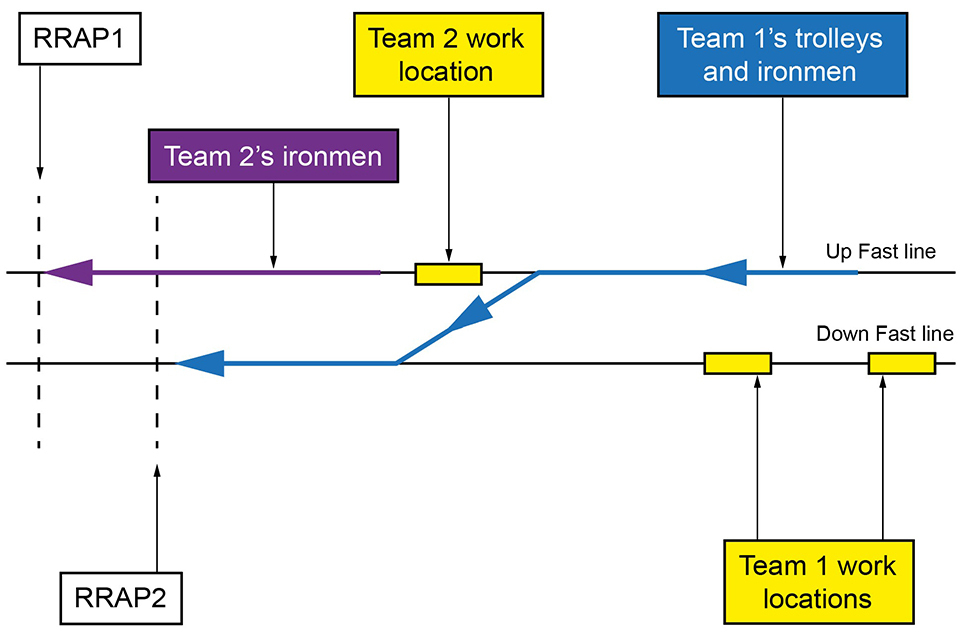
Movements of the trolleys and MPRHs by team 1.
At this point, team 2 asked team 1 to help them by pushing their MPRHs back to the access point, which team 1 agreed to do. Team 2’s COSS was aware that this had been agreed. Team 1 then pushed their flat trolleys and MPRHs along the Down Fast line and team 2’s MPRHs along the Up Fast line to RRAP2. While they were offloading their own equipment onto their road vehicle, a member of team 1 pushed team 2’s MPRHs further to RRAP1, as they knew that this was where the trolleys had been on-tracked and where team 2’s vehicle was parked. The MPRHs were left on RRAP1 ready for team 2 to take them off the track when they returned.
Team 2 completed their work around 04:00 and pushed their other two trolleys back to RRAP2. Another member of staff brought their vehicle from RRAP1 to RRAP2, as team 1 had now departed and the access point was clear. Team 2 removed their two flat trolleys and equipment from the track at RRAP2, unaware that their two MPRHs had been moved to RRAP1 by team 1.
Team 2’s COSS recognised that their MPRHs were not at RRAP2 and asked the staff at the van where they were. They told the COSS that team 1 had taken the MPRHs away, having made the incorrect assumption that team 1 had brought them to RRAP2, off-tracked them and taken them away in their vehicle.
The team 2 COSS then had a look round RRAP2 in the darkness and did not see anything on the track. The COSS did not see the MPRHs on RRAP1, which was over 100 metres away. At 04:15 they contacted the Engineering Supervisor (ES), who was responsible for co-ordinating the various teams within the work site. The COSS advised the ES that all their equipment was clear of the line, and it was now safe for the passage of trains. The MPRHs remained at RRAP1 until they were struck by the train at 05:35.
At some locations on Network Rail’s infrastructure, including Queens Park, ‘axle counters’ are used for train detection. These count the number of wheelsets (axles) entering a track section and the number leaving it. If these are matched, then the axle counter informs the signalling system that there is no train in that track section. Otherwise, the track section will be reported as occupied and the signalling system will set the appropriate signal to red (danger), to prevent another train from entering it. However, if a trolley is placed on the track within a track section that uses axle counters for train detection, it will not be detected, so a separate process known as ‘line clear verification’ is used to manage the use and removal of trolleys in such areas.
Network Rail standards set out the line clear verification process. Where trolleys are used, this requires the ES and the COSS to complete separate vehicle management forms (VMFs) to record both the placing of vehicles and trolleys on the track and their subsequent removal. If an ES identifies an anomaly on their VMF when handing back a work site, Network Rail standards require them to contact the COSS concerned to establish the whereabouts of any vehicles that are unaccounted for. If this cannot be established, a physical inspection of the entire work site must be undertaken before the line can be reopened.
The ES had been informed by the COSSs of team 1 and team 2 of the number of trolleys being used and had recorded these on their VMF at the start of work. At the end of work, both COSSs told the ES that the line was clear, and the ES recorded that the trolleys had been removed on their VMF.
Both team 1’s COSS and team 2’s COSS had been briefed on the line clear process during their training. However, a VMF was not issued to them as part of their document pack for undertaking the work on the night of 8 to 9 May and they did not have a copy of the form available. Witness evidence indicated that it was normal practice for the COSSs to rely on mentally noting which trolleys were on track and remembering to check that they had been removed, without formally recording them on a VMF.
Network Rail’s infrastructure plant manual standard requires that rail handling trolleys, such as MPRHs, ‘shall have red marker lights fitted and operational that are visible in both directions’. This is also a requirement in the Rule Book module which deals with the duties of the COSS and person in charge when using a hand trolley. The MPRHs used by team 2 were not fitted with red lights, meaning that their visibility at RRAP1 was reduced. Had they been fitted with red lights, it is possible that team 2’s COSS would have been able to see them on the track from their position at RRAP 2 before declaring that it was clear of equipment.
4. Previous similar occurrences
A number of incidents involving trains on mainline railways encountering equipment that had been left on the track have previously been investigated by RAIB.
RAIB undertook an investigation into an accident which occurred in October 2021 when a passenger train travelling at 123 mph (198 km/h) struck a trolley on the track near Challow, Oxfordshire (RAIB report 11/2022). In this case, the line clear verification checks undertaken before handing back the railway for normal operation had not identified the trolley’s presence. RAIB found that there were weaknesses in the process which formed part of these checks, and these were compounded by the maintenance team not following the process on the night concerned.
RAIB also investigated an accident which occurred in March 2024, when a passenger train derailed after striking a section of redundant rail on the approach to Walton-on-Thames station (RAIB report 04/2025). The redundant rail had inadvertently been left there by a team that had completed work in the area over the previous weekend. Checks undertaken after the work was completed did not identify this because no person in charge had supervised the work and because a track handback engineer had not been effectively briefed as to what work had been undertaken.
Other incidents with similarities to the collision at Queens Park which have resulted in RAIB safety digests include:
- Near miss near Kirkham (RAIB safety digest 11/2017). In this incident, a large tubular pile had been left on the line at the end of work and was encountered by an on-track machine.
- Passenger train striking rail on the track at Cradlehall (RAIB safety digest 05/2018). In this incident, a section of track was left over a running rail and was subsequently hit by the first train of the day.
- Train damaged by collision with an object at Highdyke (RAIB safety digest 02/2024). In this incident a temporary RRAP was left on track after overhead line maintenance work and was struck by the first train of the day.
- Collision between a train and an object left on the track at Kings Langley (RAIB safety digest 06/2024). In this incident a temporary RRAP was left on track after overhead line maintenance work and was struck by the first train of the day.