Country policy and information note: Military service, August 2026 (accessible)
Updated 12 August 2026

© Crown copyright 2026
This publication is licensed under the terms of the Open Government Licence v3.0 except where otherwise stated. To view this licence, visit nationalarchives.gov.uk/doc/open-government-licence/version/3 or write to the Information Policy Team, The National Archives, Kew, London TW9 4DU, or email: psi@nationalarchives.gov.uk.
Where we have identified any third party copyright information you will need to obtain permission from the copyright holders concerned.
This publication is available at https://www.gov.uk/government/publications/russia-country-policy-and-information-notes/country-policy-and-information-note-military-service-august-2026-accessible
Version 2.0, August 2026
Executive summary
In general, persons who simply evade/desert from military service do not fall within one of the 5 Refugee Convention grounds, including particular social group.
Russian men aged between 18 and 30 years are required to undertake one-year military service if conscripted and unless they fall into one of the categories for exemption or qualify for alternative civilian service.
In general, Russian conscripts are not forced to commit acts which are contrary to the basic rules of human conduct. Conditions of service for Russian conscripts are – whilst at times challenging – generally not so harsh as to amount to persecution.
Russian reservists remain civilians unless and until they are called up. In September 2022, President Putin issued a decree declaring a partial mobilisation. While no official end to the decree has been issued, the Russian Defence Minister reported the completion of the partial mobilisation at the end of October 2022. In general, Russian reservists are not forced to commit acts which are contrary to the basic rules of human conduct and conditions of reserve duty are not so harsh as to amount to persecution.
Professional contract soldiers form a core component of Russian forces engaged in military operations in Ukraine. Available country information indicates that Russian forces have committed serious violations of international humanitarian law and as such, contract soldiers may be involved in acts which are contrary to the basic rules of human conduct. There are reports of serious ill-treatment within some Russian units, particularly in frontline areas, including abuse, torture, detention in informal facilities, and killings carried out by commanders or fellow soldiers. The conditions of military service for contract soldiers may therefore amount to serious harm or persecution. Decision makers must consider whether there are serious reasons for considering whether one (or more) of the exclusion clauses is applicable.
The vast majority of draft evaders are only punished through fines. As such, punishment for draft evasion is, in general, not disproportionately harsh or severe and applied for a Convention reason. The law provides for alternative civilian service (ACS) for conscientious objectors, though not all applications are accepted. Those granted ACS must complete a longer service (18 to 21 months).
Similarly, formal punishment for desertion is, in general, not disproportionately harsh or severe and applied for a Convention reason. Informal punishments for desertion, however, are capable of amounting to serious harm or persecution if applied for a Convention reason, particularly for those deployed to frontline operations in Ukraine.
Where the person has a well-founded fear of persecution or serious harm from the state, they are unlikely to be able to relocate to escape that risk.
Where a claim is refused, it is unlikely to be certifiable as ‘clearly unfounded’.
Each case must be considered on its individual facts. The onus is on the person to demonstrate they face persecution or serious harm.
Assessment
Section updated: 12 June 2026
About the assessment
This section considers relevant evidence – including country information, refugee and human rights law and policy, and case law – to assess whether, in general:
-
a person faces a real risk of persecution/serious harm by state actors because of
-
the treatment and/or conditions likely to be faced by the person performing compulsory military service or serving in the armed forces as a mobilised or contract soldier; and/or
-
the penalties likely to be faced by the person for refusal to undertake, or their desertion from, compulsory military service or military service under contract or mobilisation; and/or
-
military service in the armed forces would involve acts, with which the person may be associated, which are contrary to the basic rules of human conduct
-
-
the state (or quasi state bodies) can provide effective protection
-
internal relocation is possible to avoid persecution/serious harm
-
a claim, if refused, is likely or not to be certified as ‘clearly unfounded’ under section 94 of the Nationality, Immigration and Asylum Act 2002.
Each case must be considered on its individual facts.
For details on how CPIT makes its assessments, and information on disclaimers (including the use of Artificial Intelligence (AI) in developing CPINs), see About country policy and information notes.
1. Material facts, credibility and other checks
1.1.1 Decision makers must:
-
assess credibility (see the Asylum Instruction on Assessing Credibility and Refugee Status.
-
check if there has been a previous application for a UK visa or another form of leave. Asylum applications matched to visas should be investigated prior to the asylum interview (see the Asylum Instruction on Visa Matches, Asylum Claims from UK Visa Applicants).
-
consider making an international biometric data-sharing check, when one has not already been undertaken (see Biometric data-sharing process (Migration 5 biometric data-sharing process)).
-
consider language analysis testing, where available, in cases where there are doubts surrounding a person’s claimed place of origin (see the Asylum Instruction on Language Analysis).
Official – sensitive: Not for disclosure – Start of section
1.1.2 The information in this section has been removed as it is restricted for internal Home Office use only.
1.1.3 The information in this section has been removed as it is restricted for internal Home Office use only.
Official – sensitive: Not for disclosure – End of section
2. Exclusion
2.1.1 Decision makers must consider whether there are serious reasons for considering whether one (or more) of the exclusion clauses is applicable. Each case must be considered on its individual facts and merits (See also Violations of basic rules of human conduct).
2.1.2 If the person is excluded from the Refugee Convention, they will also be excluded from a grant of humanitarian protection (which has a wider range of exclusions than refugee status).
2.1.3 For guidance on exclusion and restricted leave, see the Asylum Instruction on Exclusion under Articles 1F and 33(2) of the Refugee Convention, Humanitarian Protection and the instruction on Restricted Leave.
Official – sensitive: Not for disclosure – Start of section
2.1.4
2.1.5 The information in this section has been removed as it is restricted for internal Home Office use only.
Official – sensitive: Not for disclosure – End of section
3. Convention reason(s)
3.1.1 In general, persons who simply evade/desert from military service do not fall within one of the 5 Refugee Convention grounds, including particular social group. This is because they:
-
do not share an innate characteristic, or a common background that cannot be changed, or share a characteristic or belief that is so fundamental to identity or conscience that a person should not be forced to renounce it – and
-
do not have a distinct identity which is perceived as being different by the surrounding society.
3.1.2 However, where a person faces punishment for a refusal to perform military service that would or might involve acts contrary to the basic rules of human conduct, this may be capable of amounting to persecution on grounds of political opinion for the purposes of the Refugee Convention.
3.1.3 Some people may claim that refusing to do military service, including as a conscientious objector, will be perceived by the state as an act of political opposition. The Asylum Instruction on Military Service and Conscientious Objection and paragraph 22 of the House of Lords judgement in the case of Sepet & Another v. SSHD [2003] UKHL 15 explain that it is necessary to carefully examine the reason for the persecution in the mind of the persecutor rather than the reason which the victim believes.
3.1.4 Establishing a Convention reason is not sufficient to be recognised as a refugee. The question is whether the person has a well-founded fear of persecution on account of an actual or imputed Refugee Convention reason.
3.1.5 For guidance on military service generally, see Asylum Instruction on Military Service and Conscientious Objection.
3.1.6 For further guidance on the 5 Refugee Convention grounds, see the Asylum Instruction, Assessing Credibility and Refugee Status.
4. Risk
4.1 General approach to claims based on military service
4.1.1 Compulsory national service is a prerogative of sovereign states. A requirement to do compulsory military service – or punishment for failing to complete this duty – does not, in itself, give rise to a well-founded fear of persecution. It will only do so where, on account of a Convention reason:
(a) military service would involve acts, with which the person may be associated, which are contrary to the basic rules of human conduct, or
(b) the conditions of military service would be so harsh as to amount to persecution, or
(c) the punishment for draft evasion or desertion is disproportionately harsh or severe.
4.2 Acts contrary to the basic rules of human conduct
4.2.1 Multiple international bodies, including the International Criminal Court, the Office of the UN High Commissioner for Human Rights, and the Independent International Commission of Inquiry on Ukraine have identified widespread and recurring violations of international humanitarian law by Russian forces. Taken cumulatively, the available country information indicates that some acts have occurred on a sufficiently widespread and systematic basis to engage the principles set out in Krotov and PK and OS. However, a person undertaking compulsory military service in the Russian armed forces will not, in general take part in acts contrary to the basic rules of human conduct, as set out in section 4.3 and section 4.5.
4.2.2 In Krotov v. Secretary of State for the Home Department [2004] EWCA Civ 69, the Court of Appeal summarised what it considered the conduct captured by the concept of “basic rules of human conduct” as follows:
‘… there is a core of humanitarian norms generally accepted between nations as necessary and applicable to protect individuals in war or armed conflict and, in particular, civilians, the wounded and prisoners of war. They prohibit actions such as genocide, the deliberate killing and targeting of the civilian population, rape, torture, the execution and ill-treatment of prisoners and the taking of civilian hostages.’ (paragraph 30)
4.2.3 In paragraphs 32 to 36 of the same judgement, the Court of Appeal set out a non-exhaustive list of instruments and materials concerning international humanitarian law which it considered to articulate what is included in “acts contrary to the basic rules of human conduct”. The Court of Appeal furthermore noted in paragraph 37 of the same judgement that ‘… the crimes listed above, if committed on a systemic basis as an aspect of deliberate policy, or as a result of official indifference to the widespread actions of a brutal military, qualify as acts contrary to the basic rules of human conduct in respect of which punishment for a refusal to participate will constitute persecution within the ambit of the 1951 Convention.’
4.2.4 In the Ukraine country guidance case of PK and OS (basic rules of human conduct) Ukraine CG [2020] UKUT 00314 (IAC), the Upper Tribunal of the Immigration and Asylum Chamber held with regard to acts contrary to the basic rules of human conduct, applicable generally, that:
‘Where a person faces punishment for a refusal to perform military service that would or might involve acts contrary to the basic rules of human conduct, that is capable of amounting to “being persecuted” on grounds of political opinion for the purposes of the Refugee Convention.
‘The term “acts contrary to the basic rules of human conduct” refers to the core of humanitarian norms generally accepted between nations as necessary and applicable to protect individuals in war or armed conflict and, in particular civilians, the wounded and prisoners of war. It includes, but is not limited to, the indicative examples listed in Krotov v Secretary of State for the Home Department [2004] EWCA Civ 69 at [30] to [36]:
‘In order to engage the Refugee Convention, the conduct in question must be committed on a systematic basis, as the result of deliberate policy or official indifference to the widespread actions of a brutal military. In practice, the term conveys an elevated threshold.
‘It is not necessary for there to be specific international condemnation of the conflict in question for the conduct of the military to be categorised as engaging in acts contrary to the basic rules of human conduct. The international community of states as a whole has already condemned conduct which is contrary to the basic rules of human conduct through its recognition of the existence of international norms from which no derogation is possible, and through the adoption of international legal instruments recognising the prohibitions against such conduct.
‘However, where there is specific international condemnation of such acts, that is likely to provide an evidential basis for concluding that it is reasonably likely that the military force in question is engaging in acts contrary to the basic rules of human conduct on a widespread and systemic basis.
‘The individual concerned must demonstrate that it is reasonably likely that their military service would involve the commission of acts contrary to the basic rules of human conduct, or that it is reasonably likely that, by the performance of their tasks, they would provide indispensable support to the preparation or execution of such acts.
‘The political opinion of the person concerned must be to oppose the commission of acts contrary to the basic rules of human conduct. In practice, it is unlikely to be necessary for a person to adduce significant evidence that their political opinion is to oppose such conduct. It is only where there is evidence to the contrary that any real doubt is likely to arise, for example where there is evidence that the individual concerned has previously and voluntarily been responsible for acts contrary to the basic rules of human conduct. Such an individual may well fall foul of the exclusion clauses in the Refugee Convention in any event.
‘There must be no other way to avoid military service, for example through the individual concerned availing him or herself of a conscientious objector process.
‘Where a causal link exists between the likely military role of the conscript or mobilised reservist, the commission of or participation in acts contrary to the basic rules of human conduct, and the punishment to be imposed, punishment including a fine or a non-custodial sentence will be sufficient to amount to “being persecuted” for the purposes of the Refugee Convention, provided it is more than negligible.’
4.3 Conscripts (compulsory military service)
4.3.1 In general, (a) and (b) (outlined in 4.1.1) do not apply in respect of Russian conscripts. This is because the available country information does not support that they are forced to commit acts which are contrary to the basic rules of human conduct or that conditions of service – whilst at times challenging – are so harsh as to amount to persecution. The onus is on the person to demonstrate otherwise.
4.3.2 States are entitled to require citizens to perform military service for military purposes and this does not in itself violate an individual’s rights, as explicitly recognised in human rights provisions concerned with forced labour, such as Article 8 of the 1966 International Covenant on Civil and Political Rights. This is also provided for in the UNHCR Handbook on Procedures and Criteria for Determining Refugee Status (paragraph 167) and the UNHCR Guidelines on International Protection No. 10 regarding claims related to military service (paragraph 5). It has also been confirmed by the House of Lords in the case of Sepet and Another v. Secretary of State for the Home Department [2003] UKHL 15. Therefore, the requirement to undergo compulsory military service – or punishment for failing to complete this duty – does not in itself constitute persecution. The UNHCR Handbook further notes that ‘[d]esertion or draft-evasion does not … exclude a person from being a refugee, and a person may be a refugee in addition to being a deserter or draft-evader’ (para 167).
4.3.3 Russian men aged between 18 and 30 years are required to undertake one-year military service if conscripted unless they fall into one of the categories for exemption or qualify for alternative civilian service. The Russian authorities draft approximately 300,000 men annually, constituting roughly one third of the total population of men turning 18 each year (see Demography and Age, length of service, and number of conscripts).
4.3.4 Federal Law provides exemptions from conscription for those unfit for service on health grounds; those who have already completed military service, including in a foreign state, or alternative civilian service; those holding a recognised academic degree; and certain close relatives of deceased servicemen. Persons serving a criminal sentence, with an outstanding or unspent conviction, or under criminal investigation are also exempt. Corruption has traditionally characterised the exemption system, with doctors receiving bribes to falsify medical certificates indicating a person is unfit to serve. However, some doctors have reportedly begun cooperating with the authorities to identify draft evaders, and requests for exemptions based on health complaints are sometimes ignored (see Exemptions).
4.3.5 The law also provides for deferrals, including for persons temporarily unfit for service (for up to 1 year), those with family care responsibilities, employees of state institutions, elected officials, full-time students, and certain IT specialists meeting specified education and employment criteria. Russian authorities have, however, become less lenient about granting deferral (see Deferral).
4.3.6 In general, conscripts are primarily deployed within Russia, including border regions, where they undertake support and defensive roles such as construction of fortifications, manning observation posts, assisting First Person View (FPV) drone teams, and staffing rear artillery positions. Some conscripts may be deployed to combat operations through 30-day assignments, during which they reportedly undertake support tasks rather than participate in frontline assaults. As such, the available country information does not indicate that conscripts are generally required to carry out combat operations or otherwise provide the direct and indispensable support necessary to establish a reasonable likelihood of participation in acts contrary to the basic rules of human conduct (see Deployment of conscripts).
4.3.7 In 2022, Russian authorities confirmed that several hundred conscripts had been deployed to combat zones in Ukraine. Country information indicates that conscripts can be deployed to areas experiencing active hostilities, particularly in border regions and, in some cases, annexed Ukrainian regions of Luhansk, Donetsk, Kherson, and Zaporizhzhia. The Russian government considers these areas as part of its territory and conscripts may be exposed to shelling, drone and missile attacks, although the overall scale of such deployment is not clearly established. It is reported that some military commissariats or military commanders place stamps in military booklets of those who refuse to sign up to go to Ukraine, stating that the person refuses to take part in the special military operation in Ukraine and, as such, displays a tendency towards treason (see Deployment of conscripts and Casualties).
4.3.8 Conditions for conscripts in the Russian armed forces vary depending on the unit, location and role. Conscripts are under the authority of the Ministry of Defence and receive medical care through military facilities, although the quality and availability of treatment is uneven and affected by shortages of personnel, particularly in remote or operational areas. There are reports of delays in treatment and cases where access to medical care has been restricted. Service typically involves physically demanding duties, with a significant proportion of tasks consisting of manual labour and support functions (see Service conditions for conscripts).
4.3.9 Hazing and abuse (dedovshchina) have historically been a feature of military service. While the Russian military has taken steps to reduce its prevalence, it continues to occur. Dedovshchina exists in every arm of service, although it is less prevalent in the more specialised units like the Spetsnaz. Such practices include physical and verbal abuse and extortion, although prevalence varies and is not experienced by all conscripts. Conscripts belonging to ethnic minorities, those of diverse sexual orientation, gender identity and expression (SOGIE), those who do not align with traditional notions of masculinity as well as conscripts performing military service in remote regions of Russia are at higher risk of this abuse. Formal mechanisms for complaint and transfer exist, but these can be difficult to access in practice and may carry risks for the person (see Service conditions for conscripts).
4.3.10 As this document generally addresses Russian nationals undertaking military service, separate considerations may arise for residents of occupied Ukrainian territories unlawfully conscripted by the Russian armed forces.
4.3.11 For further guidance on assessing risk, see the Asylum Instruction on Assessing Credibility and Refugee Status.
4.4 Reservists (mobilisation)
4.4.1 In general, (a) and (b) (outlined in 4.1.1) do not apply in respect of Russian reservists because available country information does not support that they are forced to commit acts which are contrary to the basic rules of human conduct or that conditions of reserve duty are so harsh as to amount to persecution. The onus is on the person to demonstrate otherwise.
4.4.2 Two types of reserve exist: the zapas or inactive mobilisation reserve, and the rezerv or active mobilisation reserve. The inactive mobilisation reserve consists, inter alia, of those who completed or were granted exemption or deferral from compulsory military service, who performed alternative civilian service, and who completed military training. In 2022, the Russian authorities stated that the inactive mobilisation reserve numbered approximately 25 million people. The active mobilisation reserve consists of those who previously served in the army and signed a special ‘reservist’ contract with the Defence Ministry, receiving modest monthly payments while being required to regularly attend military training (see Reserve).
4.4.3 Persons in the active reserve remain civilians unless and until they are called up. They are required to participate in follow-up military training (sbory), for which they can in principle be called up at any time, although under the law such training is limited to no more than once every 3 years and each period may not exceed 2 months. Persons who are only included in the inactive reserve can also be called up for such training, although available country information indicates that this is less likely. Failure to comply with a sbor summons is punishable by an administrative fine of between 10,000 and 30,000 rubles (approximately £102 GBP and £308 GBP), and restrictive measures can in principle be imposed after 20 days, although available country information does not specify the nature of these measures and indicates that they are not systematically applied in practice (see Inactive mobilisation reserve and Active mobilisation reserve).
4.4.4 Once reservists report for training or are otherwise called up, they acquire the status of servicemen and become subject to military law. From that point, offences relating to military service, including unauthorised absence from a unit or place of service, may apply to them. As long as active reservists have not been called up, they remain civilians and are able to terminate their reservist contract. Once they are called up, however, they can no longer terminate it (see Active mobilisation reserve).
4.4.5 Active reservists are reportedly increasingly being used for security and defence functions linked to the war. Available country information indicates that reservist units have been formed in multiple regions to protect critical infrastructure and respond to drone attacks. While Russian officials have suggested that such reservists would serve only within their home regions, the legal framework contains no territorial restriction, and country information indicates that this could allow the deployment of active reservists to occupied Ukrainian territories (see Active mobilisation reserve). As called up reservists hold the status of contract soldiers, the assessment of contract soldiers may be applicable to them (see 4.5).
4.4.6 The President of the Russian Federation decides on mobilisation and anyone included in the inactive mobilisation reserve may be called up. In September 2022, President Putin issued a decree declaring a partial mobilisation. While no official end to the decree has been issued, the Russian Defence Minister reported the completion of the partial mobilisation at the end of October 2022 after meeting the mobilisation target of 300,000 service members. During the partial mobilisation, alternative civilian service was reportedly not available. Individuals called up during mobilisation are granted the status of contract soldiers, with the contract term running until the partial mobilisation is officially terminated. Indigenous Peoples and members of ethnic minorities are disproportionately targeted for mobilization and subjected to torture and ill-treatment if they refuse (see Mobilisation).
4.4.7 For further guidance on assessing risk, see the Asylum Instruction on Assessing Credibility and Refugee Status.
4.5 Contract soldiers
4.5.1 In general, (a) (outlined in 4.1.1) is likely to apply for Russian soldiers that have signed a military service contract with the Russian State’s armed forces and that are deployed to the war in Ukraine, as available country information indicates that through their military service, they may be involved in acts which are contrary to the basic rules of human conduct.
4.5.2 Furthermore, in general, (b) (outlined in 4.1.1) may apply for Russian contract soldiers deployed to the war in Ukraine as available country information indicates that conditions of military service, including treatment by commanders and exposure to hostilities can amount to serious harm or persecution. Exclusion considerations may, however, be relevant for Russian contract soldiers. For guidance on Article 1F, see the Asylum Instruction on Exclusion: Article 1F of the Refugee Convention.
4.5.3 The UNHCR Guidelines on International Protection No. 10 regarding claims related to military service note in paragraph 69:
‘In cases involving individuals who volunteered for military service or responded to a call up, and who subsequently desert, it is important to recognize that religious or other beliefs may develop or change over time, as may the circumstances of the military service in question. Thus, adverse judgements as to the credibility of the applicant should not generally be drawn based only on the fact that he or she initially joined the military service voluntarily; the full circumstances surrounding the individual’s espoused beliefs and situation need to be carefully examined.’
4.5.4 Military service under contract in the Russian Federation is open to men and women aged 18 and over, with no upper age limit. Since the full-scale invasion of Ukraine in 2022, the Russian authorities have expanded recruitment significantly, relying on significant financial incentives, including one-off federal payments of 400,000 rubles (c.£4,106 GBP) and additional regional and municipal payments, which in some regions exceed 2 million rubles (approximately £20,532 GBP). Social and financial benefits have also been extended, including preferential tax treatment, access to land, and loan deferrals or write-offs (see Recruitment of contract soldiers – general).
4.5.5 Available country information indicates that recruitment practices include a combination of financial incentives, persuasion, deception, and coercive measures. Reports indicate that a person may be misled as to the nature of their role, including being promised non-combat positions, and that some conscripts and reservists may be pressured to sign contracts. In some cases, conscripts have reportedly been threatened, intimidated, subjected to physical violence or sleep deprivation, and held incommunicado in order to induce them to sign a contract. Whilst such coercive practices as well as fraudulent contract signing are reported, available information does not indicate that all or most conscripts are compelled to sign contracts, and it remains legally possible to refuse (see Recruitment of contract soldiers – general and Recruitment as contract soldiers of conscripts and reservists).
4.5.6 Legislative amendments have also expanded the pool of potential recruits. Those with criminal convictions, as well as those under criminal investigation can avoid prosecution or a prison sentence by signing a contract for military service, which reportedly takes place under coercion for some. It is reported that approximately 200,000 prisoners have been recruited since 2022, and some estimates suggest that up to 30% of recruits have criminal records (see Recruitment as contract soldiers of detained persons).
4.5.7 In Chechnya, a republic of the Russian Federation with limited autonomy, coercive recruitment has occurred since the full-scale invasion of Ukraine in February 2022. Chechens most at risk of coercive recruitment include critics of the Chechen authorities and their family members, drug and alcohol users, individuals of diverse SOGIE, and returnees from Europe. In their military recruitment efforts, Chechen authorities rely on pressure, threats, kidnapping, violence, fabricated criminal cases, blackmailing, and extortion (see Recruitment).
4.5.8 Contract soldiers form a core component of Russian forces engaged in military operations in Ukraine. Available country information indicates that Russian forces have committed serious violations of international humanitarian law. The International Criminal Court has issued arrest warrants for the President of the Russian Federation Vladimir Putin and the Commissioner for Children’s Rights in the Office of the President of Russia Maria Lvova-Belova for the war crime of unlawful deportation and transport of children. The court has also issued arrest warrants for lieutenant general Sergei Kobylash, admiral Viktor Sokolov, former minister of defence Sergei Shoigu, and former chief of the general staff of the Russian armed forces Valery Gerasimov for the war crimes of directing attacks at civilian objects, of causing excessive incidental harm to civilians or damage to civilian objects, and the crime against humanity of inhumane acts (see Violations of international law perpetrated in the war against Ukraine).
4.5.9 Multiple sources, including the Independent International Commission of Inquiry on Ukraine, the Office of the UN High Commissioner for Human Rights and the US Department of State, report that Russian forces have committed serious violations of international humanitarian law in Ukraine, including attacks on civilians, unlawful killings, torture, sexual violence and the forcible transfer or deportation of civilians. These acts have been found to amount in some cases to war crimes and crimes against humanity (see Violations of international law perpetrated in the war against Ukraine).
4.5.10 For further information about the impact of the war on Ukraine, see Ukraine Country Policy and Information Notes on Security situation and Humanitarian situation.
4.5.11 Russian armed forces and mercenary groups have reportedly also committed acts contrary to the basic rules of human conduct in other conflicts, including, inter alia, in the Central African Republic, Mali, Sudan, Syria, and the breakaway regions of Georgia (Abkhazia and South Ossetia) (see Violations of international law perpetrated in other conflicts).
4.5.12 Conditions of service for contract soldiers vary depending on the unit, location and role. However, there is credible reporting of serious ill-treatment within some units, particularly in frontline areas. Reported practices include physical abuse, torture, detention in informal facilities, deprivation of food and water, and killings carried out by commanders or fellow soldiers. Some reports describe the use of ‘zeroing’, referring to the killing of servicemen as a form of punishment or intimidation, including by sending individuals on high-risk assault missions without adequate equipment. Whereas such acts were committed as punishment for disciplinary infractions since the early stages of the war, they have also become a method for settling personal conflicts and for punishing soldiers refusing to comply with extortion demands. The Russian independent media outlet Verstka compiled a database of over 100 Russian servicemen who are reported to have killed fellow soldiers (see Conditions of service).
4.5.13 At the time of writing, Russian contract soldiers are generally not discharged from military service as the 2022 decree on partial mobilisation stipulated that all contracts remain valid until the end of the war against Ukraine. Early discharge has only been possible for serious health issues or for individuals sentenced to prison (see Discharge from military service under contract).
4.5.14 For further guidance on assessing risk, see the Asylum Instruction on Assessing Credibility and Refugee Status.
4.6 Draft evasion
4.6.1 In general, (c) (outlined in 4.1.1) does not apply in respect to Russian nationals who have evaded or may evade compulsory military service. Available country information does not support that punishments or penalties for draft evasion are disproportionately harsh or severe and are applied for a Convention reason. The onus is on the person to demonstrate otherwise.
4.6.2 Draft evasion is common in Russia. The vast majority of draft evaders are punished through administrative fines or fines imposed by a criminal court. A criminal punishment is more likely for individuals who have repeatedly avoided conscription. Prison sentences for draft evasion are rare and are reported to have recently only been imposed on individuals that had previously been convicted. Judicial statistics cited by iStories and the European Union Asylum Agency (EUAA) show that the overwhelming majority of those convicted of draft evasion received fines, with imprisonment of up to one year imposed only in a very small number of repeat offenders. Individuals who fail to respond to a summons for military service may also lose the ability to receive loans, engage in real-estate transactions, hold a driver’s license, or register for self-employment, among other restrictions. A punishment for draft evasion does not preclude a future summons to perform compulsory military service (see Evasion of conscription).
4.6.3 Russian law provides for exemption from conscription on medical grounds, during criminal prosecution and punishment, and for family members of military personnel killed during service. Requests for exemptions on health grounds – the most commonly attempted avenue – are increasingly being ignored by military recruitment authorities. Those who formally meet an exemption ground may still be required to pay a bribe in order to be exempt or challenge a conscription decision in court (see Exemptions).
4.6.4 Russian law also provides for the deferral of military conscription for health conditions of a temporary nature, the pursuit of academic education, family care obligations, employment in state institutions or IT, and elected government officials. It is reported that the Russian authorities have recently become stricter in their granting of deferrals, in particular for the pursuit of academic studies and state employees (see Deferral).
4.6.5 According to Russian law, those whose convictions or religion contradict the performance of military service as well as members of small indigenous minorities that lead a traditional way of life are eligible for alternative civilian service lasting 18–21 months. Jehovah’s Witnesses applying for alternative civilian service risk prosecution for continuing activities of a proscribed organisation following the religious group’s 2017 ban. According to official Russian government data, over 3,200 people had chosen to perform alternative civilian service by the end of 2025, a 180% increase since the start of the full-scale invasion of Ukraine. Available country information on approval rates is inconsistent with official sources indicating that a high proportion – up to 98% – of applications are accepted whereas non‑governmental sources suggest that only around half may be approved (see Alternative Civilian Service (ACS)).
4.6.6 Access to alternative civilian service is not automatic. Applications are subject to procedural requirements including strict deadlines and evidential thresholds, and refusals occur, often on procedural grounds, for example, missed deadlines or insufficient supporting evidence, rather than solely on the basis of the applicant’s claimed beliefs. There are no reliable or comprehensive figures on the total number of applications submitted (see Alternative civilian service (ACS).
4.6.7 While conscientious objection is legally recognised, including on anti‑war grounds, there is limited information which indicates that explicitly stating such views may lead to administrative penalties under laws on ‘discrediting’ the armed forces. Reported cases are few with only 2 identified, 1 of which resulted in a fine (see Alternative civilian service (ACS)).
4.6.8 Where granted, alternative civilian service generally involves longer service than standard conscription, lasting between 18 and 21 months depending on the placement, and may require relocation as placements are allocated by the authorities. Individuals are required to complete the assigned service, and leaving it without authorisation may result in criminal action (see 4.6 and 4.7) (see Alternative civilian service (ACS)).
4.7 Desertion
4.7.1 In general, it is unlikely that (c) (outlined in 4.1.1) applies in respect to Russian soldiers who have deserted from military service. Available country information does not indicate that formal punishments or penalties for desertion, including from combat zones, are disproportionately harsh or severe, nor are they applied for a Convention reason.
4.7.2 While criminal prosecution occurs, the available information indicates that servicemen who abandon their unit or place of service are often prosecuted under provisions relating to unauthorised absence without intent to evade military service, receive non-custodial or suspended custodial sentences and are returned to military service. Informal punishments, however, including the reported use of torture, ill-treatment, and coercion to participate in high-risk frontline assaults with minimal chances of survival are capable of amounting to serious harm or persecution if applied for a Convention reason (outlined in 3.1.1) for some individuals, particularly those deployed to, or refusing deployment to frontline operations in Ukraine. However, the available information does not establish that such treatment occurs in all cases. Each case must be considered on its own facts.
4.7.3 Desertion is a criminal offence under Russian law, defined as abandoning a unit or place of service with the intention of evading military service. During mobilisation, wartime or armed conflict, including the conflict in Ukraine, this is punishable by up to 15 years’ imprisonment, rising to 20 years for individuals recruited from prison. Related offences, including refusal to obey orders and unauthorised absence, carry penalties of up to 10 years’ imprisonment. For punishment to be considered disproportionately harsh or severe, it must reach a particularly serious level. A term of imprisonment will not ordinarily be sufficient, in itself, to meet this threshold (see Asylum Instruction on Military Service and Conscientious Objection and Disobeying orders, absent without leave (AWOL) & desertion).
4.7.4 The Russian criminal code differentiates between unauthorised abandonment of a unit or place of service with and without intent to evade military service. The former is considered desertion. Since 2022, more than 50,000 Russian soldiers involved in the war in Ukraine have abandoned their units, and over 18,000 verdicts regarding this offense have been handed down. However, only a minority of defendants are sentenced for desertion, with most instead prosecuted under provisions relating to unauthorised absence without intent to evade military service, which may allow for the suspension of a sentence and return to military service. Analysis of nearly 5,000 military court judgements found that 8% of cases resulted in non-custodial penalties, including deductions from military pay or a prohibition on promotion in rank, rather than imprisonment, while 30% resulted in suspended custodial sentences. Where imprisonment was imposed, the average custodial sentence was four years and the maximum sentence identified was 13 years. Sentences for unauthorised abandonment of a unit or place of service are otherwise reported typically to amount to between 2 and 5 years in a penal colony, together with dismissal from military service. Some individuals deliberately surrender after a period of absence in order to reduce the severity of punishment (see Punishment).
4.7.5 Sources report that informal extrajudicial punishments for refusal of orders, unauthorised abandonment of a military unit and desertion are employed by units stationed at the front of the war against Ukraine. These include arbitrary detention, torture, maiming, use of unofficial detention facilities, mock and real executions, although the scale and extent of such incidents is unclear. Deserters who are captured may be forced to rejoin their units and participate in high-risk frontline assaults with minimal chances of survival. There are reports that deserters who asked for the initiation of criminal cases against them were refused and forced to return to the front (see Punishment).
4.7.6 Russian authorities are reported to take steps to identify and return deserters, including through monitoring of movement, communications, and financial activity, as well as through cooperation between military units and law enforcement. Persons who leave the front line may therefore remain at risk of being located and returned to military control (see Punishment).
4.7.7 There is only limited information in the sources consulted about the specific treatment of deserters who are imprisoned. In the reported case of ZB (Russian prison conditions) Russian Federation CG [2004], heard 13 July 2004 and promulgated 27 August 2004, the, then, Immigration Appeal Tribunal (IAT) held: ‘There is not in our view the slightest basis for saying that the conditions in Russian prisons today are such as to amount to a breach of Article 3 for each prisoner.’ (paragraph 23)
4.7.8 In the case of Ananyev and Others v. Russia, the European Court of Human Rights (ECtHR) found that conditions in Russian remand prisons, particularly severe overcrowding and inadequate sanitary facilities, amounted to inhuman and degrading treatment in breach of Article 3 ECHR (paragraph 166). The Court noted that it had previously found similar Article 3 violations in more than 80 cases concerning Russian remand centres and that approximately 250 further applications relating to inadequate detention conditions were awaiting examination. It concluded that inadequate conditions in some Russian remand facilities reflected a wider, systemic problem rather than isolated incidents (paragraph 190).
4.7.9 In the case of Russian Federation v Egorova and Ors, the Magistrates’ Court in 2019 rejected the Russian state’s requests for extradition of 4 persons as it found a real risk of them being held in conditions that seriously violate Article 3 ECHR if extradited, and that the absence of effective independent monitoring of prison conditions, including by local prison monitoring committees or the commissioners for human rights, increased that risk (paragraph 281).
4.7.10 In the case of S.P. and Others v. Russia, the ECtHR found that an informal prisoner hierarchy exists within Russian penitentiary institutions which places prisoners assigned to the lowest, or ‘outcast’, rank at risk of abuse and humiliation amounting to inhuman and degrading treatment in breach of Article 3 ECHR (paragraph 96). The Court noted that a ‘considerable number’ of inmates were designated as ‘outcasts’ (para 86), with one survey indicating that approximately 9.7% of prisoners in 24 correctional facilities belonged to this group (para 54). Prisoners may be assigned to the ‘outcast’ rank for a variety of reasons, including sexual orientation, having been subjected to sexual abuse, having committed sexual offences, or association with other ‘outcasts’. The Court further found that the Russian authorities had failed to take effective measures to protect such prisoners despite the widespread nature of the practice. However, neither the judgment nor the other sources consulted indicated that military service deserters are automatically assigned to the ‘outcast’ rank because of their conviction.
4.7.11 Available country information indicates that conditions are reported to be poor across many facilities, including limited access to adequate healthcare, poor-quality food and nutrition, and substandard sanitation, ventilation and heating. Prisoners may experience restricted movement and limited time outdoors, particularly in pre-trial detention. There are also reports of torture and ill-treatment, including beatings, electric shocks, sexual violence, and other forms of physical and psychological abuse. Such practices are described as widespread and may be used to punish or control detainees (see Conditions in Russian penitentiary institutions).
4.7.12 Oversight mechanisms exist in law, including monitoring bodies and the formal prohibition of ill-treatment. However, available information indicates that oversight is limited in practice, with allegations of abuse rarely resulting in effective investigation or accountability. Public monitoring commissions exist in nearly all regions and were initially intended to provide independent oversight. However, their independence has been undermined, and legislative and judicial measures have further restricted their effectiveness, including by introducing requirements for advance notification of visits and limitations on the scope of interviews with detainees. Detainees may be reluctant to submit complaints due to fear of reprisal, and those who do may face further mistreatment, which can discourage reporting and limit transparency (see Russia’s penal system – Oversight).
4.7.13 Whilst the Tribunal in ZB held that detention in Russia could not be regarded as giving rise to an Article 3 breach for every prisoner, more recent country information and jurisprudence indicate that serious and systemic deficiencies remain within the penitentiary system and that some prisoners may face treatment contrary to Article 3, in particular if they are held in a remand prison or are considered to belong to the ‘outcast’ rank. However, the available information indicates that apprehended deserters are typically held in military holding encampments rather than remand prisons and that convicted deserters, as a specific category of prisoners, are not automatically considered to belong to the ‘outcast’ rank. Therefore, being apprehended following desertion and subsequently being sentenced to imprisonment would not, in itself, establish a real risk of treatment contrary to Article 3. Each case must be considered on its own facts.
5. Protection
5.1.1 As the person’s fear is of persecution/serious harm at the hands of the state, they will not be able to avail themselves of the protection of the authorities.
5.1.2 For further guidance on assessing state protection, see the Asylum Instruction on Assessing Credibility and Refugee Status.
6. Internal relocation
6.1.1 As the person’s fear is of persecution/serious harm at the hands of the state, they will not be able to relocate to escape that risk.
6.1.2 For further guidance on internal relocation and factors to consider, see the Asylum Instruction on Assessing Credibility and Refugee Status.
7. Certification
7.1.1 Where a claim is refused, it is unlikely to be certifiable as ‘clearly unfounded’ under section 94 of the Nationality, Immigration and Asylum Act 2002.
7.1.2 For further guidance on certification, see Certification of Protection and Human Rights claims under section 94 of the Nationality, Immigration and Asylum Act 2002 (clearly unfounded claims).
Country information
About the country information
For details on how CPIT gathers and presents country information, its research methodology, and information on disclaimers (including the use of Artificial Intelligence (AI)), see About country policy and information notes.
The cut-off date for COI included in this note is 11 June 2026. Any event(s) that took place or report(s) published after this date are not included.
Some country information quoted in this CPIN was published in Russian and has been translated using free online translation tools. Sources originally published in Russian are clearly signposted throughout.
Maps, where included, are not intended to reflect the UK Government’s views on any boundaries.
Decision makers must use relevant COI as the evidential basis for decisions.
Currency conversions throughout this note have been based on the exchange rate provided by Forbes currency converter[footnote 1] on 8 June 2026 of 1 RUB = 0.010 GBP.
8. Armed Forces of the Russian Federation
8.1 Legal framework
8.1.1 See the Constitution of the Russian Federation, which was adopted in Russian language in 1993 and amended in 2020.
8.1.2 Article 59 of the Constitution of the Russian Federation specifies that citizens have a duty and an obligation to defend the country, and that a citizen of the Russian Federation shall perform military service in accordance with the federal law[footnote 2]. For further information on legal requirements for conscription, see section 10.1.1.
8.1.3 The Russian-language Federal Law “On Military Duty and Military Service”, approved in 1998 and as amended in November 2025, defines the legal framework for military service, including, inter alia, registration, conscription, military service under contract, dismissal from military service, reserve, and mobilisation[footnote 3].
8.1.4 The Russian-language Federal Constitutional Law “On Martial Law”, adopted in 2002 and as amended in December 2024, defines measures that can be adopted in times of war, including restrictions on civil rights and freedoms as well as general or partial military mobilisation[footnote 4].
8.1.5 Section XI of the Russian-language Criminal Code of the Russian Federation, adopted in 1996 and as amended in February 2026, sets out punishments for crimes committed by military personnel[footnote 5].
8.2 Structure and size of the Russian armed forces
8.2.1 The Institute for the Study of War (ISW), an American think tank that seeks to advance ‘an informed understanding of military affairs through reliable research, trusted analysis, and innovative education’[footnote 6], described the structure of the Russian armed forces in October 2023:
‘The Russian Armed Forces are administratively controlled by the Russian Ministry of Defense (MoD), with … [the] Defense Minister … reporting to President Vladimir Putin and sitting on the Security Council, the Russian President’s consultative body on national security…
‘The Russian General Staff is the executive body of the MoD. … The General Staff is responsible for strategic defense planning – forecasting the wars Russia will likely need to fight; assessing predominant means of warfare; and developing the Russian military necessary to meet these requirements, in addition to holding operational control over Russian forces in wartime.’[footnote 7]
8.2.2 In the same report, ISW stated that:
‘Russia’s armed services report to the General Staff. The Russian Armed Forces have three main services: the army, navy, and aerospace forces … Russia also possesses two “separate service branches” – the Airborne Forces, or VDV (for “Vozdushno-Desantnye Voiska” or “air landing troops”); and the Strategic Rocket forces, which control Russia’s intercontinental ballistic missiles … Russia’s Special Operations Forces and GRU Spetsnaz also report directly to the General Staff. Russia additionally has several security forces with combat capabilities … but with chains of command outside of the Ministry of Defense, such as Rosgvardia and the FSB Border Service …’[footnote 8]
8.2.3 ISW noted in the same report that ‘[b]elow the General Staff, the Russian military is organized into five Military Districts … which report to the General Staff and have operational control over their assigned forces in wartime. In peacetime, Military Districts are administrative divisions responsible for training and development which cover areas of Russia …’[footnote 9]
8.2.4 The ISW published the below map of the five Military Districts in a report released on 27 February 2024[footnote 10]:
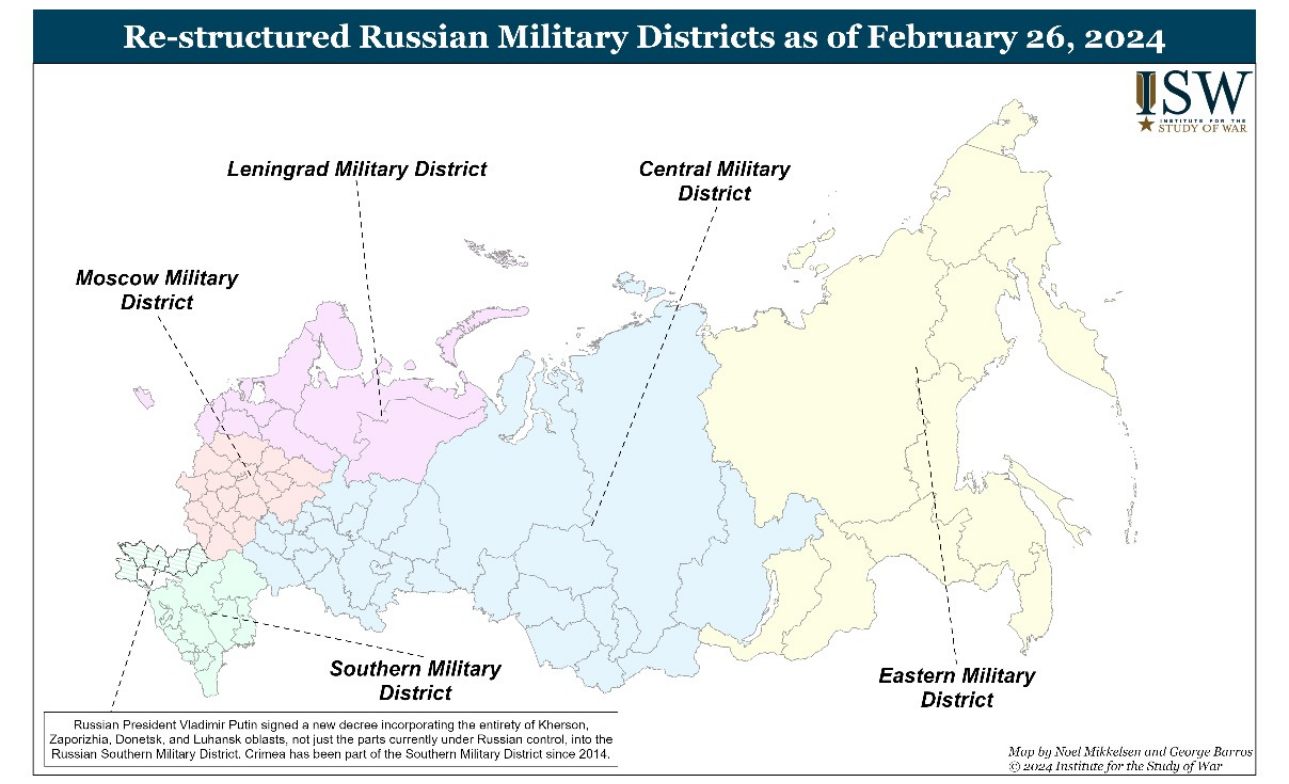
8.2.5 In the same report, ISW noted that Russian President Vladimir Putin signed a decree on 26 February 2024 that ‘incorporates occupied Ukraine into the Southern Military District (SMD), notably including all of Kherson, Zaporizhia, Donetsk, and Luhansk oblasts (as well as Crimea, which has been part of the SMD since 2014), not just the parts currently under Russian occupation.’[footnote 11]
8.2.6 The International Institute for Strategic Studies (IISS), an international think tank headquartered in London that ‘produces independent, policy-relevant data about geopolitics, geo-economics and conflict’[footnote 12], estimated in its Military Balance 2025 report that the armed forces of the Russian Federation comprised approximately 1,134,000 personnel in early 2025[footnote 13].
8.2.7 In April 2025, the Sasakawa Peace Foundation (SPF), a Japanese private foundation that explores ‘innovative solutions and approaches for addressing a wide range of issues facing the world’[footnote 14] reported the below personnel numbers of the Russian armed forces as of 2025[footnote 15], based on IISS reports:
Service Branches
- Ground Forces (SV): 550,000
- Navy (VMF): 119,000
- Aerospace Forces (VKS): 170,000
Independent Branches
- Airborne Forces (VDV): 35,000
- Strategic Rocket Forces (RVSN): 50,000
Directly under General Staff
- Special Operations Forces (SSO): 1,000
Directly under Ministry of Defence
- Railway Troops (ZhDV): 29,000
- Command and Support: 180,000
9. Demography
9.1 Population
9.1.1 As of 1 January 2026, World Population Review estimated the population of Russia to be 143,394,458, of which 66.4 million (46.35%) are male[footnote 16], based on projections of the latest UN data.
10. Conscription
10.1 Age, length of service, and number of conscripts
10.1.1 Article 22 of the Federal Law “On Military Duty and Military Service”, with amendments as of 15 November 2015, defines Russians that are subject to conscription for military service as male citizens aged 18 to 30 years[footnote 17].
10.1.2 The EU Agency for Asylum (EUAA) stated in its report ‘The Russian Federation: Country Focus’ (EUAA 2025 Report), published in December 2025, that ‘[o]ne-year military service is compulsory for all Russian men aged between 18 and 30 years old. The upper conscription age was raised from 27 years as of 1 January 2024.’[footnote 18]
10.1.3 The Danish Immigration Service (DIS) and the Swedish Migration Agency (SMA) stated in a joint COI report on Conscription in Russia (DIS and SMA 2025 Conscription Report), published in March 2025, that ‘[o]nce a man turns 30, he can no longer be drafted for conscription service, but if a man is summoned for instance two weeks before he turns 30, he is obligated to serve. The change in the age of conscription does not affect those, who have already served as conscripts. However, it does affect a person who has previously had his military service deferred for instance due to being enrolled at university.’[footnote 19]
10.1.4 The DIS and SMA 2025 Conscription Report also noted that ‘[t]here have been no changes regarding the number of people conscripted over the past years. This number is still approximately 300 000 annually, which constitutes roughly one third of the total population of men turning 18 per year…
‘Although the conscripts are an integrated part of the military, the military does not independently decide how many shall be drafted. The army will forward their request to the Kremlin, but it remains a political decision by the Kremlin as to how many shall be drafted… [T]he Russian military authorities’ main task is to ensure an increase in the number of contract soldiers rather than in the number of conscripts. Since issues concerning conscripts are sensitive to the Russian public, the Russian authorities are unwilling to increase the number of conscripts.’[footnote 20]
10.1.5 The Office of the UN High Commissioner for Human Rights (OHCHR) noted in a report released on 20 March 2026:
‘The imposition of Russian citizenship on the population in occupied territory has resulted in Ukrainian men aged 18 to 30 being treated as eligible for conscription into the Russian armed forces under Russian national legislation, although under IHL, an occupying Power cannot compel protected persons to serve in its armed forces. Since October 2023, Russian authorities have conducted five conscription campaigns in occupied territory, and adopted measures to pressure people to join the Russian armed forces. While no official statistics have been published, documents suggest that thousands of residents of occupied territory have been unlawfully conscripted into the Russian armed forces.’[footnote 21]
10.1.6 Freedom House noted in its Freedom in the World 2026 Report, covering events of 2025: ‘Members of ethnic and racial minority groups and the home regions of such populations have been disproportionately targeted in the government’s military conscription … efforts since 2022.’[footnote 22]
10.2 Military register
10.2.1 Article 8 of the Federal Law “On Military Duty and Military Service” requires all Russian citizens to be registered with the military except, inter alia, those exempted from military duty, women without a military specialisation, and those permanently residing outside the Russian Federation[footnote 23].
10.2.2 The EUAA noted in a report on human rights and military service in the Russian Federation, published on 21 November 2024 that:
‘[a]t the end of April 2024, the Russian government announced a decree on the establishment of the “Unified register of information on citizens subject to initial military registration, citizens on the military register, and citizens not on the military register but obliged to be on the military register.” The unified digital register should combine personal data about Russians from a range of government institutions, such as the tax service, law enforcement, the pension fund, and medical facilities, and have detailed records of persons eligible for military service. Besides the Ministry of Defence (MoD), the Federal Security Service (FSB) and other security agencies would also have access to the electronic register.’[footnote 24]
10.2.3 Novaya Gazeta Europe, a Latvia-based news outlet that was founded ‘following Russia’s invasion of Ukraine … and the subsequent introduction of wartime censorship’[footnote 25], reported in an article on 18 September 2024 that ‘[t]he Russian authorities have begun testing a new system for digitally issuing military draft notices to eligible conscripts in three regions of the country.
‘According to the website … [of the] “draft notice register”, a “unified register of military registration” is currently being tested in central Russia’s Ryazan region, the Volga region’s Mari El republic and on the island of Sakhalin in the Russian Far East.’[footnote 26]
10.2.4 The EUAA 2025 Report noted that:
‘by July 2025, there was widespread transfer of data to the electronic military register, with military enlistment offices (voenkomats) requesting information from various institutions such as hospitals and educational institutions, and the Ministry of Internal Affairs. The military register has also affected border crossing practices, as border officials control whether the person has received a summons from a military enlistment office, and prevent exit if an electronic summons is found in the system. At the same time, entry data is automatically transmitted to a military enlistment office.’[footnote 27]
10.3 Military booklet
10.3.1 The Belgian Office of the Commissioner General for Refugees and Stateless Persons (CGVS) published a Dutch-language COI report entitled ‘Russian Federation: Military service, contract soldiers and mobilisation’ in January 2026 (CGVS 2026 Report). Translated with free online tools, it observed:
‘The so‑called military booklet contains information about the status of a conscript’s military service. It can be obtained from the army unit where the person served or from the military commissariats, and it is issued at the following times:
-
upon completion of military service or alternative service;
-
to persons studying at a military higher‑education institution;
-
when a person is entered into the zapas [the reserve];
-
when a person is exempted from military service for medical reasons, or when they reach the age of 30 and until then had a deferral for completing military service;
-
specifically to women who have completed training that is regarded as a “military speciality” (for example, nurses).
‘Up to 2018, the military booklet was always in the form of a paper passport‑type document. After 2018, electronic versions in the form of a bank card also began to be issued … There are two types of paper booklet: a red one and a green one. The red one has 32 pages and is intended for conscripts and persons in the reserve. The green one has 40 pages and is intended only for officers in the zapas [the reserve].’[footnote 28]
10.3.2 The CGVS 2026 Report also observed:
‘In some situations, persons who are still of conscription age may experience difficulties if they do not possess a military booklet. This is the case, among other things, when they start work as an employee. Employers are obliged to pass the details of conscripts on to the military commissariat and are often reluctant to employ workers whose conscription obligations are not in order. The military booklet is also often requested in order to obtain a travel passport and a driving licence …
‘Since April 2022, sources have stated that some military commissariats or military commanders place specific stamps in the military booklets of persons who refuse to sign to go to Ukraine. There are said to be several versions in circulation, but most state that the person refuses to take part in the special military operation in Ukraine and, as such, displays a tendency towards treason. This type of stamp is not provided for in Russian legislation.’[footnote 29]
10.4 Conscription summons
10.4.1 Article 31 of the Federal Law “On Military Duty and Military Service” stipulates that Russian citizens subject to conscription for military service are obliged to receive summonses from the military commissariat in writing against receipt. It also sets out that summonses are to be sent in writing and duplicated in electronic form[footnote 30].
10.4.2 The DIS and SMA 2025 Conscription Report stated that ‘a draftee cannot legally leave Russia the moment the electronic summons has been sent to him, as the FSB will receive a notification if his passport is scanned at the border. … [T]his applies to all types of passports including non-biometric passports.’[footnote 31]
10.4.3 The Moscow Times, an Amsterdam-based ‘independent English-language media outlet’[footnote 32] reported on 30 September 2025 that ‘President Vladimir Putin signed a law in April 2023 overhauling the country’s draft system by introducing the electronic summons program and a centralized digital registry of eligible men.
‘The registry allows authorities to issue a summons through the online government portal Gosuslugi, by mail or via the new digital database, eliminating the requirement for in-person delivery, which had made the draft easier to avoid.’[footnote 33]
10.4.4 In the same article, The Moscow Times noted that ‘Russia’s digital military summons system automatically restricts draftees’ rights, including automatic travel bans, if they fail to report for compulsory service. An online notice is considered legally served seven days after being posted online, even if the recipient does not read it.’[footnote 34]
10.4.5 Furthermore, the Moscow Times stated in the same article that ‘[u]nder the law [signed in April 2023], men who continue to ignore their summons after 20 days face driving bans and limits on loans and real estate transactions.’[footnote 35]
10.4.6 Radio Free Europe/Radio Liberty (RFE/RL), a media organisation ‘providing accurate, uncensored news and open debate in countries where a free press is threatened and disinformation is pervasive’[footnote 36], reported in a Russian-language article published on 1 November 2024: ‘For ignoring a draft summons, a fine of between 10,000 and 30,000 roubles [approximately £102 GBP and £308 GBP] may be imposed. If a court establishes intent to evade service, this creates a direct risk of criminal liability, including imprisonment for up to two years.’[footnote 37]
10.4.7 The International Labour Organization’s statistics on earning and labour income list the average monthly earnings of male employees in Russia as $2,604 USD [approximately £1,953 GBP[footnote 38]] for 2021, the latest year with available data[footnote 39].
10.4.8 The Ministry of Foreign Affairs (MFA) of the Netherlands stated in a COI report released on 14 February 2025 (Dutch MFA 2025 Report):
‘Since 11 December 2023, conscripts who have been called up have had to surrender their international passports to Russian authorities. Only upon presentation of a military booklet stamped as proof of completion of compulsory military service can they get their passports back. Passports not surrendered in accordance with this law are invalidated in the systems. How conclusive these systems are, and whether the information is shared with border police, is not known.’[footnote 40]
10.4.9 The EUAA 2025 Report observed in December 2025 that the ‘delivery of electronic summonses has been introduced nationwide…
‘During the autumn draft of 2025, conscription summonses were reportedly issued solely in electronic form in Moscow oblast, Ryazan oblast, Mari El Republic, and Sakhalin oblast.’[footnote 41]
10.4.10 In the same report, EUAA noted that ‘in 2024 and 2025, there were some cases where individuals attempted to leave Russia by plane after receiving conscription summonses: reportedly, some were denied boarding, detained, or fined for failing to appear at a military enlistment office. In other cases, the border control could not detect that they had pending summonses, so they were able to leave.’[footnote 42]
10.4.11 Meduza, a Latvia-based media platform reporting ‘news and feature stories from hundreds of sources in Russia and across the former Soviet Union’[footnote 43] reported in an article published on 7 April 2026: ‘In March [2026] – just as the spring deployment period began – there was a noticeable increase in cases where the FSB blocked people from leaving the country at the airport…’[footnote 44]
10.5 Conscription process
10.5.1 The DIS and SMA 2025 Conscription Report described the conscription process as follows: ‘The year a Russian man turns 17, he is summoned at the Voenkomat where his documents will be checked and for a preliminary conscription evaluation, during which he will be assessed by medical doctors, specialists and psychologists before being evaluated for service by the Voenkomat. This preliminary evaluation is mandatory for every man once he turns 17.
‘The person would then have a brief interview with the Voenkomat personnel for them to get the information they need to assign conscripts, according to their skills. This is done because some arms of service are prioritised over others. The Voenkomat personnel will double check if the person has some kind of sporting achievement or if the person has IT skills, etc. that can be useful for the particular arm of service. Furthermore, during this interview, the potential conscript will get a chance to state if he qualifies for exemption or deferral…’[footnote 45]
10.5.2 The same report observed that after this evaluation, the individual undergoes military medical examination[footnote 46] as set out in the Regulation on Military Medical Examination, available in Russian as amended in August 2025. Appendix No. 1 to the regulation sets out the following five categories of fitness for military service[footnote 47]:
| 1. | Category A (А) | fit for military service |
| 2. | Category B (Б) | fit for military service with minor restrictions |
| 3. | Category V (В) | of limited fitness for military service |
| 4. | Category G (Г) | temporarily unfit for military service |
| 5. | Category D (Д) | unfit for military service |
10.5.3 The same appendix contains the ‘Schedule of Diseases’ which sets out health conditions and the corresponding military fitness categories. For individuals subject to conscription for military service, the category is listed in column I.
10.5.4 The DIS and SMA 2025 Conscription Report noted: ‘Those assessed in category V (3) are not called up during peacetime but may be called up during wartime. As they have no prior military training, they must undergo a shorter or longer training programme to perform service during wartime, likely in roles that are not particularly demanding.
‘Those assessed in category G (4), are referred for treatment lasting between 6 to 12 months. Following this, a new health assessment is conducted, which could potentially lead to placement in any of the other categories, i.e., A, B, V, or D. In the first two cases, individuals are called up for compulsory military service. In the latter two cases, they are not called up, but if placed in category V, they are transferred to the mobilisable reserve and may be called up during wartime. For those initially placed in category G (4), their subsequent category could be any of the four mentioned. However, the most likely outcome—if no specific treatment is undertaken during the 6-12 months but recovery from fractures or similar occurs naturally—is placement in category B (2). …
‘In peacetime, only men in category A and B are drafted for military service, but in wartime, men who have been deemed fit to serve with limitations are transferred to the reserve. In the early 2000’s, approximately 30 percent of the young men were deemed unfit to serve. During recent years, that number has decreased, according to official sources.’[footnote 48]
10.5.5 The DIS and the SMA noted in the same report:
‘After turning 18, Russian men are eligible for conscription and if they are drafted, they will once again be examined medically for changes in their health condition. It is then up to the Voenkomat to decide whether to conscript the person or grant him a deferral or an exemption. Assuming that the person will pass, he will be handed a new summons, in which it is stated when the person should reappear at the Voenkomat to commence the conscription, usually within the scope of three to five days. However, … the conventional deadline from when a person has received a summons to when he has to appear at the Voenkomat is approximately 20 days.
‘Upon reappearing at the Voenkomat, the conscript is transferred to a so-called regional collection point. Each region in Russia has one regional collection point. Here the person would be subjected to the so-called BIOS criteria, which means that the representatives of the various arms of service will be going through the personal files of the conscripts. Representatives from different military units meet at the regional collection point and choose conscripts. The selection can be based on qualifications such as special technical competence.’[footnote 49]
10.5.6 Furthermore, the same report observed:
‘So-called “one-day drafts” are illegal ways of drafting conscripts. “One-day drafts” is a process where individuals show up at the Voenkomat for a specific purpose (e.g. to collect documents) and once there, are conscripted and sent to military service the very same day. This practice constitutes a violation of Russian law and was previously uncommon. However, an increase in this practice has been noted since 2022. The practice is more common in bigger cities, since people in rural regions usually adhere to their summons to a greater extent than in larger and more densely populated places. In October 2023, at the beginning of the autumn conscription campaign, there were also examples of forced one-day conscription through raids conducted in Moscow where young people were conscripted from dormitories, apartments, grabbed on the streets, in the subway, in mosques and in educational institutions.
‘The authorities have also intensified conscription through the establishment of a Single Conscription Point (SCP) in Moscow in March 2024. In the SCP, conscripts’ personal files are stored centrally and their smartphones are confiscated at the entrance. Freedom of movement and means of communication is restricted and attorneys are not permitted. The practice of SCP is planned to be introduced in other regions.’[footnote 50]
10.5.7 Meduza reported in an article published on 7 April 2026: ‘Since January 1 [2026], Russia’s mandatory military conscription — not to be confused with wartime mobilization — has become a year-round process. … [E]nlistment offices now operate continuously, rather than only during the traditional spring and fall draft campaigns.’[footnote 51]
10.5.8 In the same article, Meduza reported that ‘[a]nother major change, introduced in 2025, extends the validity of draft decisions. They now remain in force for a full year after being issued — a shift that … tilts the balance sharply against conscripts trying to avoid service.’[footnote 52]
10.5.9 Furthermore, Meduza reported in the same article that ‘[a] recently announced law further tightens the system: appealing a draft decision in court will no longer automatically suspend deployment. In other words, exploiting procedural loopholes to avoid service is becoming nearly impossible.’[footnote 53]
10.6 Exemptions
10.6.1 Article 23 of the Federal Law “On Military Duty and Military Service”, available in Russian as amended in November 2025, sets out exemptions from conscription for individuals unfit for military service due to health reasons, those who have already completed military service or alternative civilian service, those who have completed military service in a foreign state, and those who hold an academic degree recognised under the state system of scientific attestation. Sons and brothers of servicemen that died in connection with the performance of their military service duties or military training are also to be exempt from conscription. Furthermore, convicts serving their sentence, individuals with an outstanding or unspent criminal conviction, or persons under criminal investigation are not subject to conscription[footnote 54].
10.6.2 The Ministry of Foreign Affairs of the Netherlands stated in a COI report published on 14 February 2025: ‘Requests for exemptions based on health complaints were increasingly ignored by military commissariats and military registration and recruitment offices.’[footnote 55]
10.6.3 The DIS and SMA 2025 Conscription Report noted: ‘In order to apply for exemption or deferral from conscription, a person has to contact Voenkomat and provide their grounds for exemption or deferral. The procedure of providing grounds for deferral or exemption to the Voenkomat is nowadays possible to do over e-mail or through Gosuslugi [the online government portal].’[footnote 56]
10.6.4 In the same report, the DIS and the SMA stated:
‘Traditionally, corruption has played a significant part in how many men have been exempted from military service for medical reasons. Bribing doctors to falsify medical certificates stating that one is unfit to serve is prevalent amongst young people. However, the doctors at the Voenkomat will conduct their own medical examination of each conscript. These doctors have extended experience with people falsely claiming to suffer from health issues, and therefore it is rather difficult to get out of military service due to feigned medical problems.’[footnote 57]
10.6.5 Ilia Shumanov, former head of Transparency International Russia, a non-governmental organisation that aims ‘to counter corruption in Russia and decrease the tolerance for it among Russian citizens’[footnote 58] stated in an article originally published in Russian by Meduza on 5 May 2025, that ‘[u]p to 90% of offers on the shadow market for evading military service are scams …’[footnote 59]
10.6.6 In the same article, Nadezhda Nizovkina, a Russian human rights activist from the Buryatia region, is quoted as stating that ‘“some doctors have begun cooperating with law enforcement agencies and military enlistment offices to identify draft evaders…
‘In other words, it has now become more of a trap than a genuine system of bribes. There is less and less outright corruption and more and more provocation… A person orders a falsified certificate, and they are caught and threatened with criminal prosecution. All of this is done to force them to sign a contract and go to the front.’[footnote 60]
10.6.7 It should also be noted that experts quoted in the same article, which was published before the full roll-out of the unified digital register, expected the register as well as the introduction of Single Conscription Points to help the Russian authorities’ fight against bribe-taking military commissars[footnote 61].
10.6.8 RAAM, a Dutch think tank that seeks to deepen knowledge ‘about political, social and cultural developments in Russia, Ukraine and Belarus’[footnote 62] reported in an article published on 21 May 2025 that:
‘… a vast black market has emerged to serve Russian civilians desperate to avoid conscription. Before the full-scale invasion of Ukraine, buying a military exemption document (a so-called ‘white ticket’) could cost between 90,000 and 450,000 rubles [approximately £923 GBP and £4,622 GBP] … After the announcement of mobilization, prices surged - by early 2023, forged exemption papers with a deferral-qualifying diagnosis were being sold on the dark web for over a million rubles [approximately £10,266 GBP] … More elaborate schemes, such as fake medical records or staged diagnoses of chronic illness, could cost up to 7 million … [approximately £71,848 GBP]. Telegram channels posing as legal aid groups … privately offered to make conscripts ‘disappear’ from draft databases for hundreds of thousands of rubles. Others sold spots in companies with military deferrals, such as the Ulan-Ude locomotive plant or forestry services - though new rules introduced in March 2025 have significantly narrowed the list of employers eligible for such exemptions.’[footnote 63]
10.6.9 The same article noted that:
‘a booming industry of private [legal assistance] firms now promises to guide conscripts through the draft process, often charging exorbitant fees - 150,000 to 200,000 rubles [approximately £1,539 GBP and £2,053 GBP] … - for ‘support’ that rarely leads to real results. These firms claim they can help clients avoid conscription through legal means. In many cases, medical diagnoses that should disqualify draftees are simply ignored by local draft boards - something that is less likely to happen when a conscript is represented by a lawyer. However, human rights advocates warn that many of these firms function less as legal defense and more as intermediaries in a corrupt system.’[footnote 64]
10.6.10 The EUAA 2025 Report stated:
‘Medical exemptions are ‘the most popular way to avoid military service,’ with approximately 30-40 % of conscripts seeking exemption on health grounds. As noted by Russia-based human rights organisations helping potential conscripts and their families, obtaining medical exemptions remain difficult across the county due to bureaucracy and subjective medical interpretations of medical documents at military enlistment offices. Moscow in particular has been ‘a trouble spot’ for a long time, with doctors reporting ‘that they are prohibited from assigning non-draftable diagnoses.
‘Beginning from 5 September 2025 – for the first time since years – the authorities have reclassified certain medical conditions previously leading to exemptions from military service and introduced stricter documentation requirements. The main changes affect conditions such as primary and secondary syphilis, stage I hypertension, stage I sarcoidosis, well-controlled asthma, epilepsy under treatment, skin and endocrinal conditions, and obesity, which now do not result in the category unfit for military service. In addition, it became harder for individuals suffering from mental health issues to prove their condition.’[footnote 65]
10.6.11 In the same report, the EUAA observed that
‘… in many cases, there is ‘a strong element of corruption’ at the level of local military enlistment offices. There were cases, … regarding conscription into obligatory military service … where individuals with conditions qualifying for exemption were denied it. Those who did not challenge the conscription decision in court were ultimately conscripted into military service. [T]he … situation varies across military enlistment offices, and legal procedures are not always followed, including numerous cases where individuals were denied the right to apply for an exemption or were intimidated.’[footnote 66]
10.7 Deferral
10.7.1 Article 24 of the Federal Law “On Military Duty and Military Service”, available in Russian as amended in November 2025, permits the deferral of military conscription for individuals recognised as temporarily unfit for military service for health reasons (for a period of up to one year), those engaged in family care obligations, those employed in state institutions, and elected officials of state and municipal government institutions. It also allows for the deferral of conscription into military service for full-time students[footnote 67].
10.7.2 The DIS and SMA 2025 Conscription Report noted: ‘One of the primary, if not the foremost, reasons for deferral of military service is the pursuit of academic studies. … [B]eing enrolled in an educational institution would more or less automatically lead to a deferral from military service until the completion or termination of the studies. Due to the widespread prevalence of corruption in Russia, it would also be possible for a person to pay a lower quality university for enrolment despite not intending to fulfil the studies. However, the rules have become stricter and any documents supporting grounds for deferral due to e.g. studying will likely be checked thoroughly at the Voenkomat. A person who was granted deferral from conscription due to studying one subject, would not be granted deferral should he change the subject of his studies.’[footnote 68]
10.7.3 The DIS and the SMA stated in the same report: ‘The authorities have … become less lenient when granting deferral to persons already employed by the Russian state. Furthermore, Russian authorities have tightened their efforts to draft conscripts, partly by breaching several of their rights, making it more difficult for people to use their legal rights to avoid performing military duty. The Russian authorities have reportedly isolated and detained conscripts in Voenkomats, [and] ignored deferrals due to studies …
‘There is reporting of medical personnel at the Voenkomats disregarding medical conditions of persons who are unfit for service, leading to them being drafted despite having legal reasons for deferral.’[footnote 69]
10.7.4 The Dutch-language CGVS 2026 Report, translated with free online tools, observed that:
‘[s]ince March 2022, a new category of persons entitled to deferment from conscription has been added, namely IT specialists. They must meet the following conditions: completion of higher education and official full-time employment. In May 2023, the Ministry of Defence tightened the rules under which companies can obtain deferments for their IT staff. On 4 September 2023, President Putin raised the age limit for exemption for IT specialists from 27 to 30 years.’[footnote 70]
10.8 Alternative civilian service (ACS)
10.8.1 Article 59.3 of the Constitution of the Russian Federation sets out alternative civilian service (ACS) for Russian citizens whose convictions or religion contradict the performance of military service[footnote 71].
10.8.2 Article 2 of the Federal Law “On Alternative Civilian Service”, originally adopted in Russian and as amended in August 2023, furthermore specifies that a person has the right to ACS if they belong to a small indigenous minority and lead a traditional way of life[footnote 72].
10.8.3 Article 5 of the same law defines the duration of ACS as 21 months – 1.75 times longer than the term of military service under conscription. For individuals performing ACS in a civilian role within the armed forces of Russia, the duration is 18 months – 1.5 times longer than the term of military service under conscription[footnote 73].
10.8.4 Current Time TV, a Russian-language news outlet created by RFE/RL[footnote 74], noted in an article originally published in Russian on 17 May 2024:
‘[A] trap for conscripts is the article on “discrediting the armed forces”, which appeared in the Russian Administrative and Criminal Codes in the spring of 2022. Anti-war beliefs are one of the legitimate reasons for applying for alternative civilian service. However, if a conscript states that he does not want to serve because Russia is waging an aggressive war, he may have an administrative offence report drawn up against him. Human rights defenders are aware of two such cases.’[footnote 75]
10.8.5 The article goes on to report that one of the two cases was dismissed by the court, but in the other case the man was fined 40,000 rubles [approximately £410 GBP] in June 2022[footnote 76].
10.8.6 Forum 18, a Norway-based foundation providing ‘monitoring and analysis of violations of freedom of thought, conscience and belief’ in various countries including Russia[footnote 77] noted in an article published in January 2025:
‘‘Until their organisations were liquidated and their activities banned as “extremist” in 2017, Jehovah’s Witnesses constituted approximately 60 per cent of applicants for alternative civilian service and were usually successful … Now, however, young Jehovah’s Witness men risk investigation and prosecution for “continuing the activities of an extremist organisation” if they cite active involvement in their religious communities as evidence of their beliefs.’[footnote 78]
10.8.7 The DIS and SMA 2025 Conscription Report stated:
‘Interest in ACS has … increased tenfold compared to before the full-scale war, which leads to obstacles in the procedure for ACS, even though the procedure itself is still available. Human rights defenders have also noted an increase in questions on how to apply for ACS, and what to do if this right is denied. In addition, human rights defenders note an increase in refusals from the Voenkomat and a decrease in the number of successful cases brought by conscientious objectors in the courts.
‘For a person to apply for ACS based on religious beliefs, their religious organisation must be legally registered in the Russian Federation, and the person must prove that they are a registered member of that community.’[footnote 79]
10.8.8 In the same report, the DIS and the SMA observed that ‘[t]here are multiple cases of men living a traditionalist way of life in hunter, gathering and reindeer herding communities in the far north and Siberia, applying for alternative military service on these grounds.
‘Being disabled does not constitute eligible criteria to apply for ACS. Disabled individuals (depending on their degree of disability) have to apply for regular exemption from military service.’[footnote 80]
10.8.9 The same report furthermore stated that ‘[f]or someone already conscripted, there is no mechanism for transferring to ACS or early dismissal from military service due to the formation of beliefs contrary to military service. Early dismissal is possible only for health reasons and under certain social circumstances.’[footnote 81]
10.8.10 The DIS and SMA 2025 Conscription Report furthermore stated:
‘Members of Jehovah’s Witnesses do generally not wish to serve in the military, due to their religious beliefs as pacifists.
‘Previously, it was sufficient for a summoned person to state that he belongs to Jehovah’s Witnesses and almost automatically, he would be granted ACS [alternative civilian service] instead of ordinary military service. Since 2017, Jehovah’s Witnesses is labelled an extremist movement in Russia and being a member is illegal. Therefore, a member of Jehovah’s Witnesses would likely face criminal charges rather than conscription if his affiliation to this denomination becomes known. However, the person would still be eligible for conscription as soon as cleared of criminal charges or in case no charges are raised.’[footnote 82]
10.8.11 The EUAA 2025 Report noted:
‘As of March 2025, the list of professions available for alternative civilian service consisted of 266 professions. The placements can be in the spheres of social service, healthcare, education, culture, and art, with the positions ranging from skilled professions (such as doctor, veterinarian, engineer, programmer, or economist) to general working specialities (janitor, driver, courier, handyman). The placement is determined by the draft commission and, therefore, can take place in the location different from the individual’s place of residence. Quitting alternative civilian service is not possible, as it leads to a criminal prosecution for draft evasion.’[footnote 83]
10.8.12 In the same report, EUAA observed that:
‘[a]pplicants must submit their request to the military enlistment office no later than six months before the start of the conscription period: by 1 April to enroll during the autumn draft and by 1 October to be included in next year’s spring draft. The application must clearly indicate the reasons for the inability to perform the military service and include supporting documents, such as a reference letter from the place of work or study and witness statements. Late applications can be submitted with a valid explanation for the delay.
‘Military enlistment offices often refuse the requests for alternative civilian service, including for missing application deadline (which constitutes the majority of refusals), insufficient or false information, prior evasion of military service, and lack of suitable or available vacancies…
‘Access to alternative civilian service in Moscow has become increasingly difficult, with only one in 33 applications approved during the 2025 spring draft… [E]ven if the person is granted alternative civilian service, problems often occur with finding an organisation where it can be performed, with the procedure handled by the Ministry of Labour, a civil service agency.’[footnote 84]
10.8.13 The EUAA 2025 Report also noted that ‘Huseyn Aliyev [Senior Lecturer in Political and International Studies at the University of Glasgow[footnote 85]] … noted an increase in corruption, with some applicants being requested to pay bribes to receive approval [for ACS].’[footnote 86]
10.8.14 The CGVS 2026 Report noted that ‘[t]he application for alternative service must be submitted to the local military commissariat. This can be done in person, through a representative, or by post by registered letter…
‘After the conscription commission has received the application, it must, in principle, examine it within one month following the end of the statutory application period. The conscription commission will then summon the applicant to a hearing. The applicant must appear in person before the conscription commission to explain his application. He normally receives the summons no later than three days before the hearing. At the end of the hearing, the commission communicates its decision and must provide a written certificate thereof. If the commission refuses the application, the applicant may appeal the decision before a court. Such an appeal has suspensive effect.
‘If the conscript is granted the right to perform alternative service, he must subsequently undergo a medical examination at the military commissariat. This examination is conducted in the same manner as for other conscripts.
‘In most cases, alternative service begins during the next call‑up period, as the military commissariat must transmit the details of persons performing alternative service to the Ministry of Labour. The Ministry must then identify vacant positions for them at a number of institutions designated annually. For the performance of alternative service, the conscript concludes an employment contract with the institution where he performs his service and receives a salary.’[footnote 87]
10.8.15 In the same report, CGVS stated that ‘[t]here are no objective figures on the number of applications for alternative service that are submitted, and it is therefore unclear what percentage of applications are approved. According to the Ministry of Defence, 98% of applications are accepted, whereas the organisation Movement of Conscientious Objectors states that approvals are granted in only half of cases.’[footnote 88]
10.8.16 The CGVS observed in the same report that ‘[a]fter completing alternative service, a person is placed in the zapas (reserve). However, he cannot be called up for military follow‑up training exercises, the so‑called sbory, which do apply to persons who have completed regular military service.’[footnote 89]
10.8.17 The Moscow Times reported in an article published on 9 March 2026 that:
‘[t]he number of young Russians opting to replace army service with alternative civil service reached a 14-year high in 2025 … Russia’s Federal Labor and Employment Service (Rostrud) data showed that 3,212 Russians had chosen to perform alternative civil service by the end of 2025. Alternative civil service has increased 180% since the start of Russia’s full-scale invasion of Ukraine in 2022, when 1,140 young people performed alternative civil service.’[footnote 90]
10.8.18 In the same article, The Moscow Times observed that ‘[r]ights activists say [that] Russia’s move to a year-round military draft allows would-be conscripts to apply for alternative civil service throughout the year.’[footnote 91]
10.9 Deployment of conscripts
10.9.1 The Dutch MFA 2025 Report observed that ‘[a]ccording to one [anonymous] source, … conscripts were deployed in illegally annexed Crimea.’[footnote 92]
10.9.2 The same report also stated:
‘Deployment of conscripts in combat areas did occur during the reporting period in battles outside Ukraine (in other words, in Kursk and Belgorod), where Ukrainian forces had invaded Russian territory. Although no official figures are available on the number of conscript fatalities, there were reports of hundreds of conscripts deployed in defence in the Kursk and Belgorod region, and dozens who died, were taken prisoner of war by Ukrainian forces or with whom there was no further contact.’[footnote 93]
10.9.3 The DIS and SMA 2025 Conscription Report stated that ‘[a]ll new conscripts are given six to eight weeks of basic military training upon joining the military only after which they will be given the actual rank of ‘ryadavoy’ (equivalent to private). A conscript that performs well, may eventually be promoted to the rank of “efreytor” (equivalent to the rank of private first class)…
‘Being promoted to the rank of efreytor is desirable, as efreytors are exempted from performing the more mundane tasks in the military.
‘… [Approximately] 65 percent of the tasks performed by conscripts involve manual labour. A conscript could for instance be tasked with constructing both military and civilian facilities or with cleaning the base. Other tasks could be related to logistics, communication and supply lines. The overall quality of the basic training given to conscripts is relatively low, but conscripts drafted into more elite units in the military are given better training.’[footnote 94]
10.9.4 The same report also observed that:
‘Conscripts have operated checkpoints, have forwarded observation posts and have assisted FPV [First Person View] drone teams. Rear artillery positions are also staffed by conscripts.
‘Conscripts have been actively used to guard the Russian-Ukrainian border since the autumn of 2022. By Russian law, conscripts can only be posted inside Russian territory, and most sources agree that conscripts do not serve in Ukraine proper.
‘Russia considers the annexed Ukrainian regions of Luhansk, Donetsk, Kherson and Zaporizhzhia part of the Russian territory. The question of whether conscripts serve in these regions is debated among the interviewed sources. Some sources believe that conscripts are not posted in the annexed regions. Other sources believe that conscripts are in fact posted in the annexed regions.
‘Russian law prohibits using conscripts in combat units, and the majority of sources believe, that conscripts are therefore not used for combat duties including in the annexed regions. … According to sources who believed that conscripts are posted in Ukraine, these conscripts are performing duties supporting the Russian war effort such as constructing defensive fortifications or digging trenches. Despite not being deployed for active combat, conscripts serving near the front lines do however still risk being subjected to Ukrainian drone attacks or missile attacks.
‘… [E]nding up in one of the annexed regions would put a conscript in a desperate situation, as he would be at much higher risk of sustaining life threatening injuries there than in any other part of Russia. … [T]here have been cases where military barracks housing conscripts have been hit by long-range Ukrainian missiles in Luhansk and Donetsk, but conscripts serving in Kherson and Zaporizhzhia would be less likely to be hit.’[footnote 95]
10.9.5 Novaya Gazeta Europe reported in an article originally published in Russian in September 2025:
‘[Conscripts] are sent to serve in border areas, for example in the Kursk region, and they also end up in the combat zone under shelling and drones. The authorities can also send any conscript to the so‑called ‘new regions’ …, since the boundaries of the ‘SVO zone’ [Special Military Operation, the official term used by the Russian government to describe the war against Ukraine] are not confined to Russia’s internationally recognised territory… Back in October 2022, Vladimir Putin signed laws on the incorporation into Russia of four occupied regions of Ukraine—Kherson and Zaporizhzhia regions, as well as the Luhansk and Donetsk ‘people’s republics’.’[footnote 96]
10.9.6 The EUAA 2025 Report stated:
‘Conscripts can serve in ground forces, navy, aerospace forces, strategic missile forces and airborne forces, military units dealing with logistical and technical support, the Ministry of Emergency Situations, and the National Guard (Rosgvardiya). The distribution of conscripts to military units is carried out by military enlistment offices. During conscription procedures, conscripts have a possibility to indicate their preference regarding the type of the armed forces, but there is no guarantee that they will get to serve there. … [S]ome conscripts can pay a bribe to be able to choose the type of forces and even the location of the military unit. Otherwise, the assignment of conscripts depends on the needs of military units, therefore, they can be sent anywhere in Russia, including to the border regions with Ukraine.’[footnote 97]
10.9.7 The same report noted that ‘conscripts serving in border regions can legally be deployed to combat operations through 30-day assignments. In these cases, conscripts are not sent to frontline assaults but are usually involved in support roles, such as shooting down drones or digging trenches. Still, reports of such deployments by conscripts are not widespread.’[footnote 98]
10.9.8 The CGVS 2026 Report, available in Dutch and translated with free online tools, noted that ‘[c]urrent legislation provides that conscripts may not be deployed in combat situations as long as they have not completed four months of training and acquired a military specialisation. This rule may be suspended if the authorities declare martial law or in a situation of war…
‘However, on 9 March 2022 the Russian Ministry of Defence officially acknowledged that Russian conscripts had participated in [the fighting in Ukraine] … and that some had already been taken prisoner of war. …
‘In early June 2022, the military prosecutor Artur Yegiev told the State Duma [one of the chambers of the Russian parliament[footnote 99]] that, according to his data, 600 conscripts had been present in combat zones in Ukraine and that they had been withdrawn as quickly as possible. Since then, President Putin and the Ministry of Defence have repeatedly stated that no conscripts remain in Ukraine.’[footnote 100]
10.9.9 In the same report, the CGVS stated that ‘it is legally possible to deploy regular conscripts to the border zone with Ukraine. This was confirmed, for example, during the incursion of Ukrainian forces into Russia’s Kursk region in the summer of 2024, when Russian conscripts were taken prisoner of war.
‘… [I]n 2025, there were still reports of conscripts being sent to Russia’s border regions with Ukraine to carry out their military service there.’[footnote 101]
10.10 Service conditions for conscripts
10.10.1 The DIS and SMA 2025 Conscription Report stated: ‘Conscripts are under the jurisdiction of The Ministry of Defence during their time of service. In case of injury or illness, they will therefore be treated at designated military hospitals and not at public hospitals. In the regions near Ukraine, temporary military hospitals have been constructed to offer further support to the war effort. Conscripts serving in these regions will be treated at these temporary hospitals, if need be.
‘The quality of medical services varies from region to region and the lack of medical personnel is more prevalent in the far east and in the more remote areas of Russia. Since the full-scale invasion of Ukraine in 2022, the need for medical personnel to support the forces operating in Ukraine has increased, leading to an overall lack of medical personnel everywhere in Russia proper. However, there are means of transportation available to conscripts serving in regions with a poorer quality of medical services…
‘The scarcity of medical resources has led to cases where soldiers, despite being diagnosed and recommended for treatment by a doctor, have been denied referral to a hospital by the commanding officer. In other cases, doctors failed to diagnose a soldier correctly.’[footnote 102]
10.10.2 The same report also observed, based on interviews with several expert sources: ‘Historically, the practice of hazing junior conscripts – subjecting to violence – has played a major role in the Russian military. … Dedovshchina consists of both physical and verbal abuse as well as the practice of extracting money from junior conscripts by threatening to assign them to very undesirable tasks.
‘The Russian military has taken steps to reduce the prevalence of dedovshchina. Dedovshchina does however, still exist in Russian military units, where the general level of violence is still relatively high, but is now more a concept of just violence and the prevalence of dedovshchina depends on the culture within the individual military unit and its commanding officers. It also depends on the geographical location of the military unit. For instance, conscripts serving in more remote regions like Kamchatka could be more likely to be subjected to dedovshchina, as there are fewer opportunities for conscripts to “blow off steam” and as the posting is further away from the view of higher authorities. …’ [footnote 103]
10.10.3 The same report continued:
‘Dedovshchina exists in every arm of service, although it is less prevalent in the more specialised units like the Spetznaz. Due to dedovshchina being somewhat arbitrary in nature, it is difficult to identify certain profiles who would be more at risk of being subjected to this practice than others. Certain ethnic groups such as those from Buryatia, members of the LGBT community and conscripts who do not align with traditional notions of masculinity may, however, face an increased risk of experiencing dedovshchina. Specifically, conscripts belonging to ethnic minorities not native to the territory of the Russian Federation are more likely to be subjected to harassment, hazing and discrimination. This could be the case for conscripts from Central Asian republics (Kazakhstan, Uzbekistan, Kyrgyzstan, Tajikistan, and Turkmenistan) many of whom hold Russian citizenship. …’ [footnote 104]
10.10.4 Considering treatment of LGBT+ conscripts, the DIS and SMA 2025 Conscription Report stated:
‘Members of the LGBT community are especially at risk of being subjected to dedovshchina or abuse in general, and a conscript belonging to the LGBT community would normally try to hide his sexual orientation. There are cases of LGBT members being sexually assaulted by other soldiers in the Russian military. LGBT persons who are subjected to abuse would likely be unable to obtain assistance within their military units, and asking fellow soldiers for help would more likely than not make the situation even worse.
‘… There are cases of members of the LGBT community serving in the military without any incidents, as they successfully managed to hide their sexual orientation.’[footnote 105]
10.10.5 The same report also considered the consequences of dedovshchina and avenues of redress to conscripts subjected to it:
‘Despite the prevalence of dedovshchina, there are no recent reports of serious injuries or death caused by this practice. However, traditionally death by suicide has been used within the Russian military to explain death caused by hazing.
‘A conscript who has been subjected to dedovshchina does have the formal right to file a complaint to the military prosecutor’s office or to the military investigation department. Doing so does, however, inherently comes with a risk, especially if the complaint is directed at the commander of the military unit, as the conscript risks returning to that same military unit if his complaint is unsuccessful.
‘A conscript facing abuse may also seek a transfer to a different military unit, but this typically requires legal assistance, as securing a transfer independently is highly challenging.
‘The best way for a conscript facing abuse is to flee his military unit. Although fleeing is a criminal offence. However, if the conscript promptly files a complaint citing abuse as the reason for his actions, he will not be prosecuted should his complaint be successful.’[footnote 106]
For information on conscripts entering into contracted service, see also Recruitment as contract soldiers of conscripts and reservists.
10.11 Casualties
10.11.1 The BBC noted in an article originally published in Russian on 9 August 2024, that ‘[a]t least 159 Russian conscripts have died during the Russian invasion of Ukraine. The BBC established this figure by analysing the list of names of confirmed dead Russian servicemen … The real number of dead conscripts is probably higher …’[footnote 107]
10.11.2 Vot Tak, a Warsaw-based media outlet that reports on ‘Russian aggression and its consequences’[footnote 108] reported in an article originally published in Russian on 17 April 2025:
‘After the start of the full-scale invasion of Ukraine, reports of killed conscript soldiers began to appear regularly on social media and in regional news outlets. Although the war is being fought almost exclusively by contract soldiers and mobilised personnel, conscripts are regularly coming under fire in the Bryansk, Belgorod and Kursk regions and are even taking part in combat against the Armed Forces of Ukraine.
‘The exact number of Russian conscripts killed since the beginning of the invasion is unknown. However, there are approximate estimates. On 17 April, the [governmental[footnote 109]] Ukrainian project “I Want to Live”, which helps Russian soldiers surrender, published a list of 217 names of conscripts who, according to the project, died under various circumstances over three years of the full-scale war in Ukraine — from 24 February 2022 to 17 April 2025.
‘… [T]he list was compiled on the basis of data from “sources” within the Russian armed forces. It includes only those servicemen for whom it is known with certainty that they were conscripts …’[footnote 110]
10.12 Evasion of conscription
10.12.1 Article 21.5 of the Code of the Russian Federation on Administrative Offenses, available in Russian as amended in November 2025, stipulates that a person that fails to appear at a military enlistment office upon receiving a summons is liable to an administrative fine of 10,000 to 30,000 rubles [approximately £102 GBP and £308 GBP]. Lower fines apply to failures to notify a military enlistment office of changes to personal details, including marital status, education, place of study or employment, and residential address, as well as to failures to report departure from Russia for a period exceeding six months[footnote 111].
10.12.2 Article 328 of the Criminal Code of the Russian Federation, available in Russian as amended in November 2025, sets out that evasion of conscription for military service is punishable by a fine of up to 200,000 rubles [approximately £2,053 GBP] or by compulsory labour or imprisonment for up to two years[footnote 112].
10.12.3 The DIS and SMA 2025 Conscription Report stated: ‘… [D]raft evasion is moderately widespread in Russia and … there has been no major increase in the numbers of draft evaders since the beginning of Russia’s full-scale invasion of Ukraine. … [A]lthough there has been a slight increase in persons avoiding conscription, the majority of draft evaders tend to evade through the means of corruption or by enrolling themselves into higher education to get a deferral without the intention of fulfilling the studies.
‘… [T]here was an initial increase of young men leaving Russia in the early stages of the full-scale invasion and later on during the first wave of mobilisation. As of December 2024, the outflow of men leaving Russia is rather steady and in general, individuals potentially vulnerable for conscription are taking preparatory measures rather than dodging military service.’[footnote 113]
10.12.4 The same report noted: ‘… [I]f an evasion case passes on to criminal investigation, the case will be handed over to a police investigator and it will be up to the police investigator to decide on the severity of the punishment. In the very few cases of draft evasion that actually go to court, it is very likely that the person in question would be fined, although it will most likely be a higher fine than in administratively settled cases – probably the double of the administrative fine.’[footnote 114]
10.12.5 The DIS and SMA 2025 Conscription Report also observed: ‘Paying a fine for draft evasion does not mean that a person would be excluded from future drafts. A person evading one draft risks being summoned again in future drafts, provided he is still within the age of conscription. … [T]here are cases of persons who have been fined and were given a new summons basically the next day. Furthermore, a summons can also be handed out at the point of entry to Russia, such as international airports.’[footnote 115]
10.12.6 iStories, a Russian ‘independent media outlet’[footnote 116] reported in an article that summarised data published by the Judicial Department of the Supreme Court of the Russian Federation in April 2025: ‘In 2024, 916 Russians received sentences for evading military conscription. Two more were convicted on charges of evading alternative civilian service.
‘In most cases, the courts imposed fines of up to 100 thousand rubles [approximately £1,026 GBP] — 95% of all those convicted. At the same time, the average fine is increasing, as draft dodgers are increasingly being fined amounts of 25 thousand rubles [approximately £256 GBP] or more.
‘Only five Russians received suspended sentences. Actual imprisonment was applied as a punishment under this article only once — in 2022, according to data from the Judicial Department.’[footnote 117]
10.12.7 In the same article, iStories noted that the organisation Get Lost, which seeks ‘to help russians [sic] evade conscription’[footnote 118], stated that there ‘are three … situations [in which the criminal article on evasion of conscription is applied]: if the conscript did not arrive for deployment to the army; for several conscription periods ignored summonses for medical examination or meetings of the draft board; received exemption from service through fraud.’[footnote 119]
10.12.8 The EUAA 2025 Report noted that in order to establish the evasion of conscription as a criminal offence, ‘the court must establish that there was a deliberate intent to evade military service, which can be demonstrated, for instance, through proving ‘repeated failures’ to appear at the military enlistment office without a valid reason.’[footnote 120]
10.12.9 In the same report, EUAA stated that ‘in the first half of 2025, 580 people were convicted by courts for draft evasion, with the majority (576) punished by a fine. Only two individuals were sentenced to imprisonment (up to one year): these are the first prison convictions in several years, which indicates that penalties for draft evasion remain relatively lenient.’[footnote 121]
10.12.10 The CGVS 2026 Report referenced the following assessment of the Russian organisation School of Conscripts, which analyses ‘how military commissariats and draft commissions comply with the conscription procedure and whether they violate the rights of conscripts’[footnote 122]: ‘[T]he convictions in 2025 do not necessarily indicate a change in trend. In both cases, the defendants had previously been convicted, meaning that punishment by a fine alone was no longer legally possible. In 2024, five persons were also given suspended prison sentences, one person was acquitted, and criminal proceedings were discontinued without consequence in 34 cases. All others received a fine in 2024.’[footnote 123]
10.12.11 Freedom House observed in its Freedom in the World 2026 report, covering events of 2025: ‘According to the 2023 law on conscription and mobilization, individuals who fail to respond to a summons for military service may lose the ability to receive loans, engage in real-estate transactions, hold a driver’s license, or register for self-employment, among other restrictions.’[footnote 124]
10.12.12 In the same report, Freedom House noted: ‘People accused of violating military draft laws are not guaranteed access to a public defender. In addition, judgments in such cases are no longer suspended during appeals, meaning defendants can be forced into service before a final ruling.’[footnote 125]
11. Contract soldiers
11.1 Recruitment of contract soldiers - general
11.1.1 Section V of the Federal Law “On Military Duty and Military Service”, available in Russian as amended in November 2025, sets out the legal provisions relating to military service under contract in the Russian Federation[footnote 126]. Article 34 of this law stipulates the minimum age for entering a contract for military service as 18 years[footnote 127].
11.1.2 Degree No. 644 of 31 July 2024 sets out a one-time payment of 400,000 rubles [approximately £4,106 GBP] for individuals that enter a contract for military service.
11.1.3 RFE/RL stated in an article published in May 2024, that ‘[Russian] authorities have … relied on, and pressured, private-sector companies to help bolster troop numbers. Large state-run or state-owned companies like Russian Railways, the national railroad company, have used internal and external headhunter companies to recruit people to fight in Ukraine …. The recruitment aims to meet quotas set by regional and federal authorities, while also avoiding sending more qualified specialists, like engineers…
‘Upon signing a contract with a private company, a potential recruit is immediately directed to local military registration office to sign Defense Ministry contracts. If a person changes his mind, he receives no payment – and possibly other punishment. The bulk of companies participating in these military recruitment schemes appear to be large, private industrial companies or state-owned enterprises. IT companies, or banks, do not appear to be part of the effort. The motivation for participating appears to be various, experts and recruiters said. Some businesses receive tax breaks and grants for recruiting people for the Ukraine war.’[footnote 128]
11.1.4 RAAM reported in May 2025:
‘In rural Russia, authorities appear to have doubled down on targeting men who are not eligible for the draft but can be pressured into signing contracts… [I]n the Ivanovo region, socially vulnerable men - often unemployed, living in poverty, or in poor health - are being abducted and forced into service. Witnesses and relatives say men have been seized from their homes or lured away with false job offers, then coerced into signing military contracts … Families are denied information and often learn the truth only after their relatives have already been sent to the front…
‘In Siberia, a separate recruitment initiative has taken shape… [A]uthorities have been visiting homeless shelters with flyers promising large enlistment bonuses, housing, and steady work after service. Some men sign up hoping to escape poverty or alcoholism, while others are pressured or misled.’[footnote 129]
11.1.5 Verstka, a Russian independent media outlet reporting ‘about Russia without censorship, pressure and manipulation’[footnote 130] observed in an article originally published in Russian in June 2025, that Russian authorities rewarded private citizens and members of local authorities with financial payments for the recruitment of contract soldiers[footnote 131].
11.1.6 The BBC reported in an article originally published in Russian in June 2025: ‘Russian regions are continuing to increase payments to newly recruited contract soldiers for the war against Ukraine … At least 26 regions of Russia have raised these payments at least once this year … Almost half of the regions—37—offer recruits more than two million roubles [approximately £20,532 GBP].
‘The maximum regional payment currently amounts to 2.6 million roubles [approximately £26,681 GBP]; this sum is offered by the Moscow and Tula regions. In addition, a federal payment of 400,000 roubles [approximately £4,106 GBP] is provided, which, under a decree by President Vladimir Putin, has been paid to all new contract soldiers since August 2024.
‘Most payments to contract soldiers consist of three main ones: regional, federal and in some cases municipal. Municipal surcharges usually range from 100 to 700 thousand rubles [approximately £1,026 GBP to £7,184 GBP]. But in some regions they are not available, for example, in the Moscow and Tula regions.’[footnote 132]
11.1.7 Margarete Klein, the head of the research division for Eastern Europe and Eurasia at the German Institute for International and Security Affairs[footnote 133] (GIISA), a German thinktank ‘conducting independent, practice-driven research’[footnote 134] noted in an article published in September 2025:
‘The methods used to recruit contract soldiers encompass incentives, deception and indirect coercion. With regard to incentives, financial benefits play a decisive role. Since the full-scale invasion, both the monthly wage and the enlistment bonus have been raised significantly. Enlistment bonuses are up to €40,000 [approximately £34,558 GBP[footnote 135]]. Social and other financial benefits have been extended, such as preferential tax status, free land and postponement or even writing off of loans…
‘Recruitment efforts focus on concepts of duty, love for the motherland and nationalism, as well as traditional concepts of masculinity and eagerness for adventure. Reports show that men have been lured into signing contracts while being told that they will serve as cooks or drivers…’[footnote 136]
11.1.8 The CGVS 2026 Report noted that ‘… all men aged 18 and over can become contract soldiers by signing a contract at a recruitment office. Until the end of May 2022, there was an upper age limit of 40 for signing such a contract, but President Putin abolished this age limit, allowing older persons to sign a contract as well.’[footnote 137]
11.1.9 The CGVS 2026 Report observed: ‘Since the invasion of Ukraine, the authorities have used high pay, and since the summer of 2023 also one-off enlistment bonuses, to persuade individuals to sign a contract with the army. According to observers, the authorities have succeeded in attracting a considerable number of contract soldiers in this way, although they have had to increase salaries and bonuses several times to do so.’[footnote 138]
11.1.10 The CGVS 2026 Report also stated: ‘Since a legislative amendment of 7 July 2025, stateless persons have been allowed to enter service in the Russian army as contract soldiers. The [Russian] Ministry of Defence stated that it hopes to attract approximately 4,000 to 5,000 new contract soldiers through this measure.’[footnote 139]
11.1.11 RFE/RL reported in an article published in April 2026, that ‘Russian human rights groups say … cases … [of] intoxicated men allegedly pressured or tricked into signing military contracts [are becoming more common].’[footnote 140]
11.2 Recruitment as contract soldiers of conscripts and reservists
11.2.1 Meduza reported in an article published in November 2024:
‘To fill the army’s ranks, the Russian authorities have been pressuring conscripts to sign up for contract service during their 12-month mandatory military duty. Human rights advocates report that conscripts are told contract service is more lucrative, promised non-combat roles, or warned that mobilization is inevitable, so they might as well sign up now and earn money. Some are assured that contracts can be short-term or that signing will allow them to stay at their current unit. Those who refuse, however, are often threatened with deployment to combat zones — despite official claims that non-mobilized conscripts only serve “outside the conflict zone.” In some cases, conscripts have been threatened with criminal charges if they don’t sign. Lacking legal knowledge and cut off from their families, many are vulnerable to these tactics.’[footnote 141]
11.2.2 The DIS and SMA 2025 Conscription Report noted: ‘The Russian authorities exercise pressure over conscripts to convince them to sign contracts with the MoD [Ministry of Defence]. … Pressure exercised by the authorities takes place in nearly every military unit and the forms of the pressure can differ. Sometimes the command seeks to convince the conscript by using moral pressure. Physical violence in order to pressure a conscript to sign a contract is rare, but … such cases do occur.’[footnote 142]
11.2.3 The same report stated:
‘Some conscripts can be forced to sign a contract. There is a so-called blame and shame culture meaning that not signing a contract in front of the other soldiers could be considered shameful. In some military bases, some conscripts are labelled as cowards by having their photographs pinned on boards for all to see … It is possible to refuse to sign a contract. Doing so could, however, cause problems with the officers, who can make life very difficult for the conscript in question. Furthermore, his fellow soldiers would not see him as a real man. This type of peer pressure can be psychologically tough for many conscripts.
‘A more widespread approach for the authorities to make conscripts sign contracts with the MoD [Ministry of Dence] seems to be a forcible approach, where conscripts are threatened with physical punishment. They could for instance risk being locked in the basement until they sign a contract. … [T]here are various reports that hundreds of conscripts have been locked in facilities in Donetsk and Luhansk regions for months.’[footnote 143]
11.2.4 Verstka noted in an article (originally published in Russian) in June 2025:
‘In Russian military units, conscripts are being coerced into signing contracts with the Ministry of Defence. These are no longer isolated incidents: human rights defenders say the problem has become systemic, with reports coming in from across the country. Pressure tactics include persuasion and promises of good money, and if the “carrot” does not work, they resort to threats of imprisonment, being sent into “meat assaults” [frontline assaults with high expected casualties], beatings, and other forms of abuse.’[footnote 144]
11.2.5 The CGVS 2026 Report noted:
‘… [C]onscripts can choose to become contract soldiers during their period of compulsory military service. They must then conclude a contract for a minimum period of two years. Since 14 April 2023, a conscript has been able to sign a contract from the very first day of his military service. Previously, a conscript either had to hold a higher education degree or complete three months of basic training before being eligible to sign a contract as a contract soldier. Once they sign a contract, they receive higher pay and are entitled to certain social benefits. On 24 July 2023, President Putin signed a law allowing individuals who are performing military service or who are in the zapas [the reserve] to participate, after signing a contract with the Ministry of Defence, in military operations outside the territory of the Russian Federation.’[footnote 145]
11.2.6 The same report noted: ‘As early as 2022, there were reports of incidents in which conscripts were put under pressure to sign a contract as contract soldiers upon completion of their compulsory military service. …
‘At the end of 2024, several NGOs that support conscripts reported that they were observing an increase in the number of reports from conscripts who were being pressured during their military service to sign a contract with the Ministry of Defence. The organisations did not provide numerical data on the number of such cases. They themselves state that it is not possible to collect reliable data on this issue.
‘According to several organisations advocating for the rights of conscripts, … the upward trend in conscripts being forced or misled into signing a contract continued in 2025. According to their observations, an increase in the number of incidents can be discerned. The methods used to induce conscripts to sign a contract vary widely. They may be promised that they will only be sent to non-combat zones, that the contract they sign during their service will last only one year, or that, if they refuse, they will have to complete their conscription service in a border region. In some cases, a contract is even falsely signed in their name, after which they suddenly find themselves faced with a fait accompli.’[footnote 146]
11.2.7 The CGVS 2026 Report also noted that ‘threats and physical violence may also be used to induce conscripts to sign a contract. This may include, among other things, beating conscripts, depriving them of sleep, and physically exhausting them through continuous military exercises. Conscripts are often held incommunicado in this process, preventing them from seeking assistance from third parties.’[footnote 147]
11.3 Recruitment as contract soldiers of detained persons
11.3.1 The EUAA noted in a report published in November 2024: ‘[In e]arly October 2024, President Putin signed a law to allow persons facing criminal trial or appealing a conviction to avoid prosecution by signing a contract with MoD [Ministry of Defence]. The legislation enabled anyone involved in a criminal prosecution, whether at a stage of conviction or the initiation of a criminal case, to sign a contract as a ‘price for freedom’ and to avoid incarceration by joining the Russian military forces.’[footnote 148]
11.3.2 Verstka reported in an article originally published in Russian in July 2025, that ‘[p]olice officers in Russia receive bonuses of between 10,000 and 100,000 roubles [approximately £102 GBP and £1,026 GBP] for each detainee who signs a contract with the Ministry of Defence. Almost 12% of suspects leave to fight before their trial and investigation.’[footnote 149]
11.3.3 RFE/RL reported in an article published in August 2025: ‘The Russian government, facing mounting losses in Ukraine, appears to be intensifying its coercive recruitment tactics targeting prisoners … [M]ale inmates across prisons in the Volga region, including Tatarstan and Bashkortostan, as well as parts of Siberia, describe routine beatings, psychological torture, and threats aimed at forcing them into military service. Such prisoners are being funneled into the military’s notorious Storm-Z assault units, often deployed on suicide missions at the front, according to Olga Romanova, head of the Russia Behind Bars foundation [a charitable organisation assisting convicts and their families[footnote 150]].’[footnote 151]
11.3.4 The UN SR Mariana Katzarova noted in September 2025: ‘Around 12 per cent of all [criminal] suspects sign military contracts, with police officers receiving financial remuneration for each signed contract. Since 2022, approximately 200,000 inmates have been recruited, contributing to the reported closure of nearly 80 of the 900 penitentiary institutions as of July 2025.’[footnote 152]
11.3.5 Dmitry Gorenburg, a senior research scientist at the Center for Naval Analyses in Virginia, USA[footnote 153], noted in an article published in September 2025 that ‘[s]ome estimates suggest that 30 percent of recruits now have criminal records.’[footnote 154]
11.3.6 The CGVS 2026 Report stated:
‘The legislative amendment of 20 June 2023 … allows persons with a criminal conviction to enter service as contract soldiers during a period of mobilisation or martial law. Previously, such persons were excluded from contract service. The law further provides that these individuals may be exempted from criminal liability for the offences they committed. This can occur in two situations: where they receive a state award during their military service, or where they are discharged from military service due to their age, health condition, or the lifting of mobilisation, martial law, or a state of war. Persons convicted of terrorism, extremism, or crimes against the sexual integrity of minors remain excluded from contract service.
11.3.7 ‘Since March 2024, a legislative amendment has been in force making it possible to terminate a criminal investigation and lift any pre‑trial detention where the person under investigation signs a contract with the Russian army. This concerns the criminal investigation stage before the case is referred to a court. In October 2024, President Putin signed an additional legislative amendment making it possible to discontinue criminal proceedings that are already before a court when the defendant signs a contract with the Ministry of Defence.’[footnote 155]
11.3.8 RFE/RL reported in an article published in June 2026, that according to human rights groups, about 1,000 female Russian convicts have been recruited to serve in the invasion of Ukraine. They were reportedly never sent to the front. According to a human rights activist referenced in the article, ‘the last recruitment of female prisoners was in September 2023 from a facility in Russia’s Leningrad region.’[footnote 156]
11.4 Conditions of service
11.4.1 Verstka reported in an article originally published in Russian in February 2024, that extrajudicial punishments, violence, and informal disciplinary practices exist within the Russian armed forces that are fighting the war in Ukraine, based on interviews with serving soldiers and supporting video evidence. The informal and violent punishments imposed by fellow soldiers and, in some cases, by commanders, include physical abuse and torture, detention in pits or makeshift confinement, deprival of food and water, and killings[footnote 157]. The article stated: ‘The closer to the front line, the less often military prosecutors appear; the more often commanders invent punishments themselves — or fellow servicemen carry out vigilante justice.’[footnote 158]
11.4.2 The Dutch MFA 2025 Report stated: ‘‘Storm-Z’ battalions consist mainly of former prisoners recruited from detention in exchange for clearing their criminal records and financial compensation. They have to fight at the front under the most difficult conditions, with little support from the army. According to media reports, ordinary soldiers are also placed in such battalions, as punishment for not obeying orders, or as a disciplinary measure for drug or alcohol use.’[footnote 159]
11.4.3 Verstka published an investigative article in December 2025, based on interviews with Russian soldiers and their relatives, and numerous complaints submitted to the Main Military Prosecutor’s Office. The article observed that ‘[r]eports of extrajudicial killings in the Russian army began surfacing in the first year of the invasion. Initially, soldiers were executed on the spot for refusing assaults or for drinking in the trenches. By 2025, however, killings and torture had evolved — and were increasingly motivated by personal conflicts between soldiers and commanders or by a refusal to pay informal “tribute” to superiors…
‘“Zeroing” is the term Russian soldiers use for killing their own comrades — executions carried out as punishment, as intimidation, or simply to settle personal scores. … The term covers not only literal murder — shootings or torture resulting in death — but also lethal orders: sending people into a “meat grinder” with no weapons, support, or equipment.’[footnote 160]
11.4.4 In this article, Verstka also reported:
‘Frontline troops are terrified to speak openly: if they complain to their families, their commanders, or the military prosecutor’s office, they risk being “zeroed out.” The soldiers … say that “zeroing” doesn’t refer only to direct killings. A common way to eliminate an unwanted serviceman is to send him on an assault mission where survival is nearly impossible — often without a bulletproof vest or even a weapon. This method of “elimination” is widespread across many units of the Ministry of Defense.’[footnote 161]
11.4.5 In the same article, Verstka also reported claims by various soldiers that some units use their own snipers and drones to kill soldiers who refused combat missions or were considered to have committed disciplinary infractions. It also noted reports about injured Russian soldiers being killed by their own side, possibly in order to prevent their capture and the disclosure of sensitive information about frontline conditions in captivity[footnote 162].
11.4.6 Verstka also noted in this article:
‘Witnesses to the executions … say that those who carry out “zeroing” are either commanders inclined toward sadism or men who believe they have no other way to control their troops. But the main motive, they say, is money. Commanders who “zero” soldiers sell the chance to avoid combat, demand bribes, impose informal levies, and simply rob their subordinates — transferring salaries from contract soldiers’ bank cards to their own accounts. Those who refuse to pay are “zeroed”…’[footnote 163]
11.4.7 Together with the article, Verstka also published the Russian-language database ‘Zeroers’, which contains ‘information on more than 100 servicemen who ‘zero out’ their own comrades — killing them, torturing them to death, and sending them into assaults from which it is impossible to return alive’[footnote 164]. According to Verstka, sources used in the creation of the database include information obtained from military personnel and their relatives, as well as from complaints submitted to the military prosecutor’s office, open-source data, including chats of military personnel and their relatives, materials from the outlets Mediazona, Astra, Radio Svoboda, Vot Tak, and Dozhd, as well as the Telegram channels “Mobilisation DPR Live” and “Don’t Expect Good News from Ukraine”[footnote 165].
11.4.8 Radio Echo, an online publication and radio station registered in Germany[footnote 166], reported in an article originally published in Russian in December 2025, that it had obtained leaked complaints from Russian citizens to the Office of the Commissioner for the Protection of Human Rights made from late April to early September 2025. The article noted: ‘Most of the appeals - 6739 out of 9476, that is, 71% - are somehow related to the war in Ukraine. In turn, 6087 of them (that is, 90%) relate to the Russian military participating in the invasion…
‘The complaints state that the command authorities are sending untrained recruits to the front line, failing to evacuate or search for those who did not return from combat missions, and concealing losses by classifying those who are most likely dead as missing in action…’[footnote 167]
11.4.9 The same article also noted:
‘Refusal of medical assistance or inadequate treatment, the sending of wounded servicemen or those suffering from serious illnesses to the front line, and other similar issues account for 350 complaints, which is just under 6% of all appeals concerning the military. There are frequent cases in which a serviceman undergoing treatment is declared to have gone absent without leave. Military police remove him directly from his hospital bed and forcibly return him to the front line…
‘Various forms of violence against servicemen—from humiliation, threats, and the detention of those deemed “at fault” in torture pits and basements, to being sent on “meat assaults”, including without weapons, and killings on commanders’ orders (“zeroings”)—are mentioned in many complaints, often alongside other abuses; in 83 cases they constituted the main and sole subject of the appeal.’[footnote 168]
11.4.10 Verstka reported in an article originally published in Russian in March 2026, that complaints about torture and extrajudicial killings brought by affected soldiers and family members to the Investigative Committee and the Prosecutor’s Office have reportedly been futile, and in at least one case even resulted in retaliatory complaints to the authorities levelling accusations of defamation and discrediting the Russian army[footnote 169].
11.4.11 The Economist reported in an article based on interviews with a dozen Russian contract soldiers in locations including the Belgorod region, Luhansk and Donetsk, published in April 2026 and requiring a subscription to access (copy available on request): ‘Soldiers describe the front lines as a marketplace where everything has a price: drones, medals, home leave and life itself. To back up their claims, they show screenshots of bank transfers, complaints to military prosecutors, demands for money and orders to take part in assaults.’[footnote 170]
11.4.12 In the same article, The Economist noted: ‘Some commanders requisition troops’ bank cards and pin codes before sending them into an assault. … The dead are declared missing, and commanders withdraw the money they earned from their bank accounts at ATMs in Donetsk and Luhansk. There is a rich trade in medical documents declaring soldiers unfit for combat. Getting wounded is not free either. “I paid 100,000 [approximately £1,026 GBP] for leave after a wound,” says Anton [a Russian assault trooper interviewed by The Economist]. “To get discharged they ask for a million [approximately £10,266 GBP].”
‘Soldiers who refuse to pay may be thrown into dug-out pits for torture … Soldiers ordered by their commanders to kill their own comrades call it “zeroing out”. Soldiers say “refuseniks” can be zeroed out by shooting them, tying them to trees to freeze, denying them medical care after beatings or having drone operators kill them on the battlefield.”’[footnote 171]
11.4.13 RFE/RL reported in an article, published in April 2026, the account of systematic hazing and violence of a former contract soldier serving in an artillery brigade within Russia. The individual claimed to have endured severe bullying and physical abuse, which he attributed to his commander learning of his bisexual orientation. The abusive actions included forced exertion, routine beatings, and torture, including beatings with sticks, hands struck with hammers, handcuffing to radiators, deprivation of water, and confinement naked in pits. The individual also alleged sexual violence and the threat of sexual violence, including a commander’s order to rape him, which other soldiers refused to do[footnote 172].
11.5 Discharge from military service under contract
11.5.1 Article 51 of the Federal Law “On Military Duty and Military Service”, available in Russian as amended in November 2025, sets out the grounds for exercising the right to early dismissal from military service under contract[footnote 173].
11.5.2 GIISA researcher Margarete Klein stated in an article published in September 2025: ‘According to Putin’s decree on partial mobilisation, the contracts of all kontraktniki [Russian contract soldiers] remain valid until the end of the “special military operation”. In consequence, kontraktniki cannot cancel their military service and contracts about to expire are automatically renewed.’[footnote 174]
11.5.3 The EUAA 2025 Report stated: ‘According to the presidential decree on ‘partial mobilisation,’ the contracts of all contract soldiers (kontraktniki) … remain in force until the end of the ‘special military operation’.’[footnote 175]
11.5.4 The EUAA 2025 Report furthermore noted: ‘For [contract soldiers] …, since autumn 2022, leaving the military service has been possible only because of serious health issues, such as injuries rendering a person temporarily or permanently unfit for the service, if a person has been sentenced to a real prison term. … [T]here are individuals who … joined the army as volunteers in 2022 who still continue to serve.’[footnote 176]
11.5.5 The CGVS 2026 Report stated: ‘Under normal circumstances, a contract soldier may terminate his contract at his own request. This possibility was temporarily suspended following the partial mobilisation announced by President Putin on 20 September 2022. …
11.5.6 ‘In order to terminate his contract [under normal conditions], the contract soldier must submit a written request to his commander, who then draws up a report in duplicate setting out the reasons cited for the request for discharge. The commander forwards this report to a commission of the military district, which then decides whether or not to grant the request. The commission subsequently informs the commander of its decision.’[footnote 177]
11.5.7 In the sources consulted, CPIT was unable to ascertain how many contract soldiers have left military service since the 2022 partial mobilisation (See Bibliography).
12. Reserve
12.1 Legal Framework
12.1.1 Sections VIII and VIII.1 of the Federal Law “On Military Duty and Military Service”, available in Russian as amended in November 2025, set out the legal framework establishing the reserve of the Russian armed forces. Two types of reserve exist: the ‘zapas’ or inactive mobilisation reserve, and the ‘rezerv’ or active mobilisation reserve[footnote 178].
12.1.2 Article 52 of the same law stipulates that the inactive mobilisation reserve consists of:
-
individuals discharged from obligatory military service and added to the military reserve
-
individuals who completed military training as reserve sergeants, petty officers, soldiers, or sailors at higher education institutions, and graduated from these institutions
-
individuals who completed military training as reserve officers, sergeants, reserve petty officers, reserve soldiers, or sailors at military training centres, and graduated from these centres
-
individuals who did not complete military service due to exemption from or deferral of conscription
-
individuals who did not complete military service without legal grounds and reached the age of 30
-
individuals who were not subject to conscription and reached the age of 30
-
individuals who were dismissed from military service without military registration and subsequently registered with military commissariats
-
individuals who completed alternative civilian service
-
women with a military specialty[footnote 179]
12.1.3 Article 53 of the same law sets out the division of the inactive mobilisation reserve into three categories, based on rank and age[footnote 180]:
| Military ranks | Age of Russian nationals in the reserve: First category | Age of Russian nationals in the reserve: Second category | Age of Russian nationals in the reserve: Third category |
|---|---|---|---|
| Soldiers, sailors, sergeants, petty officers, warrant officers, and midshipmen | up to 40 | up to 50 | up to 55 |
| Junior officers | up to 50 | up to 55 | up to 60 |
| Majors, captains of the 3rd rank, lieutenant colonels, captains of the 2nd rank | up to 55 | up to 60 | up to 65 |
| Colonels, captains of the 1st rank | up to 60 | up to 65 | |
| Senior officers | up to 65 | up to 70 |
12.1.4 Article 53 of the Federal Law “On Military Duty and Military Service” also stipulates that Russian women in the reserve are in the third category – women with military ranks of officers are in the reserve until they reach the age of 50, and women with other military ranks until they reach the age of 45[footnote 181].
12.1.5 Article 57.1 of the same law states that members of the inactive mobilisation reserve as well as members of the reserves of the Foreign Intelligence Service and the Federal Security Service may enter the active mobilisation reserve by concluding a contract to this effect[footnote 182].
12.1.6 The CGVS 2026 Report stated:
‘Persons in the rezerv commit themselves to participating in follow-up military training (sbory) within specific military units, for which they can in principle be called up at any time. They receive financial compensation for this. However, persons who are only included in the zapas may also be called up for follow-up training, although the likelihood of this is much lower. Under the law, an individual may only be called up for such training once every three years, and each training period may not last longer than two months. Persons who join the rezerv sign an initial contract for three years. Upon expiry, they may sign a contract for three or five years.’[footnote 183]
12.1.7 The same report also noted:
‘Each year, the Russian president issues a decree determining how many persons are to be called up for sbory during that year. Military commissariats are responsible for the practical implementation and decide who will be called up. A summons for a sbor must be personally delivered and signed for upon receipt. Since August 2025, there have been reports that such summonses are also issued electronically. After receiving the summons, the reservist must report to the military commissariat. Failure to comply is punishable by an administrative fine of between 10,000 and 30,000 RUB [approximately £102 GBP and £308 GBP]. If the summoned individual has not reported within twenty days, restrictive measures … may in principle be imposed, with the exception of a ban on leaving the country, which does not apply to persons in the zapas. … [T]hese restrictions are not yet systematically applied in practice for sbory call-ups.
‘Criminal prosecution under Article 328 of the Criminal Code [evasion of military and alternative civilian service[footnote 184]] does not apply to failure to comply with a sbor summons. When a reservist reports to the military commissariat, a mandatory medical examination is carried out before they may be sent for training. Once they are sent to undertake sbory, they acquire the status of a serviceman and may be held criminally liable for offences against military service. From that moment, Articles 337 [unauthorized abandonment of a unit or place of service[footnote 185]] and 328 of the Criminal Code may apply…’[footnote 186]
12.2 Inactive mobilisation reserve
12.2.1 The EUAA 2025 Report stated: ‘The ‘partial mobilisation’ held between 21 September 2022 and 31 October 2022 concerned persons included to the inactive mobilisation reserve. Following the announcement of the ‘partial mobilisation’ in September 2022, the then-Defence Minister, Sergei Shoigu, claimed that the size of Russia’s inactive mobilisation reserve reached approximately 25 million people.’[footnote 187]
12.2.2 For further information regarding mobilisation of the inactive mobilisation reserve, see section 12. For further information on the partial mobilisation of 2022, see section 12.3.
12.3 Active mobilisation reserve
12.3.1 The Moscow Times noted in an article published in November 2025: ‘Putin established a[n active] mobilization reserve — the Special Combat Army Reserve, or BARS — in 2015. The reserve is open to individuals who previously served in the army and signed a special “reservist” contract with the Defense Ministry.
‘These individuals, known as reservists, live civilian lives and receive a modest monthly payment of up to 10,000 rubles [approximately £102 GBP] … Though they are not considered contract servicemen, reservists are required to regularly attend military training sessions to maintain and update their combat skills. During this training, reservists’ employers are compensated for their employees’ absence.
‘The total number of reservists is not publicly known. Active recruitment into the reserve began in 2021, shortly before Russia’s invasion of Ukraine. At that time, the size of the reserve reportedly surged from a few thousand to 100,000… During the early months of the war, many reservists volunteered to fight as part of so-called BARS battalions and later signed military contracts with the Defense Ministry.’[footnote 188]
12.3.2 In a further article published in November 2025, The Moscow Times reported that ‘[a]t least 20 Russian regions have begun recruiting military reservists to guard strategic infrastructure under a new law that allows the military to deploy them during peacetime…
‘The regions forming reservist units to combat drone attacks are widely distributed across western and central Russia, with the Krasnoyarsk region the only eastern territory…
‘Authorities in the republics of Tatarstan and Bashkortostan are reportedly forming specialized units tasked with countering drone attacks against local oil refineries and petrochemical sites. Reservist units known as BARS had already been created in 2024 in the Belgorod, Bryansk and Kursk regions near the border with Ukraine. Under the new law, Bryansk and Kursk will reportedly form additional detachments to help thwart sabotage attempts and assist in emergency evacuations, while Belgorod appears set to maintain its current personnel numbers.’[footnote 189]
12.3.3 The ISW stated in an analytical brief released in November 2025:
‘The Kremlin continues to set conditions to deploy active reservists to combat in Ukraine. Russia recently passed a law allowing active reservists to participate in special training sessions to ensure the protection of critical facilities in Russia. Russian officials previously claimed that Russian authorities will only send reservists to protect critical infrastructure within their home region, but the law notably does not include such restrictions. The Kremlin defines the four illegally annexed oblasts in Ukraine as part of Russia, such that the law’s lack of territorial restrictions could allow Russia to send active reservists to areas of occupied Ukraine.’[footnote 190]
12.3.4 The CGVS 2026 Report stated that
‘… as long as reservists have not been called up for a sbor, they have the possibility to terminate their contract, as they remain civilians. Once they are called up, however, they acquire the status of servicemen and can no longer terminate their contract. …[A] contract for military service and a contract as a reservist are two distinct types of contracts, separately regulated by law. These contracts cannot be active simultaneously; if a reservist signs a military service contract, they must be removed from the rezerv.’[footnote 191]
12.3.5 The same report noted:
‘Reservists may also be deployed in so-called state unitary enterprises (gosudarstvennye unitarnye predpriyatiya) at the regional level. Following the mutiny of Yevgeny Prigozhin in the summer of 2023, federal authorities adopted legislation allowing regional governors to establish their own military units in the form of such enterprises. The new possibility to call up reservists for special sbory [to protect critical facilities in Russia] also provides for their inclusion in such units, which are intended to counter sabotage and protect state infrastructure, including against drone attacks.’[footnote 192]
13. Mobilisation
13.1 Legal Framework
13.1.1 The Federal Law “On Mobilisation Preparation and Mobilisation in the Russian Federation”, available in Russian as amended in March 2024, sets out how personnel can be called up for service in the armed forces of Russia during full or partial mobilisation[footnote 193].
13.1.2 The CGVS 2026 Report described the mobilisation system as follows: ‘The President of the Russian Federation decides on mobilisation and informs the State Duma and the Federation Council. Mobilisation may cover part or all of the territory and always applies to specific groups.
‘During mobilisation, anyone included in the zapas (the list of military reservists) can be called up. This therefore also applies, for example, to persons who did not complete military service because they were assigned medical fitness category V (B), or to women who have completed training considered a “military speciality”. Persons included in the zapas but not called up for mobilisation may be assigned to civilian roles within military units.
‘Persons of conscription age who still have to complete their military service or alternative service are not yet included in the zapas and, in principle, cannot be called up for mobilisation. Military commissariats are responsible for implementing mobilisation.’[footnote 194]
13.1.3 The CGVS also noted in the same report:
‘During mobilisation, three groups are called up sequentially, the so-called mobilisation categories. These are set out in Article 53 of the Law on Military Service. On 24 July 2023, President Putin signed a law increasing the age limits for these categories as of 1 January 2024. …
‘The new age categories for soldiers introduced in January 2024 follow a transitional scheme: persons in the zapas who turn 50 in 2024 can be called up until age 51; those who turn 50 in 2025 until age 52; those who turn 50 in 2026 until age 53; and those who turn 50 in 2027 until age 54. Persons aged 50 to 54 who had already been removed from the reserve list on 1 January 2024 are no longer eligible for call-up.
‘Persons subject to mobilisation have, under the Constitution, the right to request conversion of their military service into alternative service. It is currently unclear whether this possibility can be applied in practice… On 25 September 2022, a government information website stated that alternative service is not possible during mobilisation.
‘Following a legislative amendment of 4 November 2022, persons who have already completed alternative service may, during mobilisation, be called up to serve as civilian personnel in the armed forces. Persons who are still performing alternative service during mobilisation may be assigned as civilian personnel to the armed forces for that period…’[footnote 195]
13.2 Deferral
13.2.1 Article 18 of the Federal Law “On Mobilisation Preparation and Mobilisation in the Russian Federation”, available in Russian as amended in March 2024, sets out the conditions for deferral from mobilisation. They include health reasons, care responsibilities, guardianship and certain parenting obligations, political office holders, and the participation in authorised volunteer formations. Other citizens or categories of citizens may be granted deferment by a presidential decree[footnote 196].
13.2.2 The CGVS 2026 Report noted: ‘[The September 2022 decree on partial mobilisation] … introduced an additional ground for deferment during mobilisation, namely for employees of the defence industry. On 7 October 2022, by means of a separate decree, Putin also added students enrolled in initial or continuing higher education programmes as a category eligible for deferment.’[footnote 197]
13.2.3 Articles 22 and 23 of the Federal Law “On Mobilisation Preparation and Mobilisation in the Russian Federation”, available in Russian as amended in March 2024, stipulate that Russian citizens employed in state institutions and local government bodies as well as defence industry companies and essential supplier sectors can be ‘reserved’ – meaning they are exempt from mobilisation for the period of deferment granted, even if they are in the reserve[footnote 198].
13.3 Partial mobilisation of 2022
13.3.1 The Decree “On the Declaration of Partial Mobilisation in the Russian Federation”, issued on 21 September 2022 in Russian language, established a partial mobilisation in order to call-up Russian citizens into the Armed Forces. The decree stipulated that existing military contracts would remain valid for the duration of the mobilisation period, unless terminated on specified grounds, including reaching the maximum service age, medical unfitness, or a court sentence involving imprisonment[footnote 199].
13.3.2 On 28 October 2022, Novaya Gazeta Europe reported in an article that was originally published in Russian, that ‘Defense Minister Sergei Shoigu reported to Russian President Vladimir Putin on the completion of partial mobilization in Russia. … At the same time, no official decree on the end of mobilisation has been issued yet. According to Shoigu, “the established target of 300,000 people has been fulfilled, and no further mobilisation tasks are planned.”’[footnote 200]
13.3.3 Verstka reported in an article originally published in Russian in February 2025, based on interviews with mobilised service members as well as their families, that ‘commanders in the Russian army are forcing men mobilized in 2022 to sign contracts with the Ministry of Defense … Contracts indicate a formal end date, but in practice they can remain in force indefinitely. Those who refuse to sign the paperwork are threatened with being sent on a “meat assault.”’[footnote 201]
13.3.4 In the same article, Verstka observed: ‘One of the reasons for coercing people into signing contracts is the shortage of experienced personnel in the Russian army. Mobilised soldiers who are still alive have gained experience since 2022, whereas “those signing contracts now are coming in as complete novices,” one serviceman explains.’[footnote 202]
13.3.5 The EUAA 2025 Report stated:
‘Since [the end of mobilisation efforts] …, military recruitment has focused on the enlistment of volunteers who enter military service under contracts with the Ministry of Defence (MoD). However, as the presidential decree on ‘partial mobilisation’ sets no official end date, persons drafted between 21 September 2022 and 31 October 2022 cannot leave the military service.
‘During the ‘partial mobilisation’ held between in that period [sic], numerous irregularities in the mobilisation process were reported. Uncertainty over the profiles of people who would be drafted created widespread panic across the country… [A]round 900 000 men fled Russia following the announcement of the mobilisation.’[footnote 203]
13.3.6 The CGVS 2026 Report noted:
‘The decree [on partial mobilisation] states that only citizens who were, at that time, registered in the zapas (reserve) are subject to mobilisation. This primarily concerns individuals who have already served in the army and who possess a specific military skill. … Persons called up during mobilisation are granted the status of contract soldiers. The contract term of mobilised individuals runs until President Putin officially terminates the partial mobilisation of September 2022.’[footnote 204]
13.3.7 Freedom House noted in its Freedom in the World 2026 report, covering events of 2025: ‘Members of ethnic and racial minority groups and the home regions of such populations have been disproportionately targeted in the government’s military … mobilization efforts since 2022. According to reports by the Free Buryatia Foundation, mobilized individuals from ethnic minority regions have … been far more likely than ethnic Russians to die in the Ukraine conflict.’[footnote 205]
13.4 Evasion of mobilisation
13.4.1 Mediazona, a Russian independent media outlet founded by anti-Putin political activists, reported in an article published in September 2023, one year after the announcement of partial mobilisation, that ‘[the September 2022] decree not only summoned hundreds of thousands of men to war in Ukraine but also led to amendments in the Criminal Code. Anticipating a large number of refusals, the State Duma immediately tightened most of the articles of the Criminal Code concerning crimes related to military service. Since September 2022, avoiding deployment to the front became considerably more challenging. …
‘Ignoring the draft notice during the 2022 mobilisation was not considered a crime, and no one was convicted for it. The only attempt to apply Article 328 of the Criminal Code (evasion of military service) against a would-be mobilised soldier failed. Maxim Moiseev, a 32-year-old resident of the Penza region, refused to accept the draft notice and report to the military recruitment office. He was detained under Article 328 of the Criminal Code and placed in a detention centre for two days. However, the prosecutor’s office soon declared the decision to initiate this case illegal, and the head of the regional investigative committee faced disciplinary action. The case was dismissed because Article 328 of the Criminal Code refers to evasion from conscription, not mobilisation.’[footnote 206]
13.4.2 In the same article, Mediazona also reported:
‘In the year following Putin’s decree, the courts were inundated with over 3,000 AWOL [Absent Without Leave] cases, accentuated by the grave circumstance of it being committed during the mobilisation. A significant surge in such cases was observed from March 2023, with the pinnacle reached in July when 500 cases were filed in just that single month. From late May, garrison military courts have been delivering about a hundred verdicts on AWOL cases each week.
‘A look at the cases, particularly those with published decisions (513 cases in total), offers clarity on the profile of the accused. A significant 58% (298 verdicts) concern those summoned to service by Putin’s decree…
‘Over half of all the sentences are suspended. As previously reported by Mediazona, judges often opt for this decision to ensure the convicted man can be dispatched back to the frontlines. In some instances, this commitment by the defendant is explicitly stated in the verdict. Moreover, a suspended sentence enables military superiors to maintain a tighter rein on their personnel, since any breach could readily convert the sentence into actual incarceration.’[footnote 207]
13.4.3 Further information on punishments for unauthorised absence from military service and desertion can be found in section 14.
14. Chechen groups
14.1 Background
14.1.1 Nationalia, ‘an online news site specializing in news and commentary on stateless people, languages, diversity, and secessionism’[footnote 208] noted on a Chechnya profile webpage, last updated in March 2026 that:
‘Chechnya is one of the 22 constituent republics of the Russian Federation. Unlike the other republics, Chechnya maintains a high degree of autonomy, the result of a pact between Russian President Vladimir Putin and Chechen President Ramzan Kadyrov.
‘The republic has its own government and parliament. In practice, Chechnya is ruled under an authoritarian system where power is concentrated by Kadyrov …’[footnote 209]
14.1.2 Novaya Gazeta Europe noted in an article published in September 2024: ‘Despite officially restarting conscription on a tiny scale in 2014, the Russian military has not obliged the vast majority of Chechens to perform compulsory military service since 1991. At present, just 500 Chechens are called up in each wave of conscription, which amounts to just 0.33% of the total number of conscripts in the military’s most recent intake, a figure that has not changed even since the outbreak of war in Ukraine.’[footnote 210]
14.1.3 Mark Youngman, senior lecturer at the University of Portsmouth[footnote 211], noted in an article published in December 2024: ‘The kadyrovtsy [Chechnya-based military and paramilitary units] participated in post-2014 operations in eastern Ukraine, where they fought against pro-Ukrainian Chechen units. They also deployed to Syria in 2014−2015 as part of Russia’s support to the regime of Bashar al-Assad.’[footnote 212]
14.1.4 In the same article, Mark Youngman observed: ‘… [I]n the early phases of the war [against Ukraine], the kadyrovtsy contributed to Russian advances in Mariupol, Severodonetsk, and Lysychansk, aiding Russia’s attritional strategy. From late 2022, however, their focus shifted to rear operations, including policing (and looting) the occupied territories, supporting Russian-installed local authorities, and providing border security.’[footnote 213]
14.1.5 The Moscow Times noted in an article published in December 2024:
‘Before 2022, Kadyrov had seven battalions, regiments, police and rapid response units under the formal command of Russia’s National Guard and the Interior Ministry. These military and paramilitary units are known colloquially as “the Kadyrovtsy.”
‘Since then, Kadyrov has created 10 additional units, eight of which are under the formal command of Russia’s defense ministry and the other two under the National Guard. Separately, … Kadyrov also gained control of two other National Guard regiments by appointing commanders loyal to him at the height of the Ukraine war. It is not publicly known how many soldiers are in these units.’[footnote 214]
14.2 Recruitment
14.2.1 DIS and the SMA noted in a joint report on recruitment of Chechens to the war in Ukraine, published in April 2024:
‘The Chechen authorities are recruiting in three different ways: patriotic reasons, financial incentives and by coercive recruitment. While almost no one has been willing to sign up for patriotic reasons, recruiting Chechens by offering recruits comparably high salaries has been more successful. Most Chechens posted in Ukraine have signed contracts for financial reasons. Coercive recruitment of Chechens has been ongoing since February 2022. Coercive recruitment in Chechnya peaked around the end of September 2022, when Putin announced a partial mobilisation. …’[footnote 215]
14.2.2 Considering coercive recruitment, the same report noted:
‘The Chechens most at risk of being coercively recruited are critics of the authorities, family members of vocal critics, drug and alcohol users as well as members of the LGBT community. The Chechen authorities have used coercive recruitment to get rid of what they call the undesirables. In general, any deviation from the norms and rules of Kadyrov’s leadership could be used to coercively recruit Chechens. In this regard, the Chechen authorities use forced recruitment as a form of punishment in Chechnya. Although certain groups can be identified as being more at risk than others, there is also a high degree of unpredictability and arbitrariness in the actions of Chechen authorities in regards to coercive recruitment.’[footnote 216]
14.2.3 The same report continued:
‘It is difficult to assess whether there are any actual exemptions for recruitment in Chechnya, as the Chechen authorities largely ignore the formal exemptions for recruitment to military service in Russia. Paying a bribe can exempt a person from recruitment. However, even after a person had paid a bribe, the Chechen authorities could return for this person after a while in order to recruit him. It would be very difficult to resist coercive recruitment in Chechnya, as the Chechen authorities would likely use violence and physical abuse, resort to threats of a prison sentence based on fabricated criminal charges or would beat the person to death if he refuses to comply.
‘The Chechen authorities have recruited Chechens serving time in Chechen prisons for the war effort in Ukraine. … Chechens serving their prison sentence in other parts of Russia has [sic] been subject to recruitment to the war in Ukraine.’[footnote 217]
14.2.4 The Dutch MFA 2025 Report stated: ‘Recruiting was also used as punishment against certain groups (for example, critics of the [Chechen] regime), sometimes even for following a ‘wrong’ Telegram channel. Relatives of critics were also said to risk punitive recruitment.’[footnote 218]
14.2.5 The Program on New Approaches to Research and Security in Eurasia (PONARS), ‘a network of over 140 academics, mainly from North America and post-Soviet Eurasia, advancing new approaches to research on security, politics, economics, and society in Russia and Eurasia’[footnote 219] noted in a policy memo published in March 2025:
‘Kadyrov repurposed mobilization as a tool of political repression, sending disgraced former elites and prisoners to the front lines as a form of punishment for their disloyalty. Another source of recruits came from Chechens who had returned from Europe to visit their relatives. In his regime’s eyes, living abroad—unless one had strong ties to the regime—was a sign of opposition. The regime’s propaganda coined the term “EuroChechen” as an epithet meant to humiliate Chechens living abroad. Coercive mobilization served both to suppress this perceived opposition and to punish them for their lower status.
‘Kadyrov ordered the forced mobilization of individuals who were seen as potential opposition figures, those reported for expressing dissatisfaction with local governance, and anyone deemed insufficiently submissive. This crackdown extended to people caught using drugs or alcohol, as well as convicts. By autumn 2024, Kadyrov’s methods had grown even more aggressive: For example, a new directive allowed for individuals violating traffic regulations to be forcibly enlisted as a form of punishment.’[footnote 220]
14.2.6 The same memo also reported that ‘[a]cross the North Caucasus, law enforcement officers, motivated by their own desire to avoid being sent to the front lines, carried out coercive recruitment to meet “volunteer” quotas. Opposition channels have reported regular raids conducted by police forces in … Chechnya and on Chechens living in other parts of Russia.’[footnote 221]
14.2.7 The Insider, ‘an online publication specializing in journalistic investigations, fact-checking and political analysis’[footnote 222] based in Latvia, reported in September 2025:
‘Forced recruitment in the Kadyrovite [Chechen] republic began in the summer of 2022 with fabricated “terrorism” cases, kidnapped relatives, and threats to “dishonor” female relatives. A new popular technique is the use of “honeytraps.” Underage girls or married women are tasked with approaching men to collect compromising material. The men are then kidnapped and threatened with public exposure if they do not sign a contract with the Ministry of Defense. Some of the women used in these operations are also coerced.’[footnote 223]
14.2.8 The EUAA 2025 Report stated:
‘Chechen authorities employ distinct methods of military recruitment, compared to other parts of Russia, with cases of forced recruitment reported since summer 2022. … Chechen security resort to such methods as pressure, threats, kidnapping, violence, fabrication of criminal cases, blackmailing, and extortion. Moreover, the authorities have reportedly also used such methods as kidnappings of relatives and threatened to ‘dishonour’ female family members of men refusing to join the military…
‘Longstanding practices also include forced recruitment of prison inmates, and intimidation of suspects accused of various minor offences, ranging from traffic violations to alcohol consumption (which is formally prohibited in Chechnya) and drug use to petty crimes, such as public disturbances. … The authorities have also pressured critics of Ramzan Kadyrov and LGBTIQ persons to either enlist for military service or face imprisonment. Among people subjected to forced recruitment are also relatives and family members of opposition figures, including those who are abroad. Some of them were in their late 50s or 60s, ‘indicating that there is no age limit.’[footnote 224]
14.2.9 In the same report, the EUAA noted that ‘[s]ecurity forces reportedly use arbitrary detention of men, stopping cars for alleged traffic violation or for travelling together with a woman who is not a relative (staged by the law enforcement officers) or detaining men of military age at the borders with other republics of the North Caucasus to check their phones, resulting in their transfer to military unit deployment sites.’[footnote 225]
15. Volunteer formations and private military contractors
15.1 Background
15.1.1 Article 359 of the Criminal Code of the Russian Federation prohibits the recruitment, training, financing, or other material support of a mercenary, as well as their use in an armed conflict or hostilities[footnote 226].
15.1.2 Margarete Klein noted in an article published in the Russian Analytical Digest in January 2025, that Russian Private Military Contractors (PMCs) ‘are [therefore] either registered abroad or take the form of private security companies, which are allowed to operate in Russia.
‘Russian companies have been gaining visibility and importance since at least the 2010s. While most of them focused initially on protective services (Moran Security, RSB Group) or engaged in military consulting and training for foreign militaries, the beginning of the Ukraine war in 2014 became a turning point. Mercenaries from Wagner and E.N.O.T. participated in combat missions alongside pro-Russian forces in the Donbas. Thereafter, Russian PMCs mushroomed and began to significantly expand their activities as well as their area of operation, which came to stretch from Ukraine to Syria, Libya, and sub-Saharan Africa.
‘… [M]any PMCs maintained from the beginning close ties to Russian security structures like the GRU, the FSB, and the Ministry of Defense, using their training facilities and getting equipment from them, among other things. Some, like Patriot, Redut, and Shchit, can even be classified as pure front organizations of the Ministry of Defense and the GRU.’[footnote 227]
15.1.3 In the same article, Margarete Klein observed:
‘While PMCs, militias, and Cossack forces existed before the full-scale invasion in Ukraine, two new categories of volunteer formations emerged only afterwards. In July 2022, the Russian government instructed the administrations of the 85 subjects of the Russian Federation (including the illegally annexed Crimea and Sevastopol) to form battalions of 400 men each…
‘Parallel to the regions, (semi-)state and private companies have been forming volunteer battalions since summer 2022. Recruiting among their employees and private security companies, Gazprom (Potok, Plamia, Fakel), Roskosmos (Uran), and Rusal (Sokol) sent fighters to the frontline. In addition, wealthy individuals and entrepreneurs … are said to be actively engaging in (co-)financing volunteer units of different origin.’[footnote 228]
15.2 Recruitment – general
15.2.1 Margarete Klein stated in an article published in January 2025:
‘While monetary incentives such as high recruitment bonuses and salaries play a decisive role in the enlistment of … mercenaries, ideological motives are more likely to be decisive when it comes to recruiting “patriotic”-nationalist forces. … [W]hen it comes to recruiting fighters for the war [against Ukraine], the Kremlin counts on “patriotic” forces considered loyal to him. These include pro-Russian militias like the Union of Donbas Volunteers, the Russian Orthodox Church, and Cossacks who have been fighting on Ukrainian soil for Russia since 2014. In the tradition of warrior peasants in Tsarist Russia, “patriotism,” militarism, and Orthodox Christianity are their core values.’[footnote 229]
15.2.2 Margarete Klein observed in an article published in October 2025:
‘Incentives to sign up at one of the volunteer formations encompass money foremost, but ideology and nationalism, loyalty to the regime, amnesty or the opportunity to exercise violence in a tolerated way seem to play a role, too. For example, the recruitment campaigns of „Rusich“, „Veterany“ and others focus strongly on feelings of nationalist pride and superiority or orthodox faith. Media reports indicate that state officials as well as parliamentarians and their relatives deliberately join formations – like „Grom Kaskad“– that perform missions with a lower casualty rate in order to demonstrate loyalty. There is no comparative overview of how much the fighters in the individual formations can earn. According to media reports, for example, „Wagner“ mercenaries were paid much more than contract soldiers by receiving up to 10,000 $ per month [approximately £7,503 GBP[footnote 230]]. When volunteer formations and fighters were forced to sign contracts with the Ministry of Defence following the Wagner mutiny by 1st of July 2023, the fighters formally turned into „military servicemen“ and became eligible to the same social benefits in case of disability and death as „kontraktniki“ while still having the opportunity to get higher salaries than contract soldiers. However, the main comparative advantage of joining one of the volunteer formations is the possibility to sign up for a more flexible and shorter time frame. While contracts of regular soldiers are valid until the end of the „special military operation“, volunteer fighters are offered contracts with a fixed term of service that can´t be extended involuntarily. Some contracts are signed just for a few months. This allows the fighters to either serve for a short time or to subsequently conclude several contracts and collect the sign-up bonus on multiple occassions [sic].’[footnote 231]
15.2.3 The EUAA 2025 Report reported that ‘… [PMCs that are active in Ukraine] continue to offer one-year contracts and reportedly respect the contract terms, allowing the recruited personnel to leave service after completion of the contract. More than 20 000 individuals have served under these contracts with various PMCs, and they were subsequently demobilised. Notably, 13 000 former PMCs reportedly received ‘veteran status’ in 2024.’[footnote 232]
15.3 Recruitment of detained persons
15.3.1 Mediazona reported in an article published in June 2024, that at least 48,000 Russian prisoners were recruited by the Wagner PMC between 1 July 2022 and 7 February 2023 from penal colonies and prison facilities across almost the entire Russian territory. According to the article, recruited prisoners were sent to the Luhansk region of Ukraine and assigned to assault detachments after two weeks of training[footnote 233].
15.3.2 In August 2025 the Finnish Immigration Service published a Finnish-language report on the Wagner Group’s recruitment in prisons. This report, translated with free online tools, noted:
‘Prisoners were offered a six-month military contract in exchange for a pardon, the expungement of their criminal record, and financial compensation, including payments to relatives in the event of death or serious injury. Those who agreed to the contract underwent basic physical tests and a short interview, during which they were asked about, inter alia, their reasons for participating in the war, their attitude towards the Russian authorities, and any possible intentions to defect to Ukraine. In some cases, lie detector tests were used during the interviews. It is unclear whether any applicants were rejected during the screening process.
‘Individuals with HIV/AIDS and hepatitis were also recruited, although they were assigned to a separate military unit. In the initial phase of the campaign, recruiters selected prisoners with a background in the military or law enforcement. Subsequently, they began recruiting prisoners convicted of violent offences. Recruiters showed particular interest in prisoners convicted of murder or robbery who were in good physical condition. As recruitment progressed, contracts were eventually offered to all willing participants. The majority of those recruited were repeat offenders… [O]n average 20–30% of prisoners in each visited institution joined the Wagner Group.’[footnote 234]
15.3.3 The same report observed: ‘Reports indicate that the Wagner Group recruited prisoners using threats and intimidation. In some cases, prisoners were prevented from contacting their families and lawyers during recruiters’ visits to the institutions. … [I]nformation is not widely available regarding the possible consequences faced by prisoners who refused to join Wagner.’[footnote 235]
15.3.4 The same report also lists allegations made by prisoners and their relatives of forced recruitment, including beatings, handcuffing to radiators, threats of extending sentences or additional criminal charges as well as transfer to disciplinary units[footnote 236].
15.3.5 Dmitry Gorenburg noted in September 2025 that ‘the Wagner Group was given free rein to pursue large-scale prisoner recruitment, which proved highly successful in delivering tens of thousands of combat troops for operations near Bakhmut.’[footnote 237]
15.4 Deployment
15.4.1 The Molfar Intelligence Institute, ‘an organization that educates and informs about intelligence and digital security’[footnote 238] published a comprehensive catalogue of Russian PMCs in April 2023. It noted that ‘… until 2014, Russian PMCs operated in a maximum of 2-3 countries, and since 2020, the number has increased to 30 countries.’ The analysis reported that 25 PMCs had been present in Ukraine since 2014 …[footnote 239].
15.4.2 Margarete Klein stated in an article published in January 2025: ‘According to the All-Russian Cossack Society, 50,000 Cossacks fought in Ukraine between February 2022 and the end of July 2024. In April 2024, a law creating a Cossack reserve of 60,000 men was passed.’[footnote 240]
15.4.3 Verstka reported in an article originally published in Russian in June 2025: ‘The presence of the Wagner PMC in Mali became known in the fall of 2021, shortly after a coup took place in the country and Colonel Assimi Goita came to power. The junta maintains friendly relations with Russia. Its power is maintained, among other things, thanks to the participation of armed structures associated with the Russian PMC Wagner …
‘The mercenaries of the Wagner PMC, who did not sign a contract with the Russian army after the mutiny in June 2023 and the subsequent death of the group’s founder, Yevgeny Prigozhin, for the most part went to Africa, where the PMC was involved in hostilities even before the start of the Russian attack on Ukraine.’[footnote 241]
15.4.4 In the same article, Verstka reported that Wagner PMC had announced its withdrawal from Mali. The news outlet also noted: ‘In addition to Mali, the [Wagner] PMC is present in the Central African Republic, Libya, Niger, Burkina Faso, Sudan, Mozambique, and Madagascar…’[footnote 242]
15.4.5 The Bertelsmann Stiftung, ‘a private operating foundation which engages in evidence-based and solely nonprofit activities’[footnote 243] noted in its Transformation Index 2026:
‘Following the June 2023 Wagner rebellion and the subsequent killing of its leader Yevgeny Prigozhin, the landscape of private military companies has shifted significantly. While Wagner’s operations have been largely absorbed by the Russian Ministry of Defense, new militia-type military units like Redut and Convoy have emerged, operating under closer state control. These groups maintain a significant presence in Africa – indicatively labeled Afrika Corps – continuing Russia’s strategy of military influence through private contractors.’[footnote 244]
15.4.6 RFE/RL reported in an article published in April 2026:
‘Africa Corps was set up by the [Russian] Defense Ministry following the dissolution of Wagner Group, Russia’s best-known, and most notorious, private military company. Under its founder Yevgeny Prigozhin, Wagner had grown across nearly a dozen countries in Africa and the Middle East, building lucrative commercial operations and frequently employing brutal military tactics. In the Central African Republic, Wagner and its related commercial divisions mined and exported diamonds, gold, and hardwood timber – and, with the government’s blessing, used its soldiers to terrorize the local population.
‘Wagner troops played a key role in Russia’s intervention in Syria to bolster dictator Bashar al-Assad and later in Ukraine, where Wagner units battled alongside regular troops to capture the city of Bakhmut after months of scorched-earth fighting. In June 2023, an emboldened Prigozhin staged a brief mutiny, sending a convoy of troops toward Moscow in what was seen as the biggest challenge to President Vladimir Putin in his two decades in power. Two months later, Prigozhin was killed in a plane explosion that Western intelligence believes was an assassination. In the wake of his death, Wagner was dismantled, with various military units incorporated into other entities. The Defense Ministry took over Wagner’s Africa portfolio.’[footnote 245]
16. Disobeying orders, absent without leave (AWOL) & desertion
16.1 Background
16.1.1 Article 332 of the Criminal Code of the Russian Federation sets out the punishment for failure to comply with an order by a military superior. The maximum prison sentence for disobeying an order or refusing to participate in military or combat actions during martial law, in wartime, or in an armed conflict is ten years[footnote 246].
16.1.2 Article 337 of the Criminal Code of the Russian Federation sets out the punishment for unauthorised abandonment of a unit or place of service for individuals performing military service under conscription or contract, depending on the duration of the absence. The maximum prison sentence for unauthorised abandonment of a unit or place of service during mobilisation, martial law, in wartime, or in armed conflict is ten years. The maximum prison sentence for an individual conditionally released from prison to the Russian armed forces, is twelve years [footnote 247].
16.1.3 Article 338 of the Criminal Code of the Russian Federation sets out the punishment for desertion, defined as the unauthorised abandonment of a unit or place of service in order to evade military service. The maximum prison sentence for desertion during a period of mobilisation, martial law, wartime, or in conditions of an armed conflict is 15 years. The maximum prison sentence for an individual conditionally released from prison to the Russian armed forces, is 20 years[footnote 248].
16.1.4 The Dutch MFA 2025 Report noted: ‘In criminal proceedings for desertion, absence without leave or refusal of orders, the authorities did not distinguish between mobilised reservists and contract soldiers. This distinction is also not made in the statistics published in media…’[footnote 249]
16.1.5 Frontelligence Insight, a Ukrainian analysis group[footnote 250], reported in March 2025 that leaked Russian military documents indicated that over 50,000 Russian service members had deserted/ gone AWOL. Most cases of desertion/ AWOL were reported to have occurred in the Southern Military District (22,577), followed by the Central Military District (13,769), the Moscow Military District (7,778), the Eastern Military District (3,378), and the Leningrad Military District (3,052)[footnote 251].
16.1.6 The UN Special Rapporteur on the situation of human rights in the Russian Federation (UN SR), Mariana Katzarova, noted in a report to the UN Human Rights Council, released on 15 September 2025: ‘Desertion has become one of the main avenues for those seeking to avoid participating in the war. Estimates indicate that over 50,000 Russian soldiers had deserted since 2022, representing nearly 10 per cent of all Russian troops in Ukraine. Since 2022, more than 16,000 military personnel have been prosecuted for desertion-related offences, with over 13,500 conscripts and contract soldiers convicted in 2024.’[footnote 252]
16.1.7 Frontelligence Insight identified five common ways of deserting the Russian armed forces in an article published in September 2025, based on anecdotes and prior reports:
‘1. Leaving the military base before deployment to Ukraine. This is a common method, as it allows soldiers to escape within Russian territory without crossing borders or bypassing multiple checkpoints. It can occur during rotation, training, or the pre-deployment period.
‘2. Failing to return from leave. One of the easiest methods, this allows a soldier to leave their the [sic] war zone legally and cross the border. However, it does not work for everyone: certain groups, such as former prisoners, often do not receive official leave.
‘3. Leaving the hospital. Soldiers evacuated to hospitals in Russia, such as those in Rostov or Belgorod, sometimes use this opportunity to desert. This method is less viable when soldiers are sent to hospitals in occupied territories. Security measures vary: some hospitals actively prevent desertions, while others make little effort.
‘4. Escaping from the combat zone. This method has grown more common in 2025, despite being difficult. To reach the Russian border, soldiers must bypass multiple checkpoints and avoid drawing attention from units performing military-police or administrative duties in the occupied area. After reaching the border, they still need to cross from occupied territory into Russia. In some regions that crossing is relatively easy; in others it requires local knowledge of weak points in the border.
‘5. Using forged leave papers or bribery near the front. Some soldiers desert from temporary bases or positions close to the front not by crossing the border on their own, but by making fake leave documents or paying off people on checkpoints. We lack hard statistics on these cases, but multiple anecdotes describe soldiers presenting forged papers that border guards or checkpoint personnel either fail to check closely or cannot quickly verify.’[footnote 253]
16.1.8 United24 Media, ‘[Ukraine’s] largest English-language media platform focused on the war [with Russia] and its consequences for global security’[footnote 254] reported in October 2025: ‘More than 25,000 Russian soldiers and officers have deserted from the Central Military District since late 2024, according to Ukraine’s Main Directorate of Intelligence (HUR) of the Ministry of Defense.
‘According to HUR, between November 2024 and July 2025, troops from the Central Military District—one of five operational zones of the Russian Armed Forces — have “illegally abandoned their units.”’[footnote 255]
16.2 Punishment
16.2.1 The UN SR Mariana Katzarova observed in a report released in October 2024:
‘Since the start of partial mobilization in September 2022, torture and ill treatment have been used by Russian army commanders against conscientious objectors, mobilized men and regular servicemen who refuse to obey orders to fight against Ukraine. At least 15 unofficial places of detention exist close to the front line where hundreds are kept and subjected to torture to punish them… Indigenous Peoples and members of ethnic minorities are disproportionately targeted for mobilization and subjected to torture and ill-treatment if they refuse. A group of 28 Indigenous men who refused to go back to war after being wounded and treated were detained in May 2024, placed in the pretrial detention facility in Yakutsk and subjected to torture.’[footnote 256]
16.2.2 The Dutch MFA 2025 Report stated that ‘… soldiers refusing to fight or wishing to end their military service were punished by superiors with severe assault and extrajudicial detention. The scale at which this occurred is not known. Media reported large numbers of cases of torture and assault, partly in makeshift prisons for alleged deserters, partly in pits in the ground or in cages, or tied to a tree. Some of these cases involved fatalities. If soldiers themselves asked to be criminally prosecuted for refusing an order rather than being sent back to the front, it was often refused, given the lack of troops.
‘Soldiers who did manage to leave their military units without permission were likely to be arrested in Russia. These soldiers could be traced by the military authorities within Russia through Russian payment traffic, through mobile phone traffic and the public transport network. … Even if soldiers managed to return home unhindered, there was a chance that people in their hometown would recognise them and report them to the authorities.’[footnote 257]
16.2.3 Cherta, a Russian ‘independent media outlet’[footnote 258] reported in May 2025 in an article that was originally published in Russian: ‘Under Article 337 of the Criminal Code [unauthorized abandonment of a unit or place of service], sentences most often amount to 5 years in a general-regime penal colony. The shorter the period of absence, the lighter the punishment; for this reason, some refuseniks deliberately choose to “turn themselves in” after between 2 days and 1 month of unauthorised absence.
‘In practice, it is virtually impossible to secure the initiation of a criminal case and subsequent discharge while serving at the front … Since April 2024, the situation has also become more difficult for servicemen located on the territory of the Russian Federation (those who have absented themselves without leave or failed to return from leave or medical treatment).
‘Whereas previously individuals accused of unauthorised absence … were, as a rule, persuaded to return to the front in exchange for a suspended sentence, they are now being forcibly sent back to the front even where criminal cases have been initiated against them.’[footnote 259]
16.2.4 In the same article, Cherta reported:
‘Everything that happens in the “annexed” territories and directly in the places of hostilities is a space of widespread arbitrariness. In July 2024, detention at the front without a court decision became legal, although refuseniks had previously been arbitrarily detained. They are held in facilities without heating or basic amenities, sometimes literally in pits; they are poorly fed and subjected to beatings… As a form of punishment for attempting to refuse service, servicemen are often sent on assault missions or to carry out mine clearance.’[footnote 260]
16.2.5 The Insider reported in an article that was originally published in Russian in August 2025:
‘Since February 2023, the Judicial Department of the Supreme Court has removed detailed statistics on crimes against military service from the public domain, including offences such as desertion and unauthorised absence from a military unit. The decision was justified by orders from the Federal Security Service and the Ministry of Defence concerning secrecy. The … concealment of these data is most likely linked to the authorities’ unwillingness to acknowledge the true scale of desertion in the Russian army, which contradicts official statements, including Putin’s assertion that “all of Russia constitutes a united and cohesive popular front.”’[footnote 261]
16.2.6 In the same article, The Insider reported data from over 100 Russian garrison courts that individually continue to publish statistics on sentences. These data do not include sentences handed down by courts in the Ukrainian territories that are occupied by Russia, which are not publicly available. The Insider reported: ‘Over three and a half years of the full-scale war in Ukraine, Russia’s garrison military courts have handed down at least 18,341 verdicts in cases of desertion and leaving the place of service … A total of 18,470 individuals were defendants in these cases.’[footnote 262]
16.2.7 The Insider noted in the same article: ‘The overwhelming majority of defendants—around 17,500 individuals—were convicted under the article on unauthorised absence from a military unit (Article 337 of the Criminal Code). Only around 1,000 individuals were convicted specifically under the article on “desertion” (Article 338 of the Criminal Code). In addition, 94 individuals were convicted under the article on evasion of military service by feigning illness.
‘… [T]his distribution [is due] to the fact that the sanction under the article on leaving a military unit allows, as an alternative to a custodial sentence, for a suspended sentence, which makes it possible to return the convicted individual to the army. In addition, those convicted under this article are not included in statistics on irrecoverable losses, unlike those convicted of desertion.’[footnote 263]
16.2.8 The same article furthermore analysed a sub-sample of almost 5,000 garrison military court judgements, representing 26% of the total number under consideration. The analysis indicated:
‘In 8% of cases, the punishment involved restrictions on military service [such as deductions from the serviceman’s pay or a prohibition on promotion in rank] rather than imprisonment.
‘In 30% of cases, custodial sentences were suspended, allowing the serviceman to be returned to the frontline.
‘The average custodial sentence was four years’ imprisonment.
‘The maximum sentence was 13 years’ imprisonment …’[footnote 264]
16.2.9 The UN SR Mariana Katzarova noted in September 2025: ‘The “disobeying orders” charge is applied to men, including injured soldiers, who refuse to fight. Torture and ill-treatment, including beatings, starvation and death threats, are used to “enforce discipline” and compel compliance with military orders. So-called “torture pits” were created at training grounds to punish soldiers who try to escape fighting on the front lines in Ukraine.’[footnote 265]
16.2.10 Frontelligence Insight reported in an article on rising desertion rates in the Russian armed forces, published in September 2025:
‘To address the growing problem, Russian forces have been developing and expanding various methods to prevent desertion, minimize its impact, and return deserters.
‘Russian forces use a range of measures to prevent desertion, combining legal and administrative controls with harsher extrajudicial punishments. In rear areas, checkpoints, and border zones, authorities increase policing and oversight, while some units reportedly employ physical torture, maiming, and both mock and real executions. In several cases, soldiers who deserted from the battlefield were captured and executed by their own units, yet officially remained listed as deserters. This ensures that their families cannot receive state benefits and serves as a warning that desertion carries consequences for both the individual and their relatives.
‘Despite these severe measures, the number of soldiers successfully escaping has continued to grow. To counter this, military units work closely with law enforcement to locate deserters at their last known addresses and return them. Depending on the situation, soldiers may be sent back to their original units, usually to high-risk assault units, where survival chances are low.’[footnote 266]
16.2.11 The EUAA 2025 Report stated: ‘… [T]he authorities treat conscientious refusal to participate in the so-called ‘special military operation’ [the war against Ukraine] as a criminal offence. In the best-case scenario, individuals can receive a relatively lenient sentence of two to three years in a settlement colony, which also results in formal dismissal from military service.’[footnote 267]
16.2.12 The same EUAA report noted that
‘… illegal measures against individuals refusing to serve were particularly widely applied in 2024, with no difference regardless of wether [sic] the contract had been signed voluntarily or on the person’s behalf. While there were many reports about individuals being held in informal detention sites, such as basements, and subjected to torture and other forms of inhumane treatment, in 2025, such reports became less frequent. … [T]his may reflect the institutionalisation of these practices, with soldiers being now fully aware of the severe consequences of refusing to obey orders.’[footnote 268]
16.2.13 Mediazona reported in an article published in May 2026:
‘With losses mounting and conditions at the front deteriorating, a growing number of men are now trying to be charged with desertion; it sounds grotesque, but they see no other option but to beg investigators for “mercy” and paying for lawyers’ services to fight for “the right” to be imprisoned. The military, short of bodies for the front, has other ideas…
‘Reports of […] temporary military holding points for unauthorised absent soldiers are frequently popping up across various military Telegram channels. Judging by these messages, makeshift encampments for deserters may exist in nearly every region, from annexed Crimea right through to Primorye in the Pacific Far East. Due to their unclear legal status, servicemen can remain in these temporary camps indefinitely; their fate rests solely with the whims of military police officers, investigators from the military investigative department, and the unit commander.’[footnote 269]
16.2.14 In the same article, Mediazona reported that a defence lawyer specialising in military cases and speaking to the outlet on condition of anonymity estimated that roughly two out of ten desertion cases succeeded in getting a verdict and keep the client off the front line. The article furthermore observed: ‘When desertion cases do reach the courtroom, the sentences are heavy. The lawyer’s outfit currently considers its best result a three-year-and-ten-month sentence in prison for one year’s absence, and four years in a lighter prison-settlement for an absence of a year and a half.’[footnote 270]
17. Russia’s penal system
17.1 Note on available information
17.1.1 The below information is about detention conditions generally, including for those persons considered to be political prisoners. There is limited information on detention conditions specific to persons who have evaded conscription or deserted military service (see Bibliography).
17.2 Background
17.2.1 The Foreign, Commonwealth & Development Office’s (FCDO) guidance (UK FCDO 2026 guidance) ‘Arrested or in prison in Russia’, which provides information on the prison conditions in the Russian Federation and was last updated in May 2026, observed:
‘In Russia prisoners serve their sentences in penal camps (исправительная колония) or prisons (тюрьма). There are several types of penal camps:
-
penal settlements (колония-поселение)
-
general camps (колония общего режима)
-
high-security camps (колония строгого режима)
-
special camps (колония особого режима)
‘Depending on your sentence and circumstances, 3 imprisonment regimes may apply within penal camps:
-
standard
-
flexible
-
strict (enhanced security and restricted rights)
‘The court verdict sets the type of penal institution where a convicted person is to serve their sentence. The federal prison administration decides which penal facility a prisoner will be sent to.’[footnote 271]
17.2.2 The Institute for Crime & Justice Policy Research (ICPR) at Birkbeck, University of London, noted in its World Prison Brief entry for Russia, that as of March 2022, there were 872 (penal) establishments with an official capacity of 714,253 (figure from 31 January 2021), which had 308,000 inmates in March 2026. 28.9% of this prison population are prisoners held in pre-trial detention[footnote 272].
17.2.3 Article 12 of the Code on the Execution of Sentences of the Russian Federation, adopted in 1997 and as amended in December 2025, stipulates that convicts may not be subjected to cruel or degrading treatment or punishment[footnote 273].
17.2.4 The Council of Europe reported in November 2025: ‘On 30 October 2025, the Russian authorities officially informed the Council of Europe that they were denouncing the European Convention for the Prevention of Torture and Inhuman or Degrading Treatment or Punishment (ECPT). The denunciation was registered with an entry into force of 1 November 2026 as under Article 22, paragraph 2, of the ECPT, the Russian Federation remains bound by the ECPT for another year.’[footnote 274]
17.3 Conditions in Russian penitentiary institutions
17.3.1 The US Department of State’s 2023 Country Report on Human Rights Practices, published in April 2024, observed:
‘Conditions in prisons and detention centers varied but were often harsh and life threatening. Overcrowding, abuse by guards and inmates, limited access to health care, food shortages, and inadequate sanitation were common in prisons, penal colonies, and other detention facilities…
‘Prison overcrowding was a serious problem. Overcrowding, ventilation, heating, sanitation, and nutritional standards varied among facilities but generally were poor. Opportunities for movement and exercise in pretrial detention were minimal. Potable water was sometimes rationed, and food quality was poor; many inmates relied on food provided by family or NGOs. Access to quality medical care was a problem; NGOs reported approximately 50 percent of prisoners with HIV did not receive adequate treatment. While the law mandated the separation of women and men, juveniles and adults, and pretrial detainees and convicted prisoners in separate quarters, anecdotal evidence indicated not all prison facilities followed these rules.
‘Physical and sexual abuse by prison guards was systemic, according to human rights NGOs…’[footnote 275]
17.3.2 The UN SR stated in a report on torture in the Russian Federation, released in October 2024: ‘There is widespread use of torture and other human rights violations within detention facilities in the Russian Federation, including in police custody, pretrial detention centres, penitentiary institutions, migration detention centres, medical facilities and military bases, under the responsibility of a range of federal ministries and services.’[footnote 276]
17.3.3 In the same report, the UN SR reported a range of torture methods employed across detention facilities in the Russian Federation that are designed to inflict severe physical and psychological pain, including, inter alia, beatings, electric shocks, waterboarding, stress positions, sleep deprivation, exposure to extreme temperatures, rape, inflicting burns, and mock executions. The report furthermore noted:
‘Prolonged solitary confinement, forced psychiatric treatment, the denial of needed medical care and other ill-treatment are also inflicted on detainees. All of these abhorrent practices are well known and widespread in the Russian Federation, clearly indicative of the broader culture of violence where physical and psychological torture and other ill-treatment have become institutionalized, systemic and indeed a norm in places of detention across the country.’[footnote 277]
17.3.4 The UN SR further stated in her report: ‘The use of torture and ill-treatment is widespread in pretrial detention facilities (SIZO) under the responsibility of the Federal Penitentiary Service of the Russian Federation… There are also reports of medical care being denied, incidents leading to suicide and suspicious deaths.’[footnote 278]
17.3.5 In the same report, the UN SR reported ‘punishments in prisons where inmates are subjected to prolonged periods of solitary confinement amounting to torture, often with food and sleep deprivation. Russian law limits a punishment cell term to 15 days, but prison officials may and indeed commonly do bypass this restriction by adding a new term upon an inmate’s release, citing new violations…
‘Placement in a suicide or self-harm watch regime is used not only for genuine concerns about an individual’s safety but also as a form of torture and ill-treatment. The prisoner is subjected to heightened surveillance in a bare cell and has restricted access to communication with the outside world. These practices often lead to deteriorating physical and mental health of the detainees.’[footnote 279]
17.3.6 The same report by the UN SR noted:
‘Proper criminal investigations can be bypassed by referring arrested individuals for psychiatric examination and to specialized psychiatric hospitals or wards for involuntary treatment, during which severe human rights violations are perpetrated by staff against detainees viewed as “troublemakers”. In recent years, the number of individuals sentenced to compulsory psychiatric treatment for political offences has increased… Prisoners can be confined in psychiatric wards as a form of punishment for complaining about prison conditions or treatment by prison staff. Reports of torture in these wards include physical and sexual violence, rape, forced administration of heavy doses of medications, and threats by other inmates under orders by prison administration.’[footnote 280]
17.3.7 In the same report, the UN SR furthermore reported that ‘[t]he use of sexual violence within the Russian prison system is a pervasive, acute and long-standing problem…’[footnote 281] The UN SR also described events that followed a mass riot and fire in a Russian penal colony in 2020, when ‘… [s]everal hundred prisoners from the penal colony, many in their underwear or entirely naked, were transferred to other prisons, where they were subjected to torture, including sexual violence, inflicted by other prisoners under coercion from the administration in order to extract testimonies to support the official narrative of the cause and handling of the riot and fire. Many were raped using broom handles or other items in front of prison authorities who watched and shouted obscenities encouraging the torture.’[footnote 282]
17.3.8 The US Department of State’s 2024 Country Report on Human Rights Practices, published in August 2025, noted: ‘There were multiple reports that in some prison colonies and other places of detention, authorities systematically tortured inmates, including cases resulting in death or suicide.’[footnote 283]
17.3.9 In the same report, the US Department of State observed:
‘Physical abuse of suspects by police officers reportedly was systemic and usually occurred within the first few days of arrest in pretrial detention facilities. Reports from human rights groups and former police officers indicated police most often used electric shocks, suffocation, and stretching or applying pressure to joints and ligaments because those methods were considered less likely to leave visible marks… NGOs reported an increase in the abuse of psychiatry by authorities in the country as of March, including a minimum of 35 persons undergoing involuntary “treatment.” Authorities detained defendants for psychiatric evaluations to exert pressure on them or sent defendants to psychiatric treatment as punishment. Prosecutors and certified medical professionals requested that suspects be placed in psychiatric clinics on an involuntary basis.’[footnote 284]
17.3.10 The Finnish Immigration Service reported in a Finnish-language report on penal institutions in Russia, excluding the North Caucasus, that was released in August 2025 and translated with free online tools:
‘… [F]ood provided to inmates in penal colonies and pre-trial detention centres includes, among other things, undercooked porridge, raw bread and spoiled meat. Vegetables are scarcely available. Food is generally described as inedible. Prisoners have reportedly lost weight and suffered, among other things, from digestive problems. Prisoners’ ability to prepare food independently is limited and varies by region, due to various restrictions and the lack of cooking facilities. Former detainees in pre-trial detention in Moscow have reported that food shortages are somewhat mitigated by the possibility of receiving parcels and deliveries from relatives outside the facility; however, for example, vegetables cannot be sent due to the risk of spoilage and must instead be delivered in person. Many detainees rely entirely on food sent by their relatives. Female prisoners in particular are often left without external support and food deliveries and are therefore dependent on the food provided by detention facilities. In Moscow pre-trial detention centres, it is reportedly possible to order paid meals from a “prison restaurant”. In some detention facilities there are “prison shops”. According to Oleg Orlov, a human rights activist from the Memorial organisation [a Russian human rights organisation that documents human rights violations and offers legal assistance and informational support to political prisoners[footnote 285]], conditions worsen the further a facility is located from Moscow: in some places shops do not exist, and in others they are formally open but have nothing for sale. If a prisoner is placed in a punishment cell, visits from relatives, phone calls, the purchase of food, and the receipt of parcels, deliveries and letters are prohibited. Food is provided three times a day.’[footnote 286]
17.3.11 The DIS and the Danish Refugee Council (DRC) stated in a joint report titled ‘Russia – The Situation of LGBT+ Persons’ (DIS & DRC 2026 LGBT+ Report), published in February 2026:
‘… [T]here have been numerous reports of torture and violence towards LGBT+ activists in SIZO [remand prison]… LGBT+ persons in SIZO are generally at risk of violations such as physical attacks, but one source noted that the numerous reports on abuses and violence against male remand prisoners make it difficult to determine whether LGBT+ inmates are disproportionately disadvantaged compared to other inmates in SIZO. Intimidation aimed towards LGBT+ prisoners in SIZO originates from both prison staff and from prison inmates…
‘Homosexual women are reported to feel particularly vulnerable in SIZO, as they are subjected to sexual violence from staff.’[footnote 287]
17.3.12 The DIS & DRC 2026 LGBT+ Report further noted: ‘The general conditions for LGBT+ persons in Russian prisons are bad, as they are not separated from the general prison population, and as there are no legal protective measures based on sexual orientation or gender identity…
‘Russian penitentiary culture is generally characterised by internal hierarchal systems, in which inmates hold varying levels of social status. The hierarchical social structure is founded upon a distinction between male and female roles, often understood as the dominant and the receptive sexual roles. LGBT+ persons are reported to belong to the lowest caste within the Russian prison culture, exposing them to discrimination and risk of violence. This prison hierarchy legitimises sexual violence. … [T]he violence is also encouraged from prison staff.’[footnote 288]
17.3.13 Amnesty International noted in its 2026 annual human rights report, covering the year 2025: ‘Torture and other ill-treatment in custody remained endemic, as did impunity for perpetrators. Detainees were held in inhuman or degrading conditions and were often denied healthcare and contact with the outside world.’[footnote 289]
17.3.14 The UK FCDO 2026 guidance noted:
‘The conditions in penitentiary institutions are affected by the poor state of prison facilities. A Russian prison normally has a library, a medical unit, open air area for exercise, and work opportunities. Neither study opportunities nor Internet access are available. Most Russian prisons are penal camps, where the prisoners are expected to work until they reach retirement age. There are 8 prisons in Russia where prisoners convicted for the most serious crimes or sentenced for life are confined to cells.’[footnote 290]
17.3.15 The UK FCDO 2026 guidance also stated:
‘Prisoners on remand are normally kept in remand prisons, separately from sentenced prisoners. The rights of remanded prisoners and their detention conditions differ from those of sentenced prisoners…
‘In Russian prisons, single or shared cells, or barracks-style accommodation may be available. There are normally washbasins, electricity and running cold water in the cells and barracks. Cells and barracks may or may not have hot water, and most of them have natural light. Cells and barracks are normally heated from October until May. There are bunk beds with mattresses, blankets and bedding. The quality and conditions of the facilities as well as ventilation and sanitation in the cells may not meet UK standards.
‘Overcrowding is currently not a common problem in Russian prisons. In remand prison, a cell normally accommodates one or several persons. You’re provided with a bed, bedding and a weekly change of bed linen, towel, utensils and cutlery, basic toiletries, basic medical services and receive 3 hot meals a day. You may be able to make phone calls. Normally, you’re entitled to one walk a day outdoors, on the prison premises, for at least one hour.
‘Sentenced prisoners are accommodated in barracks with a capacity of 20 beds or more, or in cells of smaller capacity, unless they are sentenced to solitary confinement.’[footnote 291]
17.3.16 The UK FCDO 2026 guidance furthermore observed:
‘The medical services available at Russian prisons are very basic. Emergency medical services are available to prisoners 24 hours a day. You can see a prison doctor upon request. The prison provides medicine if it is available, but it may be locally manufactured. … [F]amily or friends may also provide medicine but only with the prior approval of the prison doctor. The medicine provided by external parties can only be taken under the direct observation of a prison medical specialist.’[footnote 292]
17.3.17 The UK FCDO 2026 guidance also noted:
‘Possible punishments for breaching prison regulations include a verbal reprimand, a fine and a transfer to solitary confinement for up to 15 days. Repeat offenders may be transferred from barracks to cells for up to one year, or to solitary confinement for up to 6 months. Such punishment is also accompanied by the temporary restriction of access to phone calls and the prison shop, visits, receipt of parcels, and outdoor walks.
‘In Russian prisons, the breaches of prison regulations include:
-
use of psychoactive substances
-
threats or disobedience to prison staff
-
manufacturing of prohibited items
-
staging or participating in riots
-
refusal to work’[footnote 293]
17.3.18 The UK FCDO 2026 guidance also stated: ‘In Russian prisons, you receive 3 hot meals a day. The diet includes carbohydrates, fats and proteins. It is based on the calorific intake sufficient to sustain human health but tends to be bland and lacking fresh vegetables and fruits or dairy products… In Russian prisons, tap water is normally used for drinking, but the quality of water varies by region…
‘In Russian prisons, no special diets are available for religious, lifestyle or health reasons. Prisoners with severe health issues or disabilities, adolescents and pregnant women are entitled to a more nutritious diet.’[footnote 294]
17.3.19 The UK FCDO 2026 guidance further noted: ‘Barracks or cells in Russian prisons normally have running cold water but may not have hot water. There is usually a schedule to take hot showers at a prison facility. Men can take a shower at least twice a week. Women can shower 3 times a week. The shower facilities are communal. Your bedding should be changed weekly.
‘Conditions in shower stalls and toilets vary by prison and may be substandard, particularly in older facilities.
‘The prison administration normally provides you with basic toiletries, including soap, toothpaste and toothbrush, toilet paper, shaving razors for men and hygiene supplies for women. Basic toiletries are normally available at prison shops.’[footnote 295]
17.3.20 The UK FCDO 2026 guidance also observed: ‘Work is compulsory in most Russian prisons. Prisoners usually work on prison premises. The type of work is determined by the prison administration and may include manufacturing clothes or spare parts for machinery, wood processing, or work in the prison kitchen…
‘Working hours are normally 6 to 8 hours per day with a break for a hot meal, 5 or 6 days a week. The exact working schedule is set by the prison administration. Working prisoners are entitled to annual leave from work of 12 working days. The prison administration may request you to work for free repairing and renovating prison premises.’[footnote 296]
17.3.21 The UK FCDO 2026 guidance continued: ‘In most Russian penal camps, contact with other inmates is not restricted, while it may be restricted in prisons or special camps. Contact with other inmates may also be restricted if you’re subjected to disciplinary actions…
‘You can watch television which is provided by the prison administration and shared by inmates. You cannot have your own TV or radio sets.
‘Russian prisons normally offer vocational training courses with a qualification. Prison administration can also support you to enrol in postal studies, where possible.’[footnote 297]
17.3.22 The UK FCDO 2026 guidance also noted: ‘In Russian penal camps, you’re permitted to go outdoors within the premises and move around during the day: to and from work - in a group accompanied by camp guards, or unaccompanied during your free time. You’re not allowed to leave your barracks at night.
‘Movement is restricted for prisoners in special camps and prisons, and for those serving time under strict regime or subjected to disciplinary actions. Prisoners under strict regime are allowed an hour-long walk at a specially designated outdoor area. Depending on their type and infrastructure, prisons may have sport facilities available to prisoners and organise regular group exercises for them.’[footnote 298]
17.3.23 The UK FCDO 2026 guidance furthermore stated: ‘You’re free to take part in religious services of your choice or refrain from any religious activities. You’re allowed to have religious items and conduct religious ceremonies…
‘You can have an unlimited number of individual meetings with a clergyman of your choice up to 2 hours each. Normally, a prison member of staff is present at such meetings. If requested by you and agreed by the clergyman, the meeting can be held so prison staff can observe but not listen.
‘Prison administration allows onto prison premises only the representatives from the officially registered religions. There are no religious ministers on staff in prisons in Russia.’[footnote 299]
17.4 Oversight
17.4.1 The US Department of State’s 2023 Country Report on Human Rights Practices, published in April 2024, observed:
‘Authorities rarely conducted investigations of credible allegations of mistreatment. While prisoners could file complaints with public oversight commissions or with the Office of the Human Rights Ombudsperson, they often did not do so due to fear of reprisal. Prison reform activists reported that only prisoners who believed they had no other option risked the consequences of filing a complaint. Complaints that reached the oversight commissions often focused on minor personal requests…
‘Authorities permitted representatives of public oversight commissions to visit prisons regularly to monitor conditions. According to the Public Chamber, there were public oversight commissions in almost all regions. Human rights activists expressed concern that some members of the commissions were individuals close to authorities and included persons with law enforcement backgrounds. Officials allegedly transferred some high-profile prisoners to penal colonies far from major cities where access and visitation was significantly more difficult.’[footnote 300]
17.4.2 The UN SR noted in her report on torture in the Russian Federation:
‘The creation of public monitoring commissions in 2008 was seen at the time as a positive development to ensure public oversight of human rights conditions in places of detention. The commissions, which exist in all regions of the Russian Federation, were intended to operate independently, but their independence and impartiality have been seriously undermined. Human rights defenders have been deliberately excluded from membership, and a disproportionate number of members with law enforcement backgrounds or affiliated with the authorities have been appointed. In 2022, when the membership of 43 of the 85 commissions was renewed, all independent human rights activists were excluded.
‘The work of the public monitoring commissions has been further compromised by the Constitutional Court decision to uphold the prison administration’s power to intervene in the commissions’ interviews with inmates if matters other than prison conditions are discussed, for example if detainees mention force being used against them during their arrest. Mandatory advance 48-hour notification is now required for commission visits.
‘No mechanisms exist in the Russian Federation to protect individuals who report torture. A complaint brought by a torture victim can be treated as an attempt to falsely accuse law enforcement officials of a crime, opening the victim to retaliatory punishment and criminal charges that require a low standard of proof and regularly result in conviction. This can force victims to recant their complaints, thus concealing the actual prevalence of torture in the country.’[footnote 301]
18. Violations of basic rules of conduct
18.1 Legal framework
18.1.1 The International Committee of the Red Cross (ICRC) hosts the International Humanitarian Law Databases which record International Humanitarian Law (IHL) treaties, states parties, the rules of customary international humanitarian law, and national practice. The Treaties, States Parties and Commentaries Database’s entry for the Russian Federation notes that the country has ratified the four Geneva Conventions and the two additional protocols as well as a number of other treaties on the methods and means of warfare[footnote 302].
18.1.2 The OHCHR’s records of ratification of International Human Rights Law (IHRL) treaties indicate that the Russian Federation has ratified a number of IHRL treaties, such as the International Covenant on Civil and Political Rights and its first Optional Protocol, the International Covenant on Economic, Social and Cultural Rights, and the Convention against Torture and Other Cruel, Inhuman or Degrading Treatment or Punishment[footnote 303].
18.1.3 The Organization for Security and Co-Operation in Europe (OSCE) published an analysis of the legal framework applicable to the armed conflict in Ukraine in 2023, which noted that the Russian Federation in its military conduct is bound by the rules of Customary International Law[footnote 304]. The analysis also observed that the country remains bound by the human rights treaties it has ratified, including in territories over which it exercises jurisdiction or effective control, as it has not notified the UN Secretary General of the suspension of any obligations[footnote 305].
18.1.4 Human Rights Watch noted in an article published in July 2023: ‘Russia’s lower house of parliament, the State Duma, adopted in final reading a law providing immunity for crimes committed “in the interests of the Russian state.” The apparent objective behind the law … is to shield Russian military personnel, civilian officials, and their proxies from accountability for war crimes and grave human rights abuses committed in Russian-occupied areas of Ukraine.’[footnote 306]
18.2 Violations of international law perpetrated in the war against Ukraine
18.2.1 The International Criminal Court issued warrants of arrest for President of the Russian Federation Vladimir Putin and Commissioner for Children’s Rights in the Office of the President of Russia Maria Lvova-Belova in March 2023, for the war crime of unlawful deportation and transport of children. In March 2024, the ICC issued warrants of arrest for lieutenant general Sergei Kobylash and admiral Viktor Sokolov, for the war crimes of directing attacks at civilian objects, of causing excessive incidental harm to civilians or damage to civilian objects, and the crime against humanity of inhumane acts. In June 2024, the ICC issued two further warrants of arrest for former minister of defence Sergei Shoigu and former chief of the general staff of the Russian armed forces Valery Gerasimov, for the war crimes of directing attacks at civilian objects, of causing excessive incidental harm to civilians or damage to civilian objects, and for the crime against humanity of inhumane acts[footnote 307].
18.2.2 The US Department of State’s 2024 Country Report on Human Rights Practices, published in August 2025:
‘There were credible reports some Russian forces committed war crimes and some of its forces and officials committed crimes against humanity in Ukraine. Reporting indicated that Russian personnel committed execution-style killings of Ukrainian men, women, and children; torture of civilians in detention through beatings, electrocution, and mock executions; conflict-related sexual violence, including rape; and, alongside other Russian officials, deportation of thousands of Ukrainian civilians to Russia, including children forcibly separated from their families. There were numerous credible reports the war also caused thousands of civilian deaths, widespread displacement, and disruption to education, health, and energy services.
‘Significant human rights issues in the occupied areas included credible reports of: arbitrary or unlawful killings; disappearances; torture or cruel, inhuman, or degrading treatment or punishment by Russia’s forces or Russia-led proxies; serious abuses in a conflict; serious restrictions on freedom of speech and media freedom, including violence or threats of violence against journalists, unjust arrests or prosecutions of journalists, and censorship; restrictions of religious freedom; trafficking in persons, including forced labor; and prohibiting independent trade unions or significant or systematic restrictions on workers’ freedom of association.’[footnote 308]
18.2.3 The Independent International Commission of Inquiry on Ukraine, established by the UN Human Rights Council in March 2022 ‘to investigate all alleged violations and abuses of human rights, violations of international humanitarian law and related crimes in the context of the aggression against Ukraine by the Russian Federation’[footnote 309], noted in a report published in October 2025:
‘… [T]he evidence collected demonstrates that recurrent attacks with short-range drones by Russian armed forces against civilians in frontline areas have killed and injured many, caused large-scale destruction, and created a coercive environment compelling thousands to flee. The Commission has concluded that these acts amount to the crimes against humanity of murder and of forcible transfer of population. Second, the Commission has also found that deportations and transfers of civilians from areas occupied by Russian authorities constitute war crimes.
‘For over one year, Russian armed forces have been directing drone attacks against an extensive range of civilian targets, in an area spanning over 300 kilometres along the right bank of the Dnipro River, across Dnipropetrovsk, Kherson, and Mykolaiv oblasts. The attacks targeted civilian persons, houses or buildings, humanitarian distribution points, and critical energy infrastructure servicing civilians. They even hit first responders – including ambulances and fire brigades, regardless of their special protection under international humanitarian law, obstructing their intervention. Many of the attacks struck the same objects repeatedly, deliberately setting them on fire. Residents of the targeted localities described life conditions as unbearable.’[footnote 310]
18.2.4 The UN Human Rights Monitoring Mission in Ukraine, which was deployed ‘in March 2014 to monitor and publicly report on the human rights situation in the country’[footnote 311], noted in a report published in February 2026:
‘Serious violations of international humanitarian law have been widespread, particularly by Russian authorities, with virtual impunity. Russian authorities have executed civilian detainees and captured Ukrainian military personnel, with an increase in reports of executions of captured military personnel in late 2025. Russian authorities have subjected POWs [prisoners of war] and civilian detainees to widespread and systematic torture and ill-treatment, including with the pervasive use of sexual violence.’[footnote 312]
18.2.5 In the same report, the UN Human Rights Monitoring Mission in Ukraine reported the following violations of IHL with regards to the treatment of prisoners of war (POWs) held by the Russian Federation:
‘697 (96 %) out of 725 released Ukrainian POWs interviewed (689 men, 36 women) provided accounts of torture or ill-treatment in Russian captivity throughout the stages of their captivity. Russian authorities have severely restricted POWs’ communication with their families, as well as access for independent monitors to places of internment. At least 109 captured Ukrainian military personnel (all men) have been executed, including 70 (all men) in 2024 and 2025. At least 43 Ukrainian POWs (all men) have died in custody.’[footnote 313]
18.2.6 The same report stated the following regarding the treatment of civilian detainees held by the Russian Federation: ‘321 of 380 (84%) released civilian detainees interviewed by OHCHR provided accounts of torture and ill treatment. At least 182 civilians (148 men, 27 women, 5 boys, 2 girls) have been executed in areas controlled by Russian authorities, including in places of detention. At least 40 civilians (31 men and 9 women) have died in custody.’[footnote 314]
18.2.7 The report also noted: ‘At least 701 people (546 men, 139 women, 14 girls and 2 boys) have been subjected to sexual violence by Russian officials, including 445 Ukrainian POWs (418 men and 27 women), 168 civilian detainees (121 men, 46 women and 1 boy), and 96 civilians in residential areas (11 men, 70 women, 14 girls and 1 boy). At least 3 children were born of rape.’[footnote 315]
18.2.8 In March 2026, OHCHR published a thematic report on forcible transfers and deportations of persons from Ukrainian territory occupied by the Russian Federation, distinct from displacement caused directly by active hostilities, covering the period 24 February 2022 to 31 December 2025. It observed: ‘Since seizing control of additional occupied territory of Ukraine in February 2022, the occupying authorities have, through direct action, forcibly transferred or deported protected persons from the occupied territory to territory controlled by Ukrainian authorities or third countries – most commonly those who opposed or were perceived as opposing the Russian occupation of Ukrainian territory.
‘In July 2022, the occupying authorities in Kherson and Zaporizhzhia regions published separate decrees announcing that individuals who failed to comply with the requirements of the occupying authorities may be “forcibly deported.” In the following months, occupying authorities forcibly transferred or deported numerous individuals from the occupied territory to Government-controlled territory, forcing them to walk across the frontline, often at great risk due to ongoing hostilities and landmines. Most cases took place at an official crossing point in Vasylivka, Zaporizhzhia region, but OHCHR has also documented similar cases in Kharkiv region. Some people went missing. In several cases, the occupying authorities read aloud a “deportation order” and/or forced the victim to give false statements, which were sometimes filmed and posted online…
‘In total, OHCHR has documented that the occupying authorities have forcibly transferred or deported 104 individuals from occupied territory, including local officials, law enforcement personnel, teachers and school personnel, emergency workers, medical personnel, religious leaders, and employees of critical infrastructure facilities who, in various ways, did not cooperate with the occupying authorities.’[footnote 316]
18.2.9 For information about the impact of the war on Ukraine, see the Ukraine Country Policy and Information Notes.
18.3 Violations of international law perpetrated in other conflicts
18.3.1 Russian armed forces and mercenary groups have repeatedly been accused of violating IHL and IHRL in military conflicts other than the war against Ukraine. The following paragraphs provide a non-exhaustive overview of recent violations of international law reported to have occurred in the Central African Republic, Mali, Sudan, Syria, and the breakaway regions of Georgia (Abkhazia and South Ossetia).
18.3.2 The Sentry, a US-based ‘investigative and policy organization’[footnote 317] published a report on the activities of the Wagner Group in the Central African Republic in June 2023 which stated that ‘… Wagner, Touadéra [the President of the Central African Republic], and his inner circle have perpetrated widespread, systematic, and well-planned campaigns of mass killing, torture, and rape throughout the country. Executed by Central African armed forces and Wagner fighters backed by militiamen, these campaigns of terror have served as psychological warfare to force anti-Touadéra militiamen and their allies to accept defeat and the broader population to accept the authority of Wagner and of Russia’s ally, Touadéra.’[footnote 318]
18.3.3 The US Department of State published a report on atrocities committed by the Wagner Group in Africa in February 2024 which noted:
‘Wagner Group mercenaries have killed scores of Sudanese miners working in artisanal gold mines along the border between Sudan and the Central African Republic (CAR), according to survivors of these attacks, while they loot Sudan’s rich gold mines. Other survivors report that Wagner mercenaries have attacked encampments full of migrant workers and miners along the Sudanese/CAR border, shooting indiscriminately. A witness who lost his brother and six relatives at the hands of Wagner soldiers said more than 70 people were killed in a single attack.’[footnote 319]
18.3.4 In the same report, the US Department of State stated with regards to the Wagner Group’s activities in Libya:
‘The Wagner Group placed landmines and boobytraps while withdrawing from Tripoli in 2020, according to public reporting. Mines and other explosive ordnance reportedly killed or wounded more than 300 people in Libya between May 2020 and March 2022, including in areas formerly controlled by Wagner Group forces. The UN Fact-Finding Mission in Libya’s (FFM’s) final report indicates that Wagner forces placed “military explosives in homes, inside sofas and bathroom fixtures, and other civilian areas, which led to death and injury of civilians.” The FFM determined that Wagner personnel “may have violated the international law principle of proportionality and the obligation to minimize the indiscriminate effects of mines and other explosives” as well as “violating the right to life” of Libyans by not clearing the ordnance for the safety of civilians.’[footnote 320]
18.3.5 In April 2024, the European Court of Human Rights issued a judgement in the case Georgia v. Russia (IV), on the process of ‘borderisation’ – the blocking of people from crossing the administrative boundary lines freely between Georgian-controlled territory and the Russian-backed breakaway Georgian regions of Abkhazia and South Ossetia following the 2008 Georgia-Russia conflict. The Court held that Russian military forces or de facto Abkhaz and South Ossetian agents had killed people while trying to enter or exit Abkhazia or South Ossetia, while others had been arrested, detained and/or ill-treated for “illegally crossing”[footnote 321].
18.3.6 RFE/RL reported in an article published in February 2025 that successor units of the Wagner Group continue to violate international law in the Central African Republic, including through looting, torture, extrajudicial killings, kidnapping, rape, and sexual violence[footnote 322].
18.3.7 The Independent International Commission of Inquiry on the Syrian Arab Republic, which was established by the UN Human Rights Council in August 2011 ‘to investigate all alleged violations of international human rights law since March 2011 in the Syrian Arab Republic’[footnote 323] noted in a press release published in March 2024:
‘Syrian Government and Russian forces responded [to drone strikes targeting a graduation ceremony at a military academy] with bombardments affecting at least 2,300 sites in opposition-controlled areas over just three weeks, killing and injuring hundreds of civilians. Their indiscriminate attacks, which may amount to war crimes, hit well-known and visible hospitals, schools, markets and camps for internally displaced persons, and have since continued.’[footnote 324]
18.3.8 UN experts stated in a press release about summary executions in Mali, published in April 2025:
‘On 12 April 2025, around 100 men, most of whom were from the Peul community, were arrested by the Malian Armed Forces (FAMa). They were accompanied by military and security personnel recruited by the Russia-based Wagner Group. … While some of those arrested were released immediately, approximately 60 others were reportedly taken to the Kwala military camp in the Koulikoro region. According to unconfirmed reports, those arrested were tortured and interrogated about alleged links with “terrorists” at the Kwala military camp. The victims were reportedly whipped during interrogation. Afterwards, military and security personnel recruited by the Wagner Group reportedly took the victims out of the camp and executed them by opening fire. Between 21 and 22 April 2025, several dozen decomposing bodies, suspected to be those arrested in Sebabougou on 12 April 2025, were found scattered on the outskirts of the Kwala military camp by people searching for their relatives.’[footnote 325]
Terms of Reference
The ‘Terms of Reference’ (ToR) provides a broad outline of the issues relevant to the scope of this note and forms the basis for the country information.
The following topics were identified prior to drafting as relevant and on which research was undertaken:
-
Context
-
Russian legislation
-
Structure and size of armed forces
-
-
Entering military service
-
Conscription / draft
-
Contract service
-
Mobilisation
-
Mercenaries / PMCs
-
Chechen groups
-
Refusal of and alternatives to military service
-
-
Undertaking military service
-
Deployment (including geographic allocation of service members)
-
Conditions of service
-
Military conduct and adherence to IHL and IHRL
-
-
Evasion and desertion (including conditions in prison / penal colonies)
Bibliography
Sources cited
Amnesty International, The State of the World’s Human Rights – Russia, April 2026. Accessed: 18 May 2026
BBC, “They are there.” How Russian conscripts are dying in Russia’s war with Ukraine, 9 August 2024. Accessed: 23 April 2026
Bertelsmann Stiftung,
About Us, no date. Accessed: 8 May 2026
BTI 2026 Country Report – Russia, 2026. Accessed: 8 May 2026
Center for Naval Analyses, Dmitry Gorenburg, Ph.D., no date. Accessed: 8 May 2026
Centre for Research and Evidence on Security Threats, Mark Youngman, no date. Accessed: 7 May 2026
Cherta,
About Us, no date. Accessed: 11 May 2026
How to leave the army and stop fighting?, 22 May 2025. Accessed: 11 May 2026
Commissioner General for Refugees & Stateless Persons (CGVS), Russian Federation: Military service, contract soldiers and mobilisation, 14 January 2026. Accessed: 17 April 2026
Council of Europe, Russia withdraws from the Council of Europe’s Anti-Torture Convention, 3 November 2025. Accessed: 18 May 2026
Current Time TV,
About us, no date. Accessed: 20 April 2026
“For conscripts, it works.” Who chooses, and how to secure alternative civilian service in Russia during the war, 17 May 2024. Accessed: 20 April 2026
Danish Immigration Service (DIS) & Danish Refugee Council (DRC), Russia - The Situation of LGBT+ Persons, February 2026. Accessed: 14 May 2026
Danish Immigration Service (DIS) & Swedish Migration Agency (SMA),
Russia – Conscription, March 2025. Accessed: 16 April 2026
Russia – Recruitment of Chechens to the War in Ukraine, April 2024. Accessed: 7 May 2026
Dmitry Gorenburg, Russian Mobilisation, 26 September 2025. Accessed: 8 May 2026
The Economist, On the front lines, Russian soldiers pay officers to stay alive, 1 April 2026. Accessed: 1 May 2026
EU Agency for Asylum (EUAA),
COI Query - Russian Federation: Major developments regarding human rights and military service, 21 November 2024. Accessed: 16 April 2026
The Russian Federation: Country Focus, December 2025. Accessed: 16 April 2026
European Court of Human Rights,
Georgia v. Russia (IV) - 39611/18, April 2024. Accessed: 13 May 2026
S.P. and Others v. Russia, 2 May 2023. Accessed: 21 May 2026
Finnish Immigration Service, Russia / Wagner Group: recruitment in prisons, capture of Bakhmut and the June 2023 mutiny, 19 August 2025. Accessed: 8 May 2026
Foreign, Commonwealth & Development Office (FCDO), Arrested or in prison in Russia, updated 14 May 2026. Accessed: 14 May 2026
Forum 18, Russia: Getting Alternative Civilian Service “a hellishly difficult task”, 24 January 2025. Accessed: 23 June 2026
Freedom House, Freedom in the World 2026 – Russia, 2026. Accessed: 29 June 2026
Frontelligence Insight,
About, no date. Accessed: 11 May 2026
Desertions and Loss Ratios: Trends and Forecasts, 5 March 2025. Accessed: 11 May 2026
Silent Exodus: Rising Desertions in the Russian Army, 27 September 2025. Accessed: 11 May 2026
German Institute for International and Security Affairs (GIISA),
About SWP, no date. Accessed: 30 April 2026
Margarete Klein, no date. Accessed: 30 April 2026
Get Lost, About Us, no date. Accessed: 27 April 2026
Human Rights Watch, Russia Grants Immunity for Crimes Committed in State’s Interests, 24 July 2023. Accessed: 12 May 2026
The Insider,
About the project, no date. Accessed: 7 May 2026
At least 18,500 people have been convicted in Russia for desertion and unauthorised absence from a military unit during the period of the full-scale war in Ukraine, 19 August 2025. Accessed: 11 May 2026
“They pointed at some woman and said I’d been caught red-handed”: How Chechen security services honeytrap men into going to war, 25 September 2025. 7 May 2026
Institute for Crime & Justice Policy Research (ICPR), World Prison Brief - Russian Federation, no date. Accessed: 14 May 2026
Institute for the Study of War (ISW),
About ISW, no date. Accessed: 16 April 2026
Russian Offensive Campaign Assessment, February 26, 2024, 27 February 2024. Accessed: 16 April 2026
Russian Offensive Campaign Assessment, November 5, 2025, 5 November 2025. Accessed: 6 May 2026
Russian Regular Ground Forces – Order of Battle, October 2023. Accessed: 16 April 2026
International Committee of the Red Cross (ICRC), Treaties, States Parties and Commentaries database, no date. Accessed: 12 May 2026
International Institute for Strategic Studies (IISS),
About Us, no date. Accessed: 15 April 2026
The Military Balance 2025, 12 February 2025. Accessed: 15 April 2026
International Criminal Court, Situation in Ukraine, no date. Accessed: 12 May 2026
iStories,
Help Us Uncover and Report Stories That Matter, no date. Accessed: 27 April 2026
How and for What Russians Are Judged in 2024, 18 April 2025. Accessed: 27 April 2026
I Want to Live, About the project “I Want to live”, no date. Accessed: 24 April 2026
Margarete Klein,
Mobilising for the war: Russia’s recruitment efforts, 26 September 2025. Accessed: 30 April 2026
Russia’s Covert Mobilization: Instruments, Actors and Repercussions for Regime Stability and Confrontation with the West, October 2025. Accessed: 30 April 2026
Russia’s Volunteer Formations: Instruments for Recruitment, Proof of Loyalty or Diffusion of Power?, 20 January 2025. Accessed: 8 May 2026
Mark Youngman, Chechnya’s war on Ukraine, 5 December 2024. Accessed: 7 May 2026
Mediazona,
Evading > refusing > fleeing. A year of mobilization in Russia through trials and verdicts, 21 September 2023. Accessed: 6 May 2026
“I’d rather be in prison”. Some Russian soldiers are begging to be jailed rather than fight in Ukraine, but the system won’t let them, 20 May 2026. Accessed: 23 June 2026
The price of Bakhmut. We reveal the staggering toll of Russia’s bloodiest battle since WW2 and Wagner’s inmates recruited to fight it, 10 June 2024. Accessed: 8 April 2026
Meduza,
About Meduza, no date. Accessed: 16 April 2026
Desperate for new army recruits, Russian authorities resort to planting drugs and posting fake job ads, 13 November 2024. Accessed: 28 April 2026
“People simply didn’t understand how else to save themselves”, 5 May 2025. Accessed: 20 April 2026
Russia has shifted to a year-round conscription system. Here’s what that means for the country’s young men., 7 April 2026. Accessed: 16 April 2026
Memorial Human Rights Defence Centre, Who We Are and What We Do — About Memorial, no date
Ministry of Foreign Affairs (MFA) of the Netherlands, Thematic Country of Origin Information Report on the Russian Federation – Military service; LGBTIQ+; critics and opponents, 14 February 2025. Accessed: 20 April 2026
Molfar Intelligence Institute,
About us, no date. Accessed: 8 May 2026
Catalog of Russian PMCs: 37 private military companies of the Russian Federation, 24 April 2023. Accessed: 8 May 2026
The Moscow Times,
About Us, no date. Accessed: 17 April 2026
‘Hidden Mobilization?’: What Russia’s New Reservist Law Could Mean for the War in Ukraine, 7 November 2025. Accessed: 6 May 2026
Record Number of Russians Opt for Alternative Civil Service – Vyorstka, 9 March 2026. Accessed: 20 April 2026
Russian Regions Launch Drive to Recruit Reservists for Critical Infrastructure Defense, 10 November 2025. Accessed: 7 May 2026
Russia’s Fall Draft To Use Digital-Only Summons in Moscow and 3 Other Regions, 30 September 2025. Accessed: 17 April 2026
Nationalia,
About us, no date. Accessed: 7 May 2026
Nation Profile – Chechnya, last updated March 2026. Accessed: 7 May 2026
Novaya Gazeta Europe,
About, no date. Accessed: 17 April 2026
An army of one, 4 September 2024. Accessed: 7 May 2026
Shoigu reported to Putin on the completion of partial mobilisation in Russia, 28 October 2022. Accessed: 6 May 2026
Three Russian regions begin to test issuing digital military conscription notices, 18 September 2024. Accessed: 17 April 2026
The authorities are once again promising not to send conscripts to war. In reality, things are quite different, 23 September 2025. Accessed: 24 April 2026
Office of the UN High Commissioner for Human Rights (OHCHR),
Forced Displacement from Territory of Ukraine Occupied by the Russian Federation: Forcible Transfer and Deportation, Barriers to Return, and the Rights of Internally Displaced Persons, 20 March 2026. Accessed: 16 April 2026
Four Years Since the Full-Scale Invasion of Ukraine: Key Facts and Findings, February 2026. Accessed: 13 May 2026
Independent International Commission of Inquiry on Ukraine, no date. Accessed: 12 May 2026
Mali: UN experts outraged by reports of summary executions and enforced disappearances, 30 April 2025. Accessed: 13 May 2026
Report of the Independent International Commission of Inquiry on Ukraine, 21 October 2025. Accessed: 12 May 2026
Status of Ratification – Interactive Dashboard, no date. Accessed: 12 May 2026
UN Human Rights Monitoring Mission in Ukraine, no date. Accessed: 13 May 2026
Organization for Security and Co-Operation in Europe (OSCE), The Legal Framework Applicable to the Armed Conflict in Ukraine, 2023. Accessed: 12 May 2026
Program on New Approaches to Research and Security in Eurasia (PONARS),
About Us, no date. Accessed: 7 May 2026
Military Mobilization in Russia’s Regions: From Protests to Submission, 10 March 2025. Accessed: 7 May 2026
RAAM,
Mission of RAAM, no date. Accessed: 20 April 2026
Russia’s largest conscription campaign in years runs on brute force and deception, 21 May 2025. Accessed: 20 April 2026
Radio Echo,
A database of despair: what “Echo” learned from thousands of appeals to the Human Rights Commissioner, 23 December 2025. Accessed: 5 May 2026
Imprint, no date. Accessed: 5 May 2026
Radio Free Europe/Radio Liberty (RFE/RL),
About RFE/RL, no date. Accessed: 17 April 2026
‘Drunk? Sign Here’: Russia Recruits Intoxicated Men As Military Manpower Crisis Peaks, 2 April 2026. Accessed: 28 April 2026
Female Convicts To The Front: How The Kremlin Tried, And Failed, To Bolster The Ukraine Invasion, 3 June 2026. Accessed: 8 June 2026
In Russia, a register with electronic army draft summonses has been launched, 1 November 2024. Accessed: 17 April 2026
Inside Russia’s Improvised System For Mobilizing Men For The Ukraine War: An RFE/RL Investigation, 15 May 2024. Accessed: 28 April 2026
Inside Russia’s Shadow Battalions: Coercion, Violence, And Ethnic Targeting, 3 August 2025. Accessed: 29 June 2026
Russia Hoped Africa Corps Would Replicate Wagner’s Success. It’s Not Going Well., 28 April 2026. Accessed: 8 May 2026
Torture, Beatings, Rape: Inside The Sadism Of A Russian Artillery Brigade, 16 April 2026. Accessed: 5 May 2026
Wagner’s Successors Wage Campaign Of Terror In Central African Republic, 28 March 2025. Accessed: 13 May 2026
Sasakawa Peace Foundation (SPF),
About Us, no date. Accessed: 15 April 2026
Key Changes in the Russian Military since the Start of the War, 30 April 2025. Accessed: 15 April 2026
School of Conscripts, About the school, no date. Accessed: 27 April 2026
The Sentry,
About The Sentry, no date. Accessed: 13 May 2026
Architects of Terror - The Wagner Group’s Blueprint for State Capture in the Central African Republic, June 2023. Accessed: 13 May 2026
The State Duma, About, no date. Accessed: 23 April 2026
Transparency International Russia, About Us, no date. 17 April 2026
United24 Media,
About Us, no date. Accessed: 11 May 2026
Ukrainian Intelligence Reports Unprecedented Russian Desertion Rates. Here’s What We Know, 18 October 2025. Accessed: 11 May 2026
University of Glasgow, Dr Huseyn Aliyev, no date. Accessed: 22 April 2026
United Nations Special Rapporteur on the situation of human rights in the Russian Federation (UN SR),
Situation of human rights in the Russian Federation, 15 September 2025. Accessed: 11 May 2026
Torture in the Russian Federation: a tool for repression at home and aggression abroad, 11 October 2024. Accessed: 14 May 2026
US Department of State,
2023 Country Reports on Human Rights Practices: Russia, 22 April 2024. Accessed: 18 May 2026
2024 Country Reports on Human Rights Practices: Russia, 12 August 2025. Accessed: 12 May 2026
The Wagner Group’s Atrocities in Africa: Lies and Truth, 8 February 2024. Accessed: 13 May 2026
United Nations World Population Review, Population of Russia, 1 January 2026. Accessed: 11 June 2026
Verstka,
About Us, no date. Accessed: 27 April 2026
“Bring a friend”, or how Russians make money by sending one another to war, 11 June 2025. Accessed: 28 April 2026
“It’s dirty money”: how police officers send detainees to war instead of to trial, 10 July 2025. Accessed: 28 April 2026
“Listen, it’s worse here than in hell” – Extrajudicial reprisals being concealed within the Russian army, 23 February 2024. Accessed: 1 May 2026
“Pay up so they don’t send you into the meat grinder.” How Russian army commanders extort money from soldiers, 16 March 2026. Accessed: 30 April 2026
“The aim is that as few people as possible return home”: in anticipation of peace negotiations, mobilised soldiers are being pressured into signing contracts, 12 February 2025. Accessed: 6 May 2026
“They don’t give a fuck who they kill”: Inside the execution practices of the Russian army, 15 December 2025. Accessed: 1 May 2026
“You will be killed, others will be sent in your place.” How conscripts are forced to sign contracts, 26 June 2025. Accessed: 27 April 2026
Zeroers, no date. Accessed: 1 May 2026
Zeroers – About the project, no date. Accessed: 1 May 2026
Sources consulted but not cited
Frontelligence Insight, From Africa to the Donbas Meat Grinder: Russia’s Mercenary Surge, 6 October 2025. Accessed: 11 May 2026
iStories,
How the Russian authorities failed the mobilisation, 21 October 2022. Accessed: 6 May 2025
‘Volunteers’ for the war: migrants, bankrupts, debtors and the unemployed, 2 November 2023. Accessed: 28 April 2026
What We Learned from a Hacker Attack on the Russian Military Registry Developer, 22 December 2025. Accessed: 28 April 2026
Mediazona, 500 ‘five-hundredths’. Since the start of mobilisation, more than 500 cases have been brought before military courts against refusers — a Mediazona study., 22 March 2023. Accessed: 26 May 2026
Meduza,
A 20-year-old conscript from Sakhalin was killed in the war in Ukraine. He had claimed that his signature on a contract with the Ministry of Defence had been forged — an expert examination has now confirmed this., 11 December 2024. Accessed: 28 April 2026
Conscripts from a unit in Kurgan Region received 405,000 roubles each for contracts with the Ministry of Defence that they had not signed., 23 October 2024. Accessed: 28 April 2026
Russia’s Judicial Department removes conviction statistics from its website, 22 April 2026. Accessed: 27 April 2026
Russia’s military recruitment numbers remain steady, but how long can the regions foot the bill? Meduza asks researcher Janis Kluge., 23 February 2026. Accessed: 28 April 2026
Novaya Gazeta, From trench to grave, 20 March 2026. Accessed: 28 April 2026
Radio Free Europe/Radio Liberty (RFE/RL),
Maximum effort to send people to the front: the conscription campaign in the south and the North Caucasus, 9 April 2024, Accessed: 7 May 2026
Russian Conscripts Can’t Be Sent Into Battle. This One Was. And He’s Not Happy About It., 20 May 2025. Accessed: 24 April 2026
Version control and feedback
Clearance
Below is information on when this note was cleared:
-
Version 2.0
-
valid from 10 August 2026
Official – sensitive: Not for disclosure – Start of section
The information in this section has been removed as it is restricted for internal Home Office use only.
Official – sensitive: Not for disclosure – End of section
Changes from last version of this note
Updated COI on recruitment, deployment, and service conditions of Russian conscripts, reservists, contract soldiers, and mercenaries. Updated COI on deferral of and exemption from mandatory military service as well as alternative civilian service. Updated COI on punishments for draft evasion and desertion as well as on conditions in Russian penitentiary institutions.
Feedback to the Home Office
We welcome feedback on how to improve our products. If you would like to comment on this note, please email the cipu@homeoffice.gov.uk.
Independent Advisory Group on Country Information
The Independent Advisory Group on Country Information (IAGCI) was set up in March 2009 by the Independent Chief Inspector of Borders and Immigration to support them in reviewing the efficiency, effectiveness and consistency of approach of COI produced by the Home Office.
The IAGCI welcomes feedback on the Home Office’s COI material. It is not the function of the IAGCI to endorse any Home Office material, procedures or policy. The IAGCI may be contacted at:
Independent Advisory Group on Country Information
Independent Chief Inspector of Borders and Immigration
3rd Floor
28 Kirby Street
London
EC1N 8TE
Email: chiefinspector@icibi.gov.uk
Information about the IAGCI’s work and a list of the documents which have been reviewed by the IAGCI can be found on the Independent Chief Inspector’s pages of the gov.uk website.
-
Forbes, Currency Converter RUB to GBP, 8 June 2026 ↩
-
Federal Law on “On Military Duty and Military Service”, 1998 ↩
-
ISW, Russian Regular Ground Forces – Order of Battle (page 10), October 2023 ↩
-
ISW, Russian Regular Ground Forces – Order of Battle (page 10), October 2023 ↩
-
ISW, Russian Regular Ground Forces – Order of Battle (page 13), October 2023 ↩
-
ISW, Russian Offensive Campaign Assessment, February 26, 2024, 27 February 2024 ↩
-
ISW, Russian Offensive Campaign Assessment, February 26, 2024, 27 February 2024 ↩
-
IISS, The Military Balance 2025, 12 February 2025 ↩
-
SPF, Key Changes in the Russian Military since the Start of the War, 30 April 2025 ↩
-
UN World Population Review, Population of Russia, 1 January 2026 ↩
-
EUAA, The Russian Federation: Country Focus (page 78), December 2025 ↩
-
DIS & SMA, Russia – Conscription (page 10), March 2025 ↩
-
DIS & SMA, Russia – Conscription (page 15), March 2025 ↩
-
OHCHR, Forced Displacement From Territory of Ukraine Occupied by … (page 13), 20 March 2026 ↩
-
Freedom House, Freedom in the World 2026 – Russia (F4), 2026 ↩
-
EUAA, COI Query - Russian Federation: Major developments … (page 23), 21 November 2024 ↩
-
Novaya Gazeta Europe, Three Russian regions begin to test issuing digital …, 18 September 2024 ↩
-
EUAA, The Russian Federation: Country Focus (page 80), December 2025 ↩
-
CGVS, Russian Federation: Military service, contract soldiers and … (page 12), 14 January 2026 ↩
-
CGVS, Russian Federation: Military service, contract soldiers and … (page 12), 14 January 2026 ↩
-
DIS & SMA, Russia – Conscription (page 23), March 2025 ↩
-
The Moscow Times, Russia’s Fall Draft To Use Digital-Only Summons in …, 30 September 2025 ↩
-
The Moscow Times, Russia’s Fall Draft To Use Digital-Only Summons in …, 30 September 2025 ↩
-
The Moscow Times, Russia’s Fall Draft To Use Digital-Only Summons in …, 30 September 2025 ↩
-
RFE/RL, About RFE/RL, no date ↩
-
RFE/RL, In Russia, a register with electronic army summons has been launched, 1 November 2024 ↩
-
Forbes, Currency Converter USD to GBP, 8 June 2026 ↩
-
International Labour Organization, Statistics on earnings and labour income, no date ↩
-
MFA of the Netherlands, Thematic Country of Origin Information … (page 14), 14 February 2025 ↩
-
EUAA, The Russian Federation: Country Focus (page 81), December 2025 ↩
-
EUAA, The Russian Federation: Country Focus (page 82), December 2025 ↩
-
Meduza, About Meduza, no date ↩
-
Meduza, Russia has shifted to a year-round conscription system. Here’s what that …, 7 April 2026 ↩
-
DIS & SMA, Russia – Conscription (page 16), March 2025 ↩
-
DIS & SMA, Russia – Conscription (page 16), March 2025 ↩
-
DIS & SMA, Russia – Conscription (page 16), March 2025 ↩
-
DIS & SMA, Russia – Conscription (page 17), March 2025 ↩
-
DIS & SMA, Russia – Conscription (page 19), March 2025 ↩
-
Meduza, Russia has shifted to a year-round conscription system. Here’s what that …, 7 April 2026 ↩
-
Meduza, Russia has shifted to a year-round conscription system. Here’s what that …, 7 April 2026 ↩
-
Meduza, Russia has shifted to a year-round conscription system. Here’s what that …, 7 April 2026 ↩
-
MFA of the Netherlands, Thematic Country of Origin Information… (page 14), 14 February 2025 ↩
-
DIS & SMA, Russia – Conscription (page 26), March 2025 ↩
-
DIS & SMA, Russia – Conscription (page 26), March 2025 ↩
-
Meduza, “People simply didn’t understand how else to save themselves”, 5 May 2025 ↩
-
Meduza, “People simply didn’t understand how else to save themselves”, 5 May 2025 ↩
-
Meduza, “People simply didn’t understand how else to save themselves”, 5 May 2025 ↩
-
RAAM, Mission of RAAM, no date ↩
-
RAAM, Russia’s largest conscription campaign in years runs on brute force and …, 21 May 2025 ↩
-
RAAM, Russia’s largest conscription campaign in years runs on brute force and …, 21 May 2025 ↩
-
EUAA, The Russian Federation: Country Focus (page 83), December 2025 ↩
-
EUAA, The Russian Federation: Country Focus (page 83), December 2025 ↩
-
DIS & SMA, Russia – Conscription (page 26), March 2025 ↩
-
DIS & SMA, Russia – Conscription (page 27), March 2025 ↩
-
CGVS, Russian Federation: Military service, contract soldiers and … (page 22), 14 January 2026 ↩
-
Current Time TV, “For conscripts, it works.” Who chooses, and how to secure …, 17 May 2024 ↩
-
Current Time TV, “For conscripts, it works.” Who chooses, and how to secure …, 17 May 2024 ↩
-
Forum 18, Russia: Getting Alternative Civilian Service “a hellishly difficult task”, 24 January 2025 ↩
-
DIS & SMA, Russia – Conscription (page 28), March 2025 ↩
-
DIS & SMA, Russia – Conscription (page 29), March 2025 ↩
-
DIS & SMA, Russia – Conscription (page 31), March 2025 ↩
-
DIS & SMA, Russia – Conscription (page 31), March 2025 ↩
-
EUAA, The Russian Federation: Country Focus (page 84), December 2025 ↩
-
EUAA, The Russian Federation: Country Focus (page 85), December 2025 ↩
-
University of Glasgow, Dr Huseyn Aliyev, no date ↩
-
EUAA, The Russian Federation: Country Focus (page 85), December 2025 ↩
-
CGVS, Russian Federation: Military service, contract soldiers and … (page 29), 14 January 2026 ↩
-
CGVS, Russian Federation: Military service, contract soldiers and … (page 29), 14 January 2026 ↩
-
CGVS, Russian Federation: Military service, contract soldiers and … (page 30), 14 January 2026 ↩
-
The Moscow Times, Record Number of Russians Opt for Alternative Civil Service …, 9 March 2026 ↩
-
The Moscow Times, Record Number of Russians Opt for Alternative Civil Service …, 9 March 2026 ↩
-
MFA of the Netherlands, Thematic Country of Origin Information … (page 16), 14 February 2025 ↩
-
MFA of the Netherlands, Thematic Country of Origin Information … (page 16), 14 February 2025 ↩
-
DIS & SMA, Russia – Conscription (page 49), March 2025 ↩
-
DIS & SMA, Russia – Conscription (page 50), March 2025 ↩
-
Novaya Gazeta Europe, The authorities are once again promising not to …, 23 September 2025 ↩
-
EUAA, The Russian Federation: Country Focus (page 88), December 2025 ↩
-
EUAA, The Russian Federation: Country Focus (page 89), December 2025 ↩
-
CGVS, Russian Federation: Military service, contract soldiers and … (page 26), 14 January 2026 ↩
-
CGVS, Russian Federation: Military service, contract soldiers and … (page 27), 14 January 2026 ↩
-
DIS & SMA, Russia – Conscription (page 45), March 2025 ↩
-
DIS & SMA, Russia – Conscription (page 45), March 2025 ↩
-
DIS & SMA, Russia – Conscription (page 45), March 2025 ↩
-
DIS & SMA, Russia – Conscription (page 47), March 2025 ↩
-
DIS & SMA, Russia – Conscription (page 45), March 2025 ↩
-
BBC, “They are there.” How Russian conscripts are dying in Russia’s war with …, 9 August 2024 ↩
-
I Want to Live, About the project “I Want to live”, no date ↩
-
Vot Tak, Conscripts who will never be demobilised. 217 Russian conscript …, 17 April 2025 ↩
-
Code of the Russian Federation on Administrative Offenses, 2001 ↩
-
DIS & SMA, Russia – Conscription (page 36), March 2025 ↩
-
DIS & SMA, Russia – Conscription (page 37), March 2025 ↩
-
DIS & SMA, Russia – Conscription (page 38), March 2025 ↩
-
iStories, Help Us Uncover and Report Stories That Matter, no date ↩
-
iStories, How and for What Russians Are Judged in 2024, 18 April 2025 ↩
-
iStories, How and for What Russians Are Judged in 2024, 18 April 2025 ↩
-
EUAA, The Russian Federation: Country Focus (page 88), December 2025 ↩
-
EUAA, The Russian Federation: Country Focus (page 88), December 2025 ↩
-
School of Conscripts, About the school, no date ↩
-
CGVS, Russian Federation: Military service, contract soldiers and … (page 15), 14 January 2026 ↩
-
Freedom House, Freedom in the World 2026 – Russia (G4), 2026 ↩
-
Freedom House, Freedom in the World 2026 – Russia (F2), 2026 ↩
-
RFE/RL, Inside Russia’s Improvised System For Mobilizing Men For The Ukraine …, 15 May 2024 ↩
-
RAAM, Russia’s largest conscription campaign in years runs on brute force and …, 21 May 2025 ↩
-
Verstka, “Bring a friend”, or how Russians make money by sending one another …, 11 June 2025 ↩
-
BBC, Not enough for a foreign car. How the Russian authorities are increasing …, 16 June 2025 ↩
-
German Institute for International and Security Affairs, Margarete Klein, no date ↩
-
German Institute for International and Security Affairs, About SWP, no date ↩
-
Forbes, Currency Converter EUR to GBP, 8 June 2026 ↩
-
Margarete Klein, Mobilising for the war: Russia’s recruitment efforts (page 12), 26 September 2025 ↩
-
CGVS, Russian Federation: Military service, contract soldiers and … (page 31), 14 January 2026 ↩
-
CGVS, Russian Federation: Military service, contract soldiers and … (page 33), 14 January 2026 ↩
-
CGVS, Russian Federation: Military service, contract soldiers and … (page 33), 14 January 2026 ↩
-
REF/RL, ‘Drunk? Sign Here’: Russia Recruits Intoxicated Men As Military …, 2 April 2026 ↩
-
Meduza, Desperate for new army recruits, Russian authorities resort to …, 13 November 2024 ↩
-
DIS & SMA, Russia – Conscription (page 56), March 2025 ↩
-
DIS & SMA, Russia – Conscription (page 56), March 2025 ↩
-
Verstka, “You will be killed, others will be sent in your place.” How conscripts …, 26 June 2025 ↩
-
CGVS, Russian Federation: Military service, contract soldiers and … (page 31), 14 January 2026 ↩
-
CGVS, Russian Federation: Military service, contract soldiers and … (page 34), 14 January 2026 ↩
-
CGVS, Russian Federation: Military service, contract soldiers and … (page 35), 14 January 2026 ↩
-
EUAA, COI Query - Russian Federation: Major developments … (page 33), 21 November 2024 ↩
-
Verstka, “It’s dirty money”: how police officers send detainees to war instead of to …, 10 July 2025 ↩
-
RFE/RL, Inside Russia’s Shadow Battalions: Coercion, Violence, And Ethnic …, 3 August 2025 ↩
-
UN SR, Situation of human rights in the Russian Federation, 15 September 2025 ↩
-
Center for Naval Analyses, Dmitry Gorenburg, Ph.D., no date ↩
-
Dmitry Gorenburg, Russian Mobilisation, 26 September 2025 ↩
-
CGVS, Russian Federation: Military service, contract soldiers and … (page 32), 14 January 2026 ↩
-
RFE/RL, Female Convicts To The Front: How The Kremlin Tried, And Failed, To …, 3 June 2026 ↩
-
Verstka, “Listen, it’s worse here than in hell” - Extrajudicial reprisals being …, 23 February 2024 ↩
-
Verstka, “Listen, it’s worse here than in hell” - Extrajudicial reprisals being …, 23 February 2024 ↩
-
MFA of the Netherlands, Thematic Country of Origin Information … (page 18), 14 February 2025 ↩
-
Verstka, “They don’t give a fuck who they kill”: Inside the execution …, 15 December 2025 ↩
-
Verstka, “They don’t give a fuck who they kill”: Inside the execution …, 15 December 2025 ↩
-
Verstka, “They don’t give a fuck who they kill”: Inside the execution …, 15 December 2025 ↩
-
Verstka, “They don’t give a fuck who they kill”: Inside the execution …, 15 December 2025 ↩
-
Verstka, Zeroers – About the project, no date ↩
-
Radio Echo, A database of despair: what “Echo” learned from thousands …, 23 December 2025 ↩
-
Radio Echo, A database of despair: what “Echo” learned from thousands …, 23 December 2025 ↩
-
Verstka, “Pay up so they don’t send you into the meat grinder.” How Russian …, 16 March 2026 ↩
-
The Economist, On the front lines, Russian soldiers pay officers to stay alive, 1 April 2026 ↩
-
The Economist, On the front lines, Russian soldiers pay officers to stay alive, 1 April 2026 ↩
-
RFE/RL, Torture, Beatings, Rape: Inside The Sadism Of A Russian Artillery …, 16 April 2026 ↩
-
Margarete Klein, Mobilising for the war: Russia’s recruitment efforts (page 12), 26 September 2025 ↩
-
EUAA, The Russian Federation: Country Focus (page 93), December 2025 ↩
-
EUAA, The Russian Federation: Country Focus (page 93), December 2025 ↩
-
CGVS, Russian Federation: Military service, contract soldiers and … (page 32), 14 January 2026 ↩
-
CGVS, Russian Federation: Military service, contract soldiers and … (page 38), 14 January 2026 ↩
-
CGVS, Russian Federation: Military service, contract soldiers and … (page 39), 14 January 2026 ↩
-
EUAA, The Russian Federation: Country Focus (page 76), December 2025 ↩
-
The Moscow Times, ‘Hidden Mobilization?’: What Russia’s New Reservist …, 7 November 2025 ↩
-
The Moscow Times, Russian Regions Launch Drive to Recruit Reservists …, 10 November 2025 ↩
-
ISW, Russian Offensive Campaign Assessment, November 5, 2025, 5 November 2025 ↩
-
CGVS, Russian Federation: Military service, contract soldiers and … (page 40), 14 January 2026 ↩
-
CGVS, Russian Federation: Military service, contract soldiers and … (page 40), 14 January 2026 ↩
-
Federal Law “On Mobilisation Preparation and Mobilisation in the Russian Federation”, 1997 ↩
-
CGVS, Russian Federation: Military service, contract soldiers and … (page 41), 14 January 2026 ↩
-
CGVS, Russian Federation: Military service, contract soldiers and … (page 42), 14 January 2026 ↩
-
Federal Law “On Mobilisation Preparation and Mobilisation in the Russian Federation”, 1997 ↩
-
CGVS, Russian Federation: Military service, contract soldiers and … (page 44), 14 January 2026 ↩
-
Federal Law “On Mobilisation Preparation and Mobilisation in the Russian Federation”, 1997 ↩
-
Decree “On the Declaration of Partial Mobilisation in the Russian Federation”, 2022 ↩
-
Novaya Gazeta Europe, Shoigu reported to Putin on the completion of partial …, 28 October 2022 ↩
-
Verstka, “The aim is that as few people as possible return home”: in …, 12 February 2025 ↩
-
Verstka, “The aim is that as few people as possible return home”: in …, 12 February 2025 ↩
-
EUAA, The Russian Federation: Country Focus (page 77), December 2025 ↩
-
CGVS, Russian Federation: Military service, contract soldiers and … (page 44), 14 January 2026 ↩
-
Freedom House, Freedom in the World 2026 – Russia (F4), 2026 ↩
-
Mediazona, Evading > refusing > fleeing. A year of mobilization in Russia …, 21 September 2023 ↩
-
Mediazona, Evading > refusing > fleeing. A year of mobilization in Russia …, 21 September 2023 ↩
-
Nationalia, Nation Profile – Chechnya, last updated March 2026 ↩
-
Novaya Gazeta Europe, An army of one, 4 September 2024 ↩
-
Centre for Research and Evidence on Security Threats, Mark Youngman, no date ↩
-
Mark Youngman, Chechnya’s war on Ukraine, 5 December 2024 ↩
-
Mark Youngman, Chechnya’s war on Ukraine, 5 December 2024 ↩
-
The Moscow Times, Chechnya’s Kadyrov Nearly Triples Loyal Military …, 12 December 2024 ↩
-
DIS & SMA, Russia – Recruitment of Chechens to the War in Ukraine (page 1), April 2024 ↩
-
DIS & SMA, Russia – Recruitment of Chechens to the War in Ukraine (page 1), April 2024 ↩
-
DIS & SMA, Russia – Recruitment of Chechens to the War in Ukraine (page 1), April 2024 ↩
-
MFA of the Netherlands, Thematic Country of Origin Information … (page 14), 14 February 2025 ↩
-
PONARS, Military Mobilization in Russia’s Regions: From Protests to Submission, 10 March 2025 ↩
-
PONARS, Military Mobilization in Russia’s Regions: From Protests to Submission, 10 March 2025 ↩
-
The Insider, About the project, no date ↩
-
The Insider, “They pointed at some woman and said I’d been caught …, 25 September 2025 ↩
-
EUAA, The Russian Federation: Country Focus (page 96), December 2025 ↩
-
EUAA, The Russian Federation: Country Focus (page 97), December 2025 ↩
-
Margarete Klein, Russia’s Volunteer Formations: Instruments for … (page 20), 20 January 2025 ↩
-
Margarete Klein, Russia’s Volunteer Formations: Instruments for … (page 21), 20 January 2025 ↩
-
Margarete Klein, Russia’s Volunteer Formations: Instruments for … (page 20), 20 January 2025 ↩
-
Forbes, Currency Converter USD to GBP, 8 June 2026 ↩
-
Margarete Klein, Russia’s Covert Mobilization: Instruments, Actors … (page 175), October 2025 ↩
-
EUAA, The Russian Federation: Country Focus (page 94), December 2025 ↩
-
Mediazona, The price of Bakhmut. We reveal the staggering toll of Russia’s …, 10 June 2024 ↩
-
Finnish Immigration Service, Russia / Wagner Group: recruitment in … (page 3), 19 August 2025 ↩
-
Finnish Immigration Service, Russia / Wagner Group: recruitment in … (page 4), 19 August 2025 ↩
-
Finnish Immigration Service, Russia / Wagner Group: recruitment in … (page 4), 19 August 2025 ↩
-
Dmitry Gorenburg, Russian Mobilisation, 26 September 2025 ↩
-
Molfar Intelligence Institute, Catalog of Russian PMCs: 37 private military …, 24 April 2023 ↩
-
Margarete Klein, Russia’s Volunteer Formations: Instruments for … (page 21), 20 January 2025 ↩
-
Verstka, PMC “Wagner” has announced its withdrawal from Mali. Observers …, 9 June 2025 ↩
-
Verstka, PMC “Wagner” has announced its withdrawal from Mali. Observers …, 9 June 2025 ↩
-
Bertelsmann Stiftung, BTI 2026 Country Report – Russia (page 6), 2026 ↩
-
RFE/RL, Russia Hoped Africa Corps Would Replicate Wagner’s Success. It’s Not …, 28 April 2026 ↩
-
MFA of the Netherlands, Thematic Country of Origin Information… (page 26), 14 February 2025 ↩
-
Frontelligence Insight, Desertions and Loss Ratios: Trends and Forecasts, 5 March 2025 ↩
-
UN SR, Situation of human rights in the Russian Federation, 15 September 2025 ↩
-
Frontelligence Insight, Silent Exodus: Rising Desertions in the Russian Army, 27 September 2025 ↩
-
United24 Media, Ukrainian Intelligence Reports Unprecedented Russian …, 18 October 2025 ↩
-
UN SR, Torture in the Russian Federation: a tool for repression at … (page 14), 11 October 2024 ↩
-
MFA of the Netherlands, Thematic Country of Origin Information… (page 27), 14 February 2025 ↩
-
Cherta, How to leave the army and stop fighting?, 22 May 2025 ↩
-
Cherta, How to leave the army and stop fighting?, 22 May 2025 ↩
-
The Insider, At least 18,500 people have been convicted in Russia for …, 19 August 2025 ↩
-
The Insider, At least 18,500 people have been convicted in Russia for …, 19 August 2025 ↩
-
The Insider, At least 18,500 people have been convicted in Russia for …, 19 August 2025 ↩
-
The Insider, At least 18,500 people have been convicted in Russia for …, 19 August 2025 ↩
-
UN SR, Situation of human rights in the Russian Federation, 15 September 2025 ↩
-
Frontelligence Insight, Silent Exodus: Rising Desertions in the Russian Army, 27 September 2025 ↩
-
EUAA, The Russian Federation: Country Focus (page 99), December 2025 ↩
-
EUAA, The Russian Federation: Country Focus (page 100), December 2025 ↩
-
Mediazona, “I’d rather be in prison”. Some Russian soldiers are begging to be …, 20 May 2026 ↩
-
Mediazona, “I’d rather be in prison”. Some Russian soldiers are begging to be …, 20 May 2026 ↩
-
FCDO, Arrested or in prison in Russia, updated 14 May 2026 ↩
-
ICPR, World Prison Brief - Russian Federation, no date ↩
-
Code on the Execution of Sentences of the Russian Federation, 1997 ↩
-
Council of Europe, Russia withdraws from the Council of Europe’s …, 3 November 2025 ↩
-
US Department of State, 2023 Country Reports on Human Rights Practices …, 22 April 2024 ↩
-
UN SR, Torture in the Russian Federation: a tool for repression at … (page 7), 11 October 2024 ↩
-
UN SR, Torture in the Russian Federation: a tool for repression at … (page 7), 11 October 2024 ↩
-
UN SR, Torture in the Russian Federation: a tool for repression at … (page 10), 11 October 2024 ↩
-
UN SR, Torture in the Russian Federation: a tool for repression at … (page 10), 11 October 2024 ↩
-
UN SR, Torture in the Russian Federation: a tool for repression at … (page 11), 11 October 2024 ↩
-
UN SR, Torture in the Russian Federation: a tool for repression at … (page 12), 11 October 2024 ↩
-
UN SR, Torture in the Russian Federation: a tool for repression at … (page 12), 11 October 2024 ↩
-
US Department of State, 2024 Country Reports on Human Rights Practices …, 12 August 2025 ↩
-
US Department of State, 2024 Country Reports on Human Rights Practices …, 12 August 2025 ↩
-
Memorial Human Rights Defence Centre, Who We Are and What We Do — About …, no date ↩
-
Finnish Immigration Service, Penal institutions in Russia, excluding the North …, 13 August 2025 ↩
-
DIS & DRC, Russia - The Situation of LGBT+ Persons (page 49), February 2026 ↩
-
DIS & DRC, Russia - The Situation of LGBT+ Persons (page 50), February 2026 ↩
-
Amnesty International, The State of the World’s Human Rights – Russia, April 2026 ↩
-
FCDO, Arrested or in prison in Russia, updated 14 May 2026 ↩
-
FCDO, Arrested or in prison in Russia, updated 14 May 2026 ↩
-
FCDO, Arrested or in prison in Russia, updated 14 May 2026 ↩
-
FCDO, Arrested or in prison in Russia, updated 14 May 2026 ↩
-
FCDO, Arrested or in prison in Russia, updated 14 May 2026 ↩
-
FCDO, Arrested or in prison in Russia, updated 14 May 2026 ↩
-
FCDO, Arrested or in prison in Russia, updated 14 May 2026 ↩
-
FCDO, Arrested or in prison in Russia, updated 14 May 2026 ↩
-
FCDO, Arrested or in prison in Russia, updated 14 May 2026 ↩
-
FCDO, Arrested or in prison in Russia, updated 14 May 2026 ↩
-
US Department of State, 2023 Country Reports on Human Rights Practices …, 22 April 2024 ↩
-
UN SR, Torture in the Russian Federation: a tool for repression at … (page 5), 11 October 2024 ↩
-
ICRC, Treaties, States Parties and Commentaries Database, no date ↩
-
OHCHR, Status of Ratification – Interactive Dashboard, no date ↩
-
OSCE, The Legal Framework Applicable to the Armed Conflict in Ukraine (page 3), 2023 ↩
-
OSCE, The Legal Framework Applicable to the Armed Conflict in Ukraine (page 5), 2023 ↩
-
Human Rights Watch, Russia Grants Immunity for Crimes Committed in …, 24 July 2023 ↩
-
International Criminal Court, Situation in Ukraine, no date ↩
-
US Department of State, 2024 Country Reports on Human Rights Practices …, 12 August 2025 ↩
-
OHCHR, Independent International Commission of Inquiry on Ukraine, no date ↩
-
OHCHR, Report of the Independent International Commission of Inquiry on…, 21 October 2025 ↩
-
OHCHR, UN Human Rights Monitoring Mission in Ukraine, no date ↩
-
OHCHR, Four Years Since the Full-Scale Invasion of Ukraine: Key … (page 2), February 2026 ↩
-
OHCHR, Four Years Since the Full-Scale Invasion of Ukraine: Key … (page 2), February 2026 ↩
-
OHCHR, Four Years Since the Full-Scale Invasion of Ukraine: Key … (page 3), February 2026 ↩
-
OHCHR, Four Years Since the Full-Scale Invasion of Ukraine: Key … (page 3), February 2026 ↩
-
OHCHR, Forced Displacement from Territory of Ukraine Occupied … (page 11), 20 March 2026 ↩
-
The Sentry, About The Sentry, no date ↩
-
The Sentry, Architects of Terror - The Wagner Group’s Blueprint for State … (page 3), June 2023 ↩
-
US Department of State, The Wagner Group’s Atrocities in Africa: Lies and Truth, 8 February 2024 ↩
-
US Department of State, The Wagner Group’s Atrocities in Africa: Lies and Truth, 8 February 2024 ↩
-
European Court of Human Rights, Georgia v. Russia (IV) - 39611/18, 9 April 2024 ↩
-
RFE/RL, Wagner’s Successors Wage Campaign Of Terror In Central African …, 28 March 2025 ↩
-
OHCHR, Independent International Commission of Inquiry on the Syrian Arab Republic, no date ↩
-
OHCHR, UN Commission of Inquiry: “Syria, too, desperately needs a ceasefire”, 11 March 2024 ↩
-
OHCHR, Mali: UN experts outraged by reports of summary executions and …, 30 April 2025 ↩