Rough sleeping data framework, July to September 2026 - release
Published 27 November 2026
Applies to England

© Crown copyright 2026
This publication is licensed under the terms of the Open Government Licence v3.0 except where otherwise stated. To view this licence, visit nationalarchives.gov.uk/doc/open-government-licence/version/3 or write to the Information Policy Team, The National Archives, Kew, London TW9 4DU, or email: psi@nationalarchives.gov.uk.
Where we have identified any third party copyright information you will need to obtain permission from the copyright holders concerned.
This publication is available at https://www.gov.uk/government/publications/rough-sleeping-data-framework-july-to-september-2026/rough-sleeping-data-framework-july-to-september-2026-release
1. Main findings
In September 2026, there were an estimated 9,369 people sleeping rough over the month, 77 more people than in the previous September, an increase of 1%.
Of people sleeping rough over the month:
-
31% were new to rough sleeping
-
38% had been sleeping rough long-term
-
16% were accommodated
-
11% were returning to sleeping rough and of these, 27% had moved into settled accommodation in the previous year
-
6% had left an institution including 4% who had recently left prison, 1% who had recently left hospital, 1% who were care leavers aged under 25, and 1% that had recently left asylum support
-
4% were under 25 years old
-
78% were male, 19% were female
-
Where nationality was known, 81% were UK nationals, 9% were European Economic Area (EEA) nationals and 10% had another nationality
-
Where nationality was known, 90% had access to public funds, either due to being a UK national or from their immigration status
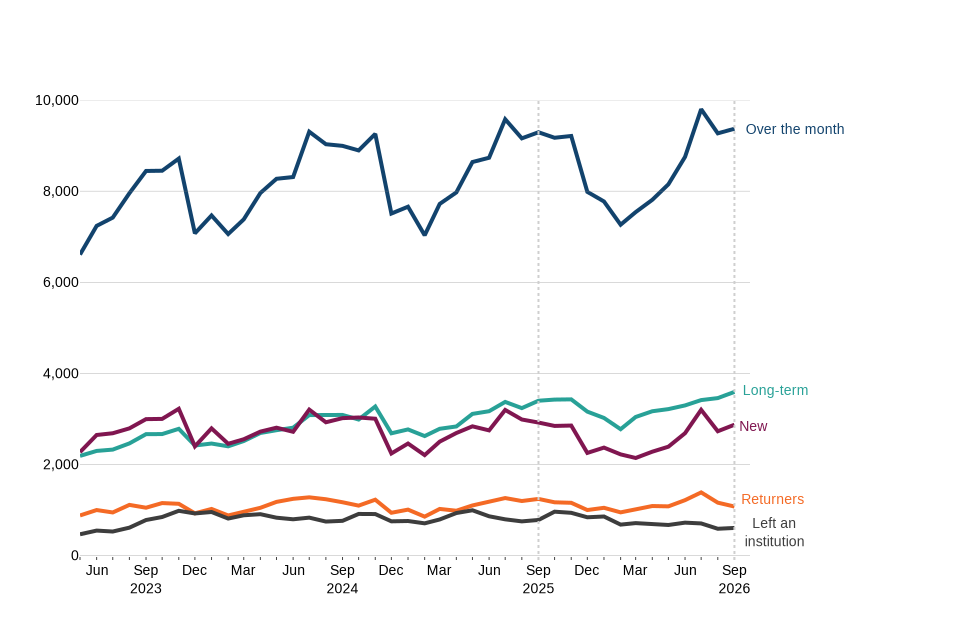
People sleeping rough long-term is at a record high since data collection began in May 2023 and has been increasing month-on-month since February 2026. In September 2026, there were 3,591 people (38% of the total) estimated to be sleeping rough long-term, 194 more people than in September 2025, an increase of 6%.
Compared with September 2025, the number of new people sleeping rough decreased by 2% and the number of people returning to sleeping rough decreased by 13%. The number of people sleeping rough after recently leaving an institution has decreased by 22% compared with September 2025 and reached its lowest monthly level in August 2026 since July 2023.
In September 2026, an estimated 4,156 people were sleeping rough on a single night, up 3% from last year and a record high for this time of year.
There were 2.3 times more people sleeping rough over the month compared to a single night, illustrating that the flow of people onto and off the street over the course of a month is significantly higher than those seen on any given night due to the dynamic nature of rough sleeping.
London continues to have the highest levels of rough sleeping. Compared with the same period last year, the number of people sleeping rough over the month increased by 4%, while the number sleeping rough on a single night decreased by 5%.
Date of next publication: It is expected that the next quarterly publication of monthly data (up to December 2026) will be published on 25 February 2027
2. Introduction
Since May 2023, the Ministry of Housing, Communities and Local Government has been collecting data on metrics as part of a framework to better understand how far rough sleeping is prevented wherever possible, and where it does occur, whether it is rare, brief, and non-recurring.
This data is relevant to people working locally to reduce rough sleeping and is an important step towards driving better outcomes for vulnerable people.
There are eight indicators included in the framework, these are:
Rare
-
The number of people sleeping rough (on a single night and over the course of the month).
-
The number of people sleeping rough over the course of the month who have moved into accommodation over the course of the month.
Prevented
-
The number of new people sleeping rough over the course of the month.
-
The number of people sleeping rough over the month who have been discharged from institutions.
Brief
-
The number of people sleeping rough over the course of the month who have been sleeping rough long-term.
-
The number of nights on which people were seen sleeping rough.
Non-recurring
-
The number of people sleeping rough over the course of the month who are returning to sleeping rough.
-
The number of people sleeping rough over the course of the month who are returning to sleeping rough, who had previously moved into settled accommodation.
There are a range of factors that can affect the number of people who sleep rough on any given night, for example, the availability of night shelters, the weather, and where people choose to sleep.
The number of people sleeping rough tends to be higher in the summer months when it is warmer, and lower in the winter months, reflecting the seasonality of rough sleeping, because of these comparisons we typically compare against previous year’s figures rather than the previous quarter.
The management information is largely gathered by outreach workers as part of their regular outreach activity and may also be gathered from referrals from partner agencies to help identify people that may not engage with services. This means the quality of the information is linked to the coverage and frequency of outreach activity as well as the local data systems in place to accurately track and record this information.
The figures in this release are therefore subject to some uncertainty and should be treated as estimates.
2.1 Uses and limitations
These statistics can be used:
-
To estimate the number of people of sleeping rough on a single night and over the month
-
To assess changes in the number of people sleeping rough over time
-
To compare local authorities and regions
-
To understand flows from institutions to sleeping rough
-
To understand the number of people who are new, returning or long-term rough sleepers and the number of people who have been accommodated
-
To understand some basic demographics about people who sleep rough across the month e.g. gender and nationality
These statistics are not suitable:
-
To estimate the total number of people sleeping rough across the year
-
To understand the reasons why people sleep rough or the causes
-
For make direct comparisons with other UK countries, because different definitions and approaches to measuring rough sleeping are used across the UK
-
To estimate the number of homeless people, hidden homeless or people with nowhere safe to stay
3. Overall trends
The number of people sleeping rough over the month and long-term have both increased compared with last year, with long-term rough sleeping at a record high. However, the number of new people sleeping rough, those returning to rough sleeping and those who have recently left an institution have all decreased.
Figure 1: Estimated number of people sleeping rough over the month, sleeping rough long-term, new to sleeping rough, returning to sleeping rough and sleeping rough having left an institution, May 2023 to September 2026
Source: MHCLG
Of those sleeping rough over the month, the largest group were people who had been sleeping rough long-term (38%), followed by those who were new to sleeping rough (31%) and those returning to sleeping rough (11%). [footnote 1]
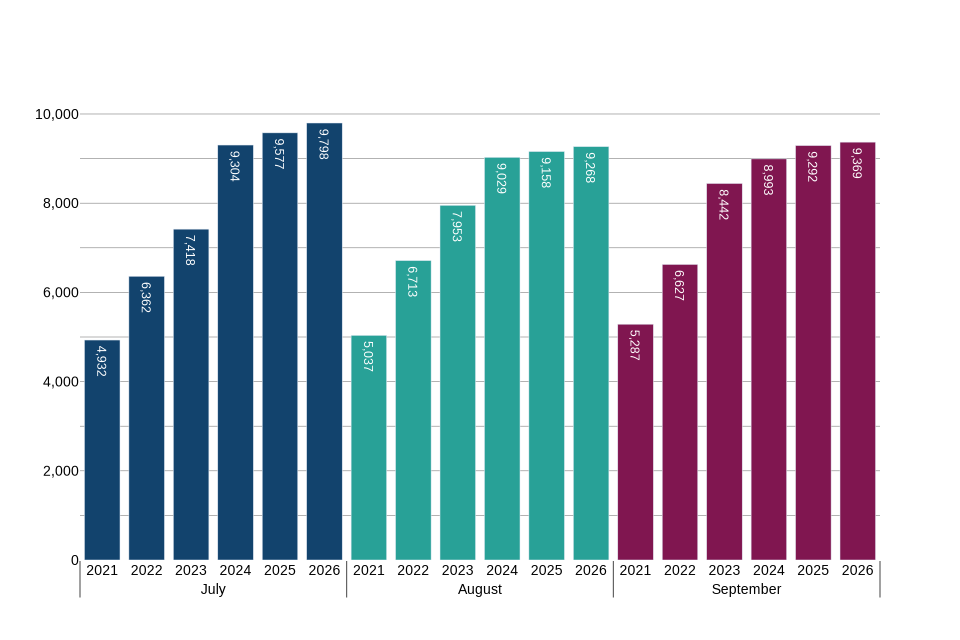
The number of people sleeping rough over the month saw small increases when compared to the same time last year, with increases of 2% in July and 1% in both August and September.
Figure 2: Estimated number of people sleeping rough over the month July to September 2021 to 2026
Source: MHCLG
4. Making rough sleeping rare
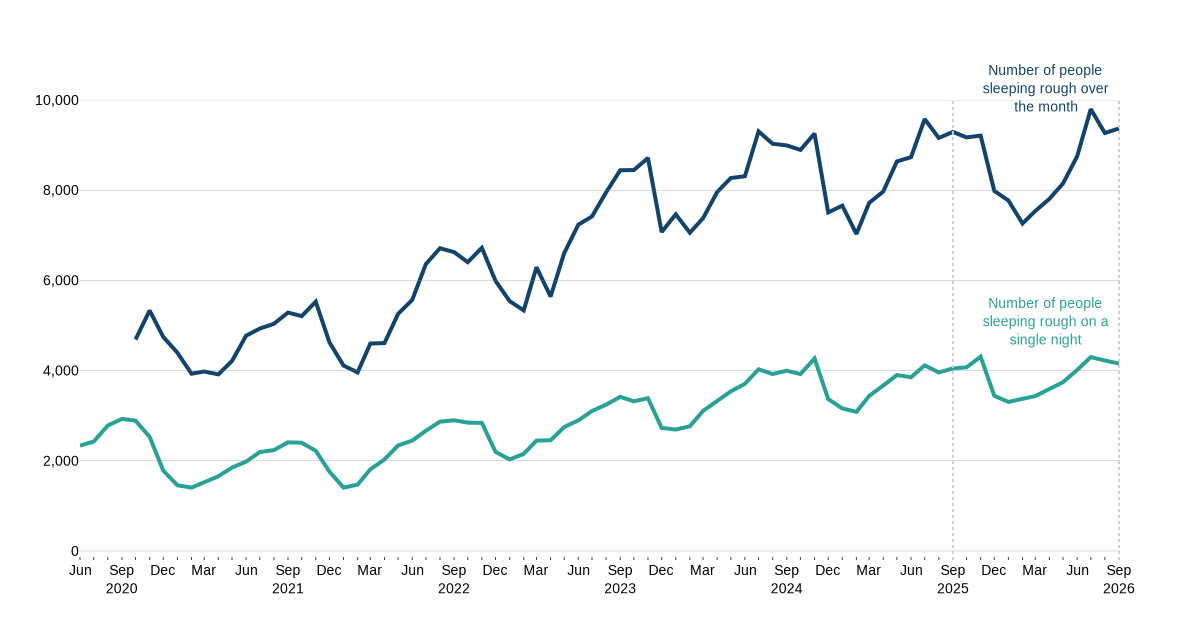
The number of people sleeping rough over the month and on a single night has increased compared with the same time last year, reaching record highs for this time of year.
Figure 3: Estimated number of people sleeping rough on a single night (June 2020 to September 2026) and over the month (October 2020 to September 2026)
Source: MHCLG
Estimated number of people sleeping rough over the month
There were 9,369 people estimated to be sleeping rough over the month in September 2026. This is a 1% increase since last year (September 2025).
The rate of people sleeping rough over the month of September 2026 in England was 15.9 people per 100,000, compared with 15.8 people per 100,000 in the same period last year. [footnote 2]
London was the region with the highest number of people sleeping rough over the month, with 2,277 people, accounting for 24% of the England total. Westminster remained the local authority with the highest number, with 536 people sleeping rough over the month. This accounted for 6% of the England total and was approximately 2.3 times the number recorded in Camden and Bristol, which had the joint second-highest total (237 people each).
Westminster City Council’s Homelessness and Rough Sleeping Strategy and Action Plan 2025–2030 highlights its central London location as a factor in the high levels of rough sleeping, with people drawn to the area from other parts of the UK and other countries.
The remaining local authorities in the top 10 were a mix of large cities and coastal areas. Overall, the top 10 local authorities accounted for 22% of all people sleeping rough over the month.
In September 2026, 48% of local authorities reported an annual increase of at least one person sleeping rough over a month, while 44% reported a decrease and 8% reported no change.
The monthly estimate was 2.3 times higher than the number of people seen sleeping rough on a single night, illustrating that the flow of people onto and off the street over the course of a month is significantly higher than those seen on any given night due to the dynamic nature of rough sleeping.
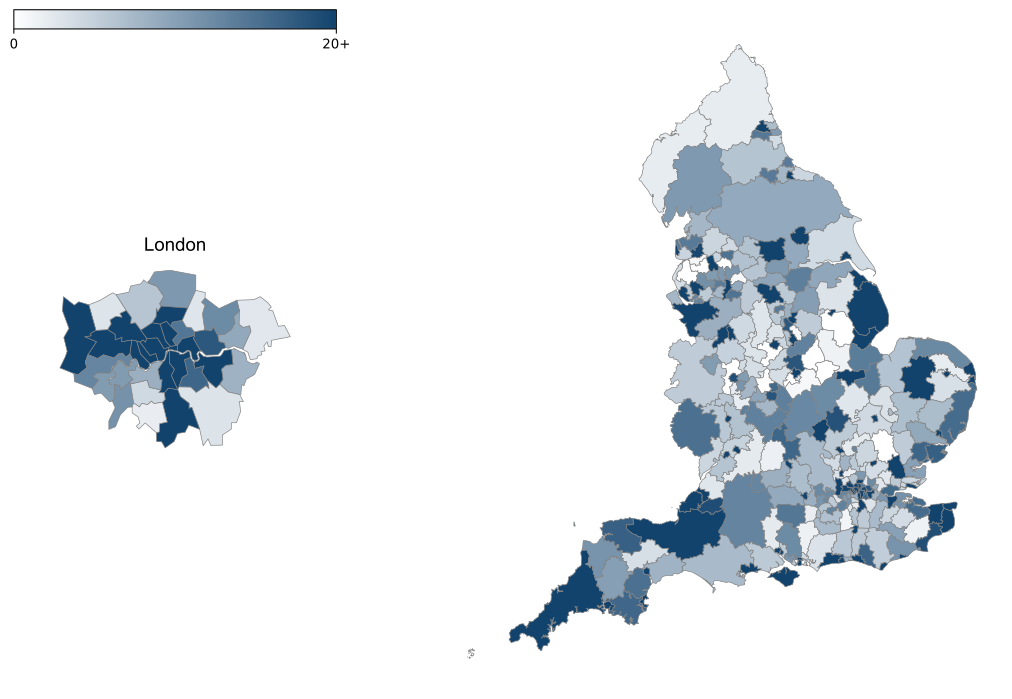
The highest rates of sleeping rough over the month are mainly in London, other major cities and coastal areas in the South of England.
Figure 4: Estimated number of people sleeping rough over the month per 100,000 people in the population, September 2026
Source: MHCLG
Estimated number of people sleeping rough on a single night
There were 4,156 people estimated to be sleeping rough on a single night in September 2026, up 3% since last year (September 2025). In July and August, the number of people sleeping rough on a single night increased compared with the same time last year, by 4% and 7% respectively.
The rate of people estimated to be sleeping rough on a single night in England was 7.1 people per 100,000, compared with 6.9 per 100,000 during the same period last year. [footnote 2]
London continues to have the highest levels of rough sleeping on a single night. However, in September 2026, London and the West Midlands were the only regions to see a decrease compared with the previous year, falling by 5% and 8% respectively.
Estimated number of people who were sleeping rough who have now moved into accommodation
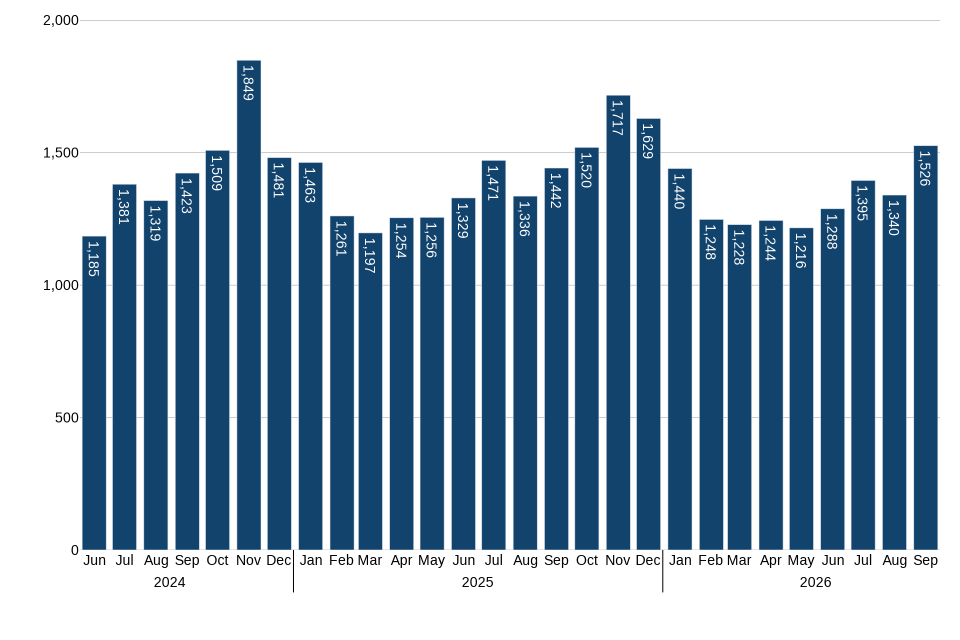
Compared with the previous year, the number of people sleeping rough who were provided with accommodation by the end of the month decreased in July but increased in August and September, accounting for an average of 15% of the total.
Figure 5: Estimated number of people sleeping rough who have moved into accommodation, June 2024 to September 2026
Source: MHCLG
In September 2026, there were 1,526 people sleeping rough over the course of the month who had moved into accommodation by the end of the month, 16% of those sleeping rough over the month. This is a 6% increase since last year (September 2025). The proportion of people being accommodated was the same as last year (16%) and since being collected this has ranged between 14% and 20%, with a higher proportion of people accommodated during the winter months. [footnote 3]
5. Preventing people sleeping rough
Estimated number of new people sleeping rough
There were 2,870 new people estimated to be sleeping rough over the month in September 2026, accounting for 31% of all people sleeping rough over the month. This was 48 fewer people than in September 2025, a decrease of 2%. Over the past 12 months, the number of new people sleeping rough has decreased year-on-year in 9 months. London accounted for the largest regional share, at 29%, while Westminster had the largest local authority share, at 7%.
The area with the largest annual decrease in the number of new people sleeping rough was Liverpool, with 31 fewer people in September 2026 than in September 2025. Gloucester and Leicester had the next largest decreases, falling by 30 and 22 fewer people respectively.
Estimated number of people sleeping rough who have left an institution
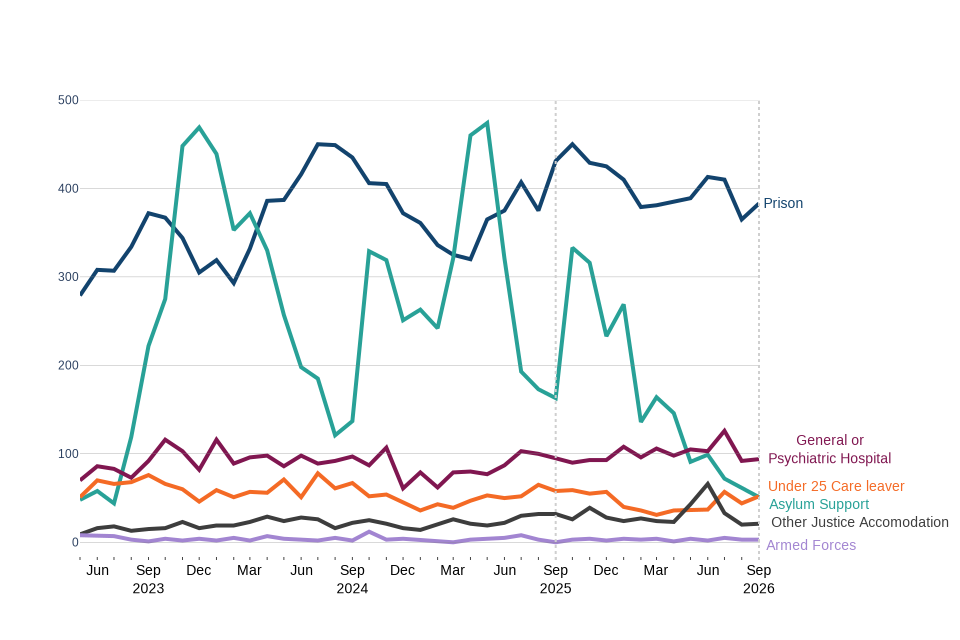
People leaving prison remain the largest group of people sleeping rough who had recently left an institution. Following a large decrease in the number of people sleeping rough after leaving asylum support, people leaving hospital are now the next largest group.
Figure 6: Estimated number of people sleeping rough over the course of the month who have left an institution, May 2023 to September 2026
Source: MHCLG
There were 604 people estimated to be sleeping rough over the month in September 2026 who had recently left an institution, accounting for 6% of all people sleeping rough over the month. This was 175 fewer people than in September 2025, a decrease of 22%. The South East accounted for the largest regional share (18%), while Bradford had the largest local authority share (3%).
There were 383 recent prison leavers sleeping rough in September 2026, accounting for 63% of all recent institutional leavers and 4% of all people sleeping rough over the month. This was an 11% decrease compared with last year. Despite this decline, prison leavers remained the largest group of recent institutional leavers sleeping rough, since June 2025.
In September 2026, 94 people sleeping rough had left a general or psychiatric hospital in the last 85 days decreasing by 1% compared with the same time last year. People leaving hospital have been the second largest group of institutional leavers sleeping rough since May 2026.
Care leavers aged under 25 are now the third-largest group of recent institutional leavers sleeping rough, following the decrease in people leaving asylum support. In September 2026, 52 care leavers aged under 25 were sleeping rough, a 10% decrease compared with the same time last year.
In September 2026, there were 51 people sleeping rough who had recently left asylum support, a decrease of 69% compared with the same time last year and the lowest level recorded since July 2023. The number of people sleeping rough after recently leaving asylum support may be affected by a range of operational factors including asylum applications volumes, refusal rates and tribunal activity, as well as seasonal variation in rough sleeping, which means the overall number of people sleeping rough may increase or decrease substantially each month.
In September 2026, 21 people were sleeping rough after leaving other justice accommodation in the last 85 days, returning to its usual level after a sharp rise and fall to 66 people in June 2026. There were 3 people sleeping rough in September 2026 after leaving the UK Armed Forces in the last 85 days. [footnote 4]
6. Making rough sleeping brief
Estimated number of people sleeping rough long-term
The number of people sleeping rough over the month who had been sleeping rough long-term in September 2026 was the highest recorded figure since data collection began.
In September 2026, there were 3,591 people estimated to be sleeping rough long-term, accounting for 38% of all people sleeping rough over the month. This was 194 more people than in September 2025, an increase of 6%. People sleeping rough long-term have been the largest group since November 2024. London accounted for the largest regional share (28%). Compared with last year, long-term rough sleeping increased in the South West (+40%), North East (+34%), North West (+23%) and London (+8%). The largest decreases were in the West Midlands (-18%) and East Midlands (-9%).
In September 2026, Westminster remained the local authority with the highest number of people sleeping rough long-term, with 263 people (7% of the England total). This was approximately 2.6 times the number recorded in Bristol, which had the second-highest total (102), and was higher than the totals for each of the North East, East Midlands, West Midlands and Yorkshire and the Humber as a whole. Camden, Somerset and Leeds had the next highest numbers of people sleeping rough long-term. Collectively, the top 10 local authorities accounted for 26% of all people sleeping rough long-term in England.
Estimated number of nights people seen sleeping rough over the previous six months
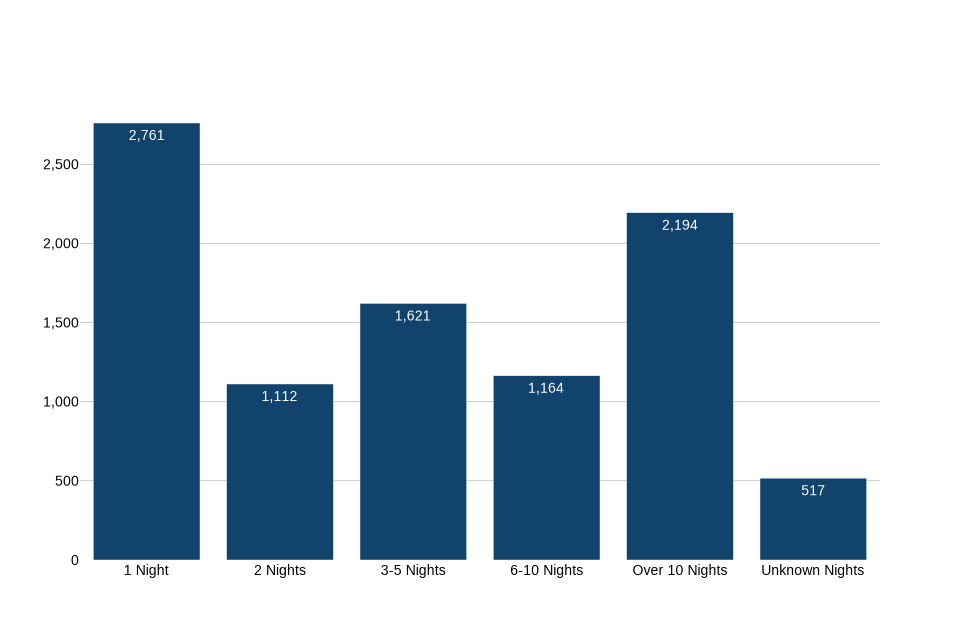
The most common length of time people are seen sleeping rough is one night.
Figure 7: Number of nights people estimated to have been seen sleeping rough over the last six months, September 2026
Source: MHCLG
In September 2026, people seen sleeping rough for one night in the previous 180 days remained the largest group, with 2,761 people (29%), followed by those seen on over 10 nights (2,194 people, 23%) and three to five nights (1,621 people, 17%).
People seen sleeping rough for one night have consistently been the largest group since data collection began in June 2024. The number of people seen sleeping rough on over 10 nights reached a record high in September 2026, increasing from 2,142 in September 2025 to 2,194, a rise of 2%.
7. Making rough sleeping a non-recurring experience
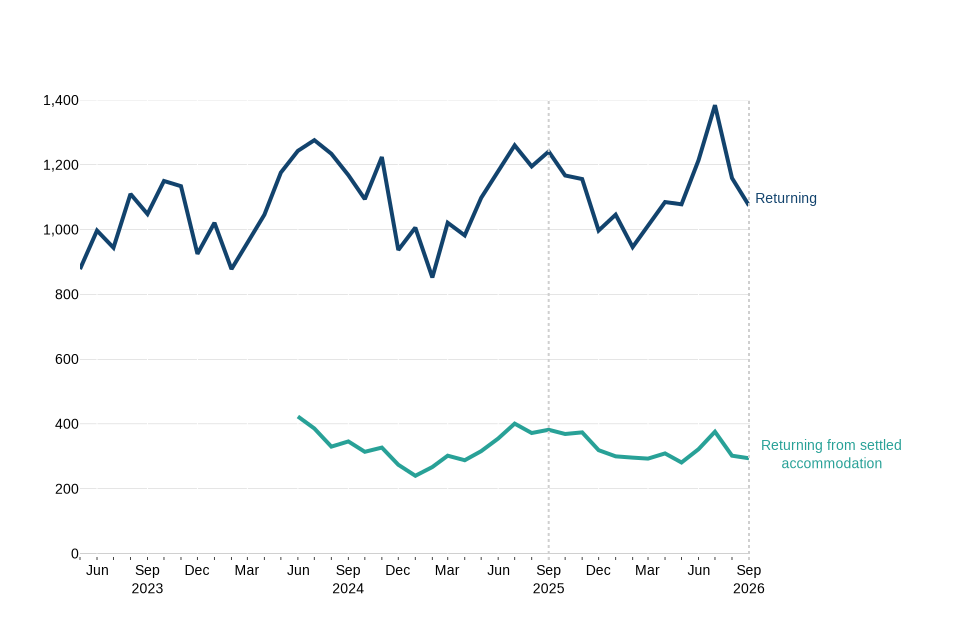
The number of people returning to rough sleeping increased in July but decreased in August and September 2026 compared with the same months last year.
Figure 8: Estimated number of people sleeping rough over the month, May 2023 to September 2026, including those returning to sleeping rough after moving into settled accommodation, June 2024 to September 2026
Source: MHCLG
There were 1,074 people estimated to be returning to sleeping rough over the month in September 2026, 11% of the total number of people sleeping rough over the month. This is a decrease of 13% compared with September 2025, 167 fewer people.
The area with the largest annual decrease in the number of people returning to sleeping rough was in Cheshire West and Chester, with 30 fewer people in September 2026 than in September 2025. Bournemouth, Christchurch and Poole and Southend-on-Sea had the next largest decrease, falling by 27 and 24 people respectively.
In September 2026, 294 people were estimated to be returning to sleeping rough after moving into settled accommodation in the preceding 12 months, accounting for 27% of all people returning to sleeping rough over the month. This was 88 fewer people than in September 2025, a decrease of 23%.
8. Demographics
We collect basic demographic information on people sleeping rough, including age and gender monthly, and nationality and immigration status on a quarterly basis.
If a person refused to give, or did not want to share, their personal information, they would still be recorded as sleeping rough and their gender, nationality and immigration information would be recorded as ‘not known’. It may not be possible to record demographic information, due to an individual being asleep when they were approached for example. A person’s demographic information may also be unknown if they had only been sleeping rough for a short period of time, and outreach teams were unable to collect this information. This information relies primarily on self-disclosure, either through direct engagement with individuals or existing knowledge held by services. Consequently, collecting more detailed demographic information can take time.
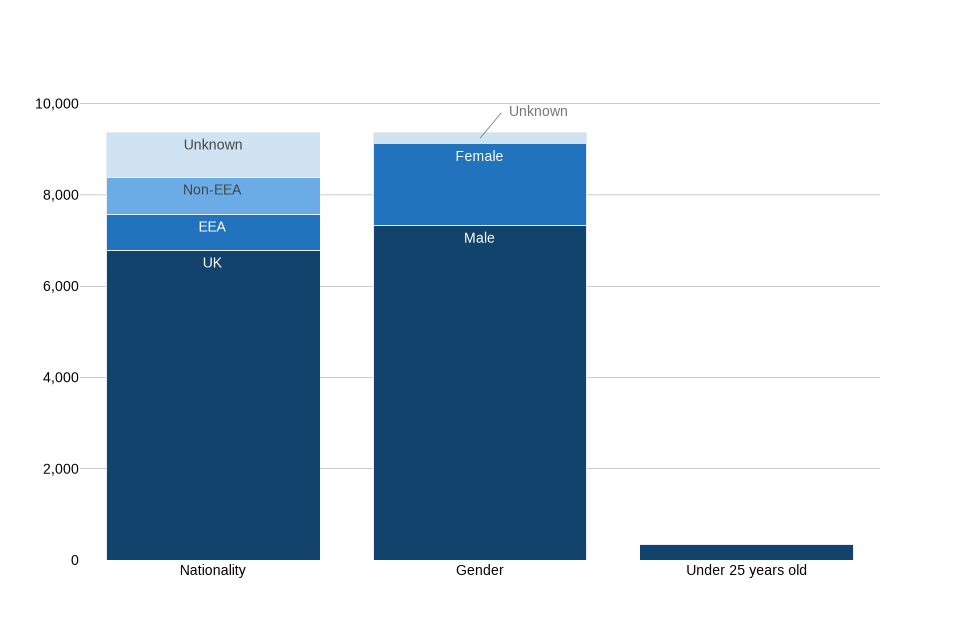
Most people sleeping rough over the month are male, over the age of 25 and UK nationals.
Figure 9: Estimated number of people sleeping rough over the course of the month by nationality, gender and under 25 years old, September 2026 [footnote 5]
Source: MHCLG
Information on the gender of people sleeping rough over the month has been collected since June 2025.
The majority of people sleeping rough over the month in September 2026 were male, with 7,327 male (78%) and 1,789 female (19%). Gender was unknown, other or prefer not to say for 253 people (3%). Compared with September 2025, the proportion of males decreased from 81% to 78%, while the proportion of females increased from 18% to 19% and the proportion recorded as unknown, other or prefer not to say increased from 2% to 3%.
The gender breakdown of people sleeping rough has remained similar at an England level, although there is some slight variation between individual regions and months. The overall breakdown also remains similar to the annual rough sleeping snapshot.
Sleeping patterns of females experiencing rough sleeping are more hidden, transient and intermittent and therefore may not be fully captured by the management information.
In September 2026, 337 people (4% of total) sleeping rough over the month were aged under 25 years old. The proportion of total people sleeping rough over the month aged under 25 years old remained similar each month over the last 12 months, ranging from 3% to 5%.
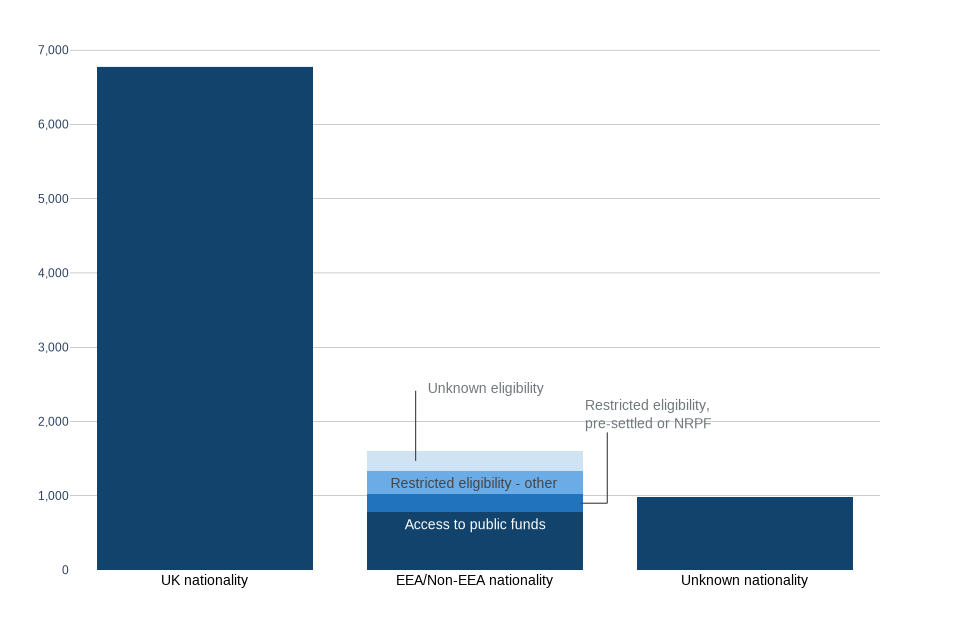
Most people sleeping rough are UK nationals and of those non-UK nationals, just under half have access to public funds.
Figure 10: Estimated number of people sleeping rough over the course of the month, by nationality and immigration status, September 2026
Source: MHCLG
Information on the nationality and the immigration status of those sleeping rough has been collected on a quarterly basis, throughout the year for the months of March, June, September and December, since June 2024.
In September 2026, of those where nationality was known 6,780 (81%) of the people sleeping rough over the month were UK nationals, the highest proportion since data collection began in June 2024. There were 791 (9%) European Economic Area (EEA) nationals in September 2026, the lowest proportion since data collection began, and 813 people (10%) were non-EEA nationals. The nationality of 985 people was unknown.
People sleeping rough who are UK nationals remained the largest group and increased by 3% compared with September 2025, while EEA and non-EEA nationals both decreased by around 14%.
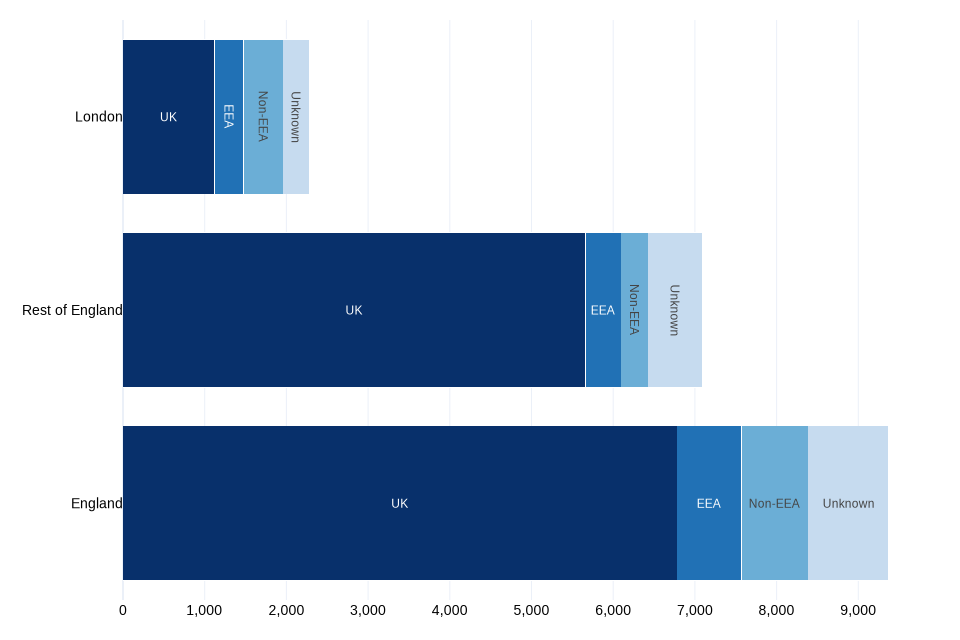
In London, where nationality was known, more than 4 in 10 people sleeping rough were non-UK nationals, despite decreases in both EEA and non-EEA nationals compared with last year.
Figure 11: Estimated number of people sleeping rough over the course of the month, by nationality, by region, September 2026
Source: MHCLG
London typically has a lower proportion of UK nationals and higher proportions of EEA and non-EEA nationals compared with the other regions in England, which are broadly similar to each other.
In London, of those where nationality was known, 1,119 people (57%) were from the UK, 356 (18%) were EEA nationals and 486 (25%) were non-EEA nationals. The nationality of 316 people was unknown. Compared with September 2025, the overall number of people sleeping rough in London increased by 4%, with the number of UK nationals increasing by 13%. In contrast, EEA and non-EEA nationals decreased by 15% and 11% respectively.
Across England, the proportion of non-UK nationals who have either access to public funds, leave to enter/remain, restricted eligibility that neither grants access or falls under restricted access, or unknown immigration status is broadly similar each quarter. See definitions for further explanation of these statuses.
Of the 1,604 people sleeping rough over the month who were EEA or non-EEA nationals, 778 people (49%) had status allowing access to public funds. A further 242 people (15%) had leave to enter or remain with restricted eligibility to public funds, including 145 people (9%) with no recourse to public funds and 97 people (6%) with pre-settled status.
313 people (20%) had restricted eligibility that neither grants access to public funds or falls under stated categories for restricted access e.g. No Recourse to Public Funds (NRPF) and 271 people (17%) had an unknown immigration status.
Compared with September 2025, the overall number of non-UK nationals sleeping rough decreased by 269 people (14%). The largest decrease was among those with access to public funds, which fell by 187 people (19%), followed by a decrease of 48 people (17%) among those with restricted eligibility to public funds. Smaller decreases were seen for other forms of restricted eligibility, down by 9 people (3%), and unknown immigration status, down by 25 people (8%).
9. Definitions
New people sleeping rough
A person is considered ‘new’ if they have not been seen sleeping rough in the local authority in the 5 calendar years (60 months) preceding the date they were seen sleeping rough during the current reporting period. If a person was seen more than 5 years previously, they are to be counted as ‘New’. If there is no historical data available for the last 5 years, people seen sleeping rough for the first time should be counted as ‘New’ whilst a historical database is compiled.
Prior to May 2023, the definition was less specific in terms of time period, and a person was considered new if they were not known to local authority outreach teams and other support services.
People sleeping rough who have been discharged from an institution
A person is counted as having left an institution recently if they report having been discharged from any of the below within the last 85 days (12 weeks + 1 day):
-
Prisons (adult and youth)
-
Other justice accommodation e.g. accommodation provided by the National Probation Service (i.e. Approved Premises)
-
General and psychiatric hospitals
-
Discharged from the UK Armed Forces
-
Asylum support (previously ‘National Asylum Support Services Accommodation’)
The 85 day period is based on Community Accommodation Service Tier 3 (CAS3) which provides temporary accommodation for up to 84 nights for homeless prison leavers and those moving on from Approved Premises to help them move into settled accommodation. This is designed to improve partnership working between homelessness and rough sleeping services and institutions to ensure people recently leaving institutions have suitable accommodation pathways. People under 25 who are care leavers are also included but the 85 day timeframe does not apply.
People sleeping rough
People sleeping rough are defined as:
People sleeping, about to bed down (sitting on/in or standing next to their bedding) or bedded down in the open air (such as on the street, in tents, doorways, parks, bus shelters or encampments).
People in buildings or other places not designed for habitation (such as stairwells, barns, sheds, car parks, cars, derelict boats, stations or “bashes” which are makeshift shelters often comprised of cardboard boxes).
The definition does not include:
-
People in hostels or shelters
-
People in campsites or other sites used for recreational purposes or organised protest
-
Squatters
-
Travellers
Bedded down is taken to mean either lying down or sleeping.
About to bed down includes those who are sitting in/on or near a sleeping bag or other bedding.
This is the same definition as is used for the annual rough sleeping snapshot statistics.
The number of people sleeping rough on a single night is an estimated figure determined from outreach contacts, or from a ‘Point-in-Time’ snapshot.
The number of people sleeping rough over the course of the month is an estimated figure based on outreach contacts.
Number of people sleeping rough who have moved into accommodation
This is an estimate of the number of people seen sleeping rough over the month who have moved into accommodation over the course of the month, not including those accommodated under severe weather emergency protocols (SWEP).
People sleeping rough long-term
Long-term rough sleeping is defined as the number of people seen recently (within the reporting month) who have been seen sleeping rough in 3 or more months out of the last 12 months (1 year).
Number of nights seen sleeping rough
For each person seen sleeping rough over the month, the number of nights over the last 6 months (180 days) on which each person was seen sleeping rough is categorised as follows:
-
1 night
-
2 nights
-
3-5 nights
-
6-10 nights
-
More than 10 nights
-
An unknown number of nights
People returning to sleeping rough
A person is considered a ‘returner’ if they are seen sleeping rough again after no contact for 2 or more quarters (180 days), whichever is shorter, measured from the last date the person was seen.
Number of people sleeping rough who had previously moved into settled accommodation
For a person to be counted under this indicator, they should be returning to sleeping rough after no contact of 2 or more quarters (180 days) (as in NR1), they should have been seen in the previous 5 years (i.e., they don’t meet the criteria for P1), and they should have been moved into settled accommodation, defined as accommodation intended to last for an extended period of time and including the following categories:
-
Social rented sector (including council tenancy, registered providers)
-
Supported Accommodation (including Housing First, care homes, and other supported accommodation pathways)
-
Hostels (including reception centres, emergency units and refuges) with accommodation for longer than 6 months
-
Private rented sector (with an Assured Shorthold Tenancy Agreement)
-
Staying with family or friends
-
Owner-occupier
-
Returned to home country
Potential overlaps in groups
There is the potential for some overlap between new people sleeping rough over the month and people returning to sleeping rough if a person found sleeping rough returns to sleeping rough after not being seen for more than five years. There is also potential for some overlap between the long-term and returner indicators if a person has not been seen sleeping rough for the last 6 months, but in the 6 months previous was seen 2 further times, this would mean this person is both a long-term rough sleeper and a returner. Not all people seen sleeping rough over the month, are included in new people sleeping rough over the month, people sleeping rough long-term or people returning to sleeping rough. People who have left an institution may also overlap all of those categories.
No Recourse to Public Funds
No Recourse to Public Funds (NRPF) is a standard condition applied to most categories of temporary immigration permission to protect public funds. NRPF is also applied to illegal migrants.
Examples of public funds for immigration purposes are Universal Credit, Child Benefit and Housing Benefit.
Non-UK nationals with status that allows for access to public funds
Refers to non-UK national individuals who have been granted status in the UK which allows for access to public funds. Types of status these individuals may have, but are not limited to, include Indefinite Leave to Remain (including Settled Status under the EU Settlement Scheme) and Refugee Status. For further information on what constitutes public funds, see Home Office guidance.
Non-UK nationals with leave to enter/remain with restricted eligibility to public funds
Refers to non-UK national individuals who have been granted the following types of status which restricts their eligibility to public funds:
People with pre-settled status (arrivals pre-December 31, 2020) if they are not exercising a qualifying right to reside (includes those with a pending EUSS application).
This individual has pre-settled status granted under the EUSS but has limited access to public funds as they are not exercising a qualifying right to reside. This also includes individuals who have a pending EUSS application. For example, an individual has a qualifying right to reside if they meet any of the following criteria:
-
are a worker
-
are self-employed
-
are self-sufficient
-
are a jobseeker
-
are a student
People with limited leave to remain subject to a no recourse to public funds (NRPF) condition (arrivals post-December 31, 2020).
This individual has arrived in the UK after December 31st 2020 and has been granted limited leave to remain subject to an NRPF condition.
People with limited leave to remain subject to a no recourse to public funds (NRPF) condition.
This individual has been granted limited leave to remain subject to an NRPF condition.
Non-UK nationals with restricted eligibility that neither grants access to public funds or falls under stated categories for restricted access e.g. NRPF
This category refers to those non-UK national individuals who have restricted eligibility for public funds however, this restriction falls outside of the sub-categories set out above.
Non-UK nationals with unknown status
This category refers to those non-UK national individuals whose status is unknown to the local authority.
10. Things you need to know
On average, over the last 12 months 98% of areas provide a response each month and for those areas that do not provide data, imputed figures based on previous management information are used.
This monthly management information, provided by local authorities, includes a more frequent although less robust estimate of people sleeping rough on a single night, compared to the annual official rough sleeping snapshot statistics. Both the management information and the official statistics are collated by local authorities, outreach workers, local charities and community groups, but the official statistics are independently quality assured by Homeless Link.
The management information also provides an estimate of the number of people sleeping rough over the course of the month in each local authority to better understand the flow of people sleeping rough. This figure is based on casework done by outreach teams and other service providers.
11. MHCLG related statistics
The Ministry of Housing, Communities and Local Government have been collecting monthly management information from all local authorities in England about the support for people sleeping rough and those at risk of sleeping rough, since May 2020, alongside the annual rough sleeping snapshot statistics.
Rough Sleeping Programme monitoring information
The new 2026 Rough Sleeping Programme, will provide funding over 3 years to support the ambition to end rough sleeping at the earliest opportunity. The programme will support people sleeping rough to access accommodation and support quickly, alongside settled accommodation and intensive wraparound support for those with the most severe and long-term experiences of rough sleeping.
A new monthly data collection to support Programme of monitoring will be published as part of a new Rough Sleeping Programme monitoring information series. The first release in the series will be of October 2026 data, due to be published on the 27 November 2026. The series will run for a finite time to support the Programme.
Annual rough sleeping snapshot
The MHCLG’s official annual rough sleeping snapshot statistics provides a way of estimating the number of people sleeping rough across England on a single night in autumn and assess change over time. These statistics provide information about the estimated number of people sleeping rough on a single night between 1 October and 30 November each year and some basic demographic details (i.e. age, gender, nationality).
Statutory homelessness
MHCLG also collect and publish quarterly and annual statistics on the broad characteristics and circumstances of households owed a statutory homelessness duty. This includes households who are rough sleeping at the time of local authority approach.
12. Enquiries
Media
Telephone: 0303 444 1209
Email: newsdesk@communities.gov.uk
Statistical enquiries
Telephone: 0303 444 2623
Email: roughsleepingstatistics@communities.gov.uk
Information on Official Statistics is available via the UK Statistics Authority website.
Information about statistics at MHCLG is available via the department’s website.
-
These indicators are not mutually exclusive, and some overlaps can occur between the different indicators. Please refer to definitions ↩
-
Based on ONS mid-2025 population estimates. ↩ ↩2
-
This refers to anyone seen sleeping rough over the month who at some point in the month was placed into accommodation, whether that was short-term or long-term. This should not include placements into accommodation due to Severe Weather Emergency Protocol (SWEP), which provides support for individuals during extreme weather. A person is only counted once even if they have moved into accommodation multiple times over the same month. ↩
-
The 85-day period is based on Community Accommodation Service Tier 3 (CAS3) which provides temporary accommodation for up to 84 nights for homeless prison leavers and those moving on from Approved Premises to help them move into settled accommodation. This is designed to improve partnership working between homelessness and rough sleeping services and institutions to ensure people recently leaving institutions have suitable accommodation pathways. People under 25 who are care leavers are also included but the 85-day timeframe does not apply. ↩
-
Information on the number of people sleeping rough who are under 25 years old is mainly collected as part of the prevention indicator to understand the number of care leavers who are under 25 years old who are sleeping rough. This indicator is designed to highlight recent inflows on the streets from institutions to take action to reduce rough sleeping. We do not collect data on other age categories as the main aim is the focus on young people care leavers. ↩