Risk assessment for the introduction of African Horse Sickness into Great Britain via the import of live registered horses from South Africa
Published 26 August 2026

© Crown copyright 2026
This publication is licensed under the terms of the Open Government Licence v3.0 except where otherwise stated. To view this licence, visit nationalarchives.gov.uk/doc/open-government-licence/version/3 or write to the Information Policy Team, The National Archives, Kew, London TW9 4DU, or email: psi@nationalarchives.gov.uk.
Where we have identified any third party copyright information you will need to obtain permission from the copyright holders concerned.
This publication is available at https://www.gov.uk/government/publications/risk-assessment-african-horse-sickness-into-great-britain-from-south-africa/risk-assessment-for-the-introduction-of-african-horse-sickness-into-great-britain-via-the-import-of-live-registered-horses-from-south-africa
Executive Summary
This is a Veterinary Risk Assessment (VRA) prepared for the UK Office for Sanitary and Phytosanitary Trade Assurance (UKOSPSTA) to assess the risk that African Horse Sickness (AHS) virus could be introduced to Great Britain through the movement of live registered horses from the export quarantine centre in the AHS Free Zone of the Western Cape of South Africa.
“The likelihood of AHS virus being introduced to Great Britain through the movement of live registered horses from the export quarantine centre in the AHS Free Zone of the Western Cape of South Africa is assessed as very low (event is very rare, but cannot be excluded) with low uncertainty”.
AHS is present throughout South Africa excluding the controlled area in the Western Cape. The AHS controlled area in the Western Cape is structured into three zones with decreasing levels of risk:
- the Protection Zone (PZ) is a 100km zone closest to the endemic area where annual vaccination is required and where horse movements are strictly controlled.
- the surrounding 50km Surveillance Zone (SZ), where vaccination is only permitted under licence for horses resident in the SZ which are leaving the controlled area (into the endemic zone). Movements from the endemic and protection zones into the SZ are regulated. Horses must meet requirements for vaccination, identification, and veterinary health checks.
- the Free Zone (FZ) is an area under 15km where disease freedom is maintained through surveillance. Vaccination against AHS is only permitted under licence for horses resident in the FZ. Movements from the endemic and protection zones into the FZ are regulated. Horses must meet requirements for vaccination, identification, and veterinary health checks. The export quarantine centre is present in the FZ.
Across the controlled area, vaccination is restricted to the defined low vector period (1 June to 31 October), which reduces the likelihood of vaccine virus transmission and is intended to minimise the risk of viral reassortment or reversion to virulence during periods of higher vector activity. Further requirements for movement between zones are discussed under specific pathways in the main body of the text.
The risk estimate is based on that posed per single registered horse imported into Great Britain from the quarantine centre in the AHS Free Zone of South Africa. There is currently high uncertainty in the number of horses that would be exported directly from the Western Cape to Great Britain. Currently, 10,000 registered horses per year are exported to Great Britain from all approved trading partners. The single registered horse risk should be aggregated when considering the total number of imports (for example, per annum) from South Africa. It should be noted that while the risk level for each movement (of a low number of horses where the same probability of infection can be assumed) may be assessed as very low, there will be a greater likelihood of at least one movement resulting in an incursion of AHS with an increased number of movements (Appendix 1).
This risk assessment only considers the introduction of disease into Great Britain and not its onward spread within Great Britain.
The risk pathways consider the time from when the horse is resident in the AHS Free Zone of the Western Cape to when it is loaded onto the transport destined for Great Britain following pre-export testing.
Aims
This VRA was commissioned by the UK Office for Sanitary and Phytosanitary Trade Assurance (UKSPSTA) to inform the risk of importing AHS virus into Great Britain via the movement of live registered horses from the quarantine centre of the AHS Free Zone of the Western Cape of South Africa to Great Britain. It was commissioned following Defra’s audit to the Republic of South Africa to evaluate the animal health controls in relation to exports of registered equine animals to Great Britain.
Introduction
African Horse Sickness (AHS) is endemic in South Africa, although a small area in the Western Cape, around Cape Town, has previously been designated as an AHS-free controlled area. The European Union (EU) formally recognised and approved South Africa for export of live registered horses from the export quarantine centre in the Western Cape in 1997. However, this approval was granted under strict control measures including the creation of an AHS control area in the region, comprising a Free Zone (FZ), Surveillance Zone (SZ) and Protection Zone (PZ). These control measures are set out in Commission Decision 2008/698/EC (legislation.gov.uk, 2008), which defines the AHS Free Zone as the Metropolitan area of Cape Town (Figure 1, Final Report of an Audit of South Africa, 2023). The AHS Free Zone (<15km) is surrounded by a SZ of at least 50km, and the SZ is surrounded by a PZ of at least 100km. Monthly serological surveillance is carried out in unvaccinated sentinel horses across the FZ and SZ. Systematic vaccination is prohibited in the FZ and SZ, vaccination against AHS is only permitted in these two zones under a licence. There is a system of vaccination permits for horses moving to the endemic zone from the FZ and SZ.
In March 2011, South Africa reported outbreaks of AHS on the boundaries between the SZ and the AHS FZ (Figure 1, Final Report of an Audit of South Africa, 2023). In response, Commission Decision 2011/267/EU was implemented that prohibited the movement of live registered horses from the FZ into the EU (legislation.gov.uk, 2011). There have been several outbreaks in this area since (Final Report of an Audit of South Africa, 2023). However, there have been no reports in the FZ since its establishment in 1997.
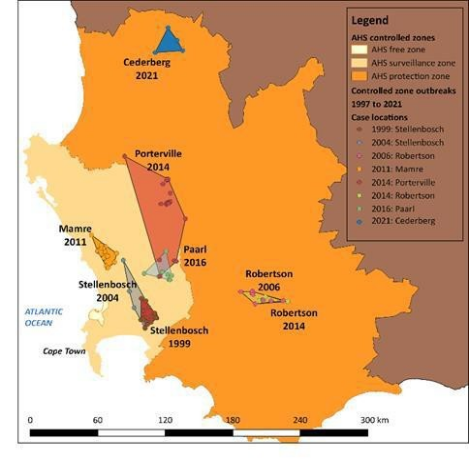
Figure 1: Locations of African horse sickness (AHS) outbreaks in Western Cape Province, South Africa, 1997–2021, including the spatial distribution of each of the AHS virus type 1 outbreaks that have occurred in the AHS controlled area (PZ, SZ and FZ) since 1997 (Final Report of an Audit of South Africa, 2023).
Alternative text: Figure 1 illustrates the spatial distribution of African horse sickness (AHS) outbreaks in the Western Cape Province, South Africa, between 1997 and 2021, with a focus on outbreaks occurring within the AHS controlled area. The map distinguishes three zones: the protection zone (PZ), surveillance zone (SZ), and free zone (FZ), arranged from inland to coastal areas near Cape Town. Outbreaks within the controlled area have been sporadic and geographically clustered, with cases reported in Stellenbosch (1999, 2004), Robertson (2006, 2014), Mamre (2011), Porterville (2014), Paarl (2016), and Cederberg (2021). Most outbreaks are concentrated in the western and south-western parts of the province, particularly around Stellenbosch and adjacent areas, with occasional spread further inland and northwards. The figure highlights that outbreaks have occurred intermittently over time across different zones, rather than showing sustained transmission within a single location.
In May 2013, the EU audited South Africa and found multiple non-compliances with Retained Commission Decision 2008/698/EC. The EU’s response to these findings was to continue with these movement prohibitions and recommended several actions for the competent authority (CA) to follow to achieve compliance.
In 2014, the South African Equine Health and Protocols (SAEHP) began a sentinel surveillance programme in the FZ and SZ with monthly sampling and testing. In the period examined (2014 to 2017), AHS freedom was demonstrated. Vector surveillance has also been applied to the quarantine facility, matching the requirements set out in the WOAH terrestrial guide; however, this does not extend into the SZ and PZ. According to WAHIS (WOAH) the last recorded case of AHS in South Africa was reported May 2021 in Cederberg, as marked in blue in Figure 1. After completion of this action plan, South Africa have since contacted both the EU and Great Britain, to request that we remove the prohibition and allow the movement of registered horses from the AHS free zone of the Western Cape into the EU and Great Britain.
The EU audited South Africa again in October 2022 and found that compliance was much improved compared to its audit in May 2013. It was concluded that the Controlled Area had an effective system for prevention and surveillance of AHS. Shortcomings identified around the organisation of national laboratories have been addressed and now provide good and reliable analytical support to the competent authority. The South African AHS contingency plan was also updated in 2018, and appropriate control measures were detailed, increasing confidence in the authorities’ ability to control AHS in the PZ and SZ, as well as guaranteeing the absence of disease in the FZ.
In May 2024, the EU listed SA again. Registered horses can now be sent direct to the EU (not including Great Britain) from the in-country quarantine facility after 13 years of no direct exports to the EU.
The UK Office for Sanitary and Phytosanitary Trade Assurance, Defra conducted an audit to SA in 2024 to determine whether direct exports should be permitted to Great Britain. This risk assessment is conducted using findings from that audit, amongst other available information.
Risk question
“What is the likelihood of incursion of AHS virus into Great Britain through the import of live registered horses from the quarantine centre in the AHS Free Zone of the Western Cape of South Africa to Great Britain per imported horse?”
Hazard identification
The hazard is African horse sickness virus (AHSV). The specific risk is that live registered horses may introduce the virus into Great Britain and that they could transmit virus to the resident susceptible equine population in Great Britain should a competent vector be present.
AHS is endemic in sub-Saharan Africa, outbreaks have also occurred in Egypt, the Middle East, Pakistan, and India (1959-1960), Morocco, Spain, and Portugal (1989-1991) (Pirbright, 2022; WOAH Terrestrial Code, 2022). There was an outbreak in Thailand in 2020 attributed to the import of zebra from SA (King et al., 2020).
The virus is from the family Reoviridae of the genus Orbivirus and there are 9 types (serotypes). AHSV is spread by biting midges (Culicoides) (Pirbright, 2022) and infects the lungs, spleen, and other lymphoid tissues.
AHSV infects all equine species and is often fatal in horses and mules. Wild ungulates such as zebras, and donkeys are usually asymptomatic and can act as reservoirs of the virus (Molini et al., 2020). Animals such as camels, African elephants and black and white rhinos may also be susceptible but are unlikely to be involved in sustained transmission of the disease. Dogs can contract the virus through eating infected horse meat. As transmission is vector-borne, AHS is inherently a seasonal disease, with risk closely linked to midge activity. In South Africa, a defined low vector period occurs between 1 June and 31 October, when vector abundance and transmission potential are reduced.
There are four different forms of the disease (Pirbright, 2022):
- respiratory form: fever, respiratory distress, sweating, frothy discharge from the nostrils and death within a few hours
- cardiac form: fever, swelling around the eyes, lips, cheeks, tongue, and neck and in some cases colic
- mixed form: a combination of signs from the cardiac and respiratory forms can be seen
- horse sickness fever: fever for a few days, depression, and reduced appetite. These animals often recover from the disease
There is no specific treatment available other than supportive treatment and therefore measures to control exposure of horses to biting insects are essential to prevent an outbreak from spreading. Live attenuated vaccines are in use in South Africa but are not licensed in Europe due to safety concerns. South Africa has confirmed that viral reassortment of the live attenuated vaccines and/or reversion to virulence in vaccinated horses has resulted in outbreaks of disease. Systematic vaccination is prohibited in the FZ and SZ, vaccination against AHS is only permitted in these two zones under a licence. Vaccination is only carried out following permission from the Boland State Vet Office and is restricted to 1 June to 31 October each year.
In the PZ, horses must be vaccinated against AHS annually, vaccination may only be carried out between 1 June and 31 October each year. Permission is not required prior to vaccination in the PZ or outside the Controlled Area. (Weyer et al., 2016).
Risk estimate
The post-audit likelihood that the import of registered live horses from the quarantine centre in the Western Cape of South Africa could introduce AHS virus into Great Britain is assessed as very low (event is very rare, but cannot be excluded).
The risk estimate presented reflects the likelihood associated with a single registered horse exported to Great Britain via this pathway. While this likelihood is assessed as very low, it is recognised that the overall probability of introduction will increase as the number of horses imported increases. Consequently, the aggregated risk should be considered in the context of the total number of consignments over a given time period (Appendix 1).
Seasonality may also influence the level of risk. The likelihood of infection is expected to be even lower during the defined low vector period (June to October), when vector activity is reduced and vaccination is permitted under controlled conditions. Mitigation measures, including surveillance, movement controls, vaccination, quarantine and pre-export testing, reduce the likelihood of an infected animal being exported.
Uncertainty
There is a low level of uncertainty regarding the risk of importing AHS in live registered horses from the quarantine centre in the Western Cape of South Africa. This is in part due to the robust surveillance schemes and movement data recorded in the Myhorse system (Myhorse, n.d.), which are collated monthly, and the mitigations in place in the Controlled Area (PZ, SZ, FZ). Additionally, data on non-horse equids in the endemic zone are collated and vector surveillance is in place in the quarantine facility.
Assumptions
The risk assessment below is based on the following assumptions.
-
Trade of horses will only be from the quarantine centre of the AHS FZ of the Western Cape and are fully compliant with all import requirements.
-
The source of infection of registered horses during residency in the FZ is by an infected vector. The risk of transmission from vectors feeding off infected wild ungulates (zebra) or donkeys, meat and by-products, germplasm or on contaminated equipment in the AHS free zone is not considered.
-
All pre-export checks will be carried out in accordance with Great Britain and EU trade requirements.
4. The South African CA is compliant with two recommendations provided in the EU 2022 audit and intends to follow the proposed recommendations in the Great Britain 2024 audit.
Risk assessment
Background
This risk assessment considers the risks and uncertainties highlighted above and considers the multiple steps that must be taken before a horse is exported.
Horse Export Pathway from an AHS Free Zone to Great Britain
This section is a description of the biosecurity pathway used to export a horse from an African Horse Sickness (AHS) free zone in the Western Cape to Great Britain.
Step 1: Endemic / Controlled Area – Area Status Before Movement
Before a movement permit is issued, the area’s disease risk status is assessed.
Risk categories:
- Low risk
- Direct movement into the AHS controlled area may be permitted, subject to standard requirements
- High risk
- Direct movement is not permitted unless additional mitigation is applied
- Partial high risk
- Movement is assessed case-by-case
- Additional mitigation required
- Risk assessed case by case
- Applied where insufficient data available
Minimum requirements for movement into the AHS controlled area:
- valid passport, including horse identification
- AHS vaccination (40 days to 24 months before quarantine entry)
- movement permit
- veterinary health check within 72 hours
Area disease risk status is informed by:
- recent AHS cases (within 40 days)
- seasonal and vector activity
- proximity to equine populations
- weather conditions
- other vector-borne disease activity
Step 2: AHS Free Zone (Western Cape) – 60-Day Residency
Horse resides in the AHS Free Zone for a minimum of 60 days prior to export quarantine.
Surveillance and permit checks include:
- confirming 60-day residency in free zone
- verify movement eligibility
- review passport and horse identification
- check vaccination and health records
Risk Pathway 1 (R1)
Horses infected during residency in the Free Zone.
Risk Pathway 3 (R3)
Horse infected prior to entry into Free Zone.
Step 3: Export Quarantine / Transit – Minimum 40 Days
Horse enters approved export quarantine facility.
Requirements:
- minimum 40-day quarantine period
- vaccination given 40 days to 24 months prior to entry
- vector-avoidance measures applied
Additional controls:
- PCR testing as required
- vector-protected transport to the airport
Risk Pathway 2 (R2)
Horse infected during quarantine or transit.
Step 4: Pre-Export Testing and Export to Great Britain
Pre-export PCR testing:
- conducted between:
- 14 days after entry into quarantine
- within 72 hours before export
- approximate 98% sensitivity
Outcome:
- registered horse exported to Great Britain.
Infected horses would only be exported if:
- not detected during free zone surveillance
- not detected during quarantine
- not detected by pre-export PCR testing
Key time requirement
Total minimum time from entry into the AHS Free Zone to export: 60 days or more.
Additional vector-avoidance measures include:
- insecticide or repellent treatment
- light traps in stables
- exercise during low vector activity
- vector-protected transport
Legend
- R1: Risk Pathway 1: Infected during residency in Free Zone
- R2: Risk Pathway 2: Infected during quarantine or transit
- R3: Risk Pathway 3: Infected prior to entry into the Free Zone
The risk pathways can be shown in Figure 3. The descriptions of each pathway are shown in Table 1. These consider the risk that a registered horse will become exposed and subsequently infected in the Free Zone (R1), during transit to the quarantine facility or while resident at the quarantine facility (R2), and the risk that an infected horse will move into the Free Zone and subsequently not be detected in the Free Zone or quarantine facility prior to introduction into Great Britain (R3).
Estimation of each risk pathway, summary of risk factors, mitigation factors, uncertainties, assumptions, risk estimate and level of confidence
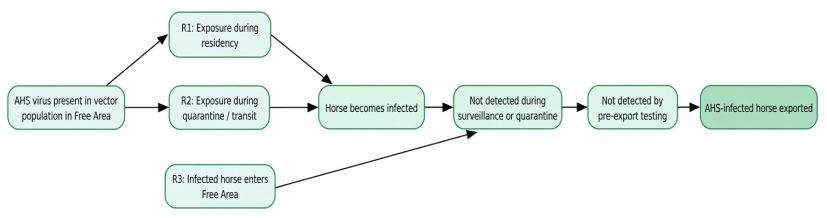
Figure 3: Schematic representation of the AHS risk pathway for export of registered horses from the Western Cape Free Zone to Great Britain, showing infection pathways (R1–R3) and subsequent detection steps through surveillance, quarantine, and pre-export testing
Alternative text: Figure 3 presents a simplified risk pathway showing how African horse sickness (AHS) infection could occur and remain undetected during export of horses from the Western Cape Free Zone to Great Britain. Three potential infection routes are identified: infection prior to entry into the Free Zone (R3), exposure during residency in the Free Zone (R1), and exposure during quarantine or transport (R2), all of which can lead to an infected horse. The pathway then illustrates sequential detection steps, including surveillance in the Free Zone, monitoring during quarantine, and pre‑export PCR testing.
R1: AHS incursion via import of a registered horse infected during residency in the AHS Free Zone of the Western Cape, South Africa
This pathway considers the risk that a registered horse becomes infected with African Horse Sickness (AHS) while resident within the AHS FZ of the Western Cape and is subsequently exported.
For infection to occur, AHS virus must first be present in the local vector (Culicoides midge) population. Evidence indicates that this likelihood is extremely low. There have been no confirmed AHS outbreaks in the FZ since its establishment in 1997, and more recent outbreaks have been confined to surrounding zones, with the last PZ outbreak in 2021 and no SZ outbreaks since 2016. Outbreaks in the PZ and SZ have historically been associated with factors such as illegal movements of equids or viral reassortment/reversion to virulence of live attenuated vaccine strains, rather than persistence of infection within the FZ itself. Dispersal of vectors from infected areas into the FZ is also highly unlikely due to the large size of the zones (>100 km), with modelling suggesting a negligible probability of spread over this range (Grewar et al., 2021). The virus is unlikely to become established in the vector population in the FZ because it is highly unlikely that infection would persist in horses or zebras in the area. While zebra populations can act as reservoir hosts, available evidence suggests their population density in the Western Cape is insufficient to support endemic viral persistence (Porphyre & Grewar, 2019). The high proportion of vaccinated horses in the PZ and the requirement to have a negative PCR test before entering the SZ or FZ makes it highly unlikely that infection would persist in the horse population.
Even if infected vectors were present, the likelihood of exposure to registered horses is considered low to very low. Horses in the FZ are not kept in vector-proof housing and so may be exposed to biting midges; however many of the horses are vaccinated and exposure to infected midges depends on the already very low probability of virus presence in the vector population. Ongoing vector and disease surveillance further supports confidence in freedom, with no detections and an estimated probability of disease freedom of approximately 89.5% in 2025 (Grewar et al., 2020; 2025 Sentinel Surveillance report).
Finally, the probability of an infected horse not being detected before it enters the quarantine centre is very low. A combination of active surveillance (PCR-based sentinel testing designed to detect ≥2% prevalence at 95% confidence), passive surveillance (mandatory reporting of suspect cases), and the severe clinical presentation and high mortality (70–95%) of AHS in horses all contribute to a high likelihood of detection. Although subclinical infection is possible, particularly in vaccinated animals, such cases are likely to be captured by surveillance systems.
Additional safeguards are applied during the residency, quarantine, and pre-export stages. Registered horses must remain in the AHS Free Zone (FZ) for at least 60 days prior to export to Great Britain. This residency period forms part of the broader requirement that horses must have been resident in the country of dispatch for at least 90 days (or since birth or entry, where applicable).Horses must also undergo a minimum 40-day period of pre-export isolation in an officially approved vector-protected quarantine facility. This quarantine period is a mandatory component of, and can be counted within, the required residency period in the AHS Free Zone. During quarantine, horses undergo twice-daily clinical monitoring. Horses are tested by PCR once within the required testing window (between 14 days after entry into quarantine and 72 hours prior to export). Given the high sensitivity of the test (~98%), combined with clinical monitoring, the likelihood of undetected infection is very low.
The combination of clinical monitoring, testing, and controlled conditions makes the likelihood of an infected horse remaining undetected negligible to very low.
Overall, the risk for this pathway is assessed as very low, with low uncertainty.
R2: AHS incursion via import of a registered horse infected during quarantine or transit from the Free Zone of the Western Cape, South Africa
This pathway evaluates the risk of a horse becoming infected during quarantine or transport following residency in the Free Zone. Horses in the quarantine centre may exercise outside in the free area immediately surrounding the quarantine centre, during low vector activity times of day.
As in R1, the likelihood of AHS virus being present in the surrounding vector population is very low, supported by long-term absence of outbreaks and surveillance data. Within the quarantine facility, horses are maintained under strict vector-protected conditions, with limited outdoor access restricted to periods of low vector activity and the use of insecticides and repellents.
Vector surveillance within and around the quarantine facility provides strong assurance of protection. Historical data shows that while vectors are present outside the facility, extremely few have ever been detected indoors, with none recorded in the last three years. This indicates that biosecurity measures are highly effective in preventing vector entry.
Even if vectors were present, the likelihood of midges being infected remains very low given the epidemiological context. Additional mitigation measures include insecticide use, light traps, controlled exercise timing, and strict hygiene practices, making iatrogenic transmission negligible.
During transport, horses are moved in vector-protected conditions (e.g. sealed containers; aircraft are cleaned and disinfected in advance with a disinfectant officially recognised by the importing country and sprayed against vector insects immediately prior to take-off), further reducing exposure risk. While there is some uncertainty regarding the effectiveness of certain insecticides and cumulative exposure risk over repeated consignments, the probability of infection during this stage remains low.
Horses are pre-export tested by PCR through an approved laboratory between 14 days and 72 hours before export and so it is possible for a horse to become infected after the PCR test was taken. However, as all horses are vaccinated and monitored closely for clinical signs of infection, this is considered highly unlikely.
Overall, the risk for this pathway is assessed as negligible-very low, with low uncertainty due to some residual concerns around vector control and cumulative exposure.
R3: AHS incursion via import of a registered horse infected prior to entry into the Free Zone of the Western Cape, South Africa
This pathway considers the risk of a horse becoming infected in an endemic or controlled zone, entering the FZ undetected and remaining infected at the point of export to Great Britain.
Movement of equidae between zones is strictly regulated, with requirements including vaccination, veterinary clinical checks, movement permits, pre-notification, and, in some cases, PCR testing or quarantine. Additional controls apply depending on the origin zone, and movements are subject to official oversight.
For an infected horse to enter the FZ, multiple system failures would need to occur simultaneously. These include illegal or non-compliant movement, failure of vaccination or testing requirements, evasion of clinical detection, and breakdown of movement controls. While subclinical infection could theoretically contribute to such a scenario, the cumulative likelihood of all these failures occurring together is considered very low/negligible.
There are acknowledged limitations, including incomplete identification and traceability systems outside the controlled area with relatively low levels of movement checks, and the existence of derogations for certain types of movement (e.g. racing). However, enforcement actions (including movement bans), and the historically low number of recorded movements from higher-risk zones into the FZ provides strong reassurance.
Importantly, even if an infected horse entered the FZ, it would still need to remain undetected throughout the subsequent 60-day residency and quarantine period, during which surveillance and testing measures would likely identify infection before export.
Overall, the risk for this pathway is assessed as negligible-very low, with low uncertainty reflecting gaps in movement control and equine traceability systems.
Conclusions
This risk assessment reviewed available data including surveillance programmes, movement data and controls within the AHS Free Zone (FZ), Surveillance Zone (SZ) and Protection Zone (PZ), information from Defra’s audit of the SA official controls on AHS and the export quarantine facility, and evidence on the epidemiology and clinical presentation of AHS in South Africa. The likelihood of AHS virus being introduced into Great Britain via this pathway is assessed as very low, with low uncertainty.
This conclusion is supported by the long-term absence of outbreaks in the FZ, the effectiveness of surveillance systems designed to detect low levels of infection, and the structured controls governing equine movements between zones. Additional mitigation is provided through vaccination strategies in surrounding areas, reducing viral circulation risk, alongside vector control and surveillance measures, particularly within the quarantine facility. The export pathway itself includes multiple sequential safeguards, including residency requirements, vector-protected quarantine, clinical monitoring and PCR testing prior to export, which together make it highly unlikely that an infected animal would remain undetected. Furthermore, AHS is a notifiable disease with a high mortality rate in susceptible horses and would likely be detected if clinical signs were present.
The combined evidence indicates a high level of confidence that the current system provides robust and effective controls to prevent the export of infected animals from the Western Cape Free Zone to Great Britain.
References
APHA, 2022, Veterinary Checks on Live Animals Import Information Note (IIN) VCLA May 2022
Assets.publishing.service.gov.uk, 2022, Model health certificate for Import from non-EU countries - registered horse, registered equine animal or equine animal for breeding and production GBHC044X v3.1 September 2022
Azna, I., McAteer, G., Gaynor, S., 2011, Risk assessment of the introduction of African Horse Sickness (AHS) into the Republic of Ireland (ROI)
Defra Food and Farming Group, 2008, International Animal Health Qualitative Risk Assessment, African horse Sickness: Potential Risk Factors and the likelihood for the introduction in of the disease into the UK
Department of Agriculture Forestry and Fisheries, 2019, Directorate Animal Health, African Horse Sickness Control Standard Operating Procedure: Maps of the African Horse Sickness control zones
Draft report of an audit to the Republic of South Africa to evaluate the animal health controls in relation to exports of registered equine animals to Great Britain. Defra. Nov 2023.
European Commission, 2013, Final report carried out in South Africa from May 20 to 29 May 2013
Fernando Boinas, Paolo Calistri, Mariano Domingoc, Marta Martínez Avilés, Beatriz Martínez López, Belen Rodríguez Sánchez, Jose Manuel Sánchez Vizcaíno, 2009. Scientific review on African Horse Sickness - SCIENTIFIC REPORT submitted to EFSA
Final Report of an Audit of South Africa carried out from 11 to 26 October 2022 to evaluate the animal health controls in relation to exports of registered equine animals to the European Union. July 2023
Grewar JD, Kotze JL, Parker BJ, van Helden LS, Weyer CT (2021) An entry risk assessment of African horse sickness virus into the controlled area of South Africa through the legal movement of equids. PLoS ONE 16(5): e0252117. https://doi.org/10.1371/journal.pone.0252117
Legislation.gov.uk, 2008, Commission Decision of 8 August 2008 on the temporary admission and imports into the Community of registered horses from South Africa (notified under document number C(2008) 4211) (Text with EEA relevance) (2008/698/EC)
Legislation.gov.uk, 2011, Commission Implementing Decision of 3 May 2011 amending Decision 2004/211/EC as regards the entry for South Africa in the list of third countries and parts thereof from which the introduction into the European Union of live equidae and semen, ova and embryos of the equine species are authorised (notified under document C(2011) 2959) (Text with EEA relevance) (2011/267/EU)
Molini U, Zaccaria G, Kandiwa E, Mushonga B, Khaiseb S, Ntahonshikira C, Chiwome B, Baines I, Madzingira O, Savini G, D’Alterio N. Seroprevalence of African horse sickness in selected donkey populations in Namibia. Vet World. 2020 May;13(5):1005-1009. doi: 10.14202/vetworld.2020.1005-1009. Epub 2020 May 31. PMID: 32636601; PMCID: PMC7311865.
Kelly, L., Kosmider, R, Gale, P., Snary, E.L, 2018. Qualitative import risk assessment: A proposed method for estimating the aggregated probability of entry of infection, Microbial Risk Analysis,Volume 9, Pages 33-37, ISSN 2352 3522,https://doi.org/10.1016/j.mran.2018.03.001.
King, S., Rajko-Nenow, P., Ashby, M., Frost, L., Carpenter, S. and Batten, C., 2020. Outbreak of African horse sickness in Thailand, 2020. Transboundary and Emerging Diseases.
Sergeant, E., Grewar, J., Weyer, C. and Guthrie, A., 2016. Quantitative Risk Assessment for African Horse Sickness in Live Horses Exported from South Africa. PLOS ONE, 11(3), p.0151757.
SportingPost.co.za (website), 2022, AHS Vaccine – SA Racing and Breeding Says ‘Enough’
Venter GJ, Koekemoer JJ, Paweska JT. Investigations on outbreaks of African horse sickness in the surveillance zone in South Africa. Rev Sci Tech. 2006 Dec;25(3):1097-109. PMID: 17361773.
Western Cape Government, 2021, Situation Report: African Horse Sickness in Cederberg Local Municipality, 20 April 2021
Western Cape Government, 2022, Restrictions in the movement of equids due to increase in AHS cases
WOAH Terrestrial Code Online Access, 2022, Section 12 Equidae, Chapter 12.1 infection with African Horse Sickness Virus, Article 12.1.13
Weyer C, Grewar JD, Burger P, Rossouw E, Lourens C, Joone C, et al. African Horse Sickness Caused by Genome Reassortment and Reversion to Virulence of Live, Attenuated Vaccine Viruses, South Africa, 2004–2014. Emerg Infect Dis. 2016;22(12):2087-2096.
Questionnaire to request information for the assessment of animal health requirements to export registered horses from the Republic of South Africa to Great Britain. Defra. Nov 2023.
Appendices
Appendix 1: Risk Terminology
The terminology used to define the qualitative likelihoods used in this risk assessment is based on those by EFSA (2006) and OIE (2004). This is supplemented by expanded descriptions to assist in interpretation and use of the EFSA (2006) terms.
Table 1: Definitions for the qualitative risk terms used in this assessment, based on EFSA (2006) and OIE (2012) with expanded descriptions adapted from Kahn et al., (1999) and FAO (2009)
| Risk level | Definition |
|---|---|
| Negligible | Event is so rare, does not merit consideration |
| Very low | Event is very rare, but cannot be excluded |
| Low | Event is rare, but does occur |
| Medium | Event occurs regularly |
| High | Event occurs very often |
| Very high | Event occurs almost certainly |
Qualitative categories for expressing uncertainty given the available evidence; based on definitions within the literature (EFSA, 2006; ECDC, 2011, Spiegelhalter & Riesch, 2011)
Low - Further research is very unlikely to change our confidence in the assessed risk
Type of information/evidence to support uncertainty category:
- solid and complete data available (for example, long-term monitoring results)
- peer reviewed published studies where design and analysis reduce bias (for example, systematic reviews, randomised control trials, outbreak reports using analytical epidemiology)
- complementary evidence provided in multiple references
- expert group risk assessments, specialised expert knowledge, consensus opinion of experts
- established surveillance systems by recognised authoritative institutions
- authors report similar conclusions
Medium - Further research is likely to have an important impact on our confidence in the risk estimate
Type of information/evidence to support uncertainty category:
- some but no complete data available
- non peer-reviewed published studies/reports
- observational studies/surveillance reports/outbreak reports
- individual (expert) opinion
- evidence provided in a small number of references
- authors report conclusions that vary from one another
High - Further research is very likely to have an important impact on our confidence in the risk estimate
Type of information/evidence to support uncertainty category:
- scarce or no data available
- no published scientific studies available
- evidence is provided in grey literature (unpublished reports, observations, personal communication)
- individual (non-expert) opinion
- authors report conclusions that vary considerably between them
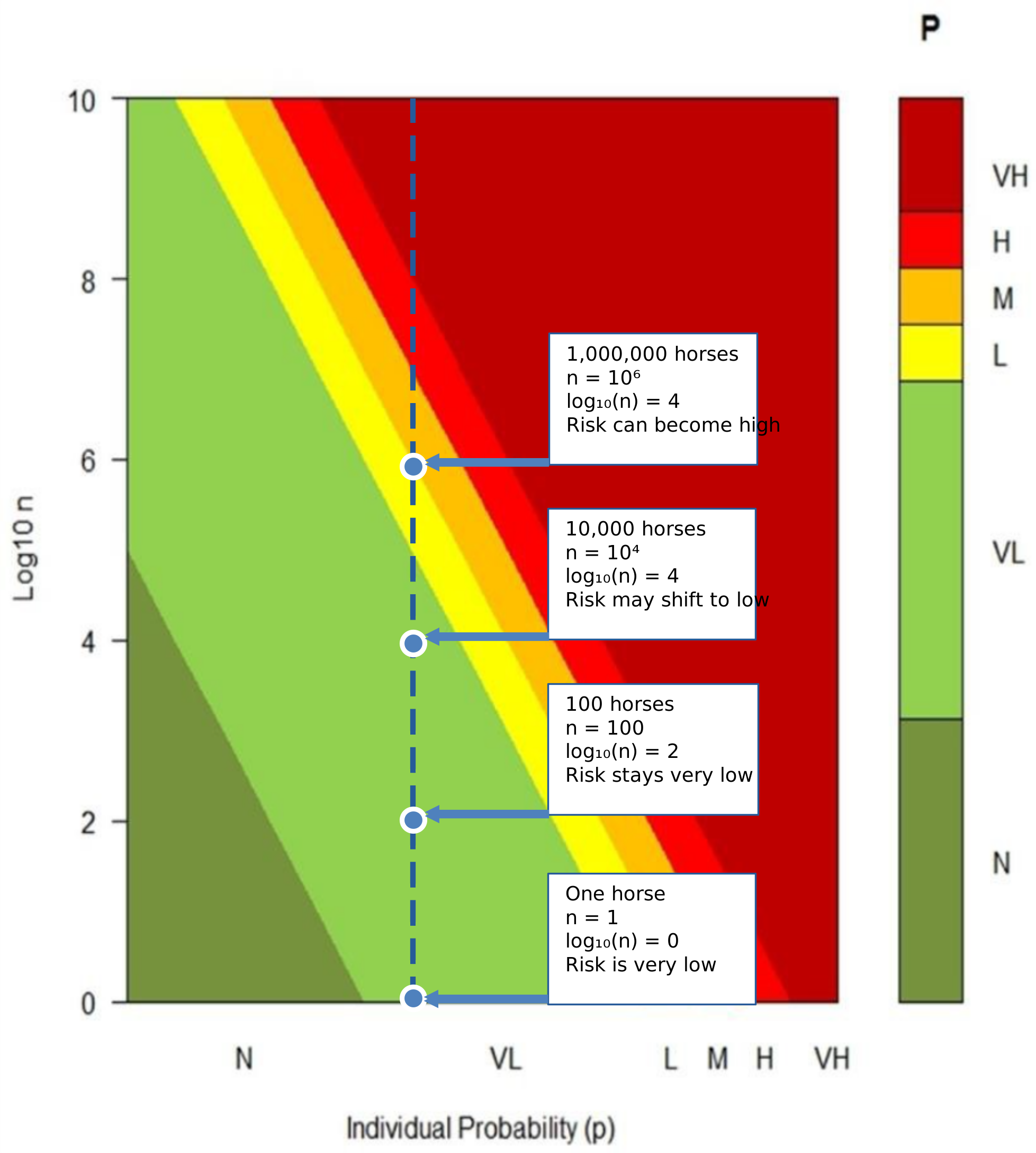
Figure 1: Graph displaying logarithmic increase for aggregated risk (Kelly et al., 2018)
Alternative text: Figure 1 illustrates how aggregated risk increases in a non‑linear (logarithmic) manner as individual probabilities increase. The horizontal axis represents individual probability categories, ranging from negligible to very high, while the vertical axis represents the logarithmic scale of combined risk. As individual probability increases, the aggregated risk rises sharply, moving through categories from negligible and very low to low, medium, high, and very high. The colour gradient (green to red) highlights this transition, showing that relatively small increases in individual probability at higher levels can result in disproportionately large increases in overall risk
Appendix 2. Summary of AHS epidemiological situation in Western Cape, South Africa
There have been no outbreaks in the free zone. There have been a number of outbreaks in the surveillance and protection zone believed to be a result of illegal movements or reassortment or reversion to virulence of the modified live vaccine. The last outbreak in the surveillance zone was in Cederberg in 2021 believed to be the result of an illegal movement.
Table 3: A summary of the AHS outbreaks in the AHS controlled area since 1997 is provided below.
| Outbreak | Serotype | Source | Date range | Cases | Sub-clinical cases | Positive herds | Population at risk: All equines | Population at risk: Equines in positive herds | Population at risk : All herds |
|---|---|---|---|---|---|---|---|---|---|
| 1999 Stellenbosch | 7 | Illegal movement | 21/03 - 28/05 1999 | 54 | - | 18 | 485 | 112 | 76 |
| 2004 Stellenbosch | 1 | Ra* and Rv* | 31/01 - 28/03 2004 | 23 | 0 | 3 | 4289 | 201 | 603 |
| 2006 Robertson | 5 | Illegal movement | 23/03 - 14/06 2006 | 32 | - | 8 | 844 | 774 | 26 |
| 2011 Mamre | 1 | Ra | 26/02 – 03/05 2011 | 84 | 15 | 47 | 447 | 228 | 81 |
| 2014 Porterville | 1 | Ra | 22/02 - 06/05 2014 | 89 | 52 | 31 | 868 | 250 | 118 |
| 2014 Robertson | 1 | Ra | 09/04 - 21/05 2014 | 22 | 17 | 8 | 839 | 680 | 25 |
| 2016 Paarl | 1 | Rv | 02/04 – 04/05 2021 | 21 | 14 | 8 | 1817 | 296 | 118 |
| 2021 Cederberg | 9 | Likely illegal movement | 09/04 - 25/05 2021 | 37 | 10 | 4 | 217 | 53 | 18 |
*RA - Reassortment of the modified live vaccine *RV - Reversion to virulence of the modified live vaccine