Domestic abuse related death review: statutory guidance (accessible)
Updated 27 November 2026

© Crown copyright 2026
This publication is licensed under the terms of the Open Government Licence v3.0 except where otherwise stated. To view this licence, visit nationalarchives.gov.uk/doc/open-government-licence/version/3 or write to the Information Policy Team, The National Archives, Kew, London TW9 4DU, or email: psi@nationalarchives.gov.uk.
Where we have identified any third party copyright information you will need to obtain permission from the copyright holders concerned.
This publication is available at https://www.gov.uk/government/publications/revised-statutory-guidance-for-the-conduct-of-domestic-homicide-reviews/domestic-abuse-related-death-review-statutory-guidance-accessible
September 2026
Introduction
“Illuminating the past to make the future safer”
Frank Mullane MBE, Advocacy After Fatal Domestic Abuse
Purpose and legal status
Under section 8A of the Domestic Violence, Crime and Victims Act 2004[footnote 1] (as amended by section 19 of the Victims and Prisoners Act 2024), a Domestic Abuse Related Death Review (DARDR), formerly known as Domestic Homicide Review (DHR), is a review of the circumstances in which the death of a person aged 16 or over[footnote 2] has, or appears to have, resulted from domestic abuse[footnote 3], with a view to identifying the lessons to be learned from the death. A DARDR provides an opportunity for national and local agencies, local communities, and society as a whole to consider each victim individually and treat every death as preventable.
The legislation underpinning DARDRs was amended by the Victims and Prisoners Act 2024[footnote 4], so that a DARDR is commissioned when a death has, or appears to have, resulted from domestic abuse, as defined by section 1 of the Domestic Abuse Act 2021[footnote 5] (“the 2021 Act”). The Domestic Abuse Act 2021 introduced a statutory definition of domestic abuse. Applying this definition will ensure that DARDRs continue to enhance our understanding of the different forms domestic abuse can take, and capture learnings to prevent domestic abuse related deaths. The Victims and Prisoners Act 2024 also renamed these reviews to Domestic Abuse Related Death Reviews, to better reflect the range of the deaths that fall within the scope of a review, including homicides, suicides and unexplained deaths that may have resulted from domestic abuse.
It has been over ten years since the statutory guidance was last updated in 2016, and over fifteen years since the first guidance was published and the reviews were operationalised in 2011. Over this time, we have learnt a great deal about the strengths of DARDRs, in addition to where they can be improved to maximise their potential for better understanding and preventing domestic abuse related deaths. We are dedicated to continuing with the fundamental principles of the DARDR, however, we recognise there is room for improvement in the way these are conducted, and the lessons applied.
Since the guidance was last reviewed, the Government has committed to halving violence against women and girls (VAWG) in a decade, which includes a programme of work to prevent and better understand domestic abuse related deaths. The Home Office has also launched the Domestic Abuse Related Death Review Library which holds all published DARDRs, to improve transparency and contribute to learning. All partners now have easy access to material to learn from previous domestic abuse related deaths and ultimately prevent future deaths.
This guidance applies to reviews where the notification of a death was received by the Community Safety Partnership after 15 September 2026. Any notifications received or reviews underway prior to this may continue to proceed under the previous DHR guidance.
Structure
The guidance has been divided into three sections: Section 1: Introduction; Section 2: Conducting a Domestic Abuse Related Death Review; and Section 3: Making Learning Count - Preventing Future Deaths. Each section provides detailed guidance as to how a DARDR should be conducted, outlining the necessary requirements. In addition, a ‘DARDR Toolkit’ has been included at the end of the document to provide templates, examples and signpost a range of support services.
New additions to this revised guidance include the introduction of a Scoping Review process to improve how early learning is recorded and actioned. The guidance also confirms the new process of documenting the reasoning why a DARDR should or should not be undertaken.
Information has been added on conducting DARDRs in instances where a domestic abuse victim has died by suicide[footnote 6], neglect or in circumstances that cannot be explained but there is evidence that they experienced domestic abuse. In addition, this guidance outlines the steps preceding publication of the DARDR, including arrangements for the dissemination of learning and quality assurance. It seeks to map how the DARDR process should be conducted to improve understanding and prevention of domestic abuse related deaths, and to further enhance the reputation of DARDRs as world-class domestic abuse related death reviews.
Audience
This statutory guidance is aimed at those organising, conducting and participating in a DARDR. This includes Community Safety Partnerships, the DARDR Chair and Panel, the Domestic Abuse Commissioner, Police and Crime Commissioners, organisations working with victims or perpetrators, commissioning services (including the police, local authorities, and the NHS) and the family, friends and community of the victim.
The guidance applies to England and Wales. In Wales, it applies insofar as it relates to matters that are reserved to the UK Government; this is primarily policing, and criminal justice, and to civil and family justice matters that operate on an England and Wales basis. In Wales, it is aimed at persons and bodies exercising public functions in relation to these matters, who must have regard to this guidance in respect to these matters when carrying out those functions. Separate arrangements apply in respect of devolved matters. Further information about reviews conducted in Scotland and Northern Ireland is set out in Section 5d.
It is important to note that in Wales, the Welsh Government has introduced the Single Unified Safeguarding Review (SUSR) process. The SUSR provides a single review framework which incorporates DARDRs, Child Practice Reviews, Adult Practice Reviews, Mental Health Homicide Reviews and Offensive Weapons Homicide Reviews and is conducted where the criteria of one or more of these reviews are met. In Wales, DARDRs are therefore conducted through the SUSR process. For further information on conducting a DARDR through the SUSR in Wales, please refer to Section 16.
To develop this guidance, a range of statutory, specialist and voluntary organisations and individuals have been consulted, and we thank them for their contributions. We also acknowledge the significant contribution of Poppy Robinson, whose long-standing commitment to this work shaped the development of this guidance.
Section 1: Introduction to Domestic Abuse Related Death Reviews
1 Purpose of a DARDR
1.1 The purpose of a DARDR is to understand what lessons can be learnt from domestic abuse related deaths and to identify and implement these at local and national level, in order to inform improvements in practice and better safeguard victims of domestic abuse.
1.2 DARDRs are not inquiries into how the victim died or into who is culpable; that is a matter for coroners and criminal courts to determine as appropriate. DARDRs are not specifically part of any disciplinary inquiry or process. However, a coroner’s inquest and police investigation will be of considerable assistance as a DARDR may review these and in some cases identify evidence of domestic abuse that had not been recognised in other processes.
1.3 Local learning: A DARDR should establish what lessons are to be learnt from the death. Specifically, the way in which local professionals and agencies work – and work together – to identify and safeguard victims. As far as possible, the review should be conducted in such a way that the process is seen as a learning exercise and not as a way of apportioning blame. In addition to professionals, agencies and multi-agency responses, the insights of families, friends, neighbours and colleagues should be sought to help inform the review and any local learning. Communities play a key role alongside professional organisations to identify barriers faced when attempting to access services, gaps in local service provision and to determine how these can be addressed with changes to local processes and systems. This learning should inform the local response to tackling domestic abuse.
1.4 National learning: While DARDRs are rooted in the local area, it is likely that the process will identify learnings which are applicable nationally. Where gaps are identified that need to be addressed at a national level, these should be reflected in recommendations directed to the relevant Government department and organisational body (for example, the Department of Health and Social Care and NHS England or the Home Office and the College of Policing). Further information on national recommendations can be found in Section 18.
1.5 To achieve their purpose, a DARDR must be victim-centred and conducted in a trauma-informed way. A DARDR should aim to see life through the eyes of the victim and their children. To achieve this, the DARDR Chair must endeavour to work with the people who were close to the victim; family and friends, neighbours, community members, their employer, colleagues and professionals. This helps reviewers to understand the victim’s reality; to identify any barriers the victim faced and learning why any interventions did not work to prevent their death. The key to a victim-centred DARDR is situating the review in the home, family and community of the victim. Further information on trauma-informed working can be found in Section 7a.
1.6 Whilst a DARDR should remain victim-centred, it should consider engaging with the perpetrator(s) to help the panel understand the full range of challenges facing the victim, and to identify if there were opportunities to prevent the perpetrator from engaging in abuse. More information on how to appropriately engage with perpetrators can be found in Section 7d.
2 Criteria and definitions for a DARDR
2.1 Under section 8A(1) of the Domestic Violence, Crime and Victims Act 2004[footnote 7] (“the 2004 Act”) (as amended by the Victims and Prisoners Act 2024), a Domestic Abuse Related Death Review (DARDR) is a review of the circumstances in which the death of a person aged 16 or over has, or appears to have, resulted from domestic abuse towards the person. It is held with a view to identifying the lessons to be learned from the death.
2.2 In practice, a DARDR must be considered in cases involving murder, manslaughter, suicide, neglect or deaths occurring in unexplained or unclear circumstances where the victim had experienced domestic abuse.
2.3 Due to the possible number of deaths that may meet these criteria, we do not anticipate it will be possible for every case to progress to a full DARDR. In all cases, however, an initial Scoping Review must be undertaken to determine whether a full DARDR should be commissioned and to ensure that early learning is identified. For more information on conducting Scoping Reviews, please see Section 4.
2.4 CSPs should consider a range of factors when deciding if a DARDR should be commissioned, including (but not limited to):
i. Indicators of previous domestic abuse, such as:
-
any previous incidents of domestic abuse reported to the police or other agencies (for example health, education or social care);
-
reports or disclosures made to other specialist organisations or support services, including domestic abuse charities.
ii. Early indications of possible learning, such as:
-
information from the victim – including reported or anecdotal indications that domestic abuse occurred prior to the death. This may include disclosures to the police or other services, text messages, diary entries, emails or other recorded communications;
-
information from family, friends, or members of the community – including concerns, observations, or disclosures suggesting that the victim may have been experiencing domestic abuse before their death;
-
information on the victim’s vulnerabilities – including that the victim had no recourse to public funds or was subject to insecure immigration status, substance misuse, or had multiple disadvantages[footnote 8];
-
risk factors associated with the suspected perpetrator – including, but not limited to, mental ill health, coercive or controlling behaviour, ‘honour’-based abuse, alcohol or substance misuse, escalation in abusive behaviour and recent separation, threat of separation, or other relationship changes known to increase risk such as recently coming out to family and community members;
-
patterns of agency contact – whether the victim or suspected perpetrator had recent engagement with police, health services, social care, or specialist domestic abuse services that may have indicated risk;
-
history of domestic abuse – including any previous police reports, civil or protective orders, Multi-Agency Risk Assessment Conference (MARAC) or other multi-agency forum involvement, or safeguarding concerns linked to the victim or the suspected perpetrator; and
-
a lack of prior contact with relevant agencies, which could indicate that services did not reach the victim effectively.
2.5 A DARDR is not a criminal investigation and does not seek to apportion blame or determine criminal liability. The purpose of the DARDR is to identify learning from the actions taken, or not taken, by agencies and organisations that could have identified and managed any potential domestic abuse as a risk.
2.6 A DARDR needs to identify both a victim and a suspected perpetrator(s) of domestic abuse, or a contextual basis for domestic abuse, in order for a review to be commissioned. However, as a statutory review, a DARDR may proceed even where no perpetrator has been identified by law enforcement agencies.
Section 8A(1) of The Domestic Violence, Crime and Victims Act 2004, as amended by the Victim and Prisoners Act 2024:
(1) In this section “domestic abuse related death review” means a review of the circumstances of the death of a person which is held—
- (a) where the death has, or appears to have, resulted from domestic abuse towards the person within the meaning of the Domestic Abuse Act 2021, and
- (b) with a view to identifying the lessons to be learned from the death.
(2) The Secretary of State may in a particular case direct a specified person or body within subsection (6) to establish, or to participate in, a domestic abuse related death review.
(3) It is the duty of any person or body within subsection (6) establishing or participating in a domestic abuse related death review (whether or not held pursuant to a direction under subsection (2)) to have regard to any guidance issued by the Secretary of State as to the establishment and conduct of such reviews.
(4) A person or body within subsection (6) that establishes a domestic abuse related death review (whether or not held pursuant to a direction under subsection (2)) must send a copy of any report setting out the conclusions of the review to the Secretary of State and the Domestic Abuse Commissioner.
(5) The copy must be sent as soon as reasonably practicable after the report is completed.
(6) The persons and bodies within this subsection are—
- i. chief officers of police for police areas in England and Wales;
- ii. local authorities;
- iii. NHS England;
- iv. integrated care boards established under section 14Z25 of the National Health Service Act 2006;
- v. providers of probation services;
- vi. Local Health Boards established under section 11 of the National Health Service (Wales) Act 2006;
- vii. NHS trusts established under section 25 of the National Health Service Act 2006 or section 18 of the National Health Service (Wales) Act 2006.
Section 1 of The Domestic Abuse Act 2021 defines domestic abuse as:
(2) Behaviour of a person (“A”) towards another person (“B”) is “domestic abuse” if—
- (a) A and B are each aged 16 or over and are personally connected to each other, and
- (b) the behaviour is abusive.
(3) Behaviour is “abusive” if it consists of any of the following—
- (a) physical or sexual abuse;
- (b) violent or threatening behaviour;
- (c) controlling or coercive behaviour;
- (d) economic abuse (see subsection (4));
- (e) psychological, emotional or other abuse;
and it does not matter whether the behaviour consists of a single incident or a course of conduct.
(4) “Economic abuse” means any behaviour that has a substantial adverse effect on B’s ability to—
- (a) acquire, use or maintain money or other property, or
- (b) obtain goods or services.
(5) For the purposes of this Act A’s behaviour may be behaviour “towards” B despite the fact that it consists of conduct directed at another person (for example, B’s child).
(6) References in this Act to being abusive towards another person are to be read in accordance with this section.
(7) For the meaning of “personally connected”, see section 2.
2a. Cases not ruled as homicide
2.7 Domestic abuse related deaths can involve victims who die by suicide or in unexplained or unclear circumstances. [footnote 9] Reviewing suicides and unexplained deaths linked to domestic abuse is an important step in continuing to build the evidence base and improve understanding of the risk factors for victims and perpetrators of domestic abuse outside the context of a homicide.
2.8 To identify cases of suicide and unexplained death which should be considered for a DARDR, CSPs should establish strong links with public health partners and local real-time suicide surveillance processes.
2.9 When considering whether a DARDR should be commissioned following a death by suicide or an unexplained death linked to domestic abuse, the CSP should take into account a range of relevant factors, as outlined in Section 2 (paragraph 2.4).
Section 2: Conducting a Domestic Abuse Related Death Review
Figure 1: Domestic Abuse Related Death Review process map
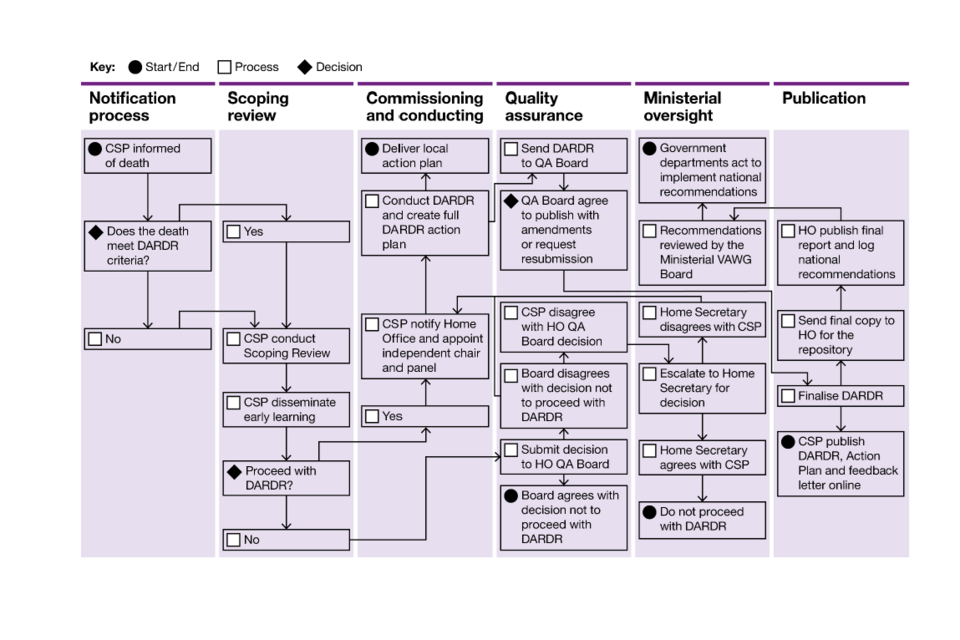
Image: process map showing the stages and decision points in a Domestic Abuse Related Death Review.
3 Notification of a death to the Community Safety Partnership
3.1 The Community Safety Partnership (CSP) should be notified of a domestic abuse related death by the local area police force.
3.2 Whilst notifications are typically made by the local area police force, notifications are not limited to the police. Where relevant persons or bodies, including friends or family members of the deceased, become aware of the qualifying circumstances of a death, or of facts that make it likely that the conditions in section 8A of the 2004 Act are satisfied in relation to a death, a notification can be made directly to the local CSP.
3.3 The CSP should be contacted in writing in the first instance, for example by email, to ensure that the information provided is appropriately documented and dated. Friends or family members may find it helpful to contact a statutory agency or specialist support service who had prior contact with the deceased for support when contacting the CSP.
4 Scoping Review process
4.1 The CSP should conduct a Scoping Review for all fatalities referred to them for a DARDR. The Scoping Review can be carried out as a desk-based exercise or the CSP may choose to convene a panel or utilise existing decision-making structures.
4.2 The Scoping Review will support the CSP to determine whether a DARDR should be commissioned. Its purpose is to:
-
assess whether a full DARDR is required (Scoping Reviews must not replace the DARDR process);
-
identify the likely scope and parameters of the review required;
-
determine whether a DARDR is the most appropriate review mechanism, including whether other review processes may be more suitable (see section 8 on parallel reviews for more information);
-
capture early learning from the death so that improvements can be identified acted upon swiftly; and
-
identify learning for cases that do not progress to full DARDRs, ensuring that no insights are lost.
4.3 In cases where the criteria for a DARDR are clearly met, the Scoping Review should be undertaken promptly and without unnecessary delay, with the aim of enabling local agencies to rapidly share insights and early learning.
4.4 The CSP should notify the family of the victim that a Scoping Review is being undertaken. The process should be explained clearly and the family’s views on whether a DARDR should be commissioned should be sought. This engagement must be managed sensitively, and independent specialist advocacy should be offered to the family at the earliest opportunity.
4.5 Resources are available for family members and friends) that provide clear information about the DARDR process. These should be shared as part of the CSP’s engagement with those affected by the death.
4.6 The Scoping Review can also help to identify whether there are any ongoing criminal proceedings of which the DARDR Chair will need to be aware. Further information about managing DARDRs in these instances is set out in Section 9.
4a. Conducting the Scoping Review Process
4.7 The Scoping Review template can be found in Annex C[footnote 10]. Each Scoping Review must include:
-
a concise summary of events that led up to the death;
-
a summary of agency interaction (if any) with the victim and perpetrator;
-
key emerging learning and themes identified;
-
an action plan, outlining any immediate or short-term improvements required;
-
the views of family and/or friends;
-
a decision on whether a DARDR will be commissioned, including a clear rationale to support the decision not to commission a DARDR (see Section 4b for further information);
-
whether a DARDR will be commissioned but must be paused due to ongoing criminal proceedings. See Section 9a for more information; and
-
for historic cases, CSPs should consider whether potential learning may be limited by changes in organisational structures, local practice, or legislation since the death occurred.
4.8 Following completion of the Scoping Review, the CSP is responsible for determining whether a DARDR should be commissioned.
4.9 The CSP must notify the Home Office DARDR Team that a review is being initiated by emailing «DARDREnquiries@homeoffice.gov.uk>. Any early findings, emerging themes or action plans identified during the Scoping Review must be considered and further developed as part of the full DARDR.
4b. Decisions not to conduct a DARDR
4.10 Where the CSP decides not to proceed with a DARDR, the completed Scoping Review must be submitted to the Home Office DARDR Team at: «DARDREnquiries@homeoffice.gov.uk>.
4.11 A decision not to conduct a DARDR must be based on whether a full review is likely to provide additional, meaningful learning. The rationale for this decision must be clearly recorded in the Scoping Review.
4.12 CSPs may decide not to proceed where both of the following conditions are met:
- There was little or no agency involvement with either the victim or the perpetrator;
and
- Family members, friends or the wider community have limited or no knowledge or awareness of domestic abuse having occurred.
4.13 CSPs must demonstrate that all reasonable opportunities for learning have been explored. The Scoping Review must clearly evidence how both of the above conditions apply and set out why a full review would not add further value.
4.14 Where possible, CSPs should engage with families sensitively to gather information that may inform the decision. Families may hold important insights about the nature and extent of the abuse that agencies were unaware of. However, if families choose not to be actively involved with the process, it is important that CSPs clearly record the family’s position as part of the Scoping Review.
4.15 Families should not be informed that a review will not be conducted until the decision-making process is complete, and formal feedback has been received from the Home Office Quality Assurance (QA) Board. This approach is intended to prevent unnecessary distress caused by repeated or changing communications.
4.16 All Scoping Reviews where the CSP has decided not to conduct a DARDR will be submitted to the Home Office Quality Assurance (QA) Board. The QA Board will review whether the case meets the statutory criteria for a DARDR and consider the rationale provided in the Scoping Review. The QA Board will aim to notify the CSP within 8 weeks from the date they acknowledge receipt of the notification whether:
-
It agrees with the decision not to commission a DARDR, or
-
It recommends that a full DARDR should be carried out.
4.17 Where the QA Board recommends that a DARDR should be commissioned and the CSP maintain that a DARDR should not be undertaken, the decision will be escalated to the Home Secretary. The Home Secretary has the power to direct a CSP to conduct a DARDR where it is deemed appropriate under section 8A(2) of the Domestic Violence, Crime and Victims Act 2004.
4.18 Once the QA Board’s decision, or the Home Secretary’s decision, where escalated, has been received, the outcome should be shared with the victim’s family without unnecessary delay.
4.19 CSPs are responsible for the dissemination of any learning identified during the Scoping Review in cases that do not progress to a full DARDR.
Figure 2: Scoping Review process summary
Phase 1: Initiation and family engagement
- Action: CSP conducts a Scoping Review (either desk-based or by a panel) for all referred fatalities.
- Family contact: Notify the family of the victim, explain the process and seek their views on whether they think a DARDR should be commissioned.
- Support: The process should be managed sensitively, and independent specialist advocacy should be offered as early as possible.
- Resources: Provide family members and friends with information about the DARDR process.
Phase 2: Conducting the Scoping Review
The Scoping Review must include:
- a summary of events that led up to the death
- a summary of agency interaction with the victim and perpetrator (if any)
- significant learnings and themes
- an action plan
- the views of family/friends on whether they believe a DARDR should be commissioned
- whether a DARDR will be commissioned or rationale to support a decision not to commission a DARDR where relevant
- whether a DARDR will be commissioned but must be paused due to ongoing criminal proceedings
Phase 3: The commissioning decision
- Option 1: Criteria to commission a DARDR is met. Notify Home Office and proceed swiftly to full DARDR and disseminate early findings.
- Option 2: In some cases, the criteria for a DARDR are met, but commissioning is paused for criminal proceedings to take place.
- Option 3: Criteria to commission a DARDR is not met. Provide rationale and submit the Scoping Review to the HO QA Board. Do not inform family of decision until formal feedback is received.
Phase 4: Quality assurance and final ruling
- HO QA Board review: Reviews of decisions not to conduct a DARDR take approximately 8 weeks to turnaround.
- Board recommendation:
- Agreement not to conduct: CSP notifies family of the final decision without delay.
- Recommendation to conduct: If CSP disagrees, the case is escalated to the Home Secretary.
- Final power: Under Domestic Violence, Crime and Victims Act 2004, the Home Secretary will review the case and may direct the CSP to conduct a DARDR.
5 Coordinating a Domestic Abuse Related Death Review at the local level
5.1 Once a Scoping Review has been completed and the decision to proceed with a DARDR has been made, the CSP should formally commission a DARDR as soon as possible.
5a. Convening a DARDR Panel
5.2 When a decision is made to undertake a DARDR, the CSP must establish a local DARDR Panel.
5.3 The DARDR Panel must include individuals from the statutory agencies listed under section 8A(4) of the Domestic Violence, Crime and Victims Act 2004, as outlined in Section 1.2 Criteria and definitions for a DARDR. It should also include representation from the national or local VAWG[footnote 11] specialist services[footnote 12], and expert representatives on marginalised groups from ‘by and for’ and specialist organisations who will have knowledge of the dynamics of domestic abuse and how it manifests and can represent the perspective of the victim and/or, where appropriate, the perpetrator. For example, this could include representation from organisations specialising in supporting male victims, older victims, ‘honour’-based abuse, or on suicide prevention.
5.4 Panel members must be independent of any line management of staff involved in the case. They must also be sufficiently senior to have the authority to commit to decisions made on behalf of their agency during a panel meeting and demonstrate how they will ensure learning is embedded within their organisation.
5.5 Expectations of Panel engagement throughout the DARDR:
-
Panel members should be able to consistently attend DARDR meetings.
-
The Panel must meet to agree the scope and terms of reference for the DARDR at the initial meeting.
-
The Panel must meet to review and discuss the Individual Management Reviews (IMRs).
-
The Panel must meet to discuss and agree the final draft of the DARDR.
-
It is encouraged that the Panel to meet quarterly to receive updates from the DARDR Chair and provide feedback and challenge throughout the process.
-
The Panel should consider themselves as co-producers of the DARDR. As such, they should seek to engage in the process of creating the Terms of Reference scrutinising information that is collated to identify learnings and participate in developing the final DARDR.
-
Panel members should use their expertise to consider and constructively challenge the DARDR Chair and the interim findings to ensure it comprehensively considers all relevant issues. Debate is encouraged, however any disagreements between Panel members must be resolved by the members and DARDR Chair. If they cannot be resolved, the DARDR will need to record the areas of disagreement and actions taken towards a resolution. The Home Office will not arbitrate when there is disagreement.
-
Panel members should remain mindful of their mental wellbeing, as DARDRs often involve exposure to highly distressing information; this can be particularly difficult for members who contribute to consecutive DARDRs, as well as other statutory reviews.
-
Panel members should liaise and share the learning from DARDRs with their own organisations, where relevant.
5.6 The CSP must have local governance structures in place to monitor the implementation of the DARDR’s action plan. The CSP should ensure that the DARDR Panel is aware of this and its responsibilities within it.
5b. Appointing a Chair for the DARDR
5.7 The CSP is responsible for appointing an independent Chair of the local DARDR Panel. To ensure independence, the CSP must review whether they have connections to any panel members or organisations represented (personal or professional). The DARDR Chair should not be directly associated, or have any recent involvement, with any agencies involved in the DARDR or the CSP. An ‘independence statement’ should be included as an appendix to the DARDR, setting out the Chair’s career history, independence and any conflicts of interests.
5.8 The DARDR Chair is responsible for producing the final DARDR report based on evidence that DARDR Panel decides is relevant. This includes ensuring that the report is of a high standard and complies with the statutory guidance.
5.9 The DARDR Chair is responsible for cultivating and maintaining relationships amongst the DARDR Panel and between the DARDR Panel and participating agencies, organisations, individuals and families. Therefore, any conflict of interest should be declared at the point of recruitment and when it arises during the DARDR process. The DARDR Chair is also responsible for leading on engagement with the family, friends and community of the victim and with the perpetrator where appropriate.
5.10 The DARDR Chair is responsible for amending the report in line with feedback from the QA Board and must continue to be involved in the DARDR process up to the point of publication.
5.11 The Chair is required to use the DARDR Template provided in Annex A. A final version of the DARDR and accompanying DARDR Schema should be sent to the CSP for local governance approvals and then sent to the Home Office. A copy of the DARDR Data Capture Form is included as Annex H.
5.12 From now onwards, any individual which the CSP seeks to appoint as DARDR Chair must have completed the mandatory DARDR Chair training in order to be eligible to chair a review. The purpose of this is to ensure DARDR Chairs can conduct a DARDR effectively, successfully identify all relevant learning and develop recommendations that will improve the safety of domestic abuse victims and prevent further deaths.
5.13 CSPs can request access to the official register of qualified DARDR Chairs by contacting training@aafda.org.uk. The register provides relevant information about Chairs, including work experience, contact information, and when they received the Certificate in Chairing a DARDR.
5.14 CSPs should consider the skills and expertise of any individuals they are seeking to appoint as a DARDR Chair. Alongside completion of the Chair training, the CSP should be confident that the DARDR Chair has the following:
-
Policy and legislative knowledge:
-
expert knowledge of domestic abuse policy, including research, guidance and legislation relating to adults and children, including for example the Domestic Abuse Act 2021, Domestic Abuse Act Statutory Guidance (2022), Controlling or Coercive Behaviour Statutory Guidance Framework (2023), Serious Crime Act 2015[footnote 13], Children’s Act 2004[footnote 14], Care Act 2014[footnote 15] and Equality Act 2010;
-
an understanding of the role and context of the main agencies involved in a DARDR;
-
an understanding of wider statutory review frameworks.
-
-
Practical experience:
-
understanding and experience in trauma-informed practices;
-
experience of supporting domestic abuse victims or frontline experience in the domestic abuse sector is favourable although not essential;
-
experience in managing multiple stakeholders.
-
-
Analytical and communication skills:
-
ability to synthesise complex information and produce a strategic assessment;
-
good written and verbal communication skills;
-
experience of writing formal reports.
-
-
Subject-matter sensitivity:
-
clear understanding of the nature of confidentiality;
-
understanding of an individual’s personal experiences and needs, and its impact on an individual’s experiences with agencies.
-
5.15 It is recommended that CSPs request that Chairs hold an appropriate Disclosure and Barring Services (DBS) check before undertaking a review.
5.16 During a DARDR, Chairs should be aware of local safeguarding procedures. If the Chair identifies any live or immediate safeguarding concerns, these should be reported to the relevant agency or authorities without delay.
5.17 CSPs should check the Chair’s availability and confirm that they are available to undertake the DARDR upon appointment to ensure that the review is not unnecessarily delayed.
5c. Cross-border Reviews
5.18 Where more than one local authority area has had contact with and holds relevant information about the victim, the CSP of the area in which the victim was primarily resident[footnote 16] should take lead responsibility for commissioning and overseeing the review.
5.18.1 Where the victim has no settled or established address prior to the incident, lead responsibility should ordinarily sit with the CSP for the area where the victim was last known to be living or had regularly spent time. This should be determined at the outset of the process and kept under review, having regard to the specific circumstances of the case.
5.18.2 There may be circumstances where lead responsibility for conducting a review may not be easily determined due to the complex nature of the case. In such cases, it is strongly advised that the relevant CSPs agree on the division of lead and shared responsibilities as part of the initial scoping process, to avoid any unnecessary delays and to ensure that learning is captured from all relevant agencies and geographical areas involved.
5d. Reviews undertaken in Wales, Scotland and Northern Ireland
5.19 There are differences between review models in England, Wales, Scotland and Northern Ireland.
5.20 In England and Wales, DARDRs and SUSRs apply to domestic abuse related deaths where the victim was aged 16 and over, and who are considered personally connected to the perpetrator, as defined in section 2 of the Domestic Abuse Act 2021. These reviews may include, homicides, suicides and deaths occurring in unexplained or unclear circumstances, where there is evidence that domestic abuse may have been a contributing factor.
5.21 For information about undertaking reviews in Wales, including the operation of the SUSR framework, see Section 16 on the Single Unified Safeguarding Review (SUSR).
5.22 Domestic Homicide and Suicide Reviews (DHSRs) in Scotland operate under the Criminal Justice Modernisation and Abusive Domestic Behaviour Reviews (Scotland) Act 2025[footnote 17], which provides a statutory framework for the model. DHSRs in Scotland commenced on 1 April 2026.
5.23 The scope of DHSRs in Scotland include the review of domestic abuse related deaths in the following circumstances:
-
where a victim is killed by a partner or ex-partner;
-
where a person kills their children or the children (of any age e.g. a 45-year-old living independently) of their partner or ex-partner;
-
cases of violent resistance, where a victim of domestic abuse kills their abusive partner or ex-partner;
-
where a person kills children or young people (under 18 or up to the age of 26 for care-experienced individuals) who live in the same household as them or their partner or ex-partner;
-
domestic abuse related suicide; and
-
connected deaths of children and young people, including those who died as part of a domestic abuse related death (or near fatal incident) but who may or may not be related to the victim or perpetrator. For a death of a connected young person they must be under 18 or 26 if previously looked after.
5.24 DHSRs in Scotland do not include the deaths of wider family members beyond those categories set out above. For cross-border cases requiring collaboration with Scotland, enquiries should be sent to dhsrmodel@gov.scot.
5.25 In Northern Ireland, Domestic Homicide Reviews have been operational in since 2020. Reviews are conducted when a person aged over 16 has died as a result of, or appears to have resulted from, domestic violence and abuse[footnote 18]. The purpose of the review is to identify lessons to be learned from the death in order to improve the response of agencies.
5.26 DHRs in Northern Ireland do not include suicides and do not apply to the deaths of children under the age of 16. For cross-border cases requiring collaboration with Norther Ireland, enquiries should be sent to dhradmin@justice-ni.gov.uk.
5.27 Some DARDRs may involve cases where the victim or perpetrator lived in, or accessed services in another part of the UK for a period of time. In such cases, cross-border collaboration is strongly encouraged, where appropriate, to ensure all the relevant information is gathered and that learning reflects the full range of agency involvement. For information about domestic abuse related deaths that take place overseas, see Section 11: Overseas Deaths.
6 Conducting the Domestic Abuse Related Death Review
6.1 In consultation with the DARDR Panel, the DARDR Chair should determine the scope of the DARDR and create Terms of Reference. The Terms of Reference should be drafted by the DARDR Chair and must be shared with the DARDR Panel for comment and agreement. In addition, the Terms of Reference should be shared with family and friends of the victim if they are engaging with the DARDR and their views should be considered. These may need to be revisited as the DARDR progresses and as new information emerges. Any reconsideration or changes to these documents will need to be agreed by the DARDR Panel.
6.2 If a DARDR is anticipated to run in parallel to a criminal investigation or prosecution, the DARDR Chair should inform the police. This will allow the police the opportunity to express their views and input to the DARDR Terms of Reference before they are finalised.
6a. Scope of the DARDR and Terms of Reference
6.3 The Terms of Reference should be clear, relevant and proportionate to the case.
6.4 The DARDR Chair should consider the following non-exhaustive list of factors when developing the scope of the DARDR:
6.4.1 The time periods under review in the lives of the victim and perpetrator. Whilst it may not be possible to determine a cut-off point as to how far back the DARDR should go, efforts should be made to learn about their history to help better understand the events leading to the death.
6.4.2 The agencies that had been involved with the victim or perpetrator should be asked to contribute an Individual Management Review (IMR). The DARDR Chair should also consider contacting agencies that have not come into contact with the victim or perpetrator, but might have been expected to do so. This could support the development of learning that improves understanding of why contact was not made.
6.4.3 A determination of whether the victim or perpetrator were subject to Multi-Agency Risk Assessment Conference (MARAC) or Multi-Agency Public Protection Arrangements (MAPPA) or other arrangements. The DARDR Chair should seek to request the minutes or Memorandum of Understandings from these meetings.
6.4.4 The terms of engagement with family members, friends and other support networks (for example, co-workers and employers, neighbours, faith and community groups); and where appropriate, the perpetrator, should be clarified in writing by the DARDR Chair. Consideration should be given to how family members, friends and support networks of the victim will be engaged and updated and how the services of an independent advocate can be utilised. This may entail the use of interpreters where required. Arrangements for giving feedback and sharing the contents of the DARDR with the family members or friends closest to the victim before publication should also be clarified.
6.4.5 Consideration by the DARDR Chair of how any public and media attention and engagement should be managed before, during and after the DARDR, and work with the CSP who are responsible for this.
6.4.6 Specific considerations around equality and diversity relating to the victim and perpetrator should be explored, these include: age, disability (including learning disabilities), gender reassignment, marriage and civil partnership, pregnancy and maternity, race (including nationality and citizenship), religion and belief, sex and sexual orientation. Further information regarding diversity and inclusion can be found in Annex F.
6.4.7 Consideration of other reviews taking place into the case, including decisions to conduct joint or parallel reviews. The Chair should consider other reviews prior to the first meeting with the DARDR Panel. The Terms of Reference should ensure the key requirements of both processes are clearly identified and met. Further information can be found in Section 8.
6.4.8 Establish whether there have been other DARDRs in the same local authority area. If so, consider whether there are relevant recommendations to consider alongside the current DARDR’s learning.
6.5 It is critical that there is control over any information which is shared, to ensure information does not jeopardise or undermine a criminal investigation or other criminal justice proceedings running in parallel to the DARDR. It may be necessary to wait for the resolution of criminal investigations and proceedings before certain details are shared with DARDR Panel members or included in the DARDR. This should be balanced against the benefits of learning being identified in a timely manner. Further information about conducting a DARDR alongside a criminal investigation can be found in Section 9.
6.6 The DARDR Chair should agree with the CSP any plans for briefing sessions or learning events for relevant review partners and appropriate bodies to establish what lessons are to be learnt from the incident. The learnings may also be circulated to relevant partners.
6b. Additional evidence and research
6.7 The DARDR Chair must consider what additional evidence, information or research the DARDR would benefit from. Any findings, analysis or recommendations from the DARDR should be evidence based. Therefore, the following should be included at a minimum.
6.8 Individual Management Reviews (IMRs) are written reports outlining an organisation’s involvement with the victim, perpetrator or their families.
-
IMRs should allow agencies to look openly and critically at individual and organisational practices and the context within which professionals were working (culture, leadership, supervision, training, etc.), to see whether the death indicates that gaps exist, or practice needs to be changed or improved to support professionals to carry out their work to the highest standards;
-
identify interactions with the victim and/or perpetrator;
-
identify how and when those changes or improvements to practice will be implemented;
-
identify examples of good practice within agencies; and
-
the DARDR Chair is expected to invite IMR authors to present and discuss drafts with the DARDR Panel. The template for IMR is included as Annex D.
6.9 Interviews with family, friends and community members to ensure the DARDR presents a comprehensive picture of the victim and their life. Where possible these should be used to inform early discussions. These can be:
-
interviews with the victim’s family and friends or wider community;
-
interviews with the perpetrator’s family and friends or wider community;
-
consider approaching the victim’s and perpetrator’s employers where relevant; and
-
consider approaching financial advisors or financial institutions from whom the victim was engaging services, where relevant.
6.10 The voices of any children involved also need to be considered to understand their perspectives and how the death, or domestic abuse that took place prior to the death, affected them.
-
Children should be offered specialist support through which they can be offered an opportunity to safely contribute to the DARDR.
-
When engaging with children as part of the DARDR, it is important to understand:
-
that children are now recognised as victims of domestic abuse in their own right, in accordance with Section 3 of the Domestic Abuse Act 2021[footnote 19];
-
that sensitivity is key to avoid triggering any traumatic memories and recognition of the impacts of trauma on how they may present;
-
that the DARDR Chair and Panel must consider every case individually, as engagement may not be appropriate in every case;
-
how the age of the child and wider factors, such as neurodiversity, may require different forms of engagement and support;
-
when children are ready to talk and be supported to understand domestic abuse;
-
that more time may be needed to support children and to work at the child or young person’s pace;
-
the unequal power balance as an adult and that children and young people may benefit from being supported by someone they know; and
-
that children have important pieces of information as they are victims in their own right and should be trusted and respected when sharing their story.
-
6.11 Secondary research and evidence to support findings and recommendations. Where research is used, DARDR Chairs must ensure it is relevant to the case. This can include:
-
immediate actions already taken;
-
actions identified in the Scoping Review;
-
reference to previous DARDRs in the local area;
-
submissions or reports on existing strategic assessments from agencies, the CSP or other relevant bodies about their response to domestic abuse; and
-
published research.
7 Compiling the Domestic Abuse Related Death Review
7.1 The analysis of information is a crucial component of the DARDR. The DARDR Chair and panel must probe the information provided and examine how and why the death occurred. The analysis must consider whether different decisions or action could have led to a different course of events. It is also an opportunity to highlight where good practice occurs.
7.2 Once the Terms of Reference are finalised, the information has been considered and agreed by the DARDR Panel, and the panel have engaged with family and friends, the DARDR Chair should draft the DARDR using the DARDR Template included at Annex A. A non-exhaustive list of items to consider whilst drafting the DARDR are outlined below:
7.2.1 Review all information collated during the Scoping Review, IMRs submitted by agencies and interviews, and summarise the information in a combined chronology leading up to the incident.
7.2.2 Analyse the information gathered to identify key learning and recommendations. It may be necessary to prioritise what issues are the most important to address when identifying the learning from the incident.
7.2.3 Ensure data collection from all relevant sources is documented to enable the DARDR Data Capture Form to be populated. The document should be sent alongside the final DARDR to the Home Office on completion. A copy of the DARDR Data Capture Form is included as Annex H.
7.2.4 The CSP must complete the DARDR local Action Plan (a template has been provided in Annex B). Arrangements for the oversight of the implementation of the Action Plan should also be made clear in the template.
7a. Trauma-informed approach
7.3 Conducting a DARDR requires a trauma-informed approach[footnote 20], [footnote 21]. A DARDR will engage with significant trauma, including the trauma suffered by the victim of the DARDR, the family, friends and community of the victim and the perpetrator, in addition to the potential secondary trauma experienced by Panel members. The DARDR Chair and Panel should collaboratively discuss and agree on how the DARDR will take a trauma-informed approach at the first Panel meeting.
7.4 Using a trauma-informed approach when conducting a DARDR may help to prevent further re-traumatisation of the family, friends, community of the victim and the perpetrator and Panel members. It will also allow the DARDR to collectively understand and acknowledge the impact of the past trauma experienced by the victim. By understanding these experiences, the Panel will be able to identify the relevance of how a victim may have perceived or responded to certain actions or circumstances (for example childhood trauma can impact the child or young person’s thinking about their social world, potentially leading to social isolation, low self-esteem, and mistrust of others, which in turn can have implications for how the child or young person engages with a professional[footnote 22]). This highlights that an individual’s engagement with services is impacted by the multi-dimensional experiences of trauma. Service provisions should therefore reflect this by using a ‘multipronged approach’ to meet their needs and effectively intervene and improve the outcomes for potential victims and perpetrators.
7.5 To do this successfully the DARDR Chair and Panel should work to increase practitioners’ awareness of the individual and community impact of trauma. For example, it may affect an individual’s ability to feel safe and/or develop trusting relationships with professionals. A DARDR that uses a trauma-informed approach will see beyond a victim and perpetrator’s presenting behaviours and ask, ‘What did this person need?’ rather than promoting victim blaming narratives of ‘What was wrong with this person?’ and ‘Why did they not leave?’.
7.5 Professionals engaging with the DARDR will also be exposed to information that could be traumatising and trigger a trauma response. The DARDR Chair must work to create a psychologically safe environment for professionals engaging in the DARDR. To ensure DARDRs are conducted in a psychologically safe environment, DARDR Chairs should consciously use sensitive language when discussing the death, provide trigger warnings prior to the description of graphic content and actively ensure the well-being of the Panel members is not negatively affected by their involvement in the DARDR. [footnote 23]
7.6 All DARDR Chairs, Panels and CSPs should ensure that they use trauma-informed language and agree a ‘shared language’ when creating the Terms of Reference. This is particularly important in instances when a review is related to a victim who died by suicide, as it helps to create a safe and compassionate environment and aims to prevent re-traumatisation.[footnote 24]
7.7 For further information, please consult the guidance on GOV.UK regarding the working definition of trauma-informed practice.
7b. Victim-centred approach
7.8 DARDRs should adopt a victim-centred approach, seeking to understand the victim’s lived experience and circumstance and, where relevant, the experience and needs of any children affected by the domestic abuse. By taking this approach, the DARDR will explore and identify any barriers the victim faced, as well as any missed opportunities by agencies to intervene, which can be used to create learning for organisations to improve and ultimately, prevent future deaths. If a DARDR is not victim-centred, it can easily become a de-humanising exercise, and in the worst cases, continue to perpetuate the power dynamics of domestic abuse that existed in the victim’s life.
7.9 To ensure the DARDR employs a victim-centred approach, throughout the process, DARDR Chairs must:
-
ensure that family, friends and the community of the victim are treated as crucial and integral to the DARDR process;
-
not accept perpetrator narratives without challenge;
-
involve experts to better understand the victim’s experience; and
-
guard against victim blaming narratives.
7.10 Setting the tone of a victim-centred approach at the beginning of the DARDR by using a ‘pen portrait’ [footnote 25] is good practice as it gives the reader a sense of what the victim was like, their likes and dislikes, their hobbies and how their family and friends described them. If the victim’s family and friends have decided not to write their own pen portrait, the DARDR Chair can outline what they have learnt about who the victim was.
7.11 The DARDR should challenge any agency narratives stating ‘the victim did not engage with services’. Instead, the DARDR Chair should explore if there were barriers that the victim faced when accessing services or if there are other service provision models that could have been used to support or safeguard the victim.
7c. Involvement of family, friends and communities
7.12 The quality and accuracy of a DARDR is likely to be significantly enhanced by the involvement of family, friends and communities.[footnote 26] Families should be given the opportunity to engage closely with the DARDR and should be treated as a key stakeholder and offered specialist advocacy. The benefits of involving family, friends and the communities of the victim and where appropriate, the perpetrator’s, include obtaining information about the nature and extent of the abuse which may not have been shared with agencies. It can also humanise and help to better understand the victim.
7.13 It is also important to consider seeking contributions from the victim’s wider community, to create a well-rounded understanding of the victim’s life within the DARDR. This can include, but is not limited to, employers and work colleagues, local community groups, interest groups (e.g. hobbies and sports) and faith-related groups.
7.14 The DARDR Panel should be aware of the risk of ascribing a ‘hierarchy of testimony’ regarding the weight they give to statutory agencies, the voluntary sector, and contributions from family and friends.
7.15 Family and friends may choose not to be actively involved with the DARDR. In these cases, the DARDR Chair should consider making a further approach to the family or friends before the DARDR is finalised (and sent to the Home Office) to check if their position has changed and to offer a further opportunity to engage.
7.16 In some cases, family and/or friends may seek to advance or maintain a narrative aligned with that of the perpetrator. Where the domestic abuse has been occurred within a wider family or community context, some individuals may be reluctant or fearful to engage in the DARDR due to concerns about potential reprisals from those who perpetuate harmful beliefs, narratives and behaviours. For example, in cases where ‘honour’-based abuse has taken place. The DARDR Chair and CSP should be alert and sensitive to these issues, apply professional curiosity and ensure those who wish to engage in the DARDR are given the opportunity to do so. Engagement should be supported by appropriate specialist services, risk assessments and safety planning, where necessary, to safeguard those involved.
7.17 The safety of individuals involved in a DARDR must take precedence. Therefore, adult and/or child safeguarding risk assessments, in line with local practices, must be conducted to ensure the safety of said individuals. The identified perpetrator(s) of the death may not be a convicted criminal or have any criminal charges brought against them relating to the death, meaning the perpetrator and associated family and friends may still be present and pose a risk to the victim’s family and friends, notably the victim’s children.
7.18 The ten requirements outlined in Figure 2 (below) need to be specifically outlined in the DARDR and if they have not been met, an explanation for why must also be included and communicated to the family and friends. Annex G in the DARDR toolkit presents the requirements in a checklist form.
Figure 3: Ten requirements for engaging family and friends in the DARDR
| Requirement | Responsibility | |
|---|---|---|
| 1 | Family/friends must be notified when a Scoping Review is commissioned. If the CSP is recommending that a DARDR must not be conducted, the views of the family and friends on this decision must be included in the Scoping Review. | CSP |
| 2 | When a DARDR is commissioned the CSP must ensure that family and friends of the victim are given the Home Office leaflet [footnote 27] ,[footnote 28] and referred to a specialist and independent advocacy service. Children must also be given specialist help and an opportunity to contribute as they may have important information to offer. | CSP |
| 3 | Once a DARDR Chair has been appointed, they must write to the family and friends at the earliest possible opportunity to introduce themselves, offering the opportunity to engage with the DARDR. The DARDR Chair must explain clearly how the information disclosed will be used, anonymised and whether this information will be published. Individuals should also be directed, where appropriate, to relevant information about how their personal data will be processed. The Chair should also use this to get a sense of any wider family, friends or community context. | DARDR Chair |
| 4 | Adjustments must be put in place throughout to ensure that family/friends are given the opportunity to engage with the DARDR and contribute to it. This might entail the use of interpreters, translated versions of documents, agreeing a reasonable timeframe for the family to review the terms of reference and final DARDR. | CSP and DARDR Chair |
| 5 | Family/friends must be given the opportunity and adequate time to review a draft of the terms of reference for the DARDR and to share any feedback with the DARDR Chair and panel. | DARDR Chair |
| 6 | Family/friends must be given the opportunity to attend and share information at DARDR panel meetings, where appropriate, or with the DARDR Chair alone. | DARDR Chair |
| 7 | The DARDR Chair must agree with family/friends how regularly they would like to be updated on the progress of the DARDR. | DARDR Chair |
| 8 | Family or if more appropriate, friends closest to the victim must be given a copy of the full draft DARDR before submission to the Home Office and the opportunity to provide feedback on the DARDR, with clear timescales agreed. If there are disagreements between family/friends and the DARDR Chair and local panel, this must be recorded in the DARDR. | DARDR Chair |
| 9 | The DARDR Chair must continue to engage with the review process, including updating the family/friends and giving them the opportunity to participate, until the publication of the final report. If the Chair and family disagree with the language used in the report, this should be stated clearly in the report itself. | DARDR Chair |
| 10 | The DARDR Chair must (with their permission) hand over contact details of all family and friends to the CSP, who must update family/friends on the implementation of the DARDR Action Plan. | DARDR Chair and CSP |
7d. Engagement with perpetrators
7.19 A note on terminology: in reviews where the death was a homicide, the perpetrator should be referred to as the perpetrator of the homicide. In reviews where the death was a suicide, or as a result of neglect, or where circumstances surrounding the death are unexplained or unclear, the perpetrator should be referred to as to the alleged perpetrator or the perpetrator of domestic abuse. The Chair should consider the term most appropriate for the case and make this clear within the DARDR.
7.20 Where possible and appropriate, it is important to engage with perpetrators as part of the DARDR to understand the role they played in a victim’s life and the challenges the perpetrator presented within the relationship, whether that was intimate or familial. By considering the perpetrator’s background and the relationship shared with the victim, the DARDR Panel can gather in-depth information about the drivers of domestic abuse related deaths, which can ultimately inform local and national practices.
7.21 A DARDR is a learning exercise, and this is the approach that should be taken when engaging with perpetrators. Before approaching the perpetrator for information, the DARDR Chair and Panel should consider what they can learn from this interaction; not every case will require perpetrator engagement. It is also important to ensure that the DARDR does not advance or maintain the perpetrator’s narrative.
7.22 The DARDR should consider what interventions could have been in place for the perpetrator to prevent them causing harm. Putting all the focus for interventions on the victim, and none on the perpetrator can create a victim blaming narrative, highlighting a lack of understanding and essential expertise in the dynamics of domestic abuse and the challenges facing victims.
7.23 Before approaching a perpetrator, the DARDR Chair should discuss their plans with the family and friends of the victim and take their views into consideration. Any concerns for the safety of family, friends or reviewers may mean it is not possible to engage the perpetrator in the DARDR. This may be particularly relevant when conducting a review for a death that has not been ruled as a domestic homicide.
7.24 Whilst it can be beneficial to engage perpetrators to understand their perspective, DARDR Chairs should be careful not to focus unduly on their views. A DARDR is about identifying and implementing learning from these events. Therefore, if engagement with the perpetrator is taken forward, the DARDR should focus on what interventions or support they did or did not receive to address their behaviour, and their views on this. The purpose of this focus is to create a learning opportunity for agencies, but it is important to set boundaries in the interview.
7.25 Where personal data relating to a perpetrator is processed as part of a DARDR, organisations should consider any applicable transparency obligations under data protection legislation. The extent to which information should be provided, and the timing of any such provision, will depend on the circumstances of the case and any applicable legal requirements or exemptions. Particular consideration may be required where there are ongoing criminal justice, safeguarding, or other relevant considerations, or where an organisation considers that an exemption under data protection legislation may apply. Organisations remain responsible for determining how transparency obligations apply to their processing activities and should refer to relevant ICO guidance where appropriate.
7.26 In cases where the perpetrator of the homicide is determined to have been a victim of domestic abuse and to have killed their abusive partner or ex-partner, it is important to conduct the DARDR with the utmost sensitivity. The review should recognise that the individual’s actions may have occurred in the context of domestic abuse and maintain a clear focus on identifying the learning and systemic improvement, rather than on apportioning blame.
7e. Cases without criminal proceedings
7.27 When commissioning a review on a domestic abuse related death where there are no ongoing criminal proceedings, the CSP and DARDR Chair must work closely with police to understand whether there is any intention to open future criminal investigations. This will ensure that the CSP and DARDR Chair are able to make informed decisions about information sharing, disclosure and any engagement with the perpetrator(s) of domestic abuse identified through the review and to avoid inadvertently prejudicing any potential future investigations.
7.28 The DARDR Chair, CSP and local panel should also be mindful that, in cases where there are no criminal proceedings, the victim’s family are unlikely to have been assigned a Family Liaison Officer. It is therefore crucial that referrals to specialist and independent advocacy are made at the earliest opportunity. The CSP should also consider whether there are any additional referral pathways available locally to support the family as they navigate bereavement and the complex practical, emotional and procedural challenges arising from a death in circumstances of domestic abuse.
7.29 In cases where the death is a suspected suicide, all local areas have a suicide prevention strategy overseen by the Director of Public Health. The DARDR Chair and local panel must ensure that those responsible for the local suicide prevention strategy are aware of the DARDR and given the opportunity to contribute their local knowledge, expertise and learning to the review process.
7f. Analysis
7.30 The Analysis section within the DARDR should examine how and why events occurred, information that was shared or not shared, the decisions that were made, and the actions that were taken or not taken. It can consider whether different decisions or actions may have led to a different course of events. The analysis section should address the Terms of Reference and the key lines of enquiry within them. It is also where any examples of good practice should be highlighted. DARDR Chairs are encouraged to consider any relevant research to support the analysis.
7.31 The DARDR Chair and the DARDR Review Panel should consider equality and diversity issues throughout the DARDR. All DARDR Chairs and Panels must comply with the requirements set out in the Public Sector Equality Duty[footnote 29]. The Equality and Diversity section in the DARDR must not merely cite data but analyse how each protected characteristic impacted the individual and the events that led to the death. DARDR Chairs must explicitly cite the sources that they have used. As outlined in Section 4 of the Equality Act 2010, the legally recognised protected characteristics are: age; disability; gender reassignment; marriage and civil partnership; pregnancy and maternity; race; religion and belief; sex and sexual orientation.
7.32 These protected characteristics may impact how an individual experiences and interacts with services and agencies. Therefore, the DARDR should reflect these in the information it documents about the victim’s life. These characteristics should be explored for all individuals. More than one protected characteristic may impact an individual’s personal experience.
7.33 Other vulnerabilities that are not captured by protected characteristics should also be considered, such as individuals who are known to have been victims of different forms of abuse throughout their lives. In this section, the Chair may also consider insecure immigration status, socio-economic status and geographical factors, for example, a domestic abuse victim living in a rural community may not have the same access to services as a victim living in a city.
7.34 Panel members and agencies involved in the DARDR should take tangible actions to mitigate against any bias that may impact the conduct and outcome of the review, consciously or unconsciously. There should be reference to this within the DARDR.
8 Parallel Reviews
8.1 In instances where a death could fall in scope of multiple statutory or non-statutory reviews, the CSP and the DARDR Chair should inform the relevant boards that a DARDR is being considered at the earliest opportunity.
8.2 Early conversations at the outset will limit duplication, for both the professionals involved in the reviews and the family and friends of the victim, if they are required to participate. It can also help to identify the most appropriate way to foster professional and agency learning that can be shared by both reviews.
8.3 Where appropriate, a joint review can be undertaken and is encouraged. It is important for safeguarding partners to organise how reviews can be successfully combined while still meeting the core purpose of each. Collaborative working is essential for successful joint reviews, to draw out the most relevant learning and eliminate duplication.
8.4 The Terms of Reference of the DARDR should reflect any decision to conduct joint or parallel reviews. The Terms of Reference should be shared with the agencies involved, and a consensus reached to ensure the key requirements of both processes are clearly identified and met. Joint working ensures that all aspects of the review can be addressed and that the identified processes complement and strengthen each other.
8.5 It may be necessary for the DARDR Chair to consider pausing the DARDR to allow criminal investigations or inquests to take place.
8.6 In the event it is deemed appropriate for a parallel review to take place, the guidance in 8a-8d should inform ways of working.
8a. Mental Health Homicide Reviews (MHHRs)
8.7 Where a DARDR is being considered and it is confirmed or possible that the perpetrator/ alleged perpetrator was in receipt of secondary mental health services, both a DARDR and MHHR can take place in parallel or jointly.
8.8 NHS England is responsible for carrying out an MHHR. These deaths are investigated using the NHS England Patient Safety Incident Response Framework and supporting guidance.
8.9 The DARDR Chair should make early contact with the relevant NHS England lead. Relevant contact details can be found in the Glossary of Key Contacts.
8b. Safeguarding Adult Reviews
8.10 A Safeguarding Adults Board (SAB) is required to arrange a Safeguarding Adult Review (SAR) of a case involving an adult in its area with needs for care and support (whether or not the local authority has been meeting those needs) if there is reasonable cause for concern about how partner agencies worked together to safeguard the adult. SABs are also required to carry out a SAR in circumstances where the adult has either (1) died and the SAB knows or suspects the death resulted from abuse or neglect (whether or not they knew about or suspected the abuse or neglect before the adult died) or (2) is still alive and the SAB knows or suspects the adult has experienced serious abuse or neglect. More information on how SAR links with other reviews can be found in the Care and Support statutory guidance.
8c. Child Safeguarding Practice Reviews
8.11 Working Together to Safeguard Children 2026 states that harm to a child can include ill treatment that is not physical as well as the impact of witnessing ill treatment of others. This can be particularly relevant, for example, in relation to the impact on children who may have witnessed the murder of a parent or family member. It can also be relevant in relation to the impact on children of all forms of domestic abuse, where they see, hear, or experience its effects. In these circumstances, a Serious Incident Notification must be made by the local safeguarding partners and submitted by the local authority in which the incident happened. The Serious Incident Notification is the start of the learning process to understand the involvement of all individuals, organisations and agencies, and the impact of their actions on all of the children involved. This helps identify whether alternative approaches or decisions might have led to a better outcome.
8.12 Local safeguarding partners are responsible for deciding if a serious incident meets the criteria for a Local Child Safeguarding Practice Review (LCSPR). The purpose of a LCSPR, at both local and national level, is to identify improvements to be made to safeguard and promote the welfare of children. Learning is relevant locally, but it has a wider importance for all practitioners working with children and families and for the government and policy officials. Understanding whether there are systemic issues, and whether and how policy and practice need to change, is critical to the system being dynamic and self-improving.
8.13 Section 16C(1) of the Children Act 2004 (as amended by the Children and Social Work Act 2017) states: “[W]here a local authority in England knows or suspects that a child has been abused or neglected, the local authority must notify the Child Safeguarding Practice Review Panel if – (a) the child dies or is seriously harmed in the local authority’s area, or (b) while normally resident in the local authority’s area, the child dies or is seriously harmed outside England.”
8.14 Alongside any national or local reviews, there could be a criminal investigation, a coroner’s investigation and/or professional body disciplinary procedures. The CSPR Panel and the safeguarding partners should have clear processes for how they will work with other investigations, including DARDRs and work collaboratively with those responsible. This will reduce burdens on and anxiety for the children and families concerned and minimise duplication of effort and uncertainty.
8.15 If the victim was aged 16-18, it is possible a DARDR may be conducted alongside a CSPR. This may also be appropriate where separate review processes arise from a single or linked incident.
8d. Child Death Reviews
8.16 Following the death of any child under the age of 18, a Child Death Review (CDR) may be undertaken to capture the expertise and views of all parties who interacted with the case, to identify learning and changes relevant to the welfare of children in the area or to public health and safety, and to consider whether action should be taken in relation to any matters identified[footnote 30].] If a CDR finds action should be taken by an individual or organisation, CDR partners must inform them.
8.17 Further information about CDRs is available in the CDR Statutory Guidance and the Working Together to Safeguard Children 2026 statutory guidance.
8e. Serious Further Offence Reviews
8.18 In the event a perpetrator subject to Probation supervision has been charged with a Serious Further Offence (SFO)[footnote 31], the Probation Service (PS) will carry out an internal review to determine whether the action taken to supervise the offender were reasonable and defensible and to identify any further action to promote good practice or address any areas for improvement.
8.19 The SFO review will inform the completion of a timely and comprehensive IMR which directly addresses the specific Terms of Reference of the DARDR. The lead Senior Manager for the PS should liaise with the DARDR Chair to facilitate adequate information sharing including in relation to liaison with victims. PS are expected to contribute to any parallel review and provide relevant information from the SFO review in an IMR, which directly addresses the specific Terms of Reference of the review. The Probation Service should not routinely disclose the SFO review in full, but there may be a small number of cases where the Probation Service decides that this would best support the completion of any parallel investigation.
8f. MAPPA Serious Case Reviews
8.20 Multi-Agency Public Protection Arrangements (MAPPA) Serious Case Reviews (SCR) are commissioned when individuals managed at MAPPA Level 2 or 3 commit the most serious offences. They may also be held for those managed at MAPPA Level 1 at the discretion of the Strategic Management Board.
8.21 The purpose of an SCR is to examine whether the MAPPA were applied effectively and whether the agencies worked together to do all they reasonably could to manage the risk of further offending in the community. An SCR should also establish whether there are improvements to be made, identify them clearly, decide what action to take, and aim to inform the future development of MAPPA policies and procedures. It may also identify areas of good practice. It is not the purpose of an SCR to examine whether agencies followed their internal case management procedures or determine why an offence was committed. Nor is it the purpose of an SCR to apportion blame. SCRs are shared with the victim and their families but are not published.
8.22 SCRs may cover similar issues to the DARDR and may be conducted alongside a DARDR, in which case the Chairs should communicate with each other.
9 Criminal investigations
9.1 The DARDR Chair must determine if there are any criminal proceedings associated with the death at the earliest opportunity.
9.2 It is good practice to make any enquiries about ongoing criminal proceedings during the Scoping Review stage. To do this, the CSP should contact the Crown Prosecution Service (CPS) Single Point of Contact (SPOC). Regional SPOC details can be found in the Glossary of Key Contacts.
9.3 Early contact with the CPS, and other appropriate criminal justice agencies or bodies (e.g. HM Coroner, the police, the Independent Office for Police Conduct (IOPC)), will ensure the DARDR and the separate criminal proceedings can be sequenced in the most suitable way.
9.4 The CSP should consider inviting the Senior Investigating Officer (SIO), Officer in Charge (OIC), or a nominated deputy to brief the Scoping Review Panel or the DARDR Panel if it has been established.
9a. Decision to pause the DARDR
9.5 If, following representations from the police, it is agreed by the DARDR Panel to delay progressing the DARDR, it must be concluded without delay as soon as the criminal proceedings have finished so lessons can be identified and rapid action taken to address them. The family of the victim should be informed of the decision to delay the DARDR at the earliest opportunity.
9.6 Before a criminal trial has taken place, the DARDR Chair can carry out preliminary work to prepare for the DARDR. This may include commissioning and analysing IMRs and drafting a first iteration of a chronology. The DARDR Chair must avoid speaking to potential witnesses whilst doing so.
9.7 When considering interviews as part of the preliminary work, the DARDR Panel must consider that family members, friends and other support networks may be potential witnesses, or even defendants in a future criminal trial. The DARDR Chair will need to discuss the timescales for interviews with the police and take guidance regarding any ongoing criminal proceedings.
9.8 Any appeals lodged following the conclusion of criminal proceedings should not delay the submission of a DARDR to the Home Office for quality assurance.
9b. Conducting a DARDR alongside criminal proceedings
9.9 If a DARDR is anticipated to run in parallel to a criminal investigation or prosecution, the DARDR Chair should inform the police. This will allow the police the opportunity to express their views and input into the DARDR Terms of Reference before they are finalised.
9c. Disclosure
9.10 Conducting a DARDR in parallel to criminal proceedings is likely to incur disclosure implications[footnote 32], which need to be carefully managed. The DARDR Chair is responsible for establishing and maintaining regular contact with the police, who may defer to the relevant disclosure officer. This will aid the development of a robust process for disclosure of any relevant materials.
9.11 If there are any disclosure issues, they must be discussed with the police, the CPS and the HM Coroner’s representative as appropriate; and provisions outlined in the Criminal Procedure and Investigations Act 1996[footnote 33] must be followed.
9.12 Dependent on the case, material gathered during a DARDR may be capable of assisting the case. It is important to consider that interviews with other agency staff, documents, case conferences and other related documents may all be disclosable.
9.13 Where suicide has occurred following domestic abuse, the DARDR may encounter material indicating a possible connection between the domestic abuse and the suicide. In most cases, for the purposes of criminal liability, it may not be possible to conclude that the suicide was caused by the actions of another person. However, in some cases, the conduct of the perpetrator may have resulted in a recognised psychological injury to the victim, or the abuse may have been so severe that it raises questions as to whether the victim’s actions were voluntary. In such cases, offences such as manslaughter may warrant consideration or investigation by the police. It may be appropriate for the DARDR to consider whether a criminal investigation into the circumstances of the death has taken place, and whether relevant material reviewed during the DARDR has also been considered by the police.[footnote 34]
10 Coronial Inquests
10.1 When conducting a DARDR, the coroner’s investigation must be considered where relevant. The relevant coroner’s office should be informed by the DARDR Chair or CSP that a DARDR has commenced in relation to a death. Where the perpetrator is alive and criminal proceedings (for a homicide offence or a related offence) are being undertaken, the coroner’s inquest may be suspended whilst awaiting the outcome of the trial. In these cases, the coroner will likely want to have access to the final DARDR and may also wish to access relevant underlying information.
10.2 The coroner will require sufficient disclosure of information and evidence for them to carry out their statutory duties. The public interest in the pursuit of an appropriately detailed inquest may outweigh a public interest claim for non-disclosure of a DARDR into a death, especially when the disclosure is to a coroner rather than the public. Coroners may therefore either request the draft DARDR report, or order that it is provided under Schedule 5 of the Coroners and Justice Act 2009[footnote 35], so that they may properly assess the scope of an inquest and the witnesses to be called.
10.3 The DARDR Chair must explain to the coroner that the DARDR, and its findings, are confidential and subject to significant change after receiving feedback from the Home Office QA Board. The coroner should be asked not to disclose the unpublished report without first giving the DADR Chair an opportunity to make representations.
10.4 It should be noted that IMRs belong to the responsible agencies and as such, it is for those agencies to determine whether these documents are shared with coroners.
10.5 Early notification of the DARDR to the coroner will help manage the exchange of information and the identification of any data sharing or disclosure concerns.
10.6 Prior to publication of the final DARDR or sharing any drafts with family members, discussions should be held in advance with relevant parties to ensure sensitive information is not disclosed inappropriately, or in a way which could cause distress. For example, the post-mortem report on the victim may form part of the information provided by the police to the DARDR. This should not be shared with a wider audience without the permission of the coroner. It may also be appropriate to consider consulting health professionals involved in the victim’s treatment when deciding whether or not to share this information.
11 Overseas deaths
11.1 Where a British national dies overseas as a result of murder or manslaughter, the relevant authorities in that country will likely maintain responsibility for the investigation and any subsequent criminal proceedings. The UK Government cannot intervene, or direct, another country’s investigative or judicial processes. In these cases, the Foreign, Commonwealth and Development Office (FCDO) is the UK Government department responsible for providing assistance to bereaved families. This includes offering information about local laws, customs, procedures and signposting support services.
11.2 The FCDO will work with the coroners (where a body is repatriated back to the UK) and Police Forces in England and Wales to assist in the provision of a comprehensive level of service to bereaved families. This is outlined in guidance[footnote 36] published by the FCDO. The FCDO also provides general bereavement information[footnote 37] and as well as guidance specific to country[footnote 38], and this includes information on how to bring a British national back to the UK following their death.
11.3 A DARDR may be conducted for a death of a British national, if the deceased was primarily resident[footnote 39] and had previously experienced domestic abuse in England and Wales. However, there is no power in the Domestic Violence, Crime and Victims Act 2004 to request information from foreign agencies and law enforcement.
12 Anonymisation and data minimisation
12.1 DARDRs must be anonymised. Requirements include:
12.1.1 Pseudonyms for all individuals referenced in the DARDR. In some cases, the family of the victim may request that victim’s real first name is used. This decision should be made by the CSP and if accepted, all other anonymisation requirements should remain;
12.1.2 Pseudonyms should not be numbers or initials.
12.1.3 Exact dates should not be used, only the month and year are required;
12.1.4 Place names, names of buildings, schools etc should not be used;
12.1.5 For children, sex or specific age should not be referred to.
12.2 To maintain anonymity and prevent unnecessary risks to panel members, members of the DARDR Panel should not be named in the DARDR. However, the names of their respective agencies and the DARDR Chair should be included.
12.3 Anonymity may be challenging for some cases, but particularly for those that are highly publicised, as the details of the case may be identifiable, even in a redacted DARDR. Nonetheless, it is important to apply data minimisation techniques to the reports to protect those involved.
12.4 If the DARDR Chair and Panel have concerns about the identification of individuals involved or about publishing the full DARDR due to privacy issues, please refer to Section 15a: Decision to not publish a DARDR.
13 Data protection
13.1 DARDRs should be treated as draft and restricted documents until the quality assurance process has been completed and the report has been approved by the QA Board. Access to draft DARDRs should therefore be limited to those with a clear role in the review process. Until publication, all DARDR documentation should be marked as ‘Official-Sensitive’.
13.2 The preparation, handling and publication of DARDRs are subject to the Data Protection Act 2018[footnote 40] (DPA) and the UK General Data Protection Regulation (GDPR). The DARDR Chair and relevant partners should carefully consider whether sections of the DARDR need to be redacted to ensure compliance with data protection legislation and to prevent inappropriate disclosure. In particular, they must ensure that information intended for publication in the DARDR does not undermine any ongoing criminal or future investigations or jeopardise the safety of any person, including family members of the victim, witnesses or other vulnerable persons. It is important to note that a redacted DARDR may still contain personal data where the identity of the victim, perpetrator or another individual can be inferred from the information contained within it.
Lawful Bases for Processing Personal Data
13.3 For the purpose of a DARDR, there are three lawful bases under Article 6 of the GDPR that may be relied upon when processing data. This may apply across all DARDRs, including where the victim died by suicide or in unexplained or unclear circumstances:
13.3.1 Legal obligation (Article 6(1)(c)): processing of the data is lawful where it is necessary for the relevant body to comply with a legal obligation. This does not require a specific statutory provision mandating each individual act of processing, but the processing must be necessary to meet a broader legal obligation arising from either common law or statute, such as establishing and undertaking a DARDR under section 8A of the Domestic Violence, Crime and Victims Act 2004 (as amended by the Victims and Prisoners Act 2024). Article 6(1)(c) is likely to be available in many cases where processing is necessary to comply with statutory obligations relating to the establishment and conduct of a DARDR. However, organisations remain responsible for identifying the appropriate lawful basis for their processing activities.
13.3.2 Public task (Article 6(1)(e)): processing of the data may be lawful where it is necessary for the performance of a task carried out in the public interest, or in the exercise of official authority conferred on the relevant body. This does not require a specific statutory provision mandating each individual act of processing, but the processing must be necessary to perform a public interest task or exercise official authority that has a sufficiently clear basis in law.
13.3.3 Legitimate interest (Article 6(1)(f)): processing of the data may be lawful where it is necessary for the legitimate interests of the data controller or a third party (e.g. DARDR Chair or Panel), except where those interests are overridden by the rights and freedoms of the individual. Reliance on this basis requires consideration of:
- Purpose: is the body pursuing a legitimate interest?
- Necessity: is the processing necessary for that purpose?
- Balancing: do the individual’s interests override the legitimate interest?
13.4 The lawful basis relied upon may differ depending on the nature of the organisation and the processing being undertaken. Public authorities carrying out their statutory functions in connection with a DARDR are likely to rely on Article 6(1)(c) and/or Article 6(1)(e). Other organisations participating in the DARDR process may need to identify a different lawful basis appropriate to their circumstances. Organisations remain responsible for determining the lawful basis applicable to their processing activities.
13.5 When processing or sharing information relating to a deceased person, relevant bodies should consider the potential impact on living third parties mentioned in the data (e.g. relatives, professionals or alleged perpetrator). Where disclosure could cause unwarranted harm to the third party, the public interest in sharing the information for the purposes of a DARDR should be clearly articulated and justified.
Special Category Data
13.6 Article 9 of the GDPR applies where the DARDR involves the processing of special category data. This relates to sensitive personal data that requires more protection, including information relating to health, racial and ethnic origin, political opinions, religious or philosophical beliefs, a person’s sex life, or sexual orientation.
13.7 The condition of substantial public interest (Article 9(2)(g)) is relevant to DARDRs for processing or sharing special category data. Article 9(2)(g) may be relied upon where the processing is necessary for reasons of substantial public interest and one of the conditions in Part 2 of Schedule 1 to the Data Protection Act 2018 is met. Depending on the circumstances, relevant conditions may include processing necessary for the exercise of a function conferred by an enactment, safeguarding of children and individuals at risk, or other applicable substantial public interest conditions. Organisations remain responsible for determining which condition applies to their processing activity.
13.8 Article 4 of the GDPR and section 3 of the DPA defines ‘processing’ broadly as any operation or sets of operations performed on personal data, including (but not limited to) the collection, recording, storage, use, disclosure (including sharing), redaction, restriction or destruction of personal data.
13.9 Information relating solely to a deceased person does not constitute personal data for the purposes of the DPA or the GDPR, which apply only to living individuals. However, such information may still engage confidentiality, common law duties, coronial requirements, or affect the rights and interests of living persons. This includes the common law duty of confidentiality that applies to health and care data, which extends beyond death. Requests for, or disclosures of, a deceased’s personal information should therefore be considered in line with organisational policies and relevant legal frameworks.
13.10 DARDR Chairs and Panels must handle personal data in accordance with data protection principles, including ensuring that processing is lawful, fair and transparent; that personal data is limited to what is necessary for the purposes of the DARDR; that it is retained only for as long as necessary; that appropriate security and risk mitigation measures are in place; and that the rights and interests of living and deceased individuals affected by the processing are respected.
Health and social care
13.11 The Department of Health and Social Care expects clinicians and health professionals to cooperate with DARDRs and to disclose all relevant information about the victim and, where appropriate, the perpetrator of domestic abuse.
13.12 Health and care information may be subject to the common law duty of confidentiality, which can continue after the death of the individual concerned. Where record holders consider that full disclosure of information is not appropriate (e.g. due to confidentiality obligations or other human rights considerations), they should:
-
Consider whether relevant information may be disclosed in a more limited or appropriately redacted form, consistent with the purpose of the review.
-
Inform the DARDR Chair and Panel about the existence of relevant information; and
-
Discuss their concerns about disclosure with the DARDR Chair and Panel. Attempts to reach agreement on the confidential handling of records or partial redaction of record content should be made.
13.13 The Department of Health and Social Care is clear that, where there is evidence to suggest that a person is an alleged or convicted perpetrator of domestic abuse and/or may be responsible for the death of the victim (e.g. homicide and unlawful killing, or acts to encourage or assist the suicide of another), the public interest in learning and prevention should be prioritised over the individual’s right to confidentiality. The statutory purpose of a DARDR, including learning lessons and preventing future domestic abuse related deaths, may provide a strong public interest in disclosure.
14 Home Office Quality Assurance Board
14.1 The Home Office Quality Assurance Board (‘the QA Board’) will review all DARDRs prior to publication. The purpose of the QA Board is to consider whether the DARDR has met the requirements set out in the DARDR statutory guidance and to consider any gaps in the DARDR. Where gaps are identified, the QA Board will provide feedback to the CSP. DARDRs cannot be published without approval from the QA Board. The full Terms of Reference for the QA Board can be found in Annex I.
14.2 Criteria used by the QA Board to determine if a DARDR is ready for publication:
-
The scope and Terms of Reference are appropriate;
-
The DARDR employs a trauma-informed approach;
-
DARDR is victim-centred;
-
The views of the family, friends and the community are reflected and if this is not possible, an explanation of why they did not engage is provided;
-
There is comprehensive analysis of the information gathered;
-
Appropriate learnings are identified; and
-
The DARDR is compliant with the template and guidance.
14.3 Where these criteria have not been met, the QA Board may request a DARDR is resubmitted for a second review before it can be published. Where the criteria are met but the QA Board identify areas for improvement, CSPs are expected to reflect the changes requested before publication.
14.4 The QA Board is chaired by the Home Office and includes membership from statutory agencies and domestic abuse experts who have been appointed via an open public appointments process to ensure that reports are reviewed and feedback is provided in a timely manner. The QA Board meets every month to discuss DARDRs and any Scoping Reviews that have been submitted to the Home Office where the CSP is recommending that a DARDR should not be commissioned.
14.5 Information about the current membership of the QA Board can be found here: DHR quality assurance board public appointments - GOV.UK.
14.6 As part of the SUSR the Home Office and Welsh Government are piloting a process which negates the requirement for submission of completed SUSRs to the Quality Assurance Board. Instead, these SUSRs will undergo quality checks through Welsh Government to ensure they meet the criteria set out above.
14a. Decisions not to conduct a DARDR
14.7 Where a CSP is proposing not to conduct a DARDR (or an SUSR in Wales), the QA Board will consider whether the case meets the criteria as per the Domestic Violence, Crime and Victims Act 2004 and review the rationale provided in the Scoping Review.
14.8 The QA Board’s decision will then be shared with the CSP by the QA Board Secretariat. If the QA Board recommends that a DARDR should be commissioned and the CSP continue to maintain that a DARDR should not be, the decision will be escalated to the Home Secretary who may choose to direct the CSP to conduct a DARDR, using the powers available under the Domestic Violence, Crime and Victims Act 2004.
14.9 Where a decision not to conduct a DARDR has been confirmed by the QA Board, CSPs will be responsible for sharing any learning from the Scoping Review.
15 Publication
15.1 Once approval to publish has been received from the QA Board, the final copy of the DARDR should be shared with the family and friends. It must then be sent to the Home Office, the Domestic Abuse Commissioner and the relevant Police and Crime Commissioner (PCC) (or Mayor or relevant Policing and Crime Board from May 2028), and will be published on the DARDR Library.
15.2 Publication requirements for the DARDR Library are:
-
The DARDR should be converted to one PDF document and be smaller than 20 MB in size and include the following annexes;
-
The final QA Board feedback letter should be attached to the end of the DARDR as an annex; and
-
The DARDR Action Plan should be added to the DARDR as an annex. This should include all implementation updates and note that the action plan is a live document and subject to change as outcomes are delivered. The Action Plan template and guidance can be found in Annex B.
-
15.3 Community Safety Partnerships should continue to publish the DARDR on their own websites. This must be the same version as that published on the DARDR Library.
15a. Decision to not publish a DARDR
15.4 There will be a small number of DARDRs that are not published in their entirety or at all. The recommendation not to publish should be based on a risk assessment for the safety of family members and friends of the victim, in addition to the DARDR Panel members or wider members of the public.
15.5 All requests to not publish a DARDR (in part or full) should be submitted to the QA Board alongside the draft DARDR. This submission should set out what the CSP will publish (e.g. a redacted version of the DARDR and action plan) and how the CSP will share learning locally with professionals and the community. The QA Board will review the request and share feedback on the publication decision and plans with the CSP. Family and friends should also be consulted on the proposal not to publish the DARDR.
15b. Amending a published DARDR
15.6 It is possible that further information may emerge after a DARDR has been published that is pertinent to the findings. In these scenarios, it is the responsibility of the CSP to decide whether the DARDR needs to be updated, in consultation with the family. If the CSP decide to update the DARDR, they must notify the Home Office to remove the DARDR from the DARDR Library. Any amendments and additions to the DARDR must be clearly signposted in the document. In some circumstances, the change may be minimal, therefore the Home Office may agree that a DARDR can be updated without going back to the QA Board, provided amendments are clearly marked and it is noted that it has not been seen by the QA Board.
16 Conducting a DARDR in Wales: The Single Unified Safeguarding Review (SUSR)
What is a Single Unified Safeguarding Review (SUSR)?
16.1 The Single Unified Safeguarding Review (SUSR) was established in Wales in October 2024. A SUSR is carried out when someone has experienced abuse or neglect and suffered significant harm or died as a result and where it is thought lessons can be learned. It is essential that organisations and agencies that work in Wales and across both Wales and England follow the SUSR Statutory Guidance.
16.2 The approach ensures partners and organisations work together across disciplines and partnership arrangements in Wales, to share learning and prevent harm. Organisations such as the Welsh Government, Public Health Wales, local authorities, local health boards, His Majesty’s Prison and Probation Service, Policing in Wales (Chief Constables and Police and Crime Commissioners) and the third sector work together across Community Safety Partnerships, Regional Safeguarding Boards and Public Service Boards to ensure learning (individual and thematic) is shared effectively and acted on appropriately, to protect people and communities from harm.
16.3 The Government of Wales Act 1998[footnote 41] (GoWA 1998) provided for the transfer of executive functions from UK Government Ministers to the National Assembly for Wales (now Senedd Cymru). Under GoWA 2006[footnote 42], those functions were transferred from the National Assembly for Wales to the Welsh Ministers. Welsh Ministers now exercise the majority of the executive and subordinate legislative powers in relation to local government, despite whether those powers are conferred by an Act of Senedd Cymru or an Act of the UK Parliament. Section 108A of, and Schedules 7A and 7B of GoWA 2006 establish the basis of the legislative competence of the Senedd to make primary legislation. Schedule 7A specifies the areas of policy in respect of which only the Westminster Parliament can legislate. Any area not listed within Schedule 7A is within the legislative competence of the Senedd; Schedule 7B contains general restrictions on the way in which the Senedd may exercise its legislative competence.
16.4 Services such as education, health, housing, local government, social welfare and Fire and Rescue are within the legislative competence of the Senedd Cymru. Therefore, all reviews undertaken in Wales, must be compatible with the devolution settlement and relevant processes established in Wales. To ensure learning is embedded in policies and processes, where possible, the relevant Welsh Ministers should be made aware of review recommendations which sit within their policy portfolios.
Overarching Purpose of Single Unified Safeguarding Review
16.5 The purpose of the Single Unified Safeguarding Review is to provide a single, proportionate mechanism for reviewing the most serious of incidents in Wales. Where one or more review criteria are met, the Single Unified Safeguarding Review process will avoid the need to undertake a series of multiple reviews on single incidents. These include Domestic Abuse Related Death Reviews, Child Practice Reviews, Adult Practice Reviews and Mental Health Homicide Reviews.
16.6 The Single Unified Safeguarding Review process has been created to:
-
deliver a single review instead of multiple reviews in relation to an incident(s);
-
create a simplified yet concentrated approach to reviews which reduces trauma to families and ensures the victim/family impacted is at the heart of the review process;
-
take a “one public service” approach so that victims and families are not left to make sense of the work of different professions or agencies;
-
eliminate duplication of effort to ensure the most efficient use of resources and achieve best value;
-
produce a Review Report that is focussed on improving service delivery with a clear Action Plan that will be used by the Single Unified Safeguarding Review Co-ordination Hub, Regional Safeguarding Boards, Community Safety Partnerships and other relevant groups to ensure that recommendations are implemented; and
-
enable the sharing of information, recommendations, and thematic learning to safeguard future generations utilising the Wales Safeguarding Repository to improve practices and prevent future harm.
What does this mean for DARDRs undertaken in Wales?
16.7 The definition and criteria for DARDRs is incorporated within the SUSR Statutory Guidance. Therefore, if the incident meets the criteria for a DARDR in Wales the SUSR process must be initiated. It should be noted that there are some additional steps that need to be undertaken to ensure the DARDR legislative requirements are met for reviews in Wales. These are stipulated in the SUSR process and include the submission of the final review to the Home Office Quality Assurance Board and to the Office of the Domestic Abuse Commissioner. This approach ensures compliance with both Welsh safeguarding arrangements and UK statutory domestic abuse review obligations, while maintaining a single, unified review framework
17 Complaints
17.1 Complaints regarding a DARDR should be directed to the relevant CSP or local authority overseeing the review.
Section 3: Making Learning Count – Preventing Future Deaths
18 National and local oversight and implementation of learning
18.1 Action plans and recommendations are a vital part of the DARDR process, and it is crucial that sufficient focus and attention is given to their development, quality, and implementation to ensure learning is meaningful, relevant and results in tangible change to improve responses to domestic abuse and reduce the risk of further abuse and homicide.
18.2 DARDRs are rooted in the community of the victim and perpetrator. Each DARDR must be accompanied by a local action plan which addresses the learning identified through the DARDR with targeted, proportionate and measurable actions. These actions should have clear ownership, timescales and intended outcomes, and be capable of making a demonstrable difference to local practice and safeguarding arrangements. Further information on action plans can be found in Annex B.
18.3 In addition to local learning, DARDRs may identify issues that require change at a national level. Where appropriate, DARDR Chairs can therefore make national recommendations where policy change is needed on a national scale.
18.4 The Home Office has a coordinating role in relation to national recommendations. Recommendations should be directed to the relevant government department, but CSPs may contact the Home Office DARDR Secretariat for advice on identifying the most appropriate contact to receive the recommendation. Where recommendations are incorrectly directed to the Home Office, the Secretariat will notify the CSP and provide supporting information to send alongside national recommendations, explaining the purpose of DARDRs and setting out the expectations for government departments in relation to acknowledging and responding to recommendation within an appropriate timescale. National recommendations will be processed prior to publication where possible to ensure learning is disseminated at the earliest possible opportunity.
18.5 Going forward, national recommendations will be shared with the Ministerial Violence Against Women and Girls Board to ensure that learning from DARDRs is overseen and considered by lead Ministers in all departments.
18.6 Additionally, the Home Office has committed to developing and delivering an oversight mechanism for recommendations made as part of DARDRs. The mechanism will provide a digital platform through which recommendations can be recorded and monitored. This will ensure that learning is captured and translated into tangible action. Further detail on the mechanism will be set out in due course.
18.7 The national and local oversight structures for Wales, which includes Welsh Government, UK Government, Welsh Ministers, the DAC, PCCs and CSPs is outlined in the SUSR Statutory Guidance.
19 Roles of agencies in identifying and implementing learning
19a. DARDR Chairs
19.1 As set out in Section 5b, the DARDR Chair is responsible for managing the DARDR process and ensuring all avenues that may provide learning to prevent future domestic abuse related deaths are explored. For example, in collaboration with the DARDR Panel, the DARDR Chair must work to identify the learning from analysis of the death. The DARDR Chair must consider what actions will lead to measurable outcomes which will improve safeguarding for victims and their children, and risk management of perpetrators. The Chair should keep the CSP closely informed of their progress throughout the review process.
19.2 The Chair should provide support where necessary to the CSP as they develop the action plan. The DARDR Action Plan must reflect any gaps identified during the DARDR and should seek to put in place measures to reduce the risk of another tragedy occurring in similar circumstances.
19.3 For further detail on conducting and producing a DARDR, please refer to Section 6: ‘Conducting the Domestic Abuse Related Death Review’ and Section 7: ‘Compiling the Domestic Abuse Related Death Review’.
19b. Community Safety Partnerships
19.4 The CSP has overall responsibility for the DARDR and the creation and implementation of the action plan. As the action plan is being developed, the CSP should work collaboratively with the DARDR Chair and local DARDR Panel to engage and work with local agencies for who actions have been identified. The CSP should ensure that the actions developed are appropriate, with an identified owner who will be responsible within the organisation. To ensure that the action is implemented in a timely manner and is working to achieve the intended outcomes, the CSP should develop a governance structure when working with partners, so as to ensure effective delivery.
19.5 The CSP must engage with relevant policing stakeholders, such as local PCCs, to consider levers and governance for the delivery of the draft action plan. This may assist in identifying where wider application of the action plan would be beneficial; convene agencies to identify how the plan and recommendations should be disseminated more widely; and identify resources to assist with the delivery of the action plan where appropriate. Pre-existing local governance structures may be utilised to develop insight into how DARDR actions and recommendations are being delivered to achieve change. Structures in place to prevent and reduce crime will vary locally. Examples may include multi-agency partnerships such as Domestic Abuse Partnership Boards, Integrated Care Boards, Health and Wellbeing boards, or be a collaboration of several different partnership forums.
19.6 The CSP should disseminate learnings from the DARDR to local professionals, for example through a learning event. Early learning can also be shared whilst the DARDR is still underway to aid continuous improvement to delivery of services. A learning event should be held after the DARDR has been published to share the final action plan with local professionals, agencies and Domestic Abuse Partnership Boards. This will maintain momentum across agencies to ensure that meaningful change is embedded following the death. It is good practice to include the PCC and Domestic Abuse Commissioner in post publication learning events to increase the opportunity for cross border learning.
19c. Police and Crime Commissioners
19.7 Police and Crime Commissioners (PCCs) were introduced in England and Wales in 2012 by the Police Reform and Social Responsibility Act 2011. They are responsible for setting local policing and crime objectives for their area, and for holding the Chief Constable to account for running the force. PCCs are also the local victims’ advocate and are responsible for overseeing how the criminal justice system locally is meeting the needs of victims and for commissioning support services for victims and witnesses of crime. In some areas the PCC functions are exercised by Strategic Authority Mayors and some also hold responsibility for fire governance. PCCs work in partnership across a range of agencies at local and national level, to ensure there is a unified approach to preventing and reducing crime.
19.8 In the DARDR process, PCCs have a key role in disseminating information and learning, making improvements and escalating concerns within their policing areas.
19.9 PCCs should be sighted on DARDR findings and be involved in the strategic oversight of DARDRs, as detailed below, across their areas to support knowledge sharing. Due to the variations in structure, size and function of PCCs, the mechanisms and structures which the PCC adopts for this oversight of DARDRs will vary. The CSP must ensure that they actively engage their local PCC, to ensure a joined-up approach; this can be achieved through existing structures and ways of working.
19.10 Working with CSPs, PCCs can support with convening partners and provide strategic advice should the CSP require their assistance with the development or delivery of the action plans.
19.11 Following the publication of the action plan, the PCC should consider attending knowledge sharing events and engage with CSPs to assist with disseminating the learning across their policing area and relevant partners.
19.12 The PCC should consider findings from multiple DARDRs, to draw out thematic learning and support knowledge sharing in their relevant policing areas.
19.13 The Police Reform White Paper, published in January 2026, sets out the government’s plans to reform local policing governance and in May 2028, transfer the PCC functions to Strategic Authority Mayors, or elected council leaders, through Policing and Crime Boards. The Home Office will work closely across government and with stakeholders to understand the implications of these reforms for the role described above and to determine how it should operate under the future governance arrangements.
19d. The Domestic Abuse Commissioner
19.14 The role of the Domestic Abuse Commissioner (DAC) was established under Part 2 of the Domestic Abuse Act 2021. The Commissioner’s role is to provide strategic leadership and oversight in relation to domestic abuse and to encourage effective practice across statutory agencies and government in England and Wales. The DAC is independent of government. Under section 15(3) of the Domestic Abuse Act 2021, specified authorities, including government departments and other bodies, have a statutory duty to cooperate with the DAC and to respond to the Commissioner’s recommendations. The Domestic Abuse Commissioner’s statutory functions, set out in section 7, are to encourage good practice in relation to:
-
the prevention of domestic abuse;
-
the prevention, detection, investigation and prosecution of offences involving domestic abuse;
-
the identification of people who carry out domestic abuse, are victims of domestic abuse and children affected by domestic abuse; and
-
the provision of protection and support to people affected by domestic abuse.
19.15 As amended by the Victims and Prisoners Act 2024, section 8A(4) of the Domestic Violence, Crime and Victims Act 2004, requires any person or body that establishes a domestic abuse related death review to send a copy of any report setting out the conclusions of the review to the Domestic Abuse Commissioner, as soon as reasonably practicable after completion.
19.16 As the independent advocate for victims and survivors of domestic abuse, the Commissioner’s role within DARDRs is focused on promoting best practice and accountability at a national level on a range of issues related to domestic abuse.
19e. The Home Office
19.17 The Home Office is the responsible Government department for overarching policy relating to DARDRs. This includes:
-
maintaining and updating the Statutory Guidance that underpins DARDRs;
-
overseeing the quality assurance process and providing a secretariat function to support the QA Board in delivering its remit; and
-
managing the DARDR Library.
19.18 As set out above, the Home Office will provide support to government departments to facilitate a whole-systems approach to implement national recommendations. This will be carried out through the inter-Ministerial VAWG Board, chaired by Home Office and Ministry of Justice Ministers.
19f. Child Protection Authority
19.19 The Government has now published plans to establish the Child Protection Authority (CPA) to address longstanding challenges in the child protection system. The response to the consultation was published in July 2026. This seeks to address fragmentation, lack of national oversight, inconsistent sharing and embedding of good practice and a failure to ensure that learning from incidents leads to sustained improvement. The Home Office will continue to work with the Department for Education on the design of the CPA given the opportunities it presents to understand drivers behind harm and the learning that can be implemented to create lasting change.
DARDR Toolkit
Annex A: DARDR Template
Title page of DARDR
- Name of the Community Safety Partnership
- Victim’s pseudonym and month and year of death
- Author’s name Date of publication
1 List of contents page
2 Pen portrait of victim
Family and friends to be given the opportunity to write a pen portrait of the victim. If the victim’s family and friends have decided not to write their own pen portrait, the DARDR Chair can outline what they have learnt about who the victim was.
A Pen Portrait is ‘a description of someone as a person (e.g. their personality, their likes and dislikes), their history (e.g. over their life course or more recently) as well as their needs or experiences’.
3 DARDR Chair + CSP condolences
4 Confidentiality and anonymity statement
Include pseudonym/s agreed with the family and used in the DARDR to protect the identity of the individual(s) involved. Names rather than letters are encouraged as it is more humanising.
Include confirmation of efforts made to protect the privacy of those involved in the review.
If applicable, include declaration of use of Artificial Intelligence (e.g. ChatGPT, Co-Pilot).
5 Executive summary
A high-level summary of the death, analysis, and lessons learnt. This should be approximately 2-4 pages.
6 Terms of reference
A non-exhaustive list of factors that the DARDR Chair should consider when developing the scope of the DARDR includes the time period under review; agencies that had been involved; a determination of MARAC involvement; terms of engagement with family and friends; public and media attention and engagement; equality and diversity; other reviews into the death; and whether there have been other DARDRs in the same local authority area and any relevant learning they offer.
7 Background information (the facts)
- A synopsis of the death (what actually happened and how the victim was killed/died).
- Details of the Postmortem and inquest and/or Coroner’s inquiry if already held. State the cause of death.
- Members of the family and the household. Who else lived at the address and, if children were living there, what their ages were at the time (to protect privacy, the children’s sex should not be given). Where known details of the type of housing should be provided.
- How long the victim had been living with the perpetrator(s). If a partner/ex-partner, how long they had been together as a couple.
- Details of any criminal charges including the date and outcome of the trial, and sentence given.
- If the review is being undertaken into a victim that died by suicide, state on what basis this was considered to meet the criteria to undertake the review.
8 Agency overview
An overview that summarises what information was known to the agencies and professionals involved about the victim, the perpetrator and their families. Including whether there was no contact with the victim and perpetrator and any other relevant facts or information about the victim and perpetrator, for example psychological assessments.
9 Combined chronology
There must be a combined agency chronology (rather than outlining each agency’s contact in turn).
If the family structure is extensive or complex, consider including an anonymised genogram at the start of the chronology
Explain the background history of the victim and the perpetrator prior to the timescales under review stated in the terms of reference to give context to their story. Provide a combined narrative chronology charting relevant key events/contact/involvement with the victim, the perpetrator and their families by agencies, professionals and others who have contributed to the DARDR process. Note the time and date of each occasion when the victim, perpetrator or child(ren) was seen and the views and wishes that were sought or expressed.
10 Analysis
This part of the overview should examine how and why events occurred, information that was shared, the decisions that were made, and the actions that were taken or not taken. It can consider whether different decisions or actions may have led to a different course of events. The analysis section should address the terms of reference and the key lines of enquiry within them. It is also where any examples of good practice should be highlighted. The relevant research that underpins the analysis should be detailed. Where information has already been provided the analysis should reference this rather than repeating it.
Address each of the nine protected characteristics under the Equality Act 2010 and explain if they are relevant to the DARDR. Include examining barriers to accessing services in addition to wider consideration as to whether service delivery was impacted. Additional vulnerabilities which may have influenced access to services e.g. rural location.
Analysis information required in the DARDR and in the data collection:
Aggravating Factors in the death including:
- Separation
- Coercive or controlling behaviour
- Stalking (physical / digital)
- Forced Marriage
- ‘Honour’-based abuse
- Faith-based abuse
- Sexual abuse
- Psychological or emotional abuse
- Physical abuse
- Economic abuse
- Non-fatal strangulation
- Modern slavery
- Abuse of the victim’s immigration status
Mental health issues identified for victim / perpetrator / children (both diagnosed and undiagnosed)
Vulnerabilities experienced by the victim and perpetrator:
- Experiencing alcohol misuse
- Experiencing other substance misuse
- Experiencing housing issues
- Physical disability
- Learning disabilities (including all diagnosed or undiagnosed neurodiversity)
- Speech, language and communication difficulties
- Pregnancy or maternity
- Mental ill-health
- Involvement in the sex industry
- Insecure immigration status
- Socio-economic status
Previous abuse
- Had the victim been the victim of any forms of abuse previously
- Had the perpetrator previously been known to be a perpetrator of domestic abuse
- Has the victim/perpetrator been subject to adverse childhood experiences (ACEs)
- Consider whether the victim was previously known as a perpetrator of domestic abuse
- Consider whether the perpetrator had any contact with services as a victim
Agency contact pertaining to the victim and perpetrator
- Any known contact with the police, probation, DA services or Children’s Social Services
- Had the victim been referred to MARAC at anytime
- Had the victim/perpetrator had contact with adult social care and/or mental health services
- Any known interaction/involvement with immigration
- Consider whether the victim was previously known as a perpetrator of domestic abuse
- Consider whether the perpetrator had any contact with services as a victim
Children
- Were any children present when the death occurred
- Were any children subject to child protection procedures
- Were any children known to children’s social care
- If yes to the above, had referrals been made and then marked ‘no further action’
11 Conclusions
Bring together an overview of main issues identified and conclusions drawn from them which will translate into the detailing of lessons learnt in the next section.
12 Lessons learnt and recommendations
This part of the DARDR should summarise what lessons are to be drawn from the case and how those lessons should be translated into recommendations for action. State any early learning identified during the DARDR process and whether this has already been acted upon.
Recommendations should include, but not be limited to, those made in Individual Management Reports and can include recommendations of national impact made for national level bodies or organisations. Recommendations should be focused and specific, timebound and implementable.
Recommendations should be written clearly and in simple language. They should be directed to the correct organisation or Government department responsible for the area covered in the recommendation to avoid potential delays or misdirection.
Annex A: DARDR process information
13 Timescales
This DARDR began on (date) and was concluded on (date). DARDRs should be completed, where possible, within one year of the commencement. Explain any reasons for delay in completion.
14 Contributors to the DARDR
- List the agencies and other contributors to the DARDR and the nature of their contribution i.e. IMR, report, or information.
- Confirm the independence of IMR authors and how they are independent.
15 The DARDR Panel members
- List the agencies and roles of the panel members involved in the DARDR Panel (please do not include the names of individuals).
- Include number of times the DARDR Panel met.
- Confirm independence of DARDR Panel members.
- List sources of specialist advice where there was no representation amongst the DARDR Panel. For example, economic abuse.
16 DARDR author
Explain the independence of the DARDR Chair (and author if separate roles) and give details of their career history and relevant experience. Confirm that the DARDR Chair/author have had no connection with the Community Safety Partnership. If they have worked for any agency in the area previously state how long ago that employment ended.
17 Parallel reviews
State if an inquest or any other reviews or inquiries have been conducted and whether they have been used to inform this DARDR. Consider including whether a parallel/joint review was considered and the rationale behind not engaging in a parallel/joint review.
18 Scoping Review
Attach the Scoping Review which was completed for this DARDR.
Annex B: Action Plan Template and Guidance
Title of DARDR
Governance arrangements: Outline governance arrangements to oversee the implementation of DARDR action plan
| Recommendation | Level of recommendation (local/regional/national) | Action | Lead agency | Outcome that action will achieve | Responsible lead | Key milestones to complete action | Target date | Overall RAG | Progress | Date of completion | Was outcome achieved? |
|---|---|---|---|---|---|---|---|---|---|---|---|
| Recommendation | 1.1 Action | ||||||||||
| Recommendation | 1.2 Action | ||||||||||
| Recommendation | 1.3 Action | ||||||||||
| Recommendation | 1.4 Action | ||||||||||
| Recommendation | 2.1 Action | ||||||||||
| Recommendation | 2.2 Action | ||||||||||
| Recommendation | 3.1 Action | ||||||||||
| Recommendation | 3.2 Action |
Action Plan Guidance
- Actions must be SMART:
- Specific
- Measurable
- Achievable
- Relevant
- Time-bound
-
Actions must be outcome focussed; this means the action plan must articulate what change can be expected as a result of the implementation of the action. For example, if the action identified is ‘x’ then the outcome might be ‘y’.
-
Actions must have an identified responsible owner.
-
As outlined in the section 18 of the DARDR statutory guidance the CSP should agree future points that they will update family/friends on the implementation of the DARDR Action Plan.
-
During the development of the action plan, the DARDR Chair and local DARDR Panel must engage with the relevant Police and Crime Commissioner (or Mayor or relevant Policing and Crime Board from May 2028) to consider levers and governance for delivery of the action plan.
- When the final DARDR is published the most up to date action plan should be added as an annex to the DARDR with all implementation updates whilst noting that the action plan is a live document and is subject to change as outcomes are delivered. The CSP should publish the action plan on their own website and update as progress is made.
Annex C: Scoping Review Template
Title page of Scoping Review
- Name of the Community Safety Partnership
- Anonymised identifier as to which Scoping Review this refers to, i.e. pseudonym or number
- Date the Scoping Review was submitted to the Home Office
- Whether the CSP has commissioned a DARDR or is recommending a DARDR should not be commissioned
- Whether the death is a domestic homicide/ neglect/ suicide/ unexplained/ still to be determined
- If applicable, declare any use of Artificial Intelligence (e.g. ChatGPT, Co-Pilot)
1 How was the CSP notified of this death and on what date did this take place?
2 Summary of fatal incident
3 Background – what has been learnt about the victim and perpetrator?
4 What is the early learning that has been identified by agencies in this case?
5 What action(s), with outcomes and timelines will be taken as a result of the learning identified?
At this stage a comprehensive action plan is not necessary. Only actions already agreed at this stage need to be included. Actions identified in the Scoping Review should be automatically transferred to the DARDR action plan as it is developed.
6 If the Scoping Review process has concluded with a decision not to commission a DARDR for this case, please outline the rationale for this decision below.
7 What are the family/friends’ views on whether a DARDR should be commissioned?
8 Which agencies and organisations have been consulted/involved in the Scoping Review?
9 Are there other reviews planned relating to this death?
Annex D: Individual Management Review Template
Handling note: to be shared only with those who require this information for the purposes of undertaking a DARDR
| Name of person subject to review | |
| Date of Birth | |
| Date of Death | |
| Job title and contact details of person completing this IMR (include confirmation regarding independence from the line management of the case). | |
| If applicable, declare any use of Artificial Intelligence (e.g. ChatGPT, Co-Pilot) |
Introduction
Brief factual/contextual summary of the situation leading to the DARDR including an outline of the terms of reference and date for completion
Victim, perpetrator, family details if relevant
| Name | Date of birth | Relationship | Ethnic origin | Address | ||
Summary of agency involvement
- Construct a comprehensive chronology of involvement by your agency over the period of time set out in the review’s terms of reference.
- State when the victim/child/family/perpetrator was seen including antecedent history where relevant.
- Identify the details of the professionals from within your agency who were involved with the victim, family, perpetrator and whether they were interviewed or not for the purposes of this IMR.
- Include information on parallel reviews the agency is involved in.
Analysis of involvement
- Consider the events that occurred, the decisions made, and the actions taken or not.
- Assess practice against guidance, internal policies and relevant legislation.
- Provide details on any additional and relevant context.
Addressing terms of reference
Consider further analysis in respect of key critical factors, which are not otherwise covered by the sections above.
Effective practice, lessons learnt & recommendations
Recommendations should be focused on the key findings of the IMR and be specific about the outcome which they are seeking. This should also include details on recommendations that have already been actioned.
Annex E: Quality Assurance Board DARDR Feedback Template
| Title of DARDR | |
| Community Safety Partnership | |
| Summary of case | |
| Date reviewed by QA Board | |
| Decision | |
| Good practice commended | |
| Feedback for future DARDRs |
| DARDR section | DARDR QA Board feedback (improvements required before publication) | |
|---|---|---|
| 1 | Title Page | |
| 2 | Contents Page | |
| 3 | Pen Portrait | |
| 4 | Condolences | |
| 5 | Confidentiality and Anonymity | |
| 6 | Terms of Reference | |
| 7 | Equality and Diversity | |
| 8 | Background Information | |
| 9 | Combined Chronology | |
| 10 | Overview | |
| 11 | Analysis | |
| 12 | Conclusions | |
| 13 | Lessons learnt and recommendations | |
| 14 | Timescales | |
| 15 | Involvement of family / friends / community | |
| 16 | DARDR contributors | |
| 17 | DARDR Panel | |
| 18 | DARDR Author | |
| 19 | Parallel Reviews | |
| 20 | Dissemination | |
| 21 | Action Plan | |
| 22 | Has there been a request to withhold publication? If Yes, include the reason for the request. Is it proportionate and appropriate? |
|
| 23 | Any other comments |
Annex F: Equality and Diversity Toolkit
Barriers and challenges to different communities and characteristics are laid out in the Domestic Abuse Statutory Guidance. Due regard should be given to this guidance to understand the context for the victim.[footnote 43]
| Protected Characteristic | Prevalence |
|---|---|
| Age | Anyone, at any age, can be impacted by domestic abuse. Under section 3 of the Domestic Abuse Act 2021 , children are now recognised as victims of domestic abuse in their own right, when they see, hear or experience the effects of domestic abuse and are related to either the perpetrator or victim. The Crime Survey for England and Wales (CSEW) for the year ending March 2025[footnote 1] showed that a significantly higher proportion of people aged 16 to 19 years (18.2%) and 20 to 24 years (12.9%) were victims of any domestic abuse in the last year, compared with those in age categories of 25 years and over. The proportion of people who were victims of domestic abuse, aged 60 to 74 years (5.3%) and 75 years and over (3.4%), was significantly lower than people in age groups between 16 and 59 years. Data from the Home Office Homicide Index indicates that the average age of the 352 victims (aged 16 and over) recorded between the year ending March 2022 and the year ending March 2024 was 49 years .[footnote 44] |
| Disability | As defined by the Equality Act 2010 , a person is disabled if they have a physical or mental impairment that has a ‘substantial’ and ‘long-term’ negative effect on their ability to do normal daily activities. Disabled people experience disproportionately higher rates of domestic abuse .[footnote 45] Estimates from the year ending March 2025 CSEW showed 13.4% of people aged 16 years and over with a disability were victims of domestic abuse in the last year. This was significantly higher than for people without a disability (6.7%). Analytics Cambridge and QE Assessments Ltd conducted analysis of 153 Domestic Homicide Reviews between September 2022 and October 2023. This analysis showed that physical disability was identified as a vulnerability for 13% of the 158 recorded victims. This analysis included cases where the victim died by suicide, where there is a known history of domestic abuse[footnote 46]. |
| Gender reassignment | The CSEW for the year ending March 2025 estimated that 19.3% of transgender adults and 7.7% of cisgender adults experienced domestic abuse in the last year. However, we cannot determine whether these differences are statistically significant, so it remains unclear if one group is at statistically higher risk. Between April 2020 and March 2024, the Vulnerability Knowledge and Practice Programme (VKPP) collected data on domestic abuse-related deaths – applying a definition broader than the statutory definition of domestic homicide. Of the 1012 victims recorded, three were identified as having undergone gender reassignment, although this characteristic was ‘not known’ or not recorded for 14% (n=143) of victims .[footnote 47] It is important to note that the VKPP includes the following typologies in its domestic homicide dataset: intimate partner homicide, adult family homicide, unexpected death following domestic abuse, suspected victim suicide following domestic abuse, child death, and deaths classified as ‘other’. These typologies do not fully align with the statutory definition of domestic homicide. |
| Marriage and civil partnership | The year ending March 2025, CSEW[footnote 48] estimates showed that a significantly lower proportion of people aged 16 years and over who were married or in a civil partnership (4.4%) experienced domestic abuse in the last year than those who were either cohabiting (8.8%), single (12.2%), separated (22.7%) or divorced (16.3%). However, marital status may have changed as a result of the abuse experienced. |
| Pregnancy and maternity | Being pregnant may put women at increased risk of abuse, although the data available on prevalence of domestic abuse amongst pregnant individuals is limited. Studies suggest that pregnancy can be a trigger for domestic abuse and that existing abuse may get worse during pregnancy or after giving birth.[footnote 49] Some studies suggest that as many as 40-60% of pregnant women experience abuse during pregnancy, while others suggest prevalence is much lower, ranging between 1% and 20%[footnote 50] (depending on the country and how prevalence is calculated)[footnote 51]. |
| Race & Ethnicity | For year ending March 2025[footnote 52], most differences between domestic abuse estimates across different ethnic groups from the CSEW were found not to be significant. However, there was a significantly higher proportion of people aged 16 years and over in the Black ethnic group (11.5%), who experienced domestic abuse in the last year, compared with those in the Asian or Asian British group (6.1%). According to the Home Office Domestic Homicide Index, between April 2021 and March 2024, out of the 352 domestic homicide victims recorded, 74.7% (263 individuals) were White, 9.4% (33) were Black and 13.9% (49) belonged to other ethnic groups .[footnote 53] |
| Religion and belief | Victims who follow a religion or are from faith backgrounds may experience additional barriers to receiving help or reporting abuse due to issues with accessing support related to their religious identity and their faith group .[footnote 54] The CSEW for the year ending March 2025 estimated that 8.8% of adults with no religion, 11.7% of adults with a Buddhist religion, 7.2% of adults with a Christian religion, 3.3% of adults with a Hindu religion, 5.0% of adults with a Muslim religion and 12.9% of adults with a religion marked as ‘Other’ experienced domestic abuse in the last year. However, we cannot determine whether these differences are statistically significant, so it remains unclear if one or more groups is at statistically higher risk [footnote 55]. |
| Sex | Both men and women can experience domestic abuse, but women represent the majority of victims. The year ending March 2025 CSEW estimated that 2.2 million women and 1.5 million men aged 16 years and over experienced domestic abuse in the previous year. This equates to approximately 9 in 100 women and 7 in 100 men. The victim was female in 72.1% of domestic abuse-related crimes recorded by the police in the year ending March 2025. According to the Home Office Domestic Homicide Index, between April 2021 and March 2024, out of the 352 domestic homicide victims recorded, 69.6% were female and 30.4% were male [footnote 56]. In 86.1% of the 352 cases, the suspect was male and in 13.9% the suspect was female. For the majority of female domestic homicides, the suspect was a male partner or ex-partner (72.7%), whereas in the majority of male domestic homicides, the suspect was a male family member (58.9%). |
| Sexual Orientation | LGBT victims can have a similar experience of domestic abuse to heterosexual victims, but they can also experience specific forms of abuse relating to their sexual orientation. Additionally, they may encounter greater barriers to accessing appropriate support services.[footnote 57] The CSEW for the year ending March 2025 estimated that 19.9% of bisexual adults and 18.9% of adults who identified their sexuality as ‘Other’ experienced domestic abuse in the previous year. The estimated prevalence was 14.5% among adults who identified as gay or lesbian, and 7.2% among those who identified as heterosexual or straight. However, we cannot determine whether these differences are statistically significant, so it remains unclear if one or more groups is at statistically higher risk[footnote 58]. According to data collected by the VKPP between April 2020 and March 2024 on domestic homicides in England and Wales, 37 (4%) of the 1,012 recorded victims were identified as LGBTQ+. For 26% (n=266) of victims, sexual orientation was listed as ‘not known’ or not recorded .[footnote 59] It is important to note that the VKPP includes the following typologies in its dataset of domestic homicides: intimate partner homicide, adult family homicide, unexpected death following domestic abuse, suspected victim suicide following domestic abuse, child death, and deaths classified as ‘other’. These typologies do not fully align with the statutory definition of domestic homicide. |
Annex G: Involvement of family, friends, work colleagues, neighbours and wider community toolkit
| Action/Question | Answer | ||
|---|---|---|---|
| 1 | What was the nature of the relationship of those involved in the DARDR? Family, friends, work colleagues, neighbours or wider community | ||
| 2 | First date contacted | ||
| 3 | Nature of their involvement | ||
| 4 | Was a Home Office leaflet provided? (Y/N) | ||
| 4 | If no, why? | ||
| 5 | Was specialist advocacy offered? (Y/N) | ||
| 5 | If no, why? | ||
| 6 | Have the Terms of Reference been shared? (Y/N) | ||
| 6 | Was the opportunity to feedback on the Terms of Reference offered? (Y/N) | ||
| 6 | If no, why? | ||
| 7 | Date they met with the DARDR Panel | ||
| 7 | If they did not meet with the Panel, why? | ||
| 8 | Were they regularly updated on the progress of the DARDR? (Y/N) | ||
| 8 | State the regularity of updates | ||
| 8 | If they were not regularly updated, why? | ||
| 9 | Were they given the draft DARDR to review and provide feedback before submission to the DARDR QA Board? | ||
| 9 | If no, why? | ||
| 10 | Were any adjustments made for their engagement? e.g. use of interpreters, or translation of DARDR provided | ||
| 11 | Were children given the opportunity to contribute to the review? | ||
| 11 | If not, why? | ||
| 12 | Was specialist advocacy offered to children? | ||
| 12 | If not, why? |
Annex H: DARDR Data Capture Form
This is not for publication – for Home Office data collection only
Annex I: DARDR Home Office Quality Assurance Board Terms of Reference
The Terms of Reference are subject to change.
1. Background
1.1 The Domestic Abuse Related Death Review (DARDR) process is underpinned by the Domestic Violence, Crime and Victims Act 2004[footnote 60] (“the Act”) which provides for local areas to carry out a DARDR in instances where the death of a person aged 16 or over ‘has, or appears to have, resulted from domestic abuse towards the person within the meaning of the Domestic Abuse Act 2021, with a view to identifying the lessons to be learned from the death’.
1.2 The expectation is that a DARDRs should be undertaken into every death that meets the circumstances above and where lessons can be learned. The Home Secretary can direct a specified body or person to establish and participate in DARDRs (section 8A(4) of the Act), where the Home Secretary considers they should be carried out.
1.3 The purpose of a DARDR is to establish lessons learned regarding how local professionals and organisations work individually and together to safeguard victims. The DARDR process helps to improve the response to domestic abuse and prevent future homicides. The Chair of the DARDR identifies actions and makes recommendations for statutory agencies and Community Safety Partnerships (CSPs) to implement improved practices.
1.4 Quality assurance for completed DARDRs rests with the expert board made of statutory and voluntary sector agencies and is managed by the Home Office.
2. Purpose
2.1 The purpose of the DARDR Quality Assurance (QA) Board is to: ensure the DARDR statutory guidance has been adhered to; that the DARDR Chair has engaged appropriate agencies, organisations and family and friends to establish as full a picture as possible; and that learning has been identified and the likelihood of further domestic abuse related deaths are minimised.
3. Responsibilities
3.1 The responsibilities of the QA Board are to:
-
Review all DARDRs submitted by the Home Office. There is an expectation that a minimum of 16 DARDRs will be reviewed each month. The Board may be required to review a higher number of cases when required and will need to manage their time according to the number of cases submitted each month.
-
Review all decisions made by CSPs not to commission DARDRs (an average of 6 cases each month).
-
Provide feedback on DARDRs to CSPs and the DARDR Chair, which is informed by the DARDR statutory guidance and own professional expertise, this will include completion of a form covering: the way that the review has followed the statutory guidance; the analysis of domestic abuse within the review; and the effectiveness and suitability of the recommendations that have been identified from the analysis of this fatality to prevent further domestic abuse.
-
Identify areas of good practice within DARDRs and where a DARDR might need to be amended prior to publication.
-
Consider whether the recommendations made are SMART and outcome focussed to ensure that learning can be meaningfully embedded.
-
Share best practice and wider insight by publishing an annual report with data on DARDRs reviewed and themes in QA Board feedback.
3.2 The QA Board’s responsibilities extend to England and Wales only and is not expected to provide ministerial advice on DARDR issues, conduct media interviews on DARDRs following publication, or respond publicly on DARDRs.
3.3 Report Writer
-
One non-statutory member will have the additional task of the annual report writer for the Chair.
-
The DARDR annual report is expected to include data on DARDRs reviewed and themes in feedback. It will be published online.
3.4 For QA Board members representing statutory organisations:
- Members will be required to review the DARDRs being considered by the QA Board that cover their respective areas. Members will be required to review all decisions made my CSPs not to commission DARDRs.
4. Membership and expertise
The Board members will consist of a mix of statutory and non-statutory members:
4.1 Statutory members from:
- a. NHS England
- b. Ministry of Justice
4.2 Members will need to demonstrate they have a minimum of 3 years’ experience gained in the public sector and/or voluntary sector or academia by:
- a. working on domestic abuse or
- b. working on domestic homicide and/or suicide linked to domestic abuse
4.3 Chair and Secretariat
4.3.1 Chair
4.3.2 The Chair of the QA Board will be held by the Deputy Director of the Home Office Interpersonal Abuse Unit and can be deputised to a Home Office official as needed.
4.3.3 The Chair will be expected to provide direction in bringing members to a consensus publication of individual DARDR reports or decisions being considered at any given QA Board meeting.
4.3.4 Secretariat
4.3.5 The role of Secretariat will be held by officials within the Home Office Interpersonal Abuse Unit. Their function is to support the Board in delivering its remit.
4.3.6 Tasks include, but are not limited to:
- a. Collating comments on DARDRs from board members
- b. Communications to board members
- c. Efficient management of the overall DARDR Quality Assurance process
- d. Organisation of board meetings
5. Standards for Members & Governance of Board Business
5.1 Members should at all times:
- a. Observe the highest standards of impartiality, integrity and objectivity in relation to the advice they provide and the management of the Board;
- b. Be accountable to the Home Office for its activities and for the standard of advice and decisions it makes;
- c. Act in accordance with the Code of Conduct for Board Members of Public Bodies (June 2019) Code of conduct for board members of public bodies and the Seven Principles of Public Life: The Seven Principles of Public Life;
- d. Comply with this code and ensure they understand their duties, rights and responsibilities and that they are familiar with the function and role of this body and any relevant statements of Government policy;
- e. Not misuse information gained in the course of their public service for personal gain or political purpose, nor seek to use the opportunity of public service to promote their private interests or those of connected persons, firms, businesses or other organisations;
- f. Not hold any paid or high-profile unpaid posts in a political party, and not engage in specific political activities on matters directly affecting the work of this body;
- g. When engaging in other political activities, members should be conscious of their public role and exercise proper discretion.
6. Performance Management
6.1 The Chair should periodically review the performance of the Board, including the contribution, performance and conduct of individual members. Individual feedback should be provided to individual board members and in exceptional circumstances the Chair may submit advice to Home Office Ministers if satisfied that a Member;
- a. has become unfit or unable to discharge his or her functions properly, or
- b. has behaved in a way that is not compatible with continuing in office.
7. Terms of appointment
7.1 Publicly appointed board members are appointed by the Secretary of State for the Home Department in accordance with the governance code on public appointments. Public appointments are usually for a term of 3 years, though length of tenure is ultimately for Ministers to determine. Members can be reappointed but there is a strong assumption that no individual should serve more than two terms, or 10 years in post.
7.2 The member or the Secretary of State for the Home Department, following advice from officials, can terminate the appointment by giving 3 months’ notice.
7.3 Statutory board members are predominantly appointed by the organisation they represent. If the Chair is dissatisfied with the performance of a member then they will need to follow the performance management procedure and if Ministerial approval is provided the Chair will then ask the statutory organisation to appoint a new board member of a similar calibre and expertise.
8. Conduct of Meetings
8.1 Agenda
The following standard agenda shall be directed by the Chair:
-
A summary of each DARDR to be considered will be read out by the Secretariat and then discussed by board members, who will have advance copies to read.
-
A discussion will then take place on the review, followed by a vote by board members to decide based on the majority vote whether: the DARDR can be published by the Community Safety Partnership (subject to feedback from the QA Board being reflected in the report); or if the DARDR should be resubmitted to the QA Board for another QA check prior to publication.
-
A summary of all decisions made by CSPs not to commission DARDRs. A discussion will then take place on the case followed by a vote on whether board members agree with the decision made.
8.2 Notice of Meetings
- The Secretariat will send the Board a Microsoft Teams meeting invite and provide all relevant DARDR papers and agenda at least 1 month before the board, and provide more time where permissible.
8.3 Frequency of meetings
- The normal frequency of the meeting will be monthly for 2 and half hours. However, the Chair can call additional meetings if needed and to ensure any backlog in DARDRs are progressed in a timely manner. An annual super board can also be arranged by the Chair providing members advance notice of at least 3 months. Super boards will be held over half a day where twice the number of DARDRs will be reviewed.
9. Attendance
9.1 The following will attend each QA Board meeting:
- a. The Chair, or their appointed senior official should they be unavailable to chair any QA Board meeting;
- b. Secretariat;
- c. Nominated representatives of each statutory organisation;
- d. Each publicly appointed board member.
9.2 If for any reason Board members are unable to attend the meeting under exceptional circumstances, then they should provide the QA Board with feedback on DARDRs for consideration and decisions will be made in their absence.
10. Escalation
10.1 There is no escalation process above the Chair of the QA Board should a board member be dissatisfied for any reason.
11. Approval, review and variation of Terms of Reference Terms
11.1 The Parliamentary Under-Secretary of State for Safeguarding and Violence Against Women and Girls approves these Terms of Reference which can be reviewed and amended at any time.
Annex J: DARDR Submission Checklist
Document checklist for DARDR Panel & CSP use prior to submission of the DARDR to the Home Office QA Board
This checklist is provided to assist DARDR Panels and CSPs in their statutory sign off duties for their DARDR with the aim of reducing the need for the DARDR to be resubmitted due to missing information. Please use this checklist to ensure all information required is set out in line with the Domestic Abuse Related Death Review Statutory Guidance and the DARDR Action Plan is covered in your DARDR.
Please include this checklist with your DARDR documents to the Home Office.
| Essential Information | Tick if Covered in DARDR | |
|---|---|---|
| Title/Contents Page | Contains: Name of CSP. Victim’s pseudonym, month & year of death. DARDR Chair/Author’s name. Date DARDR completed. | |
| Title/Contents Page | Has this been followed by a contents page? | |
| Pen portrait | If family or friends have contributed a pen portrait, is this placed immediately after the contents page? If the victim’s family and friends have decided not to write their own pen portrait, has the DARDR Chair outlined what they have learnt about who the victim was? | |
| Introductory paragraphs | A message of condolence has been included. | |
| Confidentiality | Confidentiality statement has been included. | |
| Confidentiality | The section contains the pseudonyms used to increase anonymity for the individuals involved and their families, and who chose the victim’s pseudonym, and who chose the perpetrator’s pseudonym is stated. Use of initials has been avoided. | |
| Confidentiality | Age of victim and perpetrator at the time of the fatal incident, and their ethnicity are included. | |
| Terms of Reference | The key lines of enquiry (including sources of research) of the terms of reference are placed in the body of the DARDR along with the time period the DARDR is examining, and an explanation is given for the time period chosen to be reviewed. | |
| Terms of Reference | The key lines of enquiry contain case specific terms pertinent to the case, not just generic terms of reference. Where generic terms are included, these are included in the DARDR and not just referenced. | |
| Terms of Reference | The terms of reference may also be added as an appendix. | |
| Equality & Diversity | Have the nine protected characteristics under the Equality Act 2010 if relevant to the DARDR have been fully explored? | |
| Equality & Diversity | Have the characteristics and any diversity issues been examined to explore whether these were relevant to shaping the victim’s thinking about the decisions they made including barriers to accessing services | |
| Equality & Diversity | Did any of the protected characteristics impact on service delivery? | |
| Equality & Diversity | Were there any issues based on personal experience and needs to consider? | |
| Equality & Diversity | Did any of the subjects of the DARDR have any specific vulnerabilities which impacted on the circumstances of the DARDR? | |
| Background Information (The Facts) | Has the following information required in guidance has been provided: Where the victim lived and where the death took place. A synopsis of the homicide (what actually happened and how the victim was killed or took their life is briefly described). | |
| Background Information (The Facts) | Details of the Post Mortem and inquest and/or Coroner’s inquiry if already held. State the cause of death. | |
| Background Information (The Facts) | Members of the family and the household. Who else lived at the address or was a regular visitor and, if children were living there, what their approximate ages were at the time (to enhance anonymity, the children’s sex and exact age should not be given in the DARDR but should be provided in the Home Office data sheet). | |
| Background Information (The Facts) | How long the victim had been living with the perpetrator(s). If a partner/ex-partner, how long they had been together as a couple. | |
| Background Information (The Facts) | Who was charged with the homicide, the date (month & year), outcome of the trial, and sentence tariff. | |
| Background Information (The Facts) | If the DARDR is being undertaken into a victim who died by suicide or in unexplained circumstances, on what basis this was considered to meet the criteria to undertake the DARDR has been stated. | |
| Chronology | Has the background history of the victim and the perpetrator prior to the timescales under review been included to give context to their story. A combined narrative chronology charting relevant key events/agency contact/involvement with the victim, the perpetrator and their families has been provided to show agency coordinated actions, or non-action (not an agency-by-agency report of contacts). The time (if available) and date of each occasion when the victim, perpetrator, or child(ren) were seen is included in the combined chronology and any views and wishes that were sought or expressed. |
|
| Overview | There is a summary of briefly describing information known to agencies and professionals about the victim, perpetrator, and their families. | |
| Overview | Any relevant facts or information about the victim and perpetrator. e.g. psychiatric report, or additional sources of information has been included, with identifying details removed. | |
| Analysis | Has the analysis addressed the Terms of Reference and/or key lines of enquiry within them? | |
| Analysis | Has the analysis adequately examined how and why events occurred, information that was shared, the decisions that were made, and the actions that were taken or not taken? | |
| Analysis | Has it considered whether different decisions or actions may have led to a different course of events? | |
| Analysis | Has the analysis been able to highlight any good practice? | |
| Analysis | Have previous local DARDRs been considered to check that agency deficits have been addressed? | |
| Analysis | Review practice the QA Board expect to see in a statutory report: Has the DARDR used and cited suitable research to back up statements, to give examples of good practice, and to increase learning? | |
| Conclusions | Have the conclusion brought together an overview of main issues identified and are the key findings clearly expressed? | |
| Conclusions | Do the conclusions draw out issues which will translate into the lessons learnt in the next section? | |
| Conclusions | If key agencies were not involved, has due consideration been given as to why this may be the case? | |
| Conclusions | Has consideration been given as to what would need to be different about responses to achieve a different outcome? | |
| Lessons to be Learnt | Has this section summarised what lessons are to be drawn from the case and how the lessons should be translated into recommendations for action? Are these lessons evidence based? | |
| Lessons to be Learnt | Has any early learning identified during the DARDR process been included? If so, has this included the date on which the early learning was acted upon and by whom? | |
| Recommendations | Do the recommendations reflect the Lessons Learnt? | |
| Recommendations | Have IMR recommendations been included as expected? | |
| Recommendations | Have any recommendations been made which could be of national impact and made for national level bodies or organisations? | |
| Recommendations | Are the recommendations focused, specific, succinct, and capable of being implemented? |
| Annexes | Essential Information | Tick if Covered in DARDR |
|---|---|---|
| Timescales | Start and completion dates of the DARDR are stated. | |
| Timescales | Has an explanation for any delays in completion been stated? | |
| Methodology | Have the following been included: Decision process to hold a DARDR and who was involved, including if domestic abuse specialists were part of consultation process. | |
| Methodology | When the Home Office and victim’s family were informed of the decision. | |
| Methodology | Methodology used, documents used, and any interviews undertaken. | |
| Involvement of family, friends, colleagues, neighbours & wider community | Have the following been included: When people were contacted and by whom. | |
| Involvement of family, friends, colleagues, neighbours & wider community | The nature of the individual’s involvement. | |
| Involvement of family, friends, colleagues, neighbours & wider community | Confirm provision of the Home Office DARDR leaflet. | |
| Involvement of family, friends, colleagues, neighbours & wider community | The family had the help of a specialist and expert advocate. | |
| Involvement of family, friends, colleagues, neighbours & wider community | The terms of reference were shared with them to assist with the scope of the DARDR and what contribution the family made. | |
| Involvement of family, friends, colleagues, neighbours & wider community | The family met the DARDR Panel and/or Chair. | |
| Involvement of family, friends, colleagues, neighbours & wider community | The family have been updated regularly. | |
| Involvement of family, friends, colleagues, neighbours & wider community | The family or friend(s) closest to the victim have reviewed the draft DARDR in private with plenty of time to do so and had the opportunity to comment and make amendments if required. | |
| Involvement of family, friends, colleagues, neighbours & wider community | All those contributing were able to do so using the medium they prefer. | |
| Involvement of family, friends, colleagues, neighbours & wider community | Any changes or comments from the family are clearly recorded including any disagreements. | |
| Contributors to the DARDR | The names of agencies and other contributors and the nature of their contribution has been stated i.e. IMR, report, expert advice or other information, are listed. | |
| Contributors to the DARDR | The independence of IMR authors has been confirmed. | |
| The DARDR Panel | The role, job title and the agency the Panel members represent are included. | |
| The DARDR Panel | The independence of Panel members is stated. | |
| The DARDR Panel | The number of times Panel met is stated. | |
| The DARDR Panel | It is clear that the Panel is a mixture of statutory and voluntary sector agencies, and domestic abuse specialist services were Panel members. | |
| The DARDR Panel | Where an agency’s name does not clearly depict the service it provides the service has been explained in brackets or in a footnote. | |
| The Author of the Overview Review Report | The independence of the DARDR Chair & author (if separate roles) from the CSP and local agencies has been confirmed. | |
| The Author of the Overview Review Report | Details of their career history and their relevant experience as per statutory guidance has been described. | |
| The Author of the Overview Review Report | If they have worked for any agency previously the agency is named and when that employment ended has been included. | |
| Parallel Reviews | State if an inquest or any other agency reviews or inquiries have been conducted and whether they have been used to inform this review. | |
| Dissemination | The dissemination list of recipients who will receive copies of the DARDR are included, and the PCC has been included in the list to receive the DARDR. | |
| Dissemination | Details are provided of any planned learning events or other methods of spreading the findings. |
| The Action Plan | ||
|---|---|---|
| The Action plan | Has your action plan used the template in statutory guidance or included all these headings in your plan? | |
| The Action plan | Do all the columns in your plan have the required text entered i.e. actions, lead agency name, the key milestone and target date? | |
| The Action plan | Does your plan state clear outcomes expected to result from the recommendations in the Outcomes/Date Completed column? | |
| The Action plan | If an action is marked completed, has the date of completion been inserted? | |
| The Action plan | If all the actions to achieve a recommendation have been completed has the completion date been entered into the Outcome/Date completed column. |
| Final Checks | ||
|---|---|---|
| Proofread Checks | Are the contents pages accurate? | |
| Proofread Checks | Do the Overview and Executive Summary include all of the required headings? | |
| Proofread Checks | It is helpful to the QA Board and for feedback if the documents have paragraph numbers throughout. | |
| Proofread Checks | Have the DARDR documents been checked for typographical and formatting errors? | |
| Proofread Checks | Where relevant, a glossary has been included. | |
| Tone Can you answer yes to the following questions? | If I were someone who loved the victim, would I think this DARDR was open, honest and thorough? | |
| Tone Can you answer yes to the following questions? | Have you ensured that proposed changes are focused on agencies changing rather than victims or their families? | |
| Tone Can you answer yes to the following questions? | Is the language used free of victim-blaming? | |
| Tone Can you answer yes to the following questions? | We need to learn about perpetrator behaviour and organisational interventions and opportunities with them. Has the DARDR considered the perpetrator as a whole person, including the context of their background and history? |
Annex K: Glossary of Key Contacts
NHS England leads:
| Region | |
|---|---|
| Midlands | midlands-investigations.england@nhs.net |
| East of England | eoe.investigations@nhs.net |
| London | ENGLAND.LondonInvestigations@nhs.net |
| Northeast and Yorkshire | england.ney-investigations@nhs.net |
| Southwest | sw-investigations.england@nhs.net |
| Southeast | se-investigations.england@nhs.net |
| Northwest | england.northwest-investigations@nhs.net |
CPS regional Single Point of Contact (SPOC):
For CPS SPOC, please find the relevant regional page on www.cps.gov.uk, and via the ‘contact us’ tab, submit a general enquiry for the attention (FAO) of the local Deputy Chief Crown Prosecutor (DCCP). They will then direct you to the current regional SPOC.
Home Office:
| Role | |
|---|---|
| DARDR Enquiries (Home Office) | DARDREnquiries@homeoffice.gov.uk |
Domestic Abuse Commissioner:
| Role | |
|---|---|
| DARDR Inbox (DAC) | DHR@domesticabusecommissioner.independent.gov.uk |
Help and Support contacts:
For links to online forms and webchat services, please click here: Domestic abuse: how to get help - GOV.UK (www.gov.uk)
| Nation | Helpline | Contact |
|---|---|---|
| England | Refuge’s National Domestic Abuse Helpline | 0808 2000 247 |
| Northern Ireland | Domestic and Sexual Abuse Helpline | 0808 802 1414 help@dsahelpline.org |
| Scotland | Domestic Abuse and Forced Marriage Helpline | 0800 027 1234 helpline@sdafmh.org.uk |
| Wales | Live Fear Free | 0808 80 10 800 info@livefearfreehelpline.wales |
| UK-Wide | Men’s Advice Line | 0808 801 0327 info@mensadviceline.org.uk |
Domestic abuse related deaths specific support:
| Organisation | Contact |
|---|---|
| AAFDA (Advocacy After Fatal Domestic Abuse) | 07887 488 464 www.aafda.org.uk |
| National Homicide Service | 0845 3030 900 www.victimsupport.org.uk |
| NHS | https://www.nhs.uk/mental-health/feelings- symptoms-behaviours/behaviours/help-for-suicidal-thoughts/ |
Wider support:
| Organisation | Contact |
|---|---|
| EIDA (Employers’ Initiative on Domestic Abuse) A network of employers and businesses supporting their employees affected by domestic abuse. | www.eida.org.uk |
| Refuge An organisation that provides support for women who are victims of domestic abuse. | 0808 2000 247 info@refuge.org.uk |
| Respect The UK charity stopping domestic abuse perpetrators, providing the Respect Phoneline for people concerned about their behaviour. | 0808 802 4040 info@respect.uk.net |
| Money Advice Plus Centre for Excellence for debt and economic abuse services. Offers a helpline and regulated debt casework service supporting victims of economic abuse. | 0808 196 8845 |
| NSPCC The UK’s leading children’s charity working to prevent abuse, rebuild children’s lives and support families. | 0808 800 5000 help@nspcc.org.uk |
| Galop A specialist organisation and LGBT anti-violence charity offering support to LGBT victims. | 0800 999 5428 help@galop.org.uk |
| Samaritans A UK and Ireland charity providing 24/7 helpline for anyone struggling to cope, experiencing distress, or at risk of suicide. | 116 123 |
Annex L: Glossary of Abbreviations & Acronyms
| Abbreviation/ Acronym | Term |
|---|---|
| AAFDA | Advocacy After Fatal Domestic Abuse |
| CPA | Child Protection Authority |
| CPS | Crown Prosecution Service |
| CSEW | Crime Survey for England and Wales |
| CSP | Community Safety Partnership |
| LCSPR | Local Child Safeguarding Practice Review |
| DAC | Domestic Abuse Commissioner for England and Wales |
| DARDR | Domestic Abuse Related Death Review |
| DHR | Domestic Homicide Review ( former name ) |
| DHSR | Domestic Homicide and Suicide Review ( Scotland ) |
| DPA | Data Protection Act |
| GDPR | General Data Protection Regulation |
| IDVA | Independent Domestic Violence Advocate/Adviser |
| IMR | Individual Management Review |
| IDVA | Independent Domestic Violence Advocate |
| ISVA | Independent Sexual Violence Advocate |
| MAPPA | Multi-Agency Public Protection Arrangements |
| MHHR | Mental Health Homicide Review |
| NHS | National Health Service |
| NHSE | NHS England |
| PCC | Police and Crime Commissioner |
| PS | Probation Service |
| SAR | Safeguarding Adult Review |
| SAB | Safeguarding Adults Board |
| SCR | Serious Case Reviews |
| SUSR | Single Unified Safeguarding Review ( Wales ) |
-
In cases where a person under the age of 16 dies following domestic abuse a Child Death Review or a Child Safeguarding Practice Review may be conducted to identify lessons and prevent future child deaths. ↩
-
“Domestic abuse” within the meaning of section 1 of the Domestic Abuse Act 2021.This legislation only applies to England and Wales. ↩
-
We acknowledge that in some circumstances a DARDR may take place whilst the cause of death is still ‘suspected suicide’. However, for the purpose of this statutory guidance we will refer to all suspected and confirmed suicides as ‘died by suicide’. ↩
-
Section 9(1) Domestic Violence, Crime and Victims Act 2004 ↩
-
Multiple disadvantages refers to those people who face multiple and intersecting inequalities including protected characteristics as outlined in Chapter 1: Section 4 of the Equalities Act (2010), experience of crimes that fall under the banner of violence against women and girls (VAWG), substance use, mental ill health, disabilities, homelessness, insecure immigration status and no recourse to public funds, being involved in the criminal justice system and the removal and fear of removal of children. ↩
-
VKPP Domestic Homicides and Suspected Victim Suicides 2020-2025 Year 5 Report ↩
-
For SUSRs, the Safeguarding Boards in Wales will continue to use the SUSR Report and SUSR Action Plan templates. ↩
-
When referring to the VAWG specialist sector, this includes organisations that support male victims of these crimes also. ↩
-
Home Office. Violence against women and girls national statement of expectations: 2022 ↩
-
For the purposes of a DARDR, “primarily resident” means the place where, on the balance of evidence, the person’s main home and centre of day-to-day life was at the time of their death, or in the period immediately preceding it. ↩
-
Criminal Justice Modernisation and Abusive Domestic Behaviour Reviews (Scotland) Act 2025 ↩
-
More detail on the definition of trauma-informed practice can be found here: Working definition of trauma-informed practice - GOV.UK ↩
-
Colleagues in Wales should note Wales have an established trauma-Informed Wales Framework that should be referred to: Trauma-Informed Wales (traumaframeworkcymru.com) ↩
-
Research In Practice. Recognise and respond to trauma: 2023 ↩
-
WellPower. Language Matters When Talking About Suicide: 2019 ↩
-
A Pen Portrait is a description of someone as a person (e.g. their personality, their likes and dislikes), their history (e.g. over their life course or more recently) as well as their needs or experiences. ↩
-
‘Communities’ includes colleagues, neighbours and anyone who may have had close and regular contact with the victim. ↩
-
Domestic abuse related death review: leaflet for family members ↩
-
Public Sector Equality Duty: guidance for public authorities - GOV.UK ↩
-
Ministry of Justice and HM Prison and Probation Service. Probation Service Serious Further Offence procedures Policy Framework: 2021. ↩
-
Crown Prosecution Service. Disclosure Manual: 2022. ↩
-
For examples of cases where suicide has occurred following domestic abuse, see: [2018] EWCA Crim 690 and [2006] EWCA Crim 1139. ↩
-
Murder, manslaughter and infanticide of British nationals abroad - GOV.UK ↩
-
For the purposes of a DARDR, “primarily resident” means the place where, on the balance of evidence, the person’s main home and centre of day-to-day life was at the time of their death, or in the period immediately preceding it. ↩
-
ONS. Domestic abuse prevalence and victim characteristics - Office for National Statistics. Data from year ending March 2025. ↩
-
ONS. Data related to Domestic abuse in England and Wales overview - Office for National Statistics. Data from year ending March 2025. ↩
-
ONS. Domestic abuse prevalence and victim characteristics - Office for National Statistics. Data from year ending March 2025. ↩
-
Potter, R. 2024. Quantitative analysis of domestic homicide reviews: October 2022 to September 2023 (accessible) - GOV.UK ↩
-
Vulnerability Knowledge and Practice Programme (VKPP). Domestic Homicides and Suspected Victim Suicides 2020-2024 Year 4 Report: 2024. ↩
-
ONS. Domestic abuse prevalence and victim characteristics - Office for National Statistics. Data from year ending March 2025. ↩
-
https://www.nhs.uk/pregnancy/support/domestic-abuse-in-pregnancy/ ↩
-
Bailey B. A. (2010). Partner violence during pregnancy: prevalence, effects, screening, and management. International journal of women’s health, 2, 183–197. ↩
-
SafeLives. Cry for Health full report.pdf (safelives.org.uk) ↩
-
ONS. Domestic abuse prevalence and victim characteristics - Office for National Statistics. Data from year ending March 2025. ↩
-
ONS. Data related to Domestic abuse in England and Wales overview - Office for National Statistics. Data from year ending March 2025. ↩
-
Home Office. Domestic Abuse Act (2021) Statutory Guidance: 2022 ↩
-
ONS. Domestic abuse prevalence and victim characteristics - Office for National Statistics. Data from year ending March 2025. ↩
-
ONS. Domestic abuse victim characteristics, England and Wales - Office for National Statistics. Data from the year ending March 2024 publication. ↩
-
Home Office. Domestic Abuse Act (2021) Statutory Guidance: 2022 ↩
-
ONS. Domestic abuse prevalence and victim characteristics - Office for National Statistics. Data from year ending March 2025. ↩
-
Vulnerability Knowledge and Practice Programme (VKPP). Domestic Homicides and Suspected Victim Suicides 2020-2024 Year 4 Report: 2024. ↩