
Review of salary requirements (accessible)
Updated 18 December 2025

© Crown copyright 2025
This publication is licensed under the terms of the Open Government Licence v3.0 except where otherwise stated. To view this licence, visit nationalarchives.gov.uk/doc/open-government-licence/version/3 or write to the Information Policy Team, The National Archives, Kew, London TW9 4DU, or email: psi@nationalarchives.gov.uk.
Where we have identified any third party copyright information you will need to obtain permission from the copyright holders concerned.
This publication is available at https://www.gov.uk/government/publications/review-of-salary-requirements/review-of-salary-requirements-accessible
Foreword
This report fulfils a commission from the former Home Secretary to consider the salary requirements and discounts for the Skilled Worker (SW), Health and Care Worker (H&CW), Global Business Mobility (GBM) and Scale-up routes.
Salary thresholds have multiple purposes in the work visa system. They can be used to ensure that migrants are not being underpaid for their work; to make overseas recruits more expensive and thus encourage employers to look to the domestic labour force first; to ensure that work migrants earn enough to be net contributors to public finances or push up average earnings or productivity; or to reduce net migration by making it too expensive for some employers to recruit from overseas.
A sensible set of thresholds will vary depending on which of these goals the government wants to prioritise. In this report we provide some options and outline their implications.
Large shares of sponsored workers are paid well above the required salary and so are not affected by salary rules. This report focuses on the employers, occupations and workers who are affected.
Skilled Worker route
The SW route (excluding H&C) has two salary thresholds: a general threshold of £41,700 that sets an annual minimum regardless of the hours the person works, and an occupation-specific, hourly rate threshold set at the median earnings for the occupation. These two thresholds do different jobs. The occupation-specific threshold prevents visa holders from being underpaid for the type of work they do. The general threshold limits migration of people with lower annual earnings, who make smaller contributions to public finances.
In April 2024, the previous government increased the occupation-specific threshold from the 25th percentile of the occupation’s earnings distribution to the median. While it may sound sensible to require workers to receive ‘average’ pay, there are plenty of reasons a worker might be paid below the median despite getting the market rate for their job. For example, their occupation may include several job titles that attract different salaries, or they may live in a lower-paying locality. If the government’s goal at that time was to reduce net migration, increasing the occupation-specific threshold was an inefficient way to do so because it implicitly prioritises lower-paying occupations. For example, a librarian earning £41,700 would be prioritised over an IT director earning £85,000.
We propose that the 25th percentile occupation-specific threshold is sufficient to protect against the risk of undercutting pay of domestic workers, and that the general threshold should do the work of reducing net migration and improving the fiscal and skill profile of the Skilled Worker route.
Where the general threshold should be set depends on the government’s priorities, and particularly how it balances the desire to reduce net migration against fiscal and other economic priorities. The previous government’s decision to substantially increase the general threshold in April 2024 (as well as the routine uprating in July 2025) means that effectively all Skilled Workers are now projected, at the point they arrive in the UK, to be net fiscally positive over the course of their lifetimes.
Calculating impacts of salary threshold changes on net migration and public finances is an uncertain science. However, we estimate that reducing the occupation-specific threshold to the 25th percentile while leaving the general threshold at around £41,700 (uprated each year in line with wage growth) would bring lifetime fiscal benefits worth £660m in net present value terms for each annual cohort of Skilled Worker migrants. We believe that thresholds at around this level would support the government’s fiscal, productivity and Industrial Strategy priorities and would have only a small impact on net migration. However, if the government wanted to leave net migration of Skilled Worker visa holders unchanged from present levels, our estimates suggest it could raise the general threshold to £48,400 while still reducing the occupation-specific threshold to the 25th percentile without paying a fiscal cost. By contrast, raising the general threshold further to £52,500 and leaving the occupation-specific threshold unchanged would bring a projected lifetime net fiscal cost of £520-710 million in net present value terms for each annual cohort, because many fiscally beneficial migrants would be denied entry.
Discounts and exceptions to Skilled Worker salaries
Younger workers tend to earn less, even though on average they become more highly paid and productive later in their careers. It is therefore economically beneficial to allow young Skilled Workers to qualify with a lower salary threshold. The current discounted general threshold for ‘new entrants’ is set at £33,400, which is broadly in line with current graduate starting salaries. If the government wants people in skilled graduate entry jobs, including in Industrial Strategy occupations such as electrical engineers, to have access to SW visas, it will need to maintain a new entrant rate roughly at this level. As there are insufficient data to calculate salary progression for each occupation, we propose a single discounted rate instead of the current system of percentage discounts on both the general and occupation-specific thresholds.
Currently, the 4-year duration of the new entrant discount for younger workers to reach the undiscounted rate requires employers in some occupations to raise visa holders’ salaries faster than would be standard in their industry. As a result, some employers are paying migrant workers considerably more than British workers in the same roles to meet the requirements of the route. Others are declining to sponsor them. Longer discounts for new entrants would enable more natural pay progression but may interact with settlement policy if the government wants workers to be able to meet undiscounted rates when they apply for Indefinite Leave to Remain (ILR). Given that the government are currently consulting on changes to ILR policy, we simply highlight the issues raised with the duration of the new entrant discount.
We recommend abolishing the salary discount for people with PhDs, which currently applies regardless of how long ago they completed their PhD. There is no evidence that people with PhDs are paid less. We also provide a recommendation on the separate postdoctoral discount.
We do not recommend any regional variation in Skilled Worker salary thresholds. Wages vary far more within regions than across regions, so even if thresholds were set at a regional level there would still be many areas of the UK that would struggle to meet them. Regional salary thresholds would also add complexity and may be harder to enforce within the migration system. We also do not want to institutionalise some parts of the UK as ‘lower wage’.
Occupations paid using national pay scales (such as most National Health Service (NHS) roles and teachers) do not have to meet the main Skilled Worker thresholds, effectively prioritising public sector over private sector workers. If the government wants these roles to be eligible to use the immigration system, their special treatment will inevitably need to continue. But it should be recognised that this places most of the burden of adjustment on private sector employers.
Global Business Mobility, Temporary Shortage List and Scale-up
The GBM Senior Specialist route should have salaries commensurate with the requirement for people to be senior specialists. In our view, increasing the occupation-specific thresholds from the 25th percentile to the median would thus be appropriate.
Similarly, we propose that occupations on the Temporary Shortage List (TSL) should continue to have occupation-specific salary thresholds at the median. This route is designed to bring in fully qualified workers, rather than allow a pathway into the labour market for younger workers. We therefore suggest there should be no discounts on TSL occupations. We do not make a strong recommendation for the TSL general threshold, but recommend that if it is lowered, it should be no lower than £30,900 – a level broadly consistent with a worker having an acceptable standard of living.
The Scale-up route admits very few workers in start-up businesses. It is unclear whether there is an additional benefit in having this separate route. Setting up small, symbolic routes that do not fill any gap in the immigration system incurs costs and wastes public money, and we recommend that the government avoids doing this in future. If it keeps the route, we suggest aligning salary thresholds with the Skilled Worker route. Startups must compete in the same labour market as other firms, so they should face the same salary thresholds.
Finally, we would like to note a problem that has surfaced repeatedly in our engagement with employers on the SW route. Many employers with sponsor licenses are uncertain about their legal obligations towards job candidates who require sponsorship and are concerned that they could fall foul of employment and equality laws if they do not hire someone because the person requires a visa. The government should consider clarifying (either in guidance or regulations, as necessary), that employers are not obliged to sponsor and can choose to prioritise candidates who will not require sponsorship.
Introduction
Details of our commission
On 2 July 2025 the previous Home Secretary commissioned us to examine the salary requirements and available discounts for the Skilled Worker (SW), Health and Care Worker (H&CW), Global Business Mobility (GBM) and Scale-up routes. We were specifically asked to consider:
-
What should the general salary threshold be for the SW route?
-
Should there continue to be different salary thresholds for H&CW visas and the GBM and Scale-up routes and, if so, what should these be?
-
What, if any, discounts should apply to salary requirements?
-
Should there be any changes to the current approach to occupational going rates?
-
How frequently should salary requirements be updated?
The commissioning letter referred to the Immigration White Paper and stated that international recruitment should not be used as an alternative to fair pay for the domestic workforce. We were asked to report back within six months of the commission.
The letter also commissioned us to review the Temporary Shortage List (TSL), to run concurrently with our review of salary requirements; we published our TSL Stage 1 review in October 2025 and our Stage 2 report will be published in July 2026.
Our approach
We have approached this review as a largely technical exercise, undertaking wage analysis on 2024 Annual Survey of Hours and Earnings (ASHE) data (the same source used to calculate the current salary thresholds), but noting that values should be recalculated using 2025 ASHE data when thresholds are updated. We therefore did not run a Call for Evidence. To obtain evidence and stakeholder views for this review, we held a series of tailored roundtables with representative bodies, employers, and trade unions with a presence across the UK and with direct and indirect experience of the hiring and employment process for both domestic workers and those from overseas. Consideration was given to the location and size of businesses to ensure a diverse mix of stakeholders. We also received several written submissions from stakeholders.
To learn more about certain areas such as NHS pay bands and teacher pay scales, we held bilateral conversations with relevant sector experts. We also met with Ministers from the Devolved Governments.
We have considered geographic variation, incorporating geographic data cuts in this review where data are available, of good quality, and where they demonstrate distinct geographic differences. We will continue to work with stakeholders, including the Devolved Governments, to improve the geographic migration data that we use and improve the localised insights we can provide.
Each of the four visa routes in scope serve distinct purposes which are detailed in Chapter 1. On 22 July 2025, Immigration Rule changes came into force that raised the skills threshold for the SW and H&CW visas to Regulated Qualification Framework (RQF) Level 6+, equivalent to degree level. The main focus of this review is therefore on RQF 6+ occupations. We do however provide further advice on salary thresholds for RQF 3-5 occupations that will be eligible for the TSL.
This commission comes in the context of the government’s stated ambition to rebalance the UK labour market away from what it sees as an over-reliance on international recruitment, by linking migration and skills policy, thereby increasing the availability of a skilled domestic workforce now and in the future. The MAC is part of the Labour Market Evidence Group (LMEG), alongside the Industrial Strategy Advisory Council (ISAC), the Department for Work and Pensions (DWP), Skills England (SE) and equivalent skills representatives from the Devolved Governments. The LMEG has a standing function to gather and share evidence about the state of the workforce, training levels and participation by the domestic labour force, including at devolved and regional levels, with a focus on the sectors and occupations which are central to the Industrial Strategy, and which currently have high levels of reliance on migration for their workforce.
Structure of this review
This report is organised into the following chapters:
-
Chapter 1 outlines the routes in scope for this review.
-
Chapter 2 examines the salary thresholds for the SW route.
-
Chapter 3 assesses the available discounts within the SW route.
-
Chapter 4 reviews the thresholds of the other routes in scope.
-
Chapter 5 summarises our conclusions and recommendations.
Chapter 1: Routes in scope
The commissioning letter asked the MAC to review the salary requirements for the Skilled Worker, Health and Care Worker, Global Business Mobility and Scale-Up visa routes. This chapter summarises the purpose of each route as well as the current thresholds and discounts. We note that the system of salary thresholds across work routes is hugely complex and would benefit from simplification - this is an issue that stakeholders often highlight.
Skilled Worker visa
The Skilled Worker (SW) visa allows migrants to work in the UK in an eligible job with an approved employer. Workers must be paid at least the higher of a general threshold or the occupation-specific threshold; the general threshold is the minimum annual salary for all applications, whilst the occupation-specific threshold is the standard annual salary for a given occupation. There are discounts for PhD qualifications, ‘new entrants’[footnote 1] and occupations on national pay scales. In order to sponsor a worker an employer must hold a Home Office sponsor licence.
On 22 July 2025, the government raised the skill threshold to occupations that are Regulated Qualifications Framework (RQF) Level 6+ (equivalent to an undergraduate degree) to address the growth in visa numbers and concerns about exploitation of overseas recruits in occupations below RQF 6. This ends the changes introduced in 2020 that had relaxed the skills threshold to RQF 3+, allowing companies to make up for a shortfall of workers following the end of free movement. Table 1.1 sets out SW visa usage prior to the recent change in RQF Level.
Table 1.1 Skilled Worker visa usage - April 2024 to March 2025
| RQF Level | Number of visas out of country | Number of visas in country | Share of total visas |
|---|---|---|---|
| RQF 6+ | 24,000 | 20,000 | 49% |
| RQF 3-5 | 15,000 | 19,000 | 37% |
| Below RQF 3 | 7,000 | 6,000 | 14% |
Source: Home Office MI data.
Notes: Visas granted, main applicants, rounded to the nearest thousand. Number of visas in country includes those switching to the visa.
In April 2024, occupation-specific salary thresholds were increased from the 25th percentile to the 50th percentile (median) of full-time annual earnings, based on Annual Survey of Hours and Earnings (ASHE) 2023 data, alongside an increase of the general threshold. These rates were routinely uprated in July 2025 in line with 2024 ASHE data, and as of 22 July 2025, the general threshold is £41,700 for Skilled Workers which is the median of all RQF 3+ occupations (including many RQF 3-5 that are no longer eligible). SW thresholds and discounts are listed in Table 1.2 below. We discuss these discounts in detail in Chapter 3.
The two categories of thresholds serve different purposes. The occupation-specific thresholds are pro-rated based on the number of hours, to ensure similar pay to resident workers. The general threshold is a measure of the minimum economic contribution (plus an assurance that workers will be paid enough to support themselves) and is never pro-rated. Therefore, a worker subject to the £41,700 general threshold must be paid at least £41,700.
Table 1.2 Skilled Worker visa – thresholds and discounts
| Description | General threshold (GT) - per year | General threshold (GT) - per year | Occupation-specific threshold |
|---|---|---|---|
| General | Before 22 July 2025: £38,700 | From 22 July 2025: £41,700 | Full |
| Relevant PhD (non-STEM) | Before 22 July 2025: £34,830 (90% of GT) | From 22 July 2025: £37,500 (90% of GT) | 90% |
| Relevant PhD (STEM) | Before 22 July 2025: £30,960 (80% of GT) | From 22 July 2025: £33,400 (80% of GT) | 80% |
| Immigration Salary List (ISL)* | Before 22 July 2025: £30,960 (80% of GT) | From 22 July 2025: £33,400 (80% of GT) | Full |
| New entrant | Before 22 July 2025: £30,960 (80% of GT) | From 22 July 2025: £33,400 (80% of GT) | 70% |
| Postdoctoral | Before 22 July 2025: £30,960 (80% of GT) | From 22 July 2025: £33,400 (80% of GT) | 70% |
| National pay scale occupations | Before 9 April 2025: £23,200 (80% of H&C threshold) | From 9 April 2025: £25,000 (80% of H&C threshold) | Full |
Source: Home Office.
Note: *The ISL is being abolished and replaced with the Temporary Shortage List (see below).
The government raised the absolute minimum salary floor for Skilled Workers (including those on a Health & Care visa) from £23,200 to £25,000 on 9 April 2025. This means that workers, even with a discount, cannot be paid under this £25,000 salary floor.
Temporary Shortage List
The government’s Immigration White Paper announced the replacement of the Immigration Salary List (ISL) with the Temporary Shortage List (TSL), coinciding with the increased skill threshold for the SW route from RQF 3+ to RQF 6+. The purpose of the TSL is to provide time-limited access to the immigration system for RQF 3-5 “mid-skilled” occupations where long-term shortages have been identified, and which have been deemed crucial to the delivery of the UK’s Industrial Strategy or building critical infrastructure.
The MAC are currently reviewing and identifying the occupations which we will recommend for inclusion on the TSL, with our final report due to be published in July 2026. We consider salary thresholds for the TSL in Chapter 4.
Health & Care Worker visa
The Health and Care Worker (H&CW) visa is a pathway within the Skilled Worker route designed to facilitate the recruitment of qualified health and care professionals and address skills shortages in the UK’s health and social care sectors. Recruitment of overseas workers for social care roles ended on 22 July 2025; transitional provisions will allow overseas workers who have been employed by their UK sponsor for at least three months to switch into the SW route as care workers until 22 July 2028 (the government has said this date will be kept under review).
The general threshold for the H&CW visa depends on whether the occupation uses national pay scales to determine the occupation-specific threshold or is in the care sector. National pay scales are used to determine how much employees in public sector roles are paid to ensure consistent pay across different roles, departments and regions. There are 24 national pay scale health and care occupations eligible for the SW route, 21 of which are paid according to Agenda for Change pay scales. Pay bands vary by Devolved Nation (see Annex Table A.4) and are usually updated annually, although rarely in alignment with the April financial year target.
From 22 July 2025, the general threshold for standard occupations (i.e. those not paid according to pay scales) is set at £31,300. For national pay scale or care occupations, the general threshold is £25,000, as per Table 1.3. In April 2024 both the Skilled Worker general threshold and occupation-specific threshold were raised to the median, but the H&CW thresholds were kept at the 25th percentile for standard occupations.
Discounts for new entrants, PhDs, or postdoctoral researchers can be applied to standard occupation thresholds but not to thresholds for national pay scale occupations.
Table 1.3 Health and Care Worker visa – thresholds and discounts
| Description | General threshold (GT) | Occupation-specific threshold |
|---|---|---|
| General, Health & Care | Before 22 July 2025: £29,000, After 22 July 2025: £31,300 | Full |
| Relevant PhD (non-STEM) | Before 22 July 2025: £26,100 (90% of H&C threshold), Before 22 July 2025: £28,200 (90% of H&C threshold) | 90% |
| Relevant PhD (STEM) | £25,000 (20% discount on GT) | 80% |
| Immigration Salary List | £25,000 (20% discount on GT) | Full |
| New entrant | £25,000 (20% discount on GT) | 70% |
| Postdoctoral | £25,000 (20% discount on GT) | 70% |
| National pay scale occupations (health and education) | £25,000 (20% discount on GT) | Full |
Source: Home Office.
Skills requirements for the H&CW visa now track those of the SW visa i.e. RQF 6+. Table 1.4 sets out H&CW visa usage prior to the change in skill requirements. Those in the SW route before the July 2025 changes and in occupations below RQF 6 can continue to extend and switch within the route. However, the Home Office has outlined that these transitional arrangements will not be in place indefinitely. Occupations below RQF 6 on the Immigration Salary List (ISL) will remain in place until December 2026. Adult social care has specific arrangements for in country applications switching from another route until July 2028.
Table 1.4 Health and Care Worker visa usage - April 2024 to March 2025
| RQF Level | Number of visas out of country | Number of visas in country | Share of total visas |
|---|---|---|---|
| RQF 6+ | 13,000 | 6,000 | 36% |
| RQF 3-5 | 300 | 1,000 | 3% |
| Below RQF 3 | 7,000 | 25,000 | 62% |
Source: Home Office MI data.
Notes: Visas granted, main applicants, rounded to the nearest thousand. Number of visas in country includes those either extending their visa or switching to the visa.
Global Business Mobility visa
The Global Business Mobility (GBM) visa was launched in April 2022, replacing previous visa categories including the Intra-Company Transfer, Intra-Company Graduate Trainee, Sole Representative of an Overseas Business and a section of the Temporary Worker – International Agreement route. The GBM visa comprises five distinct sponsored work routes for overseas businesses with a presence in the UK who want to send their existing employees to the UK for specific temporary work assignments. These are:
-
Senior or specialist worker - For senior executives and specialists doing temporary assignments at a UK branch or subsidiary of the business they work for.
-
UK expansion worker - Teams of workers sent to establish a new branch or subsidiary of an overseas business.
-
Graduate trainee - Graduates undertaking a placement in the UK as part of a structured training programme.
-
Secondment worker - Secondments to UK businesses in connection with a high-value contract for goods and investment.
-
Service supplier - For service suppliers doing work required by one of the UK’s commitments on trade in services.
The GBM skills threshold is generally RQF 6+, although service suppliers can be below this threshold if they have a degree and 3-6 years’ experience, depending on the role. GBM has its own list of eligible occupations and there are salary thresholds for three of the five sub-routes, as per Table 1.5. GBM routes also have requirements distinct from the SW route including length of stay, pre-existing employment with current employer, and no English language requirement. The GBM route helps to deliver commitments under Mode 4 of the General Agreement on Trade in Services (GATS).
Table 1.5 Global Business Mobility (GBM) visa – thresholds and discounts
| GBM visa | General threshold | Occupation-specific threshold | |
|---|---|---|---|
| Senior or Specialist Worker | Before 22 July 2025: £48,500, After 22 July 2025: £52,500 | Higher: £73,900 | Lower (25th percentile) |
| UK Expansion Worker | Before 22 July 2025: £48,500, After 22 July 2025: £52,500 | Lower (25th percentile) | |
| Graduate Trainee | Before 22 July 2025: £25,410, After 22 July 2025: £27,300 | 70% of lower (25th percentile) | |
| Service Supplier | N/A - other requirements in place | ||
| Secondment Worker | N/A - other requirements in place |
Source: Home Office.
Within GBM Senior or Specialist there is a ‘Higher Earners Threshold’ of £73,900 which exempts holders from a requirement to have worked for 12 continuous months with the overseas employer prior to entering the UK. This figure has not been updated, despite our recommendation for an annual uprating in our 2021 review of the Intra-Company Transfer (ICT) route. GBM occupation-specific thresholds have also been lower than the SW route since SW occupation-specific thresholds were raised from the 25th percentile to the median in April 2024.
Scale-up route
The Scale-up route was introduced in August 2022 to provide a route for UK businesses who demonstrate a significant period of growth to sponsor talented and skilled individuals to help that business continue growing, supporting wider economic growth. Eligible occupations are RQF 6+. Applicants must have a job offer from a licensed scale-up sponsor and are tied to that employer for the first six months. After this period, they can switch to any employer (including non-licensed employers) or become self-employed.
The general threshold is £39,100; the occupation-specific thresholds remain at the 25th percentile. The route has been lightly used when compared to the other routes in scope for this review, with around 90 visas granted in 2024.
Transitional arrangements
Transitional arrangements are a common part of the immigration system. For work visas, these arrangements aim to ensure that employers and workers are not adversely impacted by changes to the Immigration Rules. The establishment of such arrangements by the Home Office generally coincide with non-routine changes to the eligibility criteria or conditions within a route, e.g. the April 2024 rules changes.
Most recently, transitional arrangements were put in place as part of the July 2025 changes to work which enables existing Skilled Worker (including H&CW) visa holders to renew their visas, change employment and take supplementary employment in occupations below RQF 6. There are, however, no transitional arrangements relating to the routine updates to salary requirements which took place this July (apart from a small number of PhD occupations). The Home Office has also stated that the transitional arrangements will not be in place indefinitely.
Interim arrangements also exist for the ISL and TSL, consisting of both an expanded ISL and an interim TSL; the expanded ISL contains occupations which were already on the ISL prior to the July 2025 rules changes, as well as occupations at RQF 3-5 which we identified as being in shortage in our October 2023 review of the Shortage Occupation List (SOL) and our February 2024 review of the ISL. Occupations on the expanded ISL continue to receive a 20% discount on the general threshold. The interim TSL contains occupations at RQF 3-5 which the Department for Business and Trade (DBT) and His Majesty’s Treasury (HMT) have identified as important to the UK’s Industrial Strategy. An expiry date of 31 December 2026 has been set for both lists. Occupations on the interim TSL must meet the same salary requirements as occupations on the Skilled Worker route; there are currently no discounts.
We expect the Home Office will consider appropriate transitional arrangements in light of our recommendations within this report.
Chapter 2: Skilled Worker salary thresholds
Summary
-
The general and occupation-specific thresholds serve different functions. Occupation-specific thresholds help prevent undercutting of domestic workers and unfairly low wages being paid to migrant workers, while providing employers with incentives to invest in domestic skills and technology. The general threshold exists to promote higher net fiscal contributions of migrants (as well as wider productivity and economic benefits) and may also be used to limit net migration. Both thresholds are important.
-
The previous government’s decision to increase occupation-specific thresholds from the 25th percentile to the median with the aim of reducing net migration means these thresholds no longer serve their core purpose effectively. Job and associated wage variation within occupations means the current thresholds go beyond preventing undercutting and exclude certain jobs and parts of the UK from effectively using the immigration system. Additionally, using higher occupational thresholds to reduce work migration visas inadvertently prioritises workers in lower paid occupations.
-
We recommend that this decision be reversed. Occupation-specific thresholds should be set at a level to fulfil their intended function – reducing the risk of undercutting the wages of domestic workers and the paying of unfair wages to migrants – without inadvertently excluding parts of the occupation and nations and regions of the UK labour market from using the migration system or prioritising lower paid occupations.
-
The general threshold should do the work of improving the fiscal impact of migration and limiting net migration (if desired). Currently, the general threshold is set at the median salary for RQF 3+ occupations (£41,700).
-
We present estimates of the associated fiscal, net migration, and regional impacts of different thresholds for the UK. Any changes in net migration and therefore changes in population size can have other costs and benefits for the UK beyond public finances, including impacts on infrastructure, housing and the demographic makeup of the UK.
-
Our recommendations seek to rationalise the current system and balance key government policy objectives such as fiscal contribution and net migration considerations. Alongside our recommendation to return occupation-specific thresholds to the 25th percentile, we recommend that the general threshold remains at £41,700. This arrangement would mean that Skilled Worker visa holders were making meaningful positive fiscal contributions over the course of their lifetime, contributing to Industrial Strategy occupations, and pushing up average earnings and productivity. However, if the government wished to ensure that the majority of occupations saw a rise in their effective thresholds, it could raise the general threshold to £48,400.
The purpose of salary thresholds
The general and occupation-specific thresholds serve different functions, and both are important. Jobs have varying wages as they require different levels of skill, experience and education. Occupation-specific thresholds prevent migrant workers from undercutting (being paid less than) domestic workers in the same occupation and driving wages down. They also prevent unfairly low wages being paid to migrant workers, while providing employers with incentives to invest in domestic skills and technology as they are less able to rely on relatively cheap migrant labour. The general threshold promotes higher net fiscal contributions of migrants as well as wider productivity and economic benefits. It may also be used to efficiently limit net migration, where employers are not willing or able to raise workers’ salaries enough to meet the threshold.
Limitations of the present system
In April 2024, the occupation-specific thresholds were increased from the 25th percentile to the median for each occupation, with the aim of reducing net migration. Job and associated wage variation within occupations means that these current thresholds go beyond preventing undercutting and now act to effectively exclude certain jobs and some areas of the UK outside of London (where wages are lower on average) from using the immigration system. In many cases, the thresholds in fact cause overseas workers to be paid considerably more than domestic workers performing the same roles in the same organisation. This was a source of concern for many employers in our engagement, who were concerned about equity within their workforces.
Occupations are defined in the migration rules by Standard Occupational Classification (SOC) codes, each of which contains a range of different job roles. This causes pay to vary within occupations and setting occupational thresholds at the median to exclude certain jobs. For example, within one of the largest users of the SW route, the Programmers and software development professionals’ occupation, job advert data from Lightcast suggest that the median salary for Software developers is £44,900. This is £10,000 less than the (median) occupation-specific threshold of £54,700 (a value skewed upward by roles such as Software engineers with a median salary of £62,600 and Solutions architects with median salary £80,100) and means Software developers may be priced out of using the system. A similar story is true for Higher education teaching professionals, where both Research and postdoctoral fellows (average wages of £41,700 and £43,500 respectively) would be effectively excluded by a median occupational threshold of £52,600.
Further, it is likely that the jobs that remain eligible are not necessarily the most beneficial to the UK economy. By having an occupation-specific threshold as high as the median, the government is implicitly prioritising lower-paid occupations. For example, the current system allows the recruitment of a Librarian at £41,700, while an employer could not hire a full time IT director for £85,000 (as the occupational median is £86,000). The system, as described here, effectively punishes higher paid occupations, despite the highly skilled nature of these roles and higher fiscal contributions (and in the case of IT directors, relevance to the UK’s Industrial Strategy). This approach makes little sense.
Increasing occupation-specific thresholds from the 25th percentile to the median is also more restrictive for employers outside of London. Figure 2.1 demonstrates how the proportion of the domestic workforce earning above the threshold is heavily reduced by the move from 25th to 50th percentile occupational thresholds.
Figure 2.1 % of domestic workforce above their occupation’s effective threshold by region
25th percentile
| Region | >10% below threshold | 0%-10% below threshold | Above threshold |
|---|---|---|---|
| North East | 37% | 8% | 55% |
| Wales | 34% | 11% | 55% |
| Yorkshire and the Humber | 33% | 10% | 58% |
| East Midlands | 32% | 10% | 58% |
| South West | 27% | 11% | 62% |
| North West | 28% | 10% | 62% |
| West Midlands | 29% | 8% | 62% |
| Scotland | 25% | 11% | 64% |
| Northern Ireland | 24% | 10% | 66% |
| East | 25% | 8% | 67% |
| South East | 23% | 8% | 69% |
| London | 14% | 7% | 80% |
Median
| Region | >10% below threshold | 0%-10% below threshold | Above threshold |
|---|---|---|---|
| Wales | 53% | 14% | 33% |
| North East | 54% | 11% | 35% |
| East Midlands | 50% | 12% | 38% |
| Yorkshire and the Humber | 51% | 11% | 38% |
| South West | 47% | 10% | 43% |
| West Midlands | 46% | 11% | 43% |
| North West | 47% | 10% | 43% |
| Scotland | 44% | 11% | 45% |
| Northern Ireland | 42% | 11% | 48% |
| East | 41% | 11% | 48% |
| South East | 39% | 11% | 51% |
| London | 27% | 9% | 64% |
Source: Annual Survey of Hours and Earnings (ASHE) 2024 Provisional.
Notes: Chart titles indicate the level of the occupation-specific thresholds in each scenario. Both charts assume a general threshold set at the 30th percentile of the UK RQF 6+ full-time annual earnings distribution.
We believe that the primary function of occupation-specific thresholds is to reduce the risk of undercutting and unfair wages, and that they should be set at a level which fulfils this purpose without inadvertently excluding parts of the occupation and areas of the UK from using the migration system, or prioritising people in lower paid occupations. Given this, we believe that the median is too high a level for occupational thresholds.
Rather, it is the general threshold which should do the work of restricting relatively lower-paid workers, improving the fiscal impact of migration and limiting net migration where desired. The general threshold is currently set at the median salary for RQF 3+ occupations (£41,700), which is the 30th percentile of the now eligible RQF 6+ occupations.
The impact of different threshold levels
To inform what levels the general and occupation-specific thresholds should be set at, the next part of this chapter considers the associated fiscal, net migration, and regional impacts of different threshold levels for the UK. Estimating these impacts first requires an understanding of how employers respond to changes in the threshold.
Many workers on the Skilled Worker route are very highly paid, meaning these workers and their employers are unaffected by the current thresholds. While 13% of visas from July 2023 to March 2024 were just above (0 to 10% above) their salary threshold, a significant proportion of workers were being paid far above the required salary. 40% earned more than double the required level and 18% earned more than triple the required level.
Figure 2.2 How much more than the required level are skilled worker migrants paid?
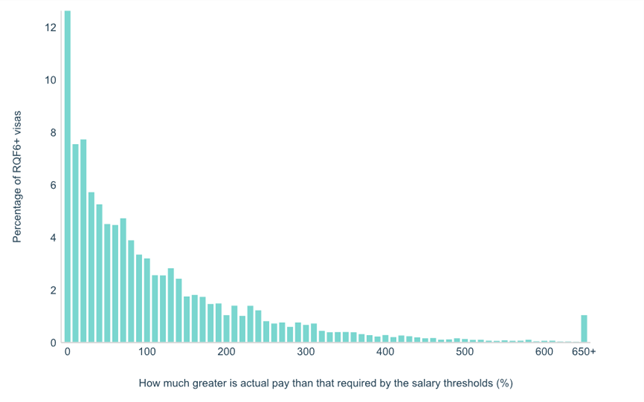
Source: Certificate of Sponsorship (CoS) microdata for visa grants in the 9-month period before April 2024 (July 2023 – March 2024).
Notes: SW route (non-pay scale), RQF 6+ skill level occupations. Observations below the threshold were excluded.
In many cases, employers are unaffected by salary threshold increases as they are already paying wages higher than the new threshold. For example, in April 2024, the effective threshold for Solicitors and lawyers rose 55% from £33,700 to £52,300. However, in the nine months before the threshold change, over 90% of visa holders in this occupation were already being paid above this new threshold.
Some employers will be affected by the thresholds changing. If thresholds rise and an employer is paying a salary below the new minimum, they must decide - assuming they intend to maintain the same level of hiring the following year - whether to increase pay or stop sponsoring overseas workers. The chart below demonstrates this for the April 2024 rules change. In this case, over the nine-months prior to the change, around 6,000 visas had salaries which would no longer meet requirements after April. Given that after the change, there were around 1,300 more visas with salaries just above the new threshold than the ‘business as usual’ level before the change, it might be reasonable to infer that roughly 20% of the affected visas saw their salaries rise to meet the new threshold. This is an imperfect comparison as it ignores other factors that may have affected absolute numbers of visas granted, but it gives an approximate sense of scale.
In our engagement with both employers and unions, many said that employers had increased salaries for some sponsored workers, but they were concerned about the risk of creating pay disparities between sponsored and British or other non-sponsored workers performing the same roles.
Figure 2.3 What proportion of affected visas have salaries pulled up?
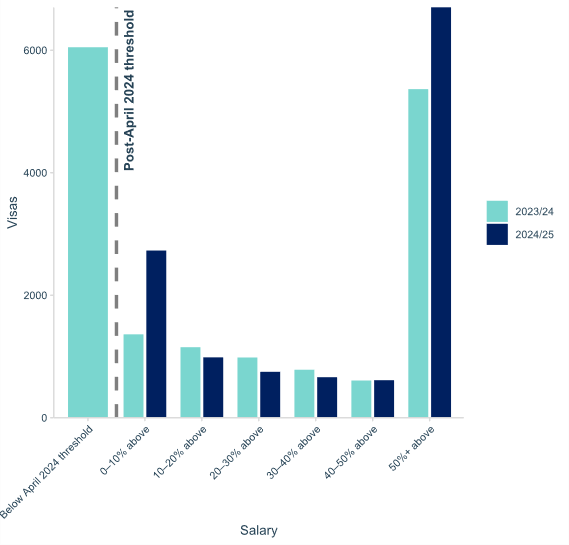
Source: Certificate of Sponsorship (CoS) microdata for visa grants in the 9-month period before April 2024 (July 2023 – March 2024) and for the 9-month period after (July 2024 – March 2025). RQF 6+ skill level, non-pay scale occupations only. Sample restricted to occupations where 90% of the SOC10 code maps to the SOC20 code, allowing us to assign both the pre-April 2024 threshold and the post-April 2024 threshold to each occupation.
Notes: The charts show how visa salaries on the SW route were distributed in 2023/24 (turquoise) and 2024/25 (dark blue). To the left of the ‘post-April 2024 threshold’ line are 2023/24 visas which would not meet the salary threshold rules if the same visa was applied for after April 2024. For example, the effective threshold for IT managers increased from £37,900 to £50,900 at this point, so any IT managers being paid less than £50,900 would appear in this bar. If the same visa was applied for after April 2024 it would not meet the threshold. To the right of line are visas which exceed the post April 2024 threshold (and by how much), whether they were bound by it (as 2024/25 visas were) or not (as it was not effective for 2023/24). For example, an IT manager in 2023/24 might already have a salary of £60,000, exceeding both the effective threshold at the time and the one forthcoming in April 2024.
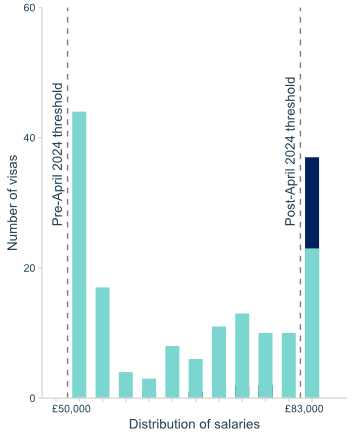
We expect that the ability of employers to raise pay will be more limited in future now that salaries are more bunched around the thresholds than they were before April 2024. Unsurprisingly, our analysis suggests that occupations with salaries already bunched around the threshold were most likely to struggle to raise wages to meet the new, higher threshold. In Figure 2.4, Marketing, sales and advertising directors (Chart A) had a high proportion of 2023/24 visas clustered at or near the threshold, with our analysis suggesting they struggled to increase salaries to meet the new threshold (see size of dark blue bar). By contrast, a relatively low percentage of visas for Financial managers and directors (Chart B) in 2023/24 were bunched at the previous threshold, with over 50% of affected visas raised to meet the new threshold.
Figure 2.4 How does the ability to raise salaries depend on how much pay is bunched around the previous threshold?
A. More bunching around the threshold: Marketing, sales and advertising directors (1132)
B. Less bunching around the threshold: Financial managers and directors (1131)
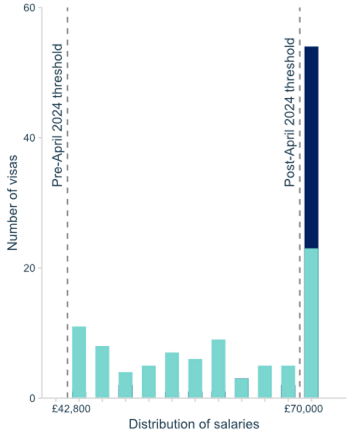
Source: CoS microdata for visa grants in the 9-month period before April 2024 (July 2023 – March 2024) and the 9-month period after April 2024 (July 2024 – March 2025).
Notes: The charts show how visa salaries in occupations 1131 and 1132 were distributed in 2023/24 (turquoise) and 2024/25 (dark blue) The 2024/25 bars sit behind the 2023/24, so dark blue only becomes visible when the number of visas granted in 2024/25 is higher than the year before. For example, it shows approximately 25 marketing directors were recruited at salaries 0-10% above the post-April 2024 threshold in 2023/24, while more than 35 were recruited in this salary range in 2024/25. The salary range included is from the pre-April 2024 threshold (which was effective/had to be met in 2023/24), up to the post-April 2024 threshold (which was not effective/ a relevant salary to be met in 2023/24 but of course was in 2024/25) and 0-10% above the post-April 2024 threshold (but not salaries above this). Salaries included represent the undiscounted effective thresholds for the occupations pre and post April 2024.
Options for the Skilled Worker route salary thresholds
The chapter now considers several options for the Skilled Worker route salary thresholds. They involve different permutations of the general threshold being set at the present level of £41,700 (equivalent to the 30th percentile of eligible occupations), £48,400 (43rd percentile) and £52,500 (50th i.e. median), and the occupation-specific thresholds being set at the 25th, 37.5th and 50th percentile (median). A general threshold of £48,400 would mean that the majority of occupations would see a real increase in their effective threshold if the occupation-specific threshold was reduced back to the 25th percentile. We show how net migration, fiscal, and regional impacts differ under these options. We note that these aspects do not fully consider the societal impacts of migration.
These options demonstrate the trade-offs that exist when setting threshold levels. Lower thresholds are likely to allow improved access to the immigration system for employers outside of London and bring fiscal benefits (see the MAC’s fiscal paper for further details). However, lower thresholds are also likely to result in more visas being granted, and hence higher net migration. The increase in population that results has other costs and benefits for the UK beyond public finances, including impacts on infrastructure, housing and the demographic makeup of the UK.
Net migration and fiscal impacts
Reducing occupational thresholds from the median to the 25th percentile while leaving the general threshold unchanged (option 1) could feasibly boost the UK’s fiscal position by almost £700 million over the lifetime of the cohort that arrives in a given year, while adding approximately 4,000 people to long run annual net migration. Conversely, raising the general threshold from its current level to the median, while leaving occupational thresholds unchanged (option 5) might reduce annual net migration by more than 3,000 but have a lifetime fiscal cost for each annual cohort of migrants of more than £500 million. Note that these net migration projections are by their nature uncertain and policymakers should monitor closely how flows change in response to salary threshold changes and be ready to act promptly if the response is substantially larger than anticipated.
Table 2.5 Illustrative net migration and fiscal impacts of different thresholds
| Option | General threshold | Occupation-specific threshold | Change in visas | Cohort LR net migration impact | Cohort lifetime fiscal impact |
|---|---|---|---|---|---|
| 1. | £41,700 (30th percentile) | 25th percentile | +6200 to +7000 | +4100 to +4800 | +£660mn |
| 2.* | £41,700 (30th percentile) | Median | 0 | 0 | - |
| 3. | £48,400 (43rd percentile) | 25th percentile | -300 to +1300 | -200 to +900 | +£70mn to +£140mn |
| 4. | £48,400 (43rd percentile) | 37.5th percentile | -1200 to +300 | -800 to +200 | -£80mn to 0 |
| 5. | £52,500 (Median) | Median | -4300 to -7600 | -2900 to -5100 | -£710mn to -£520mn |
Source: Change in visa numbers and net migration calculations use CoS microdata for visa grants in 2023/24 and 2024/25 (SW route only, standard, RQF 6+ occupations). Fiscal calculations rely on MAC’s fiscal model in net present value terms.
Notes: * Option 2 represents the current level of occupation and general thresholds. Percentile included in the general threshold column refers to the salary percentile of the SW route eligible (RQF 6+) occupations in ASHE. Total visa numbers assume 0.85 dependants per main applicant. Net migration calculations assume that 68% of skilled worker migrants will remain in the UK long term, thereby contributing to long run UK net migration (see net migration publication). Analysis uses historic data and applies the option thresholds to them retrospectively. It calculates, if the rules moved from the baseline, current option (GT at 30th percentile, OSTs at the median) to the option thresholds (a) how many visas would no longer be eligible and (b) how many visas would now become eligible. See Figure 2.7 below for a visual example of this. Threshold levels are recalculated using the appropriate year of ASHE data. The ranges included cover two employer responses – one in which none of the affected visas have salaries increased, and one in which 20% of visas have salaries increased to meet the new threshold.
Because the significant increase in salary thresholds under the previous government has now excluded the lower-earning skilled workers, further increasing salary thresholds will be costly to the government by excluding workers who would be net fiscally positive. Given that the fiscal breakeven point for a main applicant in a route that allows dependants is roughly £29,000, the average SW migrant is comfortably net fiscally positive in our baseline fiscal model scenario. As the evidence suggests that only a small portion of employers can raise salaries to meet higher thresholds, and that this is likely to have become harder, setting thresholds at a higher level on the SW route will have a fiscal cost. However, given the inevitable uncertainty and numerous assumptions that must be made to derive a fiscal breakeven point, the government may sensibly choose a higher threshold to reduce the risk that the actual breakeven is higher than our estimates.
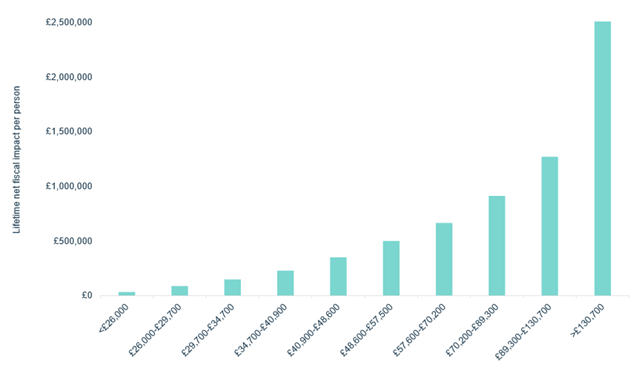
However, while some fiscal cost is to be expected by excluding skilled workers, the largest fiscal contributors are the highest earners on the route who would be unaffected by changes to salary thresholds. Figure 2.6 shows that before the restrictions on skill levels and the increase in salary thresholds, we estimate that the top 10% of SW (excl. H&C) main applicants earners made an average lifetime contribution of £2.2 million. This accounts for 39% of the total contribution of this cohort, while the bottom 10% contribute just 1% of the total. Therefore, the potential fiscal impact of the previous government’s choice to raise the general threshold to exclude the lowest paid skilled workers was relatively small. Because the bottom three deciles in Figure 2.6 were already excluded by the previous government’s decision to raise the general threshold to £38,700 in 2024, the fiscal cost of further increases to the threshold is higher, but it remains the case that the bulk of the lifetime fiscal benefits of the route come from the top deciles.
Figure 2.6 Lifetime fiscal impact of SW migrants (excluding H&CW) by decile
Source: MAC fiscal model. Uses data from the 2022/23 Financial Year.
Notes: HMRC wage at entry. Analysis factors in wage progression using age-earnings profiles created using ASHE. A bar chart showing the lifetime net fiscal impact of a Skilled Worker migrant split by decile. the bar on the far right is much taller than the others indicating that the highest-earning skilled worker migrants have a substantially greater postitive fiscal impact over their lifetime (>£2,000,000)
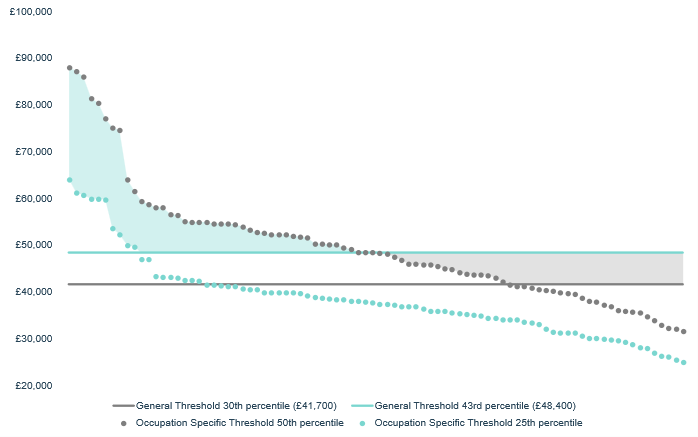
In our view, a general threshold of £41,700 with occupation-specific thresholds at the 25th percentile ensures that the route remains highly selective, while contributing to public finances and raising average incomes. However, the analysis indicates that if the government wanted to raise thresholds to reduce net migration, small threshold increases can be implemented at relatively small fiscal cost, so long as it does so by raising the general threshold and not the occupation-specific thresholds. Raising the general threshold would restrict access to relatively lower paid workers and maintain access for the most fiscally beneficial, highly paid workers. Moving from the current set of thresholds to option 3 (Figure 2.7), which reduces occupational thresholds to the 25th percentile and raises the general threshold to £48,400, would still increase access for the highest earning occupations (turquoise shaded area). IT directors could then be hired for £61,200, down from £86,000. Conversely, access would be reduced for the lowest paid occupations (grey shaded area). As Table 2.5 shows, this arrangement could feasibly lead to both a fall in net migration, while being accompanied by fiscal benefits – though in reality all the estimated impacts are quite small and subject to significant uncertainty given the behavioural response by migrants and employers is hard to predict.
Figure 2.7 Salary ranges gained and lost under option 3
Source: ASHE 2024 Provisional.
Notes: Intended as a visual representation only. Each dot represents the salary threshold for a specific occupation under that OST condition, ordered from largest to smallest (so an occupation’s 50th percentile value may not appear directly above the 25th percentile). Does not account for discounts.
Distributional impacts
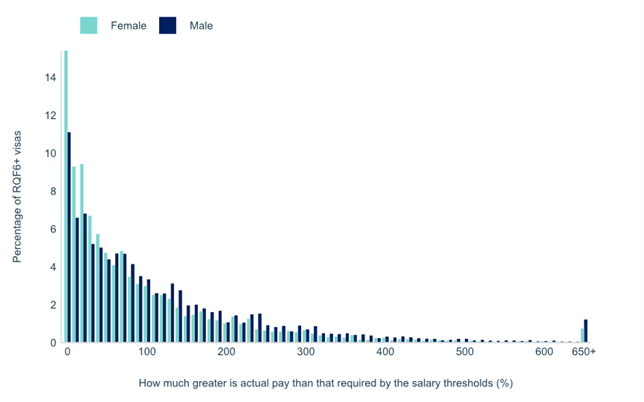
While this approach favours higher-earning applicants, it may have unintended distributional effects. As illustrated in Figure 2.8 which shows salary margins above the threshold across genders, female applicants may be disproportionately impacted. Women’s earnings tend to exhibit more clustering near the thresholds, while male applicants display a wider distribution, with a greater proportion exceeding the threshold by larger margins.
We found evidence that this observed clustering of women’s earnings may reflect occupational sorting effects, whereby women are more concentrated in occupations that, on average, exhibit tighter clustering around thresholds. For example, in 2024/25, 42% of visa holders in the Business and related research professionals occupation earned salaries within 0–10% above the threshold. Women account for nearly two-thirds of visa holders in the occupation. Our analysis also found that women’s salaries are more likely to bunch closer to the threshold than men’s within the same occupation. For example, among women in the Business and related research professionals occupation, 48% fall into the band earning 0–10% above the threshold, compared to just 30% of men in the same occupation.
In our stakeholder roundtables, trade union representatives noted that women were disproportionately affected by raising thresholds due to both lower average pay and caring responsibilities. An NHS trust pointed out that being unable to pro-rate the general threshold made it harder to employ part time workers (who are more likely to be women). The government should be aware of these implications if they increase salary thresholds.
A general threshold of £48,400 would also make hiring more difficult for some occupations (see Table A.8). This will have a modest impact on Industrial Strategy occupations. Of the RQF 6+ occupations with more than half of their employment in Industrial Strategy/critical infrastructure sectors, 42% would have thresholds increase (while they would fall for the other 58%). The largest users of the immigration system in priority sectors which would see their thresholds increase are Finance and investment analysts and advisers (2,700 visa grants in the last nine months, effective threshold increasing from £45,800 to £48,400) and Natural and social science professionals (1,000 visa grants, effective threshold increases from £41,700 to £48,400).
Figure 2.8 How much more than the required level are migrants paid, by gender?
Source: CoS microdata for visa grants the 9-month period before April 2024 (July 2023 – March 2024). SW route (non-pay scale), RQF 6+ skill level occupations.
Note: Observations below the threshold were excluded. A bar chart showing the distribution of actual pay of visa holders in RQF 6+ jobs relative to that required by the salary thresholds, split by gender, which indicates that women’s salaries tend to bunch more around the effective salary thresholds than men’s salaries.
From a regional perspective, some areas of the UK are more affected by changes to salary thresholds than others due to differences in regional pay. As noted, lowering occupation-specific thresholds to the 25th percentile would be more affordable for employers outside of London, with over 50% of all workers in each region earning enough to meet the thresholds if set at that level (see Figure 2.1). In contrast, areas like Wales and the North-East of England would struggle to an even greater extent if thresholds were increased above their current level.
These options highlight the trade-offs that exist when setting salary thresholds. If the government’s main priority was fiscal contribution, reducing the occupation-specific threshold and maintaining the general threshold at its current level (i.e., option 1) would be the best way to achieve this, albeit accompanied with a small increase in net migration. If reducing net migration was the only concern, raising the general threshold to restrict visas would best serve this purpose but would come with a fiscal cost (i.e., option 5).
Recommendations
We propose that occupation-specific thresholds are set at a level which allows them to effectively serve their purpose – reducing the risk of undercutting domestic workers – without preventing certain jobs within occupations from using the system and inadvertently prioritising lower paid workers. Without detailed data on job titles within occupations it is difficult to truly measure undercutting; however, we remain comfortable with the recommendation we have made several times in the past that the 25th percentile of occupational earnings is adequate for this purpose. If the government does not want to accept this recommendation, it should still consider reducing the occupation-specific thresholds to a different point below their current level. This does not have to mean liberalising overall skilled work migration or increasing net migration as the impact of the thresholds also depends on where the general threshold is set.
The general threshold should be chosen to achieve the appropriate balance between the overall policy objectives of the government. We recommend maintaining the general threshold at £41,700 as this would maximise the fiscal gain among the options we present, help ensure that Industrial Strategy sectors could recruit the workers they are likely to need over the coming years (given the long training periods often involved for such workers) and reflect the variation in wages across the UK. It would however somewhat increase net migration (by approximately 4,000 people). Alternatively, increasing the general threshold to £48,400 would result in the effective threshold rising for the majority of occupations. Combined with occupation-specific thresholds at the 25th percentile, it would broadly replicate the current set of thresholds in terms of the expected impact on net migration and fiscal contribution. It would be less fiscally positive than leaving the general threshold at £41,700, but not dramatically so. If the government wishes for the effective thresholds to rise on average, the option of £48,400 would achieve this (noting that such an increase would undo some of the benefits of occupational thresholds set at the 25th percentile in terms of allowing regional and job title-based salary variation). Obviously, the government could choose any general threshold between these levels and achieve a slightly different balance between their objectives.
Regional salary thresholds
We are often asked to consider excluding London wages when setting the SW salary thresholds. This would have only a modest impact as the thresholds are calculated using the median (the middle value when all salaries in the sample are ordered from smallest to largest) rather than the mean. As Table 2.9 shows, median differences are reasonably small, whilst the differences in means are much larger as they are more impacted by the higher salaries paid in London. This highlights the importance of setting thresholds at percentiles rather than simple averages.
Table 2.9 RQF 6+ mean & median including & excluding London
| Inc./Exc. London | Mean | Median |
|---|---|---|
| Including | £66,100 | £52,400 |
| Excluding | £57,200 | £49,600 |
| Difference | £8,900, 15.6% | £2,800, 5.6% |
Source: ASHE 2024 Provisional.
Note: Calculations exclude pay scale occupations.
At the occupation level, there is generally minimal variation between the UK-wide median pay and the median pay excluding London for most roles. Among the RQF 6+ occupations eligible for the SW route with employment in London, three-quarters have a median salary that is no more than £3,000 higher when London is included. In five cases, the median salary is actually lower when London is included.
Only three occupations show a difference in median pay exceeding £10,000: Chief executives and senior officials, Financial managers and directors, and Actuaries, economists, and statisticians. For these, the inclusion of London raises the median by £14,300 (16%), £12,400 (17%) and £11,000 (20%), respectively. In these cases, it is likely that only the highest paying employers outside London will be able to use the immigration system. This is supported by data showing that the percentage of visa grants in 2024/25 that were for London-based employment in these occupations was 70%, 83%, and 91% respectively.
We continue to believe that ‘regional salary thresholds also bring more complexity and may be harder to enforce within the migration system, particularly as the UK is geographically small, making it is easy to live in one region and work in another’. We also do not want to institutionalise some parts of the UK as ‘lower wage’. Furthermore, as the MAC has shown previously, wages vary far more within regions than across them so even if thresholds were set at a regional level there would still be many areas of the UK that would struggle to meet them (see Table 2.10). We therefore again recommend that SW salary thresholds should be set at a UK-wide level.
Table 2.10 Wage variation across vs within regions
| Geography | Overall Median full-time annual employee earnings | Lowest Paid LA Median full-time annual employee earnings | Highest Paid LA Median full-time annual employee earnings | Differences Within | Differences vs. UK |
|---|---|---|---|---|---|
| United Kingdom | £37,430 | £28,217 | £64,995 | 130% | 0% |
| England | £37,630 | £28,672 | £64,995 | 127% | 1% |
| North East | £32,960 | £30,652 | £35,129 | 15% | -12% |
| North West | £35,170 | £28,672 | £41,750 | 46% | -6% |
| Yorkshire and The Humber | £34,401 | £30,628 | £36,830 | 20% | -8% |
| East Midlands | £33,973 | £28,767 | £39,748 | 38% | -9% |
| West Midlands | £34,938 | £29,978 | £37,575 | 25% | -7% |
| East of England | £36,949 | £30,120 | £44,532 | 48% | -1% |
| London | £47,455 | £35,777 | £64,995 | 82% | 27% |
| South East | £39,038 | £30,983 | £46,733 | 51% | 4% |
| South West | £35,634 | £29,553 | £40,902 | 38% | -5% |
| Wales | £34,303 | £29,154 | £38,668 | 33% | -8% |
| Scotland | £38,315 | £33,452 | £42,578 | 27% | 2% |
| Northern Ireland | £34,378 | £28,217 | £37,232 | 32% | -8% |
Source: ASHE 2024 Provisional.
Notes: (Within) % difference between highest and lowest paid local authority; (UK) % difference between region/nation and UK median.
Updating salary requirements
Historically the Home Office has often updated occupation-specific thresholds annually but not the general threshold. This leads to a real terms decrease in the general threshold over time and then a more significant increase of the general threshold every few years, resulting in less predictability in the system for employers. We remain of the view that salary requirements should be updated on a scheduled annual basis. This will ensure changes are regular, more predictable, and better aligned with evolving labour market conditions.
Updating the general threshold annually would be relatively straightforward – whether by re-calculating the percentile of eligible occupations in new data or uprating the threshold in line with average wage growth – since these calculations are based on large samples and reflect prevailing UK labour market conditions. At present the government does not take this approach, leading to large, irregular increases in the general threshold.
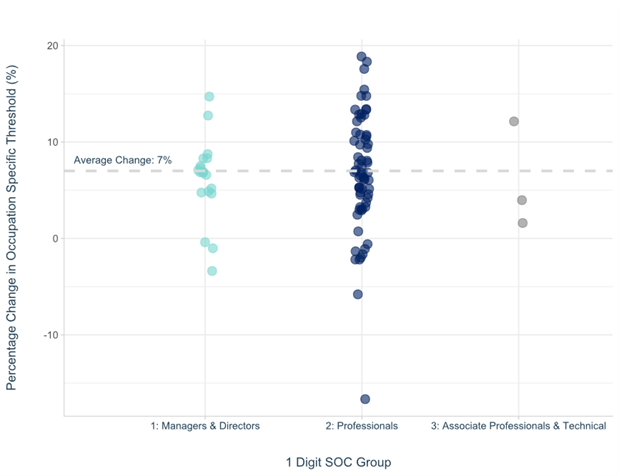
Updating the occupation-specific thresholds annually is also sensible. However, estimates of occupation salary levels, which determine the thresholds, often fluctuate significantly from year to year. In July 2025, the occupation-specific thresholds for eligible RQF 6+ occupations on the Skilled Worker route increased by an average of 7%, following their update from ASHE 2023 to 2024 data (see Figure 2.11). Notably, more than one in four occupations experienced an absolute percentage change of more than 10%.
Figure 2.11 Percentage changes in occupation-specific thresholds by 1-digit SOC group
Source: Based on ASHE 2023 and 2024.
Notes: SW route, non-pay scale, RQF 6+ skill level occupations. A scatter plot showing the percentage changes in the occupation-specific thresholds following the latest update in July 2025, clustered by 1-digit SOC code.
For some occupations, small sample sizes make the thresholds highly sensitive to year-on-year fluctuations. This risk is amplified at present because these occupation-specific thresholds are set at the median rather than the 25th percentile – a higher level which means they bind for more occupations – thereby directly setting the minimum salary employers are required to pay. During our roundtable discussions for this review, both employers and trade union representatives highlighted that such variability in salary requirements year-on-year creates uncertainty for all users of the system – making budgeting, compliance, and hiring strategies particularly challenging for employers.
This effect could be mitigated by smoothing large annual changes in occupation-specific thresholds. Smoothing is desirable when the change stems from noise in the data (for instance, due to small sample sizes in ASHE, which in turn often require us to use an imputation method to calculate the occupational thresholds). Conversely, where ASHE picks up labour market trends with a sufficient sample, capping annual movements could distort thresholds and prevent timely alignment of the immigration system with market conditions.
If the Home Office would like to consider smoothing of occupational thresholds, we would be happy to support in developing an appropriate methodology.
Chapter 3: Discounts to Skilled Worker salary thresholds
Summary
-
Younger individuals tend to earn less than older, more experienced workers in the same occupation. A discount therefore enables entry to the UK for this group which, given the relationship between age and earnings, is likely to be fiscally positive and contribute to raising productivity and incomes over their lifetime as their earnings progress.
-
The recommended size and length of this new entrant discount depend upon the level of the standard Skilled Worker (SW) salary thresholds. Higher undiscounted thresholds mean new entrant starting salaries will be lower relative to those thresholds. It would therefore take longer for new entrant salaries to grow to meet higher thresholds.
-
We recommend that the new entrant rate be set to the current general threshold for new entrants (£33,400). Continuing to implement different sizes of discounts on both the occupation-specific and general thresholds for the SW route is challenging with the available data and may prevent occupations that are important to the Industrial Strategy from accessing the immigration system for graduate-entry roles.
-
We recommend different durations of new entrant eligibility depending on the level of the undiscounted thresholds chosen by the government following our recommendations in Chapter 2. Currently, new entrant eligibility only lasts four years. However, our analysis suggests it could take up to six years for new entrants to catch up to their occupation’s effective salary threshold if the government chooses our recommended undiscounted thresholds, and up to sixteen years if it chooses higher values for the undiscounted thresholds. Such a long discount duration is not necessarily desirable and would presumably interact with the government’s settlement policy.
-
There is no evidence to suggest that those with PhDs, whether they have recently completed their studies or not, receive lower pay than the average Skilled Worker and therefore require a discount. We recommend abolishing this discount.
-
Allowing those working in pay scale occupations to be paid according to the relevant pay scale remains appropriate as it keeps the immigration system from limiting the ability of the healthcare and education sectors to recruit overseas workers. However, this arrangement reflects the system’s clear preferential treatment of the public sector over the private sector.
The work routes in scope for this review operate a range of discounts on the standard salary thresholds. SW visa applicants can currently be paid less than the standard thresholds if they qualify as ‘new entrants’, hold a PhD qualification, or work in national pay scale occupations. These discounts are set out in Table 1.2, and we summarise the government’s rationale for each discount below:
New entrant discount – the current discount originates from a recommendation contained in the MAC’s January 2020 report A Points-Based System and Salary Thresholds for Immigration. The review argued that “Salary thresholds should be lower for new entrants to the labour market” to reflect that “pay is lower for less experienced workers” and recommended that “The reduction percentage for new entrants should be set at 30 per cent.”
PhD discount – established to reflect the government’s view that PhD holders are often not paid salaries commensurate with their level of qualifications. The higher discount for STEM PhDs reflects the importance the government placed on STEM at the time. This discount did not originate from a MAC recommendation.
Postdoctoral discount – established at the same time as the new entrant discount and currently mirrors the benefits new entrants receive, but eligibility differs. It is available to only a small selection of science and higher education roles, including biological scientists and higher education teaching professionals. This discount also did not originate from a MAC recommendation.
National pay scales – primarily covering health and education occupations, this discount recognises the challenges facing government finances and that the scope for public sector pay increases is limited. In our 2020 review of the Points-Based System, we stated that “We recommend the use of national pay scales as the relevant salary thresholds for 24 occupations, which covers most occupations eligible for the route in the NHS and schools… The use of national pay scales can be justified on the grounds that there is lower risk of undercutting for these workers… Many of these pay scales are covered by Pay Review Bodies which provides some protection against employers using migrants to undercut the resident labour market.”
This chapter tests the rationale for these existing discounts. In principle, discounts to salary thresholds should only be available if a certain characteristic means a subset of individuals, whose access to the immigration system is beneficial to the UK, receive systematically lower pay which excludes them from the system. For a discount to be appropriate, the following must therefore be true:
-
There must be evidence that a definable characteristic is clearly linked to a group receiving lower pay than the UK average;
-
Receiving lower pay would result in this group being excluded from the immigration system without a discount; and,
-
This group having access to the immigration system would be beneficial to the UK.
The use of discounts should also be weighed against other factors such as the possibility of entrenching lower pay for that group, the practicality of implementing the discount for Home Office caseworkers and the ability of relevant authorities to enforce proper use of any discount.
New entrant discount
Under the current rules, a Skilled Worker can be paid less than the standard salary thresholds if they are a ‘new entrant’ to the labour market to reflect the lower wages paid to less experienced workers. Offering a discount to this pool of workers allows employers to use the SW route to recruit younger foreign workers, who are often switching from a Student or Graduate visa, into roles such as graduate training programmes. If the government’s ambition was for the SW route to focus only on the recruitment of experienced workers, it could remove the new entrant discount and these younger foreign workers would be largely unable to access the route as a consequence. However, such a decision would likely harm the UK’s fiscal position and could restrict growth, at least in the short-term, in Industrial Strategy sectors.
Despite earning lower salaries initially, many new entrants in graduate-level jobs will be fiscally beneficial to the UK in the long run as their wages rise and will also contribute to UK productivity and average incomes. Estimates of the minimum salaries required to be fiscally positive on average by age group are outlined in Figure 3.1.
Figure 3.1 Central lifetime fiscal breakeven estimate by age group at entry
| Age band | fiscal breakeven estimate |
|---|---|
| 18-29 | £22,300 |
| 30-39 | £28,000 |
| 40-49 | £32,300 |
| 50+ | £34,400 |
Source: MAC Dynamic Fiscal Modelling, accounting for wage progression over time.
The purpose of the new entrant discount is to allow new entrants access to the immigration system and give sufficient time for their pay to catch up to the undiscounted salary thresholds. Current rules allow an individual to be considered a new entrant for up to four years across the SW and Graduate routes. Currently, a new entrant may be paid 70% of the standard occupation-specific salary threshold if their salary meets at least 80% of the general Skilled Worker threshold. This reduced threshold applies to individuals who meet one of the following conditions:
-
they are under 26 years old at the time of application;
-
they are currently studying at bachelor’s degree level or above on a student visa, or have done so within the past two years with a Student visa as their most recent status (other than as a visitor);
-
they are currently in the UK on a Graduate visa, or as their most recent status (other than as a visitor);
-
they are working towards a recognised qualification in a UK-regulated profession; or
-
they are pursuing full registration or chartered status in the occupation for which they are being sponsored.
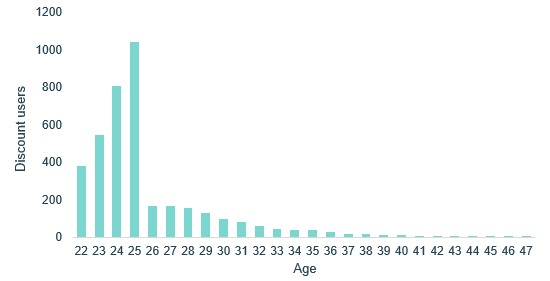
While there is likely considerable overlap among individuals who qualify under the various new entrant criteria, the available data are insufficient to support a simplification of the rules without risking the exclusion of specific groups who are economically beneficial to the UK. However, existing evidence indicates that the majority of those benefiting from the new entrant discount qualify under the age-based criterion. Specifically, 74% of recent users entered the UK under the age of 26. The median age of this group is 24, with the most common user being aged 25.
Figure 3.2 Age distribution of new entrant discount users
Source: Home Office Management Information, April 2024 – March 2025.
New entrant rate
Knowing the typical wage earned by young people is important both to set an appropriate new entrant rate and to consider how long it should last. Given that all the jobs under the Skilled Worker route are at RQF 6+, Table 3.3 shows estimates for the average graduate starting salary from the Institute of Student Employers and the High Fliers survey. These estimates also align with the median salary for 22 to 25-year-olds working full-time in RQF 6+ occupations according to ASHE, which sits at approximately £32,200.
Table 3.3 Graduate starting salaries
| Source | Estimate |
|---|---|
| Institute of Student Employers | £32,000 |
| High Fliers Survey | £35,000 |
Sources: Institute of Student Employers Development Survey 2025; High Fliers Survey 2025.
Notes: The Institute of Student Employers development survey ran during January and March 2025 and received 148 responses from employers across a range of sectors and organisation types. The High Fliers survey is an annual review of graduate vacancies and starting salaries at the UK’s one hundred leading graduate employers.
Figure 3.4 shows that graduate starting salaries vary significantly by sector, ranging from £28,800 to £60,000, with the highest salaries being typically found in graduate roles in Investment Banking, while the lowest are in Media. In a best-case scenario, the new entrant rate would also vary by occupation to reflect occupational differences in graduate pay and wage growth. However, due to limitations in the available data, it is not currently possible to produce reliable estimates of graduate starting salaries for all eligible occupations.
Figure 3.4 Median graduate starting salaries in different UK Sectors
| Sector | Salary |
|---|---|
| Investment banking | £60,000 |
| Law | £56,000 |
| Consulting | £50,000 |
| Banking and finance | £45,000 |
| Oil and energy | £42,000 |
| Consumer goods | £38,000 |
| Accounting and professional services | £37,000 |
| Chemical and pharmaceuticals | £35,000 |
| Armed forces | £34,700 |
| Technology | £34,000 |
| Retail | £34,000 |
| Engineering and industrial | £32,000 |
| Public sector | £31,000 |
| Media | 28,000 |
Source: High Fliers Survey 2025.
While it appears that a new entrant discount of 30% on the median occupation-specific thresholds allows the average new entrant to access the immigration system, without a reliable understanding of graduate starting salaries by occupation we cannot validate whether applying a percentage discount in this way excludes occupations that are important to the government’s Industrial Strategy. For instance, applying a 30% discount to an occupation-specific threshold set at the median full-time wage for an Electrical Engineer yields a discounted threshold of £41,100, but data published by UCAS suggest that new workers in the occupation are more likely to earn around £35,300.
As a result, we recommend that a single new entrant rate be set around the average graduate starting salary, which, as Table 3.2 shows, appears to sit somewhere between £32,000 and £35,000. The median wage for full-time workers in RQF 6+ occupations between the ages of 22 and 25 is also around £32,200. Given that the current general threshold for new entrants (£33,400) sits within this range, it seems sensible to use this as the new entrant rate.
Setting a single new entrant threshold at this level would ensure that a typical new graduate can be employed through the immigration system while being paid sufficiently to remain fiscally beneficial to the UK over their lifetime. A new entrant rate set at this level could then be uprated using annual growth in the median wage of 22- to 25-year-olds working in RQF 6+ occupations.
Implementing a new entrant rate of £33,400 instead of applying a percentage discount means that some occupations, particularly those with higher salaries, will naturally receive a larger discount for new entrants. These occupations are generally high-experience roles such as Chief Executives and Senior Officials and Marketing, Sales and Advertising Directors, which typically hire far fewer new entrants compared to other eligible occupations. For example, in the top 20 occupations that would experience the largest threshold decrease from having a new entrant rate of £33,400, only five employ a share of new entrants above the median for all occupations. Given that new entrants represent such a small share of these occupations, any unintended consequences from lowering the effective threshold are likely to be relatively small.
Recommendation: The new entrant rate should reflect average graduate starting salaries and therefore be set at £33,400.
Length of new entrant eligibility
The time it will take a new entrant earning £33,400 to catch up to the standard salary thresholds, and the typical age at which this is achieved, will depend upon the chosen level of these thresholds.
The MAC’s 2020 PBS report recommended that the new entrant discount should apply for five years, an extension from the previous 3-year entitlement. This was in the context of occupation-specific thresholds being set at the 25th percentile. This recommendation stemmed from responses to calls for evidence where participants highlighted concerns about the ability to jump from new entrant to experienced applicant thresholds over a 3-year period. The MAC heard similar concerns from stakeholders about the current 4-year duration during roundtables for this review. Since the rationale of the new entrant discount is to give sufficient time to reach the standard effective salary thresholds, the length of the discount should reflect the average time it takes workers to actually do so. It would be unreasonable to expect migrant graduate entrants to achieve faster wage progression than domestic graduate entrants.
To determine how long people need to reach standard salary thresholds, Figure 3.5 shows how individual earnings compare to their effective salary threshold at each age when the occupation-specific threshold is set at the 25th percentile and the general threshold at £41,700 – our recommended combination of thresholds. When the dark blue line, which shows the ratio of earnings to the effective threshold, crosses 1, it indicates that earnings for the median worker at that age have reached the effective threshold and thus they should no longer need the new entrant discount. Figure 3.5 shows that individuals typically reach their effective salary threshold at age 28 if the standard thresholds are set in line with our recommendations in Chapter 2.
Figure 3.5 Estimated ratio of individual earnings to effective threshold
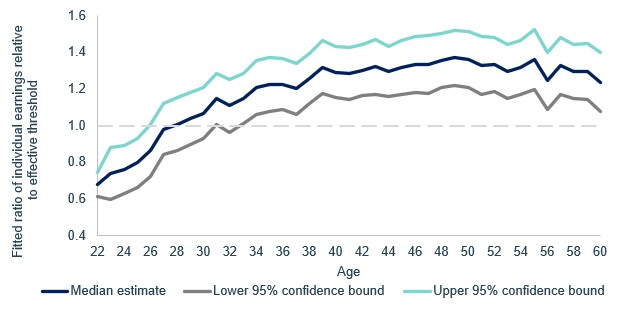
Source: Annual Survey of Hours and Earnings (ASHE) 2024 Provisional.
Notes: Assumes occupation-specific thresholds set at the 25th percentile and a general threshold of £41,700. Quantile regression with τ equal to 0.5. Ratio of individual’s annual gross pay to their occupation’s effective threshold regressed against a set of age dummies. When the fitted ratio equals 1 it indicates that at the median pay for that age group is equal to the proposed effective thresholds.
Table 3.6 shows the length of time the data suggest a 22-year-old new entrant would in theory need a discount under various combinations of undiscounted salary thresholds. By presenting durations of up to of sixteen years, we are not proposing there should be a 16-year route to settlement. The table simply shows how long we should expect it will take the average new entrant to reach the undiscounted thresholds. The government should consider the suggested length of time new entrants will need the discount alongside its wider consultation on earned settlement.
Concerns about undercutting or misuse of this discount may increase if, in response to a longer duration, employers pay lower wages for longer periods and do not provide the regular wage increases we would expect to see for younger workers. Tapering the discount annually to guard against this outcome would likely be inoperable and unenforceable. Introducing a checkpoint halfway through the eligibility period may be more feasible, but setting the appropriate level for this checkpoint would prove difficult. More generally, these issues of undercutting and potential misuse of the discount highlight the added complications that could result from choosing to set higher salary thresholds for the SW route.
Table 3.6 Length the new entrant rate could apply for by scenario
| Occupation-specific threshold | General threshold - £41,700 | General threshold - £48,400 |
|---|---|---|
| 25th percentile | 6 years | 9 years |
| Median | 13 years | 16 years |
Source: MAC analysis using ASHE 2024 provisional.
Interactions with settlement policy
The duration of new entrant eligibility may interact with settlement policy. Currently, eligibility for the discount lasts four years, while those on the SW route can apply for settlement after five years. Those reaching settlement must therefore currently earn a salary that meets the undiscounted salary thresholds. This year between the end of new entrant eligibility and becoming eligible to apply for settlement gives an individual time to demonstrate that their earnings meet the undiscounted thresholds.
The outcome of the ongoing earned settlement consultation will likely impact the desired new entrant eligibility window. If the government decides that the standard waiting time for Indefinite Leave to Remain (ILR) eligibility should be shorter than the time it takes new entrants to catch up to the undiscounted thresholds for Skilled Workers, then the length of the ILR waiting time would effectively act as a cap on the duration of any new entrant discount. Conversely, a longer path to ILR would make feasible a longer duration for the discount. For example, if the government proceeds with a 10-year route to settlement for those earning less than £50,270, as outlined in the earned settlement consultation, this could in theory accommodate e.g. a 6-year new entrant discount. The consultation proposes that future settlement policy could establish different pathways and durations to ILR for different workers. If this is the outcome of the current consultation, the government could choose to lengthen the new entrant discount for those who need it whilst allowing others who do not require the discount to progress faster to ILR.
Alternatively, the government could decide that individuals can qualify for ILR without meeting undiscounted rates, especially if it chooses relatively high thresholds that new entrants would take longer to reach – even though they may be on a trajectory towards significant lifetime positive fiscal contributions to the UK. Given settlement policy is currently under review, we do not make specific recommendations on how the new entrant discount should interact with ILR.
Interactions with the Graduate route
Separately, a common topic which arose in our stakeholder engagement was the interaction between the Graduate route and the new entrant discount. Specifically, concerns were raised about the ability of firms to bridge the gap between discounted and undiscounted salary thresholds for the SW route. We spoke to employers and representative bodies who explained that, in many instances, firms will recruit an individual who has already used up a portion of their 4-year eligibility for the new entrant discount by spending time on the Graduate route.
These same stakeholders expressed concerns that if an eligible individual has spent e.g. 18 months on the Graduate route, this leaves only two and a half years to bridge the gap between the discounted SW route’s new entrant thresholds and the route’s full, undiscounted thresholds which must be met once the discount’s four years have elapsed. Employers proposed that time spent on the Graduate route should not be counted as part of the four years duration of the new entrant discount.
We recognise the difficulties a shortened duration of discount can cause employers, given the length of time our analysis indicates it takes younger workers to catch up to the median salary for their occupation. However, the discount calculations above are based on age, and workers continue to age while on the Graduate route. A solution lies within the immigration system as it currently stands rather than altering the relationship between the Graduate route and the new entrant discount. Recruiting individuals straight from the student route would ensure that both firms and individuals can use the full duration of the new entrant discount to bridge this gap between discounted and undiscounted salary thresholds. Therefore, it remains appropriate to continue to count time on the Graduate route towards the new entrant discount period.
However, we believe that the duration of the new entrant discount is unfairly shortened in the specific circumstance for those who apply to renew their SW visa. Imagine a 25-year-old individual receives a new entrant discount for a 2-year SW visa in order to complete a graduate training programme. On completion of that programme and in receipt of an offer of continued employment at the same firm, they must evidence again at the point of renewal that they still meet the criteria for a new entrant discount. An applicant may no longer be eligible for the discount based, for instance, on age, even though they have only used two of the four years available. The same individual would have been able to use the full duration if their initial visa had lasted four years.
Recommendation: The new entrant discount should be based on the fulfilment of the eligibility criteria at the point of entry into the Graduate or Skilled Worker route and last for its full duration, irrespective of the length of the initial visa granted.
PhD discount
Currently, SW visa holders can also be paid less than the standard salary thresholds if they have a PhD in a subject relevant to the job they undertake in the UK. Those with a PhD in a science, technology, engineering or maths (STEM) subject can be paid 80% of their standard occupation-specific threshold so long as their pay exceeds 80% of the standard general threshold. If the PhD is in a non-STEM subject, the discount on the general and occupation-specific thresholds is 90%.
Anyone with a PhD, regardless of when they received their qualification, is eligible for this discount. Given the purpose of salary threshold discounts, this suggests that we should expect workers with a PhD to earn less than the average worker across their working life. This is not what the data show.
Table 3.7 shows that across RQF 6+ occupations there is no evidence to suggest that PhD holders are systematically paid less than non-PhD holders. Within occupations, PhD holders receive a wage premium of approximately 7% on average relative to workers without PhDs. Given this evidence, there is no reasonable rationale for the discount in its current form.
Table 3.7 Impact of having a PhD on log earnings
| (1) | (2) | (3) | (4) | |
|---|---|---|---|---|
| PhD | 0.08***, (0.02) | 0.03*, (0.02) | 0.03*, (0.02) | 0.07***, (0.02) |
| Age | 0.08***, (0.00) | 0.08***, (0.00) | 0.07***, (0.00) | |
| Age squared | -0.00***, (0.00) | -0.00***, (0.00) | -0.00***, (0.00) | |
| Sex | 0.18***, (0.01) | 0.09***, (0.01) | ||
| London | 0.27***, (0.01) | 0.21***, (0.01) | ||
| White | 0.03*, (0.01) | 0.05***, (0.01) | ||
| Occupation fixed effects | No | No | No | Yes |
Source: ONS, Annual Population Survey 2022-2024.
Notes: *** 1% significance; ** 5%; *10%. All values in the table are rounded to two decimal places. A value of -0.00 represents a very small negative number that rounds to zero.
We have also considered whether recent PhD graduates face a wage penalty when entering the labour market due to limited work experience, like that of other new entrants. Table 3.8 presents data for UK graduates between 2020 and 2023, showing that one, three, and five years after graduation, PhD holders consistently earn more than those with bachelor’s or master’s degrees.
Table 3.8 Median earnings of graduates 1, 3 and 5 years after graduating (YAG)
| RQF Level | 2020-21, 1 YAG | 2020-21, 3 YAG | 2020-21, 5 YAG | 2021-22, 1 YAG | 2021-22, 3 YAG | 2021-22, 5 YAG | 2022-23, 1 YAG | 2022-23, 3 YAG | 2022-23, 5 YAG |
|---|---|---|---|---|---|---|---|---|---|
| Bachelor’s | £21,200 | £25,200 | £28,800 | £22,600 | £26,300 | £29,900 | £24,800 | £28,100 | £31,400 |
| Master’s | £27,400 | £32,100 | £35,000 | £28,100 | £32,500 | £36,100 | £29,900 | £34,300 | £38,000 |
| PhD | £34,700 | £37,600 | £40,500 | £35,800 | £39,100 | £41,200 | £38,300 | £40,900 | £43,100 |
Source: Longitudinal Education Outcomes (LEO) data (2020-2023).
Notes: Analysis includes UK domiciled graduates regardless of the skill level of their occupation.
Table 3.9 examines this further and finds no statistical difference between the wages of a recent PhD graduate and the average worker on a SW visa[footnote 2]. While recent graduates in general earn less than their more experienced peers, the analysis shows that those with PhDs still earn more than graduates with lower-level qualifications. This indicates that recent PhD graduates do not experience a significant wage penalty. It is also important to remember that those who have recently graduated with a PhD from a UK university are eligible for the new entrant discount under current rules.
Table 3.9 Impact of being a recent PhD graduate on log earnings
| (1) | (2) | (3) | (4) | |
|---|---|---|---|---|
| PhD | 0.10***, (0.02) | 0.06***, (0.02) | 0.06**, (0.02) | 0.11***, (0.02) |
| Recent graduate | -0.32***, (0.01) | -0.12***, (0.02) | -0.10***, (0.02) | -0.09***, (0.01) |
| PhD × Recent graduate | 0.00, (0.05) | -0.03, (0.05) | -0.02, (0.05) | -0.05, (0.05) |
| Age | 0.07***, (0.00) | 0.07***, (0.00) | 0.06***, (0.00) | |
| Age squared | -0.00***, (0.00) | -0.00***, (0.00) | -0.00***, (0.00) | |
| Sex | 0.18***, (0.01) | 0.09***, (0.01) | ||
| London | 0.24***, (0.01) | 0.20***, (0.01) | ||
| White | 0.02, (0.02) | 0.05***, (0.01) | ||
| Occupation fixed effects | No | No | No | Yes |
Source: ONS, Annual Population Survey 2022-2024.
Notes: *** 1% significance; ** 5%; *10%. All values in the table are rounded to two decimal places. A value of -0.00 represents a small negative number that rounds to zero.
Recommendation: The PhD discount should be abolished.
This recommendation is distinct from the postdoctoral discount, which is discussed separately below under ‘Other Discounts’.
National pay scales
Those applying for a SW visa can also be paid less than the standard salary thresholds discussed in Chapter 2 if they are applying to work in an occupation in healthcare or education that is paid according to national pay scales. The salary thresholds for these occupations are dependent on the relevant national pay scales, offering a significant discount on the standard salary thresholds of the SW route.
There are currently 24 national pay scale health and care occupations eligible for the SW route, 21 of which are paid according to Agenda for Change[footnote 3] pay scales, while six teaching occupations have their pay set by an independent review body and are also eligible for the route (for further detail on NHS pay bands see Annex Tables A.2-A.4, and teacher pay scales in Annex Tables A.5-A.7). The aim of setting separate salary thresholds for these groups of occupations is to reflect domestic pay scales and keep the immigration system from limiting the ability of these key sectors to recruit international workers. Given the importance of these sectors to the welfare of the resident population, this is a defensible approach.
However, this approach also reflects the preferential treatment that the public sector receives over the private sector in the immigration system. This takes the form of lower salary thresholds, highlighting the extent to which the government is content to allow the immigration system to support the public sector while making the system less accessible for private sector firms. When policy is tightened, this places most of the burden of adjustment on private sector employers.
Currently, the general threshold for pay scale occupations is set at 80% of the 25th percentile of all RQF 3+ occupations (£25,000). The occupation-specific thresholds are set according to the pay scale for the occupation, as determined by the relevant independent review body.
Healthcare Occupations
Despite NHS trusts having the power to pay individuals appropriately for prior experience, most migrant workers entering the NHS are often not compensated for experience in their country of origin. As a result, they are paid at the bottom end of the relevant pay band when they arrive in the UK (see Figure 3.10). When the general threshold for pay scale occupations was originally set at the 25th percentile of all RQF 3+ occupations, it was initially lower than the Band 3 minimum salary. Setting the general threshold in this way meant that it could act as a salary floor to protect against pro-rating the lowest-paid workers’ salaries downwards, while allowing NHS pay bands to act as the occupation-specific thresholds.
Figure 3.10 Migrant band 5 nursing professionals wage distribution
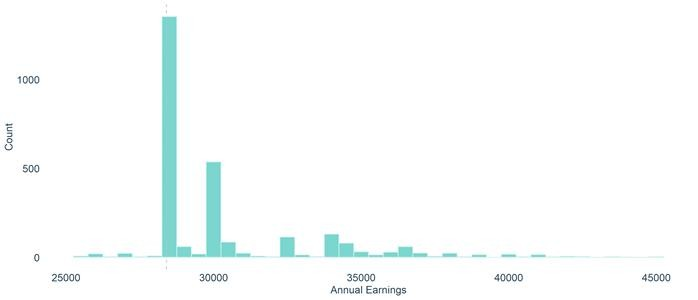
Source: Home Office Management Information, Certificates of Sponsorship (April 2024 – March 2025).
Notes: Out of country, H&CW visas. A bar chart showing the wage distribution for migrant band 5 nursing professionals. Most wages cluster tightly around £28,500, with the tallest bar exceeding a count of 1,000.
This approach is logical, but the calculation for the general threshold is out of date as the skills threshold for the visa was updated to RQF 6+ in line with the rest of the SW route. The Home Office considers roles in Bands 3 & 4 to be RQF 3-5 and therefore below this new skills threshold, although there are some exemptions (pre-registration nurses and nursing auxiliaries) from this skills cutoff.
To maintain the original principle that the immigration system should facilitate the recruitment of health professionals to allow the NHS to find productive matches for vacancies, while bringing thresholds in line with the updated skills threshold, we recommend aligning the general threshold for pay scale occupations with the bottom of Band 5 of the Agenda for Change pay scale. This would mean ceasing to use the discounted RQF 3+ 25th percentile.
As the pay bands differ across the four nations, the threshold should be aligned with the nation with the lowest Band 5 salary to avoid inadvertently denying any parts of the NHS across the UK access to the immigration system. Currently, this would mean the threshold would sit at £29,970 to align with the bottom of Band 5 in Northern Ireland. We also recommend maintaining the provisions that allow sponsored nurses or midwives to enter at a lower band for up to eight months so they can achieve registration if they meet the requirements set out in SW 13.2 to SW 13.3.
In our engagement, NHS stakeholders were most concerned about being required to terminate the employment of existing H&CW visa holders because their Agenda for Change pay levels no longer met the requisite salary thresholds. For example, the general threshold for the H&CW visa was previously increased to £63 above the bottom of Band 3. There was also concern about existing employees who were biomedical scientists. If the government does not intend for existing H&CW visa holders in these roles to lose their jobs, it should ensure that transitional arrangements accommodate them.
Recommendation: The general threshold for pay scale occupations should be set in line with the bottom of Band 5 of the Agenda for Change pay scale.
Recommendation: The occupation-specific thresholds for pay scale occupations should continue to be determined by the relevant national pay scale.
Education occupations
The teaching profession also uses national pay scales. Like in healthcare occupations, the assumption is international teaching recruits generally enter work in these occupations at the bottom of the pay band, which currently sits at £32,916 for Qualified Teachers in England outside London. Pay scale teaching occupations also currently face the same general threshold as healthcare occupations, which sits at 80% of the RQF 3+ 25th percentile (£25,000), with national pay scales acting as the occupation-specific thresholds.
The education sector is not as reliant on immigration as healthcare, with a substantially lower percentage of teachers recruited internationally than those working in healthcare pay scale occupations. Nonetheless, overseas recruitment still contributes meaningfully to the overall labour supply. Setting one general threshold for national pay scale occupations would ensure that the current approach to recruiting teachers internationally is maintained. Teacher pay scales across the UK sit above Band 5 nursing pay scales in every instance. The lowest paid region for teaching is Northern Ireland at £31,650; for NHS Band 5 the annual salary in Northern Ireland is £29,970. This means a general threshold set at the bottom of the Agenda for Change Band 5 in Northern Ireland would not bind for full-time teachers, allowing teaching pay scales to act as the effective thresholds. As a result, our proposed increase in the general threshold for pay scale occupations should not impact recruitment into these teaching professions.
In light of annual updates to both healthcare and teaching pay scales across the UK, the Home Office should ensure that both sets of occupations can continue to use the system as our recommendation intends.
Other discounts
Immigration Salary List (ISL)
Skilled Workers are also eligible for discounts on the standard salary thresholds if they are working in an occupation that is on the Immigration Salary List (ISL). The ISL will be abolished in 2026 when the government considers our recommendations on the TSL, so we do not make any recommendations about the discounts it offers.
Postdoctoral discount
Separate from the PhD discount, the postdoctoral discount allows SWs to be paid 70% of the occupation-specific threshold or 80% of the general threshold if the job is a postdoctoral position in certain science or higher education roles. As noted earlier in this chapter, the postdoctoral discount was established after the publication of the MAC’s Points Based System report from 2012. However, we did not recommend that such a discount be established. Given the lack of data on postdoctoral wages in the eligible occupations, it is difficult to understand how the size of the current discount was determined.
The rules specify eight occupations that are covered by the salary discount – mainly scientific occupations and the higher education teaching profession which will cover universities. Table 3.11 shows the salary thresholds faced by those who qualify for the discount. As mentioned in Chapter 2, Lightcast’s online job advert data suggest that the median advertised pay for Research and Postdoctoral Fellows sits at £41,728 and £43,520 respectively, both of which are well above these effective thresholds.
Table 3.11 Postdoctoral discounted thresholds
| Occupation | Occupation-specific threshold | Discounted occupation-specific threshold | Effective discounted threshold |
|---|---|---|---|
| 2111: Chemical scientists | £39,900 | £27,900 | £33,400 |
| 2112: Biological scientists | £40,300 | £28,200 | £33,400 |
| 2113: Biochemists and biomedical scientists | £45,900 | £32,100 | £33,400 |
| 2114: Physical scientists | £54,600 | £38,200 | £38,200 |
| 2115: Social and humanities scientists | £40,400 | £28,300 | £33,400 |
| 2119: Natural and social science professionals n.e.c | £41,500 | £29,000 | £33,400 |
| 2162: Other researchers, unspecified discipline | £43,600 | £30,500 | £33,400 |
| 2311: Higher education teaching professionals | £52,600 | £36,800 | £36,800 |
Source: gov.uk.
It is important to recognise that this discount is simply choosing particular jobs within an occupation and operating a different salary threshold. This is not done for other occupations on the SW route and so is a special case which requires justification. We think there are good arguments for the discount to support the research base of the UK, recognising that many of the jobs will be in Industrial Strategy sectors. However, it is also likely that other sectors could make equally compelling arguments for jobs within other occupations that pay less than the occupation median.
It is for the government to decide whether this discount is fulfilling an important policy objective. If the government believes it is, we suggest that instead of operating a discount percentage, the discount should be reformulated as a fixed minimum annual salary that Skilled Workers in these roles must be paid. We have no data that can help evaluate an appropriate percentage discount across occupations for such roles and hence propose a single salary threshold for those in postdoctoral positions.
To avoid overcomplicating the system, a postdoctoral rate could be aligned with the new entrant rate of £33,400 proposed above. However, these workers have a PhD and are therefore significantly more skilled than the average new entrant. Online job adverts suggest median salaries for Research and Postdoctoral Fellows of £41,728 and £43,520 respectively, suggesting that a salary threshold of £33,400 would sit well below usual rates of pay for these roles. While the risk of undercutting in the public sector would be mitigated by the nationally negotiated higher education pay spine, we believe it would be more appropriate to set a single salary threshold for postdoctoral positions of £41,700 to better reflect pay of those working in these roles.
If the government chooses to accept our recommendations in Chapter 2, that the general threshold for the SW route should be set at £41,700 with occupation-specific thresholds at the 25th percentile, then a postdoctoral salary threshold would not be required as it would align with the standard thresholds. However, if the government chooses to keep occupation-specific thresholds at the median or increase the general threshold, this proposed rate would provide discounted access to the SW route for those in postdoctoral positions.
Current discount users are eligible for up to four years (including any time spent in the UK on a Graduate visa). Should a discounted rate for this group be needed, four years remains an appropriate duration given the length of most postdoctoral appointments.
Recommendation: If the government wishes to maintain a discount for postdoctoral positions, it should be set a single discounted rate of £41,700 with a duration of four years.
Chapter 4: Salary thresholds for other visa routes
Summary
-
The general threshold for the Temporary Shortage List (TSL) should ensure that, at a minimum, migrants are paid a wage that affords them a reasonable standard of living. Fiscal considerations are less important if the visas are temporary, as a limited stay for visa holders and a ban on dependants will mean it is highly likely they will be fiscally positive.
-
The TSL’s occupation-specific thresholds should incentivise employers to recruit and train domestic workers and reflect the crucial roles eligible occupations play in innovative and productive ‘growth driving’ sectors and the fact they are in shortage.
-
As there is no specific test to demonstrate the senior/specialist nature of the workers using the Global Business Mobility (GBM) route, its salary thresholds should reflect these characteristics. The current occupation-specific thresholds, which are set at the 25th percentile, are too low to do this effectively. At a minimum, the median is more appropriate to reflect the fact that the workers are required to be senior or specialist.
-
Health & Care Worker (H&CW) visa:
a. To simplify the system, salary thresholds for standard occupations on the H&CW visa should be set using the same method as for Skilled Workers.
b. Biochemists and biomedical scientists are currently treated as a standard occupation, despite containing biomedical scientists who are paid according to pay scales when working for the NHS. If the government wishes to allow the NHS to recruit international biomedical scientists, it will either need to restrict the use of the pay scale threshold to NHS employers or accept that private-sector employers will also be able to bring in workers at relatively low levels of pay.
-
Start-ups should not be allowed to pay migrant workers less than other firms, so the salary thresholds for the Scale-up route should be aligned with the Skilled Worker (SW) route.
This chapter will consider how salary thresholds should be set for the remaining work routes within scope of this review. This includes the TSL, GBM route, the H&CW visa and the Scale-up route.
Temporary Shortage List
On 12 May 2025, the government published its Immigration White Paper (IWP) titled “Restoring Control over the Immigration System”, which announced an increase in the skills threshold for the SW route to Regulated Qualifications Framework (RQF) Level 6 (degree level) and above. The White Paper also announced that the Immigration Salary List would be replaced with the TSL, which will allow employers to recruit international workers in RQF 3-5 occupations that are crucial to delivering the Industrial Strategy and critical infrastructure.
In October 2025, we published our TSL Stage 1 report containing recommendations regarding the design of the TSL and which RQF 3-5 occupations are eligible to be considered for inclusion on the route. In that report we highlighted how the general threshold and occupation-specific thresholds for the TSL should serve different purposes. While occupation-specific thresholds should be set to prevent undercutting and encourage domestic hiring and investment in skills, the general threshold should improve workers’ fiscal contributions and ensure a minimum standard of living for those on TSL visas.
General threshold
As with the general threshold for the SW route, the approach to setting the general threshold for the TSL must consider the fiscal contributions of route users. TSL visa holders will be unable to bring dependants, meaning there is no possibility for them to bring a non-working partner or children who could be a fiscal cost.
The net fiscal contributions of route users are also heavily dependent upon whether the TSL offers a path to settlement. The earned settlement consultation does not reference the TSL, and we have based our recommendations on the assumption that the route will not offer a path to settlement. If this is indeed the case, on average TSL visa holders will be overwhelmingly fiscally positive as they will not be entitled to welfare benefits and will not impose long-term costs on the taxpayer as they age. This means the fiscal contributions of route users are not a key consideration as they will be positive almost regardless of the level of the general threshold. However, if the government decides the TSL should offer a path to settlement, the general threshold will need to be reconsidered to ensure that it is set at a level to achieve a positive net fiscal outcome over the lifetime of route users. We will be happy to provide further advice on the matter if this is the choice the government makes.
Any general threshold should, at a minimum, ensure migrants are paid a wage that is sufficient to afford them a reasonable standard of living. The Joseph Rowntree Foundation’s (JRF) 2025 minimum income standard indicates that £30,500 is enough to secure a reasonable standard of living for a single person in the UK. This benchmark is developed through deliberative conversations with the public to identify the goods and services needed for a minimum socially acceptable living standard, which includes maintaining a balanced diet, heating to maintain a warm home and staying connected with a basic mobile phone.
Basing the TSL’s general threshold on the JRF’s figure would create an external dependency, as the value is based on the JRF’s methodology and data for calculations. However, the 30th percentile of the UK’s overall full-time earnings distribution, which sits at £30,900, would act as an appropriate proxy, ensuring TSL route users are paid at least as much as the JRF suggest is necessary to afford a reasonable standard of living. At a minimum, the general threshold for the TSL should be set at this level. The 30th percentile of the full-time earnings distribution for all RQF 3-5 occupations (£30,600) and for the occupations that passed Stage 1 of our TSL review (£30,700) also sit at around this level and could act as alternative methods of calculation.
However, the government’s priority of reducing net migration may mean it judges a higher threshold to be more appropriate, particularly given that a higher general threshold would increase the average fiscal contribution of each TSL visa holder. Between October 2024 and June 2025, around 5,800 SW visas (22% of total) were issued to occupations that have passed Stage 1 of the TSL review, indicating that some employers would be able to meet thresholds if they continue to be set at their current levels. On the other hand, higher levels for the general threshold will mean it becomes the effective threshold for more TSL occupations and may conflict with the government’s Industrial Strategy objectives.
Recommendation: The general threshold for the TSL should be set at least as high as £30,900, the 30th percentile of the UK’s full-time annual earnings distribution.
Occupation-specific thresholds
In the Immigration White Paper, the government argued that labour market and immigration policy have become misaligned, resulting in “a reduction in investment in skills, rising inactivity of the domestic labour market, poor future workforce planning and high levels of recruitment from abroad.” The TSL has been created in this context and thus its design, including its salary thresholds, should incentivise firms to employ and invest in domestic workers as a means of addressing shortages. This is particularly important because, in theory, it should be cheaper and faster to train domestic workers in mid-skilled RQF 3-5 TSL occupations compared to those in the high-skilled RQF 6+ occupations on the SW route.
The nature of TSL occupations – being both in shortage and part of innovative and productive ‘growth driving’ sectors – also means wages should be competitive. In addition to differing skill levels, these features further distinguish occupations eligible for the TSL from those on the SW route. Occupations eligible for the SW route are not necessarily in shortage or part of growth driving sectors. Both the purpose of the TSL and the nature of the occupations that will be eligible for the route suggest that occupation-specific thresholds should be at least as high, if not higher, than those for the SW route. As we noted in Chapter 2, setting occupation-specific thresholds as high as the median will make a route less accessible for potential users, particularly in lower paying regions of the UK. However, this is a more suitable outcome for the TSL than the SW route, because it has been designed to primarily incentivise recruitment of domestic workers whereas this aim is less of a priority for the SW route.
While higher occupation-specific thresholds would make it harder for employers from across the UK to meet the required thresholds there will be differences in these impacts between regions. As Figure 4.1 shows, it would be harder for lower paying nations and regions, such as Northern Ireland and the North East, to meet occupation-specific thresholds set at the median than the 25th percentile. However, as we have outlined in Chapter 1, pay variation within regions and within occupations means that some areas will always struggle to meet any realistic threshold.
Figure 4.1 Share of regional workforce meeting their effective salary threshold
25th percentile
| Region | Share | ||
|---|---|---|---|
| North East | 31% | 12% | 57% |
| Northern Ireland | 28% | 15% | 58% |
| South West | 27% | 13% | 60% |
| Wales | 28% | 12% | 61% |
| North West | 27% | 13% | 61% |
| Yorkshire and the Humber | 27% | 11% | 62% |
| East Midlands | 25% | 12% | 63% |
| West Midlands | 26% | 11% | 63% |
| East | 22% | 11% | 67% |
| Scotland | 20% | 12% | 68% |
| South East | 20% | 11% | 69% |
| London | 14% | 8% | 78% |
Median
| Region | Share | ||
|---|---|---|---|
| Northern Ireland | 44% | 15% | 40% |
| North East | 45% | 14% | 41% |
| Wales | 42% | 17% | 41% |
| South West | 43% | 14% | 42% |
| Yorkshire and the Humber | 42% | 15% | 43% |
| North West | 42% | 15% | 43% |
| East Midlands | 41% | 15% | 44% |
| West Midlands | 41% | 14% | 44% |
| East | 37% | 15% | 48% |
| South East | 35% | 14% | 51% |
| Scotland | 34% | 14% | 53% |
| London | 24% | 11% | 65% |
Source: Annual Survey of Hours and Earnings (ASHE) 2024 provisional.
Notes: RQF 3-5 occupations only. Both charts assume a general threshold set at the 30th percentile of the UK’s full-time annual earnings distribution.
While occupation-specific thresholds set at the median clearly make the system accessible for fewer employers than thresholds at the 25th percentile, even in the UK’s lowest paying nation, 40% of RQF 3-5 workers are paid above their occupation’s effective salary threshold when the occupation-specific thresholds are set at the median. Given the TSL is intended to allow firms from growing industries to recruit skills in shortage, this should be sufficient for firms to access the system when needed.
Setting occupation-specific thresholds at the median of the occupation’s wage distribution would balance the need to incentivise domestic recruitment and investment in skills, against the regional considerations we have outlined above.
Recommendation: Occupation-specific thresholds for the TSL should be set at the median of each eligible occupation’s full-time annual earnings distribution.
Figure 4.2 demonstrates how occupation-specific thresholds set at the median would interact with a general threshold at the 30th percentile (£30,900). As the figure shows, setting the thresholds in this way would mean 90% of occupations that passed Stage 1 of our TSL review would typically be bound by the occupation-specific rate (where the dark blue dots exceed the dark blue line). Applying the same thresholds to all RQF 3-5 occupations would see a similar proportion of the eligible occupations bound by the general threshold so the balance between the general and occupation-specific thresholds would be unlikely to change substantially if occupations move on and off the list over time.
Figure 4.2 General and occupation-specific TSL thresholds
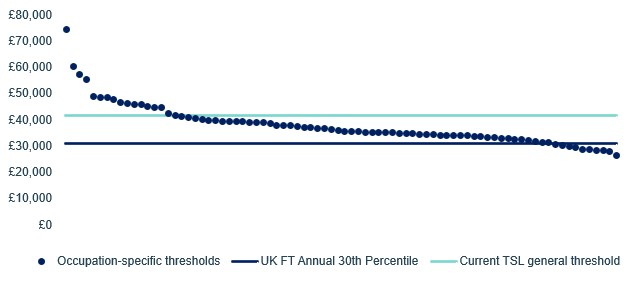
Source: ASHE 2025 Provisional.
Notes: RQF 3+ median (£41,700) is the current general threshold faced by occupations on the interim TSL. The 30th percentile of the UK full-time annual earnings distribution is £30,900.
Discounts
The TSL is intended to allow employers to address short-term shortages. Workers who are already fully competent and need minimal additional training are most suitable in this context. A new entrant discount is therefore not appropriate for the TSL, as the route should incentivise the recruitment of more experienced workers rather than provide younger workers a path into the workforce. Allowances therefore do not need to be made for the lower salaries of younger workers compared to the median within their occupation and hence there should be no such discount available.
Our recommendation for a minimum TSL general threshold is devised to ensure a reasonable standard of living for TSL visa holders. Offering any discount on this threshold would undermine the intention to protect the living standards of workers.
Given this intended function, the Home Office may also wish to consider this threshold as an option for the absolute minimum salary floor for non-pay scale occupations on the SW route. We note that the public sector would likely be allowed to pay beneath this salary floor to align with national pay scales. Once more, this highlights the public sector’s preferential treatment in the immigration system and raises concerns about fair pay in these occupations.
Finally, several of the occupations that passed Stage 1 of our TSL review are currently on the Immigration Salary List (ISL) and thus are eligible for the ISL discount. As mentioned in Chapter 3, the ISL will be abolished in 2026 when the government considers our recommendations on the TSL, removing the opportunity to claim this discount when recruiting via the TSL.
Recommendation: There should be no discounts on salary thresholds for the TSL.
Global Business Mobility route
As explained in Chapter 1, the GBM route consists of five sponsored work sub-routes for overseas businesses with a presence in the UK needing to send their existing employees to the UK for specific temporary work assignments. Visa holders on three of these routes - the Senior or Specialist, UK Expansion Worker and Graduate Trainee - must meet specific salary requirements. The other two GBM sub-routes - Service Suppliers and Secondment Workers – do not have salary thresholds but are subject to other requirements, such as providing a service to a UK business under a contract covered by a valid international trade agreement, or being an employee of an overseas firm with a high-value contract with a UK organisation. In this section, we will comment on the thresholds for each of the GBM visas with salary requirements.
Senior or Specialist route
The GBM Senior or Specialist route is the most used GBM route, making up 94% of GBM visas issued from July 2024 to June 2025. It is designed to allow senior or specialist workers access to the UK to carry out temporary assignments at a UK branch of a business for which they already work and, as referenced in Chapter 1, helps to deliver commitments under Mode 4 of the General Agreement on Trade in Services (GATS). The UK has relatively generous eligibility rules for GBM; unlike the approaches taken to this type of route in other countries such as South Korea and the United States, there is no formal test to demonstrate the senior or specialist nature of the worker. Instead, the route implicitly relies on the pay of workers and thus its salary thresholds to demonstrate seniority or specialism, with anyone working in an RQF 6+ role being eligible. Similarly, the GBM visa duration of five years in six (for those paid less than £73,900) also exceeds the standard minimum duration of three years required by the UK’s Mode 4 commitments.
It is logical to expect that senior workers and those with specialist skills will be paid at least as much as those on the SW route working in their occupation. This was reflected in the occupation-specific thresholds for the route when it was created in April 2022, when they were set at the 25th percentile to align with those of the SW route. At the same time, the general threshold was set at the median of all eligible RQF 6+ occupations (£42,400) – a substantially higher level than the SW general threshold at the time (£25,600) and one that adequately reflects the higher pay one would expect senior managers and specialists to receive.
However, when the SW occupation-specific thresholds were increased to the median in April 2024, the Senior or Specialist thresholds remained at their original level. As Figure 4.3 demonstrates, this has resulted in a perverse situation in which the effective salary thresholds for several RQF 6+ occupations have become higher on the SW route than they are on the Senior or Specialist route.
Figure 4.3 GBM Senior Specialist & Skilled Worker effective thresholds
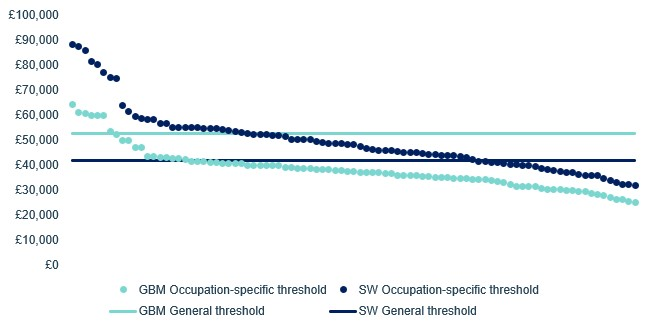
Sources: ASHE 2024 Provisional.
Notes: Occupation-specific rates are positioned according to their rank, which differs between GBM & SW. This means the difference between dots in the same position on the x-axis do not necessarily reflect the difference in the rates for the same occupation. The SW general threshold is £41,700 and the GBM general threshold is £52,500.
To fix this issue and properly reflect the senior or specialist nature of the work that the visa holders are undertaking, we recommend that the Senior or Specialist occupation-specific thresholds should be increased to the median. It is unacceptable that multinational firms should be allowed to bring senior workers and those with specialist skills to the UK at lower rates of pay than domestic UK firms, giving them a competitive advantage. Increasing the Senior or Specialist thresholds to the median would realign them with the SW route, eliminating the incentive to use the GBM route to pay workers a lower salary.
Even if the government chooses to reduce the occupation-specific thresholds for the SW route, as we recommend in Chapter 2, increasing the GBM thresholds to the median would also better reflect the required experience and skill of the senior and specialist workers using the visa. Similar analysis to that shown in Table 3.5 reveals the median worker in an RQF 6+ occupation earns at least the 25th percentile for their occupation by the time they reach age 26. While experience is not always commensurate with age, given that the median age of migrants on the Senior or Specialist route is 35, this suggests that the 25th percentile is not high enough to ensure wages reflect the expected experience of those using the route.
The notion that occupation-specific thresholds should be set higher than the 25th percentile is also supported by the significant usage of the route among multinational firms based in London. Between April 2024 and March 2025, 65% of all Senior or Specialist visas were granted via sponsors based in London & the South East. These areas of high usage are to be expected given the higher wages usually paid in these regions and the propensity for multinational firms to locate their headquarters in these areas. However, this further suggests that the wage distributions of the workers most commonly using the route - senior or specialist workers based in London and the South East - are likely to have higher quantiles than the UK-wide distributions, thus indicating that the 25th percentiles of the UK-wide distributions are likely too low to serve as effective occupation-specific thresholds for the route.
The impact of increasing the occupation-specific rates on the route’s effective thresholds would be dampened by the general threshold, which currently binds for most occupations. As Figure 4.3 shows, moving from the 25th percentile to the median would increase the effective threshold for 29 (32%) of the eligible occupations, with 22 bound by their occupation-specific threshold where they were previously caught by the general. Only 13 of the highest paying occupations would see an effective threshold increase of more than 10%. If thresholds had been set in this way from July 2024 to March 2023, in 2,200 (23%) of cases the sponsoring employer would either have had to raise the wages to meet the threshold or not used the route to transfer the worker to the UK.
We recommend against increasing occupation-specific thresholds for the Senior or Specialist visa beyond the median. Due to the temporary nature of the assignments undertaken by GBM visa holders, the salary level that would ensure they make a net fiscal contribution over their time in the UK is significantly lower than for SW visa holders. This means that GBM visa holders earning a salary equivalent to the median for their occupation will be making a substantial net fiscal contribution to the UK and increasing thresholds beyond this level would mean many of these workers would not get the opportunity to come to the UK and contribute to the public purse. To balance these fiscal considerations against the need to increase the occupation-specific thresholds to better reflect the expected pay of senior and specialist workers, we believe the median is a suitable level for the thresholds.
Within GBM Senior or Specialist there is also a ‘Higher Earners Threshold’ of £73,900 which exempts holders from a requirement to have worked for 12 continuous months with the overseas employer prior to entering the UK. This figure has not been updated, despite our recommendation for an annual uprating in our 2021 review of the Intra-Company Transfer (ICT) route. We continue to recommend that this threshold be updated in line with the latest ASHE data (£81,300 in 2024).
Recommendation: The general threshold for the GBM Senior or Specialist route should continue to be set at the median of the full-time annual earnings distribution of the route’s eligible occupations.
Recommendation: Occupation-specific thresholds for the GBM Senior or Specialist route should be set at the median of each eligible occupation’s full-time annual earnings distribution.
Graduate Trainee route
The Graduate Trainee route is the second most used of the GBM routes, though accounting for only 3% of GBM visas issued from July 2024 to June 2025. As discussed in Chapter 1, it is designed to allow graduates access to the UK to undertake a graduate training programme leading to a senior management or specialist position.
As we discussed at length in the discounts section of Chapter 3, recent graduates typically receive lower pay than the average worker in their occupation. To make the route accessible for the graduates it is designed to reach, the Graduate Trainee route requires lower salary thresholds than the Senior or Specialist route.
The logic applied in Chapter 3 to arrive at our recommendations on the new entrant rate can also be translated to the Graduate Trainee context. The starting salaries for users of the Graduate Trainee route are likely to be similar to those of new entrants using the SW route, thus the threshold for graduate trainees should mirror the SW new entrant threshold of £33,400 recommended in Chapter 3. As for the SW route, we are unable to recommend occupation-specific rates due to a lack of data showing graduate starting salaries by occupation. This change would result in the effective threshold rising for most graduate trainee roles.
Recommendation: The salary threshold for the Graduate Trainee route should be set at £33,400, in line with the SW new entrant rate. Occupation-specific rates for the route should be abolished.
UK Expansion Worker route
The final GBM route with specific salary requirements is the UK Expansion Worker route, which made up just 1% of GBM visas from July 2024 to June 2025. The route allows users to come to the UK to set up a branch of an overseas business that has not yet started trading in the UK. Crucially, visa holders must already work for their employer as either a senior manager or specialist employee. This criterion is similar to that of the Senior or Specialist route and as a result the salary thresholds for the two routes have been aligned since they were introduced. We agree with this rationale, therefore our recommendations for the UK Expansion Worker route mirror our recommendations for the Senior or Specialist route.
Recommendation: The general threshold for the GBM UK Expansion Worker route should continue to be set at the median of the full-time annual earnings distribution of the route’s eligible occupations.
Recommendation: Occupation-specific thresholds for the GBM UK Expansion Worker route should be set at the median of each eligible occupation’s full-time annual earnings distribution.
Health & Care Worker visa
As introduced in Chapter 1, the H&CW visa allows medical professionals to come to or stay in the UK to work in an eligible occupation in the NHS, an NHS supplier or in adult social care. It is intended to facilitate the recruitment of medical professionals and address skill shortages in the UK’s health and social care sector.
The method for setting the salary thresholds for an eligible occupation depends upon whether those working in that occupation are most likely to be paid according to the Agenda for Change pay scales. As discussed in Chapter 3, those working in occupations that are paid according to these pay scales receive a discount on the standard salary thresholds for the SW route and H&CW visa. 24 of the 31 occupations that are currently eligible for the H&CW visa are paid according to pay scales and are treated as such by the immigration system. We recommend that salary thresholds for pay scale occupations eligible for the H&CW visa remain aligned with those of pay scale occupations that are eligible for the SW route. Chapter 3 outlines our recommended salary thresholds for these pay scale occupations.
For the remaining seven occupations eligible for the H&CW visa but not paid according to the national pay scales, their general threshold is currently set at the 25th percentile (£31,300) of all RQF 3+ occupations. Their occupation-specific thresholds are also set at the 25th percentile, a significant discount compared to the current SW route thresholds.
Now that care workers are ineligible for the H&CW visa, route usage among these occupations makes up less than 1% of all H&CW visas. In fact, as shown in Table 4.4, two of the three standard RQF 6+ occupations currently use more SW visas than H&CW visas, despite the SW route having higher salary thresholds.
Table 4.4 Visas issued by type
| Occupation | Health and Care Worker | GBM Senior/Specialist | Skilled Worker |
|---|---|---|---|
| Health services and public health managers and directors | 11 (58%) | 1 (5%) | 7 (37%) |
| Biochemists and biomedical scientists | 18 (31%) | 1 (2%) | 39 (67%) |
| Physical scientists | 1 (1%) | 12 (18%) | 54 (81%) |
Source: Home Office Published Immigration Statistics, October 2024 – September 2025.
As Table 4.5 shows, the wage distributions for these occupations indicate that most standard H&CW visa holders would still have received their visa if they had applied against the SW thresholds. As a result, we recommend simplifying the system so the method for calculating the salary thresholds for Health services and public health managers and directors (1171) and Physical scientists (2114) is aligned with the SW route.
Table 4.5 Share of H&CW occupations meeting SW salary thresholds
| Occupation | Share exceeding SW thresholds |
|---|---|
| Health services and public health managers and directors | 92% |
| Biochemists and biomedical scientists | 66% |
| Physical scientists | 82% |
Source: Home Office Management Information, April 2024 - March 2025.
Biochemists and biomedical scientists (2113) are a special case. While the salary thresholds for the occupation are determined as though they are not a pay scale occupation, the occupation contains biomedical scientists which is a pay scale occupation in the NHS, with most workers entering at Band 5 with a degree-level qualification. There is a gap between the salary threshold as it is currently set (£35,100) and the Agenda for Change Band 5 (£33,247), which makes it difficult for the NHS to recruit biomedical scientists internationally and may be why we see so few H&CW visas for the occupation in Table 4.4.
However, at least half of those working in the occupation do so outside of the NHS (see Table 4.6). As a result, the Home Office have previously used the 25th percentile for the occupation to best reflect the pay of the occupation as a whole.
Table 4.6 Where do biochemists and biomedical scientists work?
| Public/Private Sector | Share of occupation |
|---|---|
| Private Sector | 37% |
| Public Sector - Health Authority or NHS Trust | 49% |
| Public Sector - Other | 14% |
Source: Pooled Annual Population Survey, 2022-2024.
If the government wishes to allow the NHS to use the immigration system to recruit biomedical scientists by allowing them to be paid according to the national pay scales, it will either need to restrict the use of the pay scale threshold to NHS employers or accept that private-sector employers will also be able to bring in workers at relatively low levels of pay.
We make no recommendation regarding the salary thresholds of the remaining four occupations that are still eligible for the H&CW visa, because they are all below the RQF 6+ skills threshold and we expect they will have their access to the route terminated once the ISL is abolished.
Scale-up route
The final route in scope for our review is the Scale-up route. Set up in August 2022, this visa was designed to provide a route for UK businesses who demonstrate a significant period of growth to sponsor talented and skilled individuals to help that business grow, with the aim of supporting economic growth. However, since its introduction, usage of the route has been limited. Between July 2024 and June 2025, fewer than 100 Scale-up visas were granted. The Home Office incurs non-trivial administrative costs setting up routes like this, and when subsequent visa uptake is low, as has been the case for the Scale-up route, they are very unlikely to have delivered value for money for taxpayers. We do not think it would make much difference if the route were abolished. Strikingly, the stakeholders we engaged with seemed largely indifferent to its existence.
We recommend that in future the government avoids setting up symbolic routes like the Scale-Up route and assesses the actual labour market and immigration policy need that is being addressed by any new work routes. Startups can already use the SW route and must compete in the same labour market as other firms, so they should face the same salary thresholds. The fiscal contributions of Scale-up workers are also likely to be similar to SWs and setting occupation-specific thresholds at the 25th percentile is sufficient to minimise the risk of undercutting. For these reasons, if the government is to keep the Scale-up route, we recommend that its salary thresholds should be aligned with those of the SW route. We make this recommendation while acknowledging that this will effectively eliminate the main incentive for an employer to choose the Scale-up route over the SW route, aside from the exemption to the Immigration Skills Charge, and may result in the route becoming dormant. We believe this simplification of the rules is appropriate given the route’s already limited usage.
Recommendation: We recommend that in future the government avoids setting up symbolic routes like the Scale-Up route and assesses the labour market need being addressed by any new work routes.
Recommendation: We recommend that the salary thresholds for the Scale-up route are aligned with those of the SW route.
Chapter 5: Conclusions and recommendations
This report fulfils the commission from the previous Home Secretary to review the salary requirements for the Skilled Worker (SW), Health & Care Worker (H&CW), Global Business Mobility (GBM) and Scale-up routes.
The commissioning letter posed the questions below for our consideration.
1. What should the general salary threshold be for the Skilled Worker route?
2. Should there continue to be different salary thresholds for Health & Care Worker visas and the Global Business Mobility and Scale-up routes and, if so, what should these be?
3. What, if any, discounts should apply to salary requirements?
4. Should there be any changes to the current approach to occupational going rates?
5. How frequently should salary requirements be updated?
We address these questions below, chapter by chapter.
Chapter 2: Skilled Worker salary thresholds
We recommend that occupation-specific thresholds for the SW route are set at a level which reduces the risk of undercutting domestic workers, without preventing certain jobs within occupations from using the system and inadvertently prioritising lower paid workers. Given this, we argue that the median is too high a level for occupational thresholds. We echo the recommendation we have made several times in the past that the 25th percentile of occupational earnings is adequate for this purpose. A reduction in the occupation-specific thresholds does not necessarily mean liberalising overall skilled work migration or increasing net migration, because the impact of these thresholds depends on the level of the general threshold.
As outlined in Chapter 2, the general threshold should be set to achieve the appropriate balance between the overall policy objectives of the government.
Of the options we present, maintaining the general threshold at £41,700 would maximise fiscal benefits, help ensure that Industrial Strategy sectors could recruit the workers they will likely need over the coming years, and reflect variation in wages across the UK. This is our recommendation.
Increasing the general threshold to £48,400 would result in the effective threshold rising for the majority of occupations. Combined with occupation-specific thresholds being set at the 25th percentile, it would broadly replicate the current set of thresholds in terms of the impact on net migration and fiscal contribution (and could feasibly lead to a small fall in net migration with some fiscal benefits) but would overall be less fiscally positive than if it were set at £41,700.
We continue to recommend that salary thresholds for work routes should be set at the UK-wide level and highlight that lowering occupation-specific thresholds to the 25th percentile would be more affordable for employers outside of London. Wages vary far more within regions than across regions, so even if thresholds were set at a regional level there would still be many areas of the UK that would struggle to meet them. Regional salary thresholds would also add complexity and may be harder to enforce within the migration system.
Salary requirements should be updated on a scheduled annual basis. This will ensure changes are regular, more predictable, and better aligned with evolving labour market conditions. Further detail is available in Chapter 2.
To note, much of the analysis in this report was carried out using ASHE 2024 data. Any updates to the Immigration Rules by the Home Office should be carried out using ASHE 2025.
Chapter 3: Discounts on Skilled Worker salary thresholds
New entrant discount
We recommend that a single new entrant rate be set at £33,400, to ensure a typical graduate entrant can be employed using the immigration system whilst also being sufficiently paid to provide a net fiscal benefit to the UK over their lifetime.
We recommend that the duration of this discount should change from its current length of four years but also recognise that the duration of the discount may interact with settlement policy. We therefore simply lay out how long, in theory, the discount is needed for workers to catch up with undiscounted thresholds; these durations should not be taken as recommendations for routes to settlement:
-
If the occupation-specific threshold is set at the 25th percentile and the general threshold is £41,700 for the SW route, the valid discount period for new entrants would be six years.
-
If the 25th percentile is maintained but the general threshold is increased to £48,400, the discount period would extend to nine years.
-
If the occupation-specific threshold is set at the median and the general threshold is £41,700, the discount period would be 13 years.
-
If the median is maintained but the general threshold is increased to £48,400, the discount period would extend to 16 years.
We note that very long new entrant discounts, which are required for higher undiscounted thresholds, may be undesirable; in particular, it is not feasible to taper the discount gradually over time, which means that workers in the final years of a long discount period could be underpaid.
We also recommend that the discount should be available to use for its full duration, independently of the length of time that the initial visa was granted for.
PhD discount
There was no substantial evidence to suggest that PhD holders receive lower pay than the average Skilled Worker and require a discount. We disagree that workers with a PhD should be expected to earn less than the average worker across their working life. We therefore recommend abolishing the PhD discount.
Postdoctoral discount
The MAC has never recommended a postdoctoral discount. However, there are legitimate arguments for this discount to support the research base in the UK – noting that many of the jobs will be in Industrial Strategy sectors. It is also likely, though, that other sectors will make similarly compelling arguments for other occupations that pay less than the occupation average. If the government wishes to maintain a discount for postdoctoral positions, we suggest setting the discounted salary at £41,700 for four years.
If the government chooses to accept our recommended salary thresholds for the SW route, whereby the general threshold would continue to be set at £41,700 and occupation-specific thresholds at the 25th percentile, then a postdoctoral salary threshold would align with the undiscounted thresholds and thus would not be required.
Chapter 4: Salary thresholds for other visa routes
Temporary Shortage List (TSL)
We recommend that the general threshold for the TSL should be set at least as high as the 30th percentile of the UK’s full-time annual earnings distribution (approx. £30,900), ensuring migrants are paid a wage that affords a reasonable standard of living. If the government wants to keep use of the route low, it could choose a higher threshold, such as one close to the interim TSL’s threshold of £41,700, but this would potentially restrict growth in Industrial Strategy sectors.
This recommendation is made on the basis that the TSL will not provide a path to settlement for route users. If the government decides the route should provide a path to settlement, then the general threshold may need to be reconsidered to ensure it is set at a level to ensure that users make a net positive fiscal contribution to the UK over their lifetimes.
The occupation-specific thresholds should be set at the median of each eligible occupation’s full-time annual earnings distribution.
Global Business Mobility (GBM) route
-
Senior or Specialist route: The general threshold should continue to be set at the median of the full-time annual earnings distribution of eligible occupations. The occupation-specific thresholds should be set at the median of each eligible occupation’s full-time annual earnings distribution. The current occupation-specific thresholds, which are set at the 25th percentile, are too low to reflect the seniority of the route. The median is more appropriate to ensure that the workers are genuinely senior or specialist.
-
Graduate Trainee route: A single salary threshold should be set at £33,400, mirroring the SW new entrant threshold. Due to lack of data demonstrating graduate starting salaries by occupation, we are unable to recommend occupation-specific rates and conclude they should be abolished.
-
UK Expansion Worker route: The general threshold should continue to be set at the median of the full-time annual earnings distribution of the route’s eligible occupations. Occupation-specific thresholds should be set at the median of each eligible occupation’s full-time annual earnings distribution.
Pay scale occupations and standard H&CW occupations
The general threshold for pay scale occupations should be set at the level equivalent to Band 5 in the lowest paying UK nation, ensuring that healthcare and education occupations can be recruited in the same way across England, Northern Ireland, Scotland, and Wales. Occupation-specific thresholds should remain aligned with the relevant pay bands for each occupation.
For standard occupations, those not paid according to national pay scales, thresholds should be set using the same methods as the SW route. However, transitional arrangements should ensure that workers already in the UK in RQF 3–5 jobs are not accidentally required to leave. In the case of biomedical scientists, if the government wishes to allow the NHS to use the immigration system to recruit them by being paid according to the national pay scales, it will either need to restrict the use of the pay scale threshold for NHS employers or accept that private-sector employers will also be able to hire workers at relatively low levels of pay.
Scale-up
Salary thresholds for the Scale-up route should be aligned with those for the SW route. We make this recommendation with the knowledge that it will remove the main incentive for employers to choose this route over the SW route. The Home Office incurs non-trivial administrative costs setting up routes, and when subsequent visa uptake is low, as has been the case for the Scale-up route, they are very unlikely to have delivered value for money for taxpayers. We do not think it would make much difference if the route were abolished. We also recommend that the government avoid setting up similar routes unless there is a clear gap in the immigration system.
Other considerations
To better understand how employers use discounts, the Home Office’s Certificate of Sponsorship (CoS) data should include if an individual is using a discount, and, if possible, where they are eligible for one but do not use it. This information (certainly the former) will be collected by Home Office case workers but is not made available in the microdata, making it necessary for us to create our own proxies for discount usage. There are other limitations of the CoS data which impeded our analysis, such as the ‘size of business’ variable being unreliable, which would be useful to address.
Recommendation: The Home Office should ensure that data on discounts and the size of the business be recorded accurately in CoS data in a form that allows statistical analysis.
We also note the recent announcement from the ONS that is set to pause the current version of the Annual Population Survey. While we recognise the issues the ONS has faced administering the survey since 2020, as is clear from the analysis in this report, we often rely on these data for occupation-level analysis. We would like to be consulted on future changes to it and other products such as the Transformed Labour Force Survey.
Separately, as part of our engagement for this commission, we spoke to many employers who regularly use the Skilled Worker route. Several of these employers highlighted uncertainty over their legal obligations to recruit candidates who require sponsorship compared to domestic candidates.
In our discussions, it became clear that many sponsor licence holders remain concerned, despite their best intentions to comply with all regulations, that they could fall foul of employment and equality laws if they do not hire someone because that person requires a visa. The government should consider clarifying (either in guidance or regulations, as necessary), that employers are not obliged to sponsor and can choose to prioritise candidates who do not require sponsorship.
Annexes
Table A.1 New entrant post-doctoral discount occupations
| SOC code | Occupation |
|---|---|
| 2111 | Chemical scientists |
| 2112 | Biological scientists |
| 2113 | Biochemists and biomedical scientists |
| 2114 | Physical scientists |
| 2115 | Social and humanities scientists |
| 2119 | Natural and social science professionals n.e.c. |
| 2162 | Other researchers, unspecified discipline |
| 2311 | Higher education teaching professionals |
Source: Skilled Worker Salary Discount for New Entrants - 2025 Guide.
Table A.2 NHS bands higher skilled healthcare occupation codes
| SOC code | Occupation |
|---|---|
| 2221 | Physiotherapists |
| 2222 | Occupational therapists |
| 2223 | Speech and language therapists |
| 2224 | Psychotherapists and cognitive behaviour therapists |
| 2225 | Clinical psychologists |
| 2226 | Other Psychologists |
| 2229 | Therapy professionals n.e.c. |
| 2231 | Midwifery nurses |
| 2232 | Registered community nurses |
| 2233 | Registered specialist nurses |
| 2234 | Registered nurse practitioners |
| 2235 | Registered mental health nurses |
| 2236 | Registered children’s nurses |
| 2237 | Other registered nursing professionals |
| 2251 | Pharmacists |
| 2252 | Optometrists |
| 2254 | Medical radiographers |
| 2255 | Paramedics |
| 2256 | Podiatrists |
| 2259 | Other health professionals n.e.c. |
| 2461 | Social workers |
Source: National pay scales for eligible healthcare occupation codes.
Table A.3 NHS bands medium skilled healthcare occupation codes[footnote 4]
| SOC code | Occupation |
|---|---|
| 3213 | Mental and dental technicians |
| 3219 | Health associate professionals n.e.c. |
| 6131 | Nursing auxiliaries and assistants |
| 6132 | Ambulance staff (excl. paramedics) |
| 6133 | Dental nurses |
Source: National pay scales for eligible healthcare occupation codes.
Table A.4 Entry step NHS pay bands by nation 2025/26 (annual salaries)
| Band and types of roles | England | Scotland | Wales | Northern Ireland |
|---|---|---|---|---|
| Band 2 | £24,465 | £25,694 | £24,833 | £23,615 |
| Band 3 Clinical support worker (CSW), trainee nursing associates (TNA), emergency care assistant, clinical coding officer, estates officer and therapy worker. |
£24,938 | £28,011 | £25,313 | £24,071 |
| Band 4 Registered nursing associate (RNA), assistant practitioner, audio visual technician, pharmacy technician, dental nurse and theatre support worker. |
£27,485 | £30,353 | £27,897 | £26,530 |
| Band 5 Staff nurse, newly qualified midwife, operating department practitioner (ODP), podiatrist, physiotherapist, occupational therapist, therapeutic radiographer, practice manager and ICT test analyst. |
£31,048 | £33,247 | £31,515 | £29,970 |
| Band 6 Deputy ward sister/charge nurse, school nurse, experienced paramedic, health records manager, senior physiotherapist or occupational therapist, clinical psychology trainee and biomedical scientist. |
£38,638 | £41,608 | £39,262 | £37,338 |
| Band 7 | £47,809 | £50,861 | £48,526 | £46,148 |
| Band 8a | £55,689 | £62,681 | £56,514 | £53,755 |
| Band 8b | £64,455 | £74,003 | £65,422 | £62,215 |
| Band 8c | £76,964 | £87,400 | £90,013 | £74,290 |
| Band 8d | £91,341 | £103,764 | £92,712 | £88,168 |
| Band 9 (top) | £109,179 | £122,736 | £110,817 | £105,385 |
Source: Agenda for Change NHS Pay Bands 2025/26 (Updated).
Table A.5 Teacher and education leadership pay scale occupations
| SOC code | Occupation | Skill level |
|---|---|---|
| 2313 | Secondary education teaching professionals | Higher skilled |
| 2314 | Primary education teaching professionals | Higher skilled |
| 2315 | Nursery education teaching professionals | Higher skilled |
| 2312 | Further education teaching professionals | Higher skilled |
| 2316 | Special and additional needs education teaching professionals | Higher skilled |
| 2321 | Head teachers and principals | Higher skilled |
| 3231 | Higher level teaching assistants | Medium skilled |
| 6112 | Teaching assistants | Medium skilled |
| 6113 | Educational support assistants | Medium skilled |
| Source: National pay scales for eligible teaching and education leadership occupation codes. |
Table A.6 Qualified Teacher pay scales England, Wales & Northern Ireland (2025/2026)
| Band | England (excl. London) | London (Inner) | London (Outer) | London (Fringe) | Wales | Northern Ireland* |
|---|---|---|---|---|---|---|
| M1 | £32,916 | £40,317 | £37,870 | £34,398 | ||
| M2 | £34,823 | £42,234 | £39,851 | £36,373 | £33,731 | £31,650 |
| M3 | £37,101 | £44,238 | £41,935 | £38,627 | £36,441 | £33,831 |
| M4 | £39,556 | £46,339 | £44,128 | £41,075 | £39,249 | £36,354 |
| M5 | £42,057 | £48,952 | £46,800 | £43,545 | £42,339 | £39,134 |
| M6 | £45,352 | £52,300 | £50,474 | £46,839 | £46,595 | £42,144 |
| U1 | £47,472 | £57,632 | £52,219 | £48,913 | £48,304 | £45,567 |
| U2 | £49,232 | £60,464 | £54,151 | £50,668 | £50,095 | £47,215 |
| U3 | £51,048 | £62,496 | £56,154 | £52,490 | £51,942 | £48,919 |
Source: Teacher Pay Scales 2025–2026: UK Salary Breakdown.
| *Note: Figures for Northern Ireland represent the 2024/2025 pay award which came into effect from April 2025. |
Table A.7 Teacher pay scales (Scotland)
| Main grade | Salary at 01.08.2025 |
|---|---|
| 0 (Probationer) | £34,938 |
| 1 | £41,916 |
| 2 | £44,295 |
| 3 | £46,866 |
| 4 | £49,839 |
| 5 | £52,614 |
Source: Current Salary Scales - EIS.
Table A.8 Occupations affected by the increase in the general threshold
| Occupation | 25th percentile | Median | Total visas granted | Share of domestic workers paid less than £48,400 | Critical to IS & Critical Infrastructure |
|---|---|---|---|---|---|
| 1135 - Charitable organisation managers and directors | £35,900 | £44,300 | 40 | Insufficient data | No |
| 1172 - Social services managers and directors | £33,100 | £43,000 | 0 | 65% | No |
| 1254 - Waste disposal and environmental services managers | £39,700 | £48,300 | <30 | 49% | No |
| 1255 - Managers and directors in the creative industries | £37,000 | £44,900 | 50 | 55% | Yes |
| 2111 - Chemical scientists | £31,300 | £39,900 | 80 | 68% | Yes |
| 2112 - Biological scientists | £30,700 | £40,300 | 140 | 58% | No |
| 2113 - Biochemists and biomedical scientists | £35,100 | £45,900 | 50 | 56% | No |
| 2115 - Social and humanities scientists | £28,000 | £40,400 | 30 | 86% | No |
| 2119 - Natural and social science professionals n.e.c. | £33,700 | £41,500 | 730 | 69% | Yes |
| 2122 - Mechanical engineers | £38,400 | £46,800 | 430 | 54% | Yes |
| 2125 - Production and process engineers | £36,500 | £45,000 | 170 | 58% | Yes |
| 2129 - Engineering professionals n.e.c. | £37,500 | £46,100 | 460 | 57% | Yes |
| 2136 - IT quality and testing professionals | £34,500 | £41,200 | 280 | 64% | Yes |
| 2137 - IT network professionals | £38,100 | £45,600 | 60 | 59% | Yes |
| 2141 - Web design professionals | £31,300 | £43,800 | 110 | 65% | Yes |
| 2142 - Graphic and multimedia designers | £26,200 | £31,700 | 340 | 95% | Yes |
| 2151 - Conservation professionals | £29,800 | £36,000 | <30 | 84% | No |
| 2152 - Environment professionals | £31,400 | £37,200 | 70 | 78% | Yes |
| 2162 - Other researchers, unspecified discipline | £37,400 | £43,600 | 540 | 61% | No |
| 2317 - Teachers of English as a foreign language | £30,100 | £36,200 | <30 | Insufficient data | No |
| 2319 - Teaching professionals n.e.c. | £27,100 | £32,100 | 60 | 92% | No |
| 2322 - Education managers | £34,900 | £43,900 | <30 | 66% | No |
| 2323 - Education advisers and school inspectors | £35,700 | £42,200 | <30 | 72% | No |
| 2329 - Other educational professionals n.e.c. | £30,000 | £40,600 | <30 | 63% | No |
| 2419 - Legal professionals n.e.c. | £25,100 | £32,300 | 310 | 78% | Yes |
| 2422 - Finance and investment analysts and advisers | £34,200 | £45,800 | 2500 | 56% | Yes |
| 2434 - Business and related research professionals | £31,500 | £38,800 | 100 | 73% | No |
| 2451 - Architects | £37,800 | £47,600 | 50 | 50% | Yes |
| 2452 - Chartered architectural technologists, planning officers and consultants | £28,200 | £35,800 | 80 | 75% | Yes |
| 2454 - Chartered surveyors | £36,000 | £43,800 | 50 | 63% | Yes |
| 2462 - Probation officers | £29,400 | £35,700 | 0 | Insufficient data | No |
| 2464 - Youth work professionals | £34,500 | £38,000 | <30 | Insufficient data | No |
| 2469 - Welfare professionals n.e.c. | £33,500 | £39,700 | <30 | 72% | No |
| 2471 - Librarians | £26,400 | £34,800 | <30 | 82% | No |
| 2472 - Archivists, conservators and curators | £29,600 | £32,900 | <30 | 97% | Yes |
| 2481 - Quality control and planning engineers | £34,100 | £41,300 | 120 | 68% | Yes |
| 2482 - Quality assurance and regulatory professionals | £38,100 | £48,200 | 270 | 50% | No |
| 2483 - Environmental health professionals | £34,100 | £40,900 | <30 | 72% | No |
| 2491 - Newspaper, periodical and broadcast editors | £32,200 | £39,600 | 40 | 72% | Yes |
| 2492 - Newspaper and periodical broadcast journalists and reporters | £25,500 | £34,000 | 40 | Insufficient data | Yes |
| 2493 - Public relations professionals | £30,100 | £37,000 | 110 | 75% | No |
| 2494 - Advertising accounts managers and creative directors | £37,200 | £46,000 | 90 | 54% | Yes |
| 3416 - Arts officers, producers and directors | £28,800 | £38,100 | 60 | 75% | Yes |
Sources: Annual Survey of Hours & Earnings 2024 Provisional (salaries); Home Office Sponsored work entry clearance visas by occupation and industry (visa grants).
Notes: Occupations critical to Industrial Strategy and Critical Infrastructure are those in which at least 50% of workers are employed within these sectors. The total number of visas granted covers the period from October 2024 to September 2025 and are rounded to the nearest 10.
-
‘New entrants’ are defined as either aged under 26; a post-doctoral position in one of 8 SOC Codes; working towards a recognised professional qualification; working towards chartered status with a professional body; or are switching from the Student visa route or Graduate visa route. ↩
-
The average worker is defined as someone who is employed full-time in an occupation that is eligible for the Skilled Worker visa and has obtained at least a bachelor’s degree. ↩
-
The Agenda for Change is a nationally unified pay and conditions system for the vast majority of NHS staff in the UK, implemented in 2004 to provide “equal pay for work of equal value” and to harmonize terms and conditions. ↩
-
Medium Skilled occupations are not eligible for the Global Business Mobility or Scale-up routes. Skilled Worker applications can only be made if it is to extend permission granted under the rules in force before 22 July 2025 or the job is on the Immigration Salary List or the Temporary Shortage List. ↩