Regulatory Reform (Fire Safety) Order 2005 guidance note 2: determinations by the Secretary of State
Updated 3 July 2026
Applies to England

© Crown copyright 2026
This publication is licensed under the terms of the Open Government Licence v3.0 except where otherwise stated. To view this licence, visit nationalarchives.gov.uk/doc/open-government-licence/version/3 or write to the Information Policy Team, The National Archives, Kew, London TW9 4DU, or email: psi@nationalarchives.gov.uk.
Where we have identified any third party copyright information you will need to obtain permission from the copyright holders concerned.
This publication is available at https://www.gov.uk/government/publications/regulatory-reform-fire-safety-order-2005-guidance-note-determination-request-process/regulatory-reform-fire-safety-order-2005-guidance-note-2-determinations-by-the-secretary-of-state
Introduction
1. The Regulatory Reform (Fire Safety) Order 2005 (FSO) sets out requirements for the ongoing management of fire safety in non-domestic premises in England once in occupation (that is, following construction). These include the common areas, external walls, structure and (fire) doors in blocks of flats and other buildings containing two or more domestic premises.
2. The FSO places duties on the ‘responsible person’ and other persons who have control of the premises when carrying out any fire safety-related activity it regulates. References to the responsible person in this guidance also include these other persons.
3. Responsible persons are expected to self-regulate under the FSO. However, enforcement also occurs through risk-based inspection programmes of audits by enforcing authorities (usually a fire and rescue authority). If an enforcing authority considers that the responsible person has failed to comply with any provision of the FSO, they can give advice or issue an enforcement notice specifying what measures they consider necessary to remedy the breach.
4. Article 26 of the FSO requires every enforcing authority to enforce the provisions in the order and any regulations made under it, and to have regard to guidance issued by the Secretary of State in their enforcement approach. This guidance note is intended to assist enforcing authorities in a situation where they and the responsible person agree that remedial action is necessary in a specific premises but cannot agree on the technical measures to remedy the breach.
5. It explains when both parties may jointly seek a determination from the Secretary of State under article 36 of the FSO and the process to follow. Therefore, responsible persons and the wider public may also refer to this guidance to better understand this aspect of the FSO, alongside other guidance notes to enforcing authorities and article 50 guidance to responsible persons.
What is a determination?
6. Determinations provide a tool to resolve disputes between an enforcing authority and a responsible person where they have been unable to agree necessary measures to remedy a breach, specific to the circumstances of the case put before the Secretary of State.
Examples of previous determinations
Determination about the use of self-closing devices on bedroom doors in a care home (ref: FLSP 4/6/4, 19 July 2011): The determination concluded that bedroom doors in the care home must be fitted with self-closing devices to meet the requirements of article 14(2)(b). A management-only approach was judged insufficient to ensure safe evacuation in the specific circumstances of this care home.
Determination about the fire safety adequacy of fire detection in a hotel (ref: 004/006/003, 13 August 2009): The determination concluded that heat detectors provided adequate fire detection for this particular hotel, based on its risk profile and the absence of evidence that it received guests with mobility or other special needs. A higher level of detection was therefore not considered necessary.
7. Article 36 of the FSO provides for a responsible person who is in breach of their fire safety duties and the relevant enforcing authority, to agree to refer the question as to what measures are necessary to remedy the breach, by submitting a request for a determination to the Secretary of State.
When is it appropriate to seek a determination?
A decision flowchart is provided at Annex A.
8. Consideration of a determination under article 36 of the FSO should be at the earliest suitable opportunity and wherever possible before a formal enforcement notice has been issued.
9. If an enforcing authority considers the breach is so serious that they have served an enforcement notice, a determination may still be appropriate if it concerns directions issued by the enforcing authority within the notice. If the enforcing authority has already issued a notice and there is a legal dispute, the appropriate course of action for the responsible person is to lodge an appeal within 21 days of the date of the notice.
10. Determinations are only for technical solutions where there is a breach of the FSO and the enforcing authority and responsible person cannot agree on the measures which are necessary to remedy the failure, not questions about the law and its interpretation.
Example (real-life scenario)
A 4-storey residential building consists of 2 blocks joined together by a central atrium with flats accessed via staircases at either end and a number of floating walkways. The enforcing authority finds that the central area is entirely clad in a timber wall system rated as class E and concludes that the cladding should be removed, due to the potential for all escape routes (via the atrium) to become compromised by fire and smoke should a fire start in the atrium.
The responsible person’s view is that there is no need for improvements to the fire precautions, as it was sufficient to install a means of detecting fire in the atrium and operate a simultaneous evacuation strategy as a long-term solution.
Due to the nature of the risk to residents’ safety in the event of a fire, the enforcing authority has served 2 enforcement notices – one for the installation of a means of detecting fire and raising an alarm as an interim measure, and a second for the removal or replacement of the wall system in question.
The responsible person appeals the enforcing authority’s notices, but after it receives legal advice fails to provide any evidence at case hearing management stage and ends up withdrawing the appeal and paying for the authority’s costs.
11. In cases where either the enforcing authority or the responsible person does not agree that there is a technical dispute necessitating a determination to be made, but all reasonable efforts to resolve the disagreement locally have failed, the enforcing authority should proceed with the enforcement action deemed appropriate.
12. We estimate the timeline to make a determination is 3 to 4 months. Where an enforcing authority considers that any delay brought about by the determination process would put people’s safety disproportionately at risk, enforcement action may be necessary to compel the responsible person to improve fire safety precautions over a shorter period – subject to an appeal being lodged to resolve the dispute through legal proceedings.
Example (hypothetical scenario)
A trader has begun to use a new mezzanine floor in a warehouse. Both the enforcing authority and the responsible person agree that the distance to a place of safety is excessive.
The enforcing authority feels that it is necessary to provide an alternative escape route from the mezzanine floor. The responsible person believes that a smoke detection system in the whole building will reduce the time for escape to an acceptable level with the existing escape route.
Both agree to approach the Secretary of State to seek a determination under article 36 of the FSO.
How to apply for a determination
A checklist is proposed at Annex B.
13. An application for determination should contain the following information:
- names and electronic addresses of the enforcing authority and the responsible person
- full postal address of the premises in question
- joint statement from both parties requesting determination by the Secretary of State
- whether any enforcement action has been taken and, if so, full details of that action, with copies of any relevant written advice or notice already issued by the enforcing authority to the responsible person
- copy of any pictures taken by either party on the premises and relevant to the dispute
- copy of the most recent risk assessment for the premises
- statement setting out the provision of the FSO at issue, the measures proposed by both parties to remedy the breach, and the areas of disagreement
- copy of any other relevant correspondence involved
- any other documentation supporting the case for compliance, including plans, calculations etc
14. The information pack should be sent using the MHCLG contact form with the subject matter ‘Request for a ministerial determination under the FSO’. Alternatively, you may wish to send this by post to:
Ministry of Housing, Communities and Local Government
Fry Building
2 Marsham Street
London
SW1P 4DF
What happens on receipt of a determination request?
The determination process is explained at Annex C.
15. You will receive an acknowledgement of receipt.
16. You may also be asked to provide additional information within the specified timescale, or the Secretary of State may refuse to consider the case further.
17. The Secretary of State may seek technical advice from a range of sources, other than from either of the parties seeking the determination.
18. The department will aim to issue a determination within 4 months of the request being submitted. Both parties will receive a copy of the determination which will be published on GOV.UK.
What happens after a determination is made?
19. Once the determination has been issued, the Secretary of State has no further jurisdiction in the case. There is no right of appeal against a determination under the FSO and the department will not enter into any correspondence with respect to a case or offer any further explanation of a determination and its conclusions.
20. Any matters that follow should be referred back to the enforcing authority. The enforcing authority may not take enforcement action that would be in conflict with the determination. However, if there has been a change in the specific circumstances on which a determination is based such that the risk to relevant persons has significantly changed, the enforcing authority may reach an alternative conclusion as to what enforcement action is now appropriate.
Example (hypothetical scenario)
The Secretary of State has issued a determination in relation to the evacuation procedures in place in a warehouse used for the storage of stone ornaments. The extended travel distances in the premises are considered acceptable as the fire risk in the premises is low due to various protective measures provided in the premises.
Subsequently, during an inspection the enforcing authority finds that the premises is now being used for the storage of plastic toys stored in cardboard packaging using a high bay warehouse. The protective measures have not been revised for the increased risk from fire loading on the premises.
If the enforcing authority considers that the protective measures are now inadequate, they may serve an enforcement notice requiring the procedures to be improved, without reference to the previous determination.
Annex A: decision whether to seek a determination
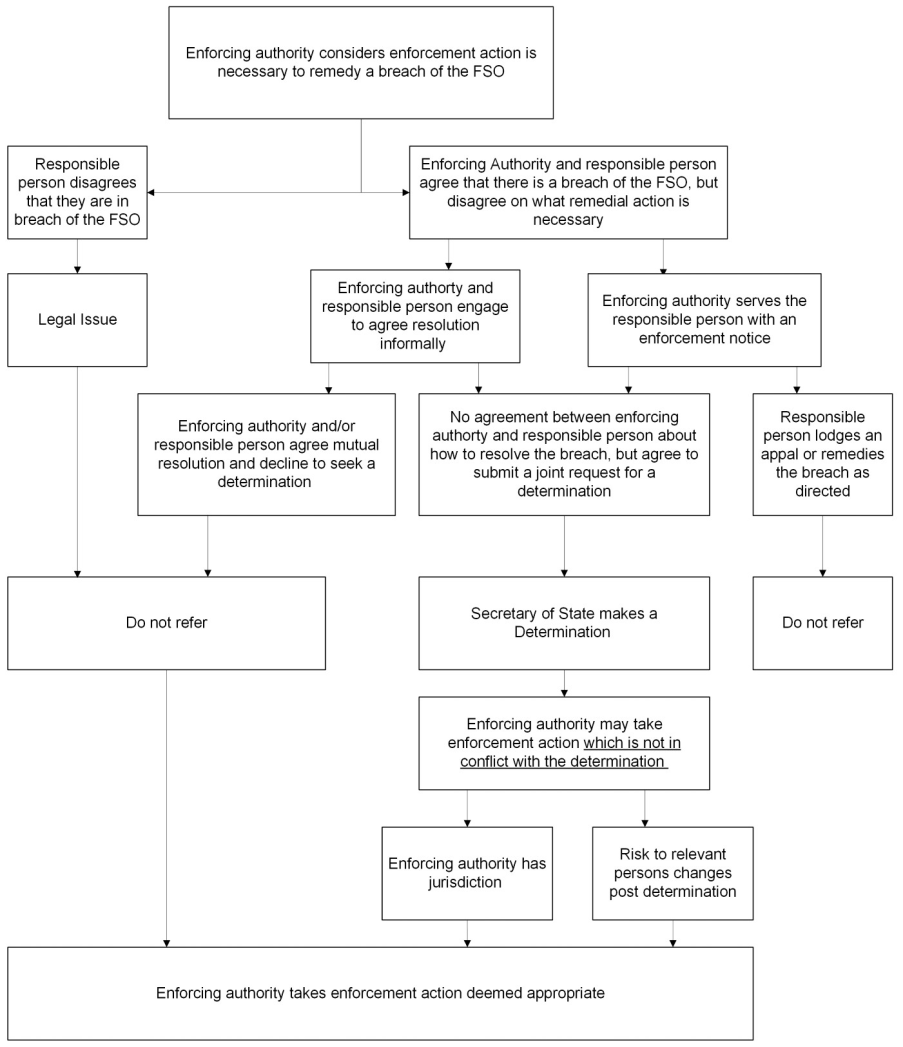
This flow diagram shows the process when the enforcing authority considers enforcement action is necessary to remedy a breach of the FSO.
Annex B: checklist to apply for a determination
Information to provide in any case:
-
names and electronic addresses of the enforcing authority and the responsible person
-
full postal address of the premises in question
-
joint statement from both parties requesting determination by the Secretary of State
-
details of any enforcement action taken, with copies of written advice or notice already issued
-
copy of any pictures taken by either party on the premises and relevant to the dispute
-
copy of the most recent fire risk assessment for the premises
-
statement setting out the relevant provision of the FSO at issue, the measures proposed by both parties to remedy the breach, and the areas of disagreement
-
copy of any other relevant correspondence
-
supporting documentation including plans, calculations and technical data
Annex C: determination process with indicative timeline
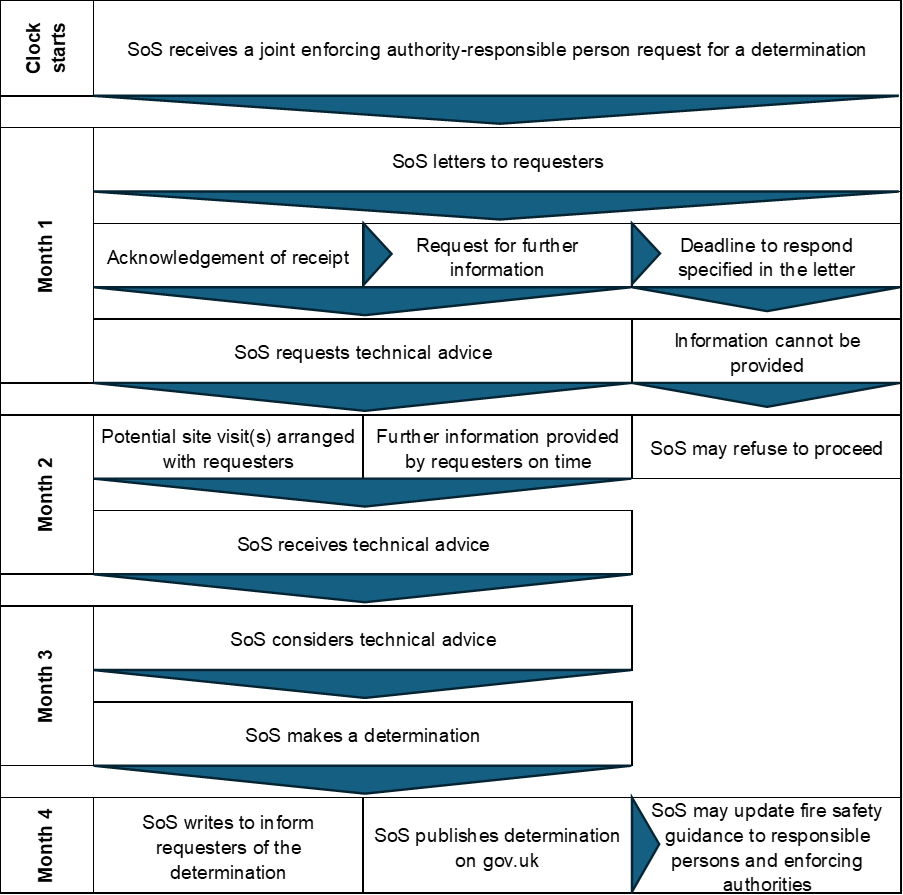
This flow diagram shows an indicative timeline of the determination process, from when the clock starts to months 1, 2, 3 and 4.