
Qualification price statistics report: 2026 (accessible)
Published 13 May 2026
Applies to England

© Crown copyright 2026
This publication is licensed under the terms of the Open Government Licence v3.0 except where otherwise stated. To view this licence, visit nationalarchives.gov.uk/doc/open-government-licence/version/3 or write to the Information Policy Team, The National Archives, Kew, London TW9 4DU, or email: psi@nationalarchives.gov.uk.
Where we have identified any third party copyright information you will need to obtain permission from the copyright holders concerned.
This publication is available at https://www.gov.uk/government/publications/qualification-price-statistics-2026/qualification-price-statistics-report-2026-accessible
Executive summary
We produce the qualification price statistics (QPS) report each year to support qualification purchasers in making informed decisions about the value for money that they get from their qualifications. The report sets out the average price and inflation rates of a range of qualification types and sectors, including GCSEs, A Levels and T Levels.
This year’s report includes the following key findings:
-
average GCSE prices were £55.80 at the start of 2026, 3.4% higher than at the same time in 2025.
-
average A Level prices were £132.97 at the start of 2026, a 3.5% rise.
-
average vocational and technical qualification (VTQ) prices were £76.44, a 4.0% rise.
-
qualification price changes over the medium and long-term remain in line with broader consumer price rises and wage increases.
We publish the QPS as part of a range of material providing insight into the functioning of the qualifications market. These include:
-
QPS interactive data visualisation: an interactive data exploration tool providing more detailed insight into pricing and market share in the GCSE, AS and A Level markets
-
QPS 2026 data tables: detailed tables setting out the findings in the report as well as statistics for several more detailed sub-sectors
-
standard qualification fee data: the data we receive from awarding organisations during our annual census of qualification fees, which underpins the QPS publication
-
the Annual qualifications market report: a report presenting the volume of qualifications, certificates and awarding organisations involved in different qualification sectors
-
the Apprenticeship end-point assessments statistical report: a report presenting volumes and outcomes for apprenticeship end-point assessments taken in England
Introduction
Ofqual is the independent regulator of qualifications in England. We regulate 255 awarding organisations and more than 10,100 active qualifications. In the 2024 to 2025 academic year, awarding organisations issued around 11.8 million certificates to students. These qualifications include vocational and technical qualifications, apprenticeship end-point assessments (EPAs), and GCSEs, AS and A Levels.
We estimate that awarding organisations earn more than £910 million each year from regulated qualifications in England, based on standard qualification fees. Our regulated qualifications also have a strong international reputation. As a result, there is a large export market, with more than 8.3 million certificates awarded to students outside the UK.
One of Ofqual’s objectives is to make sure that regulated qualifications offer value for money. While qualification fees matter, value for money is about more than price alone. It also depends on the quality of the qualifications, how reliable assessment is, and the level of confidence that learners, employers and the public can place in results.
Taken as a whole, regulated qualifications provide significant value to students, apprentices and the economy. They are trusted ways of showing what a person knows and can do, helping to turn investment in education into information that employers and education providers can use. By clearly recording skills and achievements, qualifications can reduce the need for additional tests when people apply for jobs or further study, and they support individuals to move into education or employment that matches their skills.
Decisions about value for money for individual qualifications are mainly made by schools, colleges and training providers. They choose which qualifications to offer based on the needs of their students and their local community. We support stakeholders to make informed decisions by providing clear and accessible information, including the material outlined in the executive summary.
We also monitor views on value for money through our perception surveys. These cover GCSEs, A Levels and applied general qualifications (most recently in 2024), and vocational and technical qualifications (most recently in 2025).
Methodology
Ofqual first published qualifications price statistics in 2019. In 2023, we improved the method by basing our analysis on a full set of qualification prices, rather than a sample. This means the statistics now use prices for all relevant regulated qualifications.
This release presents 2 main types of price statistics:
- year‑on‑year qualification price inflation, showing how prices have changed over time
- average qualification prices, weighted by the number of certificates awarded
The statistics are shown for different qualification sectors and sub‑sectors. The average prices are weighted using certificate volumes in order to better reflect what qualification purchasers actually paid. More popular qualifications have a greater influence on the average than less popular ones. To avoid confusion, we only publish the average price for the most recent data collection.
We collect current qualification prices for all regulated qualifications that are open to new learners in England and listed on Ofqual’s Register. Each collection happens at the start of the calendar year. For this release, we refer to the period from February 2025 to February 2026 as the reporting period. Any changes to previously published data are explained in the annex.
This release covers regulated qualifications across 3 broad groups:
- GCSEs, AS and A Levels
- Vocational and technical qualifications (VTQs)
- Apprenticeship assessment qualifications and end‑point assessments (EPAs)
VTQs include qualifications such as those used in performance tables (for example Applied Generals), Functional Skills and performing arts qualifications, among others.
EPA and apprenticeship assessment prices are weighted using apprenticeship completion data from Ofqual’s annual end‑point assessment statistics. These completion figures are not directly comparable with certificate volumes used for other qualifications and cover a different time period, from March to February. Apprenticeship assessments also differ from other qualifications in their funding arrangements and the costs that awarding organisations may charge. For these reasons, EPA price statistics should be interpreted with care, especially when comparing them with other qualification sectors.
This release includes Technical Qualifications used in T Levels for the first time. Because of how T Levels are structured, we do not hold certificate volume data that is comparable with other VTQs. As a result, price statistics for Technical Qualifications are not weighted, and care should be taken when making comparisons with other prices in this publication.
We have also updated how we weight GCSE combined science qualifications. Previously, combined science certificates were counted twice because they lead to 2 GCSEs. For this publication, we have removed this double weighting to give a more accurate picture of demand for individual qualifications. This updated approach has been applied across all statistics in this release.
Key findings
Average prices for key sectors
- GCSEs: £55.80[footnote 1]
- A Level: £132.97
- VTQ (Overall): £76.44
- Apprenticeship Assessments: £1,031.24
Inflation for key sectors
- GCSEs: 3.4%
- A Level: 3.5%
- VTQs (Overall): 4.0%
- Apprenticeship Assessments: 0.2%
Between February 2025 and February 2026 qualification price inflation for most of these categories was slightly above consumer price inflation (3.2%) and was broadly similar to wage inflation (3.5%).
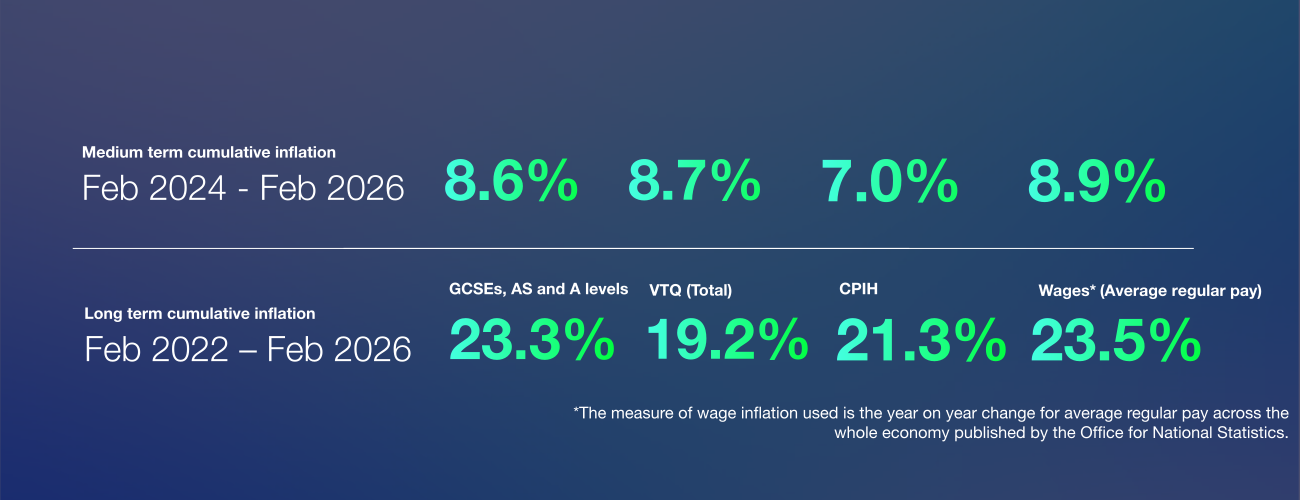
To account for the effects of longer-term macroeconomic and sectoral change, we also consider total price changes over a medium-term (2 year) and long-term (5 year) horizon in the ‘context’ section of this report. Over both horizons, qualification prices were broadly in-line with consumer price inflation and wage inflation.
Qualification prices over the reporting period
Consumer inflation as measured by the Consumer Price Index including owner-occupier’s housing costs (CPIH) is referred to in this report to help interpret the findings. Wage inflation is also provided as a comparison as a substantial proportion of awarding organisations’ costs stem from their workforce. There is not a requirement that qualification prices inflation matches consumer price inflation.
We have provided inflation figures for last year (2024-2025) where appropriate. These provide context for this year’s (2025-2026) inflation figures. The inflation figures for last year may be different to those published in the QPS 2025 report because of revisions to the fee or certificate data that we hold. The annex to this report sets out these revisions in greater detail.
Overall
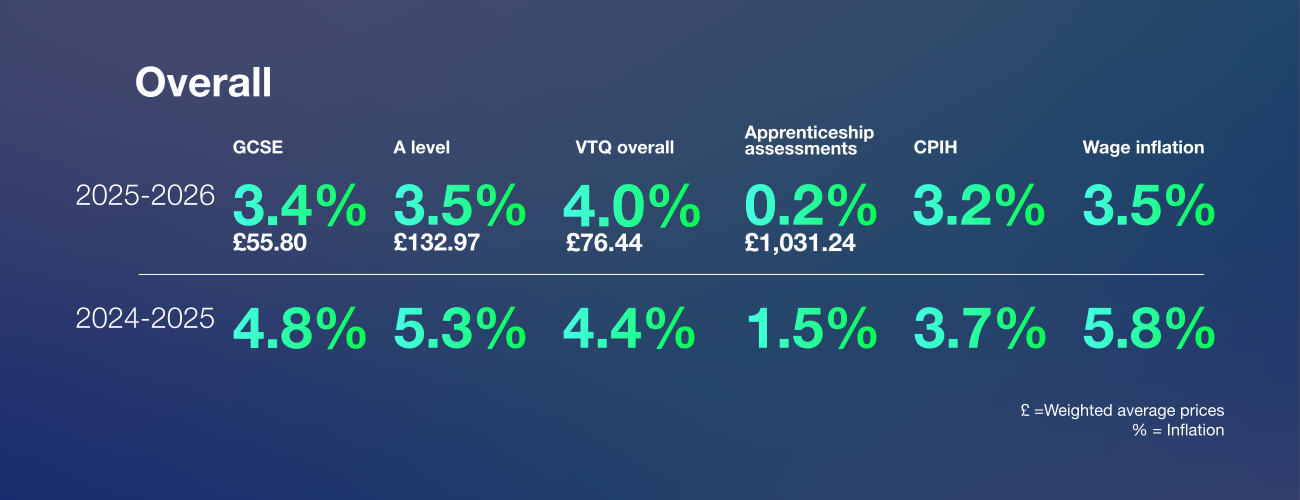
The following table shows price statistics for key qualification groups. Price inflation for all qualification groups fell from the values reported last year. This continued to bring qualification price changes for GCSEs and A Levels in line with consumer price changes and wage increases. Overall VTQ price inflation is higher than either consumer price or wage inflation.
EPA and apprenticeship assessment qualification inflation stood at 0.2%, significantly below both consumer price and wage inflation. There is a maximum level of funding available for apprenticeships and the Department for Education (DfE) expects that EPA costs should not exceed 20% of this funding. On average, EPA and apprenticeship assessment qualifications were 11.6% of their funding band maximum.
Table 1: Weighted average prices and inflation for key qualification groups
| Qualification group | Weighted average price 2026 | Inflation (2025 – 2026) | Inflation (2024-2025) |
|---|---|---|---|
| GCSE | £55.80 | 3.4% | 4.8% |
| A Level | £132.97 | 3.5% | 5.3% |
| VTQs (overall) | £76.44 | 4.0% | 4.4% |
| Apprenticeship assessment qualifications and EPAs | £1,031.24 (11.6% of funding band maximum) | 0.2% | 1.5% |
| CPIH | Not applicable | 3.2% | 3.7% |
| Wage inflation | Not applicable | 3.5% | 5.8% |
In detail: GCSE and A Level market-level trends
While the overall price statistics for GCSEs and A Levels are a helpful benchmark for understanding general price trends in those sectors, subject level information may also be useful for qualification purchasers and potential purchasers. We have published a QPS interactive data visualisation allowing users to view the past and current range of prices for each exam board in GCSE and A Level subjects markets.
As an example of the level of detail the QPS interactive data visualisation provides, we have provided the table below which shows the current and historical prices for qualifications in the A Level mathematics market.
Table 2: Standard qualification fees for A Level mathematics qualifications
| Year | Pearson (603/1333/X) | AQA (603/1164/2) | OCR B (MEI) (603/1002/9) | OCR A (603/1038/8) |
|---|---|---|---|---|
| 2024 | £146.40 | £136.50 | £147.00 | £147.00 |
| 2025 | £155.05 | £141.30 | £156.00 | £156.00 |
| 2026 | £160.80 | £145.60 | £162.00 | £162.00 |
Vocational and technical qualifications
The VTQ sector consists of more than 9,800 active qualifications covering skills relevant to the full range of economic activity. They range from short courses that can be completed in a single day through to qualifications requiring study across multiple years. We provide price statistics for VTQs by level and a focus on performance table qualifications including T Level Technical Qualifications. We recognise that within these sub-sectors there may be significant variation.
We have published additional breakdowns in the data tables accompanying this release. The additional breakdowns cover VTQs by high-level and detailed sector subject areas.
VTQs by level
Table 3: Weighted average prices and inflation for VTQs by qualification level
| Qualification level | Weighted average price 2026 | Inflation (2025-2026) | Inflation (2024-2025) |
|---|---|---|---|
| Entry Level | £44.42 | 4.3% | 4.4% |
| Level 1 | £55.34 | 5.3% | 3.6% |
| Level 1/Level 2 | £83.53 | 4.7% | 5.5% |
| Level 2 | £65.00 | 4.4% | 3.6% |
| Level 3 | £92.54 | 3.4% | 4.6% |
| Level 4+ | £272.10 | 3.3% | 4.9% |
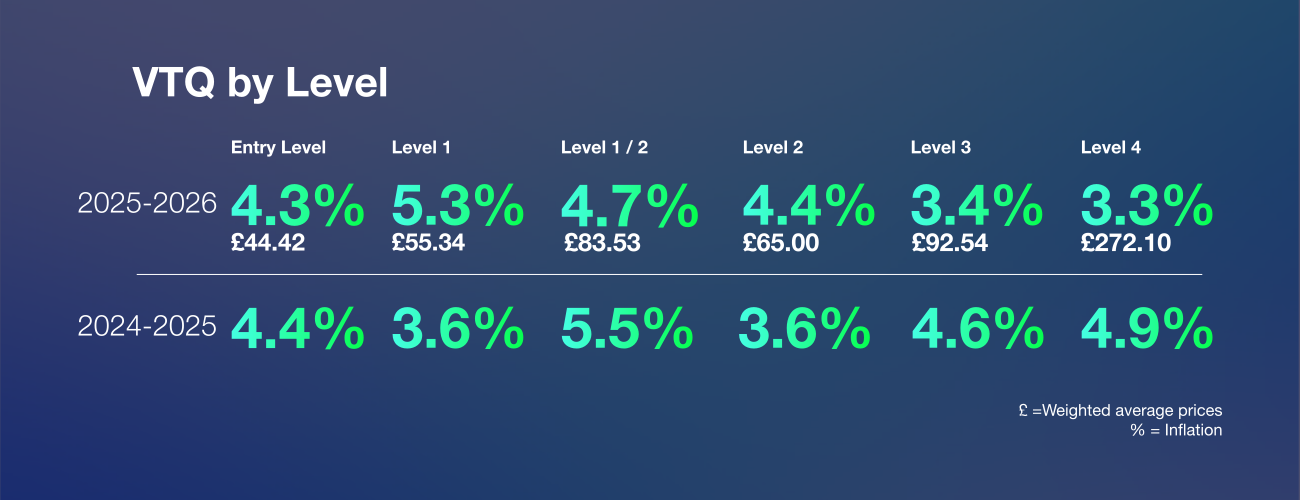
While fees generally increase with qualification level, inflation was more varied. Inflation ranged from 3.3% for Level 4+ qualifications to 5.3% for Level 1. For most qualification groupings, price increases were lower than in 2024 though Level 1 and Level 2 VTQs rose more quickly in 2025 than in the previous year.
VTQ performance table qualifications
Table 4: Weighted average prices and inflation for VTQs by performance table category
| Performance table category | Level | Weighted Average Price 2026 | Inflation (2025-2026) |
|---|---|---|---|
| Technical Award | Level 1 to Level 2 | £80.82 | 4.7% |
| Technical Certificates | Level 2 | £186.67 | 7.7% |
| Applied Generals | Level 3 | £186.12 | 3.7% |
| Tech Levels | Level 3 | £247.40 | 5.2% |
| T Level Technical Qualifications | Level 3 | £283.75 | 3.0% |
| All VTQs other than performance table qualifications | Entry to Level 8 | £69.45 | 4.0% |
This release marks the first time we have presented price statistics for VTQ qualifications included in Department for Education key stage 4 and 16 to 18 performance table lists for 2025. Tech Awards are level 1 to level 2 qualifications designed to be taken alongside GCSEs. Technical Certificates are level 2 qualifications, while applied generals and tech levels are level 3 qualifications which students may take alongside or instead of AS and A Levels. VTQ performance table qualifications are more varied in their structure and assessment methods than AS and A Levels. For example, T Levels and some tech levels generally take as much time as 3 A Levels to complete. This means care should be taken when comparing prices.
The government is reforming the post-16 qualifications landscape. As part of its reforms, it is introducing new qualification types called V Levels, Foundation Certificates, and Occupational Certificates which will start to be taught in September 2027. These will take the place of many of the VTQ performance table qualifications represented here. We discuss this further in the context section of this report.
Unlike GCSEs and A Levels, VTQ performance table qualifications of the same type can vary in size. For instance, the guided learning hours for qualifications classed as applied generals ranges from under 200 to more than 1,500. By comparison, A Level qualifications require 360 guided learning hours. Taken as a whole, the average fee for performance table qualifications varies from £80 for technical awards through to £247 for tech levels. Price rises also varied substantially by the type, with inflation ranging from 3.7% over 2025 for applied generals through to 7.7% for Technical Certificates.
T Level Technical Qualifications had an average price of £284 in the reporting period, following a 3.0% price rise. The Technical Qualification is only part of the assessment required for students to achieve a T Level with students also needing to complete an industry placement. Ofqual only regulates the Technical Qualification aspect of T Levels. Unlike other statistics in this release, these statistics are unweighted because of the way volume data for Technical Qualifications is recorded. Further information can be found in the background information to the Annual Qualification and Market Report.
Apprenticeship Assessment qualifications and end-point assessments
By apprenticeship route
Table 5: Weighted average prices and inflation for Apprenticeship Assessment qualifications and end-point assessments by apprenticeship route
| Apprenticeship route | Weighted average price 2026 | Average proportion of funding band maximum | Inflation (2025-2026) |
|---|---|---|---|
| Agriculture, environmental and animal care | £1,667.98 | 14.8% | 1.3% |
| Business and administration | £892.60 | 12.6% | 0.3% |
| Care services | £627.17 | 12.4% | 0.0% |
| Catering and hospitality | £932.06 | 15.0% | 1.4% |
| Construction and the built environment | £1,148.88 | 9.1% | 0.3% |
| Creative and design | £1,411.04 | 13.5% | -2.6% |
| Digital | £1,417.08 | 9.4% | -2.5% |
| Education and early years | £664.16 | 10.2% | 0.7% |
| Engineering and manufacturing | £1,800.40 | 10.8% | 0.4% |
| Hair and beauty | £412.83 | 5.4% | -4.2% |
| Health and science | £1,192.15 | 12.8% | 2.1% |
| Legal, finance and accounting | £886.53 | 7.5% | 1.2% |
| Protective services | £1,217.71 | 12.5% | 2.1% |
| Sales, marketing and procurement | £828.55 | 18.4% | 0.8% |
| Transport and logistics | £1,282.28 | 12.7% | -0.1% |
We are reporting price statistics for apprenticeship assessment qualifications and EPAs by apprenticeship route for the first time. Weighted average prices in the apprenticeship sector are highly varied, ranging from £413 for assessment in the hair and beauty route through to £1,800 in engineering and manufacturing. Prices and inflation rates between routes are not necessarily comparable because cost pressures vary across routes. These cost pressures include:
-
the cost of assessors – assessors may charge different amounts based on the supply of potential assessors and the wage that they could earn in their industry if they were not conducting assessments
-
the cost of equipment – assessments in certain industries could require the use of rare or very valuable equipment, which may increase the price of the assessment overall
-
the demand for assessments – less popular routes reduce the ability of awarding organisations to spread fixed costs across apprentices
Each apprenticeship standard has a maximum amount of government funding available allocated to it by the DfE. The amount of funding allocated reflects the costs of an apprenticeship in that standard. This includes some of the cost pressures outlined above. To provide context for the average prices, we have set out the proportion of the relevant funding band maximum that each qualification represents and provided an average of those proportions for each route. The average hair and beauty assessment costs 5.4% of its relevant funding band maximum, for example, while the average engineering and manufacturing assessment accounts for 10.8%.
Context
Qualification fees can be influenced by a wide variety of factors including general economic conditions and education policy. In this section we contextualise the price statistics presented above by providing a view of price changes over multiple years.
Macroeconomic context
The table and chart below show the overall price changes and plot the annual inflation rates for consumer price inflation, wage inflation and top-level General Qualification (GQ – GCSE, AS and A Level) and VTQ inflation. We have taken a long-term view by considering the overall change in prices between February 2022 and February 2026, and a medium-term view by considering the period of February 2024 to February 2026.
Table 6: Medium and long-term inflation for key qualification groupings, consumer prices and wages
| Period | GCSE, AS and A Levels (combined) | VTQ (Total) | CPIH | Wages* (average regular pay) |
|---|---|---|---|---|
| Medium-term Feb 2024 – Feb 2026 | 8.6% | 8.7% | 7.0% | 8.9% |
| Long-term Feb 2022 – Feb 2026 | 23.3% | 19.2% | 21.3% | 23.5% |
*The measure of wage inflation used is the year on year change for average regular pay across the whole economy published by the Office for National Statistics.
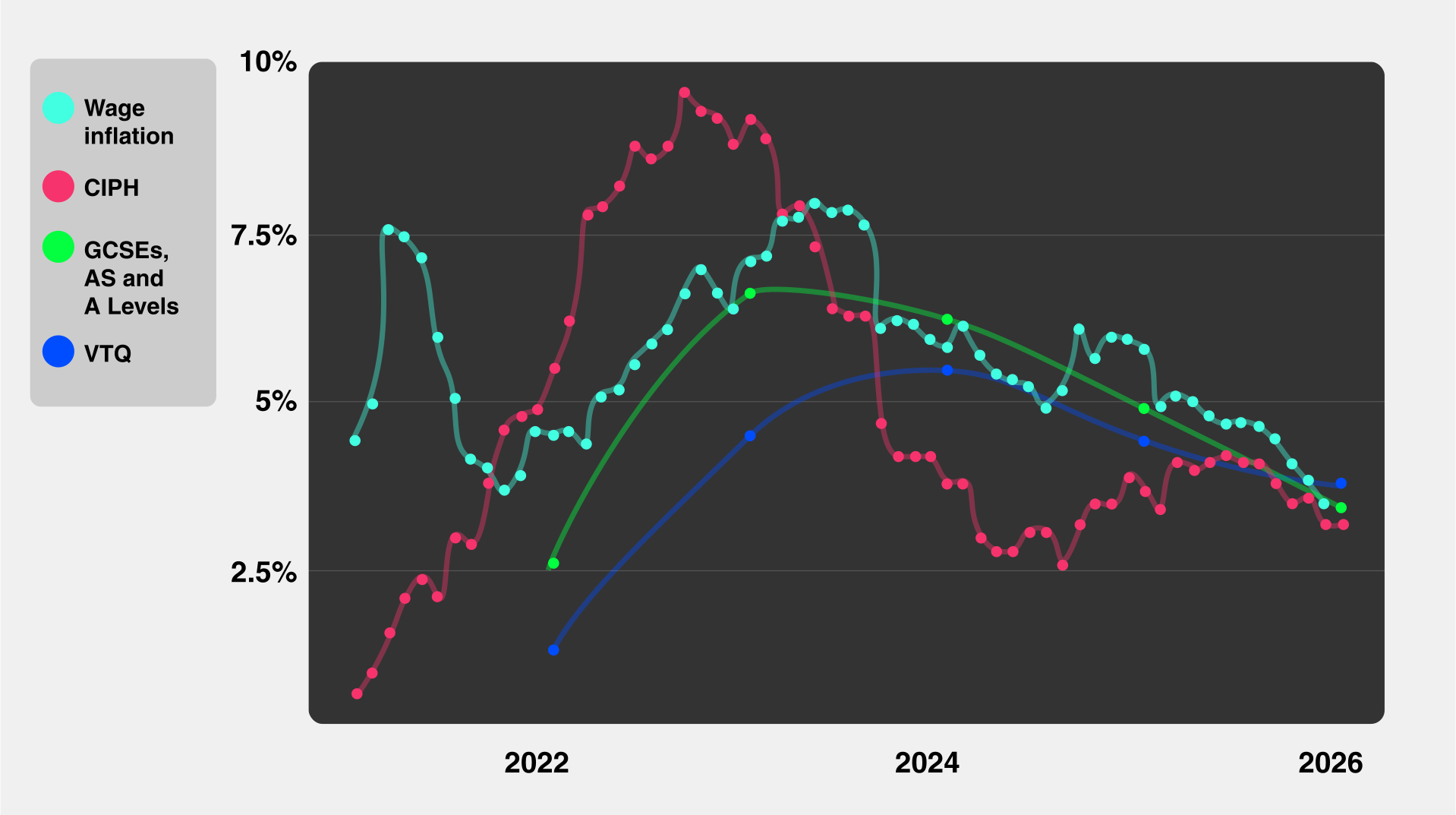
Earlier in the decade the UK economy experienced a period of instability driven by the COVID-19 pandemic and broader geopolitical events. These led CPIH inflation to rise to a peak of nearly 10% in late 2022, with the labour market response seeing average regular pay growth remaining above 5% since the middle of 2022. In response the Bank of England base rate increased from 0.1% in late 2021 through to 4.5% in February 2025. This increased the cost of borrowing and servicing some existing debt, although it has since fallen to 3.75% as of March 2026.
As the chart above shows, the ‘shape’ of qualification inflation follows CPIH inflation, offset by around one year. We are aware that staffing is a significant cost area for the sector. Awarding organisations have told us that rising wages have been a notable factor affecting price rises. This can be seen in the above graph where qualification fee inflation closely follows the pattern and magnitude of wage inflation changes. We are aware that wages are a major part of overall qualification design and delivery costs, so changes in consumer prices and wages, including those that may emerge due to the continuing instability in geopolitical events may be reflected in qualification prices as they pass through the supply chain.
Sectoral context
Alongside macroeconomic changes, other factors within the sector may also influence awarding organisations.
The regulated qualification sector is entering a major period of change. These reforms affect many qualifications and the organisations offering them. Following recommendations from the Curriculum and Assessment Review, the government has begun reshaping the qualifications system. This includes changes to the Progress 8 and Attainment 8 GCSE measures, as well as reforms to post‑16 education through the introduction of V Levels, Foundation Certificates, and Occupational Certificates. The changes to the post-16 landscape follow a prior set of reforms initiated by the previous government through the introduction of alternative academic qualifications and technical occupational qualifications. Changes are also being rolled out in how apprenticeships are assessed.
Awarding organisations affected by these reforms may need to invest in updating their current offer or launching new qualifications in the new markets. This investment may affect future prices relating to both their directly affected qualifications and their portfolio more broadly as they attempt to balance costs. Awarding organisations may also update their forecasts and commercial strategy for their current offer in light of the announced reforms.
We do not know the prices of the new qualifications. When awarding organisations confirm them, we will include an analysis of them in the QPS. We expect prices to be set at a reasonable level that allows for appropriate investment in design and delivery, while also representing value for money for qualification purchasers.
We expect awarding organisations to think long term about how they invest in their qualifications. This includes putting ongoing resources into areas like resilience, cyber security and wider systems that help keep qualifications safe and reliable, now and in the future. These measures can be expensive, but they are necessary to protect learners and maintain trust in the qualifications system.
We also expect awarding organisations to look for new and better ways of working. The current reforms create an opportunity to explore innovative approaches that improve how qualifications are designed, developed, delivered, and enhance their overall quality. In line with our responsibility under the Growth Duty, we aim to support innovation that will lead to sustainable benefit for students, apprentices, centres and society. For example, we operate an innovation service where awarding organisations can test proposals against our regulatory framework.
Annex: Revisions
There are revisions to the inflation rates published in the Qualification Price Statistics 2025 report. These are due to two reasons: some awarding organisations provided corrected fee data following the publication of the 2025 document, and the methodological change to the weighting of combined science GCSE, discussed in the methodology section of this report.
The cumulative effect of these revisions is generally relatively minor to the high-level statistics, although there are notable changes to several more granular qualification groupings. The largest revision is to the education and training inflation rate, which has been revised up to 7.9% from 4.3%. This is a low-volume sector with relatively few qualifications, making it particularly sensitive to revisions from several subjects.
Table 7: Revisions to inflation rates published in the QPS 2025
| Qualification | Inflation over 2024 (published) | Inflation over 2024 (revised) |
|---|---|---|
| GQ (overall) | 4.8% | 4.9% |
| VTQ (overall) | 4.1% | 4.4% |
| EPA (overall) | 1.8% | 1.5% |
| GCSE | 4.7% | 4.8% |
| AS level | 5.7% | 5.7% |
| A Level | 5.3% | 5.3% |
| VTQ – agriculture, horticulture and animal care | 5.9% | 5.9% |
| VTQ – arts, media and publishing | 5.3% | 5.2% |
| VTQ – business, administration and law | 3.0% | 3.5% |
| VTQ – construction, planning and the built environment | 4.8% | 5.3% |
| VTQ – education and training | 4.3% | 7.9% |
| VTQ – engineering and manufacturing technologies | 4.8% | 6.1% |
| VTQ – health, public service and care | 4.0% | 3.9% |
| VTQ – digital technology | 4.7% | 4.7% |
| VTQ – languages and academic subjects | 2.7% | 2.8% |
| VTQ – leisure, travel and tourism | 4.2% | 3.6% |
| VTQ – preparation for life and work | 3.2% | 4.0% |
| VTQ – retail and commercial enterprise | 5.6% | 5.6% |
| VTQ – entry level | 3.9% | 4.5% |
| VTQ – level 1 | 3.6% | 3.6% |
| VTQ – level 1/level 2 | 5.5% | 5.6% |
| VTQ – level 2 | 3.6% | 3.7% |
| VTQ – level 3 | 4.5% | 4.6% |
| VTQ – level 4+ | 3.3% | 4.9% |
-
The updated approach to weighting combined science certificates has had a downward impact on the average GCSE price statistic, so care should be taken comparing this to previous publications. An updated figure for 2025 is presented in the annex. ↩