Insourcing and the Public Interest Test - Guidance Note (HTML)
Published 17 June 2026

© Crown copyright 2026
This publication is licensed under the terms of the Open Government Licence v3.0 except where otherwise stated. To view this licence, visit nationalarchives.gov.uk/doc/open-government-licence/version/3 or write to the Information Policy Team, The National Archives, Kew, London TW9 4DU, or email: psi@nationalarchives.gov.uk.
Where we have identified any third party copyright information you will need to obtain permission from the copyright holders concerned.
This publication is available at https://www.gov.uk/government/publications/ppn-024-the-public-interest-test-and-insourcing-strategy/insourcing-and-the-public-interest-test-guidance-note-html
1. Delivering Public Value Through Insourcing
Background
Sourcing decisions can critically impact the quality of public services and the successful delivery of government objectives. Insourcing can be a crucial mechanism for enhancing value, control and resilience.
This policy provides the framework for conducting a Public Interest Test and developing a contracting authority’s Insourcing Strategy. Enabling decision-makers to look beyond short-term pricing, to holistically assess long-term value for money, service quality, and broader economic and social goals when making sourcing decisions.
Historically, sourcing decisions have been made on a contract-by-contract basis. However, effective sourcing of public services requires contracting authorities to take a longer-term approach and build the necessary capability and capacity to consider delivering the service directly. Therefore, central government departments with £100 million (including VAT) or more of spend per year on contracts should develop Insourcing Strategies.
By establishing a formal framework through five-year Insourcing Strategies, Government can identify these opportunities early in the project lifecycle. This forward-looking planning provides the essential lead time required to build internal skills and operational readiness, supporting a shift to a more interventionist, market-shaping approach in central government procurement.
A Public Interest Test can:
- Enable contracting authorities to critically review the delivery of a service overall;
- Support contracting authorities to make evidence-based sourcing decisions;
- Inform elements of a contracting authority’s commercial strategy; and
- Help identify opportunities to deliver value for money (including wider economic and social impacts) through alternative delivery approaches.
1.2. Benefits of insourcing
Choosing to deliver services in-house is a decision rooted in the fundamental benefits that direct public provision can provide. It is an opportunity to ensure that public resources are maximised for public benefit. In the right circumstances, insourcing serves as a catalyst for:
- Ensuring public accountability and agility: Direct delivery provides full oversight of service delivery. This allows public bodies to respond rapidly to changing policy priorities, national emergencies, and the evolving needs of service users, without the potential delays and friction often associated with commercial contract variations.
- Long-term value for money: An in-house model can realise structural efficiencies over time by removing supplier profit margins, risk premiums, and contract administration; as well as effectively utilising internal resources such as existing teams or expertise. Insourcing can secure greater overall value where the anticipated benefits of market efficiencies – such as economies of scale or pooled expertise – fail to materialise in practice, or are outweighed by the costs of contracting.
- Increasing public sector capacity and expertise: Insourcing can increase service quality, efficiency and productivity by retaining or building core technical expertise in-house. Secure employment in the public sector can lead to higher workforce morale and reduced staff turnover, creating a stable, experienced team that builds long-term organisational resilience and mitigates external market reliance.
- High-quality jobs and stimulating local economies: Insourcing can drive growth through delivery of good jobs in the UK. Public sector employment can raise labour standards, expand apprenticeship programmes, and deliver targeted social value outcomes that external markets cannot always reliably replicate.
1.3. A holistic approach to value for money
A reliance on narrow, short-term operational priorities often obscures the true cost of service delivery, including long-term service stability, operational resilience and the impact on local communities. Encouraging a focus on price alone can create false economies and unhealthy markets, often leading to unsustainable delivery models. This reduces the overall value for money that the public sector can derive from its services and can result in significant performance issues or contract failures over time.
When assessing value for money, practitioners should consider a broad range of factors beyond upfront costs. A robust assessment considers whole-life costs[footnote 1], local investment, and organisational resilience as core components of the appraisal. By understanding the long-term benefits of a stable, in-house workforce and the impact of direct public investment, practitioners can ensure that delivery decisions reflect the true value provided to the public.
2. Context
2.1. Overview
The Public Interest Test (‘the Test’) is an early-stage assessment to identify whether a service might be better delivered in-house. The Test is made up of two parts: Part One considers whether a service is a good candidate for insourcing, and Part Two considers a contracting authority’s readiness to insource the service. For the purposes of this guidance, ‘insourcing’ or ‘delivered in-house’ refers to the provision of a service under the direct operation and control of the organisation, often characterised by a direct employment relationship between the organisation and the staff delivering the service.
The Test should be conducted in advance of any planned procurement, typically at the Strategic Outline Case (SOC) stage or equivalent. It is intended to be a quick exercise and is expected to take, for all but the most complex requirements, at most two days to complete. For the majority of contracts this should be through a straightforward desk-based assessment, or for the most complex requirements (e.g., gold-tier contracts[footnote 2]) a workshop of subject matter experts.
The Test is not a substitute for the Delivery Model Assessment[footnote 3] (DMA) or any other equivalent investment appraisal requiring an in-depth analysis of sourcing options. It is intended to support contracting authorities in identifying early opportunities for insourcing, providing sufficient time to plan for the development of any necessary internal capability. The conclusion of the Test should be subject to undertaking further analysis (such as a full DMA) which will determine the final recommended delivery model.
The Insourcing Strategy acts as a contracting authority’s medium-term roadmap for capability building and is designed to complement the Test. While the Test evaluates individual services on a case-by-case basis, the Insourcing Strategy takes a longer-term view of service delivery. It outlines exactly how the contracting authority will develop the internal skills, capacity, and competencies required to make insourcing a practical reality over time. For more detail on the Insourcing Strategy, see section 3.
2.2. Application and scope
All central government departments, their executive agencies and non-departmental public bodies (excluding NHS trusts and foundation trusts) are expected to follow and apply this guidance. All other contracting authorities (including NHS trusts and foundation trusts) should consider this guidance as good practice when planning projects and services.
This guidance does not apply to devolved Welsh authorities, transferred Northern Ireland authorities, private utilities or, for the avoidance of doubt, devolved Scottish authorities, as defined in the Act.
The Test applies to any planned project or service, including re-procurements, which could potentially result in the award of a public contract (as defined in the Act) for services valued at more than £1 million (including VAT)[footnote 4], subject to the exemptions set out at section 4.2. Contracting authorities may, at their discretion, apply these principles to contracts below the threshold, to goods or works contracts where appropriate and to call-off contracts from a framework established under previous regulations.
For the purposes of this guidance, a service contract refers to any public contract (as defined by Section 3 of the Procurement Act 2023) whose primary object is the provision of services delivered within the UK.
Where it is clear from the outset that a project will only involve the award or establishment of a Framework Agreement or Dynamic Market and no other public contract, a Public Interest Test is not required as there is no committed spend or specific service defined. Instead, the Test should be applied prior to the award of any specific call-off contract under such arrangements, where the estimated value of that individual call-off exceeds the £1 million (including VAT) threshold.
Central government departments with an annual contract spend of £100 million (including VAT) or more should also produce a five-year Insourcing Strategy.
2.3. Contacts
For further information or to provide feedback on the Public Interest Test guidance note, please contact the Markets, Sourcing and Suppliers team at markets-sourcing-suppliers@gca.gov.uk.
3. Insourcing Strategy
3.1. Overview
Successful insourcing requires rebuilding the capability and capacity necessary for the direct delivery of public services. To facilitate this, contracting authorities with an annual contract spend of £100 million (including VAT) or more should develop an Insourcing Strategy. This establishes a formal framework to identify service categories that align with the contracting authority’s delivery objectives, ensuring insourcing opportunities are captured early in the project lifecycle.
The Insourcing Strategy is designed to produce a medium-term outlook of the contracting authority’s activities and deliverables. The Insourcing Strategy should cover a minimum of five years.
Contracting authorities should treat the Insourcing Strategy as a living document, refining it iteratively to reflect evolving requirements. A comprehensive, ‘bottom-up’ review should be undertaken at least every five years to ensure the strategy remains current, or sooner if triggered by significant organisational or situational changes.
3.2. Contents of the Insourcing Strategy
A contracting authority’s Insourcing Strategy should articulate the following key elements:
Service profiling and operational requirements: The contracting authority should provide a high-level overview of the services the contracting authority delivers, including enabling services. This section focuses on the internal operational needs of the contracting authority, identifying key service delivery themes and evaluating their specific requirements to understand where direct, in-house control is most appropriate.
Key considerations include:
- Operational control: Where the contracting authority requires high transparency, granular data access, or direct control over delivery standards; insourcing may offer greater oversight than an arms-length contractual relationship.
- Resilience requirements: For critical, uninterruptible services, the contracting authority should assess whether reliance on the external market introduces unacceptable risks of supplier failure or supply chain disruption.
- Flexibility: If a service operates in a volatile environment or requires frequent, unpredictable changes, in-house delivery may provide greater ability to respond and redeploy resource quickly.
Identification of insourcing potential: Building on the internal service profile, the contracting authority should evaluate the external and structural characteristics across its deliverables that indicate a strong potential for insourcing. These criteria focus on the nature of the service and market dynamics, serving as a baseline for the development of a target delivery model.
Services with high insourcing potential typically exhibit a number of the following characteristics:
- High complexity or uncertainty: Services where requirements are difficult to specify in advance, or where volumes and scope fluctuate significantly. Insourcing these services avoids the high costs associated with frequent contract changes and risk premiums from suppliers.
- Prescribed delivery models: Services where highly prescriptive, input-based requirements restrict a supplier’s ability to add value or innovate. Where this prevents the supplier from exercising genuine autonomy, insourcing may be more cost effective by eliminating a profit margin that yields little benefit.
- Government-created markets: Requirements that are uniquely governmental are often inherently difficult for the private sector to cost or manage effectively. These services often lack a broader commercial marketplace, making it challenging for bidders to price risk without excessive premiums. This is frequently compounded by incumbency advantage, where the specialised nature of the service makes competitive re-procurement less viable over time.
- Evidence of market failure: Service categories operating in a market characterised by monopoly, oligopoly, or unusually high barriers to entry. Where a lack of genuine market competition consistently erodes value for money or concentrates delivery risk among a limited number of suppliers, insourcing can provide a mechanism to secure long-term public value.
- Evidence of prior poor performance: Service categories where performance has historically failed to meet expectations. Insourcing these services, where root cause analysis finds the delivery model to be the issue, can enable direct control to remediate quality issues.
- Evidence of poor value for money: Service categories that have been shown to generate excessive profits for suppliers, without evidence of superior cost efficiency or better outcomes. Where contract-specific root cause analysis confirms that these costs are driven by structural failures in the delivery model, moving to in-house delivery can reduce expenditure by eliminating the profit element, provided the contracting authority can maintain a comparable cost base.
- Evidence of improved quality and wider government objectives: Service categories where evidence indicates that direct provision would achieve a higher quality of service and better support wider government objectives. Where this evidence exists – whether internally generated or based on similar services – insourcing provides the direct control needed to secure these outcomes and deliver on those broader priorities.
Required competencies and capacity building: The contracting authority should map the specific competencies required to insource services, spanning key factors such as skills, technology, and infrastructure. Where gaps are identified, the strategy should assess the feasibility and suitability of developing these capabilities in-house to enable direct delivery.
Key considerations include:
- Technical leadership: Does the contracting authority possess the senior operational leadership required to run these services? If not, is it a viable option to recruit and retain leadership?
- Assets and infrastructure: Does the contracting authority currently own, or could it acquire, the physical and digital assets needed to operate these service lines?
Target delivery model: Based on the deliverables and competency map, the contracting authority should identify service types where insourcing could potentially drive better outcomes, such as improved quality, flexibility, or cost efficiency. This assessment should be holistic, evaluating potential economies of scale or synergies from insourcing multiple service lines. The strategy should clearly set out a vision for which service types are targeted for in-house delivery versus those likely to remain outsourced.
Key considerations include:
- Market strategy: Based on the assessment of market health, what is the contracting authority’s strategy to shape the market? For example, will insourcing certain core functions allow the contracting authority to stimulate competition for remaining sub-contracts?
- Synergies: Are there opportunities to combine fragmented contracts into a single in-house workforce to reduce management overheads and enhance coordination?
Implementation challenges and mitigations: The strategy should proactively identify barriers to delivery, such as resource constraints or the need for significant capability building, alongside a clear plan for mitigation.
Key considerations include:
- Upfront investment: Does the contracting authority have access to the necessary capital and revenue budget to fund the transition and ongoing operation of the strategy?
- Capability building: Will the contracting authority be able to build the necessary organisational structure and develop or obtain the capability to deliver its strategy in the required timeframe?
- Exit feasibility and transition: Do existing contractual terms, such as long-term expiry dates, exit fees, or intellectual property ownership, create structural barriers to the new strategy? Can existing commercial arrangements be exited without incurring prohibitive costs (e.g., funding a period of ‘dual running’) or unacceptable risks.
3.3. Resourcing and governance
The development of an Insourcing Strategy should be a cross-functional effort, ensuring that commercial decisions are fully aligned with operational and financial realities. Contracting authorities should engage a multi-disciplinary team comprising commercial, finance, policy and operational delivery professionals. Contracting authorities should also take a consultative approach and engage with trade unions, the wider workforce and service end-users to inform their approach.
The successful execution of Insourcing Strategies requires senior leaders to set the direction of the contracting authority and drive implementation. To ensure appropriate governance and secure the commitment required for successful delivery, the final strategy should be formally approved by the contracting authority’s senior leadership, including relevant ministers.
3.4. Publication of the Insourcing Strategy
To ensure transparency and provide the market with clear visibility of future requirements, contracting authorities should publish their Insourcing Strategies on their own GOV.UK pages or official websites.
4. What is the Public Interest Test
4.1. Overview
The Test is an initial evaluation of a service to identify whether it has potential to be better delivered in-house. The Test should be applied to services that are currently delivered by third parties (‘outsourced services’), to new services, or where significant changes are planned to a service that is currently delivered in-house.
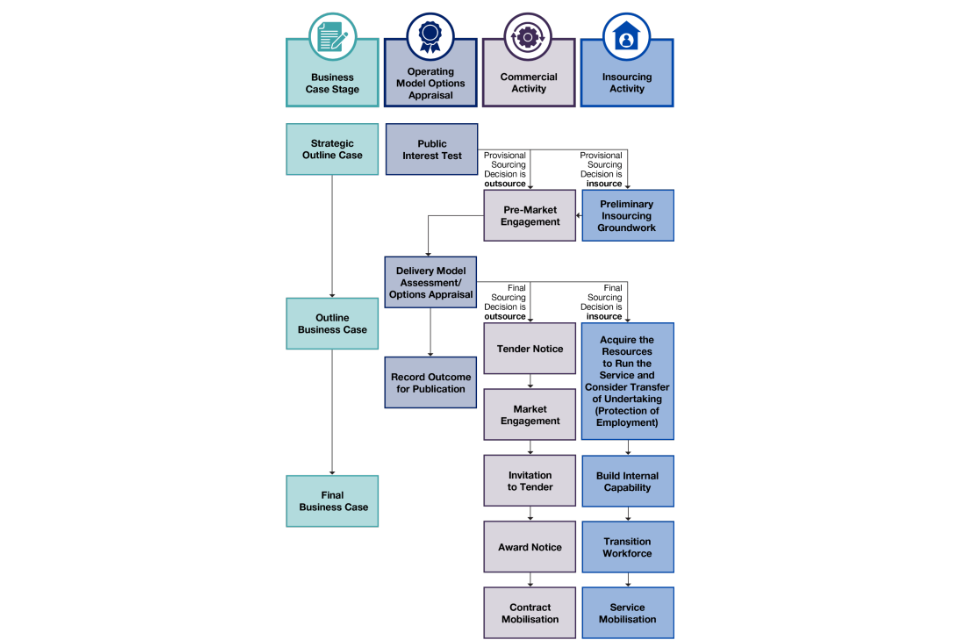
The Test is intended to sit within and alongside existing commercial and approvals processes, typically taking place at the SOC (or equivalent) stage, see Figure 1 for an overview of how the Test aligns with various commercial and business case stages.
Conducting the Test early in the project life cycle allows contracting authorities sufficient time to conduct more detailed analysis of the feasibility and success criteria and, should it be required, to invest in and develop the necessary internal capabilities and resourcing to deliver a service in-house.
The Test is intended to be a quick exercise and is expected to take, for all but the most complex requirements, at most two days to complete. For the majority of contracts this should be through a straightforward desk-based assessment, or for the most complex requirements a workshop of subject matter experts. It will generally be led by the programme team, with support from commercial and other functions depending on the requirement and complexity.
The outcome of the Test is a ‘Provisional Sourcing Decision’. This decision serves as an indication of strategic direction, ensuring that where insourcing is identified as potentially delivering benefits, it is carried forward as a shortlisted option for rigorous testing. This decision allows the contracting authority to begin proportionate, exploratory groundwork for insourcing while the DMA or equivalent investment appraisal will undertake a full disaggregation of the service to provide a final recommendation of the preferred delivery model.
As the Provisional Sourcing Decision serves as the expected starting point for further analysis rather than a final delivery model selection, the decision may be overturned if subsequent detailed analysis, such as that conducted within a DMA, demonstrates it is unfeasible or fails to deliver value for money.
The Test consists of a series of questions, which are set out in Chapter 6. These have been designed to support contracting authorities to come to a Provisional Sourcing Decision which maximises value for money, high quality services and wider social and economic value. In applying the Test, contracting authorities should carefully consider both the characteristics of a service, and their organisational capability and capacity to deliver the service in-house, in order to identify if the service may be better delivered in-house.
When conducting the Test, contracting authorities are encouraged to apply realistic but constructive assumptions. While the assessment must be evidence-based, it should avoid undue emphasis on risks or barriers to insourcing. As the Provisional Sourcing Decision is subject to further validation, any significant downside risks or delivery constraints will be rigorously tested and either mitigated or the Provisional Sourcing Decision overturned during the subsequent DMA or business case stages.
4.2. When is a Public Interest Test required?
The Test should be conducted in advance of any planned project, which may potentially result in the award of a public contract[footnote 5] (including re-procurements) for a service with an estimated value of more than £1 million (including VAT), using the estimating methodology set out in the Act, with the following exceptions:
- Direct award contracts made under Section 41 of the Act (which permits direct awards for special cases including extreme urgency, prototypes, exclusive rights, repeat requirements, commodities, insolvency, and user choice contracts), with the exception of the justification laid out in paragraph 6 of Schedule 5 (absence of competition for technical reasons);
- Direct award contracts made under Section 42 of the Act (which permits direct awards necessary to protect life or public safety);
- Exempted contracts under Schedule 2 of the Act;
- Defence and Security contracts (as defined by the Act) for services related to Defence and Security goods where those services are delivered by the original equipment manufacturer;
- Service contracts whose primary object is the provision of services delivered outside of the UK;
- Contracts for regulated health procurement exempted under Regulation 43 of the Procurement Regulations 2024 (which excludes health services defined in Section 120(2) of the Act from the standard procurement regime);
- Where the contract is for policy or programme evaluation, research more generally, or technical data/analysis development and the work will be: once-off or highly infrequent (thus making it unviable to build the requisite specialist technical expertise or recruit permanent in-house staff); where external sourcing from academia, civil society or the private sector (i.e. a non-government perspective) is important for the perceived and actual independence, credibility, trustworthiness and transparency of the work; or where delivery requires access to established fieldwork infrastructure, including large, scalable interviewer networks to undertake national surveys at pace and to the required standard;
- Where the specific, individual service requirement has already been explicitly appraised within the Insourcing Strategy, provided that the depth of analysis is similar in rigour to the requirements of the Test; and
- Procurements solely to establish a framework or set up a dynamic market; or
- If after conducting a Public Interest Test, the final sourcing decision was to establish a framework or dynamic market, subsequent call-off contracts will not require further Tests, provided the call-off is for the same service.
The Test should be initiated as soon as a service requirement is identified, prior to any formal stages of the procurement process. It serves as a prerequisite to more formal planning, with the resultant Provisional Sourcing Decision acting as a foundation for future analysis.
In all instances, the Provisional Sourcing Decision should be established before either the DMA or Outline Business Case (OBC) stage (or equivalent) begins.
Figure 1: Integration of the Public Interest Test within the Commercial Lifecycle
4.3. Proportionate cross-functional engagement
The Test is typically owned by the requirement owner. The assessment is designed to be proportionate, meaning the extent of cross-functional engagement should scale directly with the criticality, value, and risk profile of the service.
For the vast majority of lower-complexity requirements, the Test should be a streamlined, desk-based collaboration primarily conducted between the requirement owner and a commercial practitioner, with other functions only being involved if the contracting authority deems it necessary at this stage for the particular requirement.
As the complexity or operational risk of a service increases contracting authorities should consider greater participation of cross-functional expertise. While effective delivery ultimately depends on utilising the right skills, wider functional experts may only be required where there is a material impact on their specific area of expertise.
Table 1 provides a guide to functions that may, where appropriate, support the Test. These are mapped against their role and key responsibilities. Roles are defined using OKUD, which stands for:
- Ownership: Individuals within the function lead the activity and have overall responsibility for it.
- Knowledge: Individuals within the function are the subject matter experts on at least one element of the activity.
- Understanding: Individuals within the function understand what the activity is and what good looks like.
- Discretionary: Individuals within the function are engaged on an ad-hoc basis, only when their technical expertise is required to evaluate an aspect of the service.
Table 1: Public Interest Test Functional Responsibilities
| Function | Roles | Responsibilities |
|---|---|---|
| Requirement owner or programme (including project delivery, digital, property, HR) | O | Requirement owners or programme teams will typically hold ownership of the Test. They are responsible for driving the process, incorporating the assessment into the overarching project plan, and coordinating cross-functional activity to ensure deadlines are met. Beyond process management, these teams provide the core operational knowledge and practical understanding of how the service must be delivered day-to-day. As part of this, specific operational disciplines will supply the critical subject-matter expertise needed to assess the contracting authority’s internal capability. For example, HR teams can advise on the implications of the Transfer of Undertakings (Protection of Employment) (TUPE) Regulations, workforce planning, and productivity drivers, while property can assess location strategies and estate capacity. |
| Commercial | K | Commercial teams are likely to support the Test by providing procurement expertise and knowledge of existing contract performance and provisions. |
| Policy | U | Policy teams may be involved to define the core strategic objectives and wider government outcomes associated with the requirement. |
| Finance | U | Finance teams may be engaged during the Test to support the development of high-level costings and confirm budget availability. |
| Legal | D | Legal teams should be consulted where specific regulatory or contractual risks are identified. |
| Other functions (including audit, communications, security, etc.) | D | Other functions should be consulted where the individual service requires specific knowledge or functional expertise. |
4.4. The role of external stakeholders
When conducting the Test, contracting authorities should undertake external engagement proportionate to the value, complexity, type and risk profile of the specific service being assessed.
Targeted engagement with key stakeholders can yield important insights about the service, providing an efficient way to gather evidence that might otherwise be time-consuming and resource-intensive for the contracting authority to establish internally. Table 2 details external stakeholders and how they can contribute to the Test.
Table 2: How external stakeholders can support the Public Interest Test
| Stakeholder | Contribution |
|---|---|
| Trade unions and workforce representatives | Trade unions are likely to support the Test by providing frontline operational insights and evidence regarding historical employment practices, workforce resilience, and the potential social value impacts of direct delivery. |
| The supply market | The market can support the Test by providing intelligence on market health, competitive appetite, and commercial viability, helping to identify signs of market failure, monopolies, or excessive risk premiums. |
| Other public sector bodies | Public bodies delivering similar services can provide benchmarking data and practical ‘lessons learned’ from insourcing, helping to validate the feasibility, timelines, and cost baselines for in-house delivery. |
4.5. Benefits of conducting a Public Interest Test
Sourcing decisions represent a critical strategic lever for determining the quality of public services and the successful delivery of the Government’s objectives. The Test serves as an evidence-based framework to appraise service delivery models and provides an early indication of where insourcing may be the most effective route. By conducting this assessment, contracting authorities ensure they maximise value for money (including wider economic and social impacts), accounting for whole-life costs, organisational resilience, and the long-term impact on the public.
The findings of the Test can help contracting authorities identify where a service might be better suited to being delivered in-house, the benefits this might drive and the issues that may need to be addressed in order to deliver this.
This can be used to shape a contracting authority’s Insourcing Strategy by, for example, identifying technical capabilities that may need to be developed or investments that may be required to provide a service in-house.
5. Before You Start the Public Interest Test
5.1. Overview
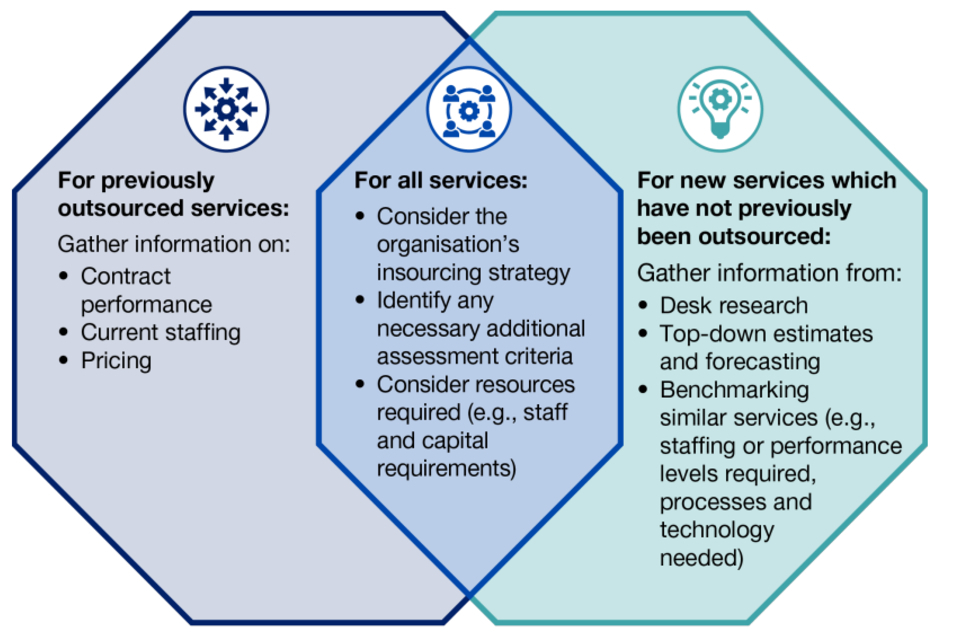
In preparation for the Test, contracting authorities should assemble a high-level information pack. The focus should be on leveraging existing data and knowledge to evaluate the service efficiently. At this stage, high-level estimates are sufficient; the objective is to inform a strategic direction, not to produce final technical specifications or exhaustive financial models.
5.2. Required information
The information gathered for the Test should reflect the early stage at which it is conducted and consist of high-level estimates. The evidence and data used to inform the Public Interest Test should be strictly proportionate to the value and complexity of the service. For standard or lower-value requirements, contracting authorities should rely on existing internal data, historic contract performance metrics, and high-level market knowledge.
While the categories in this section provide a framework for assessment, the level of detail required will vary; for lower-complexity needs, it may not be necessary or proportionate to address every category listed below.
Service requirements: A high-level definition of the core need, objectives, timescales, and critical outcomes. For existing services, the current specification may be used, provided the outcomes are clearly defined and align with future service requirements. For new services, and where the current specification lacks clear outcomes or is no longer suitable, a ‘vision statement’ or list of required outputs is sufficient. A full technical specification is not required for the Test.
Performance data: A baseline of service performance. For existing services, use a summary of recent KPI trends, significant issues, or end-user feedback. For new services, utilise high-level benchmarking or analogous services from other government contracts to establish expected levels of performance.
Market health: A brief assessment of market health and capability[footnote 6]. Consider whether a competitive market exists, the potential for small and medium-sized enterprise (SME) and voluntary, community and social enterprise (VCSE) participation, and whether the service is uniquely governmental. This should be a desk-based review of existing market intelligence rather than a new market engagement exercise.
Staffing information: An indicative profile of headcount and core capability requirements. For outsourced services, use information from the incumbent or original bid. If unavailable, a ‘bottom-up’ estimate of the core team required to run the service is sufficient. High-level TUPE or pension consideration for labour-intensive, complex services is sufficient for the Test.
Cost estimate: A ‘top-down’ cost model to understand the scale of expenditure. For existing services, use current contract costs adjusted for inflation and any known cost driver changes. For new services, use market benchmarks to establish an indicative baseline. A full Should Cost Model[footnote 7] (SCM) is not required; this will be developed during the DMA.
Risk management: An identification of the major risks associated with service delivery and an initial view on where that risk sits[footnote 8] (the contracting authority, supplier or shared). Use existing project risk registers as a baseline where available to avoid duplication of effort.
Strategic alignment: A review of the contracting authority’s overarching direction. If a formal Insourcing Strategy is in place, this should be the primary reference. In its absence, the team should identify broader policy goals and the defined service objectives and outcomes. Contracting authorities should also consider wider Government aims, objectives and strategies, including the Government Commercial Function Strategy.
Figure 2: Information Required for the Public Interest Test
6. The Public Interest Test: Assessment Criteria
6.1. Overview
The Test requires contracting authorities to consider a core set of questions to arrive at a Provisional Sourcing Decision. The Test should be conducted in two sequential parts.
The criteria detailed in Part One and Part Two of this chapter serve as the framework for the Test. Contracting authorities should record their responses to these statements, along with any supporting evidence gathered as part of the assessment.
The Test is not required to be a binary decision. While typically applied to a service as a whole, evaluating a large, multi-faceted project as a single entity can distort the assessment. Instead, it can be beneficial to identify the potential for a ‘mixed economy’ model, where certain elements are delivered in-house.
Where a project breaks down into obvious, distinct service lines (for example, a digital project naturally separating into system development and ongoing IT helpdesk support), contracting authorities may consider testing these separately, resulting in a distinct Provisional Sourcing Decision for each. However, teams should avoid granular service disaggregation at this stage. If identifying distinct services requires analysis, then contracting authorities should conduct a single assessment for the overall requirement. In-depth consideration of service components is a function of the subsequent DMA or business case and therefore out of the scope of this initial assessment.
6.2. Part One: Characteristics of the Service
Part One of the Test focuses on the characteristics of the service and whether it would be a good candidate for insourcing. The considerations are broken down into three categories: Value for Money and Strategic Alignment; Social Value; and Economic Growth and Market Impact.
The contracting authority should identify if the following indicators that a service is a good candidate for insourcing are present:
1. Value for Money and Strategic Alignment
a. There is a strategic need for the contracting authority to retain direct control of the service, in line with the contracting authority’s Insourcing Strategy;
b. There is a reasonable expectation that in-house delivery will provide better value for money (including wider economic and social impacts), as greater internal efficiencies and removed contracting costs outweigh any potential market efficiencies;
c. That the service is inherently difficult to define or measure, or is subject to ongoing policy volatility, resulting in difficulties contractualising the requirement without incurring significant risk premiums or change costs; and
d. That suppliers have previously struggled to deliver high-quality services, or that the nature of the service encourages sub-optimal behaviours under an outsourced delivery model.
2. Social Value
a. That in-house delivery is likely to generate equivalent or additional social value[footnote 9] compared to provision by an external supplier, aligning with wider government policy outcomes.
3. Economic Growth and Market Impact
a. That the service does not operate within a healthy, competitive market due to limited providers, excessive incumbency advantage or because it is a Government-created market;
b. That the market is restricted by severe labour shortages or capacity constraints, and direct delivery offers greater operational resilience against supply chain instability;
c. An insourced model is consistent with maintaining continuity of dependent services and is unlikely to have a disproportionate impact on SMEs and VCSEs; and
d. There may be opportunities to deliver additional economic growth through direct public investment, local employment, or skills development.
Contracting authorities may elect to add additional criteria to reflect organisation-specific priorities or unique service requirements, provided they are not intended to drive a particular sourcing outcome.
There is no prescribed number of answers that would dictate a particular outcome. However, generally services where a majority of the questions to Part One have been answered positively are good candidates for insourcing.
If Part One indicates that the service is a good candidate for insourcing, the contracting authority should complete Part Two of the Test. Otherwise, the Provisional Sourcing Decision is to outsource and contracting authorities are not required to complete Part Two of the Test.
6.3. Part Two: Organisational Capability and Capacity
If the contracting authority has determined a service to be a good candidate for insourcing, then prior to coming to a Provisional Sourcing Decision, a contracting authority should assess its readiness for insourcing and satisfy itself:
4. Organisational Capability and Capacity
a. That the contracting authority already possesses, or has the capacity and budget to realistically recruit, onboard and retain, adequate management, technical, and operational staff prior to service commencement;
b. That the contracting authority already possesses, or has the budgetary provision to realistically mobilise and sustain, the necessary infrastructure and assets to run the service in-house from the point of service commencement;
c. That the contracting authority has considered potential delivery vehicles, ranging from direct provision to an arm’s-length body or wholly-owned company, and understands the management capabilities required alongside the legal and employment implications of the chosen structure; and
d. That the potential risks and impacts of transitioning to an insourced model have been considered, including the contracting authority’s readiness and governance required to manage the service.
There is no prescribed number of affirmative answers required to establish a contracting authority’s potential readiness to insource. However, in most instances, demonstrating sufficient capability and capacity will mean the contracting authority is able to answer all questions in Part Two in the affirmative.
7. Following Completion of the Public Interest Test
7.1. Outcomes of the Public Interest Test
Where it is determined, following the Test, that the service is a good candidate for insourcing and that the contracting authority has sufficient readiness to insource, the Provisional Sourcing Decision should be to insource the service.
The Provisional Sourcing Decision (either to insource or outsource) and its supporting rationale should be formally recorded in a short evaluation document and signed off by the relevant Senior Responsible Owner (SRO) or an individual with appropriate delegated authority.
The Test may indicate that while the service is a good candidate for insourcing, the contracting authority lacks the capability or capacity to insource the service at this time. In this scenario, contracting authorities should focus on enabling a future transition.
Contracting authorities should consider building internal capability during the life of the future contract and evaluate contract duration based on whole-life value for money. This may justify a shorter initial term, despite potentially higher contract costs, if it enables an earlier transfer to a more beneficial in-house model. The costs and practical implications of this approach should be considered during any subsequent DMA and business case evaluation to ensure budgets are available and the long-term benefits are balanced against short-term requirements.
7.2. Implications of a Provisional Sourcing Decision to insource
A Provisional Sourcing Decision to insource establishes the strategic direction for the requirement. The contracting authority should therefore carry the in-house option forward for evaluation within the DMA and the subsequent business case.
The contracting authority should use the period prior to the DMA to undertake initial mobilisation-enabling work, aimed at ensuring success of insourcing by starting tasks with long-lead times early. This groundwork should be proportionate and include:
- Asset and data identification: Identifying the core assets, software licences, and data sets required to run the service, and determining whether these are currently owned by the contracting authority or the incumbent supplier.
- Knowledge and capability mapping: Identifying the critical expertise and leadership roles required to manage the service and determining the high-level strategy for capturing or recruiting these skills.
- Organisational alignment: Determining the high-level position of the service within the contracting authority’s structure and identifying a suitable SRO for the potential transition.
7.3. Validation of the Provisional Sourcing Decision
During subsequent investment appraisal stages (e.g. the DMA), the contracting authority should analyse the feasibility of insourcing with a level of rigour comparable to other options, retaining it as a shortlisted delivery model until the final decision point.
The Provisional Sourcing Decision remains subject to validation. It may be revised or overturned if, for example, subsequent detailed analysis:
- Identifies further information that would have fundamentally altered the original decision;
- Demonstrates that an alternative delivery model offers greater value for money (including wider economic and social impacts); or
- Determines insourcing to be unfeasible due to operational, legal, or financial constraints.
Where a Provisional Sourcing Decision to insource is subsequently overturned, the contracting authority should formally document the evidence and rationale for this change and obtain SRO (or equivalent) approval.
7.4. Next steps
Following completion of the Test, irrespective of the Provisional Sourcing Decision, contracting authorities should progress through formal investment appraisal and governance processes to validate the outcome.
Key activities include the completion of a DMA to rigorously test the preferred option, followed by the development of a compliant business case.
Where the Provisional Sourcing Decision was to insource, contracting authorities should utilise the additional lead-in time to undertake preliminary mobilisation planning – such as workforce modelling, capability mapping or transition scoping – where cost effective.
7.5. Publication of the Public Interest Test
To ensure transparency of decision-making, results of the Test will be published centrally. Contracting authorities should record their Test outcomes using a standardised quarterly reporting template to be provided by the Government Commercial Agency. Contracting authorities should submit this completed template as a quarterly return to the Government Commercial Agency at markets-sourcing-suppliers@gca.gov.uk, which will consolidate and publish these returns. Contracting authorities are responsible for redacting sensitive information from the return before submission
When recording the outcome of the Test for internal governance or publication, the administrative burden should remain proportionate to the scale, risk, and public profile of the contract. While high-value or complex services may necessitate a more detailed narrative justifying the sourcing decision, routine or lower-value requirements can be satisfied with a concise, high-level summary of the rationale.
Results should only be included in the quarterly return following the contracting authority making the final decision on the delivery model for the service. Because the Test only generates a Provisional Sourcing Decision, which may be overturned following further analysis, reporting at the final decision stage ensures a complete and transparent record.
For each Test where the final decision on the delivery model has been confirmed within the quarterly reporting period, the return should include:
- Part One assessment: The answer to Part One of the Test (Characteristics of the Service), accompanied by a brief rationale;
- Part Two assessment (if applicable): The answer to Part Two of the Test (Capability and Capacity), accompanied by a brief rationale. This is only applicable if Part One indicated the service was a candidate for insourcing;
- The Provisional Sourcing Decision: The initial sourcing outcome resulting from the Public Interest Test;
- The final decision: The ultimate determination, following further analysis, to insource or outsource the service; and
- Justification for divergence: A brief explanation outlining the rationale if the final decision differs from the initial provisional decision.
While full transparency is the default expectation, contracting authorities retain the discretion to redact specific information from their return where appropriate. Contracting authorities are responsible for making any necessary redactions before submission, as the Government Commercial Agency will not redact information prior to publication. When exercising this judgment, contracting authorities should align their approach with the principles of Section 94 of the Act[footnote 10]. Information should generally only be withheld if the contracting authority is satisfied that publication would compromise national security or disclose sensitive commercial information where there is an overriding public interest in withholding it.
© Crown copyright 2026
This publication is licensed under the terms of the Open Government
Licence v3.0 except where otherwise stated. To view this licence,
visit nationalarchives.gov.uk/doc/open-government-licence/version/3
Where we have identified any third party copyright information you will need to obtain permission from the copyright holders concerned.
-
For more guidance on appraisal, see the Green Book. ↩
-
Cabinet Office has developed a Contract Tiering Tool to measure criticality. ↩
-
For detailed methodologies, please refer to Guidance: Valuation of Contracts. ↩
-
Public Contract: As defined in Section 3 of the Act. For the purposes of this guidance, this includes any contract for pecuniary interest between a contracting authority and a supplier for the supply of services that will be delivered in the UK, regardless of the award route (including, but not limited to, call-offs from frameworks or dynamic markets). ↩
-
See the Market Management guidance (PDF, 518KB) for detail on assessing market health. ↩
-
For detailed methodologies, please refer to the Estimating and Should Cost Modelling guidance (PDF< 439KB). ↩
-
See The Orange Book (PDF, 465KB) for risk management frameworks, and the Risk Allocation and Pricing Approaches guidance for specific allocation models. ↩
-
Please refer to the Social Value Model detailed in Procurement Policy Note 002: The Social Value Model. ↩
-
For more detail on exemptions, see Guidance: Publication of Information. ↩