Right to rent scheme: permission to rent (accessible)
Updated 11 September 2026

© Crown copyright 2026
This publication is licensed under the terms of the Open Government Licence v3.0 except where otherwise stated. To view this licence, visit nationalarchives.gov.uk/doc/open-government-licence/version/3 or write to the Information Policy Team, The National Archives, Kew, London TW9 4DU, or email: psi@nationalarchives.gov.uk.
Where we have identified any third party copyright information you will need to obtain permission from the copyright holders concerned.
This publication is available at https://www.gov.uk/government/publications/powers-and-operational-procedure-caseworker-guidance/right-to-rent-scheme-permission-to-rent-accessible
Version 2.0
1. About this guidance
This guidance tells Home Office officials about the Right to Rent Scheme (the Scheme) and the Permission to Rent (PtR) safeguard. It details the process you should follow when considering whether someone qualifies for PtR.
1.1 Contacts
If you have any questions about the guidance and your line manager or senior caseworker cannot help you, or you think that the guidance has factual errors, then email Right to Rent and Right to Work.
If you notice any formatting errors in this guidance (broken links, spelling mistakes and so on) or have any comments about the layout or navigability of the guidance then you can email the Guidance Rules and Forms team.
1.2 Publication
Below is information on when this version of the guidance was published:
-
version 2.0
-
published for Home Office officials in 11 August 2026
1.3 Changes from last version of this guidance
The previous version of this guidance was published on 2 April 2025. This guidance has been updated in August 2026, and the most significant changes relate to:
-
the introduction of a centralised Permission to Rent (PtR) application route
-
the introduction of a Permission to Rent (PtR) Application Form on GOV.UK as the preferred route for applications
-
clarification that PtR decisions may be made by any appropriately trained Home Office official, whilst applications should normally be routed through CCPU
-
clarification of the criteria and discretionary considerations relevant to PTR decision making
-
updated guidance on Administrative Review (AR) considerations when assessing discretionary PtR requests
-
updated guidance on decision recording, notification and Landlord Checking Service (LCS) processes
-
the introduction of visual process maps, decision routes and criteria matrices to support consistency in decision making
-
revised PtR criteria table and supporting guidance on decision recording and LCS processes
2. Right to Rent Scheme
2.1 Background
The Right to Rent Scheme applies only to residential tenancy agreements first entered into on or after 1 December 2014 in Birmingham, Wolverhampton, Dudley, Sandwell and Walsall, and on or after 1 February 2016 in the rest of England.
Under the Scheme, landlords in England must conduct right to rent checks on all prospective adult occupiers before the start of a tenancy. These checks are designed to establish whether an individual is disqualified from renting accommodation as a result of their immigration status.
The Immigration Act 2014 introduced the Right to Rent Scheme and the power to impose a civil penalty on landlords, homeowners and letting agents who rent accommodation to an individual who does not have a right to rent.
The Immigration Act 2016 strengthened the Scheme by introducing a criminal offence of knowingly renting accommodation to a person who is disqualified from renting because of their immigration status and by providing measures to support the termination of tenancies where appropriate.
The following guidance provides information on conducting right to rent checks.
-
Code of practice on right to rent: Right to Rent Scheme for landlords and their agents
-
Right to rent checks: a guide to immigration documents for tenants and landlords
If landlords conduct checks in accordance with the published guidance and Codes of Practice, they will establish a statutory excuse against liability for a civil penalty. This means that where a landlord is subsequently found to have rented accommodation to a person who does not have a right to rent, they will not be liable for a civil penalty if they carried out the prescribed checks correctly and retained the required evidence.
2.2 Who has a right to rent?
Individuals who are lawfully present in the UK generally have the right to rent residential accommodation in England.
Under the Right to Rent Scheme, landlords and letting agents must carry out prescribed checks before the start of a tenancy to establish whether a prospective occupier has a right to rent. An individual who requires immigration permission to enter or remain in the UK, but does not have it, will normally be disqualified from renting residential accommodation in England. This includes individuals who have no valid immigration permission and no other lawful basis to remain in the UK.
In limited circumstances, an individual who does not have a right to rent may qualify for Permission to Rent (PtR). PtR is a discretionary safeguard that may be allowed where the circumstances of the case meet the criteria as set out in this guidance
The measures are not retrospective and do not apply to tenancies which began before the scheme came into effect in England on 1 December 2014. Also, some properties, such as social housing are exempt from the scheme and further details of these properties can be found on gov.uk at: Landlords guide to right to rent checks.
2.3 Those with no right to rent
An individual will normally not have a right to rent if they require immigration permission to enter or remain in the UK but do not have it.
When considering whether a person has a right to rent, you must also consider whether they have:
-
valid immigration permission
-
an outstanding application or claim which provides a right to rent
-
section 3C leave under the Immigration Act 1971
Individuals with section 3C leave continue to hold the same conditions attached to their previous grant of immigration permission until a decision is made on their outstanding application or appeal.
An individual who does not have valid immigration permission, an outstanding claim which provides a right to rent, or section 3C leave will normally be disqualified from renting residential accommodation in England.
Where an individual does not have a right to rent, you should consider whether they meet the criteria for Permission to Rent set out in this guidance.
A landlord who authorises occupation of residential accommodation by an individual who does not have a right to rent may be liable for a civil penalty where the prescribed checks have not been carried out.
2.4 Right to Rent and Permission to Rent decision route

Flowchart showing the decision route for Right to Rent and Permission to Rent (PtR). First, check whether the person has a right to rent through valid leave, qualifying immigration status, section 3C leave, or a qualifying outstanding application or claim. If the person has a right to rent, PtR is not needed. If the person does not have a right to rent, consider whether PtR criteria or discretion apply. If the criteria or discretion apply, allow PtR and record the decision. If the criteria or discretion do not apply, refuse PtR and record the rationale.
3. Permission to rent
Where an individual does not have a right to rent, you may consider allowing Permission to Rent (PtR). PtR is a discretionary safeguard within the Right to Rent Scheme which allows certain individuals without a right to rent to access private rented accommodation where the circumstances of their case justify it.
Where PtR is allowed, it should normally be allowed before the start of a tenancy agreement so that the landlord or letting agent can obtain a statutory excuse through the Landlord Checking Service (LCS).PtR should only be allowed in limited circumstances. When considering whether to allow PtR, you must take account of the individual circumstances of the case, including whether the person is complying with requirements imposed by the Home Office, such as maintaining contact with the Home Office, complying with reporting conditions, or residing at a specified address.
The purpose of the Right to Rent Scheme is to prevent individuals without valid immigration permission from accessing the private rented sector and to encourage those with no lawful basis to remain in the UK to resolve their immigration status or leave the UK where appropriate.
3.1 Purpose of Permission to Rent
PtR is intended to:
-
protect individuals who are vulnerable or unable to make their own decisions
-
avoid a breach of human rights
-
reduce the risk of homelessness and associated burdens on local authorities
-
enable the Home Office to maintain contact with an individual and better progress their immigration case where appropriate
3.2 Who can consider Permission to Rent
Under the Immigration Act 2014, Permission to Rent (PtR) decisions may be made by an appropriately trained Home Office official.
To improve consistency, efficiency and data collection, the Home Office introduced a centralised PtR application process in January 2026. Whilst PtR decision-making is not restricted to a single business area, the preferred route for most applications is through the Decision Enablement Service (DES) Children’s Case Progression Unit (CCPU).
For cases managed within Asylum and Human Rights Operations (AHRO), PtR applications will normally be considered and decided by the DES Children’s Case Progression Unit (CCPU). Where an application relates to an individual whose case is managed by another business area, CCPU will triage the application and refer it to the appropriate operational team for consideration and decision. Responsibility for considering a PtR request rests with the business area managing the individual’s immigration case at the time the request is received.
The centralised process is intended to:
-
improve consistency and standardisation
-
reduce incomplete or inaccurate applications
-
strengthen management information and data relating to PtR
-
minimise the risk of legal challenge
3.3 Permission to Rent application process
Individuals wishing to request PtR should complete the Permission to Rent Application Form available on GOV.UK and submit it to the dedicated CCPU inbox.
CCPU will:
-
Receive and triage applications.
-
Check that sufficient information has been provided.
-
Request further information where necessary.
-
Make a decision or refer the case to the appropriate operational team where required.
-
Where additional information is required, the applicant should normally be given 5 working days to respond. If the requested information is not received, a decision may be made based on the information available.
3.4 Permission to Rent application and CCPU triage process
The following diagram summarises the preferred centralised application route through DES Children’s Case Progression Unit (CCPU).
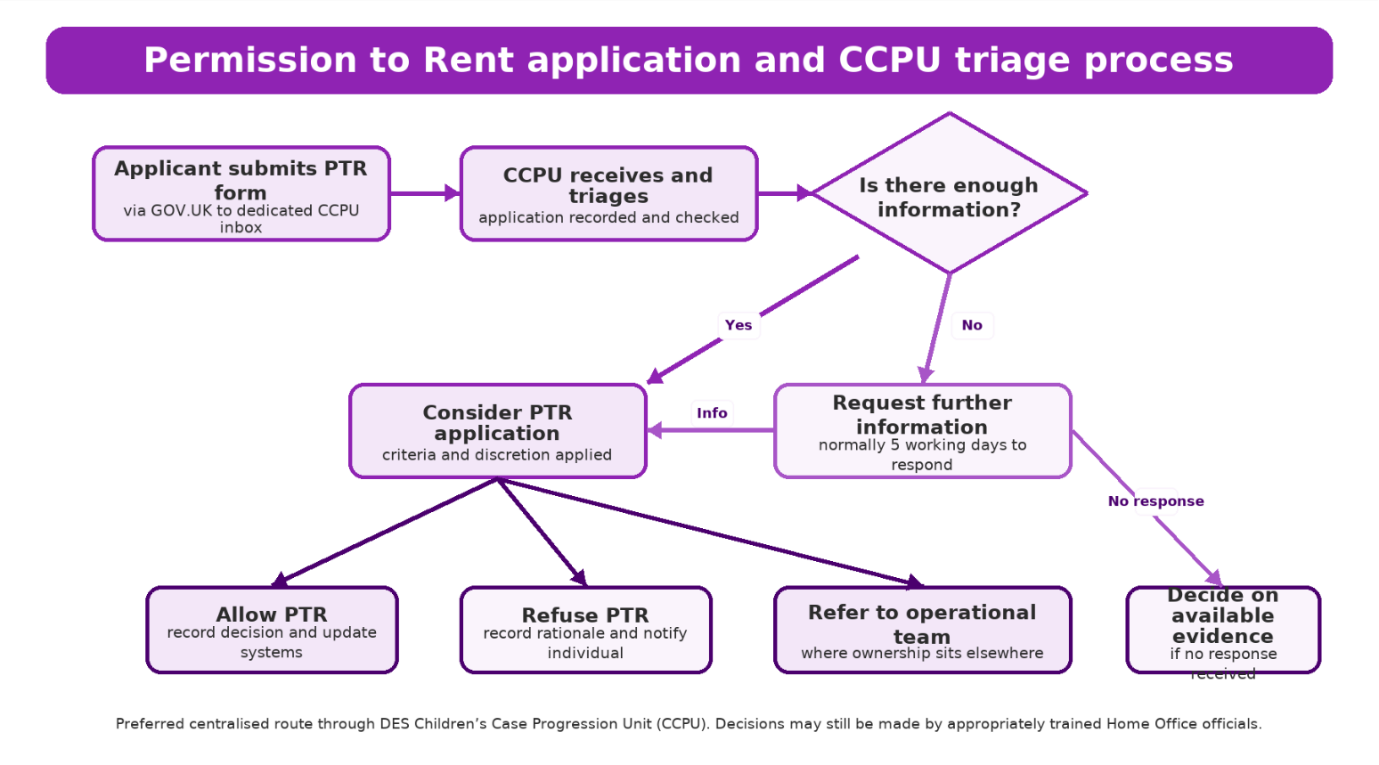
Flowchart showing the Permission to Rent (PtR) application and DES Children’s Case Progression Unit triage process. The applicant submits the PtR form through GOV.UK to the dedicated CCPU inbox. CCPU receives, records and triages the application. If there is enough information, CCPU considers the application against the PtR criteria. If there is not enough information, CCPU requests further information, normally giving 5 working days to respond. If information is provided, the application returns to consideration. If there is no response, CCPU may decide the application on the available evidence. Following consideration, CCPU may allow, refuse or refer the case to the appropriate operational team where ownership sits elsewhere.
3.5 Length of time permission to rent can be allowed
Permission to Rent (PtR) may be allowed for a maximum period of 12 months. Where PtR is allowed, the landlord or letting agent will obtain a statutory excuse through the Landlord Checking Service (LCS) for the period specified in the Positive Right to Rent Notice. Before the end of the PtR period, the landlord or letting agent must carry out a follow-up check to maintain their statutory excuse.
Individuals who continue to require PtR may submit a further application before their current period of PtR expires. Applications should normally be submitted within 28 days of the expiry date. The 12-month limit helps ensure individuals maintain contact with the Home Office and that their circumstances are reviewed regularly.
4. Permission to rent decision-making considerations
You must consider the individual circumstances of each case before deciding to allow PtR. PtR will normally be considered where one or more of the criteria set out in this guidance apply.
4.1 Decision making principles
When considering PtR you should ask:
-
Does the individual meet one of the published PtR criteria?
-
Is there a discretionary reason why PtR should be allowed?
-
Would refusing PtR give rise to any human rights concerns?
For cases managed within Asylum and Human Rights Operations (AHRO), PtR applications will normally be considered and decided by DES Children’s Case Progression Unit (CCPU). Where an application relates to an individual whose case is managed by another business area, CCPU will triage the application and refer it to the appropriate operational team for consideration and decision. The responsibility for considering a PtR request sits with the business area managing the individual’s immigration case at the time the request is received.
4.2 Discretionary considerations
Even where an individual does not fall within one of the published PtR criteria, you may consider allowing PtR if there is a compelling reason to do so.
4.3 The Home Office will better progress an individual’s case
In some circumstances, allowing PtR may help the Home Office maintain contact with an individual and better progress their immigration case.
Examples may include where:
-
the individual is actively engaging with the Home Office
-
maintaining a stable address is necessary for case progression
-
the individual is complying with reporting requirements or other restrictions.
-
it is necessary and proportionate to allow PtR whilst an aspect of the individual’s case is being reconsidered
4.4 Vulnerability
PtR may be appropriate where an individual is particularly vulnerable or unable to make informed decisions about their accommodation arrangements.
You should consider all available evidence and the individual’s personal circumstances when assessing vulnerability.
4.5 Human rights considerations
You must consider whether refusing PtR would result in a breach of an individual’s human rights.
This may include consideration of:
-
Article 3 of the European Convention on Human Rights (ECHR)
-
Article 8 of the European Convention on Human Rights (ECHR)
When considering human rights, you must first be satisfied that:
-
the individual does not meet any of the published PtR criteria; and
-
there is no other discretionary reason to allow PtR
Only then should you consider whether refusing PtR would amount to a human rights breach based on the information available. The fact that an individual may have difficulty obtaining accommodation will not, by itself, mean that PtR should be allowed. You must consider the full circumstances of the case and whether there is evidence that refusing PtR would give rise to a genuine human rights concern.
4.6 Outstanding Administrative Reviews
An outstanding Administrative Review (AR) does not automatically give rise to a right to rent and does not necessarily mean that an individual has section 3C leave.
However, where an individual has an outstanding AR and remains engaged with the Home Office, decision makers may consider whether there are discretionary reasons why PtR should be allowed. Each case must be considered on its individual facts, including the individual’s immigration history, current circumstances and any barriers to resolving their accommodation needs.
4.7 Communicating a Permission to Rent decision
Once you have decided to allow, refuse or revoke Permission to Rent (PtR), you must:
-
record the decision and your rationale on the relevant Home Office systems
-
record any evidence or factors considered when reaching the decision
-
issue the appropriate decision letter to the individual
The decision letter should clearly explain:
-
whether PtR has been allowed, refused or revoked
-
the reasons for the decision
-
any review or reapplication options available to the individual
-
any action the individual must take following the decision
4.8 Landlord Checking Service (LCS)
Where PtR has been allowed, the individual should advise their landlord or letting agent that they must contact the Landlord Checking Service (LCS) to obtain confirmation of the outcome. The landlord or letting agent must submit a request using the LCS online form. The LCS will verify Home Office records and issue the appropriate notice confirming whether PtR has been allowed, refused or revoked.
Where PtR has been allowed, the notice issued by the LCS will provide the landlord or letting agent with a statutory excuse against liability for a civil penalty for the period specified in the notice.
Further information on the when to contact the LCS to verify right to rent can be found in the Landlords guide to right to rent checks on GOV.UK.
4.9 Communicating a Permission to Rent decision
The following diagram summarises the actions that must be taken after a decision has been made to allow, refuse or revoke Permission to Rent (PtR). It also shows how landlords and letting agents obtain confirmation of the decision through the Landlord Checking Service (LCS) and, where applicable, establish a statutory excuse.
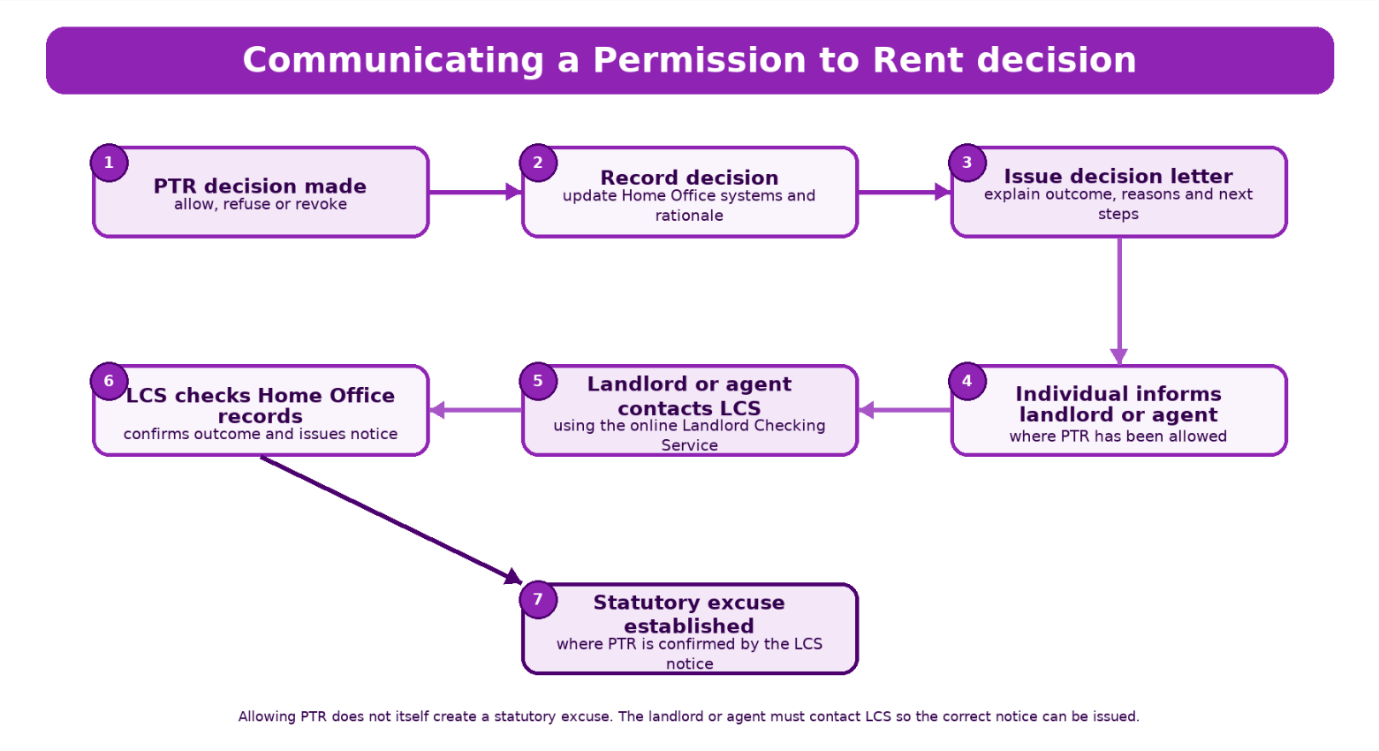
Flowchart showing the process for communicating a Permission to Rent decision. A decision is made to allow, refuse or revoke Permission to Rent. The decision and rationale are recorded on Home Office systems and a decision letter is issued to the individual. Where Permission to Rent has been allowed, the individual informs their landlord or letting agent. The landlord or letting agent contacts the Landlord Checking Service, which checks Home Office records and issues the appropriate notice. Where Permission to Rent is confirmed by the Landlord Checking Service, the landlord or letting agent establishes a statutory excuse against liability for a civil penalty.
5. Permission to rent criteria
Permission to Rent will normally be considered where:
5.1 Protection and human rights cases
| Permission to rent criteria | Further explanation |
|---|---|
| Individuals with an outstanding protection claim, article 3 of the European Convention on Human Rights (ECHR) medical claim, or an outstanding appeal against the refusal of such a claim. | This relates largely to migrants who have sought asylum or made a claim for international protection. |
| Individuals who have lodged further submissions against the refusal of a protection claim and the submissions have been outstanding for more than 5 working days. | This relates largely to migrants who have sought asylum or made a claim for international protection. Particularly concerns protection cases where further submissions have been made. |
| Individuals who have an outstanding appeal that cannot be pursued from abroad. | Some certified decisions will not carry a right of appeal in the UK. Other appeals which have been made in the UK cannot be pursued from abroad. |
| Individuals whose judicial review application has been given permission to proceed and where the judicial review would as a matter of policy be treated as being suspensive of removal, this would continue until any reconsideration required of the Home Office as an outcome of the judicial review had been undertaken. | If a judicial review would not be considered to be suspensive of removal, then permission to rent should not be considered for that reason. |
| Individuals who have been granted bail by an immigration tribunal or the courts which contains a residence restriction and / or electronic monitoring restrictions. | Presenting officers will manage bail applications in the normal way and consider whether the Home Office should resist any application. However, where the Tribunal or court is minded to grant bail despite Home Office concerns, presenting officers may provide the courts with assurance that permission to rent will be allowed and Home Office systems updated immediately so that any check by a landlord can be managed quickly (through the online form for the Landlords Checking Service LCS) in order to establish that they may rent to the bailee. |
| Potential victims of modern slavery from the date of a positive reasonable grounds decision from the national referral mechanism (NRM) up until 2 weeks after either a positive or negative conclusive grounds decision. | - |
| Recognised victims of modern slavery with an associated outstanding application for discretionary leave immigration permission. | - |
| Families with one or more children under the age of 18 who are cooperating with the Home Office’s family returns process. | - |
| Individuals who are complying with the Home Office’s Voluntary Returns Service (VRS) to voluntarily depart the UK. This includes those with genuine obstacles to return, providing that they are taking all reasonable steps to address these. | The VRS sits within the National Returns Progression Command (NRPC), and the consideration as to whether someone continues to comply with voluntary return lies with them. If it is not clear if an individual is complying with the voluntary departure process, then contact VRS for clarification. In order to remain in the process an individual will have to be working with VRS in order to lift any barriers to their departure. Such instances may include where an individual needs assistance in leaving the UK because of medical reasons; help to obtain a travel document or help in finding a viable route of return (though consideration will also have to be given to whether they could travel to a third country). |
5.2 Discretionary permission to rent
Even where an individual does not meet one of the categories above, PtR may still be appropriate in exceptional circumstances. The discretionary considerations which may be relevant when assessing whether Permission to Rent (PtR) should be allowed are set out above under:
-
discretionary considerations
-
the Home Office will better progress an individual’s case
-
vulnerability
-
human rights considerations
-
outstanding Administrative Reviews
You should consider these factors alongside the published PtR criteria and the individual circumstances of the case when reaching a decision.