Environmental surveillance for polio
Updated 7 July 2026

© Crown copyright 2026
This publication is licensed under the terms of the Open Government Licence v3.0 except where otherwise stated. To view this licence, visit nationalarchives.gov.uk/doc/open-government-licence/version/3 or write to the Information Policy Team, The National Archives, Kew, London TW9 4DU, or email: psi@nationalarchives.gov.uk.
Where we have identified any third party copyright information you will need to obtain permission from the copyright holders concerned.
This publication is available at https://www.gov.uk/government/publications/polio-global-eradication-nac-and-environmental-surveillance/environmental-surveillance-for-polio
The UK Health Security Agency (UKHSA), working with the World Health Organization (WHO) Polio Global Specialised Laboratory at the Medicines and Healthcare products Regulatory Agency (MHRA), conducts routine environmental surveillance for polio in England as part of our commitment to the Global Polio Eradication Initiative (GPEI).
Environmental surveillance
Environmental surveillance consists of the collection of raw sewage samples from a number of locations which are then tested for the presence of enteroviruses including poliovirus. The purpose of the sewage surveillance is to provide an early warning system of poliovirus importations which may then lead to community transmission. In this latter scenario the poliovirus detected would be expected to persist for a period of weeks and months.
UKHSA has followed the WHO guidance on environmental surveillance for poliovirus and established protocols to test samples using the latest advice. Currently this includes obtaining the nucleotide sequence of the gene coding for the virus (capsid VP1 protein) which is essential for virus classification. The UKHSA National Polio Guidelines outline response actions to be undertaken depending on the virus detected. This could be vaccine-like poliovirus showing none or few nucleotide changes from the live-attenuated oral polio vaccine (OPV) strain, indicative of no or very short-lived replication/transmission in vaccinees and/or close contacts, or a vaccine-derived poliovirus (VDPV) which shows higher sequence drift from the OPV vaccine strain, suggestive of longer-term replication or transmission in one or more individuals. The third type is wild poliovirus (WPV) which might be imported from areas of Pakistan and Afghanistan where WPV type 1 (WPV1) is still circulating or has been inadvertently released from laboratory facilities using WPV for vaccine production and/or quality control and research activities.
As part of this routine polio surveillance, we do expect to detect polioviruses from time to time. These are normally one-off findings due to:
-
individuals who have been recently vaccinated overseas with OPV and then enter the UK where they would briefly ‘shed’ traces of the ‘vaccine-like’ poliovirus in their faeces. Several countries offer OPV on exit, for example, Pakistan, as part of their response to polio outbreaks
-
individuals who are immunosuppressed and have been vaccinated or exposed to OPV virus previously, who may shed VDPV for a long period of time, named immunodeficiency-related vaccine-derived poliovirus (iVDPV)
-
a visitor from a country where VDPV has been circulating
These one-off or brief detections do not require any public health action.
In England, untreated sewage samples are collected monthly from 28 sewage treatment sites (see map) in collaboration with the water companies and are sent to the MHRA laboratory for processing, with additional testing capacity provided by NHS Lothian.
Figure 1. Map of sewage treatment sites
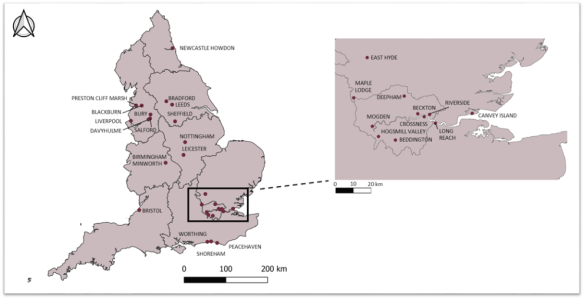
Text version of Figure 1. Map of sewage treatment sites in England
The map shows sites marked in Newcastle Howdon, Preston Cliff Marsh, Blackburn, Liverpool, Davyhulme, Bury, Salford, Bradford, Leeds, Sheffield, Nottingham, Leicester, Birmingham Minworth, Bristol, East Hyde, Maple Lodge, Deepham, Mogden, Hogsmill Valley, Beddington, Crossness, Long Reach, Beckton, Riverside, Canvey Island, Worthing, Shoreham and Peacehaven.
The sewage sampling sites were selected on the basis of the following criteria:
-
areas with low vaccine coverage for the childhood immunisation programme
-
areas with pockets of under-vaccinated communities
-
areas with higher risk of importation from a country where WPV1 or VDPV is circulating or where OPV is still used
The UKHSA is working closely with partners in the devolved governments who are at different stages of establishing routine environmental surveillance for polio.
Main findings
As part of routine surveillance, it is normal for a handful of ‘vaccine-like’ polioviruses to be detected each year in UK sewage samples, but these are usually single or very brief detections that do not trigger any public health action. Here we summarise key findings from detections that have required a national incident team to be established in order to coordinate the investigation and response.
2022
In June 2022, UKHSA announced that environmental surveillance for polio had been persistently detecting poliovirus in sewage samples collected from the London Beckton Sewage Treatment Works (STW) since February 2022. A UKHSA national enhanced incident response was established, and environmental surveillance was expanded to cover a range of sites around England. In August 2022 it was formally confirmed that the UK had a ‘circulating’ vaccine-derived polioviruses type 2 (cVDPV2) based on the detection of the same isolate for more than 60 days. Evidence also suggested that the virus detected in London was genetically linked to the poliovirus detected in Israel and the US. In response, the Joint Committee on Vaccination and Immunisation (JCVI) recommended that polio vaccine booster doses should be offered to children aged one to 9 years across London, and this was implemented in 2022. The last detection linked to this incident was in sewage collected in London in November 2022. The WHO removed the UK from the list of polio ‘infected’ countries in December 2023 after there had been no detections for a period of 12 months. The full details of the findings were published in the Lancet.
2023
In 2023, a poliovirus type 1 isolate was detected from a single sewage sample collected in September from the Leeds Knostrop STW. The virus detected was one that is known to be used in research activities. Since then, this virus (or any related virus) was never detected again from Leeds or any other sites tested since then. A national standard incident response was stood up to investigate the source of this one-off finding. Working closely with the UK NAC, UKHSA was able to rapidly identify that the isolate was linked to the use of live poliovirus in medical research at one of the laboratories at the University of Leeds. The lab immediately stood down all its work with poliovirus (and this has not been reinstated). The Health and Safety Executive (HSE) led a rigorous investigation of processes at the lab that included potential exposures of university personnel, and concluded that the containment breach was most likely due to ineffective inactivation of the poliovirus prior to disposal to sewer via the laboratory sink. Lessons from this incident are being written up for publication.
2024
Testing of sewage samples collected in November 2024 identified cVDPV2 in one sample from East Worthing STW, which covers some of the West Sussex local authority and adjacent areas, 2 samples from Leeds Knostrop STW, one sample from London Beckton STW and one sample from London Crossness STW. At that time, sampling at the sites where the VDPV2 was detected was increased to fortnightly to inform a timely investigation and any necessary response. The viruses were genetically linked to viruses identified in sewage samples from 4 other European countries during the same period.
Testing of sewage samples in December detected VDPV2 from a single sample collected from London Beckton STW on 10 December. All other sites tested negative for poliovirus in December.
The poliovirus isolates found in the UK are genetically linked to VDPV2 emergence NIE-ZAS-1 which was first detected in Nigeria in 2020 and that has been widely circulating in several African countries in recent months, unrelated to any previous poliovirus found in the UK. All strains detected from the 5 countries in Europe are genetically linked between them, classifying these isolates as cVDPV2 as per GPEI requirements for VDPV classification and reporting.
The UKHSA coordinated the public health investigation and response to these detections with system partners at the national, regional and local level. There is no evidence of community transmission in the UK, and the risk to the public is low.
A rapid communication was published in Eurosurveillance which provides an overview of the linked detections of VDPV2 in 5 countries in Europe: Spain, Poland, Germany, the UK and Finland.
2025
In 2025, VDPV2 linked to the November and December 2024 detections (emergence NIE-ZAS-1) were identified from:
- a single sample collected from Shoreham STW on 20 January, with subsequent samples from this site testing negative
- a single sample collected from Sheffield Blackburn Meadows STW on 16 September with subsequent samples from this site testing negative until another VDPV2 isolate was identified from a sample collected from the same site on 16 December, with subsequent samples from this site testing negative
All other sites, including all those with VDPV2 detections in 2024, continued to test negative for poliovirus in 2025. Sequence analysis provides no evidence of sustained community transmission in the UK. UK isolates do not form a coherent phylogenetic cluster and are, instead, more closely related to the contemporaneous isolates detected elsewhere in Europe than to each other. This pattern is consistent with multiple independent importation events from as yet unidentified sources, rather than local transmission chains. Accordingly, the overall risk to the public remains low. A few additional linked VDPV2 detections have been reported in Germany up to December 2025.
2026
In 2026 to date (26 March 2026) there have been 2 unrelated VDPV2 detections as follows:
- A VPDV2 was identified by direct detection nanopore sequencing (DDNS) in a single sewage sample collected from London Beckton STW on 5 January 2026. Comparison with sequences in the WHO Global Polio Lab Network (GPLN) database shows that this sequence is genetically consistent with an ‘orphan’ detection (>1.5% sequence difference with the closest match) and is not related to any previous VDPV detection in the UK. The sample was negative for poliovirus by cell culture. This was a single detection of a VDPV2 not related to any previous UK sequence, therefore there is no evidence of local transmission.
- A VDPV2 isolate was identified by virus isolation in a sewage sample from London Beckton STW collected on 3 March 2026. It is unrelated to the detection in January but is linked to detections from the UK and Europe in 2024 to 2025 noted above (emergence NIE-ZAS-1). This is the first such virus detected in 2026 anywhere in Europe. It is closer genetically to 2024 isolates from elsewhere in Europe than to 2025 UK isolates, making the finding consistent with a fresh importation. There is no evidence of local transmission. UKHSA continues to test Beckton samples fortnightly.
Figure 2. Flowchart of sewage surveillance and its role in the detection and prevention of polio
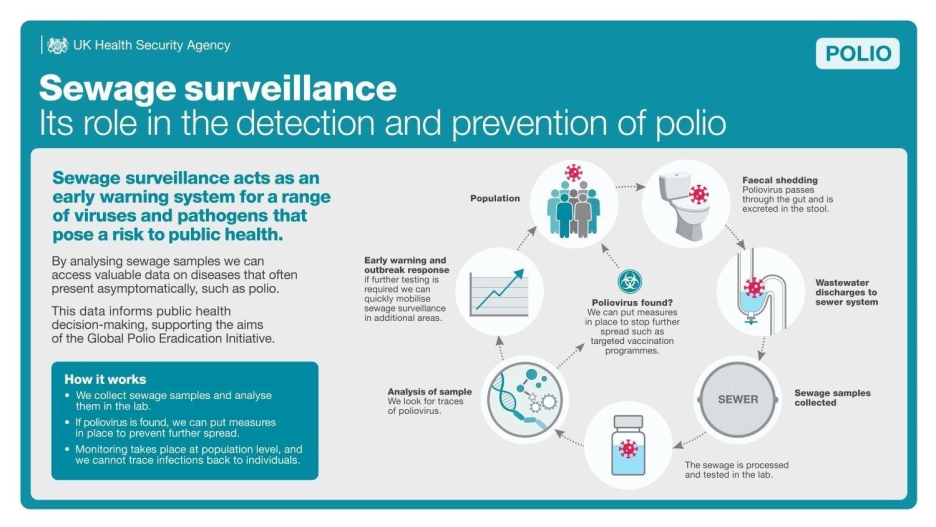
Text version of Figure 2. Flowchart of sewage surveillance and its role in the detection and prevention of polio
Sewage surveillance acts as an early warning system for a range of viruses and pathogens that pose a risk to public health.
By analysing sewage samples we can access valuable data on diseases that often present asymptomatically, such as polio.
This data informs public health decision-making, supporting the aims of the Global Polio Eradication Initiative.
How it works:
-
we collect sewage samples and analyse them in the lab
-
if poliovirus is found, we can put measures in place to prevent further spread
-
monitoring takes place at population level, and we cannot trace infections back to individuals
The graphic shows a circular system starting with:
Polio virus in the population.
(arrow to)
Faecal shedding – poliovirus passes through the gut and is excreted in the stool.
(arrow to)
Wastewater discharges to sewer system.
(arrow to)
Sewage samples collected.
(arrow to)
The sewage is processed and tested in the lab.
(arrow to)
Analysis of sample – we look for traces of poliovirus.
(arrows to either ‘Early warning and outbreak response’ or to ‘Poliovirus found?’)
Early warning and outbreak response – if further testing is require we can quickly mobilise sewage surveillance in additional areas.
(arrow back to ‘Population’)
Poliovirus found? – we can put measures in place to stop further spread, such as targeted vaccination programmes.
(arrow to back to ‘Population’)