NHS Cervical Screening Programme Operational Guidance for Transgender and Non-Binary Opt In
Published 17 September 2026
Applies to England

© Crown copyright 2026
This publication is licensed under the terms of the Open Government Licence v3.0 except where otherwise stated. To view this licence, visit nationalarchives.gov.uk/doc/open-government-licence/version/3 or write to the Information Policy Team, The National Archives, Kew, London TW9 4DU, or email: psi@nationalarchives.gov.uk.
Where we have identified any third party copyright information you will need to obtain permission from the copyright holders concerned.
This publication is available at https://www.gov.uk/government/publications/operational-guidance-for-transgender-and-non-binary-opt-in/nhs-cervical-screening-programme-operational-guidance-for-transgender-and-non-binary-opt-in
1. Introduction
The Cervical Screening Management System (CSMS) has the functionality to enable trans men and non-binary people the option to opt-in to receive automatic invitations for cervical screening, regardless of the gender status recorded on their NHS health record.
This guide sets out the process that should be followed and covers:
- Identifying eligible individuals
- Contacting those eligible
- The opt-in consultation
- Completing the opt-in form
2. Opt-in process
2.1 Step by step opt-in process
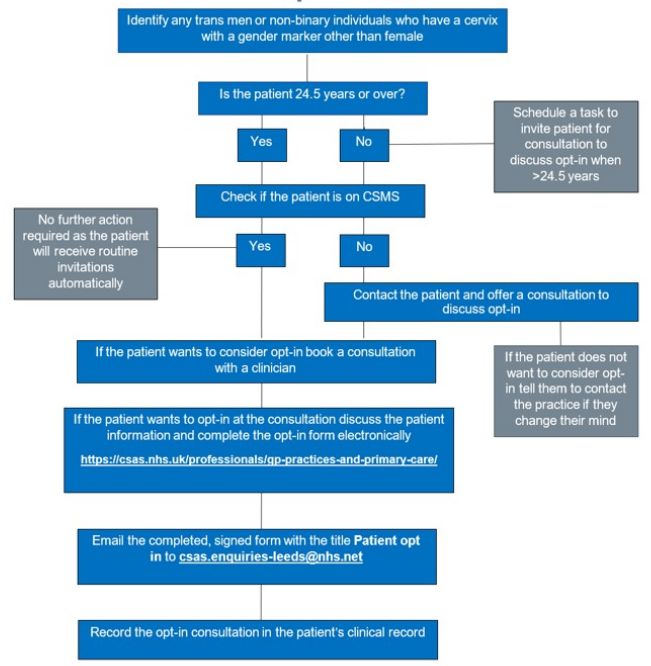
- Identify any trans men or non-binary individuals who have a cervix with a gender marker other than female.
- Identify if the patient is over 24.5 years old. If not schedule a task to invite the patient for a consultation to discuss the opt-in when they reach 24.5 years.
- Check if the patient is on CSMS. If they are, no further action is required as the patient will automatically receive routine invitations.
- If the patient is not on CSMS, contact the patient and offer a consultation to discuss opt-in.
- If the patient does not want to consider opt-in, tell them to contact the practice if they change their mind.
- If the patient wants to consider opt-in, book a consultation with a clinician.
- If the patient decides they want to opt-in at the consultation, discuss the patient information and complete the opt-in form. The opt-in form is available here http://csas.nhs.uk/professionals/gp-practices-and-primary-care/
- Email the completed form with the title Patient Opt-in to csas.enquires-leeds@nhs.net
- Record the opt-in form in the patient’s clinical record.
2.2 Flow chart for opt-in process
3. Learning from early adopters
3.1 Searching for eligible patients
Some practices will have a register of patients who have changed gender and many may be known to practice nurses due to requiring hormone injections.
Other practices may need to run searches on codes/key words i.e. transgender, issued testosterone, gender incongruence or gender dysphoria. Running searches on whether registered sex matches assigned at birth may also be helpful. Please ensure compliance with your respective data protection obligations as detailed in the Records Management Code of Practice.
Examples of searches that were found to be helpful in identifying any transmen or non-binary individuals who have a cervix with a gender marker other than female:
Example 1:
- Create a search in GP system using the umbrella terms: “gender identity dysphoria” and “gender identity” finding
- Limit the age range to 24-64.
- Code each individual as cervix absent or cervix present.
Example 2:
- Search patients who have had hormonal prescriptions
- Check if they were referred to transgender services
Prospectively, practices may wish to include a question on practice registration forms and/or at a new patient medical i.e. ask if patient is same gender as assigned at birth. With patient consent practices could use an alert in the medical record which states whether the patient was Assigned Female At Birth (AFAB) or Assigned Male At Birth (AMAB). This would then easily identify patients for appropriate health screening. Please ensure compliance with your respective data protection obligations as detailed in the Records Management Code of Practice.
3.2 Contacting eligible individuals
Once eligible patients who are not already on CSMS have been identified, practices should contact them to offer them a consultation to discuss the offer of opting in to receive routine cervical screening invitations automatically.
For patients that have a good relationship with the practice, or who have previously engaged with the NHS Cervical Screening Programme (but are no longer on CSMS), a phone consultation to offer opt in could be conducted.
Patients who have not previously engaged with the NHS Cervical Screening Programme should ideally be offered a face-to-face discussion.
In appendix A there is an example letter that you could send to eligible patients if you are not contacting them by telephone.
As well as searching for eligible patients, practices could make every contact count with patients to enable them to opt in to receive routine cervical screening invitations. Examples of opportunities include:
- Testosterone injection appointments
- New Patient Appointments
- Routine blood test
- Opportunistic screening
If a patient chooses not to opt-in, health professionals should make patients aware that as long as they are still eligible for cervical screening, they can change their mind and opt-in for cervical screening at any time. Patients should speak to their GP, sexual health clinic or transgender service if/when this is the case.
3.3 During the opt-in consultation
The important patient information on pages 2 and 3 of the opt in form contains the facts about this process and may help with response to any questions patients may have about opt-in and what will happen to their data.
To improve uptake of screening, options to access cervical screening could be covered in the opt-in consultation. This may include other settings where the patient may access cervical screening including sexual health clinics and specialist Transgender services.
3.4 Completing the Opt-in form
The opt in form has been created to provide CSAS with the relevant information to bring the patient into the NHS Cervical Screening Programme.
The form is similar to other CSAS forms and is available on the CSAS website: https://csas.nhs.uk/professionals/gp-practices-and-primary-care/
By completing the form and sending it to CSAS you are confirming that the patient has given their consent to opt-in, and they will receive routine cervical screening invitations.
The patient may also have a next test due date (NTDD) for cervical screening which is held locally and if they are happy to share this information, please provide the date on the form in the format DD/MM/YYYY. This will be entered on to the patient’s record and supports the programme to invite the individual at the appropriate interval. If they do not know this needs to be left blank.
Advise the patient that they will be sent an invitation letter when they are due for screening.
4. Key Resources
Opt in form on CSAS website https://csas.nhs.uk/professionals/gp-practices-and-primary-care/
NHS population screening information for trans and non-binary people: NHS population screening: information for trans and non-binary people – GOV.UK (www.gov.uk)
Cervical screening: support for people who find it hard to attend: https://www.gov.uk/government/publications/cervical-screening-support-for-people-who-find-it-hard-to-attend
Cervical Screening Care Pathway: https://www.gov.uk/government/publications/cervical-screening-care-pathway/cervical-screening-care-pathway
Eve Appeal have some resources for health professionals, services and patients https://eveappeal.org.uk/gynaecological-cancers/tnbiinfo/