Next Steps Accommodation Programme evaluation: Briefing paper
Published 11 December 2025
Applies to England

© Crown copyright 2025
This publication is licensed under the terms of the Open Government Licence v3.0 except where otherwise stated. To view this licence, visit nationalarchives.gov.uk/doc/open-government-licence/version/3 or write to the Information Policy Team, The National Archives, Kew, London TW9 4DU, or email: psi@nationalarchives.gov.uk.
Where we have identified any third party copyright information you will need to obtain permission from the copyright holders concerned.
This publication is available at https://www.gov.uk/government/publications/next-steps-accommodation-programme-evaluation-briefing-paper/next-steps-accommodation-programme-evaluation-briefing-paper
1. Background, research approach and aims
On 26 March 2020, the first national lockdown requiring people to ‘stay at home’ to protect the health of the public from the COVID-19 pandemic, came into force. People sleeping rough were particularly vulnerable, and local authorities in England worked with the UK government and voluntary sector organisations to protect this population by moving them into accommodation as part of the ‘Everyone In’ initiative. In autumn 2021, the Next Steps Accommodation Programme and the Rough Sleeping Accommodation Programme were launched, with funding provided for local councils to help rough sleepers and those at risk of rough sleeping to stay in longer-term accommodation. By December 2021 over 40,000 people who were rough sleeping or at risk of rough sleeping had been placed in accommodation.[footnote 1]
Telephone interviews were conducted with service users who have been re-housed into longer-term accommodation after a period of living in emergency accommodation during the COVID-19 pandemic. Wave 1 fieldwork took place between February and July 2021, around 12 months after the start of the ‘Everyone In’ initiative and afterbetween 5 and 10 months in ‘Next Steps’ (624 respondents). Wave 2 fieldwork was conducted between October and December 2021, around 18 months after the start of the ‘Everyone In’ initiative and after 11-16 months in ‘Next Steps’ (270 respondents). Service users from 34 local authorities were included in the research.
This evaluation aims to understand the outcomes of people initially accommodated through the ‘Everyone In’ initiative and subsequently supported through ‘Next Steps’. There are some limits on the capacity to draw conclusions on the impact of the programme, given a lack of data from before people were housed for comparison, and relatively small numbers of respondents. However, the research does allow an exploration of the outcomes of those who remain in contact with their local authority around 12 and 18 months after the start of the pandemic (likely to be those with the most sustained accommodation outcomes), including understanding of:
- use of programme support and public services
- both housing outcomes and wider outcomes
- factors which could influence the chance of sustained tenancy
- areas where additional support may be needed to maintain positive outcomes
The following issues limit the ability of the research to fully answer the research questions:
- a lack of baseline data allowing comparison of the survey data to provide direct evidence of outcomes and factors associated with better housing sustainability
- the number of respondents in each wave was smaller than originally anticipated
This means we do not know how well survey respondents represent the population initially housed under the programme.
2. Profile of Next Steps respondents
Respondents had a very similar profile at both research waves so figures in this section are taken solely from the data provided by participants at the 18-month point, at wave 2 (i.e., those with the longest sustained housing outcomes).
Reflecting other research, the population was predominantly male, and 8 in 10 were UK nationals (as shown in Figure 1). Three in ten were London-based, higher than the proportion of those placed under the programme by December 2021 by London authorities.[footnote 2] This may suggest a higher degree of long-term engagement in London but could also reflect the much higher prevalence of rough sleepers and people in emergency accommodation in London than in other English regions (thus competition for sustained accommodation).
While 6 in 10 were White, a quarter were Black (much higher than in the general population). Black respondents and those in London were strongly overlapping populations, with both more likely to be female, and younger, while almost all respondents who were not UK or EU-nationals were Black. Differences between White and Black, Black British or African respondents often reflect the differences between respondents from London and those from the rest of England.
Figure 1. Demographic profile (wave 2 – all, Black and London-based respondents)
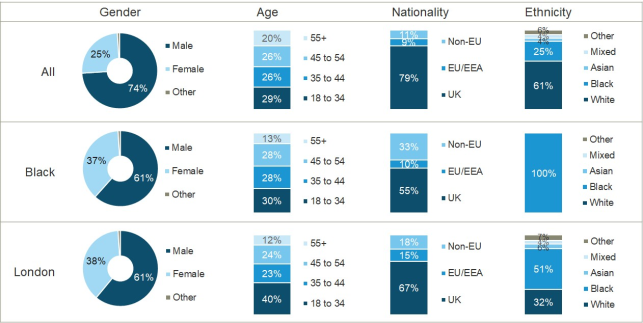
Base: All respondents wave 2: All (270); Black (67); London-based (82)
Furthermore, in line with other research, many respondents also had a number of additional support needs (as shown in Figure 2) including longstanding physical and mental health conditions, substance dependency and some history of being imprisoned. There was a high level of correlation between such support needs: over half had at least 3 such additional support needs. This was lower in London and among Black respondents, reflecting their younger, more female profile.
Figure 2. Additional support needs (wave 2 – all respondents)
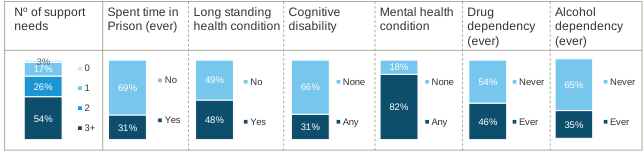
Base: All respondents wave 2 (270) (derived support variables from range of questions – see questionnaire)
3. Use of programme support and public services
Three in ten respondents reported receiving help from a housing support worker. This support was targeted to those most in need, but even among those with multiple additional needs, only a minority had a housing support worker (as shown in Figure 3). Those in London and Black respondents were less likely to report such support. Those with a housing support worker were generally more positive about their outcomes, despite their additional support needs.
Priorities for support among those with a support worker shifted over time, with help with benefit applications and practical help in moving becoming less important by wave 2, but with help with mental health services and wellbeing remaining just as important at wave 2 (as shown in Figure 3).
Figure 3. Whether getting help from housing support worker (wave 2 – all respondents) and priorities for support (waves 1 & 2 – respondents with HSW)
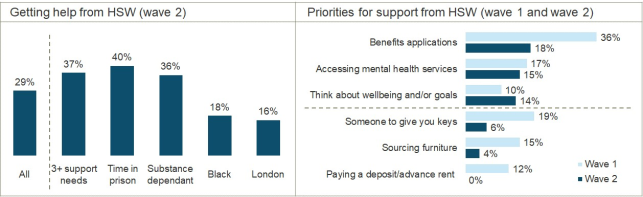
Base: Are you currently receiving help from a housing support worker? All respondents wave 2 (270); Which, if any, of the following have been very important to you? Respondents with a housing support worker wave 1/wave 2 (210/78)
Public health services were also used by the majority, but there was some evidence of gaps in access, particularly for mental health services: at each wave just a third of those with a mental health problem said they had accessed these in the past 6 months. There may also be gaps in support for substance dependency, particularly alcohol. Further to this, 64% reported uptake of the Covid vaccinations by the end of 2021. This was lower than among the general public (90%).
Given the strong level of interaction between housing and a range of additional needs, any gaps in treatment for such needs could make it more difficult for respondents to sustain their longer-term accommodation.
4. Housing outcomes
While there was evidence of the programme leading to many respondents being settled in their accommodation, 18 months after the start of the initiative, over half still reported experience of homeless accommodation in the last 6 months and 1 in 10 reported rough sleeping in the past 3 months, with this almost exclusively for those with 3 or more additional needs. This reinforces the need for additional support to sustain longer-term accommodation among those with additional needs.
From wave 1 to wave 2 there was a shift from short-term supported housing to social rented housing offering further evidence of ongoing ‘settling’, although there was also an increase in other, largely temporary, accommodation. While similar shifts were also seen among London-based respondents, Londoners remained relatively more likely to be in private rented accommodation and less likely to be in social rented housing than those across England at wave 2 (as shown in Figure 4).
At wave 2, around 2 in 3 remained confident that they would still be in stable accommodation in 6 months time and most remained satisfied with their housing, including the proximity of their accommodation to shops and other services, the safety and security and the condition of their accommodation (as shown in Figure 4). Those in social rented housing were relatively more positive about their housing. Those living in London were less positive, this is related to the greater prevalence of private rented housing in London.
Figure 4. Current housing type (waves 1 & 2 – all respondents) and attitudes towards current housing (wave 2 - all respondents)
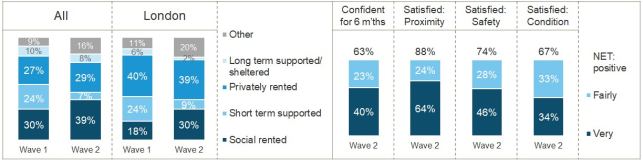
Base: What type of housing are you currently living in? All respondents wave 1/2 (624/270); On a scale from very confident to not at all confident, how confident do you feel that you will be in this accommodation or other stable accommodation in 6 months-time? How satisfied are you with the following aspect of your current accommodation… All respondents wave 2 (270)
5. Wider outcomes
There were a number of positive shifts in wider outcomes not related directly to housing between the 12 month stage (wave 1) and the 18 month stage (wave 2 - Figure 5), and there is evidence that at least some of this change is related to the sustained nature of accommodation.
By wave 2, fewer respondents reported being a victim of the types of crime commonly reported by people at risk of rough sleeping than 6 months earlier, such as abuse, assault and theft of belongings. Reported use of illegal drugs was also lower: this could be, at least in part, the result of some of those with an ongoing drug dependency dropping out of the research, but it could also reflect the stabilising influence of sustained accommodation.
There was also evidence of better mental health outcomes by wave 2. Fewer respondents met the criteria for probable depression[footnote 3] and respondents reported each of feeling close to others, feeling useful, thinking clearly and dealing well with problems more frequently than 6 months earlier (as shown in Figure 5).
These positive shifts in outcomes were more likely for those confident that they would still be in stable accommodation in 6 months, those getting help from a housing support worker, and those with multiple additional needs, providing evidence that sustained accommodation and support relating to housing may help to mitigate other (non-housing) needs to some degree.
Figure 5. Non-housing outcomes (waves 1 & 2 – all respondents)
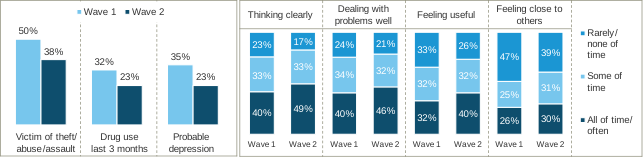
Base: In the last 6 months have you been …: In the last 3 months, have you used any of the following … : Please tell me how often you’ve been feeling this way over the last 2 weeks …: Could you tell me what your main sources of income have been in the last 6 months? All respondents wave 1/2 (624/270)
Furthermore, by wave 2 paid work was reported by a higher proportion of respondents than 6 months earlier at wave 1 (27% up from 16%), usually alongside benefits. It is worth noting, however, that half of respondents said they could not take on paid work because of health problems, limiting scope to expand this. Also, around half of those in paid work said their income from work was not stable, so for some this may not be sustainable work in the longer term.
6. Conclusions
Keeping in mind the constraints on drawing conclusions (due to the lack of baseline data for comparison and small number of interviews), the research supplies a wealth of information on those who were still in contact with their local authority, including potential drivers of and barriers to sustaining longer term accommodation for this population.
Alongside the expected predominantly male population, many of whom have multiple additional support needs, the potentially different needs and challenges of Black respondents, and those based in London also need to be taken into account. These strongly overlapping populations tend to be younger, relatively more female and with fewer additional needs, and so are less likely to be assigned a housing support worker. In addition, the higher dependence on the private rented sector in London risks reducing the sustainability of the available accommodation.
There is evidence that sustained accommodation feeds into wider improvements in areas such as mental wellbeing and work. There is clearly a strong positive influence of housing support workers for those with multiple additional needs. There are, however, many vulnerable respondents not in receipt of this ongoing personal support, all with the potential to fall through the cracks: while many are now settled, there are still repeated periods spent in homeless accommodation and rough sleeping among this population. Housing needs and other needs such as health, offending and dependency are clearly inter-related, and unless both housing and additional needs are adequately supported, there always remains a risk of a return to homeless accommodation.
-
Annex A: Support for people sleeping rough in England, 2021. ↩
-
Annex A: Support for people sleeping rough in England, 2021. ↩
-
Using the Short Warwick-Edinburgh Mental Wellbeing scale. ↩