New Hospital Programme annual report: 2025 to 2026
Published 8 July 2026
Applies to England

© Crown copyright 2026
This publication is licensed under the terms of the Open Government Licence v3.0 except where otherwise stated. To view this licence, visit nationalarchives.gov.uk/doc/open-government-licence/version/3 or write to the Information Policy Team, The National Archives, Kew, London TW9 4DU, or email: psi@nationalarchives.gov.uk.
Where we have identified any third party copyright information you will need to obtain permission from the copyright holders concerned.
This publication is available at https://www.gov.uk/government/publications/new-hospital-programme-annual-report-financial-year-2025-to-2026/new-hospital-programme-annual-report-2025-to-2026
Presented to Parliament by the Secretary of State for Health and Social Care by Command of His Majesty.
© Crown copyright July 2026
ISBN 978-1-5286-6639-8
CP 1607
Forewords
Ministerial foreword
The New Hospital Programme (NHP) is an important part of the government’s long-term commitment to renewing the NHS estate and supporting delivery of the 10 Year Health Plan for England: fit for the future.
The NHP aims to provide new hospital infrastructure to consistent national standards, supported by clear accountability, strengthened assurance and a focus on value for money for taxpayers.
Following the NHP reset and publication of the New Hospital Programme: plan for implementation in January 2025, this first annual report provides a transparent account of progress during the 2025 to 2026 financial year. It reflects a phased and more realistic approach to delivery that is aligned to available funding and market capacity, and supported by strengthened oversight and assurance arrangements.
This report has been developed in the context of recent scrutiny by the National Audit Office (NAO) and Public Accounts Committee (PAC) and reflects the NHP’s response, including improvements in transparency, assurance and delivery oversight. It fulfils the government’s commitment to provide Parliament with a clear, annual account of progress across the NHP.
As the first report of its kind, it establishes a baseline for consistent reporting, focusing on progress during the 2025 to 2026 financial year and the approach now in place to support implementation within agreed funding and capacity constraints.
Karin Smyth MP, Minister of State for Health, Department of Health and Social Care
Joint senior responsible owners’ foreword
This annual report covers the first full year of delivery following the NHP reset and the approval of a costed, phased plan through the NHP plan for implementation in January 2025. It represents an important transition from programme stabilisation towards sustained delivery of new hospitals within a clearer and more realistic framework.
During the 2025 to 2026 financial year, the NHP strengthened its governance and assurance arrangements, clarified roles and responsibilities between the sponsor team in the Department of Health and Social Care (DHSC) and the delivery team in NHS England, and embedded a more rigorous approach to sequencing, risk management and affordability. These changes respond to findings from NAO and PAC, and form the basis for a more disciplined and transparent approach to implementation.
Maintaining a clear focus on the feasibility of delivery and value for money has been central to the NHP’s approach, particularly for schemes already in construction and those making progress through business case development. This includes a clearer recognition of the constraints within which the NHP is operating, including funding, market capacity and the complexity of individual schemes. Delivery is undertaken in partnership with NHS England and NHS trusts, with the NHP providing central oversight, assurance and co-ordination across the portfolio. The NHP has worked closely with delivery partners to stabilise delivery in the early waves, while laying the foundations for future waves through standardisation, market engagement and capability development.
A particular focus this year has been strengthening programme-wide planning, sequencing and management of interdependencies, supported by improved assurance processes and engagement with delivery partners.
In line with commitments made to Parliament, this report provides a programme-level update, alongside scheme-level information, where available, to support greater transparency on delivery and sequencing. It highlights the progress made during the year and the areas where continued discipline and sustained focus will be required to implement the NHP successfully over the coming years.
Finally, we want to recognise the important work being undertaken across trusts, NHS England and DHSC to progress this ambitious programme. This has continued amid uncertainty arising from organisational change and the wider economic and geopolitical environment. We wish to thank all those who are putting in the hard work to provide world-class hospitals for the benefit of staff and patients.
Charlotte Taylor and Paul Mustow, joint senior responsible owners for the NHP
Executive summary
The NHP comprises a number of schemes, each of which delivers new hospital facilities that may include one or more buildings across one or multiple sites. Seven schemes are open to patients as follows:
- Royal Liverpool Hospital
- Dyson Cancer Centre, Bath
- Midland Metropolitan University Hospital
- Brighton 3Ts (Royal Sussex County Hospital redevelopment)
- Northern Centre for Cancer Care
- Greater Manchester Major Trauma Hospital (GMMTH)
- Care Environment Development and Re-provision (CEDAR) Programme
Note: the Brighton 3Ts scheme includes the Louisa Martindale Building, which is open to patients, and the Sussex Cancer Centre, which is under construction. The scheme will be considered complete when the Sussex Cancer Centre is opened and ancillary works finished.
The 2025 to 2026 financial year has been pivotal for the NHP, moving from the reset in January 2025 to the early stages of sustained delivery. The NHP is focused on delivering the NHP plan for implementation and progress has been made across schemes at different stages of development.
The NHP will deliver long-term benefits for patients, staff and the wider health system, with a focus on improved occupant safety and experience, and patient flow, to ensure new hospitals transform how care is delivered and are fit for the future. New hospitals will embed innovative digital solutions and technologies to increase productivity, drive efficiencies and improve patient outcomes.
This year has established and strengthened core enablers of the NHP. Hospital 2.0 (H2.0), the NHP’s standardised approach to hospital design and delivery, is central to successful delivery. Developing and refining the standardised designs for new hospitals was an important focus during the year - for example, by testing a life-sized single bedroom prototype for core clinical activities.
H2.0 is supported by the Hospital 2.0 Alliance (H2A), a multi-supplier framework supporting construction, mobilised in March 2026, and the NHP’s delivery partner Health Delivery Partnership (HDP), appointed in April 2025, which is providing necessary technical expertise and capacity to the NHP.
Together, these initiatives are strengthening the NHP’s ability to deliver efficiently, consistently and at scale, while maintaining a clear focus on value for money.
The NHP was given an ‘amber’ delivery confidence rating by the National Infrastructure and Service Transformation Authority (NISTA) (formerly the Infrastructure Projects Authority) in March 2026, reflecting that successful delivery is feasible while recognising the need for continued work on managing risk and delivering improvements in programme governance and capability. This is consistent with the broader Government Major Projects Portfolio (GMPP), where over 60% of projects were rated ‘amber’ in the 2024 to 2025 financial year.
The 2025 to 2026 financial year has not been without its challenges. The NHP continues to operate within a complex and evolving strategic environment, including:
- wider system reform
- changes following the publication of the 10 Year Health Plan
- broader economic and geopolitical pressures
In addition, each of the schemes being delivered by the NHP has its own set of complicated issues to resolve, such as clinical transformation, digital maturity and complex construction challenges - each of which can create pressure on the delivery timeline.
Market capacity at all tiers continues to present potential delivery constraints, with high UK construction activity creating competing demand for capital infrastructure resources. H2A seeks to provide a commercial environment that protects the supply chain and enables concurrent delivery of several large hospital schemes, but the risk will need to be monitored carefully to ensure that this mitigation remains effective.
The NHP has also embraced opportunities to accelerate delivery of the programme over the 2025 to 2026 financial year, including:
- streamlining the business case approvals process
- working across government to support scheme progress and unblock issues
The 7 reinforced autoclaved aerated concrete (RAAC) replacement schemes - while having been deemed safe to remain open beyond 2030 with appropriate mitigations in place - have remained a priority and will continue to be a primary focus for the NHP in the financial year 2026 to 2027.
About the New Hospital Programme
The NHP is investing in 46 hospital schemes across England.
Figure 1: NHP summary
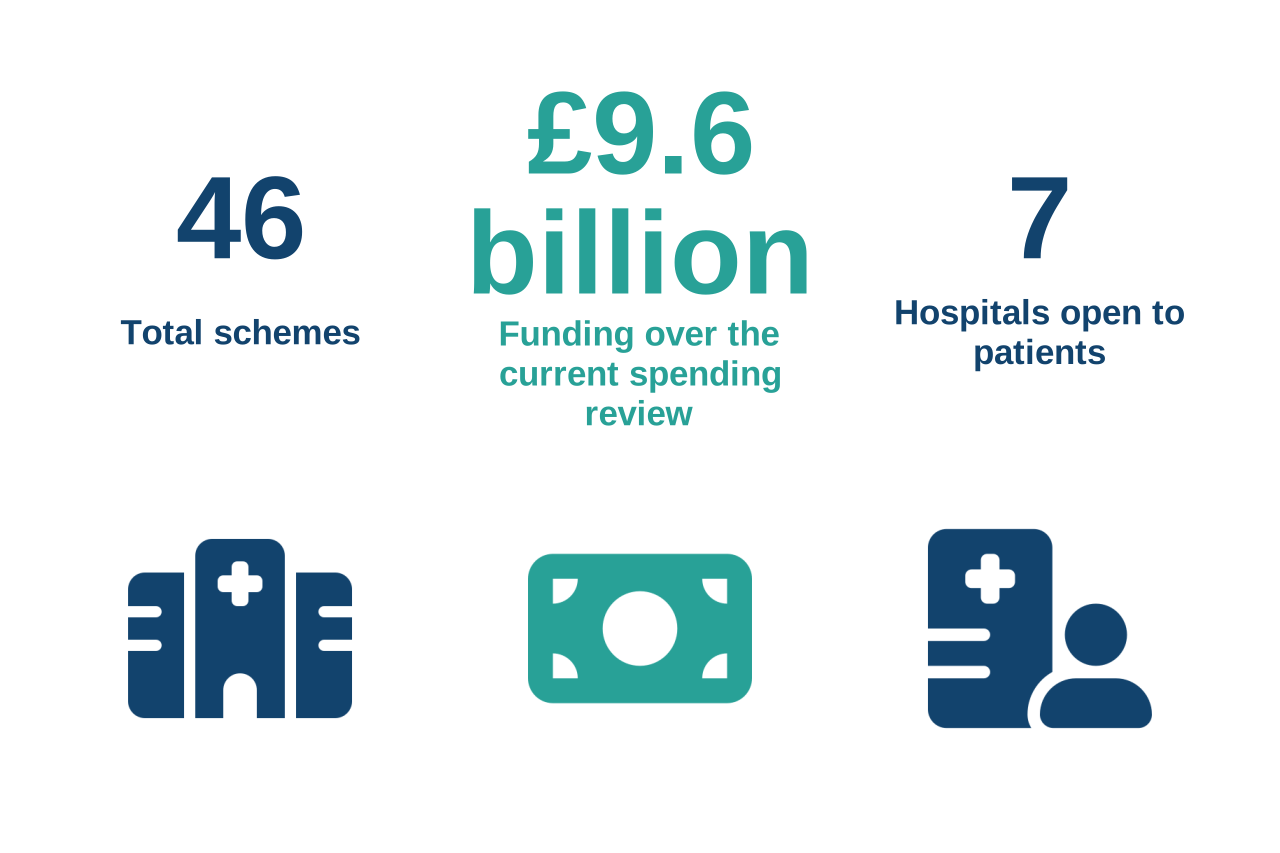
Figure 1 above is an infographic showing that the government is investing in 46 total schemes and providing £9.6 billion funding over the current spending review, and 7 hospitals are open to patients.
The lack of investment in hospital infrastructure over successive decades means much of the existing hospital estate needs rebuilding. England’s growing and ageing population will only add to the investment need as demands and pressures on hospital estates continue to increase, even as technology develops and opportunities to provide care closer to home increase.
The NHP was first established in October 2020 to deliver 40 new hospitals by 2030 and improve how new hospitals are designed, delivered and operated through a central standardised approach. However, the NHP did not have the certainty it needed to progress at pace. It was reviewed and reset in 2024 to produce a realistic timeline within the funding available, as set out in the published NHP plan for implementation.
On the basis of the new approach, the NHP was able to develop a programme business case (PBC), which was approved with funding commitments confirmed in the spring 2025 Spending Review. The government has committed to long-term investment that will increase to up to £15 billion over each consecutive 5-year wave, averaging around £3 billion a year from 2030, along with £9.6 billion over this spending review.
The PBC identifies benefits arising from new infrastructure, design, technology and increased capacity, supported by a standardised and programmatic approach to delivery. This includes improvements such as:
- more efficient patient flow
- increased diagnostic activity
- reduced staff absence and turnover
- better use of estate through standardised design and modern facilities
In addition, the NHP supports wider system benefits, including meeting future demand and delivering broader societal value through investment in critical national infrastructure.
The NHP is now fully focused on continuing to progress schemes in line with the NHP plan for implementation. At its heart is a programmatic and standardised approach, which will allow multiple hospital schemes to be delivered concurrently across the country as efficiently and effectively as possible.
This report sets out the NHP’s progress and achievements over the 2025 to 2026 financial year.
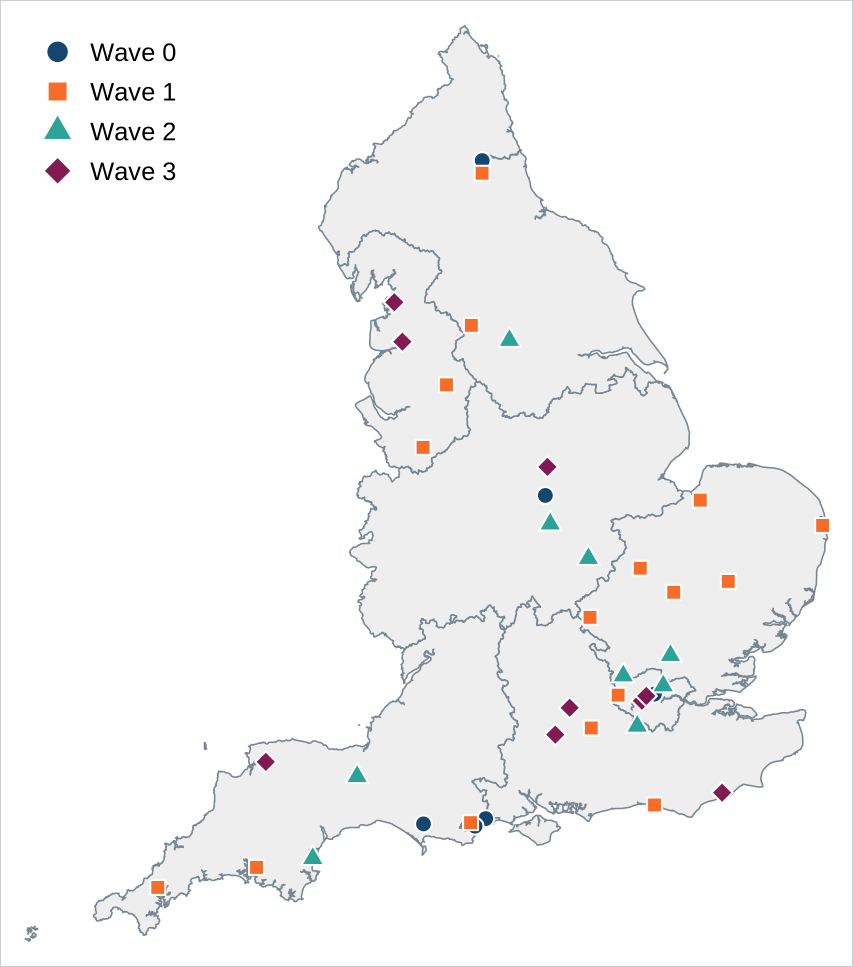
Figure 2: location of schemes by wave
Contains Ordnance Survey data.
Source: Office for National Statistics’ Open Geography Portal. NHS England Regions (January 2024) Boundaries EN BSC.
Figure 2 above is a static map of England showing NHP scheme locations by wave, using both marker colour and shape to denote each co-ordinate. The map includes 41 wave 0 to wave 3 schemes.
Each scheme is represented by one location: this may be their existing site, or the headquarters of the scheme’s operating trust. Where a scheme covers multiple sites, only one co-ordinate is shown.
For a full list of all scheme locations, see sheet ‘3: Scheme locations’ of the accompanying New Hospital Programme provisional annual data tables: 2025 to 2026.
Progress and achievements in 2025 to 2026
Scheme progress
During the 2025 to 2026 financial year, the NHP made progress across schemes at different stages of development, in line with the phased approach set out in the NHP plan for implementation.
For schemes in earlier waves, this included continued construction activity, alongside detailed development work through the business case process and pre-construction planning. A number of schemes were able to advance enabling works, including site preparation, demolition and infrastructure upgrades, supporting site readiness and reducing delivery risk.
Chris Knights, Healthier Futures Programme Director at Leighton Hospital, said:
I’m proud to say that, in this past year, we’ve moved beyond a simple trust-NHP working relationship towards the development of a ‘one team approach’ that now sees us working together for the people of mid-Cheshire. This team approach puts us in good stead as we progress with our OBC and additional site-enabling business cases.
For schemes in later waves, activity focused on early-stage development including:
- site identification
- land acquisition
- initial design and planning work
- the development of enabling works business cases
This reflects the longer-term nature of these schemes and the NHP’s approach to de-risking delivery ahead of main construction.
Across schemes, progress has been made within the framework, ensuring that delivery remains aligned to available funding, sequencing requirements and market capacity. This represents a shift from programme stabilisation following the reset to the early stages of sustained delivery. See annex A for a breakdown of progress made by individual schemes during the 2025 to 2026 financial year.
Programme achievements
Alongside scheme-level progress, the 2025 to 2026 financial year has seen further development of primary programmatic enablers, supporting a more standardised and programmatic approach to hospital delivery.
Hospital 2.0
At the centre of the NHP’s approach is H2.0, which establishes a standardised model for the design, delivery and operation of new hospitals. By introducing repeatable designs and consistent planning assumptions, H2.0 is intended to reduce variability, improve productivity and enable concurrent delivery at scale.
It is focused on speeding up the end-to-end process from concept to the opening of future NHS hospitals, while putting occupant safety and experience at its heart to significantly improve both patient and staff experience. H2.0:
- aims to deliver future-proofed estates that are designed to meet healthcare needs for at least the next 60 years
- is intended to:
- enhance safety, patient experience and efficiency through features such as single bedrooms, smart technology, sustainable construction, flexible clinical spaces and improved patient and staff flow
- support infection control, antimicrobial resistance, medicines optimisation and staff wellbeing, including protected welfare space
The H2.0 design is substantively complete, and the single bedroom prototype was tested in October 2025. Design products are continuing to be developed and refined and are being shared with trusts on an ongoing basis, with final design products due to be finalised in summer 2026.
Given H2.0 will be applied to all schemes from wave 1 onwards, it is critical that the design is clinically safe, operationally workable and fully compliant with building regulations.
Leanne Cooper, Executive Managing Director of the Royal Liverpool and Liverpool Women’s University Hospitals, said:
The move to the new Royal Liverpool University Hospital has delivered clear benefits for patients, particularly in terms of privacy, dignity and improved flexibility in how we use our beds.
Single rooms support better infection prevention and patient flow, although - like all NHS environments - we still rely heavily on our hard-working staff to follow existing processes and to adapt to different ways of working.
As with any major hospital transformation, there have been practical challenges to overcome alongside the benefits, but without doubt the new Royal provides a modern environment that supports safer, more personalised care and receives positive feedback from our patients and staff.
Hospital 2.0 Alliance
Building new hospitals requires significant market appetite and capacity. In March 2026, the NHP appointed 10 construction firms to the H2A, a multi-supplier commercial framework providing major works for hospital build, refurbishment and ancillary works. It will create optimised capacity and efficiency, and enable lessons to be learned from the repeated construction process unique to the NHP.
The H2A enables a strong approach to construction health and safety by bringing construction partners together to work collaboratively to shared standards, de-risking programme delivery and systematically creating a collaborative learning environment through which risks, lessons and operational insight can be identified and shared across schemes and future delivery waves.
Health and safety performance is regularly monitored at all levels of the NHP and routinely reported on at the NHP Programme Board, with the NHP continuing to identify opportunities to set leading practice across the sector. This underpins the NHP’s commitment to placing health and safety at its core.
The following construction partners have been appointed to the H2A:
- Bovis Construction (Europe) Limited
- Dragados Sociedad Anonima
- Integrated Health Projects
- John Graham Construction Limited
- Kier Construction Limited
- Laing O’Rourke Delivery Limited
- Morgan Sindall Construction and Infrastructure Ltd
- Sacyr UK Limited
- Skanska Construction UK Limited
- Willmott Dixon Construction Limited
By working closely with industry, the NHP is scaling up and applying more standardised, programmatic approaches to construction. Industrialisation will:
- reduce variability and waste
- standardise products, processes and data
- use machine-led production and advanced technologies
The H2A shifts away from a traditional transactional model to a long-term, sustainable and collaborative supply chain partnership. This reflects the enduring nature of the NHP and the need to deliver successive waves of construction over time.
Industrialisation and standardisation
Through the application of the Product Platform Rulebook methodology, used for the first time in public sector procurement, the NHP has standardised and aggregated demand across the NHP. In this context, demand means defining clearly what the NHP requires from the construction sector, including:
- the types of building systems needed
- the scale and volume of those systems across multiple hospitals
- when they are required
Taking this NHP-wide view has allowed the NHP to identify risks and opportunities at an early stage. Standardised systems have then been co-created with supply chain partners to reduce these risks and improve value for money across both the construction and operational life of the hospitals. Systems that have been standardised to date include partitions, doors, mechanical and electrical systems, and facades.
This approach is expected to support improved value for money by reducing variation, increasing repeatability and giving the NHP a clearer view of demand across future waves of delivery.
Health Delivery Partnership
Delivery capability was strengthened in April 2025 through the appointment of the HDP, which provides specialist technical, commercial and programme expertise.
The HDP supports co-ordination across schemes and helps embed consistent processes, improving the NHP’s ability to deliver complex infrastructure in a structured and disciplined way.
New Hospital Programme Academy
In parallel, the NHP supported the development of in-house capability through the NHP Academy, which was launched in November 2025 to provide a platform for learning and collaboration across trusts, the NHS and the supply chain.
The academy supports the development of important skills required to deliver major infrastructure programmes including in areas such as digital skills, artificial intelligence and industrialisation.
Recognition and engagement
During the year, the NHP has engaged with a wide range of stakeholders, including clinical leaders, system partners and industry, to inform the development of design standards and delivery approaches.
The NHP’s work has also been recognised externally. In July 2025, the NHP demand model received the Florence Nightingale Award for Excellence in Health and Care Analytics, reflecting its contribution to improving understanding of future healthcare demand across the NHS. This cutting-edge, NHS‑owned common model provides a robust, patient‑level approach to forecasting demand, supporting planning for the shift of care from hospital to community settings.
NAO recently recommended in its Update on the New Hospital Programme report (page 13) that DHSC should:
share and disseminate this good practice more widely across government.
This underscores the model’s value and wider applicability.
The model has:
- informed planning at national, regional and local levels
- identified opportunities to moderate demand
- supported modelling of the opportunities to move clinical care from a hospital setting to one closer to the community
Designed for use across all trusts in England, it is now applied beyond the NHP, including work to deliver aspects of the 10 Year Health Plan.
MP engagement
The NHP maintained regular engagement with MPs through a series of meetings led by the Minister of State for Health. These included sessions with MPs with a constituency interest in NHP schemes in waves 1, 2 and 3 in June 2025, and a further session with wave 1 MPs in November 2025.
The minister also wrote to all MPs with a constituency interest in wave 1 schemes in April 2025, and to those with a constituency interest in waves 2 and 3 in December 2025 to provide updates on NHP activity.
These engagements provided a regular opportunity for MPs to raise constituency issues and seek clarification on delivery plans, supporting ongoing communication with Parliament as the NHP progressed.
Engagement events
The NHP recognises the importance of ensuring that new designs meet the future needs of patients, staff and clinicians, and has undertaken extensive engagement from the outset.
Feedback from NHS staff and service users has informed the development of H2.0, covering:
- clinical design
- staff welfare spaces
- estate management
- digital requirements
- operational processes
We have received contributions from:
- major teaching hospitals
- professional bodies
- royal colleges
- national specialist advisers
- international health experts
The NHP has also continued to capture lived experience through engagement events, including clinical workshops, patient voice workshops, and feedback from royal colleges and chief nurses.
International engagement
The NHP has engaged with a range of countries to learn from and share international best practice, including:
- Australia
- Bulgaria
- Canada
- Denmark
- Finland
- Norway
- Saudi Arabia
- Singapore
Alongside this, the NHP has engaged with companies overseas to attract international partners and increase construction capacity in the UK. This targeted approach has enabled the NHP to draw on the most relevant global experience to strengthen its own methodology, while also attracting interest from other countries seeking to learn from the NHP’s innovative work.
Lessons learned from completed schemes
A programmatic approach enables the NHP to incorporate lessons from completed schemes into future designs, ensuring each wave reflects best practice from across the healthcare system. Where early schemes include elements of H2.0, such as single room designs, the NHP is working with trusts to capture lessons learned and apply them to future schemes.
The NHP has drawn important lessons from early schemes, including the significant challenges created by contractor failure, such as the collapse of Carillion on the Midland Metropolitan University Hospital and Royal Liverpool University Hospital schemes. The support provided to move these schemes from delayed construction to completion has enabled lessons to be shared at a programmatic level.
Programme performance and assurance
The NHP remains part of the GMPP and is subject to regular assurance and audit activity. During the 2025 to 2026 financial year, external scrutiny of the NHP included:
- a Government Internal Audit Agency audit (June to August 2025)
- the NAO’s ‘Update on the New Hospital Programme’ report (June 2025 to January 2026)
- a Public Accounts Committee hearing providing oral evidence on the NHP update (February 2026)
- a NISTA project assessment review (March 2026)
NHP Programme Board
During this reporting period, 9 meetings of the NHP Programme Board - the main oversight and assurance vehicle for the NHP - were held and an additional one conducted by correspondence only.
Over the year, the board has evolved, with meetings shifting from monthly to quarterly and the chair transitioning from the joint senior responsible owners to an NHS England non-executive director. Membership has also expanded to include additional senior stakeholders from both NHS England and DHSC.
The board has provided challenge, scrutiny, advice, guidance and decision making to ensure the NHP remains aligned with its intended objectives.
Developing proposals for the NHP to support investment decisions
The NHP continues to make progress across approvals, construction and openings.
Figure 3: NHP milestones
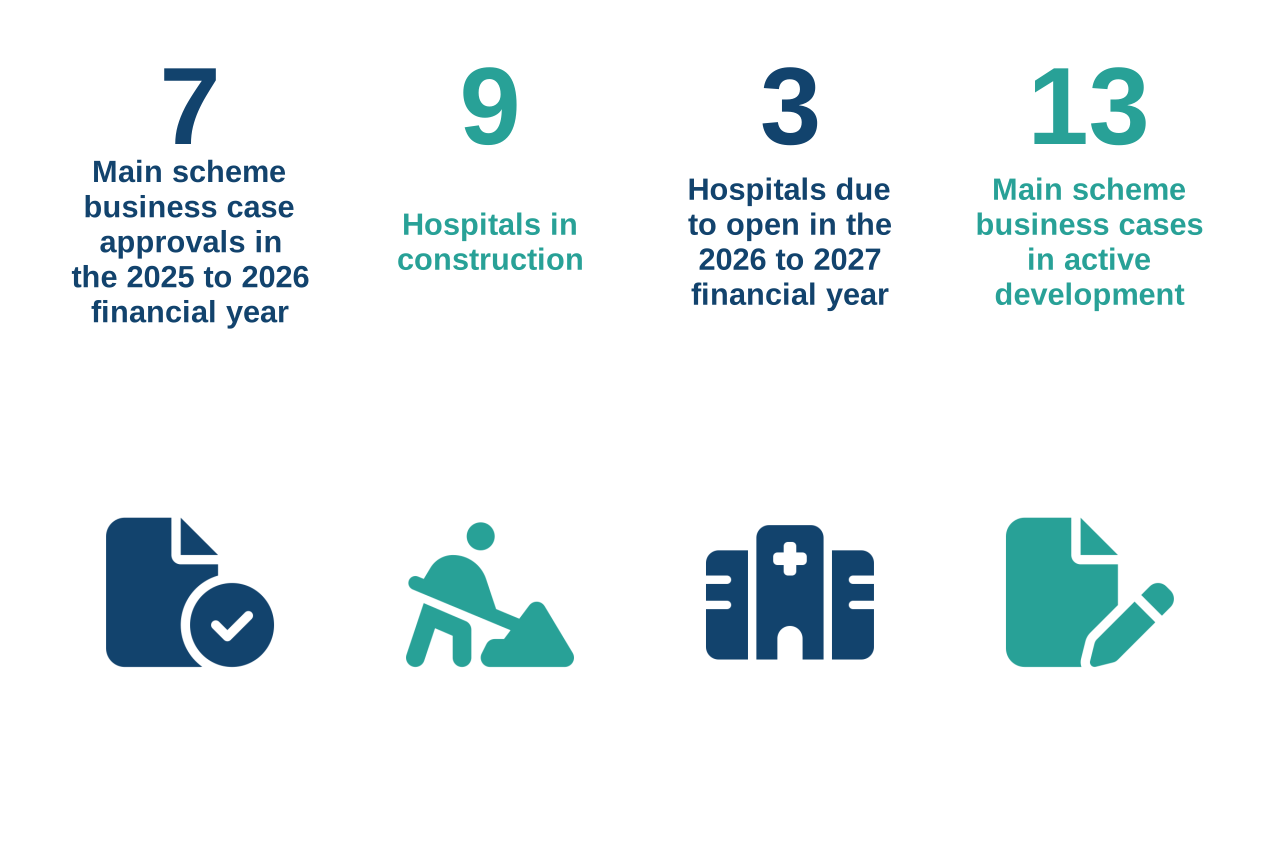
Figure 3 above is an infographic showing that, in the 2025 to 2026 financial year, 7 main scheme business cases were approved. This includes 4 strategic outline cases (SOCs) and 3 full business cases (FBCs). Another 13 are in active development, with 9 hospitals in construction.
The NHP is supporting trusts to develop all required business cases to enable main construction to begin, demonstrating value for money and deliverability. The business case process agreed between DHSC, NHS England and HM Treasury (HMT) provides a consistent approach, clarifying roles and responsibilities and accelerating approvals wherever possible.
Each individual hospital scheme will require 3 business cases with increasing levels of detail as plans develop - these are as follows:
- SOC
- outline business case (OBC)
- FBC
Cases are prepared in line with HMT’s The Green Book investment appraisal guidance, and will need to go through a rigorous independent scrutiny and approval process. For more information on the business case process and approval stages, see annex B.
Across all waves of delivery, the NHP has made significant progress over the last year.
Several wave 0 and 1 schemes have moved further through the business case and delivery process
Figure 4: governance status of wave 0 and 1 schemes, April 2025 and March 2026
| Governance status | April 2025 | March 2026 |
|---|---|---|
| SOC | 6 | 2 |
| OBC | 6 | 10 |
| FBC | 4 | 1 |
| Delivery phase | 6 | 9 |
| Complete | 1 | 1 |
Note on figure 4: Alumhurst Road Children’s Mental Health Unit, Dorset (Seastone) completed construction in May 2026, and St Ann’s Hospital, Dorset completed construction in April 2026. Both were in the Delivery phase in March 2026.
The grouped bar chart in figure 4 shows that, between April 2025 and March 2026, the number of wave 0 and 1 schemes in SOC and FBC stages fell, while the number in OBC and delivery phase rose. The majority of schemes in April 2025 were in the SOC, OBC and delivery phases (each with 6 schemes). By March 2026, most schemes were in the OBC stage (10 schemes) and delivery phase (9 schemes).
Table 1: governance status of wave 0 and 1 schemes, April 2025 and March 2026
| Scheme name | Scheme status: April 2025 | Scheme status: March 2026 |
|---|---|---|
| Airedale General Hospital (RAAC) | SOC development | SOC assurance |
| Frimley Park Hospital (RAAC) | SOC development | SOC assurance |
| Hinchingbrooke Hospital (RAAC) | SOC development | OBC development |
| James Paget Hospital, Great Yarmouth (RAAC) | SOC development | OBC development |
| Leighton Hospital (RAAC) | SOC development | OBC development |
| Queen Elizabeth Hospital, King’s Lynn (RAAC) | SOC development | OBC development |
| Hillingdon Hospital, North West London | OBC development | OBC development |
| Milton Keynes Hospital | OBC development | OBC development |
| North Manchester General Hospital | OBC development | OBC development |
| Shotley Bridge Community Hospital, Durham | OBC development | OBC development |
| West Suffolk Hospital, Bury St Edmunds (RAAC) | OBC development | OBC development |
| Women and Children’s Hospital, Cornwall | OBC development | OBC development |
| Cambridge Cancer Research Hospital | FBC development | FBC development |
| Brighton 3Ts Hospital (Sussex Cancer Centre) | FBC development | Delivery phase |
| Derriford Emergency Care Hospital, Plymouth | FBC development | Delivery phase |
| Poole Hospital, Dorset | FBC development | Delivery phase |
| Alumhurst Road Children’s Mental Health Unit, Dorset (Seastone) | Delivery phase | Delivery phase |
| Dorset County Hospital, Dorchester | Delivery phase | Delivery phase |
| National Rehabilitation Centre (NRC) | Delivery phase | Delivery phase |
| Oriel Eye Hospital | Delivery phase | Delivery phase |
| Royal Bournemouth Hospital, Dorset | Delivery phase | Delivery phase |
| St Ann’s Hospital, Dorset | Delivery phase | Delivery phase |
| CEDAR Programme | Complete | Complete |
Notes on table 1:
- ‘RAAC’ indicates that there is reinforced autoclaved aerated concrete present in the scheme.
- This table excludes phase 1 of the Brighton 3Ts scheme, the Louisa Martindale building, which is already complete and opened to patients.
- For more information on how scheme status is defined, see annex B.
Delivery and strategic priorities for 2026 to 2027
Planned deliverables for the 2026 to 2027 financial year
The NHP will continue to progress schemes in line with the NHP plan for implementation, while recognising that delivery expectations may be subject to change depending on local and national factors. The NHP reserves the right to adjust the delivery plan as schemes develop.
Wave 1
Wave 1 schemes will continue to progress to the construction dates set out in the NHP plan for implementation.
Two schemes, the new Sussex Cancer Centre (Brighton) and Poole Hospital (Dorset), will continue construction of their schemes.
The remaining schemes, including the 7 RAAC replacement hospitals, will continue to progress through the detailed design and development work for their main schemes to ensure plans represent value for taxpayers’ money and meet the needs of local communities.
Roxanne Smith, Chief Strategy Officer of University Hospitals Sussex’s Brighton 3Ts scheme, said:
Our partnership with NHP to build the new Sussex Cancer Centre in Brighton is enabling us to transform patient care, experience and research for a population of nearly 2 million people. The positive engagement and support received from NHP over the past year have enabled us to maintain momentum and progress our quarter-of-a-billion-pound scheme at pace.
As a wave 1 project, we are proud to be part of this wider national effort, and look forward to sharing our experiences and lessons learned with other trusts as their schemes develop with the support of NHP.
Most schemes in wave 1 are developing their OBC, which is where the following will be determined:
- value for money of the preferred option
- the procurement approach
- further design development
- the investment expected to be needed to deliver the proposed scheme
The FBC develops the detailed planning even further to include:
- the final designs
- contract details
- confirmation of the funding required to deliver the scheme
- the major milestones for delivery
While the main scheme business case is in development, further activity will be undertaken to prepare sites for main construction. This will include a range of activity including:
- multi-storey car parks
- land purchases
- development of energy centres
- demolitions
Many of the above will need their own business cases so that this work can be approved and delivered while the main scheme business case is being developed and agreed.
The NHP continues to support individual trusts as their plans develop, including:
- opportunities to deliver priorities set out in the 10 Year Health Plan
- working closely with local integrated care boards and NHS England regional teams to ensure new hospitals will meet the needs of local communities in the future
Wave 2
Wave 2 schemes are at an earlier stage of development, with main construction scheduled to start between 2030 and 2035, in line with the NHP plan for implementation.
Activity in the 2026 to 2027 financial year will therefore focus on early works to support scheme readiness and de-risk future delivery. More broadly, this includes making progress on enabling infrastructure such as energy centres, alongside decant, demolition and site preparation activity where approved. In parallel, schemes will continue to develop and seek approval for business cases to support these works.
Given the early stage of development, the scope and pace of activity will vary across schemes and will continue to be kept under review.
Wave 3
As main construction of schemes is expected to start between 2035 and 2039, there is focus on early pre-construction work to de-risk the delivery of schemes, where it is prudent to complete this at this stage.
Across the wave, planned deliverables focus on making progress on enabling works and addressing important site dependencies.
NHP continues to progress schemes in line with the NHP plan for implementation, and it will work closely with individual trusts to support readiness for construction as quickly as possible. Given the early stage of development, the scope and pace of activity will vary across schemes and will continue to be kept under review.
Professor Silas Nicholls, Chief Executive of Lancashire Teaching Hospitals NHS Foundation Trust, said:
Completing the final stage of land acquisition for the proposed site for the replacement Royal Preston Hospital in March 2026, supported through the New Hospital Programme, was a hugely important milestone for us as a trust, recognising that any decision about a new hospital will be subject to full public consultation and the necessary approvals.
Securing the land allows us to continue developing plans for a modern facility that could significantly improve care for our communities.
Investment through the New Hospital Programme has been instrumental in enabling us to take forward these ambitious plans, strengthening our partnerships and giving us greater confidence in delivering high-quality, future-ready services for our population.
Funding
Funding was provided across all waves of delivery during the 2025 to 2026 financial year
Figure 5: New Hospital Programme funding by wave, wave 0 to 3 (£ million)
| Wave | Funding to date (£ million) | Funding in 2025 to 2026 (£ million) |
|---|---|---|
| Wave 0 | 687 | 227 |
| Wave 1 | 696 | 250 |
| Wave 2 | 261 | 44 |
| Wave 3 | 186 | 61 |
Notes on figure 5:
- Figure 5 excludes pre-wave 0 schemes that are complete and any funding provided pre-April 2021 when the NHP was formed.
- Funding in the 2025 to 2026 financial year is provisional subject to accounts finalisation. For more information, see annex B.
Figure 5 above is a grouped bar chart showing NHP funding by wave. It compares total funding to date with funding in the 2025 to 2026 financial year.
Funding was provided across all waves of delivery during the 2025 to 2026 financial year. The majority of this funding was to support detailed scheme development and main build construction for wave 0 and wave 1 schemes.
However, some funding was also provided to wave 2 and wave 3 schemes for necessary enabling works and to purchase land. This was to ensure that these schemes are ready to start construction when these waves of delivery begin.
Since the 2021 to 2022 financial year when the NHP was established, £1,830 million has been provided to trusts, with the majority of that delivering wave 0 and wave 1 schemes.
In addition, pre-wave 0 schemes, which are now all completed, received £17 million of funding in the 2025 to 2026 financial year, with their NHP funding totalling £684 million since the 2021 to 2022 financial year. A breakdown of funding provided to these schemes is available in the accompanying ‘New Hospital Programme provisional annual data tables: 2025 to 2026’.
Table 2: wave 0 provisional scheme funding and cost estimate (£ million)
| Scheme | NHP funding provided in the 2025 to 2026 financial year | Total NHP funding provided to date | Total cost estimate |
|---|---|---|---|
| Alumhurst Road Children’s Mental Health Unit, Dorset (Seastone) | 11 | 21 | 500 or less |
| CEDAR Programme | Less than 1 | 62 | Not applicable |
| Dorset County Hospital, Dorchester | 20 | 39 | 500 or less |
| National Rehabilitation Centre (NRC) | 8 | 96 | Not applicable |
| Oriel Eye Hospital | 95 | 248 | Not applicable |
| Royal Bournemouth Hospital, Dorset | 79 | 196 | 500 or less |
| St Ann’s Hospital, Dorset | 13 | 25 | 500 or less |
Table 3: wave 1 provisional scheme funding and cost estimate (£ million)
| Scheme | NHP funding provided in the 2025 to 2026 financial year | Total NHP funding provided to date | Total cost estimate |
|---|---|---|---|
| Airedale General Hospital (RAAC) | 21 | 36 | 1,000 to 1,500 |
| Brighton 3Ts Hospital | 39 | 150 | Not applicable |
| Cambridge Cancer Research Hospital | 12 | 39 | 500 or less |
| Derriford Emergency Care Hospital, Plymouth | 42 | 81 | 500 or less |
| Frimley Park Hospital (RAAC) | 8 | 17 | 1,500 to 2,000 |
| Hillingdon Hospital, North West London | 12 | 56 | 1,000 to 1,500 |
| Hinchingbrooke Hospital (RAAC) | 18 | 26 | 501 to 1,000 |
| James Paget Hospital, Great Yarmouth (RAAC) | 11 | 31 | 1,000 to 1,500 |
| Leighton Hospital (RAAC) | 12 | 29 | 1,000 to 1,500 |
| Milton Keynes Hospital | 27 | 53 | 500 or less |
| North Manchester General Hospital | 12 | 83 | 1,000 to 1,500 |
| Poole Hospital, Dorset | 5 | 8 | 500 or less |
| Queen Elizabeth Hospital, King’s Lynn (RAAC) | 10 | 19 | 1,000 to 1,500 |
| Shotley Bridge Community Hospital, Durham | 1 | 4 | 500 or less |
| West Suffolk Hospital, Bury St Edmunds (RAAC) | 12 | 39 | 1,000 to 1,500 |
| Women and Children’s Hospital, Cornwall | 6 | 25 | 500 or less |
Table 4: wave 2 provisional scheme funding and cost estimate (£ million)
| Scheme | NHP funding provided in the 2025 to 2026 financial year | Total NHP funding provided to date | Total cost estimate |
|---|---|---|---|
| Kettering General Hospital | 19 | 30 | 1,000 to 1,500 |
| Leeds General Infirmary | 0 | 44 | 1,500 to 2,000 |
| Leicester Royal Infirmary, Leicester General Hospital and Glenfield Hospital | 5 | 16 | 1,000 to 1,500 |
| Musgrove Park Hospital, Taunton | 0 | 8 | 501 to 1,000 |
| Specialist Emergency Care Hospital, Sutton | Less than 1 | 27 | 1,500 to 2,000 |
| The Princess Alexandra Hospital, Harlow | 1 | 6 | 1,500 to 2,000 |
| Torbay Hospital, Torquay | 0 | 7 | 501 to 1,000 |
| Watford General Hospital | 6 | 82 | 1,500 to 2,000 |
| Whipps Cross University Hospital, North East London | 13 | 42 | 1,000 to 1,500 |
Table 5: wave 3 provisional scheme funding and cost estimate (£ million)
| Scheme | NHP funding provided in the 2025 to 2026 financial year | Total NHP funding provided to date | Total cost estimate |
|---|---|---|---|
| Charing Cross Hospital and Hammersmith Hospital, London | 0 | 5 | 1,500 to 2,000 |
| Eastbourne District General, Conquest Hospital and Bexhill Community Hospital | 0 | 9 | 1,500 to 2,000 |
| Hampshire Hospitals | 25 | 35 | 2,000 or more |
| North Devon District Hospital, Barnstaple | 6 | 25 | 1,000 to 1,500 |
| Royal Berkshire Hospital, Reading | 1 | 8 | 2,000 or more |
| Royal Lancaster Infirmary | 0 | 62 | 1,000 to 1,500 |
| Royal Preston Hospital | 19 | 19 | 2,000 or more |
| St Mary’s Hospital, North West London | 10 | 17 | 2,000 or more |
| The Queen’s Medical Centre (QMC) and Nottingham City Hospital | 0 | 5 | 2,000 or more |
Notes on tables 2 to 5 above:
- All funding figures are provisional as the final funding provided in the 2025 to 2026 financial year will be subject to accounts finalisation. See annex B for more information and an explanation of how NHP funding has been calculated.
- ‘Total NHP funding to date’ includes all funding from the 2021 to 2022 financial year to the latest financial year (2025 to 2026). Some NHP schemes had already received funding prior to the NHP being established, and some schemes consist of more than one hospital or phase (for example, Brighton 3Ts scheme includes the Louisa Martindale building and the Sussex Cancer Centre). For more information, see the accompanying ‘New Hospital Programme provisional annual data tables: 2025 to 2026’.
- The ‘Total cost estimate’ represents the total estimated cost of each full scheme as reported in the NHP plan for implementation in January 2025. ‘Not applicable’ means no cost estimate was provided as the scheme costs were announced before the establishment of the NHP in October 2020.
- ‘RAAC’ indicates that there is reinforced autoclaved aerated concrete present in the scheme.
- Figures are rounded to the nearest million.
Annex A: individual scheme progress during the 2025 to 2026 financial year
Table 6: wave 0 progress
| Scheme | Progress made during the 2025 to 2026 financial year |
|---|---|
| Alumhurst Road Children’s Mental Health Unit, Dorset (Seastone) | In construction, completed construction in May 2026 |
| CEDAR Programme | Completed, opened to patients in August 2025 |
| Dorset County Hospital, Dorchester | In construction, groundbreaking ceremony in June 2025 |
| National Rehabilitation Centre (NRC) | A ministerial visit was held on 3 November 2025 to mark construction complete |
| Oriel Eye Hospital | In construction |
| Royal Bournemouth Hospital, Dorset | In construction, topping out ceremony of COAST building in June 2025 |
| St Ann’s Hospital, Dorset | In construction, completed construction in April 2026 |
Note on table 6: St Ann’s Hospital, Dorset and Alumhurst Road, Dorset are both expected to be open to patients by the time of publication - however, this report reflects progress only up to the end of March 2026.
Table 7: wave 1 progress
| Scheme | Progress made during the 2025 to 2026 financial year |
|---|---|
| Airedale General Hospital (RAAC) | SOC assurance continued |
| Brighton 3Ts (Sussex Cancer Centre) | Main construction started |
| Cambridge Cancer Research Hospital | FBC development continued |
| Derriford Emergency Care Hospital, Plymouth | Construction started |
| Frimley Park Hospital (RAAC) | SOC assurance continued |
| Hillingdon Hospital, North West London | OBC development continued |
| Hinchingbrooke Hospital (RAAC) | SOC approved and OBC development continued |
| James Paget Hospital, Great Yarmouth (RAAC) | SOC approved and OBC development continued |
| Leighton Hospital (RAAC) | SOC approved in March 2026 and OBC development continued, electrical capacity enabling works started |
| Milton Keynes Hospital | OBC development continued |
| North Manchester General Hospital | OBC development continued |
| Poole Hospital, Dorset | Main construction started |
| Queen Elizabeth Hospital, King’s Lynn (RAAC) | SOC approved and OBC development continued |
| Shotley Bridge Community Hospital, Durham | OBC development continued |
| West Suffolk Hospital, Bury St Edmunds (RAAC) | OBC development continued |
| Women and Children’s Hospital, Cornwall | OBC development continued |
Notes on table 7:
- Brighton 3Ts (Sussex Cancer Centre) and Poole Hospital, Dorset are expected to be in construction by the time of publication - however, this report reflects progress only up to the end of March 2026.
- ‘RAAC’ indicates that there is reinforced autoclaved aerated concrete present in the scheme.
Table 8: wave 2 progress
| Scheme | Progress made during the 2025 to 2026 financial year |
|---|---|
| Kettering General Hospital | Enabling works, including building a new energy centre and upgrading the power supply to the hospital site were approved and construction work began. Continued progress on the multi-storey car park business case |
| Leeds General Infirmary | Continued work to secure power supply for the scheme |
| Leicester Royal Infirmary, Leicester General Hospital and Glenfield Hospital | Enabling works FBC approved in November 2025 |
| Musgrove Park Hospital, Taunton | Limited activity |
| Specialist Emergency Care Hospital, Sutton | Continued work to secure power supply and land for the scheme |
| The Princess Alexandra Hospital, Harlow | Continued work to secure land for the scheme |
| Torbay Hospital, Torquay | Limited activity |
| Watford General Hospital | NHP supported trust with enabling works business cases for vacuum-insulated evaporator relocation, removal of the Granger ward, securing the power supply, and the decant and demolition of the Pathology and Medical Assessment Unit |
| Whipps Cross University Hospital, North East London | Multi-storey car park opened in November 2025 |
Table 9: wave 3 progress
| Scheme | Progress made during the 2025 to 2026 financial year |
|---|---|
| Charing Cross Hospital and Hammersmith Hospital, London | Limited activity |
| Eastbourne District General, Conquest Hospital and Bexhill Community Hospital | Limited activity |
| Hampshire Hospitals | Land needed for the new hospital site purchased in March 2026 |
| North Devon District Hospital, Barnstaple | Continued to make progress on masterplanning and planning permission |
| Royal Berkshire Hospital, Reading | Continued to make progress on masterplanning and planning permission |
| Royal Lancaster Infirmary | Limited activity |
| Royal Preston Hospital | Additional land needed for the new hospital site purchased in March 2026 |
| St Mary’s Hospital, North West London | Continued to make progress on masterplanning and planning permission |
| The Queen’s Medical Centre (QMC) and Nottingham City Hospital | Limited activity |
Annex B: methodology note
Provisional data
All funding figures are provisional as the final funding provided in the 2025 to 2026 financial year will be subject to accounts finalisation.
Funding data
What the funding figures include
All NHP funding figures presented in this report represent the total of:
- net public dividend capital (PDC) support provided to a scheme by DHSC through the NHP (which will be published in the ‘Financial assistance under section 40 of the National Health Service Act 2006’ (section 40) report alongside the ‘DHSC annual report and accounts: 2025 to 2026’ later this year)
- capital loan support
- capital departmental expenditure limit (CDEL)-only support
Central programme contingency and any charitable donations are excluded from all funding figures provided.
How the funding figures are calculated
To calculate these figures, the NHP finance team performs an annual exercise after the year end to reconcile the figures reported in the section 40 reports with the figures submitted. At year end, all funding issued must be fully reconciled, including:
- PDC
- CDEL adjustments
- loan funding and repayments
- technical adjustments
The reconciliation aligns 4 core data sets:
- section 40 report (government position)
- trust annual accounts
- NHP memorandum of understanding (MoU) tracker (internal record)
- capital and cash outturn and month 13 financial position
This process provides:
- assurance to the NHP Finance Sub-Committee in NHS England that funding records are accurate
- transparency in the use of public funding
- evidence to support audit and external scrutiny
- early identification and resolution of discrepancies
This exercise produces a set of ‘approved’ numbers that are then used for all scheme reporting going forward. The reconciled numbers are finalised through a final approval process.
Scheme status data
Each hospital scheme progresses through a series of business case stages as plans become more detailed. These stages are as follows:
- SOC development.
- SOC assurance.
- OBC development.
- OBC assurance.
- FBC development.
- FBC assurance.
- Delivery phase.
- Complete.
In addition, the business case process for the main construction of schemes moves through 4 approval stages, covering development activity such as demand modelling, outline design and planning.
NHP first works with trusts to co-produce their business case, ensuring it is aligned with DHSC and NHS England regional requirements, before NHP and NHS England confirm it is ready for independent assurance by DHSC and NHS England.
The business case is then submitted to the DHSC and NHS England Joint Investment Committee ahead of onward approval.
Ministerial approval is required for SOCs, while both ministerial and HMT approval are required for OBCs and FBCs. Total scheme costs remain indicative until FBC approval.
In this publication, schemes are recorded as being in the ‘development’ stage of a business case while the business case is being prepared with the trust. Schemes are recorded as moving from ‘development’ to ‘assurance’ once the business case has been submitted to the DHSC and NHS England Joint Investment Committee.
A scheme is recorded as having completed a business case stage once it has received all relevant approvals for that stage. Once a business case stage has been approved, the scheme moves to the development stage of the next business case.
Schemes are recorded as entering the ‘delivery phase’ once their FBC has been approved. Schemes are recorded as ‘complete’ once they are open to patients.
The scheme status data presented in this report was collected through internal programme reporting. The business case stage recorded for each scheme reflects the position reported through this process as of March 2026.
Revisions and corrections
This publication contains provisional data that is yet to be finalised. Once final figures are available, any changes will be published separately as a data table release and signposted from this report.
Where any subsequent changes are minor, updated figures will be incorporated into the next annual publication. We do not plan to publish a scheduled revision of this report.
Any revisions will be made in line with the DHSC statement on revisions and corrections policy and the National Archives’ How to correct a laid paper guidance.
Any unscheduled or substantial revisions that do not fit into the DHSC statistics scheduled revisions criteria will be highlighted accordingly.
Use of icons
The infographics in this publication use icons from Font Awesome Free by Fonticons, Inc., licensed under Creative Commons Attribution 4.0.