
1. Overview of nature-based solutions for water resources
Published 17 August 2026
Applies to England

© Crown copyright 2026
This publication is licensed under the terms of the Open Government Licence v3.0 except where otherwise stated. To view this licence, visit nationalarchives.gov.uk/doc/open-government-licence/version/3 or write to the Information Policy Team, The National Archives, Kew, London TW9 4DU, or email: psi@nationalarchives.gov.uk.
Where we have identified any third party copyright information you will need to obtain permission from the copyright holders concerned.
This publication is available at https://www.gov.uk/government/publications/nature-based-solutions-for-water-resources-handbook/1-overview-of-nature-based-solutions-for-water-resources
This guide explains what nature-based solutions (NbS) are and how they support water resources. Use it to understand how NbS work and which types may be suitable for your catchment.
1. What are nature-based solutions (NbS) for water resources
Definition of NbS
NbS are defined by the EU Commission as:
solutions that are inspired and supported by nature, which are cost-effective, simultaneously provide environmental, social and economic benefits and help build resilience. Such solutions bring more, and more diverse, nature and natural features and processes into cities, landscapes and seascapes, through locally adapted and systemic interventions.
NbS can limit the impacts of climate change, while simultaneously improving biodiversity and providing a range of other social and economic benefits.
They provide more integrated and sustainable solutions, and can support the protection, restoration and management of natural and semi-natural ecosystems.
Aims of NbS for water resources
NbS for water resources improve the resilience of the water environment using ecosystem services.
They work with natural processes, designed to emulate and manage natural processes by working with the water cycle to encourage water storage and infiltration.
There are 3 main aims of NbS for water resources:
- improving groundwater resources
- improving low flows in rivers
- improving resilience to drought in the land and water environments
You can modify features of the water cycle to achieve these aims.
See more information on the Environment Agency’s position statement on NbS to support sustainable water resources.
2. How to approach NbS for water resources
Protect existing natural systems
NbS are designed to emulate and manage natural processes, but most benefits derived from the landscape are from systems and processes that already exist.
Where you have identified existing well-functioning systems, you should focus on prioritising, maintaining and preserving these systems in any water resource management programme.
For example, protecting the excellent soil structure and health of a historic meadow acts on the same part of the water cycle as enhancing the degraded soil structure of an arable field. Protecting this existing system has minimal impact and supports a wide range of co-benefits.
Target interventions for maximum impact
The greatest system-wide benefits from NbS are achieved through large-scale, upstream interventions which can address multiple challenges simultaneously, such as:
- upland land management
- sustainable drainage systems (SuDS)
Therefore, NbS should be viewed as a mechanism for improving whole-system water resilience, rather than addressing individual issues in isolation.
As with conventional infrastructure, achieving reliable outcomes depends on selecting the right solution in the right place. To maximise NbS benefits, you need to design solutions around the characteristics of a place and deliver them at an appropriate scale, typically the catchment scale.
Effective schemes work with natural hydrological, hydrogeological and geomorphological processes and deliver the greatest downstream impact. For example, recharge is common across the upper reaches of a catchment compared to the discharge areas of lower catchments, which should influence NbS installation.
You should design schemes to be resilient, adaptive and, where possible, low maintenance over the long term.
Understand the NbS spectrum
Understanding the NbS spectrum can help you during decision making, for example, between 2 NbS which either restore or manage a natural process.
At one end of the spectrum, NbS seek to protect and use existing ecosystem services or restore and rehabilitate degraded natural processes. These NbS are implemented over longer periods, at larger scales and achieve multiple benefits. You should prioritise these types of interventions where possible.
At the other end of the spectrum, NbS manage the development of new services copying natural processes. These NbS are implemented faster and over smaller scales, but they achieve fewer benefits comparatively.
For more information on the NbS spectrum, see Figure 1-6 in Appendix 3: NbS for water resources technical handbook.
3. Benefits of NbS
NbS have multiple social, environmental and economic co-benefits that can support many environmental objectives alongside water resources.
Water resources benefits
NbS provide multiple water resources benefits including:
- increased groundwater recharge through improved infiltration
- increased catchment storage and the increase of low flows
- better water quality through natural filtration – water stored in soil, ground or held on floodplains can deposit silt and undergo physical and biological filtration, removing sediments, heavy metals and nutrients
This protects groundwater from contamination and reduces turbidity in downstream water.
Economic benefits
Once established, NbS often provide cost-effective benefits with minimal maintenance compared to traditional engineered measures. They can be more cost-effective than alternatives and offer various funding opportunities through multiple policy drivers and environmental programmes.
Environmental benefits
NbS provide extensive environmental co-benefits including:
- climate change adaptation
- mitigations to future droughts
- natural flood management
- microclimate regulation
- enhanced biodiversity and nature recovery
- carbon capture
- improved resilience of agricultural and fisheries industries
- restoring natural processes
4. Types of NbS and outcomes for water resources
Different types of NbS work on different scales. You should consider these differences when considering options for NbS implementation.
Some types may be implemented across a range of different settings or be more spatially constrained, and some may be more fast-acting than others.
For example, soil, land management and land cover measures could be implemented over a larger area, so therefore they have the potential to have the greatest impact. There is an assumption that more spatially constrained measures such as floodplain restoration have less potential to be implemented at scale, so they may have fewer water resources benefits.
However, these assumptions are not supported by detailed scientific study. We need to better understand which suites of NbS have the greatest impact on water resources and at what scale they need to be implemented to have an impact. Projects should aim to fill this gap in scientific knowledge, if possible. We list our recommendations for future work in section 7.
For guidance on selecting an NbS option, see NbS for water resources: plan your project.
For further discussion around the benefits and disbenefits of NbS for water resources, read the associated literature review.
Soil and land management NbS
Soil and land management NbS aim to assist natural recovery and reverse the impacts of past land management practices through restoring or imitating natural processes.
Table 1 describes the different soil and land management NbS which could be implemented and the types of water resources benefits they could provide.
Table 1: Soil and land management NbS and their water resources benefits
| NbS name | NbS description | Main outcomes for water resources |
|---|---|---|
| Soil and land management | Includes soil aeration and subsoiling. In arable systems, includes conservation tillage, early sowing winter crops and cover crops, and crop rotation. |
Outcomes include improved soil health and structure, increased surface roughness, capturing runoff on the surface and allowing infiltration and recharge. |
| Change in land use cover | Includes altering stocking density and changing vegetation cover in grassland systems. Includes agricultural landscape features such as planting hedgerows and including buffer strips. |
Outcomes include reduced evaporation and transpiration, reduced interception of rainfall, reduced irrigation demands, improved soil health structure, increased surface roughness, capturing runoff on the surface and allowing infiltration and recharge. |
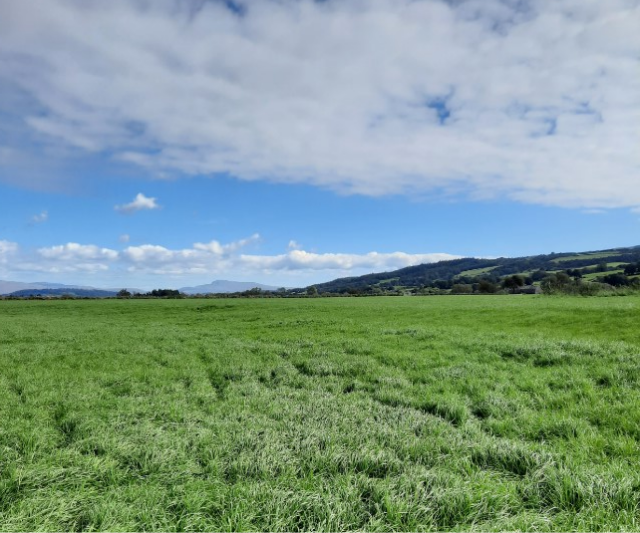
Change in land use cover in a grassland system. Source: WWNP evidence base, 2017.
Scale of impact and implementation
These interventions can be implemented on most rural land in England, with potential to be implemented nationally. This depends on the ability of farmers and land managers to change their land management activities and may require access to financial incentives. For more information on funding, see section 8 in NbS for water resources: plan your project.
Each soil and land management intervention takes different lengths of time to be effective, with most being effective between 0 to 5 years. Some measures will be faster than others. For example, restoring hedgerows and soil structure will take longer than installing buffer strips or changing plantation practices.
Woodland NbS
Woodland NbS can implement the restoration of natural processes or assist in natural recovery.
Table 2 describes the different sorts of woodland NbS which could be implemented and the types of water resources benefits which they could provide.
Table 2: Woodland NbS and their water resources benefits
| NbS name | NbS description | Main outcomes for water resources |
|---|---|---|
| Catchment woodland | Catchment woodland is the total area of all woodland within a catchment. It combines general woodland cover of all types and species, including plantations, plus specific forms where present, such as cross-slope, riparian and floodplain woodland. | Outcomes include reduced irrigation demands, improved soil health and structure, and increased surface roughness. |
| Floodplain and riparian woodlands | Floodplain and riparian woodland include woodland lying within the fluvial floodplain and within the riparian corridor. It is subject to an intermittent, regular planned or natural flooding regime. It typically comprises broadleaved woodland and can range from productive woodland on drier, intermittently flooded, areas to unmanaged, native wet woodland in wetter areas. | Outcomes include reduced irrigation demands, improved soil health and structure, and increased surface roughness. |
| Cross-slope woodland | Cross-slope woodland involves the placement of smaller areas or, more typically, belts of woodland across hill slopes. It can comprise all woodland types and species. | Outcomes include reduced irrigation demands, increased surface roughness, capturing runoff on the surface and allowing infiltration and recharge. |
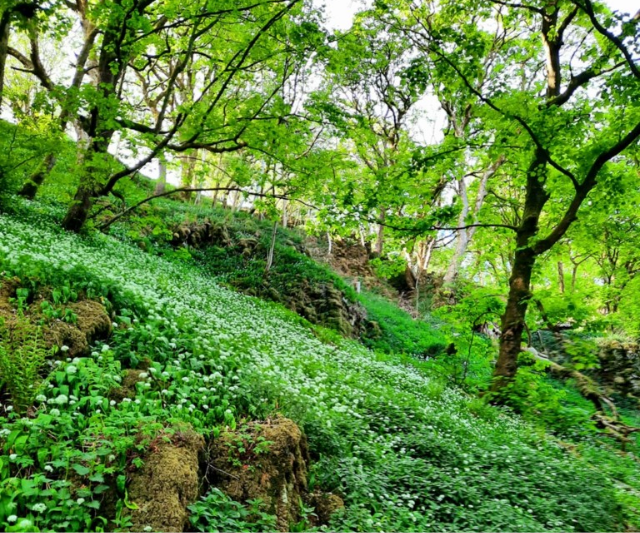
Cross-slope woodland. Source: WWNP evidence base, 2017.
Scale of impact and implementation
Woodland NbS may have a high scale of benefits achievable as woodlands provide a wide range of ecosystem service benefits alongside water resources benefits. Their impact varies with species, density and woodland type, with coniferous woodlands generally being more water intensive than deciduous woodlands.
Woodland can take time to develop so have longer implementation timescales and take longer to become effective, around 10 to 20 years. These NbS are constrained to locations where land can be converted to woodland.
You should avoid planting woodland in locations that could result in negative impacts on water resources.
Runoff and overland flow NbS
Table 3 describes the different sorts of runoff attenuation and overland flow NbS which could be implemented and the types of water resources benefits they could provide.
Table 3: Runoff and overland flow NbS and their water resources benefits
| NbS name | NbS description | Main outcomes for water resources |
|---|---|---|
| Peatland restoration | Peatland restoration involves rewetting degraded areas. It includes measures such as grip blocking which blocks eroded gullies to re-wet the habitat by raising the water table. Peatland restoration can also involve re-planting peat species such as sphagnum moss. | Outcomes include increased surface roughness, capturing runoff on the surface and allowing infiltration and recharge. |
| Runoff pathway management | Runoff pathway management measures capture water generated by overland flow and store it temporarily using bunds, ponds, swales and other offline storage features. | Outcomes include capturing runoff on the surface and allowing infiltration and recharge. |
| Infiltration basins or SuDS | Infiltration basins are a main component of SuDS in urban settings but may also be used in rural settings. They are vegetated depressions designed to temporarily store stormwater runoff and allow it to infiltrate into the ground. They are typically dry, except during and immediately after rainfall. | Outcomes include capturing runoff on the surface and allowing infiltration and recharge. |
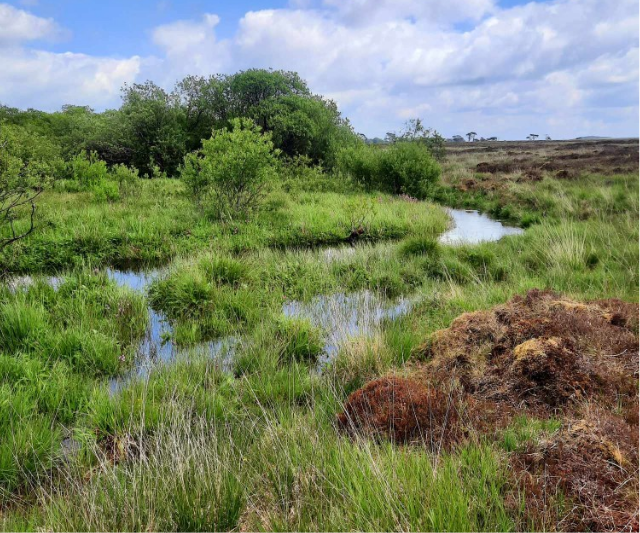
Peatland restoration, Exmoor. Source: WWNP evidence base, 2017.
Scale of impact and implementation
Peatland restoration has a high scale of benefits achievable. They provide a wide range of ecosystem services and contribute to the restoration of natural processes. Runoff attenuation features (RAFs) and SuDS are more man-made and initially mimic natural processes. They provide a medium level of ecosystem service benefits though it depends on their design.
Runoff and overland flow NbS take between 0 to 2 years to become effective. Peatland restoration supports the natural recovery of lost ecosystems and therefore is implemented over longer timescales. RAFs and SuDS are fast to implement and are almost immediately effective.
Peatland restoration is restricted to locations where this habitat is currently or was present in the past. Its potential for restoration is more spatially constrained. RAFs and SuDS are suitable in many locations. They are also fast and cheap to implement and are hence often favoured by landowners and non-governmental organisations (NGOs), making their implementation faster than the scale-up of some NbS.
River and floodplain NbS
River and floodplain NbS aim to assist the natural recovery of ecosystems.
Table 4 describes the different sorts of river and floodplain NbS which could be implementation and the types of water resources benefits which they could provide.
Table 4: River and floodplain NbS and their water resources benefits
| NbS name | NbS description | Main outcomes for water resources |
|---|---|---|
| Floodplain restoration | This aims to restore hydrological connection between rivers and floodplains by removing flood embankments and other barriers to floodplain connectivity. This is so that floodwaters inundate the floodplains and store water during times of high flows. | Outcomes include increased surface roughness, capture runoff on the surface, allow infiltration and recharge, raise overdeepened riverbeds, improve floodplain connectivity and store water on the floodplain. |
| River restoration | River restoration is the process of managing rivers to reinstate natural processes (including flow and sediment transport processes) to improve biodiversity and enhance water quality. This may help a river adjust towards a more natural form. It can be assisted natural recovery or more engineered solutions such as removing culverts and other man-made structures. | Outcomes include increased surface roughness, raise overdeepened riverbeds, improved hyporheic zone exchanges and improved floodplain connectivity. |
| Wetland and reedbeds | Wetlands are areas of land where water is either permanently or seasonally present, supporting plant and animal life adapted to these conditions. Reedbeds, a specific type of wetland, have dense stands of common reed (Phragmites australis). | Outcomes include increased surface roughness, capture runoff on the surface, allow infiltration and recharge, and store water on the floodplain. |
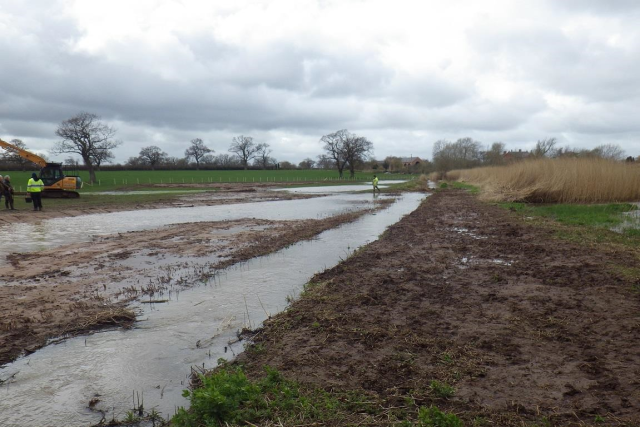
Mill Brook floodplain restoration following construction. Source: WWNP evidence base, 2017.
Scale of impact and implementation
River, floodplain and wetland restoration seeks to assist the natural recovery of ecosystems. They can be designed to work with natural processes or can be engineered to fit into more limited environments, depending on their location. The scale of benefits achievable is high as river floodplain restoration provides many benefits alongside water resources.
Restoration is constrained geographically to river corridors and floodplains. However, they have the potential to be implemented across many rivers and streams, as those systems in England are highly modified. Cost to implement can vary depending on the scale of restoration and the types of restoration techniques used.
They usually take between 0 to 5 years to become effective, though these habitats can take longer to be restored once constructed.
In-channel NbS
Table 5 describes the different sorts of in-channel NbS which could be implemented and the types of water resources benefits which they could provide.
Table 5: In-channel NbS and their water resources benefits
| NbS name | NbS description | Main outcomes for water resources |
|---|---|---|
| Leaky barriers | Leaky barriers consist of wood that accumulates naturally in river channels, riverbanks and floodplains. Structures can also be engineered by humans to restore rivers and floodplains to slow and store flood water. | Outcomes include increased infiltration and recharge, raise overdeepened riverbed, improve floodplain connectivity, and filtration of fine sediment. |
| Beaver dams | Beaver dams are structures built across streams using sticks, mud and rocks to protect beavers from predators and hold food during the winter. These dams can extend beyond the river channel and create a raised barrier (or berm) which can hold back water and create wetland-type features. Beavers are ecosystem engineers because they can modify ecosystems. | Outcomes include increased surface roughness, allow infiltration and recharge, capture runoff on the surface, raise overdeepened riverbed, improve floodplain connectivity and store water on the floodplain. |
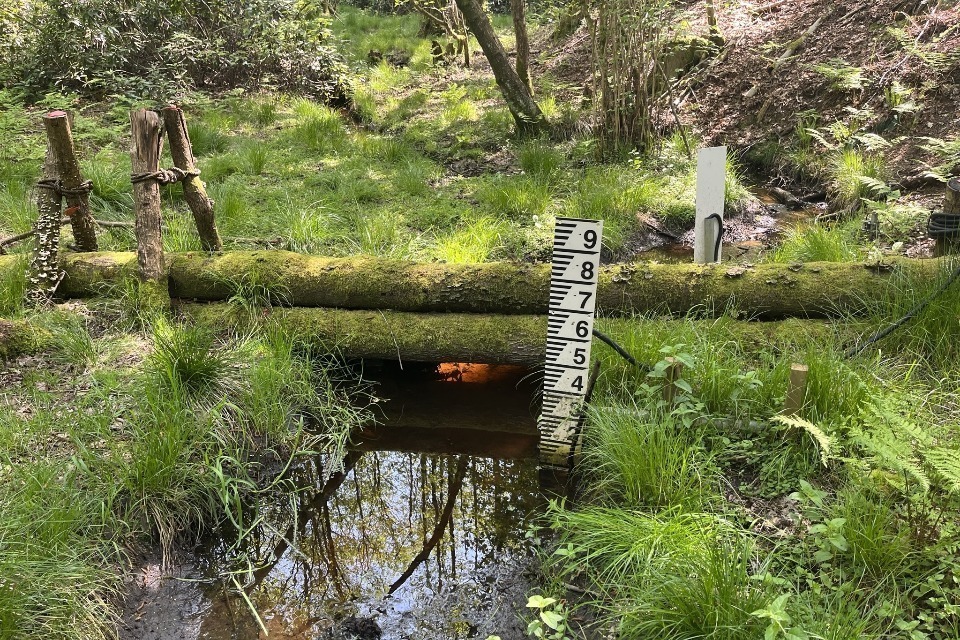
Leaky barriers, Dorking. Source: Ben Tonkin, Environment Agency
Scale of impact and implementation
Beaver dams contribute to the restoration of natural processes. They support the natural recovery of lost or degraded ecosystems and therefore are implemented over longer timescales. The scale of benefits for beaver dams is high because they provide a wide range of ecosystem service benefits alongside water resources benefits.
The reintroduction of beavers may be spatially limited to catchments where the local community accepts them, limiting the scale at which this NbS can be implemented. Leaky barriers have the potential to be implemented across many rivers and streams.
Leaky barriers are more man-made and they initially mimic natural processes. In the long term, leaky dams may help restore natural processes, reconnecting rivers to floodplains. The scale of benefits for leaky dams is medium because they can provide a wide range of ecosystem service benefits, but it depends on their design. Poorly designed leaky barriers can harm river environments, increasing sedimentation, creating barriers to fish and eel migration, and potentially causing blockages if they fail.
In-channel NbS can take 0 to 5 years to become effective.
Leaky barriers are fast to implement, take less time to be effective and are cheap to implement. They are often favoured by landowners and NGOs, making their implementation faster than the scale-up of some NbS.
5. NbS interventions and the water cycle
NbS for water resources interventions may modify the water cycle. Different types of measures are more effective in different parts of the water cycle.
NbS for water resources can have the greatest impact when focused on the shallow groundwater zones of the water cycle. The 4 main interventions within this zone which can improve groundwater resources and low river flows are:
- water use
- runoff infiltration split
- runoff capture and infiltration
- floodplain and river restoration
Water use
Water use interventions can:
- reduce evaporation and transpiration
- reduce interception of rainfall
- reduce irrigation demands
The following techniques may be implemented:
- choose crops that have lower evaporation rates and need less irrigation
- replace dense conifer plantations with more open deciduous woodland pasture
- intelligent use of cover crops to improve soil infiltration properties
Runoff infiltration split
The runoff infiltration split determines how rainfall is divided between water that soaks (infiltrates) into the soil, and water that becomes surface runoff. Interventions that influence this process aim to enable water to soak into the soil before it has become runoff. These interventions could do the following:
- improve soil structure to allow more infiltration
- increase surface roughness to slow runoff at source, such as by using buffer strips
- maintain healthy chemical and biological soil properties
The following techniques might be implemented:
- adoption of sustainable soil management practices, with the aim of increasing organic content, reducing compaction and using limited tillage approaches
- change land use cover in areas susceptible to erosion, including consideration of the use of cover crops
- maintaining well-established habitats that have favourable effects on water resources
- woodland creation
- buffer strips
Runoff attenuation and infiltration
Runoff capture and infiltration interventions aim to capture water once it has already become runoff. These interventions could capture runoff on the surface and allow it to infiltrate into the ground.
The following techniques might be implemented:
- RAFs
- infiltration basins, temporary storage ponds, earth bunds, field corner storage and swales and scrapes
- cross-slope interventions such as hedgerow planting and field boundary interventions
- headwater management
- woodland creation
Floodplain and river restoration
Floodplain and river restoration could:
- raise the bed of a river where it has been overdeepened, so it has less impact on the local water table
- improve floodplain connectivity, allowing floodwaters to be stored on the floodplain
- create wetlands in the lower catchment, increasing the storage of water on the floodplain
The following techniques might be implemented:
- river-floodplain reconnection
- increased water storage on the floodplain through improving or creating pond, scrapes and swales
- wetland creation
For a summary of the water resources benefits each of the NbS in section 3 can provide, see Table 2-1 in Appendix 3: NbS for water resources technical handbook.
6. Supporting policies
There are wide-ranging UK and EU policy drivers supporting the use of NbS, including:
- Environmental Improvement Plan 2025
- Environment Act 2021
- Local Nature Recovery Strategies
- Agricultural Transition Plan
- Biodiversity Net Gain requirements
- European Green Deal
- EU Biodiversity Strategy for 2030
- UN’s sustainable development goals
- Nature-based solutions: Environment Agency position statement
These policies emphasise using NbS to enhance biodiversity, reduce flood risks, improve air and water quality, and achieve climate neutrality goals.
NbS are internationally recognised, with guidance on their implementation provided by:
- The International Union for Conservation of Nature (IUCN) Global Standard for Nature-based Solutions
- World Bank – Implementing Nature Based Flood Protection: principles and implementation guidance
- United States Army Corps of Engineers – International Guidelines on Natural and Nature-Based Features for Flood Risk Management
7. Recommendations for future work
1. Explain the need to identify and understand hydrological processes within a place before considering actions and interventions, for example:
- understanding where natural ecohydrology can be achieved focusing on water resource, drought and wider climate change outcomes
- better explaining the water resource benefits, such as increased infiltration, soil water-holding capacity, enhanced landscape storage, reduced runoff generation and restoration of natural hydrology
2. Strengthen the drought resilience narrative by:
- strengthening the modelling evidence of increased drought resilience and long-term water security
- better describing the healthy habitats, focusing on soils and naturally functioning ecohydrological systems where achievable – these can increase water retention within catchments and support more resilient environmental and agricultural systems during prolonged dry periods
3. Better articulate the link between water resources and wider environmental outcomes by strengthening the message on delivery of multiple NbS outcomes – this include water resources, biodiversity recovery, water quality improvements, natural flood management and wider ecological resilience.
4. Give greater recognition to terrestrial habitats and land management through:
- further investigation into healthy soils and terrestrial habitats
- better explaining the importance of species-rich grasslands, heathlands, peatland transition zones, riparian habitats, hedgerows and arable margins
5. Promote a ‘source before pathway’ approach which:
- better explain the combination of NbS interventions from source and the mechanisms that prevent or reduce runoff generation, before focusing on measures that manage runoff further downstream
- investigate further the removal of artificial drainage, regenerative grazing, improving soil health, reducing compaction, increasing soil organic matter, increasing surface roughness and creating a more complex micro-topography
6. Recognise the importance of scale and cumulative impact by:
- explaining how the terrestrial and land management interventions deliver their greatest value when implemented at scale across a catchment
- further clarify where the cumulative benefits that can be achieved through improvements in habitat condition and soil function
7. Provide a clearer message on additionality where:
- NbS investment should build on existing regulatory requirements and recognised good practice
- funding should support genuine environmental need and where possible produce water resource benefits
8. Present risk, complexity and benefit more clearly by:
- acknowledging that different NbS interventions carry different levels of risk, complexity and maintenance requirements
- better explaining habitat and soil-based interventions which can provide significant benefits with relatively low implementation and maintenance burdens – whereas some in-channel interventions may involve more complex design, consenting and long-term management requirements
9. Promote a whole-catchment thinking and evaluation against an entire hydrological unit – through better explaining how different habitats and interventions can function together at a range of scales including field/plot-scale, sub-catchment and whole catchment.
10. Review woodland messaging with a better description of the complexity of relationships between woodland creation, water resources and drought resilience – ensuring that benefits and trade-offs are presented in a balanced way.
11. Strengthen the planning and optimisation narrative by:
- encouraging a whole-system approach
- identifying the full potential of a site or catchment, consider optimisation of outcomes, and then work through trade-offs, constraints and co-benefits from that starting point
8. Next steps
When deciding on the NbS option for your site, you need to begin by understanding your catchment. This is to ensure you implement NbS in the right areas to maximise their benefits.
You can then use a variety of mapping and modelling tools to further appraise the options and choose which options to take forward. For example, Local Nature Recovery Strategies (LNRS) are now in place across England and will be useful to help identify possible NbS options.
NbS for water resources can also be integrated into a range of projects. There is significant overlap in the NbS for water resources measures with other NbS practices and habitat creation programmes.
For more guidance on planning your NbS project, including integration with other objectives, see NbS for water resources: plan your project.
See other related guides on NbS for water resources:
- NbS for water resources: design and build your project
- NbS for water resources: monitoring and maintenance
- Appendix 1: NbS for water resources case studies
9. Contact the Environment Agency
If you have questions about any aspects of this guidance, contact the Environment Agency.
General enquiries
National Customer Contact Centre
PO Box 544
Rotherham
S60 1BY
Email enquiries@environment-agency.gov.uk
Telephone 03708 506 506
Telephone from outside the UK (Monday to Friday, 8am to 6pm GMT) +44 (0) 114 282 5312
Monday to Friday, 8am to 6pm.