Monitoring your medium abdominal aortic aneurysm (AAA)
Updated 5 February 2026
Applies to England

© Crown copyright 2026
This publication is licensed under the terms of the Open Government Licence v3.0 except where otherwise stated. To view this licence, visit nationalarchives.gov.uk/doc/open-government-licence/version/3 or write to the Information Policy Team, The National Archives, Kew, London TW9 4DU, or email: psi@nationalarchives.gov.uk.
Where we have identified any third party copyright information you will need to obtain permission from the copyright holders concerned.
This publication is available at https://www.gov.uk/government/publications/monitoring-your-medium-abdominal-aortic-aneurysm/your-screening-results-you-have-a-medium-abdominal-aortic-aneurysm-aaa
This information is for anyone with a medium abdominal aortic aneurysm (AAA) screening result.
Your AAA screening result
When we screened you, we found that your aorta is between 4.5cm and 5.4cm. This is wider than usual and means that you have a medium AAA. AAAs can be different sizes:
- small AAAs are 3.0cm to 4.4cm
- medium AAAs are 4.5cm to 5.4cm
- large AAAs are 5.5cm or bigger.
Around 1 in 500 men we screen has a medium AAA. We will invite you back for an ultrasound scan every 3 months to see if it is getting bigger.
Abdominal aortic aneurysm (AAA)
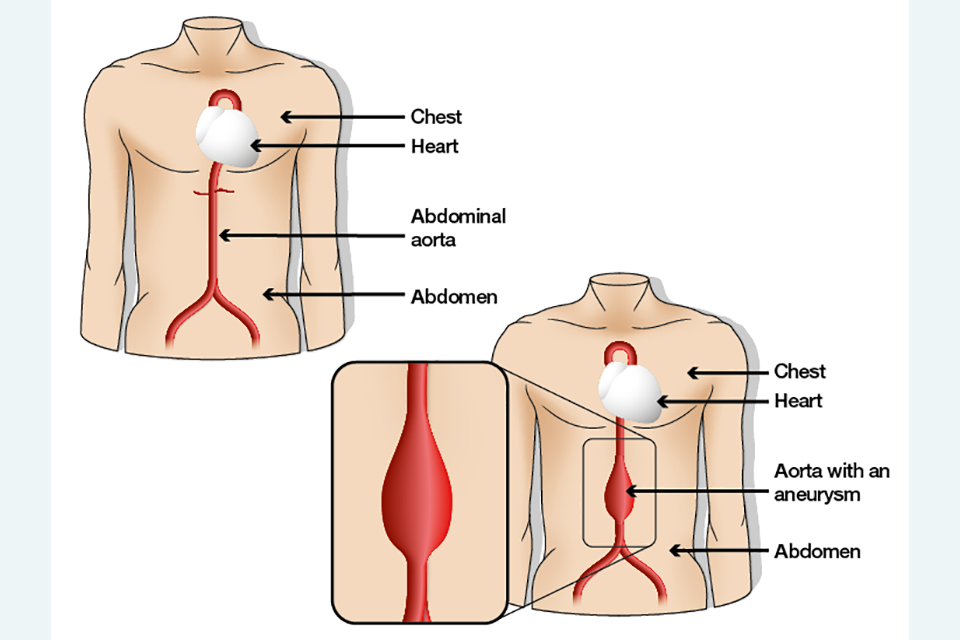
An aneurysm is a swelling in the aorta. The aorta is the artery that carries blood from the heart to the abdomen (tummy).
In some people, as they get older, the wall of the aorta in the abdomen can weaken. It can then start to swell (like a balloon) and form an aneurysm.
The condition is most common in men aged 65 and over.
Understanding your result
The risk of a medium AAA bursting is low. A medium AAA can grow over time and become serious, so it is important to monitor its size.
If it grows to 5.5cm, it is considered a large AAA. If that happens, you will need to see a specialist. They will talk to you about further tests and possible treatment options, usually surgery.
Large AAAs are rare but can be serious. As the wall of the aorta stretches, it weakens and can burst, causing internal bleeding. If this happens, it is a medical emergency. Around 85 out of every 100 people with a burst AAA die as a result.
Most aneurysms grow slowly, so you may never develop a large AAA that needs treatment.
Contact your local screening service if you have questions about your screening result.
What happens next
We will offer you an appointment with a specialist nurse. They can help answer any questions you have about your AAA and give you information and advice. This will include general health advice, which can help reduce the risk of your AAA growing. They may ask to check your blood pressure. We will invite you back for another scan in 3 months.
Your follow-up scans
We will invite you for a scan every 3 months unless your AAA increases to 5.5cm or wider.
Why you don’t need an operation now
All operations have risks. The operation for an AAA is no different.
Research shows that surgery for a medium AAA carries a higher risk than monitoring it. The NHS only offers surgery when the risk to your life from your aneurysm is more than the risk from surgery.
If your AAA grows, you may need surgery in the future. You can help reduce the risk of complications if you ever need surgery by:
- stopping smoking, if you are a smoker – find more information at www.nhs.uk/better-health/quit-smoking
- making sure your blood pressure is within safe limits
- eating healthily
- losing weight, if you are overweight
- staying active every day to improve general fitness
- cutting down on alcohol.
Symptoms to be aware of
AAAs usually have no symptoms. It is unlikely that you will feel any pain or discomfort from a medium AAA.
The risk of a medium AAA bursting is very low. However, it is important to be aware of symptoms of a burst AAA.
If you have severe, lasting pain in your lower back or abdomen, you should seek urgent medical help. Call an ambulance or go to A&E straight away and tell them you have a medium AAA.
Looking after your health
Your GP can give you advice on looking after your health. They may also want to give you medicine or review any prescribed medicine you already take.
If you go into hospital for any reason, you should let the staff know that you have an AAA found through screening.
You do not need to make any other changes to your lifestyle. You can continue with any sports or hobbies.
Telling close relatives
The risk of having an AAA increases if your biological brother, sister or parent has had one.
This means any brothers, sisters or children you have may be at risk too. They can ask their GP about the possibility of having a scan 5 years before they reach the age you were when your AAA was found.
Driving
Car drivers and motorcyclists with a medium aneurysm can continue driving as normal. You must:
- tell the DVLA if your AAA grows to 6cm or more
- not drive if your AAA grows to 6.5cm or more but can drive again once it has been successfully treated.
Bus, coach and lorry drivers must:
- tell the DVLA that you have an AAA, no matter what the size is
- not drive if your AAA grows to 5.5cm wide or more but can drive again once it has been successfully treated.
Visit www.gov.uk/aneurysm-and-driving to find out more.
More information and support
You can get more information at:
- your GP surgery
- your local AAA screening service
- NHS.UK
- Circulation Foundation
- British Heart Foundation
We use personal information from your NHS records to invite you for screening at the right time. This information helps us improve the screening programme and deliver quality care. Read more about how we use and protect your information.
Find out how to opt out of screening.