Easy Read guide to the menigitis B vaccination (simple text only)
Updated 25 March 2026
Applies to England

© Crown copyright 2026
This publication is licensed under the terms of the Open Government Licence v3.0 except where otherwise stated. To view this licence, visit nationalarchives.gov.uk/doc/open-government-licence/version/3 or write to the Information Policy Team, The National Archives, Kew, London TW9 4DU, or email: psi@nationalarchives.gov.uk.
Where we have identified any third party copyright information you will need to obtain permission from the copyright holders concerned.
This publication is available at https://www.gov.uk/government/publications/meningococcal-disease-outbreak-resources/easy-read-guide-to-the-menigitis-b-vaccination-simple-text-only
What is meningococcal B disease?
Meningococcal disease is caused by a type of bacteria. A bacteria is a germ that can make you ill.
Most people that come into contact with someone who has MenB do not get ill and do not get any signs.
Sometimes MenB can get into your body and make you very ill.
It can cause:
- meningitis – swelling around the brain
- septicaemia – a dangerous infection in your blood
You might get poorly very quickly after your signs start so it is important to know the signs and when to get help.
Information about meningococcal disease
Meningococcal disease is an illness that can spread between people. It can make some people very ill.
If you get signs of meningococcal disease, phone 999.
If you are worried, phone your GP or NHS 111.
Checking for the signs of meningococcal disease
These are the signs in your body that you may be poorly because of meningococcal disease.
The best way to stay safe is to know the signs and act quickly if they appear.
Signs include:
- a rash that does not go away if you push it with a glass
- a high temperature. A high temperature is over 39°C
- a having very cold hands and feet.
- feeling sick and being sick
- having diarrhoea. Diarrhoea is when your poo is very runny.
- new pains in your muscles and joints
- a new dislike of bright lights and headache
- new tiredness and being difficult to wake up
This is what the rash and glass test look like
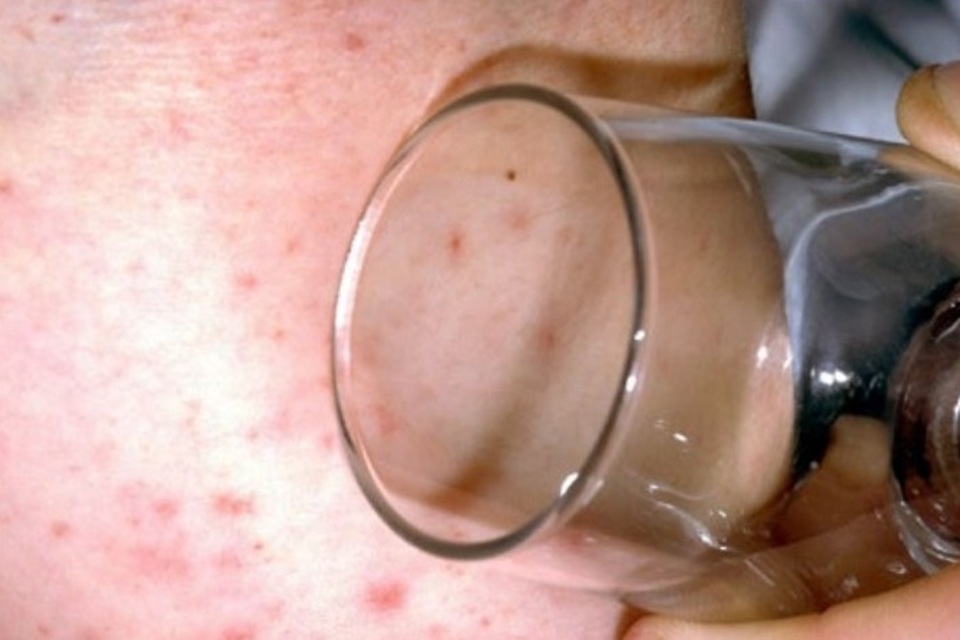
If you have MenB disease you might get some of these signs but not all of them.
What to do if you have the signs of MenB disease
If you have signs and think that it might be MenB disease, phone 999 or go to the hospital straight away.
Do not wait. It is important that you get help quickly.
If someone else you live with or look after is unwell, check on them often.
If you are very unwell or they are very unwell, phone 999 straight away. Always call 999 in an emergency.
If you are worried, phone your doctor or NHS 111 for advice. NHS 111 is a free non-emergency medical helpline.
How MenB disease spreads
MenB is spread by very close contact between people: - it can be spread if you live in the same household as someone with MenB - it can be spread by kissing - you cannot get MenB by just touching things or by sitting next to someone who is infected
Information about vaccination
The MenB vaccine helps to protect you from the MenB bacteria.
Vaccines can help to stop you from getting very ill from infections.
Vaccines contain a very tiny part of the bacteria or virus that causes a disease.
This is so that your body’s immune system can make things called antibodies.
Antibodies are things that your immune system make to fight infections and diseases.
This means that if you catch an infection which you have already had a vaccine for, your immune system will be able to fight it better.
You will need 2 doses of this vaccine to give you the best protection. You will have 1 vaccine and then a second in about 1 month.
Other types of meningococcal disease can also cause serious illnesses like meningitis and septicaemia.
You can protect yourself against some of these types by getting the MenACWY vaccine.
You can have the MenACWY vaccine until you are 25 years old.
Talk to your Doctor if you have not had the MenACWY vaccine or are unsure if you have.
More information
There is more information about MenB on the NHS website.
You can phone the Meningitis Research Foundation for more information: 0808 800 3344 or visit the website.
You can phone Meningitis Now for more information: 0808 80 10 388 or visit the website.