Confirmed cases of measles in England by month, age, region and upper tier local authority: 2026
Updated 15 October 2026
Applies to England

© Crown copyright 2026
This publication is licensed under the terms of the Open Government Licence v3.0 except where otherwise stated. To view this licence, visit nationalarchives.gov.uk/doc/open-government-licence/version/3 or write to the Information Policy Team, The National Archives, Kew, London TW9 4DU, or email: psi@nationalarchives.gov.uk.
Where we have identified any third party copyright information you will need to obtain permission from the copyright holders concerned.
This publication is available at https://www.gov.uk/government/publications/measles-epidemiology-2023-to-2026/confirmed-cases-of-measles-in-england-by-month-age-region-and-upper-tier-local-authority-2026
This page is updated every 4 weeks. The next scheduled update is 12 November 2026.
England measles epidemiology 2026
This report describes measles epidemiology in England from 1 January 2026.
Situational update
In 2024 there were 2,911 laboratory-confirmed measles cases in England, the highest number of cases recorded annually, since 2012. In 2025, there were a total of 958 laboratory-confirmed measles cases. Data for 2023 to 2026 and historical data are available.
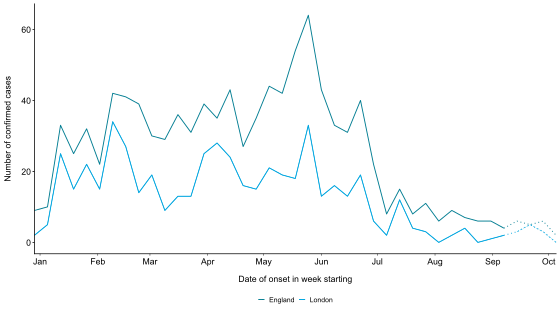
Between 1 January 2026 and 12 October 2026, there have been 1,030 laboratory-confirmed measles cases reported in England. An additional 27 cases were reported since the last publication on 17 September 2026 (Figures 1 and 2). In 2026, measles activity started to increase in February, peaked in May and has declined and stabilised since then.
Summary
The number of laboratory-confirmed measles cases by month of symptom onset in 2026 to date are:
- January: 105
- February: 142
- March: 144
- April: 156
- May: 215
- June: 154
- July: 52
- August: 33
- September: 26
- October: 3 (to date)
The UKHSA data dashboard provides tabular data on the total number of cases by week of onset in 2026.
The majority (629 out of 1,030, 61%) of these cases were in children aged 10 years and under, and 33% (339 out of 1,030) were in young people and adults aged 15 years and over (Table 1). 50% (520 out of 1,030) of these cases have been in London, 16% (162 out of 1,030) in the West Midlands, and 11% (111 out of 1,030) in the North West. However, all regions have reported at least one confirmed case with symptom onset since January 2026. A total of 98 upper tier local authorities (UTLAs) have reported at least one confirmed case with symptom onset since January 2026, with the highest numbers reported in Enfield (111 out of 1,030, 11%), Birmingham (82 out of 1,030, 8%) and Hertfordshire (64 out of 1,030, 6%) (Table 2a).
The vaccination status of all confirmed cases is published quarterly in the related health protection reports.
Three measles related deaths have been reported to date in 2026: one was an acute measles death in a child, another was a death in a child due to late effects of measles, and the third was a death in an adult with an underlying immunological problem. Information on historical measles-related deaths is available on the notifications and deaths webpage.
Recent activity
There have been 19 laboratory -confirmed measles cases with symptom onset date in the 4 weeks since 14 September 2026. Data reporting lags have the greatest impact on the most recent 4 weeks and therefore the reported figures are likely to underestimate activity. London accounted for the highest proportion of these cases (58%, 11 out of 19). A total of 16% (3 out of 19) of cases have been in the North West, and 11% (2 out of 19) in the North East. A total of 12 UTLAs have reported at least one confirmed case with symptom onset since 14 September 2026.
Figure 1. Laboratory-confirmed cases of measles by month of onset of rash or symptoms reported, London and England: 1 January 2012 to 14 September 2026 [note 1] [note 2]
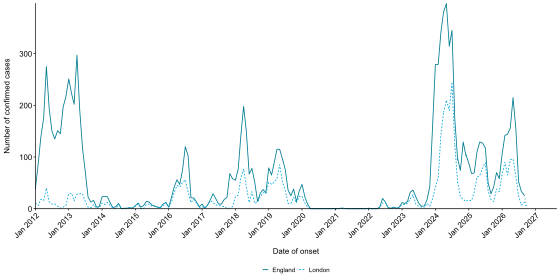
Figure 2. Laboratory-confirmed cases of measles by week of onset of rash or symptoms reported, London and England: 1 January 2026 to 14 September 2026 [note 1] [note 2]
Note 1: cases confirmed through either local or reference laboratory testing.
Note 2: data is provisional and subject to change as:
- more suspected cases undergo confirmatory testing
- some locally tested cases are discarded after confirmatory testing at the reference laboratory
The data reporting lag has had the greatest impact on the most recent 4 weeks and therefore the reported figures are likely to underestimate activity. For this reason, these data points are represented by dotted lines.
Table 1. Laboratory-confirmed cases of measles by age group and region in England: 1 January 2026 to 14 September 2026 [note 3]
| Age group (years) | East Midlands | East of England | London | North East | North West | South East | South West | West Midlands | Yorkshire and Humber | England |
|---|---|---|---|---|---|---|---|---|---|---|
| < 1 | 2 | 13 | 49 | 3 | 14 | 4 | 0 | 28 | 9 | 122 |
| 1-4 | 6 | 24 | 145 | 2 | 28 | 9 | 2 | 42 | 18 | 276 |
| 5-10 | 2 | 26 | 125 | 1 | 22 | 7 | 1 | 32 | 15 | 231 |
| 11-14 | 3 | 3 | 35 | 0 | 9 | 1 | 0 | 8 | 3 | 62 |
| 15-24 | 2 | 8 | 61 | 0 | 11 | 7 | 0 | 14 | 20 | 123 |
| 25-34 | 4 | 9 | 52 | 1 | 15 | 3 | 1 | 19 | 10 | 114 |
| 35+ | 0 | 6 | 53 | 1 | 12 | 5 | 4 | 19 | 2 | 102 |
| Total | 19 | 89 | 520 | 8 | 111 | 36 | 8 | 162 | 77 | 1030 |
Note 3: data is provisional and subject to change as:
- more suspected cases undergo confirmatory testing
- some locally tested cases are discarded after confirmatory testing at the reference laboratory
Table 2a. Number of laboratory-confirmed measles cases by region and upper tier local authority (UTLA), England: 1 January 2026 to 14 September 2026 [note 4]
| Upper tier local authority (UTLA) | Region | Total cases |
|---|---|---|
| Enfield | London | 111 |
| Birmingham | West Midlands | 82 |
| Hertfordshire | East of England | 64 |
| Haringey | London | 55 |
| Islington | London | 55 |
| Kirklees | Yorkshire and Humber | 39 |
| Worcestershire | West Midlands | 35 |
| Ealing | London | 27 |
| Hackney | London | 26 |
| Barnet | London | 24 |
| Brent | London | 24 |
| Bradford | Yorkshire and Humber | 23 |
| Camden | London | 22 |
| Harrow | London | 22 |
| Hillingdon | London | 20 |
| Bolton | North West | 17 |
| Essex | East of England | 17 |
| Staffordshire | West Midlands | 17 |
| Wirral | North West | 17 |
| Hounslow | London | 16 |
| Newham | London | 13 |
| Barking and Dagenham | London | 12 |
| Cheshire West and Chester | North West | 12 |
| Lancashire | North West | 12 |
| Sandwell | West Midlands | 12 |
| Sefton | North West | 12 |
| Waltham Forest | London | 12 |
| Kent | South East | 11 |
Note 4: case counts have been suppressed to not present any UTLAs with fewer than 10 cases.
Data is provisional and subject to change as:
- more suspected cases undergo confirmatory testing
- some locally tested cases are discarded after obtaining further epidemiological information or undergoing confirmatory testing at the reference laboratory
Table 2b. Number of laboratory-confirmed measles cases by region and upper tier local authority (UTLA), England: 17 August 2026 to 14 September 2026 [note 5]
Note 5: no UTLA recorded 10 or more laboratory-confirmed measles cases during this reporting period and so there is no Table 2b this week.
Case counts have been suppressed to not present any UTLAs with fewer than 10 cases.
Data is provisional and subject to change as:
- more suspected cases undergo confirmatory testing
- some locally tested cases are discarded after obtaining further epidemiological information or undergoing confirmatory testing at the reference laboratory
The data reporting lag has had the greatest impact on the most recent 4 weeks, and therefore the reported figures are likely to underestimate activity.