Market Value Survey: 2024 - technical report
Published 14 April 2026
Applies to England

© Crown copyright 2026
This publication is licensed under the terms of the Open Government Licence v3.0 except where otherwise stated. To view this licence, visit nationalarchives.gov.uk/doc/open-government-licence/version/3 or write to the Information Policy Team, The National Archives, Kew, London TW9 4DU, or email: psi@nationalarchives.gov.uk.
Where we have identified any third party copyright information you will need to obtain permission from the copyright holders concerned.
This publication is available at https://www.gov.uk/government/publications/market-value-survey-2024/market-value-survey-2024-technical-report
1. Introduction
The Ministry of Housing Communities and Local Government (MHCLG) has responsibility for housing policy in England and, as such, commissions the English Housing Survey (EHS). The EHS collects information on the condition and energy efficiency of housing in England as well as details regarding the household. It covers all types of housing, whether owner-occupied or owned by local authorities, housing associations, or private landlords.
Until 2009-10, the Market Value Survey (MVS) was a standard component of the EHS. Each year, it provided MHCLG with a valuation of all properties in the EHS sample and an assessment of the type of housing market within which they were located. Since 2009-10, MHCLG has commissioned two stand-alone Market Value Surveys in 2015 (using EHS 2013-2014 and EHS 2014-15 physical survey data) see EHS: 2015 Market Value Survey, Technical Report and the current MVS 2024 (using EHS 2022-23 and EHS 2023-24 physical survey data).
The 2024 MVS enables the continued use of this data through the EHS, given the housing market changes since the previous MVS surveys.
The MVS was commissioned by MHCLG as part of the English Housing Survey (EHS). The market valuations were provided via a website which was designed and managed by the Building Research Establishment (BRE). BRE is independent research based consultancy, testing and training organisation, offering expertise in every aspect of the built environment and associated industries. BRE have been responsible for large parts of the EHS since the 1970s. Today BRE’s services to the survey include; development of methodology, data collection tools, surveyor training, complex data modelling, data analysis and reporting. BRE has been involved in all previous Market Value Surveys.
The Valuation Office Agency (VOA) was appointed by MHCLG to provide desktop market valuations of 13,288 pilot properties. The VOA is the Government Agency responsible for the compilation and provision of property valuation lists for business rates and Council Tax purposes. It also provides valuation services to HMRC for tax purposes and provides a wide range of property advice services to over 1,300 public sector bodies across the country, through its property services arm, District Valuer Services. The VOA has 35 local offices in the UK, (27 across England), is the largest employer of Chartered Surveyors in the UK and is a member of the Government Property Profession, sharing best practice property expertise across departmental bodies. The Valuation Office Agency (VOA) has provided valuations for the previous EHS MVS exercise in 2015.
The 13,288 properties in the 2024 MVS consisted of the most recent two years’ of sampled data (2022-23 and 2023-24) from the EHS ‘physical survey’. The physical survey sample of properties were inspected by EHS surveyors who collected all the relevant information that was included on the MVS website.
The objective of the MVS was to supply two valuations for all 13,288 properties, assuming vacant possession:
- for the actual condition as at 1st July 2024
- assuming any defects are rectified as at 1st July 2024
Additional information was provided by the VOA relating to the property market conditions for the area in which each sampled dwelling was located.
Valuations were carried in two tranches during August to October 2024 (2022-23 sample) and during April to June 2025 (2023-24 sample).
If you have any queries about this report or would like further information about the Market Value Survey, please contact ehs@communities.gov.uk.
2. Website and project plan
This section provides the background information regarding the English Housing Survey (EHS) sample of properties and the content and functionality of the website used for the project, and the overall project structure and timetable.
The 2024 MVS website was an updated version of the 2015 website designed specifically for the project by BRE. It gave VOA valuers secure access to all the information (from the EHS) they required to make their market valuations.
The English Housing Survey
The EHS is a national survey commissioned by MHCLG. The survey collects information about people’s housing circumstances and the condition and energy efficiency of housing in England. It has two component surveys:
- a household interview
- a physical inspection of properties (i.e. a physical survey)
The EHS physical survey, delivered by the Building Research Establishment (BRE) in partnership with CADS Housing Surveys (CADS), collects data on liveability, housing health and safety rating system (HHSRS), energy efficiency (SAP), the state of repair and the Decent Homes initiative. More details on the physical survey can be found in the EHS technical report, the latest of which can be viewed at: English Housing Survey: technical advice.
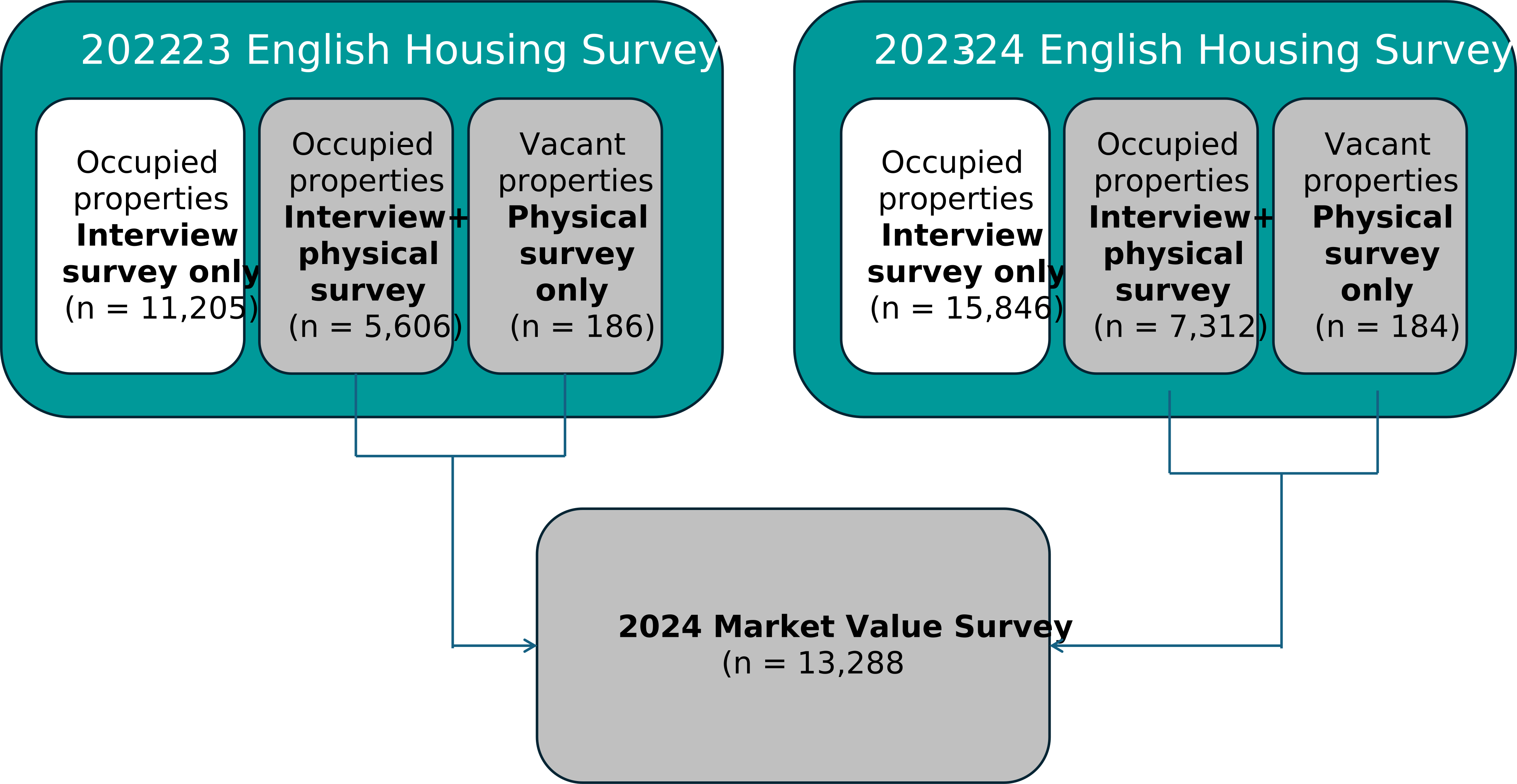
The properties included in the 2024 MVS were obtained from the sample of 13,288 dwellings included in the 2022-23 and 2023-24 EHS physical surveys. The dwellings included in the sample are shown in the diagram below.
Website
The valuations for the 2024 MVS were completed and submitted via this bespoke website. The 2024 MVS website was an updated version of the one specifically developed by BRE for 2015 MVS website - see 2015 MVS report EHS: 2015 Market Value Survey, Technical Report.
Separate passwords and protected users accounts were created to provide secure access to the EHS survey data for the VOA project team. BRE liaised closely with the VOA to ensure that the VOA team only had access to property details required of their role. The BRE website complied with all Cyber Essentials security requirements and met the standards for encryption levels, user access controls and data storage locations.
The website included data from the EHS physical survey including detailed property characteristics and photographs. The key data from the EHS physical inspection of properties provided to valuers included:
- photographs of subject dwelling and the immediate vicinity (typically front, rear and street view)
- dwelling address, including postcode
- Council Tax Band (Supplied by VOA prior to exercise and based upon 1991 levels of value - used for information only)
- tenure (e.g. owner-occupied, private rented etc.)
- dwelling type (e.g. detached house, flat etc.)
- construction type (e.g. cavity masonry, pre-cast concrete panels etc.)
- construction date (in banded date-spans)
- number of bedrooms and total number of habitable rooms
- number of floors
- useable floor area
- type of main heating
- the extent of double glazing (e.g. 80% or more)
- the type of location (town/rural, with indication of density)
- parking provision (e.g. garage, street)
- estimated repairs costs: chimney, roof, walls, windows, damp proof course, interior fabric and amenities, structural works, and common and shared facilities
The VOA Address Key: UARN (Unique Address Reference Number) was used to locate the property and associated information within the VOA Address Database.
The valuations were completed and submitted via the website by navigating through the information and using specific functions to save the data. An overview of all surveys and their status was available e.g. Not Started, In Progress and Completed.
All property lists could be filtered in order of UARN, Case Number, Billing Authority Code and Address.
All valuation inputs on the website were classified as follows:
-
Saved The data was saved but remained open to enable further amendment. The status of the case moved from Not Started to In Progress
-
Submit to BRE. This changed the status of the case from In Progress to Complete.
Further amendments could only be made with project manager approval and
effectively recalled, however a ‘read only’ facility was available.
Management functions enabled an overview of the status, progress and output of all surveys. Nominated managers had full access to the data and the facility to Return cases for further consideration. If this occurred, the case could only be subsequently closed when a Verified by a manager.
In addition, to increase data quality and consistency, the website featured several validation checks. If a validation check was flagged, a text description of the issue appeared at the top of the page for the valuer to address:
- highlighted valuation of the dwelling assuming repairs carried out was not less than the valuation of the dwelling in its actual condition
- post repair valuation was greater than 130% of the actual valuation
- any fields not completed
BRE and VOA exchanged information regarding the website and validation check throughout the project to ensure queries were addressed before the delivery date. The VOA also provided regular valuation progress reports to both MHCLG and BRE.
VOA roles / responsibilities
The Project Director reported directly to the VOA Director of Property Services who is a member of the VOA Operating and Performance Board, responsibilities included:
- overall project delivery including quality, time and cost
- key stakeholder liaison, reporting directly to DCLG on a weekly basis
- liaison across VOA to secure specialist expertise and resourcing
- delivery of final technical report
- resource and project planning on a national basis
- sign off of all guidance and instructions
The Project Lead Consultant reported directly to the Project Director and responsibilities included:
- providing technical advice and guidance nationally
- providing project delivery recommendations
- liaising with VOA specialist teams as necessary
- guidance and quality control of houses in multiple occupation (HMOs)
The Operational Project Manager reported directly to the Project Director and responsibilities included:
- issue of all national guidance and instructions
- system progress reports to all stakeholders
- daily confirmation of resourcing and market research/valuation progress with Regional co-ordinators
- IT liaison with BRE in terms of website service and data enquiries
- monitoring risks and mitigation
- final quality assurance check of all the outputs and other data prior to delivery (see 3.18)
Regional Co-ordinators reported directly to the Project Manager and Director, they were allocated a geographic area with a regional team of valuers. Responsibilities included:
- confirming individual understanding of all instructions and distribution of frequently asked questions and responses
- communication and support across the team
- providing technical assistance
- completion of ongoing and final quality control
- confirming appropriate record management and an audit trail was in place
Research Teams comprised of Operational Support staff, graduates / assistant surveyors linked to each regional team and responsibilities included:
- collating the relevant data from the VOA Database.
- researching missing property or transaction data
- research and analysis of market information
- developing and maintaining the records management system
- providing additional market intelligence as requested by the valuers
All the above was supported by a Project Administrator who supported the Operational Project Manager.
Valuer Teams comprised of 136 Surveyors for both tranches located across England. Each tranche required a team of around 78 valuers.
Dwellings were allocated to valuers based upon their regional base office locations.
The sample dwellings were grouped into eight geographical regions:
- North East
- North Yorkshire and Humber
- North West
- Central West
- East
- London
- South East
- South West
These regions were sub divided into local authority areas.
BRE replicated the allocations on the website, providing each valuer with access to their allocations. Regional Co-ordinators and Project Managers had additional access across regions, including the facility to reallocate cases.
3. Valuation methodology
This section outlines the valuation methodology used in the MVS. It details the research, and valuation stages and provides more detail regarding any specialist types of property and the prevailing market conditions at the time of valuation.
Pre-programme valuation planning stage involved detailed instructions, including website and valuation guidance provision to the research team, valuers, Regional Co-ordinators and Project Managers to ensure national consistency. Further guidance was provided for Quality Control and for the valuation of houses in multiple occupation (HMOs) details of which can be found below.
The VOA Project Manager arranged training sessions via teams call with all VOA Delivery Team valuers, which included start to finish valuation processes, locality questions, using the BRE portal and the VOA internal bespoke Tracker systems. Following initial training workshops, live sample valuations were presented (via teams) to consolidate the training and a Q&A session to address any further questions. All training and live valuation events were recorded to be used for reference as required. The Project Manager held weekly online meetings with all Regional Project Leads, who in turn held weekly meetings with their regional delivery teams to share progress performance, knowledge, complexities and resource updates.
Definitions
Dwelling
The EHS defines a dwelling as “a unit of accommodation (normally a house or flat) where all the rooms and amenities (ie kitchen, bath/shower room and WC) are for the exclusive use of the household(s) occupying them. Amenities may be located outside the front door but provided they are for the exclusive use of the occupants the accommodation is still a dwelling.”
A single unit within a property otherwise in multi occupation may, therefore, form part of the survey where the accommodation is for the exclusive use of individual occupiers. In these instances, the information provided were for the single unit of occupation, not the whole property which may contain several such units.
Floor area
The EHS definition of dwelling floor area is aligned with Building Regulations and represents the area within the footprint of the dwelling, minus the three following areas:
- the area under the external walls
- the area of integral balconies
- the area of integral garages
The area remaining represented the total of all room areas, hallways and circulation space including cupboards and stairs. The area under partition walls is also included. Loft space is not included unless the loft is habitable, with a fixed stair in place to access it.
Houses in multiple occupation (HMOs) were included in the sample (27 in total). These types of property were classified as ‘accommodation occupied by one or more households where all amenities are for the exclusive use of the household(s)’.
Examples of HMOs include:
- a large house divided into bedsits with shared kitchen and bathroom facilities
- sheltered accommodation e.g. for the elderly, of the type where residents have their own kitchen and WC but use a shared bathroom, often under supervision
- part of a large property where there is a mix of self-contained and non-self-contained accommodation
Research process
The VOA research team formed part of the location teams and the research timetable ran parallel to the valuer resource plan to ensure all market intelligence was available when required over the project period.
The VOA holds a comprehensive database of sales of all properties in England comprising of transaction data notified by the HM Land Registry on Stamp Duty Land Tax forms (SDLTs) and this was the primary source of evidence to support the valuations.
Basic property attributes are also held on the VOA Database and used to enhance the transaction data. Attributes include:
- type of property ( e.g. house/flat)
- construction date
- heating ( Y/N)
- tenure
- floor levels
- floor area
- parking
- value significant information (e.g. agricultural dwelling/ shared drive)
- modernised (year)
- Unique Address Reference Number (UARN)
- Council Tax band
The VOA also have access to the Right Move and Resi-data websites.
The researchers provided the most relevant information for each property from the VOA Database within set parameters (e.g. postcode specific, transactions 2020 onwards). The researchers liaised with the valuers for any extended parameters, e.g. wider geographical search or additional information required e.g. current market activity. The objective was to build a library of information on which the valuations would be based.
For records management purposes, all market information, comparables and valuation reasoning was stored electronically for each property. This was also required for audit purposes.
Valuation process
The desktop market valuations were carried out by VOA’s valuers comprising including Surveyors, Chartered Surveyors (Royal Institute of Chartered Surveyors Registered Valuers) and comprised a delivery team of seventy-eight in Tranche 1, and Tranche 2.
The information provided on the website for each dwelling is shown at Appendix 1. Valuers were required to complete the following for each property:
- two market valuations, in current state of repair and if all repairs were completed
- questions on level of confidence in the valuations provided
- questions on whether there were any data inconsistencies and whether these affected the valuation
- questions on the level of prices and demand for properties in the locality
Values confirmed the full details of the dwelling provided on the BRE website page, together with any additional information held in VOA records. In some cases data on the website was not consistent with VOA data and this was highlighted through the question in 2.11 above. All valuations were based upon the information provided by BRE, as this was generally the most recent physical survey of the properties.
The valuation process included:
- reference to the market transactions provided by the research team.
- analysing the sales information and comparing to the subject property in terms of all characteristics (type, size, location etc.)
- additional internet research to view local activity (as a guide only)
- weighting the information to take account of transactions closest to the valuation date of 1 July 2024 and closest to the characteristics, condition and location of the subject property
- application of local knowledge and experience of the area to arrive at a reasoned and justified valuation for the property
As in previous years, the 2024 MVS included properties that do not normally come onto the open market, such as local authority owned and housing association properties. To assist with the valuation process, the valuers were able to draw on specific specialist expertise within the VOA.
VOA teams have been involved in the valuation of Local Authority property for many years and have a statutory role in the determination of values of property where the Council and tenant are unable to agree the valuation under the ‘Right to Buy’ scheme. Expertise is required to identify and understand Local Authority sales to tenants, particularly how tenants improvements are reflected at the ‘Right To Buy’ stage and then for subsequent sales. The valuers therefore take account of these potential differences in approaching the valuation.
The VOA also carries out the Housing Revenue Account valuations for asset purposes for the residential stock of a significant number of both Local Authorities and Housing Associations across England in accordance with MHCLG regulations.
All HMO valuations were carried out by Chartered Surveyors with Registered Valuer status with guidance provided by the project consultant. Extra information about these dwellings was also provided by the BRE team. Confirming the precise area to be valued was essential for HMOs. This type of accommodation would rarely come onto the market. In these situations the valuation was based on the information available, valuer experience and professional judgement.
Where a property was known to be held on a ground lease, the assumption was that at least a 99 year term remained on the lease, effectively equating to freehold in terms of valuation.
Two valuations were entered on the website for each property. The first is the market value of the dwelling in its actual condition as at 1 July 2024. The second is the value of the dwelling, at the same date, on the assumption that the repair works identified as part of the EHS physical survey had been rectified. The valuers made a judgement as to the effect on market value of the repair works. The difference in the two valuations is not directly related to the estimated expenditure. This valuation reflects the varied opinions of potential purchasers in terms of the value added. The “after repairs” valuation may be enhanced by all or none of the repairs costs. In some cases where extensive repairs were necessary, the value may be increased by an amount exceeding the repair costs.
Valuers sourced advice as required from VOA in house Building Surveyors regarding any unusual or system built structures and the potential effect these might have on market value.
Valuers provided a view of the level of confidence on the market values provided. This was primarily based upon the sales transactions available to support the valuation and included local knowledge and expertise. This is detailed further in Section 5.
Valuers also answered two questions on whether there were discrepancies in the information provided by BRE, the VOA’s data or their own local knowledge, and whether any such discrepancy had a serious effect on the valuation provided. This is also detailed further in Section 5.
Locality information and market conditions
The Locality Information section of the website is also shown at Appendix 2. In addition to the market value of each dwelling, valuers were asked to provide further information on the value of a “typical property” and the level of supply and demand for properties for sale or rent in the locality as at the valuation date of 1 July 2024.
Since there is not a standard consistency of market movement and level of demand across the country, locality observations were required on a location by location basis. The valuers have detailed local knowledge on market supply and demand, as they affect values for residential accommodation.
These questions were:
- typical property value in the locality
- average number of weeks to sell a property in the locality
- percentage of properties vacant long term in the locality
- percentage of properties for sale/rent in the locality
The “typical property” value is based on a three bedroom semi-detached house in the locality of the subject dwelling. If the locality did not contain such a property, the valuer estimated the value of such a dwelling assuming it was of an age and type in keeping with other properties in the locality. Valuers analysed details from the VOA’s sales transactions information and property database to evaluate and apply a theoretical valuation.
The “average house selling period’’ was based on the percentage of properties vacant long term and for sale or rent. The responses were banded within a range of parameters (see Appendix 3). Valuers used their local knowledge and all available information to analyse trends and to provide an estimate.
Market conditions
The Regional Co-ordinators agreed the market overview with the team for each locality and region to use as a sense check and guide when carrying out Quality Control. The VOA local valuers across England were aware of local markets and trends for market performance. There is not a standard consistency of market movement and level of demand across the whole country however, a general overall guide can be provided. During the period 2015 and 2024 UK House Prices increased by 40.54%, with an average annual increase of 3.9%. In the same period the English housing market has experienced an average overall increase of 63.9% with an average annual increase of 5.48% (Nationwide HPI).
Following July’s general election, the UK housing market is waiting for more clarity from the government in relation to its tax plans. Meanwhile, as sub-4% mortgages re-appear, demand will be boosted in the autumn by the August rate cut and the prospect of a further reduction before the end of the year. House prices continue to rise while falling mortgage interest rates drive activity back towards pre-Covid norms. Market conditions over the next few months will continue to be reliant on mortgage interest rates. Coastal markets in the South and East have experienced the largest price falls, according to Land Registry data, in a reverse of the lockdown induced ‘Race for Space’ trend where they were among the strongest performers. In turn this may be driving stronger growth in the commuter markets of outer London and parts of the Home Counties. Supply remains a key factor in core urban markets.
4. Quality control and quality assurance
This section outlines the approach to quality control and quality assurance, including the standards applied and the processes followed.
Quality control
The VOA operates rigorous quality control and quality assurance systems, which are subject to scrutiny by the National Audit Office and the Board of HMRC‘s Internal Audit Office. Its quality procedures ensure the integrity of valuations and tolerances for valuation accuracy. It has regard to the comprehensive advice available from VOA Manuals of Instruction and The RICS Professional Standards (the “Red Book”).
The “Red Book” provide the best guide to good practice and methodology and is designed to assure clients of the quality of work undertaken by demonstrating and recording that all work has been undertaken in a methodical and uniform manner.
Quality Control was embedded throughout the project to ensure that all quality standards were met. Specific areas were reviewed on a regular basis including valuation methodology and accuracy. The Project Consultant, Regional Co-ordinators and Project Managers had a responsibility for confirming that standards were met throughout the valuation exercise and they ensured that the correct methodology and data sets were consistent.
The Operational Project Manager carried out a comprehensive final Quality check on output data, making checks against the set criteria. This also involved responding to queries raised by BRE.
Regional Co-ordinators were responsible for ensuring that final valuations were in accordance with the client requirements.
Quality Control was carried out by the Regional Co-ordinators and other expert valuers under the direction of the Project Manager. Detailed instructions were issued to all those taking a lead in the process.
The formal Quality Control process was completed anonymously with no individual awareness of which properties had been selected for review. All records management relating to Quality Control was stored in a separate location and was password protected. Full access was only available to the Project Director and the Operational Project Manager.
MHCLG and VOA agreed on a sample of 20% of dwellings to be subject to quality control (i.e. checked by regional co-coordinators). Samples were chosen on a random basis to ensure that it covered a sufficient, meaningful selection for each valuer and each region, and that it captured high value or sensitive areas and HMOs. A total of 2703 dwellings, or 20.3% of the 13,288 valuations were reviewed for quality control.
Regional Co-ordinators or allocated experts (in the case of HMOs) were provided with a password protected individual list.
Where Regional Co-ordinators had carried out any initial valuations, alternative reviewers, with local knowledge and expertise were selected to provide an independent review.
The reviewer would examine all the market evidence and the valuation process for each case and confirm whether the valuation was within tolerance. The reviewer would Verify the valuation on the website if acceptable or Return to the valuer if not acceptable, with an email of the information which required confirmation.
The verification of the case would return the case to BRE with the Verified flag to highlight Quality Control had taken place. Where the case was returned, any further review would be re-submitted when all actions were satisfactorily completed. The case would be re-submitted and verified.
When considering each individual case, reviewers also carried out a sense-check by examining cases in the surrounding locality to ensure consistency in the responses, both in terms of the valuations and answers to the locality questions.
Each reviewer updated their individual Quality Control records and returned the data to the Project Manager for auditing.
Quality assurance
On completion of the two required valuations for each dwelling, valuers were asked questions on the potential effect of discrepancies in the information available, and also in the confidence they had in their valuations. See Appendix 2 for the relevant section of the webpage.
Around 16% of properties had at least one major discrepancy. In these cases, valuers were asked whether these discrepancies had affected the valuation. In 471 cases, valuers considered that the discrepancies had affected the valuation. This equates to around 4% of all cases, or 22% of the cases which had discrepancies. This is fewer discrepancies than in previous Market Value Surveys.
In cases where valuers felt that the discrepancy between VOA data and the website data would affect the valuation, their instructions were to follow the information provided by BRE on the website as far as possible, since the physical survey had been carried out more recently than much of the information held by the VOA at the time. In the very small number of cases of inconsistencies within the BRE website data, was queried and clarified with BRE to allow the valuation to proceed.
Valuers were also asked to indicate the level of confidence in their valuations, Table 3.1. Valuers had a high level of confidence (ranging from being reasonably confident to basing their valuations on a recent sale) in about two-thirds (86%) of valuations. They were less confident in about a third of cases (14%). Confidence.
- Based on recent sale - The valuation is based on recent sale of the actual or neighbouring property (3.8%)
- Very confident - Lots of recent sales and letting comparators of good quality, typically around 5 or 6 comparators in the last three months (20.2%)
- Reasonably confident - Some recent sale and letting comparators, typically at least 3 good comparators in the last three months (62.5%)
- Less confident - Very few recent comparators for sales and lettings. Typically only one or two comparators in the last six months, or slightly more numerous but very poor quality
The percentage levels of confidence shown above are based on the evidence available at the time of the MVS. The valuation date was 1 July 2024 and the MVS valuations began in August 2024, this limited the availability of recent sales and letting comparators. The responses are based on the facts as defined above e.g. ‘less confident’ at 14% was based on very few sales and lettings to support the valuation in the last six months across England, however this varied drastically across locations with some areas experiencing an active market with lots of sales and vice versa. This did not impact on the accuracy of the valuations provided due to local knowledge and an understanding of the local markets by local valuers.
5. Data processing and validation
During the valuation process BRE carried out data acceptance tests on the data submitted. This mainly occurred at the end of each Tranche. In order to do this the submitted data was exported from BRE’s Database into an Excel spreadsheet and then uploaded into an interrogable SPSS dataset for examination.
The valuation data was examined to see whether there were any inconsistencies or extreme values (“outliers”) that had been submitted. The types of checks included were:
- high and low valuations
- high and low valuations by region
- where the “assumed post-repair” valuation was greater than 130% of the valuation in actual condition
- where the “typical property” valuation is more than 3 times greater than the “assumed post-repair” valuation (for a house)
- where the “typical property” valuation is more than 3 times lower than the “assumed post-repair” valuation (for a house)
- where the “typical property” valuation is more than 5 times greater than the “assumed post-repair” valuation (for a flat)
- where the “typical property” valuation is lower than the “assumed post-repair” valuation of a flat
- checks of HMOs properties
- additional checks were explored to look at shared owners and to compare large differences in valuations given in the interview survey compared with the VOA valuations, however, no changes were required
BRE compiled a list of these cases and provided the exception report to VOA for verification by the Regional Co-ordinators or Project Managers. Across the two tranches, 773 cases were returned to the VOA for further verification. Less than 1% of cases required corrections, these were mostly a result of data entry errors.
The quality control process was adopted to check all exceptions including subsequent verification.