Awareness of risk
Updated 31 July 2026

© Crown copyright 2026
This publication is licensed under the terms of the Open Government Licence v3.0 except where otherwise stated. To view this licence, visit nationalarchives.gov.uk/doc/open-government-licence/version/3 or write to the Information Policy Team, The National Archives, Kew, London TW9 4DU, or email: psi@nationalarchives.gov.uk.
Where we have identified any third party copyright information you will need to obtain permission from the copyright holders concerned.
This publication is available at https://www.gov.uk/government/publications/malaria-prevention-guidelines-for-travellers-from-the-uk-2026/awareness-of-risk
Malaria facts
Key facts about malaria:
- malaria is a serious febrile illness due to infection of red blood cells with a parasite called Plasmodium
- malaria is transmitted by mosquitoes
- 5 species of Plasmodium regularly infect humans (see Table 1, below)
- mixed infections with more than one species of malaria parasite are not commonly reported (27 in the UK in 2024)
Table 1. Plasmodium species that infect humans
| Species | Comment | Number of cases reported in the UK in 2024 (Provisional data) |
|---|---|---|
| Plasmodium falciparum | The most dangerous species, responsible for the vast majority of malaria deaths worldwide | 1,467 |
| Plasmodium vivax | In recent years, the incidence of Plasmodium vivax in UK travellers has dropped, but in regions where it is a problem, the risk of acquiring vivax malaria is year-round (4). A relapsing malaria: see Life cycle section, below | 143 |
| Plasmodium ovale | A relapsing malaria: see Life cycle section, below | 143 |
| Plasmodium malariae | May present with late recrudescence after many years | 49 |
| Plasmodium knowlesi | Very rarely imported at present, but capable of producing severe illness | 1 |
(The annual UK malaria figures for the preceding January to December are released annually and can be found at Malaria: guidance, data and analysis.)
Life cycle
An infected mosquito inoculates 10 to 15 sporozoites when it bites. Each sporozoite introduced into a human that successfully enters a liver cell develops in 5 to 7 days (P. falciparum) into a schizont containing approximately 30,000 offspring (merozoites) which are released into the bloodstream when the schizont ruptures. Each merozoite has the potential to infect a red blood cell. Once inside the red cell, the malaria parasite grows and divides over 24 hours (P. knowlesi), 48 hours (P. falciparum, P. vivax or P. ovale), or 72 hours (P. malariae) to form between 8 and 32 parasites, whereupon the red cell bursts to release them to infect new red cells. These cycles in the red cells continue, increasing the number of parasites in the infected person and leading to clinical illness. Some parasites in the red cells do not divide but form sexual stages (gametocytes) which mate if taken up by a biting female mosquito and thus complete the malaria life cycle. Figure 1 shows the points in the life cycle at which antimalarial preventive measures are targeted.
Figure 1. The malaria life cycle
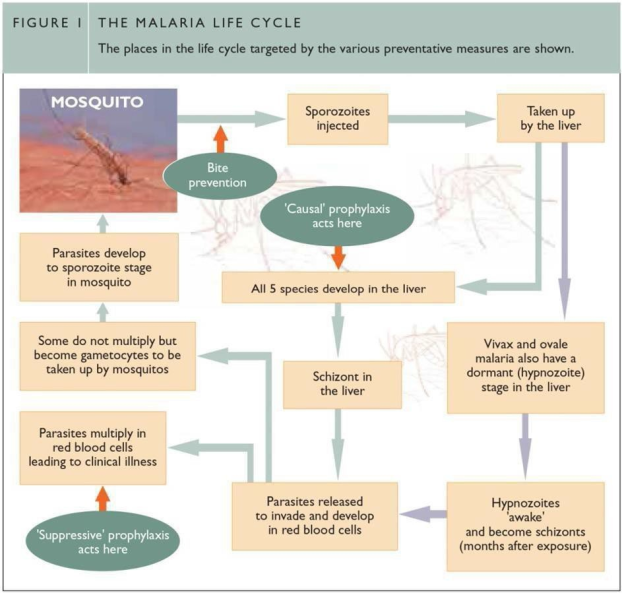
This figure shows the life cycle described above in pictorial form, to indicate the points at which malaria preventative measures act. Bite prevention acts at the very start of the life cycle to prevent bites from infected mosquitoes; There are 2 main forms of prophylaxis: causal prophylaxis and suppressive prophylaxis. Causal prophylaxis acts on the parasite in the liver, suppressive prophylaxis acts on parasites in the red blood cells.
The malarial illness
Malaria can neither be confirmed nor excluded by clinical features alone. The common symptoms and signs are shown below. There may be no physical signs apart from fever, but it must be noted that even the absence of fever itself does not exclude the diagnosis in an ill patient. There is a risk of misdiagnosing malaria as influenza or another infectious illness such as viral hepatitis (if jaundice is present), gastroenteritis (if diarrhoea is evident) or lower respiratory tract infection (cough can be a non-specific symptom).
Clinical symptoms and signs of malaria
(These symptoms and signs are taken from the UKMEAG malaria treatment guidelines.)
Non-specific symptoms of malaria:
- fever, sweats or chills
- malaise (vague discomfort)
- myalgia (muscle pain, tenderness)
- diarrhoea
- cough
Major features of severe or complicated falciparum malaria in adults:
- impaired consciousness or seizures
- renal impairment (oliguria less than 0.4 millilitre per kilogram (ml/kg) bodyweight per hour or creatinine more than 265 micromoles per litre (μmol/l))
- acidosis (pH less than 7.3)
- hypoglycaemia (less than 2.2 mmol/l)
- pulmonary oedema or acute respiratory distress syndrome (ARDS)
- spontaneous bleeding or disseminated intravascular coagulation
- shock (algid malaria)
- haemoglobinuria (without G6PD deficiency)
Major features of severe or complicated malaria in children:
- impaired consciousness or seizures
- respiratory distress or acidosis (pH less than 7.3)
- hypoglycaemia
- severe anaemia
- prostration (inability to sit or stand)
- parasitaemia (more than 2% red blood cells parasitised)
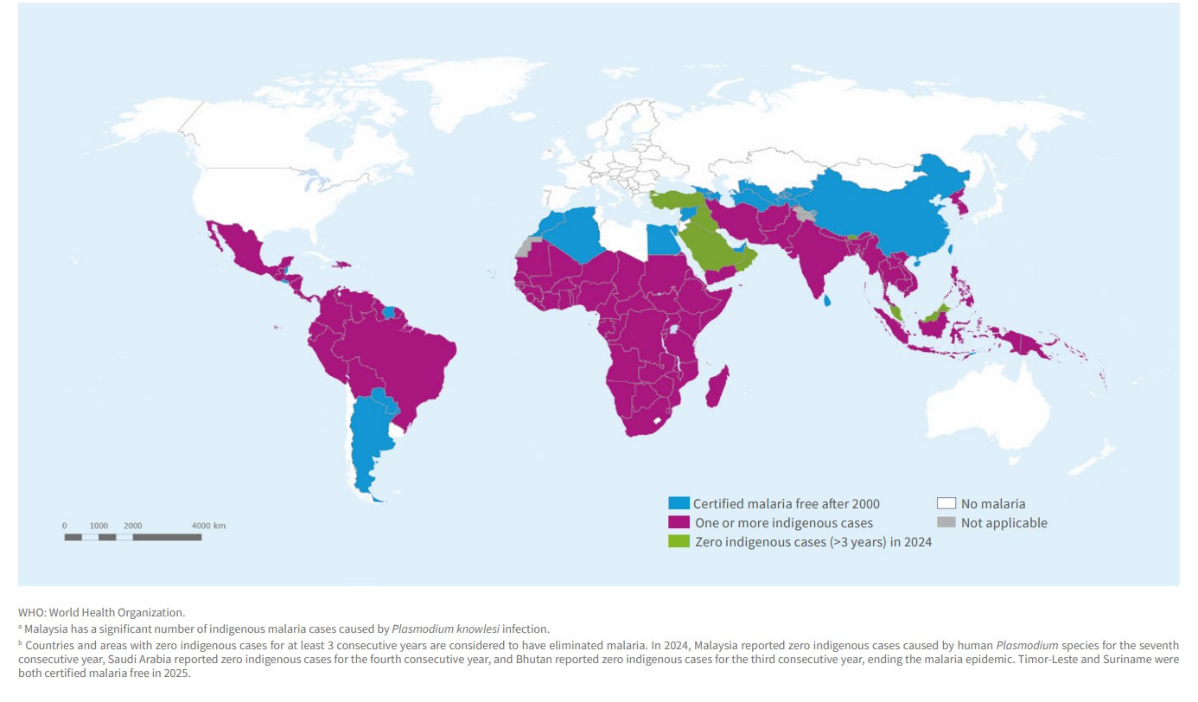
Figure 2. Countries and areas with indigenous cases in 2000 and their status by 2024
(Reproduced from the 2025 World Health Organization World Malaria Report, courtesy of the WHO)
Source: WHO database. Reproduced from the 2025 World Health Organization World Malaria Report, courtesy of the WHO.
Where malaria is found
Figure 2 shows the countries with indigenous cases of malaria as at 2024 courtesy of WHO (5). It is for illustration only and should not be used to advise individual travellers on chemoprophylaxis. Changes in malaria prevalence as a result of interrupted control efforts due to the COVID-19 pandemic may result in indigenous cases occurring in areas previously thought to be malaria-free. Choice of preventive measures should be based on the information stated in the Country recommendations’ table, supported by the text of these guidelines.
In-country maps of prophylactic advice linked to malaria distribution are available for selected countries in these guidelines for use when advising individual travellers and can be printed for them. The likelihood of malaria transmission may vary considerably within one country.
Practitioners should be aware of the recognition of P. knowlesi as the fifth malaria parasite of humans. It is a parasite of macaques and a zoonosis in humans in the Asia-Pacific region. As its asexual cycle takes only 24 hours, it is possible for its parasitaemia to rise more rapidly than with the other malaria species. A further danger is its close morphological resemblance to P. malariae which is a much less severe infection.
Therefore, P. knowlesi should be urgently considered in any patient with malaria from the Asia- Pacific region with what appears to be P. malariae. Whilst P. knowlesi is a zoonosis and thus not amenable to control in the same way as those parasites which infect humans alone, prevention of human infection still relies on bite prevention, awareness of risk and chemoprophylaxis. P. knowlesi is sensitive to chloroquine.
Factors affecting risk of exposure to malaria
Exposure of individual travellers to malaria is influenced by the number of infectious bites received. Factors affecting the number of infectious bites received are given below.
Temperature, altitude and season
The optimum conditions for malaria transmission are high humidity and an ambient temperature in the range 20°C to 30°C (6).
Malaria transmission does not usually occur in regions with temperatures below the 16°C isotherm (line on a weather map joining all the places that have the same average temperature over a given time).
Parasite maturation in the mosquito usually cannot take place at altitudes greater than 2,000 metres. However, it has been reported at altitudes up to 2,500 metres in some countries.
Seasonal rainfall increases mosquito breeding and in some areas malaria is highly seasonal.
Climate change may influence the distribution of mosquitoes and malaria parasites and thus alter the areas where malaria is a risk, so the advice in the country tables is regularly reviewed.
Rural versus urban location
Malaria incidence is generally higher in rural than in urban areas. However, in sub-Saharan Africa, urbanisation and the spread of the Anopheles stephensi mosquito which thrives in urban environments has led to a high prevalence of urban malaria infection (7, 8).
Type of accommodation
An insecticide impregnated bed net should be used unless the accommodation is fitted with functioning air-conditioning which is switched on, and windows and doors which are sufficiently well sealed to prevent mosquito entry.
Backpackers and others staying in cheap accommodation have a higher risk of being bitten compared to tourists staying in air-conditioned hotels.
Patterns of activity
Anopheles mosquitoes can be active during the day, at dawn and dusk, and throughout the night depending on species and geographical location. Dawn and dusk are higher risk generally, but it must be noted that the risk can occur at other times of the day; daytime biting in forested areas or overcast days for example. Both indoor and outdoor biting can occur, including inside vehicles. Biting at an airport on arrival while disembarking or awaiting luggage and onward ground transport should also be considered a risk area.
Length of stay
The longer the stay in the malarious area, the higher the risk of contracting malaria.
Distribution of drug-resistant malaria
Chloroquine-resistant falciparum malaria is now widespread (effectively universal). P. falciparum has also developed resistance to a variety of other agents in certain areas. Further comment on the extent and severity of drug resistance is given in the table in Country recommendations.
Chloroquine remains effective against P. ovale and P. malariae (9).
Chloroquine-resistant P. vivax is found in the Indonesian archipelago, the Malay Peninsula, including Myanmar, and eastward to Thailand, Cambodia, and Southern Vietnam. It is also reported from Ethiopia and South America (10, 11).
P. vivax with reduced susceptibility to primaquine is found in South-East Asia and Oceania (10).
References
Reference numbers refer to the complete list of references found in the References section.
4. Broderick C, Nadjm B, Smith V, Blaze M, Checkley A, Chiodini PL and others. ‘Clinical, geographical, and temporal risk factors associated with presentation and outcome of vivax malaria imported into the United Kingdom over 27 years: observational study’ British Medical Journal 2015: volume 350, h1,703
5. World Health Organization (WHO). World Malaria Report 2025
6. White N. ‘Malaria’ In: Farrar J and others, editors. Manson’s Tropical Diseases: Elsevier Health Sciences 2024, page 573
7. De Silva PM, Marshall JM. ‘Factors contributing to urban malaria transmission in sub- Saharan Africa: a systematic review’ Journal of Tropical Medicine 2012: 819563
8. Merga H, Degefa T, Birhanu Z, Tadele A, Lee MC, Yan G, Yewhalaw D. ‘Urban malaria in sub-Saharan Africa: a scoping review of epidemiologic studies’ Malaria Journal 2025: volume 24, issue 1, page 131
9. Siswantoro H, Russell B, Ratcliff A, Prasetyorini B, Chalfein F, Marfurt J, Kenangalem E, Wuwung M, Piera KA, Ebsworth EP, Anstey NM, Tjitra E, Price RN. ‘In vivo and in vitro efficacy of chloroquine against Plasmodium malariae and P. ovale in Papua, Indonesia’ Antimicrobial Agents and Chemotherapy 2011: volume 55, issue 1, pages 197 to 202
10. Baird JK. ‘Resistance to therapies for infection by Plasmodium vivax’ Clinical Microbiology Reviews 2009: volume 22, issue 3, pages 508 to 534
11. Ric N Price, Lorenz von Seidlein, Neena Valecha, Francois Nosten, J Kevin Baird, Nicholas J White. ‘Global extent of chloroquine-resistant Plasmodium vivax: a systematic review and meta-analysis’ Lancet Infectious Diseases 2014: volume 14, pages 982 to 991