Life courses and pension saving patterns
Published 18 May 2026

© Crown copyright 2026
This publication is licensed under the terms of the Open Government Licence v3.0 except where otherwise stated. To view this licence, visit nationalarchives.gov.uk/doc/open-government-licence/version/3 or write to the Information Policy Team, The National Archives, Kew, London TW9 4DU, or email: psi@nationalarchives.gov.uk.
Where we have identified any third party copyright information you will need to obtain permission from the copyright holders concerned.
This publication is available at https://www.gov.uk/government/publications/life-courses-and-pension-saving-patterns/life-courses-and-pension-saving-patterns
DWP ad hoc research report no. 131
A report of research carried out by Bee Boileau, Jonathan Cribb, Heidi Karjalainen and Laurence O’Brien from the Institute for Fiscal Studies (IFS) on behalf of the Department for Work and Pensions (DWP).
Crown copyright 2026.
You may re-use this information (not including logos) free of charge in any format or medium, under the terms of the Open Government Licence. To view this licence, visit Open Government Licence - National Archives or write to the Information Policy Team, The National Archives, Kew, London TW9 4DU, or email psi@nationalarchives.gov.uk.
This document/publication is also available on our website at: Research at DWP - GOV.UK
If you would like to know more about DWP research, email socialresearch@dwp.gov.uk
First published May 2026.
ISBN 978-1-78659-997-1
Views expressed in this report are not necessarily those of the Department for Work and Pensions or any other government department.
Executive summary
This report explores how labour market histories and life events are associated with pension saving in the UK, and how different labour market patterns translate into differences in retirement outcomes in later life.
-
Under the current private pension system, certain groups are at risk of accumulating little or no private pensions over their working-age life, especially those with long spells of non-employment or self-employment, and to a lesser extent those mostly in part-time work.
-
Sustained periods of non-employment or part-time work are particularly common among women (especially those from ethnic minorities) and other groups that tend to be more disadvantaged on a number of dimensions, such as those who report being disabled in their later working life. These labour market patterns tend to lead to lower private pension saving over the life course among these groups.
-
While some of the differences in pension participation have narrowed since 2012 due to automatic enrolment, as long as significant differences in labour market patterns exist, automatic enrolment policies on their own cannot eliminate the differences in pension saving between groups.
-
Differences in pension saving patterns also translate into differences in retirement outcomes. People who are mostly in full-time paid work during their working lives have much higher retirement incomes than (for example) women who have taken significant breaks from paid work in order to raise children.
-
Average retirement incomes for groups that have lower labour market attachment and private pension saving are higher once partners’ incomes are included, making the gaps between groups smaller. However, marriages and partnerships can end due to divorce, separation or bereavement, which can expose people, in particular women, to lower resources in later life.
-
We find that ‘life events’ (such as having a child; relationship breakdown; or changing housing tenure) tend to have a limited effect on pension participation or changes in contribution rates for people who remain private sector employees. However, to the extent that life events affect labour market outcomes, they can still impact the amount people save in private pensions. Most notably, private pension saving of men and women diverge after the birth of a first child, almost entirely due to changing working patterns and earnings rather than due to pension contributions conditional on labour market behaviour.
1. Introduction
This report outlines the key findings from IFS work commissioned by the Department for Work and Pensions (DWP) in early 2026 to feed into the evidence base for the Pensions Commission.
In this research we use longitudinal household survey datasets to investigate how employment patterns over the life course translate into differences in pension saving and retirement outcomes.
There is a great deal of evidence showing differences in pension saving in the UK using cross-sectional data (see for example DWP, 2025 and Office for National Statistics, 2026). However, cross-sectional analysis only provides a snapshot of saving behaviours which may not reflect how people are building up private pension wealth over a longer period.
Longitudinal data is therefore needed to allow us to understand labour market trajectories across the life course, and how those relate to saving behaviours and retirement incomes. This will in turn enable the identification of groups who are most at risk of not saving for retirement across their working lives.
This work builds on existing analysis of how life courses and life events are associated with pension saving and retirement incomes. For example, the WHERL (Wellbeing, Health, Retirement and the Lifecourse) project (Glaser and others, 2017) showed that longer career breaks, as well as moving into part-time work due to caring responsibilities, are associated with poorer retirement outcomes for women. On the other hand, existing IFS analysis (Cribb and others, 2023) finds very limited evidence of pension saving changes for those who remain in paid work after life events such as getting married or having children.
We add to this evidence base with many important extensions, such as studying self-employment as part of the life course analysis, studying longitudinal patterns of pension saving, and studying new dimensions of heterogeneity. We are also able to use more recent data for up to date analysis, which allows us to study more recent cohorts of retirees than would have been possible in earlier work.
The work is split into 4 Research Questions (RQs):
- RQ1: What do labour market life courses look like? Can life courses be grouped by type?
- RQ2: What do pension participation histories look like, and how do they relate to the life courses?
- RQ3: How do life courses relate to retirement incomes?
- RQ4: What is the relationship between ‘life events’ and retirement outcomes?
2. Data and methodology
This section summarises the data and methodology used for the analysis in this report.
2.1 Data
We use 3 datasets in this analysis:
- UK Household Longitudinal Study (UKHLS): cohorts born 1960 to 1973 and 1974 to 1988, observed across waves 1 to 14 (2009 to 2024).
- British Household Panel Study (BHPS): cohort born 1960 to 1973, observed across all waves 1 to 18 (1991 to 2008).
- English Longitudinal Study of Ageing (ELSA): cohorts born 1937 to 1946 and 1947 to 1959, observed across waves 1 to 11 (2002–03 to 2021–23), and ‘life history data’ collected in 2006 to 2007 and 2021 to 2023.
2.2 Methodology
In Research Question 1 we categorise labour market life courses by following people over time in UKHLS and BHPS, and in the case of ELSA, using information on respondents’ earlier working lives based on life history questionnaires.
In UKHLS and BHPS we observe people for a shorter number of years than in ELSA. For the UKHLS analysis, we construct life courses based on up to 15 years of data; for UKHLS+BHPS this increases to up to 31 years. In ELSA, we have people’s work histories for all years from age 20 to 65, based on the questions asked about past jobs in the life history questionnaires.
This is important for comparisons between datasets – UKHLS and UKHLS+BHPS only capture a fraction of people’s working lives, whereas ELSA life history questionnaires document full profiles from age 20 to 65.
For most of the analysis in RQ1 our sample includes:
- UKHLS: Individuals observed age 22 to 65 in at least 8 waves of UKHLS, including at least one of waves 1 to 3 and at least one of waves 12 to 14 and born between 1960 and 1988.
- UKHLS+BHPS: individuals observed age 22 to 65 in at least 25 waves of UKHLS+BHPS, including at least one of waves 1 to 3 of BHPS and at least one of waves 12 to 14 of UKHLS and born between 1960 and 1974.
- ELSA: all individuals who completed the life history questionnaire (in wave 3 or 11) at least up to the work-related questions.
We use 4 different economic activities to categorise life courses:
- Full-time employee
- In UKHLS and BHPS: defined as working 30 hours or more per week in main job where self-reported hours are available.
- In the ELSA life history survey: people are asked to recall whether they worked full-time or part-time without reporting hours. We use this self-reported status.
- Part-time employee
- In UKHLS/BHPS: fewer than 30 hours per week in main job where available.
- In ELSA life history: use self-reported status.
- Self-employed
- In all datasets: use self-reported status.
- Not in paid work
- In all datasets: those who do not report being an employee or self-employed.
We define life courses based on the main form of economic activity that individuals undertake over the periods in which they are observed. In particular, we focus on the mutually exclusive and exhaustive groupings below:
- full-time (FT) work more than 75% of the time
- FT work 50% to 75% of the time
- part-time (PT) work more than 50% of the time
- employee more than 50% of the time, mix of PT and FT work (neither more than 50% of the time on their own but combined more than 50%)
- self-employed more than 50% of the time
- out of paid work more than 50% of the time
- other / mixed
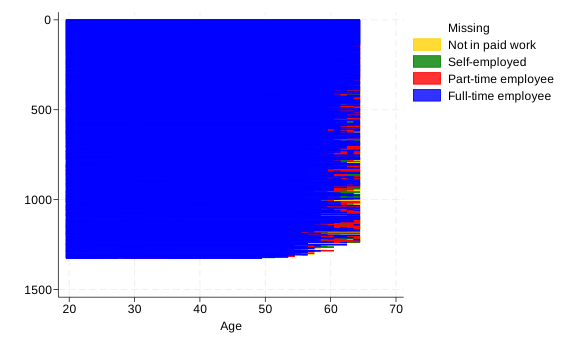
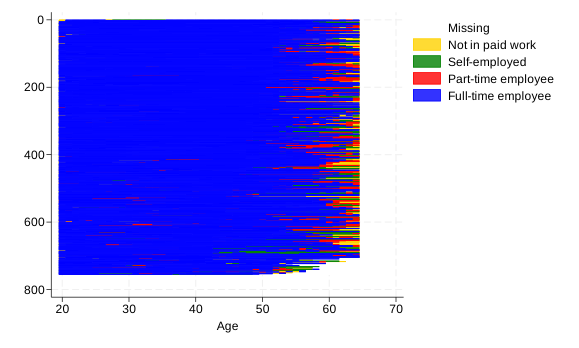
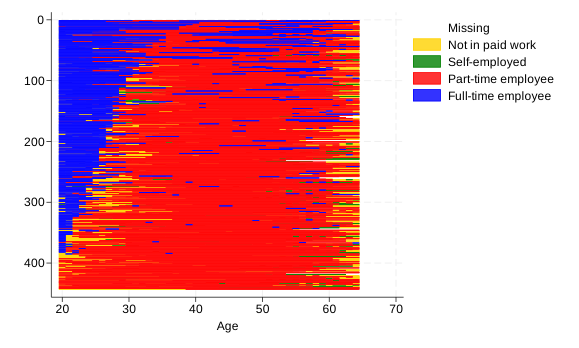
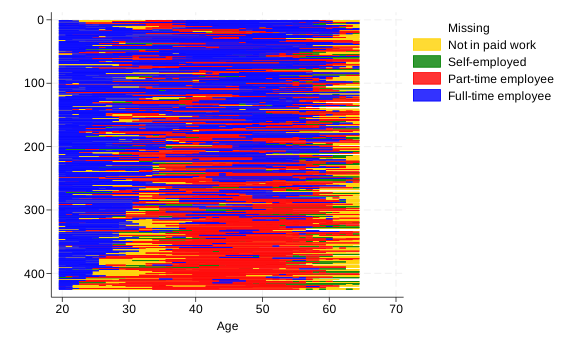
We also create “sequence index plots” in order to illustrate the extent of heterogeneity in types of life courses within these groupings. Sequence index plots consist of line segments which indicate how individuals move between the different states of economic activity over time or over their lifetime, where different colours refer to different states.
In Research Question 2 we use the UKHLS panel (2009 to 2024) to estimate proportion of years people save in a private pension.
We define pension participation as saving either into a workplace pension or a personal pension. Personal pension participation is observed in even waves 2 to 10 and in wave 13. We only use even waves (i.e. 2010 to 2020) for the analysis of observed pension saving, because wave 13 personal pension participation data is unreliable due to being asked on its own without a question on workplace pension participation. We link the pension participation histories to labour market life courses from RQ1, and examine prevalence of always saving, never saving, and average number of waves saved across these groups. We restrict the sample to a “balanced panel” for much of this analysis, i.e. we focus on individuals who responded to the survey in all even waves 2 to 10 of UKHLS. The results when using the balanced panel are easier to interpret, but we have also confirmed the results in this section look very similar when the analysis is run on a larger sample of people who respond at least once in the early waves (2 to 6) and at least once in the later waves (6 to 10).
As automatic enrolment (AE) – the requirement for employers to automatically enrol eligible staff into workplace pension schemes – was rolled out during the period in which our data covers, it is also important to model what participation may have looked like under the current policy. In order to do this, we simulate what pension participation may have looked like in the period 2010 to 2020 under automatic enrolment using labour market status, to match the following probabilities of participating in a pension for different groups based on DWP Official Statistics (DWP, 2025b, Tables 1.1 and 1.10):
- AE-eligible employee: 89%
- non-AE-eligible employee: 38%
- self-employed: 17%
- not in paid work: 1%
We run this simulation for the entire period of UKHLS data (waves 1 to 14 i.e. 2009 to 2024), and again examine how simulated pension participation histories differ across the life courses from RQ1.
In order to better understand long-term non-participation in private pensions, we use information from waves 1 to 11 (2002 to 2003 to 2021 to 2023) of ELSA for people born 1937 to 1946 and 1947 1o 1959 to estimate the proportion of people aged 55 to 65 who have accumulated no private pension wealth (and therefore never participated in a private pension), and how this varies for different groups.
Having no private pension wealth is defined as someone who we never observe with any kind of pension between ages 55 and 65 – that means they have no retained pensions, no active pension they currently contribute to, and they are also not receiving private pension income.[footnote 1]
In Research Question 3 we study incomes in retirement. We use ELSA for this analysis and focus on the cohort 1937 to 1946 who are mostly observed in their 70s and early 80s (between 2018 and 2023), to capture outcomes for an age group who are (mostly) fully retired.
The outcomes we focus on are individual and benefit unit (BU) disposable incomes in retirement, and the probability of having low income in retirement (defined as being in the bottom fifth of disposable income for the cohort and wave of observation).
Benefit unit is defined as an individual and their cohabiting partner or spouse (if they have one). The benefit unit income is equivalised to the equivalent for a single-adult using the OECD modified equivalence scale. In practice this means that income for a couple without dependent children is divided by 1.5, to be represented as the equivalent for a single adult. Incomes are winsorised[footnote 2] at the 99th percentile within each cohort and wave in order to ensure that the results are not driven by outliers.
Disposable incomes include earnings from employment and self-employment, benefits (including State Pension income), private pension income, and other income (such as investment income). They are measured net of direct taxes. Benefit unit disposable income is also calculated after deducting housing costs, where housing costs are defined as rent (net of any Housing Benefit received) and mortgage payments. The incomes are presented as weekly incomes in 2024 prices (adjusting for inflation using the CPI).
As some characteristics (region, disability, marital status and housing tenure) vary over time, we measure them at the point when the sample respondents were aged 55 to 65, in order to capture the status in later working age.[footnote 3]
Research Question 4 extends the analysis in Cribb and O’Brien (2023) ‘When and why do employees change their pension saving?’, specifically Chapter 4 ‘The effects of changes in household circumstances on pension saving for private sector employees’.
This analysis is conducted using even waves of UKHLS data, which contain information on workplace pension saving. We principally use even waves 2 to 14, covering 2010 to 2024. UKHLS also contains detailed information on individual and household characteristics, meaning we can observe the ‘life events’ we are interested in. The life events that we focus on are: changes in marital status (getting married, marriage ending due to any of divorce, separation or bereavement); changes in the number of children living in the household (first child born, additional child born, and child leaves household); changes in housing status (starting to rent after living with parents, taking out a mortgage after living with parents, moving from renting to owning with a mortgage, completing mortgage repayments); changes in partner’s work status (starting or stopping work); changes in caring responsibilities (starting or stopping caring responsibilities); and changes in health status (new health condition or recovered from health condition).
Our analysis principally focuses on individuals who are private-sector employees in 2 consecutive even waves of the data, i.e. observed 2 years apart. For those who are not saving in a workplace pension in the initial wave, we analyse how the proportion who start saving in a workplace pension in the subsequent wave varies by life event. Conversely, we also examine how life events affect the probability of stopping saving in a workplace pension for those who are saving in a workplace pension in the initial wave. Finally, for those who are saving in a workplace pension in both waves, we analyse how life events are associated with changes in employee pension contribution rates.
We document the raw differences in how pension saving decisions and changes vary between groups experiencing different life events. We also use multivariate regression analysis to estimate how each individual life event is associated with changes in pension saving, controlling for other life events and changes in earnings, hours of work, employer, job, age and year.
Finally, we also show how individual pension contributions evolve around life events across everyone (whether in work or not), and how this differs for men and women. For this analysis, we use even waves 2 to 10 of UKHLS and focus on the level of individual contributions to both workplace and personal pensions. This analysis sheds light on how life events can affect pension contributions through their effects on labour market outcomes.
Throughout all of the research questions, the results are weighted using cross-sectional weights from the relevant datasets (unless otherwise specified). Number of observations are reported as the unweighted number of observations.
3. What do labour market life courses look like? Can life courses be grouped by type?
Life courses of employment are important because most private pension saving is undertaken by individuals while they are in paid work, and these savings are built up slowly over time.
Some people who are – at any one point in time – out of paid work and not saving in a pension may have many years of work experience at other points of their lives. On the other hand, some who are currently in paid work may have only a very partial work history.
We first start by documenting the prevalence of the different life courses and how they differ by cohort and by a range of characteristics.
3.1. Life course analysis using UKHLS
First focusing on results using UKHLS, Table 1 shows that across both cohorts (born 1960 to 1973 or 1974 to 1988), the majority of people are in FT work for most of the period we observe them during their working-age life. For example, among the youngest cohort (shown in the second panel of Table 1, born 1974 to 1988 and observed in UKHLS over a 15-year period), 49% were in full-time work more than 75% of the time and 13% between 50 and 75% of the time.
However, many have significant periods either in self-employment, part-time work, or out of paid work. For example, among the 1974 to 1988 cohort, 10% worked mostly part-time, 7% did a mix of part-time and full-time work, 7% were mostly self-employed, and 11% were mostly out of paid work (with 3% having mixed life course).
Table 1. Life courses by cohort, gender and ethnicity
a) Cohort born 1960 to 1973
| Group | More than 75% FT | 50% to 75% FT | Mostly PT | FT/PT mix | Mostly SE | Mostly no work | Mix | Obs |
|---|---|---|---|---|---|---|---|---|
| All | 46% | 12% | 12% | 5% | 10% | 13% | 3% | 7,083 |
| Men | 59% | 11% | 2% | 2% | 14% | 9% | 3% | 3,016 |
| Women | 33% | 13% | 21% | 7% | 7% | 16% | 4% | 4,067 |
| White men | 60% | 11% | 2% | 2% | 14% | 9% | 3% | 2,622 |
| White women | 33% | 13% | 21% | 7% | 7% | 16% | 4% | 3,502 |
| Non-white men | 50% | 10% | 3% | 5% | 21% | 8% | 4% | 394 |
| Non-white women | 31% | 11% | 14% | 10% | 7% | 25% | 3% | 565 |
b) Cohort born 1974 to 1988
| Group | More than 75% FT | 50% to 75% FT | Mostly PT | FT/PT mix | Mostly SE | Mostly no work | Mix | Obs |
|---|---|---|---|---|---|---|---|---|
| All | 49% | 13% | 10% | 7% | 7% | 11% | 3% | 5,015 |
| Men | 67% | 10% | 2% | 3% | 10% | 5% | 3% | 1,960 |
| Women | 33% | 15% | 17% | 11% | 5% | 17% | 3% | 3,055 |
| White men | 68% | 10% | 2% | 3% | 10% | 5% | 3% | 1,621 |
| White women | 34% | 15% | 18% | 11% | 5% | 15% | 3% | 2,476 |
| Non-white men | 56% | 19% | 1% | 3% | 9% | 7% | 7% | 337 |
| Non-white women | 27% | 13% | 10% | 10% | 3% | 34% | 3% | 577 |
Source: UKHLS waves 1 to 14 (2009 to 2024).
While there are some differences in the prevalence of life courses between the 2 cohorts we examine (shown in the 2 panels of Table 1), these differences are generally small and may largely reflect the different ages that these cohorts are observed. For example, a higher share of the 1960 to 1973 cohort is mostly self-employed in the 15-year UKHLS panel (10%) than for the 1974 to 1988 cohort (7%); however, this is to some extent driven by the fact we observe the 1960 to 1973 cohort at older ages, when self-employment is more prevalent.
There are more significant differences in the prevalence of different life courses by individual characteristics. In particular, the differences between men and women are stark – women are much more likely to experience life courses that contain significant part-time work and/or non-employment, and much less likely to have an ‘almost always full-time’ employment trajectory. For example, for the UKHLS sample born 1974 to 1988, 77% of men were mostly (over half the time) in full-time employment over the 15 years they were observed, compared with 48% of women.
Ethnic minorities[footnote 4] are also less likely to be in sustained FT work, and the differences are even larger when splitting by both ethnicity and gender – 34% of non-white women in the 1974 to 1988 cohort spent most of the last 15 years not in paid work, compared with 15% among white women. There is no evidence of this gap narrowing; in fact the gap is larger among the 1974 to 1988 cohort than among the 1960 to 1973.
3.2. Life course analysis using ELSA
Table 2 shows the prevalence of different life courses using ELSA. The first row shows similar patterns to the previous table – in particular, the majority of people are in full-time work throughout their working-age life (from age 20 to 65), but many also spend significant periods in part-time work and self-employment.
In ELSA we also study how the prevalence of life courses differs by characteristics measured at age 55 to 65 – for example, whether the person reports being disabled (as defined in Equality Act 2010 as having a long-standing health condition that substantially limits their ability to do normal daily activities), and their housing tenure. We also have a measure of whether the respondent reports ever having cared for someone with a long-term health condition, disability or problems related to ageing.
Table 2 shows that across these 2 ELSA cohorts (1937 to 1946 and 1947 to 1959), there are large differences in the prevalence of sustained full-time work especially by disability, where those who report being disabled in their late 50s or early 60s are less likely to have worked mostly full-time over their working life, and more likely to spend significant amounts of time out of paid work.
For housing tenure, we find that the majority of those who were social renters in their late 50s or early 60s were not in sustained full-time work throughout their working lives and are much more likely to mostly be not in paid work.
There are also differences in employment life courses based on whether the respondent has ever cared for family or friends, but these are smaller in magnitude.
Table 2. Life courses by cohort, whether ever cared for a friend or relative, and disability and housing tenure status observed at age 55–65
a) Cohort born 1937 to 1946
| Group | More than 75% FT | 50% to 75% FT | Mostly PT | FT/PT mix | Mostly SE | Mostly no work | Mix | Obs |
|---|---|---|---|---|---|---|---|---|
| All | 36% | 20% | 9% | 10% | 7% | 15% | 2% | 2,410 |
| Not disabled | 40% | 22% | 10% | 10% | 8% | 9% | [2%] | 738 |
| Disabled | 28% | 22% | [8%] | [12%] | [6%] | 20% | [4%] | 371 |
| Owns | 35% | 20% | 11% | 11% | 7% | 14% | [2%] | 1,297 |
| Mortgage | 43% | 22% | 8% | 8% | 7% | 10% | [2%] | 724 |
| Private renter | 20% | [18%] | [7%] | [11%] | [18%] | [19%] | [8%] | 54 |
| Social renter | 30% | [19%] | [8%] | [10%] | [4%] | 27% | [3%] | 232 |
| Never carer | 40% | 19% | 7% | 8% | 9% | 15% | [1%] | 1,241 |
| Carer | 32% | 21% | 11% | 11% | 6% | 15% | [3%] | 1,169 |
b) Cohort born 1947 to 1959
| Group | More than 75% FT | 50% to 75% FT | Mostly PT | FT/PT mix | Mostly SE | Mostly no work | Mix | Obs |
|---|---|---|---|---|---|---|---|---|
| All | 34% | 19% | 11% | 9% | 6% | 17% | 4% | 3,123 |
| Not disabled | 39% | 20% | 12% | 9% | 6% | 12% | 4% | 1,658 |
| Disabled | 28% | 19% | 9% | 11% | 7% | 22% | [4%] | 1,104 |
| Owns | 32% | 19% | 13% | 11% | 6% | 15% | 4% | 1,245 |
| Mortgage | 39% | 20% | 10% | 8% | 8% | 12% | 4% | 1,204 |
| Private renter | [31%] | [19%] | [6%] | [14%] | [9%] | [17%] | [6%] | 104 |
| Social renter | [16%] | 21% | [9%] | [9%] | [2%] | 40% | [4%] | 319 |
| Never carer | 39% | 18% | 9% | 8% | 7% | 18% | [3%] | 1,645 |
| Carer | 29% | 20% | 13% | 11% | 6% | 16% | 5% | 1,478 |
Note: Square brackets indicate percentages where the numerator has fewer than 50 observations (unweighted).
Source: ELSA waves 1 to 11 (2002–2003 to 2021–2023) and life history waves 1 and 2.
It is worth noting that while these groupings are useful in identifying common labour market patterns and assessing how those relate to other outcomes, there is also significant heterogeneity within those groups. The sequence index plots in the Appendix illustrate this heterogeneity, and as an example of these, Figure 1 shows the sequence index plot for those who are ‘mostly part-time employees’ (same as Panel C of Figure A1).
Figure 1. Sequence index plot for those with the ‘mostly part-time employee’ life course (1947 to 1959 ELSA cohort)
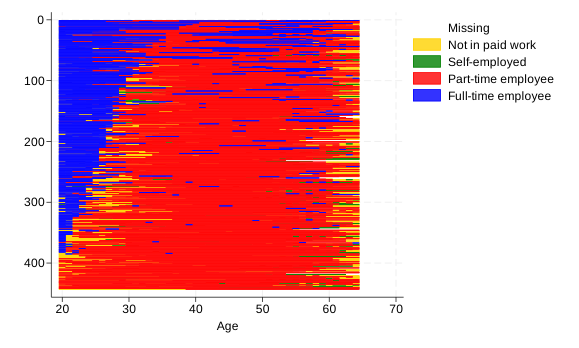
Note: Each row indicates one individual. The colour at each age indicates labour market status at that age. Unweighted.
Source: ELSA waves 1 to 11 (2002–03 to 2021–23) and life history waves 1 and 2.
Each line in these plots indicates one individual, and the plots are drawn for each life course for the 1947 to 1959 cohort. The plots provide clear graphical illustration of both common patterns as well as heterogeneity of life courses within the groupings.
For example, it is clear from Figure 1 that even among those who are ‘mostly part-time employees’ over their working life, many people (in this case mainly women) start their working life in full-time work, before moving out of work or to part-time work at different points in their 20s or 30s.
4. What do pension participation histories look like, and how do they relate to the life courses?
In this section we study how pension participation patterns over time relate to the labour market life courses identified in the previous question. In particular, it is important to understand to what extent ‘patchy’ pension participation histories are driven by particular labour market histories, and which groups of people are more or less likely to ever save in a pension when observing them over a longer time period.
4.1 Studying pension saving patterns using UKHLS
We first document observed pension saving in the 5 even waves of UKHLS (2010 to 2020) which contain pension saving information. We define pension participation as saving in either a workplace or personal pension. Figure 2 shows that among the older UKHLS cohort (1960 to 1973) about 42% save in a pension in all 5 observed waves, while about 22% save in none. Among the younger cohort (1974 to 1988) fewer (about 30%) save in all 5 waves, while about 21% save in none. The differences between cohorts are consistent with older working-age people being more likely to save into a pension, especially before automatic enrolment.
Figure 2. Distribution of number of waves saving in a pension, by birth cohort
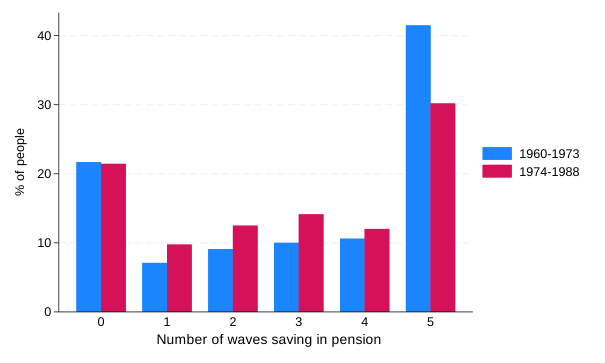
Notes: Balanced panel observed in all UKHLS even waves 2 to 10. Pension participation is defined as saving either into a workplace pension or a personal pension.
Source: UKHLS even waves 2 to 10 (2010 to 2020).
We also study associations between the life courses identified in the previous question and pension participation. Many of the patterns look as expected: those with stronger labour market attachment show more complete records of private pension saving. For example, Figure 3 shows that those in mostly full-time work are more likely to be saving into a pension in all waves than the other employment life course groups. On the other hand, those mostly self-employed or mostly out of paid work are more likely to never save in a private pension over the period they are observed (60% of the mostly self-employed and 80% of those mostly out of paid work never save in a private pension).
An interesting pattern arises when looking at part-time workers – among those who were mostly part-time workers, about 38% were saving in every wave, and 18% never saved. This means that this group of people are significantly more likely to be ‘always saving’ than those mostly out of work or in self-employment, as well as those doing a mix of full-time and part-time work over their careers.
Figure 3. Percentage of people never saving or always saving in a pension, by life course
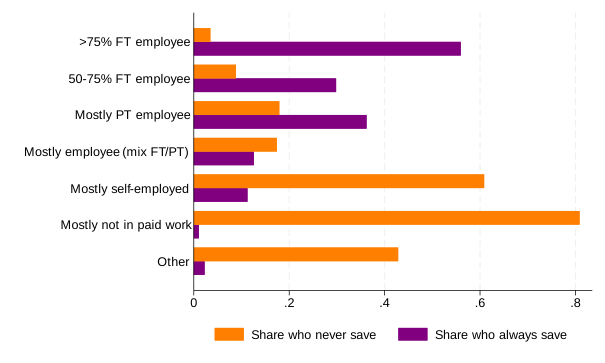
Notes: Balanced panel observed in all UKHLS even waves 2 to 10 of those born 1960 to 1988. Pension participation is defined as saving either into a workplace pension or a personal pension.
Source: UKHLS even waves 2 to 10 (2010 to 2020).
The data we have used for the pension saving analysis so far covers years 2010 to 2020, which is when automatic enrolment was rolled out in the UK, starting in 2012 and completing in 2018. This means that at the start of the period no one was being automatically enrolled into a pension, whereas by the end automatic enrolment applied to all eligible employees.
We can clearly see the effect of automatic enrolment in Figure 4, which shows the share of people saving in a pension by age and cohort. Among each cohort, the share of people saving in a pension rises very rapidly in the 2010s due to the gradual roll-out of automatic enrolment. This means that each successive cohort is much more likely to be saving in a private pension at a given age compared to the previous one.
Figure 4. Percentage of people who are saving in a pension, by age and birth cohort
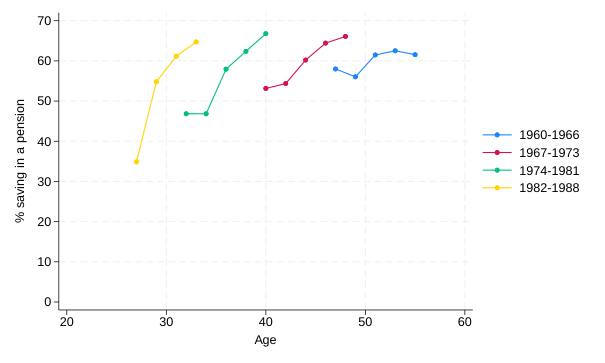
Notes: Pension participation is defined as saving either into a workplace pension or a personal pension.
Source: UKHLS even waves 2 to 10 (2010 to 2020).
In order to understand how the results in this section may differ in the future given that automatic enrolment is now firmly in place, we also simulate pension participation under automatic enrolment for the full 15 years of the data, as described in the Methodology section.
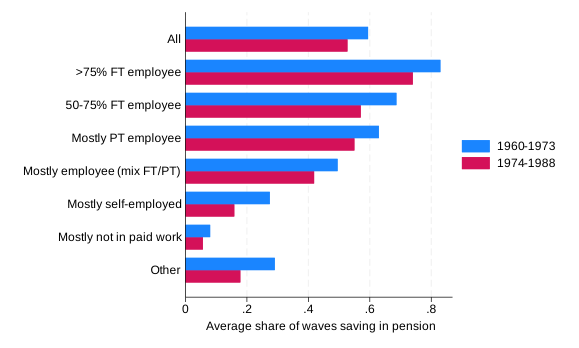
Taking into account the automatic enrolment simulation increases participation rates across all groups, but the patterns between life course groups look largely similar, as shown in the Figure 5 (where the first panel shows observed saving and second panel simulated saving). Interestingly, once we account for the introduction of automatic enrolment, “mostly part-time employees” see a particularly large increase in private pension participation, reflecting the fact that the earnings trigger of £10,000 now brings many part-time workers into automatic enrolment.
Figure 5. Average percentage of waves people are saving in a pension, by life course and birth cohort
a) Observed saving
b) Simulated saving
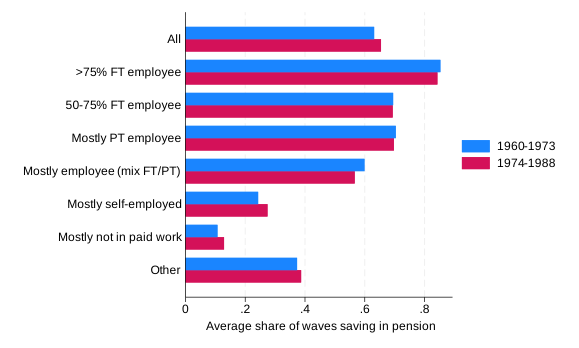
Notes: Panel a): balanced panel observed in all UKHLS even waves 2 to 10 of those born 1960 to 1988. Pension participation is defined as saving either into a workplace pension or a personal pension. Panel b): simulated participation using all UKHLS waves those born 1960 to 1988.
Source: UKHLS waves 1 to 14 (2009 to 2024).
When considering other types of heterogeneity, we find that differences in pension participation across different groups follow similar patterns as the life-course analysis, although the differences in pension participation between groups are somewhat smaller in magnitude than we may expect based on the large differences in prevalence of sustained full-time work – for example among those born 1974 to 1988, the average share of waves simulated to be saving in a pension was 69% for men and 59% for women (Table 3).
Table 3. Average percentage of waves people are simulated to save in a pension, by characteristics and birth cohort
| Cohort | Group | Average % of waves saving | Obs |
|---|---|---|---|
| 1960 to 1973 | All | 61% | 91,367 |
| 1960 to 1973 | Men | 63% | 38,886 |
| 1960 to 1973 | Women | 60% | 52,479 |
| 1974 to 1988 | All | 63% | 63,195 |
| 1974 to 1988 | Men | 69% | 24,673 |
| 1974 to 1988 | Women | 59% | 38,520 |
Notes: Pension participation is defined as saving either into a workplace pension or a personal pension. Simulated participation using all UKHLS waves for those born 1960 to 1988.
Source: UKHLS waves 1 to 14 (2009 to 2024).
4.2 Studying prevalence of no private pension wealth using ELSA
In the second part of analysis for this research question we use ELSA to document the prevalence of people who report having no private pension wealth or private pension income in their mid-50s to mid-60s. We define this both at the individual and the benefit unit level.
We focus on the 1947 to 1959 cohort in this section, because many of these individuals were still in paid work at the time of the introduction of automatic enrolment. As a result, their private pension accumulation will look more similar to what we might expect among younger cohorts. Results for the older cohort are shown in Appendix Table A1.
Table 4 shows that among the 1947 to 1959 cohort, 21% of individuals have no individual private pension wealth, and 15% of benefit units have none. The difference in the prevalence of no private pension wealth between individuals and benefit units shows the importance of studying the household when considering retirement resources available to people.
Table 4. Prevalence of not having any (individual or benefit unit (BU)) private pension observed at age 55 to 65, cohort born 1947 to 1959
| Group | No individual private pension | No BU private pension | Obs |
|---|---|---|---|
| All | 21% | 15% | 3,123 |
| More than 75% FT | 12% | 10% | 1,037 |
| 50% to 75% FT | 13% | 10% | 591 |
| Mostly PT | 25% | 14% | 345 |
| FT/PT mix | 22% | [12%] | 320 |
| Mostly SE | 23% | [14%] | 195 |
| Mostly no work | 46% | 32% | 516 |
| Other | [29%] | [13%] | 119 |
| Men | 13% | 11% | 1,376 |
| Women | 29% | 18% | 1,747 |
| No disability | 14% | 9% | 1,658 |
| Disability | 25% | 16% | 1,104 |
| Owns outright | 13% | 6% | 1,245 |
| Mortgage | 12% | 4% | 1,204 |
| Private renter | [19%] | [13%] | 104 |
| Social renter | 48% | 41% | 319 |
Note: No private pension is defined as not reporting an active or retained pension and no private pension income ever when observed aged 55 to 65. Square brackets indicate percentages where the numerator has fewer than 50 observations (unweighted).
Source: ELSA waves 1 to 11 (2002–2003 to 2021–2023).
Table 4 also shows that there are clear differences in the extent to which people have no private pension wealth by life course. Among those who were in full-time work at least 75% of the time, 12% had no individual private pension wealth, compared with 25% among those working mostly part-time, 23% among those mostly self-employed, and 46% among those mostly not in paid work. The differences when taking into account benefit unit wealth are much smaller – the figures are 10% for mostly full-time workers, 14% for mostly part-time, 14% for mostly self-employed, and 32% for mostly out of paid work.
The difference between the proportion of people who have no individual private pension wealth and the proportion who live in a benefit unit with no pension wealth is particularly notable for women. 29% of women and 13% of men have no private pension wealth at the individual level, whereas at the benefit unit level these figures are 18% for women and 11% for men.
Consistent with the labour market patterns documented above, there are also large differences in the prevalence of no private pension wealth by disability and housing tenure.
5. How do life courses relate to retirement incomes?
In this research question we relate the life-course groups to average disposable income and prevalence of low income in retirement, using data from ELSA and focusing on the 1937 to 1946 cohort. We focus on this older cohort who are mostly observed in their 70s (between 2018 and 2023), to get a sense of how retirement resources differ for people who are currently (mostly) fully retired.
Outcomes are shown for individual income as well as for equivalised benefit unit income. Benefit unit disposable income is also calculated after deducting housing costs (although as the majority of people in retirement own their homes outright in both of the cohorts we look at, this adjustment has a limited impact).
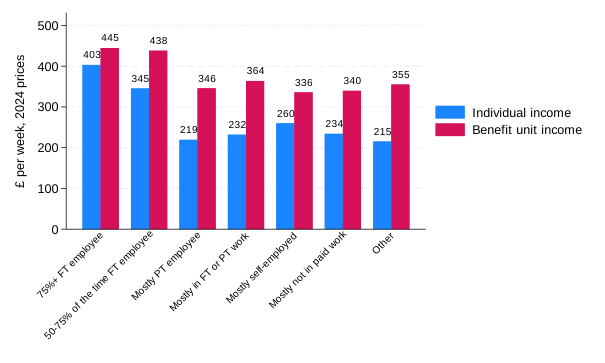
Figure 6 shows that retirement incomes differ substantially by life course, especially on an individual basis. As expected, those who spent more time in full-time work have higher incomes in retirement – for example, median weekly individual income for those in full-time work more than 75% of their working life was £403 per week, compared with £219 per week for those mostly working part-time.
We find that the prevalence of relative low income follows an equivalent (but mirrored) pattern between life courses – for example 6% of those who worked full-time over 75% of the time were in the bottom fifth of individual income, compared with 40% of those mostly in part-time work.
Interestingly, while the results in RQ2 suggest that pension saving is more prevalent among those mostly in part-time work than those mostly out of work, the retirement incomes for these 2 groups are relatively similar – median individual retirement income for those mostly in part-time work was £219 per week, compared with £234 per week for those mostly out of work (although the median benefit unit income for those mostly in part-time work is slightly higher at £346 per week compared with £340 for those mostly not in paid work).
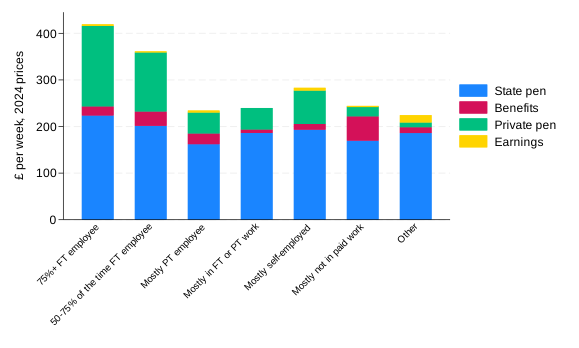
Figure 7 shows that the composition of income is different among these 2 groups – both groups receive on average a similar amount of State Pension, but those mostly out of work compensate for the lower private pension income through higher average receipt of other state benefits.[footnote 5]
Figure 6. Retirement incomes by life course, cohort 1937 to 1946
a) Median disposable incomes
b) Percentage of group in the lowest 20% of the income distribution
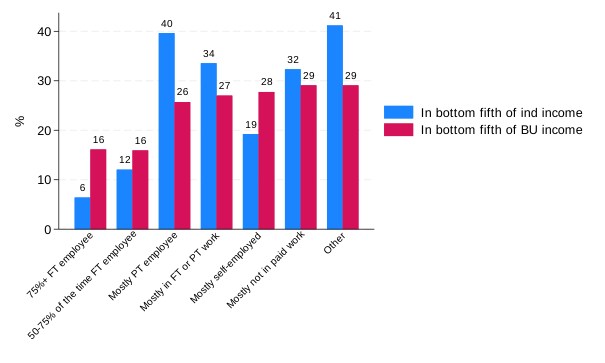
Note: Benefit unit incomes equivalised to the level of a single person.
Source: ELSA waves 9 to 11 (2018–2019 to 2021–2023) and life history waves 1 and 2.
Figure 7. Mean income by component for middle income individuals and benefit units, cohort 1937–46
a) Individual income
b) Benefit unit income
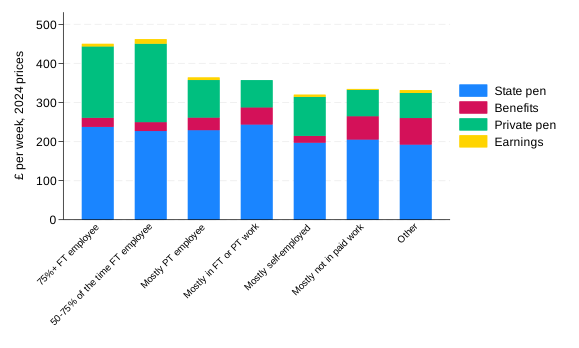
Notes: Middle income individuals and benefit units are defined as those in the middle income third, where thirds are defined within wave, cohort and life course for total individual income (for the first panel) and benefit unit income (for the second panel). Benefit unit incomes equivalised to the level of a single person.
Source: ELSA waves 1 to 11 (2002–2003 to 2021–2023) and life history waves 1 and 2.
Figure 6 also shows that examining benefit unit incomes significantly compresses the gaps between groups. This is consistent with partners’ incomes partially offsetting low individual income for some life courses, especially those with weaker own earnings histories. However, the benefit unit incomes for individuals who were mostly in full-time work are still higher than among those in other life courses – the median equivalised benefit unit income among those in full-time work was £445 per week compared with £346 for those mostly part-time employees.
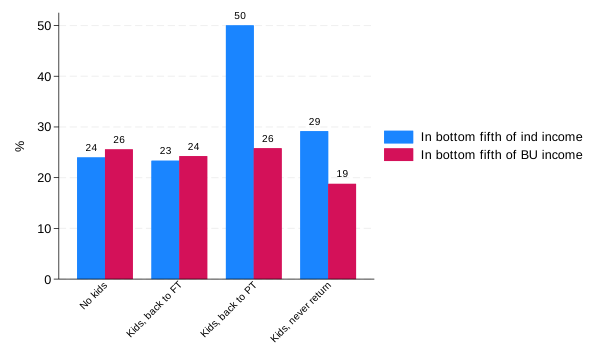
We can see the importance of partners’ incomes especially when looking at individual and benefit unit incomes for women who took career breaks to care for their children. For example, 50% of women who returned to part-time work but not full-time work after having children were in the lowest fifth of incomes in terms of their individual income in retirement, but once partner’s incomes are taken into account, 26% of this group of women were in the lowest fifth – this is shown in the second panel of Appendix Figure A2.
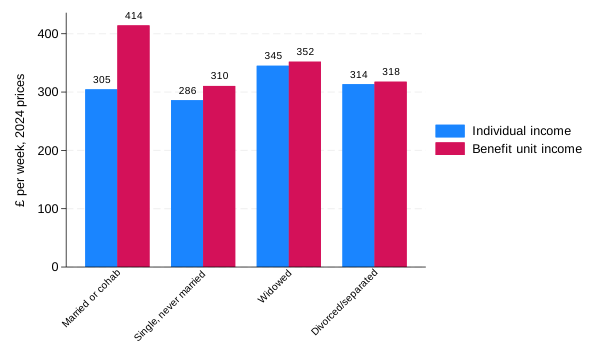
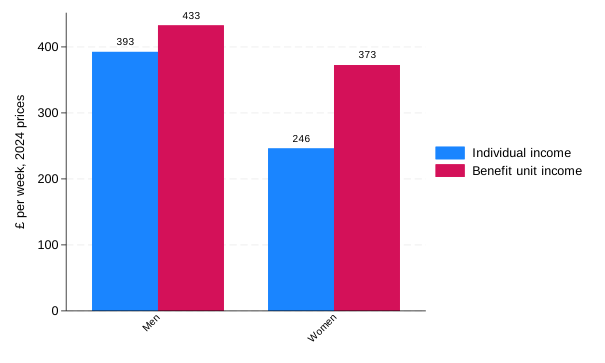
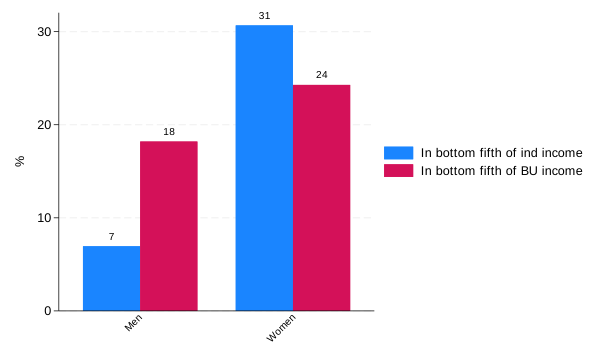
Retirement incomes tend to be worse for single people, especially when measured at the benefit unit level as single people do not have a partner to share their resources with. When focusing on different types of single people, Figure 8 shows that widows tend to have slightly higher incomes and are somewhat less likely to have very low disposable income, whereas those never married and those who are divorced or separated are much more likely to face low retirement resources. When considering other types of heterogeneity, we find that gaps by gender are large for individual incomes and smaller but still meaningful for benefit unit incomes (Figure 9).
Figure 8. Retirement incomes by marital status at age 55 to 65, cohort 1937 to 1946
a) Median disposable incomes
b) Percentage of group in the lowest 20% of the income distribution
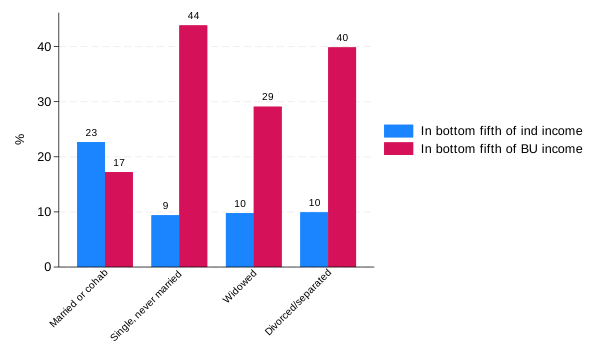
Note: Benefit unit incomes equivalised to the level of a single person.
Source: ELSA waves 9 to 11 (2018–2019 to 2021–2023) and life history waves 1 and 2.
Figure 9. Retirement incomes by sex at age 55 to 65, cohort 1937 to 1946
a) Median disposable incomes
b) Percentage of group in the lowest 20% of the income distribution
Note: Benefit unit incomes equivalised to the level of a single person.
Source: ELSA waves 9 to 11 (2018–2019 to 2021–2023) and life history waves 1 and 2.
6. What is the relationship between life events and retirement outcomes?
In this section, we update the analysis of Cribb and O’Brien (2023) ‘When and why do employees change their pension saving?’, specifically Chapter 4 ‘The effects of changes in household circumstances on pension saving for private sector employees’. We use UKHLS throughout this section. We extend the data up to the latest possible wave (i.e. up to 2024) and widen the sample to study all employees in the age range for automatic enrolment (22 to 65 rather than 22 to 59 as in the original analysis). We also extend the analysis to cover a wider set of life events.[footnote 6]
Our analysis principally focuses on individuals who are private-sector employees in 2 consecutive waves of the data. For those who are not saving in a workplace pension in the initial wave, we analyse how the proportion who start saving in a workplace pension in the subsequent wave varies by life event. Conversely, we also examine how life events affect the probability of stopping saving in a workplace pension for those who are saving in a workplace pension in the initial wave. Finally, for those who are saving in a workplace pension in both waves, we analyse how life events are associated with changes in employee pension contribution rates.
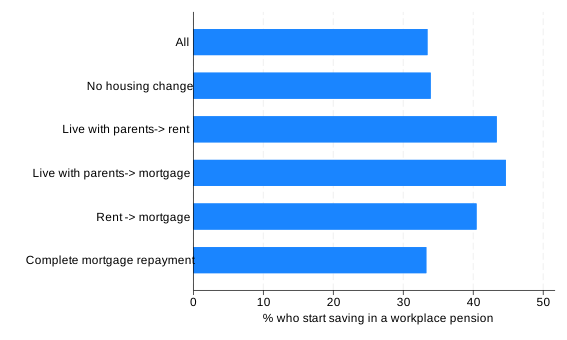
We first compare raw differences in how pension saving changes at the time of the life event. We find that there is some variation in the probabilities of joining or leaving a workplace pension, and in changes in contribution rates, by life event. Private sector employees who go from living with their parents to renting are more likely to start saving in a pension (43%) than those with no change in their housing status (34%) (first panel of Figure 10). However, this group is also particularly likely to stop saving in a pension, as shown in first panel of Figure 11.
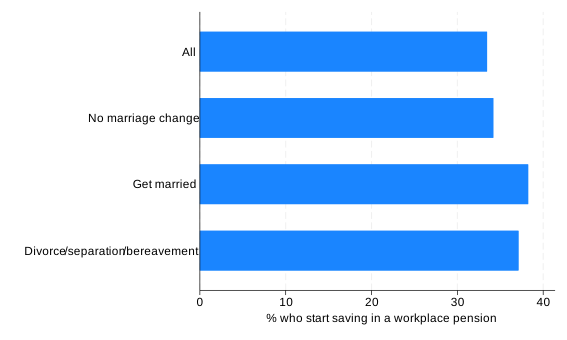
Figure 10. Percentage of private sector employees who start saving in a workplace pension over the course of 2 years, conditional on not saving in a workplace pension originally, by change of circumstance
a) Housing status
b) Marital status
Note: Sample contains observations on private sector employees in consecutive even waves of the data who are aged 22 to 65.
Source: UKHLS waves 1 to 14 (2009 to 2024).
Figure 11. Percentage of private sector employees who stop saving in a workplace pension over the course of 2 years, conditional on saving in a workplace pension originally, by change of circumstance
a) Housing status
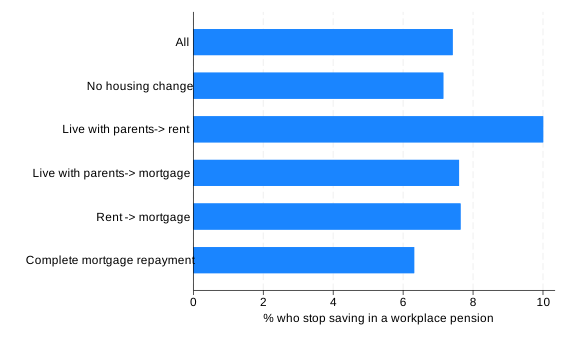
b) Marital status
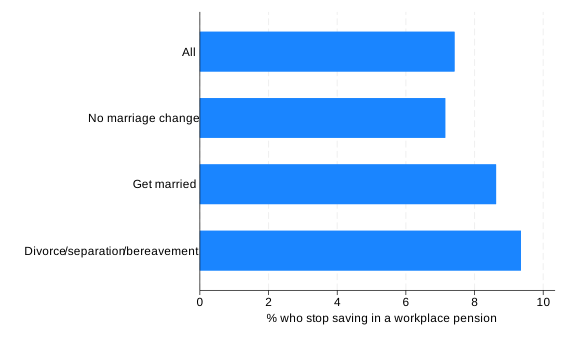
Note: Sample contains observations on private sector employees in consecutive even waves of the data who are aged 22 to 65.
Source: UKHLS waves 1 to 14 (2009 to 2024).
Private sector employees whose marriage ends (due to separation, divorce, or death of a spouse) are more likely to stop saving in a pension (10%) than those with no change in marital status (8%) (second panel of Figure 11). Private sector employees who have a first child have a smaller increase in employee contribution rates (0.2% of pay) than those with no change in the number of children in the household (0.4% of pay) (Figure 12).
Figure 12. Percentage point change in employee contribution rate (among savers), by change in number of children
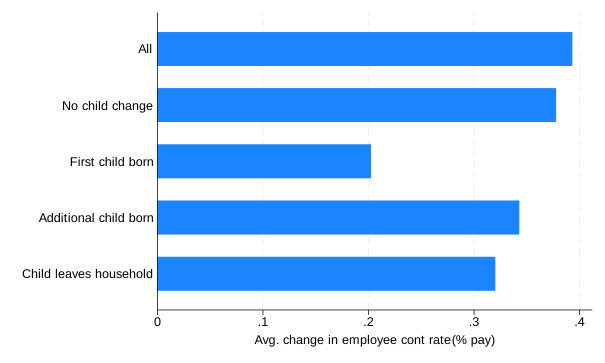
Note: Sample contains observations on private sector employees saving in a private pension in consecutive even waves of the data who are aged 22–65.
Source: UKHLS waves 1 to 14 (2009 to 2024).
However, it is hard to draw firm conclusions from these correlations between individual life events and changes in pension saving. This is because different life events are almost certainly correlated with each other: for example, people who get married over the course of 2 years are also more likely to buy a house and have a child. In addition, the ages at which these life events tend to happen can also affect pension saving.
Because of this, we use multivariate regression analysis to estimate how each individual life event is associated with changes in pension saving, controlling for other life events and changes in earnings, hours, employer, job and age.
Overall, consistent with Cribb and O’Brien (2023), we generally do not find large effects of life events on pension participation and contribution rates for private sector employees (as shown in Appendix Table A2). This is despite these life events often being associated with large changes in income or spending commitments, making them a good time to change pension saving. This is also generally the case for the new life events we study – changes in caring responsibilities or health conditions – that were not analysed in Cribb and O’Brien (2023).
We do find that employee pension contributions increase by around 0.3% of pay when people move from renting to having a mortgage, as in Cribb and O’Brien (2023) (Appendix Table A2.3, coefficient statistically significantly different from zero at the 95% confidence level). This may be because this change typically involves a reduction in spending needs, and therefore an increase in disposable income, in recent years. This effect is principally driven by men. We also find that employee contributions decrease by around 0.2% (statistically significant at the 95% confidence level) of pay after the arrival of a first child, which is typically associated with an increase in spending needs. This effect is particularly driven by women. In addition, the onset of caring responsibilities is found to be associated with an increase in employee pension contribution rates of around 0.2% of pay (statistically significant at the 95% confidence level), particularly driven by men.
Finally, although life events do not generally seem to affect pension participation and contribution rates among private sector employees, they can affect pension participation and contributions if they affect labour market outcomes. In other words, life events could affect people’s earnings, or whether they are in paid work at all, which then affects pension contributions.
Life events can have particularly different impacts on labour market outcomes for men and women. Figure 13 shows that the gender gap in pension contributions widens significantly with the arrival of the first child, which is when differences in employment rates, hours and wages also start to emerge (see for example Costa Dias and others, 2020). As the analysis presented in this figure includes all men and women – not just those in paid work – it is clear that this effect is almost entirely driven by labour market differences opening up at this point. However, the earlier results also suggest that pension contributions tend to decrease slightly after the arrival of a first child, even controlling for changes in hours and earnings, with the effect slightly larger for women than for men.
Figure 13. Own pension contributions among all men and women, by years before and after the birth of first child, by sex
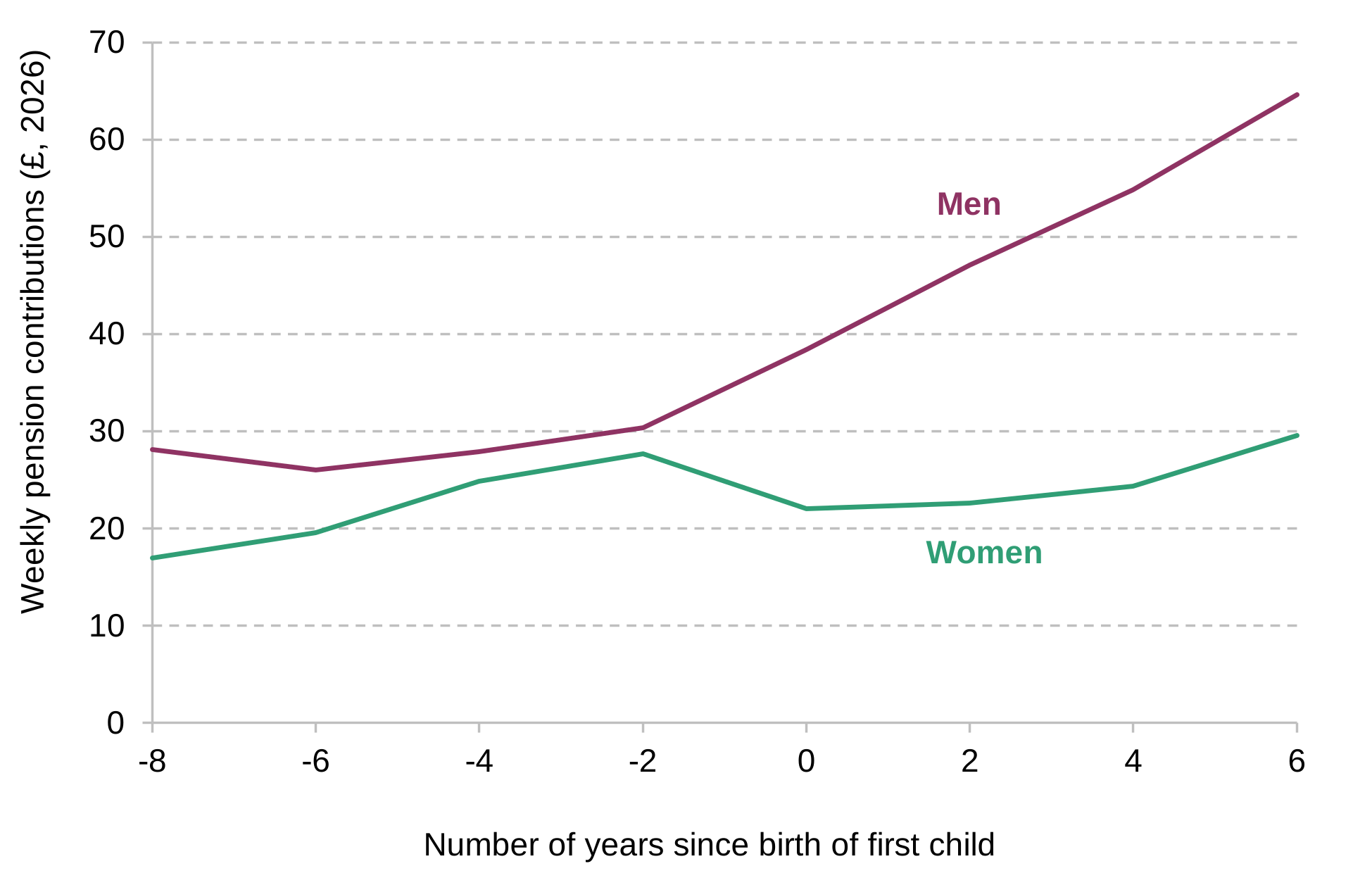
Notes: Includes all men and women observed around having first child, both those in paid work and those out of paid work. Includes contributions to personal pensions and employee contributions to workplace pensions, but does not include employer pension contributions.
Source: UKHLS even waves 2 to 10 (2010 to 2020).
7. Conclusion
This report provides new evidence of how different experiences over the life course relate to private pension savings and financial outcomes in retirement, and how they interact with individual characteristics including sex, ethnicity, being disabled, and caring.
We use longitudinal data from high-quality household surveys, which allows us to see how different generations of people in the UK have experienced different life courses and how that feeds through into pension saving and retirement incomes. We use the most up-to-date data available, thus building on existing research that has investigated on these issues from a life course perspective, but which focused on an older cohort of people (see for example, Glaser and others, 2017).
This new research allows us to understand the patterns for people who have benefitted from automatic enrolment, which started to be rolled out in 2012, for part of their working lives. In addition, we have supplemented our analysis of observed microdata with simulations of how patterns would differ for people who experience automatic enrolment over the course of their whole careers, as most people currently in their mid-30s (or younger) will do.
Despite changes in patterns of paid work for women in recent decades, it remains the case that women are more likely to experience sustained periods of non-employment or part-time work, which translate into lower private pension saving and ultimately lower pension incomes in retirement. This is especially the case for women from ethnic minority backgrounds. Gaps in labour market activity (and therefore pension saving) between men and women are particularly likely to open up around the birth of a first child.
In the UK, the new State Pension provides a foundation of retirement income, as its level is (broadly) unrelated to labour market activity during working life. In contrast, private pension incomes are determined by contributions made over working-life, which are positively related to earnings. This means that under the current pension system, labour market inequalities translate into retirement income inequality through the private pension system. And while automatic enrolment has broadened private pension participation, as long as these labour market differences exist, automatic enrolment policies on their own will not close the gaps in pension incomes.
References
Costa Dias, M., Joyce, R. and Parodi, F. (2020) ‘The gender pay gap in the UK: children and experience in work’, Oxford Review of Economic Policy, 36, 4, 855–881. Retrieved from: The gender pay gap in the UK: children and experience in work - Oxford Review of Economic Policy
Cribb, J. and O’Brien, L. (2023) ‘When and why do employees change their pension saving?’, Institute for Fiscal Studies. Retrieved from: When and why do employees change their pension saving? - Institute for Fiscal Studies
Cribb, J., Karjalainen, H. and O’Brien, L. (2023) ‘The gender gap in pension saving’, Institute for Fiscal Studies. Retrieved from: The gender gap in pension saving - Institute for Fiscal Studies
Department for Work and Pensions (2025a) ‘Finishing the job: launching the Pensions Commission’, Department for Work and Pensions. Retrieved from: Finishing the job: Launching the Pensions Commission - GOV.UK
Department for Work and Pensions (2025b) ‘Workplace pension participation and savings trends: 2009 to 2024’, Department for Work and Pensions. Retrieved from: Workplace pension participation and savings trends: 2009 to 2024 - GOV.UK
Glaser, K., Price, D., Corna, L.M., Sacker, A., Stewart, R., Sacco, L., Di Gessa, G., Worts, D., McDonough, P., Benson, R., Platts, L.G., Perera, G., Stutchbury, R., Pike, T., Adams, J., Curry, C., Carrino, L. and Ewert, H. (2017) ‘The Wellbeing, Health, Retirement and the Lifecourse project’, Pensions Policy Institute. Retrieved from: The Wellbeing, Health, Retirement and the Lifecourse project - Pensions Policy Institute
Office for National Statistics (2026) ‘Employee workplace pensions in the UK: 2024 provisional and 2021 to 2023 final results’, Office for National Statistics. Retrieved from: Employee workplace pensions in the UK: 2024 provisional and 2021 to 2023 final results - Office For National Statistics
Data
NatCen Social Research, University College London, Institute for Fiscal Studies. (2023). English Longitudinal Study of Ageing. [data series]. 7th Release. UK Data Service. SN: 200011, DOI: 10.5255/UKDA-Series-200011
University of Essex, Institute for Social and Economic Research. (2025). Understanding Society. [data series]. 14th Release. UK Data Service. SN: 2000053, DOI: 10.5255/UKDA-Series-2000053
Appendix
Figure A1. Sequence index plots, by life course (1947 to 1959 ELSA cohort)
a) Full-time employee more than 75% of the time
b) Full-time employee 50% to 75% of the time
c) Mostly part-time employee
d) Mostly employee, mixed part-time and full-time
e) Mostly self-employed
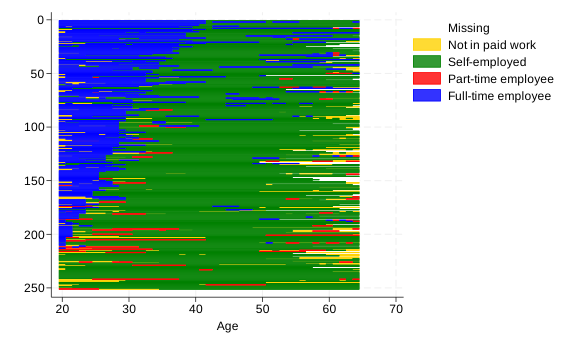
f) Mostly out of paid work
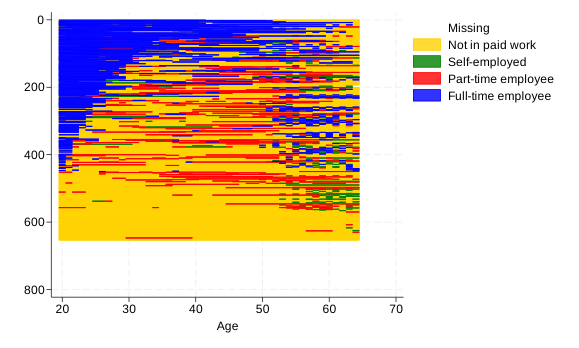
g) Mixed
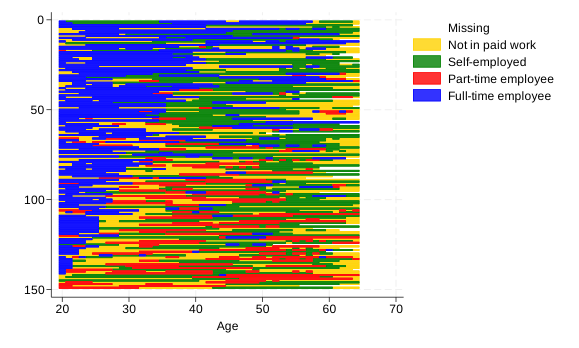
Note: Each row indicates one individual. The colour at each age indicates labour market status at that age. Unweighted.
Source: ELSA waves 1 to 11 (2002–03 to 2021–23) and life history waves 1 and 2.
Figure A2. Retirement incomes by whether returned to work after having children, women only, cohort 1937 to 1946
a) Median disposable incomes
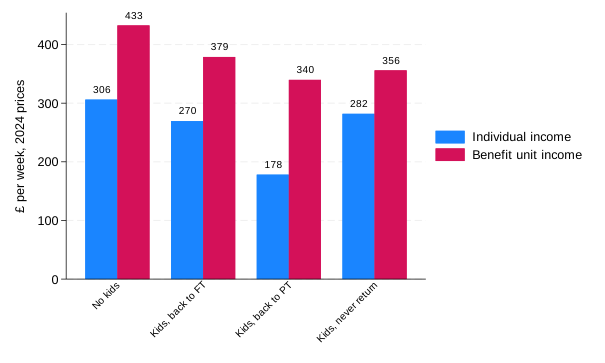
b) Percentage of group in the lowest 20% of the income distribution
Note: Benefit unit incomes equivalised to the level of a single person.
Source: ELSA waves 9 to 11 (2018–19 to 2021–23) and life history waves 1 and 2.
Table A1. Prevalence of no individual and benefit unit private pension observed at age 55 to 65, cohort born 1937 to 1946
| Group | No individual private pension | No BU private pension | Obs |
|---|---|---|---|
| All | 38% | 26% | 2,410 |
| More than 75% FT | 25% | 21% | 844 |
| 50% to 75% FT | 23% | 17% | 491 |
| Mostly PT | 54% | 28% | 229 |
| FT/PT mix | 39% | 22% | 244 |
| Mostly SE | 46% | 38% | 166 |
| Mostly no work | 73% | 44% | 377 |
| Other | [58%] | [31%] | 59 |
| Men | 28% | 25% | 1,100 |
| Women | 47% | 27% | 1,310 |
| No disability | 18% | 8% | 738 |
| Disability | 29% | 15% | 371 |
| Owns outright | 37% | 23% | 1,297 |
| Mortgage | 25% | 15% | 724 |
| Private renter | [44%] | [33%] | 54 |
| Social renter | 63% | 53% | 232 |
Note: No private pension is defined as not reporting an active or retained pension and no private pension income ever when observed aged 55 to 65. Square brackets indicate percentages where the numerator has fewer than 50 observations (unweighted).
Source: ELSA waves 1 to 11 (2002–03 to 2021–23).
Table A2.1. Effect of different changes in circumstances on the probability of joining a workplace pension, by sex
| All (1) | Men (2) | Women (3) | |
|---|---|---|---|
| Get married | 0.017 (0.018) | 0.021 (0.026) | 0.016 (0.024) |
| Divorce/separation/bereavement | 0.006 (0.035) | 0.017 (0.060) | 0.021 (0.044) |
| First child born | −0.003 (0.021) | −0.047* (0.027) | 0.047 (0.033) |
| Additional child born | 0.001 (0.018) | 0.001 (0.025) | −0.014 (0.027) |
| Child leaves household | −0.046*** (0.012) | −0.047** (0.019) | −0.044*** (0.016) |
| Live with parents → rent | 0.030 (0.026) | 0.015 (0.035) | 0.045 (0.038) |
| Live with parents → mortgage | 0.037 (0.033) | −0.042 (0.042) | 0.121** (0.052) |
| Rent → mortgage | 0.019 (0.026) | −0.018 (0.036) | 0.052 (0.036) |
| Complete mortgage repayment | −0.006 (0.023) | −0.002 (0.034) | −0.006 (0.031) |
| Partner starts work | −0.008 (0.014) | −0.010 (0.020) | −0.007 (0.020) |
| Partner stops work | −0.009 (0.014) | 0.020 (0.021) | −0.033* (0.019) |
| New caring responsibilities | −0.009 (0.014) | −0.018 (0.021) | 0.003 (0.018) |
| End caring responsibilities | 0.002 (0.014) | 0.032 (0.022) | −0.014 (0.018) |
| New health condition | 0.019 (0.012) | 0.010 (0.018) | 0.027 (0.016) |
| Recovered from health condition | 0.003 (0.012) | −0.000 (0.018) | 0.007 (0.017) |
| Observations | 16,078 | 7,678 | 8,400 |
| Baseline Share | 0.34 | 0.36 | 0.31 |
Notes: ***, ** and * denote the effect is significantly different from zero at the 1%, 5% and 10% level, respectively. Standard errors in parentheses. Sample contains observations on private sector employees in consecutive even waves of the data who are aged 22 to 65. Regressions also control for change in log earnings, change in hours, and whether the employee changed employer or job, and include year and (5-year) age dummies. Source: UKHLS waves 1 to 14 (2009 to 2024).
Table A2.2. Effect of different changes in circumstances on the probability of leaving a workplace pension, by sex
| All (1) | Men (2) | Women (3) | |
|---|---|---|---|
| Get married | 0.015* (0.008) | 0.013 (0.011) | 0.019 (0.013) |
| Divorce/separation/bereavement | 0.017 (0.016) | −0.019 (0.018) | 0.047* (0.026) |
| First child born | −0.018** (0.007) | −0.018** (0.009) | −0.015 (0.012) |
| Additional child born | −0.008 (0.008) | 0.001 (0.010) | −0.018 (0.012) |
| Child leaves household | −0.001 (0.006) | −0.000 (0.008) | 0.003 (0.009) |
| Live with parents → rent | 0.008 (0.016) | −0.007 (0.021) | 0.022 (0.025) |
| Live with parents → mortgage | −0.021 (0.013) | −0.026 (0.016) | −0.013 (0.020) |
| Rent → mortgage | −0.003 (0.011) | −0.017 (0.013) | 0.013 (0.017) |
| Complete mortgage repayment | −0.013* (0.008) | −0.022** (0.010) | −0.002 (0.013) |
| Partner starts work | −0.003 (0.006) | 0.010 (0.009) | −0.022** (0.009) |
| Partner stops work | 0.002 (0.006) | −0.001 (0.008) | 0.007 (0.009) |
| New caring responsibilities | 0.009 (0.006) | 0.006 (0.009) | 0.013 (0.009) |
| End caring responsibilities | −0.004 (0.006) | −0.005 (0.009) | −0.004 (0.009) |
| New health condition | 0.008 (0.005) | 0.004 (0.007) | 0.014* (0.008) |
| Recovered from health condition | 0.011* (0.006) | 0.006 (0.008) | 0.016* (0.009) |
| Observations | 27,632 | 15,342 | 12,289 |
| Baseline Share | 0.07 | 0.07 | 0.08 |
Notes: ***, ** and * denote the effect is significantly different from zero at the 1%, 5% and 10% level, respectively. Standard errors in parentheses. Sample contains observations on private sector employees in consecutive even waves of the data who are aged 22 to 65. Regressions also control for change in log earnings, change in hours, and whether the employee changed employer or job, and include year and (5-year) age dummies. Source: UKHLS waves 1 to 14 (2009 to 2024).
Table A2.3. Effect of different changes in circumstances on average employee contribution rate among savers, by sex
| All (1) | Men (2) | Women (3) | |
|---|---|---|---|
| Get married | −0.127 (0.110) | −0.037 (0.147) | −0.267 (0.164) |
| Divorce/separation/bereavement | −0.205 (0.239) | 0.021 (0.324) | −0.413 (0.354) |
| First child born | −0.234** (0.117) | −0.062 (0.149) | −0.509*** (0.188) |
| Additional child born | −0.103 (0.121) | −0.085 (0.157) | −0.142 (0.188) |
| Child leaves household | −0.009 (0.082) | −0.044 (0.097) | 0.059 (0.153) |
| Live with parents → rent | −0.268 (0.233) | −0.246 (0.298) | −0.323 (0.367) |
| Live with parents → mortgage | 0.161 (0.184) | −0.160 (0.230) | 0.543* (0.297) |
| Rent → mortgage | 0.343** (0.142) | 0.464** (0.189) | 0.143 (0.214) |
| Complete mortgage repayment | 0.067 (0.123) | 0.031 (0.166) | 0.154 (0.182) |
| Partner starts work | −0.098 (0.094) | −0.225* (0.120) | 0.115 (0.149) |
| Partner stops work | −0.005 (0.091) | −0.066 (0.121) | 0.072 (0.139) |
| New caring responsibilities | 0.218** (0.104) | 0.302** (0.145) | 0.120 (0.148) |
| End caring responsibilities | −0.057 (0.108) | −0.125 (0.155) | 0.031 (0.145) |
| New health condition | −0.128 (0.088) | −0.056 (0.115) | −0.224 (0.138) |
| Recovered from health condition | −0.045 (0.095) | 0.025 (0.130) | −0.139 (0.136) |
| Observations | 16,588 | 10,028 | 6,559 |
| Baseline Share | 0.39 | 0.39 | 0.40 |
Notes: ***, ** and * denote the effect is significantly different from zero at the 1%, 5% and 10% level, respectively. Standard errors in parentheses. Sample contains observations on private sector employees in consecutive even waves of the data who are aged 22 to 65. Regressions also control for change in log earnings, change in hours, and whether the employee changed employer or job, and include year and (5-year) age dummies. Source: UKHLS waves 1 to 14 (2009 to 2024).
-
As people can access their private pensions from age 55, we may exclude some people here who had one or more private pensions that they have fully withdrawn before being observed. ↩
-
We cap outliers by replacing incomes above the 99th percentile with the 99th percentile income. ↩
-
If the characteristics vary within this age range, for being disabled we prioritise ever reporting being disabled, for marital status we prioritise divorced / separated, widowed, then single, for housing tenure social renter, private renter, then owns with mortgage, for region we prioritise South, then Midlands. ↩
-
We have combined the non-white ethnic minorities in order to have enough sample size to split the sample both by ethnicity and gender. ↩
-
We use the mean (rather than median) income here so that the sum of the mean income components adds up to total mean income. As the median income of some of the components is zero, the analysis of mean incomes is more informative here. ↩
-
As divorce / separation and bereavement can have very different types of effects on household finances, we have explored examining these separately. However, as bereavement is relatively rare in our sample of working-age individuals, the sample size is not sufficient for splitting these out. ↩