KAM Guide: IP and wider knowledge assets in technology transfer
Updated 6 August 2026

© Crown copyright 2026
This publication is licensed under the terms of the Open Government Licence v3.0 except where otherwise stated. To view this licence, visit nationalarchives.gov.uk/doc/open-government-licence/version/3 or write to the Information Policy Team, The National Archives, Kew, London TW9 4DU, or email: psi@nationalarchives.gov.uk.
Where we have identified any third party copyright information you will need to obtain permission from the copyright holders concerned.
This publication is available at https://www.gov.uk/government/publications/knowledge-asset-management-kam-hub/kam-guide-ip-and-wider-knowledge-assets-in-technology-transfer
Disclaimer
This guide does not constitute legal, business, financial or other professional advice and should not be relied upon when taking business, legal or other decisions. The IPO is not responsible for the use that might be made of this information. Appropriate professional advice should be sought.
Every effort is made to ensure that the information provided is accurate and up to date as at the time of publication. However, no legal responsibility is accepted for any errors or omissions.
This guide may link or signpost to external sites. The IPO is not responsible for this content including the accuracy or reliability. It is your responsibility to ensure the accuracy of any guidance and other information you must exercise your own judgment when engaging with this content or associated services.
Introduction
Purpose of this guide
This chapter provides guidance for universities and research institutions carrying out research, knowledge exchange and technology transfer. It draws on good practice from across the sector.
It sets out some strategic themes relating to intellectual property (IP) and wider knowledge assets, to support activities linked to the commercialisation of research.
The guidance explains how to identify, manage and use IP and wider knowledge assets. It highlights important considerations for protection, collaboration and commercialisation.
It is intended for people involved in research, innovation and project delivery. How it is used will depend on your role, responsibilities and organisational context.
The guidance includes prompts and examples to help you recognise IP and wider knowledge assets, bring together relevant information, and consider options when planning projects. Examples are illustrative and do not cover every situation. Further sources of support are signposted where relevant, and key terms are explained in the glossary.
Technology transfer, IP and wider knowledge assets, and research
Academic staff are likely to be involved in a wide variety of research and commercialisation activities, such as:
-
collaborations
-
studentships
-
industrial partnerships
-
consultancy
-
licensing
-
spin-out company formation
-
start-up company formation
In this guide, technology transfer refers to the process of moving knowledge, research, inventions, innovations from one entity to another. For example from university to business, or between universities.
Table 1: This table provides illustrative examples of knowledge exchange and commercialisation activities that can generate income within the higher education sector. These examples reflect categories captured through national data collection on university engagement with business and the wider community, which records activity annually across the sector. The full range of activity is captured through the annual Higher Education Business and Community Interaction (HESA) survey.
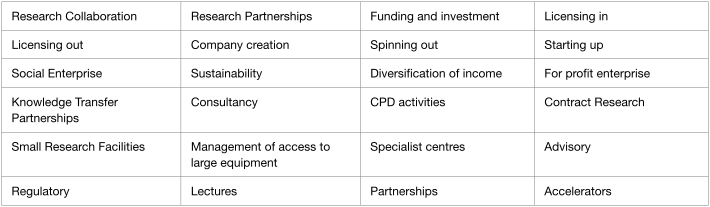
Note: This table is an illustrative synthesis to signpost common activity types and is not intended to reproduce the HE‑BCI framework, definitions or coverage in full. For sector‑level reference, the authoritative source is the annual HESA HE Business and Community Interaction (HE‑BCI) survey and its published tables and definitions.
These examples are:
-
research collaboration
-
research partnerships
-
funding and investment
-
licensing in
-
licensing out
-
company creation
-
spinning out
-
starting up
-
social enterprise
-
sustainability activity
-
diversification of income
-
for-profit enterprise
-
knowledge transfer partnerships
-
consultancy
-
continuing professional development (CPD)
-
contract research
-
small research facilities
-
managing access to large-scale equipment
-
specialist centres
-
advisory activity
-
regulatory activity
-
lectures
-
partnerships
-
accelerators
IP due diligence and freedom to operate assessments play an important role in supporting technology transfer. By helping to identify existing IP, clarify ownership and understand any third‑party rights, it builds a clear picture of the IP landscape surrounding a project. This improves confidence for all parties involved, supports constructive negotiation of agreements, and reduces uncertainty around how knowledge assets can be shared, licensed or developed.
A clear project scope helps to identify IP and wider knowledge asset risks, opportunities, contingency planning. It will help to:
-
plan resource allocation
-
identify areas of concern
-
assess gaps in skills, infrastructure, and funding
Active recording and curation of this kind of information at the beginning of a research project helps to identify and manage IP and wider knowledge assets. Keeping the plan updated throughout a project means any changes to the underlying assumptions can be identified to mitigate risks or take advantage of any new opportunities.
Research
Research can take many forms and may make use of different sources of funding. Each funding may have a specific set of terms and conditions that need to be identified, understood and managed within the project and institutional context.
Universities and research activities vary in opportunity, purpose and context. As a result, there is no single mechanism or pathway for how universities undertake research, engage in knowledge exchange, or commercialise knowledge assets.
However, your institutional IP policy is a document that helps to outline your institution’s approach to the management of IP and wider knowledge assets. The IP policy further provides guidance on institutional procedures and governance systems to be followed. It also sets out designated authority for decision making and sign off and who to ask for help. Further guidance on creating an IP policy in your institution is in the IP policy chapter of this guide.
The NPSA Trusted Research guidance has an implementation collaboration check list (PDF, 281 KB), to support evaluation of new research proposals and considerations before collaborating or partnering.
Universities and research institutions are often registered charities and this guide highlights charity law compliance as a consideration in the institutional context. In England and Wales, the Charities Act 2011 provides the statutory framework referenced in this section. The Charity Commission publishes guidance. They state that this is to help you set up and run your charity by providing relevant background when considering how charitable status interacts with activities and partnerships. For example, how charities reconcile contract research and partnerships with businesses with their charitable status.
The IP guides, published by the European Patent Office, on Research by Higher Education Institutions provides comprehensive overviews on specific fields of IP rights and IP management, including practical tips and further resources
UK Research and Innovation publish research outcomes and impact case studies from Research by Education Institutions, presenting examples of the people and projects it invests in and the impacts.
Technology transfer
For the purposes of this guide, technology transfer is described as the movement of IP or knowledge assets between entities. This can occur through mechanisms such as partnerships, collaboration, licensing, assignments and spinout company formation.
The technology transfer process is governed by institutional policies such as those concerned with IP, and by associated legal frameworks. The guide therefore emphasises the importance of understanding institutional policies, processes and procedures that support these activities. Highlighting that early engagement with relevant professional services as part of good practice in research activities that may involve knowledge assets or IP.
Technology transfer can occur between universities, businesses, or government. Therefore, technology transfer activities will differ depending on the asset, the mechanism of transfer and the nature of the outcome.
For a widely used international framing, World Intellectual Property Office (WIPO) describes knowledge and technology transfer as a collaborative process. This process enables scientific findings, knowledge and IP to flow from creators (such as universities and research institutions) to public and private users, supporting transformation into products and services.
Identifying your IP and wider knowledge assets
It is important to understand the IP and wider knowledge assets you have including third party IP, and under what terms and conditions you can use them. The complexity of the research environment means that there may be multiple opportunities for IP conflict. This could include situations where relevant IP and wider knowledge assets may be unavailable for your intended use.
It is helpful to develop an initial understanding of your activities and any potential impact on those activities. This supports active and consistent decision making concerning your IP and wider knowledge assets. The following sections set out some options.
Check IP and wider knowledge assets ownership and access early.
Before starting any project or venture (whether fundamental research or commercial work), identify any relevant IP and wider knowledge assets (such as data, materials, software, or know-how). Confirm who owns them and ensure you have the appropriate rights or permissions to access and use them.
Identify, understand and actively manage your opportunities for IP and wider knowledge assets.
Build in time to identify, understand and manage potential opportunities concerning IP and wider knowledge assets as your work develops.
Plan how you will protect IP and wider knowledge assets before you act.
Consider what protection is appropriate how to protect your IP and wider knowledge assets. Put a plan in place before publishing, sharing or progressing activity, so you maintain your ability to use the IP and wider knowledge assets you may need.
Use confidentiality measures where needed.
Consider whether you may need a Non-Disclosure Agreement (NDA) or Confidentiality Disclosure Agreement (CDA). These agreements protect your ideas and any sensitive information generated or owned, recording the conditions for disclosure and sharing.
Understand contractual terms and obligations.
Before entering into any contract or agreement, make sure you understand the terms, conditions and obligations. For example how confidentiality, responsibilities, and IP/knowledge asset handling are set out.
Engage specialist support early.
Ask your technology transfer office or relevant professional services team early in the process for advice and support across these considerations.
Using an invention disclosure form
A confidential invention disclosure form provides a confidential record of a new invention or innovation opportunity. It captures how the invention was created, its key features, and any factors that may affect protection and use such as IP rights.
The invention disclosure form is a confidential record tailored to the organisation’s IP policy and governance processes.
It is important that everyone involved in research understands the need to disclose new inventions confidentially, how the process works, and its limitations.
University guidance on internal and external disclosure timing, and the risks of public disclosure, is usually available within an organisation. This may form part of the organisation’s IP policy.
Completing the form appropriately with the university’s professional services team is important. It supports clear documentation, helps assess protection, use, management, opportunity and risk. It helps to reduce the risk of premature disclosure and helps clarify inventorship and ownership.
The form may typically include the following examples.
Confirmation of who the inventors are and the nature of their contributions, to support clarity and avoid later disputes.
Detailed technical information about the invention, including:
-
the technical problem it solves
-
a comprehensive description of how it works
-
any previous inventions it builds on
The date the invention was conceived.
Details of any past or planned public disclosures, such as:
-
conference presentations
-
publications
-
discussions with third parties
Any prior public disclosure may affect the potential patentability of the invention.
Details of third party collaborators and funders, including their IP positions and any related obligations.
The use of third‑party materials, artificial intelligence tools, software, code, data or other contributing elements.
Understanding IP ownership, IP due diligence and opportunity.
IP ownership refers to the legal rights over assets such as patents, copyright, trade marks, designs and trade secrets.
Understanding ownership is an important part of IP due diligence. This includes knowing who owns IP, what rights exist, and whether there are any constraints on how knowledge assets can be used or commercialised.
Academic freedom to teach and publish sits alongside the need to understand how to use or exploit knowledge assets. This includes doing so without infringing third‑party IP or breaching duties of confidence.
Publishing can be used to place ideas or innovation in the public domain. However, timing is important as publishing too early may prevent later patent or design protection of your creations.
Before starting research projects, collaborations, partnerships, licensing, or commercialisation activities, IP due diligence activities may be undertaken.
This process can help to identify such things as:
-
further opportunities
-
connected contracts and research
-
funders T&Cs
-
third-party IP
-
potential liabilities
-
security or reputational risks
-
any legal or regulatory requirements, such as export controls or obligations under the National Security and Investment Act
For commercialisation opportunities specifically, IP due diligence should confirm who contributed to the IP and wider knowledge assets. It should also confirm whether the institution has the rights needed to take the opportunity forward. Some high-level considerations can be used to guide due diligence. A few examples include:
-
contributors (including staff, collaborators and students)
-
funding sources and associated terms
-
use of external materials, software, data or other resources, and any licences or restrictions
The objective is to ensure clarity on ownership, rights and permissions before progressing.
Publication and IP
Before any form of publication, it is important to consider how IP and wider knowledge assets will be managed. Many IP rights require protection in a specific sequence and cannot be recovered once prematurely disclosed. For patentable inventions in particular, publication, conference presentation, or other public disclosure must not occur before filing the patent. Prior disclosure removes novelty and prevents a patent from being granted. Therefore, it is crucial to involve your university’s professional services early where your research may lead to a patentable invention, or any form of knowledge asset. Correctly handled confidential disclosure to your universities professional services team will not negatively impact your invention.
Within universities, significant new knowledge is generated and often published openly. It is therefore useful to consider funder terms, open access requirements, publisher rights and any rights retention policies.
Publication may also occur through institutional repositories, including student theses. When preparing a thesis for submission or deposit. It also helps to consider any IP and wider knowledge assets it contains and to determine what measures may be needed to safeguard them. This includes ensuring that material requiring protection has not been prematurely disclosed. Any necessary steps for managing confidential or potentially protectable content should be taken before the thesis becomes publicly available.
Funding conditions can also shape publication routes. For example, some funders require notification or acknowledgement. Sponsors may also request temporary delays to the release of theses or outputs until IP protection is secured.
Transfer of materials into and out of institutions
Transferring materials owned by a university to another university, institution or business is a routine part of research activity. These transfers are normally set out in a material transfer agreement or similar contract. This will include any associated rights in the materials, including IP rights and wider knowledge assets.
Having an agreement in place before materials are sent to or received from another organisation helps ensure that expectations are clearly described and applied. These expectations can be around use, publication, ownership and confidentiality.
Such agreements should reflect the principles of the institutional IP policy and are typically managed through professional services.
Record keeping
Maintaining accurate, up-to-date records is an important part of managing and protecting IP and wider knowledge assets created within an institution. Clear documentation helps establish ownership or authorship when needed and captures the terms and conditions governing access, use and control of the assets. Consistent record keeping, aligned with institutional IP management processes supports tracking and demonstrating impact. It also provides information required for reporting to funders, including charities with specific compliance expectations.
Students and studentships
Significant numbers of students are creating businesses during or after their studies. In 2024/25, HESA described this as new businesses started by recent students with formal support from their HE provider, reporting 4,687 such start‑ups.
Understanding how IP and wider knowledge assets are generated, owned and managed in this context is therefore increasingly useful. Students may be undergraduate or postgraduate. Universities may support these activities in different ways, including through investment and providing workspaces, resources, mentoring and business network access.
Institutional IP policies should set out the position on ownership of student generated IP and available support. They should also cover any circumstances in which the university may take equity in student ventures. However, ownership can differ depending on factors such as funding arrangements, the use of existing university IP or the level of collaboration with university staff. Sponsored projects, studentships and collaborative agreements may establish different ownership positions. Undergraduate and postgraduate students may also be treated differently depending on the nature of their work.
When students contribute to research, their role and any associated IP rights should be clearly understood and explained. Institutions may also need to consider whether agreements, such as IP assignments, confidentiality agreements or internship and visitor arrangements, are required.
It is important to distinguish between inventors and contributors. Inventors are those who actually devised the invention. This means that that they contributed to the formulation of the inventive concept and therefore meet the legal definition of inventor. Other contributors may have supported research and been named on publications, but they do not meet the legal definition of inventorship.
Across all scenarios, accurate record keeping and clear contractual arrangements help ensure that IP ownership, responsibilities and related obligations are understood. It also ensures these are managed in line with institutional IP policy and processes.
Teaching and learning
Demand for university courses changes over time, and universities often adjust provision in response to employer and student needs. Teaching is also increasingly supported by digital tools and online delivery. When designing and delivering courses, it is helpful to consider how IP and wider knowledge assets are created, used and shared. This covers ownership and permitted use of teaching materials. This also includes recorded and digital learning, where institutional policies may set rules for creating, accessing, distributing, reusing and repurposing recordings. Institutional IP and copyright policies can help clarify who owns course materials and what happens when the creator leaves or moves organisation. A review of UK university copyright policies found most address teaching materials explicitly. It is also important to address termination rights and manage the whole process.
Research collaboration
Research collaboration brings together different forms of expertise, experience and resources, and it often involves the creation, exchange and use of IP and wider knowledge assets. Collaborations can provide access to specialised equipment, facilities and skills, and new forms of partnership can broaden perspectives and strengthen supply‑chain resilience. These activities frequently generate shared outputs. It is therefore helpful to ensure that the management, protection and use of the resulting IP and knowledge assets is clearly understood by all parties.
At the outset of any collaboration, documenting who owns existing IP and wider knowledge assets, helps to establish clarity and reduces the likelihood of future disputes. This is also helped by agreeing ownership of any new assets generated through joint activity. Clear arrangements support effective collaboration and enable partners to work confidently with shared knowledge and resources.
An appropriate agreement, such as a collaboration contract or bilateral arrangement, should set out how IP and wider knowledge assets will be accessed, used and protected. This includes defining rights to background assets contributed by each party and rights to new assets created during the project. It also includes any conditions related to confidentiality, publication, development, ongoing use or commercial use. Partners may seek rights to exploit project results commercially. Therefore, the agreement should make clear how such rights interact with institutional aims and how potential conflicts of interest will be managed.
Institutional IP policies provide the overarching framework for knowledge exchange and commercialisation activity, including collaboration, licensing, partnering and spinout routes. They explain the institution’s approach to IP ownership, use and the sharing of financial returns, aligned with its charitable purpose and governance processes. This is detailed in the IP Policy chapter of this guidance.
Governance
Governance foundations
IP and wider knowledge asset governance refers to the framework of policies, processes and regulations. These guide how an organisation manages, protects and uses its IP and wider knowledge assets. This framework is intended to support ethical, legal and strategic handling of IP and wider knowledge assets, aligned to wider business or research goals.
Governance processes should also ensure that decisions and activities are reviewed and authorised by individuals with the appropriate authority. There should be a clear governance process and timeline for approvals within stages of technology transfer and commercialisation activities.
Collaborating institutions should maintain up-to-date IP policies aligned with organisational goals, and proactively manage their IP portfolios, associated rights and any relevant agreements.
International knowledge exchange and collaboration
International partnerships can offer access to diverse expertise, approaches and resources, including specialist facilities and equipment that support research at different stages. However, international partnerships can also introduce new risks.
International knowledge exchange and collaboration increasingly involve the creation, use and movement of IP and wider knowledge assets across borders. Many of the principles that govern domestic collaboration also apply internationally, but working with overseas partners introduces additional considerations.
Before entering an international partnership, it is helpful to consider the legal and IP protection frameworks in the relevant jurisdictions. An IP due diligence process can help to clarify the nature of the project and the role of each partner. It can also identify the legal environment in which collaboration will take place.
Differences in national IP laws, such as rules on assignment, inventorship, registration, time limits or translation requirements, can affect how assets are protected and used.
When collaborating internationally, it is helpful to ensure that institutional policies and procedures specifically guide how IP and wider knowledge assets will be managed across borders. The UK operates a strong IP system, but partners overseas may be subject to different legal frameworks, ownership rules and terminology.
Consideration of national security requirements may also be needed, particularly where technology areas involve dual-use applications or sensitive research.
International collaboration can also engage other regulatory frameworks. Export control rules, data protection requirements and technology transfer regulations may apply, depending on the subject matter and countries involved. Research involving personal data may require cross-border data sharing agreements that comply with laws such as the General Data Protection Regulation (GDPR).
International collaboration can expose IP and wider knowledge assets to additional risks. These may include infringement, misappropriation of IP, mismanagement due to lack of knowledge, and cultural and legal differences. They may also include compliance obligations, language barriers in contracts and agreements, and challenges in transferring IP or data across borders. Understanding these risks helps institutions manage their assets responsibly when working internationally.
Agreements should therefore set out how background IP is contributed and how new IP will be protected, used, owned or commercialised. Agreements should also cover how knowledge assets and confidential information will be shared and protected throughout the collaboration.
Contracts and agreements used in international collaborations should be translated accurately and tailored to the jurisdiction in which the work takes place. Clear choices around governing law, jurisdiction and contract language help to reduce the risk of misinterpretation where IP ownership and inventorship laws differ. Agreements are usually governed by the laws of the country where the research occurs. However, they may instead be governed by the legal framework of the country of the commissioning or collaborating partner if this is agreed between the parties.
Clear, accurate records and active contract management support transparency and help safeguard both existing and newly created knowledge assets. Depending on the circumstances, institutions may also need to seek specialist legal input to ensure that agreements and IP arrangements are robust and aligned with institutional policies.
The European Commission Cross Border decision guide is an interactive toolkit. It takes the user through a decision-making process and raises a set of strategic questions to consider when planning and negotiating collaborative research projects. The appendices to the decision guide provide factsheets detailing the major elements of the IP rights (IPR) framework (PDF, 2.1 MB) and IPR rules in 19 European countries and New Zealand.
IP and wider knowledge asset governance refers to the framework of policies, processes and regulations. These guide how an organisation manages, protects and uses its IP and wider knowledge assets. This framework is intended to support ethical, legal and strategic handling of IP and wider knowledge assets, aligned to wider business or research goals. Governance processes should also ensure that decisions and activities are reviewed and authorised by individuals with the appropriate authority. There should be a clear governance process and timeline for approvals within stages of technology transfer and commercialisation activities.
National Security
National Security and Investment Act (NS&I Act)
The National Security and Investment (NS&I) Act was introduced in 2021 and gives the UK government powers to protect national security. The government can scrutinise and intervene in acquisitions made by anyone, including businesses and investors and in business transactions. In instances where an acquisition could harm the UK’s national security, the government can impose certain conditions on an acquisition or block it completely. Further information, guidance and case studies are available on the National Security and Investment Act.
The requirements of the Act extend to Higher Education Institutions. The government has published separate guidance for the higher education and research intensive sectors on the National Security and Investment Act. This covers its impact on research and commercialisation activities.
The Investment Security Unit sits within the Cabinet Office and operates the National Security and Investment regime. You can contact the Investment Security Unit for an informal discussion about notifications or a future acquisition by emailing investment.screening@cabinetoffice.gov.uk.
National Protective Security Authority (NPSA) - Trusted Research & Secure Innovation
NPSA is the National Technical Authority for personnel and physical security and offers protective security advice to a range of organisations across the UK. The Trusted Research campaign is aimed at the UK’s higher education and research sector. It offers practical advice and guidance to raise awareness of potential risks, help support secure international collaboration, and drive improvements in research security practices across the sector. The guidance has been developed in collaboration with the sector to ensure it is practical and proportionate.
The NPSA Trusted Research website contains extensive information for academics, professional services/research services, and senior leaders in UK universities and research organisations. It also offers a range of tools to help support individuals and institutions conduct research securely.
NPSA have also developed guidance and materials for the emerging tech sector. The Secure Innovation campaign offers practical and proportionate steps for small businesses, start-ups and spin-outs to protect their innovation from the start of their commercial journey. It includes accessible “Quick Start” guides as well as more detailed security information.
Research Collaboration Advice Team (RCAT)
The Research Collaboration Advice Team (RCAT) provides guidance to research institutions regarding the security risks linked to national and international research. It also assists in the protection of the security of the UK’s research ecosystem. RCAT is the first point of contact and a trusted source for advice on identifying and mitigating risks to international research collaborations.
RCAT is responsible for:
-
increasing understanding among academics of the laws and regulations they need to follow as they work internationally
-
developing academics’ understanding about unacceptable tactics we see adversaries using - how these put researchers and their work at risk, and how these risks can be effectively and proportionately managed
-
improving the government’s understanding of how academics encounter risk and how they tackle it and how government and academia might work together to improve practices
-
supporting academic institutions to design
-
implementing policies and standards which reflect the importance of the UK’s research base to national security
RCAT is not an enforcement body. They work with research institutions on a voluntary basis, with full respect for the independence of academics and their institutions.
Within research institutions, communication with RCAT should be conducted through your institution’s nominated RCAT point of contact. If you are unsure who this is, please contact your research office.
RCAT have regional representation throughout the UK, covering:
-
Edinburgh (Scotland and N Ireland)
-
Salford (RCAT Head Office and N England)
-
Birmingham (Midlands)
-
London (SE England – 2 teams)
-
Cardiff (S Wales and SW England)
More information is available on the Research Collaboration Advice Team and their role to provide advice on the national security risks linked to international research.
UK Research and Innovation (UKRI)
UK Research and Innovation (UKRI) is the national funding agency investing in science and research in the UK to advance knowledge, improve lives and drive growth. Operating across the whole of the UK, UKRI brings together seven Research Councils, Innovate UK, and Research England.
International collaboration is vital. It ensures that the extraordinary potential of research and innovation can enrich and improve the lives of people in the UK and around the world. UKRI helps the UK’s research and innovation system to thrive by supporting UK researchers and businesses working with people, organisations, and facilities around the world.
UKRI has offices in China, India, North America, and Europe which are co-located with British Embassies and High Commissions. These offices are building and broadening UKRI’s research and innovation partnerships within those regions. Further information is available in UKRI’s International Funding and Support and guidance on research in a global setting.
UKRI operates a Trusted Research and Innovation Programme to protect the IP, sensitive research, people, and infrastructure that it supports from potential theft, misuse, and exploitation. UKRI has published ‘Trusted Research and Innovation: principles and expectations’. This outlines the principles that UKRI applies to Trusted Research and Innovation and its general expectations of the supported research organisations. These organisations include businesses, research institutes, and research technical organisations. Its expectations are also set out in UKRI’s policy on organisation eligibility, and in the terms and conditions for specific awards, including any additional terms and conditions.
Academic Technology Approval Scheme (ATAS)
The Academic Technology Approval Scheme (ATAS) is a certificate issued by the Foreign, Commonwealth and Development Office (FCDO). It gives the applicant the required security clearance to study specific subject areas. Guidance is available on the Academic Technology Approval Scheme..
Commercialisation
Commercialisation is the process through which academic, scientific and technical research outputs are translated into products, services or technologies that reach the marketplace. It enables universities and research institutions to maximise the value and impact of their knowledge assets by applying them beyond academia and contributing to social and economic benefit.
IP and wider knowledge assets can be commercialised in different ways, including such things as:
-
consultancy
-
licensing
-
joint ventures
-
partnerships
-
the creation of spinout companies
Institutional IP policies set out the principles that govern these routes and provide the framework for managing translational activity.
To support commercialisation, IP and related knowledge assets need to be identified, evaluated and protected in a timely and coordinated manner. This relies on active IP management, ensuring due diligence can be completed efficiently and that freedom to operate is understood and maintained.
IP due diligence is commonly undertaken by professional services teams and should be aligned with institutional policies in areas such as IP, risk, employment and finance. Additional considerations may arise depending on the nature of the project or activity.
Areas where IP due diligence typically supports commercialisation can include:
-
awareness of academic entrepreneurship and the IP arising from it
-
identification of new opportunities and assessment of commercial potential
-
protection and management of IP and wider knowledge assets
-
support for translational development
-
reviewing of funding terms and conditions
-
licensing of IP and the formation of spin‑out companies
Across all commercialisation pathways, clear processes and well‑maintained records help ensure that IP and wider knowledge assets are managed consistently with institutional policies and long‑term strategic aims.
Technology Readiness Levels
Technology Readiness Levels (TRLs) describe the maturity of a technology, from early research through testing and demonstration towards use in practice. TRLs are used to summarise technical maturity, including how far a technology has progressed through evidence, testing and demonstration.
Some sectors and organisations use terms such as “commercial readiness levels” to describe how close an innovation is to being taken up or deployed. These terms are not defined in a single, standard way and can vary by sector. Commercial factors can be considered alongside TRLs to support a rounded view of what may still be needed to move towards use. This avoids the need for a separate commercial readiness scale.
TRLs were originally developed by NASA and are now used widely beyond their original context, including in UK government material and research funding guidance.
Source: TRL scale descriptions and definitions are published by NASA and are used widely in other contexts, including UK government material and UKRI funding guidance on activities and eligibility across TRLs.
Table 2: Summary of Technology Readiness Levels (TRLs), showing levels 1 to 9 and their descriptions from early research to operational use.
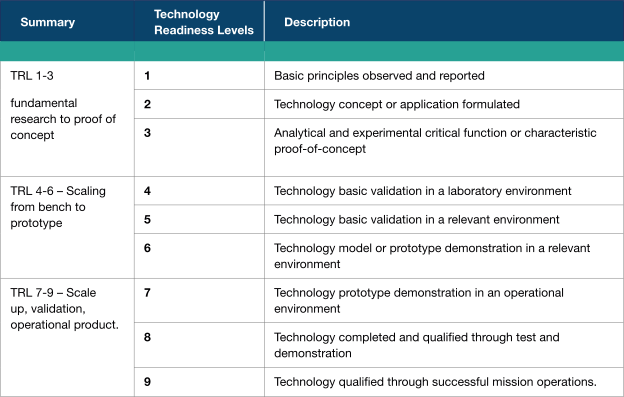
TRL 1–3: fundamental research to proof of concept:
-
TRL 1: basic principles are observed and reported
-
TRL 2: a technology concept or application is formulated
-
TRL 3: analytical and experimental work produces a proof of concept for a critical function or characteristic
TRLs describe technical maturity, not whether something is ready to be used or sold. At TRL 1–3 the work is usually exploratory. At this stage the focus is typically clarified, including user need, securing the right capability and resources. Appropriate arrangements for IP and other knowledge assets should also be put in place.
TRL 4–6: scaling from bench to prototype:
-
TRL 4: technology is validated in a laboratory environment
-
TRL 5: technology is validated in a relevant environment
-
TRL 6: a technology model or prototype is demonstrated in a relevant environment
At TRL 4–6 there is stronger evidence from testing and demonstration, often in conditions that are closer to intended use. Things such as whether there is a defined route to adoption, suitable partners or delivery options, funding, and a clear view of regulatory, quality and assurance requirements may be considered. Clarification of the position on IP and other knowledge assets also affects what can be shared, developed or licensed.
TRL 7–9: scale‑up, validation and operational use:
-
TRL 7: a prototype is demonstrated in an operational environment
-
TRL 8: the technology is completed and qualified through test and demonstration
-
TRL 9: the technology is proven through successful mission operations (operational use)
High TRLs indicate that a technology is close to, or operating in, an intended environment. They do not, on their own, confirm that an opportunity is ready for wide adoption or market rollout. Readiness for deployment also depends on whether practical steps are in place, such as manufacturing or service delivery capability, compliance with regulatory and quality requirements, evidence of user or customer uptake, and ongoing management of IP and other knowledge assets.
Research emerging from academic environments is often at an early TRL. It may require further development before it is ready for licensing or adoption by a spinout company. Translational funding, including incubators, accelerators and proof of concept schemes, can help bridge this gap. This is achieved by supporting technical validation and the safeguarding of IP and wider knowledge assets as they progress. As technologies move through these levels, active and timely management of the associated assets supports both their protection and their future commercial potential.
IP licensing
Licensing is a common mechanism for enabling the use of IP and wider knowledge assets while allowing the original owner to retain ownership and oversight. Licensing arrangements can create structured ways for benefits arising from the use of these assets to be shared. An example of this is by linking financial returns to the value generated. They may also support collaboration with established organisations whose technical capabilities, market knowledge or distribution networks can help progress an innovation. In certain sectors, particularly high-technology areas where they may be overlapping patent rights innovators may be required to reach licensing deals for multiple patents held by multiple parties.
A licence is a formal agreement between the owner of the IP and knowledge asset and one or more parties who receive permission to use it under defined conditions. Ownership or control of the asset remains with the licensor, who sets out how the assets may be accessed, used or commercialised, and whether financial payments will apply.
Licences can take several forms. A “licence-out” refers to another party using the licensor’s assets, while a “licence-in” grants the institution permission to use assets owned by someone else. Licences may involve several different assets. They may also involve single or multiple licensors or licensees, and they may be exclusive or non-exclusive depending on the scope of the rights granted. Cross licenses allow for two parties to share the use of assets from both sides. Sub-licenses enable a licensee to issue further licenses.
Institutions usually set out their approach to licensing within their wider knowledge exchange and commercialisation framework and IP policy. For each project or opportunity, licensing arrangements should consider how ownership, use and reuse of the relevant assets will be managed. This includes circumstances where rights might return to the institution if an opportunity is not progressed. Such arrangements can help ensure that IP and associated knowledge assets continue to have routes for future development or application.
Licensing agreements range from simple to complex depending on the context and the level of control required. A clear starting point is an accurate record of the key outcomes of initial discussions, often captured in a non‑binding IP focussed Heads of Terms record. This document can support negotiations by summarising intentions while leaving detailed rights and responsibilities to be set out in the final contract.
The IPO has a checklist on the benefits of licensing and when licensing is not appropriate.
You can find out more about licensing IP, the guidance varies on whether you’re licensing:
-
patents: Licensing IP
-
trade Marks: License, mortgage, transfer, merge and market your trade mark
-
designs: License, mortgage, sell, change ownership and market your design
In some cases, use of IP assets owned by third parties can be used without permission under exceptions laid out in the legal framework for that IP right. However, the scope of the exception should be checked before completing any technology transfer activities, in case a licence-in is required. The use of exceptions may require expert consultation.
Spin-out companies
A spin-out company is a new business formed to develop and apply the IP, research outputs or wider knowledge assets generated within a university or research institution. Spin-outs represent one pathway for progressing early stage innovations toward commercial use. They typically require coordination between academics, professional services and external partners.
Establishing a spin-out usually involves bringing together a range of assets and capabilities needed to commercialise the underlying IP. These may include investment, specialist management experience, technical expertise, equipment and suitable facilities. Different commercialisation routes may therefore be considered depending on the resources available and the intended outcomes for the knowledge assets involved. Throughout this process, accurate, comprehensive and active recordkeeping helps ensure that existing and newly created IP and wider knowledge assets are documented, understood and managed effectively.
Several IP related considerations may arise when forming a spinout. These can include how equity will be allocated between the university, academic founders and external investors, and how the shareholders’ agreement reflects these positions. It is also important to define clearly the IP and wider knowledge assets to be commercialised, including any associated know-how. Any background IP required by the spin-out should also be identified.
Agreements may set out whether IP and wider knowledge assets will be licensed or assigned to the company. This may also include whether assignment is linked to milestones such as commercial progress or investment levels.
Additional considerations may relate to:
-
the use and ownership of trade marks
-
reimbursement of patent costs incurred by the university
-
the terms of any licence granted to the spin-out
Licensing arrangements may address aspects such as:
-
royalties
-
responsibility for the IP and wider knowledge assets
-
prosecution and maintenance
-
action against infringement
-
any ongoing research or technical support
Spinouts may require access to university facilities, equipment or staff, and agreements can define the terms under which this access is provided. These arrangements help ensure that the IP and wider knowledge assets underpinning the spinout are understood, recorded and managed in line with institutional policies and processes. This supports clarity for all parties involved.
Social enterprise
A social enterprise is a business established to address social or environmental challenges while generating revenue to support its activities. Unlike traditional commercial models, social enterprises balance financial sustainability with social impact and typically reinvest surplus funds to advance their mission.
As with any organisational model that develops or deploys new ideas, it is useful to consider IP and wider knowledge assets. These include those that are brought into, created within or used by the enterprise.
Understanding the parties involved, the origins of the knowledge assets and the conditions under which those assets can be used or shared supports clarity and responsible management. This includes considering ownership, access, ongoing management and any arrangements that shape how the assets contribute to the enterprise’s mission.
Accurate and comprehensive recordkeeping also plays an important role. It supports the identification, documentation and continued management of the IP and wider knowledge assets that underpin the social enterprise’s work.
Accelerators and Incubators
Accelerators and incubators offer structured environments to support the development of early stage startups and spin-outs. Accelerators typically provide short, intensive programmes that combine funding, mentoring, training and networking to help ventures progress rapidly. Incubators usually run over a longer period and focus more on developing ideas and products. They may provide in-kind support rather than direct funding and often place less emphasis on rapid scaling.
Within these programmes, various activities can involve or generate IP and wider knowledge assets. These may include:
-
structured training programmes
-
seed funding arrangements
-
mentorship from industry experts
-
networking events or investor focused activities, such as pitch development
Each of these interactions can influence how knowledge assets are created, shared or managed.
For startups participating in accelerators or incubators, understanding IP and knowledge assets involved at an early stage supports clarity as the venture develops. This includes recognising:
-
what assets are brought into the programme
-
what new assets emerge during it
-
how new assets are managed when engaging with external partners, mentors or investors
Clear documentation and active recordkeeping help ensure that relevant assets are identified, tracked and managed in line with institutional policies and programme expectations.
Many accelerator and incubator programmes include elements of IP awareness or training to help participants build a foundation for managing their knowledge assets effectively. Where needed, further support may be sought from appropriate institutional or external sources as part of the programme’s wider development activities. Advice for businesses is available from the IPO.
Consultancy
Consultancy is an example of one of the mechanisms through which knowledge may move between a university and external organisations. This can support exchange in both directions and complements other routes such as licensing or collaborative research. Consultancy activity can generate new IP and wider knowledge assets. Therefore, it is useful to identify how any resulting assets will be owned, managed and used as part of the contractual arrangements.
IP generated through consultancy may be handled differently depending on the type of consultancy involved. This includes:
-
university managed consultancy
-
consultancy provided to a spin-out
-
private consultancy undertaken by an academic
Institutional IP and consultancy policies usually set out the relevant principles that guide ownership and use in each of these contexts. Clear, accurate, and active recordkeeping supports this process. It does this by documenting the assets brought into the consultancy, the assets created during it and the agreed terms that govern their use.
Universities often have policies to ensure that private consultancy does not conflict with institutional consultancy activities or wider commercialisation objectives. These policies also help ensure that academic staff are aware of any institutional requirements connected with IP, knowledge asset management or contractual responsibilities. Together, these measures support consistent and transparent handling of IP and wider knowledge assets arising from consultancy work.
Contract research
Contract research involves the use of existing knowledge to deliver a defined piece of work funded entirely by an external organisation, such as a business or government body. Unlike collaborative research, the work programme in contract research is typically set by the external partner, and the anticipated outcomes are usually well understood rather than exploratory. Because the activity is directed toward the needs of the funder, it often does not fall within the Frascati definition of research.
Institutional IP policies play an important role in providing a framework for contract research. They outline the procedures and governance arrangements that guide professional services teams when negotiating contracts, managing the IP and wider knowledge assets involved. This ensures that the interests of all parties are recognised. Clear documentation also assists in identifying background assets, newly generated assets and the conditions under which these may be accessed, used or transferred.
The Charity Commission has issued guidance on how charitable bodies can undertake contract research or work with businesses in ways that remain compatible with charitable status. Universities often adopt a blended approach to sponsored and contract research, with processes for managing grants, broader partnership arrangements, and contract research operating alongside one another. This approach helps institutions manage knowledge asset use, contractual terms, and compliance requirements in a coherent and transparent manner.
Transferring Knowledge
Universities hold extensive, state-of-the-art knowledge within the disciplines in which they operate, and this knowledge is transferred in many ways. Teaching is one important route, but knowledge is also exchanged through a wide range of other activities involving partners outside the university.
Businesses may approach universities to access expertise, solve organisational challenges or support innovation. This can take many forms, such as commissioning materials testing, seeking analytical support, or drawing on academic insight to develop strategies or processes. These interactions often involve the use, development or exchange of IP and wider knowledge assets. Therefore, making it important to understand what assets are being used and how they are managed.
Guidance on Knowledge Transfer Partnerships (KTPs) is available. In this case, the IP generated is not always protectable but is a consequence of collective know-how and access to facilities. IP outputs (such as copyright subsisting in any reports or other deliverables) are often only relevant to the client.
Continuing Professional Development (CPD)
Continued Professional Development (CPD) refers to the ongoing process of learning, training and skills enhancement that enables individuals to maintain, update or advance their professional capabilities. As part of this process, new IP and broader knowledge assets may be created. These can include teaching materials, training content, tools, frameworks and other learning resources.
Because these outputs can hold significant organisational value, they should be identified, protected and managed effectively. CPD activities can also generate substantial income for the organisation. This means that the IP arising from teaching and skills development must be handled with appropriate consideration of ownership, rights of use and long term strategic value.
Clear IP management is particularly important where teaching materials may be used or shared nationally or internationally. Ensuring the organisation retains appropriate ownership and control helps to:
-
safeguard quality
-
maintain brand consistency
-
unlock opportunities for commercialisation, partnership and wider impact
Showcasing Technology Transfer, Collaborations and Commercialisation
There are many examples of successful collaborations between universities and businesses that showcase good practice, including:
-
Showcasing Collaboration (National Centre for Universities and Business)
-
Research Excellence Framework impact case studies (Research England, UK Research and Innovation)
-
Higher Education Innovation Funding: case studies 2021 (UK Research and Innovation)
The UK research community is also working to identify and share good practice in knowledge exchange and commercialisation, including through the Knowledge Exchange Concordat and its supporting resources.
The IPO has a range of materials relevant to knowledge exchange activities, including guidance on licensing and non-disclosure agreements. However, it is important to seek professional legal advice when entering into contracts.
There are also wider guidance materials from the IPO to support knowledge exchange activity, including guidance on valuing intellectual property and the intellectual property finance toolkit.