KAM Guide: Introduction and intellectual property policy
Updated 6 August 2026

© Crown copyright 2026
This publication is licensed under the terms of the Open Government Licence v3.0 except where otherwise stated. To view this licence, visit nationalarchives.gov.uk/doc/open-government-licence/version/3 or write to the Information Policy Team, The National Archives, Kew, London TW9 4DU, or email: psi@nationalarchives.gov.uk.
Where we have identified any third party copyright information you will need to obtain permission from the copyright holders concerned.
This publication is available at https://www.gov.uk/government/publications/knowledge-asset-management-kam-hub/kam-guide-introduction-and-intellectual-property-policy
Disclaimer
This guide does not constitute legal, business, financial or other professional advice and should not be relied upon when taking business, legal or other decisions. The IPO is not responsible for the use that might be made of this information. Appropriate professional advice should be sought.
Every effort is made to ensure that the information provided is accurate and up to date as at the time of publication. However, no legal responsibility is accepted for any errors or omissions.
This guide may link or signpost to external sites. The IPO is not responsible for this content including the accuracy or reliability. It is your responsibility to ensure the accuracy of any guidance and other information. You must exercise your own judgment when engaging with this content or associated services.
Introduction
Purpose of this guide
This Knowledge Asset Management (KAM) guide sets out practical intellectual property (IP) focused principles for managing, protecting, collaborating, and commercialising IP and wider knowledge assets. It brings together sector good practice and highlights key strategic considerations relevant to research, partnerships and knowledge exchange.
How you use the guide will depend on your role and responsibilities within your institution. The guide is designed for a wide audience, including senior leaders, policy and governance teams, and researchers and practitioners involved in knowledge creation and exchange, as shown in Figure 1. Each play a vital, complementary role in the effective stewardship of IP and wider knowledge assets. The guide offers prompts and guidance to support reflection, discussion and planning. It recognises that approaches should be tailored to the specific context of each project and institution. The examples are illustrative rather than exhaustive and additional resources are signposted where appropriate.
Early and ongoing consideration of IP and wider knowledge assets supports clear project scoping and better risk and opportunity management. It also enables informed decision making throughout the research lifecycle.
Clear project scoping:
-
supports the identification of IP and wider knowledge assets risks and opportunities
-
informs resource allocation
-
highlights gaps in skills, infrastructure, or funding
-
strengthens contingency planning
Keeping it under review throughout the project allows changes in assumptions to be addressed in a timely way. This helps mitigate risk and enable new opportunities to be realised.
Figure 1: A diagram showing university roles in knowledge asset management. Roles range from strategic leadership setting direction, through operational governance and policy, to practitioners implementing processes in practice.

The modern research environment
Research operates in a complex environment shaped by global factors, rapid technological change, geopolitics, research security and societal needs. Universities and research institutions sit at the centre of this system. They drive creativity, scientific and technological progress to boost knowledge, productivity and growth. They do this by enabling innovation, strengthening commercialisation, and developing the skills and knowledge needed to turn ideas into real market impact.
Research increasingly takes place across borders and disciplines, sharing data, facilities, funding and expertise. This accelerates discovery by broadening ideas and improving access to technology and information. However, it also creates challenges around knowledge assets, IP, legal and ethical frameworks, data access, and differing regulatory requirements.
Today’s interconnected research system offers major opportunities for collaboration, mobility and innovation. However, it must be managed carefully to protect IP and wider knowledge assets, comply with regulations and maintain trust.
The UK’s long-standing strength in innovation is supported by a robust IP framework; however, this is insufficient alone, a well-managed research environment is essential to maximise impact. Effective identification, understanding and management of IP and wider knowledge assets help to preserve academic freedom. This approach also enables research to take place safely and securely with benefits realised in the way intended. It also helps researchers to identify IP owned by others and use it lawfully.
Effective IP management can strengthen research or your market position. It can help organisations make best use of opportunities and reduce risks.
An institution’s IP policy sets out how IP and wider knowledge assets are governed and managed. The policy also explains where to go for advice and support.
Introducing IP and wider knowledge assets
Knowledge assets are intangible resources such as IP, information, skills and reputation. IP is therefore a sub-set of knowledge assets. Knowledge assets include people’s expertise and experience, information that can help to maintain an organisation’s competitive edge.
They are valuable because they help an organisation create value, support the institutional mission, support careers, research, collaboration, partnerships and research excellence that affect socio-economic impact.
Examples of knowledge assets include documented processes, data, systems, IP, and the relationships and reputation an organisation builds with partners, customers and suppliers. IP and wider knowledge assets underpin much of the activity and output (as shown in table 1) from within the university environment.
Some of these assets can be protected by registered or unregistered IP rights. However, others, such as data, trade secrets, and know-how, may be protected through other mechanisms such as confidentiality and non-disclosure terms and conditions.
Table 1: Examples of knowledge assets and the activities that produce them
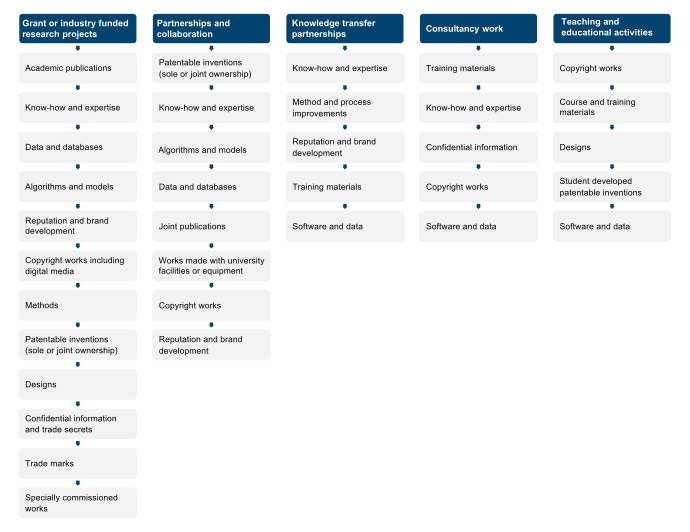
Types of activities and associated intellectual property and wider knowledge assets
This section describes examples of some common university activities and the types of IP and wider knowledge assets that may be generated through them.
Research, teaching and engagement activities
The following activities may generate a range of IP and knowledge assets:
-
grant‑funded and industry‑funded research projects
-
partnerships and collaborative research
-
Knowledge Transfer Partnerships
-
consultancy work
-
teaching and educational activities
These activities may result in:
-
academic publications
-
patentable inventions
-
know‑how and expertise
-
training and course materials
-
copyright works
Know‑how, expertise and methods
Activities involving the development or application of specialist knowledge may generate:
-
know‑how and expertise
-
methods and process improvements
-
course and training materials
These assets are often embedded in practice rather than formal outputs and may require specific approaches to protection and management.
Data, software and digital outputs
Work involving data and digital innovation may produce:
-
data sets and databases
-
algorithms and models
-
software and software‑related outputs
-
training materials
-
copyright works
-
patentable inventions
Reputation and collaborative outputs
Some activities contribute to institutional reputation and collaborative standing, including:
-
joint academic publications
-
software and data created collaboratively
-
reputation and brand development
These outputs may have value even where they do not attract formal IP rights.
Creative and copyright‑protected works
Creative and content‑based activities may result in:
-
copyright works, including digital media
-
works created using university facilities or equipment
Copyright protection usually arises automatically on creation.
Designs, confidential information and other assets
Across a range of activities, institutions may also generate or use:
-
designs
-
confidential information
-
reputational assets
These require appropriate governance, may include registered or unregistered IP rights, confidentiality controls and contractual management.
Summary
Different university activities generate different types of IP and knowledge assets. An effective approach and IP policy should recognise this variety and provide guidance on how these assets are identified, managed, protected and used across research, teaching, collaboration and commercialisation.
Table 1 lists examples of knowledge assets produced within the university. It includes assets created through research, teaching, collaboration and the use of university facilities. Some assets may be protected by registered or unregistered IP rights, such as patents, designs, copyright and trade marks. Others, including data, know‑how and expertise, may be protected through confidentiality, non‑disclosure agreements or contractual terms.
The IP system and the Intellectual Property Office (IPO)
The UK IP framework aims to encourage an environment in which creativity and innovation can flourish.
IP allows organisations and individuals to secure exclusive legal rights over their intangible creations. These rights support competitive advantage by enabling creators and innovators to apply them strategically to their work.
As an Executive Agency of the Department of Science, Innovation and Technology (DSIT), the Intellectual Property Office (IPO) is responsible for the IP system. The IPO is tasked with the promotion and administration of the IP system, and the provision and dissemination of information about IP.
Ownership of IP rights is governed by UK statute and common law. In the UK, employee IP rights are subject to the provisions of the following legislation:
IP and IP rights
Institutions and individuals must follow established processes and procedures to ensure IP rights are identified and protected in a timely way. This helps to support both institutional interests and individual rights.
Table 2: Registered and unregistered IP rights and wider knowledge assets in the UK
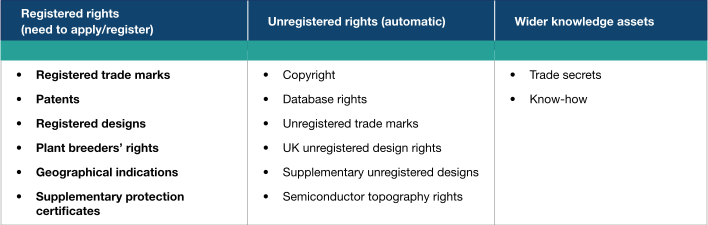
Plant Breeders’ Rights in the UK are awarded by The Animal and Plant Health Agency (APHA)
IP rights are the legal rights that protect intellectual creations. In the UK, these can be registered or unregistered rights. Examples of IP rights are shown in Table 2, and include:
-
patents, registered and unregistered designs
-
unregistered, and registered trade marks
-
copyright
-
database rights
-
plant variety rights
-
geographical indications
-
rights protecting of the layout designs of semiconductor topographies
Under UK law, employers will usually own IP rights to any work created by the employee in the course normal of their employment. Rules on IP ownership are set out in the relevant legislation. Ownership can also be determined through agreements, such as employment contracts and collaboration agreements.
The following table describes three groups of IP rights and knowledge assets recognised in the UK: registered rights, unregistered rights, and wider knowledge assets.
Registered IP rights are rights that require an application or formal registration. These include:
-
registered trade marks
-
patents
-
registered designs
-
plant breeders’ rights
-
geographical indications
-
supplementary protection certificates
Unregistered IP rights arise automatically and do not require registration. These include:
-
copyright
-
database rights
-
unregistered trade marks
-
UK unregistered design rights
-
supplementary unregistered designs
-
semiconductor topography rights
Wider knowledge assets are valuable assets that are not protected through formal IP registration. These include:
-
trade secrets
-
know‑how
In the UK, plant breeders’ rights are awarded by the Animal and Plant Health Agency.
IP rights are territorial, meaning they only provide protection in the countries where they are granted or registered. Protection and rules differ between countries. It is important that you know the rules and options open to you when operating within and outside the UK.
A clear understanding and active management of IP and wider knowledge assets is important to support an institution’s activities. Effective management helps institutions and researchers make best use of opportunities and reduce risks.
Table 3 highlights examples of income generating and knowledge exchange activities that universities may undertake. These activities are recorded through the annual Higher Education Business and Community Interaction (HE-BCI) survey.
The HE‑BCI survey is a statutory annual return completed by UK higher education institutions. It collects data on interactions between universities, business and the wider community, including research, knowledge exchange, commercialisation, and social and cultural engagement. The survey data is collected and published by the Higher Education Statistics Agency and used to inform funding, policy and monitoring of knowledge exchange activity.
Table 3: Examples of income‑generating and knowledge exchange activities in universities
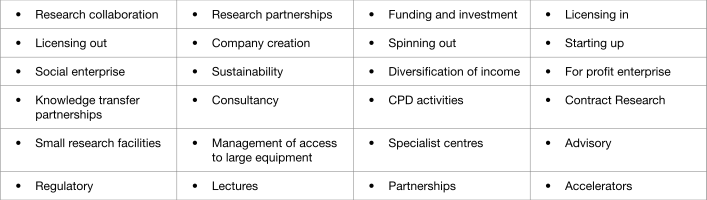
This table lists examples of activities that universities may undertake as part of research, knowledge exchange and engagement with business and the wider community.
These activities include:
-
research collaboration
-
research partnerships
-
funding and investment
-
licensing in
-
licensing out
-
company creation
-
spin‑outs
-
start‑ups
-
social enterprise activity
-
sustainability‑related activity
-
diversification of income
-
for‑profit enterprise activity
-
knowledge transfer partnerships
-
consultancy
-
continuing professional development activities
-
contract research
-
small research facilities
-
management of access to large equipment
-
specialist centres
-
advisory activity
-
regulatory activity
-
lectures
-
partnerships
-
accelerators
These activities align with the categories and data collected through the Higher Education Business and Community Interaction survey.
Institutional IP policy
An institutional IP policy is a dynamic document that sets out how IP is identified, protected, owned and managed within a university or research setting. It defines the principles, rules, processes and governance that guide the handling of IP across the institution.
As a core institutional document, the policy connects with other policies, governance arrangements, procedures and training. Legal and regulatory requirements change over time, so the policy should be regularly reviewed to ensure it remains compliant. If a policy is not kept up to date, institutions may risk losing IP rights as well as facing legal disputes, reputational damage, and financial loss.
Universities and research institutions are often registered charities and must comply with the Charities Act 2011. This legislation sets out what constitutes a charity, the requirement for charitable purposes, and the public benefit obligation.
The Charity Commission has published guidance for higher education institutions. This covers how they can undertake research, contract research and partnerships with businesses while complying with charity law and maintaining charitable status. This guidance explains how research activity can further charitable purposes and how private benefit can be managed appropriately.
Additional guidance relevant to institutional IP management is available from public bodies, this can be found in the references section of this document.
Institutional IP policy, procedure and governance
Figure 2 shows a tri‑level framework illustrating how institutional IP activity is organised, moving from strategic direction and governance to practical application.
Figure 2: Top down/bottom-up representation for the approach to IP policy and associated procedures
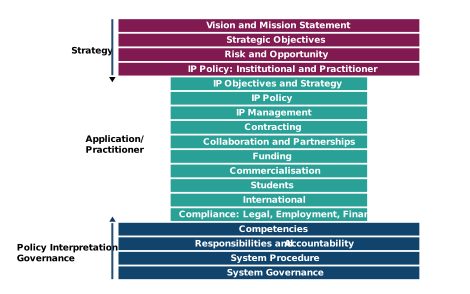
Strategy
This level sets the organisation’s overall approach to IP. It defines how IP is understood and managed and provides direction for those working with IP across the organisation.
Policy interpretation and governance
This level provides the rules, responsibilities and oversight needed to support consistent decision making. It provides expectation for compliance and supports effective implementation of IP policy across the organisation.
Application and practitioner activity
This level represents the operational work carried out by staff and teams. This level describes how practitioners apply the organisation’s IP strategy in their day‑to‑day activities.
IP policy considerations
This section sets out considerations to help organisations identify and manage IP and wider knowledge assets. It is not exhaustive. Other issues may apply depending on organisational structure, activities and risk profile.
Purpose of an IP policy
A well designed IP policy provides a consistent system for identifying, protecting, governing and using institutional IP and wider knowledge assets. It aligns IP management with organisational missions and strategy. It supports research education, collaboration and knowledge exchange activities by defining how IP and wider knowledge assets are protected, governed and used responsibly.
When developing an IP policy, organisations should consider the purpose of the document, its scope, and how it aligns with organisational objectives, values, purpose and vision. The policy should be designed so it can be translated into effective processes, procedures and governance, supported by appropriate training across the organisation.
An effective IP policy can support a wide range of university and research activities. It positions IP as an enabler of impact, supporting collaboration, commercialisation, public sector use and, where appropriate, publication. The policy should also allow flexibility so that different approaches can be taken as required depending on the research discipline, activity, opportunity, risk and intended outcomes.
The IP policy should be actively maintained and reviewed on a regular basis. This helps ensure continued alignment with institutional strategy, ongoing compliance with legal and regulatory requirements, and a shared understanding of the policy across the organisation.
Early identification and recording of IP and wider knowledge assets
An effective IP policy protects organisational IP and wider knowledge assets by establishing clear and consistent systems. These systems cover the identification of IP and wider knowledge assets, ownership, recording and managing IP, confidentiality, disclosure, governance and risk management. Clear governance structures and responsibilities help staff understand required actions and accountability. At a practical level, this helps reduce the risk of premature disclosure, misuse of IP or accidental loss of rights and value.
Early identification, understanding and recording of IP and wider knowledge assets is essential. It allows organisations to secure IP rights before disclosure, supports timely internal review, safeguards confidentiality, and clarifies ownership. Accurate records also help manage risk, including where activities involve multiple legal systems or jurisdictions, such as overseas campuses or international partnerships.
What the IP policy covers
An effective IP policy sets out how the institution manages activities associated with IP and wider knowledge assets. This includes research collaboration, knowledge exchange and commercialisation activities such as training and engagement, licensing, spinouts, consultancy.
A well-designed IP policy should cover such things as:
-
explain how financial matters are handled, including royalties, equity, milestone payments and third‑party obligations
-
set out how confidentiality, disclosure and publication are managed, particularly where early disclosure could affect patentability or commercial value
-
establish the ownership position of IP and wider knowledge assets created by people working in or with the institution, to be secured through employment contracts or other agreements
-
explain how the institution meets its obligations under Charity law where applicable
-
set out clear and consistent systems for managing IP within the UK and internationally
-
define governance structures, processes, procedures and protocols so that decision making roles, responsibilities and sources of support are clear
Who is involved in developing the IP policy
IP policies should be developed in consultation with key institutional services. These typically include legal services, human resources, finance, research contracts, technology transfer offices, library and student services. Engagement with trade unions, student unions and other professional services may also be appropriate. The specific groups involved may change over time as organisational needs and structures evolve.
Who the IP policy applies to
The IP policy applies to everyone working in or with an organisation. This includes senior leaders, staff, researchers, academics, students, and professional services staff. It also applies to external partners involved in activities that generate or use IP and wider knowledge assets. The policy extends to situations where staff or collaborators are working abroad or engaging with international partners, collaborators or colleagues.
An institutional IP management system
The IP policy should include guidelines on how to keep accurate records of all activities and legal agreements relating to IP and wider knowledge assets. This supports the creation and maintenance of an asset register. The register may record IP rights, knowledge assets created, and any third‑party IP or knowledge assets used by the organisation, together with the terms governing their use.
IP management systems define how IP is disclosed, recorded and used, how confidentiality is protected, and when formal IP protection or other safeguards are appropriate.
Accurate record keeping is essential where organisations need to demonstrate ownership, inventorship, authorship or validity of IP. It also supports internal due diligence and informed decision making about IP assets.
Roles and responsibilities
An institutional IP policy should clearly define roles and responsibilities for its development and implementation across the organisation. This includes identifying decision makers, authorised signatories and those accountable at each stage of the IP management process.
For example, senior leaders set the strategic direction for IP and ensure alignment with organisational mission. Governance arrangements, processes and systems then enable staff to apply the policy consistently. Researchers and practitioners apply the policy in their day‑to‑day work.
At all levels, the IP policy should specify decision making authority, accountability, and access to training and guidance. This helps ensure the IP policy is consistently understood and effectively enacted across the institution.
International considerations
An institutional IP policy should set out how the organisation operates both in the UK and internationally. IP rights are territorial, meaning they only provide protection in the countries where they are granted or registered. International activity can therefore introduce additional complexity and risk.
The IP policy should explain the scope and purpose of your international activities and how these build on your domestic IP approach. This will help to ensure that international issues are considered at an early stage. These issues may include suitable protection routes, differences in national legislation and practice, and jurisdictional issues affecting ownership, enforcement and commercialisation.
The IP policy should also provide direction if there are any restrictions on your activities. Legal or regulatory restrictions may apply to activity connected with international collaboration or commercialisation. This includes situations where activities are based in the UK but involve overseas partners, funders, contractors or investors.
In some cases, UK legislation with extraterritorial relevance may apply. This includes the National Security and Investment Act (NS&I Act), which allows the government to review and intervene in certain transactions involving IP and other assets.
Even where activity is primarily domestic, organisations and individuals should consider:
-
who they are working or collaborating with
-
whether there are any associated third-parties or contractors
-
where the parties are based
-
whether these factors affect how IP and wider knowledge assets are protected, managed and used
The Intellectual Property Office’s International IP Service provides guidance to help companies and researchers when collaborating, exporting or investing overseas.
Informed decision making
Effective management of IP and wider knowledge assets depends on access to appropriate expertise at all levels of decision making. This expertise may be provided internally or through external advisers. The IP policy should explain how specialist advice is accessed and how expert input informs decisions. Using such expertise supports capability, risk management and compliance across the institution.
Review
The institutional IP policy should be actively managed and reviewed on a clear and regular basis. In addition to scheduled reviews, some activities may trigger the need for an update. These include entering into new international collaborations, overseas commercialisation or significant changes in legal or regulatory requirements.
The active curation and regular review across institutional responsibilities helps ensure that the policy remains aligned with applicable law and practice. This shared approach creates a shared responsibility and consistent understanding of the IP policy, enables issues to be raised from across the organisation, and informs governance arrangements, procedures and training.
Awareness, training and guidance
Awareness, training and guidance are essential to the effective operation of an IP policy. They help ensure that everyone across the organisation understands the policy and their responsibilities. Without this shared understanding, IP may not be managed consistently, and compliance becomes uneven.
Regular training builds organisational IP literacy and helps embed good practice. It enables staff to recognise when disclosure, publication or collaboration could compromise protection or infringe on third party rights. This reduces the risk of accidental losses of rights or legal disputes.
Clear guidance supports consistent and confident decision making by explaining what actions to take, when to take them and who is responsible. This reduces confusion, avoids delays and supports consistent practice across teams. Training and awareness activities also help promote a positive, innovation friendly culture where IP is understood as a shared responsibility and a facilitator of collaboration and commercialisation.
Embedding training into everyday processes helps translate policy into practice by aligning governance, procedures and behaviours across the institution. Ongoing awareness activity and guidance also helps ensure staff remain informed of changing legal and regulatory requirements, reducing the risk of inadvertent non‑compliance.
To be effective, an IP policy should therefore be supported by regular, proportionate, tailored training and access to up-to-date information.
References
References for Introduction
Managing intellectual property and confidentiality – Department for Science, Innovation and Technology and Government Office for Technology Transfer (2023). Explains why identifying, protecting and managing intellectual property and knowledge assets is important, including lawful use of third‑party IP and risk reduction.
Guide to Managing Intellectual Property and Confidentiality (PDF, 1.3 MB) – Government Office for Technology Transfer (2023). Sets out how intellectual property and knowledge assets should be identified, protected, managed and governed within organisations, including the role of institutional policies and access to support.
UKRI intellectual property strategic statement – UK Research and Innovation (2026). Describes the importance of effective IP management to maximise research impact, strengthen market position, and reduce risks associated with research and innovation activities.
References for IP and IP rights
Get plant breeders’ rights for your new variety – Animal and Plant Health Agency. Confirms that plant breeders’ rights are IP rights in the UK and that they are awarded by the Animal and Plant Health Agency.
HE Business and Community Interaction (HE-BCI) data – Higher Education Statistics Agency (HESA). Explains the scope of the HE‑BCI survey and the types of knowledge exchange, research, commercialisation and engagement activities reported by UK universities.
Higher education provider business and community interaction data UK – Department for Education and Higher Education Statistics Agency. Confirms that the HE-BCI survey is a statutory annual return and describes the activities covered, including knowledge exchange, IP, business services, and social and cultural engagement.
HE-BCI survey overview – University of Cambridge Describes the HE-BCI survey structure and the categories of activity reported, including collaborative research, contract research, consultancy, facilities and equipment, CPD, IP commercialisation, spin‑outs and start‑ups.
References for Institutional IP policy
Intellectual asset management for universities - Intellectual Property Office (PDF, 1.8MB) – Intellectual Property Office. Explains the role of institutional IP policies and the importance of identifying, managing and reviewing IP to achieve public and economic benefit.
Charities Act 2011 – Legislation.gov.uk. Sets out the legal framework for charities in England and Wales, including charitable purposes and the public benefit requirement.
Research by higher education institutions – Charity Commission. Provides guidance on how universities, as charities, can undertake research and engage with business while complying with charity law.
UK Research and Innovation: knowledge exchange data and metrics – UK Research and Innovation Publishes analyses and case studies showing research outcomes and impact from higher education and research institutions.
References for Institutional IP policy, procedure and governance
Intellectual asset management for universities – Intellectual Property Office (PDF, 1.8MB) Sets out the need for universities to take a strategic approach to managing intellectual assets, link strategy to operational practice, and put in place governance and oversight arrangements to maximise public and economic benefit.
IP Policies for Universities and Research Institutions – World Intellectual Property Organization (WIPO) Explains that institutional IP management operates across multiple levels, including strategic direction, operational application by practitioners, and policy frameworks with governance and oversight.
Models of Intellectual Property Governance and Administration: IP policy framework and governance – World Intellectual Property Organization (WIPO) Describes IP policy frameworks as combining high‑level strategy, implementation mechanisms, and governance structures to support consistent and effective IP management.
Making the Most of Intellectual Property: Developing an Institutional IP Policy (PDF, 0.8MB – Kowalski, IP Handbook (WIPO‑hosted) Explains institutional IP policies as the foundation for IP activity, linking institutional mission and strategy with practical application and governance responsibilities.
References for Purpose of an IP policy
IP Policies for Universities and Research Institutions – World Intellectual Property Organization
Charities Act 2011 – Legislation.gov.uk
References for Roles and responsibilities
IP Policies for Universities and Research Institutions – World Intellectual Property Organization
Making the most of intellectual property: developing an institutional IP policy (PDF) – WIPO IP Handbook
Charities Act 2011 – Legislation.gov.uk.
References for Awareness, training and guidance
National Security and Investment Act: guidance on acquisitions – Cabinet Office.
National Security and Investment Act 2021 – Legislation.gov.uk
WIPO Academy IP eLearning programmes – World Intellectual Property Organization