KAM Guide: Intellectual property management
Updated 6 August 2026

© Crown copyright 2026
This publication is licensed under the terms of the Open Government Licence v3.0 except where otherwise stated. To view this licence, visit nationalarchives.gov.uk/doc/open-government-licence/version/3 or write to the Information Policy Team, The National Archives, Kew, London TW9 4DU, or email: psi@nationalarchives.gov.uk.
Where we have identified any third party copyright information you will need to obtain permission from the copyright holders concerned.
This publication is available at https://www.gov.uk/government/publications/knowledge-asset-management-kam-hub/kam-guide-intellectual-property-management
Introduction
Purpose of this guide
This document is the second section of the Knowledge Asset Management (KAM) guide. It explains how knowledge assets and intellectual property can be identified, protected and managed. It also outlines the key issues to consider when working with research outputs, disclosure, collaboration and the use of confidential information.
For a full introduction to the KAM guide, section one explains the goals and intentions of the guide.
Knowledge Assets
Knowledge assets (KA) are non physical assets that an organisation owns, controls, or has access to. They include anything an organisation knows, creates, or uses that has social, economic, or financial value. This value may exist even where an asset cannot be legally owned or formally protected. This definition reflects approaches used across government and internationally, including by the World Intellectual Property Organization (WIPO) and the Department for Science, Innovation and Technology (DSIT).
Some knowledge assets can be protected using intellectual property (IP) rights, such as patents, trade marks, copyright, and database rights. Other knowledge assets can be just as valuable, even where formal IP rights do not apply. These include data, trade secrets, relationships, sector knowledge, and organisational know how. These assets are protected in different ways. Protection may rely on contracts, terms and conditions, and duties of confidentiality or secrecy.
Intellectual property and knowledge asset protection
There are different forms of registered and unregistered IP protection available depending on what you’ve created and what you want to do with it. However, it is important to understand that things will need to be carried out in a particular order by professional experts.
There are different types of IP protection, including registered and unregistered rights. The protection available depends on what you have created and what you want to do with it.
It is important to understand that some things will need to be carried out in a specific order. This is particularly important, for registered IP rights. These usually require support from professional experts and must follow defined steps. The process takes time and may involve preparing:
-
applications
-
filing documents
-
examination
-
formal grant of the rights
Intellectual Property Rights
Patents
A patent is a legal right for an invention. It can let the patent owner stop others from making, using, selling or importing the invention without permission, in the places where the patent is in force. In return, the invention must be described in the patent application so the information is published and can be used by others through agreement or once the protection ends and allows the ideas to be built on. In the UK, patents are governed by the Patents Act 1977 and administered by the Intellectual Property Office.
Patentable and non-patentable inventions
Patents can protect:
-
products
-
processes
-
machines or devices
-
software that is technical in nature
Patents cannot protect:
-
literary, dramatic, musical or artistic works
-
ways of doing business, playing a game or thinking
-
methods of medical treatment or diagnosis
-
discoveries, scientific theories or mathematical methods
-
the way information is presented
-
software that has a ‘non-technical’ purpose
Patentability criteria
An invention must satisfy certain conditions to be eligible for patent protection, these are as follows.
Novelty
It must not have been made publicly available anywhere in the world at the time of filing. For example, it must not have been described in a publication, in a presentation or embodied in a product or process made available to the public. Publicly available disclosures are known as ‘prior art’ or the ‘state of the art’.
Inventive step
It must involve an inventive step, meaning it must not be obvious to a person skilled in the art. This is considering the content of the state of the art at the time of filing.
Industrial application
It must be capable of industrial application, by being something that can be made or used in any industry.
Applying for a patent
The Intellectual Property Office (IPO) provides guidance and information on how to apply for a patent and guidance on how to file documents with the IPO. As part of the process, the IPO will look at whether your invention is new and inventive (by carrying out a search of existing documents).
The IPO then makes a thorough check of your application to decide if your invention can be patented (known as a ‘substantive examination’). This could take place several years after you first apply. If you require the process to be completed more quickly, the IPO offers accelerated procedures in certain circumstances to get your patent granted more quickly.
Applicants may need to amend their patent application based on the IPO’s recommendations. Their patent will only be granted once all outstanding issues have been resolved through examination. Around 18 months after application, the IPO will publish the application in full.
Territorial nature of patent rights
Patent rights are territorial. For example, a UK patent may help if you want to take legal action against someone who uses your patented invention without your permission within the UK. If you are using, intend to use, or wish to prevent others from using your invention overseas, the IPO provides information on protecting your UK IP abroad.
If seeking protection abroad, you must apply directly to that country’s official IP authority. Alternatively, you can use European or international application routes through the European Patent Office (EPO) or Patent Cooperation Treaty (PCT), respectively.
The IPO’s International IP Service provides information regarding international application routes. It is important to be aware that European or international application routes typically still lead to the grant of national patents. These must be granted by and renewed with each countries official IP authority.
European or international routes can also be used to obtain patent protection in the UK. The IPO provides information on protecting your UK IP abroad.
Patents and ‘licences of right’
Patent holders can ask the IPO to endorse their patent with a licence of right in the register of patents. This signals that the owner is willing to license the invention. This means that anyone can apply for a licence to use your invention. Although the patent is made openly available for licensing, the terms and fees remain a private commercial matter between the parties.
One key benefit of having your patent endorsed with a licence of right is that it lets other people know you are happy to licence your IP.
Supplementary Protection Certificates (SPC)
Pharmaceutical or plant protection products, such as new medicines or pesticides, require regulatory approval in the UK before they can be sold. If you have a patent protecting the active ingredients in these products, the requirement for regulatory approval can delay you being able to use the patent.
SPC compensate for this delay by providing similar protection to the patent for up to 5 years beginning from the date of expiry of the patent. If an SPC protects a medicinal active ingredient that has undergone appropriate paediatric testing, it may be extended for a further six-month period.
Further guidance on SPC can be found in the supplementary protection certificates guidance and forms collection.
Plant breeders’ rights and plant varieties
IP rights over plant varieties in the UK are known as plant breeders’ rights (PBR). The Animal and Plant Health Agency (APHA) awards rights for the UK. Plant breeders’ rights may provide protection against others taking the certain actions. These include:
-
production or reproduction
-
selling or offering for sale
-
altering so it can be propagated
-
exporting or importing
-
keeping stock of your plant species for any reason
The Plant Varieties Act 1997 details the exemptions that are allowed.
You may wish to add a plant variety to the UK’s national list. It has an application process that is separate to plant breeders’ rights. For agricultural and vegetable varieties, you can apply for plant breeders’ rights and for national listing simultaneously.
Trade marks
A trade mark is a sign that distinguishes the goods and services of one business from those of others and protects a brand’s identity. You can register your trade mark to protect your brand, for example the name of your product or service. The logo of your university is likely to also be a trade mark.
What you can register as a trade mark:
-
words
-
sounds
-
logos
-
colours
-
a combination of these
You cannot register as a trade mark:
-
offensive material, for example contain swear words or pornographic images
-
purely a description of the goods or services it will relate to, for example the word ‘cotton’ cannot be a trade mark for a cotton textile company
-
misleading content, for example use the word ‘organic’ for goods that are not organic
-
material that is too common and non-distinctive, for example a statement like ‘we lead the way’
-
solely a generic shape associated with your business, for example if you sell apples, you cannot trade mark the shape of an apple
-
use of national flags you do not have permission to use
-
use of official emblems or hallmarks, for example coats of arms you do not have permission to use
When your trade mark is registered in the UK, you’ll be able to take legal action against anyone who uses your trade mark without your permission in the UK. You must continue to use your trade mark and renew it every ten years.
You may not be able to register your trade mark if it’s the same as, or similar to, a trade mark of another business. This applies where that business sells the same, or similar, goods or services. In the UK a trade mark application will be refused if it is successfully opposed by the owner of earlier trade mark rights in the UK. This will not apply to trade mark rights owned in another country.
Put the registered trade mark (®) symbol next to your registered trade mark to show that it’s registered and to warn others against using it. You can also sell and license your trade mark. The IPO has information on how to file documents with the IPO to register your trade mark.
Unregistered trade marks
Unregistered trade marks are not registered with a national intellectual property office. Unregistered trade marks are protected in the UK under the law of passing off, which is interpreted and enforced by the courts. Passing off sits outside the IPO’s registration‑based systems.
The claimant in a passing off claim must prove that the unregistered trade mark has goodwill in the mark and that unauthorised use will give rise to a misrepresentation. They must also prove that the misrepresentation has caused or is likely to cause damage to the goodwill in the mark. This position is set out and explained in official government material, including HM Revenue & Customs guidance with supporting guidance by the IPO.
Unregistered trade marks can be identified by using the trade mark symbol (™) next to the word or image. This indicates that a sign is being used as a trade mark, even though it is not registered.
Designs
A registered design helps protect the appearance of a product, such as its shape or pattern. Registering your design makes it easier to prove that the design is legally yours and when you created it. This will help if anyone tries to copy or use your design without your permission.
What you can register as a design
To be registered, designs must be new and have individual character.
Designs can include one or more of the following features:
-
physical shape
-
configuration (or how different parts of a design are arranged together)
-
decoration or colour
-
pattern
You cannot register as a design:
-
offensive material, for example swear words or pornographic images
-
designs making use of national flags you do not have permission to use
-
designs making use of official emblems or hallmarks, for example the Olympic™ rings or coats of arms
-
designs that are solely functional, for example a chair that folds down more quickly than others of the same kind
Similar to patents, designs must be novel. However, the IPO will not conduct a search of prior designs. This means that it is your responsibility to consider whether your design is new, as it may be challenged by third parties after registration.
Information to how to register a design with the IPO include detailed illustrations of your design and any notes to describe exactly what you are registering.
Unregistered designs
There are different types of unregistered design. A UK unregistered design right is an automatic right, which applies to the shape and configuration of three-dimensional objects. It does not protect surface decoration.
A supplementary unregistered design protects the appearance of a product in the UK for 3 years from the date the design is made public.
Copyright
Copyright protects your work and stops others from using it without your permission. This is according to the restricted acts listed in Section 16 of the Copyright, Designs and Patents Act (CDPA). Copyright therefore protects your work by providing a basis for taking legal action against people who copy and distribute your work without your permission.
Copyright is an automatic IP right where protection starts as soon as a work is created. You do not need to apply or pay a fee. Examples of copyright are:
-
original literary, dramatic, musical and artistic works
-
original non-literary written work, such as software and the selection and arrangement of material in databases
-
sound and music recordings
-
film and television recordings
-
broadcasts
-
the layout of published editions of written, dramatic and musical works
You can mark your work with the copyright symbol (©), your name and the year of creation. Whether you mark the work or not does not affect the level of protection you have. It is good practice within a research environment to keep records of when copyright has been created. This may help to support any future collaborations, commercialisation and when acting against any infringement. There is no government register of copyright works in the UK.
Table 3 outlines the type of work and length of copyright protection. Once your copyright has expired, anyone can use or copy your work.
Crown copyright
Crown copyright applies to works made by an officer or servant of the Crown in the course of their duties, and to works made under the direction or control of the Crown.
Crown copyright lasts for 125 years from the end of the calendar year in which the work is made. However, if the work is commercially published within 75 years of creation, this reduces to 50 years from the end of the calendar year of first publication.
Parliamentary copyright
Parliamentary copyright applies to works made by or under the direction or control of either House of Parliament. Parliamentary copyright lasts for 50 years from the end of the calendar year in which the work is made.
Copyright overseas
Copyright protection is territorial, meaning it is governed by the national law of each country. As a result, the following can vary between jurisdictions and what you need to do to ensure protection:
-
the scope of protection
-
the types of works covered
-
how copyright operates
Your work may also be protected by copyright in other countries through international agreements, for example the Berne Convention for the Protection of Literary and Artistic Works.
Orphan works
Orphan works are copyright works or performances where the rights holder cannot be identified or located. This makes it difficult to obtain permission for use and leads to legal uncertainly since using an orphan work without permission can incur legal risk.
The IPO provides information concerning orphan works, including the orphan rights register and how to apply to license an orphan work. An orphan works licence applies only for use in the UK and can be for commercial or non-commercial use. It is non-exclusive (not restricted to a single licensee) and can last up to an initial seven years, before renewal.
Database rights
Database rights arise automatically rather than through an application process. In the UK, sui generis database rights protect the contents of a database. A database does not have to be original for it to qualify for database rights. However, there must have been substantial financial, human or technical investment in obtaining, verifying or presenting the data for a database to qualify for database rights.
Database rights expire 15 years after the year of the database’s creation. If the database is made available to the public later, rights expire 15 years from that point instead.
Where a substantial change to the contents of a database amounts to a substantial new investment, a new 15-year term of protection applies. This includes changes resulting from the accumulation of successive additions, deletions or alterations. The database resulting from that investment shall qualify for the new term of protection.
In research environments, it is important to keep clear records of when a database was created and when it was made available to the public. Any substantial changes made to its contents. This can help support future collaboration, commercialisation activities, and enforcement action where database rights are infringed.
Database rights are separate from copyright, although the selection and arrangement of material in a database may also be covered by copyright protection.
Like other IP rights, database rights are territorial. Protection and rules differ between countries. It is important that you know the rules and options open to you when operating within and outside the UK.
Other confidential information
Know how
Know‑how refers to practical knowledge, skills, or experience that provide an operational or competitive advantage. This can include:
-
methods
-
techniques
-
processes
-
expertise developed through research, delivery, or professional practice
Know‑how may be protected under the law of confidence where it is confidential. If the information is disclosed publicly, protection under the law of confidence will generally no longer apply. For this reason, maintaining confidentiality is critical where know‑how is relied upon as an asset.
To maintain the confidentiality of know how, you must ensure it stays secret. Steps should be taken to control access and prevent unauthorised disclosure. This may include things such as limiting sharing to those who need the information, setting clear expectations about confidentiality and using contractual protections.
Non-Disclosure Agreements or Confidentiality Agreements can support the protection of confidential know‑how.
Know how can exist in many forms. It may be written down or stored digitally, but it can also be held tacitly, such as in the experience, memory or expertise of individuals. Although know‑how is not a registered IP right, it is often treated as an important intellectual asset where it remains confidential. Know how, however, may be legally protected if it remains confidential and is shared under circumstances that create a duty of confidentiality.
Trade secrets
A trade secret is confidential business information that derives value from not being generally known. Trade secrets can include, among other things, formulas, practices, designs, instruments, patterns, or a compilation of information. For information to qualify as a trade secret, it must be:
-
unknown to others in the respective business circles
-
have commercial value because it is secret
-
have been subject to reasonable steps under the circumstances, to keep it secret, by the person lawfully in control of the information
Trade secrets and know how should be actively identified, protected and managed by the asset holder. Trade secret holders are required to take reasonable steps to preserve the secrecy of their trade secret. These may include:
-
physical security measures
-
cyber-security measures
-
restricting access to those who need the information
-
contractual protections such as non-disclosure agreements and other contractual confidentiality commitments - The IPO provides information concerning the economic and innovation impacts of trade secrets
Trade secrets are protected under two legal frameworks, the common law doctrine of breach of confidence and by statutory protection under the Trade Secrets (Enforcement, etc.) Regulations 2018, which operates alongside and supplement the protections available in common law.
Where common law affords broader protection for confidential information than the statutory regime, a trade secret holder may rely on both frameworks in parallel. Trade secret holders also frequently employ contractual mechanisms, most notably Non-Disclosure Agreements (NDAs), to reinforce their rights through contract law.
Not all inventions or confidential information will qualify as trade secrets. Some information may instead be treated as confidential information without meeting the full definition of a trade secret.
Table 1: An overview of UK IP protection for registered IP Rights. Includes examples of what can be protected and how long protection lasts.
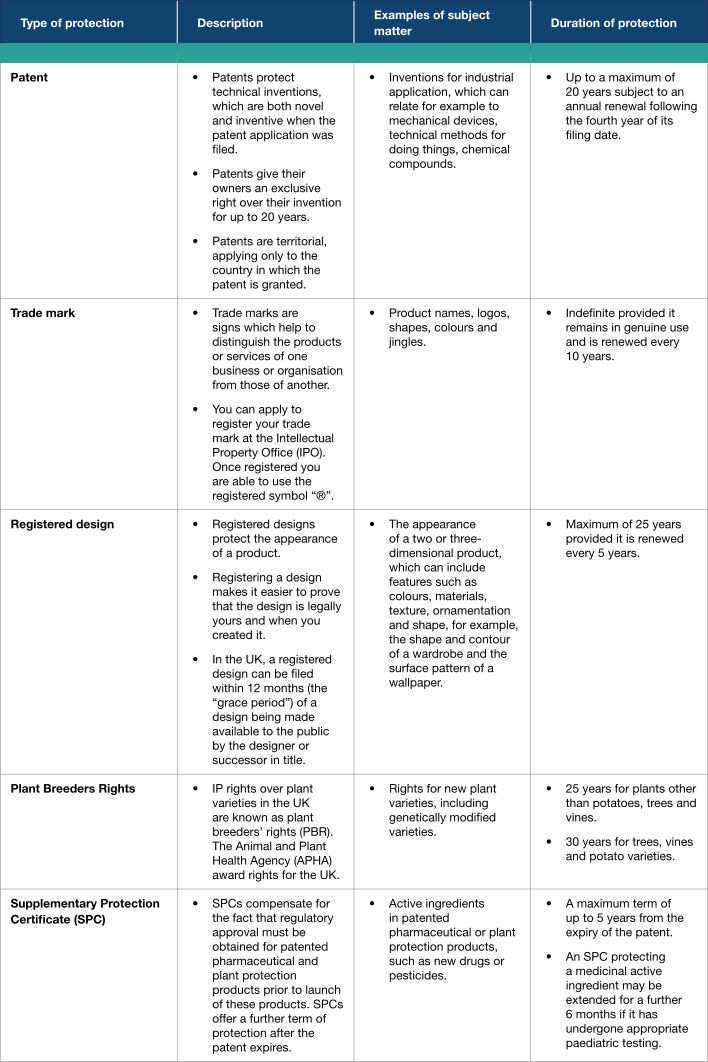
Patent
Patents protect technical inventions that are new and inventive at the time the application is filed. A patent gives its owner exclusive rights to the invention. These rights apply only in the country where the patent is granted.
Examples include inventions for industrial application, such as mechanical devices, technical methods, or chemical compounds.
Patent protection can last for up to 20 years. This is subject to annual renewal, starting after the fourth year from the filing date.
Trade mark
Trade marks protect signs that distinguish the goods or services of one organisation from those of another. Trade marks can be registered with the Intellectual Property Office. Once registered, the registered symbol “®” may be used.
Examples include product names, logos, shapes, colours, and jingles.
Trade mark protection can last indefinitely, provided the trade mark is in genuine use and is renewed every 10 years.
Registered design
Registered designs protect the appearance of a product. Registering a design makes it easier to show that the design is legally yours and when it was created.
In the UK, a registered design can be filed within 12 months of the design being made public. This is known as the grace period.
Registered designs protect the appearance of two‑ or three‑dimensional products. This can include colours, materials, texture, ornamentation, and shape. Examples include the shape and contour of a wardrobe or the surface pattern of wallpaper.
Protection can last for up to 25 years, provided the design is renewed every 5 years.
Plant breeders’ rights
IP rights for plant varieties in the UK are known as plant breeders’ rights. These rights are awarded by the Animal and Plant Health Agency.
They protect new plant varieties, including genetically modified varieties.
Protection lasts for 25 years for most plants. For trees, vines, and potato varieties, protection lasts for 30 years.
Supplementary Protection Certificate
Supplementary Protection Certificates, known as SPC, extend protection for patented pharmaceutical and plant protection products. They exist to compensate for time spent obtaining regulatory approval before products can be sold.
SPC apply to active ingredients in patented pharmaceutical or plant protection products, such as new medicines or pesticides.
An SPC can provide up to 5 additional years of protection after the patent expires. For medicinal products, this may be extended by a further 6 months if appropriate paediatric testing has been completed.
Description of unregistered intellectual property rights that arise automatically when legal requirements are met
Table 2: Description of unregistered IP rights that arise automatically when legal requirements are met
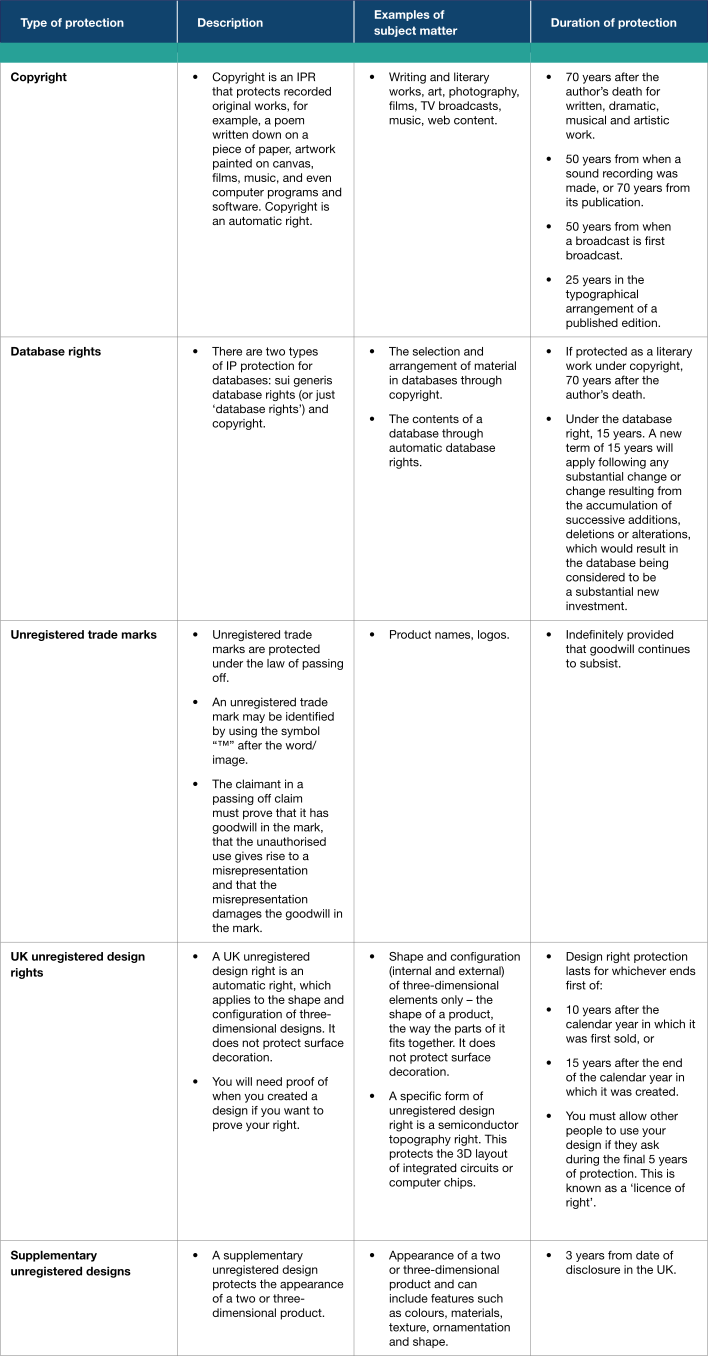
Copyright
Copyright protects original works that are recorded in some form. This includes written, visual, audio, and digital works. Copyright arises automatically.
Examples of what can be protected are writing and literary works, art, photography, films, television broadcasts, music, software, and web content.
Duration of protection
-
written, dramatic, musical, and artistic works: 70 years after the author’s death
-
sound recordings: 50 years from when the recording was made, or 70 years from publication
-
broadcasts: 50 years from first broadcast
-
typographical arrangement of a published edition: 25 years
Database rights
Databases can be protected in two ways: through copyright and through sui generis database rights.
Examples of what can be protected can be the selection or arrangement of database content, protected by copyright, or the contents of a database, protected by database rights.
Duration of protection
-
if protected by copyright as a literary work: 70 years after the author’s death
-
under database rights: 15 years
-
a new 15‑year term applies if there is a substantial change resulting in a significant new investment
Unregistered trade marks
Unregistered trade marks are protected under the law of passing off. They may be marked using the “™” symbol. To succeed in a passing‑off claim, the owner must show goodwill in the mark, misrepresentation, and resulting damage.
Examples of what can be protected are product names and logos.
Duration of protection
- protection can continue indefinitely, as long as goodwill in the mark remains.
UK unregistered design rights
UK unregistered design rights protect the shape and configuration of three‑dimensional designs. They do not protect surface decoration. These rights arise automatically. Evidence of when the design was created is required to enforce the right.
Examples of what can be protected are the shape and arrangement of three‑dimensional elements, both internal and external, such as a product’s form or how its parts fit together.
A specific form of unregistered design right, known as semiconductor topography right, protects the three‑dimensional layout of integrated circuits or computer chips.
Duration of protection Protection lasts until whichever of the following ends first:
-
10 years after the end of the calendar year in which the design was first sold
-
15 years after the end of the calendar year in which the design was created
During the final 5 years of protection, others may request use of the design under a licence of right.
Supplementary unregistered designs
Supplementary unregistered designs protect the appearance of two‑ or three‑ dimensional products.
Examples of what can be protected include features such as colours, materials, texture, ornamentation, and shape.
Duration of protection
3 years from the date the design is first disclosed in the UK.
Summary of the types of copyright work and duration of protection under the Copyright, Designs and Patents Act 1988
Table 3: Summary of the types of copyright work and duration of protection under the Copyright, Designs and Patents Act 1988
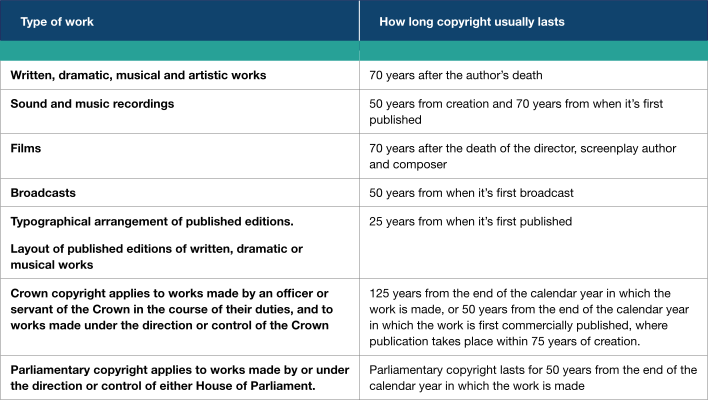
Literary, dramatic, musical and artistic works
Copyright lasts for 70 years from the end of the calendar year in which the author dies. Where there is joint authorship, copyright lasts until 70 years after the death of the last surviving author.
Sound recordings
Copyright lasts for 50 years from the end of the calendar year in which the recording is made, or 70 years from the end of the calendar year in which the recording is first published or first lawfully made available to the public, if this happens within that initial 50‑year period.
Films
Copyright lasts for 70 years from the end of the calendar year in which the last to die of the following persons dies:
-
the principal director
-
the author of the screenplay
-
the author of the dialogue
-
the composer of music specially created for the film
Broadcasts
Copyright lasts for 50 years from the end of the calendar year in which the broadcast is made.
Typographical arrangement of published editions
Copyright lasts for 25 years from the end of the calendar year in which the edition is first published.
Types of confidential information used as knowledge assets
Table 4: Types of confidential information used as knowledge assets
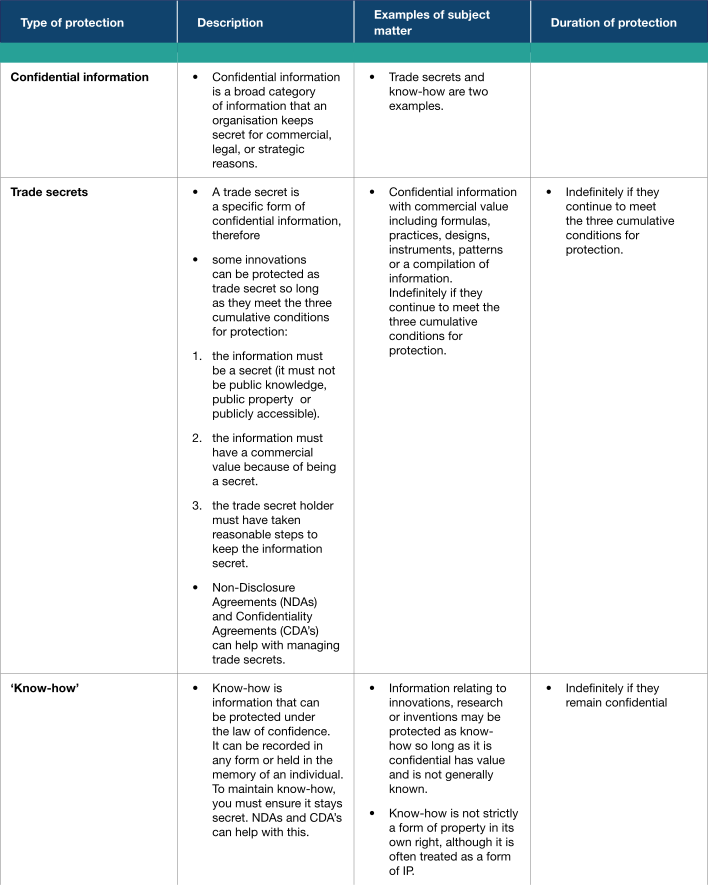
Confidential information
Confidential information is a broad category of knowledge assets that an organisation needs or chooses to keep secret. This may be for legal, commercial, security, ethical, or strategic reasons.
It can cover many different types of information. Trade secrets and know‑how are two important examples, but they are not the only forms of confidential information an organisation may hold or share.
Trade secrets
Trade secrets are a specific type of confidential information. Some innovations can be protected as trade secrets if certain conditions are met. Trade secret protection arises automatically.
Conditions for protection
To qualify as a trade secret, all of the following conditions must be met:
-
the information must be secret, meaning it is not generally known or publicly accessible
-
the information must have commercial value because it is secret
-
reasonable steps must have been taken to keep the information secret
Non‑disclosure agreements (NDAs) and confidentiality agreements (CDA’s) can help manage and protect trade secrets.
Examples of what can be protected are confidential information with commercial value, such as:
-
formulas
-
practices and methods
-
designs
-
instruments
-
patterns or compilations of information
Duration of protection
Trade secret protection can last indefinitely, provided the information continues to meet all three conditions for protection.
Know‑how
Know‑how is a form of confidential information made up of practical knowledge and experience developed through activity, learning, or problem‑solving. It can be recorded in any form or held in the memory of an individual.
Know‑how is commonly protected under the law of confidence. While it is not always a property right in itself, it is often treated as a form of IP in practice.
To maintain protection, know‑how must remain confidential. NDAs or CDA’s can help support this.
Examples of what can be protected may include information relating to innovations, research, or inventions may be protected as know‑how where it:
-
is confidential
-
has value
-
is not generally known
This may include:
-
technical expertise
-
operational processes
-
specialist skills and practices
-
experience gained through research, development, or delivery
Duration of protection
Protection lasts for as long as the know‑how remains confidential and continues to provide value.
Intellectual property and disclosure
Universities and research institutions regularly create new knowledge and IP. Much of this activity is intended for public benefit and is shared openly through routes such as:
-
academic journals
-
conference papers
-
grant publications
-
institutional websites
-
student theses
-
wider commentary
Care must be taken to avoid premature disclosure of ideas or results that may later be candidates for IP protection. This is important because in the UK and other territories, it may not be possible to obtain valid rights protection after they have been disclosed. For example, to obtain patent protection most territories have an absolute requirement for novelty. This will be destroyed by any form of public disclosure before an application is filed.
Early identification allows time to consider appropriate protection, prioritisation and management options. It also helps reduce the risk of unintentionally placing valuable ideas into the public domain before decisions have been taken.
Identifying, recording, and regularly reviewing your IP from creation through the many stages of development and use will support you to use your assets effectively. This includes for including collaboration, commercialisation and impact activities.
Wider legal and organisational considerations
IP and wider knowledge assets are at the heart of innovation and research impact. Decisions about how they are disclosed, managed and used may need to be considered alongside other areas of law.
Universities and research institutions are often registered charities and must operate in accordance with the Charities Act 2011. The Charity Commission has published guidance explaining how charities can undertake research contracts and partnerships with businesses while remaining compliant with their charitable purposes.
Intellectual property guides
Research by Higher Education Institutions provide overviews of different IP rights and approaches to IP management, including practical tips and links to further resources. In addition, UK Research and Innovation (UKRI) publishes research outcomes and impact case studies from research undertaken by education Institutions.
Intellectual property internationally
Protecting and managing IP internationally can be challenging and complex. IP rights are territorial, which means that they are governed by national or regional law and may operate differently between jurisdictions.
These differences may relate to:
-
which rights are available
-
the rules governing their protection, applicable terms and local laws
-
how protection is obtained and maintained
-
the mechanisms used to register, protect, manage and enforce those rights
As a result, IP and wider knowledge assets may be treated differently depending on where they are created, used or commercialised.
The territorial nature of IP rights means that they only provide protection in countries where they are granted, registered or established. If you register a patent, trade mark, or design in the UK, your legal protection normally only covers the UK. The same IP will not be protected in other countries unless you take steps to secure protection in those territories as well.
If you are using, or intend to use, your registered IP overseas, then you must apply directly to that country’s official IP authority. Alternatively, you can use a regional or international application route, such as the Patent Cooperation Treaty (PCT) route, which helps to file for patent protection in several countries at once. When planning international IP protection, consideration should be given to factors such as:
-
where inventors or creators are from and are based
-
where the IP will be used, licensed or commercialised
-
the costs and benefits of protection in different territories
-
where you need to file for IP protection
Some unregistered IP rights are protected internationally through reciprocal arrangements such as the Berne Convention.
Due diligence and unregistered rights
As part of IP due diligence activities, understanding how territorial differences affect your IP can help you assess the environments in which your knowledge assets may operate. It can also help identify circumstances where specialist advice from professional IP advisers may be appropriate.
The IPO’s International IP Service provides information on international application routes and further guidance on protecting your IP overseas.
There are several treaties and reciprocal agreements on IP that many countries are a signatory to, including the following international agreements.
The Paris Convention
As part of the requirements of this agreement, any person from a signatory state can apply for a patent, trade mark or design in any other signatory state. They will be given the same enforcement rights and status as a national of that country.
The Berne Convention
Under this, each member state recognises the copyright of authors from other member states in the same way as the copyright of its own nationals.
The Madrid Protocol
Under this, a person can file a single trade mark application at their national office to obtain an international registration that provides protection in multiple countries.
The Patent Cooperation Treaty
This is a central system for obtaining a ‘bundle’ of national patent applications in different jurisdictions through a single application.
The Hague Agreement
Allows the protection of designs in multiple countries through a single filing.
IP and international research collaboration
A university’s IP policy may set out how the organisation approaches the opportunities and risks associated with its IP and wider knowledge assets when working internationally. IP due diligence can contribute to this by helping to identify factors that may be relevant when operating in other territories. This includes any risks relating to the organisation, its personnel, research activities or the handling of information. This can assist in understanding how international activities align with institutional priorities and where additional consideration or safeguards may be appropriate.
Some threats to science and research can arise from the theft, misuse or exploitation of IP. Others may stem from a lack of awareness or the mismanagement of IP. Conducting effective IP due diligence at the start of a project and throughout its lifecycle can help identify risks. It can also determine how they might be managed or mitigated. This process also supports understanding whether the institutions and individuals you work with pose any potential risk to:
-
you
-
your research
-
your institution
-
your wider national interests
UKRI and the National Protective Security Authority provide further guidance, support and resources designed to help you conduct international research collaboration safely and securely with minimal risk.
Working with international parties
When working with international partners, it is important to understand:
-
who you will be collaborating with
-
how the collaboration will operate
-
why it is being undertaken
-
where the research activities will take place
-
who will own the outputs from the project
Understanding a partner’s location, operating environment, and reputation during IP due diligence can help to determine whether the collaboration aligns with your project aims and institutional mission. IP due diligence will also involve considering how your existing IP, IP Rights and wider knowledge assets will be handled during the collaboration. This includes any new assets that may arise. This includes understanding who may use, control or benefit from any resulting IP, and identifying potential opportunities and risks at an early stage.
It is helpful to explore how international partners will contribute to the project and whether this fits with your funding arrangements, institutional policies and IP strategy. This may include gaining clarity on any subcontractors or parent organisations involved, their roles and locations, their level of IP and knowledge asset maturity. It should also consider how their involvement interacts with your wider requirements. These considerations form an integral part of assessing the environment in which your IP and wider knowledge assets may be used.
Collaborative work may also involve sharing data, information, IP or wider knowledge assets. IP due diligence can support consideration of the nature and duration of any access. This is as well as alignment with institutional policies on permissions, terms, timescales and responsibilities for oversight. Clarity on how a collaboration will conclude, such as withdrawal of access and return of materials, can also form part of good due diligence practice. Additional considerations may arise depending on the specific activities and context of the project.
When working in other territories, or with international individuals or companies, formal restrictions on IP management may apply. This includes restrictions on the management of wider knowledge assets. These may reflect institutional policies, research requirements, or applicable UK and international law, including legislation such as the National Security and Investment Act (NS&I Act). IP due diligence can support understanding of these requirements and how they may affect the collaboration.
In the UK, IP regulatory framework is controlled through UK statute and common law, and their provisions need to be considered. The UK Patents Act 1977 details the IP protection for research assets, in the form of a patent for an invention. The UK Patents Act 1977 details IP protection for research assets in the form of a patent for an invention. A patent may be granted following publication of the relevant information by the IPO.
This permits the patentee to prevent others using the invention within the UK. The patent does not apply outside the UK; however, patents can also be obtained in other countries to prevent use of the invention in those countries.
Patent applications for inventions prejudicial to national security are withheld from publication and grant under the UK Patents Act 1977. They receive a security grading classification and are only released when the classification is lifted.
Further provision prevents the filing of such patents abroad without permission. The IPO has guidance on protecting your IP overseas, and information regarding the global IP attaché network. The network provides guidance and support in South East Asia, China, North America, Latin America, India and the Middle East and North Africa.
Security checks on patent applications
All patent applications filed at the IPO are checked to identify any that could be prejudicial to national security or public safety. A small number of applications may become subject to directions under section 22 of the Patents Act 1977. This places restrictions on, for example, the disclosure of the application to any third party or filing equivalent applications overseas. Guidance on the process is detailed in the Manual of Patent Practice - Section 22.
Export controls
The UK operates a strategic export controls regime that you should be aware of if you are exporting goods, software or technology as part of operating overseas. Specific guidance is available to how export controls apply to academics, university researchers and their institutions, and when an export licence is needed.
To support sustained impact, knowledge assets should be considered at all levels of an institution, from strategic planning to individual research activity. This should span the full range of work, from exploratory research to commercial application.
An institutional IP policy provides the governance framework that supports consistent processes and procedures for managing a knowledge asset portfolio. Effective governance helps ensure that roles, responsibilities and decision‑making routes are clear.
Identification and control of intellectual property
Knowledge asset management includes the early identification and control of IP and related assets. When undertaken early and systematically, this process:
- helps identify assets and the terms governing their use
- supports tracking of access, use and permitted purposes
- reduces the risk of premature or inappropriate disclosure
- highlights third‑party rights, restrictions and obligations
This approach supports informed decisions about how, when and where assets can be used or shared, and under what conditions protection or return of assets is required.
Identification of opportunity and risk
Early identification of IP and wider knowledge assets also helps reveal potential opportunities and risks arising from ownership, access rights and contractual terms. Having a clear understanding of those assets, opportunities and risks will help in managing them deliberately throughout the project’s lifecycle.
The process provides a common language for consistent, auditable decision making across institutions. Common tools such as IP due diligence and freedom to operate analysis can support consistent, auditable decision‑making. These checks are most effective when undertaken early and reviewed as projects evolve to support effective decision making.
Management of collaborations, partnerships and funding.
Contracts with collaborators, funders and commercial partners often include provisions governing IP ownership, access and benefit‑sharing. Identifying, understanding and recording these arrangements helps institutions:
- recognise opportunities and constraints
- manage conflicts or dependencies
- ensure obligations are met throughout the project lifecycle
This clarity supports effective collaboration and reduces the risk of dispute or unintended loss of rights.
Maintaining competitive advantage and safeguarding assets.
Keeping accurate records and curation of IP, IP rights, and wider knowledge assets through a clear management process helps track asset use. It also helps track any associated terms and conditions, including registrations, licences, and obligations. Clear management processes help identify opportunities for further use or commercialisation and enable early identification of risks, allowing mitigation action to be taken where needed.
The UK IP framework provides legal mechanisms to protect many forms of IP. Legal rights protections give you the power to manage and control your assets. Understanding the rights available and how they apply to specific assets helps institutions use them effectively, including taking enforcement action where appropriate.
For this reason, it can be helpful to maintain an up‑to‑date knowledge asset register, with particular attention to IP rights. This supports oversight across research, collaborations and partnerships.
Information commonly recorded in a knowledge asset register
The information needed will depend on the asset, but may include the following.
Accurate and confidential records of core asset details
A clear description of each asset, including creators, inventors or authors, ownership details, and any relevant agreements. For registered rights, application numbers, territories and status should be recorded.
Key dates and costs
Important dates such as creation, disclosure, registration, renewal deadlines and associated fees or costs.
Disclosure records
Information on whether, how and when an asset has been disclosed, including to whom and under what circumstances. This can be important in demonstrating ownership or priority. Accurate record keeping of all IP related activities is essential.
Commitments and conditions
Details of obligations, revenue arrangements, risk factors and compliance requirements, including confidentiality or export controls.
Ongoing updates
Regular updates as projects progress, such as changes in registration status, agreement terms or contact details. Access to the register should be controlled, and relevant institutional authorities kept informed.
Knowledge asset and intellectual property management training
Developing skills in IP management supports innovation, research impact and careers in growth‑driving sectors. Building IP capability helps researchers and students identify, protect, manage and use their IP and related rights effectively.
The wider innovation ecosystem provides guidance and support for collaboration and commercialisation. However, it is individual institutions and their IP culture that shape the entrepreneurial behaviour and ambitions of their staff and students.
Universities may provide incubators, accelerators and training programmes to support staff and student founders. These activities help individuals understand IP and wider knowledge assets and support the development of informed strategies for protecting and using those assets.
Practical training and capability building
Practical IP training should be considered for anyone who is likely to create, manage or interact with IP and wider knowledge assets. This may include academics, researchers, technicians, professional services staff and students.
Training should support participants to:
- understand what IP and wider knowledge assets are
- recognise when IP rights may be relevant and when applications may be required
- manage IP during registration and after rights are granted
- understand how IP is managed in collaborative, research and commercial settings, both in the UK and internationally
Training content should align with institutional IP policies, processes and points of contact. Using case studies and real‑world scenarios can help make learning practical and relevant.
The IPO have developed digital e-learning modules, guidance and toolkits on knowledge asset management within the UK and internationally. These tools help those in universities and research institutions to increase and improve understanding of how to identify, manage, protect, and use IP, with a view to increasing innovation and investment in research and development. All our digital tools and guidance to support innovation and knowledge exchange are freely available on the IP support platform.
Infringement and defending IP
The IPO provides guidance on IP crime and infringement, including offences, enforcement options, and dispute resolution. Parties are expected to consider alternative dispute resolution (ADR) before commencing court proceedings.
Mediation
A mediator can be used if parties cannot come to an agreement over an IP dispute. Mediation is a form of ADR that can be used to resolve many IP disputes without going to court. A mediator does not decide the dispute but works with parties to help them reach a mutually acceptable outcome.
Mediation is typically quicker and less costly than litigation. Discussions are confidential and cannot later be relied upon in court if the dispute is not resolved.
The IPO offers an IP mediation service, with charges based on the type and length of the mediation session.
The UK IPO has guidance on its own mediation service, chargeable depending on the type and length of mediation sessions.
References
References for Intellectual property and knowledge asset protection
World Intellectual Property Organization, Managing Intellectual Property for Universities, 2020.
Department for Science, Innovation and Technology, Knowledge Assets Framework, 2024.
Patentable and non-patentable inventions
Intellectual Property Office (2018, updated 2024). The Patents Act 1977 (as amended): Section 1 – Patentable inventions. GOV.UK. (Accessed: 8 May 2026).
Intellectual Property Office (2016, updated 2026). Manual of Patent Practice: Section 1 – Patentability. GOV.UK. (Accessed: 8 May 2026).
Patents Act 1977 (c.37). Legislation.gov.uk. (Accessed: 8 May 2026).
Intellectual Property Office (2014, updated 2026). Patents: Manual of Patent Practice. GOV.UK. (Accessed: 8 May 2026).
General sources and references
Government Digital Service (2016, updated 2026). Style guide. GOV.UK. Accessed 8 May 2026.
Department for Science, Innovation and Technology (2024). Knowledge Assets Framework. UK Government.
World Intellectual Property Organization (2020). Managing Intellectual Property for Universities. WIPO.
Intellectual Property Office (2014, updated 2026). Licensing intellectual property. GOV.UK. Accessed 8 May 2026.
Intellectual Property Office (2021). Copyright notice: duration of copyright (term). GOV.UK. Accessed 8 May 2026.
Copyright, Designs and Patents Act 1988 (c.48). Legislation.gov.uk. Accessed 8 May 2026.
Trade Marks Act 1994 (c.26). Legislation.gov.uk. Accessed 8 May 2026.
Patents Act 1977 (c.37). Legislation.gov.uk / GOV.UK publication. Accessed 8 May 2026.
The Copyright and Rights in Databases Regulations 1997 (SI 1997/3032). Legislation.gov.uk. Accessed 8 May 2026.
Trade Secrets (Enforcement, etc.) Regulations 2018 (SI 2018/597). Legislation.gov.uk. Accessed 8 May 2026.
Registered Designs Act 1949 (as amended). Legislation.gov.uk. Accessed 8 May 2026.
Plant Varieties Act 1997 (c.66). Legislation.gov.uk. Accessed 8 May 2026.
Intellectual Property Office (2021, updated 2025). International IP service. GOV.UK. Accessed 8 May 2026.
World Intellectual Property Organization. Berne Convention for the Protection of Literary and Artistic Works (summary and treaty information). WIPO. Accessed 8 May 2026.
World Intellectual Property Organization. Patent Cooperation Treaty (text). WIPO. Accessed 8 May 2026.
European Patent Office. Novelty and prior art. EPO. Accessed 8 May 2026.