International Climate Finance KPI 11 methodology: volume of public finance mobilised for climate change purposes as a result of ICF
Published 1 March 2024

© Crown copyright 2024
This publication is licensed under the terms of the Open Government Licence v3.0 except where otherwise stated. To view this licence, visit nationalarchives.gov.uk/doc/open-government-licence/version/3 or write to the Information Policy Team, The National Archives, Kew, London TW9 4DU, or email: psi@nationalarchives.gov.uk.
Where we have identified any third party copyright information you will need to obtain permission from the copyright holders concerned.
This publication is available at https://www.gov.uk/government/publications/international-climate-finance-kpi-11-methodology-public-finance-mobilised-for-climate-change-purposes/international-climate-finance-kpi-11-methodology-volume-of-public-finance-mobilised-for-climate-change-purposes-as-a-result-of-icf
Purpose of the document
International Climate Finance (ICF) is Official Development Assistance (ODA) from the UK to support developing countries to reduce poverty and respond to the causes and impacts of climate change. These investments help developing countries to:
- adapt and build resilience to the current and future effects of climate change
- pursue low-carbon economic growth and development
- protect, restore and sustainably manage nature
- accelerate the clean energy transition
ICF is spent by the Foreign, Commonwealth and Development Office (FCDO), the Department for Environment, Food and Rural Affairs (Defra), the Department for Energy Security and Net Zero (DESNZ), and the Department for Science, Innovation and Technology (DSIT).
This methodology note explains how to calculate one of the key performance indicators (KPI) that we use to measure the achievements of UK ICF. The intended audience is ICF programme teams, results leads, climate analysts and our programme implementing partners.
Visit https://www.gov.uk/guidance/international-climate-finance to learn more about UK International Climate Finance, its results and read case studies.
Rationale
On its own, UK ICF public finance will be insufficient to meet climate change objectives. Substantial amounts of public and private finance from other sources will also be required. ICF KPI 11 seeks to measure the amount of ‘other’ (that is, non ICF) public money mobilised for climate change as a result of ICF funding.
In addition, high-income countries committed under the UNFCCC to jointly mobilise $100 billion in public and private climate financing per year by 2020 for developing country climate change actions. Analysis suggests this goal was reached in 2022[footnote 1] . The UK government therefore wants to ensure that public sector money mobilised via its initiatives is monitored to facilitate reporting to the relevant body in relation to the $100 billion goal and subsequent international goals.
Note that mobilisation of private finance is assessed using a separate indicator, ICF KPI 12.
Summary table
Table 1: ICF KPI 11 summary
| Units | £ (GBP) |
|---|---|
| Headline data to be reported | Volume of public finance mobilised for climate change purposes as a result of ICF (£) |
| Disaggregations | Mobilised public climate finance should be disaggregated by: Origin of finance; Climate theme supported by finance; Leveraging mechanism and role/position; Sector; Number of investors in each tranche (where applicable); Method of mobilisation. For programmes which utilise specific instrument types, the number of investors in each tranche are also required. |
| Revision history | January 2026: Alignment with OECD DAC latest guidance and standards on reporting technical assistance; Additional disaggregation category. February 2024: Improved format to align with all other ICF KPIs; Re-worked Methodological Summary; Alignment and updating of OECD guidance; Updated required disaggregated data; Updated all worked examples. August 2018: The main revisions to this Methodology Note were: Alignment with OECD DAC latest guidance and standards; Improved format and updated worked examples. Reporters should double check the latest OECD guidance. |
| Timing | ICF programmes will be commissioned to report ICF results in spring, according to department-specific processes. Report results for the most recent complete programming year. If reporting lags mean that results are only available more than a year after they were delivered, enter them under the relevant earlier year. |
| Links across the ICF KPI portfolio | Programmes reporting public finance mobilised indicator frequently also report private finance mobilised under ICF KPI 12. This indicator can be an earlier outcome precedent to the other ICF KPIs as the public finance mobilised can support delivery of other results. For details on how to attribute results from leveraged public finance under other indicators please refer to the supplementary methodology note on additionality and attribution. |
Technical definition
This indicator aims to measure the volume of public finance for climate change purposes mobilised by UK ICF investment. ‘Mobilised public climate finance’ is funding for climate change purposes that has been provided by public bodies, as a result of ICF’s prior actions or investment. Whether funding should be classified as ‘mobilised public climate finance’ should be based on the application of 3 definitional tests.
Public finance test: Is the finance provided by a public organisation?
- finance should be classified as public or private based on the type of organisation providing the finance. In general, organisations should be defined as public if they are government agencies, or if governments own more than 50% of equity/shares in an organisation with multiple shareholders (for example, a bank with both public and private shareholders)
- in some cases, this ownership-based approach may not accurately reflect the character of financial transactions made by organisations that are publicly owned but operate according to market-oriented commercial or private principles. In these cases, programmes may classify reporting based on who exercises control of investment decisions or based on the principles used to make investment decisions.
Climate finance test: Is the finance intended for climate change adaptation or mitigation purposes?
- finance should be categorised as climate finance if the purpose of the project/programme includes support to meet climate change mitigation and/or adaptation goals[footnote 2] . Climate financing should not be determined based on whether the source of the finance is nominally drawn from a climate change fund/window
- if finance also provides support to other (non-climate) goals, only the portion of the funding directed towards climate goals should be counted as climate finance. Climate finance should exclude finance for coal-related power generation, except if related to Carbon Capture and Storage/Use
Mobilised finance test: Has the finance been mobilised by the ICF; in other words, is it additional and causally linked to ICF funding or support?
- mobilised finance is funding from another actor that has been directed to an objective, project or programme that would otherwise not have benefitted from these funds and is a direct result of the original mobilising actor’s efforts. Mobilising is sometimes referred to as leveraging of finance
- doesn’t include finance that would have occurred anyway without initial ICF. This definition requires funds to be additional, in that they would not otherwise have been allocated to a climate objective or activity, and that the ICF programme can identify a causal link between its funding or actions and the mobilised finance
For further guidance on applying these definitional tests see Annex 4.
Methodological summary
This section will guide reporters to accurately determine the volume of public finance mobilised for climate change purposes as a result of ICF. As set out in the technical definition above, a precondition of mobilised public climate finance is that it meets the 3 definitional tests. This should be seen as the precondition, or step zero, before going onto the methodology – summarised as:
- Does the finance meet the 3 definitional tests:
a) Is it Public Finance? b) Is it Climate finance? c) Has it been mobilised by ICF support?
This methodology section will firstly focus on the 6 main stages of calculating the volume of public finance mobilised for climate change purposes as a result of ICF:
- Identify UK ICF’s financing contribution
- Identify all public and private finance contributions from various sources (debt, equity, etc) and its origin, distinguishing between private and public finance.
- Identify the ‘Business as Usual’ (BAU) baseline public co-finance that would have been provided in the absence of ICF spending/action
- Determine the volume of mobilised public finance
- Attribute finance among all actors who have mobilised the additional finance
- Report mobilised public finance and disaggregated data
Secondly, the methodology will go into more detailed subsections on Quantifying mobilised climate finance, Time horizons for reporting, Currency rate conversions, Additionality and Causality, and Attribution which all support the 6 main stages of calculating the volume of public finance mobilised for climate change purposes as a result of ICF.
It should also be noted that in-kind and monetised contributions from host national partners (for example, sub-regional, municipal, village-level, foundations, CBOs) frequently form a significant portion of the overall resource envelope for the target programme and are normally expected as prerequisites for donor assistance. As such, these contributions can play a pivotal role in successfully leveraging donor aid.
However, these vital contributions can be difficult to quantify as there is currently no internationally accepted methodology for their quantitative accounting. Therefore, where in-kind resources have substantively contributed to the programme’s overall resource envelope, please briefly describe their significance/role in having strategically mobilised additional resources, but please do not include the volume in the total finance mobilised.
Methodology
To calculate the volume of public finance mobilised for climate change purposes as a result of ICF:
1. Identify UK ICF’s financing contribution.
See Annex 2: Worked examples.
2. Identify all public and private finance contributions from various sources (debt, equity) and its origin, distinguishing between private and public finance
This should include all up-front co-financing of projects, and any subsequent public finance provided after the initial financing (within appropriate time horizons)[footnote 3]. Convert all finance into common financial terms (GBP/£), see ‘Currency rate conversions’ below.
If the finance supports a project/investment that relates to more than climate change, then apply appropriate deductions for non-climate change elements. For more detail on identifying finance contributions please see the subsection on ‘Quantifying mobilised climate finance’. See Annex 2: Worked examples.
3. Identify the ‘business as usual’ (BAU) baseline public co-finance that would have been provided in the absence of ICF spending/action
A counterfactual ‘Business as Usual’ (BAU) baseline should be used to calculate mobilised public climate finance, reflecting what would have happened in the absence of ICF funding or action. This BAU approach is needed to determine the additionality of any mobilised finance.
Calculating the baseline can be challenging and will likely involve some estimation and discussions with involved parties and stakeholders to determine whether ICF support influenced their funding decisions.
For example, programmes could consider equivalent investment rates in similar projects that have not received ICF support. However, in this case programmes will need to be sure that the ICF support has not affected investment in these other projects as well, for example by supporting the general investment or policy environment or by demonstrating commercial sustainability of investment in similar projects. If ICF support has affected investments in these ways, these investment levels will not reflect a true BAU case.
Where it is difficult to determine a counterfactual, historical data may also be useful in estimating the BAU case (for example, average annual levels of investment in a sector or typical project prior to ICF support).
If you are not able to estimate what the counterfactual is, it is suggested to use an ‘adjustment factor’, which should be high (for example, 95%) if you are confident your results are additional, and your data quality is good. A lower ‘adjustment factor’ (for example, 50%) should be used if you have a lot of uncertainty surrounding the estimated counterfactual.
The adjustment factor should be applied after all other steps in the calculation process are completed. Please refer to the supplementary methodology note on Additionality and Attribution[footnote 4] for further details. See Annex 2: Worked examples.
5. Attribute finance among all actors who have mobilised the additional finance
Where the UK Government is the only actor supporting an investment, all mobilised finance can be attributed to UK ICF. Where the UK Government is one of multiple public actors supporting an investment, it must attribute the mobilised finance results across all responsible parties. See additional guidance on determining attribution[footnote 4] and Annex 2: Worked examples.
6. Report mobilised public finance and disaggregated data
The volume of mobilised public finance (£) should be reported with the following disaggregation:
- origin of finance
- climate theme supported by finance
- leveraging mechanism and role/position
- sector
- method of mobilisation
For programmes which utilise specific instrument types, the number of investors in each tranche are also required.
The leveraging mechanism and role/position is a different kind of disaggregation compared to the others listed above which are more standard for ICF reporting. For the ‘leveraging mechanism and role/position’ reporters may also wish to refer to the OECD DAC’s specific guidance on measuring mobilised finance for specific instruments. The OECD has designed methodologies[footnote 5] to measure and incorporate mobilised private finance into the OECD DAC Creditor Reporting System (CRS) for:
- collective investment vehicles (CIVs, pooled investments from a number of investors into a portfolio of companies)
- syndicated loans (loans provided by a group of lenders – the ‘syndicate’ – to a single borrower)
- credit lines (a standing credit amount that can be accessed by financial institutions)
- guarantees (where guarantors agree to pay part or all of a payment due on a loan, equity or other credit in the event of non-payment by the supported party or loss of value in a company)
- direct investment in companies (on-balance sheet investments in corporate entities without any intermediary, for example equity or ‘senior loans’)
- simple co-financing arrangements (Simple co-financing arrangements refer to various business partnerships, B2B programmes, business surveys, matching programmes and similar, but also result-based approaches – and also grants and loans)
- project finance (financing through special purpose companies/vehicles, including a mixture of equity, ‘junior debt’ and ‘senior debt’)
The specific instruments used should be recorded under the ‘Leveraging mechanism and role/position’ disaggregation in the online reporting system. Many of the methodologies are also applicable to measuring public finance mobilisation from specific instruments.
Following these reporting guidelines for public finance mobilised can help ensure consistency with international reporting standards and also support the UK Government’s reporting of ODA flows to the OECD. Reporting programmes should align with these OECD guidelines[footnote 6] and summary guidance[footnote 7]. For more information on data disaggregation, please see Annex 3 and Annex 2: Worked examples.
Quantifying mobilised climate finance
Reporting teams should quantify all finance provided, including funding from development partner countries, host country national, sub-national or local governments, international organisations or financiers, and other philanthropic financiers.
All mobilised public finance investments – including grants, equity, concessional loans and commercial loans or other instruments as set out in OECD methodologies – should be accounted for at cash face value. For example, loans should be valued using the full cash value committed rather than their grant equivalent amount, as should equity investments and grants. Any guarantees mobilised by ICF investments should only be counted as mobilised finance if activated[footnote 8], at which point they would be valued at the face value of the guarantee finance provided.
Reporters should exclude any part of the project/programme that is not specifically related to climate change mitigation or adaptation actions. For example, if the project/programme is working with private sector enterprises around improving their practices generally to achieve cost-savings but some of that includes energy efficiency improvements to reduce GHG emissions, then only the part related to energy efficiency should be included.
Likewise, if the ICF-supported project focusses on livelihood security activities in the context of building resilience to disasters, and some of the funds are invested in climate risk management practices to improve the climate resilience and adaptability of a vulnerable business cluster or at-risk community, then only the climate risk management component can be included.
Quantifying mobilised finance may be more challenging where UK ICF has invested in more complex programmes or paid into multilateral funds. In these cases, funds may finance a number of subsequent projects or programmes.
Reporters should aim to calculate any mobilisation from the funds at the lowest feasible level – ideally at the project level, but if funds include multiple layers (for example under ‘fund of funds’ models) this may be at a fund level. Assessments at the project level should ideally include individual project-level additionality and causality assessments (see additional guidance on determining additionality below).
If data is not available at the project level, reporters should only report fund-level mobilisation data if they are confident that the reporting from funds follows approaches to determining additionality and causality that align with ICF KPI standards.
Time horizons for reporting
Mobilised public finance should be reported to the UK Government based on the UK fiscal year in which the finance is committed by the organisation/actor, and only for the year it is committed.
However, note that for international reporting (to the UNFCCC, OECD DAC) calendar year data will be required. Reporters should therefore make a note of the date of commitments to enable subsequent central calculations for international reporting purposes.
UK ICF investments may continue to mobilise additional finance for multiple years after funding is committed, especially if ICF funds are disbursed over a number of years. In general, ICF-supported projects or programmes may consider mobilisation claims for the duration of the project or programme[footnote 9].
However, in cases where substantial time has passed between UK ICF funding/support and the provision of mobilised public finance (and potentially beyond the ICF-financed project life cycle), reporters should consider whether the UK Government can justifiably claim to have causally mobilised this finance.
This approach is in line with OECD DAC standards for reporting financial flows. The OECD DAC definition for ODA commitments should be used to guide assessments of when a commitment has been made. It states: “A commitment is a firm written obligation by a government or official agency, backed by the appropriation or availability of the necessary funds, to provide resources of a specified amount under specified financial terms and conditions, and for specified purposes for the benefit of a recipient country or a multilateral agency.
Commitments are considered to be made at the date a loan or grant agreement is signed or the obligation is otherwise made known to the recipient (for example, in the case of budgetary allocations to overseas territories, the final vote of the budget should be taken as the date of commitment)”[footnote 10].
Currency rate conversions
Finance is to be reported in British Pounds (GBP/£) for this ICF KPI. Where project financing plans and data sources report international finance flows in US Dollars (USD/$) or in another currency, values should be converted using an appropriate exchange rate.
The appropriate exchange rate to apply depends on the information available. The following hierarchy should be adopted:
- Use the exchange rate for the specific transaction, converting the currency on the rate at the time the finance was committed, if formalised/known. Daily spot exchange rates are published by the Bank of England[footnote 11].
- Use the OECD DAC annual exchange rate. The basis of measurement in DAC statistics is the US dollar. Data reported to the OECD DAC in other currencies are converted to dollars by the Secretariat. The list of exchange rates is published annually and represents an average of the yearly exchange rates[footnote 12].
- Use the BoE yearly average spot rate. OECD exchange rates are only for donor currencies, therefore, for other currencies use the BoE yearly average spot rates for the transaction year.
Note that future reporting to the UNFCCC will be on a USD basis. Where original information is in USD, please also record these original values of finance flows. Where original values are in a different currency, conversions to USD will be applied centrally.
Additionality and causality
‘Additionality’ refers to funding that would not otherwise have been allocated towards the project or programme. This may include cases where the activity (and additional funding) would not have taken place in the absence of the funding or intervention from development partners, or where funding would not have been provided at the same scale without the UK Government’s support[footnote 13].
‘Causality’ refers to the assessment that: the UK Government claims responsibility for mobilising the additional funding because of funding provided though the ICF, or from actions taken under an ICF-funded project/programme (or a portion of the causal responsibility if there are other responsible co-funders).
The UK Government must meet both additionality and causality criteria to claim that it has mobilised climate finance, as there may be cases where additional funding is allocated to projects or programmes as a result of another actor’s support or efforts.
There are a range of ways in which ICF funding or actions can causally mobilise additional climate finance, including[footnote 14]:
- direct mobilisation, where ICF financial support spurs others to invest in projects or programmes by improving the risk-reward profile of projects, or convincing other funders to invest
- intermediated mobilisation, where financial instruments supported by ICF lead to further investment by providing upstream funding for and improving the risk-return profile of investments, such as through credit lines or fund-level instruments
- financial incentivisation, where ICF actions lead to increased investment by improving financial incentives for investment, for example by supporting subsidy schemes or tax breaks (more likely to support private finance mobilisation than public sector mobilisation); or by reducing risks by acting as a guaranteed off-taker for an investment (by committing to purchase final assets or clean energy produced by renewables energy investments)
- indirect mobilisation, where capacity building support (though grants, loans or technical assistance) or other climate support (for example, for climate targets or green labelling schemes) improve the readiness of partners to invest in climate projects
- catalytic action, where non-climate support improves the enabling environment, for example by reducing general constraints to investment by other actors (more likely to support private finance mobilisation than public sector mobilisation)[footnote 15]
ICF funding or support could potentially mobilise additional support through any of these channels, though in practice making a convincing causal claim around indirect mobilisation and catalytic action may require more rationalisation. The evidence backing up a causal claim around indirect mobilisation and catalytic action will have to be very robust and detail the causal chain which leads to indirect mobilisation or catalytic action. A clear recording of this evidence and submission alongside ICF KPI 11 results data is required for claiming results linked to Indirect Mobilisation and Catalytic action.
Additionality should be assessed at the investment or programme level. That is, reporters should assess whether other public climate finance provided to a programme or investment supported by the UK Government would have been provided to that programme/investment in the absence of UK ICF’s funding or support (or if the additional finance would have otherwise been spent on a less ambitious climate project)[footnote 16].
Assessments of additionality and causality require the judgement of the project/programme officer. Some real-world considerations for determining additionality are detailed below.
Additionality and causality may be straightforward to assess for certain types of instruments. For example, investments that require recipients to provide or secure co-financing are likely to causally mobilise additional financing – though reporters should consider whether recipients’ co-financing would have been used for the investment even without the ICF intervention.
The UK Government will be more likely to be able to claim additionality if it designed and led the project/programme.
More complex programmes may wish to apply more sophisticated approaches to calculate additionality, including at the aggregate/fund level (rather than the project/programme level). The Climate Public Private Partnership (CP3) programme determined additionality of mobilised finance by using statistical analysis to determine the amount of investment that would have been expected in a country without the CP3 intervention. They then deducted this from the finance provided with the programme to determine how much finance was additional[footnote 17].
Note that mobilised funding should not include ‘replication projects’ where UK ICF funding has led to replication of approaches. These are too remote for the UK Government to claim to have mobilised the public finance. If projects have led to replication, this could be captured within an assessment of the transformational impact of the investment under ICF KPI 15.
Attribution
If the UK Government is the sole investor in a project or programme, it should assume all responsibility for any results (where the results are assessed to be additional and where the UK Government has a causal role). In many instances the UK Government may be acting alongside one or more other development partners or multilateral bodies that also provide funding or support for projects or programmes – and where each partner has played a role towards the results. In these cases, the UK Government should only claim responsibility for the portion of results that can be attributed to its support.
If the UK Government is only funding part of a project/programme or contributing to a fund, then reporters should identify the type of instrument/leveraging mechanism used and apply the appropriate OECD DAC methodology. The leveraging mechanisms to select from are: simple co-financing arrangements, collective investment vehicles, syndicated loans, credit lines, guarantees, direct investment in companies, and project finance. The OECD DAC methodology details how to attribute mobilised finance under each of these different instruments.
For example, if the UK government is only funding part of a project/programme through simple co-financing arrangements with partners that bear the same level of risk, reporters should calculate results as a pro-rata attributable share based on the face value of public co-financing towards the project. However, if the UK government is contributing to a fund with different risk levels, then a more detailed methodology will be required. Annex 2 provides worked examples illustrating how to attribute private finance under various scenarios, and further examples are available from the OECD DAC methodology.
‘First best’ approach: use project/programme level attribution
In this approach, reporters calculate results attributable to the UK for each project/programme implemented by the fund using the appropriate OECD DAC methodology attribution approach, and then sum results across all projects/programmes in the fund to reach total UK attributable results.
However, this approach may be complicated or not always possible in practice as it relies on (i) full information about project/programme level inputs, (ii) additional work to calculate results at the project/programme level and (iii) it may not be possible for some leveraging mechanisms for example, shares in collective investment vehicles.
‘Second best’ approach: use fund-level attribution
Reporters apply fund-level attribution (that is, at point of UK investment) for reporting results. Results should be shared across all donors that contribute to a fund using the appropriate OECD DAC methodology.
In some cases, there may be multiple rounds of mobilisation, for example under ICF contribution to projects or programmes that mobilise further funding over time. In these cases, reporters should attribute mobilised finance iteratively in line with the OCED DAC methodology.
In some cases, the use of different types of instruments or different levels of risk borne by different funders may require a more nuanced approach to attribution. For example, one investor may issue a longer-term loan compared to other investors, assume a ‘first loss’ position (where they bear financial losses first among all investors) or take an equity stake in a company while others issue loans.
In determining attribution in these cases, reporters should follow the OECD DAC’s instrument-specific reporting.
In general, where some public funders take on a higher level of risk, the OECD guidance recommends attributing 50% of the mobilised finance (on equal terms) to the actor(s) taking the highest level of risk and attributing the remaining 50% of the mobilised finance among all public-sector parties (on face value pro-rata terms).
In these cases reporters should liaise with co-mobilising partners to agree which partners have borne a greater level of risk, to ensure common reporting and avoid the problem of double-counting.
Data quality
Portfolio ICF results are published following the UK statistics authority Code of Practice for Statistics. This means that we make efforts to maximise the trustworthiness, quality and value of the statistics. To support ICF data quality, please:
- Review ICF KPI results provided by programme partners, ensuring that methodologies have been adhered to, and calculations are documented and correct.
- Ask a suitable analyst or climate adviser to quality assure ICF results before submission.
- Submit ICF results following the instructions specific to your department. Include supporting documentation of calculations and any concerns about data quality.
- A revision to historical results may be needed if programme monitoring systems or methodologies are improved, or historical data errors are found. Please update results for earlier years as necessary, and make a note in the return. ICF results are reported cumulatively, therefore it is important to make these corrections.
Questions about results reporting can be discussed with central ICF analysts, who undertake a further stage of quality assurance before publication.
Data sources
Some data will be available directly from programmes, for example from project-level monitoring. It is the responsibility of the recipients of ICF funding, or a third-party auditing entity, to collect data. This information will need to be kept up to date by liaising with programme managers.
Partner country expenditure can be sourced from government fiscal and reporting systems (for example, Ministry of Finance, Ministry of Environment, etc.). Additionally, the International Aid Transparency Initiative (IATI)[footnote 18] database may provide funding data for non-DAC donors, providers of South-South cooperation (SSC), NGOs, private foundations and private sector organisations.[footnote 19] Data availability Programme teams should be aware when other donor finance is added to ICF-funded programmes, either directly or via communication with programme managers.
Data on partner government contributions (for example, Central Government, Sub-Regional, Township) should be available at least annually. Data should be reported when available, on an annual basis at a minimum. Care needs to be taken about not reporting the same public finance more than once. Reporting documents should show finance committed in the year to date and a cumulative total. Requirements to report this data should be included in contracts or MoUs with programme partners and the indicator should be included in programme logframes if possible.
Risks and challenges
Assessments of additionality and causality will need to be done on a case-by-case basis, and will require the judgement of the project/programme reporting officer (and possibly the implementing agency/department).
Attribution calculations may be challenging as these will require details of partner organisation spending, and potentially an assessment of the level of risk associated with different investments. Where possible, programmes should agree if any party(ies) bear a higher level of risk among all partners responsible for mobilisation, to ensure consistent attribution of mobilisation across different partners.
Programmes need to avoid double-counting. It is also important to check that 2 (or more) different UK ICF funded programmes are not claiming to have mobilised the same public finance. If in doubt about this, programme teams should let ICF analysts know during the results commission.
As other donors may be reporting this data back to OECD/DAC and the UNFCCC, it is important to liaise with them when projects/programmes include multiple donors or involve multilateral organisations to align approaches to attribution and to avoid double counting.
Quality assurance
Programmes are asked to report on definitions, data sources and additionality assumptions, to ensure that all central quality assurance reporting is consistent with the Methodology Note. Workings documents should list all other co-mobilising donors, and the methodology for BAU.
Annex 1: Synergies with other international indicators
There are other international indicators on mobilised finance being reported on - these include:
- UNFCCC Biennial Reporting[footnote 20] will require Parties to provide information on directly provided public finance and mobilised private finance but is not expected to include mobilised public finance
- the OECD DAC similarly requires members to report spending on development projects related to climate change goals as part of the ‘Rio Markers’. The OECD DAC has expanded its reporting to include mobilised private finance, but this does not include mobilised public finance[footnote 21]
- the MDB Joint Report[footnote 22] on climate finance and co-finance. This reporting includes all public and private finance provided alongside MDB-provided climate finance
For more information on these indicators and any synergies please get in touch with a UK ICF analyst.
Annex 2: Worked examples
Worked example 1 (see Figure 1): Simple co-financing arrangements (where the UK Government is the sole donor)
1. Identify UK ICF’s financing contribution
An ICF programme provides £50 million in grant funding towards a solar PV installation in a South Asian country.
2. Identify all public and private finance contributions
The South Asian country government is deciding between a $100 million investment in a coal-fired power station or in a solar PV installation. Due to higher upfront capital costs for the solar PV installation, the government would not be able to fully capitalise the investment without external support. The ICF grant that enables the government to capitalise the investment. No other development partners or multilateral partners are involved in the transaction.
3. Identify the ‘Business as Usual’ (BAU) baseline
As the government funding is diverted from a carbon-intensive purpose towards a renewable energy investment because of ICF support, ICF can claim to have mobilised this public climate finance.
4. Determine the volume of mobilised public finance
The total mobilised finance of $100 million is converted to GBP terms using the OECD DAC annual exchange rate, amounting to £78.7 million.
5. Attribute finance among all actors who have mobilised the additional finance
As no other development partners are involved, the full amount can be attributed to ICF support.
6. Report mobilised public finance and disaggregated data
The finance should be reported as originating from developing country partners and allocated under the mitigation theme in programme reporting.
Figure 1
How to attribute results under worked example 1 for the UK government as a sole donor
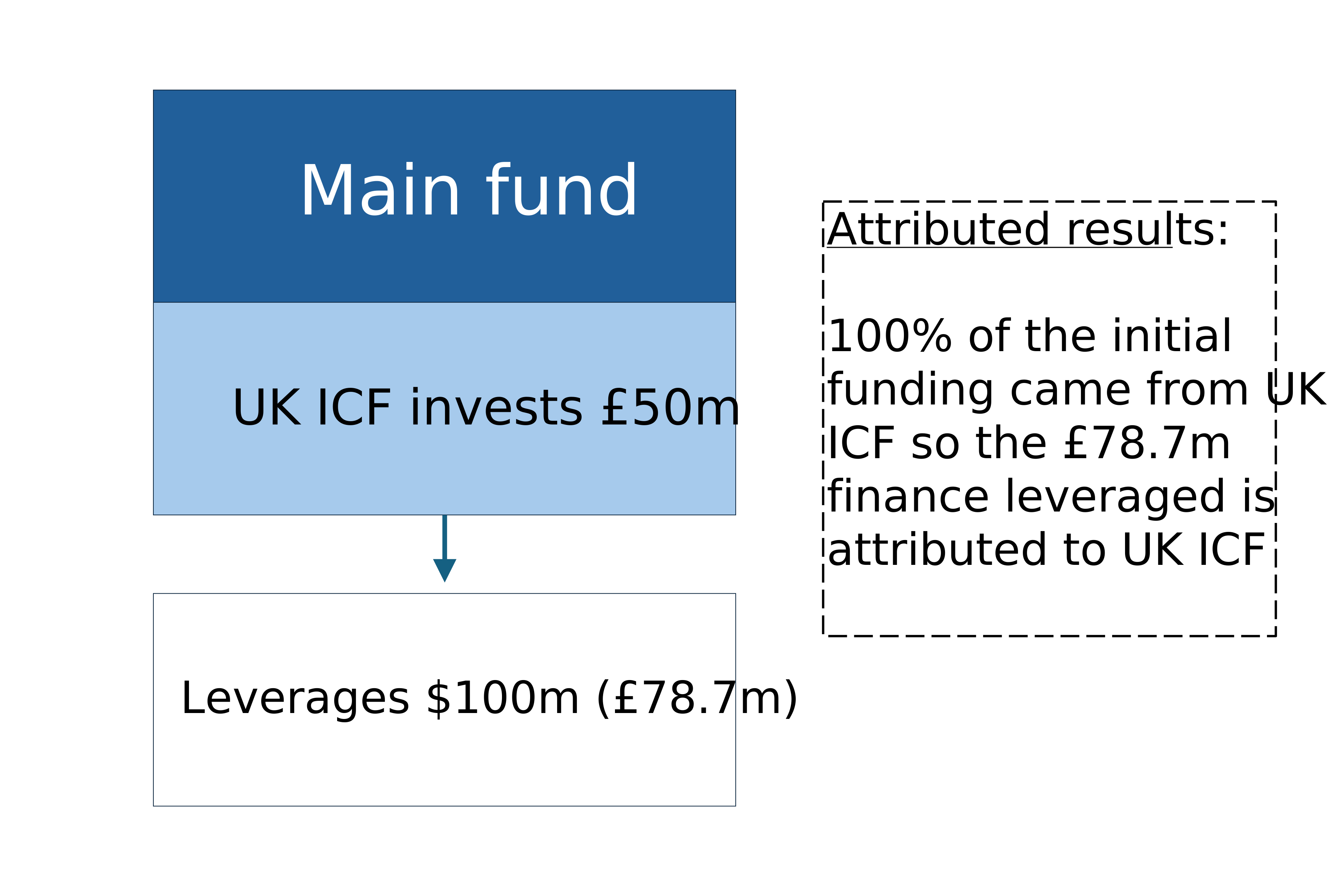
Table 3
Example of how to report additional disaggregated data using worked example 1
| Disaggregation | Information to report | Explanation for worked example 1 |
|---|---|---|
| Leveraging mechanism | Simple co-financing arrangements | No other donors contribute funds |
| Origin of finance | DAC donor: £0, Multilateral: £0, Developing country: £78.7m, Non-DAC donor: £0 = Total: £78.7m | The recipient country actors (South Asian country government) are the only sources of finance. |
| Climate Theme | Climate mitigation theme: £78.7m, Climate adaptation theme: £0, Both: £0m, = Total: £78.7m | All finance should be reported as addressing the climate change mitigation theme, as this renewable energy installation is mitigation only |
| Sector | Energy supply: £78.7m | Renewable energy is in the energy sector. |
| Number of official (public) investors in each tranche (where applicable) | Not applicable | Not applicable |
| Method of mobilisation | Direct mobilisation | ICF financial support allows the other government to invest in the project |
Worked example 2: Simple co-financing arrangements (multiple donors)
1. Identify UK ICF’s financing contribution
An ICF co-funded programme provides support for renewable electricity developments in a West African country by offering premium payments to developers per kWh produced by renewable energy installations (results-based finance). ICF provides £50 million in programme funding.
2. Identify all public and private finance contributions
Three co-investing bilateral development partners provide a combined €50 million (£42.5 million) in programme funding (all in non-returnable grant financing):
- bilateral development partner 1 invests €20 million (£17 million)
- bilateral development partner 2 invests €20 million (£17 million)
- bilateral development partner 3 invests €10 million (£8.5 million)
Renewable energy installations supported by the programme attract $500 million in project funding: - $50 million comes from domestic (West African) private sector developers, and $100 million comes from international private sector developers (an OECD country), which is a combined total of $150 million from private sources - $350 million comes from international development finance institutions, which is categorised as official (public) funding
3. Identify the ‘Business as Usual’ (BAU) baseline
Project developers report that none of the developments would have proceeded without the price incentive provided by the programme’s premium payments, and no additional financing would have been provided.
4. Determine the volume of mobilised public finance
As none of the developments or finance would have taken place without the programme, all public financing can therefore be determined to have been mobilised by the programme. Total mobilised public finance of $350 million is converted to GBP terms using the OECD DAC annual exchange rate, amounting to £276 million.
5. Attribute finance among all actors who have mobilised the additional finance
Mobilised finance is attributed to the UK Government based on ICF’s share of the initial contributions to the programme. The co-investing partners’ shares are equivalent to £44 million, with total contributions amounting to £92.5 million. ICF’s share of total initial co-funding amounts to 54% of the total, so the UK Government can attribute 54% of mobilised finance to its support, amounting to £149 million.
6. Report mobilised public finance and disaggregated data
As this funding is sourced from international development finance institutions, this funding should be reported as originating from multilateral sources and as addressing the climate change mitigation theme.
Figure 2
Example of how to attribute results under worked example 2 for simple co-financing arrangement
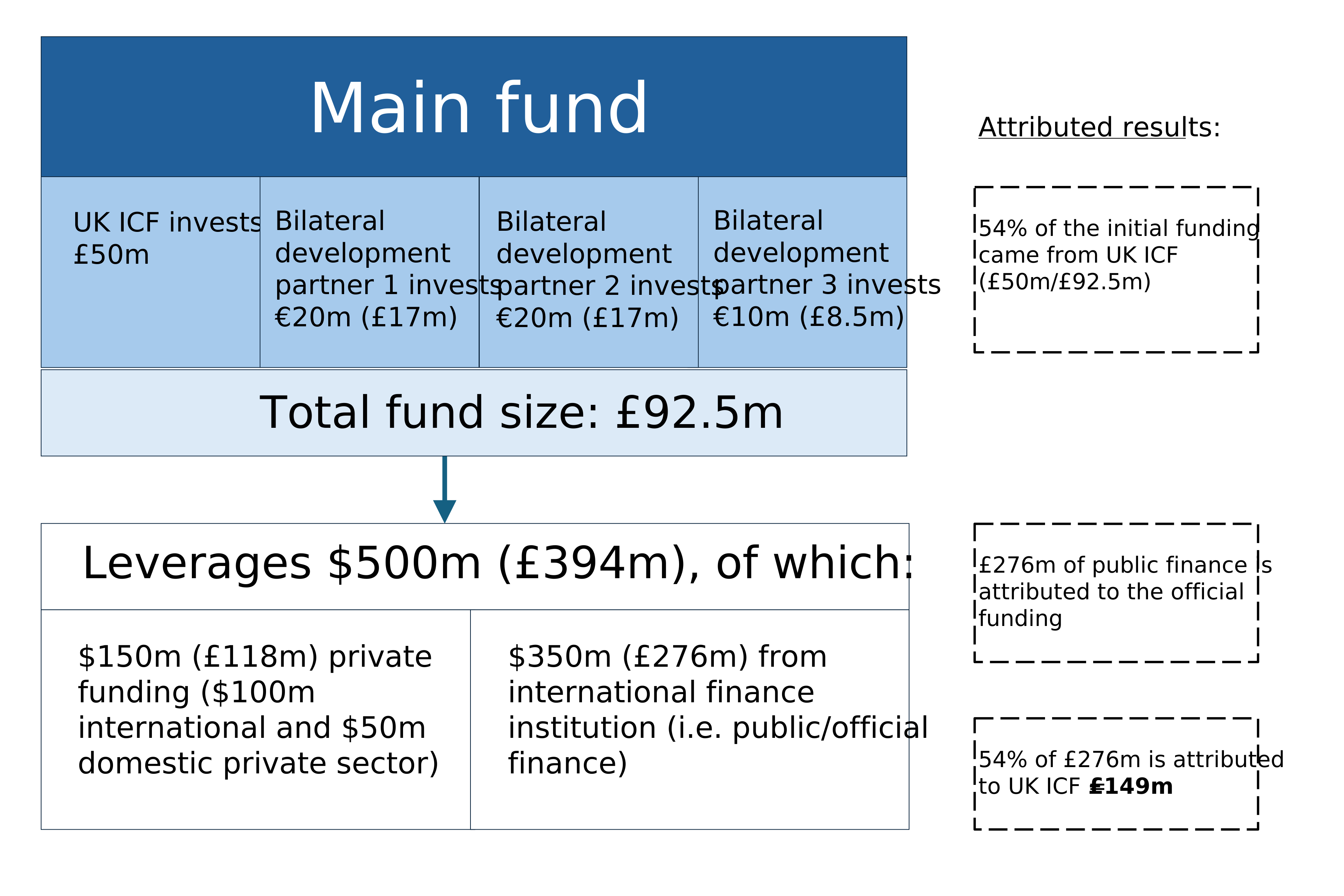
Table 4
Example of how to report additional disaggregated data using worked example 2.
| Disaggregation | Information to report | Explanation for worked example 2 |
|---|---|---|
| Leveraging mechanism | Simple co-financing arrangements | This is a results-based approach with premium payments for kWh of renewable energy produced. |
| Origin of finance | DAC donor: £0, Multilateral: £149m, Developing country: £0, Non-DAC donor: £0 | The recipient country actors are the West African country private sector developers. All the international private sector developers were from an OECD country. |
| Climate Theme | Climate mitigation theme: £149m, Climate adaptation theme: £0m | All finance should be reported as addressing the climate change mitigation theme, as this renewable energy installation is mitigation only |
| Sector | Energy Supply: £149m | Renewable energy is in the energy sector. |
| Number of official (public) investors in each tranche (where applicable) | Not applicable | Not applicable |
| Method of mobilisation | Financial incentivisation | ICF actions led to increased investment by improving financial incentives through the premium payments |
Worked example 3: Shares in Collective Investment Vehicles
1. Identify UK ICF’s financing contribution
ICF provides £10 million in the riskiest tranche of an open-ended collective investment vehicle with an African country’s government to provide loans to small to medium enterprises to adapt to long-term changes in weather patterns.
2. Identify all public and private finance contributions
A co-investing bilateral development partner also provides €10 million, and the African country’s national government provides €5 million in grant co-funding to the national fund.
As a result of the initial fund capitalisation, the fund successfully accesses further funding in the mezzanine tranche from multilateral development partners totalling
$14 million, and the African country’s national development bank provides $40 million between 2021 and 2022. The African country’s development bank is determined to be private finance as the bank operates according to commercial banking principles.
3. Identify the ‘Business as Usual’ (BAU) baseline
The programme reporting officer assesses that the fund would not have been able to access the funding raised in the mezzanine tranche (multilateral partners and African development bank) without the initial support from ICF, the bilateral partner, and the initial African country’s government capitalisation.
4. Determine the volume of mobilised public finance
Total mobilised public finance is assessed to be €14 million (the €40 million from the national development bank is not included as the bank operates according to commercial banking principles). The finance is converted to GBP terms using the OECD DAC annual exchange rate, amounting to £12.2 million.
5. Attribute finance among all actors who have mobilised the additional finance
If all partners bore the same risk, the £12.2 million in mobilised public finance would be attributed among partners based on the face value of their co-mobilising financial contributions, so the ICF would attribute to around 29%[footnote 23] of the financing to its support (based on contributing £10 million of £35 million total public funding).
However, as the ICF, bilateral development partner and African country’s government invested in the riskiest tranche and bear more risk, the programme reporting team adjusts attribution to take account of risk levels.
They attribute 50% of mobilised finance to ICF, the bilateral development partner and the African country’s government, which is then divided equally between the 3 actors (to reflect the higher risk). The remaining 50% of mobilised finance is attributed among all 4 mobilising partners based on the face value of their financial contributions.
Therefore, the UK Government can attribute £3.8 million to the ICF’s support – 33% of £6.1 million attributed to the riskiest mobilising instruments (based on the ICF being one of the 3 donors taking the most risk), and 29% of £6.1 million attributed to all mobilising actors (based on contributing £10 million of the total £35 million in initial funding).
6. Report mobilised public finance and disaggregated data
This finance should be disaggregated by source, with £3.8 million coming from multilateral development partners. As the funding is used for mitigation and adaptation projects, the finance is marked as relating to both themes in the programme reporting.
Figure 3
Relating to Worked Example 3: Shares in Collective Investment Vehicles
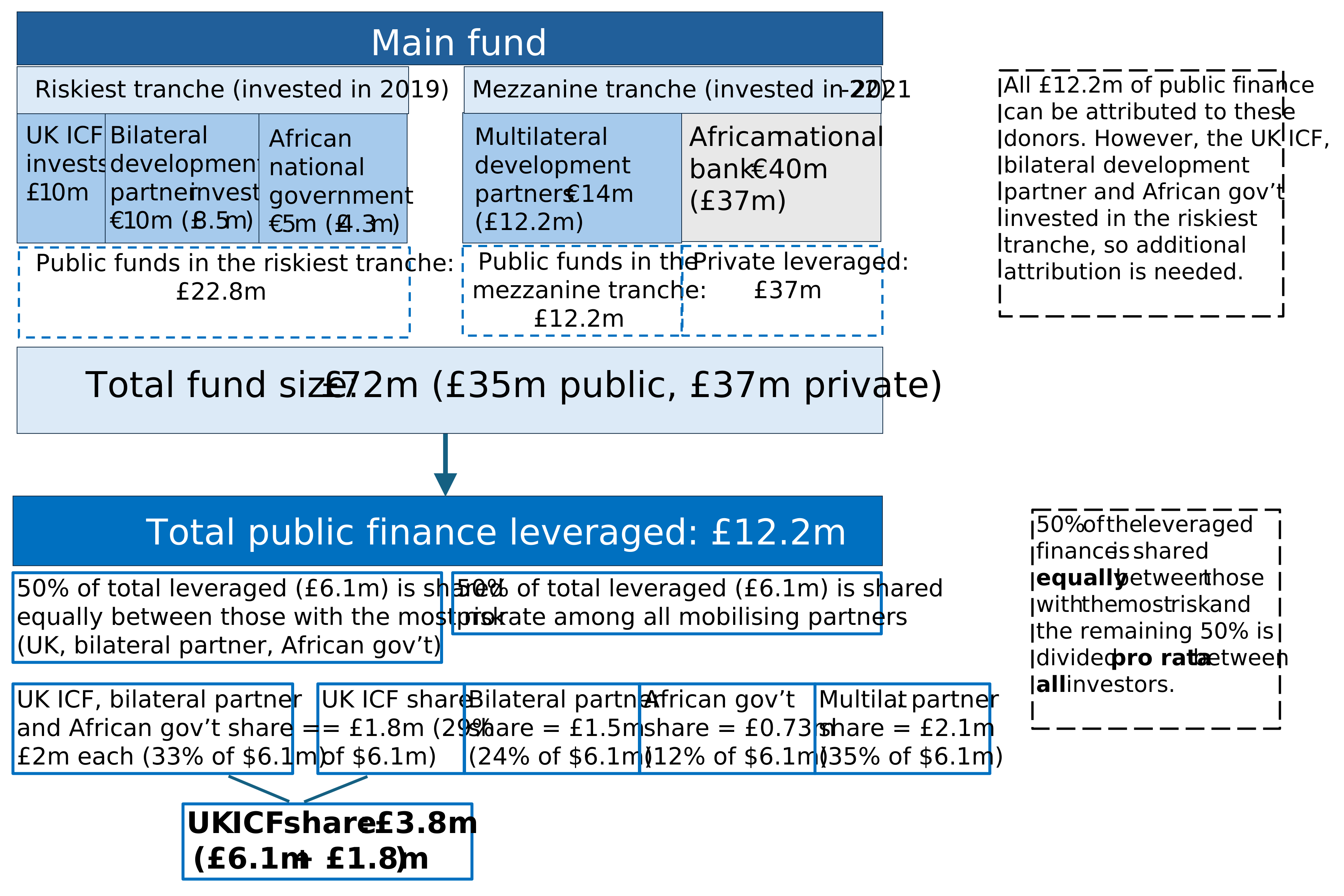
Table 5
Example of how to report additional disaggregated data using worked example 3
| Disaggregation | Information to report | Explanation for worked example 3 |
|---|---|---|
| Leveraging mechanism | Shares in collective investment vehicles | Investors pool their money and jointly invest in a portfolio of companies |
| Origin of finance | DAC donor: £0, Multilateral: £0, Developing country: £3.8m, Non-DAC donor: £0, Total: £3.8m | The source is the African national bank, which is based in the recipient country. No other private finance is leveraged. |
| Climate Theme | Climate mitigation theme: £0m, Climate adaptation theme: £3.8m, Both: £0m, Total: £3.8m | The funds are designed to improve the ability of social institutions to adapt to the effects of climate change (long term changes in weather patterns). |
| Sector | Business | The small and medium enterprises being supported to cope with climate change are in the business sector. |
| Number of official (public) investors in each tranche (where applicable) | Riskiest tranche: 3 investors, Mezzanine tranche: 1 investor | ICF, the bilateral development partner and the African country’s government invest in 2019 in the riskiest tranche. The multilateral development partner invests in 2021 in the mezzanine tranche, and the African national bank is deemed to be private finance so is not counted. |
| Method of mobilisation | Direct mobilisation | ICF investment in the riskiest tranche spurs others to invest |
Annex 3: Data disaggregation
Results should be disaggregated by:
- origin of finance
- climate theme supported by finance
- leveraging mechanism and role/position
- sector
- number of investors in each tranche (where applicable)
Origin of finance
Mobilised public finance can be provided by developed country organisations, multilateral organisations, or partner/developing country organisations. The UK Government considers it important to mobilise all sources of climate finance. However, it is important to understand the origin of mobilised finance, especially as mobilised finance from developing countries should not be included in the UK’s reporting on mobilised finance towards meeting the $100 billion global goal.
Data on mobilised public climate finance should be disaggregated according to the 4 classifications below, in line with the OECD DAC criteria for finance providers[footnote 24][footnote 25]:
| Origin of finance | Definition |
|---|---|
| DAC Donor finance | OECD DAC bilateral finance providers (based on OECD DAC membership |
| Multilateral finance | OECD DAC multilateral finance (based on ODA eligible international organisations |
| Developing country finance | ODA eligible countries (based on the OECD DAC list, which is periodically reviewed) |
| Non-DAC donor finance | Other finance providers, excluded from the definitions above |
Climate theme supported by finance
Data should also be disaggregated by the climate change theme supported by the mobilised finance:
- climate change adaptation
- climate change mitigation, or both
Leveraging mechanism and role/position
There are different mechanisms by which public finance is mobilised. The mechanism by which the ICF funding was provided, which mobilised the public finance, should be identified.
| Leveraging mechanism and role/position | Definition |
|---|---|
| Shares in Collective Investment Vehicles | Shares in collective investment vehicles (CIVs) are those invested in entities that allow investors to pool their money and jointly invest in a portfolio of companies. |
| Syndicated loans | Loans provided by a group of lenders (called a syndicate) who work together to provide funds for a single borrower. |
| Credit lines | A standing credit amount which can be drawn upon at any time, up to a specific amount and within a given period of time. Borrowers (LFIs) decide how much of the agreed funding they wish to draw down and interest is paid only on the amount which is actually borrowed and not on the amount made available. |
| Guarantees | Guarantees refer to legally binding agreements under which the guarantor agrees to pay part or the entire amount due on a loan, equity or other instrument in the event of non-payment by the obligor or loss of value in case of investment. The term guarantee refers to both guarantee and insurance scheme. |
| Direct investment in companies | Direct investment in companies refers to on-balance sheet investments in corporate entities which are conducted without any intermediary (for example, a collective investment vehicle) and which typically consist of or can combine the following instruments/mechanisms: equity, mezzanine finance and senior loans. |
| Simple co-financing arrangements | Simple co-financing arrangements refer to various business partnerships, B2B programmes, business surveys, matching programmes and similar, but also result-based approaches. |
| Project finance | Financing through special purpose companies/vehicles, including a mixture of equity, ‘junior debt’ and ‘senior debt’ |
Sector
Disaggregate all results by sector:
| Sector | Examples |
|---|---|
| Energy supply | Oil & Gas; Electricity; Power; Utilities |
| Industrial processes | Mining; Chemicals; Electronics; Material; Cement; Manufacturing |
| Business | Retail; Supply chain; Customer services; Financial; Banking & capital markets; Insurance; Investors; Leisure; Tourism; Hospitality |
| Public | Healthcare; Education; Research |
| Residential | Housing; Domestic combustion; Composting |
| Transport | Transport; Automotive; Aviation; Shipping |
| Agriculture | Agribusiness; Food & Beverages |
| Fisheries and aquaculture | Fisheries; Aquaculture |
| Waste management | Solid Waste Disposal; Waste Incineration; Wastewater Handling |
| Forestry | Forestry; Wood products |
| Land/sea-use and Land/sea-use change | Environment; Construction and spatial planning; Land-use change |
| Water | Water management; Water & sanitation |
For programmes which utilise specific instrument types the number of investors in each tranche are also required. These specific instrument types are:
- shares in Collective Investment Vehicles
- direct investment in companies
- project finance (only for ‘Reporting of the non-guaranteed and not syndicated private investment’, when it is treated like direct investment in companies)
Method of mobilisation
There are a range of ways in which ICF funding or actions can causally mobilise additional climate finance, including[footnote 26]:
| Method of Mobilisation | Definition |
|---|---|
| Direct mobilisation | Where ICF financial support spurs others to invest in projects or programmes by improving the risk-reward profile of projects or convincing other funders to invest. |
| Intermediated mobilisation | Where financial instruments supported by ICF lead to further investment by providing upstream funding for, and improving the risk-return profile of investments, such as through credit lines or fund-level instruments. |
| Financial incentivisation | Where ICF actions lead to increased investment by improving financial incentives for investment, for example by supporting subsidy schemes or tax breaks or by reducing risks by acting as a guaranteed off-taker for an investment (by committing to purchase final assets or clean energy produced by renewable energy investments). |
| Indirect mobilisation | Where capacity building support (though grants, loans or technical assistance) or other climate support (for example, for climate targets or green labelling schemes) improve the readiness of partners to invest in climate projects. |
| Catalytic action | Where non-climate support improves the enabling environment, for example by reducing general constraints to investment by other actors (more likely to support private finance mobilisation than public sector mobilisation). |
Annex 4: Definitional tests for mobilised public climate finance
Definition of public finance
Test: Is the finance provided by a public organisation?
For the purposes of tracking climate finance, financial flows and transactions can be classified as either ‘public’ or ‘private’. The distinction between public and private flows should primarily be based on whether the organisation providing the mobilised finance is a public or private actor, in line with the OECD DAC’s latest guidance on tracking finance[footnote 27], as follows:
- “official (public) transactions are those undertaken by central, state or local government agencies at their own risk and responsibility, regardless of whether these agencies have raised the funds through taxation or through borrowing from the private sector. This includes transactions by public corporations, that is, corporations over which the government secures control by owning more than half of the voting equity securities or otherwise controlling more than half of the equity holders’ voting power; or through special legislation empowering the government to determine corporate policy or to appoint directors.”
- “private transactions are those undertaken by firms and individuals…from their own private funds.”
Reporters should apply this public/private ownership-based approach to determine whether mobilised finance is public or private, and should report only on public finance under this ICF KPI. Reporters should exclude public finance mobilised from other (non-ICF) UK public bodies.
However, in some cases this public/private ownership-based approach may not accurately reflect the character of financial transactions made by organisations that are publicly owned but operate according to market-oriented commercial or private principles. For example, (majority or wholly) state-owned financial institutions may invest along commercial lines with no public-sector direction of investments. This may be especially common in countries with more centralised planning systems, such as China, Cuba, Vietnam, Bhutan or former USSR socialist states.
For example, finance mobilised from a bank that is majority owned (greater that 50% of shares) by a national government would be considered as public finance under the standard OECD DAC guidance, though it may in practice invest according to commercial principles.
In such cases, programmes may wish to report such finance as private finance rather than public finance, but should include a justification for this approach. A number of factors may help guide the classification of finance as ‘public’ or ‘private’ in cases where ownership status is ambiguous:
- does the public sector ‘control’ the investment decisions made by the organisation[footnote 28]? If not, the finance could potentially be classified as ‘private’
- does the organisation operate according to market-oriented commercial investment principles? If so, the finance could potentially be classified as ‘private’, especially if the finance sector in which the institution originates is dominated by publicly-owned institutions. This would exclude cases where these actors invest explicitly in line with national development goals
If reporters wish to diverge from the default ‘ownership’ approach, and report such mobilised finance as ‘private finance’ under ICF KPI 12, they should include a justification that the organisation is either not controlled by the public sector or acts as a non-state or market-oriented commercial entity, and note this clearly alongside reported mobilised finance numbers.
Definition of climate finance
Test: Is the finance intended for climate change adaptation or mitigation purposes?
Finance should be categorised as climate finance if the purpose of the project/programme includes support to meet bona fide climate change mitigation and/or adaptation goals. Climate financing should not be determined based on whether the source of the finance is nominally drawn from a climate change fund/window/etc.
Finance should be defined as climate change-related based on the OECD DAC Rio Markers’ definitions for climate change adaptation and mitigation. All Official Development Assistance (ODA) spend is qualitatively assessed and ‘tagged’ under these definitions for ODA reporting, and these headline definitions are internationally recognised and used by numerous development organisations and climate change financing entities in their reporting on climate finance. The OECD DAC RIO Marker definitions are as follows:
- climate change mitigation: an activity that contributes to the objective of stabilisation of greenhouse gas (GHG) concentrations in the atmosphere at a level that would prevent dangerous anthropogenic interference with the climate system by promoting efforts to reduce or limit GHG emissions or to enhance GHG sequestration
- climate change adaptation: an activity that… intends to reduce the vulnerability of human or natural systems to the impacts of climate change and climate-related risks, by maintaining or increasing adaptive capacity and resilience. This encompasses a range of activities from information and knowledge generation, to capacity development, planning and the implementation of climate change adaptation actions
For further information on the OECD DAC definition and indicative classification guidance, please see the OECD DAC’s Handbook[footnote 29] for using the Rio Markers for climate change activities[footnote 30]. Note that finance may also provide support to other goals, but must include climate action among its supported areas – and the final calculation of mobilised finance should exclude any funding for non-climate purposes.
In addition, climate finance should exclude finance for coal-related power generation, except if related to Carbon Capture and Storage/Use based on an agreement by the Technical Working Group on mobilised climate finance.
Definition of mobilised finance
Test: Has the finance been mobilised by the ICF; in other words, is it additional and causally linked to ICF funding or support?
Mobilised finance is funding from another actor that has been directed to an objective / project / programme that would otherwise not have benefitted from these funds, and is a direct result of the original mobilising actor’s efforts. Mobilising is sometimes referred to as leveraging of finance.
This definition requires that:
- Funds are additional, in that they would not otherwise have been allocated to a climate objective or activity and
- The ICF can identify a causal link between its funding or actions and the mobilised finance.
It is important to distinguish between financing that would have occurred regardless of the ICF’s involvement, and mobilised financing that is both additional and where the ICF can claim a causal link.
Mobilised finance could include:
- upfront financing, that is, resources committed to the project/programme from other donors or partner governments at the time of project approval. Note that upfront financing (for example, from other development partners) can only be claimed as mobilised if the partner funder would not have allocated this funding to the project or programme in the absence of ICF’s financing
- subsequent financing, as in resources mobilised after the project has been operating, for example where early success encourages others to contribute
Annex 5: Definitions
Additionality: Results are additional if they are beyond the results that would have occurred in the absence of the ICF-supported intervention under a ‘business as usual’ counterfactual (see definition below and supplementary guidance: additionality and attribution - GOV.UK)
Attribution: Attribution refers to allocating responsibility for results among all actors that have played a causal role in their delivery. This is commonly done based on share of financial contributions. However, there are situations where greater nuance is needed, as with ICF KPI 11 and ICF KPI 12 on public and private finance mobilised, where a broader range of factors is considered. See supplementary guidance: additionality and attribution - GOV.UK
Causality: Causality refers to the assessment that one or more development actors bear responsibility for results, because of ICF-funded interventions.
Counterfactual: The situation one might expect to have prevailed at the point in time in which a programme is providing results, under different conditions. Commonly, this is used to refer to a counterfactual case that would have been observed if the ICF-supported intervention had not taken place.
-
Climate Finance Provided and Mobilised by Developed Countries in 2013-2021, OECD ↩
-
Converged Statistical Reporting Directives for the Creditor Reporting System (CRS) and the Annual DAC Questionnaire (OECD, 2023). Also see Annex 20 Rio Markers. ↩
-
Reporting teams should not include ‘in kind’ contributions from development partners or host countries in this assessment. While these contributions can form a significant portion of the overall resource envelope for some programmes, the causal role of these resources towards mobilising finance is difficult to quantify and there is currently no internationally agreed methodology for accounting for their role in mobilisation ↩
-
International Climate Finance supplementary guidance: additionality and attribution - GOV.UK ↩ ↩2
-
Please double-check the latest reporting guidelines available from the OECD DAC for these instruments. ↩
-
OECD (2023) Converged Statistical Reporting Directives for the Creditor Reporting System (CRS) and the Annual DAC Questionnaire and Annexes. ↩
-
Handbook on measuring and reporting on Mobilised Private Finance in OECD DAC statistics and Mobilisation of private finance for development dashboard - methodology, OECD ↩
-
In line with the OECD’s approach to valuing instruments mobilising private sector climate finance set out in Assessing the alignment of finance with climate goals, OECD ↩
-
To measure fund mobilisation from individual instruments (for example, guarantees, direct investment in companies), OECD DAC guidance references various timeframes to determine additionality. Reporters may wish to refer to these time frames for additionality claims. ↩
-
Converged Statistical Reporting Directives for the Creditor Reporting System (CRS) and the Annual DAC Questionnaire OECD DAC (2023). Paragraph 90. ↩
-
Bank of England daily spot rates](https://www.bankofengland.co.uk/boeapps/database/Rates.asp?Travel=NIxAZx&into=GBP). Accessed 27th February 2024. ↩
-
An actor’s initial support could also accelerate other actors’ investments so that they happen sooner. However, it is difficult to justify that such finance is truly additional if it was ultimately intended to be spent on the supported programme/investment. ↩
-
Based on ‘Private finance for climate action: Estimating the effects of public interventions’ OECD (2017) Assessing the alignment of finance with climate goals. ↩
-
While ‘indirect mobilisation’ and ‘catalytic action’ may mobilise support in principle, methodologies for quantifying finance mobilised through these channels have not yet been internationally agreed (for example, by the OECD DAC). ↩
-
Technically, this investment/programme-based approach considers whether finance is additional to ICF’s climate priorities, rather than whether finance is additional to any climate objective. For example, an additionality assessment for ICF KPI 11 would include public climate finance that would otherwise have been used in a different climate change programme but has been diverted towards an ICF-supported programme as a result of ICF funding or other support. ↩
-
For more details on a generalised version of this approach to determine additionality, see Escalante, D., D. Abramskiehn, K. Hallmeyer & J. Brown (2018) Approaches to assess the additionality of climate investments ↩
-
The International Aid Transparency Initiative (IATI) (Accessed 27th February 2024) provides a complementary role to the OECD-DAC Creditor Reporting System . ↩
-
SeeIATI Datastore - iatistandard.org. Accessed 27th February 2024 ↩
-
Given potential difference between how the OECD DAC and ICF may classify organisations and the finance they provide as ‘private’ or ‘public’, it is possible that some finance classified as ‘private’ by the UK Government may be deemed ‘public’ by the OECD DAC. However, this primarily has implications for synergies under ICF KPI 12, rather than direct implications for reporting under ICF KPI 11. ↩
-
2021 Joint Report on Multilateral Development Banks’ Climate Finance ↩
-
Examples have been rounded to nearest whole percentage. ↩
-
ODA recipients: countries, territories, and international organisations, OECD ↩
-
Based on ‘Private finance for climate action: Estimating the effects of public interventions’ OECD (2017) ↩
-
[Converged Statistical Reporting Directives for the Creditor Reporting System (CRS) and the Annual DAC Questionnaire’, OECD DAC (2023). Paragraph 13.] (https://one.oecd.org/document/DCD/DAC/STAT(2023)9/FINAL/en/pdf) ↩
-
See discussions of control of public bodies in Estimating Mobilised Private Climate Finance, OECD. Reporters may also wish to refer to the Office for National Statistics’ ‘classification guidance’ for public or private actors within economic statistics to ensure consistency with UK statistics. ↩
-
Reporters may also wish to refer to the MDB’s examples or indicative eligible adaptation and mitigation activities for accessible summary lists of relevant activities – see Annex B and Annex C in 2015 Joint Report on Multilateral Development Banks’ Climate Finance. Reporters should defer to OECD DAC guidance in the case of any discrepancies between approaches. ↩